Showing posts with label Kamala Harris. Show all posts

Monday, November 04, 2024

Vote Joy


Tomorrow is election day. Voting isn't the only obligation of a democratic citizenry, but it is the most basic one. Voting isn't the guarantor of positive change, but it is an essential component of it.

If you haven't voted already, please make sure you get to the polls. And when you do, I encourage you to vote joy.

Wednesday, September 11, 2024

There But For the Grace of God

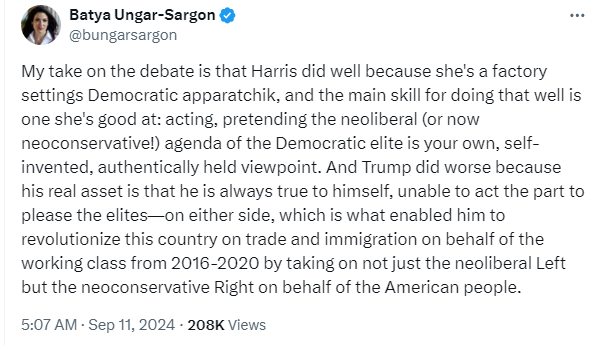
Over at the bad place, Batya Ungar-Sargon is mainlining copium to explain Donald Trump's debate performance.


Ah yes, that explains it. Donald Trump is just too pure authentic for this world. His raw untamable independent streak just couldn't be corralled to please "the elites" ("on either side"!). Harris gets "if anything, she was too prepared" version 2.0. It's amazing how hard one has to work to avoid the Occam's Razor explanation* that Trump sounded like a madman because he is one; that Trump's inability to articulate a concept of a plan for America beyond crude xenophobic nativism is because he lacks one.

Batya's descent into utter madness brain worms territory (which has been ongoing for years, including being a key player making Newsweek the house journal for the alt-right and antisemitic White supremacists and parroting the crudest Putinist propaganda about how funding of "Zelensky's War" is why Americans don't have manufacturing jobs) legitimately frightens me, because I don't know what zombie bit her and so I don't know how to ensure it doesn't bite me too. My main inference right now is "don't become opinion editor for a Jewish media outlet", because it was her experience at the Forward that seemed to drive her into the arms of madness, but I'm terrified that if exposed to the wrong trauma I too might go from being a reasonably intelligent and thoughtful commentator to a true believer in every fever swamp inanity imaginable.

I'm not really exposed to Batya these days, since she's not on BlueSky. There's a line on BlueSky that it's an echo chamber, and that's something I worry about too -- isn't it important that I be exposed to more views like Batya's, to ensure that I'm not cocooning myself in an epistemic bubble? The problem, though, is that while when I expose myself to the Batyas of the world I may pat myself on the back for being a good, virtuous epistemic citizen willing to challenge myself with views-not-my-own, in reality exposing myself to the likes of Batya feels less challenging than it is confirmatory. Reading her takes only makes me feel incredibly relieved that I don't have her takes. She is anti-persuasive. 

If the point of reading diverse views is to have that "huh, I never thought of it that way" moment, reading these people makes me go "huh, turns out that the caricatured mental model I have of brain-rotted right-wingers isn't a caricature at all." They're saying exactly what I expect them to say; there are no surprises. I'm unconvinced that confirming that instinct is actually healthier, even along the axis of remaining open-minded to divergent opinions.

* Of course, this circle also struggles mightily to understand what an "Occam's Razor" explanation is.

UPDATE: Matt Taibbi got bit as well.

UPDATE 2x: The Taibbi piece, in particular, reminded me of an exchange I had with an old high school buddy of mine who sadly has also gone off the deep end. He posted a collage of various media outlets all reporting on the travails of Twitter/X under Elon Musk -- that it had cratered in value and become a haven for bigots and extremists. He decided that the fact that similar reporting was appearing across many different media outlets could only mean one thing: a conspiracy by the legacy media to collude in order to slander Elon Musk's reputation. I sarcastically wondered if he saw a similar conspiracy in the fact that every atlas will tell you the capital of Norway is Oslo, or every science textbook will inform you that the Earth rotates around the Sun. 

He said "I bet you think you're so smart." I assured him that I never dreamed that my observation required any intelligence whatsoever.

Wednesday, August 21, 2024

The Joy of Being a Democrat


One of the things I'm enjoying most about the Harris/Walz campaign, and the current Democratic mood more broadly, is how joyful it is. A common critique of progressives has always been that we're joyless, and while that attack has never been entirely fair, it doesn't come wholly from nowhere either. There's a generalized version of the old Futurama joke ("I'm sorry, but if it's fun in any way, it's not environmentalism!") -- if you're not trudging along in grimdark misery, then you don't understand the stakes/don't care about the oppressed/aren't a true believer in the revolution. It's exhausting to live out, and it isn't a lifestyle anyone really wants to join.

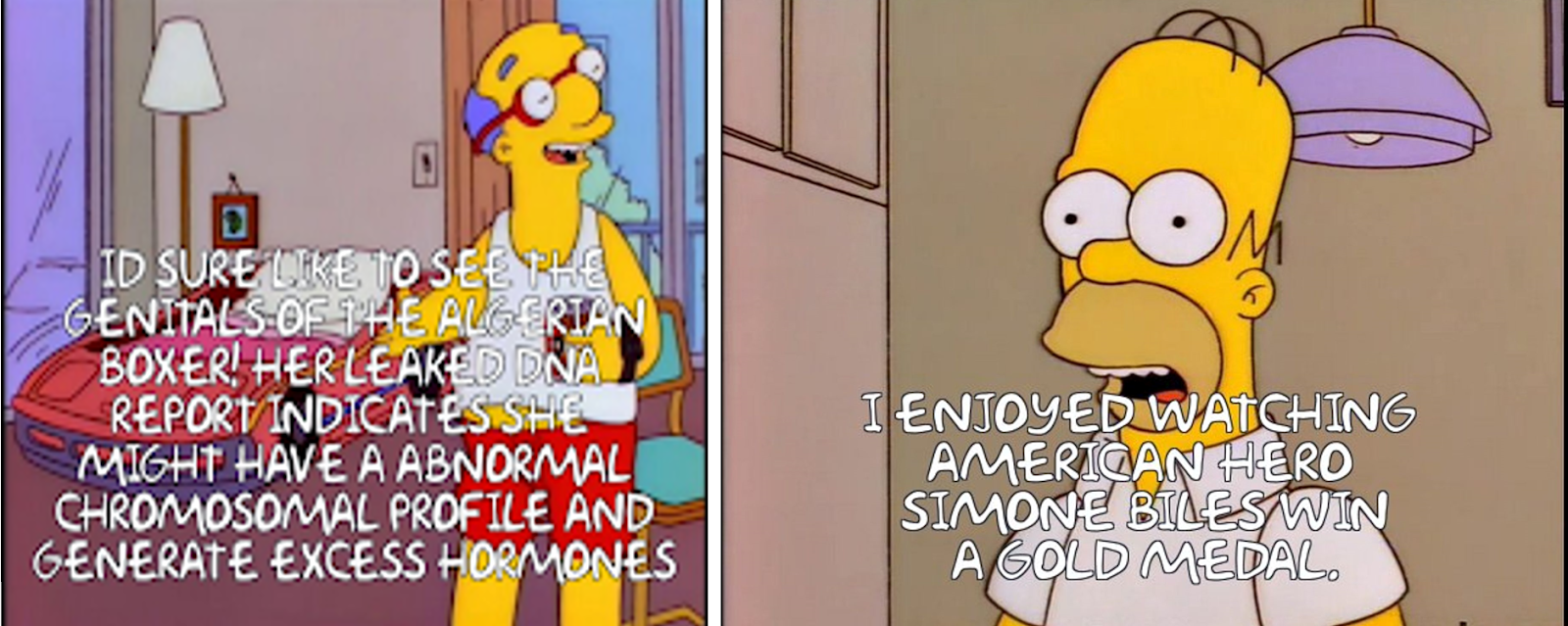
But that isn't us right now! It's the right that is wallowing in its own self-induced machine of rage and fear and misery. The Olympics were a great example -- conservatives spent their time searching for their calipers and reliving their frustration that Simone Biles didn't snap her neck in 2021; meanwhile liberals just enjoyed watching some of the greatest athletes on Earth do incredible things under the American banner. Who would you rather be? 

And this divide is present all over the 2024 race. The complete inability of conservatives to make anything stick on Tim Walz stems from their complete bafflement that a basic cishet white guy can just be happy in 2024. Doesn't he know that trans-CRT-illegal-abortionists are coming for his daughter?!? The RNC was a miserable slog of one apparatchik after another warning us that we're all going to die unless the God-king Trump is restored; the DNC was a dance party featuring your favorite tunes from middle school. Hell, one of the primary attack lines Republicans have been trying against Kamala Harris is her laugh! Democrats now are literally the party of laughing (and football, and Bud Light)!

It's really nice. And for what it's worth, I do understand the stakes, and I do understand that many people are hurting, and I do understand there's a lot of work to be done. But joy counts for something. And it feels really good to be part of a joyful Democratic coalition.

Tuesday, August 06, 2024

May I Have This Walz?


Minnesota Governor Tim Walz has been selected as Kamala Harris' running mate.

I thought all of the major names floating for VP would have been fine picks. But now that Walz has gotten the official nod, I can say that I'm really enthusiastic about him joining the ticket. 

What do I like about him? To begin, he's got the support of the base while not doesn't seeming to have any particular clique or bloc of voters with a beef against him. In terms of immediate reaction and instinctual enthusiasm, he's all upside. He's already proven himself an effective messenger against Trump and Vance, which is really a VP candidate's number one job. His presentation is a best-of-all-worlds: moderate affect, but progressive results. What's not to like?

As a member of congress representing a swing district, he had a relatively moderate voting record. But his moderation never took the form of hippie-punching for its own sake. In contrast to a Sinema or Manchin type, he wasn't randomly looking to sabotage progressive priorities just so he could grandstand about how he's constraining the left. He just wasn't interested in putting on a show of being a bold maverick bucking the party.

That approach really has come through in his tenure as Minnesota Governor, where he's delivered a long list of progressive priorities that have made Minnesota a model for other states to follow. Some people were surprised at Walz's leadership, again taking cues from his moderate reputation. But Walz's progressivism is really a lot like his moderation -- it wasn't part of some big performance about taking on The Democratic Establishment or being leftier-than-thou, it was just the honest, grinding work of making progress when you can. And it turns out that when you have that orientation, you really can accomplish a lot that makes a lot of people's lives better.

In short, Walz is a pragmatist in the best possible sense: someone who concentrates on getting things done. And I've realized that I lot of what I like about Walz is what I like about Joe Biden. Sure, there's the folksy demeanor and the "moderate" reputation, and the underlying warmth and human decency. But fundamentally, Walz seems like someone who is in politics to actually make things happen -- not to talk about them, not to ride the talk show circuit and get a big book contract, and not to impotently fulminate about how the system makes any real change impossible. And when he's put in a position to make positive change, he's taken it. Just as Joe Biden surprised a lot of people with the muscularity of his domestic agenda (coming from a "moderate"), so too did Tim Walz as Governor of Minnesota. In both cases, the surprise was a product of mistaking an affect and a pragmatic orientation for antipathy to progressivism. And in both cases, the results speak for themselves. I have absolutely zero qualms about carrying that tradition forward.

So I'm delighted to have this Walz on the Democratic ticket. To victory in November!

Thursday, July 25, 2024

Josh Shapiro Would Make a Fine VP and Probably Shouldn't Be Picked


There's a job opening for the position of Democratic Vice Presidential candidate, and a list of possibilities is beginning to emerge. The main names I've seen floated are Pennsylvania Governor Josh Shapiro, Arizona Senator Mark Kelly, Secretary of Transportation Pete Buttigieg, Kentucky Governor Andy Beshear, Michigan Governor Gretchen Whitmer, Illinois Governor, J.B. Pritzker, North Carolina Governor Roy Cooper, and Minnesota Governor Tim Walz.

As far as I'm concerned, all of these are fine choices. None of them are blue dog quasi-GOPers. None of them are DSA-adjacent fire breathers. They're all solid, mainline Democrats with a lot to offer. Anecdotally, the name that seems to get the most enthusiasm in my circles is Senator Kelly; a poll of DNC delegates gave a plurality to Shapiro (albeit lagging significantly behind "undecided").

With respect to Shapiro, the case in favor is pretty obvious. He stomped to victory in the keystone key swing state of Pennsylvania in 2022, and remains quite popular in what is still a battleground state. He's generally done a good job a governor, and his out-and-proud Jewishness not only helps dissipates bad faith GOP grandstanding about protecting the Jews, it has also provoked plenty of "show us how you really feel" antisemitism on the part of Republicans whose love for "Jews" is matched only by their hatred for (actual, real-life) Jews. Plus, he provides a model of liberal religiosity which helps challenge the monopoly right-wing conservative Christians have sought to claim over the mantle of faith. It will not surprise you that I like Shapiro a lot, and his was the first name that came to mind for me when I thought of my preferred VP choice.

Unfortunately, Shapiro also seems to be getting the most amount of pushback of any VP contender from the single-issue (anti-)Israel voter crowd, who have tagged Shapiro has having an especially problematic pro-Israel outlook.

The entire dynamic surrounding the Biden-to-Harris switch and how it relates to the burbling pro-Palestinian sentiment amongst many younger Democrats is interesting. Over the past few months we saw quite a few people loudly aver they could never bring themselves to vote for "genocide Joe" because of the way in which he and his administration have enabled Israel's assault in Gaza. The closer we got to election day, the higher stakes this game of chicken became -- will they blink or will they actually usher in Trump 2.0 -- but now that Biden is off the ballot many of these persons seem to be happy to return to the Democratic column. Now, objectively speaking, Kamala Harris is part of the Biden administration and, minor rhetorical gestures aside, has not meaningfully separated herself from Biden's Israel policy -- if you genuinely believe that the Biden administration's policy regarding Israel is monstrous and unforgivable, Harris, as the second-highest ranking official in that administration, should be tainted too. Practically speaking, though, not having Biden be the name on the ballot has offered people who had perhaps overindulged in self-righteous chest thumping and consequently talked themselves into a corner a face-saving offramp. If they were fully genuine in what they say they believe about the Biden administration's choices being "unforgivable",* they'd be equally indignant about voting for Harris. That they're not suggests there was no small measure of performance going on, but for my part, I'm happy not to look a gift horse in the mouth. Welcome back.

But while this cadre may be willing to let bygones be bygones with Harris, many of them have seemingly decided that Shapiro is going to be the stand-in for the type of pro-Israel Democrat they cannot stand. Part of me recoils at this. Shapiro's positions actually don't seem that far off-line from those of his peers (he enforced an anti-BDS law that also exists in 37 other states?!?), and the effort to try and draw distinctions from how he has spoken of, e.g., antisemitism at pro-Palestine protests compared to how other analogous Democrats have spoken about it feels very thin. To be honest, the congealing anti-Shapiro backlash smacks of a very predictable and unlovely hyperpolicing of Jews-qua-Jews on Israel, whose every jot and tittle on the matter will be pored over with exacting and unforgiving scrutiny in a manner that just isn't imposed upon non-Jews. Non-Jews can have unacceptable positions on Israel, but only Jews become unacceptable for things like "her book has an Israeli in it." Shapiro is getting heightened scrutiny here not because his positions on Israel are significantly different from those of Kelly or Beshear or Cooper, but because he's a very visibly Jewish politician and so is presumed to need greater scrutiny.

That's not good. But even though it's not good, I think that for better or for worse it does give a good reason not to pick Shapiro as Harris' VP. Under circumstances where there are many good choices for the VP candidate, the fact that one in particular runs the risk of cheesing off a substantial contingent of wavering Democratic voters is reason enough not to choose him, regardless of whether the reason he runs that risk is "fair" or not. It'd be different if we were in a situation where there was a dearth of good options, or Shapiro was somehow the obvious best choice, or if the "anti-Shapiro" cadre was declaring itself ready to fight to the death over every remotely plausible mainstream Democratic choice or trying to sabotage any potential VP who wasn't all in on BDS. But we're not in that situation. The other Democratic alternatives to Shapiro are also good. Their positions on Israel are probably not that meaningfully distinct from Shapiro's. If I'm happy with a lot of people, and some people whose votes matter are particularly unhappy with one person, there's little reason not to pick someone that makes us all happy.

Throughout this electoral cycle, people in my position have insisted to fellow progressives that the importance of winning in 2024 is too important to take one's ball and go home the instant things don't go your way. That applies here too, but what it means right now -- when no VP has been picked -- is that it'd be unreasonable for me to die on the hill of picking Josh Shapiro for VP, even if I think he'd be a good pick, and even if I think the rationale upon which people are anti-Shapiro is wrongheaded or even pernicious. I may well be right. But winning in 2024 is more important than vindicating my correctness is. If Shapiro gets picked, I'll happily rally behind him and I hope everyone else does too. But there's no shame in Kamala Harris picking someone else if she thinks they will do a better job uniting the progressive community towards the goal of winning this November.

* On that note, I'll give, if not credit, then at least points for consistency to Rep. Rashida Tlaib, who is one of the few Democrats who self-consciously declined to endorse Harris following Biden's withdrawal. Agree with it or not, her position was not a performance.

Sunday, July 21, 2024

Harris '24


To be honest, I didn't have strong feelings about whether Biden should or shouldn't drop out of the race. But his decision to step down should be seen as an incredible act of selflessness and statesmanship. Joe Biden has had an amazing array of accomplishments as President. But this step was entirely about ensuring that the fascist maniac atop the cult of personality that's become the GOP does not return to the White House in January, and he deserves great praise for that.

The media, it seems clear, is not ready for the circus to leave town. It is bombarding us with calls for an open convention or speed primary or some nonsense about picking Mitt Romney -- anything to maintain the frenzy of Democrats in chaos. But overwhelmingly, the reaction I'm seeing from most Democrats is relief: relief that we have a resolution, and relief that we're in good hands with Harris. Whereas the drumbeat to get Biden out the race, while partially media generated, did reflect at some level of genuine concern from actual Democrats of note following the debate disaster, right now it's going to be very hard to maintain a narrative of Dems in Disarray given the rapidity with which the party coalesced behind Harris. Indeed, virtually all the chatter I've seen about the need to Avoid A Coronation!!! comes from the usual pundit has-beens -- I'm seeing essentially no appetite from any Democrat of note to offer themselves up as an alternative to Harris, and she's rapidly securing endorsements from every sector of the party. Kamala Harris is going to be the nominee, Democrats seem very happy that Harris is going to be the nominee, and I'm excited to rally behind her and return her to the White House.

The next few months won't be easy. For example, we can expect the media's interest in the age of candidates to disappear as rapidly as its interest in classified document security. But Harris is a good woman, a good leader, and a good politician. We can do this. Let's get to it.

Sunday, November 28, 2021

Journalistic Defectors

One of the more dangerous players in contemporary discourse -- or at least one of the types that makes me the most nervous, anyway -- are people who are trained as journalists, who know the forms of the genre, but now are working consciously and intentionally as advocates.

Adam Kredo -- he of Kamala Harris' pot-gate -- is one example. Before joining the Washington Free Beacon, he was a relatively well-respected "neutral" journalist working for the Washington Jewish Week. Now, nobody confuses what he does for the Beacon as dispassionate journalism (except maybe Kredo, who claimed -- apparently with a straight face -- that at the Beacon he remains a straight news reporter who is "not in the opinion biz"). Nonetheless, there's little question that Kredo is more effective as a purveyor of partisan hit pieces precisely because he knows how to write an article in a way that follows journalistic conventions. Get quotes from alternative sources, ask subjects for comments (that they're damned if they do and damned if they don't is a bonus), do much of the heavy narrative lifting not by direct accusation but in terms of presuppositions and framing -- it works in a way that more direct propaganda doesn't. I suspect the "news-ier" side of Fox News (not Tucker Carlson or Sean Hannity, but the parts that present themselves as straight coverage) fits this mold too.

On the other side of the street, one can see similar characteristics at Jewish Currents. Again, many of the people writing for Currents have clear talent as journalists, and their stories track journalistic conventions. They aren't obvious agitprop. But they're great examples of how, if you know what you're doing as a journalist, you know how to push every convention to the limits of its tolerance band in a way that gets you to something pretty close to agitprop while still looking on face like a regular investigation. If every choice of framing is meant to accentuate one side's story, if every presupposition of the relevant political climate or social atmosphere reaffirms a particular point of view, if every inference or interpretation is just a little credulous to the right people and cynical to the wrong ones, the result is an article in which all the constituent elements are defensible as fair but the net result is intentionally one-sided (their piece on Ritchie Torres I think works as a decent example of what I mean).

I've sometimes said that the "evil" version of me would make a good press secretary, because I think I'd be very good at spinning effectively. This is a version of that -- if you're a journalist, you know how the narrative machine works, and knowing how it works you also know how to break the machine. And as parts of a political toolkit this is very effective; arguably even necessary, even as it is also intentionally manipulative and kind of hackish. The reason "evil" me is a Press Secretary rather than actual me is that in real life I don't have the stomach for that sort of work. Which is not the same thing as saying that either I or the people I admire are perfectly virtuous or fair-minded in how we relate to our own interlocutors. We have times our biases shine through too. But there is, I submit, a difference between unknowingly being swayed by one's personal biases, or even a temporary lapse acknowledged as a wrong, and knowingly and self-consciously trying to align one's work product with one's biases to the maximum extent possible.

In any event, I suspect the people who do this are in fact decently self-conscious about what they're doing -- they don't (contra Kredo) actually think they're not engaged in opinion; they're relatively open about their agenda. Press them, and they might say something like "all news coverage has a political agenda behind it; the difference is that we are self-conscious about it, whereas the people who think they're doing straight news are more likely to be unconsciously parroting orthodox Pablum without recognizing that's a view too." And I have some sympathy for that critique, actually. We all could stand to be more reflective on what our biases and presuppositions are. But I also think there is a difference between actually trying to understand issues on their own terms and be fair to subjects one is covering, versus just going through the motions of it because "hey, everyone has an agenda right?" Such is the curse of many liberal values (objectivity, neutrality, even-handedness, etc.): they're simultaneously impossible to achieve, and yet things are so much worse when people stop even trying to achieve them.

Demystifying the very much non-neutral "mainstream" coverage norms need not necessarily take the form of "replicating those norms, but intentionally and in service of a different political program." But in practice, it often does, and the result is I think work product that is very slick, very effective for its chosen audience, and very dangerous for the project of fair-minded discourse.

Tuesday, August 11, 2020

The Harris Pick versus White Fragility

California Senator Kamala Harris has been selected as Joe Biden's running mate.

This is, I think, the chalk pick, and one I'm quite content with. I like Harris -- she was my off-the-blocks favorite before I switched my support to Warren -- and I think she'd make a fine President in the event that Biden's health fails him. It's momentous that a Black woman is filling this role, and that shouldn't be undersold just because many predicted it in advance (as Yair Rosenberg notes, part of what makes it historic is precisely that it feels conventional). I also am excited for the prospect of the first Second Man being the first Jewish Second Man.

There is one other thing that rose to my mind that I haven't seen fully emphasized. Harris' biggest moment on the campaign trail this primary season was, of course, when she hit Joe Biden on his failure to support busing as a racial integration measure. Given that, it is I think notable that Biden picked her as his VP anyway. The standard "White Fragility" narrative* is that such a challenge, from a Black woman, to a White man, will be taken as the gravest and most unforgivable of insults -- a shattering offense from which there can be no recovery. Biden is modeling an alternative -- he did not respond to a very public, very pointed anti-racism challenge by treating the challenger as cherem. He stayed in relationship with her and elevated her as his political partner. It's not the largest thing, but it is a thing that matters.

* I know "White Fragility" is passe now among the cool kids, but for what it's worth I read it back when it was a random academic article published in an obscure journal in 2011.

Saturday, February 29, 2020

Who Will/Should Be the Democratic VP Nominee?

With Joe Biden's resounding victory in South Carolina, political observers can spend a few more days pretending like this primary field is anybody's ballgame before Super Tuesday re-confirms that Bernie Sanders will be the Democratic nominee. So in this narrow window of faux-potentiality, why not ask the question: Who will each Democratic contender nominate as their VP? And who should be their nominee?

Bernie Sanders
Who it will be: Elizabeth Warren.
Who it should be: Tammy Baldwin.

The first big point of potential conflict between Sanders and his base will come when he picks a VP nominee, as he'll be under immense pressure to select a "unifying" figure and they'll be on sharp watch for a centrist fifth column. Sanders' uneasy, at best, relationship with the Democratic establishment limits his options -- there are only so many high profile Democrats he trusts, and most of them are simply double-downs on his own electoral profile.

Elizabeth Warren will seem like an appealing option as a "unity" pick -- she's long been floated as a bridge between the establishment and the insurgents anyway, and she's by far the highest-profile party member whose at least arguably ideologically in his corner. Plus, I think Sanders knows that he needs a woman as VP. But as an outreach gesture towards the center of the party Warren (and I say this as someone who voted for her) is about as stingy as Sanders could get. And depending on how long she stays in the race his base is unlikely to forgive her perssssstance. Instead of being a unity candidate, Warren might again be caught in the middle as the worst-of-all-worlds choice.

By contrast, Wisconsin Senator Tammy Baldwin has sufficient gravitas to be a viable VP pick and has solid progressive bona fides while not being alienating to the center. Most importantly, she's kept a relatively low profile this primary campaign, so nobody on either wing of the party is conditioned to hate her. And the fact that she's from a midwestern swing state that Sanders will target hard is a not-insubstantial bonus.

Joe Biden
Who it will be: Stacey Abrams
Who it should be: Stacey Abrams

Biden announced early on that he wanted Abrams as his VP, and its easy to see why: she's a young, energetic Black woman who has unifying appeal across party constituencies and strong appeal in the areas Democrats are looking to grow in. Abrams herself has largely stayed out of the primary fray, and it's far from clear that Biden is her first choice, but I don't think she would turn him down if he was the nominee.

Mike Bloomberg
Who it will be: Kamala Harris
Who it should be: Lucy McBath

Having been hammered on his record on race, Bloomberg might think that lining up with the most prominent African-American woman in elected office right now might help assuage skittish Black voters going into the general. But Harris never really caught on with the Black community, and if your weakness is on race generally and racial injustice in law enforcement specifically, Kamala "IS A COP" Harris may do less for you than you'd think.

Rep. Lucy McBath (D-GA) would be a stronger choice. Gun control is Bloomberg's signature issue, and since there's no way for him to run away from it come November, he may as well lean into it, and McBath's personal story (her son died after being shot in an incident of gun violence) is a natural fit. McBath herself already endorsed Bloomberg, and while she's taken flak for allegedly having her endorsement "bought", if Bloomberg's the nominee frankly anyone who he chooses is going to face that accusation -- so it might as well be someone that endorsed him early.

Elizabeth Warren
Who it will be: Julián Castro
Who it should be: Julián Castro

If my Twitter feed reflected real-life, Warren would be the nominee in a landslide, but if my Twitter account reflected real life Castro would have at some point risen above 2% in the polls. In any event, Castro quickly endorsed Warren after he dropped out and they clearly have a good relationship with one another and a mutually-congenial approach to politics. Castro's youthful dynamism pairs well with Warren's wonkishness, and he also benefits from having dropped out early enough to avoid being hated by large numbers of people.

Pete Buttigieg/Amy Klobuchar

To be honest, even for purpose of this exercise I can't imagine them winning, so it's hard to imagine who they'd pick. Cory Booker could be a solid choice for either one -- Klobuchar could use someone to round off her sharper edges and Buttigieg cannot pick a White guy. Booker is a bucket of positive energy and a good team player, and while he doesn't do a ton to appease the Sanders Sib crowd, I can't think of any VP pick that either Klobuchar or (especially) Buttigieg could make that could mend that rift.

I have heard folks suggest, only half-joking, that Klobuchar and Buttigieg jointly would make a decent all-in-on-the-midwest ticket. There's no way that Klobuchar would serve under Mayor Pete, but I can imagine she might be fine with him being her subordinate. Just think of how many opportunities she'd have to throw a stapler at him!

Wednesday, December 04, 2019

What To Do With The Two Truths About Kamala Harris

Ever since Kamala Harris prematurely ended her once-promising presidential bid, I've seen a host of progressive takes making roughly the same claim about two simultaneous "truths":

  1. There are plenty of legitimate reasons not to have preferred Senator Harris as one's number one candidate; and
  2. Senator Harris was held to a higher and more unforgiving standard because of her race and sex.
And indeed, both of these things are true. Obviously, people are allowed to have policy beliefs that align with other candidates more than Senator Harris. And equally obviously, racism, misogyny, and misogynoir also factor in to how people weigh various issues and commitments in assessing the different candidates, as well as in governing how people move along the spectrum of "not my speed, but that's okay" to "she-devil COP!"

But what I haven't seen is a lot of people taking the next step, and asking what we do with these two truths.

This isn't, after all, just a Kamala Harris problem. These truths will emerge in any circumstance where we believe that unjust social prejudice is systemic and ingrained, such that it will manifest not just in fits of irrational hatred but also in "normal politics". An important implication of viewing racism and sexism as systemic is that it will still exert force -- often considerable force -- in political and policy disputes where there are perfectly valid reasons to take a variety of different positions. So the remedy can't be "don't oppose Kamala Harris" (there are legitimate reasons not to support her!), but neither can the existence of legitimate reasons to oppose Kamala Harris be taken as decisively falsifying any influence of racism and/or sexism.

Obviously, this is a question I've pondered for awhile, since it roughly corresponds to how I think the antisemitism-Israel relationship works (there are perfectly valid reasons to dislike many things Israel does, and also Israel gets held to a more exacting and unforgiving standard because of its Jewish character). And there too, the answer can neither be "never oppose Israeli policies", nor can it be "because there are legitimate bases to oppose Israeli policies, antisemitism isn't an issue." The uncomfortable truth is that antisemitism still operates even in the arena of legitimate opposition to Israeli conduct, and by the same token the fact that antisemitism still operates in that arena doesn't in itself delegitimize the validity of opposing Israeli actions.

Boiled down this way, the problem is even thornier than many have let on: under conditions of ingrained, systemic racism and sexism, there is probably no way to have a discourse about Kamala Harris that is not affected by racism and sexism. There's two trade-offs here: the one I already mentioned, where Harris opponents can't say "there's no racism or misogyny at work here, we have legitimate reasons for our views"; but also another one where Harris proponents can't say "in any case where we can say racism or misogyny is doing work, that case is per se delegitimated."

Why can't the latter claim work? Because one implication of viewing racism and misogyny as pervasive social forces is that there isn't a way to extract a "pure" discussion of her that is innocent of them. They'll always be there. Which means -- since again, the conclusion can't be "everyone is obligated to support Kamala Harris" -- we have to figure out what it means to ethically participate in a political discourse about prominent Black women in conditions where racism and misogyny simply will be present. People are not taking that problem seriously enough, because they retain a fantasy whereby via either sufficient cognizance or self-discipline we can neutralize the effects of racism and misogyny and drop them from our analysis. If that's not possible, and the racism and misogyny must always factor in even as they don't control, we're in far more discomforting terrain.

Tuesday, July 02, 2019

Harris, Warren the Big Winners from the First Debate Round

The polls are in, and the big winners from the first Democratic debate(s) are Elizabeth Warren and especially Kamala Harris (as I said -- don't listen to me).

Of course, it's still very early. But right now there's a four person race between Biden, Sanders, Warren, and Harris -- and a pretty steep drop-off after that.

For me, that means that the biggest loser from the first debate was not actually Joe Biden, but Pete Buttigieg. Buttigieg had been right up there in the front-runner conversation, and now he's on the outside looking in. Beto O'Rourke was in a similar circumstance, although he had already seemingly started to fade -- a lackluster debate performance only confirmed the trend. But that Buttigieg, who did not seem to perform particularly poorly (though hardly scintillating either), got separated out from the top-tier of candidates is much more of a problem.

While Sanders is still part of the Big Four, I'm not sure that this is good news for him either. He's already at near-maximum name recognition, and it's far from clear from whom he'll draw supporters as other candidates drop out. The most promising target is Warren -- but now it's more likely that Warren will last to the end, and maybe Sanders will start bleeding his support to her.

The other big mover people have mentioned coming out of the first debate was Julian Castro, but it mostly looks like he went from "complete non-entity" to part of that mid-tier group that's outside-looking-in (like Booker, O'Rourke, and now Buttigieg). Definitely an improvement for him, but not the surge we saw out of Harris.

As for Biden, I agree with Paul Campos that he's in the position of having a massive early lead that you know is going to get eaten away -- the only question is how fast. I don't think he's going to be able to hold it. But he's actually in a fundamentally different position and I'd say better position than Sanders, who affirmatively needs to grow and doesn't have a clear route to doing it. Biden just has to stem the bleeding for long enough that the clock runs out -- though I have to say, that isn't the most inspiring way to limp into a general election.

Thursday, June 27, 2019

I Watched a Debate! Part 2

I watched the first debate, so I kind of felt obligated to watch the second as well. Fair is fair (though I did miss the first half hour). Tonight certainly felt a little more eventful and punchy than last night -- in part because Biden was such an inviting target. It was a bit surprising to Harris take the lead on the Biden pile-on, though. I would also say there was a wider range of views expressed on stage than there were last night, where it really was a near-universal convergence on a broadly progressive vision.

Most importantly, I think there was more of a "shake-up" tonight compared to last night, where for the most part everyone just treaded water. Here we saw a candidate who had struggled to gain traction really shine (Gillibrand) and two who had been near the top really stumble (Harris and especially Biden).

Now for individual assessments:
  • Joe Biden: Not a good night for him. True, he was in a tough spot, as he clearly had a target on his back and was taking a lot of heat from other candidates. But he didn't do himself any favors, either. He was garbled, he had little narrative other than "I was next to Obama when he did a bunch of great things", and his exchange with Harris on school busing was the worst moment in the debate that didn't involve Marianne Williamson speaking. This is the sort of performance that a lot of us feared would start his inevitable unraveling. C
  • Bernie Sanders: While not exactly scintillating, I'd say this was a successful night for Sanders. Somebody drilled into him that he needed to not be overtly antagonistic to the other Democrats on stage, and he for the most part stayed disciplined on that score. The ending bit where he specifically complimented the other "good ideas on stage", before pivoting to his need for a political revolution, was the right frame. And while I don't think he really stood out, he didn't need to stand out -- he just needed to stand back and watch Biden go into free-fall. A-
  • Kamala Harris: One of my early favorites, but I have to say I was not impressed. She seemed shaky and unsure of herself, like her nerves had gotten to her. She improved as the night went on, and got lucky that Biden's truly terrible answer on busing bailed her out at one point, but overall she did not seem ready for primetime and that surprised me. C+
  • Pete Buttigieg: He's a good speaker, but not a lot else was going on. He'd clearly prepped the hell out of the question on the shooting in South Bend, and the answer wasn't bad, but he got baited into being defensive in an exchange with someone (Bennett?) that did not go in his favor. Still, on the whole, he probably held steady. B
  • Kirsten Gillibrand: She was, in my view, the breakout winner. She was smart, composed, and substantive, and had a clear narrative around protecting women and families. I liked Gillibrand before, but had kind of written her off because she wasn't getting any traction in the polls. I wonder if she might see a bump after tonight. I thought she was really strong. A+
  • Michael Bennet: Seemed like a fine, basically progressive generic White guy, which isn't good enough for a guy like him in a field like this. C+
  • Eric Swalwell: Had a bunch of smirky little lines that weren't as clever as he thought. Otherwise unremarkable. C
  • John Hickenlooper: He really seemed committed to red-baiting, and I do not think it's a winning strategy. He's, at best, third on the depth chart for the "moderate" lane behind Biden and Klobuchar, and Klobuchar in particular would wipe the floor with him (possibly literally, if he forgets to bring a salad fork). D+
  • Andrew Yang: He's at his best when talking about the freedom dividend, which makes sense since that's his signature. On any other issue he sounds like a tech bro who thinks doing well in Silicon Valley qualifies him to run the world. Do you remember when we were all aghast at Mark Zuckerberg running for President? This is the same thing, except less interesting. I do not think drawing a straight line from "enthusiasm on Reddit boards" to "Democratic debate stage" is proof that our democracy still works. C
  • Marianne Williamson: Who is this women? What is that accent? Why is her first call as President to the Prime Minister of New Zealand (to say "nuh-uh -- we're the best place to raise a child!")? It was physically uncomfortable listening to her tonight. I don't know what specific conspiracy theories she believes in, but I have no doubt she believes in some. F
At this stage in the game, I'm mostly concerned with winnowing the field down to something manageable so we can actually have a reasonable nominating contest. So here's my take on who (from both evening's debates) should drop out (or at least be cut from future debates), based on their performance and my assessment of whether there's any plausible route for them to make a serious play in the contest.
  • Drop-outs: Williamson, Swalwell, Hickenlooper, Ryan, Delaney.
  • Bubble (they should probably all drop out too, but it's early and I'm feeling nice): Yang, Bennet, Gabbard, Inslee, De Blasio.
UPDATE: Reading through others reactions, wow am I ever in the minority re: Harris (and again -- I'm a Harris fan! She was my off-the-blocks favorite! So this isn't anti-Harris hostility). And obviously it matters more what others think than what I think. Likewise, nobody else seems to have even noticed Gillibrand, let alone given her the sort of breakaway credit I did.

Yesterday I think my views aligned with the CW, today clearly they don't. But since most of my appraisals were based on my assessment of "will this appeal to people", you should take the crowd's wisdom over mine. Harris surge!

Monday, March 18, 2019

Gap Day Predictions

I'm in the aforementioned gap day between my friends' wedding (it was great!) and my honeymoon (leave tomorrow!).

But I've been wanting to lay down my current take/prediction on the 2020 Democratic primary. Because it's never too early, and if I get it right now I will be seen as a God.

In short: I think the field will winnow down to Harris versus Sanders and I think Harris wins that head-to-head.

More specifically, and including potentials as well as the already-announced:

Joe Biden: I didn't think he'd run, frankly. There are two stories to his lofty status in the polls. One is that it's pure name recognition and that, much like all his other presidential campaigns, he'll crater once the race actually gets under way. The other is that Biden is widely liked, is viewed (rightly or not) as very electable, and will lock down the hefty portion of the Democratic primary electorate which misses the Obama years. I think story one will end up beating story two.

Bernie Sanders: I actually also didn't think he'd run (I'm off to a great start). Sanders is helped by a fractured field, because I think he has the largest core of support (though like Biden some of his backing right now is a name recognition thing), but I don't know how much growth he has once other candidates drop out. Twitter I think exaggerates both how much Sanders is loved and how much he is loathed among Democrats, but other than Warren, I'm not sure which other major candidates' voters would go to Sanders once they drop out.

Elizabeth Warren: Her oxygen seems to have been sucked up by Sanders, which I think is unfortunate. I'm also surprised by how much the Cherokee DNA test thing seems to be sticking to her -- not saying it's unimportant, but we have like nine million political scandals each week and this one doesn't immediately jump out as the one that matters. If Sanders wasn't in the race I'd have her as one of the front-runners because she straddles the establishment/insurgent divide very well. But I don't see a lot of Bernie backers jumping ship to her, and that will do her in.

Kamala Harris: I think she's the strongest of the more "establishment" flavored Democratic candidates. The left is hitting her on criminal justice issues, which isn't surprising, but I think she can and will cover that flank pretty well. And other than that, she has a lot of strengths and very few weaknesses. Like Biden, she scratches the "I miss Obama" itch very well without, you know, being Joe Biden.

Amy Klobuchar: The "mean boss" thing doesn't matter as much as the fact that she seems to be trying to position herself as the "moderate" in the race. That's going to be a mistake this time around.

Cory Booker: I always liked Booker, but Harris seems to be occupying his lane of "smart, wonkish mainstream POC liberal who kind of reminds us of Obama". In a large field, I'm not sure he'll have enough space to distinguish himself fast enough to make a real go of it.

Kirsten Gillibrand: I'm honestly not sure why she's not getting any traction. And to the extent it's "because of what she did to Al Franken", I'm outright angry that anyone is holding that against her. She might fare better if/when Klobuchar drops.

Beto O'Rourke: I don't think he should be running for President. If you'd asked me yesterday I'd have said his campaign is DOA, but the $6.1 million initial haul at least raised my eyebrow.

Stacey Abrams: The real wild card. Of all the unannounced candidates this side of Joe Biden, she has the largest potential upside in terms of generating real enthusiasm--in part because she seems well-liked by both establishment and insurgent sorts. But I can also see her ultimately petering out. It's hard to see Democrats, desperate to win in 2020, nominating anyone who lost her last race--no matter how inspiring the campaign was (that goes for O'Rourke as well).

John Hickenlooper: Even more annoyed he's running than I am at Beto. He should be taking a Senate seat from Cory Gardner.

Pete Buttigieg: I'm sure he's very smart, but mayor of South Bend, Indiana (smaller than Miramar, Florida, but you don't see me covering Wayne Messam) is a pretty big leap to President. Maybe try boosting Democratic fortunes in the Hoosier State first?

Julian Castro: Another rising star who probably should've found a different office to pursue before "President". Though, like Indiana, Texas is tough territory for Democrats to win high-profile office, so maybe this is his best option. Still don't see much of a route forward for him. It's a bad sign he's getting even less attention than Buttigieg.

Jay Inslee: In a sense he doesn't count since he obviously isn't running to win, but just to draw attention to climate change. A noble goal. And since there's no Senate race he should be focusing on instead, I'm okay with it--so long as he doesn't pull any sore loser routine or distract from the ultimate nominee.

Tulsi Gabbard: "There are many great candidates running for the Democratic nomination, and also Tulsi Gabbard."

John Delaney: Will never, ever break out of "who?" status with most Americans.

Andrew Yang: I refuse to find out who this person is.

Friday, August 04, 2017

Arbitrary Candidate Disqualifications are Arbitrary

I've staked out a rather unique position in the last few contested Democratic primaries, in that -- while having a preferred candidate -- I've strongly felt that many of the front-running contenders would make fine elected officials and I'd happily support the lot of them. This, of course, puts me in a decided-minority particularly in our post-2016 world which still sees the Democratic world divided between "neoliberal Shillary" and "Bernie was a traitor". And by all accounts, as we approach 2020, we're in for the same set of shenanigans.

Hence my endorsement of Scott Lemieux's views on "arbitrary dealbreakers" when assessing potential 2020 presidential candidates. It is perfectly fine to have a preference for one candidate over another, and it's perfectly fine to fairly call out a candidate for having weaknesses. If you think that Kamala Harris' record on criminal justice issues as California Attorney General was weak, it's entirely fair game to point that out. But what you can't legitimately do is come up with a hodgepodge of supposedly dispositive "standards" which fade into and out of existence as befits your preferred love or hate of a particular politician, or which decides that only weaknesses count. If Harris' weaknesses on criminal justice matters are your "dealbreaker", then you have to give due credit to Cory Booker for being strong at the issue -- to turn around on him and say "but Wall Street!" defines ad hoc (see also: it's more outrageous that Clinton supported the 1994 crime bill than that Sanders voted for it).

I'm not sure it's intentional that the candidates most frequently subjected to get this sort impossible purity test seem to be women and minorities (Harris, Booker, Deval Patrick, are mentioned in this post, and I've also seen it applied to Kirsten Gillibrand and, of course, Hillary Clinton), but it perhaps isn't quite coincidental either. In any event, I will continue to oppose it (no doubt in vain) for the next three years. As the 2020 field develops, there will be perfectly adequate grounds to favor certain candidates and discount others. But the desire to preemptively exclude everyone (or everyone but one anointed saint) as insufficiently pure is poisonous.