Saturday, March 12, 2022

Some Things I'm Already Really Tired of Seeing "Debated" Everywhere (Israel on Russia/Ukraine Edition)

A non-exhaustive list (though I, personally, am quite exhausted):

  1. Is Israel (or Palestine) more the "Ukraine" or more the "Russia"?
  2. Who is supporting Ukraine more, Israel or Palestine?
  3. Do the incipient boycott/sanctions efforts against Russia make it hypocritical to oppose BDS against Israel?
  4. Does the justified backlash against boycott/sanction overreach targeting ordinary Russians make it hypocritical to support BDS against Israel?
  5. Does praise for Ukrainian resistance against Russia's invasion make it hypocritical to oppose (which forms of?) Palestinian resistance against the Israeli occupation?
  6. Is Israel really supporting Ukraine, or really supporting Russia, or really staying neutral to serve as an "arbiter"?
  7. Is Ukraine inspired by Israel's example or furious at Israel's faint-heartedness?
  8. Is Israel offering asylum to Ukrainian Jewish refugees salutary or colonialist?
Some of these are, in isolation, at least marginally interesting questions, but the degree to which they are constantly dominating my Twitter feed -- and admittedly, that's in no small part due to selection bias re: who is on my Twitter feed -- is absolutely draining. Marginally interesting as they may be, these are sub-sub-tertiary questions that often are treated as the critical geopolitical fulcrum around which all other Russia/Ukraine debates must revolve, and I just can't.

Anyway, since they're apparently inescapable in my neck of the internet woods, here are my very quick answers, with the caveat that I probably won't expand on any of these because -- again -- they're of sub-sub-tertiary importance and my opinions simply do not matter that much.
  1. Israel is more the "Russia" re: Palestine but historically has been more the "Ukraine" re: the rest of the Middle East; this entire stupid debate depends on the frame of reference.
  2. Don't know, and you can probably find cherry-picked evidence to support either claim.
  3. Not necessarily, but it does further weaken the "singles out" argument while also normalizing boycott-type activity as a non-extraordinary tool in the political activism toolkit.
  4. Yes, at least as far as the more over-reaching forms of boycott that target Israelis-qua-Israelis (e.g., the Moshava Philly incident), but not all forms of boycott activity are that sweeping (and are not being subjected to the backlash).
  5. Public opinion probably would be different if Ukraine's "resistance" took the form of firing rockets into Moscow, but at the very least the Ukraine example seemingly requires one to affirm that Palestinians have the right to military resistance against Israeli military targets.
  6. If I had to guess, I'd say Israel is trying to tip-toe around Russia (for reasons including but not limited to Russia's dangerous presence in Syria) and is using the "we have to preserve our ability to be a neutral arbiter" as an excuse to refrain from some more aggressive anti-Russia actions without publicly dissenting from their legitimacy. That said, the real answer is unknown, as the stories are constantly in flux on this and frankly Ukrainian public officials have more important things to do than be sure that international media outlets receive the most perfectly accurate impression about how earnest or not Israel's diplomatic efforts have been.
  7. Probably a bit of column A and a bit of column B, but again mostly they're not thinking about Israel at all and it's the height of vanity to assume otherwise.
  8. Salutary, full stop.

Tuesday, March 08, 2022

The Right To Be Wrong in Claiming Antisemitism

Is it necessarily problematic when people make "wrong" claims of antisemitism?

"Wrong", of course, is not a synonym for "intentionally false", "malicious", or "bad faith". A "wrong" claim of antisemitism is one that, we will stipulate, is sincerely believed and not facially absurd, but which following our best sincere investigation we conclude is ill-taken.

This is something I initially started thinking about in the context of folks calling Amnesty's "apartheid" report on Israel antisemitic. Many responded to those claims by objecting to the very question -- it was "chilling" or "silencing" to make that allegation, even if (as was often conceded) one could legitimately disagree with the conclusion Amnesty came to that Israel was an apartheid state. I thought about again in the context of this letter signed by several University of Toronto faculty members, condemning a university colleague for promoting the IHRA definition of antisemitism (a definition the letter-signers think is wrong and incorrectly labels as antisemitic innocuous criticism of Israel). The letter doesn't just say "here is why we think IHRA is wrong"; it suggests that the choice to adopt an understanding of antisemitism the letter-writers disagree with is facially problematic.

This struck me as an interesting formulation. In the Amnesty example, it suggests that it is not problematic for Amnesty to call Israel an apartheid state even if that conclusion turned out to be incorrect (Amnesty is "allowed" to be mistaken), but it is problematic for Amnesty's critics to call Amnesty antisemitic unless they've got the organization dead to rights (there is no tolerance for being "mistaken"). One could, after all, say to the critics of Amnesty's critics "it's fine to disagree with the contention that Amnesty is antisemitic, but don't preemptively dismiss the claim as facially illicit" -- which is, of course, the same structure urged for responding to Amnesty's claim of apartheid. We can agree or disagree that Israel is an apartheid state, we can agree or disagree that Amnesty is an antisemitic organization, but our ultimate evaluation of either question will not suffice to preemptively invalidate assertions positing contrary conclusions.

So what is it about putatively "wrong" antisemitism claims that makes it different in kind from putatively "wrong" apartheid claims? I'm not sure what could legitimately account for the difference. If, for example, the argument against "wrong" accusations of antisemitism is that the term is so explosive and earth-shattering that it must only be deployed in cases where the claimant absolutely, positively, has the goods, one could say the exact same thing about claims of "apartheid".

Next week, I'm presenting at a conference on law and antisemitism at Indiana University on the subject of "epistemic antisemitism"; a core theme of the paper is on how, by restricting "legitimate" antisemitism claims to only those which are "clearly" correct, we end up sabotaging the ability to conduct the discourse at all. In a political context, antisemitism claims are virtually always going to be contested; there will be arguments and factors that push in favor or against the label. In these circumstances, there has to be a gap -- I'd say a somewhat sizeable gap -- between circumstances where we conclude that a given claim is incorrect and circumstances where we conclude that leveling the claim is a form of abuse.

In general, political conversation cannot occur if there is no room to be wrong. Political conversation is a series of people making claims, and many of them will turn out following discussion and investigation to not hold water. If that outcome preemptively delegitimizes the initial conversational gambit, the entire project comes to a screeching halt and quick. As tempting as it is to say that people should only make claims of "antisemitism" (or "apartheid", or "racism") when they are right, there is no universe in which free discussion of such ideas can occur without some instances of the claims being wrong. A system which allows for no false positives, even at the initial claim-formation stage, is one that will endure near-infinite false negatives. 

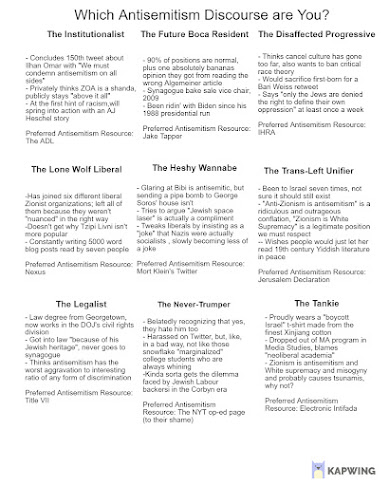
All of this, of course, was the impetus behind one of the jokes I made about the "trans-left unifier": They insist that calling anti-Zionism "antisemitism" is an outrageous conflation that suppresses discourse, while calling Zionism "White supremacy" is a legitimate position we must respect. That sort of disjuncture, where Jews are told over and over again "even if your instinct is to disagree, you have to allow the argument to be made" for every hostile appellation given to Israel, whereas if they give a non-conforming argument about antisemitism they're accused of poisoning the conversational well, is tremendously frustrating and I think theoretically unsustainable. "Antisemitism" is like any other claim -- sometimes it will be right, sometimes it will be wrong, we figure it out by considering it carefully, and the fact that some of those careful considerations will yield the conclusion of "the claim is wrong" does not, on its own, demonstrate that it was a foul to have proffered the claim in the first place.


Friday, March 04, 2022

The Crime versus the Blunder: AIPAC's Insurrectionist Endorsements

A few months ago, AIPAC announced it was breaking with its longstanding tradition to directly endorse and fundraise on behalf of political candidates. Several more liberal Jewish groups immediately pressed AIPAC to refuse to endorse any candidate who supported the January 6 insurrection by trying to prevent certification of Joe Biden as President. AIPAC demurred, and now we know why: its initial endorsement list contains dozens of GOP insurrectionists. Among the 61 endorsed Republicans (alongside 59 Democrats) are such luminaries as Jim Jordan(!!!), Nicole Malliotakis, and Tom Emmer. Shared values!

This decision is so obviously disgraceful that one could almost overlook how stupid it is too. But in the annals of "obvious 'pro-Israel' lobbying own-goals" this may well surpass anything DMFI has done, and that's saying something. What's so amazing about AIPAC's blunder here is that it's not only indefensible on the merits, but even the second-order apologias for why "even if this wasn't the wisest move they were in a difficult position" don't work either.

Most obviously: AIPAC did not need to do this. Any observer (read: this observer) could have told them that this election cycle was an especially fraught time to initiate overtly wading into partisan politics. It'd be one thing if these candidates were ones it had been supporting for years and was now being asked to explicitly withdraw support previously extended. They still should have done it -- friends don't stay friends with insurrectionists -- but at least that'd be an actual dilemma. But here AIPAC made the affirmative choice to initiate this support right now; voluntarily and consciously jumping into a political thicket. It could have avoided all of this merely by sticking with its longstanding practice of not endorsing candidates. It chose not to, knowing this was the consequence.

Other attempted excuses that try to move AIPAC out of "bone-headed" into merely "indefensible" fare no better. Let's run through a few:

"AIPAC has to maintain relationships with both parties."

First of all, if AIPAC cannot find enough Republicans to endorse without wading into insurrectionist territory, that seems like it should be a GOP problem, not an AIPAC problem. But in principle, I agree that AIPAC cannot jettison either party outright. In particular, it makes sense to put both parties' leaders -- Pelosi and McCarthy -- on the list; if that was all that was happening here, I could at least understand the logic notwithstanding McCarthy's insurrectionist ballot.

But this logic cannot explain why, say, Jim Jordan (again -- !!!!) makes the list. Jim Jordan isn't on the foreign affairs committee, he's not known as a crucial player in international relations, he's not some necessary bigwig you have to cultivate if you're going to succeed in pro-Israel lobbying. When it comes to Israel, Jordan is basically indistinguishable from the next marginal Republican who is not directly implicated in trying to overthrow the government. He brings nothing to the table other than being a frothing right-wing extremist and budding authoritarian, and so every observer who sees his name on AIPAC's list will assume that he's on there because AIPAC wants to curry favor with a frothing right-wing extremist and budding authoritarian.

If you're doing the "keep relationships with both parties" thing, put down the congressional leaders plus a dozen or so uncontroversial figures from both parties to keep up a balance. AIPAC didn't make that choice -- they deliberately put down some of the most extreme and inflammatory figures, for no clear political gain.

"AIPAC is a single issue lobby -- the only criteria for inclusion is a politician's Israel policy."

This was AIPAC spokesman Marshall Wittman's argument, and it's bull. To begin, if you're going to tie support for Israel to "shared values", then you can't say its irrelevant whether a given politician rejects the principle of democratically-elected governance. If you can't be trusted to defend democracy in America, you certainly aren't going to do it in Israel.

But moreover, particularly on the Republican side there's no Israel policy thread that distinguishes the GOP politicians who are on the endorsement list from those who aren't. I defy anyone to tell me how Elise Stefanik's Israel views differ at all from Lauren Boebert's. The reason the latter isn't on AIPAC's list has nothing to do with her not having the "right" views on Israel (from AIPAC's vantage anyway), it's because she's a loon and AIPAC doesn't want to be associated with her. But once it makes that judgment, it's entirely reasonable to hold them accountable for their cheerful association with the insurrectionist caucus. AIPAC is choosing to tie itself to GOP insurrectionists; it could have very easily chosen not to, and absolutely deserves to take all the hell in the world as a consequence of its indefensible and eminently avoidable choice.

"Sometimes, you have to support the lesser-of-two-evils, and support unideal figures to prevent someone with overtly anti-Israel from occupying these seats."

Again, the logic is fine, but the application to AIPAC's actual conduct is nonexistent. Problem #1: The vast majority of these congresspersons are not running in competitive seats. I have no idea who Jim Jordan's Democratic opponent is, much less what his or her Israel views are, but (regrettably) said opponent stands no chance of dislodging Rep. Jordan. And as for competitive races, I guess I can understand why AIPAC felt compelled to endorse Nicole Malliotakis, notwithstanding her insurrection vote, if the alternative would be known anti-Israel zealot *checks notes* Max Rose. Seriously -- that endorsement might be the biggest slap in the face of all: Rose is a pro-Israel darling, exactly the sort of Democrat AIPAC claims to want to foster, and AIPAC won't even support him (hell, won't even stay neutral) in his race against a woman who tried to overturn the 2020 election? Screw you!

The most likely place where we're liable to see a contested race where one candidate has (from AIPAC's vantage) a much worse Israel record than their competitor is in Democratic primaries where a strong pro-Israel Democrat might face a challenge from their left that AIPAC would want to fend off (the reason this doesn't apply to Republican primaries is that I doubt there is any rightwing position on Israel -- at least that which nominally drapes itself as "pro-Israel" -- that is too extreme for AIPAC to accept. But remember, they support a two-state solution!). This probably explains the Haley Stevens endorsement in her intra-party match against Andy Levin -- an endorsement which I have no facial problem with even if the rhetoric could stand to be tamped down a notch. But it's far from clear that AIPAC's endorsement is even beneficial these days in a Democratic primary, and associating AIPAC with GOP insurrectionists makes the brand even more toxic. If the top priority is keeping pro-Israel Democrats secure against flanking attacks, the main effect of AIPAC's endorsement list is to kneecap their own credibility.

What was it De Talleyrand famously said? "It's worse than a crime, it's a blunder." AIPAC's decision to endorse politicians who are barely a year removed from trying to overturn American democracy is a grave crime against political decency. But its criminality is almost exceeded by its sheer stupidity. AIPAC did not have to endorse candidates in 2022; indeed, 2022 seems like the absolute worst time for an organization that seeks to straddle partisan divides to initiate wading into direct political campaigning. And once it made that decision, it did not have to endorse GOP insurrectionists -- it very easily could have limited itself to at least less controversial figures on both sides of the aisle and stayed out of the fray. Instead, for no discernible reason, it made the conscious choice to single out some of the most overtly extreme and toxic figures in American politics and a wrap them in a big ol' bear hug. The result is already proving catastrophic for AIPAC's brand. And if AIPAC ever did care about shoring up support for Israel among Democratic politics, it's made that task far harder to accomplish as well.

Nice work, guys.

Thursday, March 03, 2022

The Best Little Antisemitism Training in Kentucky

A Kentucky state legislator went on a bizarre tirade about various Jewish connections to RU-486 (popularly known as "the abortion bill"). It really is impossible to summarize -- it features alleged connections to Zyklon B, musings about Jewish women's sexual practices, complaints about the Nobel Prize awards process ... really, just click through the link.

Anyway, the conclusion of the story informs the reader that "A spokeswoman for the state’s Senate Republicans told the [Louisville] Courier-Journal that the leadership will add training on antisemitism to the annual training senators receive."

Put aside whether any amount of training could anticipate ... this. And put aside whether we trust the Kentucky Republican Party to be even halfway competent in picking antisemitism training. My question is, even if Kentucky Republicans were being earnest here, what major counter-antisemitism training initiatives right now are primarily focused on the sort of antisemitism Kentucky Republicans are most likely to indulge in (see also: "Jew them down")? 

Regardless of your views on the nexus between antisemitism and anti-Zionism, I don't think Kentucky Republican politicos are especially likely to start endorsing BDS in an antisemitic fashion. And while I don't want to suggest, falsely, that the programs attacking contemporary antisemitism do not care about or cover more right-wing varieties, I do feel as if much of the new energy and material on the subject tends to focus on alleged left-wing iterations. The relevant curriculum and research on right-wing practices, in other words, perhaps hasn't been updated -- particularly with an eye towards moving past overt KKK style right-wing antisemitism and into the more "insidious" (to borrow a term) forms that are penetrating mainstream conservative politics.

Monday, February 28, 2022

On Non-Jews Telling Jews They're Bad Jews

A minor league baseball player, Brett Netzer, was released by the Red Sox organization after going on a bigoted tirade against a Jewish team executive, Chaim Bloom. There's plenty of awful here, but I want to flag one comment in particular: while agreeing(!) that his tweets were racist and homophobic, Netzer denied they were antisemitic because, he said, Bloom is "an embarrassment to any Torah-following Jew."

Netzer, I am pretty sure, is not Jewish. So this another example of non-Jews believing it is their place and prerogative to tell Jews what it means to be a good Jew.

This entitlement is one I am seeing increasingly often in right-wing discourse, and it is not getting nearly enough attention. It is, simply put, a monster lurking beneath the discursive waters about Jews, because it offers a way for non-Jews (typically Christians) to harmonize their abstract claims of being great friends of the Jewish people with their very concrete seething hatred for the actual Jews in America and around the world who do not behave according to their expectations. When they hate those Jews, it is not hatred of Jews; it is the opposite, it is hating those Jews for being bad Jews. In their twisted imagination, the most naked antisemitism becomes almost a form of allyship -- protecting "the Jews" from, you know, actual Jews.

Again, Netzer is not acting in isolation here. This sort of discourse is an emergent pattern, and mark my words, it is going to be a key driver of a new wave of antisemitism (thinly presented as philosemitism) that purports to love Jews even as it intentionally and expressly drives hate towards the vast majority of Jews. And this logic also of course fits in with Christian supersessionism -- the idea that Christians, ultimately, are the true inheritors of Judaism and so have the prerogative to declare what is and is not authentically Jewish. So even when it isn't overtly hateful, it's still inherently antisemitic. But increasingly, that hate and disdain for Jews is wide open.

Non-Jews have no authority to tell Jews what being a good Jew means. If Jews do not behave in manner that coheres to Christian understandings of what it means to be Jewish, that's a them problem, not an us problem. When it comes attached to such an obvious wretch as Netzer, hopefully that's obvious enough. But this is a problem that goes way beyond him, and as far as I can tell a lot of the big antisemitism watchdogs are slow to catch on.*

* I am very proud that the Nexus document on the connection between Israel and antisemitism, which I helped draft, does gesture at this practice in stating that "[d]enigrating or denying the Jewish identity of certain Jews because they are perceived as holding the “wrong” position (whether too critical or too favorable) on Israel" is a form of antisemitism. But that is very much an exception.

Saturday, February 26, 2022

What Does a Ukraine Peace Deal Look Like?

Russia's war against Ukraine has begun in full force. So far, the Ukrainian government and people have done a remarkable job in slowing Russian aggression. But Russia is much bigger than Ukraine, and every day this war goes on is another day of wholly unnecessary death and bloodshed.

There are reports that Ukraine has asked Israel to mediate peace talks with Russia (Israel being one of a very small number of countries that remains on at least halfway decent terms with both nations). Obviously, if Israel can do anything to bring this horrific war to end I hope it does so. We also, unfortunately, know that what with Israel being, you know, Israel, any hiccups in the negotiation process, or any sense that a resulting agreement is unfair or unjust (and someone will always find it unfair or unjust) will yield a quite ... predictable sort of discourse as a consequence.

Which leads me to ask: what, even roughly speaking, does a peace deal between Russia and Ukraine even look like?

This is an area I want to emphasize I am no expert in, and so I invite people who are experts to correct or supplement me. But here are some of the assumptions I'm working off of (which, again, I'm very open to correction).
  1. First and foremost: this was a complete and unprovoked pure war of aggression by Russia against Ukraine. In a just world, they should get absolutely nothing -- not Donetsk, not Crimea, not Luhansk, nothing but a barrelful of summons to an international war crimes tribunal.  Any end to the conflict which appears to reward Russia for launching this invasion will be hideously unjust. Unfortunately, the ends of wars needn't be any more just than their beginnings.
  2. While Ukraine has done an impressive job stymying Russia's advance so far, in terms of pure military material Russia retains a considerable advantage. It is highly unlikely that Ukraine can actually push Russia back on the battlefield or force Russia into a position where it has to "surrender", even though it can inflict heavy losses on Russian forces.
  3. Ukraine is in a bit of a paradox: it obviously wants the war to end as soon as possible, but it's only chance to prevail is in slowing it down -- putting Russia in a morass, making the price unacceptable for the Russian people on the home front.
  4. The war has not gone as quickly or as smoothly as Putin predicted, and that's a big problem for him. Europe is far more unified than he expected, his military is underperforming, and his normal allies are saying "nuh-uh, this is your mess". He needs something to come out of this that he can point to as a win, and undoing western sanctions that only came into play because of his own recklessness won't cut it. Launching an obviously optional war of aggression and limping back in pure defeat potentially puts his entire regime in jeopardy. In this context, it realistically puts Putin's head in jeopardy.
Basically, the core of the problem is that a viable deal almost certainly needs to give Putin something face-saving, but there's nothing obvious to give him that would not rightfully be a non-starter from the vantage of Ukraine and which wouldn't set a horrible precedent in terms of incentivizing offensive wars of aggression. Now to be clear: I, personally, have no interest in saving Putin's face or any other part of his body. He can swing for all I care. But while Ukraine can perhaps stop Russia from achieving total victory, it can't force Russia into a position of abject defeat, and so cannot compel a deal that -- however just -- Putin will never accept and can never accept without probably being ousted from power outright.

So that's my question: under these constraints, what does a peace deal look like? What proposal can be put together that maintains Ukraine's territorial integrity, deters Russia from undertaking similar actions in the future, but actually can get Russia's signature? If such a deal cannot be contemplated, it is hard to see how this war can be prevented from dragging on for the foreseeable future.

Wednesday, February 23, 2022

Russia Invades Ukraine

The war has begun. It is pure, unadulterated, irredentist imperialist aggression by a far-right authoritarian state against an American ally, and if there's the tiniest of silver linings it's that every serious commentator -- which includes people like Bernie Sanders but excludes people like Donald Trump, Tulsi Gabbard, and Tucker Carlson -- is unapologetic in recognizing it as such.

We can only hope that something convinces Russia to turn off this course of action with a minimum of bloodshed and human suffering. But acts require a united response from the liberal democracies of the world, and so far thankfully it looks like that's what we're seeing.

Friday, February 18, 2022

Who's Afraid of Jewish Priorities?

The JTA reported yesterday that the Jewish Federations of North America, the umbrella organization of local Jewish Federations, had removed several prominent issues -- such as gun control, LGBTQ rights, and voting rights -- from its list of "policy priorities". The relevant document now speaks in far vaguer generalities about "policies that ensure justice and equity" and promoting "resources to combat abuse and harassment." Many suspected the change came at the behest of conservative elements in the Jewish community annoyed that our umbrella organizations were tackling issues they view as politically controversial or contested. The document does continue to specifically list "support for Israel" as an ongoing policy priority.

For their part, JFNA officials claimed that the change was meant to permit local federations to be more "nimble" in their approach, and contended that it was "misleading" to suggest it constituted a backtracking on prior commitments to at least LGBTQ and gun control issues. Its decision to speak in terms of more "theme-based priorities" should not be seen as a denigration of the importance of specific issues like guns or gay rights (I actually have not seen, in any of the subsequent commentaries and apologies from JFNA spokespersons, an express mention of voting rights as a continued priority area).

I seem to recall a branch of Jewish public discourse that was positively furious anytime, say, "antisemitism" was left unnamed or held to be subsumed under some generic commitment to "equality". They would call that move "all lives matter-ing" the issue; perhaps we could refer to the JFNA's new approach as one of "all issues matter"? In any event, it seems quite evident that the move away from explicitly naming these issues as priorities is an attempt to decenter them, and that in turn is yet another example of mainstream Jewish organizations kowtowing to right-wing pressure even in the face of an obvious Jewish consensus.

For example, polls indicate that on the matter of guns, Jews have a perfectly robust consensus: 70% favoring a pro-gun control position versus 25% opposed. That 25% figure, incidentally, is about the same as the percentage of Jews who stake out anti-Israel positions that sharply deviate from what JFNA and like organizations would no doubt consider "support for Israel". To be clear, I don't have any objection to the JFNA representing the huge majority of Jews who do care a lot about "support for Israel" over the comparatively small minority that takes the dissident view. But the point is that the "consensus" around the two issues is identical, yet it's no accident which one the JFNA feels comfortable cutting loose. It is part of a long pattern and practice of Jewish communal organizations taking liberal Jews -- the Jewish majority! -- for granted, and thumbing us in the eye as expendable. Our issues can be thrown out, even if they carry huge majority support, based on mewling complaints from the right flank -- a privilege never accorded to liberal Jews objecting to more conservative priority areas.

The issues that JFNA decided they now want to soft-pedal for fear of upsetting delicate conservative feelings are policy arenas which are reaching a crisis point in 2022. After Colleyville and Louisville, can we really say gun violence is no longer a critical area? We're seeing a veritable torrent of state legislative action targeting queer and especially trans youth for ostracism and discrimination, a pattern that has only accelerated over the last year. And of course, on the question of voting rights, following 1/6 and the Supreme Court's laser-like determination to gut the Voting Rights Act, the basic precepts of American democracy may never have been under more direct threat in my lifetime. To deprioritize them now represents an appalling abdication of duty.

The broad point is this: when the JFNA decides to decenter and soft play issues like gun control and voting rights, they are not acting to promote "Jewish priorities". They are afraid of "Jewish priorities". They think "Jewish priorities" are too partisan, too controversial -- frankly, too liberal -- to fit within their comfort level. And so they make the decision to jettison them. That's them selling out the very people they purport to represent. It's outrageous, and they deserve every bit of blowback they've gotten over this.

I wrote a somewhat ... pointed ... email to my contacts at the Portland JFed making these points, and both urging that the local organization continue to be clear it will work in these policy arenas and communicating to the national office that it cannot keep selling out the liberal Jewish majority like this. I received a perfectly nice note back confirming that our local JCRC has and will continue to advocate in all of these areas (though demurring on calling out the national body). But it is important to keep the heat on (and I think it's notable that the JFNA clearly did feel some heat and responded somewhat defensively). These organizations have to come to understand that "Jewish consensus" is not "when the right agrees with the center".

UPDATE: The JFNA has released a new document which adds back in many of these priorities. One can still quibble with the details, and be annoyed at their initial skittishness, but it is a good thing they both felt and were responsive to community pressure on this axis.

Wednesday, February 16, 2022

The Bongani Masuku Case Comes To A Close(?)

Long (loooong) time readers of this blog may recall the case of Bongani Masuku, a former top trade union official in South Africa alleged to have engaged in hate speech against Jews in the course of condemnatory comments about Israel during the 2009 conflict with Palestine in Gaza. This has been a lengthy saga -- in 2009, the South African Human Rights Commission concluded that Masuku had engaged in hate speech; in 2017, that ruling was upheld by the Equality Court; and in 2018, that ruling was in turn reversed by an appellate court. Now, finally, in 2022, the Constitutional Court of South Africa -- the highest court -- has weighed in, unanimously concluding that one of the four challenged statements by Masuku does in fact constitute hate speech and ordering Masuku to deliver an apology (link to the opinion here).

Again, this is a complicated saga and some of the points I would make would be repetitive. But a few points are worth (re)emphasizing here:
  • Some of the most damning statements by Masuku do not seem to be in the record the courts have been reviewing -- I'm not sure why (I assume it is for some procedural reasons regarding how the challenge was brought, not that the courts are just studiously ignoring them, but I'm not sure). For example, Masuku reportedly expressly said that his comments were meant to "convey a message to the Jews of South Africa", which seems quite germane to assessing whether his comments should be seen as targeting Jews.
  • Likewise, I have no particular knowledge about South African law, and so cannot comment on whether this decision is correct or not as a faithful application of the current (or "best") reading of the relevant constitutional clauses and statutes.
  • Finally, while I oppose "hate speech" rules on principle, South Africa has elected to take a different approach on speech than does American constitutional law. Given that, there is no reason why the Jewish community of South Africa should not be able to avail itself of these protections.
The Court analyzed four (but really two) comments by Masuku to see if they qualified as hate speech. The first was a blog comment where Masuku said:
1. [A]s we struggle to liberate Palestine from the racists, fascists and Zionists who belong
to the era of their Friend Hitler! We must not apologise, every Zionist must be made
to drink the bitter medicine they are feeding our brothers and sisters in Palestine. We
must target them, expose them and do all that is needed to subject them to perpetual
suffering until they withdraw from the land of others and stop their savage attacks on
human dignity.

(In the realm of "damning comments not discussed", during this blog discussion Masuku reportedly said that he had come to conclude that "Jews are arrogant, not from being told by any Palestinian, but from what I saw myself").

The other three all came during a pro-Palestine university rally (and the court analyzes them together, hence why I think it's perhaps more sensible to view them as one statement rather than three). There Masuku said:

2. “COSATU has got members here even on this campus; we can make sure that for that side [the pro-Israel side] it will be hell.” 

3. “[T]he following things are going to apply: any South African family, I want to repeat it so that it is clear for anyone, any South African family who sends its son or daughter to be part of the Israel Defence Force must not blame us when something happens to them with immediate effect.”

4. “COSATU is with you, we will do everything to make sure that whether it’s at Wits, whether it’s at Orange Grove, anyone who does not support equality and dignity, who does not support rights of other people must face the consequences even if it means that we will do something that may necessarily cause what is regarded as harm.” 

The Court ultimately concluded that the first statement (in the blog) was hate speech, while the other three are not. The deciding factor was the Hitler reference, which, the Court concluded, would reasonably be seen as targeting the Jewish community insofar as Hitler of course is famous for targeting Jews (and not specifically "Zionist Jews"). The other statements, by contrast, however hurtful or offensive they might have been, appear to be in the context specifically of opposing "pro-Israel" persons rather than the Jewish community as such.

Overall, I think this should be viewed as a pretty sizeable victory for the Jewish community. I might suggest that the fourth statement, too, could be seen as targeting the Jewish community insofar as Orange Grove is apparently well-known as a heavily Jewish neighborhood and its inclusion therefore seems to be specifically about referencing the Jewish community as Jews (that is, just as a Hitler reference is evocative of Jews, not Zionist Jews, Orange Grove is also associated with Jews, not specifically Zionist Jews). I think the Court's assessment of the second and third statements is fair enough; there is no doubt those words represent sharp blows thrown, but they expressly relate to persons who are by some form of action taking a side and are commentary on that side. One need not like or approve of them to think they fall within the bounds of protected speech.

But on the whole, the Court seemed quite thoughtful here. It recognized that words which on face might appear neutral or nonsectarian may, given social context, historical usage, or other considerations, nonetheless evoke hateful tropes; this was very important in avoiding what I thought was some too-quick moves by the appellate court to simply intone the truism that Zionism and Judaism are not synonymous and call it day. On this point, the Court said something that may well be worth framing:

Due regard to this context and history must be observed when dealing with expressions that are allegedly anti-Semitic, because many socially acceptable words may become a proxy for anti-Semitic sentiments. Focusing on the plain text and ignoring the objectively ascertainable subtext would be ignorant, inappropriate and antithetical to what our Constitution demands.

Couldn't say it better. 

In any event -- Masuku and COSATU have been very aggressive in fighting this case (and, I'll be honest, I expected them to prevail). It will be interesting to see how the court-ordered apology plays out. But it appears that, as a legal matter, the Masuku saga has finally come to a close.

What To Draw from the San Francisco Recall

A recall election targeting three progressive members of the San Francisco school board has succeeding by a thumping margin, with the pro-recall side taking around 70% of the vote. I was following this saga semi-closely (I never lived in San Francisco, but being just across the Bay I still paid some amount of attention). And while everyone is going to have their hot takes on this, I'll provide the hottest take of all by serving mine at room temperature.

I will say that I'm going to try to avoid a normative assessment about whether the decision by the voters here was good or bad. You're going to get a lot of either (a) "Even in liberal San Francisco...." or (b) "San Francisco views itself as so liberal, but when push comes to shove...."; you don't need me to adjudicate that for you.

Anyway, when you read stories about the recall, the narrative seems to focus primarily on three things: (1) the failure of the Board to prioritize reopening schools; (2) the Board's insistence on renaming a huge swath of schools whose namesakes were deemed historically problematic; and (3) the Board instituting a "lottery" for admission to an elite public high school which had previously used a competitive, test-based admissions regime (this reportedly aroused the anger of the city's Asian-American community, which had a large presence at the school that it thought would be reduced under the lottery system).

Of course, everyone wants to tell the story in such a way that it fits their political priors. If you are fulminating about the excesses of "wokeness", then the renaming controversy is going to loom large. If you are excited about the new flexing of Asian-American political muscle, the controversy over Lowell HS admissions will be a major factor. And so on.

My lukewarm take is that one should not read too much into this because it's really the confluence of factors, taken together, which was a bit of a perfect storm. For example, there are plenty of school renamings that go off without a hitch, but here the board's buzzsaw like approach targeting dozens of schools (often on thin-to-nonexistent research) really smacked of performance over substance (and we could ask -- performance for who? Who, exactly, wanted this -- or more accurately, this much of this?). The Board just clearly got too far in front of its shoes here; it wildly overestimated the demand and the appetite for this sort of endeavor (noting that "overestimated" is not the same thing as saying there is no appetite at all).

But even that would have been probably overlooked for the most part except that it was occupying much of the Board's attention instead of the seemingly more pressing matter of figuring out how to reopen schools. I have some amount of sympathy here because "reopening the schools" is a genuinely difficult problem and it's not something the Board could have just fiated into existence with a finger snap. That said, if you seem to ignore the most pressing public education issue of the year for the sake of a comparatively lower priority and you appear manifestly incompetent at addressing the thing which you've (wrongly) decided to make agenda item #1, yeah, that's going to piss people off. That reopening the schools is hard is a compelling argument that one needs to very clearly and publicly exert all your effort on figuring out how to make it happen; the worst thing you can do is appear to shrug your shoulders at the whole endeavor and say "you know what seems like a lot more fun than trying to get kids back into the classroom? Figuring out whether Dianne Feinstein should have her name on a building!"

So for me, the lesson to be learned is not "San Francisco voters reject wokeness", but it is very much that competence matters and San Francisco voters are not going to just blindly accept anything its elected pols do just because they drape themselves in the cloak of "wokeness". It has to be about substance, not symbolism. That goes for the school renamings too -- if one thinks it's all about symbolism and "sending a message", then maybe the execution doesn't matter so much. By contrast, if one actually views this issue as one of substantive import, then one should be willing to do the hard work of doing research and consensus-building and line-drawing. Arguably, one could say than San Franciscans want actual, good, thought out "wokeness", which they do not define (contra the semi-strawman version) as just pulling out a flamethrower and torching everything in sight.

But more fundamentally, the takeaway is that the basic, often dull, but bread-and-butter policy work of making sure the schools function has to come first. That's my big conclusion (and if one wants to say this is me just promoting my political priors, I don't judge you). A lot of good politics is the dry endeavor of just competently insuring that things work. The best political leaders do that and can innovate and inspire and push the ball forward. But the fundamentals have to be in place before one can build flair on top.

Get the foundation down, and you can do great work building on top of it. But if you elect people who aren't interested in the foundational work because they're mostly excited about some high-level ideological vision -- well, that can work if the underlying structure is strong enough that the system can manage itself on autopilot. But if you enter a time of stress or strain, like we are now in COVID, you need people at the helm who are both capable and committed to doing the slow boring work of making government work.

Monday, February 14, 2022

The DSA Seizes The Tankie Moment

The original "tankie" incident, the one that gave the term its name, came when the Soviets invaded Hungary in 1956 to crush a workers' uprising. "Tankies" were those leftists who followed Moscow's line in supporting the invasion, dutifully repeating Soviet propaganda about how this was "anti-fascist" or how it was responding to "American aggression", despite the fact that under any objective metric it seemed a straightforward form of imperialist aggression by a powerful state against the very democratic and labor forces that these same leftists claimed to stand in stalwart defense of. 

Most of us, of course, were not around in 1956 and so missed the opportunity to be original tankies. But all that's old is new again, and we now literally are faced with a seemingly imminent decision by Russia to once again send in tanks to invade southeastern Europe! And the Democratic Socialists of America have responded by showing just how excited they are at the chance to fly their tankie flag high. Their statement that regurgitates every predictable horseshoe-theory trope about why Russia is really the victim here, everything bad is America's fault, and "solidarity" means telling Ukraine it deserves what it has coming to it. Way to seize the moment, DSA! Who even cares that Russia is now itself a right-wing kleptocracy? It's adverse to American interests, and that's (apparently literally) all that matters.

It's a side issue, but I think there were some Jewish progressives who had some sympathies with the DSA, at least on matters of domestic policy, and were accordingly a bit rattled by the DSA's decision to go all-in on backing BDS in its most extreme and uncompromising possible form -- not because of the "trend" it did or didn't portend, but because it caused them (the Jewish progressives) to second guess their own instincts that were averse to BDS. If the DSA is a reliable guidestone to good progressive policymaking generally, what does it say that I'm bucking them here? It is, I imagine, a relief to remember that the DSA's foreign policy approach is consistently terrible, anti-democratic, and pro-authoritarian (see also: Venezuela), and that there is absolutely no reason to feel even remotely anxious or skittish if you end up on the opposite side of the argument from them.

Friday, February 11, 2022

Happy Birthday To Me!

My birthday (actual birthday, not blog-birthday) was today! Congrats on surviving another year!*

* Not quite the given it's been in years past!

Tuesday, February 08, 2022

Joy Counts for Something

"That kiss wasn't for pleasure, it was strategic and joyless."

Both Kevin Drum and Amanda Marcotte, in slightly different ways, think progressives need to learn to have more fun. Nobody likes a coalition of sourpusses. 

Now, at one level, the charge that progressives only speak in terms of the dark and dire is unfair. For example, Drum gives as one example of "grim and joyless" progressive politics the assertion that "Nobody is 'illegal.' We should welcome hardworking folks from south of the border. Unless you're a racist, that is." But this is a politics that can and often is expressed in positive terms (it has "welcome" right in the tag!). Celebrating immigrants and embracing them as full members of the community is the stuff of many a heart-warming viral video. Certainly, progressive immigration talk has its share of downer narratives ("children in cages"), but on the whole the framing is far more upbeat on the progressive side, where it is mostly celebratory and about inclusion and growth -- certainly as compared against dark GOP mutterings/bullhornings about stolen jobs and foreign invasions and great replacements.

At another level, anyone who spends time in a largely Christian society quickly learns just how many people do love a bit of self-abnegation. A little masochism goes a long way, and clearly there is pleasure to be taken (and people take great pleasure) in forms of performative self-flagellation that are the hallmark of at least some forms of progressive political behavior. The line between pleasure and grimness isn't quite as sharp as we think it is.

That said, I think there is something to the notion that progressives are maybe not giving joy the credit that it should get -- perhaps on the theory that anyone who has the temerity to express joy is disrespecting all the terrible oppressions and mistreatments that afflict various marginalized groups in contemporary society. But this approach just doesn't resonate with people who even or perhaps especially in dark times want to see and feel opportunities for happiness.

Take the Olympics. I'm on the record as a strong Olympics booster, even as I'm fully cognizant of all of the very compelling critiques of the Games: they're corrupt, they displace people, they're a fig leaf for authoritarian oppression, and so on. All of which is, indeed, true, and I don't deny the weight of those critiques. But sometimes it seems as if the persons making those critiques act as if there is nothing of weight on the other side of the ledger -- it's this parade of terribles on one side against meaningless frivolity on the other, such that only the truly self-indulgent or bubble-headed could possibly find value in it. No. No, no, no.  The Olympics represent a rare -- perhaps singular -- example of the entire global community coming together in one place for the primary and fundamental purpose of doing something fun and joyous. That is a great thing, and there is virtually nothing else comparable to it.

Recognizing that doesn't mean that there aren't important proposals for how to reform the Olympics to mitigate or eliminate its darker sides, it doesn't even compel one to weigh that good as superseding the aforementioned evils. But there needs to be recognition that the good, is a good; that the joy the Olympics creates can and should count for something, and one is not showing oneself to be a self-absorbed dilettante if one enjoys something meant to spark joy. The inability to recognize the joyousness of the Olympics -- to solely see it through the lens of the dark and the grim and the dire -- is not healthy, and for most people it's not relatable.

Saturday, February 05, 2022

And After the Party...

Are you watching The Afterparty on AppleTV? You should if you can. A genre-bending murder mystery with a great comedic cast (how wrong can you go with folks like Ilana Glazer, Ben Schwartz, and Tiffany Hadish on the same set?), centered around the investigation of the murder of a pop star at his mansion during the after party he hosted for his high school friends following their 15 year reunion.

But I want to do something a little different: give my prediction of who the murderer is, based less on anything that's happening in the show, and more on pattern recognition for how murder mystery shows work. There aren't spoilers here per se -- unless I'm right, that is.

Anyway, my guess for the murderer is Mr. Shapiro, the science teacher.

Why?

Well, my first principle is that the murderer will not be any of the main characters. In a whodunnit type series, whose premise is alternating who among the main crew suspicion is cast upon, it's really hard to finally land on any of the main players without it feeling a little anti-climatic.

At the same time, the murderer has to be someone whose name has been mentioned and who has already been confirmed to be on scene when the murder happened. You can't just say "Surprise! There was an unknown stranger hiding in the closet the whole time!"

So ideally, you want someone who has been mentioned and confirmed to be present, but is otherwise forgettable. He isn't part of the group that comes to mind in the list of suspects, but once he is revealed as the killer you can't claim that the show is cheating.

Mr. Shapiro has, of course, been named. And though we haven't seen his face, it was confirmed that he was at the titular afterparty (having sex with someone in one of the spare bedrooms). It's been treated as a throwaway gag (he was also walked in on having sex with someone in one of the classrooms during the reunion itself), but it suffices to establish his presence at the scene of the crime such that he could be a suspect. That he hasn't been seen since -- that nobody seems to remember he was present at all such that he should be among the group of suspects the detective is interviewing -- only points further in his favor as the ultimate killer.

We don't have a motive yet, but that can be established later. Again, I'm just working off genre conventions here.

Anyway, I just wanted that prediction on paper because if it's correct I claim the right to call myself a legend. But again, it's a very good, very funny show and you all should watch it.

Tuesday, February 01, 2022

Our First Experience With Antisemitism (Except for All The Other Times)

This passage, about a Jewish couple in Tennessee whose attempt to adopt a three-year old child was rejected because they were Jewish, struck a chord with me: It strikes a chord because it is reminiscent of a phenomenon Albert Memmi explored in his Portrait of a Jew. Memmi speaks of how often Jews speak of never being truly "aware" of antisemitism until some particularly stark incident slaps them across the face. Until that moment, they will say, antisemitism was never really a "thing" in their lives. And yet, if you press them a bit, it turns out that this overt incident was not the first -- there were other incidents, perhaps many other incidents, but for whatever reason they didn't "count", and it doesn't occur to them to mention them or even think about them as antisemitic incidents. So after the initial declaration that the overt incident was "the first time", there comes the belated admission that well, I guess it wasn't the first time, not by a long shot, and what at first might have felt like a isolated, even freakish incident, really is just bringing to the foreground a lot of baggage which had been tucked away in the background.

We could all stand to wonder why this practice exists, and why it has existed for so long and over eras and locations where it seems nobody -- least of all the Jews -- should have had any trouble recognizing that antisemitism wasn't isolated or freakish (Memmi's examples were people like Herzl and Einstein).  What explains this pattern? Why is our first instinct, our deep psychology, to "forget" antisemitism has happened to us?

Saturday, January 29, 2022

Safety Through Solidarity (Or Else)

In the wake of the Colleyville synagogue hostage crisis, two things became clear about the congregation's approach to its safety and standing in the broader community. One was that the Rabbi had deep pre-existing relations with the local police and groups like the ADL, whose support and training he credited for ensuring that all the hostages emerged alive. The second was that the Rabbi had been intricately connected to interfaith and community-building initiatives, and was widely praised for his work in that domain. The former might be thought of as the "traditional" approach to Jewish security; the latter related to what is sometimes called "safety through solidarity."

In the case of Colleyville, these two approaches worked in tandem with one another, and to that extent they represent a success story (insofar as we can call anything about Colleyville a "success"). A Jewish life that is self-consciously isolated from our neighbors and their concerns, that solely concentrates on building walls and fortresses and maintaining access to state power and SWAT teams, will be something stilted and shallow. At the same time, "safety through solidarity" simply does not have anything to offer to provide "safety" as against a Colleyville style incident, at least in the short- to mid-term. Both approaches can do certain things but cannot do others. So they compliment one another. There can of course be squabbles about what issue belongs on what turf -- we can, for example, disagree on whether particular antisemitic incidents are best addressed through criminal law enforcement (even if the Colleyville case is an obvious call). But in the main, the Colleyville congregation did not choose one or the other, and its two-track approach served it well. And anyone who takes from Colleyville that the synagogue should abandon the solidaristic part of its mission, that it now should only rely on the police and the guns and the walls and the fortifications, is I think badly missing the point.

However. There is a version of "safety through solidarity" that does not accept the validity of this two-track approach. Insofar as a synagogue choices to have relationships with the local police, and groups like the ADL, it is, the argument goes, consciously choosing to forgo the solidaristic route and should be condemned for it. Few were so crass as to make that argument directly about the Colleyville synagogue while the crisis was ongoing. But as memories fade (and they seem to fade quickly), people become more brazen in acting as if the only reason a synagogue would have these connections with law enforcement is due to a self-conscious decision to imbricate themselves into a system of White supremacy. A synagogue or Jewish community that elects to do that is a synagogue that is electing out of "safety through solidarity". It is instead one that is choosing unabashed and unapologetic harm to the communities that might offer "solidarity", and so can be spurned in turn.

In this register, the mantra "safety through solidarity" is not outreach. It is a threat. It is a threat because, again, "safety through solidarity" has no reply to Colleyville-style incidents. There was no real, realistic alternative in Colleyville other than the use of police. Colleyville illustrates decisively how these sorts of partnerships and initiatives and relationships are essential to Jewish safety; they cannot simply be "dropped". Outside cases like Colleyville, the security network that has been developed by groups like the ADL in partnership, yes, with law enforcement is not easily replaced even if we can imagine myriad ways in which it could modified or supplemented. And yet the demand is not to see reform or alteration, it is to see them dropped, dropped immediately, dropped without real replacement, and if they're not dropped then the synagogue has marked itself as an enemy -- if they're left to survive on their own, well, the blood is on them and their children.

Mantra notwithstanding, this is not actual "solidarity", this is ultimatum -- and it's an ultimatum that everyone knows cannot and will not be generally accepted. Ironically enough, when presented in this form, "safety through solidarity" becomes a vehicle for fraying bonds of solidarity that might otherwise take root (imagine if all the churches and mosques with which the Colleyville synagogue had been doing laudatory interfaith work decided to pull out because the congregation was tainted by its association with the ADL). And that is a nasty threat indeed -- the impossible dilemma between staying alive and staying in community.

A genuine solidaristic approach would understand the promises and limits of the solidaristic approach, at least over the foreseeable future. Even to the extent we disagree about the extent to which police are necessary, there has to be recognition that the choice by Jewish communal institutions to have these relationships with law enforcement is not reducible to simply "endorsing White supremacy"; the basic respect that undergirds any genuine solidaristic relationship demands at least that much. After all, there is no major racial, religious, or ethnic community in the United States right now that is primarily comprised of police abolitionists; it would be folly to make ACAB a litmus test before solidarity can be extended, and for the most part it is not a litmus test demanded before solidarity is extended. It is entirely possible -- and the Colleyville congregation is by all accounts a sterling example -- to build out bonds of solidarity and community under circumstances where there is tension and disagreement, to hash those disagreements out, to find areas where the ball can be pushed forward, and to think creatively towards new solutions to seemingly intractable dilemmas. But that process cannot be circumvented by ultimatum, and those who try are not I think actually all that interested in developing genuine solidaristic relationships.

There are very, very good reasons why the Jewish community tries to build up relationships with law enforcement agencies. There are very, very good reasons why the Jewish community has organizations like the ADL. Part of building up solidaristic relationships means understanding these necessities and these relationships. Once that happens, we can think about how their contours might be modified or altered -- they are not sacrosanct. The Colleyville congregation, by all accounts, is an example of a Jewish institution that seems genuinely committed to doing this work and doing it right, proof positive that one can build out solidarity while still maintaining the requisite relationships necessary in the event of calamity. They deserve immense praise for that, a model that can be emulated. But skipping that work and beginning with the ultimatum is not solidarity. It is a threat. And Jews are not wrong to hear it as one.

Sola IHRA Scriptura

A bit player in a certain Jewish drama which I otherwise will not name was the allegation that a given person had betrayed the Jewish people by suggesting that the IHRA definition of antisemitism could be improved upon. As a Nexus guy, I of course have a vested interest in not viewing IHRA as infallible (even as I also don't endorse the view that it is some sort of censorial disaster). But as a person who can read, it is very difficult for me to see how anyone could look at IHRA and think "yup, that's it. Nothing more on antisemitism needs to be said."

Yet I have noticed on more than one occasion the adoption of a decidedly un-Jewish sola scriptura attitude towards IHRA. IHRA's text is viewed as sacred and unchallengeable. This goes beyond a negative attitude towards efforts to supplant IHRA (e.g., by the JDA); any endeavor to try to interpret or improve upon it represents a threat to the Jewish community. IHRA alone can tell us all we need to know about antisemitism.

It is an interesting thing about sola scriptura that it frequently is paradoxically unconcerned with close  and careful readings of the text. The belief that the text contains all necessarily requires a fair amount of self-deception, since no text actually can contain all; hence, those who assert IHRA uber alles inevitably have to read a fair amount into, and out of, what IHRA actually says. At that point one might wonder why they bother professing that sort of commitment to IHRA -- why not admit the project of thinking about antisemitism remains live and open to further exegesis and interpretation? And the answer is that sola scriptura isn't really about the text-qua-text, it's about the text-qua-symbol. Sola scriptura texts are those which are held out as authoritative and unchallengeable, and that is the character that interpretive freedom threatens.

IHRA is, as I've said many times before, best characterized as having received a battlefield promotion to reach its current perch as the definition of antisemitism. Basically, the Jewish community, most prominently during the Labour antisemitism crisis, needed something we could point to that could be plausibly held out as authoritative; a criteria for saying "this is antisemitism" that wasn't reliant on a case-by-case "because we say so". To be clear, the reason this was a necessity was because in the relevant combat non-Jews were extremely reluctant, to say the least, to credit Jewish assertions about what was antisemitism (hence battlefield promotion). The need in question was, in essence, to say "don't believe me, believe this authoritative definition which existed independent of the current controversy." 

Obviously, pointing to a specific definition of antisemitism wouldn't eliminate contentious debates on the subject -- IHRA obviously didn't -- but it would channel them. Instead of a free-for-all battle over each and every antisemitism claim, we could reduce the debate down to two far more manageable questions: (1) do you accept the authoritative definition, and if so (2) does the controversy in question violate that definition? In this world, those who answer "no" to question one are straightforwardly marking themselves off as adversaries to Jewish communal consensus, not on an idiosyncratic case level, but on a core framing question. So the authoritative definition has a secondary virtue -- it can demarcate between those who are reasonably positioning themselves as friends to and allies of the Jewish community, and those who are adopting a confrontational or adversarial posture to it.

In terms of why it was IHRA, specifically, that became the definition, the reason really is no more complicated than the simple fact that it existed and it was available. And, under the circumstances, I don't begrudge its service. IHRA got thrown into a fire and did the best it could. But a main virtue being "it existed" does not lend itself to ideal theoretical or practical efficacy. One simply cannot read IHRA and think it comprehensively tells us that which we need to know about antisemitism. Its "core definition" is vague to the point of meaninglessness, its definitions are fine as far as they go but omit many crucial domains of antisemitism, and its essential caveat that we must "consider the context" before rendering a judgment is important but is not adorned with much in the way of telling readers what context ought point us toward one conclusion or another. All of these beg for more thoroughness and more fleshing out.

Yet one can understand, given its origin story, why many are reluctant to concede that IHRA can be improved upon. If IHRA is open to question, then IHRA's claim to be authoritative falters, and we risk falling back into the world where antisemitism claims are judged on a free-for-all basis -- and the ensuing fear that these judgments, infected as they are by general disregard for Jewish opinions, will be systematically slanted against the Jews (the proverbial "ally" who promises he will fight the "real antisemitism", but strangely seems to have never actually encountered that rara avis).

So IHRA becomes untouchable -- not as a text, but as a symbol. This has been a prevailing theme of what I've written about IHRA (and, in a somewhat different but related fashion, the JDA): they matter far less for what they say than what they mean, and that meaning has relatively little to do with a lawyerly reading of their texts. IHRA represents the ability to cleanly and confidently divide the world into allies and adversaries of the Jews; to know who one's friends and enemies are. And IHRA likewise represents an at least imagined respite from the constant bickering over antisemitism, over having to re and re-re-litigate every single issue and small point over and over again until death take us. These are not things the text can promise, but they are things the symbolism can promise -- if, again, IHRA is taken to be unchallengeable, unimprovable, and unalterable. It is, in this sense, a very jealous God indeed.

Tuesday, January 25, 2022

An Axe-less Billions?

* Some spoilers of prior Billions seasons*

Showtime did a special early release of the Billions Season 6 premier, thus giving us our first taste of a truly Axe-less series (Damien Lewis gave a never-say-never answer regarding a possible return, but didn't sound enthused). Can the show survive without one of its two leading men?

To be honest, it's really hard to say. On the one hand: Axe was an incredibly magnetic presence. Given how much I disliked Lewis in Homeland, it was astounding how well he played this character, and absolutely sold him as a true force of nature of the sort I can't easily think of paralleled on television. Paul Giamatti is great and Maggie Siff is an absolute legend, but Axe drives the story in a way nobody else does because Axe bends the world in a way nobody else did. Several characters -- most notably Wags, but even Wendy to an extent -- are almost impossible to imagine outside of Axe's orbit.

Meanwhile, Mike Prince is no Bobby Axelrod -- hell, he's no Rebecca Cantu -- and it's one hell of a void he's tasked to fill. Certainly, no other character has come close to equaling Axe as a foil for Chuck -- not Jock, not Connerty, not Dake (Taylor may be the closest, but they weren't really a foil for Chuck -- they always made for a more interesting partner-adversary to Axe). Moreover, I didn't find the end of Axe's arc to be particularly satisfying. On a character level, I can buy him retreating to Switzerland for awhile -- even a full season -- to lick his wounds. But would he actually permanently slink away in defeat? Not a chance. Of course, Damien Lewis isn't bound to perpetual service, so the show has to do what it can with what it has -- but in-universe the play of events doesn't fully work.

On the other hand: It is fair to say that Billions was starting to spin its wheels regarding the Axe/Chuck battle (my wife and I both affectionately characterized it as "will-they-won't-they", only with a decisive resolution rather than sex). There are only so many times one can set and reset the chess pieces between them, and as evenly matched as they are, they're both too smart for one to not eventually learn how to gain a decisive edge over the other. At some point, relying on their well-established personal defects stops being a character note and starts being a failure to grow. Taking Axe off the board allows for a new and fresh direction for Chuck as much as anyone. That Prince is not Axe means that everyone's relationship with Prince -- Chuck's including -- is going to be something somewhat different than what we've seen before.

On a similar note, as much as Axe's insane personal magnetism was a delight to watch, his departure may allow for some of the ensemble cast, particularly those on the finance side of the battle line, to shine whereas previously they were inevitably overshadowed. Taylor -- perhaps the only character who even attempted to assert themselves as an equal to Axe -- is an obvious candidate to emerge, but one hopes that some smaller but beloved players like Dollar Bill and Mafee (they are coming back, right?) and Bonnie and Victor might get some more love and care. (On Chuck's side, we've been long overdue for a major Sacker arc, but that's not immediately affected one way or another by Axe's departure).

In any event, I suppose we'll soon see. Billions has been one of my absolute favorite series' on television, and my hope is it will remain in that lofty tier. But Showtime series do sometimes have a tendency to overstay their welcome, and it's easy to imagine an Axe-less Billions being too-pale an imitation of its former glory.

Friday, January 21, 2022

Bay Area District Doesn't Adopt California's Model Ethnic Studies Curriculum

The controversy over Ethnic Studies in California continues apace, as the Castro Valley school district (in the East Bay) voted to sign a contract with the "Liberated" ethnic studies group of educators who had been responsible for the discredited initial draft of the California Ethnic Studies Model Curriculum. When California substantially changed their draft and adopted the much-improved final draft of the curriculum, the "Liberated" contingent disavowed the project and set out on their own to independently promote their initial vision.

First things first: this is a bad decision, and the Jewish community (which spoke out against it) has the right to be upset. From one Board member's Britta Perry-like "I lived in New York!" exclamation for why he'd never vote for anything antisemitic, to the blithe dismissal of the inclusion of Jews in the framework because Ethnic Studies is "not about religion. It’s about the American experiences of those who are marginalized and displaced" (golly, what could Jews know about being marginalized and displaced?) this was not a shining moment for the Castro Valley school board. There is little question that the school district's decision is going to result in a curriculum that is hostile to the Bay Area Jewish community in a way that was obviously and easily avoidable.

What happened here? Some people, inexplicably,* are suggesting that Castro Valley's decision discredits the Jewish community's decision to rally in favor of the California model curriculum -- again, the curriculum Castro Valley just rejected and which the educators they hired have actively disavowed. There is something profoundly strange about having heard endless wailing from groups like ACES about how the model curriculum was barely an improvement over the "liberated" curriculum, how they were two peas in a pod, how they were basically different branches of the same tree -- and then those same groups expressing horror when a district adopts the "liberated" curriculum. I get why I'm upset, but why are they mad? I'd been arguing that there was a huge difference between the two approaches; they'd been saying they were essentially identical. Now they suddenly can understand the difference that we've been harping on for months? Welcome to the party!

In terms of what happened, well, that's actually pretty simple to answer. We already knew that the California ethnic studies bill did not alter the status quo where local school districts could choose their own curriculum, and that's what Castro Valley just did. The only failproof check against that would've been to make the model curriculum mandatory, but of course team "the model curriculum is a disaster" would never have supported that. The California Jewish Legislative Caucus claims that its amendments to the Ethnic Studies bill put up guardrails preventing groups like Liberated from implanting anti-Jewish measures into even local curriculum; we'll see if they hold up (I'll be honest in saying I don't think these guardrails are that robust).

In a circumstance where local school boards are empowered to make largely independent choices about their curricular offerings, there is always the possibility -- and arguably the inevitability -- that some will make distasteful or even bad and hurtful choices. If that risk cannot be dissipated entirely, it can be mitigated via presenting a credible "off the rack" curriculum that becomes the cheapest, path-of-least-resistance option for local boards. That doesn't mean all will adopt it -- but they're far more likely to adopt it if they know it has widespread communal support and backing. The months we spent in-fighting based on ticky-tack objections to the model curriculum didn't make the curriculum any better and didn't make it harder for local boards to make autonomous decisions -- all it did was make the model curriculum less viable as an expression of mainstream consensus support, and accordingly make alternatives comparatively more attractive.

It'd be too strong to blame the model curriculum critics for the decision by the Castro Valley board. They might have voted this way no matter what happened, and in any event they're responsible for their own choices. But there's little question that the model curriculum critics made it more likely that local boards will not adopt the model curriculum, and it cannot surprise us when groups like the "Liberated" curriculum swoop in to fill the ensuing void.

* Obviously it's entirely explicable, it'd just be rude to state the explanation out loud.

Monday, January 17, 2022

In Honor of MLK Day, Read MLK

One of the recurrent themes of the "anti-CRT" push by conservative politicians and activists is that they are merely upholding the legacy of Martin Luther King. Liberals counter by pointing out that Republicans seem to think MLK's entire legacy consists of one line from one speech, and that Republicans only like him because he's conveniently dead. But no no!, they say, MLK is the beacon of what racial relations in America should be! He is the antithesis of CRT!

So here is my suggestion for compromise: in every state which is currently enacting a "CRT" ban, school boards should develop a course that is simply and entirely devoted to reading the collected works of MLK. They can read statements like this:

“Whites, it must frankly be said, are not putting in a similar mass effort to reeducate themselves out of their racial ignorance. It is an aspect of their sense of superiority that the white people of America believe they have so little to learn.”

And this:

Whenever the issue of compensatory treatment for the Negro is raised, some of our friends recoil in horror. The Negro should be granted equality, they agree; but he should ask nothing more. On the surface, this appears reasonable, but it is not realistic. A society that has done something special against the Negro for hundreds of years must now do something special for the Negro.

And this:

First, I must confess that over the last few years I have been gravely disappointed with the white moderate. I have almost reached the regrettable conclusion that the Negro's great stumbling block in the stride toward freedom is not the White Citizen's Council-er or the Ku Klux Klanner, but the white moderate who is more devoted to "order" than to justice; who prefers a negative peace which is the absence of tension to a positive peace which is the presence of justice; who constantly says "I agree with you in the goal you seek, but I can't agree with your methods of direct action;" who paternalistically feels he can set the timetable for another man's freedom; who lives by the myth of time and who constantly advises the Negro to wait until a "more convenient season." 

And these:

The evils of capitalism are as real as the evils of militarism and racism. The problems of racial injustice and economic injustice cannot be solved without a radical redistribution of political and economic power.

[...]

“Again we have deluded ourselves into believing the myth that capitalism grew and prospered out of the Protestant ethic of hard work and sacrifices. Capitalism was built on the exploitation of black slaves and continues to thrive on the exploitation of the poor, both black and white, both here and abroad.”

There are many more besides. It is a rich corpus of work, after all, more than sufficient to support a semester's worth of study. Reading them all together, from the "I Have a Dream" speech to the "Letter from a Birmingham Jail" to the "Three Evils" speech could spark such interesting discussions and give a more thorough foundation to the ideas and ideology of a man whom -- liberals and conservatives agree -- is one of America's great heroes.

You want to ban "divisive concepts"? I dare Republicans to try and ban the "Collected Works of MLK" class as "divisive".

UPDATE: Nikole Hannah-Jones basically just did this in speech form.