Showing posts with label Human Rights. Show all posts

Saturday, October 18, 2025

"Pro-Palestine" is a "They", Not An "It"


There is no doubt that one major development in American politics over Israel/Palestine over the last two years has been a dramatic expansion and mainstreaming of pro-Palestine political advocacy. It's no longer a given that all or nearly all politicians will ritualistically intone "I am pro-Israel." It's no longer the case that self-identified "pro-Palestine" actors are confined to a tiny fringe leafleting outside UC-Berkeley.

One upshot of this growth is pluralism. As a movement gets larger, it encompasses a wider range of perspectives. Social movements, I've long argued, "moderate as they mainstream", and this moderation effect often frustrates the original "hardcore" of the movement, who may view the newcomers as engaging in coopting or even selling out. The moderates, for their part, may well view the old guard as hidebound, extremists, or simply unrealistic. It's a common pattern, and it's pretty clear it's being replicated here as well.

That said, there are a lot of people with strong incentives to downplay this pluralism and instead treat pro-Palestine as a monolithic thing.

Consider the reports that, in the wake of the ceasefire agreement in Gaza, Hamas has launched a bloody crackdown on dissidents and rivals, including public executions of those they are accusing of being "collaborators". Given that this by all appearances is an extra-legal terror campaign against Palestinian civilians, one would expect it to be condemned, and one need not search far to find various pro-Israel voices running lines to the effect of "now that Israel isn't involved, 'pro-Palestine' groups are silent -- or even support it!" On the latter point, they're not making things up: the National Students for Justice in Palestine organization, following these reports of Hamas' killings, called for "death to collaborators" in apparent endorsement. As awful as it is to see, it appears there are prominent, non-fringe elements of the pro-Palestinian movement who more or less support Hamas engaging in violent terror not just against Israel (we knew that) but against Palestinians as well.

Yet, on another level, the pro-Israel voices I mentioned above are making something up, because the NSJP is by no means the only "pro-Palestine" organization out there, and in fact it is not at all difficult to find pro-Palestinian voices who are horrified by Hamas' rampage of terror. The Palestinian Authority lambasted Hamas' killings as "heinous crimes"; a Palestinian human rights NGO similarly accused Hamas of "extrajudicial executions" which "constitute a legal and moral crime that requires immediate condemnation and accountability."

In the abstract, there isn't anything especially odd or complicated here. "Pro-Palestine" is a "they", not an "it"; it contains a wide range of different groups and outlooks. Under that broad umbrella, why would it be hard to grasp that there might be some people who flatly support Hamas and others who find them risible?

But it's also not hard to see why many players in this drama are so enthusiastic on sweeping that pluralism under the rug. The pro-Israel commentators want the NSJP's pro-murder posts to be the paradigm example of what the pro-Palestinian movement stands for. "This is what this movement really is." In doing so, they can discredit all of the other members -- including those who are rightfully horrified by Hamas' brutality -- by association. And on the other side, obviously groups like NSJP have an incentive to present themselves as the sole and authentic representation of what "pro-Palestine" means. They want the broad, inchoate energy behind "pro-Palestine" to be channeled through them. Groups which take a softer or moderate tone are not allies, they are threats. And with strength in numbers and in unity, there is a lot of tacit pressure to defer to the leadership of established organizations and not disturb their decrees regarding what views "count" as pro-Palestine and what do not -- even if those decrees are often based more on internal political considerations than any healthy respect for pluralism and disagreement.

Yet incentives aside, we would all do better not to indulge in this game. One theme I've been returning to over the past several months is that many pro-Palestinian activists are speedrunning a realization many pro-Israel activists have also had to start grappling with: the reality that many -- not all or even potentially most, but many -- of the people who march under your flag really are exactly as extreme and nasty and blood-thirsty as your worst enemies describe them as. We like to think of these attacks as smears, and often they are insofar as they present sweeping and general guilt across the whole movement. But on the pro-Israel side, it actually is the case that there are many non-negligible figures whose outlook towards Palestinians is one of simple, naked racism; who do not remotely "just want peace"; who absolutely openly endorse human rights violations of the most vicious kind in the name of "security" or "greater Israel". And likewise, on the pro-Palestine side, it actually is the case that there are many non-negligible figures whose outlooks towards Israelis and Jews is one of simple, naked antisemitism; who do not remotely "just want peace"; who absolutely endorse human rights violations of the most vicious kind in the name of "decolonization" or "freeing Palestine." I and many other Jews who identified with Israel had to work through that reality, and so too must the pro-Palestine community work through the reality that it is not a slur or a slander or a bad-faith attack: groups like the NSJP really are right now endorsing Hamas' murder spree targeting Palestinian civilians.

However, this realization is not an accuse to swing all the way in the other direction. Those who endorse Hamas' murder spree are not an inauthentic, fringe, or fake part of "pro-Palestine", but neither are they the authentic, true, or sole representative of it either. The notion that every person who sat at a pro-Palestine campus encampment is now elated to see Hamas executing Palestinians in the streets is simply not credible. Pro-Palestine is a they, not an it. It is irresponsible to deny the presence of this particular faction; it is equally irresponsible to cede it the status of being the only relevant faction.

Monday, January 22, 2024

The Point of Hamas' "Narrative"


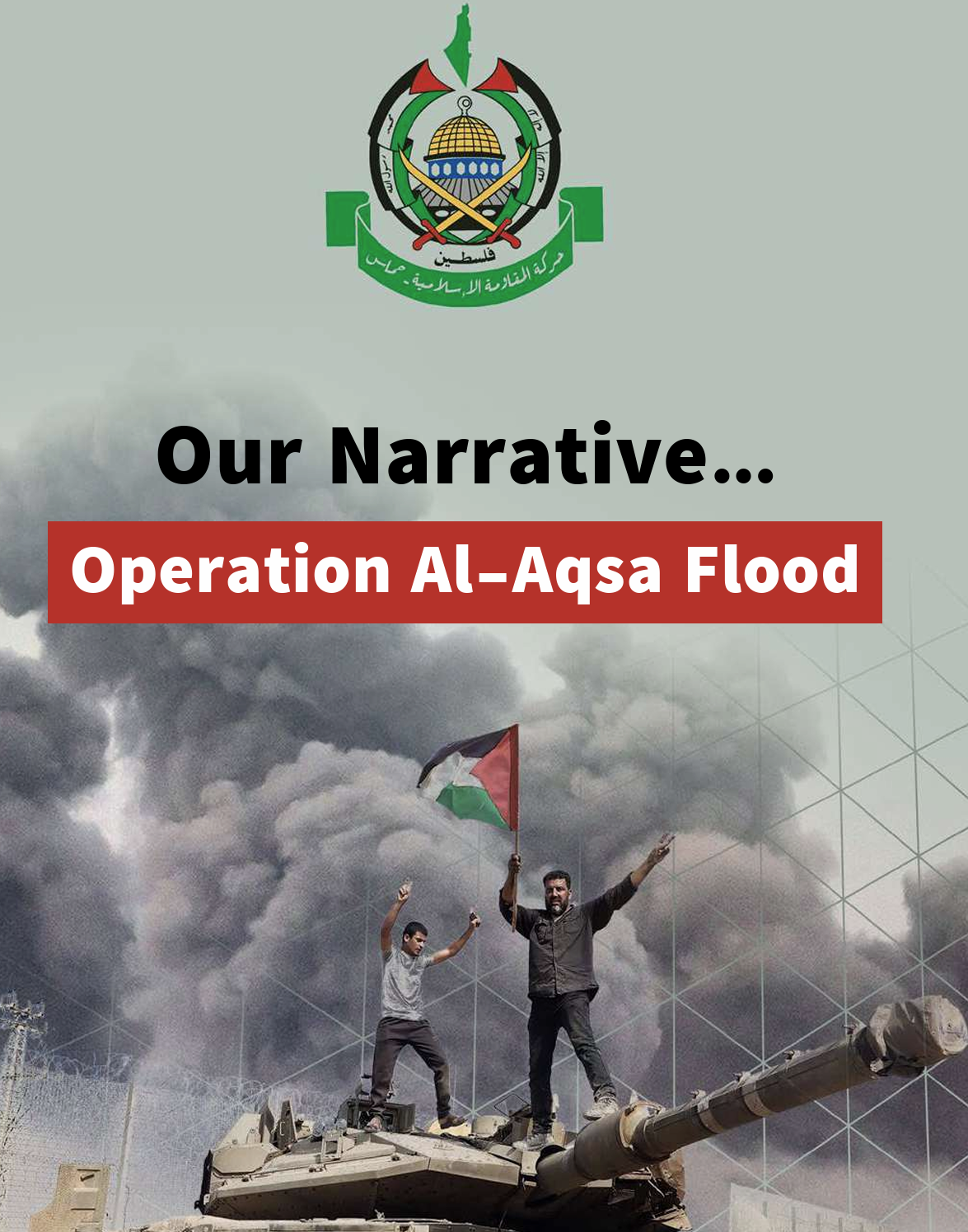
Hamas has released a slickly produced document providing a belated "narrative" of what happened on October 7. I link to it for reference, even though it's sickening reading for anyone with the slightest sense of justice or empathy for Israelis. 

It's quite obvious that this is written for a particular western audience and that Hamas knows how to write for that audience; it echoes many of the apologias one hears from its foreign sympathizers seeking to excuse its atrocities. Some of these are inserted in almost on reflex -- for example, in a section asserting that only military sites were targeted, the authors write that "the Palestinian fighters were keen to avoid harming civilians despite the fact that the resistance does not possess precise weapons." The lack of "precise weapons" is a line typically used in reference to Hamas' use of indiscriminate rocket fire, but it obviously has no bearing on the sort of close-quarters, ground operation that occurred on October 7 (Hamas' machine guns and grenades are more or less as "precise" as anyone else's machine guns and grenades; "imprecision" was not the problem here). But that follows from the overall tenor of the piece, which is to align Hamas' narrative with the way its most credulous apologists speak about Hamas -- to further bind these groups together as "all on the same side."

That said, for the most part this document should be read as an official extension of the 10/7 denialism that the Washington Post reported on the other day: that 10/7 essentially "didn't happen" (the targets were military, any civilians killed were either targeted accidentally or were actually murdered by Israelis, reports of atrocities like rape are propagandist fabrications, and so on).

What's the point of a document like this? There are several:

First, it is piggybacking on the aforementioned denialist movement that was from the get-go primed to accept any possible narrative of Israeli perfidy. This tendency exists on a continuum, but even "soft-core denialists" who are primarily invested in viewing some of the more heart-wrenching charges (mass rapes, slaughtered infants) as exaggerated or fictious will treat Hamas' document as moving the Overton Window further. Certainly, the useful idiots who promote this sort of view didn't need Hamas to give them this document, but they will be encouraged by it and will hungrily consume it and use it to fuel further excretions.

Second, it is attempting to rewrite history. Everyone and their mother has congratulated themselves for the "realization" that Hamas' goal on 10/7 was to commit an attack of sufficient brutality so as to compel a bruising Israeli response that would wreck Israel's reputation and bolster the profile of the Palestinian cause. Having succeeded in generating such a response, it only makes sense to try and erase the initial provocation. If October 7 essentially "didn't happen", then everything that happened after October 7 is simply random unmitigated acts of Israeli aggression -- no longer "backlash", now just "lash".

Third, it is a form of "I know you are but what am I" trolling. At various points, the document characterizes Hamas' operation as an "arrest" mission ("Operation Al-Aqsa Flood on Oct. 7 ... sought to arrest the enemy’s soldiers"). Here I actually don't think the goal is directly to rewrite history, because (though lord knows where this optimism comes from) I don't think even Hamas' most credulous dupes could possibly believe October 7 was actually an arrest operation. Rather, here the very absurdism is the point -- the goal is not to make anyone believe something as absurd as October 7 being an attempt at effectuating arrests, it's to make people associate claims about effectuating arrests with absurdist propaganda.

We're all familiar with the Sartre line about how antisemites "like to play with discourse" while aware of the "absurdity" of their arguments. and that's what we're seeing here. Israel does engage in genuine arrest operations on a regular basis. By "genuine", I don't mean that these operations are not or cannot be abusive, legally dubious, violent, unethical, etc.. But that doesn't mean the label of "arrest" operation is an absurd one; it's an accurate characterization of the operation (even if it is an abusive arrest, a legally dubious arrest, a violent arrest, and so on). Hamas' goal, though, is to render that word something absurd; the sort of thing we all know is just a euphemism for lawless authoritarian abuse. Think of a term like "re-education" -- when we hear a government say that a given political dissident was "re-educated", we go beyond viewing it with a skeptical eye ("was this an abusive form of education?"). We don't view it literally at all -- we understand that "re-education" is just a term authoritarians use to bowdlerize taking dissidents into a warehouse and beating them until they recant. "Re-education" isn't (sometimes, often, even always) "done abusively", "re-education" isn't done at all. The goal here is to make "arrest" be treated similarly -- an absurd term that Israel and Hamas use in obviously non-literal fashion to describe periodically raiding the territory of the other and killing people in it.

And finally, we should not overlook that this document is a means for Hamas to retraumatize its victims. There is power and sadistic pleasure in not just inflicting hurt, but also then being able to stand impassively (or -- perhaps even better -- with the most subtle of smirks) and declare that nothing actually happened, that the victim is making it all up. That, alone, would suffice as a motivator -- a psychological insult on top of injury. The forced photographs of captives "smiling" -- cited in the document as proof of Hamas' gentle hands -- are of course part of this play; a means through which victims are coerced into serving as testifiers against themselves.

A Palestinian friend of mine, responding to the article about increased 10/7 denialism, reposted comments by former Palestinian Israeli MK who observed that Palestinians are "not good people that only do good things." "Victims of the occupation aren't good people, they're victims. They are not righteous, they have a just cause." The cause of ending the occupation is just, but this does not mean that all persons under occupation -- or even all those who purport to act under the banner of "ending occupation" -- behave righteously (any more than the justness of the cause of Jewish self-determination means that all those who act under that banner behavior righteously). It is no adjunct to opposing the occupation that one must believe Hamas incapable of the horrific acts of violence and sadism that the evidence overwhelmingly documents occurred exactly as alleged, and to spread Hamas' lies on this front is not "solidarity" but sadism. The fellow travelers here -- for example, Mondoweiss, which was highlighted for the particularly vicious denial of sexual violence perpetrated by Hamas fighters -- should be called exactly what they are.

Wednesday, May 24, 2023

What Does "Disproportionate" Look Like?

There was a little chatter this week that the Biden Administration, as part of its initiative to combat antisemitism, might give a positive mention to the "Nexus" document. Little ol' Nexus! Who knew!

This news has generated pushback from the rightward elements of the Jewish community, including -- this is a right-wing campaign in 2023, after all -- comparing Nexus to Chinese authoritarianism and spuriously tying us to pedophilia.* What fun.

I might weigh in on this broader controversy. But this post is more about a sidebar to the debate.

One prominent portion of Nexus that has been flagged in these conversations is how we treat "double standards". Nexus, unlike JDA, does not say that it is okay to hold Israel to a double-standard. However, it says that the mere fact of "disproportionate attention to", or differential treatment of, Israel, is not per se proof of a problematic double-standard. People pay "disproportionate attention" to Israel for all sorts of reasons, and many times its completely benign. There certainly are cases where that attention is problematic; but there are many cases where said attention in no way justifies drawing an inference of a problematic double-standard.

AIPAC, ZOA, NGO Monitor, APN, Adalah, the American Task Force on Palestine -- all of these focus on Israel more than other countries, and that's their prerogative. It is neither weird nor sinister for a Jewish or Palestinian organization to devote more attention to human rights issues in Israel compared to China or the Crimea or Zimbabwe, and nobody actually thinks otherwise. One can, I think, fairly contrast the case of AIPAC or Adalah with, say, the UNHRC -- a body which would struggle to articulate a neutral reason for focusing overwhelmingly on Israel but does so anyway. There the antisemitism objection carries significantly more force. Again, the Nexus document provides additional gloss and detail that can help fairly instantiate the IHRA rule, avoiding opportunistic deployments where the mere fact that a Palestinian organization is talking predominantly about Palestinian issues is held out as an antisemitic "double-standard".

In short, Nexus observes that it's not the attention alone that proves a double-standard; something more than that is required. This argument is pretty hard to gainsay, in my view, and it's been amusing to watch some folks on Twitter jackknife wildly between being enraged at how "clearly wrong" Nexus is for saying that disproportionate attention is not per se proof of antisemitism to, when given the example of AIPAC or the Kohelet Forum (which is disproportionately criticizing Israel's judiciary setup far more than it attacks those of other countries), being enraged at how clearly right Nexus is.

But all of this raises the question: what does disproportionate attention even look like?

For example, one of my interlocutors last night gave three examples of human rights groups whose Twitter feeds evinced what he deemed a clearly antisemitically-disproportionate concentration on Israel: Human Rights Watch, Amnesty, and Ken Roth's personal feed.

This is something I hear a lot, and I've often wondered about. It is certainly possible that such groups really do focus on Israel to a wildly excessive degree (I'm familiar enough with the practices of the UNHRC -- which regularly is passing more resolutions about Israel than all other countries in the world combined -- to feel comfortable saying the charge fits for them, for instance). But it's also plausible that certain observers who care primarily about Israel -- pay disproportionate attention to it, we might say -- will only notice a group like HRW talking when it's talking about Israel, in which case, yes, it will seem like it does nothing but talk about Israel. But that's a function of one's own attention span, not HRW's conduct.

So last night, I actually went through these three Twitter feeds -- @HRW, @Amnesty, and @KenRoth -- to see what "disproportionate" looked like. Here's what I did:

  • For HRW and Ken Roth, I looked at all their tweets this week up until about 3 AM last night. For Amnesty, which tweeted less frequently, I looked at all their tweets for the month of May.
  • For each tweet, I marked which country was primarily being criticized (virtually all the tweets were critical, there were few if any instances of a country being praised). If multiple countries were being criticized in roughly equal forms ("Keep X and Y off the Security Council"), I coded the tweet as criticizing both. But if the tweet was primarily about one country, with a second country being more background, I only coded the former (e.g., a tweet about US border policies that mentions Mexico still would only be coded as the US).
    • Total number of tweets may be slightly inaccurate given some tweets covered multiple countries.
  • I also separately noted tweets that didn't focus on any country, but rather a specific issue area (like the death penalty).
  • Finally, I counted threads as a single tweet. But multiple tweets in a row about a single country (unthreaded) were each counted separately.
Here's what I found:

Human Rights Watch:
  • HRW had about 60 tweets/mentions in the relevant time period, which criticized 31 countries. 
  • Of those tweets, 1 was primarily about Israel.
  • The most commonly targets in this time period were Indonesia, Poland, and Belarus, each of which had five mentions. 
  • Other multiples include Vietnam (3), Afghanistan (3), Myanmar (3), Pakistan (3), the UAE (2), and Egypt, (2).

Ken Roth

  • Ken had about 80 tweets/mentions in the relevant time period, which criticized 31 countries.
  • The most common target for Ken were China and Russia, with 13 mentions each.
  • Israel was the third-most common target, with seven mentions.
  • Other multiples included India (6), Sudan (4), Belarus (3), Syria (3), Myanmar (3), Saudi Arabia (2), Ethiopia (2), Greece (2), Turkey (2).
Amnesty
  • Amnesty had about 63 tweets/mentions in the relevant time period, which criticized 16 countries (keep in mind that, because Amnesty tweeted less frequently, its time period was longer -- the entire month of May).
    • For what it's worth, had I looked at Amnesty's tweets just for this week, it would have had only eight, none of which were about Israel.
  • Amnesty was far more likely than HRW and Ken to tweet about general issues rather than country-specific incidents and policies. Sixteen of its tweets were about general policies, including six on the death penalty, four on LGBTQ rights, two on press freedom, two on social security, and one each on women's rights and climate change.
  • Amnesty's most common target was Israel, with 16 mentions. The next-most common target was Iran, with five.
  • Other multiples included the USA (4), Sudan (4), Pakistan, (4), Uganda (3), Peru (3), Kenya (2), and Russia (2).
So what do we draw from all of this -- assuming for sake of argument that the time period I drew from was representative? Are these groups actually paying disproportionate attention to Israel, or is it an artifact of the relevant observers only caring about them when they talk about Israel?

I would say the results are mixed. For Human Rights Watch, where just 1/60 mentions were about Israel, I think it is pretty hard to maintain that Israel is being subjected to some sort of unfair "double-standard" based on the amount of attention it received. Notice, though, one still could argue that it is receiving "disproportionate" attention -- there are 195 countries in the world, and yet Israel received 1/60th of the attention! Or one could say that giving Israel equal attention to Russia (which also had one mention), or the lack of a mention for China in this time period, is "disproportionate" given Russia and China's graver current offenses (though if that's the argument, how much more of a basis of complaint do the Poles, Indonesians, and Belarussians have!). 

Still, to the extent that this sort of treatment is what's being deemed "disproportionate", I think Nexus is clearly correct in rejecting the notion that there's anything per se antisemitic about it. And to the extent that some persons perceive HRW as focusing "obsessively" about Israel to the exclusion of other countries, that seems (again, assuming this period was representative) almost certainly attributable to those observers only paying attention to HRW when it talks about Israel.

For Amnesty, by contrast, 16/63 mentions were about Israel -- 3x more than the next closest rival of Iran. Here, I think the claim of genuinely problematic "disproportionate" attention is at least more colorable. While we can argue whether this is antisemitic or not, with Amnesty it does seem like the perception that it focuses disproportionately on Israel in a potentially problematic way does seem like it is warranted -- it isn't just an artifact of the listener's own slanted priorities. I will note, though, that in terms of "disproportionate attention", even Amnesty lags behind the UNHRC, which again has historically targeted in Israel in more than half of its entire body of work! Amnesty's 16/63 -- roughly 25% -- looks positively charitable in comparison!

Finally, Ken Roth is somewhere in the middle. Israel is the focus of his attention more than many other countries, but not all of them -- it stands behind both Russia and China. Is this a case of a problematic "double-standard"? It doesn't seem so -- Israel doesn't "stand out" alone on a precipice like it does for Amnesty, it is treated similar to other countries that Ken also thinks are human rights violators. One could again cherry-pick and say "well, what of Cuba -- Ken didn't talk about them at all in this period -- and they're a human rights violator too!" But this is not actually a workable standard -- political discourse simply does not work like this, where every commentator is talking about every potential token of injustice in complete equal proportion.

Relatedly, I've definitely heard the claim that given how much worse Russia and/or China is than Israel, it is "disproportionate" to focus on Israel even equally (or here, considerably less than equally) to those countries. But that sort of argument seems almost impossible to operationalize in practice, in part because it's subjective, in part because it's clearly not the case that there either is or should be a 1:1 correlation between some sort of universalist rubric of gravity-of-offense and attention paid. That's not how political discourse works, and it's not how it can possibly work. Indeed, I daresay that few think of applying that sort of standard in any case but Israel's (and even here -- does anyone say that any attention paid to Palestinian terror is prima facie "disproportionate" if it is not dwarfed by attention paid to far greater atrocities like the Myanmar genocide? Again, this just isn't workable). This, again, ratifies Nexus' instinct to not let "disproportionate" alone suffice; as the sort of conduct that is being called "disproportionate" is not actually behavior that can reasonably be indicted as problematic.

In all these cases, of course, it could be that the relevant coverage is antisemitic for other reasons ("disproportionate" is not the only basis for calling something antisemitic, after all). But to the extent one wants to argue that the allegedly "disproportionate" coverage of these groups validly generates an inference of antisemitism, that's hard to warrant at least for HRW and Roth, though it may be for Amnesty. Perhaps unsurprisingly, there is both some truth to the notion that some groups focus on Israel in an obsessive or wildly off-kilter fashion, but it is also true that this belief has caused some observers to assume that this sin is more widespread and ubiquitous than it actually is, and make accusations of problematic disproportionality in cases where it can't really hold together.

* Lest you think the latter is some egg-profile Twitter account with 54 followers and a shiny new blue checkmark, it actually came from Shmuley Boteach. So not too far from an egg-profile Twitter account with 54 followers and a shiny new blue checkmark.

Friday, October 22, 2021

It's a Small World After All

My SunriseDC posts have gotten me a bunch of new followers, and I've promised to start disappointing them as soon as possible.

Well, no time like the present, so here we go.

You probably heard the news that Israel designated six Palestinian human rights organizations as terrorist groups, alleging they are tied to the Popular Front for the Liberation of Palestine (PFLP). The US has already signaled its discontent with the move, and for my part I've suggested that a good "throw an elbow" move would be to take some extremist but nonetheless politically connected Israeli organizations (think Lehava) and place them on a terror watchlist (something we should be doing anyway, but now certainly would make an especially poetic time to do it).

But saying the Israeli government's decision to label these groups as terrorist organizations was wrong is not all that hot a take. None of you will be disappointed in me for making it, I fear. So try this one instead: the decision to label these groups as terrorist organizations was wrong even if one can find links between the organizations and the PFLP (and indeed, there are reports suggesting that there are at least some connections).

Maybe that'll get your attention.

The reason, to be clear, is not because the PFLP is not properly deemed a terrorist group. It absolutely is. And while less well known these days than, say, Hamas or Islamic Jihad, the PFLP has been responsible for some of the most gruesome violent terrorist assaults in Israeli history, including a massacre at Lod Airport that killed twenty eight people. I have no fond feelings towards the PFLP.

What came to mind, rather, was someone on my twitter feed suggesting that the PFLP was being treated as a "contaminant" -- any connection to it, at any level or through any personnel, was enough to generate this sort of absolute and uncompromising crackdown by association. "Contaminant" caught my eye because it was the same word Abe Silberstein had used to characterize what SunriseDC was doing to Jewish organizations re: Zionism -- the slightest touch or whiff was enough to warrant expulsion.

(Yes, I can already hear the howls of protest at even drawing the comparison. How dare you compare the entire ideology of Zionism with a literal terrorist group? Or, how dare you compare a criminal enactment by a national government with a decision by a piddling activist group in DC? You needn't bother to message me about it.).

One can already see, if one looks, a familiar set of excuses and modes of justification. Sure, Israel seemed to target Palestinian human rights groups -- but it didn't ban all groups. It is articulating a neutral standard, and in any event are you saying it's wrong to oppose the PFLP, a known terrorist actor? Why, it is downright insulting -- I daresay the real racism -- to suggest that a Palestinian NGO couldn't not be associated with the PFLP! You're conflating "Palestinian", an identity, with the particular ideology and tactics of certain organizations (namely, violent militant leftist resistance to the Israeli state)!

All of this is a way of eliding a simpler reality. What Israel is doing is suffocating Palestinian civil society and human rights advocacy. That it doesn't do so absolutely comprehensively is not a defense. That it has superficially defensible reasons that have nothing to do with "suffocating Palestinian civil society" is also not a defense. That you can pour through the archives and see that this assistant director was on a panel with that social activist who attended on a grant issued by a man who has also seeded money to the PFLP's government affairs wing is, too, not a defense.

The internet may be big, but the world of the Palestinian community, much like the Jewish community, is pretty small, in the scheme of things. For any remotely prominent or active player, there aren't going to be too many degrees of separation between the participants -- still less, if they're concentrating on the broadly defined shared goal of bringing attention to wrongs and mistreatments done to the Palestinian people by Israel, or, for that matter, the PA (if, as Anshel Pfeffer speculates, what Israel was actually doing is targeting internal Palestinian critics of the PA at Abbas' request, that only strengthens the point). I know for my part it would not take a lot of effort or steps to connect me to some people and groups I very much do not like and do not support (to say nothing of those with whom I disagree with on most issues but may provisionally align with for a narrow or discrete project where interests align), because the Jewish world is small, and the Jewish political world is smaller. We've all seen the breathless "investigations" which show that David Schraub is a member of this organization which is sponsored in part by this other foundation which has also funded this other group and would you look who is on their Board of Directors?

We're all familiar with the genre. I've seen, more times than I care to count, the amateur and professional shops eager to offer reams of evidence "showing" how all of Israeli or Palestinian society is a seamless web of conspiracy, such that any pin in the corkboard can and must be ostracized not because they are Israeli or Palestinian or Jewish or Muslim (perish the thought!), but solely because of neutral standards demonstrating their own bad acts and associations. And the peddlers of these screenshots and PDFs and databanks pat themselves on the back for their deep investigative reporting and congratulate themselves for proving that everyone is acting on basis of principle, and the cries of prejudice and bigotry are just the usual suspects caterwauling.

Such logic is suffocating. It is suffocating notwithstanding the smarmy replies asking whether it is "really so hard not to associate oneself" with so-and-so or such-and-such wrongdoer, and it is suffocating notwithstanding the probable fact that someone, somewhere, maybe genuinely is sufficiently disconnected to pass muster (or more likely, has their particular set of connections excused and overlooked on an ad hoc basis -- everyone has their good ones). I'm not a libertarian, but anyone with even a smidgeon of libertarian instinct can understand how the weight of enough regulations, any or all of which can sound sensible or salutary on their own, can crush the life out of even good, public-spirited businesses. The same holds true for public participation. Cast the net wide enough and fine enough, and Israel will never need to come out and say "Palestinian human rights organizations are banned". It can get rid of them all -- or all but a token few -- through regulations and policies that are not just neutral on face, but sound to the credulous audience perfectly sensible and defensible on face.

It strikes me as quite likely that there are, if one looks deep enough and stretches broad enough, some connections between the groups Israel targeted today and the PFLP. That's mostly because I suspect one could find such connections (to PFLP or to some other genuine bad guy) for essentially any political Palestinian actor; just as one could do it without too much trouble for essentially any political Jewish or Israeli actor. What strikes me as exceptionally unlikely is that these groups are outright fronts for the PFLP, pretending to do some human rights makework in the front office while busily building bombs and rockets in the back.

So no doubt you will see some bloggers or news outlets come out in the next few days with breaking reports of just how this human rights NGO is tied to the PFLP. And no doubt they will hold themselves out as proving that the very idea that Israel's actions were anti-Palestinian, that they were targeting human rights groups as opposed to engaged in the laudatory fight against terrorism, is a lie and a libel. They may even believe these things.

They'll be wrong. And their logic suffocates.

Saturday, July 03, 2021

Academic BDS Comes to China

The Guardian has an interesting article about a scientific journal editor, David Curtis, who stepped down from his post after his attempt to implement a boycott of Chinese academics was rebuffed by his publishers. The direct precipitation of his resignation appears to be a mix of two things: first, that he was prevented from publishing an article he co-authored raising the specter of a China boycott, and second, that he had of his own accord begun implementing a policy of rejecting all submissions by Chinese academics due to "the complicity of the Chinese medical and scientific establishment in human rights abuses against the Uyghurs." (The latter decision was denounced by the journal higher-ups as a violation of policies forbidding national origin discrimination).

It is not clear whether the figures involved in the call to boycott Chinese academics are involved in the BDS campaign against Israel. I can imagine them being sympathetic; I can also imagine them being people who thought BDS against Israel was absurd precisely because we should be starting with more serious violators like China and decided to put their money where their mouth was (a quick google search didn't reveal any particular links between Curtis and BDS, whether favorable or critical).

I have been banging the drum about the likelihood that BDS (or BDS-style tactics) will at some point stop "singling out" Israel and make itself apparent as part of activists' toolkits addressing other countries and controversies. And indeed, this particular iteration seems highly reminiscent of the earliest days of anti-Israel BDS (not only because it is originating in the UK). The flat ban on submissions by Chinese academics is identical to how academic BDS began -- the earliest significant academic BDS "move" was a decision by a British journal editor to demand the resignation of Israeli colleagues from her editorial board because "I can no longer live with the idea of cooperating with Israelis as such." Nowadays the BDS movement has made gestures at moving away from pure nationality-based discrimination in favor of allegedly targeting only "institutions, not individuals"; I suspect if the China BDS movement gains legs it will begin making a similar pivot (though, as with the Israel case, I also suspect that the new standard will often be honored primarily in the breach).

But what does the potential emergence of a China academic BDS movement mean for the future of the Israel academic BDS campaign? The core personnel are going to be different -- partially because different people have different interests, partially because the Israel BDS movement has more than its share of tankies who think the entire Uighur issue is western imperialist claptrap. Nonetheless, there will likely be some overlap, and the fact that BDS is being promoted in other cases will do more to legitimize it as a legitimate option even as there may be disagreements about whether a BDS style campaign is properly applied to this or that case. So in that sense, any successful mainstreaming of the China BDS campaign will likely help bolster the Israel one even if the principal actors are different people.

On the other hand, the development of "BDS" in the China context, precisely because it offers a comparator case and can falsify the "singling out" hypothesis, also is likely to generate new norms which will serve to modulate and regulate the Israel case as well. While Curtis' proposal is drastic -- no submissions from any Chinese academics, period -- it is supremely unlikely, given China's integration into global academia and knowledge-production, that a BDS movement of that form will gain any traction. Far more plausible is the implementation of considerably more narrow and targeted measures -- particular institutions or projects that are inextricably bound up in human rights abuses that directly (and not just by association) taint the specific academic work emanating therefrom. And particular will likely actually be particular -- it will not be tenable to use sweeping notions of complicity or culpability to drag in every single Chinese university or institution (the main mechanic by which "institutions, not individuals" reverts back to "individuals").

This is part of what I've been saying when I suggest that social movements, BDS including, "moderate as they mainstream." The more BDS becomes a general tool of social activism rather than an Israel-only one-off, the more it will adjust itself to adopt standards that actually can be plausibly generalized to a range of cases, and while extirpation of all Israelis from the global community is at least a conceivable social goal, extirpation of all Chinese nationals (or all nationals of all countries whose governments are implicated in significant human rights abuses) is not.

Put differently, to the extent people start thinking seriously about applying "BDS" to the China case in a manner that is plausible and scalable, the equilibrium that will be set will be one that likely will not countenance flat bars on academic participations by persons of a particular nationality, nor "institutional" proscriptions that amount to doing the same thing, but may accept narrowly-tailored measures targeted at specific wrongdoers. And -- insofar as China would be used as a comparator case to justify measures in other states as well (namely, Israel) -- there is a decent chance that these norms will translate over to the Israeli case as well. It won't happen without a fight, and you can be sure that the old-guard will continue to insist on the more fundamentalist version. But I do think that's the most likely trajectory.

Thursday, June 10, 2021

Between "One-Sided" and "Equating", and Other Curmudgeonly Thoughts

So there's another Ilhan Omar thing in the news. I'm in Portland, and having a very nice trip thank you very much, and most certainly do not have time to give this any real attention even though it is pushing all my curmudgeonly buttons.

The short version: Referring to a discussion she had with Secretary of State Anthony Blinken regarding ICC investigations in war crimes which included inquiries into cases involving the U.S., Israel, Hamas, Afghanistan, and the Taliban, Omar tweeted that:

We must have the same level of accountability and justice for all victims of crimes against humanity. … We have seen unthinkable atrocities committed by the U.S., Hamas, Israel, Afghanistan, and the Taliban.”

This generated a public response from 12 Jewish Democrats who asked Omar to "clarify" her remarks:

Equating the United States and Israel to Hamas and the Taliban is as offensive as it is misguided. Ignoring the differences between democracies governed by the rule of law and contemptible organizations that engage in terrorism at best discredits one’s intended argument and at worst reflects deep-seated prejudice.

The United States and Israel are imperfect and, like all democracies, at times deserving of critique, but false equivalencies give cover to terrorist groups. We urge Congresswoman Omar to clarify her words placing the US and Israel in the same category as Hamas and the Taliban.

And in turn, Rep. Omar provided said clarification:

On Monday, I asked Secretary of State Antony Blinken about ongoing International Criminal Court investigations. To be clear: the conversation was about accountability for specific incidents regarding those ICC cases, not a moral comparison between Hamas and the Taliban and the U.S. and Israel. I was in no way equating terrorist organizations with democratic countries with well-established judicial system.

Framed that way, I might have ventured that this was a success story. Rep. Omar issued a perhaps awkwardly worded tweet; she was asked to "clarify" her views; she did so. Huzzah!

But of course, life is never so simple, and so in the midst of this we had people making claims of antisemitism and Islamophobia and silencing and double-standards. This Is The Bad Place.

So -- a few thoughts:

Thought #1: A common refrain I've heard many times from pro-Israel sorts is that they're fine with criticizing Israel, of course they're fine with criticizing Israel, it's slanderous to say they're not fine with criticizing Israel; but the criticism can't be one-sided criticism, it needs to be clear that Hamas commits wrongs worth criticizing too. Which, sure, that makes sense. Except that it often seems that if one does criticize both sides, then the fact of criticizing both sides will itself be indicted -- this time for "equating" the two (this is the mirror image of those who assert that any mention of Hamas misdeeds represents an illegitimate blurring of the "power dynamics" between Israel and Palestine, acting as if there are "two sides" to the conflict).  Such persons don't really object to "one-sidedness" -- they love one-sidedness, they just want the one-side to be the other side.

Indeed, the cynic might wonder whether the only time criticism of Israel is legitimate is when it's one-sided, because only then do we get the litany of affirmations agreeing that "criticism" is legitimate so long as it's not "one-sided". If one comes out of the gate with the "two-sided" criticism, those invocations go mysteriously mute in favor of complaints about "equation". That inconsistency is a problem.

Thought #2: A lot of people have been sharing a Mehdi Hasan tweet where he compares what Omar said to Trump's infamous "You think our country's so innocent?" retort to condemnations of Russian human rights atrocities. As far as Republicans go, that's a fine hypocrisy argument; but as with all hypocrisy arguments it cuts both ways -- the standard Democratic view of Trump's statement was not to say "hey, when he's right he's right" but rather to condemn an alarming failure of perspective. And to Hasan's credit, he cops to this and says forthrightly that "once you take out all the nakedly partisan pointscoring and thinskinned patriotic chestbeating, Trump's point is right." But folks who aren't willing to go down that road should think more carefully about their arguments.

Thought #3: Someone suggested on Twitter that Omar, insofar as she calls out human rights violations from sources that would normally be taboo in American politics (such as, say, American violations), stands out for being consistent in a way other politicians aren't. But I'm not sure that's quite right. It's true that Omar calls out violations in places many other politicians don't, but its also true that Omar can be weirdly reticent to call out human rights violations in places many other politicians wouldn't hesitate (see: her "present" vote on the Armenian genocide resolution). So perhaps it's fairer to say she's inconsistent in an atypical way -- albeit an atypicality that is very much aligned with a particular style of leftist politics associated with her base.

Thought #4: We saw a lot of claims from Omar's defenders that the criticism of her on this issue was itself a case of racism, Islamophobia, misogyny, or these all in combination -- a double-standard where women who look like her and have her background are jumped on by mobs baying for blood whilst other politicians of different identities are given infinite benefit of the doubt. I have more sympathy for this argument than one might expect. But, having read the Jerusalem Declaration on Antisemitism I now know that both claimed double-standards and seemingly excessive vitriol and attention devoted to members of or entities associated with marginalized groups are not valid signifiers of bigotry, even if one disagrees with them on the merits, and that asserting otherwise is itself an attempt to silence free speech. It's nice to have that cleared up.

Thought #5: I said I'm a curmudgeon above, but I'm a curmudgeon with a heart of gold, and what that means in practice is that what I'm most curmudgeonly about is what I see as unnecessary fighting. So my main takeaway is this: Omar's original point was not unreasonable. The Jewish Democrats letter asking for clarification was also not unreasonable. And Omar's response to that letter was also, also not unreasonable. Neither "side" did anything that was worth me spending a millisecond thinking about any of this during my first "trip" in a year and a half.

So, to everyone else, I'll quote a sadly disgraced former jurist who nonetheless was good with the bon mot: "The parties are advised to chill." And let me enjoy my Portland trip in peace, dammit!

Monday, September 14, 2020

Involuntary Hysterectomies Reported in ICE Facilities

Two years ago, I wrote that the natural conclusion of the White nationalist fanaticism coursing through the Republican Party is forcing immigrant women to have involuntary abortions. With raging anti-immigrant sentiment going on about "demographics are destiny" and "anchor babies", there was little doubt that at some point this politics would arrive at its natural conclusion -- a full-out assault on the reproductive capacities of the immigrants who arrive on our shores.

Today, news dropped of a whistleblower report alleging mass hysterectomies -- without informed consent -- of immigrant women held in ICE detention. It's not precisely forced abortions. But it is a hair's-breadth of distance away. And the logic carries.

Roe, nominally at least, should protect women against this -- after all, Roe does not guarantee a woman's right to an abortion but rather a woman's right to choose. But we know how the right feels about Roe. And without respecting Roe as a safeguard, it is not clear what constitutional basis there is for a woman under the custodial authority of the state (such as prisoners or immigrants held in detention) to refuse a medical procedure if her wardens demand she endure it. When choice is taken away in one direction, it can be taken away in the other.


Monday, August 10, 2020

Searching for Tikhanovskaya

Belarus just had a presidential election, and incumbent Alexander Lukashenko -- who has held his position since the mid-1990s and is known as "Europe's last dictator" -- was announced the winner with over 80% of the vote.

Nobody (well, nobody but a few especially credulous tankies) believes this figure is accurate, and protests have erupted throughout the country. Meanwhile, Lukashenko's main challenger, Svetlana Tikhanovskaya, has reportedly gone missing (Tikhanovskaya entered the race after her husband was arrested two days following the announcement of his own presidential run. What a fantastic avenue for feminist advancement!).

What do you think will be the most likely circumstances of Tikhanovskaya's reappearance?

  1. She'll emerge from hiding in another European country;
  2. Flanked by government "security", she will "voluntarily" announce that she accepts the election results and urge that all Belarussians respect Lukashenko's regime;
  3. The government will report the sad news of her suicide -- she "jumped out a window" after only taking 10% of the vote, the poor thing.
  4. She'll never reemerge, or in any way be heard from again.
I certainly hope she's okay, and safe, and send my full solidarity with the people of Belarus struggling for freedom and democracy.

UPDATE: And apparently, it's door #1!

Tuesday, November 05, 2019

Israeli Supreme Court Upholds Deportation of Shakir

The Israeli Supreme Court has upheld the Israeli government's move to deport Human Rights Watch activist Omar Shakir from the country, citing his alleged support of BDS. The Court declined to say that HRW was itself a "a boycott organization", and therefore noted "it can request the employment of another representative who is not involved up to his neck in BDS activity."

There are ample reasons why I think Shakir was a poor choice for HRW to send off as its representative in Israel, and plenty of occasions where I think the quality (and neutrality) of his work could be justifiably questioned. Nonetheless, the standard for "expulsion from the country" is not coterminous with "work I think is subpar", and healthy democracies do not fear criticism (even when sometimes ill-formed). This is a dark day for those of us trying to stem the increasingly-rapid erosion of Israel's liberal character.

On that note, here's Interior Minister Aryeh Deri, celebrating:
[A]nyone who works against the state should know that we will not allow him to live or work here.
Tell me that isn't creepy as all get out.

Wednesday, January 02, 2019

Nikki Haley, Heroic Figure!

Now that she's back in private life, former UN Ambassador Nikki Haley is showing that principled advocacy and public dignity that set her apart from other Trump administration apparatchiks.

Here she is trying to act like complying with simple anti-corruption measures prohibiting public officials from using the office to gain private benefit was a deliberate Obama-led plot to target her and her Twitter feed.

And here she is, on her newly relaunched Twitter platform, giving fulsome praise to newly inaugurated Brazilian President Jair "I'm pro-torture" Bolsonaro. His first acts as President, unsurprisingly, were sweeping attacks on Brazil's gay community (he famously said he'd prefer his son die in a car accident than be gay) and indigenous populations. Human rights!

In conclusion, Nikki Haley is a fair-minded, principled advocate for the dignity of the least among us worldwide and one of the rare bright spots to come out of the Trump Administration.

Saturday, August 01, 2015

...And if they did fail to investigate, they were insane

There's an old joke amongst lawyers about the "perfect defense argument". It's a series of "in the alternative" responses that seeks to derail the plaintiff's case (usually styled as something simple like "your client broke my vase") at every turn. "You don't have a vase. If you have a vase, my client has never seen it. If he saw it, he never touched it. If he touched it, it did not fall...." and so on. The last line in the litany is that if, after all that, the man can indisputably have been shown to have broken the vase ... well, "he was insane."

It's a joke because, of course, such a strategy is not "perfect", it reeks of desperation and wouldn't be received well by any jury at all. It also smacks of how some folks are responding to Yesh Din statistics showing that a mere 7.4%  of cases of Jewish civilians committing crimes against Palestinians are cleared (which came up in the discussion over my post on the recent "price tag" murder of a Palestinian child). Here is an edited version of the fusillade of responses I've gotten to that figure on Twitter:

  • Where did that figure comes from? [Answer: Yesh Din]
  • How was it calculated? [Out of 996 complaints with investigation files opened and processed, only 7.4% resulted in any charges being filed.]
  • "Charges filed"? Why that metric? [That's basically what's known as the "clearance rate": the ratio of complaints made to arrests and charges made.]
  • Who's to say 7.4% is low? Maybe in the US it's even lower. There are plenty of cases where a crime report is filed and nobody is caught. [True, but 7.4% is still really low. The American clearance rates, by comparison, are 47% for violent crimes and 18% for property crimes] 
  • What happens if charges are dropped? Maybe the police are investigating the claims but the prosecutors are electing not to file?  [A case where charges are filed and later dropped still counts as "cleared". Since it's a measure of police efficacy, not prosecutorial talent, it stops measuring once the case is out of the police's hands.]
  • It includes dropped charges? Then those numbers are squishy; the police could goose the numbers just by arresting and charging random strangers! [There's no evidence that happens over a large scale. This is a very widely used metric of police efficiency.]
  • Bah! Your numbers are useless if they don't include convictions [Fine. The percentage of claims which result in a conviction is 3.3% (33/996). The conviction rate (how many charged cases lead to at least one conviction) is 58%]
  • Who's to say 3.3% is low? Maybe in the US it's even lower! [This again? Highly unlikely. Even if we assumed every crime was a property crime, the conviction rate would have to be an appalling 18% for the ratio of complaints to convictions to catch up.]
  • Maybe the US conviction rate is that low? [It's not. It's 66%.]
  • Well, maybe the police aren't charging people because it turns out the complaints are unfounded? [Overwhelmingly, the files are closed because the investigation fails -- no suspect or insufficient evidence to bring a case -- not because the claim is deemed unfounded.]
  • Maybe they're not finding enough evidence because no crime occurred! [Perhaps, sometimes. And perhaps sometimes the police gave it their all and just couldn't catch the perpetrator. That's why we use aggregate statistics and used the U.S. as a baseline comparison. Neither explanation is likely to account for 93% of cases.]
  • Bah again! I bet almost all claims of "price tag" attacks are lies. Ever heard of Pallywood? [I have. Again, if you think it accounts for 93% of cases, you're delusional.]
  • Also, these statistics come from Yesh Din, and they're one of those EU-funded Israeli groups that can't be trusted. [Then by all means provide contrary data from a source you like better. I'm happy to look at it.]
  • [Needless to say, actually providing contrary data, or countervailing evidence of any sort, has been met with utter silence].
You'll note that all of these responses are attempts to pot-shot at the data. They don't provide any positive evidence -- empirical or otherwise -- demonstrating that Israel does a good job investigating "price tag" attacks on a systematic level. This is the behavior of people who are guarding a belief that they desperately want to be true, and will cling to it through hell or high water. I don't want to believe that Israel systematically fails to investigate price tag attacks. I prefer it when Israel does a good job, and I'm unhappy when it does a bad job. But the fact of the matter is that they've been a colossal failure in this arena; and it's not an unimportant arena.

Tuesday, April 21, 2015

Amnesty Rejects Resolution To Combat Anti-Semitism

A proposed resolution asking Amnesty International UK to confront rising anti-Semitism Failed on a 461-468 vote. It was the only proposed resolution at the Amnesty conference that was not passed. You can read the text of the proposed resolution here, suffice to say it does not appear remotely controversial. Well, except for the part where opposing anti-Semitism is inherently controversial. Even in the private sphere, Jews still lose.

Still, I have to say that a part of me is shocked by this outcome. A resolution demanding action on anti-Semitism before a human rights group in the UK ... and it only failed by seven votes? Frankly, that's far better than I had any right to expect.

My friend Yair Rosenberg suggests that "It's going to be hard for Amnesty International to claim to stand for universal human rights after this." Oh, I'm sure they'll manage somehow.

Thursday, October 30, 2014

Does Human Rights Law Do Anything?

An interesting conference at The University of Chicago Law School. As a decided skeptic regarding the capacity (and beneficence) of international law, this sounds right up my alley.

Wednesday, August 15, 2012

Sacramento Makes Ashkelon a "Sister City"

The Sacramento City Council unanimously voted to make Ashkelon, Israel one of its "sister cities". Ashkelon joins nine other Sacramento sister cities, including Bethlehem in the Palestinian Authority (Bethlehem was added in 2009, under a deal that would see an Israeli city added later).

There was some controversy from the usual suspects (including Jewish Voice for Peace, which totally opposes only the occupation and not Israel-qua-Israel). The claim was that adding Ashkelon was unfair given Israeli human rights violations against Palestinians; some argued against Ashkelon specifically because it has a jail which holds Palestinian prisoners and because Ashkelon was formerly the site of a Palestinian village (the village had been the site of fierce fighting between Israeli and Egyptian forces during Israel's war of independence, forcing many of its residents to flee). Today, Ashkelon's most well-known relationship to the Israeli/Palestinian conflict is its status as a constant target for Palestinian shelling emanating from the Gaza Strip.

I'm disinclined to credit the claim that the opposition's problem is with Ashkleon, rather than with Israel -- the arguments they make against Ashkelon are exceptionally thin and could, with minor shifts, be applied against virtually any city in the world). Which inspired me to take a look at the other cities Sacramento has partnered with.

* Manila: Capital of the Philippines, which is currently engaged in a brutal counter-insurgency against Islamic separatists in the southern parts of the country. The Philippines has resorted to extrajudicial killings, vigilantism, disappearances, torture, and arbitrary arrest and detention.

* Matsuyama, Japan: Japan has a long-standing practice of discrimination against the indigenous Ainu people, with de jure discriminatory laws repealed only in 1997.

* Jinan, China: Yeah, I'm not even going to bother with this one. From the occupation of Tibet to one-party rule to government censorship and crackdowns on dissent, this is too easy.

* Hamilton, New Zealand: Built on the site of Maori villages prior to British colonization. New Zealand's treatment of its indigenous minority continues to be of concern.

* Liestel, Switzerland: Switzerland has recently come under fire for banning the building of minarets in Mosques. Liestal is the seat of Basel County, where over 55% of voters approved the ban.

* Chisinau: The capital of Moldova, another country with a spotty human rights record, including many restrictions on independent media and reports of widespread torture by police forces.

* Yongsan-gu, South Korea: Imperialist swine. In all seriousness, though, non-Korean minorities face considerable discrimination, particularly among non-documented workers from elsewhere in Asia. The country also has many anti-gay discriminatory laws.

* San Juan de Oriente, Nicarauga: Also built in the vicinity of native villages by European colonizers, Nicaragua has also experienced significant problems with police abuse, and President Ortega has been accused of using state apparatuses to squelch dissent while enabling regime-friendly groups free reign to violently terrorize opponents.

* Bethlehem: Palestinian security forces stand accused of violence against Christian residents, who have accelerated emigration from the city. Israeli citizens are forbidden from entering Bethlehem, including the Solomon's Pools, while Palestinians require a permit to enter Rachel's Tomb, a Jewish holy site. Military and paramilitary forces linked to the Palestinian Authority have been implicated in numerous terrorist attacks against Jewish targets.

The point isn't that any of these cities shouldn't be "sister cities". The point is that the claim that Ashkelon or Israel is somehow distinct in form from other cities that Sacramento has paired with (or indeed, most cities around the world) are essentially spurious. They're cover for a fundamental objection that Israel is there and doesn't roll over and die.

Monday, April 30, 2012

It's the Bad Law ... That You Just Didn't Pass

The UNHRC has added Israel to its list of countries which restrict the activities of human rights groups. The reason is a proposed law that restricts foreign funding to domestic NGOs. Now, I'm no fan of this law (though I don't know how it compares to other regulations countries have about international funding of domestic groups), indeed, I view it as another instance of waxing illiberalism in Israel's political sphere.

But there's a reason why "proposed" is in the other sentence: the law never actually passed the Knesset. Prime Minister Netanyahu ordered it frozen after it was determined that the law likely wouldn't pass muster with Israel's high court. So one would think happy ending, yes? Not according to UNHRC chieftain Navi Pillay:
“In Israel, the recently adopted Foreign Funding Law could have a major impact on human rights organizations, subjecting them to rigorous reporting requirements, forcing them to declare foreign financial support in all public communications, and threatening heavy penalties for non-compliance.”

Obviously, Pillay has a different definition of "recently adopted" than most people, who would presumably require the law to be, you know, adopted at all. But when the subject is the UN and the opportunity is to flambe Israel, there is no need to get hung up on such technicalities. It's repulsive.

Friday, September 09, 2011

Retaliatory Measures

The Israeli foreign ministry is contemplating various retaliatory measures against Turkey after the latter expelled the Israeli ambassador, cut military ties, and is threatening to provide military escort to any new flotilla seeking to break Israel's blockade of Gaza. It's typical Lieberman fare: pugnacious, probably counterproductive, and forcing the Prime Minister's office to distance itself. The main highlights are beginning cooperation with the PKK (a Kurdish terrorist organization working to establish an independent Kurdish state in Southeast Turkey), including potential weapons sales, and flooding the UN with complaints about Turkey's treatment of minorities (such as the Kurds).

I'm obviously not wild about supplying weapons to a recognized terrorist organization. But I will admit to finding ironically appealing sending a convey to southeast Turkey filled with Kurdish-language instruction books and other educational materials geared towards the Kurdish people. Totally non-violent "solidarity" measures, but I guarantee Turkey would flip out (Kurdish language and culture is heavily suppressed by the Turkish government). And hey, if we're talking about supporting national self-determination for local populations under the heel of another power, well, what's good for the goose....

As for the human rights complaints, both Israel and Turkey long have a habit of using such proclamations as proxies for diplomatic conflicts (see, e.g., declarations regarding the Armenia genocide). Still, it's not as if there aren't serious points of concern that deserve public airing: For example, the Turkish prime minister threatened to expel 100,000 undocumented ethnic Armenians if resolutions regarding said genocide were passed (ironic, no?).

On the other hand, there is no reason to think that UN human rights bodies will give Turkey anything but a clean bill of health no matter how serious its violations are. After all, countries in the UNHRC's good graces can get away with quite a bit: Sri Lanka earned laudations for its actions against the Tamils in the midst of killing up to 1,000 civilians a day. There is no reason to think that the UN holds any particular interest in holding Turkey accountable for wrongdoing, and it will be particularly resistant to doing so when it seen as acting on Israel's instigation, so it is not clear what any Israeli complaints would accomplish.

Thursday, September 01, 2011

Palmer Report Largely Vindicates Blockade

The United Nation's long-awaited Palmer Report on the Gaza flotilla incident has now been released, and, from Israel's perspective it has to be seen as a major win. The committee firmly decides that the blockade is legal and notes that an essential element of a legal element is that it has to be enforced consistently (which means intercepting folks trying to breach it, and can entail forcibly boarding resisting vessels). It also notes that the the Israeli soldiers who boarded the Mavi Marmara did face violent resistance. The committee does believe that Israel used excessive force in boarding the vessel and in not pursuing more non-violent interception techniques prior to its forcible boarding action. Statements from the Israeli and Turkish representatives to the commission appended at the end are revealing: the Israeli representative quibbles with the excessive force findings, but the Turkish representative is forced to disassociate himself from virtually the entire document.

I think the committee report is generally solid. It's analysis on the overall legality of the blockade is unquestionably superior to that forwarded by the UNHRC's report, which (and this is true regardless of one's ultimate perspective on the conflict) was frankly an embarrassment to the legal profession (how one even tries to undertake a proportionality analysis without even mentioning the objective in question, see paras. 51-61, compare Palmer Report pp. 38-45, is a mystery). So that's good.

Of course, I remain exceptionally dubious of the utility of these reports or the international law frame at all. The Palmer Report had been delayed several times because everyone believed it would only hurt rapprochement efforts between Israel and Turkey (Turkey is hell-bent on a full apology and an end to the blockade, which Israel is far less likely to do now that a high-profile commission has deemed the blockade legal and vindicated many, albeit not all, of its actions). Folks opposed to Israel's actions will simply cite the UNHRC report instead. Israel knows that, which limits whatever benefits it might reap from citing the Palmer Report. The conflict is political, and will be resolved politically. Whatever formal authority the Palmer Report has (and I'm not sure it has much anyway), formalism is not and should not be the primary lens for examining the issues in this controversy.

UPDATE: This older post by Kevin Jon Heller offers a good foil for some of what I'm trying to say here. Unlike the UNHRC opinion, Professor Heller provides a solid, well-reasoned argument for why the blockade is illegal (which isn't to say I'm necessarily persuaded by it; indeed, Professor Heller is admirably forthright about his uncertainty on the question). Professor Heller's basic claim is that the conflict between Israel and Hamas is not of an international character, and that international law does not contemplate the use of blockades in non-international conflicts.

The Palmer Report considers and rejects that point, instead holding that the conflict between Israel and Gaza is, for all intents and purposes, "international" for the purpose of the law governing blockades:
The Panel now turns to consider whether the other components of a lawful blockade under international law are met. Traditionally, naval blockades have most commonly been imposed in situations where there is an international armed conflict. While it is uncontested that there has been protracted violence taking the form of armed conflict between Israel and armed groups in Hamas-controlled Gaza, the characterization of this conflict as international is disputed. The conclusion of the Panel in this regard rests upon the facts as they exist on the ground. The specific circumstances of Gaza are unique and are not replicated anywhere in the world. Nor are they likely to be. Gaza and Israel are both distinct territorial and political areas. Hamas is the de facto political and administrative authority in Gaza and to a large extent has control over events on the ground there. It is Hamas that is firing the projectiles in Israel or is permitting others to do so. The Panel considers the conflict should be treated as an international one for the purposes of the law of blockade. This takes foremost into account Israel’s right to self-defence against armed attacks from outside territory. In this context, the debate on Gaza's status, in particular its relationship to Israel, should not obscure the realities. The law does not operate in a political vacuum and it is implausible to deny that the nature of the armed violence between Israel and Hamas goes beyond purely domestic matters. In fact, it has all the trappings of an international armed conflict. This conclusion goes no further than is necessary for the Panel to carry out its mandate. What other implications may or may not flow from it are not before us, even though the Panel is mindful that under the law of armed conflict a State can hardly rely on some of its provisions but not pay heed to others. (p. 41, para. 73)

This sort of analysis appeals to my legal pragmatist streak generally. And specifically with it is hard to argue against the Palmer Report's conclusion that the conflict bears the "trappings" of an international one in terms of actually describing the hostilities between Israel and Gaza. Even to the extent he's right, Professor Heller's analysis is another example of formalism and categories triumphing over descriptive and normative realities. That's not a strike against Professor Heller -- he's doing what lawyers do. And perhaps in a world where international law was a stronger force and it didn't seem like all aspects of the Israeli/Palestinian conflict were treated as sui generis anyway, it might be more important to rely on staid legalisms (though I'm not sure why participants in non-international conflicts should never be allowed to resort to blockades anyway. Their omission seems more a function of the rarity of situations where one would make sense -- Israel/Palestine really being "unique" in this regard -- than the result of some normatively sensible distinction). But that isn't our world, and in the world we live in, the Palmer approach seems far, far more reasonable.

Wednesday, May 18, 2011

Quote of the Day

From my Feminist Philosophy readings:
Edward Said's Orientalism has fathered a received wisdom in colonial studies that has proved to be as narrow and frozen in its scope as it has been powerful in its impact. It proceeds from a conviction in the totalising nature of a western power knowledge that gives to the entire Oreint a single image with absolute efficacy. Writings of the Subaltern Studies pundits of a group of feminists, largely located in the first world academia, have come to identify the structures of colonial knowledge as the originary moment for all possible kinds of power and disciplinary formations, since, going by Said, Orientalism alone reserves for itself the whole range of hegemonic capabilities. This unproblematic and entirely non=historicised "transfer of power" to structures of colonial knowledge has three major consequences; it constructs a necessarily monolithic, non-stratified colonised subject who is, moreover, entirely powerless, and entirely without an effective and operative history of his/her own. The only history that s/he is capable of generating is necessarily a derivative one. As a result, the colonised subject is absolved of all complicity and culpability in the makings of the structures of exploitation in the last two hundred years of our history. The only culpability lies in the surrender to colonial knowledge. As a result, the lone political agenda for a historiography of this period shrinks to the contestation of colonial knowledge since all power supposedly flows from this single source. Each and every kind of contestation, by the same token, is taken to be equally valid. Today, with a triumphalist growth of aggressively communist and/or fundamentalistic [identity]-politics in our country, such a position comes close to indigenism and acquires a near-Fascistic potential in its authoritarian insistence on the purity of indigenous epistemological and autological conditions.

It has weird implications for the feminist agenda as well. The assumption that colonialism has wiped out all past histories of patriarchal domination, replacing them neatly and exclusively with western forms of gender relations, has naturally led on to an identification of patriarchy in modern India with the project of liberal reform alone. While liberalism is made to stand in for the only vehicle of patriarchal ideology since it is complicit with western knowledge, its opponents--the revivalists, the orthodoxy--are vested with a rebellious, even emancipatory agenda, since they refused colonisation of the domestic ideology. And since colonised knowledge is regarded as the exclusive source of all power, anything that contests it is supposed to have an emancipatory possibility for the women. By easy degrees, then, we reach the position that while opposition to widow immolation was complicit with colonial silencing of non-colonised voices and, consequently, was an exercise of power, the practice of widow-immolation itself was a contestatory act outside the realm of power relations since it was not sanctioned by colonisation. In a country where people will still gather in lakhs to watch and celebrate the burning of a teen-aged girl as sati, such cultural studies are heavy with grim political implications.

Tanika Sarka, Rhetoric against the Age of Consent: Resisting Colonial Reason and Death of a Child-Wife, Economic and Political Weekly (September 4, 1993), p. 1869.

Professor Sarkar is an Indian historian (currently teaching at Jawaharlal Nehru University). The piece is on how this harsh binary between empowered colonial discourse, and resisting "traditional" ones, ended up masking and suppressing an indigenous political and social resistance to certain oppressive practices (here, child brides). While Orientalism certainly flattens out the cultures it gazes upon (so that "India", as a whole, supports marrying off children), defenders of the orthodox status quo are easily able to pivot off "anti-colonialism" to do the same thing -- casting their preexisting intellectual and social opponents as agents of the empire, complicit in its evil, while their behavior -- far from representing an internally-contested expression of proper cultural norms -- is "resistance", and thus not the proper subject of critique.

I don't repost this quote because I think this is something "all feminists" or "all people opposed to colonialism" do (the fact that Professor Sarkar wrote the article, and that it was assigned in a Feminist Philosophy class, gives lie to that notion anyway). But I do think Professor Sarkar is responding to a real dynamic that has real consequences in terms of how we understand securing human rights across diverse, plural societies.

Monday, May 09, 2011

Human Rights as Moral Rights

Ori Herstein on the unreflective human rights community:

As we were all taught, human rights law aspires to capture basic moral rights. Yet, somehow the aspirational component of human rights law is lost on many of the more zealous and unreflective members of the human rights community, for many of which the positivistic lawyerly labor of stringing together the variety of hard, soft, and ephemeral sources of international law functions as a form of moral as well as legal reasoning. For the unreflective human rights lawyer your position is morally wrong because it is legally wrong. Figuring out what the law is is not the beginning of the conversation – as is usually the case for legal academics – but rather the end of the conversation.

And this is where things turn from frustrating to worrying. In the minds of some, human rights law does not merely aspire to reflect morality but actually does – by definition –reflect morality, thereby making human rights law insular and immune to external moral critique. Some human rights lawyers appear to have appropriated not only certain legislative powers over international law, but by extension also view themselves as legislators of morality itself. And, anyone who dares argue against or question the supposed presumed state of human rights law is categorically an enemy of moral rights. Because after all, human rights are moral rights. Aren’t they?

I think this is amplified by my feeling that "international law" in this field is particularly amorphous and malleable, and is this particularly vulnerable to being bent to fit the moral priors of the opinion leaders who determine what international human rights law is. Substantive moral commitments can and are easily snuck into black letter doctrine as the way things always were, and then their presence as legal rules in turn buttresses their status as clear moral obligations.

Saturday, April 02, 2011

Goldstone Reassesses

The blogosphere is abuzz over Judge Richard Goldstone's reconsideration of his commission's report on Operation Cast Lead. Judge Goldstone, more or less, states that he's satisfied with the results of Israel's investigation into the accusations, that he no longer believes Israel can fairly be accused of targeting civilians as a matter of policy, and that he regrets that Israel did not cooperate with his commission's inquiry, as the evidence they have mustered would have substantially changed their conclusions. I had wondered what Judge Goldstone thought of Israel's ongoing investigations, and now we have our answers.

Jeffrey Goldberg calls this admission "as shocking as it is unexpected". I'm not sure I agree. I actually think it coheres pretty well to my read on Judge Goldstone as an arch-formalist. One of the things Judge Goldstone reemphasized in his reappraisal was that his investigation was not and was not meant to be "judicial" (in that it wasn't meant to offer definitive conclusions, only raise issues worthy of investigation). I observed that, technically true or not, Judge Goldstone was "the only person on the planet who hasn't taken the report as a definitive pronouncement of guilt and innocence." Ditto Judge Goldstone's clear disappointment that Hamas has not investigated the war crimes accusations against it, and the UNHRC's marked unwillingness to hold human rights violations against Israelis accountable. I remarked at the time that Judge Goldstone's surprise at these omissions is genuine if incredibly naive, and I think that's still accurate.

My line on Goldstone had always been that the problems in his report were structural, not the result of a malignant heart. It was Goldstone's determination to play a straight hand in a marked deck that was his undoing. Judge Goldstone was trying his level best, but there was no way to have a full and fair investigation -- no matter how diligent one is at crossing t's and dotting i's -- when the propagating party is the UNHRC and the investigation occurs within a context (the international legal community) that is shot through with bias and prejudice. There seems to be some belated realization by Judge Goldstone that this is true, but I fear it is for naught. Like his original report, his mea culpa is too legalistic to have much of an impact -- it is, shall we say, unlikely that the UN will accede to PM Netanyahu's demand that the original report be retracted in the wake of Judge Goldstone's recantation. We are, and always were, in the realm of politics, not law. Judge Goldstone tried as hard as he could to imagine that was not so, but there is no way to extract oneself in cases such as this. His colleagues in the system understood the game, and he got rolled.

I imagine some will question the reliability of Judge Goldstone's change of heart. We are, after all, dealing with the full weight and fury of the global Zionist monster -- Judge Goldstone could have simply finally cracked under the pressure. This strikes me as extremely unlikely. The Goldstone report had, frankly, fallen out of the news. It wasn't a story anymore, and the Jewish and pro-Israel community had moved on. This op-ed came out of the blue, and it is hard to imagine what leverage the Israel Lobby had over Judge Goldstone yesterday that outweighed the incredible fire he took in the immediate aftermath of the report's release. It's also difficult to imagine that Judge Goldstone's reputation or place in history will change all that much even with this op-ed. His legacy, for better or for worse, is tied to that report.

And even beyond what we think of Judge Goldstone, there is a larger sense in which this all doesn't matter. Nobody expects the folks who were Goldstone's greatest cheerleaders to reassess their evaluation of Israel's conduct. The people who excoriated may have an extra rhetorical arrow in their quiver, but they don't really need him either -- he's simply belatedly affirming the position they took all along. The world will spin on as normal. When the system is as badly broken as the UN's human rights apparatus is, it takes a far more herculean effort to see real change than what we see here.