Showing posts with label research. Show all posts

Saturday, March 18, 2023

The Effects of Whitening Jews

The ADL just released some interesting new data its compiled on antisemitism. I'm still working my way through it, but I did want to flag one experiment it did which to my mind led to some fascinating results on the interplay of Jewishness and Whiteness.

Before I talk about the study, some background. Many -- myself included, in my "White Jews: An Intersectional Approach" -- have hypothesized that in the contemporary American context Jewishness is viewed as amplifying Whiteness. That is, whereas in years past Jews were seen as paradigmatically non-White, today Jews are seen as paradigmatically White -- so much so, that even persons who might otherwise be identified as non-White will instead be coded as White once it becomes known they're Jewish. I quote one writer as arguing explicitly that "the simple attribute of being Jewish functions to whiten Sephardic and other non-white Jews,” and suggest that "All Jews are 'White Jews' in this sense—non-White Jews are deemed White in their Jewishness."

From this, we can generate a hypothesis:

Hypothesis 1: All else equal, respondents will be more likely to perceive someone they know to be Jewish as White than a person whom they know not to be Jewish.

But what is the impact of this Jews-as-White association?

Here, we can think of two stories, which I'll dub the "traditional" and "revisionist" accounts.

The traditional account suggests that as Jews became perceived as White, it opened doors and diminished antisemitic prejudice. Being seen as part of the "in" group ameliorated antisemitic otherization and reduced antisemitic stereotype, as Jews became viewed by the White majority as "one of us".

The revisionist account, by contrast, suggests that Jews being perceived as White licenses certain forms of antisemitism. As Jews become seen as White, they're no longer viewed as a marginalized group worthy of protection and instead become "fair game" for otherization and discrimination that would allegedly not be tolerated if they remained recognized as a distinct minority.

These two accounts aren't necessarily competitive. In most renditions, the revisionist account is sequential to the traditional one: that is, the argument goes that in the mid-20th century "Whitening" Jews may have been a boon for Jews, but in the 21st century (with the rise of multiculturalism and "woke" politics) it has become a liability. Or one might believe that both hypothesis are true for different sorts of persons: White people viewing Jews as White diminishes antisemitism (since it implies viewing Jews as part of their group); while non-White people viewing Jews as White will enhance antisemitism (since it implies Jews are not part of their group and are part of the dominant White group)

So we have two more hypotheses:

Hypothesis 2a [traditional]: Perceiving Jews as White will result in comparatively lesser levels of antisemitic stereotyping.

Hypothesis 2b [revisionist]: Perceiving Jews as White will result in comparatively greater levels of antisemitic stereotyping.

Keeping this in mind,  here's what the ADL did. First, they showed subjects the following photo of a racially-ambiguous person:

Some subjects were told the subject was Israeli Jewish, some were told he was Iraqi Arab, and some were told he was American. They were then asked to answer whether the pictured person was "White" or not.
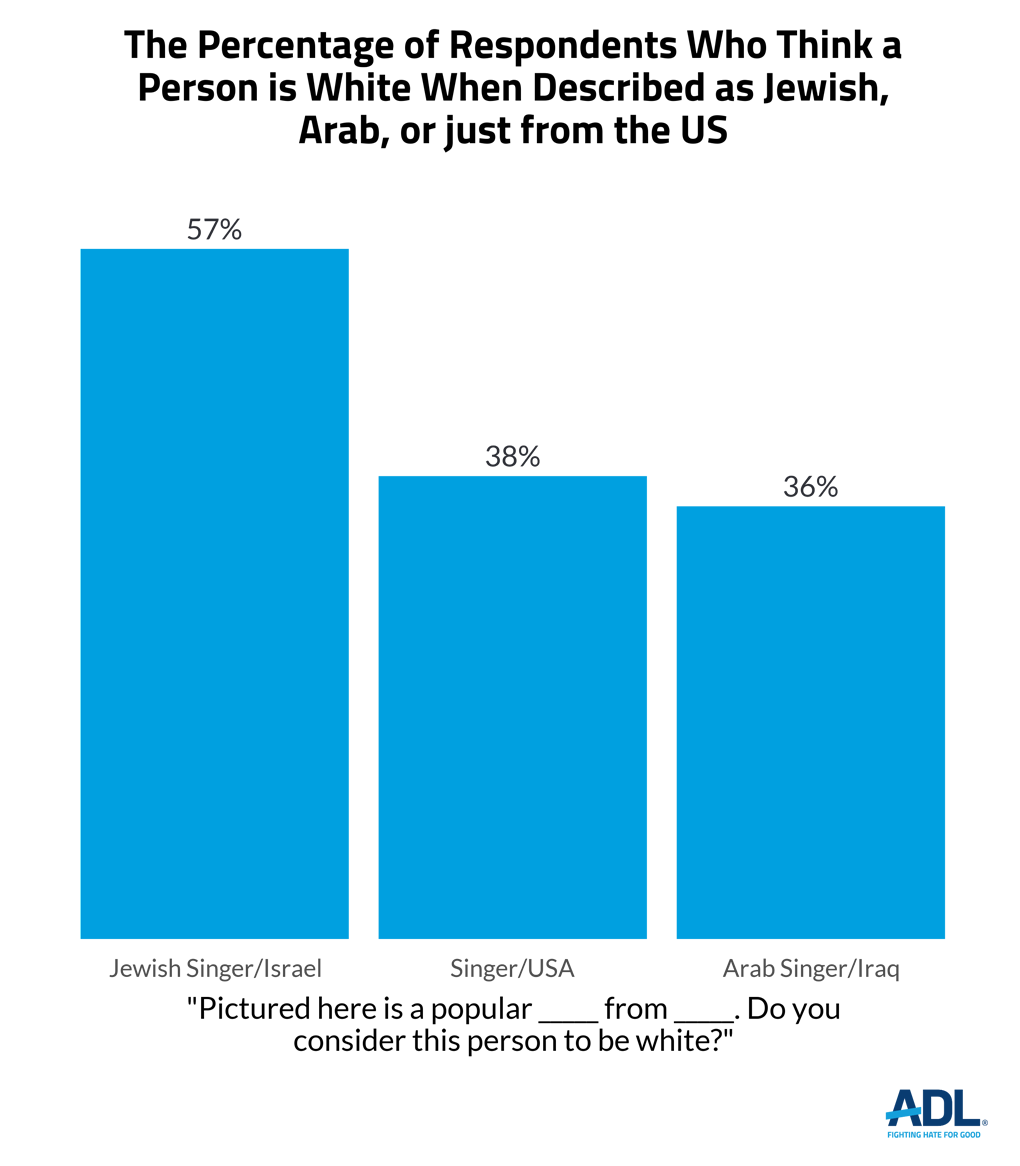

Respondents were far more likely to code the person as White if he was identified as Jewish. That there was no significant distinction in answers between the "Iraqi Arab" and "American" labels suggests that this is a function of Jewishness "Whitening" the subject. This, in turn, provides strong evidence in support of Hypothesis 1.

But what was the result of this perception? Hypothesis 2a (the traditional account) suggests that viewing the person as White should be associated with reduced antisemitic views (he's an "insider", "one of us", or a member of a respected, preferred group). Hypothesis 2b (the revisionist account) suggests the opposite: that viewing the person as White should be associated with increased antisemitic views (he's a member of the dominant caste, an oppressor).

The study found that for White respondents, viewing the pictured person as White was associated with significantly lower levels of antisemitic sentiment -- supporting the traditional account. But perhaps this is not too surprising -- the sorts of White persons invested in denying Jewish Whiteness may be especially prone to antisemitic aggression. We might think that non-White persons, for whom being White is of course not an assertion of commonality,  would push in the opposite direction. But the study found that, for non-White respondents, viewing Jews as White had no relationship to the prevalence of antisemitic attitudes. This significantly weakens the evidentiary support for the revisionist hypothesis even in its supposedly strongest turf (21st century non-White respondents).

I'll want to dive into this in more detail, of course. But what a fascinating contribution!

Sunday, February 02, 2014

This is How I Vacation

I'm taking my first vacation from work next week (week of February 10). I'm taking vacation now in part because its my birthday on February 11 (and who wants to celebrate in the office), and in part because I didn't take vacation over the holidays because I had volunteered to work on a bunch of cases with filings on or close to New Year's Day. In the immediate term, this means that I have a ton of work to do this week, since I'm trying to get it in under the wire. But nonetheless, it is very exciting -- I'm looking forward to having the week off.

People have asked me "where [I am] going" for my vacation, to which I have answered "my bed." I don't like traveling much to begin with, and in the context of a vacation I view it as basically sacrificing at least a half day if not more for no discernable benefit. I can sleep in and read books in my apartment just fine. Which leads to the second primary way I've prepared for my vacation: buying five books on deliberative democracy, which I will use to help write a new law review article I'm working on.

I haven't mentioned that part of the vacation plan at the office yet, but if I did I'm sure they'd look at me like I'm crazy. "You're taking a vacation from being a lawyer by doing a bunch of legal (or law-related) reading and writing?" This response makes superficial sense, but I honestly can't parse it. I understand why someone might not be interested in doing academic research and writing for fun, but they of all people should know that such work is a far cry from our day-to-day legal work. This is not a postman going for a walk on his day off.

I'm reminded of a story from when I was a summer associate at the firm. I was at some after-work event (I think it was basketball), and I had brought a book to read during the downtime -- a retrospective honoring the career of Iris Marion Young. A well-meaning associate saw me reading the book and said, concerned, "I hope you're not working tonight!" Now, of course, he was absolutely right that a summer associate should not have to be working through a Friday night after-work firm event -- that's the whole point of being a summer! And I told him no, this book was just for pleasure. But I wanted to say "buddy, if there's a practice group here where I might plausibly be reading books on contemporary feminist theory and democratic practice for work, by all means direct me to them right now because I need to get on that train."

In any event, writing is how I relax. Reading is how I relax. Firm life gives a lot of opportunities to read and write, of course, but not always in the forms and topics one might like. So for my vacation, I'm going to read what I want to read and write what I want to write, and I assure you I will enjoy the break thoroughly.

Monday, April 08, 2013

The Appearance Gap

During the recent Kamala Harris incident (wherein Barack Obama, in the course of calling Harris "brilliant", "dedicated", and "tough", also called her "the best looking attorney general"), a common reaction was that Obama's statement was an innocent compliment and any negative reaction was just over-sensitivity (see here for an example). What's the harm in a nice compliment?

The answer was always that such remarks -- even when complimentary on face -- make it harder for women to be taken seriously and thus hurt their entry and advancement in professional spaces. And lo and behold! New research bears this argument out (via). The study tracked what happened in a hypothetical match-up between a male and female candidate depending on whether the women's appearance was remarked upon. It found that when the female candidate's appearance was mentioned -- regardless of whether the mention was positive, negative, or neutral -- it caused a material drop in her poll numbers. To be sure, the study did not similarly measure the effect of mentioning the male candidate's appearance, so we don't know if men would be burdened in the same way. But since it is fair to say that a woman's appearance is far more likely to gain attention in the media than a man's, the finding is still important even if the effects would theoretically be entirely gender-blind.

Sunday, May 15, 2011

Ignorance is the Best Disinfectant

Kevin Drum points to Boston Globe story casting doubt on whether disclosure of conflicts-of-interest is a useful check against abuses.

Basically, researchers ran a study where one set of people was asked to make an appraisal (say, the value of a house), and another was designated experts to assist them in their appraisal. When the experts were given a conflict of interest (being paid more based on how high the appraisers valued the house), they gave inferior advice. Big surprise. But when the experts were forced to disclose their conflict, they gave even worse advice. And, the appraisers were more likely to listen to the conflicted-experts, because they didn't want to seem untrusting after the appraiser disclosed their conflict. So massive failure all around.

This reminds me of a similar story regarding a law mandating transparency in corporate executive compensation. It was passed during one of those scandals over how ridiculous corporate salaries were, and the idea was "we'll shame them into bringing their compensation practices down to earth." Well, all that happened was now all the companies knew what their competitors were paying, and all the companies below the median immediately hiked their salaries to match the market. And those above median? Well, they thought they were just rewarding good work, and wanted to maintain their edge at attracting talent -- so they jacked up their compensation too. Yay, bidding war!

Monday, August 17, 2009

Research Assistance

A new study indicates that 90% of U.S. bills carry on them traces of cocaine. $1 bills are less likely than other denominations to be contaminated, leading the head researcher to make this observation:
"Probably $1 is a little too less to purchase cocaine," [U-Mass Dartmouth Prof. Yuegang] Zuo said "I don't know exactly [why]. It's an educated guess."

Not that ... I ... would know anything about that. I'm just guessing. Who knows why? Who says I'm paranoid!?!

Saturday, August 25, 2007

Building a Better Jury

I've been reading this fascinating study by Samuel R. Sommers of Tufts University that was published last year in the Journal of Personality and Social Psychology. I mentioned the study on the blog when it came out, but I didn't get the opportunity to read it until now. Basically, it measures the performance difference between racially homogeneous and heterogeneous juries (the former being all White, the latter consisting of four Whites and two Blacks), all of whom separately deliberated on the same "case". On a variety of metrics, blind observers found that members of the heterogeneous juries outperformed their homogeneous peers. Specifically, the heterogeneous juries deliberated longer, discussed more facts, were less likely to state factual inaccuracies, were more likely to correct factual inaccuracies when they did occur, discussed more "missing" evidence (e.g., inquire as to why certain testimony wasn't presented or why there was no fingerprint evidence, and what it meant), were more likely to discuss racism-related issues, and were less likely to reflexively object when race issues were brought up. These benefits were shared by the White and Black jurors alike. That is to say, the increased deliberation wasn't because Black jurors wished to press deliberations for a longer period, pushing the average up. Rather, in heterogeneous environments, both White and Black jurors both displayed a stronger commitment to a deeper, more rigorous examination of the facts and issues surrounding the case (the specific methodology and mechanics of the study are laid out in the article).

Another interesting implication is how these findings relate to other studies which have elucidated some of the harms of diversity. These harms generally play out in terms of reduced group cohesion and morale, or increased intra-group conflict. While Sommers did not find any difference between the diverse and homogeneous juries in the perception of intra-group conflict, he argues that even where that is a significant risk, in some circumstances it might be outweighed.
But even when conflict accompanies the potential benefits of diversity, one wonders whether this is often a risk worth taking. Threats to morale can be temporary and overcome as a group acclimates to heterogeneity (Jehn et al., 1999; Watson et al., 1993). Furthermore, a little discomfort may be good if, as the present data suggest, groups’ natural tendency is to stifle discussion of controversial or unpopular topics. Many a group has goals beyond a harmonious existence, whether the decision making of committees or the performance of students in a classroom. The present findings raise the possibility that dwelling on the negative interpersonal effects of racial diversity can be shortsighted and may prevent realization of long-term performance benefits. This leads to the more general conclusion that too little attention is often paid to the threat posed by group homogeneity. Debate regarding diversity usually centers on the costs and benefits of seeking heterogeneity, but what about the alternative status quo? An extreme interpretation of the present data is that compared with racially diverse groups, homogeneous groups were lazy information processors, prone to inaccuracies, unwilling to consider uncomfortable topics, and superficial in their discussions. A kinder conclusion would be that homogeneous groups spent less time on their decisions, made more errors, and considered fewer perspectives. In either case, homogeneity was associated with performance decrements, and this is not the first time such a relationship has been noted (Janis, 1982; Kameda & Sugimori, 1993; Wilkenfeld, 2004). Nonetheless, in both popular discourse and scientific examination, cost-benefit analyses of homogeneity are too often left implied or ignored altogether in efforts to evaluate diversity. (608-609)

Where maximum performance is considered to be more important than maximum harmony, diversity should be pursued even where there are risks of fostering some reduction in intra-group morale. Juries would seem to be an obvious instance where this is the case, and I'd argue that this is also so in many of our social and democratic institutions.

I've long argued that diversity (including racial diversity) is a just end for governmental and social bodies to pursue because diversity makes institutions better at what they do. Sommers' study has laid some of the empirical groundwork that indicates that this is, in fact the case. Where racial diversity can be tied to a bona fide job requirement, even conservatives have conceded that affirmative action to pursue it is constitutional and appropriate (see Wittmer v. Peters, 87 F.3d 916, 920 (7th Cir. 1996) (opinion by Judge Richard Posner)). Sommers' study indicates the possibility that these situations exist in far more circumstances than many of us had imagined.

***

Samuel R. Sommers, "On Racial Diversity and Group Decision Making: Identifying Multiple Effects of Racial Composition on Jury Deliberations," Journal of Personality and Social Psychology, Vol. 90, No. 4, pp. 597–612 (2006)