A paper by Robert George, Sherif Girgis, and Ryan Anderson (H/T) seeking to defend the moral propriety of restricting marriage to heterosexuals, is making the rounds in right-ward circles.
I don't think it's particularly impressive. For a piece that purports to provide a positive case for the intrinsically heterosexist quality of marriage, its positive case is remarkably thin -- solely occurring in Part I.B, pp. 252-259, and effectively only in Part I.B.1, pp. 253-255. That argument, claiming that only generative sex can provide a truly comprehensive "bodily union", seems to be a recycled and cross-applied version of the arguments John Finnis made to argue that homosexual sex was intrinsically immoral -- an argument that I think was definitively shredded by Catholic legal scholar Michael Perry over a decade ago.* (The other two arguments contained in Part I.B are scarcely worth mentioning. George's claims in I.B.2 regarding the intrinsic superiority of heterosexual marriage over gay marriage as an environment for rearing children are on the margins of the relevant literature in the field. And I.B.3 is a less-than-one-page blip that tosses out some disconnected rhetoric on "marriage norms" that, by the author's own admission, are dependent on accepting the points made previously in the section.).
Returning to the Perry/Finnis discourse, it's notable, I think, how this debate does seem to be reprising similar ones over whether the state can morally proscribe homosexual conduct -- a debate that raged hot and heavy until approximately 9 months after Lawrence v. Texas. Once that case came down and the requisite fulmination about "activist judges" had subsided, the moral case for outlawing sodomy effectively died -- virtually nobody, not even virulent gay rights opponents, is willing to admit they want to recriminalize sodomy in the United States.
However, I don't think the function of George's argument is to persuade. That isn't to say that he doesn't believe what he wrote, or that many others don't agree with him. But I highly doubt that there is anybody who started sympathetic to marriage equality, who will be remotely convinced by George's argument.
The function of George's argument, in conservative circles, is to restore the question's status as one of reasonable disagreement. A considerable chunk of the conservative movement, privately, has no problem with gay rights. They may oppose gay marriage as a matter of political expedience, but once it becomes reality (and it will, slowly, fitfully, but inexorably), they don't expect the sky to fall. It is a closer cousin to sodomy than abortion in this respect -- once the battle is won, the issue will die. And they know this. They know where the nation is headed. They can't expect this to be a live issue in 50 years.
These people know they're on the wrong side of history. And yet, they still have to sleep at night, knowing who they've crawled into bed with (so to speak). And that's where Professor George comes in. He makes this issue look like something complicated -- a question upon which it is reasonable to expect some folks to be mistaken. There is no shame in being wrong about such an issue, after all. We expect a considerable chunk of the population to get hard questions wrong. It's not a moral failing. And consequently, there is no moral failing in allying with such people. It'd be akin to disowning an early 20th century scientist for initially doubting Einstein.
Of course, the issue really isn't that complicated. Professor George's argument is, as one commenter put it, "trying, desperately, to find some way, any way to overcome the naturalistic fallacy ... and of course, failing." There is a lot of totemic hand-waving towards this idea of "bodily union", but it is an argument which lies on a precariously thin reed of "biological compatibility" -- a naturalistic fallacy if there ever was one, and the style of argument that, as noted, Perry had long-since dismantled.
To my conservative friends who think that George's article will give them cover for their dalliances with the merchants of discrimination -- will shield them from the harsh judgment of history's gaze -- know this: it won't. This issue will not be seen as one of reasonable disagreement whose ultimate answer was, by the year 2010, still in doubt. This issue will be seen as the premier civil rights challenge of our times. And the enablers of the old, discriminatory ethos will be found guilty. Mark my words on that.
* Michael J. Perry, The Morality of Homosexual Conduct: A Response to John Finnis, 9 Notre Dame J. L. Ethics & Pub. Pol'y 41 (1995).
UPDATE: Vice President Joe Biden just said it is "inevitable" our nation will eventually reach a consensus in favor of gay marriage, and, following DADT repeal, mentioned DOMA as the likely next piece of the anti-gay agenda to fall. An interesting statement, given that then-Senator Biden was among the "yea" votes for the Defense of Marriage Act when it originally passed in 1996.
Friday, December 24, 2010


Thursday, December 23, 2010
Basic Instincts
For much of his career, Sen. John McCain (R-AZ) was one of the foremost champions of immigration reform. Then a few things happened. He lost the 2008 election to Barack Obama -- an event which unquestionably left him spectacularly bitter. He also faced a right-wing primary challenger in 2010 that left him racing to deny he ever was a maverick.
And so when the DREAM Act came to the floor, McCain voted nay. Grant Woods, an old friend of McCain and his first chief of staff, explains why:
So basically, much like everything else McCain has done over the past two years, his DREAM Act vote was a fit of pique to wound those who kept him out of the Oval Office. Of course, it's no mystery why Latinos broke hard for Democrats in 2008, and it seems like their instincts that Senator McCain was naught but a fair-weather friend were spot on. "Country first", indeed.
And so when the DREAM Act came to the floor, McCain voted nay. Grant Woods, an old friend of McCain and his first chief of staff, explains why:
Woods said "it hurts" McCain to vote against legislation like the Dream Act after years of working on reform but said the senator felt betrayed when Latinos overwhelmingly supported Obama in 2008. "When you carry that fight at great sacrifice year after year and then you are abandoned during the biggest fight of your life, it has to have some sort of effect on you," he said.
So basically, much like everything else McCain has done over the past two years, his DREAM Act vote was a fit of pique to wound those who kept him out of the Oval Office. Of course, it's no mystery why Latinos broke hard for Democrats in 2008, and it seems like their instincts that Senator McCain was naught but a fair-weather friend were spot on. "Country first", indeed.
Gay Men Get all the Breaks
What could be more entertaining that primer by a conservative Christian website on how to find out if your husband's gay? Nothing, that's what! Seriously -- this is hilarious. It's like someone took a catalog of gay stereotypes and added bullet points. Although, some of them are pretty tragic. Only gay men are sarcastic? Only gay men are interested in "strange sexual demands" (like, oh, say, lubricant? No, really)? Only gay men can travel alone to big cities? Only gay men groom?
Really, is this a warning for wives or an advertising pitch for men? You know what "they" say: "Once you try man, you're always a fan."
UPDATE: Doh! Got taken in by a satirical website. Egg on my face.
Really, is this a warning for wives or an advertising pitch for men? You know what "they" say: "Once you try man, you're always a fan."
UPDATE: Doh! Got taken in by a satirical website. Egg on my face.
Boxing Labels: A Typology
A few years ago, I read a news report on Carlos Baldomir's miraculous 2006, in which he scored a shocking upset over Zab Judah to win the Ring Magazine lineal welterweight championship (he then defended the title against Arturo Gatti before losing a lopsided decision to Floyd Mayweather Jr. later that year). In the story, Baldomir was referred to as a "journeyman", and I remember being quite offended. Obviously, Baldomir is not in the same league as a Floyd Mayweather, but there's a significant difference between someone who, even on a great night, is capable of becoming lineal welterweight champion, and a Reggie Strickland.
To try and rectify that, I'm trying to create a typology of boxing labels, so fighters are referred to properly and given their just due. I'm not saying they're perfect, or even that I myself have or will use them consistently. But I think they're solid benchmarks.
Superstar, Star, and Action Star
The best of the best (with one caveat, see below). What makes one a star (of any variety), in my book, is that one's fights are meaningful simply because the fighter is participating in them (and not because, say, a title is on the line). So, for example, Bernard Hopkins and Kelly Pavlik fought at a catchweight in 2008, with no belt at stake. But the fight still mattered, because Hopkins and Pavlik were in it. Obviously, a belt can help make a fight even more meaningful (e.g., Sergio Martinez and Paul Williams II for the lineal middleweight title), but the point is the fighters exert an independent gravitational pull.
Within the category, a superstar is a boxer whose popularity transcends the sport itself. A star's fights are important to boxing fans, but a superstar's fights are important to the public. Superstars show up in Nike commercials and are guests on Dancing with the Stars. They're the folks who, if you ask a random guy off the street what they think of boxing, respond "I don't watch it, but I hear that Pak-kow guy is pretty good."
An interesting permutation of this group is the action star. Unlike stars or superstars, an action fighter may not be amongst the sports elite. But like other stars, his fights are meaningful because of the fighter, not the belt. Usually that's because the boxer fights with an exciting style and has won a ton of fans. Arturo Gatti is perhaps the prototypical example of this: his fights were important because they were Gatti fights, but Arturo Gatti was never really amongst the sports top fighters. He was just an raw, brawling, tough, exciting-as-hell slugger, and folks loved him for it.
Examples
Superstars: Manny Pacquiao, Floyd Mayweather
Stars: Bernard Hopkins, Shane Mosley, Miguel Cotto
Action Stars: John Duddy, Arturo Gatti
Champions and Titlists
This category exists parallel to the above -- one can be star and a titlist or champion, or one but not the other (or, of course, neither). A titlist is someone in possession of a sanctioning body belt, while a champion is the holder of the lineal, Ring Magazine title (a/k/a, "the guy who beat the guy who beat the guy") in his weight class. One would hope that most of the fighters good enough to win titles are stars in their own right, but it's not always the case (any Vyacheslav Senchenko fans in the house?). Even a champion doesn't necessarily have to be a star -- perhaps Carlos Baldomir is an example of that. And on the flip side, one can definitely be a star with no titles in one's hands -- Bernard Hopkins being a prime example right now.
Examples
Champions: Sergio Martinez (Middleweight), Juan Manuel Marquez (Lightweight) (note that both of these fighters are also stars in their own right).
Titlists: Andre Ward (Super Middleweight), Vyacheslav Senchenko (Welterweight) (Ward is also a star, but Senchenko most certainly isn't).
Contenders and Fringe Contenders
What makes a contender? A contender is someone who is not a star, doesn't have a title, but most observers think would have a decent chance of winning one on any given night he's put in the ring with a titlist. A contender might be as good or better than a current titlist -- he just happens not to be in possession of a belt. A fringe contender is someone who, on any given night, may be able to beat another contender, and fighting the fight of his life could upset a true titlist. A title bout against a fringe contender is generally considered a weak but not inexcusable defense (but one would rather see them defend against a true contender). Fringe contenders often also double as high-level gatekeepers (see below).
Examples
Contenders: Sakio Bika (Super Middleweight), Luis Collazo (Welterweight)
Fringe Contenders: Ray Austin (Heavyweight), Said Ouali (Welterweight)
Gatekeepers
Gatekeepers have widely varied divergent skill levels. What they share in common is their service as a measuring stick for prospects (below), letting observers get a gauge for how good another fighter is. Each one is a milestone for a fighter, letting them know they have progressed to a certain skill level. Gatekeepers are generally expected to lose to the prospects they face, but it's not necessarily a foregone conclusion -- the whole point is to test whether the guy is for real, or just a hype job. Consequently, gatekeepers usually have some amount of skill, sufficient to actually test young talent. Since they are "supposed" to lose, unfortunately, it also means they're often on the wrong end of the decision in tightly contested (sometimes not-so-tightly contested) fights.
Examples
Zuri Lawrence (Heavyweight), Jerson Ravelo (Light Heavyweight).
Prospects
Who counts as a prospect? It's a little arbitrary, but I would say a prospect is someone who we can imagine reaching at least contender status at the pinnacle of his career. Of course, they're not there yet, and there is another degree of arbitrariness as to when a fighter graduates from prospect to contender. Incidentally, prospects skip over the "fringe contender" stage -- a fringe contender is nearly invariably someone who was once a contender but has since shown they couldn't hack it at that level.
Examples
Matvey Korobov (Middleweight), Sadam Ali (Welterweight)
Journeymen
Everybody else. Journeymen are the lifeblood of boxing. Most cards are filled with journeymen -- sometimes fighting each other, sometimes being fed to a prospect. They have a wide variety of records and talent levels. Sometimes they can even rise above their humble origins and become a fringe contender (or even a real one). Sometimes they're simply tomato cans. But in any event, they're worth saluting.
Examples
Reggie Strickland (Super Middleweight), Peter Buckley (Welterweight).
There's one category of fighter I can't think of a good label for -- and, ironically, it might be what characterized Baldomir before his fight against Judah. These are folks who have been fighting too long to be really be called prospects, but are effectively unknown against upper-level competition (they often are pretty obscure, until they get brought in as a random opponent for a name-guy). On the other hand, they're clearly better than journeymen, and it seems unfair to group them with the Peter Buckley's of the world. "Fringe Contender" probably comes the closest with respect to their typical talent level, but they haven't been hanging around the fringes of the division's top 10, so we don't really know for sure.
Suggestions would be appreciated -- but do them a favor, and don't call them "journeymen". They're better than that, and they deserve a better name than that.
To try and rectify that, I'm trying to create a typology of boxing labels, so fighters are referred to properly and given their just due. I'm not saying they're perfect, or even that I myself have or will use them consistently. But I think they're solid benchmarks.
Superstar, Star, and Action Star
The best of the best (with one caveat, see below). What makes one a star (of any variety), in my book, is that one's fights are meaningful simply because the fighter is participating in them (and not because, say, a title is on the line). So, for example, Bernard Hopkins and Kelly Pavlik fought at a catchweight in 2008, with no belt at stake. But the fight still mattered, because Hopkins and Pavlik were in it. Obviously, a belt can help make a fight even more meaningful (e.g., Sergio Martinez and Paul Williams II for the lineal middleweight title), but the point is the fighters exert an independent gravitational pull.
Within the category, a superstar is a boxer whose popularity transcends the sport itself. A star's fights are important to boxing fans, but a superstar's fights are important to the public. Superstars show up in Nike commercials and are guests on Dancing with the Stars. They're the folks who, if you ask a random guy off the street what they think of boxing, respond "I don't watch it, but I hear that Pak-kow guy is pretty good."
An interesting permutation of this group is the action star. Unlike stars or superstars, an action fighter may not be amongst the sports elite. But like other stars, his fights are meaningful because of the fighter, not the belt. Usually that's because the boxer fights with an exciting style and has won a ton of fans. Arturo Gatti is perhaps the prototypical example of this: his fights were important because they were Gatti fights, but Arturo Gatti was never really amongst the sports top fighters. He was just an raw, brawling, tough, exciting-as-hell slugger, and folks loved him for it.
Examples
Superstars: Manny Pacquiao, Floyd Mayweather
Stars: Bernard Hopkins, Shane Mosley, Miguel Cotto
Action Stars: John Duddy, Arturo Gatti
Champions and Titlists
This category exists parallel to the above -- one can be star and a titlist or champion, or one but not the other (or, of course, neither). A titlist is someone in possession of a sanctioning body belt, while a champion is the holder of the lineal, Ring Magazine title (a/k/a, "the guy who beat the guy who beat the guy") in his weight class. One would hope that most of the fighters good enough to win titles are stars in their own right, but it's not always the case (any Vyacheslav Senchenko fans in the house?). Even a champion doesn't necessarily have to be a star -- perhaps Carlos Baldomir is an example of that. And on the flip side, one can definitely be a star with no titles in one's hands -- Bernard Hopkins being a prime example right now.
Examples
Champions: Sergio Martinez (Middleweight), Juan Manuel Marquez (Lightweight) (note that both of these fighters are also stars in their own right).
Titlists: Andre Ward (Super Middleweight), Vyacheslav Senchenko (Welterweight) (Ward is also a star, but Senchenko most certainly isn't).
Contenders and Fringe Contenders
What makes a contender? A contender is someone who is not a star, doesn't have a title, but most observers think would have a decent chance of winning one on any given night he's put in the ring with a titlist. A contender might be as good or better than a current titlist -- he just happens not to be in possession of a belt. A fringe contender is someone who, on any given night, may be able to beat another contender, and fighting the fight of his life could upset a true titlist. A title bout against a fringe contender is generally considered a weak but not inexcusable defense (but one would rather see them defend against a true contender). Fringe contenders often also double as high-level gatekeepers (see below).
Examples
Contenders: Sakio Bika (Super Middleweight), Luis Collazo (Welterweight)
Fringe Contenders: Ray Austin (Heavyweight), Said Ouali (Welterweight)
Gatekeepers
Gatekeepers have widely varied divergent skill levels. What they share in common is their service as a measuring stick for prospects (below), letting observers get a gauge for how good another fighter is. Each one is a milestone for a fighter, letting them know they have progressed to a certain skill level. Gatekeepers are generally expected to lose to the prospects they face, but it's not necessarily a foregone conclusion -- the whole point is to test whether the guy is for real, or just a hype job. Consequently, gatekeepers usually have some amount of skill, sufficient to actually test young talent. Since they are "supposed" to lose, unfortunately, it also means they're often on the wrong end of the decision in tightly contested (sometimes not-so-tightly contested) fights.
Examples
Zuri Lawrence (Heavyweight), Jerson Ravelo (Light Heavyweight).
Prospects
Who counts as a prospect? It's a little arbitrary, but I would say a prospect is someone who we can imagine reaching at least contender status at the pinnacle of his career. Of course, they're not there yet, and there is another degree of arbitrariness as to when a fighter graduates from prospect to contender. Incidentally, prospects skip over the "fringe contender" stage -- a fringe contender is nearly invariably someone who was once a contender but has since shown they couldn't hack it at that level.
Examples
Matvey Korobov (Middleweight), Sadam Ali (Welterweight)
Journeymen
Everybody else. Journeymen are the lifeblood of boxing. Most cards are filled with journeymen -- sometimes fighting each other, sometimes being fed to a prospect. They have a wide variety of records and talent levels. Sometimes they can even rise above their humble origins and become a fringe contender (or even a real one). Sometimes they're simply tomato cans. But in any event, they're worth saluting.
Examples
Reggie Strickland (Super Middleweight), Peter Buckley (Welterweight).
There's one category of fighter I can't think of a good label for -- and, ironically, it might be what characterized Baldomir before his fight against Judah. These are folks who have been fighting too long to be really be called prospects, but are effectively unknown against upper-level competition (they often are pretty obscure, until they get brought in as a random opponent for a name-guy). On the other hand, they're clearly better than journeymen, and it seems unfair to group them with the Peter Buckley's of the world. "Fringe Contender" probably comes the closest with respect to their typical talent level, but they haven't been hanging around the fringes of the division's top 10, so we don't really know for sure.
Suggestions would be appreciated -- but do them a favor, and don't call them "journeymen". They're better than that, and they deserve a better name than that.
Wednesday, December 22, 2010
Fabulous Prizes
Throw this in the I'm an awful person for laughing pile. Is it hypocritical, though, for me to also be appalled at Fox News' carelessness?
Tuesday, December 21, 2010
The Big Announcement
So, I feel I've been teasing you with promises of news for awhile. It wasn't intentional, I swear -- I really was consistently on the edge of being able to announce stuff, and events kept transpiring to put it off. But now, I can finally reveal the entire story -- as well as my employment for the next two years.
This past September, I was offered and accepted a clerkship for the 2012-2013 term with Judge Diana Murphy on the 8th Circuit Court of Appeals, Minneapolis.
And next year, I will be a visiting professor in the Academic Fellows program at the University of Illinois law school.
These are both incredibly exciting opportunities. Judge Murphy and I really clicked in the interview -- I can't tell you how much I am looking forward to getting a chance to work with her (and Jill isn't displeased with getting to go back to the old homestead for a year).
But the Illinois position -- which I just found out about today -- represents the attainment of a dream I've been pursuing for nearly a decade. Obviously, it's not permanent, and there's a lot of things I still need to do. But starting next August, I will be able to say that I am a law professor.
The story of how this all came about is, I think, worth recounting -- and hopefully will justify the slow-roll of the news. My interview with Judge Murphy was at 7:30 AM on the first Thursday that "on-plan" federal judges could conduct interviews. It was, as I said, going fantastically -- we really seemed to click in a way that I can honestly say has never happened (at least so smoothly) in any job interview I've ever had.
Unfortunately, Judge Murphy had already finished hiring for 2011-12 term at 7 AM (yeah, I thought 7:30 was a prime slot too). But she immediately made me an offer for the following term (2012-13).
This presented a problem, for Covington had recently revised their clerkship policy such that attorneys could no longer start with the firm, then leave to clerk. We could graduate, clerk, and then begin with the firm, but they didn't want a situation where incoming attorneys got a few months of training and then, just when they began to be integrated into cases and clients, they left again.
That was the original reason why I couldn't announce the clerkship -- without something for the 2011-12 year, I couldn't accept Judge Murphy's offer without running afoul of Covington's new policy. So I immediately set to work trying to find something -- another clerkship or, preferably, a teaching fellowship, to fill the gap year so I could stay in harmony with Covington's policy.
Once it became apparent that a different clerkship wasn't on the table, the first candidate was a teaching fellowship at the University of Chicago -- specifically, the Kauffman Fellowship. And it looked good -- I met with a dean, and he said that assuming the funding was renewed, he saw no reason not to hire me. And as for the funding, he didn't know what the foundation was waiting for, but he thought maybe if he told them that he had a excellent candidate lined up for next year, that would shake loose a few dollars so they could formalize things.
That was the second iteration of nearly-having news. But as you might have guessed, it didn't pan -- despite our best efforts, the funding didn't happen. So it was back to the drawing board.
Meanwhile, there was some good news -- Covington had reversed its clerkship policy (albeit with a stated preference that we not start-then-leave), meaning I could accept Murphy's offer and return to Covington next year. That was, at least, a load off my shoulder. But it did impose a November 1st deadline to accept Covington's offer. On the theory that the Kauffman fellowship should be forthcoming, I managed to secure an extension until December 1. But once the Kauffman fell through, I had to beg for more time.
I was all amped up to actually beg -- I basically had a speech prepared and everything. After the initial pleasantries, I started into my spiel, beginning with "So some things have come up, and it's looking like I won't hear anything until February/March...." and before I got any further, the legal recruiting director brightly remarked "oh, so we won't hear from you until March? Great, I'll mark it down!" I was so prepared to have to plead my case that I don't think I really processed that, and basically continued with the begging as if she hadn't said anything, which I have to imagine sounded incredibly strange until I finally managed to restore a grip on myself and thank her.
And in that extra space of time, I applied for and received this offer at Illinois -- thus bringing my long, chaotic autumn to a close.
Speaking of Covington, I do need to give them specific thanks for being so flexible with deadlines. They extended their timeline twice to accommodate me, and if they hadn't done that, I wouldn't have been able to secure this opportunity. I am so grateful for that. I also need to thank my recommenders, but in particular Lisa Bernstein, who shepherded me through this process like a pro. And of course, everyone else -- my friends, family, Jill, the whole crew -- who was so patient with me throughout this whole ordeal. I'm sure I was more than a bit manic at times, and they kept me sane.
Anyway, to close out, it seems like such a milestone in my life should have at least some impact on my blog. And you'll note at the top that I have a new tagline. It's a bit premature -- I'm not a professor yet -- but I told myself as soon as I got my first teaching gig, I'd make the change.
This past September, I was offered and accepted a clerkship for the 2012-2013 term with Judge Diana Murphy on the 8th Circuit Court of Appeals, Minneapolis.
And next year, I will be a visiting professor in the Academic Fellows program at the University of Illinois law school.
These are both incredibly exciting opportunities. Judge Murphy and I really clicked in the interview -- I can't tell you how much I am looking forward to getting a chance to work with her (and Jill isn't displeased with getting to go back to the old homestead for a year).
But the Illinois position -- which I just found out about today -- represents the attainment of a dream I've been pursuing for nearly a decade. Obviously, it's not permanent, and there's a lot of things I still need to do. But starting next August, I will be able to say that I am a law professor.
The story of how this all came about is, I think, worth recounting -- and hopefully will justify the slow-roll of the news. My interview with Judge Murphy was at 7:30 AM on the first Thursday that "on-plan" federal judges could conduct interviews. It was, as I said, going fantastically -- we really seemed to click in a way that I can honestly say has never happened (at least so smoothly) in any job interview I've ever had.
Unfortunately, Judge Murphy had already finished hiring for 2011-12 term at 7 AM (yeah, I thought 7:30 was a prime slot too). But she immediately made me an offer for the following term (2012-13).
This presented a problem, for Covington had recently revised their clerkship policy such that attorneys could no longer start with the firm, then leave to clerk. We could graduate, clerk, and then begin with the firm, but they didn't want a situation where incoming attorneys got a few months of training and then, just when they began to be integrated into cases and clients, they left again.
That was the original reason why I couldn't announce the clerkship -- without something for the 2011-12 year, I couldn't accept Judge Murphy's offer without running afoul of Covington's new policy. So I immediately set to work trying to find something -- another clerkship or, preferably, a teaching fellowship, to fill the gap year so I could stay in harmony with Covington's policy.
Once it became apparent that a different clerkship wasn't on the table, the first candidate was a teaching fellowship at the University of Chicago -- specifically, the Kauffman Fellowship. And it looked good -- I met with a dean, and he said that assuming the funding was renewed, he saw no reason not to hire me. And as for the funding, he didn't know what the foundation was waiting for, but he thought maybe if he told them that he had a excellent candidate lined up for next year, that would shake loose a few dollars so they could formalize things.
That was the second iteration of nearly-having news. But as you might have guessed, it didn't pan -- despite our best efforts, the funding didn't happen. So it was back to the drawing board.
Meanwhile, there was some good news -- Covington had reversed its clerkship policy (albeit with a stated preference that we not start-then-leave), meaning I could accept Murphy's offer and return to Covington next year. That was, at least, a load off my shoulder. But it did impose a November 1st deadline to accept Covington's offer. On the theory that the Kauffman fellowship should be forthcoming, I managed to secure an extension until December 1. But once the Kauffman fell through, I had to beg for more time.
I was all amped up to actually beg -- I basically had a speech prepared and everything. After the initial pleasantries, I started into my spiel, beginning with "So some things have come up, and it's looking like I won't hear anything until February/March...." and before I got any further, the legal recruiting director brightly remarked "oh, so we won't hear from you until March? Great, I'll mark it down!" I was so prepared to have to plead my case that I don't think I really processed that, and basically continued with the begging as if she hadn't said anything, which I have to imagine sounded incredibly strange until I finally managed to restore a grip on myself and thank her.
And in that extra space of time, I applied for and received this offer at Illinois -- thus bringing my long, chaotic autumn to a close.
Speaking of Covington, I do need to give them specific thanks for being so flexible with deadlines. They extended their timeline twice to accommodate me, and if they hadn't done that, I wouldn't have been able to secure this opportunity. I am so grateful for that. I also need to thank my recommenders, but in particular Lisa Bernstein, who shepherded me through this process like a pro. And of course, everyone else -- my friends, family, Jill, the whole crew -- who was so patient with me throughout this whole ordeal. I'm sure I was more than a bit manic at times, and they kept me sane.
Anyway, to close out, it seems like such a milestone in my life should have at least some impact on my blog. And you'll note at the top that I have a new tagline. It's a bit premature -- I'm not a professor yet -- but I told myself as soon as I got my first teaching gig, I'd make the change.
Monday, December 20, 2010
Puerto Rico!
My first trip to the Caribbean is off on the wrong foot, of the "wake up at 4:45 AM to catch the flight" variety. But I assume it's all positive from here, and I definitely could use the break.
Sunday, December 19, 2010
B-Hop the Eternal
Last night, Bernard "The Executioner" Hopkins (51-5-2, 32 KOs) came off the canvas twice in route to a majority draw with Ring Magazine light heavyweight champion Jean Pascal (26-1-1, 16 KOs). Scores were 114-112 Hopkins, 113-113, and 114-114. I had it 115-111 Hopkins, and I firmly believe he won the fight.
Many of my friends in the boxing biz were rooting for Pascal this fight. It was nothing against Hopkins, they said. Rather, it was a simple calculation about what's good for the sport. Pascal has genuine superstar potential -- he's already getting there in Canada. He could be a draw. Whereas if Hopkins wins -- well, it's another big notch on his legacy, to be sure, but it doesn't do anything for the sport. I mean, how long can he go on?
A fair point, I said. But I was rooting for Hopkins. Why? Because Pascal beating Hopkins is just a younger guy beating an older guy. But every time Hopkins wins, you're seeing something legendary. And I like watching history happen.
Scorecards notwithstanding, I think few people were not awestruck by Hopkins performance last night. It didn't start off that way, to be sure. Hopkins was dropped in the first and third rounds -- albeit the first one appeared to my eyes a clear rabbit punch. A close second round meant that Pascal could easily be up 5 points just three rounds in -- and it seemed like father time may have finally caught up to the Executioner. Worse, the score gap effectively forced Hopkins out of his usual game plan. He couldn't fight a clinching, tight, inside game -- that leads to close rounds, and Hopkins couldn't afford close rounds while in a hole on his opponent's home turf.
So instead, Hopkins did something I think very few of us thought he could. He pressed the action offensively. He began effectively stalking Pascal across the ring, landing digging body shots that had Pascal afraid to let his hands go. After the fourth round, you really had to start reaching to find rounds to give to Pascal -- a clean sweep for Hopkins would be a very reasonable assessment. It was domination, nearly as sublime as the domination put on Pavlik. And in a sense, more so -- for Hopkins did it while overcoming severe early adversity.
Given that I think the first knockdown was a blown call, it's easy for me to say that was decisive on the scorecards -- it could have swung anywhere from 1-3 points to Hopkins on all cards, giving him a unanimous decision instead of a majority draw. But boxing is funny thing -- I think those two early knockdowns forced Hopkins to fight a more aggressive and ultimately more effective fight than he had been planning. Had he not tasted canvas, would have been so offense-minded? Who knows?
So what's next? It's an interesting question. The WBC has ordered an immediate rematch, but I believe Pascal is contractually obligated to rematch Chad Dawson in his next fight. So I can easily see the WBC stripping Pascal and putting Hopkins and some schlub in a bout for the vacant belt, thus letting Hopkins gain his place in history as the oldest fighter ever to win a title.
Even post-Dawson, a rematch between Pascal and Hopkins looks dodgy. Hopkins is never setting foot out of the United States again, and Pascal will be loathe to give up the money he earns while fighting out of Quebec. There aren't many places other than Canada that Hopkins/Pascal really draws (legend that he is, Hopkins has never really been a fan attraction). Plus, I think Pascal knows in his heart of hearts that hewas lucky to escape with a draw, and will be uninterested in tempting fate further. It's a shame, but this business will likely be unfinished.
Nonetheless, tonight was another incredible performance by a man who seems to laugh in the face of age. I don't know when Bernard Hopkins finally will become old, or when he'll finally elect to hang 'em up. But I do know it's a privilege to watch him fight. And I'm greatly appreciative I got the opportunity to do so.
Many of my friends in the boxing biz were rooting for Pascal this fight. It was nothing against Hopkins, they said. Rather, it was a simple calculation about what's good for the sport. Pascal has genuine superstar potential -- he's already getting there in Canada. He could be a draw. Whereas if Hopkins wins -- well, it's another big notch on his legacy, to be sure, but it doesn't do anything for the sport. I mean, how long can he go on?
A fair point, I said. But I was rooting for Hopkins. Why? Because Pascal beating Hopkins is just a younger guy beating an older guy. But every time Hopkins wins, you're seeing something legendary. And I like watching history happen.
Scorecards notwithstanding, I think few people were not awestruck by Hopkins performance last night. It didn't start off that way, to be sure. Hopkins was dropped in the first and third rounds -- albeit the first one appeared to my eyes a clear rabbit punch. A close second round meant that Pascal could easily be up 5 points just three rounds in -- and it seemed like father time may have finally caught up to the Executioner. Worse, the score gap effectively forced Hopkins out of his usual game plan. He couldn't fight a clinching, tight, inside game -- that leads to close rounds, and Hopkins couldn't afford close rounds while in a hole on his opponent's home turf.
So instead, Hopkins did something I think very few of us thought he could. He pressed the action offensively. He began effectively stalking Pascal across the ring, landing digging body shots that had Pascal afraid to let his hands go. After the fourth round, you really had to start reaching to find rounds to give to Pascal -- a clean sweep for Hopkins would be a very reasonable assessment. It was domination, nearly as sublime as the domination put on Pavlik. And in a sense, more so -- for Hopkins did it while overcoming severe early adversity.
Given that I think the first knockdown was a blown call, it's easy for me to say that was decisive on the scorecards -- it could have swung anywhere from 1-3 points to Hopkins on all cards, giving him a unanimous decision instead of a majority draw. But boxing is funny thing -- I think those two early knockdowns forced Hopkins to fight a more aggressive and ultimately more effective fight than he had been planning. Had he not tasted canvas, would have been so offense-minded? Who knows?
So what's next? It's an interesting question. The WBC has ordered an immediate rematch, but I believe Pascal is contractually obligated to rematch Chad Dawson in his next fight. So I can easily see the WBC stripping Pascal and putting Hopkins and some schlub in a bout for the vacant belt, thus letting Hopkins gain his place in history as the oldest fighter ever to win a title.
Even post-Dawson, a rematch between Pascal and Hopkins looks dodgy. Hopkins is never setting foot out of the United States again, and Pascal will be loathe to give up the money he earns while fighting out of Quebec. There aren't many places other than Canada that Hopkins/Pascal really draws (legend that he is, Hopkins has never really been a fan attraction). Plus, I think Pascal knows in his heart of hearts that hewas lucky to escape with a draw, and will be uninterested in tempting fate further. It's a shame, but this business will likely be unfinished.
Nonetheless, tonight was another incredible performance by a man who seems to laugh in the face of age. I don't know when Bernard Hopkins finally will become old, or when he'll finally elect to hang 'em up. But I do know it's a privilege to watch him fight. And I'm greatly appreciative I got the opportunity to do so.
Saturday, December 18, 2010
The DREAM Collapses
I had expected the DREAM act to fail. The GOP is in the grip of a hysterical anti-immigration fervor, such that even children -- children who often had no choice in coming here, children who often know no other country, children who are working hard and want to go to college, or defend our freedoms in combat -- these children, to the GOP, are enemies. The concept of "terror babies" is one that could only occur in a diseased political climate.
And in terms of raw political calculation, the GOP is exceptionally worried that these new American citizens will be Democrats. Latinos already are leaning mildly Democratic, and while that's a lean that's growing more severe each year due to the aforementioned GOP anti-Latino hysteria, the fact remains that for many GOP strategists, creating new paths to citizenship means creating new Democratic voters. So, concerns of justice notwithstanding, the DREAM act was likely to fail for the same reason DC remains disenfranchised.
But I was wrong. I was wrong to lay the blame entirely on Republicans.
The cloture vote failed, 55-41. Five more votes, and it would have passed. And wouldn't you know it, but five Democrats voted against cloture. They are Senators Max Baucus (MT), Jon Tester (MT), Kay Hagan (NC), Ben Nelson (NE) and Mark Pryor (AR). Senator Pryor is, in fact, a graduate of my high school -- a fact which now thoroughly embarrasses me. Three Republicans -- Richard Lugar (IN), Lisa Murkowski (AK), and Robert Bennett (UT) -- broke with their party, along with both Senate independents, giving us our final tally.
I assumed the DREAM act would collapse because I assumed Republicans would not let it pass. And let's be clear -- the vast majority of the Senate GOP voted against the bill. We should harbor no illusions: they are primarily at fault here. And it's worth noting that the DREAM supporters did their job -- they got the support of a majority of Americans, a majority of House members, a majority of Senators, and the President. It is a sign of our dysfunctional times that this wasn't sufficient.
But the point isn't about laying blame down. I had been fatalistic about the DREAM act because I assumed it was a sure-fire victim of GOP obstruction -- something that would fail even if the Democrats managed to keep a united front. But it wasn't. They needed Democratic help. And they got it. Five Democrats, whose presence in my party shames me.
Part of me wants to close with some tripe about how we're the real victims here -- about how America is hurt when we turn away smart, motivated kids who have worked hard to get into college, or have sworn the deepest oath imaginable to our nation by agreeing to serve in uniform. And we are hurt by our short-sightedness, no doubt. But the real victims remain the immigrants themselves -- shut out of the only country they known by a political class that is willing to turn children into monsters.
And in terms of raw political calculation, the GOP is exceptionally worried that these new American citizens will be Democrats. Latinos already are leaning mildly Democratic, and while that's a lean that's growing more severe each year due to the aforementioned GOP anti-Latino hysteria, the fact remains that for many GOP strategists, creating new paths to citizenship means creating new Democratic voters. So, concerns of justice notwithstanding, the DREAM act was likely to fail for the same reason DC remains disenfranchised.
But I was wrong. I was wrong to lay the blame entirely on Republicans.
The cloture vote failed, 55-41. Five more votes, and it would have passed. And wouldn't you know it, but five Democrats voted against cloture. They are Senators Max Baucus (MT), Jon Tester (MT), Kay Hagan (NC), Ben Nelson (NE) and Mark Pryor (AR). Senator Pryor is, in fact, a graduate of my high school -- a fact which now thoroughly embarrasses me. Three Republicans -- Richard Lugar (IN), Lisa Murkowski (AK), and Robert Bennett (UT) -- broke with their party, along with both Senate independents, giving us our final tally.
I assumed the DREAM act would collapse because I assumed Republicans would not let it pass. And let's be clear -- the vast majority of the Senate GOP voted against the bill. We should harbor no illusions: they are primarily at fault here. And it's worth noting that the DREAM supporters did their job -- they got the support of a majority of Americans, a majority of House members, a majority of Senators, and the President. It is a sign of our dysfunctional times that this wasn't sufficient.
But the point isn't about laying blame down. I had been fatalistic about the DREAM act because I assumed it was a sure-fire victim of GOP obstruction -- something that would fail even if the Democrats managed to keep a united front. But it wasn't. They needed Democratic help. And they got it. Five Democrats, whose presence in my party shames me.
Part of me wants to close with some tripe about how we're the real victims here -- about how America is hurt when we turn away smart, motivated kids who have worked hard to get into college, or have sworn the deepest oath imaginable to our nation by agreeing to serve in uniform. And we are hurt by our short-sightedness, no doubt. But the real victims remain the immigrants themselves -- shut out of the only country they known by a political class that is willing to turn children into monsters.
Friday, December 17, 2010
Early Signs for Obama '12 Are (Mildly) Positive
It was a rough cycle in 2010, but the odds seem favorable for Obama in 2012, based on some early polling -- including some figures that frankly surprised me.
One the perils of being a liberal is that we always seem to think we're isolated from the American people. It's not a crisis of principle -- we think we're right, of course -- we just tend to think of ourselves as members of a small, enlightened minority. It's a theme hammered in relentlessly by the media ("Liberal coastal latte-sipping elites can't connect with real Americans!"), and trap I fall into myself, sometimes.
So while I like President Obama quite a bit, after months of coverage wherein Obama was persistently referred to as an out-of-touch, distant, elitist, socialist, Marxist, fascist, pick-your-favorite-ist, enemy of America -- I figured that most Americans didn't really like Obama much anymore, personally or professionally.
But that's only half true. Obama's job approvals have been hovering in the mid-40s for months. But his personal approvals are still sky-high -- 72%. Of course, Republicans still loathe him, and being personally-liked doesn't secure re-election by any means (folks could think he's a decent-enough guy who's in over his head). But it's a far more resilient number than I would have expected.
And it seems to be bearing out when you do some early head-to-heads. Put Obama against Mitt Romney -- a generic "known" Republican, and he's up 47-40. Not fabulous to be under 50%, but still a decent spread. Obama versus a generic unknown Republican -- played helpfully by Sen. John Thune (R-SD) -- and you get Obama ahead by 47-27.
So the baseline right now seems to be that at least 47% of the country would vote for Obama right now against your typical Republican. But what about against the Ice Queen herself, Sarah Palin? Once again, my fear of being out-of-touch rears its head -- sure, I detest the former half-term Governor, but is that just me?
Looks like it's not. Obama trounces Palin, 55-33. That's a rather massive leap. Republicans may be enamored with their last VP nominee, but the country can't stand her. And she manages to give Obama an 8 point bump above his baseline score.
One the perils of being a liberal is that we always seem to think we're isolated from the American people. It's not a crisis of principle -- we think we're right, of course -- we just tend to think of ourselves as members of a small, enlightened minority. It's a theme hammered in relentlessly by the media ("Liberal coastal latte-sipping elites can't connect with real Americans!"), and trap I fall into myself, sometimes.
So while I like President Obama quite a bit, after months of coverage wherein Obama was persistently referred to as an out-of-touch, distant, elitist, socialist, Marxist, fascist, pick-your-favorite-ist, enemy of America -- I figured that most Americans didn't really like Obama much anymore, personally or professionally.
But that's only half true. Obama's job approvals have been hovering in the mid-40s for months. But his personal approvals are still sky-high -- 72%. Of course, Republicans still loathe him, and being personally-liked doesn't secure re-election by any means (folks could think he's a decent-enough guy who's in over his head). But it's a far more resilient number than I would have expected.
And it seems to be bearing out when you do some early head-to-heads. Put Obama against Mitt Romney -- a generic "known" Republican, and he's up 47-40. Not fabulous to be under 50%, but still a decent spread. Obama versus a generic unknown Republican -- played helpfully by Sen. John Thune (R-SD) -- and you get Obama ahead by 47-27.
So the baseline right now seems to be that at least 47% of the country would vote for Obama right now against your typical Republican. But what about against the Ice Queen herself, Sarah Palin? Once again, my fear of being out-of-touch rears its head -- sure, I detest the former half-term Governor, but is that just me?
Looks like it's not. Obama trounces Palin, 55-33. That's a rather massive leap. Republicans may be enamored with their last VP nominee, but the country can't stand her. And she manages to give Obama an 8 point bump above his baseline score.
Wednesday, December 15, 2010
We Wouldn't
In late 2007, I declared that the upcoming presidential election "is about torture". I was wrong. It wasn't. Despite my assertion that torture should stay in the public eye until we come to terms with it and, ultimately, eradicate it, our preference towards inertia won out:
The soldier accused of leaking material to WikiLeaks is currently being held in solitary. He hasn't been convicted of anything, and he wasn't on suicide watch (though now apparently we have to pump him full of anti-depressants to keep his brain intact). There is a solid case to be made, one this made in chilling detail in The New Yorker, that long-term solitary confinement rises to the level of torture.
But, as Ta-Nehisi Coates points out, the New Yorker's question -- is solitary confinement torture? -- is no longer the most salient one. Years after Abu Gharib and waterboarding, years after a Bush administration that explicitly sanctioned torture and years into an Obama administration that has done its utmost to insure there is never any accountability for it, a more harrowing question emerges: Even if it is torture, would we even care?
I think the answer is clear. No. We would not. Much as we have with prison rape, we, as a society, have come to terms with permitting torture of those we detain -- convicts, military detainees, even the accused. It is now part of who we are as a nation. And it will take a great, soul-wrenching shift to turn us away from it.
We, as a people, desperately want to ignore this issue. We want to pretend it doesn't happen. And unless there is a constant media blitz forcing Americans to come to terms with our torture policy, we'll continue to ignore it.
The soldier accused of leaking material to WikiLeaks is currently being held in solitary. He hasn't been convicted of anything, and he wasn't on suicide watch (though now apparently we have to pump him full of anti-depressants to keep his brain intact). There is a solid case to be made, one this made in chilling detail in The New Yorker, that long-term solitary confinement rises to the level of torture.
But, as Ta-Nehisi Coates points out, the New Yorker's question -- is solitary confinement torture? -- is no longer the most salient one. Years after Abu Gharib and waterboarding, years after a Bush administration that explicitly sanctioned torture and years into an Obama administration that has done its utmost to insure there is never any accountability for it, a more harrowing question emerges: Even if it is torture, would we even care?
I think the answer is clear. No. We would not. Much as we have with prison rape, we, as a society, have come to terms with permitting torture of those we detain -- convicts, military detainees, even the accused. It is now part of who we are as a nation. And it will take a great, soul-wrenching shift to turn us away from it.
Block by Block
This NYT tool which lets you examine American Community Survey data for every neighborhood is, as Matt Yglesias says, pretty awesome.
It turns out that Hyde Park, for example, is relatively White close to the Midway (the proportion of White residents crashes south of 60th street), then gets progressively more and more integrated as you move north, until the White population basically disappears north of 47th Street.
Meanwhile, the census tract I live in now is nearly 70% White -- but borders a tract which apparently has 0 White residents.
Fascinating.
It turns out that Hyde Park, for example, is relatively White close to the Midway (the proportion of White residents crashes south of 60th street), then gets progressively more and more integrated as you move north, until the White population basically disappears north of 47th Street.
Meanwhile, the census tract I live in now is nearly 70% White -- but borders a tract which apparently has 0 White residents.
Fascinating.
Tuesday, December 14, 2010
Busy Busy Bee
Just finished finals. Going home on Saturday. Going to Puerto Rico on Monday. Still have stuff to do between now and Monday. Busy busy bee.
Monday, December 13, 2010
Labels versus Teams
Matt Yglesias argues in favor of political labels:
Politics, he argues, should be the same way. Political labels provide a coherent and efficient method of sorting candidates, making it easy for the electorate to identify which politicians match their policy preferences.
There's something to this, but I think it may assume a considerably more informed and engaged electorate than we have. The better analogy might not be to labels, but to one's favorite sports team. Most people come by their favorite teams fairly arbitrarily (most commonly, the location where they're born). And while theoretically the labeling of different teams could enable easy sorting for a fan to optimize her rooting pleasure ("The Devils specialize in tight, neutral-zone trap defense backed by stellar goaltending. That's my kind of hockey!"), nobody really does that.
Political participation, by and large, seems to operate the same way. The best predictor of what party a given American supports is what party their parents support. People support their political "team" because it's fun to root for a side (indeed, this is one of the ways to overcome widespread rational political ignorance), not because they've sampled the various brands and come to a rational voting decision.
Indeed, when one tries to break down the analogy, a host of problems crop up. All one needs to know about Diet Coke to know if one will like it or not is to buy one can and taste it. There's no easy parallel in politics. Political campaigns are highly suffused in rhetoric designed to appeal to all voters (everybody hates crime, everybody likes education, everybody wants more jobs), so there isn't really effective branding along a host of politically salient axes. The real impact of a given politician on any specific aspect of any particular citizen's life is going to be, at best, highly attenuated, making it difficult to say whether John Doe's advocacy of X policy really is something one likes or dislikes beyond mere gut instinct.
Of course, if one has extremely well-developed policy preferences and pays close attention to the political arena, then it is possible to rationally sort good politicians from bad ones. But if one is that engaged, then one likely doesn't need labels to serve as a proxy. Put another way, the level of participation one needs to have in the soda market in order to rationally order preferences is very low, while the level of participation one needs to have in the political system in order to rationally order preferences is extremely high. Political labels don't really overcome this information deficit so much as they give people a reason to participate in politics notwithstanding their general lack of information.
If you go to a store you’ll find that a huge quantity of the goods on sale are labeled to indicate which brand makes them. There’s a good reason for this. Normally, how much you’re willing to pay for a good or service depends on the quality of the good or service in question. But there’s no way to sample the quality of a can of soda without buying it first. So how am I to know whether or not I want to buy that can of Diet Coke? Well it’s simple. I may not have had that can of Diet Coke before, but I have had many other cans of Diet Coke. And I can infer that the Coca-Cola corporation, having invested a great deal of time and money in building the Diet Coke band is going to make a good-faith effort to turn out a consistent product. That doesn’t necessarily mean everyone will like the taste of Diet Coke. But it does mean everyone knows more-or-less what Diet Coke tastes like, and then they can make their soda-consumption choices in a coherent way.
Politics, he argues, should be the same way. Political labels provide a coherent and efficient method of sorting candidates, making it easy for the electorate to identify which politicians match their policy preferences.
There's something to this, but I think it may assume a considerably more informed and engaged electorate than we have. The better analogy might not be to labels, but to one's favorite sports team. Most people come by their favorite teams fairly arbitrarily (most commonly, the location where they're born). And while theoretically the labeling of different teams could enable easy sorting for a fan to optimize her rooting pleasure ("The Devils specialize in tight, neutral-zone trap defense backed by stellar goaltending. That's my kind of hockey!"), nobody really does that.
Political participation, by and large, seems to operate the same way. The best predictor of what party a given American supports is what party their parents support. People support their political "team" because it's fun to root for a side (indeed, this is one of the ways to overcome widespread rational political ignorance), not because they've sampled the various brands and come to a rational voting decision.
Indeed, when one tries to break down the analogy, a host of problems crop up. All one needs to know about Diet Coke to know if one will like it or not is to buy one can and taste it. There's no easy parallel in politics. Political campaigns are highly suffused in rhetoric designed to appeal to all voters (everybody hates crime, everybody likes education, everybody wants more jobs), so there isn't really effective branding along a host of politically salient axes. The real impact of a given politician on any specific aspect of any particular citizen's life is going to be, at best, highly attenuated, making it difficult to say whether John Doe's advocacy of X policy really is something one likes or dislikes beyond mere gut instinct.
Of course, if one has extremely well-developed policy preferences and pays close attention to the political arena, then it is possible to rationally sort good politicians from bad ones. But if one is that engaged, then one likely doesn't need labels to serve as a proxy. Put another way, the level of participation one needs to have in the soda market in order to rationally order preferences is very low, while the level of participation one needs to have in the political system in order to rationally order preferences is extremely high. Political labels don't really overcome this information deficit so much as they give people a reason to participate in politics notwithstanding their general lack of information.
Thursday, December 09, 2010
Maryland Verges on Approving Gay Marriage
Bucking the trend in most states, the 2010 elections have drastically improved the prospects of legalizing same-sex marriage in Maryland. Democrats added 2 seats to their already-overwhelming majority in the State Senate (Republicans made mild gains in the House of Delegates, but are still outnumbered by a 2:1 margin). Moreover, shifts in committee assignments means that the key committee where same-sex marriage rights had previously been bottled up now contains a majority of gay rights supporters.
Though the effort would be subject to a filibuster, Democratic leaders are confident that it will be overcome (with the support of conservative Democrats who will vote against the bill but allow it to come to a vote). After that, it is likely that the law will be taken to a referendum in 2012. Polls are showing a slim majority of Marylanders favor marriage equality.
We'll see if this comes through, but we can only hope. The only downside I can see is that legislative passage likely means the Maryland Court of Appeals will never have occasion to reverse the blot on its record that is Conaway v. Deane. But I guess that's their problem.
Though the effort would be subject to a filibuster, Democratic leaders are confident that it will be overcome (with the support of conservative Democrats who will vote against the bill but allow it to come to a vote). After that, it is likely that the law will be taken to a referendum in 2012. Polls are showing a slim majority of Marylanders favor marriage equality.
We'll see if this comes through, but we can only hope. The only downside I can see is that legislative passage likely means the Maryland Court of Appeals will never have occasion to reverse the blot on its record that is Conaway v. Deane. But I guess that's their problem.
Wednesday, December 08, 2010
....Oh, and This
Yeah, in addition to all that stuff about this blog "an outlet for my writing and a place to hash out my thoughts", it's also a repository for anything which happens to amuse me. For example, this this this.

UPDATE: Rats, it's cut way off (you can't even see Betty as "Chaotic Evil!"). Click the pic for the full thing.
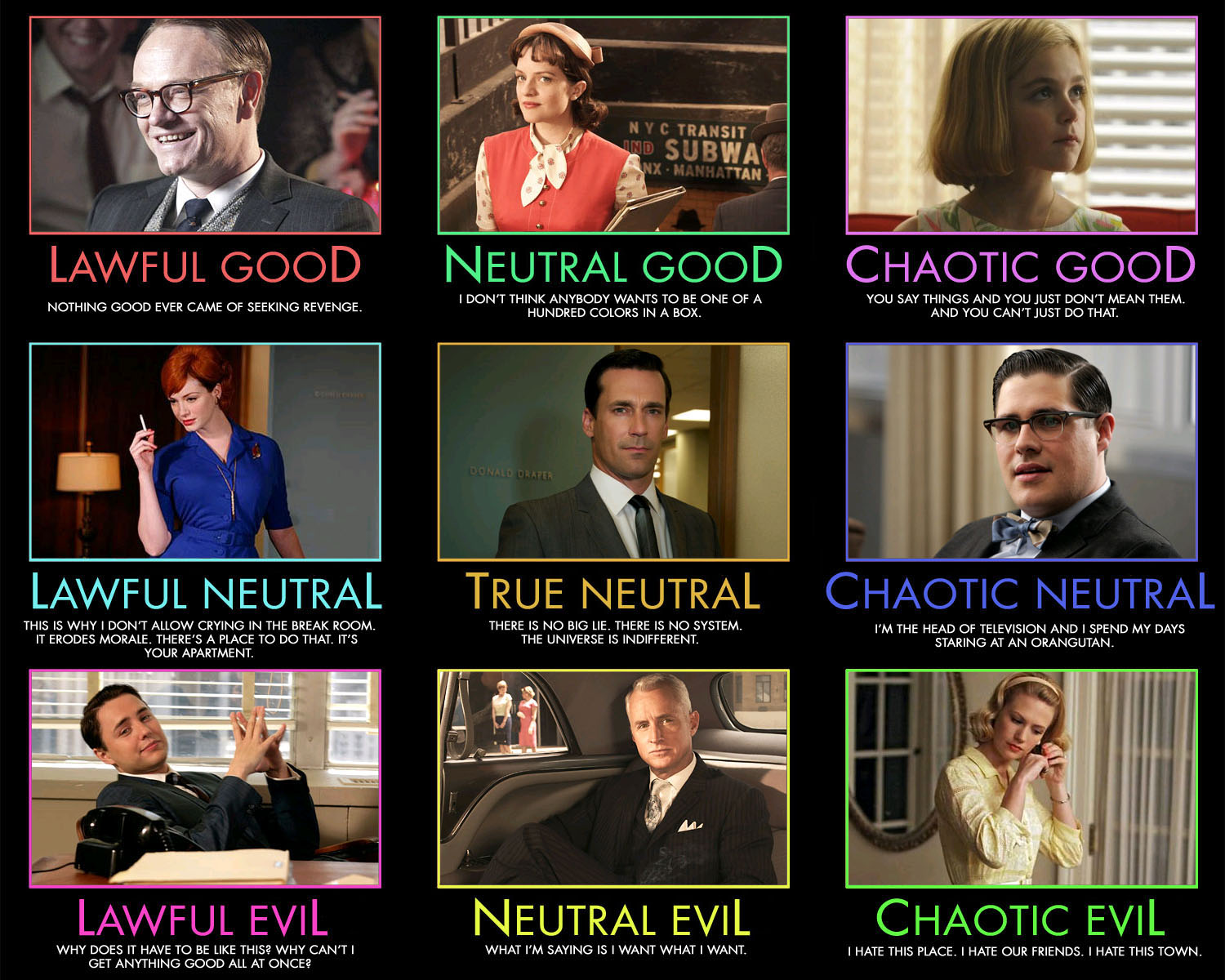
UPDATE: Rats, it's cut way off (you can't even see Betty as "Chaotic Evil!"). Click the pic for the full thing.
Two Meta Issues
1) I've become aware that blogger is eating some comments that contain URLs. It isn't doing it for my comments, and I actually do see the comments that are eaten (they're emailed to me same as all others, hence I often don't notice that they never actually make it onto the site), they just don't show for whatever reason. I don't know if I'm special as the proprietor, or if certain commenters have been flagged by the system as possible spammers. I also don't know how to fix it, and, given it's finals season and the identity of the most-affected commenters, I don't really care right now either. But I did want to register my awareness of the situation.
2) The story behind the name of this blog is simple: I was a debater in high school, and wanted to have a space where I could present arguments and sources to the debate community. Very rapidly, this blog moved away from that mission, but the name stuck (at one point I considered changing it to "The Dissenting Opinion", but I felt it was already too late. Ditto with changing the URL). Hence, the title of this blog ought not be taken as providing any explicit or implicit commitment to running my comments section in any particular way. It is, more or less, a historical accident.
At this stage, the purpose of the blog is to give me an outlet for my writing and a place to hash out my thoughts. That project is aided by intelligent interlocutors (agreeing or disagreeing). This being the internet, though, "intelligent interlocutors" are in short supply. To the extent that certain readers have historically helped deepen my understanding of issues, I'm grateful (I think those commenters know who they are, and I do wish they'd participate more often, though I understand why they don't). But I don't give participation ribbons, and don't see my comments section as an open invitation for trolls to roll in the mud with each other. My sole criterion for participation on my site via my comment threads is whether or not I, in my sole discretion, feel like there is a positive contribution being made. If one doesn't like that, Blogger is free! Start your own site. Link to me and rip/laud me to your hearts content. I may even respond. Or I may not.
Most comment boards are awful. I can think of two exceptions, Alas, a Blog, and Ta-Nehisi Coates, and it is no accident that both are heavily moderated. Unfortunately, Blogger as a platform doesn't give me the moderating tools I'd need to replicate their environment (and I don't have a broad enough readership base anyway). So unless I want to start deleting comments one-by-one, I'm forced to rely on self-regulation, and that's typically been a massive failure.
2) The story behind the name of this blog is simple: I was a debater in high school, and wanted to have a space where I could present arguments and sources to the debate community. Very rapidly, this blog moved away from that mission, but the name stuck (at one point I considered changing it to "The Dissenting Opinion", but I felt it was already too late. Ditto with changing the URL). Hence, the title of this blog ought not be taken as providing any explicit or implicit commitment to running my comments section in any particular way. It is, more or less, a historical accident.
At this stage, the purpose of the blog is to give me an outlet for my writing and a place to hash out my thoughts. That project is aided by intelligent interlocutors (agreeing or disagreeing). This being the internet, though, "intelligent interlocutors" are in short supply. To the extent that certain readers have historically helped deepen my understanding of issues, I'm grateful (I think those commenters know who they are, and I do wish they'd participate more often, though I understand why they don't). But I don't give participation ribbons, and don't see my comments section as an open invitation for trolls to roll in the mud with each other. My sole criterion for participation on my site via my comment threads is whether or not I, in my sole discretion, feel like there is a positive contribution being made. If one doesn't like that, Blogger is free! Start your own site. Link to me and rip/laud me to your hearts content. I may even respond. Or I may not.
Most comment boards are awful. I can think of two exceptions, Alas, a Blog, and Ta-Nehisi Coates, and it is no accident that both are heavily moderated. Unfortunately, Blogger as a platform doesn't give me the moderating tools I'd need to replicate their environment (and I don't have a broad enough readership base anyway). So unless I want to start deleting comments one-by-one, I'm forced to rely on self-regulation, and that's typically been a massive failure.
Tuesday, December 07, 2010
House Committee Chairs Released
Here's the list of who will be chairing the various House Committees.
Obviously, no Republican whose in a position to become a Committee chair is going to be someone who I'd truly like to see in the position. But there is some silver lining. John Kline on Education and Labor isn't bad -- I saw him at the first congressional hearing on employment discrimination against the transgendered, and he wasn't bad. Fred Upton on Energy and Commerce is notable because it means Rep. Joe "I'd like to apologize to BP" Barton (R-TX) isn't chairing it, which can only be a good thing.
On the other hand, there are, as expected, some catastrophes. All signs point to Darrell Issa leading a 1990s style witch-hunt against the Obama administration -- something all the more dangerous because Issa is a very smart, very effective, and very incisive Congressman. Putting Peter King -- the man who publicly wondered if Eric Holder is on the side of al-Qaeda (rich given that King is one of the few congressman who did, in fact, openly ally with actual terrorists) -- is a joke. In Lamar Smith, we have an extremist who once spoke at a conference where speakers advocating executing American judges who were insufficiently right-wing.
And then there's all the rest. Paul Ryan has a reputation for wonkishness, but it's not one that seems grounded in any actual mastery of economic facts, so much as it's grading on a massive, massive curve accounting for the anti-intellectual bent of the GOP mainstream. Ileana Ros-Lehtinen will insure that our policy towards Cuba will stay on the same failed trajectory it's been on for the past 40 years (and if that means sabotaging Israel, so be it), but other than amount of rhetoric devoted to the issue it's probably no real change. Spencer Bachus at least had the balls to call out Sarah Palin for something.
Agriculture: Frank D. Lucas (Okla.)
Appropriations: Hal Rogers (Ky.)
Armed Services: Howard P. "Buck" McKeon (Calif.)
Budget: Paul Ryan (Wis.)
Education and Labor: John Kline (Minn.)
Energy and Commerce: Fred Upton Mich.)
Financial Services: Spencer Bachus (Ala.)
Foreign Affairs: Ileana Ros-Lehtinen (Fla.)
Homeland Security: Peter T. King (N.Y.)
Judiciary: Lamar S. Smith (Texas)
Natural Resources: Doc Hastings (Wash.)
Oversight & Government Reform: Darrell Issa (Calif.)
Science & Technology: Ralph M. Hall (Texas)
Small Business: Sam Graves (Mo.)
Transportation & Infrastructure: John L. Mica (Fla.)
Veterans: Jeff Miller (Fla.)
Ways & Means: Dave Camp (Mich.)
Obviously, no Republican whose in a position to become a Committee chair is going to be someone who I'd truly like to see in the position. But there is some silver lining. John Kline on Education and Labor isn't bad -- I saw him at the first congressional hearing on employment discrimination against the transgendered, and he wasn't bad. Fred Upton on Energy and Commerce is notable because it means Rep. Joe "I'd like to apologize to BP" Barton (R-TX) isn't chairing it, which can only be a good thing.
On the other hand, there are, as expected, some catastrophes. All signs point to Darrell Issa leading a 1990s style witch-hunt against the Obama administration -- something all the more dangerous because Issa is a very smart, very effective, and very incisive Congressman. Putting Peter King -- the man who publicly wondered if Eric Holder is on the side of al-Qaeda (rich given that King is one of the few congressman who did, in fact, openly ally with actual terrorists) -- is a joke. In Lamar Smith, we have an extremist who once spoke at a conference where speakers advocating executing American judges who were insufficiently right-wing.
And then there's all the rest. Paul Ryan has a reputation for wonkishness, but it's not one that seems grounded in any actual mastery of economic facts, so much as it's grading on a massive, massive curve accounting for the anti-intellectual bent of the GOP mainstream. Ileana Ros-Lehtinen will insure that our policy towards Cuba will stay on the same failed trajectory it's been on for the past 40 years (and if that means sabotaging Israel, so be it), but other than amount of rhetoric devoted to the issue it's probably no real change. Spencer Bachus at least had the balls to call out Sarah Palin for something.
Monday, December 06, 2010
Still Here
Finals studying is taking a lot out of me, along with other annoyances on my plate. Stuff has been accumulating on my browser, but I haven't even mustered the energy for a roundup.
* * *
Texas conservatives are unhappy that their uber-conservative speaker also happens to be a Jew.
New comments by Helen Thomas about how we're all owned by the "Zionists" have prompted Detroit-Mercy to withdraw their sponsorship of a diversity award named after her.
For the last time, progressive Zionists aren't Zionists in spite of our progressivism, but because of it.
An interesting exploration of Columbia's local Palestinian solidarity chapter, and how its understanding of "solidarity" means that it institutionally refuses to communicate with the local campus Hillel (individual members are free to talk as they please, but the group has ruled out any official dialogue events to try and better understand the positions or sentiments of the Columbia Jewish community).
As time passes, it shouldn't be surprising that the taboos which might have once precluded Israel's fascist parties from associating with European fascist parties are falling away.
Israel's woefully inadequate fire responsive services may be the "Katrina moment" that finally causes the majority to recognize just how much of their resources are being squandered on Haredi subsidies and settler fantasies.
Look, it's not that complicated: Your judges are "activist", mine are "engaged".
* * *
Texas conservatives are unhappy that their uber-conservative speaker also happens to be a Jew.
New comments by Helen Thomas about how we're all owned by the "Zionists" have prompted Detroit-Mercy to withdraw their sponsorship of a diversity award named after her.
For the last time, progressive Zionists aren't Zionists in spite of our progressivism, but because of it.
An interesting exploration of Columbia's local Palestinian solidarity chapter, and how its understanding of "solidarity" means that it institutionally refuses to communicate with the local campus Hillel (individual members are free to talk as they please, but the group has ruled out any official dialogue events to try and better understand the positions or sentiments of the Columbia Jewish community).
As time passes, it shouldn't be surprising that the taboos which might have once precluded Israel's fascist parties from associating with European fascist parties are falling away.
Israel's woefully inadequate fire responsive services may be the "Katrina moment" that finally causes the majority to recognize just how much of their resources are being squandered on Haredi subsidies and settler fantasies.
Look, it's not that complicated: Your judges are "activist", mine are "engaged".
Friday, December 03, 2010
Staring History Down
Regarding continued GOP intransigence over the repeal of Don't Ask Don't Tell, Matt Yglesias asks:
I've often wondered the same thought myself. I can't imagine that any but the most deluded souls are unaware where this debate is heading, or how it will be evaluated 30 years hence. The opponents of DADT repeal have to be aware that they will be considered villains by history.
In a sense, that makes it a little admirable (odd as that is to say). There is something to be said for looking history in the eye and standing on principle, knowing full well you are forever committing your name to disgrace. For the people whose opposition to gay equality is genuine and heartfelt, there is something rather amazing at their willingness to take on such a role. I disagree with such people stridently, and will do my utmost to ensure that they are inscribed as villains sooner rather than later, but such deep commitment is a rare thing.
Of course, that only applies to those whose opposition stems from heartfelt commitment. For those who act this way for the sake of short-term political expediency -- or worse, pettiness and spite -- it's just sad.
I really wonder what’s happening, subjectively, inside the heads of people who oppose repealing Don’t Ask Don’t Tell. Do any of them think they’re on the right side of history here? That people are going to look back from 2040 and say “if only we’d listened to John McCain thirty years ago?”
I've often wondered the same thought myself. I can't imagine that any but the most deluded souls are unaware where this debate is heading, or how it will be evaluated 30 years hence. The opponents of DADT repeal have to be aware that they will be considered villains by history.
In a sense, that makes it a little admirable (odd as that is to say). There is something to be said for looking history in the eye and standing on principle, knowing full well you are forever committing your name to disgrace. For the people whose opposition to gay equality is genuine and heartfelt, there is something rather amazing at their willingness to take on such a role. I disagree with such people stridently, and will do my utmost to ensure that they are inscribed as villains sooner rather than later, but such deep commitment is a rare thing.
Of course, that only applies to those whose opposition stems from heartfelt commitment. For those who act this way for the sake of short-term political expediency -- or worse, pettiness and spite -- it's just sad.
Subscribe to:
Posts (Atom)


