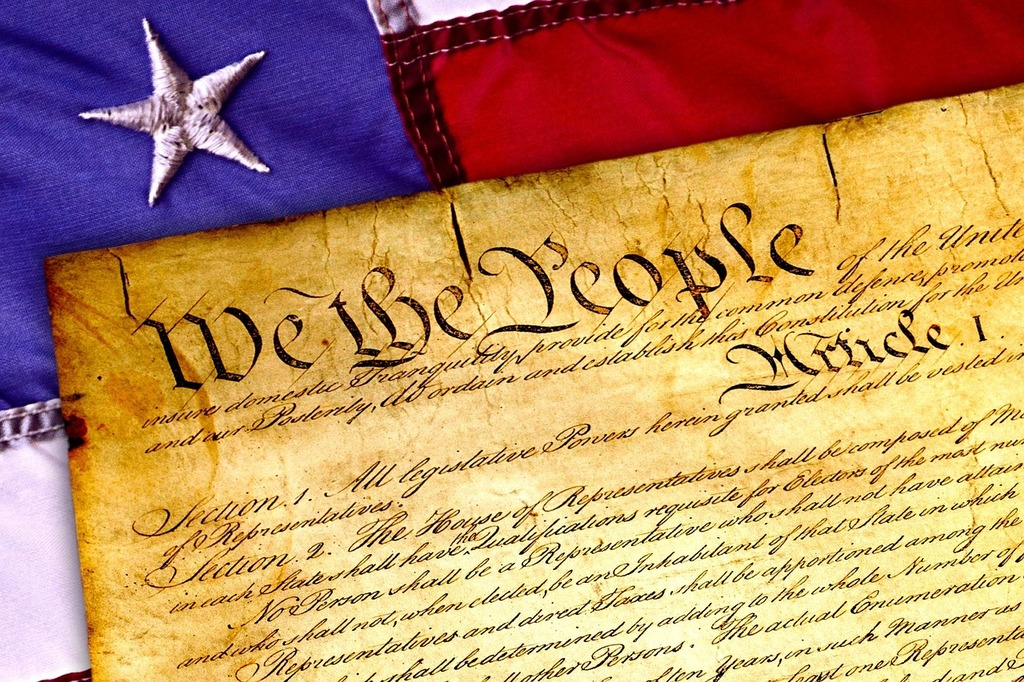
Showing posts with label constitution. Show all posts

Monday, April 07, 2025

The Constitution is in Exile


One of the small mercies of the past few months is that because I'm paternity leave, I am not teaching Constitutional Law right now. Even before the election I was dreading having to incorporate Trump v. United States into my syllabus. Obviously now, things are much, much worse.

When I was in law school, conservatives spoke of teaching about "the constitution in exile" -- the true and proper legal order that for decades had been flouted and suppressed by the courts. Of course, what they meant by that was a world where Social Security was unconstitutional. But today I think it is fair to say that the constitution is, truly, in exile. 

The upper ranks of the federal judiciary is controlled by a cabal with complete and utter contempt for the most basic constitutional values that are meant to guide this nation. Lawless disappearances, dictatorial executive power, impunity for corrupt officials, sabotaging of democratic elections -- it's all here, and it's all embedding itself into the official accounts of constitutional law as recorded in U.S. Reporter. In the foreseeable future, the prospects of undoing these decisions, or even stemming further decay, feel grim. Certainly, legal arguments don't seem likely to save us.

It is tremendously, tremendously depressing to feel as if the "law" one imparts on one's students is irrelevant; that no legal argument they can make, no matter how well-warranted or justified, will make a difference in legal outcomes if the powers-that-be prefer something different. Robert Bolt once characterized the essence of law as "a causeway upon which so long as he keeps to it a citizen may walk safely." When rule of law breaks down, this causeway turns into a mirage -- the citizen (to say nothing of the visitor or resident alien) who tries to keep to it is acutely aware that it might disappear under his feet at any time. The constitution that was supposed to guarantee us the ability to walk safely is, practically speaking, no longer present. It has been exiled, replaced by an usurper.

So what does one do as a constitutional law professor? I've always believed that my primary job, albeit not my only job, is to teach my students what the law and doctrine is, as it is declared by the Supreme Court. This view of my role is not in contrast to taking a more critical perspective -- to the contrary, the point is that foundational knowledge is a prerequisite to any effective critique. One has to know what the law is, in order to know whether the law is good, right, or should remain the law at all. Those more normative conclusions are for my students to draw for themselves; but it is absolutely in my ambit to give them the resources to make those critical judgments.

That view has not changed. But going forward, it will be even more important to contextualize the law as its being articulated today in terms of other possibilities and roads not taken. The law that we have is not something inalterable or inexorable; it is a choice. There are other choices. What are the reasons behind the choices that were made? What are the arguments for making different choices? Which choices fit better inside the broader corpus of legal values and commitments that were meant to guide the American constitutional project? And if we do currently live in a legal order that lies decisively outside the proper constitutional vision, what results? 

There isn't, I think, any need to be didactic about this. The original "constitution in exile" proponents had faith that simply laying out their alternative vision of what the constitution should be would suffice to gain them acolytes. I have similar confidence that the articulating the actual constitution -- the causeway of safety meant to guard us from predatory abuses and overreach -- will earn similar loyalty. And I do not know how long it will take for this constitution to return from its exile. But one must have faith that with enough support and enough commitment from persons who retained their faith in the rule of law, it will return, and will bring its just reckoning.

Tuesday, April 01, 2025

Laying Aside One's Toys


One of the first law review articles I ever remember reading and loving was Vesan Kevasan and Michael Stokes Paulsen's "Let's Mess with Texas", arguing (in the wake of an extreme GOP gerrymander orchestrated by Tom DeLay) that -- under the treaty governing its admission to the United States -- Texas could go even further by dividing itself into five mini-states. These "Texas tots" could of course also be gerrymandered, thus giving Republicans not just a bunch of bonus House seats, but several Senate seats besides.

Nothing came of the article, of course. It was viewed as an amusing exercise and a bit of provocation; a way of seeing how one could play with various legal principles and arguments to reach absurd results while still staying nominally inside the rules of the game. Their follow-up article, "Is West Virginia Unconstitutional", was similarly silly, fun, provocative, and obviously not ever pursued.

I am not here to say those articles should not have been written. To the contrary, I think that in a healthy legal climate, articles like these are fantastic. They're like avant-garde art -- they push boundaries, get readers to think in new ways, and provoke thought and discussion even as they are ultimately recognized as impractical and nonstarters. We should not divvy up Texas, and we should not abolish West Virginia, but those articles still were fun to read and had a lot to teach us.

But in an unhealthy legal climate, where norms are routinely shattered and long-standing legal limits are crumbling at alarming speed, this sort of play must be set aside. What in other times might be playful and provocative takes on a very different tenor when serious (or at least powerful) people are taking everything seriously.

I'm referring, of course, to the spate of right-wing scholars who responded to Donald Trump's attempted suspension of the constitutional guarantee of birthright citizenship by sprinting as fast as possible to "make the case" for it. The resulting endeavors were an embarrassing display of openly prostituting oneself to their dearest leader: starting with half-cocked tweets before moving to half-baked op-eds and blogposts, and now one of their half-completed essays is apparently being published in the Notre Dame Law Review.

As earnest scholarship, this is all transparent bullshit -- it's blindingly, painfully, shamefully obvious that the whole bit is purely results-oriented, designed to "create a debate" where none actually existed. The "best" category one could slot it into is in the mode of the playful provocations above -- can one, while appearing to stay nominally inside the rules of the game, dislodge a longstanding presumption of constitutional law everyone has taken for granted? If one can pull it off, isn't one roguish and rakish and a dashing flouter of the status quo? 

But in times like these, that "play" -- isn't. It's not charming, or funny, or quirky, or even thought-provoking. We are not in time where we enjoy the luxury of indulging in such play, because it isn't actually play at all -- it is a terrifyingly live possibility that countless American citizens will be summarily denaturalized and placed at the mercy of the state.

A few years ago, I wrote about certain right-wing ideologues who were upset that, as their faction of nationalist-conservatism ascended in power, they were no longer treated with the tolerant patience that they enjoyed in their formative years as plucky little law students. "You’re fine when you’re just a yappy little dog that can’t bite," one said, but "if you grow up to be a big dog that can actually do stuff, then you’re probably going to be put down." They framed this as a story of liberal intolerance. But it's actually exactly how things are supposed to go -- the whole point of liberal tolerance is that we're willing to discuss a lot more than we're willing to endorse as actual lived policy. We can read and consider and have serious debates over the ideas of Lenin in a political theory class precisely because there's a background presumption that Leninism isn't coming back. But

if the Leninists actually start seizing political power and instituting the purges, that would be bad! And if they said, "Oh, it was fine to debate our ideas in the classroom, but now that we're actually in charge and establishing gulags you have a problem with it," well, yeah, I do! Clearly! 

Again, I greatly prefer the days where we could be more indulgent. It's a much more vibrant and enjoyable world to be in. It's fun to play with the avant-garde sometimes. It's much nicer to contemplate "messing with Texas" as a thought experiment when we're all reasonably confident it isn't actually on the table.

But we're not in that world right now. And the "scholars" who are making play with people's lives -- not as a thought experiment, not as a hypothetical, but in a very real way with very real stakes -- don't deserve our respect or indulgence. In these times, we must lay aside our toys.

Friday, January 24, 2025

Constitutional History


My baby's bris was yesterday. The Rabbi came -- the first time we met him, in fact (we joined the synagogue in December) -- and asked me what I did for a living. I told him I was a professor at Lewis & Clark Law School, teaching constitutional law. "Are they going to move you to the history department?", he quipped.

Ha ha ha [sob].

For many, many, many reasons, I'm glad I'm not teaching this semester. But for a while now, I've been reflecting on how I teach constitutional law, and in particular how I triage the limited time I have each term. New law keeps being made and the length of a semester stays the same, so there's always a question of what to drop in order to make room for new material.

In my classes, I actually teach a fair amount of constitutional law "history" -- that is, going through doctrinal periods whose prevailing law is no longer valid (alongside, of course, the "current" doctrine" as well). For example, I devote substantial attention to the Lochner era of substantive due process and the pre-New Deal federalism/commerce clause cases. More recently, I've kept teaching Roe and Casey even after Dobbs, and Gratz/Grutter after SFFA. I teach the new cases too, of course, but I do think it is important to trace where we came from, and I don't shirk on allocating time to that project. 

At one level, these cases are the easiest to prune for space. They aren't good law anymore; one does not need to know them in order to know what "constitutional law" is today. And I suspect there will soon be even more venerable old cases whose holdings are going to be overturned or superseded in the coming years, to be replaced by new upstart doctrines.

But as we prepare to enter what in all likelihood will be a very grim period in our constitutional jurisprudence, I increasingly believe that teaching the history is more important than ever -- simply because it demonstrates that the law does not have to be this way. There is nothing inexorable about the choices that will be made, they are not simply the way the constitution is. Keeping alive the flame of alternative possibilities -- legal regimes that once prevailed and could prevail again -- is going to matter, and it is a way of not surrendering to the totalitarian darkness that is attempting to consume us.

This, after all, is one thing that conservatives did very well with their "constitution in exile", and I have no shame in following their example. And while the arc may be long and the path may bend, ultimately, mir veln zey iberlebn -- "we will outlive them."

Friday, August 09, 2024

8th Circuit Reaffirms Constitutionality of Bans on Felons Bearing Arms


The Eighth Circuit Court of Appeals has reaffirmed its earlier decision in United States v. Jackson, concluding that it is constitutional to prohibit felons from possessing firearms even if the felony they were convicted of was non-violent (the case was on remand following Rahimi). The court observed that there was ample evidence of historical precedent permitting disarmament of non-law abiding individuals even in absence of evidence they were "violent", as well as pointing to the Supreme Court's repeated insistence that its Heller/McDonald/Bruen line of cases repeatedly emphasized it was not disturbing longstanding prohibitions on felon disarmament laws.

It also reiterated a point it made in its initial ruling: that while it may be the case that prohibiting gun ownership by non-violent offenders would fail the more traditional "means/ends" scrutiny that prevailed pre-Bruen (and in most other areas of constitutional law), Bruen flatly forecloses such "policy" analysis. Bruen does not care about a law's fairness any more than it cares about your due process rights.

Friday, June 21, 2024

"I'm Not Owned! I'm Not Owned!" Originalists Continue To Insist as They Slowly Shrink and Transform into a Corn Cob


The Supreme Court today reversed the Fifth Circuit and upheld a federal statute prohibiting persons under domestic violence restraining orders from possessing firearms against a Second Amendment challenge. The case, United States v. Rahimi, had quickly become a tentpole example of the disaster show unleashed by the landmark Bruen decision, which tossed out the "heightened scrutiny" review uniformly used by lower courts to adjudicate Second Amendment challenges in favor of a "historical analogue" test that immediately proved almost entirely unworkable. The majority in Rahimi appears to have significantly retreated from Bruen, underscoring that Bruen does not demand a "clone" law but merely something "analogous" that existed at the time of the framing (here, the relevant analogy was "surety" laws, which required "individuals suspected of future misbehavior to post a bond").

The Court's decision was 8-1, with only Justice Thomas (the author of Bruen) dissenting. This isn't too surprising -- most legal observers thought after watching oral argument that the Fifth Circuit's opinion was destined to be reversed. The stance that the "cartoonishly violent" domestic abuser at the center of Rahimi had a Second Amendment right to remain armed and dangerous was predictably something that most of the Justices wanted to race away from as fast as possible.

But the real fun, for me, came in reading the concurring opinions. Two of them, authored by the liberal Justices Kagan and Jackson, are dedicated to making the obvious point that Bruen has been an absolute trainwreck. The conservative concurrences, by contrast, are a spectacle of chest-thumping paeons to originalism as the one true standard of constitutional jurisprudence, distinguished most essentially by the fact that it is not results-oriented and prevents judges from tailoring the outcome of cases to meet their ideological preferences.

Us legal progressives have to enjoy the small things these days, and if ever there have been clearer examples of protesting-too-much in a judicial opinion, I'm not sure I've seen it. It could not be clearer that the outcome in Rahimi dictated the reasoning. It could not be clearer that the contemporary social policy consequences are basically the entirety of what drives the otherwise arbitrary inquiry into how "analogous" is analogous enough (and, for what it's worth, such policy arguments also took center stage in the conservative arguments marshalled to strike down the law -- it's policy all the way down). The ferocity through which Justices Kavanaugh and Gorsuch in particular extol originalism's virtues in their opinions reek of desperation. Bruen was a classic instance of this Court taking a huge theoretical swing in service of an abstract political ideology and leaving the mess for later. Unfortunately for them, the mess piled up quicker than they anticipated, and now they're left in the humiliating position of having to act like the ensuing disaster wasn't one of their own making.

I will give some credit to Justice Barrett for grappling with a few of the critical questions here. She correctly notes that the historical test does not mean that contemporary legislatures are limited to "an updated model of a historical counterpart" in crafting gun legislation, because "historical regulations reveal a principle, not a mold." Within the general class of domains where there is historical evidence states were permitted to implement restrictions on the right to bear arms, the legislature should get significant deference in determining how it wants to instantiate those restrictions -- the flipside of Bruen's general admonition that policy judgments have no role to play in Second Amendment adjudication.

The other essential point Barrett makes is critiquing the assumption "that founding-era legislatures maximally exercised their power to regulate, thereby adopting a 'use it or lose it' view of legislative authority." We can group legislative action -- at the founding or at any other time -- into three broad buckets: (1) laws the legislature passed and which they believed  were constitutional (2) laws they did not pass because they thought they'd be unconstitutional, and (3) laws they did not pass, but not because they believed they were unconstitutional (one hopes the fourth category -- laws that were passed even though the legislature believed they were unconstitutional -- is close to a null set). The third category is an utterly mundane one: the legislature doesn't enact legislation for a whole host of reasons, the vast majority of which have nothing to do with any constitutional worries -- anything from "we think this is bad policy" to "we didn't consider this at all". 

Unless we think that founding-era Americans enacted every single possible gun law that they thought was constitutionally-permissible -- legislating to the utmost limits of their constitutional authority -- there will be entries in both the second and third categories. But to modern eyes, these two buckets will be largely observationally equivalent -- the lack of a historical precedent could mean that laws of this sort were thought to be unconstitutional, or they could mean they weren't passed for the myriad range of other reasons laws don't get passed. Bruen basically papers over this problem by pretending the last bucket doesn't exist, but in doing so it curb-stomps its own historical test. As for me, I don't have a good answer regarding how to disaggregate the two buckets, but doing so is essential to actually applying the historical test Bruen purports to impose. I'll give one cheer to Justice Barrett for at least recognizing the problem, but I suspect that this is yet another reason why Bruen's nebulous and vexing character is going to be intractable and will remain how it's begun: an incoherent mess of law office history cloaking bog-standard ideological policy judgments.

Friday, April 12, 2024

Assorted Thoughts on the Chemerinsky Incident


If you're in my neck of the internet woods, you've no doubt heard about the incident in Berkeley where a small group of students conducted a pro-Palestinian protest in the backyard of the Dean Erwin Chemerinsky's house

To make a long story short, Dean Chemerinsky had invited the 3L class over to his home to celebrate their impending graduation (he normally invites the 1L class at the start of their law school journey, but since this crop of graduating students spent their 1L year mid-pandemic and so wasn't able to come, he invited them before graduation instead). The local SJP chapter issued a demand that Chemerinsky cancel the dinner, distributing a poster showing a caricatured image of the Dean with a bloody knife and fork over the message "No dinner with Zionist Chem while Gaza starves." Chemerinsky refused to cancel the dinner; so some of the students RSVP'd and, once they arrived at his home and were welcomed into his backyard, stood up with a microphone and began delivering a speech about Gaza. Chemerinsky and his wife (Prof. Catherine Fisk) asked that they stop and leave, as guests in their home; the student with the microphone initially declined, asserting she had a "First Amendment right" to engage in her conduct. At one point, Prof. Fisk placed her hand over the shoulder of the student to try and take her microphone away (the student has characterized this as an assault -- even going so far to imply it was a sexual assault -- and has indicated she wants to file legal action against the law school). Eventually the students left, the Dean released a statement, and the internet was set ablaze.

From my vantage point, the students' behavior was abhorrent and very possibly a violation of the university's code of conduct (and the notion that they are the victims here is farcical). Beyond that bottom line, my emotional reaction to this story has been stronger than I might have anticipated, and it's worth talking through why. I do have a Berkeley connection, and though I've never met Chemerinsky personally, his reputation for both kindness and brilliance is unrivaled in the academy. I also have former students currently at Berkeley Law, and while I cannot imagine they participated in this fiasco, I would be disappointed and crushed if I found out otherwise.

On a more personal level, I suspect my views on Israel are quite similar to Chemerinsky (two-stater, sharply anti-Bibi but pro-Israel existing), and I also have been known to host students at my house for dinner (typically my small-group seminar students at the end of the semester). I view the dinners as a nice way to cultivate an environment of care and welcoming in the often-impersonal environs of the law school, and as a way of paying forward the sort of collegiate community I was lucky enough to enjoy as an undergraduate to another generation of students. If that gesture of welcoming students into my home were to be exploited in a manner akin to what the students did here, I'd be devastated. Protests like this are exploitations of trust, they rely on and take advantage of the host's unguarded openness and welcoming. We're not screening people based on ideology, we're not making people fill out political questionnaires, we just -- welcome students into our homes, without reservation. To take advantage of that, to extract costs on that openness, invariably leads to more closedness, more guardedness, and more cloisteredness -- a loss for everyone, and one that can and should be mourned (I saw someone argue on social media that if the Dean didn't want to be protested in his own backyard, he shouldn't have invited these students in the first place and instead tried to screen out whichever students he thought might be likely to protest him. That to me bespeaks an almost impossibly short-sighted and narrow attitude that is utterly toxic to the sort of university community anybody should want to cultivate).

Meanwhile, there's the question of "why was Chemerinsky picked for this protest?" That question has two related dimensions: why Chemerinsky, and why this protest (since virtually everyone seems to think that something as extreme as protesting in your host's own household should be reserved only for the most malign and irredeemable actors). Chemerinsky very much views himself as being targeted as a Jew, citing the bloody fork caricature and its resonance with the classically antisemitic blood libel. The immediate demand of the protesters is for Berkeley to divest from Israel; but the law school dean doesn't make investment/divestment decisions, so they're limply left arguing that Chemerinsky doesn't personally support divestment -- true, but a feature he shares with thousands of other members of the Berkeley community who also don't make investment decisions on behalf of the university. He also has beliefs on Israel that, while anathemas to the SJP crowd insofar as he rejects Israel being wiped off the map, are by no means some sort of Israeli maximalist/anti-Palestinian eliminationism and are entirely mainstream amongst both liberals and Jews (and are again widely present in the Berkeley community and beyond). Again, even if one opposes that stance, there is (or should be) a gap between "what we oppose" and "what we deem protest-worthy", and even among those who are protest-worthy, there is (or should be) differentiation as to when and where a protest is justified.

The most specific thing I've seen people point to in justification of "why Chemerinsky" is an editorial he wrote this past October -- just a few weeks after 10/7 -- recounting the antisemitism he's experienced as a Jew at Berkeley in the wake of the Hamas attack. The usual suspects make the usual claims in response: that Chemerinsky's claims about antisemitism are wrong, unfair, smears, conflations of anti-Zionism and antisemitism, and those sins justify what might otherwise seem an obviously abusive overreach of a protest. On that point, one thing I haven't seen commented on much is the deep and dangerous chilling effect this sort of position has (and is intended to have) on Jewish faculty speaking on the subject of antisemitism. I've written on this in the context of academic freedom, but there is a very significant contingent in American and global society who deeply believe that if you are a Jew and you speak on antisemitism in a way that they don't approve of, it is open season -- you have removed yourself from any and all protections (certainly norm-based, possibly law-based) one might enjoy in a liberal, tolerant society. Needless to say, as a Jew whose academic work centers in large part on antisemitism, this is a tremendously dangerous trend for me personally, and so of course I notice when it rears its head in such an explicit fashion.

Those are the more personal reflections I have. But there are a few more scattered issues I've seen that I might as well address here as well.

  • One area where I think the internet breaks our brains is how it interferes with our sense of proportion -- literally, in terms of "how many people are doing/believe in this thing we're upset out, compared to how many don't." The protesters appeared to number about ten students. That's not negligible, but it's also a very small percentage of Berkeley Law's total enrollment. Online, the consensus view from what I'm seeing is pretty strongly that the protesters were out of line here -- and while my internet circles are of course not perfectly representative, my read has been that one has to go pretty far out towards the fringes and randos before one starts seeing folks defending what the students did. But the thing is, even if the breakdown is, say, 80/20 against the protesters, if I'm reading one hundred posts about this event, that means I'm reading twenty people announce they support it. That feels like a lot, even though objectively an 80/20 split is actually extremely lop-sided!
  • The students' claim that her conduct was First Amendment protected is ludicrous save for the sheer moxie of lecturing Erwin Chemerinsky on First Amendment doctrine in his own house. One issue some people have flagged is this dinner being an "official" Berkeley Law event, and asking whether that changes thing insofar as Berkeley Law is of course bound by the First Amendment. But there's less here than meets the eye, because even if we view this as a "government" event, not all government events or property are public forums. Even on the Berkeley campus, areas like the administrative back offices or the classroom when classes are in session are not public forums (hence why a professor could remove a heckler from her classroom without it being a First Amendment violation even where that same speech would be protected from sanction on the campus quad). A professor's personal domicile is, if anything, a clearer case -- if public forum analysis applies at all, it is clearly a non-public forum and so the student's protest is not First Amendment protected once she is asked to leave.
  • Many people have criticized the protest against Chemerinsky in terms of it being "counterproductive". Who is this supposed to persuade? Don't they realize the protesters are the ones who look bad here? Antisemitism discredits the cause! I understand where this sentiment comes from, but I think it is at least partially misguided. First of all, whether it's "counterproductive" depends on what it's trying to produce. If the immediate goal is sympathy from either Chemerinsky himself or even the public at large, maybe it's ineffective. But if the goal is just "make an enemy miserable", then it may be perfectly effective. Second, there are many theories of protest whose model of change does not depend on the protest immediately swaying popular opinion in their favor. Without overstating comparisons to disanalogous contemporary events, we should all at this point understand how a shocking breach of basic social rules and norms can, even where it's immediately the subject of revulsion, generate a series of events that may ultimately redound to the violator's benefit. Ultimately, while it may be that this protest is counterproductive (though again, that depends on what one is trying to produce), I think the immediate declaration of counterproductivity, insofar as it is paired with a more moralistic condemnation of this sort of protest, is a means of eliding a more worrisome possibility: what if morally-contemptible norms violations are in fact quite productive means for certain social groups to achieve their goals? I've said it before and I'll say it again: antisemitism is a productive ideology. It builds things, engenders alliances, and motivates action. And so opposition to antisemitism, or other norm-violative behaviors, must be willing to oppose such actions even when they're productive -- because they often are.
  • Joe Patrice at Above the Law makes clear that he thinks this sort of protest is unjustified, but mentions in passing the "authoritarian" free speech position coming out of the right whereby it is a "free speech violation" if, say, a social media platform blocks or bans you. In many ways, the incident at Chemerinsky's house is the meatspace version of this: Chemerinsky is literally hosting, and a speaker is claiming a First Amendment entitlement to retain access to Chemerinsky's space in defiance of the wishes of the host. It's a bad First Amendment argument as applied to Twitter, and it's a worse First Amendment argument as applied to someone's backyard.
  • I'm certainly not the first person to say this, but part of civil disobedience is accepting consequences. While it's true that a good protest will often be disruptive and a breach of the normal rules of operation, it's also the case that the reason a protest is disruptive and a breach is that it violates normal, enforceable rules. To engage in that sort of breach, but then to act scandalized that the relevant authorities treat it as a breach, is to have one's cake and eat it too. And so I get someone feeling strong enough about a particular issue to say "it's worth it to me to violate this rule and face these consequences." I do not get -- or at least don't respect -- someone simultaneously expecting plaudits for being so bold as to defy the rules and demanding exemption from having those rules enforced.
  • Finally, I'm increasingly tired of the way these sorts of student protesters weaponize their status to act as if it's unreasonable to hold them to basic norms of conduct, or some sort of authoritarian imposition to subject them to consequences that can be wholly anticipated. It's true that, as we age, it's easy for professors to forget that young students are young and are still learning, and are going to make some foolish choices and say some foolish things because they haven't learned better yet. But it's also the case that as we age and our students seem ever-younger relative to us, we can also forget that the students are in fact adults and are perfectly capable of understanding how to behave as well as eminently-predictable consequences of their actions. I am not someone who thinks student discipline has to be overly punitive, and I respect that student conduct officials often find themselves in difficult spots. But unlike other recent Berkeley events, here we know who the perpetrators are; there does not seem to be much reason for why a conduct investigation shouldn't be opened here other than the administration either not wanting to or being scared to. Formal disciplinary responses are not always the first resort or the best resort, but they are a valid resort, particularly in cases where student behavior seems to be at least partially encouraged by a culture where the very idea of facing consequences for breaking rules is viewed as a form of oppression. There are people who basically immediately say student conduct violation related to speech warrants expulsion and anything short of expulsion tacitly assents to the violation. I don't agree with that, but I also don't agree with the view that every student conduct violation should be assessed solely as a "learning experience". Law and graduate students, in particular, are not smol, they are adults, and adults on the precipice of exercising significant political and social authority -- and part of entering into that latter role is accepting their status as responsible actors who can be held responsible.

Wednesday, November 22, 2023

Bruen Does Not Care About Your Due Process Rights


The landmark Bruen decision inaugurated a lot of chaos in the field of Second Amendment jurisprudence, but perhaps no follow-up case caught the public's eye quite like the 5th Circuit's ruling striking down prohibitions on persons under domestic violence restraining orders from possessing guns. I characterized that ruling (United States v. Rahimi) as "(a) insane and (b) absolutely defensible under the Supreme Court's Bruen decision," but I also flagged it as a potential candidate for Supreme Court reversal. The Supreme Court did grant cert in Rahimi, and the consensus amongst legal observers following oral argument is that the Fifth Circuit's opinion is toast.

One last ditch argument we're seeing by pro-gun zealots to try and avert this outcome is to frame Rahimi as a defendant's rights issue. Fifth Circuit Judge James Ho, in an opinion Chris Geidner characterized as a "judicial version of a post-argument supplemental filing," appealed to this principle -- citing a bevy of criminal law due process cases which protected the rights of even violent offenders and concluding that "if government must turn 'square corners' when it comes to the removal of illegal aliens, surely it must do the same when it comes to the basic rights of our own citizens." Josh Blackman made a similar argument, contending that it will be difficult to write an opinion in Rahimi that upholds the law in question that doesn't similarly pare back other rights of those accused of violent crimes.

Let's start by making one thing clear. Blackman states that "the reason why the Court may 'clarify' Bruen [in Rahimi] is because certain members of the Court don't like the results that it yields." I agree. As I wrote shortly after the Fifth Circuit's decision came down:

[I]f the Supreme Court reverses [Rahimi] -- and they might -- their reasoning will almost certainly purport to be based on some alternate assessment and reading of the historical sources. But this will be a naked smokescreen, and everyone will know it. If the Court reverses the Fifth Circuit here, it will be entirely and solely because the Court finds it too unreasonable and intolerable to permit domestic abusers free reign to carry arms -- a contemporary policy judgment anyway you look at it, no matter how much effort is or isn't expended to cloak it in some faux-historical garb. None of these judges abide by the rules they purport to lay out.

But while I agree that the results-tail will be wagging the doctrinal-dog, the "defendant's rights" argument is not a bulwark against the sort of reasoning. Rather, it is itself a form of results-oriented reasoning that Bruen -- if applied "faithfully" (and again, quotation marks because nobody is even trying to apply it "faithfully") -- expressly disclaims the legitimacy of. Put differently, to the extent Rahimi tries to present itself as faithful to Bruen, the "defendant's rights" argument is incredibly easy to dispense with. Blackman and Ho's position, by contrast, only works if one assumes Bruen does not mean what it says -- or, as I've put it, that Bruen is a one-way ratchet where social policy arguments in fact are permissible ... but only if they stand in support of a pro-gun position.

Let's review what the Bruen rule is. It's quite straightforward: where the "plain" language of the Second Amendment covers given conduct, government regulation of said conduct will only be upheld if it is consistent with the framing-era history of gun regulation. That's the alpha and the omega. No weighing of social policy consequences is permitted, period.

This approach generally has been conceptualized as a means of striking down even laws about guns that seem eminently sensible -- if they lack the relevant historical analogue, they're unconstitutional no matter how salutary they might seem. But in concept, what's good for the goose is good for the gander: a law about guns that seems arbitrary and unfair, but which does have relevant historical analogues, must be upheld no matter how ridiculous it might seem.

Suppose it turned out that there were in many states at the founding era laws that permitted anyone with a last name starting with "M" to be disarmed at the discretion of the state governor. For purposes of this hypothetical it doesn't matter why these laws were passed, and we can all agree that would be a tremendously silly and unfair law. Nonetheless, if a state today passed an identical law, under Bruen it should be upheld: the only question we're allowed to consider is "is there a historical analogue," and by stipulation there is one here. Engaging in the abstract moral theorizing about whether this law is "fair" -- no matter how obvious the answer might seem in this case -- is exactly what Bruen says courts are not allowed to do.

Similarly, suppose we had in Rahimi something that Justice Thomas in Bruen expressly denied was necessary: a "clone" law -- at the founding, there were regularly laws exactly like the federal law at issue in Rahimi throughout the states. In such a circumstance, even Ho and Blackman would have to concede (I think?) that Bruen would compel the federal law in Rahimi to be upheld, and that the "defendant's rights" argument would not enter into it. The law has a historical analogue, and so the discussion ends. That's what Bruen demands.

Of course, there was not a "clone" law at the framing to the federal prohibition on gun possession by persons under domestic violence restraining orders. So the nominal question in Rahimi is whether the laws that did exist are sufficiently analogically comparable to the federal law at issue so as to validate the latter. But that analysis, too, is completely unconcerned with any alleged unfairness to prospective criminal defendants. Either the historical analogues are sufficiently comparable, or they're not. If they are, then it doesn't matter that the results might seem unfair to potential criminal defendants any more than it matters if the results (pointing the other way) might seem unfair to domestic violence victims, or for that matter if the results seem unfair to persons whose last names start with "M". In all cases, Bruen demands we be studiously indifferent to this unfairness.

Bruen, in short, does not care about due process rights. Or put slightly differently, Bruen says that the only process anyone disarmed by the government is "due" is a determination about whether the disarmament is sufficiently analogous to practices that existed at the founding. If it is, then you can be disarmed. If it isn't, then you can't. No other consideration of "fairness" comes into play. 

It is in fact a misapprehension to say that the reason Rahimi could be disarmed consistent with Bruen is because "we're willing to reduce constitutional protections for prospective criminal defendants." If Rahimi can be disarmed, it isn't because he's a prospective criminal defendant, it's because he falls into a category of persons sufficiently analogous to persons who were deemed to be disarmable at the time of the framing. For this reason, a reversal in Rahimi poses no threat to other criminal defendant rights precedents, because in no other domain are constitutional rights treated in this absurdly reductive fashion (here we really see the lie that Bruen was about treating the Second Amendment "the same as" other constitutional rights; no other constitutional domain has a doctrine that's anything close to what Bruen proposes).

In short, all an opinion reversing the Fifth Circuit in Rahimi has to do to "contain" its ruling is state its conclusions in the terms Bruen prescribes: that the historical analogues to the challenged federal law are sufficiently comparable so as to render the latter constitutional. Once it does that, it need not and under Bruen should and cannot say a word about whether this outcome is "fair" or not to people who could prospectively be charged with a crime.

To be clear one more time: even if this is the approach the Supreme Court takes in reversing the Fifth Circuit, it will be a lie. We'll all know that the actual reason behind the Court's decision will be policy squeamishness towards the outcome. But we also know -- already knew, but Ho and Blackman helpfully confirmed it -- that a contrary ruling (or a dissent) will also be driven in part by social policy considerations and abstract arguments about fairness. Even Bruen's putative defenders don't actually take its strictures seriously, which is one more reason why the decision deserves nothing but scorn.

Sunday, September 10, 2023

The Right Not To Keep and Bear Arms


Earlier this month, a district court judge upheld a West Virginia statute which required private property owners to allow guns to be locked in employee or customer cars while in a parking lot (h/t: Volokh). The court rejected general property-rights and expressive association challenges to the statute. One argument it did not consider, however, is that West Virginia's law might violate the Second Amendment as interpreted by Bruen.

At first blush, this may seem to be a strange argument (which is probably why it wasn't made): this is a law expanding gun rights protections; and Bruen concerns attempts to restrict gun rights. But on closer inspection, I think it is quite likely (contingent on the historical record) that laws like West Virginia's violate the Second Amendment as that provision was interpreted in Bruen.

Start with first principles. Bruen, along with the other members of the "Roberts Trilogy" on guns, was emphatic that the Second Amendment is not a "second-class" constitutional right. And a critical component of other constitutional rights is that they all contain a robust negative component. The right to free speech includes the right not to speak (this is the locus of the "compelled speech" doctrine). The right to free association includes the right not to associate. The right to freedom of religion includes the right not to profess religious belief. And so, by extension, it seems evident that the right to keep and bear and arms includes a right not to keep or bear arms on one's own property.

Once that observation is made, then West Virginia's law plainly implicates property owners' Second Amendment right not to "keep" arms on their property. At that point, Bruen insists, the only question courts are permitted to ask is whether or not the law in question has historical analogues dating from the enactment of the Second and/or Fourteenth Amendment. I won't claim to have canvassed the history exhaustively, but my sense is that there aren't such laws (there certainly were plenty of laws protecting an individual's right to keep arms on his or her own property, but it doesn't seem like there were many laws which expressly forbade property owners from prohibiting arms on their own property). This is especially noteworthy because this is not a "novel" Second Amendment situation -- the issue of allowing property owners to forbid guns on their property was perfectly cognizable at the time of the framing, it is not an issue that only later sprang into existence based on some social or technological development. So if the historical record doesn't turn up a pattern of state laws akin to West Virginia's, then West Virginia's law must be struck down.

To be sure, West Virginia could argue that its law strikes a reasonable balance between the interest of gun owners being able to keep and carry their own arms for self-defense, and the desire of property owners to keep guns out. After all, the gun owner who wishes traveling in the public with his weapon will be significantly deterred from doing so if they're not even permitted to keep their gun locked in their car the moment they enter the parking lot of the "wrong" business or enterprise. In practice, a world in which gun owners can't enter even a parking lot with their guns locked in their car is one where they are significantly limited in their ability to travel anywhere with guns. 

But while this argument might have considerable purchase under traditional "balancing" review, Bruen expressly forecloses that sort of inquiry. As the Court emphasized, the Second Amendment's historical test is "the very product of an interest balancing by the people." History is what sets the "balance"; any additional weighing of policy considerations is impermissible. Ultimately, West Virginia's concerns that private limitations on gun possession may spillover to lessen the prevalence of guns is no different than New York's worries that striking down its gun control measures will result in too many guns on the streets. At root, West Virginia seeks to intrude on the Second Amendment in order to effectuate its policy judgment favoring more guns. A state like New York seeks to intrude on the Second Amendment to have fewer guns. Either state may or may not be correct as a matter of policy; but under Bruen both states' arguments must fall on deaf ears.

Nor can West Virginia's statute be defended as a means of securing the Second Amendment from infringement. Just as the First Amendment does not create an interest in forcing a newspaper to publish your op-ed, the Second Amendment protects against government infringements, not acts of private individuals. The only germane Second Amendment interest here -- the only actor threatened by government impingements -- is the negative interest of property owners who wish not to keep and bear arms on their property. Admittedly, cases like PruneYard do suggest that in the First Amendment context some government regulations protecting speakers on private property may be permissible, notwithstanding the property owners' own interest in declining to speak. But leaving aside whether that extension should carry to a law like this (West Virginia's attorney general made this argument; the court did not end up addressing it) under First Amendment balancing tests, it does not carry any weight under the Bruen regime, which again boils the question down solely to an inquiry into history. If West Virginia's law has proper historical analogues, it survives. If it doesn't, it doesn't, no matter how strong the policy argument in its favor may be.

Of course, we've already seen courts bend the "no policy" principle of Bruen when policy arguments seem to favor increased gun access, and it's entirely possible we'd see a similar move here as well. This is especially so since the "negative Second Amendment" idea the argument hangs on -- while I think one that has to be correct as a matter of constitutional interpretation -- is a bit novel and certainly cuts against the grain of what we expect the Second Amendment to do in cases like this. Nonetheless, in theory Bruen both gives and taketh away -- there will be times when Bruen strikes down even well-warranted laws and times when it upholds repellent ones. West Virginia's law strikes me as a good example of an enactment that is absolutely defensible as a matter of policy, but which probably cannot withstand Bruen's harsh review. The only question, as always, is whether Bruen's goose will ever apply to its gander.

One other thought: If you're looking for a viable progressive "bounty" program to counter the shenanigans anti-abortion activists are pulling in Texas, this seems like it could set one up.

  1. Write an ordinance that says guns are forbidden on private property unless consent is granted by the owner (an "opt-in" rule). These laws are being challenged, but I genuinely think they should survive constitutional scrutiny because all they do is establish a default rule, and for the reasons stated above the Second Amendment doesn't protect the right to bear arms on others' property.
  2. Create a civil cause of action for violating the ordinance.
  3. Add in all the abusive nonsense that Texas pioneered (no governmental enforcer, anyone can sue anyone, imbalanced attorneys fees, and so on).
  4. Lie in wait for anyone who pulls into a Wal-Mart parking lot with a gun in their trunk, and have at them.
To be clear: I think a law like this would be terrible and destructive, notwithstanding my own views on guns. These "bounty" laws are recipes for chaos. But to the extent that the only way we'll see them curbed is by showing that they'll exact costs on both political camps, I offer it as a way of establishing deterrence: mutually assured destruction.

Update: Turns out this article has already been written. Oh well -- at least I wasn't the only one with the thought!

Friday, July 21, 2023

Leaving the Mess for Later

Gfp-messy-kitchen-sink

One thing that's come up in a few of the Supreme Court's recent blockbuster decisions is the shakiness of the fact pattern in the underlying case. Mr. Kennedy in Kennedy v. Bremerton School District wasn't really just an average citizen whose desire to privately pray on his own was stymied by the evil liberal school district. Ms. Smith of 303 Creative v. Elenis might have outright falsified documents suggesting that a gay couple asked to engage her services. The Supreme Court's conservative majority did not care, blitzing ahead in decisions that made dramatic alterations to major areas of constitutional law doctrine.

At one level, I actually understand the perspective here. When it comes to abstract, "philosophical" question regarding the scope of the Establishment Clause or whether anti-discrimination law must sometimes yield to free speech commitments, the details of the individual case don't really matter. If it wasn't Kennedy, it'd be someone else. If what you care about is the broad, sweeping change -- interring Lemon v. Kurtzman for good, or laying a marker that public accommodations laws must yield to businesses' right to "expressively" discriminate -- the details don't affect the underlying arguments all that much. The same claims and counterclaims that would be made in any case would be aired here. 303 Creative probably already felt like the can that was kicked down the road from Masterpiece Cakeshop. Similar impatience was seen in some of the concurrences in Fulton v. City of Philadelphia -- we know we're going to have to decide whether to revisit Employment Division of Oregon v. Smith, and we know the arguments for and against preserving the precedent, so why delay the inevitable? Just make the decision one way or the other and get it done.

At another level, though, this speaks to how the current conservative judicial cadre really doesn't care about the formalities of law and legal doctrine. It's movement conservatism through and through -- the important thing is the bottom-line results, and the Court will shoot first and let others clean up the mess later. This especially stood out for me in 303 Creative, a case where it was striking how much more legalistic Justice Sotomayor's dissent was compared to Justice Gorsuch's majority opinion. The former, whether one agrees with the result or not, worked through the relevant First Amendment doctrine via the same methodology I'd teach my students -- explaining the relevant doctrinal framework, explaining why this case falls into a particular part of the framework, and explaining the implications thereof. The majority opinion was basically an abstract ode to the importance of free expression but skipped past significant swaths of the seemingly essential legal analysis (often by vague gestures at party "stipulations" or just treating as gospel certain holdings of the Tenth Circuit). It was hard to escape the sense that the nitty-gritty details of Lorie Smith's case were not at all what interested the majority, and so they were disinclined to spend significant time on them. They wanted to make a big statement about the interplay of free speech and anti-discrimination law, so that's where they devoted their attention. 

From that vantage, the fact that Lorie Smith's case may not have been the cleanest vehicle isn't really all that important. Of course, from the vantage of lower courts trying to figure out what the hell 303 Creative actually means, it's extremely important, because nobody actually knows the concrete rule that 303 Creative is actually establishing, and the blurry fact pattern means that trying to infer it from Lorie Smith's situation is a doomed initiative. But again, that's someone else's mess to deal with. I honestly believe that the Justices in the 303 Creative majority did not care if Lorie Smith, personally, deserves the exemption from anti-discrimination law under the doctrine that will eventually lay out. What they cared about is being decisive in defending the existing of these exemptions in concept. Lorie Smith just had the good fortune to be the next case in line that could be plucked onto the docket.

I've written before of the Machiavellian character of the current Supreme Court, specifically, it's absorption of Machiavelli's advice to tyrants: that they should take their big oppressive swings early, in full force, and all at once. You won't gain any advantage from dragging things out, and you'll probably get credit if you cut back later. And the repeated pattern we've seen is of the Court taking these huge right-wing swings that delight conservatives on the level of ideology, but without much care for how they can be operationalized as a workable legal doctrine, and leaving it lower courts to clean up its mess. And to give an inch of silver lining, there is the chance (this follows from Machiavelli too) that as that "mess" resolves itself the Court will then quietly file down some of the roughest edges. The Bruen decision, which reads as a right-wing ideological fantasy document but which has unleashed utter chaos in lower courts, may be an example if the Court uses the Rahimi case to cut back the most extreme interpretations. Take the big swing, make the chest-out assertion of insisting that no amount of public necessity can weigh against robo-originalism, and then later on at their discretion maybe pick and choose a few morsels to dial back on and claw back some legitimacy.

But nonetheless, it really is striking the degree to which the conservative legal movement just no longer cares that much about the law. As a law professor, it makes for depressing teaching. As a citizen, it makes for depressing living. Just depression all around.

Tuesday, June 06, 2023

Is the Supreme Court Lying When It Purports To Place Limits on its Extreme Rulings? Third Circuit: Obviously, Yes

Today, the Third Circuit sitting en banc in Range v. Attorney General invalidated federal prohibitions on possession of firearms by convicted felons, at least in cases of non-violent offenders (Range had been convicted of food stamp fraud), but potentially in many other circumstances as well (via). This creates a circuit split with the Eighth Circuit's opinion last week in United States v. Jackson that I discussed here

The issue of felon disarmament under Bruen is interesting. At one level, it's always possible that any gun regulation might fall prey to Bruen's rigid history-or-bust methodology for determining constitutionality under the Second Amendment (though much here depends on necessarily subjective judgment regarding what counts as a proper historical analogy). But at another level, the felon prohibitions are distinct because Bruen (along with the other members of the Roberts trilogy on guns -- Heller and McDonald) were emphatic that these prohibitions should not be questioned under the Court's rulings. As Heller said: "The Court's opinion should not be taken to cast doubt on longstanding prohibitions on the possession of firearms by felons." This was reiterated in McDonald, and confirmed again in Justice Kavanaugh's Bruen concurrence.

How does the Third Circuit get around this seemingly very explicit language? By suggesting the Court cannot be trusted to mean what it says. 

The court in an opinion by Judge Hardiman analogized adhering to the Supreme Court's express declaration that these laws remained constitutional to how the Court talked about the application of means-end scrutiny in Heller. Heller suggested that the law in question in that case would be unconstitutional “[u]nder any of the standards of scrutiny that we have applied to enumerated constitutional rights.” Lower courts, Judge Hardiman continued, universally "overread that passing comment to require a two-step approach in Second Amendment cases, utilizing means-end scrutiny at the second step," an approach the Supreme Court ended up disavowing in Bruen. And so the Third Circuit says, in essence, it won't make the same mistake twice: it must be "careful not to overread" the language suggesting felon disarmament laws remain constitutional "as we and other circuits did with Heller’s statement that the District of Columbia firearm law would fail under any form of scrutiny."

In other words, the basic question is: can we trust the Supreme Court when it says, expressly, "our decisions should not be read to mean felon disarmament laws are unconstitutional"? Or was that a promise the Supreme Court never meant to keep? In fairness to the Third Circuit, given the choice between predicting (a) the Supreme Court will abide by its own expressly-stated doctrinal limits or (b) the Supreme Court will completely ignore its own promises the instant they seem to sanction gun control limits the Court dislikes, I'm hard-pressed to say that option b isn't the safer bet. But there is something discomforting about lower courts openly acknowledging that the best way to interpret the Supreme Court's Second Amendment jurisprudence is to assume that any limits the high court purported to place on Bruen's sweeping protections for guns everywhere-for-everyone-at-any-time are probably just lies.

As a sidenote, I'll also just say that I literally finished compiling my Con Law II course materials on the post-Bruen Second Amendment last night, and immediately had to revise them again to account for the Range decision. Again, spare a thought for the underappreciated constitutional law professor, the forgotten victims of the churn and chaos the Supreme Court has unleashed in our constitutional jurisprudence.

Saturday, June 03, 2023

Bruen's Goose Does Apply to the Gander

I hate on the Eighth Circuit a lot on this blog -- prerogative of a former clerk -- but one thing I do like about it is that it has largely abjured the over-long, meandering, 100-page for every opinion trend of its sister circuits. The typical Eighth Circuit opinion is, as these things go, short, sweet, and easily digestible. Occasionally this means that some important issues or arguments I believe that deserve parsing in detail get short-changed, but more often than not it simply means they're avoiding navel-gazing and padding.

Yesterday, the Eighth Circuit filed an interesting decision in United States v. Jackson* involving the Second Amendment's applicability to restrictions on gun ownership by non-violent felons. Coming in at a compact 16 pages (8 of which are on other issues), it's easily read by the lay person. But what makes Jackson noteworthy, in my view, is that it expressly avoids a pitfall of the post-Bruen Second Amendment world that I've seen afflict conservative courts and commenters alike. Namely: it recognizes that Bruen's prohibition on means-ends analysis, and treatment of history as the be-all-end-all, applies just as much where the history licenses greater gun restrictions as when it licenses fewer such restrictions.

Quite a few conservative actors have, after happily citing Bruen's history-is-all-that-matters test, turned around and been aghast at the idea that a given historical interpretation might license more gun control than they, personally, are comfortable with or think is defensible as a policy matter. These objections have been leveled with respect to laws that bar persons previously subject to mental health orders from owning firearms (without a showing that they are currently mentally ill) and laws which bar persons subject to domestic violence restraining orders from owning firearms (even without a conviction). In both cases, the complaint was that even to the extent there arguably was historical precedent supporting laws like this (not perfect analogues, of course, but Bruen expressly disclaims the need for a "twin"), the practical consequences of applying those precedents to a case like this would be unreasonable or unfair as a matter of gun policy -- precisely the sort of reasoning that Bruen purports to take off the table.

Jackson, which is about prohibitions on gun ownership by non-violent felons, raises similar issues. It may be "unreasonable" to ban persons convicted of non-violent drug offenses, with no showing that they are in a meaningful sense "dangerous", from possessing firearms. But those arguments have no place in a Bruen world, which exclusively asks what the historical record does and does not permit. And unlike many, Jackson gets this right. It observed:

To be sure, the historical understanding that legislatures have discretion to prohibit possession of firearms by a category of persons such as felons who pose an unacceptable risk of dangerousness may allow greater regulation than would an approach that employs means-end scrutiny with respect to each individual person who is regulated. But that result is a product of the method of constitutional interpretation endorsed by Bruen

Indeed, governments appear to have more flexibility and power to impose gun regulations under a test based on text, history, and tradition than they would under strict scrutiny. After all, history and tradition show that a variety of gun regulations have co-existed with the Second Amendment right and are consistent with that right, as the Court said in Heller. By contrast, if courts applied strict scrutiny, then presumably very few gun regulations would be upheld.

Heller v. District of Columbia, 670 F.3d 1244, 1274 (D.C. Cir. 2011) (Kavanaugh, J., dissenting). Cf. Kanter v. Barr, 919 F.3d 437, 465 (7th Cir. 2019) (Barrett, J., dissenting) (concluding before Bruen that Congress cannot dispossess felons based solely on status, and that “a very strong public-interest justification and a close means-end fit” is required before a felon may be subject to a dispossession statute based on dangerousness) (quoting Ezell v. City of Chicago, 846 F.3d 888, 892 (7th Cir. 2017)).

This does not, to be clear, make Bruen a good rule. In many ways, it demonstrates its arbitrariness. But at least correctly applied, Bruen both gives and takes away when it comes to gun regulations. Where the historical record permits a type of gun restriction, legislatures are allowed to impose it no matter how ridiculous or outrageous it might appear. Where the record does not license a type of gun restriction, legislatures are forbidden from utilizing it no matter how essential or necessary it might be. That is not a good rule. But at least its randomness may lash out equally.

* There's no such thing as a "liberal" panel on the Eighth Circuit, but this panel was not an especially liberal one. The opinion was authored by Judge Colloton (viewed for many years as a SCOTUS contender for a Republican President), joined by Judge Benton and Chief Judge Smith. All three judges were Republican appointees (unsurprising, given that only one judge on the entire circuit is a Democratic appointee).

Friday, May 26, 2023

Being Perpetually at the Mercy of the Arbitrary Negligence of the State is a Punishment

At the moment, we're seeing two somewhat orthogonal trends developing in conservative legal jurisprudence, both lawless, but in distinctive ways.

The first is an increasing indifference to textualism -- being perfectly happy to manipulate or flatly ignore statutory or constitutional language in order to achieve desired results. Yesterday's Clean Water Act ruling, where the Court held 5-4 that "adjacent" doesn't mean "adjacent" because, well, they don't want it to, is a prominent example. The "major questions" doctrine is another, including the invalidation of OSHA's COVID vaccine-or-test mandate despite the fact that it fell cleanly into the clear statutory language, is another. The Court's recent voting rights jurisprudence, featuring Shelby County's entirely-invented "equal sovereignty of the states" rule, is another. The Court's recent Second Amendment jurisprudence, which has functionally decided the first half of the Second Amendment's text may as well not exist, is a yet another.

The second, by contrast, is a sort of hyper-literal textualism that zooms in so tightly on individual words that it ends up blitzing past how people actually read texts. The opinion striking down mask mandates on planes is one example here; some of the opinions striking down the eviction moratorium fit as well. Though styled as "textualism", this sort of analysis really is a dangerous confluence of putative textualists being bad at reading texts.

Slotting into the latter category is a concurring opinion by 11th Circuit Judge Kevin Newsom in Wade v. McDade, arguing that the Eighth Amendment does not forbid any level of "negligent" treatment of prisoners by prison staff --  not negligence, not gross negligence, not even criminal recklessness.  Judge Newsom's argument is deceptively simple: the Eighth Amendment forbids cruel and unusual punishments. But a punishment, he says, can by definition only be imposed intentionally. There's no such thing as a non-intentional punishment. And negligence, in all of its species, is something less than intentional. Hence:

The undeniable linguistic fact that the term “punishment” entails an intentionality element would seem to preclude any legal standard that imposes Eighth Amendment liability for unintentional conduct, no matter how negligent—whether it be only “mere[ly]” so or even “gross[ly]” so.... So on a plain reading, the Cruel and Unusual Punishments Clause applies only to penalties that are imposed intentionally and purposefully.

At one level, I appreciate Judge Newsom for saying the quiet part out loud here, because normally I'd spend time pointing out that Judge Newsom's position would warrant even the most grotesque acts of wanton disregard for the lives and wellbeing of prisoners. But Judge Newsom is quite happy to endorse (further) converting our prison system into a miniature gulag archipelago, so I guess I can skip that part and move to the textual question: is Judge Newsom's interpretation an "undeniable" inference from the term "punishment"?

And the answer, I think, is clearly "no".

At the outset of his opinion, Judge Newsom analogizes the negligent treatment of prisoners to that of parents and children: "Just as a parent can’t accidently punish his or her child, a prison official can’t accidentally—or even recklessly—'punish[]' an inmate." But in law, "accidental" and "intentional" are not an exhaustive binary. The whole purpose of the negligence and recklessness categories is to account for cases that lie between the pure accident and the specifically envisioned and desired consequence. And that makes sense, because while law contains different levels of "intent", legal fact patterns nearly always blend several of them together. 

Take a case where a speeding driver strikes a pedestrian with his car. Did the driver act "intentionally"? On one level, he was likely intentionally speeding (his foot wasn't literally glued to the gas pedal). On another level, he likely did not intend to hit the pedestrian (he did not seek to mow him down). Negligence captures the interstitial position where the driver intentionally acted in a fashion which foreseeably placed the pedestrian in danger (even if converting the danger into reality was not the driver's motivation). In this, negligence is very different from the pure accident not because it lacks intention, but precisely because of its intentionality.

Swap back to punishment. Imagine a more pre-modern society where we outsource punishment to private actors. I catch you stealing tools from my garage. As a consequence, I strip you of your clothes, take all the possessions you have on you (to make sure you have nothing you could attack me with), and drop you off in the middle of the woods without food or water which I can't be bothered to acquire for you, safely away from my house. You tell me "my pills are in my bag; if I don't take them each evening I might die!" I say "I don't care if you live or die. Oh, and watch out for the forest-dwellers -- they aren't always friendly." You do, in fact, have a seizure overnight and die. Are the actions I took "punishing" you?

Plainly, it seems the answer is yes. And this is so even if I genuinely was apathetic to whether you lived or died. Like the driver striking the pedestrian, my conduct is a mix of the purely intentional (I took your possessions, I dropped you off in the woods) and negligent/reckless (I do not care whether you have a stroke, I do not care if the forest-dwellers attack you). Being intentionally placed in a position where one's custodians do not care whether you live or die is obviously a punishment. Indeed, the fact that it's a "punishment" is the only thing that distinguishes it from pure sadism, abuse, or kidnapping. The fact that the seizure was not specifically intended doesn't change the fact that what happened to you in no way could be described as an "accident". It was the result of intentional actions, and the reason I acted in the way that I did -- with reckless disregard for your life or safety -- was very much tied to my desire to punish you.

In most prison litigation cases, there is similar "intent". The failure to, e.g., give a prisoner necessary medication isn't a wholly-accidental whoopsie-doodle (and if it is, then there isn't even negligence). It is an intentional choice. Indeed, a large part of what prison is, and what makes it such a terrifying prospect, is that it is a place the state sends you where the people who have control of your life do not and perhaps need not care if you live or die. Everything about that is intentional. Or put another way, the pervasive, heartless lack of intention is the intention -- being placed in such a situation is entirely the product of intentional choices at every step of the process.

There's a lot to dislike about the "deliberate indifference" standard which has taken over prison abuse litigation, but one thing it gets right is that indifference is absolutely a choice, not an accident. To fail to treat a person in your custody with requisite care is a choice, and it doesn't stop being a choice just because its foreseeable consequences were not expressly desired.

So what makes Judge Newsom go astray here? He seems to think we should chop up "punishment" into each potential negative experience one might have in prison. Being locked up, and being restricted from the yard, and being deprived of medication, and being placed in solitary, and being put into a cellblock with white supremacists liable to stab you -- each of these are separate (potential) "punishments" whose status as a "punishment" must be assessed atomistically. But this approach defies common sense. When someone is sentenced to prison for a crime, we don't think of it as a loose cluster of twenty or so discrete "punishments". It's one punishment. The punishment is being a prisoner and being subjected to the prison experience. Everything that happens in prison is part of the overall context of being punished. There is no need to parcel out individual moments and ask "but is this particular action a separate punishment", any more than we need to ask whether swinging bats in the on-deck circle or jogging out into the outfield is part of "playing a baseball game." It's all part of the game, and the hyper-zoomed-in focus on each discrete moment misses the forest for the trees.

In other words, while it may be true that something must be a "punishment" to fall under the auspices of the Eighth Amendment, all prisoners by definition are being punished. They pass that threshold categorically; none of them have been placed in jail by accident. At that point, the relevant question is whether the set of challenged actions or behaviors or what have you suffices to make that punishment into a "cruel and unusual" one. And certainly, being put in an Arkham City terrordome should qualify even (especially!) if the overseers assiduously do not care if you live or die. Perpetual, ongoing, systematic negligence (to say nothing of recklessness) towards persons who are helpless and in your care is one of the cruelest acts imaginable. Where that is part of the punishment, the punishment is cruel and unusual.

Judge Newsom concludes his opinion with the following:

Maybe it makes sense to hold prison officials liable for negligently or recklessly denying inmates appropriate medical care. Maybe not. But any such liability, should we choose to recognize it, must find a home somewhere other than the Eighth Amendment. We—by which I mean the courts generally—have been ignoring that provision’s text long enough. Whether we like it or not, the Cruel and Unusual Punishments Clause applies, as its moniker suggests, only to “punishments.” And whether we like it or not, “punishment[]” occurs only when a government official acts intentionally and with a specific purpose to discipline or deter.

This "whether we like or not" language is reminiscent of my Sadomasochistic Judging article. Judge Newsom seems to recognize the cruelty inherent in his position. But he leverages that cruelty into an argument for textual fidelity; the avoidance of cruelty is the hint that his colleagues have been led astray from the strictures of law. As I've demonstrated above, this isn't true; the text does not demand the cruelty Judge Newsom ascribes to it. But the pleasure of the pain of causing pain is too tempting to pass up. It's not good textualism that's motivating Judge Newsom. It's the ecstasy of bad textualism leading to bad results, whose badness is paradoxically metabolized as the purest and most faithful instantiation of textual loyalty.

Friday, February 03, 2023

Bruen's Goose Continues To Not Apply to the Gander

The thing about the Fifth Circuit's recent ruling that the Second Amendment gives men under domestic abuse restraining orders an inalienable right to bear arms is that it is (a) insane and (b) absolutely defensible under the Supreme Court's Bruen decision. This is because the Bruen decision will regularly and predictably lead to insane results.

That said, I did want to flag something in the opinion that I've picked up on before -- namely, the inconsistent commitment to Bruen's supposed prohibition on weighing or considering "social policy" considerations. Judge Wilson, writing for the panel, expressly cites to this portion of Bruen, saying that while the prohibition on gun possession by domestic abusers "embodies salutary policy goals meant to protect vulnerable people in our society ... Bruen forecloses any such analysis in favor of a historical analogical inquiry into the scope of the allowable burden on the Second Amendment right." This principle is, perhaps above all else, the crux of Bruen's standard -- no matter how ridiculous, or absurd, or unfair, or chaotic the policy outcomes are, courts are not permitted to "weigh" them against the historical limitations that bounded the Second Amendment. The latter begins and ends the conversation.

Again, that principle is absurd. But it's Bruen's principle, and the Fifth Circuit gleefully cites it to explain why the prospect of terrified and murdered women can play no role in its legal analysis. But what happens if the historical arguments seem to counsel permitting more sweeping gun regulations than conservative jurists might like? All of the sudden, those social policy considerations come roaring back into view.

Addressing the historical precedents which did clearly envision government's authority to disarm "dangerous" persons, Judge Wilson explains that such exceptions must be narrowly construed so as not to apply to the case of domestic abusers. Why? Because, he asserts,

the Government’s proffered interpretation lacks any true limiting principle. Under the Government’s reading, Congress could remove “unordinary” or “irresponsible” or “nonlaw abiding” people—however expediently defined—from the scope of the Second Amendment. Could speeders be stripped of their right to keep and bear arms? Political nonconformists? People who do not recycle or drive an electric vehicle?

I take no position on whether the government's interpretation is so expansive. But note that this line of argument is expressly an analysis of the proper policy sweep of government regulation. We should tailor our interpretation of the Second Amendment's scope so as to avoid a policy outcome whereby too few people are guaranteed the right to keep and bear arms; to avoid an outcome where the government is permitted to disarm people who these judges think it would be manifestly unfair to have their gun rights taken away.

This is exactly the sort of policy analysis Bruen purports to forbid, only here the "policy" concerns are ones counseling in favor of greater freedom to bear arms rather than reduced freedom to bear arms. Perhaps it seems absurd to permit the government to take away arms from people just for getting a speeding ticket. But so what?  Bruen was emphatic that this sort of social policy assessment has no role in Second Amendment adjudication. If the historical analogues give the state that sort of latitude, then that is supposed to end the conversation. Again, it is baked in the Bruen cake that it will lead to results that may appear to modern eyes ridiculous, because Bruen expressly instructs courts that they aren't allowed to care about those consequences no matter how absurd they might seem to be.

But as the Fifth Circuit's ruling makes clear, the Bruen prohibition on weighing policy consequences is, unsurprisingly, a one-way ratchet. Conservative courts will portentously declare that Bruen forbids them from considering the disastrous consequences of countless terrified or murdered women if it means taking away domestic abusers' guns -- but if history and tradition start to point towards enabling gun restrictions that the right finds too onerous, then all of the sudden we get a screeching parade of contemporary policy horribles that are treated as legally dispositive. This is what generates such well-deserved cynicism about the state of the judiciary today -- it's not just that the legal rules the governing class of jurists announce are absurd, it's that these jurists do not even pretend to be bound by them the second they prove inconvenient to their underlying politics.

The other thing to note about this case is that, if the Supreme Court reverses it -- and they might -- their reasoning will almost certainly purport to be based on some alternate assessment and reading of the historical sources. But this will be a naked smokescreen, and everyone will know it. If the Court reverses the Fifth Circuit here, it will be entirely and solely because the Court finds it too unreasonable and intolerable to permit domestic abusers free reign to carry arms -- a contemporary policy judgment anyway you look at it, no matter how much effort is or isn't expended to cloak it in some faux-historical garb. None of these judges abide by the rules they purport to lay out.

Tuesday, July 19, 2022

The Goose and the Gander of the Bruen Prohibition on "Balancing"

Eugene Volokh flags a case out of California involving a man allegedly prohibited from carrying a firearm due to a mental health hospitalization that occurred twenty years ago, when the man was in middle school. Federal law generally prohibits an individual "who has been committed to a mental institution" from owning, possessing, using, or purchasing a firearm or ammunition. The man, who later enlisted in the Marines and worked in law enforcement, has not had any other mental health issues since that single incident.

The court in this case ended up ducking the major constitutional issue for technical reasons we don't need to go into, but suggested that the relevant section of federal law was probably still constitutional after Bruen because several justices in that case specifically identified bans on mentally ill persons carrying firearms as among the sort of historical restrictions that had been permitted at the time of the framing. Prof. Volokh, by contrast, thinks the law should be unconstitutional insofar as it does not require any showing that the prohibited individual is presently mentally ill. The facts of this case, in particular, suggest a person for whom the law as written sweeps too broadly.

I make no judgment on whether federal law should, as a matter of policy, create such a carve-out for persons who seem to no longer be mentally ill. However, it does seem to me that this sort of analysis represents exactly the sort of "balancing" of interests that Bruen quite categorically forbade courts from engaging in. From Bruen's perspective, the sole question a court should consider is whether or not this sort of firearms restriction -- in this case, restrictions blocking the mentally ill from possessing firearms -- was historically present at the time of the framing. If the answer is no, then the restrictions are unconstitutional no matter how good a reason we might think exists for imposing such a restriction. But the flipside has to be true too: if the answer is yes, then the restrictions are constitutional no matter how unfair or untailored we might think they might be as applied to a given individual. And since the Court has already seemingly conceded that restricting the mentally ill from possession of firearms is one of the restrictions historically permitted, that should end the discussion.

The counterargument, alluded to be Volokh, is that the relevant basis for historical comparison is not the existence of "laws prohibiting the mentally ill from possessing firearms", but rather "laws prohibiting persons who once had a mental health crisis but have not had any symptoms for decades from possessing firearms." At one level, this is a familiar problem of abstractness versus specificity, one which offers courts yet more discretion to approve or disapprove of firearms regulations that they like or dislike. As I said in my last Bruen post, the application of Bruen by the judiciary will not ultimately be controlled by lawyerly parsing of the constitutional or precedential text; it will be a matter of personal judicial preference -- and the specificity problem identified here is just another opportunity for judges to disguise their policy preferences under the cloak of a legal rule. 

But if we make-believe that the putative legal rule will matter--well, Bruen promised that the relevant requirement for a historical analogue was not a "twin". And there are good reasons for that, which go beyond allowing for some amount of adjustment for societal developments as centuries pass. Requiring that state or congressional gun restrictions map on precisely to policy initiatives passed in the 19th century significantly limits the legislature's policymaking authority even in a domain where the Court agrees the legislature has the right to impose restrictions. It is facile to say that restrictions on firearms possession by the mentally ill is permitted, but Congress must only implement those restrictions via the precise programmatic means used in the 1800s. The constitution doesn't typically encode specific policy demands, it encodes general rules and standards that broadly define the parameters through which the democratic branches are allowed to fill in the details.

Given that, it seems to me that as far as Bruen is concerned, the germane constitutional question is whether the restriction in question is of the class of restrictions that had been historically been permitted. Once we answer that question in the affirmative, then Congress or the states should be given considerable leeway in figuring out how it wants to instantiate that restriction -- that inquiry being primarily a policy question which courts should be reluctant to intrude upon. Certainly, Congress cannot simply declare anything to be a "mental illness" restriction, anymore than New York in Bruen was allowed to declare the entire city of New York a "sensitive place". But it's equally clear that restricting persons who had a serious mental health episode from owning firearms is much more clearly under the umbrella of "restrictions on the mentally ill". The opposition to that rule is not really that it falls outside the category, it's that as applied here something like a "one strike rule" feels overbroad and unfair.

And maybe it is -- that rule may be too harsh. But again Bruen says it is not the judiciary's business to weigh competing interests. Mental health restrictions are historically permitted, this is Congress implementing such a restriction -- end of discussion. What is good for the goose is good for gander. That is, unless Bruen actually means what many of us suspect it to mean -- not an actual rule that constrains judicial partisanship, but a thin cloak for imposing pro-gun outcomes, text of the alleged legal rule be damned. We'll see. I'm not optimistic.