Showing posts with label crime. Show all posts

Saturday, September 06, 2025

A Question About Extradition


Hypothetical question:

Suppose a U.S. citizen kills the citizen of another country on the high seas. Suppose further that the American judicial system refuses to impose legal liability on the citizen (e.g., because they conclude his actions weren't a crime, or they find some immunity doctrine bars the prosecution). The victim's country, by contrast, does want to prosecute.

Can the United States extradite the citizen to the other nation as a way of getting around the functional immunity provided by our own courts? (Does the "high seas" part of the hypothetical matter? What if the foreign national was killed or injured on U.S. soil?).

Purely a hypothetical question, of course.

Wednesday, August 13, 2025

The Audacity of Jeanine Pirro

Yesterday, the Washington Post published an editorial by Washington D.C.'s Trump-appointed U.S. Attorney Jeanine Pirro, where she demands the elimination of various D.C. laws that provide leniency to juvenile offenders under the guise of making D.C. "safe." These include the Youth Rehabilitation Act, which suspends mandatory minimums for many crimes when the defendant is under the age of 25, and the Incarceration Reduction Amendment and Second Look Amendment Acts, which lets persons imprisoned for crimes committed while under the age of 25 to petition for resentencing after 15 years of incarceration.

I've written before about my art collection, and in particular the story of Halim Flowers (whose work in large part prompted my interest). Flowers was the beneficiary of the laws Pirro is indicting here -- he committed his crime when he was sixteen, sentenced to life in prison, but was eventually released after serving 22 years (when he was nearly forty). If Jeanine Pirro had her way, he would still be locked up, and we would have lost the beauty he has created as a sacrifice to our misplaced pride -- the arrogance to know that these children can never and will never have anything to offer society, and that we lose nothing by keeping them caged forever. Halim Flowers is testament to why laws like this must exist. 

Whenever I think about laws insisting on the lifetime incarceration of juvenile offenders, I think: would we as a society really be better off if he was still warehoused? How much else in the way of beautiful art are we depriving ourselves of by locking away so much of our human potential? Or forget art -- or business, or writing, or anything else externalized by the outside world. How much love are we giving up? How many relationships are we stymying? How many families are we poisoning? Who does this help? Perhaps there are some criminals who are truly incorrigible (though most age out of violent criminality by forty or so), but for any individual kid it's hard to imagine knowing that with so much advance confidence that one will refuse to even let the child have a chance to become a different person. Our assumptions about which children are incorrigible criminals are very often wrong, and we should have the humility to allow ourselves to be proven wrong.

The retort, of course, is the put oneself in the shoes of the victims. It's of course hard for me to imagine  a world where my wife or my son was murdered -- my brain sort of does an emergency shut-off at the thought. My best guess is that it would turn me into a broken shell of a man, and nothing would resurrect me from my nightmarish hell. It would be too cheap to say that's freeing (why bother imposing any punishment if, either way, I'll still be a broken shell of man trapped in an inescapable nightmare?) -- I certainly think I'd want the wrongdoer to be held accountable in some fashion for what they've done. But I imagine (and again, this is only imagination) that eventually, all I'd want is to not have to think about the murderer again. I don't know if I could ever forgive him. But nor would I want to expend energy hating him. The gravest injustice someone could do to me, twenty years after the fact, would be to make the murderer my mental responsibility -- whether it's the responsibility to declare "he should he go free" or the responsibility to insist "he must stay locked up." Just let me pretend that I can forget. Is that too much to ask?

What Pirro is doing here is not to the benefit of the victims or their families. They deserve better than to be pulled into this debate. The people who want leniency will urge them to show forgiveness, the people who want punitiveness will lean on them to recount their trauma. Both demands are torturous. It is an injustice on top of an injustice that we ask this of them. Just leave them alone. They've suffered enough.

Impossible questions don't yield easy answers, and I don't pretend these answers are easy. But their very impossibility makes it more essential that D.C. residents be the ones to decide for themselves -- not an outsider commissar imposed on a subjugated population deprived of its democratic rights. Jeanine Pirro does not want what's best for D.C. residents. Jeanine Pirro does not care about D.C. residents. Crime in D.C. is in fact falling (and the most prominent recent incident of mass criminality in D.C. was of course orchestrated on Trump's behalf and the site of mass pardons by Trump to inaugurate his second term), but this was never actually about what's good for one of the American colonies anyway. Jeanine Pirro is literally inventing more misery so that she can inflict more misery on the world. What a despicable human being.

One other side note: When I clicked the link to open Pirro's column, I saw with bittersweet amusement a banner informing me that my Washington Post subscription will expire in one more day (I canceled in October following their Harris non-endorsement fiasco, but I had renewed last August for a year). Even now, this is a hard moment -- I grew up with the Post, I loved it dearly, and even now I know its reporters do some great journalism. But it is, in a way, helpful to get a reminder of the feckless, Vichy nihilism that the paper now embodies (the publication of this editorial wouldn't have offended me so much if the Post hadn't just announced new ideological limits on the opinion pieces it would run -- tell me, is Pirro's lock-up-the-kids crusade in the category of "personal liberties" or "free markets"?). No principles, no values, just crass accommodation of the worst people in power. Who could really miss a newspaper like that? For that, and that alone, I'm grateful to the Post for giving me a perfect sendoff as my time as a subscriber draws to a close.

Thursday, June 12, 2025

"Personal Liberty Laws" for the MAGA Era


Earlier today, in response to the violent detention of California Senator Alex Padilla for the sin of asking an intemperate question of DHS Secretary Kristi Noem, someone quipped that "We have entered the 'caning of Charles Sumner' stage of historical parallels."

I've been thinking of antebellum precedents myself recently, albeit in response to a different issue: the new propensity of ICE and other federal police agencies to refuse to clearly identify themselves before purporting to make immigration-related arrests, and the corresponding rise in "ICE impersonator" events where criminals and scammers impersonate the agency to victimize vulnerable communities. What we are seeing, again and again, are police actions that to an immediate observer look indistinguishable from a kidnapping, abduction, or carjacking. On the one hand, this indistinguishability heightens Americans' vulnerability to violent crime; on the other hand, the adoption of these thuggish tactics by the police is itself rightly seen as an attempt to leverage terror against the population. Responsible states and cities should not cooperate in this project, and indeed they should take whatever steps they can to resist it.

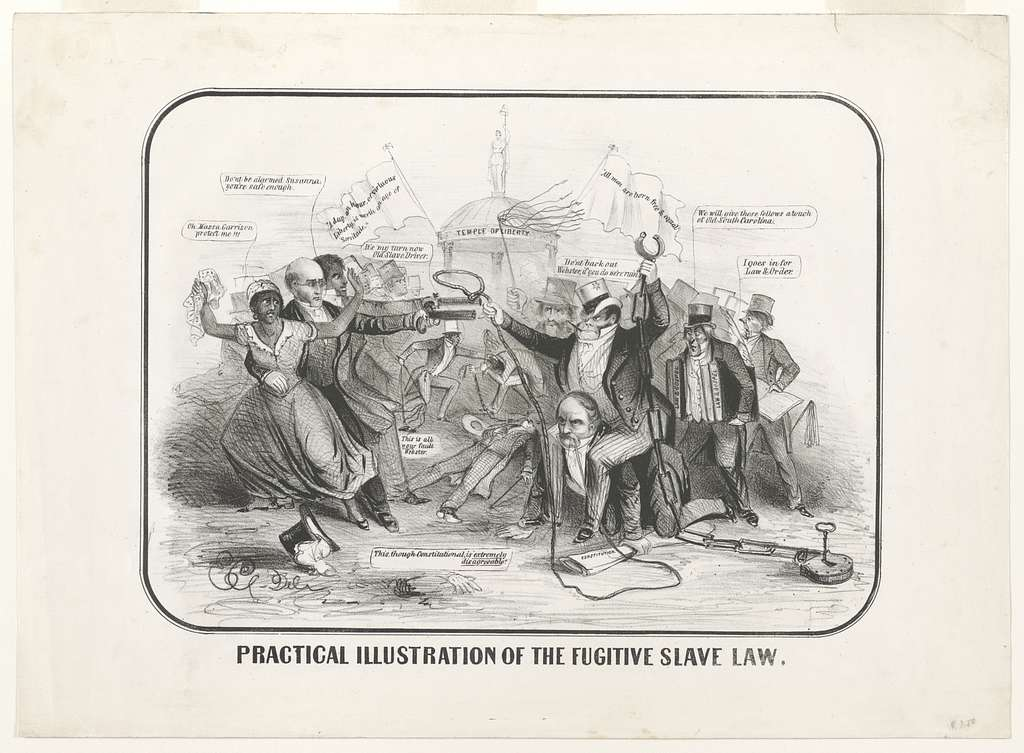
In the antebellum era, many northern states passed "Personal Liberty Laws" to blunt the effect of a different exercise of state-sponsored abductions: the Fugitive Slave Act. My proposal is for a new "Personal Liberty Law", that takes the form of directing how state and local police should respond* if they witness what appears to be a kidnapping, abduction, or the like. In essence, the policy should be as follows: 

  • Where the police witness what appears to be an abduction, they should assume it is an unlawful abduction and respond accordingly (including with use of appropriate force) unless they have actual knowledge that the detention is occurring under lawful authority (i.e., is an actual police operation).
  • "Actual knowledge" can include advance knowledge (in cases of coordination), or conspicuous display of law enforcement identification (such as a badge, or the use of marked police vehicles).
  • "Actual knowledge" does not include mere verbal or written declarations (including clothing labels) that the putative kidnapper is a member of any particular police agency, as such declarations are too easily fabricated.
Absent such "actual knowledge", the police should act as they would if someone conducted a street abduction before their eyes, up until the point they are satisfactorily given "actual knowledge" (which again, requires more than simply the raw assertion "we're with ICE"). If that means physically interceding to protect the individual at risk of abduction, so be it.

Now, I can already hear the MAGA howls: "this would put ICE agents at risk!" Whether or not that complaint moves you or not, I would humbly submit in reply that what's actually putting ICE agents at risk is that their behavior is indistinguishable from that of violent criminals, and that the proper remedy to ameliorate that risk is for ICE to avail itself of the many unique police resources -- such as badges, marked vehicles, and warrants -- that would serve to separate themselves from violent criminals. If they insist on forgoing such resources, then they take on the risk that other law enforcement officers will assume they are exactly who they appear to be. Responsible states and cities are under no obligation to leave their residents vulnerable to being targeted for kidnappings and abductions simply because Stephen Miller wants to impersonate his favorite street gangs.

* I'm bracketing the important, if not potentially fatal, issue of whether state and local police would ever follow this guidance even if it were issued. To be honest, I don't know how practically effective the original "Personal Liberty Laws" were when enacted, but the symbolism was important.

Tuesday, May 20, 2025

The Audacity To Love


As many of you know, one of the artists I collect (in fact, the artist who got me into art collecting) is Halim Flowers. Halim's backstory is incredible: he was convicted of felony murder as a juvenile in DC  after an accomplice shot a man during a home invasion of a rival drug dealer (Halim was not the trigger man and had already left the house when the killing occurred). He was sentenced to life in prison, eventually being released after twenty years thanks to a law targeting life sentences handed out to juvenile offenders. Since then, he has become a very successful artist showing internationally (his solo exhibition was featured at a Paris gallery this month).

Some people who promote Halim have described his story as "going to prison for a crime he didn't commit." I understand why they might say that, given confusion over what "felony murder" is,* but it isn't really true (and to be clear, I've never seen Halim say this or in any way try to skirt responsibility for his actions).

In any event, Halim has published a letter to "Face", the alias he went by on the streets as a kid (so-named because of his babyface). 


It's powerful reading. What impacted me the most is, again, how it doesn't try to avoid accountability, but also doesn't adopt the cliched narrative that prison was necessary to make him the man he is today. Rather, the theme of his letter is that none of this needed to happen. He didn't have to partake in crime. He didn't have to do the home invasion. There were, always, people who loved him. There were, always, people who wanted him to be the man he was always meant to be. He could've been that guy from the get-go.

The letter resonated with the post I wrote a few weeks ago about the American parents grieving their son who died after volunteering to fight for Russia against Ukraine, as part of a misguided tankie-ish "anti-imperialism", and also last year's article in Mother Jones about the mother of the UC-Santa Barbara mass shooter. These cases are all about the terrible maelstrom where unconditional parental love slams into commission of terrible crimes. You'd think something would have to give -- either denial of the crime, or abandonment of the love -- but the reality is that in many cases both persist and coexist in a terrible, chaotic symphony.

Those of us lucky enough not to be directly connected to the principals still can experience a pale echo of this. Halim's life, even after he was implicated in a serious crime, is precious -- the tremendous beauty he has created since his release is testament to that, though I don't want to say one has to be an artist of his talent for his life to matter. The man Halim's accomplice killed, even though he was also involved in the drug trade, is also precious -- we don't know what he would have done with his life, but I have no doubt he also had people who loved him and who he loved in return. The impossible necessity is to hold those truths together at the same time.

In my post, I wrote about
a nineteen-year old man arrested in Berkeley for attempted murder after stabbing someone during a fight outside a bar (as it happens, a bar I periodically frequented). When I read that, I was hit with a wave of despondency -- in part over the senseless of the stabbing, but in part as a sort of third-party grief on behalf of his parents. Didn't he know he had people who loved him? Didn't he realize how much him doing this would hurt them? How awful they must feel, and how alone, given that (understandably, and reasonably) the bulk of the community's care and concern will be directed at the victim and his family, not the perpetrator.
Part of what makes Halim's letter so powerful is that -- without being saccharine or wide-eyed -- just seeks to suffocate the problem it identifies in love. The audacity to keep loving, and the wherewithal to understand that one is loved, could alleviate and avert so much pain. In the overwhelming majority of cases, the love is already there, like a precious resource waiting to be tapped.

* Simplified, "felony murder" is the charge when a murder occurs in the course of a dangerous felony you're taking part in. It is not the same thing as "the felony of murder", which is confusing. In Halim's case, only the triggerman could be prosecuted for first-degree murder, but all accomplices to the felonious home invasion could get hit with a felony murder charge.

Image: Halim Flowers, "Audacity to Love (IP) (Blue)", silkscreen (ed. 10), 30" x 22" (2023). This print was executed shortly after October 7, and features the colors of the Israeli and Palestinian flags (there is a color-swapped white version as well). Even -- or especially -- in that moment, the audacity to love is an essential prerequisite to healing and providing for a just future.

Friday, April 25, 2025

Every Parent Grieves


Michael Gloss, a twenty-one year old American, was reported killed fighting for Russia in its war on Ukraine. This is news primarily because Gloss is the son of a relatively high-ranking official with the CIA.

In his obituary, his parents noted his love for "JRR Tolkien and his depiction of fellowship among heroes", and described him as "forging his own hero’s journey" when he was killed in "Eastern Europe."

It's easy to make fun of this. And Gloss' "journey", which took the form of a particular virulent type of anti-American tankie-ism that saw him volunteering to fight for a reactionary imperialist invasion of a democratic nation, is repellant to me.

But perhaps it's a function of being a parent, that I cannot fault any parent for how they grieve their child. When I saw that obituary, all I could think of was how Gloss was twenty-one years old, which meant that his fascination with J.R.R. Tolkien probably began only five or ten years ago. Twenty-one is an adult, but it wasn't that long ago he was a child, and no doubt his parents still vividly see him as a bright-eyed adolescent jabbering about orcs and hobbits and wizards and Gollum.

This doesn't mean he wasn't an adult now, or that he shouldn't be judged for his choices. Many other people, and from far less advantaged backgrounds, have been judged as severely or more for the choices they've made at similar ages. 

But if anything that makes it worse for those who are grieving him; knowing that in some way the rest of the world cannot join them in their grief. Like all parents, I have a persistent background fear of someone hurting my baby; of something terrible happening to him. But I also have nightmares of him growing up to hurt others, of him being in a position where something terrible would happen to him and in the eyes of the world it being warranted. What a horrible, helpless, lonesome feeling that must be.

Everyone is someone's child. The victims are someone's child and the perpetrators are someone's child. I read today about a nineteen-year old man arrested in Berkeley for attempted murder after stabbing someone during a fight outside a bar (as it happens, a bar I periodically frequented). When I read that, I was hit with a wave of despondency -- in part over the senseless of the stabbing, but in part as a sort of third-party grief on behalf of his parents. Didn't he know he had people who loved him? Didn't he realize how much him doing this would hurt them? How awful they must feel, and how alone, given that (understandably, and reasonably) the bulk of the community's care and concern will be directed at the victim and his family, not the perpetrator.

Does this mean that people who stab others should be let off without consequence? Of course not. But I can't expect the parents to abstain from fully grieving a child who is (or is practically) lost to him.

Monday, December 02, 2024

We Who Are About To Die


The Romans loved their gladiator games.

I actually have no idea if that's true. Most of what I know about gladiators comes from how they're portrayed in Ridley Scott movies. For all I know, Romans did not actually enjoy seeing innocent people torn apart in the arena by wild animals or what have you.

But, to quote Philip J. Fry, "it's a widely-believed fact!", so we'll run with it.

It seems clear that a huge part of the second Trump administration will be vindictive political prosecution of his "enemies". This was a recurrent campaign theme of his, from proposing "military tribunals" for the likes of Liz Cheney to alleging "COVID crimes" by Anthony Fauci. Willingness -- implicit or explicit -- to engage in such thuggery has been a theme of his early announced appointees, from Kash Patel to Brendan Carr to Pete Hegseth. Concern over such tactics was expressly raised by Joe Biden in his pardon announcement for his son, Hunter. How deep down the list will he go? Unclear, though normalcy will not save you. The hammerfist coming to smash American rule of law is something unprecedented in my lifetime.

These prosecutions will be lawless along every possible dimension. The people driving them won't care about the law. The venues will be selected based on political convenience (I bet one will be amazed at how many of the "crimes" in question will center on the Western District of Texas). The "crimes" themselves either will be frivolous or nakedly selective. It will be undisguised authoritarian thuggery: the apparatus of law enforcement entirely perverted to immunize the president's allies while harassing his enemies (the almost-assured pardon of the January 6 insurrectionists is also part of this story).

I won't here venture a prediction as to how the judiciary will respond to these endeavors. It's possible they'll hold the line, as they largely did in 2020. But it's also the case that in 2024 the conservative legal movement has embraced and assimilated into full-blown MAGAism to a far greater degree than in 2020; even if they don't actively embrace the conspiracism (which they might), one can very easily imagine them hiding behind rules of deference to enable Trump to run wild.

The open question I want to consider, though, is how the public will respond to all of this. Of course, Trump's base will love it -- they've been baying for blood since 2016. And equally obviously, people like me will hate it. But I have a bad feeling -- maybe doom-mongering, maybe not -- that these spectacles of prosecution will go over better than one would think with low-information independents.

The reason isn't because they necessarily have strong opinions that Joe Biden or Anthony Fauci or various military generals actually are criminals. Rather, it is a more inchoate desire to see "the powerful" get their comeuppance. It almost doesn't matter whether they're guilty or not; the mere practice of seeing people one is accustomed to thinking of as "above you" laid low, ripped apart by the animals in the arena, is desired in of itself.

Consider what is for me one of the most infuriating aspects of Trump's victory: that he will not be held accountable for his many, many blatant crimes. No sentencing for the New York felony convictions, no consequences for the attempted 2020 insurrection, no pursuit of the document theft case, no nothing. It is maddening, to see such naked abuses of power result in nothing simply because Trump is powerful enough to evade responsibility for anything. If you take that indignant sensation and shear it from any substantive political knowledge, you're just left with the boiling resentment that a vague "they" keep "getting away with it". And the mere performance of going after a "they" can appeal to those resentments -- a fascist essence where the struggle is valuable in of itself, to show oneself to be the tribune of the people.

This suggests that Democrats could have leveraged this same atavistic desire to get at a powerful "them" by, for example, a fast Garland or prosecuting big bankers for the financial crisis or going after Elon Musk. And much like with echo chambers, I'm of two minds on this: torn between thinking that (for better or for worse) this is the strategy that works, versus thinking that it is a bad thing to encourage this sort of political climate (to be clear: I have no quarrel with "going after" big bankers or whoever when they commit crimes, but performatively going after an "enemy" class -- no matter who it is -- untethered by normal rule of law constraints strikes me as bad both morally and also conducive to a political environment that ultimately helps the right).

So once again, I'm at a bit of a loss here. But if we're relying on a natural popular revulsion to politicized sham prosecutions by the Trump administration, I'm not sure we're going to get it. We are going to be entering a very, very dark time.

Monday, September 30, 2024

We Don't Know What a Fast Garland World Would've Looked Like


It is almost certain that Donald Trump is going to run out the clock on facing real legal consequences for his myriad 2020 election related crimes before the 2024 election occurs. Consequently, many are blaming Attorney General Merrick Garland for being too slow and cautious in his prosecution of Trump. By taking so much time before bringing his case, Garland enabled Trump's various delaying tactics -- aided, of course, by loyalist judges at both the trial level and Supreme Court -- to stretch the cases out until after election day. Had he moved faster and more aggressively, things would have been different.

Maybe. But the thing about alternate futures is that we can't live there; and if we did live there, we wouldn't know here. Suppose that Garland did move fast and aggressive on Trump right at the outset of Biden's term. And suppose that right-wing judges such as the current Supreme Court majority, or Judge Cannon, issued the same rulings that they did in our timeline -- providing broad immunity to Trump designed to shield him from legal accountability. I suspect that, in that timeline, there would be a lot blame cast at Garland for moving too quickly -- he rushed things, he let political expediency get in the way of methodically building a case, and so he gave the courts an excuse to slow things down or even to cast his investigation as a witch-hunt rather than a genuinely legalistic inquiry. Had he been more temperate, things would've gone differently

Now, since we live in our timeline, we know that a more temperate and methodical approach would not have led to a success story. But the point is not just that it's always easy to speak with the benefit of hindsight. It is that we actually don't know what alternative paths-not-taken would look like, and if we did know we wouldn't know what was happening in our path. This is a ubiquitous problem, and while it is entirely reasonable given what we know now to say that Garland made the wrong judgment, it is not hard to imagine a very plausible timeline where Garland made the judgment we (in the prime timeline) say is clearly "right" and it is widely viewed (in the alternate timeline) as a terrible and eminently avoidable miscalculation.

Sunday, June 11, 2023

Loose Cannon

Judge Aileen Cannon has been assigned to oversee the criminal prosecution of Donald Trump.

I've seen enough high-profile political cases to be familiar with a very specific script that gets written about the judge assigned to the case. Pretty much without fail, you'll get a passage that reads something like the following:

Judge Smith is a veteran judge who ascended to the bench after fifteen years in the U.S. Attorney's office. He has a reputation for being no-nonsense and demanding a tight ship at trial that includes rigorous questioning of attorneys on both sides.

"He doesn't tolerate a lot of guff," said one attorney who had practiced before him for many years. "You won't agree with all of his rulings, but he's universally respected."

This template is so common I've begun to wonder if it's reflex (not every judge can be "no-nonsense"!). Which makes it all the more striking that nobody -- nobody -- is writing lines like this about Judge Cannon. They weren't writing them even before she went 100% YOLO in trying to block the Mar-a-Lago investigation; they certainly aren't writing them now.

Since the news broke, I heard folks suggest that Cannon was only assigned to the preliminary aspects of the case, which appears untrue. Then I heard other folks assert that Cannon likely will be forced to recuse herself from the case. And honestly, I'm dubious about that too. 

To be clear: Judge Cannon absolutely should recuse. Her conduct in the Mar-a-Lago case suggests that she's so completely in the tank for Trump that there's no possibility that she'll be perceived as impartial. But if she was the sort of person who could be shamed into recusing just because it's the right thing to do, it wouldn't be as much of a problem if she didn't recuse.

The fact is our judicial system is not well-equipped to handle a problem like Cannon. The problem is not that she was nominated by Trump -- two of the three 11th Circuit judges who bench-slapped her Mar-a-Lago catastrophe into oblivion were Trump appointees. The problem is that Cannon, specifically, is a complete hack who's decided that her job as federal judge is to be Donald Trump's offensive line.

For very good reason, our judicial system starts with a healthy presumption of impartiality on the part of its judges. We don't let either party force out a judge just because they don't like their lean. Recusals are easiest to justify when the judge has a direct financial stake in a given controversy, or when they're close personal friends or associates with a party. These sorts of connections give everyone a face-saving option -- the problem isn't actual bias, but the appearance thereof; one could be as pure as driven snow and still agree that it is a sound policy to not preside over a case where your best buddy is being charged with a serious crime.

Unfortunately, other than the fact of her nomination Judge Cannon doesn't have those concrete ties to any party here, which means that there's no hiding the actual issue on the table. Judge Cannon needs to recuse because Judge Cannon is, in relevant respects, incompetent. I say incompetent not to suggest that her mistakes stem from ignorance rather than malice; rather, an important part of Judge Cannon's job is to administer the law fairly and impartially, and she has demonstrated herself to lack competency in that dimension of the judicial role. Hence, she cannot be trusted and is not qualified to preside over a trial like this one, with a defendant for whom she's already shown herself to be incapable of adjudicating impartially.

But once again, if Judge Cannon was the sort of person capable of recognizing that shortcoming, she likely wouldn't have it. There's no clear face-saving out where one can disclaim actual bias but recuse for prudence's sake, and there's no universe in which Judge Cannon agrees "I was so egregiously wrong in the Mar-a-Lago case that one can't help but infer I was biased." Which means it is up to an appellate court to make that determination for her, and needless to say, that's a very awkward proposition which appellate courts are going to be loathe to undertake. 

Appellate courts are not prone to saying "this case must be stripped from this district court judge because this judge is in general too biased to handle it." The closest one sees to that sort of ruling is when a case is stripped from a lower judge after repeated obstinance in refusing to implement appellate orders, and that is exceedingly rare. Even assuming that the Mar-a-Lago reversal should count towards such a showing in the criminal case, the problem with Judge Cannon's ruling there wasn't really that of repeated lower court disobedience of superior court mandates. It instead stands out because of Judge Cannon's absolute, rancid lawlessness. But again, our system is not well-built to account for the possibility that an Article III judge might as a general matter -- not due to financial stakes or personal connections, but purely as a matter of ideology -- be congenitally incapable of ruling in accordance with the law.

It's a similar problem to the situation with those single-division Texas judges. The thing everybody knows and everybody is thinking -- that the problem is that these judges are utterly and completely in the ideological tank such that law simply doesn't matter for them anymore -- can't be uttered out loud, at least not in a formal proceeding. On the outside, everyone knows that's the problem. But in a filing, you can't come out and say "judge, our basis for recusal is that you're a lawless hack." And since that is, at the end of the day, the problem, whatever alternative basis you try to hang your hat on will ultimately be a poor fit that probably won't end up justifying recusal. The structure of Article III life tenure means that placing a hack like Cannon on the federal bench is an irreversible mistake.

So count me skeptical that Judge Cannon will recuse herself, and count me skeptical that any superior court will force her recusal, at least immediately. Unfortunately, the reality is we're likely stuck with Judge Cannon and whatever hijinks she comes up with to justify torpedoing this case -- at least for the foreseeable future.

Monday, May 29, 2023

How To Hack The Law

Do you ever idly puzzle through various ideas for a "perfect crime"? It's awkward to talk about -- you don't actually want to do them, you don't actually want to give anyone a bright idea, but they're still so interesting to think through.

The legal community is abuzz with the story of a lawyer who relied on ChatGPT to do his research and submitted a brief filled with entirely invented cases. ChatGPT just made them up out of air -- complete with names, citations and quotes -- and the lawyer dutifully added them to the brief. When opposing counsel tried to read the cases for themselves, they were baffled because they couldn't find any trace of them. The presiding judge went so far as to contact the clerk of the courts where the cases were allegedly filed, confirming their non-existence. Now the lawyer is facing sanctions; he is begging for mercy on the grounds that he had no idea ChatGPT would lie to him like that.

I know of very few lawyers who have sympathy for this lawyer. But imagine a slightly different case. Let's say that LexisNexis developed a glitch where it invented a case. If you typed in the (invented) citation to the case, it would pop up on Lexis the same as any other case -- name, judge panel, court, reasoning, everything. But the case isn't real; it was a complete invention. If a lawyer came across such a "hallucinated" decision on Lexis, I think we'd be very forgiving if she ended up being deceived and relied on the case in her briefs. Indeed, I actually wonder, in a situation like this, how long it would take the legal community to figure out that the case wasn't real.

For example: the last case contained in volume 500 of the Federal Reporter (3d) is Jacobsen v. DOJ, 500 F.3d 1376 (Fed. Cir. 2007). That case ends on page 1381. Suppose an enterprising criminal hacks the Westlaw and Lexis database* and adds another case, call it Smith v. Jones, cited to 500 F.3d 1382. To further cover her tracks, the criminal "assigns" the case to a panel of judges who are no longer active on the court, to make it less likely one of them will see it and be like "I don't remember that decision." Smith v. Jones, of course, can be about and say whatever the criminal (or the unscrupulous lawyer who hired her) wants it to. Need a precedent that appears to decisively resolve a contested point of law in your favor? Voila -- the new case of Smith v. Jones is there to meet your needs. Indeed, the diligent criminal could add one or two new precedents per volume on a range of topics, providing bespoke "new" precedent to shift the legal terrain on an array of different issues.

If this happened, again I ask: how long would it take for the legal community to figure it out? If the initial hack was undetected, could one get away with doing this? Certainly, there would still be ways to confirm the cases are not real. If one back-checked the cases back to the clerk's office, one would discover they're vapor -- but realistically, that almost never happens. We take Lexis and Westlaw as proof enough; I'm not sure I can imagine a circumstance where I would try to confirm the veracity of a case I saw on Westlaw or Lexis by contacting the clerk's office. There probably would be some other hints that the cases were suspect -- the lack of citations from other cases would be a significant hint that something is shady -- but I can imagine a crime like this slipping by us for some time. And the longer it goes unnoticed, the more these cases have the opportunity to subtly adjust the overall trajectory of law in a new direction.

It's a scary thought, no? We're very reliant on the robustness and reliability of online databases. If they start to falter, we run into seriously trouble very quickly.

* Note: I assume -- and desperately hope -- that this is difficult-to-impossible to do.

Friday, May 26, 2023

Being Perpetually at the Mercy of the Arbitrary Negligence of the State is a Punishment

At the moment, we're seeing two somewhat orthogonal trends developing in conservative legal jurisprudence, both lawless, but in distinctive ways.

The first is an increasing indifference to textualism -- being perfectly happy to manipulate or flatly ignore statutory or constitutional language in order to achieve desired results. Yesterday's Clean Water Act ruling, where the Court held 5-4 that "adjacent" doesn't mean "adjacent" because, well, they don't want it to, is a prominent example. The "major questions" doctrine is another, including the invalidation of OSHA's COVID vaccine-or-test mandate despite the fact that it fell cleanly into the clear statutory language, is another. The Court's recent voting rights jurisprudence, featuring Shelby County's entirely-invented "equal sovereignty of the states" rule, is another. The Court's recent Second Amendment jurisprudence, which has functionally decided the first half of the Second Amendment's text may as well not exist, is a yet another.

The second, by contrast, is a sort of hyper-literal textualism that zooms in so tightly on individual words that it ends up blitzing past how people actually read texts. The opinion striking down mask mandates on planes is one example here; some of the opinions striking down the eviction moratorium fit as well. Though styled as "textualism", this sort of analysis really is a dangerous confluence of putative textualists being bad at reading texts.

Slotting into the latter category is a concurring opinion by 11th Circuit Judge Kevin Newsom in Wade v. McDade, arguing that the Eighth Amendment does not forbid any level of "negligent" treatment of prisoners by prison staff --  not negligence, not gross negligence, not even criminal recklessness.  Judge Newsom's argument is deceptively simple: the Eighth Amendment forbids cruel and unusual punishments. But a punishment, he says, can by definition only be imposed intentionally. There's no such thing as a non-intentional punishment. And negligence, in all of its species, is something less than intentional. Hence:

The undeniable linguistic fact that the term “punishment” entails an intentionality element would seem to preclude any legal standard that imposes Eighth Amendment liability for unintentional conduct, no matter how negligent—whether it be only “mere[ly]” so or even “gross[ly]” so.... So on a plain reading, the Cruel and Unusual Punishments Clause applies only to penalties that are imposed intentionally and purposefully.

At one level, I appreciate Judge Newsom for saying the quiet part out loud here, because normally I'd spend time pointing out that Judge Newsom's position would warrant even the most grotesque acts of wanton disregard for the lives and wellbeing of prisoners. But Judge Newsom is quite happy to endorse (further) converting our prison system into a miniature gulag archipelago, so I guess I can skip that part and move to the textual question: is Judge Newsom's interpretation an "undeniable" inference from the term "punishment"?

And the answer, I think, is clearly "no".

At the outset of his opinion, Judge Newsom analogizes the negligent treatment of prisoners to that of parents and children: "Just as a parent can’t accidently punish his or her child, a prison official can’t accidentally—or even recklessly—'punish[]' an inmate." But in law, "accidental" and "intentional" are not an exhaustive binary. The whole purpose of the negligence and recklessness categories is to account for cases that lie between the pure accident and the specifically envisioned and desired consequence. And that makes sense, because while law contains different levels of "intent", legal fact patterns nearly always blend several of them together. 

Take a case where a speeding driver strikes a pedestrian with his car. Did the driver act "intentionally"? On one level, he was likely intentionally speeding (his foot wasn't literally glued to the gas pedal). On another level, he likely did not intend to hit the pedestrian (he did not seek to mow him down). Negligence captures the interstitial position where the driver intentionally acted in a fashion which foreseeably placed the pedestrian in danger (even if converting the danger into reality was not the driver's motivation). In this, negligence is very different from the pure accident not because it lacks intention, but precisely because of its intentionality.

Swap back to punishment. Imagine a more pre-modern society where we outsource punishment to private actors. I catch you stealing tools from my garage. As a consequence, I strip you of your clothes, take all the possessions you have on you (to make sure you have nothing you could attack me with), and drop you off in the middle of the woods without food or water which I can't be bothered to acquire for you, safely away from my house. You tell me "my pills are in my bag; if I don't take them each evening I might die!" I say "I don't care if you live or die. Oh, and watch out for the forest-dwellers -- they aren't always friendly." You do, in fact, have a seizure overnight and die. Are the actions I took "punishing" you?

Plainly, it seems the answer is yes. And this is so even if I genuinely was apathetic to whether you lived or died. Like the driver striking the pedestrian, my conduct is a mix of the purely intentional (I took your possessions, I dropped you off in the woods) and negligent/reckless (I do not care whether you have a stroke, I do not care if the forest-dwellers attack you). Being intentionally placed in a position where one's custodians do not care whether you live or die is obviously a punishment. Indeed, the fact that it's a "punishment" is the only thing that distinguishes it from pure sadism, abuse, or kidnapping. The fact that the seizure was not specifically intended doesn't change the fact that what happened to you in no way could be described as an "accident". It was the result of intentional actions, and the reason I acted in the way that I did -- with reckless disregard for your life or safety -- was very much tied to my desire to punish you.

In most prison litigation cases, there is similar "intent". The failure to, e.g., give a prisoner necessary medication isn't a wholly-accidental whoopsie-doodle (and if it is, then there isn't even negligence). It is an intentional choice. Indeed, a large part of what prison is, and what makes it such a terrifying prospect, is that it is a place the state sends you where the people who have control of your life do not and perhaps need not care if you live or die. Everything about that is intentional. Or put another way, the pervasive, heartless lack of intention is the intention -- being placed in such a situation is entirely the product of intentional choices at every step of the process.

There's a lot to dislike about the "deliberate indifference" standard which has taken over prison abuse litigation, but one thing it gets right is that indifference is absolutely a choice, not an accident. To fail to treat a person in your custody with requisite care is a choice, and it doesn't stop being a choice just because its foreseeable consequences were not expressly desired.

So what makes Judge Newsom go astray here? He seems to think we should chop up "punishment" into each potential negative experience one might have in prison. Being locked up, and being restricted from the yard, and being deprived of medication, and being placed in solitary, and being put into a cellblock with white supremacists liable to stab you -- each of these are separate (potential) "punishments" whose status as a "punishment" must be assessed atomistically. But this approach defies common sense. When someone is sentenced to prison for a crime, we don't think of it as a loose cluster of twenty or so discrete "punishments". It's one punishment. The punishment is being a prisoner and being subjected to the prison experience. Everything that happens in prison is part of the overall context of being punished. There is no need to parcel out individual moments and ask "but is this particular action a separate punishment", any more than we need to ask whether swinging bats in the on-deck circle or jogging out into the outfield is part of "playing a baseball game." It's all part of the game, and the hyper-zoomed-in focus on each discrete moment misses the forest for the trees.

In other words, while it may be true that something must be a "punishment" to fall under the auspices of the Eighth Amendment, all prisoners by definition are being punished. They pass that threshold categorically; none of them have been placed in jail by accident. At that point, the relevant question is whether the set of challenged actions or behaviors or what have you suffices to make that punishment into a "cruel and unusual" one. And certainly, being put in an Arkham City terrordome should qualify even (especially!) if the overseers assiduously do not care if you live or die. Perpetual, ongoing, systematic negligence (to say nothing of recklessness) towards persons who are helpless and in your care is one of the cruelest acts imaginable. Where that is part of the punishment, the punishment is cruel and unusual.

Judge Newsom concludes his opinion with the following:

Maybe it makes sense to hold prison officials liable for negligently or recklessly denying inmates appropriate medical care. Maybe not. But any such liability, should we choose to recognize it, must find a home somewhere other than the Eighth Amendment. We—by which I mean the courts generally—have been ignoring that provision’s text long enough. Whether we like it or not, the Cruel and Unusual Punishments Clause applies, as its moniker suggests, only to “punishments.” And whether we like it or not, “punishment[]” occurs only when a government official acts intentionally and with a specific purpose to discipline or deter.

This "whether we like or not" language is reminiscent of my Sadomasochistic Judging article. Judge Newsom seems to recognize the cruelty inherent in his position. But he leverages that cruelty into an argument for textual fidelity; the avoidance of cruelty is the hint that his colleagues have been led astray from the strictures of law. As I've demonstrated above, this isn't true; the text does not demand the cruelty Judge Newsom ascribes to it. But the pleasure of the pain of causing pain is too tempting to pass up. It's not good textualism that's motivating Judge Newsom. It's the ecstasy of bad textualism leading to bad results, whose badness is paradoxically metabolized as the purest and most faithful instantiation of textual loyalty.

Tuesday, April 11, 2023

Guns as Escalators, Guns as Deescalators

Professor McGonagall's face was pinched and angry. "You are not to use the Time-Turner in that fashion, Mr. Potter! Is the concept of secrecy not something that you understand?"

"They don't know how I did it! They just think I can do really weird things by snapping my fingers! I've done other weird stuff that can't be done with Time-Turners even, and I'll do more stuff like that, and this case won't even stand out! I had to do it, Professor!"

"You did not have to do it!" snapped Professor McGonagall. "All you needed to do was get this anonymous Slytherin back on the ground and the wands put away! You could have challenged him to a game of Exploding Snap but no, you had to use the Time-Turner in a flagrant and unnecessary manner!"

"It was all I could think of! I don't even know what Exploding Snap is, they wouldn't have accepted a game of chess and if I'd picked arm-wresting I would have lost!"

"Then you should have picked wrestling! "

Harry blinked. "But then I'd have lost -"

Harry stopped.

Professor McGonagall was looking very angry.

"I'm sorry, Professor McGonagall," Harry said in a small voice. "I honestly didn't think of that, and you're right, I should have, it would have been brilliant if I had, but I just didn't think of that at all..."

-- Harry Potter and the Methods of Rationality, Chapter 17

"Mr. Potter, you have taken to using the Time-Turner as your solution to everything, often very foolishly so. You used it to get back a Remembrall. You vanished from a closet in a fashion apparent to other students, instead of going back after you were out and getting me or someone else to come and open the door."

From the look on Harry's face he hadn't thought of that.

"And more importantly," she said, "you should have simply sat in Professor Snape's class. And watched. And left at the end of class. As you would have done if you had not possessed a Time-Turner. There are some students who cannot be entrusted with Time-Turners, Mr. Potter. You are one of them. I am sorry."

"But I need it!" Harry blurted. "What if there are Slytherins threatening me and I have to escape? It keeps me safe -"

"Every other student in this castle runs the same risk, and I assure you that they survive. No student has died in this castle for fifty years. Mr. Potter, you will hand over your Time-Turner and do so now."

-- HPMOR, Chapter 18

"Harry Potter," Professor Quirrell said.

"Yes," Harry said, his voice hoarse.

"What precisely did you do wrong today, Mr. Potter?"

Harry felt like he was going to throw up. "I lost my temper."

"That is not precise," said Professor Quirrell. "I will describe it more exactly. There are many animals which have what are called dominance contests. They rush at each other with horns - trying to knock each other down, not gore each other. They fight with their paws - with claws sheathed. But why with their claws sheathed? Surely, if they used their claws, they would stand a better chance of winning? But then their enemy might unsheathe their claws as well, and instead of resolving the dominance contest with a winner and a loser, both of them might be severely hurt."

Professor Quirrell gaze seemed to come straight out at Harry from the repeater screen. "What you demonstrated today, Mr. Potter, is that - unlike those animals who keep their claws sheathed and accept the results - you do not know how to lose a dominance contest. When a Hogwarts professor challenged you, you did not back down. When it looked like you might lose, you unsheathed your claws, heedless of the danger. You escalated, and then you escalated again. It started with a slap at you from Professor Snape, who was obviously dominant over you. Instead of losing, you slapped back and lost ten points from Ravenclaw. Soon you were talking about leaving Hogwarts. The fact that you escalated even further in some unknown direction, and somehow won at the end, does not change the fact that you are an idiot."

[...]

"The next time, Mr. Potter, that you choose to escalate a contest rather than lose, you may lose all the stakes you place on the table. I cannot guess what they were today. I can guess that they were far, far too high for the loss of ten House points." 

-- HPMOR, Chapter 19

Yesterday, the New York Post ran a story about an incident in Florida where two drivers got into a rolling gunfight with one another, exchanging fire that injured both drivers' daughters (a 14-year old and 5-year old girl). While both drivers were initially charged with attempted murder, one driver -- the one who opened fire first -- had the charges dropped after prosecutors decided he had a valid self-defense claim since the other driver was the initial aggressor (allegedly trying to "run him off the road" and hurling a water bottle at his truck).

Hale tried to run Allison [the driver who had the charges dropped] — who was driving a Nissan Murano with two passengers — off Highway 1 near Calahan with his Dodge Ram pickup truck, which had four passengers, police said.

At one point, Hale drove alongside the Murano, rolled down his window and began shouting at Allison to pull over as Hale’s wife made an obscene gesture.

Allison rolled down his window to shout back when a plastic water bottle was thrown from the truck into the SUV, according to the Nassau County Sheriff’s Office in Florida.

[...] 

[Then, Allison] fired a semiautomatic handgun at [Hale], hitting Hale’s daughter, who was sitting in the back seat, and then sped off, police said.

When Hale realized the girl was hit, he sped closer to the SUV and began firing several rounds from his semiautomatic — one of which struck the 14-year-old girl. 

I was thinking about this incident, and to a lesser extent the recent case in Texas where a man was convicted of killing a protester who allegedly brandished an assault rifle at his car after the shooter reportedly drove his car into the crowd (this is the case where the Governor has promised to pardon the killer), and thinking "what would happen if none of the parties had guns?"

In the Florida incident, I do not think -- even accepting that Allison was "acting in self-defense" -- "thank goodness Allison had a gun -- who knows what would have happened if he wasn't armed!" My strong intuition -- albeit not one that can be proven -- is that if Allison was not armed, this incident would have resolved as a "normal" case of road rage, and in particular, we would not have seen two young girls be shot in their parents' cars. To be clear: Allison seems to have been the victim of terrible, threatening behavior by Hale. But the presence of guns (and it was Allison who fired the first shot) escalated the situation. It did not keep anybody involved safe; it made a bad situation far, far worse.

If Allison had no gun, the most likely result is that he would have just had to endure Hale's predatory road rage (at least until a filing a police report later). There is something disconcerting, I imagine, to saying, in effect, that this would have been the right choice. It entails, to be very colloquial about it, agreeing to "lose" to a predator. Allison firing at Hale represents an (escalatory) effort to fight back; to continue to resist; to win. Should Allison have "picked wrestling", even though it allowed Hale's predations to prevail (at least in the immediate moment)?

I think the answer is yes. At the very least, it's the choice that doesn't result in two children being shot. More to the point, it's the choice that millions of Americans who don't have guns would have had to have made in that same situation. Millions of Americans go through life without guns. When we encounter a road rage scenario like the one in Florida, we can't use a gun "in self-defense" because we don't have one. But as much as it might be humiliating or scary or infuriating to feel impotent in that scenario, it seems clearly better than what happened here when guns did enter the picture.

Proponents of gun rights as a means of self-defense imagine a template case as a scenario where a person is threatened and, had they not had the gun, they would be subjected to severe bodily injury or death. The availability of the gun "deescalates" (that's not quite the right word, but I don't have a better one) the situation insofar as, instead of the innocent victim being severely injured and/or killed, it is the wrongful perpetrator that suffers that fate.

But there are no doubt some number of circumstances -- and I don't know how one could measure it, but I suspect it's a greater number -- where the availability of a gun, even under the "self-defense" rubric, does not deescalate but escalates a situation. A scenario that would have resolved as a lower-level indignity or violation becomes one where someone is shot or killed.

Sometimes, we might say that for some sorts of criminal activity, a violent response is justified and socially beneficial even if it is in some sense escalatory (e.g., many argue this for a homeowner shooting a burglar, notwithstanding the fact that robbery is a "lesser" violation than shooting someone). Nonetheless, when I think back to the occasions where I've been a victim of violent crime, I do not think "if only I had a gun." To the contrary, whether or not on those occasions I would have been legally permitted to "stand my ground", I think it is absolutely for the best that I did not blow away either the homeless man or the drunk college students who assaulted me. It is clear to me that in those circumstances, I should have done what I actually did do, which is pick myself up and walk away. I should have "lost".

Not everyone agrees with me -- a law school classmate told me that if he was shoved to the ground as I would, he would "legitimately fear for his life" and would be justified in responding with lethal force. Perhaps if he had been in my shoes and armed, four people who we know did not need to die would be dead. I lacked the means (or desire) to respond with lethal force, and the result was the people who we know did not need to die, didn't die. Where the presence of guns converts more scenarios like that -- ones where we could just walk away -- into ones where someone or multiple someones are shot or killed, that is I think a clear net loss for society.

Again, I don't know how to measure this. But it seems clear that, just as there are some circumstances where having and using a gun averts the more tragic outcome; there are other circumstances where having and using a gun causes the more tragic outcome -- and (this is important) even under cases which fall under the rubric of self-defense.

The opening excerpts from Harry Potter and the Methods of Rationality (which I highly recommend) are about instances where Harry is, in a brute moral sense, right to resist. Professor Snape and other Slytherins are wronging him, abusing him, in a manner that in a just world he should not have to tolerate. And yet, the moral of these passages is that reckless escalation even in response to injustice or wrongdoing has immense risks; it puts even more stakes on the table that aren't always justified or commiserate to the underlying, initial abuse. Hale seems to have badly abused Allison. But Allison could not just let it lie; he escalated dramatically by firing a gun from a moving vehicle into another car. The danger that posed -- to Allison's own family, to Hale's, to other travelers or passers-by -- is almost incalculable, and hardly seems proportionate to the (very real) wrong and abuse Allison endured. If Allison lacked a gun, he would not have been able to initiate that escalation. And at least two children would not have been shot.

Friday, March 31, 2023

"Why Some Men Are Above the Law"

In 2016, the eminent philosopher Martha Nussbaum publicly recounted for (I believe) the first time her "Bill Cosby" story -- not about Cosby, but about her being raped by a different famous "TV dad" in the late 1960s. The title of the story was "Why Some Men Are Above the Law", and Nussbaum takes little time to address the myriad reasons why she never did report the attack until some fifty years later. 

One obvious reason for her reticence, Nussbaum noted, was the near-certainty that her attacker would "either to portray me as an extortionist or to sue me for defamation." On this point, Nussbaum said something -- in a parenthetical aside no less! -- that I've found myself returning to year after year:
(The famous are indeed unusually exposed to extortion, and that vulnerability itself is an aspect of their impunity: everyone easily believes that this is what a complaining woman is after.)

This is something I've turned over and over in my head. The famous are exposed to extortion; that is the reality. It is a true vulnerability; it isn't made up. And yet that vulnerability becomes itself a form of impunity: because it's always so obviously possible for them to be accused in bad faith, any accusation immediately falls under a shadow of suspicion.

I thought of this again today, when it was announced that a different television personality would be indicted for various crimes by the state of New York. Donald Trump's defenders have quickly raised hue and cry over this being a political witch hunt, dirty politics, a partisan plot (this, of course, does not even get into the de rigueur allegation that it's a Soros-led plot). I heard it said that Barack Obama will be the last president not to be indicted upon leaving office, as surely this is the new normal in tit-for-tat partisan squabbling.

The thing is, the critics have an inkling of a point. Donald Trump, by his station, is more vulnerable than the average Joe to being targeted in a political prosecution. The prospect of partisan motivations does loom larger. But that vulnerability is part of the impunity; the fact that this specter can never quite be dispelled is ultimately what has let Trump run riot over the civil and criminal laws of this country for years. No matter what he does or how brazen he gets, we'll always have to (rightfully!) second-guess whether we're letting politics overcome law -- far more so than in a standard criminal case.  It is the same ultimate story that Nussbaum told. And for too long, it has let Donald Trump stand above the law.

Tuesday, February 07, 2023

How Do Conservatives Explain Negative American Exceptionalism?

Over at the Washington Monthly, Keith Humphreys put up a chart comparing various countries along the axes of homicide rates and incarcerations rates.

Chart comparing various countries incarceration and homicide rates


Ideally, you'd want to be a country that has low homicide rates and low incarceration rates (Norway, Germany). Countries that have low murder rates, but get there by locking everyone up, are despotic (Iran). Countries that have low incarceration rates but high homicide rates are lawless (Mexico). And the finally, countries which throw everyone into prison but still have high crime rates are "disastrous", and of course, the U.S. of A. falls decisively into this category.

(Kevin Drum thinks violent crime rates are more useful than homicide rates for this sort of illustrations, which reshuffles some of the countries, but not in a way relevant to our purposes since the United States remains a clear disaster.)

I've long been curious how conservatives explain this sort of American exceptionalism -- metrics where America just clearly and unambiguously is far worse than nearly any other peer nation. Why, under the conservative telling, are we so bad at this compared to other countries?

Liberals don't have too much trouble with this problem -- partially because we're less wedded to chest-thumping about "greatest nation on Earth", more saliently because we have an easy explanation (guns + racism) ready to roll. But of course conservatives aren't going to be fans of that explanation. So what do they go with? It can't be "soft on crime" -- again, we're clearly "tougher on crime" than most peer nations (perhaps some "reforms" in that direction could push us into the "despotic" quadrant alongside Iran -- what a cheery thought -- but it doesn't seem to work as an argument). And I can't say I'm drawing much when I try to think about how they purport to explain this phenomenon. Do they just sit in denial of it?

Tuesday, December 06, 2022

Hertz So Bad

Hertz Rental Cars has settled a lawsuit after allegations that it had falsely accused numerous customers of stealing cars, resulting in terrifying police encounters, arrest, and even imprisonment. 

The rental car company Hertz Global Holdings, Inc. announced on Monday that it would pay about $168 million to settle disputes with hundreds of customers who claim they were falsely accused of vehicle theft.

The company, which filed for bankruptcy in 2020, occasionally recorded certain vehicles as stolen, even after customers had extended and paid for their rental periods, sometimes leading to frightening run-ins with the authorities, and even jail time, according to lawsuits filed on behalf of customers across the country.

As many have noted, this is all things considered a pretty light punishment -- a monetary fine that will mostly be covered by insurance, and no tangible consequences for the executives responsible for the policy itself.

I have a general rule of thumb when transacting in a business sector with a somewhat skeezy reputation: Always work with the company that most recently was caught in a high-profile scandal, because they're most likely to be on their best behavior in the near-term (it's why I bank at Wells Fargo!). But even taking that rule into account, I stay away from Hertz. The bespoke Grand Theft Auto expansion pack is just the start of their customer service trainwreck.

Friday, June 10, 2022

Be Careful If Anyone Symbolizes You

Chesa Boudin, San Francisco's reform-minded chief prosecutor, was recalled by a wide margin on Tuesday. The media has been quick to hail it as a huge repudiation of the progressive approach to policing and prosecution. Those in the know, know it's hardly that simple. Boudin's position was precarious from the start, and the structure of a recall disadvantaged him greatly. Other progressive prosecutor sorts had great success in contests across California. San Francisco isn't even the largest population unit in its region. Boudin was unfairly blamed for an "increase" in crime that wasn't actually even real and for failures of policy around homelessness that were not in his portfolio.

These are fair points, and I think the accurate political commentator should take note of them. That said, I can't quite follow the notion that it is unfair of the media to treat this as a symbolic repudiation. After all, Boudin's victory was a symbolic victory. He got attention in a way that Contra Costa County's lead attorney never will. Certainly, the cheerleaders for a new approach to public safety had no interest on tamping down the meaning of Boudin's symbolism when he was winning -- "accuracy" be damned. So they can hardly complain when that symbolic weight also attaches to his defeat. That's the risk of propping up symbols. Symbolic victories become symbolic targets. It's the way of the political world.

For my part, just like with the last San Francisco recall my lukewarm take is that any take that promises a tidal change is probably wrong. The ideology behind progressive prosecution is not a slumbering giant of electoral politics, thirsted after by a silent majority crushed under the jackboot of the state. Many of the communities that are supposedly most victimized by overpolicing were the ones that turned against Boudin most sharply in the recall. Yet it was also absurd to ever imagine that the ideology behind progressive prosecution was ever going to finally and decisively sweep the field in one masterstroke. Like all political movements, its progress will be slow, incremental, prone to reversal, and prone to adjustment and compromise. It won't look the same at the end as it did at the start, and it almost certainly won't have in its victories the pristine purity its activist core imagined of it when they first started organizing. That's okay. That's the way it works. That's the way it always works. Win some, lose some. Push the ball forward more than you get pushed back. The Boudin recall is a datapoint -- but it's only one.

Sunday, October 20, 2019

Former Student Arrested in Antisemitic, Racist Graffiti Case

Burlingame Police have arrested a suspect in a vandalism case where racist and antisemitic graffiti was sprayed outside a Bay Area high school. Logan Stone, age 20, was apparently a recent graduate of the high school.

This is being reported in the Jewish press, though it isn't really getting national attention. Which doesn't really surprise or even bother me. Most local crime stories -- even those which have a racism and antisemitism hook to them -- don't make national news.

But I mention because I more-than-infrequently hear this plaintive whine from conservatives that basically says "any time a White person does something bad its an instant national news story, but if a Black person does it nobody cares!" This isn't really based on anything -- again, the vast majority of local crime stories remain nothing but local crime stories -- but it is a central feature of contemporary White grievance politics.

And so while I won't be so bold as to venture a guess as to the racial identity of "Logan Stone", I'd just note that Logan Stone's racism and antisemitism case has, unsurprisingly, not become a national news story.

Monday, September 16, 2019

If You Can't Blame Omar ... Well, Buckle Up and Try Again

The other day, a thread by a right-wing commentator named Robby Starbuck made its way onto my Twitter feed, whipping up hysteria about "Somalis" beating up and robbing White people in Ilhan Omar's district.

There are several problems with this, starting with the fact that none of the local coverage I've read says that the perpetrators are entirely or even primarily Somali, and moving onward and outward to the incredible allegation local street crime is generally national news and only isn't when the perpetrators are Black (hey, have you heard about the gang of White students who beat up a Black classmate in Florida? No? Somehow it missed out on its entitlement to being the lead story on the Washington Post!).

As it happens, I used to live a few blocks away from the area where these crimes occurred. Crime wasn't rampant, but it wasn't entirely unheard of -- especially crime of the "robbing drunk pedestrians leaving the baseball stadium and/or surrounding bars" variety, which by all accounts appears to be what happened here. It's not a race war, and the neighborhood isn't under siege. It's crime.

In any event, I noted that -- at least at the time of Starbuck's tweet -- most non-Minnesotans probably hadn't yet heard about the arson targeting a synagogue in Duluth,* probably because it occurred in Rep. Pete Stauber's (R) district and thus couldn't be pinned on Ilhan Omar.


Of course, I'm giving people too much credit, because of course now I am seeing folks doing the whole "what about the synagogue fire!" at Rep. Omar -- and yet not, strangely-or-not-strangely enough, Rep. Stauber. For the record, Rep. Omar tweeted about the Duluth arson -- which occurred 150 miles away from her district -- on September 10th, while Rep. Stauber (who, to reiterate, actually represents Duluth) did so on September 12th.

Believe it or not, I don't bring that up as a "gotcha" at Rep. Stauber -- politicians move at different paces and one can always play the "why didn't you speak up on this faster" game. I raise it because it should, by all rights, conclusively falsify the notion that Omar was anything but way out in front on this tragedy, and deserves nothing but credit on it.

But it doesn't matter. Too many people, including too many people in my community, have been driven utterly, completely, unjustifiably bonkers by Ilhan Omar. It's fine to disagree with her on policy -- I disagree with her on (some) policies, most notably her backing of BDS. It's not fine to drop in on her any time something bad happens to a Jew within a 4,000 miles radius and go "Well? Well!?!" You want to talk about "tropes", or "implicit bias", or "double-standards" -- start right there and take a nice long drink from the fountain. It is a constant, ever-present feature of the discourse around Ilhan Omar, and it should sicken us.

* Following an arrest of the suspect, a local homeless man, police say they do not believe it was a hate crime. Of course, it still was a devastating loss for the Duluth Jewish community -- which had ample reason to fear that it was a hate crime, and certainly is following the ongoing investigation with interest.

Wednesday, January 09, 2019

It Wasn't a Bomb Roundup

unnamed (31).jpg


Unbelievably, this package -- which randomly arrived at the offices of The Jewish Daily Forward for me (I do not work at the Forward, for the record) -- didn't contain a bomb. The truth was actually weirder -- it was (eight copies of) a pamphlet on Jews, marijuana, and prostitution, given to "strengthin [sic] you and your friends."

What a weird world we live in sometimes.

* * *

The Tarrant County, Texas GOP prepares to vote on whether to remove a party official for that most heinous crime of ... being Muslim. Tarrant County is not some tiny speck -- it's where Fort Worth is.

Two Black men have turned up dead in the house of a prominent California Democratic Party donor -- another man who was hired to do drugs and sexual activity shares his story.

Carly Pildis has an insightful column on how to tighten synagogue security while recognizing that a police presence won't necessarily make all congregants feel safe (picking up on a conversation Bentley Addison helped start last November).

Tema Smith has a good essay in the Forward on the history of Jewish Whiteness in America.

Andrew Silow-Carroll does an excellent job parsing the issue of Rep. Rashida Tlaib's "dual loyalty" insinuation from a few days ago.

An ADL staffer reports on a recent interfaith trip he organized with African-American pastors to Israel and the Palestinian territories. Though I think the term "Third Narrative" has already been taken.

The Chronicle of Higher Education reports on the outcome of a significant sexual harassment investigation involving a Michigan State political scientist (though -- lawyer's tic -- the article is incorrect to say that the "preponderance of the evidence" standard used in the investigation wouldn't be used in court. "Preponderance of the evidence" is the normal standard used in non-criminal judicial proceeding).

Senator Kamala Harris comes out in favor of legalizing marijuana and expunging the convictions of non-violent offenders.

And, to complete the "not a bomb" circuit, a Berkeley man was arrested after leaving a fake bomb laced with antisemitic slurs on the UC-Berkeley campus

Wednesday, December 06, 2017

What Do You Do With Terrible Precedents Shielding Lying Prosecutors?

Bacall v. Stoddard is about a prosecutor who lied.

Bacall was accused of first-degree murder. He claimed self-defense. The prosecutor told the jury that Bacall never once raised the issue of self-defense before trial -- that it was an opportunistic argument he only now was trying to swing. This was the lie. Bacall had been emphatic in claiming self-defense since being booked for the crime, and the prosecutor was well aware of this. But following that lie, the jury (which made it clear it was agonizing over the case in deliberations), voted to convict.

The Sixth Circuit rejected Bacall's Habeas petition. They were clearly disturbed by the conduct. There was no question in their mind that the prosecutor lied, and did so intentionally (quoth the court regarding the prosecutor's statements to the jury: "This was false, and the prosecutor knew it."). The case was not one where the evidence against the defendant was overwhelming; the prosecutor's lie very well could have tipped the margin. The issue was preserved at trial (via an objection made -- on instructions of the trial court -- out of earshot of the jury).

The problem was that Supreme Court precedents and the AEDPA have made prevailing on a Habeas petition almost ludicrously difficult to manage. Even in a case like this, where there was a manifest abuse by the prosecution, the question was whether the Michigan state court's decision not to overturn the jury verdict was "was so lacking in justification that [it committed] an error well understood and comprehended in existing law beyond any possibility for fairminded disagreement." Yeah, that's a tough standard to meet.

The panel clearly believed this case well-illustrated how the current law and precedents have gone badly off the rails. It seemed to me that they weren't saying that the only reasonable way of reading the law was to require that outcome, however. Rather, their analysis suggests that they believed this outcome was the most reasonable interpretation of the governing law.

For me, this raises an interesting hypothetical. Suppose you're the appellate judge hearing this case, and you think the following things are true:
(a) the prosecutor here committed a gross miscarriage of justice, such that, in a just and functioning legal system, Bacall's conviction should clearly be reversed; 
(b) the most accurate read of the governing statute and precedents -- entirely bloodless and indifferent to the consequences or questions of justice -- would suggest that his Habeas petition must fail; 
(c) notwithstanding the above, there is a plausible and reasonable (though not the best) interpretation of the statute and precedents which would justify granting the Habeas petition; and
(d) you suspect that, if your panel does successfully grant the petition, that ruling will not be disturbed by any further appeals (the case won't go en banc or to the Supreme Court).
What do you do?