Showing posts with label discrimination. Show all posts

Tuesday, March 31, 2026

Trump Admin Can Get Its Jew List


A federal district court has agreed to enforce the EEOC's request for a list of Jewish-affiliated individuals at the University of Pennsylvania, rejected an attempt by Penn and various stakeholders (including Penn's Jewish Law Students association) to quash the subpoena. You can read Judge Gerald Pappert's opinion here.

On the legal question, the judge's decision is justifiable. The standard for issuing a subpoena in this context is very low, and under normal circumstances there are good reasons why the EEOC needs to investigatory power in this domain. Moreover, with one possible exception (which I'll discuss in a minute), I agree the challengers didn't muster much concrete evidence that they would be substantially burdened by the subpoena or that it would impinge on their protected interests.

I was not happy, however, to see the dismissive tone Judge Pappert took towards the challenge, and particular the echoes they raised regarding "Jew lists." He accused the interveners, including the Jewish interveners, of 

significantly rais[ing] the dispute's temperature by impliedly and even expressly comparing the EEOC's efforts to protect Jewish employees from antisemitism to the Holocaust and the Nazis' compilation of 'lists of Jews.' Such allegations are unfortunate and inappropriate. [emphasis original]

Elsewhere, he was disdainful of the interveners notation of ties Trump administration officials have to antisemitic and neo-Nazi organizations, characterizing them as "unserious political arguments, not serious legal ones."

I confess I am quite tired of people lecturing Jews on how inappropriate and unserious we are being when we raise concerns about antisemitism. There is a reason why the Trump administration's request raised echoes of "Jew lists" (a history which, I'd add, is by no means restricted to Nazi Germany) and the Trump administration's well-documented connections to far-right antisemites bolsters those echoes. It is not lying or political opportunism which prompts these fears. The fact that these far-right associations have discredited the Trump administration in the eyes of much of the Jewish community should be seen as an embarrassment for the Trump administration, not a failing on the part of the Jews not understanding who their "protectors" truly are. 

On that note, one might think that, if the EEOC was actually concerned about protecting Penn's Jewish employees from antisemitism, it would respond more empathetically to concerns from many of those very same employees that the EEOC's conduct was making them feel less, rather than more, secure. This is perhaps the paradigmatic arrogance of the Trump administration when it comes to antisemitism -- it dreams of fighting antisemitism without those pesky Jews getting in the way. The court's breezy acceptance of the Trump administration's preferred framing -- of course they're protecting Jewish employees -- is part of this. The Jews don't seem to feel very protected! But that doesn't matter: after all, are we really going to let some Jew tell us how to fight antisemitism?

Again, this is admittedly an objection to tone, and the law is extremely deferential to the EEOC (and I think -- though perhaps regrettably in this specific context -- appropriately so under normal conditions). At the end of the day, historical "echoes" aside, the challengers did not do much to establish much of a credible burden on the subpoena (the claim that Jews would stop praying with the Jewish Law Students Association was extremely speculative, for instance). But the one potential exception I saw was in the EEOC's request to get the information regarding participants in a "listening session" Penn conducted on antisemitism, or who reported instances of antisemitism to the Penn administration. Penn asserted that requiring disclosure of the participants here would deter employees from reporting instances of antisemitism, significantly obstructing Penn's ability to gather information on its campus climate. The court's analysis rejecting this argument was quite thin -- it didn't view the argument as establishing a burden on Penn, and it stated without elaboration that permitting Penn to withhold the names of complainants would simply give it a "weapon" to interfere with the EEOC's investigation.

On this issue, at least, the arguments Penn raised deserved greater attention. I have an article forthcoming that is expressly about how the Trump administration's hyper-aggressive approach to "fighting antisemitism" may in many cases actually serve to deter Jewish students and stakeholders from speaking out on antisemitism. One of my keynote examples is precisely a scenario like this: the student who may wish to attend a "listening session" and give her perspective on the campus climate for Jewish students. She nonetheless may decline to participate so if she knows that her remarks might become grist for a MAGA war on her university. There are many students, one imagines, who might have concerns they wish to raise, but do not want to make a (literal) federal case out of them -- particularly in the present moment, where they know that a "federal case" could mean catastrophic funding cuts for her department or arrests and deportations of her classmates. 

This chilling effect is only enhanced by the clear propensity of the Trump administration to gleefully and overtly run roughshod over the will of the Jewish students it is nominally "protecting" -- she knows full well that even a loud and unambiguous objection will not even reduce, let alone eliminate, the risk that her words and participation will be conscripted into a destructive project she abhors. In that context, it is very likely she will elect not to participate, to her detriment and to the detriment of the university which earnestly wishes to provide a space where it can hear testimony on these issues.

Again, on the law this still may a close question -- we simply aren't well-equipped right now to handle situations where a substantial portion of group the EEOC claims to be "protecting" believes that the EEOC is in fact an adversary (and that the EEOC's very investigation "on their behalf" is a component of its antagonistic campaign). So maybe even here, the information must be disclosed.

But the concerns here are legitimate ones. They are not inappropriate, they are not unserious, they are not simply the raising of political hackles. Jews have good reason for their concerns here and good reasons to mistrust what the EEOC is up to; that's true regardless of how the legal argument should play out.

In Trump's first term, we went through a similar situation to this following reports that the administration was classifying Jews as a distinct "national origin" so as to qualify Jews for protection under Title VI. This was not a novel decision -- it's roots dated back to both the Bush and Obama administration -- but in the context of this administration it raised serious worries by many Jews that Trump was trying to position us as foreign, of another "nation", and thus not truly American. I wrote then that "The fight against discrimination requires judgment—but many Jews don’t trust this administration to exercise it appropriately."

That mistrust has only grown, and only grown more justified, in the present moment. Perhaps a trustworthy administration would not garner such an intense backlash if it sought information about Jewish community members in the context of an ongoing antisemitism investigation. But Jews are not obligated to trust this administration. And whatever the right result was on the formal legal question, it was unnecessary and fundamentally improper for Judge Pappert to deride the basis for our mistrust.

Wednesday, October 22, 2025

The First Circuit's (Mostly) Correct Dismissal of the MIT Antisemitism Suit


Today, the First Circuit Court of Appeals handed down a decision affirming the dismissal of a Title VI lawsuit brought by Jewish students alleging an antisemitic hostile environment at MIT. The court concluded first that the incidents pleaded by the plaintiffs were by and large not instances of actionable discrimination but rather were protected speech, and that what pleaded incidents were plausibly antisemitic were too isolated to meet the "severe" and "pervasive" threshold necessary to assign legal liability. Second, it concluded that even if the first part of the analysis was untrue, the claim failed for the independent reason that MIT could not be demonstrated to have been deliberately indifferent to the antisemitism.

Overall, I think the opinion is strong and reached the correct result. I was particularly happy to see it acknowledge the extraordinarily difficult position academic administrators are in when trying to mediate between cross-cutting speech/discrimination complaints, as this of course reflects my own position in contrast to the many Monday-morning-quarterbacks who think that these questions are perfectly straightforward and the only reason it looks hard is because of instincts towards censorship and/or bigotry.

I also think this decision illustrates a danger in how many Jewish groups are treating law and litigation as a primary mechanism for policing allegedly antisemitic speech. The litigation approach, to my eyes, is very much tied to a broader misapprehension of the legal landscape regarding discrimination that believes, quite wrongly, that Every Group But the Jews gets immediate and unconditional legal protection the instant they feel a twinge of discomfort on campus or in the workforce. Back in 2020, when Bari Weiss resigned from the New York Times while alleging that the conditions she endured at the paper were tantamount to constructive discharge, I made the following observation (after observing that, in fact, the conduct she identified in her letter came nowhere close to that which would support a successful discrimination lawsuit):

Weiss' confusion is in line with something I've noticed from many conservative observers of anti-discrimination law. They wildly underestimate how high the barriers are to winning a discrimination claim -- probably because they're ideologically committed to the notion that minorities get their discrimination claims rubber-stamped (when the reality is such claims are overwhelmingly rejected by the courts, often before reaching a jury). So when they experience something that is in the family of discrimination, they assume that (a) it must be illegal ("if these whiny minorities are winning, surely my very real pain and trauma must present a winning case too!") and (b) if it isn't treated as illegal, that must be because of some latent anti-conservative(/white/male/whatever) bias, rather than the normal functioning of a legal system they generally endorse.

So too here. The misshapen "us too-ism" morphs what is objectively a very precarious strategy (legal discrimination claims are hard to win, especially when the conduct they are challenging is primarily speech!) into something that appears viable. Law very intentionally and in my very appropriately does not purport to capture everything that could be reasonably called antisemitic -- here, the court agrees that there are certain pleaded incidents which were (if the pleaded facts were true) antisemitic (they were just too isolated to support liability), and particularly in the speech domain there may be speech that can be called antisemitic (or at least debated as such) but which cannot have legal liability attached. But the headline that everyone reads when one files a suit and loses is "antisemitism claims found to be meritless," and there is little hope to then reignite the conversation in the more expansive and forgiving domain of discourse and dialogue.

On that note, if there was one area of the opinion where I have a bit of hesitation, it was in how it treats the plaintiffs' arguments for how anti-Zionism is antisemitic (at least in some forms). The opinion somewhat oscillates between two positions here. Sometimes, it suggests that there remains open debate on the contours of when and whether anti-Zionism is antisemitism, and that our legal system "resolves through discourse, not judicial fiat" (30). "Plaintiffs are entitled to their own interpretive lens equating anti-Zionism (as they define it) and antisemitism. But it is another matter altogether to insist that others must be bound by plaintiffs' view" (28). This I think gets it right. But at other points, the opinion shifts away from the lens of "it is inappropriate for judges to resolve this contested ideological question" and instead delivers a flat judgment that the challenged conduct was simply not antisemitic ("The disruptive political protests sympathetic to Palestinian views of the conflict with Israel were not, by and large, antisemitic." (41)). This I think is unnecessary and flouts the prior, careful choice to abstain from making that judgment one way or another.

One last point: I think the way the First Circuit dispenses with the Jewish plaintiffs' sincere belief that anti-Zionism is antisemitic is at odds with the Second Circuit decision I flagged last month regarding a Christian school's stated belief that forcing its girls' basketball team to play against teams that fielded transgender athletes would violate its religion. In the latter case, the Second Circuit treated disagreement with the Christian school's own articulation of what its religious beliefs required as tantamount to religious animus. In this case, by contrast, the First Circuit had little trouble telling the Jewish plaintiffs that they were (at least as far as the law was concerned) incorrect about what sort of conduct does or doesn't target their religious values. To be clear: I think the First Circuit is closer to the mark here than the Second: disagreement with a religious person's views, so long as that disagreement is not itself motivated by religious hostility, should not suffice to make out a claim of religious discrimination. The Second Circuit's opinion was far too expansive and, if applied consistently, almost certainly unworkable. But it goes to illustrate, once again, that these expansive new religious liberty principles being introduced by the judiciary almost certainly are not going to extend to Jewish litigants -- in part because they have to have limits, and Jews are not part of the in-group meant to be protected but not bound.

Friday, August 02, 2024

Announcing You're Going to Discriminate + Discriminating = Liability for Discrimination


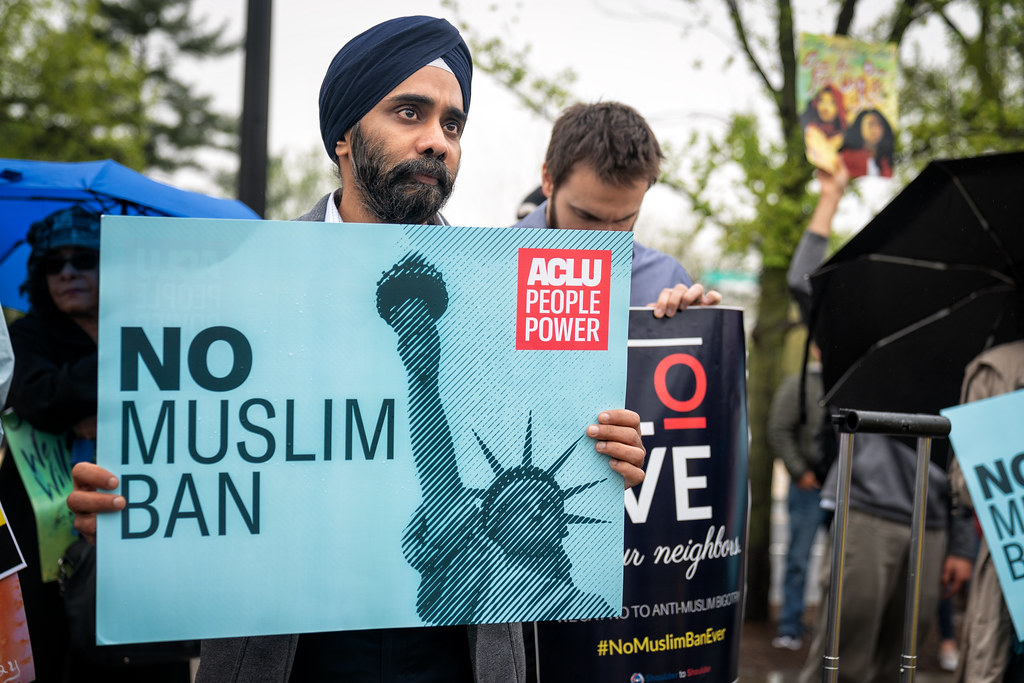
When the Trump administration's Muslim ban was moving through the courts, there was the weird debate people were having about whether it was fair to use Donald Trump's explicit statements announcing a discriminatory motive for the ban as evidence that the ban was discriminatory. The debate was weird because in any other circumstance the answer is obvious -- of course it's evidence. It's close to dispositive evidence. That's how anti-discrimination law works.

For example, this past week the Eleventh Circuit decided the case of McCarthy v. City of Cordele. Here are the relevant facts:
Joshua Deriso campaigned for election as chairman of the City Commission of Cordele, Georgia, by publicly stating his intent to “replace Caucasian employees with African Americans”; to lead “an entirely African American” City Commission; and to replace Roland McCarthy, the white City Manager, with a black City Manager. On social media, Deriso declared, “Structure needs to change . . . More Blacks!!!”; “The new City Manager should be Black”; and “it is time for African Americans to run our city.” Deriso won the election. The same day he and fellow commissioners took their oaths of office, the Commission voted on racial lines to fire McCarthy and to replace him with a black City Manager.

"The question," the court continued, "is whether those allegations permit the inference that the City Commission fired McCarthy because he is white." They quite reasonably answered "yes". When you publicly campaign on "I am going to racially discriminate", and then you do exactly what you promised to do, it's entirely reasonable to conclude that what you've done is engage in racial discrimination. And that inference is valid notwithstanding the fact that under normal circumstances the city council has wide discretion in hiring or terminating its city manager. This is not hard.

There's no pay off here other than to reemphasize the lawless anomaly that was Trump v. Hawaii. The pass it gave to blatant, undisguised discrimination is completely at odds with the doctrine both before and after the case. Judges fully understand how senseless Trump's rule is in other cases (especially, one must observe, in cases of "reverse discrimination"). Indeed, while Trump v. Hawaii was under consideration I observed that in any remotely analogous circumstance involving "Smallsville, Anystate" the case is an absolute dunker as a clear and obvious legal violation. It is only Donald Trump who received and continues to receive these ridiculous one-offs as the Supreme Court's special favorite.

Sunday, April 28, 2024

Campus Antisemitism Monitors Will Fail in Extraordinarily Predictable Fashion


Trying to capitalize on the latest headlines, a bipartisan group of legislators is seeking to create government "antisemitism monitors" that will be dispatched to colleges and universities across the country. Fail to meet their scrutiny, and colleges could lose gobs of federal funding.

If enacted, this policy will fail in spectacular fashion. How do I know? Because we have a template in state anti-BDS laws, which backfire in similarly predictable ways. The problem is that while it's conceptually possible to craft valid and legitimate anti-BDS legislation, in practice the laws will be enforced by some mixture of apathetic mid-level bureaucrats, terrified associate deans, and hotshot headline-chasing politicians. Put that cocktail together, and the result is such lovely headlines like "homeless hurricane victims can't get disaster relief until they sign anti-BDS pledge."

Indeed, if the antisemitism monitors do come into play, I can predict exactly the scenario that will go down shortly thereafter at Any College, USA.

  1. A student group invites some Palestinian poet to give a talk;
  2. Canary Mission or similar digs through the poet's instagram and finds a post where they say something that many people might find troublesome: "from the river to the sea" or "the Zionist state will be dismantled" or something of that ilk.
  3. They shriek that this is a violation of IHRA and federal law and the university risks losing all its federal funding unless it acts.
  4. Some associate dean for student affairs panics and cancels the talk.
  5. There's a massive backlash from the students (possibly including protests) as well as various academic freedom/civil liberties watchdogs who call the cancellation out as censorial bullshit.
  6. Pro-Israel/Jewish groups make surprised-Pikachu face at how they once again somehow became the poster child for heavy-handed campus censorship. Who could have predicted? (Answer: Everyone. Everyone could have predicted).
And for all the grousing about "only the Jews don't get ..." X Y or Z protections on campus, it's worth noting that no other campus minority currently has a monitoring program like this. A good rule of thumb for whether one is advisable here is if one also would support a similarly empowered and emboldened "anti-racism" or "anti-Islamophobia" monitoring program. If your answer is something along the lines of "while racism and Islamophobia are serious problems, I don't trust the implementation and I'm worried about the possibility of abuse and/or chilling free speech" -- congratulations! You've identified the exact reasons why such a program is inadvisable for antisemitism as well.

Wednesday, January 10, 2024

DeSantis' "Asylum" Offer to Jewish College Students


Florida Governor Ron DeSantis has issued an emergency order waiving various requirements for prospective transfer students into Florida public universities "who are seeking to transfer to a Florida university because of a well-founded fear of antisemitic or other religious discrimination, harassment, intimidation, or violence" at their current colleges.*

The "well-founded fear" language is borrowed from asylum law, so if I were a Jewish student considering this offer I'd have to be concerned that DeSantis' next step would be to traffic me right back out of the state via a one-way to a New England island.

In all seriousness, I have to give DeSantis a very faint tip of the cap here, if only because a few months ago I had a similar thought about whether colleges in blue states should offer a form of "asylum" running in the opposite direction -- assisting admissions or transfers of students leaving Florida public universities in the wake of DeSantis' assault on academic freedom and the rights of sexual minorities. I've certainly noticed an at least anecdotal uptick in "red state refugees" on the faculty side of academia, and it wouldn't surprise me to learn there's similar pressure on the student side. And on the other side of things, I actually wondered back in 2022 if DeSantis might seek to expressly differentiate himself from Trump on the subject of antisemitism. He hasn't really done so -- the seemingly obvious need of a GOP challenger to challenge Trump continuing to founder on the absolute inability of any Republican of substance to say a bad word about the Supreme Leader -- but he has tried to make "antisemitism" a relatively large part of his presidential narrative.

And so as DeSantis' presidential campaign continues to flounder in the most pathetic fashion, this reads like a theatrical attempt to capture some of the Stefanik-magic from last month. Of course, DeSantis isn't alone here. For whatever reason, Republicans have learned that fake performative concern about antisemitism is the easiest route for craven gutless mediocrities to become media starlets, at least for a few days. That it keeps on filling this role is maybe something that the Jewish community needs to ponder -- while on the one hand I'm not convinced it's actually Jews who are most impressed by these stunts, there does seem to be a repeated gullibility on this front that deserves closer interrogation. How has the GOP become so convinced that this play, in particular, is a winning strategy for them? 

* Nominally, "other religious discrimination" encompasses Muslim students as well -- an interesting prospect as various Muslim and pro-Palestinian groups have begun adopting the broad understandings of "antisemitism" vis-a-vis discourse about Israel and Zionism promoted by some Jewish groups and trying to cross-apply them to similar broad understandings of Islamophobia vis-a-vis how university actors talk about Palestine and anti-Zionism. In practice, it's hard to imagine that will amount to much -- in part because of the vagueness surrounding "well-founded fear" of persecution, and in part because the sort of person who is concerned about that sort of Islamophobia is perhaps unlikely to find Florida an attractive destination to flee to.

Sunday, November 26, 2023

Swapping Strategies


Different minority groups often swap strategies for protection in the context of trying to overcome societal oppression, and an advance for one group often can lead to advances for others. In a recent interview I did with Lewis & Clark's alumni magazine, for instance, I talked about how the pathway used to ensure Jews receive Title VI protections (notwithstanding the fact that Title VI doesn't cover religion, only race, ethnicity, and nationality) was quickly adopted to also secure similar protections for Muslims. Security tips meant to keep synagogues safe are often used to help secure mosques as well. And so on.

Another example of this that's less remarked upon, though which is (depending on your vantage) more interesting, more amusing, or more grim, is how the legal arguments pro-Israel advocates have used to try to extend anti-discrimination protections to cover backlash against Jews-as-Zionists have increasingly been adapted by pro-Palestine advocates to try and create discrimination claims around backlash directed at Palestinians-as-anti-Zionists.

I think we're all familiar with the contours of these arguments, and the controversy surrounding them, in the context of the "anti-Zionism as antisemitism" play. A Jewish student says something "Zionist" and is targeted by adverse action as a result. The student's supporters say "this is antisemitism -- Zionism is an integral part of my Jewish identity, and so attacking me on the basis of 'Zionism' is tantamount to attacking me as a Jew." Opponents reply that Zionism is a political ideology and criticisms of that ideology -- whether ultimately well- or ill-taken -- cannot be deemed to be targeting persons on the basis of an ascriptive identity. Not all Jews are Zionists, and in any event there is a difference between an identity and an ideology many members of a given identity happen to believe in.

Yet increasingly, we're seeing similar arguments being raised to bolster claims of anti-Palestinian discrimination. Consider the civil rights complaint Palestine Legal filed on behalf of Ahmad Daraldik, who was removed from his position as head of the Florida State University in part due to speech characterized as anti-Israel, anti-Zionist, or antisemitic. This complaint followed shortly after a high-profile complaint filed against USC on behalf of a Rose Ritch, a Jewish student ousted from student government for being a "Zionist". There are more than a few similarities between how the cases are framed that may not be coincidental. While Ritch's case is not mentioned in Daraldik's complaint, there does seem to be something to the notion that Palestine Legal (which undoubtedly was aware of the Ritch case), thought something along the lines of "if the Zionists can make claims like this, than so can we."

To be sure, some of Daraldik's allegations are quite "traditional" cases of discrimination (e.g., social media messages directed at him containing racial slurs). But others very much seek to present Daraldik's anti-Zionist speech as integral to his identity as a Palestinian, such that backlash against the speech ought to be viewed as tantamount to attacking him as a Palestinian. For example, he characterizes the hostility he endured as resulting from his "speaking about my life as a Palestinian growing up under Israel’s violent system of apartheid". And his lawyers likewise argued that statements by the university president characterizing some of Daraldik's own speech as antisemitic (a social media post which referred to an IDF soldier as a "stupid Jew" was probably the most prominent) was said to "reinforc[e] the anti-Palestinian stereotype that Palestinians reacting to experiences of violence and oppression by the Israeli government/military are inspired by anti-Jewish animus, not their own oppression" -- what many wearing other shoes might characterize (favorably or derisively) a "trope-based" argument.

These arguments, too, try to present a political orientation vis-a-vis Israel and Zionism as an integral part of an ascriptive identity. In that respect, they parallel Ritch's efforts to make the same argument at USC, and they're vulnerable to the same objections: anti-Zionism, like Zionism, is a political ideology, and so we might also say that criticisms of that ideology -- whether ultimately well- or ill-taken -- cannot be deemed to be targeting persons on the basis of their Palestinian identity. But -- without taking a position on the substance of his complaint -- I have more sympathy for Daraldik's conceptual argument here than one might suspect (precisely because I have some sympathy for Ritch's iteration too). While it's true that "not all Palestinians" likely agree with what Daraldik said or believes (what is Bassem Eid doing these days?), that does not mean there is no connection between what Daraldik said (and the backlash to it) and his Palestinian identity. I can absolutely see how not being able to level criticisms of the Israeli government or its policies would be experienced as an oppressive blanket that functionally obstructs the ability of Palestinian students to participate as equals in educational spaces. And the belief that there is "pure" animus against outgroups that does not drape itself in the garb of reasons seems unrealistic to me; the problem of disentangling "political" speech from bigotry is assuredly difficult, but it's also unavoidable. These responses don't tell us, of course, how the law should handle cases like Daraldik's or Ritch's -- at most, they show why they present genuinely nettlesome problems. But the point is they present the same problems, and the strategies for trying to make Daraldik's claims legally legible are similar to those used to do the same for Ritch's -- an overlap which simply does not seem coincidental.

A few days ago, we saw another example of this overlap in Tannous v. Cabrini University, involving a Palestinian professor terminated from his position due to social media posts that were alleged to be antisemitic but which he insisted were actually anti-Zionist (among the offending messages was one reading: "zio controlled USGOV politicians promise to cancel 2T$ of student loan debt ... yet they sent that 2T$ to Ukraine, Nato, and Israel to arm NAZIs.... Israel and Ukraine are societal cancers and must be eradicated."). 

The professor sued under a variety of theories, including claiming racial discrimination (he was at one point represented by Palestine Legal, though I don't know if they remained his attorneys throughout the litigation). In general, the district court concluded that a belief that a plaintiff is racist -- even if "wrong" -- does not equate to showing that adverse action occurred due to unlawful prejudice. In other words, it's not discriminatory to (even wrongly) accuse people of antisemitism. The exception might be if there was evidence that the only reason why a person holding X views was deemed to be racist was because they were also a member of a given identity group (another person of a different identity, but holding otherwise similar views, wouldn't be targeted). And indeed, the professor did argue that "[d]ue to his status as a Palestinian American, [the university] presumed that his tweets critical of Israel were actually criticism of Jews." The court rejected this argument as conclusory (there was no evidence presented that the university wouldn't have been equally offended no matter who wrote these tweets) -- but again, the core claim being raised here is one relying on the existence of a "trope" that seeks to convert backlash against "tweets critical of Israel" into an ascriptive attack on his Palestinian identity.

Indeed, there's a part of me that read the Tannous case and wondered if there might be a bit of 10-dimensional chess going on. The main basis for the court's decision in Tannous was that even unfairly accusing someone of "racism" or "antisemitism" is not tantamount to discrimination on basis of a protected class. Tough luck for Professor Tannous. But also, maybe, tough luck for Rose Ritch, whose detractors also could say that they acted against her not because she was Jewish, but based on their belief that her ideology was racist. That belief might be wrongheaded, but under the logic of Tannous it is not antisemitism. Tannous might have lost the battle, but Palestine Legal may have won the war -- and in any event, one can see the logic of them pursuing the case as a win-win: if arguments like the one they made on behalf of Tannous are rejected, then these arguments aren't going to be available for Zionist Jews making similar claims of discrimination where the underlying facts suggest the antisemitism is cloaked in antisemitic garb; and by contrast if those arguments are in fact legal winners, then there's no reason why they shouldn't leverage them for their own clientele.

To be clear: there's nothing unsavory about what's going on here. Legal arguments and precedents travel, and it's entirely normal and ordinary that various groups will decry the outrageous, abusive advocacy tactics of their opponents in one moment and furiously crib off them in the next. Jewish groups do it too (witness the blinding oscillation between "DEI is the devil" and "let's use contemporary DEI language to explain antisemitism"). But it's still interesting/amusing/grim (take your pick) to witness the unacknowledged but almost certainly significant influence contemporary Zionist legal advocacy is having on developing the strategies of their anti-Zionist adversaries (and, probably, vice versa).

Friday, July 21, 2023

Leaving the Mess for Later

Gfp-messy-kitchen-sink

One thing that's come up in a few of the Supreme Court's recent blockbuster decisions is the shakiness of the fact pattern in the underlying case. Mr. Kennedy in Kennedy v. Bremerton School District wasn't really just an average citizen whose desire to privately pray on his own was stymied by the evil liberal school district. Ms. Smith of 303 Creative v. Elenis might have outright falsified documents suggesting that a gay couple asked to engage her services. The Supreme Court's conservative majority did not care, blitzing ahead in decisions that made dramatic alterations to major areas of constitutional law doctrine.

At one level, I actually understand the perspective here. When it comes to abstract, "philosophical" question regarding the scope of the Establishment Clause or whether anti-discrimination law must sometimes yield to free speech commitments, the details of the individual case don't really matter. If it wasn't Kennedy, it'd be someone else. If what you care about is the broad, sweeping change -- interring Lemon v. Kurtzman for good, or laying a marker that public accommodations laws must yield to businesses' right to "expressively" discriminate -- the details don't affect the underlying arguments all that much. The same claims and counterclaims that would be made in any case would be aired here. 303 Creative probably already felt like the can that was kicked down the road from Masterpiece Cakeshop. Similar impatience was seen in some of the concurrences in Fulton v. City of Philadelphia -- we know we're going to have to decide whether to revisit Employment Division of Oregon v. Smith, and we know the arguments for and against preserving the precedent, so why delay the inevitable? Just make the decision one way or the other and get it done.

At another level, though, this speaks to how the current conservative judicial cadre really doesn't care about the formalities of law and legal doctrine. It's movement conservatism through and through -- the important thing is the bottom-line results, and the Court will shoot first and let others clean up the mess later. This especially stood out for me in 303 Creative, a case where it was striking how much more legalistic Justice Sotomayor's dissent was compared to Justice Gorsuch's majority opinion. The former, whether one agrees with the result or not, worked through the relevant First Amendment doctrine via the same methodology I'd teach my students -- explaining the relevant doctrinal framework, explaining why this case falls into a particular part of the framework, and explaining the implications thereof. The majority opinion was basically an abstract ode to the importance of free expression but skipped past significant swaths of the seemingly essential legal analysis (often by vague gestures at party "stipulations" or just treating as gospel certain holdings of the Tenth Circuit). It was hard to escape the sense that the nitty-gritty details of Lorie Smith's case were not at all what interested the majority, and so they were disinclined to spend significant time on them. They wanted to make a big statement about the interplay of free speech and anti-discrimination law, so that's where they devoted their attention. 

From that vantage, the fact that Lorie Smith's case may not have been the cleanest vehicle isn't really all that important. Of course, from the vantage of lower courts trying to figure out what the hell 303 Creative actually means, it's extremely important, because nobody actually knows the concrete rule that 303 Creative is actually establishing, and the blurry fact pattern means that trying to infer it from Lorie Smith's situation is a doomed initiative. But again, that's someone else's mess to deal with. I honestly believe that the Justices in the 303 Creative majority did not care if Lorie Smith, personally, deserves the exemption from anti-discrimination law under the doctrine that will eventually lay out. What they cared about is being decisive in defending the existing of these exemptions in concept. Lorie Smith just had the good fortune to be the next case in line that could be plucked onto the docket.

I've written before of the Machiavellian character of the current Supreme Court, specifically, it's absorption of Machiavelli's advice to tyrants: that they should take their big oppressive swings early, in full force, and all at once. You won't gain any advantage from dragging things out, and you'll probably get credit if you cut back later. And the repeated pattern we've seen is of the Court taking these huge right-wing swings that delight conservatives on the level of ideology, but without much care for how they can be operationalized as a workable legal doctrine, and leaving it lower courts to clean up its mess. And to give an inch of silver lining, there is the chance (this follows from Machiavelli too) that as that "mess" resolves itself the Court will then quietly file down some of the roughest edges. The Bruen decision, which reads as a right-wing ideological fantasy document but which has unleashed utter chaos in lower courts, may be an example if the Court uses the Rahimi case to cut back the most extreme interpretations. Take the big swing, make the chest-out assertion of insisting that no amount of public necessity can weigh against robo-originalism, and then later on at their discretion maybe pick and choose a few morsels to dial back on and claw back some legitimacy.

But nonetheless, it really is striking the degree to which the conservative legal movement just no longer cares that much about the law. As a law professor, it makes for depressing teaching. As a citizen, it makes for depressing living. Just depression all around.

Sunday, July 09, 2023

A Statutory "Green Book" After 303 Creative

In 303 Creative, the Supreme Court held that at least in some circumstances a business's free speech interest in avoiding producing expression it disagrees with constitutionally must trump the application of anti-discrimination law in areas of public accommodation, notwithstanding the admittedly "compelling state interest" the latter type of law protects.

It was not so long ago that minorities in America had booklets they carried to let them know which businesses it was safe for them to patronize, knowing that in certain places and communities they could not simply assume that a hotel, restaurant, or shop open to the general public would be open to them. The Jewish Vacation Guide was one example, the Negro Motorist Green Book was another. In circumstances where discrimination was lawful, these resources served several important needs. 

First, of course, they let their readers know where certain services simply would be unavailable. One does not want to travel through or move into a town where the only hotel or restaurant will refuse to serve you. 

Second, and almost as importantly, they enabled readers to avoid shops which would refuse to grant them service. This is distinct from the first injury, because there is a severe dignitary harm in being refused service on account of one's identity even if a competing business across the street that will happily take one's dollars. One feature of public accommodations law is precisely that one doesn't have to "run the risk" that in entering a storefront on Main Street you'll endure the indignity of being asked to leave because you're the wrong skin color, religion, or sexual orientation. Absent that guarantee being fully enshrined into law, resources like the Green Book enabled travelers to know in advance which storefronts to avoid so they wouldn't have to face that sort of humiliation.

In keeping with that tradition, I wonder if one way of balancing 303 Creative's First Amendment protections with the again conceded-to-be-compelling interest in robust antidiscrimination protections is via the time-tested policy of disclosure. States can pass laws which require any business that wishes to claim a First Amendment exemption from all or part of an anti-discrimination statute to publicly announce and display that choice; and the state can likewise maintain a list of businesses which make such claims. The law would be a sort of statutory Green Book, letting patrons know what businesses are at least claiming an ability to discriminate (and by extension assuring them that businesses not on the list remain safe to patronize).

Here's my very rough crack at some model legislative language:
Sec. XXX -- Exemptions

(a) Registration. Any business which seeks to claim a First Amendment exemption from all or part of the [this state's anti-discrimination law] ("a business seeking an exemption") must, at least thirty days prior to asserting any claim for such an exemption,

(1) Register with the Secretary of State their intent to claim an exemption, including specifying which portions of the law they assert they will not comply with.

(2) The Secretary shall publish the names and addresses of all businesses who register their intent to claim an exemption under this subsection on a publicly available website, including which provisions of the law they claim exemption from. 

(b) Public display. Within thirty days of receiving a filing under Sec. (a)(1), the Secretary shall issue a notification to the business seeking an exemption stating that "WARNING: THIS BUSINESS HAS FILED FOR A FIRST AMENDMENT EXEMPTION FROM THIS STATE'S ANTI-DISCRIMINATION LAWS", including specifying which portions of the law the business claims exemption from. Unless otherwise inapplicable, the text of this notification shall be conspicuously displayed in

(1) The front window or doorway space of any physical location of the business that is open to the general public or the businesses' regular customers; and

(2) The front page of any webpage or social media account controlled by the businesses and through which it advertises its business to the general public;

(3) Notwithstanding any other portion of this subsection, if a business claiming an exemption has neither a physical storefront under subsection (b)(1) or a webpage under subsection (b)(2), the text of the notification shall be displayed in any reasonable location where it will be conspicuous for the average customer considering patronizing the business.

(c) Presumption of sincerity. Any business which complies with the provisions in this section shall be deemed to have established, as a rebuttable presumption, the sincerity of their belief that compliance with [this state's antidiscrimination laws] conflicts with their own expressive beliefs.

(d) No entitlement to, or expansion of the scope of, exemption. Except as detailed in subsection(c), compliance with the provisions of this Section shall not entitle the business seeking an exemption from antidiscrimination law to any relief from the requirements of antidiscrimination provisions beyond that which is constitutionally required under the First Amendment; nor does it immunize the business seeking an exemption from any public or private proceeding seeking to enforce anti-discrimination provisions that would not otherwise violate the First Amendment.

The basic idea of this provision is simple: if you want to claim a First Amendment right to discriminate, you have to claim it publicly, in advance, so that people who would be denied service can plan accordingly. By creating a master list of discriminators, and by requiring businesses who seek to assert a right to discriminate to prominently display their intent on their storefront, it is far less likely that customers who would end up being excluded will on accident patronize the business.

The law would have some other salutary effects as well. By creating a reasonably comprehensive list of businesses asserting a right to discriminate, the state can learn of the existence of any "dead zones" where members of certain marginalized groups may be severely restricted or entirely unable to obtain services -- data that could be very useful for future legislative action. As reflected in subsection (c), the law also I think would aid in dividing the actual true believers from the opportunists -- I assume that only those who really, truly believe in their discriminatory impulses will be willing to announce in advance to the world "I am a discriminator" (as the 303 Creative plaintiff, to her "credit", was willing to do).

What are some potential drawbacks? One possibility is that it will be assumed that a law like this will enable more businesses to discriminate than otherwise would be licensed to do so by 303 Creative; I wrote subsection(d) to try and forestall that risk. Under this statute, registering a claim for an exemption is just that -- a claim, and the claim does not guarantee success. A business that registered but whose activities were not protected under 303 Creative's umbrella would still be liable, notwithstanding their registration.

Another possible problem is the argument that a law like this itself constitutes compelled speech. On face, the requirement that the business post the "WARNING" placard in its store to me doesn't seem any different than requiring a restaurant to display the health inspection notice. But there might be something different here insofar as the broader thrust of the statute would be to force businesses to "go public" with their intention to discriminate. While there's something instinctively odd about claiming a free expression right to avoid expressing one's deeply-held beliefs, there are circumstances where such a claim makes sense -- NAACP v. Alabama is the obvious template here. Alabama in the 1950s sought to require that the NAACP disclose the names and addresses of its members; the NAACP, unsurprisingly, did not wish to make this information public and claimed a First Amendment right to keep their membership data private. The Supreme Court ruled in favor of the NAACP (incidentally, NAACP was perhaps unsurprisingly a key precedent relied upon by the Griswold Court regarding the existence of a right to privacy). The NAACP had obviously reasonable fears that disclosure of their membership would render them vulnerable to harassment and violence; the discriminating businesses might claim fears of a similar vulnerability.

NAACP is clearly distinct, however, for a simple reason: the NAACP did not simultaneously seek to keep its "expression" quiet and claim that its expressive activity entitled it to a governmental benefit  (I've always found the Little Sisters of the Poor style claim -- wanting an exemption, but also being outraged at being forced to actually ask for the exemption -- to be utterly ridiculous). With regards to its membership information, the NAACP truly wanted nothing more than to be "let alone"; there was never a circumstance where the organization would wield its membership data as a sword against the state. By contrast, by stipulation the discriminators do wish to go public regarding their beliefs when they tell the state "you can't enforce your anti-discrimination law against me because I believe X". At most, what they want is to be able to hide their beliefs until the last minute. But that's a far less pressing claim -- at some point, the business seeking the right to discriminate will have to go public with its claim, and so it does not seem unreasonable to insist that the pivotal moment occur before an unwitting customer is humiliated and denied service.

And on the subject of harassment: certainly, violence and vandalism are never justified. But often in this context, "harassment" means nothing more than a consumer counter-boycott -- the company refuses to do business with certain groups because of its beliefs; many other consumers decide accordingly that they will no longer patronize the business in protest of that discrimination (ex: the Jewish community members who no longer are purchasing from a Kosher bakery that decided it couldn't bake "pride" treats). That is not harassment, that's counter-speech. And in that register, I'd argue that under 303 Creative's logic enabling customers to know "this business asserts a right to discriminate" is free speech facilitative, not chilling.

One of the virtues of public accommodations law is that it dissipates, under normal circumstances, the inference that basic business transactions are expressive. I very much prefer a world where the bakery that bakes a cupcake for a client isn't seen as sending some sort of message of approval towards the client and the client that eats the baker's treat isn't sending a message of approval toward the baker (beyond "this cupcake is delicious"). That, to me, seems a far more pleasant space to live in than one where every turnip and widget we buy or sell can be taken as some sort of sweeping moral approval for our business partners.

But the Supreme Court did not agree. And once we open the door to saying that ordinary business transactions should be perceived as expressive, then customers as well as businesses have a strong interest in knowing the political and social views of who they're transacting with so they can assure themselves that values align, and can redirect their dollars where they do not. This is one reason I think a consequence of 303 Creative will be to supercharge "cancel culture" -- the more businesses are allowed to say "we don't serve your kind", the more customers must be allowed to say in return "well then we don't buy from your kind". The only thing worse than cancel culture is unidirectional cancel culture. If businesses can "cancel" customers for supporting gay rights, then customers should be equally empowered to cancel businesses for asserting a right to discriminate.

Again, the model language I've written above is rough. But I'm curious what First Amendment scholars and other interested parties think of the idea. We may have to tolerate certain businesses asserting a constitutionally-protected right to discriminate. But customers have rights too. One of those rights is to have confidence that one can walk into a storefront and be served as an equal. Another right is to be able to avoid patronizing businesses who insist they have a deeply held commitment to discriminating against you, your family, or your loved ones. This statute, it seems, can help bring these clashing interests into balance.

Saturday, July 08, 2023

Jews Against Jews Who Discriminate

This is an interesting story about a New Jersey kosher bakery who refused to bake rainbow-frosted cupcakes because the baker decided Pride-themed events violated his conception of Jewish values. This decision, in turn, has led to a furious backlash from the rest of the local Jewish community, who are livid that the baker is citing Jewish values as justification for homophobic discrimination:

Multiple rabbis have accused the baker of bigotry, and some local Jews are boycotting his shop. The area’s Jewish federation privately said it would stop buying from Mittel before publicly walking back its position. And Eshel, an advocacy group for LGBTQ Orthodox Jews and their families, announced an “ally training” in West Orange this coming Sunday in response to the incident.

[....] 

The issue blew up as other rabbis in the area learned about what happened and commented publicly.

“When we refuse basic Jewish services to members of our community who are articulating who they are, we are excluding and dividing,” wrote Robert Tobin, rabbi of the Conservative B’nai Shalom in West Orange, in a blog post on June 22. He highlighted the Conservative movement’s recent strides toward LGBTQ inclusion, and an interpretation of the Torah that holds “humans are created in the image of God with a variety of potential gender identities and with the possibility of gender fluidity.” Tobin also reportedly addressed the incident in a sermon, according to the New Jersey Jewish News.

David Vaisberg, senior rabbi at the independent Temple B’nei Abraham in Livingston, New Jersey, tweeted that he was “so disappointed” in the bakery, which is located in a strip mall next to a kosher Chinese restaurant.

“They make great baked goods but have shown themselves to be against the LGBTQ+ in canceling orders of rainbow baked goods in Pride month,” he wrote, adding that he was letting the bakery know why they had lost his business and advised followers to “please do the same.” 

This reminded me of a working paper I heard about from years back (which I don't believe has been published, unfortunately), where the author asked Jewish, Christian, and Muslim respondents to give their views regarding government accommodations for Jewish, Christian, or Muslim business owners who for religious reasons did not want to serve gay customers. The most fascinating finding, as I recall, was that Jews were least likely to support an accommodation if they were told it was a Jewish business seeking to discriminate.

At one level, that was a surprising finding -- we'd naturally expect Jews (like all other groups) to display some level of in-group bias, being more sympathetic to claims made by their coreligionists. But on another level, this result made perfect sense to me. Ask me in the abstract about whether business owners can claim a religious exemption from having to serve gay customers, and I'll generally answer no, but I'll acknowledge the important religious freedom and pluralism concerns blah blah blah. 

But if somebody asks to do that while carrying my flag and representing my people? Oh, hell no. Screw that guy. You get your ass back into line and stop embarrassing the tribe with your homophobic nonsense. And I suspect something similar is going on in this community of New Jersey Jews.

Thursday, May 25, 2023

Biden Admin Releases Ambitious Strategy To Fight Antisemitism

The Biden Administration has released its long-awaited document outlining an ambitious national strategy to combat antisemitism. "This strategy," the document concludes, "represents the most comprehensive and ambitious effort to counter antisemitism in American history."

Mostly, I want to give immense praise to the Biden administration for putting this document together -- not just talking the talk, but walking the walk. It is no revelation to say that many Jews sometimes feel like the fight against antisemitism is an afterthought -- a fact that document acknowledges expressly ("One  report found that 91% of Americans believe antisemitism is a problem for everyone, and yet, in  many instances, Jews feel as though antisemitism is ignored, discounted, or not taken as  seriously as other forms of hate and bigotry."). With this strategy plan, the Biden administration is taking Jewish concerns seriously in a way that no other administration has. It has my thanks for that.

Given the discourse of the past few days, one might expect that I'd want to focus on the inclusion of the "Nexus" antisemitism definition in the document text. Several commentators, insisting on a fundamentalist version of sola IHRA scriptura, tried to curtail this inclusion by insisting that any discussion on antisemitism that goes beyond IHRA will necessarily be diluted or "confusing".

The snarky part of me wants to extend my sincere condolences to these critics, given that final document is 60 pages long, virtually all of which is comprised of words other than "IHRA". Turns out, there were more things to say. More to the point, here is the sum total of the document's treatment of this roiling controversy:

There are several definitions of antisemitism, which serve as valuable tools to raise awareness and increase understanding of antisemitism. The most prominent is the non-legally binding “working definition” of antisemitism adopted in 2016 by the 31-member states of the International Holocaust Remembrance Alliance (IHRA), which the United States has embraced. In addition, the Administration welcomes and appreciates the Nexus Document and notes other such efforts.

That's what we've been obsessing over? Seriously? An unadorned mention, following the document's "embrace" of the IHRA definition, that it also "welcomes and appreciates" Nexus?

I will say that, in the veiled language of diplomacy, this is quite the swipe against JDA. The document "embraces" IHRA. It "welcomes and appreciates" Nexus. And as for other, unnamed definitions? Yes, we note their existence. It's kind of like how I described the 2020 Democratic primary: "There are many great candidates running for the Democratic nomination, and also Tulsi Gabbard."

But that's me being petty again. I'll just one of other thing here. In the paragraph before the one I just quoted, the document describes antisemitism as follows:

Antisemitism is a stereotypical and negative perception of Jews, which may be expressed as hatred of Jews. It is prejudice, bias, hostility, discrimination, or violence against Jews for being Jews or Jewish institutions or property for being Jewish or perceived as Jewish. Antisemitism can manifest as a form of racial, religious, national origin, and/or ethnic discrimination, bias, or hatred; or, a combination thereof. However, antisemitism is not simply a form of prejudice or hate. It is also a pernicious conspiracy theory that often features myths about Jewish power and control.

The first sentence of this is clearly adopted from IHRA, albeit modified -- IHRA says that "Antisemitism is a certain perception of Jews, which may be expressed as hatred toward Jews." The Biden administration's formulation is clearly better (what is a "certain perception"), which already demonstrates that blind adherence to IHRA's text is neither necessary nor desirable.

But the following sentences go beyond anything in IHRA. Discussing antisemitism as not just a perception, but also discrimination and other actions, is closer to the language one finds in the Nexus definition: "Antisemitism consists of anti-Jewish beliefs, attitudes, actions or systemic conditions."

When you look at the above paragraph, and the portions that go beyond that first sentence, are you "confused"? Does it feel "diluted" or "counterfeit"? No. The inclusion of those iterations of antisemitism make the document stronger, not weaker.

IHRA is an important and valuable component of the national antisemitism strategy. But it couldn't shoulder the burden alone. Fortunately, it didn't need to. IHRA and Nexus are strogner together. And while I sincerely hope that this "debate" fades into the far, far periphery of future discussion over this document, for now the Biden administration deserves tremendous praise for understanding that the fight against antisemitism is too important to leave tools on the table. 

Wednesday, March 15, 2023

Woke Freeze

The internet is cackling about prominent "anti-woke" conservative Bethany Mandel drawing a complete blank when asked the simple question "what is woke".

Jon Chait objects to the pile on of someone who just "froze" on TV.

At one level, he's probably right that Mandel froze, and freezing could happen to anyone. But that doesn't mean it isn't something she should take her lumps for. The context matters here, given that Mandel holds herself out as a subject-matter expert on this exact issue. If I forget the capital of Ukraine, that's embarrassing. If a guy who just spent 30 minutes engaging in Putin-apologism for Russia's invasion then can't recall the capital of Ukraine, that's, well that's a lot more embarrassing.

But the deeper problem is that while at one level sure, Mandel obviously has an idea of what she means by woke and just froze up in articulating it, at another level Mandel has no idea what she means by woke because her definition is utterly unsuited for the political hackwork she's trying to do.

"Woke" is when a radical belief in absolute endpoint equality, deviations from which can only be the product of discrimination, is violently enforced at mobpoint. Okay, but if that's the definition it doesn't actually capture any meaningful behavior. There's no universe in which Silicon Valley Bank was committed to absolute endpoint equality which it sought to enforce by a violent mob; hence, Silicon Valley Bank cannot possibly be woke. Which is why the argument for SVB being woke doesn't rely on anything like that definition, but rather skips to things like "woke is giving to a charity" or "woke is when any Black person is in the room". Seriously -- has there ever been a more naked motte-and-bailey play than this?

The problem is that when you put the right-wing definition of "woke" (crazed radicals fomenting an angry mob to impose absolute economic equality!) next to the right-wing examples of "woke" (Silicon Valley Bank had a single Black guy on its board!), the mismatch is too evident. And that, I suspect, is the real reason why Mandel froze up -- giving the definition would have ultimately shown how ridiculous her arguments were; and she couldn't hack together a new definition on the fly which would have resolved the dissonance.

UPDATE: Great example of the bait-and-switch. What does Victoria's Secret switching its brand ambassadors from the supermodel "angels" to female "icons" like Megan Rapinoe have to do with Mandel's definition of "woke"?


Tuesday, January 17, 2023

DEI's "Psychology" Double-Bind

The NYT has an op-ed today regarding DEI programs -- and in particular, the scant research suggesting that they actually, you know, work.

I'm familiar with some of the research in this area and while I could quibble on the margins, the core point is more or less accurate. There is fairly robust research evidence that establishes implicit bias is prevalent in our society, but there is not much in the way of verifiably effective interventions that combat it. Many DEI programs which purport to address implicit bias and other forms of prejudice are at the very least not proven to actually have an impact on the problem they purport to address. Finding an intervention that reliably and durably alters discriminatory attitudes (particularly implicit ones) is somewhat of a white whale for the social psychology profession. But in the meantime, the lack of evidence that many DEI programs tailored towards altering attitudes are effective suggests that a ton of time and money is being wasted.

Given that, the article makes the following suggestions:

So what does work? Robert Livingston, a lecturer at the Harvard Kennedy School who works as both a bias researcher and a diversity consultant, has a simple proposal: “Focus on actions and behaviors rather than hearts and minds.”

Dr. Livingston suggests that it’s more important to accurately diagnose an organization’s specific problems with D.E.I. and to come up with concrete strategies for solving them than it is to attempt to change the attitudes of individual employees. And D.E.I. challenges vary widely from organization to organization: Sometimes the problem has to do with the relationship between white and nonwhite employees, sometimes it has to do with the recruitment or retention of new employees and sometimes it has to do with disparate treatment of customers (think of Black patients prescribed less pain medication than white ones).

The legwork it takes to actually understand and solve these problems isn’t necessarily glamorous. If you want more Black and Latino people in management roles at your large company, that might require gathering data on what percentage of applicants come from these groups, interviewing current Black and Latino managers on whether there are climate issues that could be contributing to the problem and possibly beefing up recruitment efforts at, say, business schools with high percentages of Black and Latino graduates. Even solving this one problem — and it’s a fairly common one — could take hundreds of hours of labor.

I have no intrinsic quarrel with this. Instead of looking for "bad brains" and trying to fix them, focus on tangible actions and outcomes. If your company has too few Black and Latino people in management roles, instead of trying to root out the deep-seated biases in your executives and HR staffers, just get to work directly on the problem.

But this anti-psychology turn is interesting for one particular reason: it flies in the face of the prevailing conservative formulation of what discrimination is: namely, discrimination occurs if and only if one can prove the presence of malign intent by a discrete decisionmaker. Unless someone holds racially discriminatory attitudes, there cannot be said to be racial discrimination at all. From that framework, which holds out psychology as the exclusive prerequisite of discrimination, it makes sense that an anti-discrimination initiative would have to be psychologically-inclined as well. And indeed, focusing on actions and behaviors in absence of establishing bad psychological intent is an anathema to the conservative (and, often, alt-liberal) framework -- that way lies "racial balancing" or "equality of result" or any number of terrible ghouls which are supposedly the patrimony of the progressive DEI edifice.

And so we have a double-bind: first, prominent political and social institutions (to say nothing of legal precedents) say that the only cognizable way to speak of discrimination is through psychology -- bad motivations. Then, when DEI professionals accordingly work within that framework and try to address the problem through psychology, they're pilloried because such interventions, it turns out, are only dubiously reliable and don't directly correlate with fixing the "actual problem" of underrepresentation of social outgroups. Which is fine as far as it goes, except that when DEI tries to pivot back to the "actual problem" without the baggage of wading through conscious and subconscious attitudes, they're lambasted as crying "discrimination!" without proof, since only psychology is said to generate valid evidence of discrimination in the first place. It's an impossible situation. 

Tuesday, December 06, 2022

Am I Nuts for Thinking a Jewish Florist Should Have To Make an Easter Arrangement?

One thing I tried to impress upon my Con Law students this semester (and every semester) is that the interplay between anti-discrimination law and freedom of speech (and freedom of religion) is complicated and raises a host of thorny questions that defy easy resolution. These issues, of course, lie at the forefront of the 303 Creative case currently before the Supreme Court, which I'm sure will address them with the care, nuance, and sensitivity they deserve [/sarcasm].

But on that matter, I want to flag a hypothetical offered by prominent First Amendment specialist and former federal judge Michael McConnell, to get folks' intuitions on:

What if a Jewish florist is asked to design the floral display of white lilies on Easter Sunday morning at a Christian church? Ordinarily, flowers are just flowers. But the lilies in church on Easter morning are a symbol of the new life in Christ. I cannot believe that a free nation would compel a Jewish florist to construct a symbol of Christ's resurrection—on pain of losing the right to be a florist.

McConnell frames this as his "personal favorite hypothetical", and clearly perceives it as a knockout argument for the pro-free speech/religious liberty side. But perhaps I'm not fully grasping the facts, because speaking as a Jew this prospect doesn't seem that frightening to me.

Suppose I'm a Jewish florist. A customer comes in and says "I've seen the lovely work you've done with white lilies, could you please make a similar display for me?" I agree, since I have loads of experience working with white lilies. The customer then says, "thanks -- we plan on putting this display up in our church on Easter morning!" This prospect ... doesn't upset me. I don't intuitively think I should be able to refuse the customer, notwithstanding the fact that I obviously don't believe in the divinity of Christ, and I don't view continuing to serve the customer as forcing me to avow any beliefs I don't hold.

At root, the reason why this prospect isn't bothersome is because I don't view my customer's use of my flowers as representing my speech. I just design the flowers; what they do with it is their business. If someone sees the arrangement at church and learns that David's Flowers created it, I do not expect them to think "wow, I had no idea David believed in Christ's divinity!" This isn't to say I have no free speech concerns regarding flower arrangements -- I would very much chafe at government regulations that, for example, regulate what shapes I can use in my designs. That part very much is my expression, would be attributed to me -- the churchgoer who compliments the pattern of the flowers would credit those decisions to David's Flowers (I wrote about this a few years ago as the problem of partially expressive conduct).

There are still plenty of tough cases at the margins. I show my customer a preliminary design; they twist their lip and say "I dunno ... it's just not capturing the majesty of Christ's resurrection, you know?" I'm at a loss ("So ... bigger?"). But I'm inclined to think that while such an example might demonstrate why I might be a bad choice to design the arrangement, it doesn't give me the right to discriminate against the customer if they are in fact thrilled with the work I do and have done for other customers.

For me, then, McConnell's hypothetical has the opposite effect than what he intended. And of course, for many Jews -- particularly Jews who live in predominantly non-Jewish areas -- the more salient threat is that local businesses will be given carte blanche authority to refuse to service any of our religious life cycle events lest it be seen as "approving" of them. To let vendors say "ordinarily, a cake is just a cake -- but a cake served at a Bar Mitzvah has religious significance that we, as Christians, cannot approve of" is not a door I want to open.

But perhaps some of my readers disagree. Curious to hear people's thoughts on this.

Tuesday, June 21, 2022

The Ministerial Exception and Neutral Rules after Carson v. Makin

States like to give money to things. They like to fund schools, or recycling campaigns, or building repairs, or sports programs. And sometimes, religious entities are among organizations who conduct the program the state is funding -- they run the school, or the recycling campaign, or the the building, or the sports program. In such scenario, there are constitutionally-speaking three possibilities:
  1. The state is prohibited from giving the money to the religious entity. Funding the religious organization is an Establishment Clause violation.
  2. The state is required to give the money to the religious entity. Refusing to fund the religious organization, when other comparable organizations are funded, is a Free Exercise violation.
  3. The state can choose whether to give the money to the religious entity. There is "play in the joints" between the Free Exercise and Establishment Clause issues, and states can choose how they want to resolve that tension.
Today, in Carson v. Makin, the Supreme Court took a big step towards Door #2. The Court struck down a Maine program which (for certain rural areas lacking public schools) funded private schools, but only if those schools are non-sectarian. If Maine is offering parents funds to send their kids to private schools generally, it cannot withhold those funds if the parents elect to send their children to a religious academy. Religious schools must be eligible for generally-available funding on the same basis as any other "comparable" private school.

In making this ruling, the Court distinguished (and significantly narrowed) an older case, Locke v. Davey, where the Court upheld a program which excluded ministerial training from an otherwise generally available scholarship program. The Carson Court said Locke was limited only to circumstances where the school was specifically training ministers; not "religious education" more broadly.

This got me thinking, however, about what options are still available to a state like Maine which is perhaps leery about sending its tax dollars to directly support religious education. Carson does not directly say "states must fund religious education" after all. It merely says that states must allow religious schools to obtain funding when they would otherwise be eligible based on the general criteria the state uses for assigning funds.

So imagine the following rule: "No school shall be funded unless each of its employees is fully subject to anti-discrimination rules." The state, it is fair to say, has a strong interest in ensuring that the subjects of its funding abide by and are protected by anti-discrimination rules. Still, anti-discrimination law contains certain exemptions, one of which is known as the "ministerial exemption" -- ministers are not subject to anti-discrimination protections. In Hosanna-Tabor Evangelical Lutheran Church and School v. EEOC, the Court expanded who counts as a minister beyond the proverbial priest or Rabbi to include many teachers at religious institutions -- these teachers now cannot sue if they are the victims of discriminatory conduct. Religious schools are relatively likely to have such "ministers" on the payroll, so they would run afoul of the neutral rule, and would not be eligible for state funding.

Whether this gambit will work depends a lot on how it is phrased and the degree to which courts are willing to accept it as a neutral rule (which, in turn, may relate to whether there are other schools whose eligibility for state funds would be limited by the rule for reasons having nothing to do with religion). But -- on about an hour's worth of thought -- it seems like a plausible argument.

Sunday, June 19, 2022

The Two Halves of Linked Oppressions

Consider paired statements of the following form:

  • "Freeing Palestine is a queer issue"/"Queer liberation is a Palestinian issue."
  • "Fighting racism is a Jewish issue"/"Fighting antisemitism is a Black issue."
  • "Opposing colonialism is a woman's issue"/"Opposing misogyny is an anti-colonial issue."

One can imagine plenty of other pairings. My question is to what extent the two components of the pair should be read as a making identical or at least inextricable points, such that affirming one half of the pair necessarily means affirming the other.

At one level, when I see statements of this form being made, while typically only one half of the "pair" is presented, the defense of the statement sounds in logic that implies that the other half is necessary as well.

Consider the antisemitism/racism pair as our example. Pressed to defend the claim "fighting racism is a Jewish issue", one most often hears either an argument about intersectionality or an argument about linked oppression. The former notes the existence of Black Jews to observe that advocating for "Jews" necessarily requires fighting the anti-Black racism that some Jews experience. The latter makes a broader contention that various forms of structural injustice are linked together such that a campaign against antisemitism will never be successful unless it tackles racism as well -- these oppressions nourish each other, reinforce each other, and so must be attacked together. Both of these arguments imply that the position could be as easily expressed by its inverse: the existence of Black Jews means that advocating for Black people must mean fighting the antisemitism some Black people experience; the interconnectedness of anti-Black racism with antisemitism means that a campaign that is "solely" against the former will be doomed to fail.

Yet it doesn't seem that it is random or trivial which half of the "pair" is trotted out, suggesting that there are practical differences between the two even if they are nominally express the same analytical point.*

One difference could be exhortative: which group is being encouraged to act in a particular way. "Palestine is a queer issue" encourages members of the LGBT community to relate in a particular way to Palestine. "Queer liberation is a Palestinian issue" encourages members of the Palestinian community to relate in a particular way to the LGBT community. Partial overlap notwithstanding, those exhortations are being directed to largely different audiences. There may different reasons for appealing to one audience over another, and likewise the relative success of the appeal might be appraised differently for one audience over another.

Another difference between the claims is descriptive: does community X view issue Y as "their" issue? If I'm a member of X, I can make the assertion that yes, it is (even if it is perhaps aspirational); but I can't necessarily make that claim about a community not my own -- so as a Jew, I can proffer that anti-racism is a Jewish issue, but it's harder for me, not being Black, to say authoritatively that antisemitism is a Black issue. Even if we accept that a non-member is entitled to make such an assertion about a group-not-their-own, again, practically speaking such a claim is less likely to be viewed as authoritative. And for the same reason, the different half of the dyad suggests different people who can validly contest the claim. Even if they are analytically wrong, it obviously matters if descriptively members of X seem to quite loudly deny that Y is in fact "their" issue.

I'm a bit of skeptic about too-easy claims about linking up all oppressions, which I think can paper over legitimate tensions and conflicts both across and within groups. So I don't think claims of the above pairings being necessarily tied to one another are self-evident as analytical propositions (even if they may still be valid moral imperatives). But I really just wanted to flag some fuzziness in how these pairings are used and the sometimes submerged implication of which half of the pair is forwarded; consequences which are elided insofar as the underlying normative argument presents the two halves of the pair as analytical equivalents.

*  Perhaps the most striking iteration of this asymmetry -- and I know I've made this point sometime in the past, but I cannot find the post -- comes in the assertion "Jews will not be free/safe/liberated until Palestine is free." True or not, I have never once heard this argument paired with its flip: "Palestine will not be free until Jews are free/safe/liberated", even though the analytical logic suggests both have to be true. The implicit justification for the omission is usually that Jews are already free/secure/liberated -- which betrays an internal contradiction off the bat (the first half of the pair stipulates that Jews are not free yet). A slightly better apologia is the assertion that the latter goes without saying, but to my ears that is far too cavalier. The reality is that it is perfectly possible to imagine the existence of an entity broadly recognized as a free Palestine in a universe where antisemitism still exists; the assertion that the absence of the latter is necessary for the former to obtain isn't actually accepted as anything but a debater's point. The far harder work is fighting against antisemitism even when it has nothing to do with whether there is a free Palestine or not; just as the harder work is fighting for a free Palestine even when it has nothing to do with furthering Jewish freedom.

Monday, June 28, 2021

Antisemitism vs. Illegitimate Anti-Israel(i) Discrimination

One thing I noticed come up a few times in the Moshava Philly saga was folks who (a) agreed that the conduct in question represented illegitimate discrimination against Israelis on the basis of nationality but (b) denied it was antisemitic. That is, they agreed it was wrong, just a different wrong from antisemitism.

I confess I haven't put a ton of thought into making this differentiation myself, particularly in cases (as here) where it seems that the "anti-Israeli" discrimination is inextricably bound up with the fact that the targets are Jewish Israelis, specifically (it is dubious that an Israeli Arab food truck would have faced the sort of pushback Moshava Philly experienced). In concept, it is obviously possibly for someone to have a prejudice against Israelis that has absolutely nothing to do with Jewishness -- it is even-handed hatred towards Israelis of all backgrounds and faiths. In practice, there are very few cases of illegitimate anti-Israel biases which are not linked in some way to its Jewishness (even if, on occasion, the link is that the non-Jewish Israelis are tied too closely with the Jewiness of it all).

But my own views notwithstanding, this got me to wondering: What are the stakes of insisting on this distinction between antisemitism and concededly illegitimate anti-Israeli discrimination? And if we do make the distinction what short-form name should we give to illegitimate anti-Israeli discrimination?

On the latter, the lack of a pithy title is inconvenient to say the least. I've heard "Ziophobia" used a few times, but let's just say not by the people who I'd expect to be invested in rigorously policing the difference between antisemitism and anti-Israeli discrimination. But I'm not sure a better term currently exists out there. Suggestions welcome.

On the former, certainly one often hears people emphatically distinguish between "antisemitism" and "legitimate criticism of Israel" -- an important distinction, to be sure. But this is different, since by stipulation the persons I'm talking about concede the "criticism" in question is not legitimate -- and, in particular, is not legitimate in a discriminatory and thereby morally wrongful fashion (there are plenty of cases where a criticism may be technically "wrong" but does not morally wrong anyone -- free speech must allow for some play in the joints where people are free to be mistaken -- but these cases go further and entail circumstances where by concession the bad behavior generates a valid claim of injustice). Given that, what are the consequences of being sure to say "this is wrong, and discriminatory, and should be opposed -- but we shouldn't call it antisemitic"?

My instinct is that it is part of a broader campaign to disassociate discourse about Israel in any form -- even concededly illegitimate forms -- from claims of antisemitism. In that way, it is an adjunct to the "legitimate criticism of Israel is not antisemitism" contention, albeit different in content. Holding fast to this distinction even in the cases of illegitimate criticism helps build the firewall which blocks accusations of antisemitism in the cases of legitimate criticism (or, perhaps more importantly, in the arguable cases).

And a side-effect -- perhaps desired, perhaps not -- is to prevent this form of discriminatory from accessing the particular moral punch of "antisemitism" as a concept. While nominally there's no reason why "antisemitic" discrimination has to be worse than "national origin discrimination against Israelis", practically speaking it represents a retreat -- it's bad, but not antisemitic bad. 

Part of what the disassociation campaign is doing, after all, is trying to split off discourse about Israel from the broader histories and structures of antisemitism that accentuate its dangers -- tying certain discourses into extreme manifestations of violence and oppression. The goal, in some ways, isn't just about protecting "legitimate" criticism but also about degrading the dangers of "illegitimate" criticism. There are all sorts of cases where we might think someone is being kind of extreme or ridiculous or unfair to, I dunno, Canada, and so we might "oppose" it insofar as we generally oppose extreme unfair ridiculousness, but we also don't view it as a four-alarm moral fire. The goal is to do the same thing when faced with unfairness towards Israel or Israelis -- not so much justify as make it mundane, make it small-potatoes, isolate it from any broader pattern or practice of systemic wrongdoing.