Wednesday, July 13, 2005

They're Boycotting WHAT? And Other Thoughts on Reparations

Over at The Moderate Voice, Joe Gandelman notes the revival of slave reparations by American companies. Though these aren't your stereotypical reparations--they're offering scholarships and education funds, not blanket checks--TMV still believes that any effort by groups like the NAACP to boycott companies who refuse to pay will be met by "a boycott by a counter group (or two) to get businesses not to participate."

I don't think that will happen, especially since the reparations are not in the form of plain cash. It's easy for commentators to grumble about reparations in the abstract. They can recite tired old arguments like "it assigns blame to innocent parties" and "it isn't what we should focus on today" (see below for more). But opposing a real-life policy of scholarship funds for minorities--and taking it to the extreme of boycotting companies that provide them? I'm cynical about racial relations in America, and I can't imagine any group stupid enough to invite that much bad press. Because, let's be honest--they're boycotting a company because said company is giving scholarships to blacks. That's how it will be reported in the media, and that's how the casual American will see it. Gee, how could that ever be taken the wrong way?

Of course, the issue of reparations as a normative matter is entirely separate. Yet, after a fair bit of the thought on the issue, I've concluded that reparations are a moral obligation for a country which too long has shirked it's obligations to remedy systematic white supremacy, both past (de jure) and present (de facto). Larry Bernard argues that reparations are wrong because
Reparations ignores [sic] the fact that the US government/Colonial government was a force that freed many slaves.
the role of abolitionists to the freedom of slaves.
the role of Africans in selling them into slavery.

The blame can go back to multiple countries that don't even have the capacity to pay for reparations.

Arguments which, themselves, miss the point. First of all, Bernard's history is way too rosy. In some cases at some times, the US government was a force for abolition. At other times, it was a force for enslavement. For the vast majority of the time (at least up until Brown in 1954), American governments were nearly universally a force for racial subordination, slavery or no. I think it's historically undeniable that America, as a nation, is still well in the negative in terms of its racial debts--a fact that exists independent of whatever blame specific African tribes had in the slave trade (this issue is also severable--as Bernard admits, most African nations couldn't even afford to pay reparations, so that "solution" is inapplicable. But while they can't, we can). But even if you don't believe that, the narrative he tells has absolutely nothing to do with corporations that benefited from slavery, which is where the NAACP is pressing the issue.

Second, Bernard mentions the role of abolitionists in freeing the slaves. I do not deny their role, but I question the relevancy to the debate at hand. The implicit argument Bernard is making is that "reparations damage white people, which is unfair because not only is it untrue that all whites were slave owners, but some whites affirmatively opposed slavery." The problem is twofold. First, again, the NAACP is specifically focusing on companies which benefited from slavery--not whites in general. Second and more importantly, however, it misconstrues the purpose of reparations. It isn't to "get back at Whitey." Rather, it is to remedy inadequacies and inequalities that have resulted from the slave system--inequalities in which all whites benefit. In a system which structurally advantages whites, all whites are advantaged, at least to some degree. A company which utilized slaves gained profits it would not have gained, which is then passed on to its (white) executives and its (white) shareholders. Those gains are illegitimately taken. While it is true that today there are some black shareholders and executives sharing the wealth, they are in a distinct minority (well behind the proportion you'd expect given their numbers in American society). The benefit to them is incidental and de minimis, about as relevant as saying that our obligations to slaves were fulfilled because we gave them housing and food.

Of course, most white beneficiaries of slavery have no racist motivations in their behavior--indeed, they probably aren't even aware of the racial dimensions. And no white alive today had a direct hand in creating the unjust system. That's all well and good, and it explains why reparations doesn't and shouldn't consist of reaching into white bank accounts and drawing out enough money until the "debt is paid." In this respect, reparations in the form of scholarships and education funds satisfy both interests at stake--not punishing whites for being unwitting beneficiaries of a system they had no role in creating, while still providing compensation for Blacks who to this day are harmed by racial subordination.

Bernard continues with a political critique of the NAACP's advocacy focus:
When black kids are getting poor educations in the inner cities, the NAACP isn't going out there and pressing on that issue.
When black parents are not just allowing, but encouraging their children to fail in this society the NAACP is silent on this issue.

But when a company can be shook down for cash, the NAACP has their hands out.

This is simply repugnant.

No, this is simply wrong. A cursory check of the NAACP's website shows that education advocacy is one of their core issues, as well as their youth and college department. These departments are two of just five issue-specific categories in which the NAACP specifically advocates (the others being Health, Development, and Legal). To say that they are "silent" on the sub-par education received by many black Americans is false, plain and simple. Perhaps we don't hear the calls of the NAACP for improved educational access for minorities, but that I think says more about how race relations is descriptively portrayed in America today (a bunch of whiny leftist radicals complaining about ridiculous things like 100 year old wrongs and too few minorities in TV shows) rather than how most minority advocacy groups would like to hear it discussed.

But perhaps what's most distressing about Bernard's argument is that it entails a wholesale reversal of virtually every standard American legal principle. If entity A illegitimately harms entity B, and gains from it, B has a valid tort claim against A and A's ill-begotten gains. This is axiomatic in American law, and on every other issue but reparations, it is also completely uncontroversial. What is the difference here? Possibly the time elapsed (though that incorrectly assumes that the racial subordination traceable to slavery (and in general, for that matter) is something "in the past," see Delgado below), I guess. But think of the precedent we're setting: that if you can dodge liability for massive injustices for X amount of years, then you're home free. In cases of massive wrongs (and in civil claims in general), this "modified statute of limitations" argument simply doesn't fly--especially since it was our legal system which prevented Blacks from pursuing slavery reparation claims when it would have been timely. For America to a) enslave people, b) prevent newly freed slaves from recovering damages for their unjust treatment for well over a century, and then c) say they can't be compensated because too much time has elapsed is a mockery of justice.

Arguing from a different position, Senor C over at Restless Mania thinks that (in a nutshell) reparations would deprive Blacks of any future ability to claim disadvantage due to their race (a sort of "we covered that already"). Senor C implies that this would be a bad thing, so reparations should be avoided.

First off, this same argument could be used to attack any program which sought to aid blacks for past injustices. Indeed, the argument has parallels to the "backlash" attack on Affirmative Action (roughly, that affirmative action will make whites resentful of blacks and thus will ultimately be a step back in their quest for equality). Likewise, Senor C believes that actions which remedy racial subordination will remove whatever sympathy whites had for their plight--ending in "a complete reversal in the treatment of blacks at all levels of society." However, we can use the example of Affirmative Action to prove this won't happen. As University of Pittsburgh Law Professor Richard Delgado notes:
The [backlash] argument is empirical. It holds that if you do X, something bad will happen. But stigmatization and negative stereotyping of people of color in the media and movies, and as reflected in public opinion polls, has either held constant or decreased in the roughly thirty-year period that affirmative action has been in place. Before this time, stereotyping of blacks and other minorities was rampant -- groveling maids and Aunt Jemimas, shoot-you-in-the-back Mexicans, "ugh-want-um" Indians, and more....Stigma is in plentiful supply still, but it predates and operates independently of affirmative action. [Richard Delgado, 10 Arguments Against Affirmative Action--How Valid?, 50 Ala. L. Rev. 135, 139 (1998)]

Second, it rather weirdly assumes that Blacks don't want a "complete reversal" of their treatment in society. Given the state of our racial condition in America today, I'd imagine this would be a benefit. People often underestimate the plight of minorities in America today--with anti-discrimination laws in place, everything is assumed to be made "right" (and such things as AA and reparations give blacks an out and out advantage!). They are unaware of or ignore evidence which notes that black poverty tends to last longer than whites (Delgado, at 140), that middle class blacks face more economic instability than comparable white families (Id.), that the children of middle-income blacks typically have worse life prospects than those of poor whites (Id., at 141), and other similar issues. A wholesale shift in the racial mapping of our society could very well be exactly what we need.

Third, if blacks aren't allowed to use their disadvantaged status for anything, what good does it do them to have it? Senor C seems to think it has some value (after all, losing it would "catalyze[]...economic, social, and political marginalization"), but the only semi-tangible benefit blacks are allowed to draw from it, apparently, is white sympathy. If I were Black, I'd say "thanks for the sympathy, but what I'd really like is some concrete action to rectify the systemic racial injustices that still exist in American society today." 140 years after abolition, with racial equality still barely on the horizon, I think African-Americans can justly cash in some of their chips. And I think that even an obligation as massive as reparations for slavery only makes a dent in what America as a nation owes the victims of its racially destructive policy. Extreme wrongs require extreme remedies.

The Blues

What is going on in the Blue States? SurveyUSA ranks all 50 governors by popularity (hat tip: Kos). The top four most popular are all Republicans: John Hoeven (ND), Jodi Rell (CT), Mike Rounds (SD), and Jon Huntsman (UT). The next four are all Democrats: Joe Manchin (WV), Mark Warner (VA), Dave Freudenthal (WY), and John Lynch (NH).

Notice anything?

Of the Republicans, three of the top four are in solid red states, which isn't surprising, and one (Rell) is in a solid blue state. For Democrats, though, none of the popular governors are in solid blue states--Lynch and to a lesser extent Manchin are in swing states and Warner and Freudenthal are clearly in the heart of red.

Indeed, after New Hampshire (which voted Bush in 2000 but Kerry in 2004), the next blue state in line on the list is New Jersey, with Governor Richard Codey clocking in at a whopping 48% approval rating, tying him for 28th place. This isn't to say that there aren't popular Democrats, but they're all in red or swing states--Oklahoma, Montana, Arizona, Kansas, Iowa, Louisiana, New Mexico, and North Carolina (plus the four I named above) all have more popular Democratic governors than New Jersey (and all have approval ratings above 50%), and yet not one of them voted Democrat in the election 2004.

Though the problem is more pronounced for Democrats, Republicans see it too. The five least popular governors are all GOPers: Arnold Schwarzenegger (CA), Matt Blunt (MO), Ernie Fletcher (KY), Frank Murkowski (AK), and Bob Taft (OH), who bottoms the list with an appalling 17% approval rating (I almost think that's a typo). Except for Schwarzenegger, the most "popular" of the five with 36% approvals, all come from states that went red in both 2000 and 2004.

I suppose that to "buck the trend," one must be a very popular Democrat/Republican to get voted into office in a Republican/Democratic state. But that doesn't explain why the locales who have governors matching their theoretical partisan affiliation are so gosh darn unhappy with them.

What gives?

Tuesday, July 12, 2005

Duck and Cover

Ann Althouse comments that the lesson we draw from the failed Bork nomination is that nominees should dodge every question they can:
The one recent nominee who did engage with the committee on substantive issues was Robert Bork, who is also the one recent nominee to be voted down.
[...]
He chose to debate, and -- I think -- he chose it because he seriously believed he knew constitutional law far better than the Senators. But they knew TV better, and he was pompous and professorial. His belief in his own superiority showed. And people do not like the look of that on television. His notion that only people with thin records can survive the questions is another example of Bork displaying a superior attitude. If he'd just reined in that attitude and "taken the judicial Fifth" like everyone else, he'd have made it.

Descriptively, Althouse is probably right. But normatively, I think this is problematic. I'm not a Bork fan (I'm sure a lot of folks lost money on that bet), but I'd still wager that, yes, he really does know more about constitutional law than your average senator. They know TV--a useful skill, I guess, but one wholly unrelated (if not diametrically opposed) to getting an intelligent and qualified person into our judiciary.

Americans deserve to know who they are putting on the court. Questions on substantive areas of law matter, for the simple reason that no judge is a robot and all come in with preconceived biases and theories. A well-balanced judiciary thus let's these differing theories and ideas, the "jarring and discordant judgments" that "[j]udges of equal learning and integrity" might bring, be debated, argued over, hashed out, and balanced [Martin v. Hunter's Lessee, 14 U.S. 304, 348 (1816)]. In this context, asking and answering questions is essentially, but not if the very act of honestly representing your record becomes a political death sentence. Our judiciary (indeed, our whole political system) is not served well if to make it good a candidate has to do the Q&A version of "duck and cover."

I'm not sure that Bork should have been put on the Supreme Court, at least not so sure that I'd call his rejection a mistake. But the "lesson" we're learning from Bork may be worse than whatever he could have dished out as a Justice. It was the last to go, but now judicial candidacies join every other political office in that honesty is a liability.

Reasonable candidates, tough questions, fair consideration. Is that really too much to ask?

Ho-hum, Another One

Unlike the Britain subway bombings or the Madrid train attack, this undoubtedly will get next to no attention. When terrorism becomes routine, it becomes invisible. Except, of course, to the terrorized.

The Latest on Gay Marriage

Hillel Levin has put up a self-described "big post" on gay marriage. An excellent post, all around (but see the post of Prof. Ribstein as well!). Kind of reminds me of my own uber-post on gay marriage, though Prof. Levin takes it from more of a legal standpoint while I operate on the normative side of things.

Also, if you're in the market for a breadbasket of gay marriage cases, I've got 'em here, with analysis and opinions out of New York, Washington, Massachusetts, Indiana, Federal District Court (M.D. Fla.) and the US Bankruptcy Court. Makes a great gift for the law geek in your family (who, if you're reading this site, is probably you. So treat yourself.).

Monday, July 11, 2005

Memory Lapse

The Family Research Council, one of the pointmen for the Christian Right on the upcoming Supreme Court battle, appears to be suffering from a bit of short term memory loss.
Senator Chuck Schumer (D-NY), who last week called for war on ANY nominee President Bush might appoint to the Supreme Court, now wishes to negotiate at Camp David with the President on picking a "consensus" judicial nominee. Merriam-Webster Online defines consensus as the judgment arrived at by most of those concerned. The U.S. Constitution grants the sole power of nominating a Supreme Court justice to the President and allows the Senate (currently being controlled by the President's own party) to then vote on that nominee. Any effort by the President to include the Senate's minority party, the Democrats, is done out of President Bush's goodwill.

Of course, this isn't really true at all. The constitution specifically says that President nominates his picks, and they are confirmed "with the advice and consent" of the senate. Schumer's proposal seems to clearly fall within the realm of proposing "advice."

Now, normally, I'd just assume that FRC, like on so many other issues, is simply unaware of the particularly constitutional provisions implicated here. As a wise man once said, I never assume malice when mere ignorance will suffice. But, as it happens, the FRC used to make quite a bit of hay over the constitutional clause they've now "forgotten."
"The Pittsburgh Post-Gazette endorsed Sen. Specter this year because "he would be in a position to block some of the ideologically extreme federal judges likely to be nominated by President Bush in a second term, some of them for the Supreme Court." With all due respect to Sen. Specter's journalist pals, but the Constitution makes it clear that the Senate's role is to "advise and consent" when it comes to judges, not "block and dissent."

In the latter statement, Mr. Perkins essentially removed the "consent" qualifier. In the former, he omitted the "advice" clause. Two wrongs--make a bigger wrong. Who knew?

Saturday, July 09, 2005

Umm...Yay?

It's so nice to see Iraq is becoming friends again with it's neighbors. Look, it's just signed a $1 billion military cooperation agreement (not including troop training aid) with Iran!

On the one hand, it is good that Iran appears not eager to restart the brutal and bloody conflict they fought with Iraq throughout the 1980s. Regional stability is sorely lacking in the area, and every little treaty and crossborder bit of cooperation helps. On the other hand, I don't really like seeing Iran and Iraq as a pals. Hell, I don't like Iran and anybody as pals. Like Kevin Drum, it kind of creeps me out.

But wouldn't it be ironic if Iran gave it's WMD program information and technology to Iraq? Oh, I can see the late-night jokes now...

This Fine Message Brought To You by NARAL

This is really just a dumb idea. Yes, let's just confirm every suspicion and stereotype the religious right has about liberals. Woohoo, teen sex (oh boy, here come the sleazy google hits)!

Link: Instapundit.

Friday, July 08, 2005

Bite Me

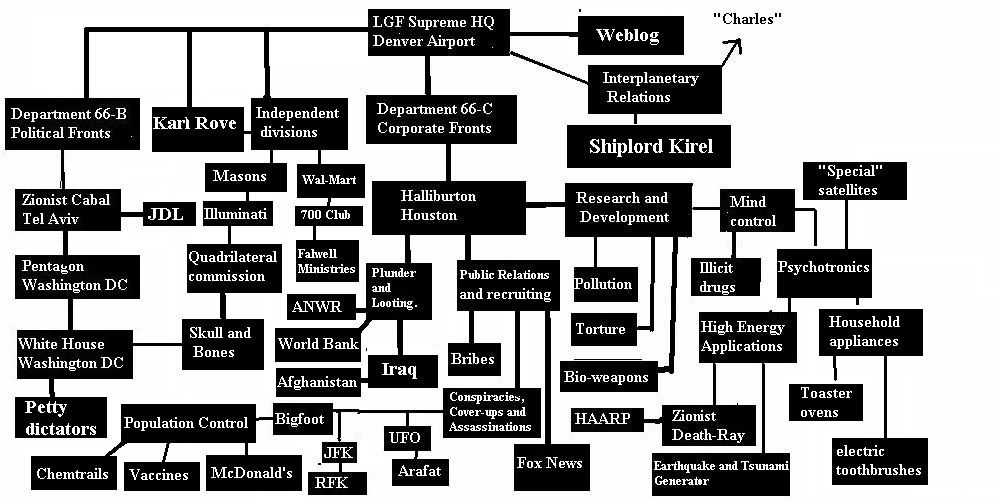
Hopefully, John Cole has gotten in the last words on the disgusting "London Bombings big Jewish conspiracy" theory floating around the web.

After all, this is the real map of the Jewish conspiracy.

Might we all benefit from, perchance, not assuming that the Jews are to blame for all the world's problems? I mean, really, y'all flatter me, but I'm not that powerful. Really.

Thursday, July 07, 2005

Shadow Boxing

The Family Research Council gives us a perfect example of either totally innocent wordplay or extremely subtle (and well-crafted) bigotry. In the course of criticizing companies for acknowledging the existence of gays, FRC chief Tony Perkins writes the following:
It baffles me how some major corporations, whose success depends on the support of American families, show contempt for the values of such families....Kraft Foods has paid $25,000 to sponsor the "Gay Games" in Chicago this summer--an event known as much for after-hours sexual activity as for on-field athletic competition. And now, FRC has discovered yet another example of corporate devotion to the homosexual agenda.

A full-page ad for Tylenol PM pain reliever appears in the July 19 issue of the pro-homosexual magazine The Advocate. It shows a photo of two bare-chested men lying beside each other in bed. Under one is the caption, "His backache is keeping him up." Under the other is the caption, "His boyfriend's backache is keeping him up." Tylenol is produced by Johnson & Johnson--the same company that makes the famous baby powder.

Let's dispense with the obvious first. The gay games are "an event known as much for after-hours sexual activity as for on-field athletic competition"? This is distinct from the regular Olympics...how? And the Tylenol ad--I presume the FRC would prefer that the caption read "his casual AIDS-infected sex partner's backache Herpes outbreak is keeping him up," but I at least am happy to see companies encouraging stable relationships over random hookups.

But here's what gets me--what's with the gratuitous reference to J&J as the company that makes "the famous baby powder"?

On surface, there's nothing wrong. J&J does make baby powder, and it is famous for it. On the other hand--what purpose does it serve? It's not to give reference to an otherwise obscure company--most people have heard of Tylenol. It has nothing to do with the advertisement in question. Could it be that the FRC wants to juxtaposition "gay sex" and "babies", playing on many heterosexuals subconscious fear of molestation?

Many people will claim I'm jumping at shadows, and perhaps they're right. Such a statement might, after all, be totally innocent. And there is the problem with well-crafted hate speech--it can disguise itself so well within the currents of mainstream (and acceptable) discourse that it often is nearly impossible to spot except by two types of people--the haters and the hated. Truly virulent homophobes see that message and think that J&J is putting their kids at risk--however illogical that may be. Other decent people may not even recognize the message, but still register it's meaning, even if only on a subconscious level (which can be just as powerful, if not more so, than overt signals). Homosexuals see the message too, and wonder--innocent, or are they being accused (yet again!) of being closeted sexual predators?

Simply put, there is no way to find out. If some foolish person (like me) writes a post saying that the statement smacks of homophobia, most people with discount it as silly. Immediately, I will be labeled as a loony liberal going wild again, playing the PC card and trying to suppress totally innocuous speech. Assuming the FRC is innocent, they'll say so and complain of political correctness run amok. If they aren't, they have plausible deniability, so they'll still say they're innocent and complain about political correctness run amok. Either way, the result is the same.

It is the ambiguity of speech on the margins that makes bigoted speech such a conundrum. Everybody recognizes and condemns the overt cases, and nobody even thinks about the clearly irrelevant cases. It's the situations in between which are nearly impossible to deal with--and while in this particular case I think the subtlety is a bit far even for the FRC, groups like that certainly know how to turn that ambiguity to their advantage.

I'm Doomed!

PrawfsBlawg links to a Chronicle of Higher Education column (sub. only) which says that bloggers have a reduced chance at being hired as faculty members at colleges and universities.

Fortunately for me, both PB and Conglomerate feel that the reasons are weak, at best. But then, life isn't fair--it might not matter that the reasons are weak. After all, in the hyper-competitive academic market, even the slightest downside can knock an otherwise worthy candidate out of the running.

Is my blog to be the death of my career goal?

(Note: I'm honestly not that worried. I really think that blogging will be a negligible downside to my resume, if at all, and that downside will be far outweighed by the blogosphere contacts I've made and the practice I've gotten writing and thinking on legal topics).

Wednesday, July 06, 2005

Democracy's Death

I have a confession to make.

I don't like democracy.

Longtime readers may be a bit surprised to hear this. And before I go on, allow me to make some caveats. When it comes to democracy, I am decidedly Churchillian--I agree whole-heartedly that "Democracy is the worst form of government except for all those others that have been tried." This is why I am such a fierce advocate of international democratization--simply put, in most cases it is by far the best case scenario.

Nor am I discounting the immense benefits of democracy. Put aside the intangible (but likely still real) effects of legitimacy and implied societal loyalty. Empirically, democracies are less likely to go to war with each other, less likely to engage in mass killings of their own citizens or others, almost guaranteed never to face a major famine, can expect to see far higher economic growth than even comparable non-democratic states, and experience a host of other bonuses.

All well and good. And in light of that, I will say flat out that I want to keep democracy around, at least until something better comes along (or even better, someone fixes the bugs in the system). But until then, let's ask ourselves--if democracy is so great, why are there so few democrats (small "d" essential)?

I. Foreign Policy

The American left has traditionally been the greatest advocate for democracy in the modern geopolitical scene. The influence of the democrats there, though, is but a shadow of its former self, mostly contained within the neo-liberal movement characterized by The New Republic and likeminded spirits. Other Democrats have become far less democratic, either becoming outright isolationists in a juvenile response to Bush's aggressive unilateralism, or joining up with the radical multiculturalist left in treating democracy merely as one (western) choice amongst many options--in other words, not something we (the imperialist west) can impose from without.

The American right likes to pretend it has stepped up for democracy, but again, it is only a small portion of true neo-conservatives who really believe. The rest play lip service to the ideal, but are not converted from their realist roots. Iraq demonstrated this most clearly--once the realist justification for the war fell apart with the lack of terrorist links or WMDs, the Bush administration's incompetence at democratization shone through. In their dealings with other nation's, we see the same thing--how else can you justify our devil's bargains with Uzbekistan, much less, of all places, Sudan? There are some true believers in the Bush administration--Wolfowitz, I think, is sincere if a bit naive--but most are not. Bush himself is only a recent convert to an aggressive US foreign presence--and I suspect that the philosophical shift never happened at all, even as political realities made lip service to the ideal essential.

II. Domestic Policy

Domestically, we're no better. At the moment, of course, Republicans preach a total submissiveness to the "will of the people," which would seem democratic if it weren't for the obvious fact that they're in charge of all our nation's democratic institutions and thus have an incentive to magnify the importance of democratic legitimacy. Where democratic norms have shown themselves to be an obstacle to the pursuit of power--as in Texas redistricting--or democratic bodies have enacted laws at odds with conservative principles--as in Takings Clause cases and the Kelo decision--conservatives have not hesitated to chuck the "will of the people" entirely out the window. Democrats have of late discovered that non-democratic bodies are more likely to be receptive to some of their core policy claims. The vast majority of recent Democratic victories have come from the courts--Roe, Lawrence, Goodridge, many others. Furthermore, they believe that smear campaigns and deliberate misinformation can undercut the process of democratic deliberation by distorting the issues and making it so that a majority of people aren't really seeing the options on the table. Poll after poll has shown issues where a majority of Americans agree with nearly all of the Democrat's policy prescriptions for a given problem--then turn around a say they "trust" Republicans more. Undoubtedly, Republicans feel the same way on many issues--that their arguments are being systematically distorted and twisted so that the people aren't hearing the words they're speaking. In this world-through-the-looking-glass, all liberals are spineless, pacifistic, socialist, nannies and all conservatives are brutish, heartless, racist aristocrats (or hicks). Somewhere along the line, the message is being lost, and after a century of trying to break through the left and right are beginning to despair.

III. On Being the Minority in a Democracy

I tend to view democracy like many members of the critical legal movement view rights or equality. Useful concepts in getting us from A to B on the social progress scale, but at the same time making it virtually impossible for us to move from B to C. The trick, of course, it to figure out how to get to C without risking sliding back to A. Democracy is great for securing governmental legitimacy, ensuring a basic degree of conversation between disparate citizens, and giving some voice to hitherto disenfranchised masses crushed under the heel of the elite. What it is really bad at, however, is protecting the interests of vulnerable minority groups whom the majority opposes. If you believe that American society is still fundamentally racist, for example, how can you communicate that idea through the democratic structure? The majority isn't going to listen to you--you're calling them a racist (even though you're not--there is a subtle distinction between saying society is structurally racist and that the people within it actively harbor malicious feelings toward minority races). It is difficult, if not impossible, to get the powerful to aid the disempowered for no reason at all except for the victims' victimhood. Perhaps you can appeal to "neutral" principles that will force the majority to treat you like they are treated. But again, this is unlikely to work. On the one hand, neutral standards are unlikely to remedy truly deep-seated inequalities. The same standard, applied to two groups in completely different situations, is not going to have the same effect. For example, saying everyone has the right to a $10,000 deduction for their house is only beneficial to those who have homes. Everybody being allowed to speak is only meaningful to those with microphones. And everybody's right to not be discriminated against on the grounds of race only will have an effect where one can prove overt racial discrimination--solving some of the problem, certainly, but not all of it. Where the discriminatory impulses are deeply rooted or subconscious, as racism has become in modern society, this becomes an impassable hurdle.

But, you protest, but this same hurdle is present to the dominant race as well! Submerged racism against them is also nearly impossible to find, or at least prove in a court of law. Very true. Also, very irrelevant. Think about it. If you are a white man in America, how big of a barrier to success would invisible, subconscious black racism be? Odds are, very little. The interviews you have at top companies are likely to be conducted with fellow whites. The important clients you deal with, same. Your boss, same, your co-workers, same. Indeed, with only a little exertion, you probably could avoid ever placing yourself in a situation where black-over-white racism ever impeded your career path. Hence, the inability to provide legal sanction against subconscious black racism is likely to be of little concern, and not being able to remedy it (weighed against, I presume, the harm of accidentally fingering an "innocent" man) will seem "fair." The reverse, alas, is not true. A black person facing subconscious white-over-black racism cannot avoid it and cannot get around it. What for a white person is at worst minor inconvenience is for him at best a major obstacle. The neutral standard remains, but suddenly it is seen in a very different light.

We've strayed a bit from democracy, so let's try and bring it back. Of course, there are many "neutral" standards one could create--presumably some of which would be more hospitable to minority claims. Why does it seem these standards are never presented? The reason is simple--the folks who set the standard are the dominant majority, and the dominant majority is blind to the effects their "neutral" standard has on those out of power. Changing the standard--raising or lowering the bar for proving discrimination claims, for example--is not seen as re-evaluating the standard because it isn't working for certain people. It is seen instead as a request for special rights--an effort to bend the system for the benefit of the few as opposed to an impartial arbiter for all. Don't you see, the majority chides, that it is exactly those grants of special rights that caused your problems in the first place? When we, in our shameful past, helped ourselves and oppressed you? We will not return to that time, and shame on you for asking.

IV. In Their Silence They Cry Out

And that's the rub--"shame on you for asking". The questions that need to be spoken are the ones most likely to get buried. And that brings me to the final criticism from this morbid post--the salvation of democracy, and why I do not see its arrival. For there is indeed a way to fix the problem--deliberative democracy. The only real problem, when you get right down to it, is that we aren't listening to each other. The narratives of the poor and downtrodden almost never reach the ears of those with wealth and power. The stigma of being racially oppressed almost never is known to those in the dominant caste. Our deepest hopes, dreams, and fears never reach the ears of those outside our own group. We talk only amongst ourselves, where democracy requires us to talk to everyone.

Note that today America almost never mentions the word race. Proof that we have moved beyond that sordid chapter in our nation's history? I doubt it. More likely, it is because any white who talks about race is presumed to be a racist, and any minority who does is "playing the race card." Whites don't want to be racists, and minorities don't want their achievements discounted, so everybody keeps quiet and the problems remain beneath the surface. Like many other issues, race has become a taboo--and deprived of being part of the democratic discussion, it enters autopilot. The results, alas, are predictable.

And race is just one of the worse offenders. As Jonathan Chait makes clear in his latest New Republic article, American voters as a whole are disengaged from the policy part of the political process.
The central assumption is that politics revolves around issues and ideas--rather than things like personality, tactics, and outside circumstances--and that the party that wins is the one that presents a more compelling vision of the future.
[...]
Alas, this sort of thinking assumes a wildly optimistic level of discernment by voters. Polls consistently show that large swaths of the voting public know very little about the positions taken by candidates. In 2000, the National Annenberg Election Survey found that just 57 percent of voters knew Al Gore was more liberal than Bush, 51 percent knew he was more supportive of gun control, and a mere 46 percent understood that he was more supportive of abortion rights. "The voting behavior literature, which is massive, shows that people are not particularly idea-driven," explains Berkeley political scientist Nelson Polsby. "They don't know what the fashions are, with respect to what ideas go with other ideas."

The people who discuss democracy are likely to be engaged in the issues concerning a democracy. The people who vote, by contrast, are not. We forget that at our own peril, because it is a necessary fantasy that keeps our faith in democracy alive. But there is no there there. Without engagement in politics, there is no way that the dominant groups will ever see past their narrowest self-interest (and the crudest caricatures of their fellows) to a broader sense of community with their less advantaged peers. The balkanization of the media and the growing polarization of political sects merely exacerbate the problem. I don't trust Republicans, therefore I don't listen to Republicans, therefore I don't talk to Republicans, and therefore I never can hear what it is they have to say. Politics becomes a Hobbessian world of pure power games, and it is the poor and disadvantaged, least able to defend their own interests, who inevitably will lose out.

V. Conclusion
This post was depressed, almost needlessly so. I am not that pessimistic about the state of our nation or anything else. Indeed, I think for all its faults, America is still a damn fine nation. But the most important thing, to me, is an everlasting belief that we can do better. We can do better than this oppressive silence that prevents people from discussing their grievances and connecting with their supposed "enemies." We can do better than blind faith in "neutral principles" and easy assurance that we are on the right path. We can do better than a nation in which nearly 66% percent has laws explicitly on the books relegating homosexuals to second class citizenship, where blacks are more likely to go to prison than go to college, where drugs users in inner cities are trucked off for multi-decade sentences while those in the suburbs get treatment after treatment after treatment. We have done better, and we can do better. I will not abandon that dream. Not for democracy, not for stability. Not for anything.

UPDATE: Traffic Jammed.

Tuesday, July 05, 2005

No More Sup. Court?

Hanno Kaiser makes the pitch (link: VC). He'd replace it with an ad hoc court, convened twice annually with randomly chosen circuit judges as the members, to resolve circuit splits. This court would only hear cases that were selected by the previous ad hoc court, thus (presumably) preserving objectivity. He claims that
Random selection would also likely have a moderating influence on the courts of appeal, because an appeals panel, intent on adopting an extreme position, could no longer expect review by a politically, ideologically, or philosophically sympathetic Supreme Court.

Isn't the opposite just as likely to be true? A random Court with little institutional memory and no control over the decisions in the cases it does decide to hear is likely to only hear a very few cases. An ideological circuit could decide to just play the odds that its number won't come up. Certainly, they can do that now too, what with the limited amount of cases the Court hears. But this would exacerbate the problem that much more, in my opinion.

Furthermore, the way it is now, the interplay of the dominant, but distant Supreme Court, and the workhorse circuit courts inherently moderates judicial decisions. Think about it, how many earth-shattering decisions have come down from the Supreme Court even in the last century? Brown, Roe, maybe one or two others. And even those have had a far more limited effect than normally ascribed. Critical Legal Theorists have noted that the combination of administrative delay, lower court circumscription, and other factors have severely limited the effect of even the most landmark cases. Thus, as many students are in segregated schools today as there were in Brown, and for many women, getting a safe abortion is not much easier than it was in the pre-Roe era. And while this has it's problems, it is also somewhat predictable, and thus respondable. Kaiser's proposal would throw in yet another level of randomness to solve a problem I don't think exists. Frankly, the myth of an evil, overarching, activist court is just that, a myth. Rarely, if ever, has a court decision made an impact on any of our lives, and it's rulings have made narrow, if any, indentation of the more important political issues discussed around the nation. The whole "attack the court" mentality is a function of conservative victimization--the deluded mindset that their values are under assault even as they control all branches of the federal government and the majority of local governments as well. Weakening the Court would do little to address any substantive concerns (such as they are), it is an ego shot designed to put more power in the institutions that conservatives currently control. When a liberal program comes out through democratic institutions that conservatives wish to see buried, they'll be the loudest advocates of anyone for Supreme Court intervention (see, e.g., Kelo).

Monday, July 04, 2005

Umm...Kinda Making An Assumption There, Maybe?

A bit late, perhaps, and not quite in the 4th of July mood, but I noticed something interesting about this article on female suicide bombers:
According to the Koran, male martyrs are welcomed to Paradise by 72 beautiful virgins. Ayat, as with many of the women she is incarcerated with, believes that a woman martyr "will be the chief of the 72 virgins, the fairest of the fair".

As was put by the blogger formerly known as Maladictorian, this is obviously ridiculously sexist. But more than that, what happens if the female suicide bomber, um, isn't a virgin? Or isn't fair at all?

I suppose while they are changing her body into the "fairest of the fair," they can restore her lost virginity to boot. But still, kind of presumptuous, perhaps.

Sunday, July 03, 2005

Shift Right

In this LA Times editorial, VCer Orin Kerr explains why he thinks O'Connor's retirement won't be the seismic shift in Court politics that everyone expects. He gives four reasons why:
Kennedy remains a key swing vote; O'Connor's replacement may not be very different from O'Connor; Rehnquist may resign, taking away a solid conservative vote that may roughly cancel out the impact of O'Connor's lost moderate vote; and respect for precedent will keep the Court from overruling most of the cases for which O'Connor provided the swing vote in the past.

Respectfully, I disagree. Let's take them one by one.

1) Yes, Kennedy is a swing vote. But recall that both Kennedy and O'Connor are moderate conservatives. There are 4 staunch liberals, 3 staunch conservatives, and 2 moderate conservatives. This makes for a nice balance--the liberals need to pick up only one swing vote, while the conservatives need two, but both swingers lean right. Taking O'Connor out of the equation would thus change the Court from it's 4-2-3 line up to a 4-1-4 line up. This means that the liberals only have one shot to grab a swing vote as opposed to two--furthermore, the "swing vote" already leans against them. Since O'Connor and Kennedy were moderate on different cases (for example, Kennedy was more likely to vote with liberals on gay rights, O'Connor on abortion), there are significant classes of cases in which liberals will be out in the cold. So while they'll still manage to pull together a majority in some cases, there will be a lot more which they lose because they can't pull Kennedy over (when they could have gotten O'Connor).

2) This is wishful thinking. As The VC's own Todd Zywicki notes, most conservatives feel there is going to be a fight regardless, so it might as well be someone worth fighting for. The folks with the most at stake in this fight, I.E., the Christian Right, have already made it quite clear they do not expect Bush to nominate an O'Connor-esque justice. Between the two, I think it's fair to assume O'Connor's replacement will be far more conservative (and less pragmatic) than she was.

3) If Rehnquist resigns, he'll be replaced by a conservative. Even if the right was inclined to allow a consensus candidate through on O'Connor (and I doubt it, see above), they'd never countenance it for Rehnquist. His retirement is unlikely to shift the Court's alignment in any meaningful way.

4) This reason is probably true, but limited. Many of the critical issues coming before the Court are not one's with tightly bound precedents. Gay rights, for example, is just beginning to come to the fore. So while I don't anticipate Lawrence being overturned, perhaps the next gay rights case won't be quite such a victory. War on terror cases pose similar problems. If there is one thing we've learned from the Rehnquist court, it's that you can slowly change the overall direction of America's legal jurisprudence without overturning a lot of decisions. Slowly but steadily, the Court can modify, revise, and distinguish its way to a more conservative worldview. Just ask liberals who feel Lopez and Morrison drastically shifted our ISC jurisprudence--while ostensibly not touching a prior case.

So, while it was nice buying into the fantasy for a little while, I don't anticipate Kerr's prediction coming true. Change is in the air--and I'm not sure it's to my liking.

UPDATE: Daniel Solove is even more pessimistic than I am--he doesn't think Stare Decisis is going to be much of a restraining factor.

There's Something About Michael

What it is about Michael W. McConnell? Powerline wants to see him nominated (right after Janice Brown Rogers, but that can't be helped). The Daily Kos thinks he's the best (realistic) choice for Chief Justice AND is continuing to back him to replace O'Connor--even though it would mean flipping a vote on Roe. I've been a longtime member of the McConnell bandwagon (see, e.g., here). How is it that this man is bringing together the left, right, and center like he is?

Indeed, it is rather difficult to find anybody not affiliated with an interest group who opposes McConnell. Helvidius at Ex Post thinks he isn't "necessarily committed to the text and history of the Constitution," which is an absurd charge--McConnell might be the single foremost originalist/textualist in American academia today. Check out some of the titles in his C.V.:
The Right to Die and the Jurisprudence of Tradition, 1997 Utah Law Review 665.

Segregation and the Original Understanding--A Reply to Professor Maltz, 13 Constitutional Commentary 233 (1996).

Originalism and the Desegregation Decisions, 81 Virginia Law Review 947 (1995).

The Originalist Justification for Brown: A Reply to Professor Klarman, 81 Virginia Law Review 1937 (1995).

Nope, nothing that even smacks of Originalism in that list.

Generally, the few people who do oppose him simply don't think he's conservative enough. They cloak it behind terminology like "originalism" and "textualism," but McConnell is proof that "following the text" doesn't always mean following the GOP talking points. What this crowd wants is a conservative activist, pure and simple.

But amongst much of the principled right (and left, especially those which have resigned themselves to the fact that yes, Bush is going to nominate a conservative), McConnell is an excellent choice.

I hope nobody tells President Bush I said that--nothing is more likely to doom McConnell's nomination than hearing that liberals won't scream bloody murder about it.

Now Showing...Me, at TMV

I've just become the latest co-blogger at Joe Gandelman's The Moderate Voice. You can access my introductory post here. I'll still be posting here, obviously. I'll do some independent stuff at TMV, but mostly cross posting and short little link blurbs. So don't worry--The Debate Link remains alive and well.

Just One Question

A few weeks back, President Bush gave a speech at Montgomery Blair HS in Silver Spring, Maryland. It was rather controversial, since not a single member of the student body--nor anybody from the town of Silver Spring, was allowed to attend. While Bush's restrictive "town meeting" rules are by now old news, this one hit particularly close to home for me since the school is only 20 minutes away from my house (I went to a different High School, but same school district).

So that got me to thinking--if you could get past that lovely barricade Bush has up between himself and independent thinkers, what would you say? If you got the chance to ask just one question or make just one comment, what would it be?

Here's mine:
President Bush, I am thrilled to have the opportunity to ask this question. A few weeks ago, one of my friends enlisted in the army. I told her how proud I was of her, and how she was an incredible person for standing up for what she believed in. Apparently, all her friends had just told her that she was going to die, and I was the first to simply thank her for her selfless choice.

That got me to thinking. I supported--and still support--both our actions in Afghanistan and Iraq. I went to a very liberal High School and attend a very liberal college, so being an Iraq war supporter caught me a lot of flak--all the more so because I'm a Democrat. But I believe strongly that the only way to make our world safer is to improve the lives of those suffering under tyranny--creating stable, liberal, democracies which don't slaughter their own citizens. So I persist in my support, because I know that it is the only way for America to win the war on terror--and failure would be disastrous.

Mr. President, I want you to know how hard you and your party have made it for people like me to continue to support this war. Top members of your party accuse Democrats--any Democrat--who questions our progress in Iraq of "giving aid and comfort to the enemy." Words like "treason" seem to fall off the lips of some of your key supporters on a regular basis--and you do nothing to repudiate them. Everything from the FMA to the Flag Burning Amendment to the Energy Bill has been justified on the basis of 9/11--3,000 people didn't die to become convenient political footballs for Karl Rove. Just last week, your Deputy Chief of Staff said that liberals--all liberals, including, presumably, the hawkish ones like me--wanted to give "therapy" to terrorists after 9/11. Only 1 member of congress dissented from the decision to go to Afghanistan--such a blanket statement is shocking, outrageous, and hurtful to the thousands of us who have advocated vociferously for aggressive American responses to terror. It is also sadly indicative. Given the opportunity to work with Democrats on the Department of Homeland Security, you instead decided to use it as a bludgeon in election 2002. Given the chance to find out, once and for all, what we could have done better before 9/11, you decided to obstruct and stonewall. Given the chance to come clean about where we are on Iraq, you stay behind your spin wall and blithely maintain that nothing has gone wrong. And all the while, there has never been any room in the coalition of the willing for willing Democrats--who were hounded out of office in 2002 and 2004 for not having a little "R" after their name. This is not the behavior of a wartime President. It's the behavior of a President at war--with the opposing party.

Mr. President, upon election you promised to be a "uniter, not a divider." You broke that promise. Myself and other Democrats like me rallied behind you on 9/11 and again before Iraq--you betrayed us. You decided that picking up a few seats in congress was worth more than sending America off to war united as one. Charlie Stenholm, Martin Frost, Max Cleland, Tom Daschle--all voted for yea on Iraq, all defeated in bitter, nasty, partisan campaigns because they refused to pledge loyalty to every word that came out of your mouth. Politics is all well and good, Mr. President, but not when we're at war.

I don't think you can regain the trust you've lost. But I'm willing to give you this chance to try. What do you have to say to the legions of moderate, centrist Democrats and liberals who feel like you've spent the last three years stabbing them in the back?

That's what I want to say. What about you?

Friday, July 01, 2005

Touching, and Touche-ing

Sandra Day O'Connor is retiring, and if I'm the first person you've heard it from, you need to expand your reading list a bit. Everybody under the sun is blogging about this, and saying essentially the same thing--the fight will be brutal, Democrats are essentially irrelevant to the process, Conservatives are laying down their red lines, abortion will be the sticking point, and Bush has zero incentive to nominate anybody remotely sane. More interestingly, Legal Fiction pines for McConnell (that's not the interesting part), but does a flip and then a reflip on Gonzalez. Neither, I think, will happen, though O'Connor retiring first might give McConnell a new lease on life.

I can't hardly wait for this.

But lo! The administration has announced that Bush won't be naming his nominee for another week! So there's still plenty of time for folks to give O'Connor the respect she deserves, right?

Enter my favorite player in the farce that is to follow, The Family Research Council. Here was their oh-so-respectful statement on O'Connor's tenure on the Court:
Washington, D.C. - Family Research Council thanks Justice O'Connor, the first woman on the United States Supreme Court, for her nearly twenty-four years of public service.

"The Family Research Council often found itself on the opposite side of her most controversial decisions," said Tony Perkins, president of Family Research Council.

"This past week Justice O'Connor sided with judicial activists and ruled against the display of the Ten Commandments on public property in two cases before the high court that have offended the values of a great segment of the American public.

"I am confident that President Bush will name a replacement for Justice O'Connor who has the same judicial philosophy as Justices Antonin Scalia and Clarence Thomas, as he indicated he would in his reelection campaign.

"The public is primed for the fight it will take to confirm a nominee. FRC can motivate significant grassroots support for the President's nominees. We will wage an unprecedented effort for a fair and prompt up or down vote through the mobilization of 20,000 churches across the nation, weekly conference calls in targeted states, the strengthening of the FRC team and activation of grassroots through www.frc.org"

The distilled version: "Thank you, you were an evil activist, let's replace you with someone radically opposed to your judicial philosophy, and we're mobilizing the troops right now to do it!"

Or as John Cole put it regarding a similar statement by James Dobson,
It couldn't be clearer. The statement wasn't "We would like to thank Sandra Day O'Connor for her service and look forward to an opportunity to participate in the debate over her successor," it was "Don't let the door hit you in the ass and bring on the rapture."

How sweet.

Oh, and a brief aside while we're on the subject. O'Connor was a legal pragmatist, while folks like Scalia or Thomas are idealists. As Eugene Volokh put it:
Justice Scalia described his jurisprudence as "The Rule of Law as the Law of Rules."

Justice O'Connor, a pragmatist, saw the work of the law as making law work.

If you believe, as I do, that law should transcend politics, then that is a far more relevant distinction for judges than liberal/conservative. Replacing the Court's foremost pragmatist with a rigid ideologue would constitute a radical shift--even if it appears on the surface to be merely moderate conservative to conservative.

Speaking of, there is an interesting discussion going on about how Democrats should frame O'Connor's tenure. Contra our Republican friends, everyone seems to agree that it should be respectful. The split is between Kevin Drum and Greg Saunders. The former thinks that instead of calling O'Connor a "moderate", we should instead use phrases like "thoughtful conservative." Placing O'Connor as the "center" would shift the judicial playing field way off to the right, hurting Democrats in the long run. The latter thinks that calling O'Connor a "moderate" will serve as a contrast to whomever Bush choices to succeed her--the public is a lot less likely to stand for a conservative replacing a moderate compared to a conservative replacing a conservative.

I fall with Drum, but for different reasons. I think calling O'Connor a "thoughtful conservative" will play out in two ways in the minds of voters. First, as Drum says, it will remind them that she is not us--that is, O'Connor is not the mainstream (which would put Democrats on the left fringe). This is rather believable, after all, most people know that O'Connor was a "swing vote" and thus opposed Democrats at least a fair number of times. But calling her a "thoughtful" conservative shows that Democrats are not opposed to the principle of opposition. It says "yes, we recognize that there are smart, fair, and intelligent conservatives, and we would welcome Bush's nomination of one." In addition to making Bush's (undoubtedly more conservative) choice look extreme ("Why couldn't he nominate someone like O'Connor? She's a conservative, but not like that lunatic Owens/Rogers Brown/Alito!"), it has the added bonus of dovetailing nicely with the "GOP gone power-mad" theme Democrats have been pushing for 2006--Democrats are sensible and looking for consensus, Republicans think that opposing their policies constitutes treason. Hmm...not too far from the truth, actually (at least for some Republicans).

Mark in Mexico has a giant roundup, as does, of course, The Moderate Voice and Scared Monkeys.

Thursday, June 30, 2005

Firing Back

I've noted before that I think Dave Kopel's argument in favor of guns for would-be genocide victims is very impressive--and this is coming from a definitive gun-skeptic.

Well, he's at it again, noting the recent gun confiscation round ordered by the Zimbabwe government. But this time, he's got a challenger: PrawfsBlawg guest blogger Kaimi Wenger. She notes that Mormon's had both guns and the right to use them in mid-19th century America, and that did little to stop the rampant anti-Mormon violence that occurred in the era. This strikes pretty close to the heart of Kopel's claims, since he is arguing that as an empirical matter, a disarmed population is a necessity for massive state-sponsored violence against a given ethnic group. The experience of the Mormons isn't true. And by the way, even if you don't buy and/or don't care about anything Wenger is saying, you should read her post anyway. It's a fascinating account of a chapter of American history I knew nothing about--and I consider myself a history buff. She also tells it well.

I'm sure that Kopel would argue that the presence of guns prevented the bloodshed from being worse than it would of--there wasn't, to be sure, a Mormon genocide. It's a good response, but Wenger's post still seems to keep some of its bite. I'm holding off judgment for now, but both sides are making stellar arguments.

UPDATE: Mark of Pseudo-Polymath points me to some more spectacular posts on the subject by Walloworld (see here and here) and Winds of Change. Great stuff all around.

Consuming the Next Generation

Yeah, it's a blatant rip off of Wonkette. Sue me.

In Van Orden v. Perry, Chief Justice Rehnquist wrote of the Court's First Amendment jurisprudence that "our cases, Januslike, point in two directions in applying the Establishment Clause." Going off that, Eugene Volokh wonders what other deities could be used in the same "Our cases, ___-like..." form.

He's opened up comments, but my contribution would be in such bad taste that I don't think it would stay there. But here it goes--if I were a lot more crass and a lot more pro-life, I'd say something like this:
Our cases, Cthulhu-like, have slaughtered innumerable unborn children.

But no, I would never say anything like that. Not a chance.

Wednesday, June 29, 2005

On Civility (Part 1?)

Brian Leiter just noticed my critique of his call to limit civility in public debates. Here was the offending quote:
As we have remarked previously, civility is the greatest gift one can bestow on the creationist conmen, the right-wing liars, and the religious bigots--not to mention the hordes of ignorant blowhards in the blogosphere. To treat their positions with civility is to already legitimate them. The consequence of doing so is now available for all the world to see: the intellectually and morally depraved state of public culture in America today.

In response, I argued that civility was an important part of our civic discourse and should not be tossed away so lightly. I also conceded that there was an outer limit to this position--Hitler, for example, and Leiter pounced:
What always strikes me in debates about "tone" and "civility" is that the critics, without fail, will abandon civility and adopt a harsh tone in the presence of the views that they deem "beyond the pale." Invariably, it turns out that they simply draw the line somewhere else (a good example is here--see the last paragraph, and the second comment), and that what really galls them is not the fact of my harshness and dismissiveness--they are equally capable of that when it comes to, e.g., Noam Chomsky or Ralph Nader or me--but rather that it is directed at the views they've been taught to take seriously, to think are serious, the views they've been led to believe are entitled to respect, even if one disagrees.

The following is the E-mail I sent Professor Leiter in response to his post:
Prof. Leiter,

Recently, you linked to my post which critiqued your call to limit civility in public discourse. I just want to clear up a few things.
[...]
First of all, I'm not among those who "dismiss" either Chomsky or Nader. Indeed, while I identify as a center-leftist (albeit one with some sympathies for radical left legal scholarship, Delgado, MacKinnon et al), Chomsky isn't someone I'd dismiss out of hand (that's not saying I agree with him--I don't--but he certainly doesn't fall into my exception to civility). In other words, I'm not part of the right wing attack machine--not all the critics are coming from that angle.

The other part of your attack is that I'm being inconsistent--with views I dislike, throw civility out the door, with views you do, of course it must stay. That's one way to interpret it, I suppose (although the extrapolation isn't really fair--where do you warrant that I object to your incivility only because I disagree with it? It is at least possible that I object to incivility in principle, and it's Hitler that is the "exception"). However, I would argue that all rules break down at the margins--every attempt to articulate cohesive sets of philosophical guidelines has found this. The margin--for me--is genocide. That is the end point at which the rules break down. But creating an exception such that I can stand opposition to genocidal policies and their perpetrators is a reflection of the logical extreme of the principle--it doesn't negate the principle
itself.

Steven Pinker caught the dilemma nicely:

"The psychology of taboo is not completely irrational. In maintaining our most precious relationships, it is not enough to say and do the right thing. We have to show that our heart is in the right place and that we don't weigh the costs and benefits of selling out those who trust us. If someone offers to buy your child or your spouse or your vote, the appropriate response is not to think it over or to ask how much. The appropriate response is to refuse even to consider the possibility. Anything less emphatic would betray the awful truth that you don't understand what it means to be a genuine parent or spouse or citizen....Unfortunately, the psychology of taboo is incompatible with the ideal of scholarship, which is that any idea is worth thinking about, if only to determine whether it is wrong."


And a dilemma it is. We all accept that there are certain ideas that should be rejected out of hand--but we simultaneously agree that to do so is not consistent with scholarly norms. It would take a smarter man than I to resolve the problem. But in the mean time, I think we can safely draw a line between Creationists and Nazis. Not because Creationists are right, or even making a reasonable argument. I simply think the rules change from the case of fringe "scientists" to that of advocates of mass murder.

It was the "who" more than the "what" that provoked my post. Thus far, we have managed to keep incivility contained to the very small group of extreme, radical evil. Creationists, for all their faults, are not in this category. I recognize the value of treating them such, but I fear for the Pandora's Box. Letting incivility become the norm, rather than the exception, strikes me as deeply dangerous to
civic cohesion and principled debate.

I hope you continue to read The Debate Link in the future. Leiter Reports has been on my blogroll for some time now--and it will continue to stay there. One disagreement does not a war declaration make. I'm sure we will clash again--indeed, I hope so. I also hope that we can do so in the spirit of discussion and open mindedness that I think we both agree is essential to a functioning polity.

Sincerely,

David Schraub

The Debate Link: http://dsadevil.blogspot.com

Leiter seems to think, contra me, that the civility/incivility line is drawn between the "hard" questions and the "easy" ones. The "hard" questions include complex interpretations of Nietzsche and Foucault. The "easy" ones include "Was the U.S. justified in invading Iraq?" Leiter admits that "those who can't tell the difference between the two kinds of questions" pose problems--but of course, it is a flaw that occurs only in other people. For example, my cultural background relating to genocide has made the question of whether the US was "justified" in invading Iraq a relatively "easy" one, but in the opposite direction of Leiter (whether or not the reasons given for invading were right, proper, or moral is another question, and one I probably fall much closer to Leiter on). Given the intense dispute over the issue, I am inclined to err on the side of humility, and not be so confident in my own convictions that I assume my opponents do not deserve the time of day. I will argue both passionately and respectfully with those who disagree--and hopefully persuade them to my side (and also hopefully be honorable enough to recognize a good point or a flaw in my reasoning when I hear it). I remain unconvinced that Leiter's line is superior--either strategically or morally, than mine.

Leiter also hints that the shouter method is more likely to persuade people than a rational, dispassionate argument. This may be so--indeed, in my more pessimistic moods this constitutes one of my key objections to democracy as a panacea. However, I think that biting into this temptation will put Democrats and Liberals in a battle they cannot win. Subject of a follow up post, perhaps.

Tuesday, June 28, 2005

Forgotten But Not Gone

I didn't actually watch Bush's speech, though I did run through the written text of it. Standard boilerplate, nothing too flashy. Oxblog gives his insta-reaction to it. Key quote: "Is it me, or does Bush sound a little defensive? Remember, that comment is coming from someone who agrees with 99% of what Bush is saying."

What caught my eye, though, was that Mr. Adnesik apparently thought Bush was going to speak on Darfur. I looked for it--nada. One might be inclined to give Bush the benefit of the doubt on this--Darfur relates only tangentially to the War on Terror (and even less so given this administration's statecentric bias). However, it has been months since I have heard a peep about Darfur from any major political or media figure. It appears it has entirely dropped off the radar screen.

It is very rare that Bush has the attention of all the news networks like this. Had he used this moment to definitively state "not on my watch," it might not have moved the US to action--but it may have struck a blow against the apathetic indifference to genocide that is currently hovering over the American populace. The news media has already decided that Darfur has lost its shock value (apparently genocide only is meaningful to America for as long as it continues to strike our conscience. Out of sight, out of mind). Those who have not already been convinced of the need for action let their eyes glaze over when they read the few tenacious voices which still speak on the subject. There are so few people who America has to at least hear, if not listen to. The President is one. Are there others?

The dying continue to wait in vain for their champion...who will rise to answer their call?

Monday, June 27, 2005

Religious Heckler's Veto

I'm still in the process of organizing my thoughts on the Van Orden and McCreary cases, so this post isn't a direct commentary on them. Rather, I wanted to opine on a critique Eugene Volokh (cross-posted to SCOTUSblog) had of the court justifying striking down the display of the 10 commandments on the grounds it was "divisive." He argues that empirically, the court's striking down of state-sanctioned religious displays has caused more divisiveness than the display itself. Ergo, the Court's logic gets hoisted by its own petard, if it really cared about ending religious strife, it would not hand down rulings that go against the sentiments of the religious majority.

It's a crafty argument, but, like Sanford Levinson, I still think it's wrong. It seems to me that such a position is the equivalent of a religious "heckler's veto." If we accept that governmental religious displays do cause some amount of religious division (leaving aside whether it is more or less than that in the aftermath of a court case), then the problem is that religious persons are reacting badly (dividing) over the court's refusal to allow them to divide. Any controversial case is going to promote some negative reactions--backlash is predictable when the court sides with the minority over the deeply held views of the majority. However, to vest the majority with this sort of power would to strip the court of its status as a counter-majoritarian check. If minority rights can be ignored whenever the majority cries loud enough, the "rights," so to speak, become non-existent. Professor Volokh's formulation echoes eerily of claims by southern racists that the court's decisions fostered more racial strife than if they had just left well enough alone. True or not, it really doesn't follow that the cause of racial tranquility would have been furthered had Brown never been decided. Indeed, one could argue that in virtually any case where an unpopular minority is granted protections that prevent the majority from acting as it otherwise would, the amount of outcry that follows the opinion would outweigh the outcry before it. This is simple mathematics--there are more members of the majority than the minority, and thus more persons to be aggrieved when their side loses. However, in the long term, reconciliation and stability are served in a community that makes tolerance its modus operandi, not a benevolent exception (I want to stress, by the way, that I am not casting any negative motivations upon the good Professor. Indeed, he specifically disclaimed that he was offering any sort of "vision" of First Amendment jurisprudence. I'm merely following the argumentative path he lays out to, what seems to me, its logical conclusion).

The other objection I have to Professor Volokh is that I think that, in the short-term at least, religious strife will be enhanced regardless of which side the Court rules for--so long as the court takes the case. This is because of the structure of our system--it's called "adversarial" for a reason. Court cases take things out of the realm of political debate, with all of its compromises, alliances, and shifting principles, and distill it down to simple X v. Y. Obviously, Courts can and do often craft compromise rulings, but the overarching framework is one of winners and losers (or sometimes, partial winners and partial losers).

On an empirical level, it would appear that the strife comes in when religion is pushed out by legal decree. But the history of religion clause litigation suggests this perception is skewed. Since the past 40 years have given strict separationists far more victories than defeats, if it is just legal decisions that cause strife, it might appear that it is strict separation that is the cause. Furthermore, since there are few cases that seek to add religion where it was absent, the inverted scenario cannot be tested. However (and this is just a sentiment I get), it seems to me that when religious groups win, the result is not tranquility at all; rather, Christian groups see the rulings as green lights for a more aggressive pursuit of their interests. This is just as "divisive" as when they lose and claim victimization. Hence, I disagree with, e.g., Listless Lawyer when he claims that "religious divisiveness" (and the culture wars in general) are products of the courts--or more accurately, the opinions and rulings of those courts. Instead, the courts are merely the most high profile (and high stakes venue) where these battles are played out.

Such a view is pessimistic on my part, because it offers little hope for short-term reconciliation in the culture war. If religious groups win, they press the attack, if they lose, they cry prejudice and counter-attack. Either way, the division remains--a product of a legal system which encourages participants to view themselves as combatants (and which, especially in constitutional law, is uniquely high stakes, winner-take-all).

I would continue to argue, though, that it is unfair to blame the victims of state-sponsored religious messages for the refusal of the religious majority to abide by or accept the constitution. Such a view turns constitutional law on its head--minorities, especially those who have little political support to begin with, already have enough trouble getting on the judiciary's radar screen, to be shackled with an inherent disadvantage from the start would make a mockery of the protections our bill of rights purports to afford. As Justice O'Connor so eloquently put it, we "don't count heads" when it comes to constitutional rights.

Friday, June 24, 2005

The Benefit of Context

Wow. It's amazing how Karl Rove gets worse with context. Here's my "favorite" part:
Conservatives believe in lower taxes; liberals believe in higher taxes. We want few regulations; they want more. Conservatives measure the effectiveness of government programs by results; liberals measure the effectiveness of government programs by inputs. We believe in curbing the size of government; they believe in expanding the size of government. Conservatives believe in making America a less litigious society; liberals believe in making America a more litigious society. We believe in accountability and parental choice in education; they don't. Conservatives believe in advancing what Pope John Paul II called a "culture of life"; liberals believe there is an absolute unlimited right to abortion.

Umm...what? Maybe once upon a time this was true. Today...not so much. Conservatives do favor lower taxes, I'll give them that. But they don't have much else. Meanwhile, liberals have, since Clinton and his third way, proven themselves to be more zealous in advocating governmental reform and accountability. Hillary Clinton has come out in favor of common-sense abortion policies--not knee-jerk crackdowns or reflexive claims to choice. And when a member of the Bush administration tells me that Republicans are interested in shrinking government, well, my response is the same as Dan Drezner's: "Spin Better!"

Do they have anything besides pathetic attacks? Shameful slanders? Bald-faced lies? I don't think they do. The benefit of context shows that this quote...wasn't out of context. It was indicative of all that is the modern GOP.

Balloon Juice tips me off.

Thursday, June 23, 2005

The General and the Tactician

Note the difference. When a political tactician, for example, Karl Rove, talks about war, he can only frame it in political terms. There is no sense that we need to unify, or that there may be many different strategies to achieving the same goal. There is only one route--a political attack on (political) enemies. Thus, we get this hideous statement by Mr. Rove, which claims that the liberal response to 9/11 was to offer "therapy" to terrorists. Obviously, Rove would rather not talk about the unanimous save one decision to give the President authority to prosecute war in Afghanistan, or the decision of many Democrats to support the war in Iraq, or the aggressive Democratic support for the Department of Homeland Defense and the 9/11 commission (both opposed by Bush). Because to the political tactician, the war on terror comes second to the war on Democrats.

This is unfortunately the state of our terrorism discourse in America--mountains on demonizing political opponents, precious little on defeating terrorism. The latest absurd manifestation of this was Representative Randy "Duke" Cunningham's (R-CA) argument in favor of the anti-flag burning amendment, which ran like this (link: Balloon Juice):
Ask the men and women who stood on top of the (World) Trade Center. Ask them and they will tell you: pass this amendment."

That's funny, because my guess would have been that if we could talk to those now-dead men and women, they'd be more likely to say "stop focusing on stupid sh-- and make our country safer."

On the flip side, while our elected officials can't see past the latest attempt for a smear job, at least our generals still occassionally talk straight. So, contra "Last Throes" Cheney, General John Abizaid testified before Congress and admitted that the Iraq insurgency is not, in fact, weakening. Who to trust, who to trust. Such a toughie, this is.

Of course, Generals don't always give you the straight and narrow. We've seen plenty of bobbing and weaving from the military over torture and Guantanamo, among other things (though that pales in comparison to the spin job our elected officials give it, IE, Rep. Duncan "Chicken or Fish" Hunter (R-CA). But since it is their people who are dying, Generals are far less happy about being forced to toe an inaccurate spin line when the on the ground reality says something different. For the tacticians on the right, every outcome is a winner--if we win the war, they're the hawks who supported the troops, if we lose, Democrats were the traitors who undermined them. Since the outcome doesn't matter, they can gleefully assault liberals as a whole, without any thought to how their claims measure up to reality.

Tuesday, June 21, 2005

And Thus We Have Our Predicament

Perhaps more than anything else, this story illustrates the predicament Israel finds itself in when trying to fight terrorism:
A badly burned Palestinian woman was alternately defiant and tearful Monday after Israeli soldiers caught her trying to enter Israel with 22 pounds of explosives hidden on her body.

The woman, who suffered serious burns on her hands, feet and neck in a kitchen explosion five months ago, had been granted permission to cross into Israel from the Gaza Strip for medical treatment when she raised the suspicion of soldiers at the Erez checkpoint.

Video released by the military showed 21-year-old Wafa al-Biss taking off articles of clothing on the orders of soldiers searching for explosives, and rubbing her disfigured neck with her burned hands and screaming.

The military said she tried to blow up the explosives Monday but failed and was not injured.

The layers of difficulty present here are astounding. As the article says, something caught the soldiers interest, that led them to conduct a search. These sorts of hunches, however, are not sure bets. Imagine, for a moment, if the soldiers had guessed wrong. What would have been in the news, instead, would be stories about how Israeli soldiers strip-searched a burn victim on her way to humanitarian treatment. The world would have gone nuts. Israel knows this, and I bet money the soldiers know it too, which makes them politically brave as well militarily so.

The worst part is that Palestinian terror groups can continue to try to pierce Israeli defenses in this manner. Their use of Red Crescent trucks as arms smugglers is well documented, this is just the next logical step. If they are really clever, they will send alot of decoy persons into Israel with nothing on that at all, and reap the international backlash that occurs when folks in France see a poor, defenseless, burn victim being searched by the IDF. Then, when Israel begins to relent, they can sneak in real bombers under the net. To the media, it's "just another" suicide attack, to Israel it's another 20 dead teenagers, and to Hamas it's a successful tactic.

As long as the lens isn't cast on terrorist groups, showcasing the brutality of their terror and not giving them cover of political legitimacy, such tactics will continue to be used, and used successfully. This attack may have been foiled, but I fear in that respect it may have been the aberration, not the norm.

Link, Sullivan by way of Cole.

Rejecting the Quran

As anybody who has watched a courtroom drama knows, prior to testifying witnesses swear to tell "the truth, the whole truth, and nothing but the truth" while placing their right hand on the Bible. If the witness does not believe in God, then he can choose simply to raise his right hand and say an oath. Kind of quaint, really, but it's a nice tradition.

In North Carolina, a local Islamic group offered to donate some Qurans to the region's courts so that Muslims could swear on them instead of the Bible. And how did the judges respond? By rejecting the overture and proclaiming that an "oath on the Quran is not a lawful oath under our law."

I would say that such an action is blatantly unconstitutional, but North Carolina is in the 4th Circuit--the circuit perhaps most hostile to non-Christian religious freedom claims. I'm not sure this is any more outrageous than the anti-Wiccan policy the 4th Circuit upheld in Simpson v. Chesterfield County Board of Supervisors (exclusion of Wiccans and only Wiccans from giving a county's legislative prayer is permissible because a "divine
appeal [must] be wide-ranging, tying its legitimacy to common religious ground" in order to be constitutional under the first amendment), so this policy may yet survive. It need not even be said how this will affect our reputation with Muslims who already are sympathetic to portrayals of America as an anti-Muslim nation.

Saturday, June 18, 2005

Good Sign

I know that a lot of Jewish voters were ambivalent on Governor Dean in the 2004 primaries, because he seemed tepid in his support of Israel. His base of supporters, drawing from the left edge of the party, made this threat even more pronounced. So I was very pleased to see his prompt condemnation of anti-Semitic bigotry at one of his events.

Balloon Juice gives the heads up. And this is also a sign, however timid, that Dean also will be able to resist the inevitable calls for an immediate Iraq withdrawal. Though I'm not willing to bank on that yet.

Friday, June 17, 2005

Out of Action

Where has this type of Republican gone? Former Missouri Senator John Danforth penned a simply spectacular editorial in the New York Times. An excerpt:
People of faith have the right, and perhaps the obligation, to bring their values to bear in politics. Many conservative Christians approach politics with a certainty that they know God's truth, and that they can advance the kingdom of God through governmental action. So they have developed a political agenda that they believe advances God's kingdom, one that includes efforts to "put God back" into the public square and to pass a constitutional amendment intended to protect marriage from the perceived threat of homosexuality.

Moderate Christians are less certain about when and how our beliefs can be translated into statutory form, not because of a lack of faith in God but because of a healthy acknowledgement of the limitations of human beings. Like conservative Christians, we attend church, read the Bible and say our prayers.

But for us, the only absolute standard of behavior is the commandment to love our neighbors as ourselves. Repeatedly in the Gospels, we find that the Love Commandment takes precedence when it conflicts with laws. We struggle to follow that commandment as we face the realities of everyday living, and we do not agree that our responsibility to live as Christians can be codified by legislators.

When, on television, we see a person in a persistent vegetative state, one who will never recover, we believe that allowing the natural and merciful end to her ordeal is more loving than imposing government power to keep her hooked up to a feeding tube.

When we see an opportunity to save our neighbors' lives through stem cell research, we believe that it is our duty to pursue that research, and to oppose legislation that would impede us from doing so.

We think that efforts to haul references of God into the public square, into schools and courthouses, are far more apt to divide Americans than to advance faith.

Following a Lord who reached out in compassion to all human beings, we oppose amending the Constitution in a way that would humiliate homosexuals.
[...]
In the decade since I left the Senate, American politics has been characterized by two phenomena: the increased activism of the Christian right, especially in the Republican Party, and the collapse of bipartisan collegiality. I do not think it is a stretch to suggest a relationship between the two. To assert that I am on God's side and you are not, that I know God's will and you do not, and that I will use the power of government to advance my understanding of God's kingdom is certain to produce hostility.

By contrast, moderate Christians see ourselves, literally, as moderators. Far from claiming to possess God's truth, we claim only to be imperfect seekers of the truth. We reject the notion that religion should present a series of wedge issues useful at election time for energizing a political base. We believe it is God's work to practice humility, to wear tolerance on our sleeves, to reach out to those with whom we disagree, and to overcome the meanness we see in today's politics.

Political Animal gets the nod. It is a tragedy that someone like Danforth probably couldn't even get out of a Republican primary these days, let alone become the respected statesman that he is today.

Sirens' Call

That about sums up the situation Democrats are faced with right about now. Legal Fiction talks about the gathering "perfect storm" about to hit the Bush administration. One important issue he gets into is on Iraq, and I think this issue particularly poses risks to the Donkey:
[S]upport for Iraq is dropping fast. Personally, I don't favor setting timetables for withdrawing or even withdrawing at this point. Civil war would be too horrific. But dear Lord, we really have the tiger by the ears here. We can't win without more troops, as this NYT article shows in painful detail. Yet, we are unwilling to send in more troops. The military is hemorrhaging recruits. The insurgency is gaining. We have 130,000 troops trying to patrol 24 million - and the coalition is pulling out. At this rate, we will lose the war. And at this point, we have absolutely no strategy other than hoping that the insurgency will stop. And the American people are beginning to sense it - at the very same time the DSM hit the news.

I agree with Publius--we can't withdraw now, the civil war would be catastrophic and the US would be permanently crippled in its democratization efforts (no, I don't think we are permanently crippled already). But there's a bind here for Democrats. On the one hand, I think it must be awfully tempting to jump back on the "bash Iraq" train. After all, the GOP has no credibility on the matter any more, and the growing insurgency (oh I'm sorry, I meant to write "last throes") is demoralizing both the general public and the military at large. Frankly, to say post-war Iraq is a failure that can be laid at Bush's feet is not an exaggeration, and its pretty tough to tell Democrats not to take the fat target sitting in front of them.

Furthermore, the normal factors that would check Democrats from drinking the withdrawal koolaid don't seem to be operating here. The thing Democrats fear more than anything else, especially after the fiascos of '02/04, is to be tagged as soft on the military. So aside from the firebrands, they tend to shy away from overt positions which suggest they don't care about security. It's important to note, however, that unless there is a substantial paradigm shift in American politics, the left can never get beyond "neutral" on this issue. Recall the period leading up to the last election. Democrats had supported wars in Iraq and Afghanistan, supported the 9/11 commission (Bush opposed), wrote legislation authorizing the Department of Homeland Security (Bush opposed), and pushed for billions of dollars in additional national security funding (Bush opposed, successful). By any objective stance, the Democrats, as a party (as opposed to John Doe Dean Volunteer), were more pro-security than the GOP. Yet the Dems reaped no benefits, indeed, the prevailing conception was that they were weak, spineless, and wussy. At some point, Democrats are going to decide that being pro-security isn't gaining them any political benefits, and that will make the Peacenik wing of the party far more powerful.

The other problem is that even if the Democrats aren't ready to abandon the pro-security stance outright, the issue of Iraq is so hot right now it might even prove to be a disadvantage if they vow to stay the course. Normally, the only risk Democrats face from being too tough on security is a few Michael Moore lookalikes voting for Nader. This is annoying, but outside something crazy like confused Jews in Florida, it isn't likely to be fatal. But right now, it isn't just the left who wants to see us get out, it's the mainstream of the political spectrum that is becoming disenchanted, and the Democrats cannot afford to let the center vent its anger on endangered incumbents. Ironically enough, Bush's weakening stature may help the GOP here, because Republican candidates won't feel as compelled to toe the party line and might start to murmur about getting out themselves. Since GOP foreign policy roots lie more heavily within the Realist School than the Neo-Conservative one, this is not too far-fetched.

In a way, this is a masterful stroke by President Bush. Even his blunder is going to aid him politically, as it places Democrats in an impossible situation, with a political opportunity they can't pass up that will invariably lead to geopolitical consequences they can't escape the blame for. Of course, its a dark victory, because it comes in the wake of Bush's greatest failure on his highest profile project. But it's always seemed like Bush cared more about hurting Democrats than helping the country anyway.

Thursday, June 16, 2005

Happy Birthday!

This blog turned one year old yesterday. Helluva milestone. I've been blessed to have such insightful readers, and to have had the support of the blogosphere as I've engaged in this project. Though I've slacked off over the last week, I've tried to maintain a quality site, and hope that I have succeeded at least to some degree.

Thank you all very much for reading. Hope to see again soon!

PS: Bought an X-Box with my new found wealth from the job. So blogging will be even more sporadic as I rot my mind away. But I swear I'll still be posting. I've gotten emotionally attached.

Federal Review

So the last chapter in the Schiavo case (hopefully) has come to a close. Her brain damage was irreversable and completely deprived her of any consciousness.

GOP Senators were unrepentant:
"My concern was for due process, and due process is not a medical issue," said Sen. Mel Martinez (R-Fla.). Asked whether he had any regrets, Sen. Rick Santorum (R-Pa.), who visited Schiavo at the hospice in her last days, responded, "None whatsoever." He added: "If a state court decides to take the life of someone, there should be a federal review."

How I wish Estoppel was a legitimate political argument. "If a state court decides to take the life of someone, there should be a federal review"? Next time Santorum and his buddies want to railroad someone through death row, throw that back at them.

And yes, I know that death row inmates do invariably get federal appeals. Too often, they are as cursory as, well, the review Schiavo got. Since presumably Santorum is not satisfied with the results of said hearing, I think it is fair to assume he wants a higher standard of review for Death Penalty inmates as well.

Spotted

On the DC Metro, Metro Center Station, this advertisement for West Virginia tourism. It shows an ATVer, riding through clearly rugged terrain.

"More dirty laundry than a judicial nominee."

Obviously, they know their audience.

Tuesday, June 14, 2005

Worst of All Worlds

Balloon Juice tells us that the Representative who brought you "Freedom Fries" and "Freedom Toast," our little jabs at the French for not supporting the war in Iraq, has decided the troops need to come home.

Guys like this are the worst of all worlds. Throwing out petty, demagogic insults in the runup to the war, but as soon as we need to stiffen some spines and get to work, he wants to cut and run. At least Kerry's ambivalence was tempered by his insistence that we get the job done.

Monday, June 13, 2005

Office Space

Tragically, you'll have to go elsewhere for all your Michael Jackson needs. I'm going to be blogging on a reduced schedule (though I won't be stopping entirely), at least for the next couple days. The job is quite interesting, but very stressful. Hopefully, when I've got some time to acclimate, I'll come back to normal.

Try to live on without me.

Sunday, June 12, 2005

Oh-Bama!

Oh yeah. He's still got it. If you don't want to read the whole thing, Obsidian Wings cuts it down to the best parts. But it truly is inspirational to read.

Okay, I'll give you a little taste:
Like so much of the American story, once again, we face a choice. Once again, there are those who believe that there isn't much we can do about this as a nation. That the best idea is to give everyone one big refund on their government—divvy it up by individual portions, in the form of tax breaks, hand it out, and encourage everyone to use their share to go buy their own health care, their own retirement plan, their own child care, their own education, and so on.

In Washington, they call this the Ownership Society. But in our past there has been another term for it—Social Darwinism—every man or woman for him or herself. It's a tempting idea, because it doesn't require much thought or ingenuity. It allows us to say that those whose health care or tuition may rise faster than they can afford—tough luck. It allows us to say to the Maytag workers who have lost their job—life isn't fair. It let's us say to the child who was born into poverty—pull yourself up by your bootstraps. And it is especially tempting because each of us believes we will always be the winner in life's lottery, that we're the one who will be the next Donald Trump, or at least we won’t be the chump who Donald Trump says: "You're fired!"

But there is a problem. It won’t work. It ignores our history. It ignores the fact that it's been government research and investment that made the railways possible and the internet possible. It's been the creation of a massive middle class, through decent wages and benefits and public schools that allowed us all to prosper. Our economic dependence depended on individual initiative. It depended on a belief in the free market; but it has also depended on our sense of mutual regard for each other, the idea that everybody has a stake in the country, that we're all in it together and everybody's got a shot at opportunity. That’s what’s produced our unrivaled political stability.

Masterful. I greatly anticipate the day I see him moving into Pennsylvania Avenue.

Before and After

So tommorow I get to start my new job! I doubt I'll be doing any job-blogging--there probably won't be any interesting stories anyway. But at least it gives me something to do from 9-5:30 besides posting here.

As for why I haven't been posting this weekend--I've been rereading the old X-Wing series books that had been hiding out in my basement. You ever had a really odd urge to read/find/do something from way back when? I presume that was what came over me when I was scouring boxes at 4 AM Friday night, looking for them.

And yes, they are as much fun to read as they were back in junior high. Some things never change.