Thursday, September 29, 2016

JVP Just Can't Quit Miko Peled

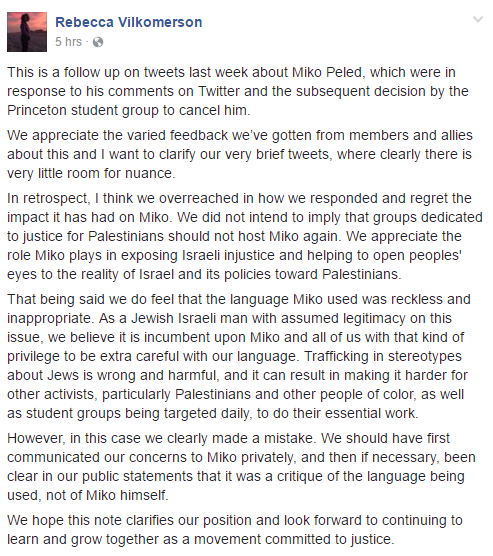
Every once in awhile, Jewish Voice for Peace finds an "anti-Zionist" who is in fact too anti-Semitic even for them. Alison Weir was an example from a few years ago. More recently, it was Miko Peled (an Israeli Jew who has become a vitriolic critic of the state) who stepped over the line after linking the US/Israeli aid deal to why "Jews have a reputation for being sleazy thieves." This led to the cancellation of a scheduled talk at Princeton (hosted by a pro-Palestine group) and later another at SDSU. JVP and its head Rebecca Vilkomerson lauded the move:
Peled was livid at the accusation of anti-Semitism, going so far as to threaten an SDSU student newspaper with a libel suit for publishing an editorial calling him anti-Semitic (lawyer's aside: he'd have no case, as assessments of anti-Semitism are matters of protected opinion immune from a libel action). With respect to JVP, he endorsed the sentiment that Vilkomerson was a "zionist in the closet" who needed "to be purged out of the movement for good."

In Weir's case, it took all of six months for her to start reappearing at JVP events. In Peled's case, JVP walked itself back in the space of a few days. Vilkomerson put up a new statement that agreed she had "overreached" and "clearly made a mistake" in her reaction to Peled's "sleazy thieves" comment.

What we have here is an example of the JVP's untenable position when it comes to anti-Semitism. The problem is not that they're "critical of Israel" or even that they're anti-Zionist. The problem is that their politics about anti-Semitism are predicated on the notion that "anti-Semitism" is, in nearly all cases, a hysterical charged lobbed in bad faith by evil Zionists wanting to suppress criticism of Israel. But, having spent years hammering this message home, they're somehow surprised to discover that when they call something anti-Semitic, they're subjected to the same treatment -- dismissed as "Zionists in the closet" (Peled's allies) or "turning priorities to suit Jewish interests" (Weir's backers). They want special dispensation as the "good Jews", and they don't get it.  Instead, their "allies" treat them exactly the same as they treat every other Jew (and indeed, exactly as JVP says Jews -- other Jews, anyway -- should be treated) -- with derision, disdain, and dismissal anytime JVP tries to use its Jewish standing to challenge rather than validate their position.
Because they fail to actually acknowledge anti-Semitism as a serious and systematic problem -- indeed, because they encourage it insofar as they promote the general sentiment that Jews normally can't be trusted -- the JVP falls into a trap of its own devise. It cannot actually advocate against epistemic anti-Semitism because that would require giving credence to the bulk of the Jewish community which adopts positions they wish to see delegitimized. But having helped normalize Jewish status as epistemically unreliable, they find their pleas for a special exception (in recognition of their respectable selves) will fall on deaf ears. It turns out that, in actuality, "good behavior" doesn't in any way diminish the perceived entitlement non-Jews have to dictate Jewish behavior.
Eventually, the JVP is going to collapse under the weight of this contradiction. Again, the problem isn't that it's critical of Israel or even that it's anti-Zionist. The problem is that its power lies simultaneously in the view that Jews are untrustworthy and the view that they (JVP) are extra-trustworthy because they are Jews. The tension is sublimated so long as JVP stays in perfect lockstep with its non-Jewish allies -- JVP providing a Jewish patina to what non-Jews are already saying about Jews. But it emerges in full force and fury whenever JVP diverges from the opinions of its peers (as when they wish to challenge anti-Semitism in their movement). And the problem will only get worse. The general belief that Jews are untrustworthy, paranoid, hysterical, irrational, and/or blood-crazed cannot help but create more and more anti-Semitism of the sort that even JVP will find intolerable. But the more that JVP tries to adopt a critical rather than a vindicatory standpoint towards its "allies", the more it will see that its "credibility" as a Jewish anti-Zionist organization can't actually be drawn on.

There is space for good Jewish left-wing criticism of Israel (and plenty of groups better than JVP occupy that space: APN, J Street, and Third Narrative, to name three). But it can only work if it doesn't draw its power from a fundamentally anti-Semitic narrative of general Jewish malfeasance. For a Jewish group to take that as their foundation is wrong in its own right, of course, but it is also self-sabotaging -- a great example of De Tallyrand's famous quip that "it was worse than a crime, it was a blunder."

Monday, September 26, 2016

2016 Presidential Debate #1: Quick Reactions

First things first: Under any definition of "winning" that goes beyond "did Donald Trump manage to stay coherent and under control for a single 90 second span", Hillary Clinton won this debate hands down. There's simply no question. No, Donald Trump did not spontaneously combust in a paroxysm of rage (though there were a few moments where I genuinely wondered if he was having a panic attack). Yes, he did manage to emphasize a few effective tropes, such  the alleged mismatch between Clinton's rhetoric now and her record of accomplishment. But the overall effect was of a blustering, out of his league lunatic who could not stop interrupting, could not stop snorting, could not stop eye-rolling, and for much of the evening could barely string two coherent sentences together. That's just not going to fly on this level.

Of course, I'm biased -- but even the Republicans I've seen have scored the debate either a Clinton win or, at best, a draw. Their main complaint, of course, is to blame the refs -- the moderator, we're told, was biased! They point out that far less time was spent on Clinton's emails than on Trump's birtherism.

You want to know why that is? It's because Clinton's answer on emails was simple: she acknowledged a mistake, and left it at that. No attempt at a convoluted justification, no complaints that the whole thing was blown out of proportion, no conspiracy theory about how it was all in her opponent's head. And if you contrast that to Trump, you get what might have been his biggest problem all night: he could not let anything go. Birtherism? It was all Clinton's fault, and Trump actually did Obama a favor! Iraq war? An endless stream of consciousness demanding that we call Sean Hannity to verify that he was too an opponent. Racial discrimination? "We never admitted any guilt," and by the way, did I tell you about the time my club admitted Black people? It reached a peak when Trump started going off on how actually he had the better "temperament" compared to Clinton, and I was like "really dude? Is this the hill you want to die on?" Even Trump's supporters must have been groaning.

Clinton performed well because she actually possesses some self-discipline and was able to blunt potential problem areas early, sucking the air out of the issue. Trump was like a frenzied chihuahua on Adderall, chasing down anything and everything and hobbling himself with assertions that ranged from ludicrous (everything was "the worst deal ever") to self-sabotaging (did he just admit he paid no federal taxes?). And I have to think that every single woman watching that debate had their blood pressure rise in empathy each time Donald Trump insisted on talking over the calm, collected, prepared woman next to her.

The only thing that seems to be causing people to hesitate in awarding Clinton a total victory is the idea that "Trump is different." We thought he got eviscerated in the primary debates too, and his people loved him even more for it. I saw Nicolle Wallace make that point on NBC, and Kevin Drum said the same in his recap. To that, I simply observe that the GOP primary is not the general, and the same rules don't apply. GOP primary rules get you Sharron Angle and Christine O'Donnell. General election rules get those candidates annihilated as independents flee in terror.

This debate was the first time Americans really got a chance to see their 2016 choices side-by-side. It presented a stark choice, and not a particularly difficult one. I predict that when the full reactions are in, independents and swing voters will not react kindly to what Trump was selling.

Sunday, September 25, 2016

Our First Jewish President

Harold Pollack, responding to Barack Obama's declaration that no one over the age of eight should ever put ketchup on a hot dog, tweeted #FirstJewishPresident. Really, it just marks him as a man of Chicago.

But it did get me to thinking: In the same vein that people once called Bill Clinton our first Black President, could one say that Barack Obama was our first Jewish President?

In introducing that argument with respect to Bill Clinton, Toni Morrison argued as follows:
After all, Clinton displays almost every trope of blackness: single-parent household, born poor, working-class, saxophone-playing, McDonald’s-and-junk-food-loving boy from Arkansas. And when virtually all the African-American Clinton appointees began, one by one, to disappear, when the President’s body, his privacy, his unpoliced sexuality became the focus of the persecution, when he was metaphorically seized and body-searched, who could gainsay these black men who knew whereof they spoke? The message was clear: “No matter how smart you are, how hard you work, how much coin you earn for us, we will put you in your place or put you out of the place you have somehow, albeit with our permission, achieved. You will be fired from your job, sent away in disgrace, and—who knows?—maybe sentenced and jailed to boot. In short, unless you do as we say (i.e., assimilate at once), your expletives belong to us.
Morrison's argument mixed elements of Clinton's background, his personal style, and the particular way he was targeted and maltreated by his opponents. I think a similar connection can be made between Obama and the Jews.

I noted before he was even elected that Obama seemed to "get", in his bones, the Jewish connection to Zionism in a way that is rare to see among non-Jews. In terms of background, Obama initially rose to prominence through scholastic excellence, most prominently embodied when he was elected President of the Harvard Law Review. His cerebral style -- concerned with argument and persuasion, believing that we can reason our way through problems while being a bit uncomfortable with the back-slapping, good-ol'-boys club mentality of Washington politics -- seems quintessentially Jewish. In terms of how he handles himself, in terms of what he values, and in terms of how he approaches politics, Barack Obama could very easily pass for a Jew.

And then there are the conspiracy theories. Obama's political career has been beset by a series of ever-more ridiculous conspiracy theories. Birtherism is just the tip of the iceberg. We saw Obama launching Jade Helm as a prelude to taking over TexasObama seeking to become UN Secretary General in order to take over the world, and of course Obama revealing himself to be the Antichrist and taking over all of human existence. I could go on more or less indefinitely.

This particular form of oppression is very much Jewish in character. A few years ago, I joked that if you ever get "conspiracy theories" as a pub trivia category, you can save time by just putting down "Jews" for every answer -- odds are that, whatever the theory, somebody has pinned it on us. The conspiracy theory may well be the central organizing feature of anti-Semitism, and it may well also be the central distinctive component of the opposition to the Obama presidency -- managing to ramp up even the fevered "Clintons had Vince Foster murdered" pitch that prevailed at the end of the prior Democratic administration. On this front, Barack Obama -- presumed to be at the forefront of every domestic and global calamity, secretly plotting with shadowy cabals and foreign enemies to bring us into ruin -- was very much the first Jew in office

Finally, there's the fact that -- while Obama is overwhelmingly popular among most Jews -- about 25% loudly declare the man utterly detestable. Which is pretty Jewish in its own right, come to think of it.

As the days of the Obama presidency come to a close, I grow ever more impressed by all he accomplished in office, and proud that my community stood firmly and decisively beside him in two successful elections. One day, hopefully in my lifetime, we will have an actual Jewish President, just as we eventually got an actual Black President and how we'll soon (knock on wood) have an actual female President. But until that day, we could do far, far worse than to identify ourselves with the Obama legacy.

Saturday, September 24, 2016

Veil of Ignorance

Last month, in Tablet Magazine, Paul Berman attempted to mount a defense of the French prohibition of Muslim veils (the infamous "Burkini" ban, or, earlier, forbidding headscarves in schools). There is a faint bit of cheekiness to it, in its appeal to French cultural history as the be-all-end-all of the argument. Why don't we respect their culture? This is just the way the French do things! Maybe it is time to check our American egos, and acknowledge that other countries have valid ideas of governance in their own right? To ban the veil is, Berman argues, simply an example of the French value of secularism -- sometimes referred to be its French term, laïcité. 

If his is meant to be a subtle jab at the lazy invocation of cultural relativism that some members of the left regularly indulge in, then well done. If it is meant to be more than a satire, though, there is a problem. The French ban on the veil is indeed an example of laïcité, though Berman actually objects to the use of the term since for him laïcité is nothing more than "the Jeffersonian principle of a wall between church and state, in its French version." This is true, in the same sense that the Revolutionary Courts are the "Marbury principle of judicial review, in its Iranian version." It may fill a similar niche, but it is shorn of all the limitations and checks that make the concept worth emulating. Laïcité is "separation of church and state" in the exact way that hyperbolic American conservatives have breathlessly condemned it: taking out the "state" and substituting in "public life." A ban on headscarves in public schools (or kippot -- oddly unmentioned by Berman given that they too are covered under the French law) would not be an example of separating church from the state --it is an effort to excise religion from public life. It does not govern statecraft, it governs individuals exercising their religion as individuals on those occasions where they step outside the home.

The reason why American (and French) liberals object to the ban on religious garb worn by private citizens who have the temerity to enter the public square is that this sort of compulsory secularism is not liberation even (in Berman's oh-so-vague clawback) "in principle". It is not compatible with religious equality for anyone, and in practice its burdens fall heavier on minority groups whose religious practices will always seem louder simply because they are different (notably, crucifixes are not banned so long as they are not "obtrusive"). If secularism takes this form, it is simply a different form of theocracy -- our personal rights stop to the extent they offend the (ir)religious orthodoxy.

If Berman is looking to build opposition to the veil, a misshapen argument that butchers liberal values of secularism is unlikely to do the trick. Perhaps he would do better to make common cause with an Egyptian MP who is pitching a veil ban on the grounds that it is a "Jewish" practice. After all, just as in certain circles it is sufficient to argue against a practice by labeling it "Islamic" (or "Islamist", which -- whatever merits it might have as a carefully-used term, here is not being used with care), in others there isn't any more powerful argument against a given behavior than persuading everyone that "it's Jewish".

Tuesday, September 20, 2016

A Roundup of Conversations Had and Not Had

Just for the record, I feel guilty about relying on roundups so much of the past few weeks.

* * *

Vox interviews Brown University professor and eclectic right-of-center Black academic Glenn Loury. I had the pleasure of meeting Dr. Loury earlier this year, and he is a very thoughtful man whose ideas are worth reading even when one disagrees. This interview is no different.


Ruth Smeeth's testimony regarding the anti-Semitism she's faced at the hands of Jeremy Corbyn supporters -- and Corbyn's own blithe indifference to the atmosphere of hate he's birthed -- is heart-breaking. Corbyn's movement really is just a left-wing version of Trumpism.

Reports are that Israel has blocked a British academic scheduled to give a series of lectures at Birzeit University from entering the West Bank. I know nothing about the professor or his scholarship, but such decisions are an anathema to academic freedom and deserve full-throated condemnation.

Well, the Oberlin Student Senate finally found a Mideast related event that demanded condemnation: the one where my friend Stacey Aviva Flint, an African-American Jew from Chicago, will talk about her experience as a Jew of color and issues of intersectionality. Flint -- a member (like me) of the left-wing Third Narrative organization -- will be joined by Kenneth Marcus of the Brandeis Center and Chloe Simone Valdary, a non-Jewish African American woman who has been active in (generally right-wing) efforts to cultivate solidarity between Israel and the African-American community.

Massachusetts Supreme Court concludes (a) that vague descriptions that a criminal suspect is a Black man wearing dark clothes is insufficient to justify a stop of any Black man wearing dark clothes and (b) that, given realities of racial profiling, the act of running from the police does not, in of itself, establish probable cause for a stop either.

Monday, September 19, 2016

Maybe It's Time To Concede This Doesn't Work

Our constitutional jurisprudence surrounding legislative prayer is a two-step dance. In the first step, the judiciary tells legislatures that they can have prayers so long as the process for selecting them is not biased with respect to particular denominations or sects. In the second step, legislatures do everything they can to be biased with respect to particular denominations and sects.

The latest remix of this everlasting beat is a 4th Circuit decision in Lund v. Rowan County, where a county commission simply had its commissioners choose the prayer leaders it preferred -- unsurprisingly, leading to an overwhelmingly Christian bent. Ian Millhiser has commentary, but I'll be honest and say that I'm not convinced the decision is obviously wrong under either SCOTUS or 4th Circuit precedent. Indeed, its not even the worst 4th Circuit legislative prayer decision since the inception of this blog -- a distinction still unquestionably held by Simpson v. Chesterfield County Board of Supervisors.

The problem is that the demand for religious neutrality contained in step one founders upon the obvious fact that the upshot of step one is that legislatures might have to admit prayers by religion groups they dislike. Which means they do everything they can to channel who gets to say the prayers, which means that the "neutrality" principle immediately collapses.

It's not that there is a conceptual incoherence to the idea that legislative prayers are permissible so long as they do not discriminate in favor or against a particular sect. But it is clear that many if not most legislative bodies aren't really willing to pay that piper -- admit prayers from Jews and Muslims and Hindus and Wiccans and Satanists. And so perhaps its time to concede that the doctrinal rule we've set up just isn't going to work. There are plenty of opportunities to pray without relying on bureaucratic set asides, and some of us don't need government-sponsored training wheels before we feel secure in our faith.

Academic Freedom versus Academic Legitimacy: The Berkeley Palestine Class

A few days ago, Berkeley administrators suspended a course in progress titled "Palestine: A Settler-Colonial Analysis". As it happens, I'm relatively familiar with the course, and became aware of it well before it found itself in the middle of a national controversy. And so observing this chain of events has been like watching a car crash in slow motion. I knew it was coming, and knew it would be awful, but there was a depressing inevitability about the destruction.

I first became aware of the class when I spotted some advertisements for it which prominently featured those ridiculous maps. That inspired me to look into and read the syllabus, and what I saw was not exactly impressive. It was indeed entirely one-sided, taking a single conclusion as a given and not demonstrating an iota of interest in alternative vantages. Basically, it was not a course that did Berkeley proud in terms of its pedagogical merits.

At the same time, I also found out that the course was a "Decal"  offering -- courses designed and led by undergraduates, for undergraduates (this also put an end to my brief consideration of enrolling or auditing -- they're not open to graduate students). My understanding is that faculty review and oversight of these courses is relatively minimal (though I'm not sure about the exact amount of standard supervision). Most of the classes are on relatively fluffy topics, really more of a way to secure a few easy credits and explore a fun topic. They are not representative of the standard Berkeley offering; they don't say much of anything about Berkeley as a whole other than that we let undergrads design some courses, and some undergraduate-designed courses won't wow me with their sense of depth or nuance. So I figured there really wasn't much worth saying. You give undergraduates power to design classes, and some of those classes won't perfectly embody recognized pedagogical ideals. Quelle surprise.

Then, a few days later, mention of this course started to burble up on my Twitter feed. I did my best to give a fair, non-alarmist description: Yes, the class looks pretty one-sided, no, it's not reflective of Berkeley as a whole -- it's an undergraduate-designed class that will only enroll a dozen or two. At the same time, the subliminal message I was trying to send was much more straight-forward: Let it go. Just let it go. LetItGoLetItGoLETITGO.

Alas, nobody ever lets these things go. The hysteria machine spun into action, and then the class was suspended. The official rationale is that it failed to get certain approvals. This reeks of pretext, and it might not even be that -- this post, though overwrought at times, proffers compelling evidence that the class in fact fulfilled all the procedural requirements it needed. And the thing is, every step in the process was eminently predictable. Of course Berkeley is the sort of place that would produce a class like this, and of course we have faculty members who don't care enough inculcating good pedagogical habits that they'll give it their unmitigated approval. And then of course it will get out, and of course the usual suspects on the Jewish right will blow up in a hysterical overreaction to a tiny undergraduate seminar. And then of course Berkeley administrators rush into the worst, most panicked response possible and suspend the class without even contacting the course facilitator, making a mockery of academic freedom in the process, and then of course that suspension will become proof that it is impossible for even the meekest "criticism of Israel" to be aired in academia. (And then of course someone will call for a sit-in, because this is Berkeley and every damn thing needs to be a sit-in, and then of course Simone Zimmerman will propose having it at Berkeley Hillel, as opposed to the university office that actually made the decision, because some people haven't met a forest fire they didn't ache to pour gasoline on).

So my basic position at the moment is that I hate everyone. This is not for me an uncommon sentiment when it comes to either Berkeley decision-making or discourse about Israel and Palestine, so I guess you could say I'm used to it. But now that this bonfire has well and truly surged out of control, I guess I'll offer my two cents after all.

Right now, the debate has fallen into the usual rut: either the class was great and thus canceling it was an academic freedom violation, or the class is awful and thus canceling it was no academic freedom violation whatsoever. This dichotomy conflates two separate questions -- "was the class pedagogically sound" and "was Berkeley justified in suspending it" -- and it is that conflation which is worth breaking down. A few years ago I wrote a very short essay entitled "Academic Freedom versus Academic Legitimacy", and I've analyzed a few academic freedom controversies through that lens. The basic thrust of the article is that "academic freedom is a constraint on remedies": It does not block criticism of bad academic choices -- the decision to invite a certain speaker, or to construct a one-sided syllabus, or to forward a terrible argument -- it simply takes off the table certain responses. You can't ban "bad" speakers, or punish those who invite them. You can't fire tenured academics for publishing awful arguments. And you can't cancel classes just because their design is pedagogically objectionable.

So, on the one hand, it is perfectly valid and legitimate to raise concerns about this course and how it was constructed. As I said, I read the course's syllabus, and it had plenty in it to object to. The problem was not that it adopted a "colonial" or "settler-colonial" analytical frame -- I think there is a very interesting course to be written along that dimension. The problem was that it adopted that frame in a remarkably narrow, ideologically-blinded way. "Balance" is an impossible goal, but good pedagogy demands that when one centers a course around a given theme, one at least acknowledge a range of views that properly bear on its complexity. The course as it stands is akin to a class titled "Palestinians: A Made-Up People?" with 15 weeks of readings all answering "yep." A class like that would be an embarrassment, a joke, an obvious failure to meet reasonable pedagogical standards.

This is why when I teach my seminar on anti-discrimination, my syllabus includes an array of thinkers ranging from Cheryl Harris to Gerald Rosenberg to Charles Lawrence to Antonin Scalia to (a whole unit on) Clarence Thomas. Anti-discrimination is a big, important topic, and while I can't expose my students to all views (let alone all views "evenly"), I would be embarrassed if I only relayed to them those arguments which mirrored my own. To do that would be to confuse being a teacher with being an advocate; it would represent a failure to meet basic standards of pedagogy and intellectual inquiry.

But on the other hand, these objections simply have no bearing from an academic freedom standpoint. Academic freedom means that, sometimes, people are going to teach classes that I think fail to meet basic standards of pedagogy and intellectual inquiry. That comes with the territory. Academic freedom is a constraint on remedies; it means that, whether warranted or not, objections that a class is "imbalanced" or "biased" or even just pedagogically terrible cannot be rectified with a suspension or ban. That option is (or should be) off the table. The decision to suspend the course is flatly incompatible with any legitimate understanding of what academic freedom entails. and Berkeley should be embarrassed that it did it.

To be sure, it is reasonable to demand of members of the Berkeley academic community that they try to meet certain basic pedagogical standards when designing courses -- that they at least try to avoid narrow and ideologically lazy course constructions and present topics with an eye towards their full nuance and complexity. Decal, in particular, should be a venue where we try to inculcate young students with these academic values -- namely, that one's role when designing and teaching a class is different than when one is participating in one (let alone leading a protest rally). It demands something different out of us, and what it demands can be especially difficult to give if one is personally close to the subject matter. To the extent that a significant portion of the Berkeley academic community is indifferent to those values -- simply does not care about courses being thinly disguised agitprop or forums for indoctrination -- that would indeed suggest a deep and serious failing in our university. But again, "academic freedom" means that we are limited in the remedies we can bring to bear against such failings. Right now any conversation we might have about these "cultural" failings will be drowned out, appropriately so, by the more obvious breach of academic freedom.

And let's be clear: the erosion of academic freedom norms has ramifications far beyond Berkeley. Sometimes, as here, it will be a "pro-Palestinian" course offering that is suppressed; elsewhere, it will be "pro-Israel" or Jewish or Zionist scholars who are threatened with exclusion from the academic community. Too many people are quick to cheer one while angrily crying "censorship!" at the other. But true academic freedom has no fair-weather friends. Either you back it, or you don't. The decision by the Berkeley administration to suspend the class was wrong. I suspect it will eventually be overturned (perhaps with some token modifications to the course; almost certainly with quintuple the attention paid to its offerings than would have resulted if the "pro-Israel" right had Just. Let. It. GO.), and it should be. That doesn't mean it wasn't a problematic offering, or that it adequately embodied the ideals we should aspire to as teachers and scholars. But academic freedom is not restricted only to those curricular offerings which meet my standards of ideal pedagogy. If we have a problem with a Berkeley undergraduate course, our solutions must be consistent with the basic ideals of academic freedom that enable open inquiry and free discussion in the modern university.

UPDATE: I have on good authority that the course has been reinstated. There may be some minor changes to the syllabus wording, but apparently no changes in the reading. More (linkable) information once I obtain it.

UPDATE x2: Here is a Forward article on the reinstatement. Hopefully that brings this sorry episode to a close.

Thursday, September 15, 2016

Man Arrested in Terrorist Attack on Florida Mosque

A 32-year old Jewish [See update -- DS] Floridian has confessed to an arson attack on the Florida mosque that was home to the Pulse nightclub shooter. Since this is being investigated as a hate crime (which, I've often argued, is just another way of saying "terrorism"), he faces a mandatory 30 year minimum prison sentence. That sounds entirely appropriate, under the circumstances. The suspect, in addition to a prior criminal record including armed robbery, also was apparently a prolific writer of anti-Muslim social media posts.

The man claims to be "embarrassed" by what he has done. Good -- he can be embarrassed for multiple decades behind bars. Terrorist violence against Americans of any religion, ethnicity, or creed is absolutely unacceptable and should be met with the full force of our justice system. I'm glad they caught the guy, and I look forward to him being sentenced. Good riddance.

UPDATE: According to the Daily Beast, the man in question is actually a Messianic Jew -- which is to say, not a Jew at all. Good news for Jews; does not alter his scumminess in the slightest.

Saturday, September 10, 2016

Palate-Cleansing Roundup

My Tablet article on Brooklyn Commons, and the follow up posted here, really pulled me away from a lot of my other reading -- including some planned posts. So here's a palate-cleansing roundup for your pleasure -- fewer entries than normal, but with more meat per bite.

* * *

An interesting piece at Deadspin exploring why hijab-wearing fencer Ibtihaj Muhammad, rather than uncovered hurdler Dalilah Muhammad, became the "face" of Muslim women among American Olympians. At one level, I think it is absolutely fair to suggest that minority groups -- of all sorts -- tend to face greater barriers to inclusion the more they are differentiated from majoritarian norms (e.g., by wearing a hijab). On other, though, I think it is not improbable that there is a degree of exoticization going on here, where we recognize as "authentic" cultural enactments which play to our pre-existing stereotypes.

In +972 Magazine, Assaf David argues that Israel is simply another Middle Eastern nation struggling to find its way in the wake of the colonial withdrawal from the region. None of Israel's problems -- from its identification with a particular religious and social group to the chafing of minority members of the state, to its ongoing struggles with sub- and super-national identities like religion, ethnicity, and community, to border disputes brought upon by indifferent colonial line-drawers and chaotic independence -- is particularly novel in the Middle East. And indeed, with a largely Mizrahi Jewish identity, Israel's own cultural heartbeat is at this point more Middle Eastern than Ashkenazi-European (via).

DOJ and Army Corps of Engineers announce a moratorium on pipeline building protested by the Standing Rock Sioux Tribe. More importantly, they look to be launching a more formal consultation process with tribal governments regarding how (either through current or new legislation) to better involve tribes in the planning and review process of infrastructural projects that touch or affect tribal lands or treaty rights.


Friday, September 09, 2016

On Listening to Us: A Follow Through on the Brooklyn Commons

As you probably know, Brooklyn Commons, a progressive space in New York, hosted a 9/11 truther anti-Semitic conspiracy theorist by the name of Christopher Bollyn yesterday. For an account of the event and the (apparently small, but present) protest, Ha'aretz and the Forward both have good write-ups.

My Tablet article on what progressives can learn from the debacle has gotten a relatively positive reception, and I wanted to take a moment to follow-through now that we're starting to get a better sense of how the broader progressive community is reacting to the event. And the first thing I want to flag is how one group, in particular, has responded. The Brooklyn Institute for Social Research -- a resident organization of the Commons -- distinguished itself off the bat by organizing an early letter condemning the event that gathered the signatures of nine other Commons tenants. They have also now announced they are withdrawing from the Commons outright, and their Executive Director issued a thoughtful personal letter situating the sort of conspiratorial anti-Semitism Bollyn peddles as the handmaiden of fascism.

I make special note of this because one of the "costly" measures I suggested to be taken in opposition to this form of anti-Semitism -- in addition to the "cheap" action of condemning a neo-Nazi -- was to leave the space. And BISR has done that, and they deserve genuine credit and praise for that. This not to downplay the importance of the other "costly" actions I suggested, but it is fair to note that things like "take Jewish claims of anti-Semitism more seriously" are not the sort of things one can demonstrate in the course of the day. In terms of immediate, tangible, concrete steps I outlined, "leaving the space" topped the list, and BISR did it. Kudos to them.

In general, there was much to be proud of in how the progressive community responded to this event. But there still remain areas of worry. And perhaps the most worrisome thing, for me, was the frequency with which groups condemning Bollyn and the Brooklyn Commons coupled their condemnations with assertions -- really, assurances -- that this event certainly didn't mean that most anti-Semitism claims, by most Jews, were worthy of credence. The Bollyn event was cast as the exceptional case where an anti-Semitism claim was on target -- and you know it was on target because the Good Jews, the ones who recognize the typical falsity of the charge, were telling you so. Even as they affirmed that this was a Real Deal anti-Semitism, they still rushed to reinforce the narrative that anti-Semitism claims are typically fake, ginned-up, bad-faith efforts to secure political advantage.

Consider the statement of IfNotNow (which hosted an event at the Commons last week but has threatened to pull them going forward):
As a Jewish movement focused on the relationship between the American Jewish community and Israel, we have thought deeply about contemporary anti-Semitism and the ways it is often falsely invoked for political gain. Criticizing the policies of the Israeli government — or any government — is not anti-Semitism. Blaming a cabal of malicious Jews for orchestrating the tragic events of 9/11 is. Christopher Bollyn is a real anti-Semite.
Jewish Voice for Peace's initial statement -- to my shock -- did not invoke this trope. But that changed when one of their officials took an entire column in Forward to stress that, in contrast to the "true" anti-Semitism of Bollyn, most of what most Jews call anti-Semitism are false alarms:
It’s unfortunate that Bollyn and his ilk are not the only ones who conflate the state of Israel and the Jewish people. It does not help us fight truly dangerous anti-Semitic narratives when the state of Israel claims to represent all of us Jews, nor when American Jewish organizations use the power that they have to silence criticism of the state. 
[...]
We all have to be able to challenge real anti-Semitism when it occurs. The prevalence of false accusations of anti-Semitism against those who advocate for Palestinian human rights, including those who see boycott, divestment and sanctions as tools to achieve those rights, are harmful toward the goal of fighting all forms of bigotry and oppression.
Both organizations are saying much the same thing: We recognize that most or many claims of anti-Semitism aren't credible, are lies, are bad-faith political gambits. And so when we tell you this is "real" anti-Semitism, you should listen. But you should also continue to feel free to ignore those other Jews, most other Jews, the purveyors of falsehoods. Don't listen to them, listen to us.

This narrative is not sustainable as a means of fighting anti-Semitism. Indeed, it is itself a form of anti-Semitism. One cannot be committed to the idea of Jewish equality while simultaneously thinking most Jews are pathological liars about our own experience. One cannot be committed to the idea of Jewish inclusion while simultaneously maintaining that most of us can and should be excluded and ignored in public dialogue about ourselves. No serious struggle against anti-Semitism can proceed unless it is accepted that Jews have the right to have our claims regarding anti-Semitism taken seriously, even -- especially -- when it challenges what other people consider to be anti-Semitism. Elsewhere in the JVP post, the author urged Jews "to stop acting as if any criticism of [Israel] is" anti-Semitic. My standing offer continues to apply: I'm happy to agree to that statement (I don't know who doesn't agree to that statement) if she agrees that some criticism of Israel is. Some is anti-Semitic, some is not, and we determine what's what by looking at the particulars of the case, rather than sweeping them all aside as some sort of mass Jewish communal psychosis.

It's not a fair deal, of course: I never wanted to maintain that "any criticism of Israel is anti-Semitic," it costs me nothing to give it up. But it costs the JVP everything to agree that it is always valid to consider anti-Semitism in the context of a given criticism of Israel; that we have to go through the inquiry, that we have work past the easy cases of conscious bias to dig in the rough soil of structural discrimination and implicit bias. All this talk about the regularity of bad, bogus, false, bad-faith anti-Semitism allegations is fundamentally about avoiding that terrible obligation. The only way we can plausibly justify preemptively dismissing anti-Semitism as even a possibility is by casting the whole discourse as diseased, as a form of "silencing" -- the classic conservative move that trumps the (largely mythical) "race card" with the (very real) "'race card' card".

One of the wonderful outcroppings of my post was a great conversation I was able to have on twitter with Daniel Sieradski (who, as I noted, did great work to put Bollyn's appearance on the left-wing Jewish map and to organize a communal response to it). It spanned wide, but it did eventually come around to this topic and how alienating it was to continually read left-wing Jews promote the systematic, preemptive, presumptive dismissal of anti-Semitic claims. I told him that I respect the right of dissident Jewish groups to dissent from the conventional Jewish views on anti-Semitism. It cannot be the case that Jews are obligated to censor their own truly-felt beliefs simply because other Jews disagree. The only obligation such Jews incurred, I argued, was that they could not offer their perspective as a replacement for listening to other Jews. They cannot validly say "don't listen to them, listen to us."

And Daniel wrote back with a very understandable reply: "Except we don't want the Jewish establishment speaking for us." By definition, dissident Jewish leftists (and, for that matter, Jewish rightists -- the same logic applies to ZOA types who also want to discredit the median liberal Jewish position) think the establishment is getting it wrong -- and wrong in a very serious way. Of course they want other people to listen to "us" and not "them." And for groups frustrated that they feel unheard or uninfluential in the Jewish community, of course it is tempting to promote narratives which elevate their credibility and undermine that of those institutions they think are getting it badly, badly wrong.

An understandable response. But ultimately, not a sustainable one -- which becomes clear if one looks at it from the vantage of the non-Jew's obligations vis-a-vis Jews and anti-Semitism. Because clearly, a non-Jew seriously committed to engaging with Jewish perspectives cannot fulfill that duty by cherry-picking the Jews he or she already agrees with. Engaging with the other cannot be an exercise in "looking over the crowd, and picking out your friends." Black conservatives have the right to dissent from their communal orthodoxy. But White conservatives cannot say that they've engaged in full, thoughtful consideration of matters of racism or Black experiences by reading Clarence Thomas, Herman Cain, and Ben Carson.

So there is a dark symbiosis at work here. The JVP-types leech credibility from Jews as a whole and arrogate it to themselves -- this is what it means to say "don't listen to them, listen to us." And meanwhile, those non-Jews who want very much to disbelieve Jews, to discredit Jews, to mistrust Jews, to marginalize Jews -- of course they will be delighted to hear (from other Jews, no less!) that their instincts are correct. They are hearing exactly what they wanted to hear, and receiving the validation that they desperately crave. And so they happily credit as exceptional "good Jews" those who provide them what they thirst for.

Ultimately this approach won't even work for the dissidents. For they will find that their enhanced standing (to borrow from Derrick Bell) withers away as soon as they cease to agree with their partners. Why wouldn't it? If someone is listening to you because they genuinely care about what Jews think, they'll continue to listen even if you say something that discomforts them. But if they're listening to you because you're saying what they already wanted to hear, of course they'll move on once you stop. JVP has certainly found this out -- when it (finally) condemned Alison Weir, Weir's supporters did not stop to reassess -- they turned on JVP and simply lobbed back the standard lines about Jews always crying anti-Semitism that JVP has been peddling for years. Where engagement isn't predicated on a baseline commitment to listen to the other even when it doesn't say that which you already believe, this is the inevitable result.

Indeed, I suggest we saw this dynamic in the Brooklyn Commons case. Certainly, many progressive organizations rallied against Bollyn and the Commons. But I doubt most of them needed persuading that 9/11 trutherism and the Protocols were anti-Semitic (and thank goodness for that!). We were not asking them to act against their instincts, to consider Jews in a hard (costly, differentiated) case. By contrast, it is the reaction of the proprietor of the Commons, Melissa Ennen, that is more interesting -- for she was herself a 9/11 truther, she didn't come in already agreeing. For her, we were asking her to listen and heed us even when the initial claim didn't resonate. And people -- people whom she had worked with, people who considered her a friend, people who had been part of her community for years -- expressed shock that their condemnations and pleas seemed to have no effect on her.

I'm not shocked. For ask yourself this: How many times do think Ennen, in her political circle, among her friends, within her community, had been told of the "prevalence of false accusations of anti-Semitism" (JVP)? How many times had she heard that anti-Semitism is "often falsely invoked for political gain" (If Not Now)? That was her atmosphere, that was the air she breathed. Is it really that surprising that, when the moment of reckoning came, she would dismiss us? She was merely applying the lessons she had been taught.

The narrative that anti-Semitism claims are frequently false, often in bad faith, and rarely need to be engaged with seriously and charitably -- this is the narrative that ultimately kneecaps our efforts to get others to confront anti-Semitism when it isn't easy, or natural, or cheap. Until persons agree to take that radical, scary, costly step of "taking [us] seriously, believing that what we say about ourselves and our experience is important and valid, even when (or perhaps especially when) it has little or no relationship to what has been or is being said about us," we will reenact these incidents over and over again. If our script remains the same, the play will never end differently.
Wednesday, September 07, 2016

Five Lessons Progressives Can Learn from the Brooklyn Commons Debacle

Today, the Brooklyn Commons -- a progressive meeting and working space in New York City -- is hosting an avowed anti-Semitic conspiracy theorist on the subject of 9/11 as an inside job by the "Israeli/Zionist and Neo-Conservative cabal that controls our government and media." So that's lovely. The event has garnered widespread condemnation on the left, including by many of the Commons' resident organizations -- and that's a good thing. But there are lessons progressives can draw from it -- and I give five of them in an article published today in Tablet Magazine.

Saturday, September 03, 2016

The Swarthmore Anti-Semitism Experiment

After swastikas and anti-Semitic graffiti appeared at Swarthmore College, William Meyer penned an excellent column that lucidly lays out the difficulties many Jews have in getting anti-Semitism taken seriously. I don't have much commentary (beyond my now-cliched pointer to my "Playing with Cards" article), but I did want to promote it. And the following line, in particular, deserves excerpting:
The greatest barrier to confronting anti-Semitism in 2016 seems to be proving that it exists.
Truth.

Wednesday, August 31, 2016

Alabama's Pro-Muslim Bias

Eugene Volokh has the scoop on a fascinating lawsuit filed by the ACLU in Alabama, alleging state religious discrimination ... against Christians and in favor of Muslims. Here are the alleged facts:
Plaintiff Yvonne Allen is a devout Christian woman who covers her hair with a headscarf as part of her religious practice. In December 2015, Ms. Allen sought to renew her driver license at the Lee County driver license office, where officials demanded that she remove her head covering to be photographed. When Ms. Allen explained her religious beliefs, the County officials responded with a remarkable claim: They admitted that there was a religious accommodation available for head coverings, but contended that it applied only to Muslims.
Assuming these claims are accurate, there is no question in my mind that the practice constitutes religious discrimination.

Yet it seems implausible, to say the least, that local governmental officials in Alabama are systematically biased in favor of Muslims and against Christians. So what gives?

One possibility is that we're seeing a weird confluence of dutiful bureaucratic obedience with a genuine belief in Fox-inspired "Muslims get special rights!" nonsense. That is, the relevant civil servants assume that in our decaying politically correct world Muslims get special rights that everyone else doesn't, and being faithful public officials they are simply following (what they take to be) the law.

But another way of thinking about this reflects something I've long wondered about religious and cultural accommodations (I could have sworn I've written a post on this, but I can't find it) -- what if the accommodation itself is motivated by some sort of degrading or stigmatizing belief about the accommodated party? Let's say one thought of a particular religious outgroup as being especially backwards and primitive. So one offers an "accommodation" to that faith that makes it easier for them to pass their GEDs. That accommodation could itself be a form of discrimination against the religious group -- a public message that they, as a collective, are the sort of people too dumb to pass high school on their own. And so here, an accommodation for Muslims-only could make sense to the extent that it marks them as other/deviant, whereas a Christian seeking the same accommodation threatens the communal sense of Christians as normal, Western, and integrated.

This type of wrong is by no means especially "conservative" in nature. It is more or less the same instinct motivating the left-wing Jewish college professor who fell over herself to be friendly to the her head-scarf wearing bus-mate when she assumed she was Muslim, but went ice-cold upon finding out that she was in fact an observant Jew. There are slight differences in valence, but in either case the "accommodation" is really a way of demarcating otherness or strangeness.

In any event, to think of Alabama as favoring its Muslim residents over its Christians is amusing enough on its own to be worth flagging. Again, the case itself seems pretty straightforward, at least on the facts alleged.

Monday, August 29, 2016

Not a Conversion, But a Unification

The Hebrew Israelite community -- an umbrella term encompassing a variety of Black Jewish organizations and movements -- has just selected Chicago Rabbi Capers C. Funnye as its official Chief Rabbi. The Forward has a good overview of this historic event and the current status of Hebrew Israelites in the United States.

Rabbi Funnye is a well-known figure in both the Hebrew Israelite and American (Ashkenazi-dominated) Jewish establishment (I was well aware of his congregation when I lived in Chicago during law school). He is also relatively unique in the Hebrew Israelite community for having undergone a "formal" (Conservative-overseen) conversion to Judaism. Many members of the Hebrew Israelite community do not do this, primarily because they already see themselves as Jews and they bristle at the suggestion that their Jewish pedigree needs validation or ratification from other (predominantly White) Jewish institutions. A similar controversy often exists in African Jewish communities, who frequently see conversion requirements as disrespecting their own historical identification as Jews.

Yet there is no doubt that Rabbi Funnye's conversion has assisted him greatly in building bridges between his Jewish community and the "mainstream" one populated by people like me. Which got me thinking. There are not that many Jews, and there are not that many people seeking to identify as Jewish. Our default stance should be to embrace diverse populations which want to join our community, and at one level a "conversion" is a great formal ritual to make clear on all sides that regardless of what you look like or where you come from, we are all equal as Jews. Yet I am sympathetic to the notion that there is something askance about forcing a predominantly Black Jewish community, that has been practicing Judaism for multiple generations and fully identifies as Jewish, to submit itself to Jewish approval by predominantly non-Black institutions. What gives us the right to form that hierarchy? And what does "conversion" say about their prior status as Jews?

So it seems to me that it should be a Jewish priority to come up with an alternative. Not a conversion, but a unification -- a ritual or practice whereby persons from Jewish communities that have historically been on the margins of normative Judaism, who perhaps have not always been recognized as Jewish by normative Judaism, can have the opportunity to declare themselves and be declared part of the broader Jewish family. Of course, this is not an open-door proposal -- unification requires, if not agreement by all parties on all aspects of what Jewishness means, then at least consent by both parties that they mutually understand the other to be Jewish in a sufficiently robust way so as to be part of a single community.

Were I a Rabbi -- and lord knows I'm not -- this is what I would be spending my time developing. I think along the same lines regarding the children of interfaith couples where the mother is not Halakhically Jewish but the child has been raised Jewish and fully identifies as a Jew. For that child, it seems to me that the Bar or Bat Mitzvah could just as easily serve the role of a "conversion" as well: it is, after all, the moment where a young person assumes the responsibilities as a Jewish adult, and so a young person who was not born a Halakhic Jew but who is willing to assume those same responsibilities can, in my view, reasonably be said to have been accepted into the community as a Jewish adult.

Judaism is strengthened by our multiculturalism -- the vast montage of human diversity and experience which is enveloped under the Jewish umbrella. We should be proud that we are a faith which for thousands of years (and through no small adversity) continues to exercise a pull on persons of widely divergent histories. I have no desire for Judaism to become a proselytizing faith. But in a world where different faiths and ethnicities interact and intersect like never before in human history, it is time for Judaism to adjust in how it embraces persons who -- diverse though their heritages may be -- are united in their identification as Jews.

Thursday, August 25, 2016

Warning Against Warning Against Trigger Warnings

A recent letter sent by the University of Chicago to its incoming students has generated quite a bit of attention for its verbiage on that ever-present collegiate bugaboo, "trigger warnings":
Our commitment to academic freedom means that we do not support so called "trigger warnings," we do not cancel invited speakers because their topics might prove controversial, and we do not condone the creation of intellectual "safe spaces" where individuals can retreat from ideas and perspectives at odds with their own.
One point of contention has been whether this statement, fairly read, means that the U of C now bans its professors from issuing trigger warnings. I'm inclined to doubt this is the case, but if it is so it most certainly is an intrusion on the academic freedom of Chicago professors to manage their own classrooms. Hopefully, we can all agree that the issue of trigger warnings is one best left to the sound academic discretion of individual professors -- it should not be mandated or forbidden by academic administrators.

But leave that aside, and turn to the advisability of "trigger warnings" as a pedagogical tool. Ilya Somin offers his "Warning against Trigger Warnings" that he delivers at the start of his Constitutional Law course.
I don’t believe in trigger warnings. But if I did, I would have to include one for virtually every day of this course. We are going to cover subjects like slavery, segregation, sexism, suicide, the death penalty, and abortion. There is no way to teach this course without discussing these issues. And there is no good way to cover them without also considering a wide range of views about these subjects and their relationship to the Constitution.
This is, to reiterate, framed as a statement against trigger warnings. But it seems to me that it functions ... basically as a trigger warning. It tells students, accurately, about some of the content they'll be reading, and notes that much of it deals with issues of deep injustice and controversy. It explains why that material is there, and why it needs to be addressed forthrightly. We see things like this a lot. Jerry Coyne argued in The New Republic that while perhaps it is appropriate of professors to prospectively inform students of triggering content, there most certainly should not be a trigger warning -- heaven forbid! What they do in disclaiming trigger warnings is for the most part not far different from what many, though not all, trigger warning advocates are asking for.

What, exactly, is going on here? In part, many people seem to ascribe to "trigger warnings" a function they are manifestly not designed for -- to avoid teaching sensitive topics. But that's silly -- if you don't want to teach a sensitive topic, you don't put it on your syllabus. The very fact of including a trigger warning indicates that this material is present on the syllabus and being taught.

What else? Well, clearly what many people have in mind when they think of "trigger warnings" are not the mild cases outlined above, but more extreme versions where every ticky-tack element of the syllabus is meticulously sorted through and warned over to appease the most sensitive theoretical student. Perhaps cases like that do exist -- I'm sure one can find some obscure sociology professor at Southwest Oregon State Technical College who's hard at work making a 12 page list of potential triggers on his syllabus -- but certainly they don't represent the main. And in any event, that's a difference of degree, not kind.

So we can certainly say that certain extreme manifestations of trigger warnings are ridiculous, pedagogically and otherwise. But this argument cuts both ways -- it seems to me that there are cases where something like a "trigger warning" would be universally agreed to be not just prudent but the only pedagogically responsible course of action.

I was talking with a colleague at another law school who teaches First Amendment law. As part of the course they discuss various anti-pornography ordinances, and as part of that unit she shows a clip in class of graphic rape pornography of the sort targeted by the ordinance. And the class before that class, she tells her students that this clip will be shown and asks them to prepare to discuss and react to it. In short -- though she doesn't use the term -- she provides a trigger warning.

We can of course debate whether it is wise to show such a clip in class at all. But given that she does so, I imagine all of us think it is wise that her pedagogical tack is not "surprise! Rape porn!" Of course you give students advance notice that it's coming. Anything else would be recklessly irresponsible. Does anyone disagree on that score?

The other argument against "trigger warnings" that might apply even in a case like this is the appeal to the "real world". In the real world, this argument goes, people are exposed to disturbing or hostile events without warning. It will happen, and it is important that young adults learn to cope with it. The proponents of this view sometimes recognize that people really do have deep-seated aversion and anxiety to certain topics, but, they suggest, the way to resolve it is through some version of "exposure therapy." We expose people to their fears under safe and controlled conditions so they learn to cope.

This argument really just does not grasp the professional and pedagogical role of a university professor. To begin, I am not my students' therapist. I am not professionally trained in getting students to overcome their anxieties. If I were forced into that role, however, my instinct would be that exposure therapy would exist alongside "trigger warnings" and even some of the more controversial forms of university "mollycoddling" that conservatives like to condemn. As my friend Kate Manne observed, we do not cure arachnophobes by randomly tossing spiders at them. If we do exposure therapy, it is in controlled environments, with advance warning and significant support to help the subject recover when they're (understandably) rattled.

But there's a deeper misunderstanding here. Just as my job as an academic is not to be a therapist, likewise it is not to be a generic life coach offering exposure to the various hard knocks my students will inevitably encounter as they walk through life. Yes, it's true that my students will "in the real world" encounter disturbing or distressing material without warning. It's also true that my students will "in the real world" most likely have a supervisor who is a jerk. Does that mean I should be a jerk to my students? They'll have to get used to it to survive in the real world! No, of course not. My job is not to offer a buffet table of life's prospective misfortunes for my students. My job is to teach the material I offer in the most effective manner possible. The advisability of a trigger warning, as far as I'm concerned, depends wholly on how it meets that criteria: will it aid or impede my students in the learning process? That will be a matter of individual judgment on individual cases, and it strikes me as fairly ridiculous to try to sweep more broadly than that.

Tuesday, August 23, 2016

SHOCKED To Find Out There Was Gambling!

A Sheldon Adelson backed anti-BDS group has distanced itself from one of its grantees after it launched a poster campaign identifying pro-Palestinian student activists as "Jew-haters." 
The Maccabee Task Force issued its disavowal of the poster campaign Monday after the Los Angeles Times reported the link between it and the David Horowitz Freedom Center, which launched the campaign in February. 
The David Horowitz Freedom Center is a conservative foundation based in Los Angeles. 
“The Maccabee Task Force did approve a modest grant to the David Horowitz Freedom Center to focus on the true nature of pro-BDS organizations, but we did not ask for or approve the poster campaign that targeted student activists, and were not aware that our money had been used to support it. It should not have been,” Maccabee Task Force Executive Director David Brog said in a statement issued Monday.
“The Maccabee Task Force does not believe that focusing on student activists who conduct themselves civilly is an appropriate or effective way to combat the BDS movement on campus. Focusing on the true nature of anti-Israel and anti-Semitic groups like SJP (Students for Justice in Palestine), however, remains a core component of our approach and we will continue to fund efforts that expose those organizations and their leadership,” Brog also said.
Holy shit, you're saying that giving money to David Horowitz might not result in an advocacy campaign that scrupulously adheres to principles of civility and political justice? Who could have known!

In any event, this statement by Brog is worth nothing unless it is followed by (a) the Task Force cutting off Horowitz from any further grants and (b) the Task Force taking cues from those Jewish organizations which managed to fight BDS on campus and condemn vicious political stunts like this at the same time.

Saturday, August 20, 2016

Things People Blame the Jews For, Volume XXX: Sadiq Khan Endorsing Owen Smith

Sadiq Khan is the Mayor of London, the first Muslim to be elected mayor of a major Western city. Khan is also a member of the UK's Labour Party, which at the moment is embroiled in a major anti-Semitism problem many lay at the feet of its leader, Jeremy Corbyn. Corbyn is unpopular with the general public, but his numbers among Jews are especially abysmal -- approaching Trump-among-Latinos depths. But Khan is relatively well liked by his Jewish constituents (London is a major center of the UK Jewish community). His campaign for mayor was characterized by an impressive level of outreach to the Jewish community, and following his election he has walked the walk. Khan is proof that Jews are perfectly happy to vote Labour if Labour offers a choice that incorporates them as part of Britain's multicultural tapestry and offers them respect and solidarity. The problem with Labour is that Corbyn-style Labour is not making that offering.

In any event, Corbyn is currently being challenged for his post as head of Labour by another MP, Owen Smith. And Khan has just come out hard for Smith, though his focus was not on the issue of anti-Semitism but on Corbyn's general lack of leadership, particularly on the "Brexit" vote. All of that information is background for this:


Five minutes. That didn't take long at all (the photo, incidentally, is genuine -- Khan really did eat Matzah at a Passover event during his campaign).

Thursday, August 18, 2016

Post-Contemporary Roundup

Yesterday, I had my first Ph.D subfield exam (in contemporary political theory). It was a delightful smorgasbord of Rawls, Walzer, Rorty, Anderson, and Landesmore; thus (hopefully) proving I am a smart young man who knows things about contemporary political theory.

As one can imagine, this has been taking up much of my time (well beyond the six hours I spent taking the actual test). But now it's over, and I can enjoy my ... one week before the Fall Term begins! Anyway, here are some links that have been cluttering my browser over the past few days.

* * *

Glenn Beck has some surprisingly thoughtful and introspective remarks on Black Lives Matter. Good for him.

MEMRI says there has been a recent streak of articles in the Saudi press urging its readers to renounce and reject anti-Semitism. Sea change, or drop in the bucket? Who knows.

"For Israel, It’s No Jew Left Behind — Unless You’re Ethiopian".

Jeremy Corbyn must find it baffling how his friends mysterious keep on saying things to Jews like "F**k him, they should cut his throat."

Department of Justice to phase out the use of private prisons. Good news, though my suspicion (possibly unfounded) is that most private prison contracts are with the states, not the federal government.

Tuesday, August 16, 2016

Complicated Problems are Still Problems

When I teach a unit on controversial topics, I sometimes begin by making an observation about "hard" and "easy" problems. Many of us have a tendency to convert hard problems into easy ones. This can be a great skill at times, particularly for lawyers -- distilling a complex and multifaceted mess of a fact pattern into a simple set of issues that straight-forwardly demand victory for one's clients. As thinkers, though, it is a more problematic instinct. For example, I've argued that there is a peculiar left-right convergence -- some of the time -- regarding how they talk about issues of racism. Some persons on the left think racism is a simple matter, in the sense that once we've identified something as racist that's all we need to know on the matter. And some persons on the right will agree with that sentiment, but proceed to argue that since such-and-such case is not simple but rather quite complex and complicated, it therefore can't be racist (since racism is, by stipulation, something that is straight-forwardly wrong). These two views converge to box out what seems to me the far more plausible reality: racism being often a matter of great complexity and moral difficulty, an appraisal which in no way diminishes the seriousness or gravity of racism as a wrong. Complicated problems are still problems.

Having told this parable, I continue to tell my students that the instinct to make hard cases easy ones is troublesome for at least two reasons. The first one is perhaps obvious: when we do it, we almost always act to exclude morally relevant considerations that should be factoring into our analysis; nuances and wrinkles that make the case a hard case and so are written out. But there's a more subtle problem as well: When we make hard cases easy, we condition ourselves to think that only easy cases are solvable cases -- that hardness is a synonym for "intractable" or (worse) "apolitical". Sometimes this leads to a sort of quiescence around hardness (as in the case of the conservative who thinks observing the complexity of racial injustice is a sufficient response to claims of racism). Other times it leads to a suspicion of hardness (as in the leftist who thinks observing the complexity of racial injustice represents a failure to take it seriously). Either way, it is a path that leads nowhere, and so I conclude by telling my students to "lean into the hardness." 

All of this came to mind when reading the penultimate paragraph of Daniel May's contribution to the MBL/Jewish flare-up, which discusses the issue of "complexity" and credibility. May offers up a list of some of the more egregious instances of Israeli injustices and then derides those who claim "that such realities must be understood in 'context,' as 'complicated,' or a tragic consequence of 'ha'matzav' (“the situation,” as Israelis call it)." 

May is articulating a real wrong here -- the conservative voice in my parable who thinks he has responded to an allegation of injustice by asserting "it's complicated." Yet there is the question of how we frame our retort. The shortfall of the conservative reply is not that the problem isn't a complicated one. The shortfall is that complicated problems are still problems. It is absolutely true that the Israeli/Palestinian conflict is bound up in all sorts of immensely difficult nets and traps which defy simple solutions or easy finger points. None of that removes the fundamental injustices that exist where an entire population is deprived of the basic democratic entitlements to vote for the sovereign authority controlling their lives, where racist incitement against Palestinians continues to surge, where "price tag" attacks by Jewish terrorists occur with near-impunity, where a military occupation persists indefinitely while insulated from any accountability to the people in its cross-hairs. And those fundamental injustices, in turn, don't flatten or dissipate the complexity of "the situation" that produces them. We deal with hard problems by tackling them in all their difficulty and complexity.

There's a reason why I think the most powerful sentence in Stacey Aviva Flint's superb reflection on the Movement for Black Lives platform is also its shortest: "I choose discomfort". The issues posed by police violence targeting people of color, or Israel's occupation of the Palestinian territories, or the dispossession of ancient Jewish communities in the Christian and Muslim worlds, or continued vulnerability of Arab and Muslim communities to state-sponsored and individual acts of violence, or systematic racism, or ongoing global anti-Semitism, are not easy, comfortable issues. They are not morality plays and we are not blessed with simple and straightforward choices. Crafting a just social sphere is hard, complicated, complex business. That observation is part of the work; it's not an excuse to refrain from it.

Sunday, August 14, 2016

It Is Not The Job of Democrats To Babysit Republicans

Donald Trump is the Republican nominee for President. This has caused a giant crisis of confidence among Republicans who are committed to denying that Trump represents the Party which voted, by overwhelming margins, for him to be their standard-bearer (as Scott Lemieux observes, the best part of this narrative is when it claims that folks like John McCain and Lindsey Graham are "leading Republicans", as opposed to, say, Donald Trump). And that has created a small cottage industry of figuring out how to blame Democrats for Trump's rise. They cried wolf, Jonah Goldberg wails! Indeed they did, says David Graham. How could Republicans take the charge that Trump was a sui generis threat to American's democratic character, when Democrats always are calling Republican politicians terrible, horrible, no good very bad candidates for higher office?

If this complaint strikes you as pathetic, that's because it is. Obviously, Democrats are generally not going to like Republican nominees for higher office (if we did, either we'd be Republicans or they'd be Democrats). Republicans are responsible for their own nominee, if their nominee reflects poorly upon them, that says nothing more than that they are who we thought they were.

But the real question is why Republicans are supposedly entitled to rely on Democrats to keep them in check? We are not their keeper, after all. Why didn't their own self-generated political principles put the breaks on Trump? The answer seems to be that Republicans at this point, by their own admission, lack any self-generated political principles. As one commentator astutely put it at the end of Obama's first term: "[T]oday’s conservatism is the opposite of what liberals want today: updated daily." The entire conservative movement today is one large exercise in ressentiment against urban coastal multicultural liberal elites, entirely reactive, creating nothing of its own. Of course it relied on Democrats to behave in such a way as to not "create a Trump"; Democrats -- indirectly -- create everything the contemporary Republican Party "stands" for.

Theirs is, as Nietzsche would put it, a Party beset by sickness. And while it's not the case that only a Party that sick could produce a Trump, it is the case that only a Party that sick could blame its opposition for forcing them into it.