Showing posts with label College. Show all posts

Tuesday, May 12, 2026

Hillel International Forbids Middlebury Chapter From Staying, Leaving


The Jewish students involved in Middlebury College's Hillel want to disaffiliate from Hillel International, citing (among other things) disagreement over implementation over the latter's "partnership policies."

Middlebury College’s Hillel student board made the decision last week after a yearlong consultation process with active participants in the campus organization, university administrators and Hillel International leadership, according to the student group’s co-presidents. The board also voted to disaffiliate from Hillel International, but were told by Middlebury’s administration that they lacked the authority to take that action, the co-presidents told the Middlebury campus newspaper.
The student group, renamed to Jewish Association of Middlebury, will continue to perform similar functions as Hillels do on hundreds of campuses around the world — holding events around Shabbat and Jewish holidays and other Jewish religious and social programming. The board says it will maintain an on-paper link with Hillel without adhering to its guidelines, and it will not receive any funding from the organization.

The response from Hillel International has been ... interesting:

Hillel International, which does not employ a rabbi or any professional staff at Middlebury, said in a statement that it was currently reviewing Hillel’s affiliation status with the college to confirm it will ensure that JAM “adheres to our mission and standards.”

“Hillel is committed to supporting all Jewish students — from all types of backgrounds and with a diversity of views and beliefs on a range of issues including Israel,” the statement in part read. “At the same time, we are a proudly Zionist organization, and do not provide a platform for programming that denies Israel’s right to exist as a Jewish and democratic state within secure borders.

“All campus Hillels — even those that are just a student group without dedicated professional Hillel staff — are expected to operate in line with our mission, vision, values, and policies.”

[....] 

At the university’s behest, the students then met virtually with Hillel International, whose representative reiterated that the board members must universally adopt Hillel International’s political views and values about Israel, according to the Campus. But the representative also conceded that it couldn’t stop the students from changing the organization’s name.
“We said we want to disaffiliate, and they said you can’t. And we said, well, we’re going to change the name anyway. And they said, we can’t stop you,” Jaffe said.

So to recap: the Middlebury Jewish students object to following the partnership guidelines. Hillel says campus chapters have to follow the partnership guidelines. So the students say they want to disaffiliate from Hillel. They're told they can't. So the students say they won't follow the partnership guidelines. And Hillel says ... they're reviewing the chapter's affiliation status?

Forgive me, but what exactly is Hillel's endgame here? Disaffiliation? That's what the students wanted to begin with! It's just a farce at this point: "We're leaving" "You can't leave" "Well we're not following your rules" "Then we'll kick you out!"

I'm a general opponent of campus witch hunts targeting Hillel, which often does essential work as a center for Jewish life on campus. But it is the case that the national office of Hillel has a tendency to forget that it ultimately serves Jewish students, not the other way around, and this is yet another instance of Hillel resisting its badly needed dose of democracy. The reason why Hillel constantly steps in it when it comes to applying the partnership guidelines (among other issues) is that it lacks meaningful democratic accountability to its students. If the Jewish students of Middlebury involved in Hillel want to raise money for World Central Kitchen's relief efforts in Gaza (the incident which apparently set this whole train in motion), that's their prerogative, and it's outrageous that the national body thinks it should be entitled to intercede against it. 

Finally, it would be easy to connect the Middlebury students' decision with broader campaigns aimed at boycotting or rejecting Hillel as a "Zionist" or "Israel-connected" institutions. However, while their problems with Hillel International are certainly related to that organization's narrowness on Israel and Zionism, it's important to stress that the Middlebury students are very much not framing their decision as a general rejection of "Israel" or "Zionism":

“Let us be clear: this decision is not a rebuke of Zionism, Zionist students, or the importance of Israel to many in the Jewish community,” a Dec. 2025 email to JAM membership read. “Rather, it reflects a desire to create the most welcoming and pluralistic space possible.”

This choice, in other words, was not made by a group of radical purists who couldn't countenance brushing up against anything associated with the "Zionist entity." Rather, it was forced by a national office made up of, well, radical purists who couldn't countenance brushing up against anything associated with support for Palestinians. The latter category includes many Jews who most certainly do not see Israel as a dirty word, but nonetheless find themselves personae non gratae in too many Jewish spaces.

Monday, December 08, 2025

Anti-DEI's "What About the Men!" Problem


There's a WaPo article going around titled "Trump’s attack on DEI may hurt college men, particularly White men" The basic thrust of it is that women are considerably more likely to apply to (elite) colleges than men, and moreover women have for some time now outperformed men on the "traditional" metrics of collegiate qualification (grades and standardized test scores). Anybody in the know knows that colleges seeking to maintain some measure of gender parity in their admitted classes have put their thumbs on the scale in pursuit of qualified men. But the Trump anti-DEI initiatives nominally prohibit such behavior, meaning that if "meritocratic" admissions policies yield overwhelmingly female classes, well, that's the way it'll have to be.

This headline, unsurprisingly, has yielded no small amount of schadenfreude among liberal observers -- once again, Trump's leopards eat the faces of his loyal supporters. But to that there's been another response from more conservative voices challenging the framing: if Trump's anti-DEI measures "hurt men", then it must mean that the prior pro-DEI measures "hurt women". As a colleague at another school put it after making this point: "Everyone fine with that?"

That was a rhetorical question, of course. But I think answering it earnestly might yield some insight.

Assume we buy the basic premise here: DEI helps men and hurts women; anti-DEI hurts men and helps women. The punch of the Post's article stems, I think, from two following observations:

  1. Many conservative initiatives aimed at propping up men who are underperforming on traditional metrics do not, on face, comport with "anti-DEI" principles (and their conservative proponents don't seem to realize this); and
  2. Many feminists and women who support DEI initiatives do so notwithstanding the fact that men may be among their primary beneficiaries.
Both of these observations deserve a deeper dive.

Start with the first. Again, it is an open secret that colleges have been putting their thumbs on the scale to help bring in more male applicants and matriculants. Sometimes their rationales are pure sexism -- Chris Rufo, for instance, admitted that many of his "reforms" at the New College were expressly designed to reduce the number of women who enrolled (comments which, I'll repeat, really should be smoking gun evidence of sex discrimination in the event of a lawsuit). More broadly, there is a cottage industry of conservative pundits pushing the line that society discriminates against men, is structured to disadvantage men, does not adequately value the contributions of men, and these injustices are what explains men's seeming underperformance. The "thumb on the scale" is actually a mechanism to compensate for these deeper inequalities. 

Now, sometimes these accounts are, as in the Rufo case, simple misogyny. But I don't want to say it's always wrong to look at gendered barriers men might face and think of ways to counteract or ameliorate them. The problem, though, is that these narratives of male disenfranchisement and the earnest efforts to reverse them are no different in form from the "DEI" logic conservatives claim to abhor -- problematizing disparities in outcomes that, on a superficial level, appear explainable by "merit" and instead treating the disparity itself as a problem needing remediation. A few weeks ago, I saw a Facebook post where the University of Chicago announced that all the EiCs of its law journals were women. An alum replied angrily that this outcome must be the product of DEI and "wokeness", because statistically what are the odds that women would occupy all the top journal roles? I snickered at this, because her jeremiad was actually a cry for proportional representation; the hitherto conservative boogeyman roundly mocked when it is used to demonstrate bias against women or minorities. But of course when it's men who fall on the wrong side of the line, then statistical underrepresentation is smoking gun proof of a Capital-P Problem. The inconsistency is glaring.

So the first observation really does just boil down to sexism -- though sometimes with a few extra steps. What of the second? The logic that, if you're giving a leg up to men for scarce admissions slots there are some marginal women who would be admitted but now will not be, certainly has purchase. And so one could understand if women, or feminist advocates, reacted strongly against such programs as tantamount to sex discrimination against women. Yet observationally, this doesn't seem to be the case. Some women, no doubt, oppose these initiatives, but it does not seem like women or feminists by and large are opposed to collegiate initiatives aimed at propping up the number of male students in attendance. What do we derive from that?

It seems that, contra the bald assertion that DEI programs must inherently be understood as injuring the class that is not the direct beneficiary, in at least some cases the overrepresented group does not perceive such programs as harmful or injurious to their interests. Perhaps they, too, take on a broader view of how colleges ought to assess "merit" than just grades and test scores. Perhaps they think the various programs targeted at men genuinely are ameliorating gendered blind spots in who and what we value as a society. Or perhaps they simply don't prefer to attend colleges that are overwhelmingly homogenous, even (or especially) when they're the in-group (one can certainly understand why at least some women -- at least those enrolling in coeducational institutions -- might not prefer a university student body that's 66%+ female). Whatever the reason, it seems that many women do not see the issue the way conservatives believe they should (or must).

Here, I'm reminded of a post I wrote in 2018 about Gail Heriot, who was arguing that feminists should oppose the ratification of the Equal Rights Amendment. Heriot's contention was that feminists support many sex-conscious programs, but the ERA -- if interpreted in parallel with the Fourteenth Amendment's Equal Protection Clause to demand a "sex-blind" constitution -- would strike most of these programs down. From this, she saw only two possibilities: either feminists don't actually support the ERA, or they don't actually care if these sex-conscious programs survive. I pointed out that Heriot seemed to entirely miss Door #3: feminists don't understand the meaning of "equality" in the ERA's text to preclude all sex-conscious programs. If the same people who support the ERA also support sex-conscious initiatives, that's strong evidence that the apparent public meaning of the ERA's "equality" language is not sex-blindness. Yet Heriot seemingly just could not process that the people might understand "equality" different from the prevailing conservative ideological predilections -- a pretty searing indictment of originalism in practice, when you think about it.

So to answer my colleague's question earnestly: while no, not everyone is "fine" with colleges making conscious efforts to try and bring in more men, many people are, including many women and many feminist advocates. They are fine with it for many reasons, ranging from their own desire to attend schools that are relatively sex-balanced, to an earnest belief that there might be certain gendered barriers to men (or certain men) pursuing higher education that a college can justly try to mitigate. I'm not saying this view is necessarily correct, but we have to take seriously that it seems to be one many people hold, even if it doesn't comport with a particular, conservative vision of how we all "should" understand equality, meritocracy, and the virtues or vices of "DEI" programs.

Wednesday, October 22, 2025

The First Circuit's (Mostly) Correct Dismissal of the MIT Antisemitism Suit


Today, the First Circuit Court of Appeals handed down a decision affirming the dismissal of a Title VI lawsuit brought by Jewish students alleging an antisemitic hostile environment at MIT. The court concluded first that the incidents pleaded by the plaintiffs were by and large not instances of actionable discrimination but rather were protected speech, and that what pleaded incidents were plausibly antisemitic were too isolated to meet the "severe" and "pervasive" threshold necessary to assign legal liability. Second, it concluded that even if the first part of the analysis was untrue, the claim failed for the independent reason that MIT could not be demonstrated to have been deliberately indifferent to the antisemitism.

Overall, I think the opinion is strong and reached the correct result. I was particularly happy to see it acknowledge the extraordinarily difficult position academic administrators are in when trying to mediate between cross-cutting speech/discrimination complaints, as this of course reflects my own position in contrast to the many Monday-morning-quarterbacks who think that these questions are perfectly straightforward and the only reason it looks hard is because of instincts towards censorship and/or bigotry.

I also think this decision illustrates a danger in how many Jewish groups are treating law and litigation as a primary mechanism for policing allegedly antisemitic speech. The litigation approach, to my eyes, is very much tied to a broader misapprehension of the legal landscape regarding discrimination that believes, quite wrongly, that Every Group But the Jews gets immediate and unconditional legal protection the instant they feel a twinge of discomfort on campus or in the workforce. Back in 2020, when Bari Weiss resigned from the New York Times while alleging that the conditions she endured at the paper were tantamount to constructive discharge, I made the following observation (after observing that, in fact, the conduct she identified in her letter came nowhere close to that which would support a successful discrimination lawsuit):

Weiss' confusion is in line with something I've noticed from many conservative observers of anti-discrimination law. They wildly underestimate how high the barriers are to winning a discrimination claim -- probably because they're ideologically committed to the notion that minorities get their discrimination claims rubber-stamped (when the reality is such claims are overwhelmingly rejected by the courts, often before reaching a jury). So when they experience something that is in the family of discrimination, they assume that (a) it must be illegal ("if these whiny minorities are winning, surely my very real pain and trauma must present a winning case too!") and (b) if it isn't treated as illegal, that must be because of some latent anti-conservative(/white/male/whatever) bias, rather than the normal functioning of a legal system they generally endorse.

So too here. The misshapen "us too-ism" morphs what is objectively a very precarious strategy (legal discrimination claims are hard to win, especially when the conduct they are challenging is primarily speech!) into something that appears viable. Law very intentionally and in my very appropriately does not purport to capture everything that could be reasonably called antisemitic -- here, the court agrees that there are certain pleaded incidents which were (if the pleaded facts were true) antisemitic (they were just too isolated to support liability), and particularly in the speech domain there may be speech that can be called antisemitic (or at least debated as such) but which cannot have legal liability attached. But the headline that everyone reads when one files a suit and loses is "antisemitism claims found to be meritless," and there is little hope to then reignite the conversation in the more expansive and forgiving domain of discourse and dialogue.

On that note, if there was one area of the opinion where I have a bit of hesitation, it was in how it treats the plaintiffs' arguments for how anti-Zionism is antisemitic (at least in some forms). The opinion somewhat oscillates between two positions here. Sometimes, it suggests that there remains open debate on the contours of when and whether anti-Zionism is antisemitism, and that our legal system "resolves through discourse, not judicial fiat" (30). "Plaintiffs are entitled to their own interpretive lens equating anti-Zionism (as they define it) and antisemitism. But it is another matter altogether to insist that others must be bound by plaintiffs' view" (28). This I think gets it right. But at other points, the opinion shifts away from the lens of "it is inappropriate for judges to resolve this contested ideological question" and instead delivers a flat judgment that the challenged conduct was simply not antisemitic ("The disruptive political protests sympathetic to Palestinian views of the conflict with Israel were not, by and large, antisemitic." (41)). This I think is unnecessary and flouts the prior, careful choice to abstain from making that judgment one way or another.

One last point: I think the way the First Circuit dispenses with the Jewish plaintiffs' sincere belief that anti-Zionism is antisemitic is at odds with the Second Circuit decision I flagged last month regarding a Christian school's stated belief that forcing its girls' basketball team to play against teams that fielded transgender athletes would violate its religion. In the latter case, the Second Circuit treated disagreement with the Christian school's own articulation of what its religious beliefs required as tantamount to religious animus. In this case, by contrast, the First Circuit had little trouble telling the Jewish plaintiffs that they were (at least as far as the law was concerned) incorrect about what sort of conduct does or doesn't target their religious values. To be clear: I think the First Circuit is closer to the mark here than the Second: disagreement with a religious person's views, so long as that disagreement is not itself motivated by religious hostility, should not suffice to make out a claim of religious discrimination. The Second Circuit's opinion was far too expansive and, if applied consistently, almost certainly unworkable. But it goes to illustrate, once again, that these expansive new religious liberty principles being introduced by the judiciary almost certainly are not going to extend to Jewish litigants -- in part because they have to have limits, and Jews are not part of the in-group meant to be protected but not bound.

Tuesday, February 25, 2025

How To Expand the NCAA Tournament


It's not breaking news, but apparently the NCAA is considering expanding its college basketball tournament to 72 or 76 teams (from the current 68).

As a certified curmudgeon, I've opposed every tournament expansion since it was at 64 teams. The basic problem is obvious: the expansions are all soulless cash grabs, and the beneficiaries are inevitably the ninth best team in the Big Ten with a barely over-500 record who'll get trounced in one round, two if lucky. Who cares?

The nominal reasons for this expansion (again, skipping past the real one, which remains "cash grab") are (a) that there are more schools in Division I than ever before, and (b) that the small number of "play-in" matches means that most fans don't view the games as "real" parts of the tournament. Expanding the number of play-ins so it more closely approximates a full tournament round means more attention to all of them.

The first reason doesn't move me. The second actually does carry some weight for me, since my absolute favorite sports weekend of the year is the first two rounds of the NCAA tournament when it's just an endless stream of do-or-die basketball and a more robust play-in round might approximate that. But again, I just don't have any real interest in seeing a few more mediocre Power Five conference teams get trotted in as sacrifices.

So here's my proposal: expand the tournament, but all the new at-large bids have to go to conferences who don't have any non-automatic qualifiers.

After all, isn't that why we watch the tournament? It's for random schools from nowhere-ville coming out of the 14 seed slot to knock off Kansas. Give me more opportunities for that! Right now, there are a bunch of conferences whose only representation is the auto-qualifier, and in some of those cases the auto-qualifier is not the best team in the conference (looking at you, 1997 Fairfield). I don't have a problem with that -- it's awesome when an objectively terrible team has a miracle run in their conference tournament to gain the auto-qualifier. But the point is I'd absolutely prefer the actual best team in that conference to get a chance to dance over some big-name school that's already proven they can't hack it.

So sure -- expand the tournament. But this time use the opportunity to spread the wealth. Down with the mediocre big names; up with the obscure mid-majors!

Thursday, January 09, 2025

A Lawsuit is Not a Press Release


If I were a judge, I think I'd be a lot more sanctions-happy than most judges.

Bad legal arguments bother me. And more specifically, lawsuits that are filed not because there's an actual colorable legal claim, but as a form of press release -- a ritualized airing of grievance trying to drape itself in the seriousness of a lawsuit -- strike me as intolerably obnoxious and abusive. Many defamation suits fit this profile (who needs SLAPP when there's Rule 11?), but there are others. And too often I see people cheer these suits (at least when they fit the right ideological profile), and I hate to see it -- these lawsuits serve no purpose other than to allow gloryhounds to chest-thump their virtue while wasting time and resources, not just of the judiciary, but of the very social movement they claim to be advocating for.

One example is the "class action" lawsuit recently filed against two Bay Area Democratic Representatives claiming that their votes in favor of aid to Israel caused emotional distress to constituents who believe that Israel's conduct in the Gaza war constitutes a genocide. As a matter of law, the suit is patently frivolous -- it is obviously foreclosed by the Speech and Debate Clause, and a moment's reflection should make anyone with half a brain recognize that enabling disappointed constituents to sue their representatives for their congressional votes is a capital-B Bad Idea. The suit has no chance of succeeding and serves no purpose other than to generate headlines, and that is not the purpose of the judiciary. I don't know if the named plaintiffs are willing participants in the charade or are genuinely deluded into thinking there is valid legal claim here, but if it's the latter, then they're being exploited in a terribly grotesque fashion. Either way, I hope the lawyers who filed it are sanctioned.

But lest anyone get too smug, this is not a sin with any particular ideological proclivity. A federal court in the Eastern District of Pennsylvania just dismissed a lawsuit filed against Haverford College alleging a hostile environment against Jews on campus. The dismissal was based on the fact that the pleadings were, in so many words, a sustained rant rather than an attempt to communicate a cohesive legal complaint.

At this stage, a court would typically review the relevant facts. I cannot cogently do so here due to the sprawling and disorganized character of Plaintiffs' Amended Complaint, which appears to detail every frustration and disagreement of Jewish students and faculty that has occurred at Haverford over the last year. It spills pages of ink on lengthy frolics about events on other college campuses and about ideological debates. Rather than isolating instances of harassment and logically relating them to the elements of a hostile environment claim, Plaintiffs set forth a running list of grievances that reads more as an opinion editorial than it does a legal complaint.

I am familiar with this sort of "legal" writing, and I am glad to see a judge call it for what it is. It's written by lawyers who forget that their job is to craft a legal complaint and instead view the courts as a suitably august forum for airing every point of grievance and riding every ideological hobbyhorse they've ever encountered. In some ways, the Haverford case is worse than that Bay Area one, because in the former the judge agreed that some of the allegations might have presented cognizable claims under Title VI but couldn't move forward on them because they were buried inside such an amalgam of irrelevant ranting that they failed to present an actionable complaint. The (potentially) valid grievances of the Jewish plaintiffs at Haverford were, in effect, sacrificed so that their lawyers could play soapbox orator. They treated the lawsuit as one big press release, and everybody -- their clients included -- is worse for it.

The lawyers suing Haverford aren't stupid, at least in the traditional sense (they attended Harvard and U. Chicago Law).* But they decided that this issue was too important for them to act as lawyers, and instead decided to act as demagogues. That's despicable. It's an abuse of the judicial process, it's unfair to Haverford College, and it disserves the Jewish community they nominally purport to defend.

* They literally just took down the link to the bios of all their attorneys,

Thursday, October 17, 2024

"... But They're Doing Great" at UW

The University of Washington has just released a joint task force report on antisemitism and Islamophobia on its campus. I haven't read it cover-to-cover, but I have looked it over, and it seems to be an excellent and thoughtful report on an obviously touchy subject, for which the authors deserve kudos.*

There's a lot of interesting data to sift through, but there was one chart in particular that stood out to me, and not in a good way.


For those who can't read the chart, it asks a set of affected campus constituencies (e.g., Palestinians, Israelis, Jews, Muslims) how they assess the campus climate for themselves and all the other groups. The results were basically that each group said "things are awful for us and ours, but they're doing great!" So, for instance, when Israelis were asked this question, they overwhelmingly reported a hostile campus climate for Israelis and Jews, but generally reported that the campus was comfortable for Arabs, MENA people, Muslims, and Palestinians. Palestinian respondents reported the opposite -- they thought the campus climate was swell for Israelis and Jews, and terrible for Arabs, MENA people, Muslims and Palestinians.

I'll leave aside the first half of the equation ("things are awful for us") for now, though it's bad enough. One could I guess try to contest it if one wanted to, but I see little reason to doubt that the relevant communities are accurately reporting their own experiences in what has almost universally been characterized as a very rough year. But for the latter half of the finding ("... they're doing great") the polarization in responses is especially disturbing. 

The best case explanation I can think of is a failure of empathic imagination. Over many years, I've observed variations of this phenomenon where one's own lived experience of hurt and marginalization is paired with a decided conviction that everybody else is getting life fed to them on a silver platter. This certainly is part of my story around "Us Too-ism" -- everybody else supposedly can get a hostile speaker canceled at the first sign of discomfort, so why not us too? -- but it long predates it. Eight years ago I was writing about circumstances at Oberlin where both Jewish and Black students contrasted tepid community responses to discrimination targeting them with what they saw as "hypervigilant" reactions enjoyed by the other. That post in turn referenced a post almost ten years before that about the "pane of glass" which is obvious to someone standing in one position and invisible to their neighbor looking from a different vantage. We're all able to see the pane of glass standing as an obstacle in front of us, while blind to the pane of glass similarly blocking our neighbor.

And so, perhaps, at UW. The Jewish and Israeli students feel lonely and isolated. They look over at the encampments and the teach-ins and the flag-wavings and think "how lucky they have it -- clearly, the community has their backs when they cry out." The Muslim and Arab and Palestinians students, meanwhile, feel hyperscrutinized and overpoliced. They observe the congressional hearings and the discipline meted out to protesters and think "how lucky they have it -- look how responsive the powers-that-be are to them when they claim injury!" Both groups feel as if they're walking on eggshells, both feel that the tremendous stress and strain they are under is being ignored. In concept, this shared vulnerability could be a vector for solidarity and compassion -- these feelings are commonalities, not distinctions. But the problem is this shared vulnerability isn't perceived as shared at all, but rather unique, and that further entrenches the feeling of loneliness.

And this, as I said, is what I'd consider the best case scenario. Another explanation for the polarized responses is that we're seeing, not a failure of imagination, but a motivated refusal to acknowledge the vulnerability of the "other side", in favor of a constructed image where their power can be contrasted with our weakness. I would not be the first to observe that there is a strand of contemporary politics that aggressively valorizes weakness and vulnerability as its own justification for political solidarity. Though sometimes identified with the identity politics left, there's actually no intrinsic political cadence to this -- the right makes this move all the time. Who can forget when Breitbart, playing off investigations into "Big Oil" or "Big Pharma", created an entire subsection of his website dedicated to resisting the overawing power of "Big Peace"(!)? And of course, the contemporary right contains no shortage of claims that it stands against the elites, the powerful, the globalist cabal -- all attempts to claim the mantle of weakness against the evils of strength.

The true cynic would point to this politics to explain why each group is so emphatic about its own vulnerability -- it wants to stay on the right side of the empathy line. As I said, I don't think one needs to go that far -- I think it is more than likely that each group is accurately recounting its own experiences about itself. The point is, though, that where vulnerability (or at least the perception thereof) is a political resource, it can become a strategic imperative to deny it to one's competitors. Acknowledging that a given community -- Jews and Israelis, or Palestinians and Muslims -- are in a vulnerable state means acknowledging them as valid subjects of empathic concern and legitimating some flow of solidaristic political resources in that direction. Denying that acknowledgment can obstruct that flow, and better maintain an asymmetry in who is worthy of care and concern. Even in circumstances where antagonism isn't that overt, where resources of care and concern are assumed to be scarce, there still will be the temptation to withhold that acknowledgment and try to direct the flow to oneself.

The reason why this is worse that the first explanation is that it isn't something that can be resolved just by expanded imaginative capacities. Again, it speaks to a motivated refusal to recognize the aforementioned joint vulnerability. It's not just ignorance, there are reasons behind it. The work of overcoming this refusal to extend empathy means, in a very real sense, insisting on sharing a political resource that feels very much in short supply with a group that may in important respects feel like a rival. That is not an easy task, least of all in present climates.

Which is the true explanation? To be honest, I suspect there's a little of column A and a little of column B. That does give me a little hope, because I still believe -- justifiably or not -- that there are enough people who won't run away from their expanded empathic imagination such that, once they're peeled away from their more fundamentalist fellows, a new core of solidarity can emerge. Maybe that's wishful thinking on my part. But I don't see much of an alternative.

* I also read a critique of the report issued by a small group of Jewish UW stakeholders (I actually read the critique before the original document). I'm not a member of the UW community myself, and so you can take what I say with a grain of salt. But to be perfectly honest I found the critique to be churlish, even petty, clearly partisan in its motivation, and ultimately not at all compelling. 

The overall theme of the critique was a contention that the report was intentionally suppressive of anti-Zionist/pro-Palestinian Jewish viewpoints and so generated skewed conclusions. That contention was extremely weakly supported -- it seemed to me that the critics came in spoiling for a fight and made a series of tendentious or stretched inferences to justify picking one. For example, a single passing mention of the IHRA antisemitism definition (which the report said it "took into consideration along with other definitions", and then never mentioned again) inspired a veritable temper tantrum by the critics and a demand that the university instead adopt the Jerusalem Declaration of Antisemitism as its preferred definition (ironic, since JDA at its inception insisted that it should not be used as a definition of antisemitism in official proceedings!). It also lambastes the report for "attacks" on DEI work, but there is no such attack -- the report actually recommends incorporating antisemitism education and training into existing DEI structures. One can contest the mechanisms through which that incorporation would occur, but this is not an "attack" in any sense -- so where on earth is this defensiveness coming from other than preloaded beliefs that reports such as this are presumptively part of an anti-DEI crusade?

Perhaps the most serious allegation contained in the critique is its speculation that the report authors skewed their focus groups toward pro-Israel identifying students. This is a very grave charge, but the critics give absolutely no concrete evidence to support it. Literally their only basis for making this claim was that "one focus group was held at UW Hillel (an organization with standards of partnership that explicitly disallow affiliation with Jews critical of the state of Israel)." That and that alone was sufficient for the critics to assert with confidence that "We know" (we know!) "that whatever steps were taken were not sufficient" to ensure proper representational diversity.

This is absurd on a multitude of levels. First, the critic's position apparently is that an attempt to connect with the UW Jewish community should have a blanket policy of refusal to work with Hillel (again, their complaint is that one focus group was held there), which is an absolutely wild claim to make and utterly incompatible with actually trying to get a deep cross-section of the UW Jewish community. Second, it's simply false to say Hillel's partnership standards "explicitly disallow affiliation with Jews critical of the state of Israel." The partnership standards aren't directed at students qua students to begin with, and they are a fair flight more specific than targeting those who are merely "critical of the state of Israel" -- an especially important distinction because the UW report is actually very good about recognizing the heterogeneity of Jewish views on Israel and expressly disaggregating those who are "critical of Israel" from those who are outright "anti-Israel" (in the sense of wanting Israel to cease its existence). At most, only the latter would find Hillel an exclusionary space, but the numbers suggest that this cadre is a small (though not non-existent) minority amongst Jewish students. 

Finally, and most damningly, the report clearly did speak to and incorporate the views of the anti-Israel minority. How do we know? Because the report (to its credit!) specifically delved into and devoted an entire section to experiences of marginalization by anti-Zionist Jews -- something one does not see every time one of these reports emerges but is absolutely appropriate given the subject matter. The report even says it included comments from "self-identified anti Zionist/anti-Israel Jews in proportion to their representation in the random sample of quotes provided to the task force co-chairs (18%)" -- that 18% figure is either equal to or if anything higher than (the report was fuzzy on this) the proportion of anti-Israel Jews in the UW Jewish community. Despite all of this effort, none of it is given any mention whatsoever in the critics' document. Perhaps they missed it. But it I think decisively belies the unsupported assertion that the report deliberately ignored the diversity of Jewish views on Israel at UW.

Ultimately, as someone who periodically does consulting work with university leaders on issues of antisemitism, I found this critique tremendously disheartening and frustrating. The report seemed unusually attentive to the diversity of views amongst Jews on matters relating to Israel, and seemed like a good faith attempt to accurately communicate the sentiments of the Jewish community as a whole. That even an effort like this was met with a response like that -- the near-reflexive at this point fuming about Zionist hegemony and suppression of dissident voices etc. etc. is, to be honest, a substantial deterrent in continuing that work forward. There's just no pleasing some people.

Tuesday, August 27, 2024

The Shut It Down Strategy at the University of Michigan


This is a really interesting article about goings-on at the University of Michigan, where a "Shut It Down" party won effective control of the campus student government in elections last spring (they have the presidency and vice presidency, and 22 of 45 student council seats). They ran on a platform of refusing to distribute student activity money unless and until the university administration acts on their demands for divestment. The funds not being dispersed include everything from subsidies for the airport shuttle to money for the Ballroom Dance team to rent rehearsal space. As many of the effected groups have noted, these consequences tend to fall on the most vulnerable and marginal students (who are dependent on subsidies and support to access the full panoply of campus offerings).

As far as "protests" go, it's hard to argue that this one is out-of-bounds. The students who ran on the shut it down platform made no secret about what they planned to do, and they were able to convince enough of their peers to vote for them (I don't know if 20% turnout is low or not for a student government election, where turnout often is thin even by America's comparatively low bar). "Democracy," as the saying goes, "is the theory that the people know what they want and deserve to get it, good and hard." We know well that political movements predicated on anti-"establishment" backlash and throwing sand in the gears of the "system" can generate genuine appeal -- at least temporarily -- and so too here. Whether that enthusiasm is sustainable once the machine actually starts sputtering to a halt is another question.

Practically speaking, the most obvious strategic analogue for what the students are doing is the recent choices of House Republicans, who have also regularly threatened to shut down government unless their political rivals cede to their demands. It is not clear, to say the least, that this strategy has worked out for the GOP -- either materially or politically -- and there are some reasons to think it will be even less successful in this context.

For one, House Republicans had the "advantage" of genuinely not caring about all the suffering their chaos play was going to cause. That sociopathic lack of empathy may or may not characterize the student political leadership at Michigan; it is quite plausible to me that they will feel more pressure to back down if and when the consequences of their defunding start to actually land on their fellow students. And I should be clear that when I say this sort of strategy isn't "out-of-bounds", I mean that it doesn't break any formal rules. Obviously, one can still criticize it for how it hurts vulnerable student in order to (perhaps not even effectively!) make a predominantly symbolic statement about a war occurring thousands of miles away.

For two, I don't see where the actual leverage over the university administration comes from. The tangible pain the Shut It Down caucus is proliferating falls almost entirely on the heads of students -- it doesn't (arguably in contrast to some of the protest activities) make the administration's life significantly more difficult. Faced with student frustration over, say, airport shuttles that have doubled in price, they can pretty easily lean back and say "we hear you, and the student council can release those funds any time it wants." Fairly or not, the comparative lack of democratic accountability for the administration compared to the student council means that any student frustration will probably be channeled towards the student council, since they're the ones who can be most easily ousted and they're the ones who are most obviously holding up distribution of the funds.

Indeed, the article suggests that there's already been some kind of side deal where the central campus will fund the frozen student activities, with the promise that the student government will pay them back later. On the one hand, this insulates the Shut It Down caucus from the consequences of their demands, perhaps making their protest more sustainable over the long-term. On the other hand, it also obviates the theoretical leverage they're trying to exploit (i.e., immiserating the campus), returning the "protest" to the level of the near-totally symbolic (for what it's worth, the Shut It Down leaders appear to be opposed to this deal -- they do not want the pain to be symbolic).

So on the whole, I'm skeptical that this strategy will work, and I think there is a solid chance -- particularly if the funding freezes actually are allowed to play out -- that there will be a substantial backlash against the Shut It Down caucus whenever the next elections are. But as "protests" go, this one is clearly one that is playing inside the rules of the game. In contrast to "shout downs" or violent disruptions or indefinite occupations of campus buildings, there is absolutely no question that students are permitted to run for and win elections in their student government and then decide to freeze their own budgets. I'm very interested to see how this plays out.

Monday, July 08, 2024

"Us Too-ism" Turns Off the Normies


You may have heard that a group of Columbia University administrators were sacked after someone posted screenshots of text messages where they were snarking at a panel on campus antisemitism they were in the audience for.

When that story broke, I was (and largely remain) of two minds on this. On the one hand, all of us have snarky texts that ripped out of context probably look pretty bad -- this sort of policing really doesn't end well for anyone. On the other hand, university administrators have a pretty grim reputation right now of treating antisemitism claims as trivial annoyances by bad faith actors, and these messages fit into that paradigm. There's a fundamental trust problem: many Jews do not trust that Columbia administrators are interested in seriously tackling antisemitism, and see these texts as verifying that disdainful dismissal; many academics do not trust Columbia's leadership to respond to antisemitism complaints with anything but reflexive brute force, and see this response as yet more kowtowing to an unappeasable media feeding frenzy. Both camps, in all honesty, have reasons for their mistrust.

But that's not what I what to concentrate on here, exactly. Rather, I want to take stock of one response in particular -- that of Kevin Drum. I'm a longtime fan of Drum's writing, which I think is a good exemplar of reasonably thoughtful and well-informed center-left "normie" politics. Seeing how he was responding to Israel's Gaza campaign was a good barometer of what people not in the hothouse of terminally-online left politics were thinking; in particular, it suggested that the belief that the current Israeli government is a fundamentally bad actor is not one confined to the "usual suspects" on the far-left.

In any event, one component of the Columbia controversy was the claim that the administrators themselves indulged in an antisemitic "trope" -- the suggestion that the panelists were hyping up instances of antisemitism as a "fundraising" opportunity allegedly feeding into claims about Jewish greed and/or perfidy. To this, Drum gave the textual equivalent of a giant eyeroll. He explained that he's long been suspicious of the word "tropes", which he said "in practice [is] used exclusively to imply someone has said something vaguely offensive without having the receipts." And this case, for him, fell squarely into that category:

I took a look at these text messages a couple of weeks ago and came away believing there wasn't much there. Since then the entire text conversation has been released, but it doesn't change things. During a panel discussion about antisemitism, the three deans in question shared private texts that you could fairly describe as snarky or irreverent. But that's about it.

To the Columbia administration, however, which was under siege from outraged alumni demanding that the three deans (plus a fourth) be fired immediately, the texts conveyed "a lack of seriousness about the concerns and the experiences of members of our Jewish community."

This is precisely backward. What the deans did was fail to show unconditional earnestness and obeisance toward every last grievance lodged by a particular community, no matter how ridiculous or overstated. This is apparently the price of admission to progressive society these days.

This whole thing is bonkers. The grievances of specific communities deserve to be given fair consideration, but they don't automatically demand absolute deference. In this case, the deans privately exhibited moderate skepticism toward a few of the claims from the panelists, some of it expressed a little bit caustically. None of it could reasonably be called antisemitic, and at most they deserve a verbal reprimand. Instead they're all out of jobs.

Drum thinks that antisemitism allegations here are thin gruel. Maybe you disagree. But one argument I've often heard, as against the claim that Columbia is overreacting here, is to say in essence "maybe so, but that ship has sailed -- every other group gets this sort of response when they claim to be the victims of discrimination, so it's only right that we the Jews do too." It's a version of what I've termed "us too-ism", and I've already outlined many of its pitfalls, not the least of which is the fact that the perception of what "every other group gets" is often not matched by reality. 

But Drum's reaction illuminates yet another problem: for many of the people who do perceive that this is what colleges "normally" do, they don't view that as a good thing. They view it as a bad, toxic practice they at best generally roll their eyes at. Indeed, I suspect most of the "normie" center-leftish Jewish commentators take that general perspective: when we're not talking about antisemitism, they view this sort of heavy-handed administrative response as indicative of wokeness gone wild, which is why when we are talking about antisemitism they defend similar behavior not on its own merits but rather via the us-too bank shot of "well, it's what everyone else gets." The problem is that when non-Jewish normies see this happening, they don't think "aha -- now the chickens have come home to roost, for the Jews also get to claim this bounty!" They think "oh great, yet another instance of overzealous activists peddling a grievance scoring one for cancel culture," and just slot Jews and anti-antisemitism politics into their mental category of "minorities who face some genuine discrimination but are taking things too far."

Again, all of this is aside from whether Drum is right "on the merits" to dismiss the antisemitism angle here. The point, rather, is to emphasize yet another problem with the "us too" argument -- more often than not, its reception outside the Jewish community is not going to be "well, fair is fair"; it's going to be to associate Jews with whatever malformed and exaggerated perception of identity politics gone wild already prevails within the broader public. It still might be a hit worth taking if one genuinely can defend the practices and arguments in question on their own merits, without relying on the crutch of what other groups are imagined to get. But if one's main basis for trying to draw blood is simply the "us too" entitlement, then it's definitely a fool's errand.

Friday, May 03, 2024

The Visible Elbow of the Protests


Recently, I had occasion to reread Charles Tilly's article "Invisible Elbow." Tilly's basic (oversimplified) thesis is that the "invisible hand" metaphor presumes far too much precision and fine-motor coordination for how social change happens, and misses the degree to which much of human action is a series of halting, try-your-best efforts that have a ton of unanticipated consequences and plenty of errors, followed by error and course corrections as we try to feel our way through to a satisfactory result. As far as the metaphor goes, instead of a delicate hand guiding change, things proceed more like trying to open a screen door with your elbow while holding a full bag of groceries. It's directional, it often works, but it's very imprecise and awkward and sometimes you miss the door and lose the groceries and everything splatters onto the floor.

I was thinking about this idea in relation to the campus protests wracking universities across the country. We've gone in the usual circles of "are they counterproductive", and my standard line on that is that whether a protest is "productive" depends on what it's trying to produce. But to give a bit more color, it seems clear to me that the protests are producing some things -- not always exactly what the protesters want, but also not necessarily orthogonal to their demands or desires either. It's not a hand, and it's certainly not invisible, but there is a visible elbow that's part of a blunt, awkward, jostling process that is creating change. That change is sometimes good, sometimes bad, sometimes in favor of the protesters, sometimes against, but one can't say the protests are not exhibiting an impact.

For example, one complaint I've heard from the protesting camp is that they're frustrated the media is focused on them rather than on what's happening now in Gaza. I'm not especially sympathetic to that complaint, but I also think they're underselling themselves -- I think the protests are actually doing a bang-up job of keeping the Israel/Gaza war forefront in American's minds at a time when it was starting to ebb a little bit. My template here was Russia's invasion of Ukraine, which riveted the nation's eyes and sparked intense activism ... for a few months. Eventually, though, it became background news as nothing really changed -- not that Russia started behaving better, but it stopped being new and fresh and started being part of the foreign policy normal. The Israel/Gaza war seemed like it was inching toward a similar status, but the campus protests (and the hyper-aggressive Columbia-style response to them) has warded that off for now. I think that has to be seen as a success for the protesters in the aggregate.

At the micro level, the "productivity" of the protests is going to depend a lot on local facts and practices. In some places, it's yielding deals to at least talk about divestment, and these deals in turn are being met with anger by Jewish stakeholder groups who are now asking "do we have to occupy a building to be heard?" My prediction on these meetings is that they will not result in termination of academic exchange programs with Israeli universities (perhaps excepting some symbolic carveouts where entire slates of programs were set to be phased out anyway -- I have to think that's what's happening here). There might be new rules on divesting from weapons manufacturers more broadly that are not structured as Israel-only one-offs but reflect some generally-enforceable decision not to invest in the sector.

It's also likely that in other quadrants the protests might generate broader-based backlash. Protesters appeared to have trashed the library at Portland State University following their occupation, it's hard to imagine that will redound to their benefit. One of Columbia's constituent schools elected an Israeli student body president propelled, it seems, in significant part by backlash to the protesters. And of course, if the protests end up giving a leg up to Donald Trump in the 2024 election -- based on a mix of "fracturing the Democratic coalition" and "independent voters just have an instinctive aversion to the sense of disorder" -- that, too, is a consequence.

On the whole, the protests are a "they" and not an "it" -- they are diverse in methods, tactics, goals, and productivity. They'll accomplish some things and fail to accomplish others, some of what they do is intended and some is unanticipated. Even if there is a "master plan", it's not going to come to fruition -- but that doesn't mean they're moot.

And the final thing I'll say is this: as someone who is generally averse to protest (and always has been -- say what you will, but for me there's no "well back in my day...." aspect to this), if you're unhappy at the conclusion that protesters are even in part driving the forces of social change either on campus or in the world as a whole, then it's incumbent on you to reflect on what other social forces might have filled the void and why they didn't. There's plenty that the protesters say or demand that I strongly disagree with. But I do think it's a positive that the institutions of American government and society are starting to treat Palestinian lives and rights as an integral part of the calculus we use to assess our policy in the Middle East, and to be blunt it's hard for me to say with a straight face that would have happened absent these sort of protest initiatives. If one doesn't like the protesters claiming credit for that shift, then one should have insisted on incorporating those interests into the calculus without the protests having been necessary. There has been a complacency (at best) in Congress for many, many years surrounding Palestinians rights and interests, and it was inevitable that void was going to be filled. If you don't like who is filling it now, ask yourself why the domain had been left empty for so long.

Wednesday, May 01, 2024

Steinbach's Revenge


My next law review article is on academic speech issues and the regulation of campus protest. You know, taking a break from the fraught topic of antisemitism and shifting over to something placid and uncontroversial. The article was accepted for publication in March, but I did ask my editors if I could make some revisions before we started the editing process due to, er, recent developments (they've been very supportive).

The framing device for my article was the student protests of a talk by Fifth Circuit Judge Kyle Duncan at Stanford Law last year (remember that?). Much of the attention surrounding that incident focused on the behavior of the Stanford administrator on-site, Tirien Steinbach. Steinbach was widely pilloried for her performance, which critics said was insufficiently protective of Judge Duncan's free speech rights and too accommodating towards the protesters. My view was that Dean Steinbach was being unfairly maligned -- she actually did a decent (not perfect, but who is?) job and that people were underestimating the difficult position she was in and the tough cross-cutting pressures that make superficially "easy" free speech issues hard.

I wonder if Steinbach is laughing, just a bit, right now.

A particular claim one saw coming out of the Stanford incident was that the disruptive behavior of the students was attributable to past and present failures by the Stanford administration to respond to illicit protest with a stern hand. Administrative indulgence was akin to tacit support, which emboldened the students to behave even more brazenly later on, and so the cycle went. If the university stopped mollycoddling and just crushed policy-violating protests with an iron fist, the argument went, then they'd send a message to the students that such activities were not okay, successfully deter future disruptions, and restore calm and campus order. Dean Steinbach's relatively conciliatory approach towards the Duncan protest was easily slotted into a villainous role under this narrative: it was a symbol of the limp and weak-willed administrative cowering that was ultimately responsible for "bad" protests.

When one looks at what is happening on campuses today, it's hard not to feel like that argument has been pretty decisively falsified. The current wave of protests and encampments really can be traced back to Columbia, and in particular Columbia President Minouche Shafik's decision to essentially immediately respond to largely peaceful encampments on her campus with a hyper-aggressive police intervention. The result, it turns out, was not that the students were duly chastened and slunk back to their dorms; the result was a cascading series of escalations and counter-escalations at Columbia and the emergence of copycat solidarity protest encampments at universities across the country. Even if one did believe that Shafik had the formal "right" to enact her decisions, it's hard for me to imagine that anyone can call these policies success stories, regardless of whether your metric is protecting free speech, preserving campus order, defending Jewish students, or anything else.

So with the benefit of now getting to see the road-not-taken, maybe Steinbach's choice to take a more conciliatory, non-confrontational approach toward the disruption at Stanford and not immediately resort to "am I formally allowed to call in the police to drag people away" didn't emanate from some personal disdain for freedom of speech. Maybe she was actually a professional who knew what she was doing.  Maybe there are lessons we can learn from her. Maybe the prevailing administrative value in responding to protests should not be reflexive insistence on asserting yourself as the boss.

There's very little for anyone to feel good about regarding what's happening on campus right now (I share Robert Farley's worry that we're rapidly constructing a social framing where "no one can be serious about protesting the war (or countering protests of the war) unless windows are broken and billy clubs bared"), but if anyone deserves to feel the slightest bit of schadenfreudean satisfaction, its Tirien Steinbach.

Sunday, April 28, 2024

Campus Antisemitism Monitors Will Fail in Extraordinarily Predictable Fashion


Trying to capitalize on the latest headlines, a bipartisan group of legislators is seeking to create government "antisemitism monitors" that will be dispatched to colleges and universities across the country. Fail to meet their scrutiny, and colleges could lose gobs of federal funding.

If enacted, this policy will fail in spectacular fashion. How do I know? Because we have a template in state anti-BDS laws, which backfire in similarly predictable ways. The problem is that while it's conceptually possible to craft valid and legitimate anti-BDS legislation, in practice the laws will be enforced by some mixture of apathetic mid-level bureaucrats, terrified associate deans, and hotshot headline-chasing politicians. Put that cocktail together, and the result is such lovely headlines like "homeless hurricane victims can't get disaster relief until they sign anti-BDS pledge."

Indeed, if the antisemitism monitors do come into play, I can predict exactly the scenario that will go down shortly thereafter at Any College, USA.

  1. A student group invites some Palestinian poet to give a talk;
  2. Canary Mission or similar digs through the poet's instagram and finds a post where they say something that many people might find troublesome: "from the river to the sea" or "the Zionist state will be dismantled" or something of that ilk.
  3. They shriek that this is a violation of IHRA and federal law and the university risks losing all its federal funding unless it acts.
  4. Some associate dean for student affairs panics and cancels the talk.
  5. There's a massive backlash from the students (possibly including protests) as well as various academic freedom/civil liberties watchdogs who call the cancellation out as censorial bullshit.
  6. Pro-Israel/Jewish groups make surprised-Pikachu face at how they once again somehow became the poster child for heavy-handed campus censorship. Who could have predicted? (Answer: Everyone. Everyone could have predicted).
And for all the grousing about "only the Jews don't get ..." X Y or Z protections on campus, it's worth noting that no other campus minority currently has a monitoring program like this. A good rule of thumb for whether one is advisable here is if one also would support a similarly empowered and emboldened "anti-racism" or "anti-Islamophobia" monitoring program. If your answer is something along the lines of "while racism and Islamophobia are serious problems, I don't trust the implementation and I'm worried about the possibility of abuse and/or chilling free speech" -- congratulations! You've identified the exact reasons why such a program is inadvisable for antisemitism as well.

Tuesday, March 05, 2024

Israel Has a Right To Exist -- After That, It's All in Play, Part II


A few years ago, I flagged a poll of American Jewish attitudes regarding Israel that had some to my mind interesting data. Basically, many of the more strident "criticisms of Israel" -- ones that many mainline organizations had often characterized as antisemitic, like "apartheid" or "genocide" allegations (this was well before October 7) -- were not generally viewed as antisemitic by most Jewish respondents. To be clear, they were not agreed with either. But fewer than half of American Jews characterized such claims as antisemitic, which I found significant.

Yet there was significant outlier to this finding: the statement that Israel has no right to exist. That statement was overwhelmingly rejected and generally thought to be antisemitic. Contrary to what one might have expected, there seemed to be a significant number of Jews who had no problem with (or outright agreed with) statements claiming Israel was genocidal, but who drew a very firm line at denying its right to exist.

I found this a bit of a perplexing finding. It's not that I found the position incoherent, but it didn't seem to track any particular movement or cadre I was familiar with participating in the discourse. For example, the "thought leaders" (if you will) who tended to promote the view of Israel as an apartheid state did not, generally, take pains to affirm Israel's right to exist; in fact, they typically were quite dismissive of that claim as well. Indeed, I'm not sure I can think of any significant organization that occupies that lane of "Israel is an apartheid, genocidal state, and also it's wrong to deny its right to exist", even as statistically it seems that this is a significant quadrant of the political space.

More recent data is confirming this point, and thus deepening my confusion. A recent ADL survey found rising anti-Israel (and antisemitic) sentiments in the American public essentially across the board, some of the more alarmist findings include a third of respondents who wouldn't want to support a "pro-Israel" political candidate, almost 45% thought (at least "somewhat") that Israel was intentionally trying to inflict as much suffering on Palestinians as possible, and nearly a third thought Israel supporters controlled the media. Half of Gen Zers would be fine holding friendships with a Hamas supporter. And yet, here too, "Israel's existence" stands out as an outlier -- almost 90%(!) of all respondents thought that "Jews have the right to an independent country," a statement that may not be identical to "Israel has a right to exist," but probably is substantially overlapping for most people. Again, try to think of a major thought leader or NGO that takes the line "Jews have the right to an independent country" and also "Israel is intentionally trying to inflict as much suffering on Palestinians as possible" -- I don't know who we're talking about here. And yet, this distinction apparently does matter quite a bit.

The apparent distinctiveness of "Israel has the right to exist" or "Jews have the right to a state", which stands apart from even vitriolic criticism of Israeli policies, also can help guide how we interpret some new data on the state of antisemitism on college campuses. Eitan Hersh, who is doing absolutely essential work getting actual hard data to supplement the often "vibes-based" discourse around antisemitism, has released a series of new surveys measuring various components of Jewish (and pro-Israel) experience on campus. The first* of these, exploring the "social costs" of being Jewish as well as being a supporter of Israel on campus, found significant levels of exclusion along all fronts that rose dramatically after October 7. Some questions had nothing to do with Israel ("In order to fit in on my campus, I feel the need to hide that I am Jewish"; "People will judge me negatively if I participate in Jewish activities on campus."). But even the question about Israel -- "On my campus, Jewish students pay a social penalty for supporting the existence of Israel as a Jewish state" -- was tied to this seemingly distinct, outlier position of support Israel's existence, without any comment on particular policies (Hersh wrote that this question was "purposefully worded so that it doesn’t reference support for the current government in Israel or for any particular political view other than the right of a Jewish state to exist in the land"). Given that, the extremely high levels of social marginalization associated with this view -- over 75% say they will experience marginalization just for supporting Israel existing -- is quite alarming.

Hersh also asked a similar question of non-Jewish students: asking whether they "wouldn’t want to be friends with someone who supports the existence of Israel as a Jewish state" (so again, keyed to this seemingly distinct "Israel has a right to exist" position). While there was general uniformity amongst students of all political persuasions, liberal, moderate, and conservative, in how they answered this question (approximately 25% agreeing), the one exception was "very liberal" student for whom almost 50% agreed.

These findings might be worrisome even in taken in isolation. But juxtaposed against the broader polling which suggests that most people (Jews and non-Jews) do seem to view "Israel has no right to exist" as a distinctly problematic, redline position even if they otherwise endorse very strong criticisms of Israeli policy, and they're more worrisome still. It suggests that amongst at least some cohorts of younger Americans, the Israel-related views which trigger social sanction and penalty include even the most bare-bones "Israel has a right to exist position" that is overwhelmingly viewed as problematic not just by stalwart pro-Israel defenders, but even many erstwhile harsh critics. That, to me, is significant evidence that this problem cannot be waved aside as "conflating criticism of Israel with antisemitism" -- we have a more fundamental pathology at work here that needs to be tackled.

* The other two studies Hersh released cover how campus Jewish life and identity has altered since October 7 and how political ideology mediates student attitudes about Jews and Israel. All are very interesting, all include data that will challenge anyone's presuppositions and presumptions about where antisemitism "is" on campus and in what forms it manifests. And again, I want to applaud Hersh for giving us some helpful data in a field that is saturated with anecdote and innuendo. There's a role for narrative and a role for theory (I myself am a theorist, not an empiricist), but we're only helped when we have actual, reliable data upon which to tie our theories and narratives to, and I'm incredibly grateful to Hersh and his research partners for taking this project on.

Saturday, December 09, 2023

Bad Faith Grandstanding on Campus Free Speech is Rewarded

The President of the University of Pennsylvania, Elizabeth Magill, has resigned in the wake of her testimony before Congress about university responses to campus antisemitism.

This is terrible news. To be sure, I don't think Magill is obligated to stay in a position where she feels she either can't be effective or can't function; she has no obligation to stick things out in what I can only imagine is right now an impossibly toxic atmosphere. But still, Magill deserved better; she said absolutely nothing wrong in her testimony. Yet the bad faith grandstanding of the likes of Elise Stefanik -- an antisemitic conspiracy-mongerer in her own right -- has claimed a high-profile victim.

I published my post Thursday before reading Ken White's more colorful response to those smearing Magill, but I endorse it in full. There have definitely been other prominent free speech advocates who have taken the right line here, including Eugene Volokh and David Lat. 

But others are not rising to the moment. I flagged in my last post Keith Whittington for wrongly and misleadingly making Magill rather than Stefanik into his standard-bearer for greater campus restrictions on speech -- even if we think Magill was wrong to begin bending to Stefanik's threats, it's evident that Magill did not originate them. To the contrary, the backlash against Magill -- which Whittington tacitly tried to latch on to -- was and is entirely about her perceived unwillingness to bend sufficiently on protecting free speech. Anyone who was joining the dunk party on Magill was, implicitly or explicitly, endorsing the very unambiguous politics of free speech censorship that Stefanik was explicitly promoting. I can't top Ken White here: "You — and I say this with love — absolute fucking dupes."

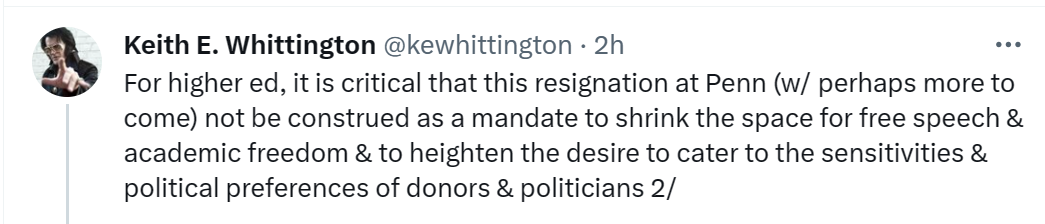
Now that Magill has resigned, here is how Whittington reacted to the news:


It's hard to imagine missing the point by a wider margin than this. Whittington's worried that Magill's resignation will be "construed" as a "mandate to shrink the space for free speech" and to "cater to the sensitivities and political preferences of donors and politicians"? Yeah, no kidding -- it will absolutely be "construed" as doing both of those things because that's exactly what prompted it. The lesson that was meant to be sent and which will be learned is "shrink the space for speech when politicians and donors demand that you do so." There's no ambiguity here; that's the entirety of what happened. Anyone who didn't want that to happen should have come out firing in defense of Magill and in opposition to the roiling censorial mob that Stefanik effectively incited.

Magill felt compelled to resign because she publicly articulated -- in the most hostile room imaginable -- the free speech values that Whittington claims are essential. That's it. And that Whittington still cannot name the actual enemy here -- cannot state clearly that Magill got it right, is being punished for getting it right, and it is rabble-rousing Republican demagogues who showed their whole face in terms of demanding censorship under the guise of protecting Jewish students -- is shameful.

I'm also not feeling especially patient towards some of the other common lines I've heard that try to rationalize why it's okay to blame Magill as having done something wrong. One common response I've seen is to say that the witnesses were poorly prepped for the particular environment of a congressional hearing; with better preparation, they could have avoided the "traps" laid out in front of them. I'm doubtful: I think it is the hubris of very smart people in particular that think they can go into a demagogue's home turf, where they're entirely in control of the proceedings, can control the flow of questioning, can reclaim time whenever they want, and outmaneuver their "traps". It's the same hubris that makes liberals think they can go on Fox News and "outdebate Hannity". No you can't, and it's not because Hannity is some secret genius. It's that he has the home field advantage -- he knows how to play this particular game better than you, precisely because it's a "game" that does not in any way reward intellectual honesty or virtuosity.

A similar argument is that, while the responses of Magill et al may have been formally, legally, correct, they were inappropriate in this context -- their role was not to be lawyers but public advocates for their university, and their sin was misapprehending what was called for from their position in this context. My former colleague at Berkeley Steven Davidoff Solomon, for example, described the university presidents as "prepared to give answers in the court — and not a public forum,” and that was their undoing: their job here is “not to give legal answers, it’s to give the vision of the university."

Once again, I'll cry foul. Yes, there are many situations where a technically correct answer nonetheless can be a bad answer because it skirts some larger truth or is inattentive to important surrounding context, which a good answer would pay heed to. But this argument only works if the problems with the "technically correct" answer are not the facts which make it correct. The people who are mad at Magill are not mad based on something like "yes, maybe it's technically true that there are some circumstances where 'calls to genocide' are protected from formal sanction, but it's more important right now to emphasize how heinous those calls are even if they always be literally punished." The thing they're mad about is the thing that Magill said which was true: there are some circumstances where even 'calls to genocide' -- and we're not even getting into Stefanik's attempt to frame the at the least more ambiguous case of 'intifada' chants as a "call to genocide" -- are protecting from formal punishment. As Howard Wasserman wrote:

Magill, Gay, and Kornbluth did not fail to denounce calls for genocide as antisemitic. No one asked whether calls for genocide or "river to sea" are antisemitic; Stefanik asked whether those statements constitute protected speech and they gave the correct answer of "it depends on context," because it does. In fact, they did at points condemn the message, just without expressing intent to sanction the speech where it remained protected.

Put differently, it's fine to say that in some cases a "technically correct answer" isn't good enough, but only if your proposed alternative is not to demand the speaker be overtly and substantively incorrect.

The last thing I'll say is that I'm not generally interested in point-tallying of the "this is the real cancel culture" variety. Free speech, as I've often said, has mostly fair-weather friends, and no camp has covered itself in glory across the board. What I will say though is that no matter how one tallies the overall scoreboard, this absolutely is an incident where the forces of censorship won and those demanding respect for free speech principles lost. The next time we face an incident where some controversial right-winger comes to campus, it will be a lot harder to persuasively lecture our students that as hateful and heinous as this figure may be, this is the demand of free speech protections etc. etc. etc., because they will have seen in vivid detail just how easily those principles can be forced to bend. 

Maybe you think that's a good thing. I still think it isn't. And at the very least, the practical shakeout of who will in practice see their speech censored and who in practice will be able to access administrative protections remains to be seen. I have zero confidence that this will either find a stable and accepted equilibrium or ultimately redound to the benefit of young Jews enduring antisemitism on campus.

Thursday, December 07, 2023

Bad Faith Grandstanding on Campus Free Speech Shouldn't Be Rewarded


Many of you have seen the fallout over recent congressional testimony about antisemitism on college campuses, featuring the presidents of MIT, Penn, and Harvard. A particularly high-profile exchange came from Rep. Elise Stefanik (R-NY), demanding to know if calling for "genocide" of Jews violated these university's conduct policies. 

The context of this questioning was the use of "intifada" in campus protests, which Stefanik suggested should be viewed as "genocidal". Right from the start, that should give us pause -- the ambiguity of "intifada" being conflated into "genocide" on its own gives ample reason for the university presidents to demur over committing to formal penalties. And certainly, in a world where its increasingly common to claim that Israel is pursuing a policy of genocide towards Palestinians, Jewish leaders should think long and hard about whether they really want to institute a rule that speech "advocating genocide" can be banned from campus. As Justice Black put it in his Beauharnais dissent, warning minority groups about the "victory" of securing a ban on hate speech: "Another such victory and I am undone."

Nonetheless, I've seen many people praising Stefanik for her "hard questioning", and dismissing the university presidents' responses as "dodges" or missteps. As grandstanding, I might concede that Stefanik was effective. But on substance, she was dead wrong, and the university presidents got it right. What we had here was a textbook example of an effective demagogue putting her targets in an impossible situation, and resolutely refusing to allow them to give a "good" answer, and I'm annoyed that this is being viewed as anything other than the bad faith rabble-rousing that it is.

Jon Chait has an excellent piece on this that strikes exactly the right notes. Here's his reprint of the relevant exchange between Stefanik and UPenn President Elizabeth Magill.

STEFANIK: Ms. Magill, at Penn, does calling for the genocide of Jews violate Penn’s rules or code of conduct? Yes or no?

MAGILL: If the speech turns into conduct, it can be harassment. Yes.

STEFANIK: I am asking, specifically calling for the genocide of Jews, does that constitute bullying or harassment?

MAGILL: If it is directed and severe, pervasive, it is harassment.

STEFANIK: So the answer is yes.

MAGILL: It is a context-dependent decision, congresswoman.

STEFANIK: So calling for the genocide of Jews is, depending upon the context, that is not bullying or harassment. This is the easiest question to answer. Yes, Ms. Magill. So is your testimony that you will not answer yes? Yes or no?

MAGILL: If the speech becomes conduct. It can be harassment, yes.

STEFANIK: Conduct meaning committing the act of genocide. The speech is not harassment. This is unacceptable. Ms. Magill, I’m gonna give you one more opportunity for the world to see your answer. Does calling for the genocide of Jews violate Penn’s code of conduct when it comes to bullying and harassment? Yes or no?

MAGILL: It can be harassment.

This has been treated as Magill being evasive and Stefanik trying to nail her down. But in reality, everything Magill is saying is exactly correct. What she said is pretty similar to how I would've responded to my own students if they asked what the rules were surrounding such speech in a campus environment, and I resent the notion that giving an accurate answer to that question should be characterized as a faux pas. 

The truth is that even hateful speech -- and a call to genocide certainly qualifies as one -- is not the subject of proscription on university campuses. This is not some rule that was just made up when Jews got antsy; it was the same principle that demanded UC-Berkeley permit an unabashed racist like Milo speak on campus and insisted that avowed White supremacist Richard Spencer be allowed to give talks at campuses nationwide. Antisemitic speech is antisemitic, but when it is just speech and not conduct, it is still protected by principles of free speech. In her testimony Magill held the line admirably, and now she's being pilloried for it.

This is why I'm actually a bit annoyed at this Chronicle article by Keith Whittington, speaking as founding chair of the Academic Committee of the Academic Freedom Alliance. Whittington presents a choice looming for college campuses on speech, between holding fast to free speech principles versus seeking to restrict speech on basis of content in the name of "safety". The former position (which is also Whittington's) he associates with Stanford Law Dean Jenny Martinez, and how she handled the aftermath of the anti-Kyle Duncan protests on her campus. The latter position he ties to Magill:

A quite different path is suggested by the University of Pennsylvania’s president, M. Elizabeth Magill. Magill has come under particularly intense pressure to address perceived antisemitism on her campus. In her testimony to the congressional committee, she emphasized that “Penn’s approach to protest is guided by the U.S. Constitution” and gives “broad protection to free expression — even expression that is offensive.” But when confronted with questions about whether calls for genocide violated university policy, Magill and her fellow presidents stumbled in their replies. As a result, Magill released a short video. There she repeated that “Penn’s policies have been guided by the Constitution,” but she added that “in today’s world … these policies need to be clarified and evaluated.” She promised a “serious and careful look at our policies” with an eye to ensuring a “safe, secure, and supportive environment.” She will, she promised, “get this right.”

Magill’s implication is clear: The university’s policies need to be revised so that they do not so closely follow the Constitution; they should instead prioritize students’ sense of safety. Protections for free expression and perhaps even academic freedom might well be pared back in the process.

Here's why I'm mad about this. It's true that Magill has backtracked on the commitment to absolutist free speech protections in the wake of the fallout over her testimony, and that's unfortunate. But Whittington's framing implies that Magill from the outset was hesitant to forthrightly defend the free speech rights of "offensive" speakers on campus, and now has gotten even worse. That's the opposite of what happened: Magill in her testimony said exactly what Whittington thinks she should have said -- and she's getting hammered for it. Contra Whittington, she did not "stumble" during the testimony itself -- or if she did, it's only from the vantage of those who take Stefanik's view that it is a misstep not to endorse paring back academic freedom and free expression in deference to students' sense of safety. 

For those who adopt Whittington's view on free speech, Magill's congressional testimony was not a "stumble" but a clear articulation of the proper position of the university. Whittington accordingly should have had her back; he should have said explicitly that the university presidents got it right in their congressional testimony and the backlash they're enduring for it is the real threat to free speech. Instead, he hung her out to dry as she takes the brunt of public heat for the position Whittington purportedly wants to see more university presidents defend. What do we expect will be the result of this? Unfairness to Magill aside, what does Whittington expect will happen -- what incentives are university administrators given -- when they see that putative "free speech" allies won't give them credit for saying the right thing on campus free speech rules. It's hardly a shocker that Magill is yielding in the face of overwhelming public backlash if even her "allies" refuse to back her up. As De Tallyrand put it, "it's worse than a crime, it's a blunder."

At the very least, Magill does not deserve to be the namesake of the censorial impulse. That dubious honor should have been attached to Stefanik (who isn't even named in Whittington's piece). As Chait writes:

What Stefanik was demanding was the wholesale ban on rhetoric and ideas that Jews find threatening, regardless of context. A university should protect students from being mobbed or having their classes occupied and disrupted. But should it protect them from an op-ed in the student newspaper calling to globalize the intifada? Or a demonstration in an open space demanding “From the river to the sea”? That would entail wholesale violations of free speech, which, in addition to the moral problem it would create, would likely backfire by making pro-Palestinian activism a kind of forbidden rebellion rather than (as many students currently find it) an irritant.

The presidents’ efforts to deflect every question about genocide of the Jews into a legalistic distinction between speech and conduct may have sounded grating, and Stefanik’s indignant replies may have sounded like moral clarity. But on the whole, they were right to focus on the distinction between speech and conduct, and Stefanik was wrong to sneer at it.

It may be unfortunate that, after the fact, Magill is bending on this important point. But as disappointing as that failing is, she isn't the originator of the threat. The actual villains of the story are the likes of Stefanik -- they're the ones proactively, not reactively, demanding that university's sacrifice free speech protections in service of student safety. If we can't name that wrongdoing; if we can't push past misbegotten awe at Stefanik's accomplishments in demagoguery, then the situation is going to get worse far before it gets better.