Saturday, August 13, 2022

Who's Afraid of "Jewish" Steve Carrell? (Or, "Us Too-ism")

The JTA headline reads: "Creators of Hulu’s ‘The Patient’ defend casting Steve Carell as Jewish therapist in latest ‘Jewface’ flare-up". I hadn't heard of the story, let alone the "flare-up," so I was curious to see who was making what argument. Unfortunately, the article doesn't actually cite any live human being objecting to Carrell's casting, just a response to an apparently ambient "controversy" (the linked Variety article also doesn't name any specific critics). That said, I know that the "Jewface" controversy isn't completely made up out of thin air. I have seen real people level such concerns before.

Now I'll lay my cards on the table -- I'm not inherently bothered when non-Jewish actors are cast to play Jewish characters. Indeed, to some extent, I feel that some -- not all -- of the "Jewface" controversy is a sort of vulgar "us too-ism" that one sees substitute for genuine Jewish political engagement these days. 

What is "us too-ism"? Some Jews see a given political demand by another minority group (e.g., that Black actors should play Black characters), and then decide that if the powers-that-be don't give similar consideration to a Jewish parallel (Jewish actors playing Jewish characters), then it's proof that "Jews Don't Count" -- full stop. To be clear, it's not that there aren't valid parallels that can be drawn between the political demands of one group and another. But these parallels aren't automatic, and what defines "us too-ism" is that it doesn't pause to ask whether the Jewish community was actually organically bothered by the "exclusion" in the first place. The fact that another group has a demand suffices to make it into a Jewish entitlement as well -- if they're getting this accommodation, then by golly, "us too!" -- even if it never occurred to us to want it until we heard their demand. It's reactive rather than proactive, and often ends up confusing itself (e.g., simultaneously wanting "CRT for Jews" but also blaming "CRT" for why Jews don't count). 

In practice, "us too-ism" often occludes the rich specific history and context which generate organic demands for particular forms of cultural respect (e.g., that actors of X background should portray characters of that background), instead imagining them to stem from some inherent entitlement of "marginalized people" (and Jews are marginalized, so therefore, it fits "us too"). It flattens important points of distinction and differentiation across various social groups that are essential to understanding what actually is oppressing, hurting, or dominating any given group. That two groups are marginalized doesn't mean they're marginalized in the same way, and so it makes sense that a practice which deeply rankles members of marginalized group A doesn't significantly disturb group B. Normatively, it strikes me as self-defeating and self-victimizing to act as if that's a flaw in B's outlook. But at the extreme, "us too-ism" attacks Jews for not being offended by something, as if it is our obligation to feel marginalized by a phenomenon even if it doesn't actually bother us. This strikes me as a tremendously toxic obligation, and one I just refuse to abide by.

All that said, that something doesn't genuinely rankle me doesn't mean it might not do so for others, and I always want to be respectful of persons who do have thought-out arguments for why it is problematic for non-Jews to portray Jewish characters. I've heard these arguments aired more frequently in the context of Jewish actresses being passed over for Jewish parts (even as elsewhere in their careers they're typecast in particular roles because of their Jewishness), and since I'm situated differently vis-à-vis that debate I try to maintain a posture of open receptivity towards those arguments. Certainly, it strikes me as reasonable to care if Jewish actors and (perhaps especially?) actresses are not getting opportunities based on a too-Jewy/non-Jewy enough double bind where stereotypically Jewish features both exclude Jews from certain roles but then are accentuated or exaggerated in non-Jewish actors to Judaize them for the screen (see, e.g., the Bradley Cooper prosthetic nose controversy).

But beyond that, my primary concern is to care about the respectfulness of the representation far more than the personal identity of who is doing the representation. "Respectfulness", itself, is a site for contestation, and people can disagree. I like Rachel Brosnahan's Mrs. Maisel, and find her and Marvelous Mrs. Maisel an endearing portrayal of the sort of New York Jewish life that my parents were raised in. Others disagree, which, fine, but I defy anyone to say Midge Maisel is more offensive than Howard Wolowitz on The Big Bang Theory notwithstanding the fact that Simon Helberg is Jewish and Brosnahan isn't.

Basically, there are dimensions of this problem that are internal and external to the work. Externally, the question is whether Jewish actors and actresses face certain exclusions in the industry on account of their Jewishness -- exclusions which no doubt would make it extra-infuriating if they are later passed over for roles where their Jewish character would seem to be an asset. That was certainly the case for Jewish actors historically, the degree to which it continues to be so is an empirical question I don't know enough to register an opinion on. Internally, the question is whether there is something about being Jewish that is necessary to accurately or effectively portraying a given role in a respectful manner. To that, I say "no". Andre Braugher isn't gay, but his portrayal of Raymond Holt was rightly seen as a watershed performance. Stephanie Beatriz is bisexual, and the same was said for her performance as Rosa Diaz. Let a thousand flowers bloom.

But again, this is a subject where I'm happy to hear other opinions. That JTA and Variety couldn't actually name any critics of Carrell's casting can easily make one think that this "flare up" is a media invention. Is it? If anyone wants to come down to register their opposition to Carroll's casting on "Jewface" grounds, I'm glad to lend you my comment section.

Thursday, August 11, 2022

COVIDing in Summer 2022

So after two and a half years, COVID finally caught me (and my wife). We tested positive on Tuesday morning.

First thing is first: We're both doing okay, with only mild symptoms (mine slightly more severe than Jill's, though part of that might be attributable to me being much more of a baby about being sick). Over the past 36 hours or so, I've gone through essentially every symptom even remotely related to a flu or cold, including:

  • Sore throat
  • Sore chest
  • Cough
  • Vomiting (from the coughing)
  • Congestion
  • Runny nose
  • Lost voice
  • Loss of appetite
  • Upset stomach
  • Fatigue
  • Muscle aches
  • Fever
  • Chills
Individually, none of these symptoms were that bad -- I've had worse iterations of all of them (and the one symptom I haven't had is low blood-oxygen levels). But having every single one of them in rapid succession wasn't exactly fun.

Right now, I'm feeling okay -- mostly the congestion and lost voice linger. My biggest worry is the timeline for recovery, which seems markedly inconsistent across cases. Some people shake it off after a few days, others linger more or less indefinitely. I already had to cancel a surgical procedure I had scheduled for next week (great timing!), and my parents who were visiting this week have checked into a hotel (really great timing!). I really hope this won't endure into the school year. I doubt it will, but again, the uncertainty is weighing on me.

Most of all, though, I'm grateful that I'm fully vaccinated and boosted. Even under the best of circumstances, I have breathing issues (initially, I thought the COVID symptoms were either allergies or GERD), and I can easily imagine that if I were unprotected my experience with COVID could've been a lot worse. It is a sobering thing to realize that, if this had happened two years ago, I could have died. The development of these vaccines, in such a compressed timeline, is a true miracle, and I'm incredibly grateful to everyone who worked so hard to make it happen. It's not implausible to say I owe my life to it.

Here's to feeling better very shortly!

Tuesday, August 09, 2022

Imagine What They Can Do To You

 The GOP response to the FBI's raid on Mar-a-Lago has been very straightforward:


The immediate response to this was that I never doubted that the FBI was capable of getting a warrant to search my house if they established probable cause that I had committed a crime. Not only was that well within the realm of imagination, it'd be very bad if I couldn't imagine it!

But it when it comes down to "imagine what they can do to you", this isn't the story that is haunting. It was this Atlantic deep dive into how Trump's "family separation" policy was implemented.

Obviously, the basic fact patterns found in that story are terrifying. Imagining your small children ripped away from you, shipped to God knows where, with no guarantee you'll ever see them again -- it beggars belief. But there's a more fundamental horror at work here -- the impunity of power. In contrast to the formal legal process that resulted in the Mar-a-Lago raid, processes which will be challengeable in a courtroom and held to significant judicial scrutiny, the parents and children victimized by Trump's family separation policy were thrust into a chaotic state of legal limbo defined by the fact that nobody would, or could, help them. Can you imagine that? Can you imagine your child gone missing, and your frantic pleas for help just ... ignored? Not even that people try to help and fail -- they won't help at all. You're in the most dire crisis imaginable, and the men and women in uniform who seem like they should be tasked with helping you, who seem like they have the power to end the nightmare, just leave you to twist?

The argument against allowing the Mar-a-Lago raid is little more complex than the belief that if you become powerful enough, the law should no longer apply to you. That form of entitled impunity is not at all unrelated to the administrative lawlessness and abandonment that characterized how the family separation victims were traumatized. In either case, the message is that one's ability to claim the protections of the law is wholly a function of whether you possess the requisite amount of social power. If you're part of the favored in-class -- the Trumps of the world -- then law will bend over backwards to ensure you have your hearing. If you're on the outside looking in, then law will ignore you no matter how loud you scream.

Imagine what that could mean for you.

Wednesday, August 03, 2022

Assessing AIPAC's Victories

Last night, Rep. Haley Stevens soundly defeated fellow incumbent Rep. Andy Levin in a D-on-D Michigan primary matchup. The race drew significant attention in the Jewish community because of the gobs of money AIPAC spent seeking to oust Levin and support Stevens. Levin earned AIPAC's ire because he is a vigorous proponent of America taking more robust steps to protect a two-state solution for Israel and Palestine -- including steps which entail places checks on Israeli government policies which place that solution in jeopardy. While I endorsed Levin, I want to be clear that I harbor no ill-will towards Haley Stevens, whom I also like and have zero qualms supporting in the 2022 general.

In any event, as the primary season nears its conclusion, it is fair to say that AIPAC's initial foray into direct candidate advocacy has been relatively successful. So far, it has notched ten victories against two defeats in the Democratic primaries it has substantially invested in. To be fair, that figure is a bit misleading, as in many of the races AIPAC either was backing a candidate who already came in as a favorite, or were in relatively low-salience open-seat races where AIPAC's firehose of cash swamped the field. For example, Stevens entered the race against Levin as the substantial favorite -- more of her old turf than Levin's was placed in the new district they both ran in, and she is generally regarded as a better and more natural campaigner than Levin. Indeed, my hot take was that Stevens probably would've bested Levin even without AIPAC's giant cash infusion. But certainly, AIPAC probably is relatively happy with its performance thus far.

What AIPAC bought with its investment into the Stevens campaign was the ability to write a narrative. It's hoping the political message taken from Stevens' victory includes lessons like "pro-Israel is good politics" or "supporting conditioning aid on Israel is a sucker's bet in Democratic politics." Needless to say, AIPAC's critics are hard at work resisting these narratives and trying to spin out others of their own ("AIPAC is a vector for letting GOP billionaires take over Democratic politics"). Meanwhile, as in nearly all races of this sort, the national attention on the race (centered on Israel/Palestine) almost certainly had relatively little impact on the local considerations that drive votes one way or another. At the end of the day, Stevens won her old turf, Levin won his old turf, but the new portions of the districts, formerly represented by Rep. Brenda Lawrence, went to Stevens -- who had Lawrence's endorsement. The actual lessons may not be much more complicated than that.

I want to do my best to separate wheat from chaff here. There are lessons to be drawn from AIPAC's victories this primary season. Though not every ecstatic claim of AIPAC supporters can be borne out, they have proven some lessons true.

At the most basic level, AIPAC's argument is that its primary victories show that Democratic voters support its version of "pro-Israel" politics. Yet this, I will suggest, remains unproven. As much as it has spent on these races, AIPAC has been notorious for virtually never speaking about Israel or Israel-policy in its advertisements or promotions of its preferred candidates. This suggests that it doesn't think that issue is necessarily a winner for them.

However, it does seem true that running against AIPAC's policies is not a winning strategy in most Democratic primaries. This is, perhaps, another "Twitter is not real-life" lesson -- the excitement and enthusiasm one sees online for a candidate who "stands up to the Israel Lobby" is not reflected in on-the-ground political performance. While it's unclear that voters affirmatively value AIPAC-style "pro-Israel" politics, it's quite evident that they don't find even Levin-style two-stateism to be a major political motivator. Similarly, it seems pretty clear that -- as of right now at least -- AIPAC has not faced any substantial backlash from Democratic voters for backing insurrectionist Republicans. A Democratic candidate who is viewed as "the pro-life candidate" is toxic in a 2022 Democratic primary. A Democratic candidate who is viewed as "the AIPAC candidate" isn't. This might change over time -- I suspect there is quite a bit of festering ill-will towards AIPAC amongst many Democratic Party actors that is waiting for an opportunity to burst forth -- but right now, AIPAC's position is secure.

It's also worth noting, in the context of right-wing Jews crowing about Levin's defeat to Stevens, that AIPAC's success does seem to decisively falsify the alarmist and opportunist narrative that the Democratic Party is being "taken over" by anti-Israel forces, that such positions are the new normal or mainstream in Democratic political life, and so on. To be clear, I find it repulsive to argue that Andy Levin in any way represents an "anti-Israel" position. But the point is one cannot simultaneously promote all of AIPAC's successes in Democratic primaries while also saying that the true soul of the Democratic Party is irreducibly hostile to Israel.

I also do think it's fair to say that AIPAC has reestablished some of its perhaps decayed deterrent effect. Democrats know that if they get on AIPAC's bad side, it can and will dump vast sums of money into ousting them from office. And by the same token, if they play ball with AIPAC they can access those same sums for themselves. That's a powerful inducement.

That said, the question of how AIPAC's interventions will affect political decision-making by prospective Democratic politicians on Israel is more complicated than might appear at first blush. I do think that, on average, a lesson that will be learned by many mainstream Democrats is "don't get on AIPAC's bad side", and to that end will result in more Democrats taking up AIPAC-friendly positions. Those positions include nominal support for a two-state solution -- AIPAC does that too -- so long as that support doesn't take the form of ever asking for any pressure on Israel or demands that America use its leverage to pushback against Israeli decisions that are destructive to the possibility of eventually establishing a Palestinian state. However, I also think that AIPAC has also paradoxically opened space for at least some Democrats to be more radical on the issue -- for example, in endorsing one-statism* -- because they'll internalize the lesson that more "moderate" approaches like Levin's robust two-stateism don't offer any political advantage.

Let's simplify potential Democratic Israel positions into three categories: (1) AIPAC-style status quo (represented by someone like Stevens), (2) The Andy Levin or J Street style two-stateism , or (3) Rashida Tlaib style one-stateism. Of course, some politicians have very strong feelings on this question and will choose based on those deeply-felt sentiments. However, my core model assumes that most politicians don't have hard-and-fast policy preferences on most issues. Rather, on most issues beyond the rarefied few they care deeply about, they will choose the political path-of-least-resistance amongst the set of choices which meet their basic criteria of moral tolerability, even if a different choice might be closer to their ideal ideological preference. So if we imagine a politician who really doesn't care one way or another about Israel/Palestine -- they are at least not repelled by any of the three forms of Israel positions above -- they won't adopt the position they "believe in" the most, they'll pick the position that is politically easiest and least likely to generate controversy or backlash. AIPAC's victories have strongly suggested that, in many contexts, that would be position #1 -- even in Democratic primaries. And to that extent, AIPAC probably will succeed in moving the Democratic needle towards its preferences.

However, we can also imagine a different sort of potential progressive candidate, one who does not find AIPAC-style status quo advocacy to be morally tolerable. For this candidate, the two viable choices for their Israel/Palestine positions are categories #2 and #3. Historically, many would have picked door #2, again, because it's the path of political least resistance. Indeed, if such a candidate a few years ago had asked me for advice -- had said that they had serious concerns about Israel's behavior and they simply couldn't endorse a position of total and unconditional support -- I'd have told them that, so long as they supported two states and opposed BDS, they'd probably be okay. They wouldn't necessarily be endeared to AIPAC or other like actors, but they wouldn't be seen as beyond the pale either. But endorse BDS, or oppose Israel's existence outright, and the full sound and fury would fall onto them.

But now AIPAC may have changed the calculus. By going scorched earth on Levin, it sends the message that it views categories #2 and #3 as equally destructive. Suddenly, door #2 is not a political "path of least resistance" compared to door #3. And if they're both going to bring AIPAC's full fury down upon the candidate, well, at that point you might as well choose based on your ideological preference. Some of these candidates, will sincerely prefer robust two-stateism over one-stateism (that characterizes me, for instance), so their behavior shouldn't change. But some will no doubt prefer one-stateism, and lacking any political rationale for tacking towards the center, they won't do it anymore.

I worry that this might be the lesson people draw from the Donna Edwards/Glenn Ivey race -- another where AIPAC dumped massive sums of money into the contest. Again, all politics is local and Ivey's victory likely reflects factors that overwhelmingly have nothing to do with AIPAC or Israel. But if one looks at Edwards' trajectory entering this race, and in particular how she tried to heal old suspicions held by Maryland's Jewish voters, it seems hard to argue that she is now (if she ever was) some sort of anti-Israel firebreather. She was never going to be AIPAC's poster girl, but she made a concerted effort to pinch towards the center and assuage Jewish concerns about her record. The result was less than nothing -- AIPAC spends eight figures on sinking her career. To be clear: I have no reason to think that Edwards' moves were anything other than sincere, or that she secretly harbors one-state sympathies. Nonetheless, there absolutely will be other politicians in Edwards' position who may decide "why bother?" There's no sense going through all this effort to listen and grow and build bridges and try and find common ground if they're going to go scorched earth regardless.

In short: there is likely a set of candidates who (a) find both one-stateism and robust two-stateism tolerable, (b) marginally prefer one-stateism over robust two-stateism, (c) would nonetheless back robust two-stateism if that was the path of political least resistance. If robust two-stateism no longer offers any political advantage, they're likely to begin promoting one-stateism. To be clear, these candidates are still likely to lose. AIPAC's hammer puts them at a decided disadvantage. But their logic will be "I'm likely to lose either way, so I might as well swing for the fences." Indeed, there's not just a moral but an instrumental logic here. Consider two strategies: One will have you lose by 10 points in 10/10 races. The second will have you lose by 30 points in 9/10 races, and win by 2 points in the tenth. The rational political actor should choose the second strategy, even if it is objectively less popular (a point I've made regarding the future of BDS in Democratic Party politics)!

Paradoxically, AIPAC may encourage some number of Democratic candidates in the more liberal tranche of the party to start supporting a one-state solution who otherwise would not have done so. And the odds are some of them will end up prevailing in their races (if only because of idiosyncratic local factors). There's a real chance that an upshot of AIPAC's intervention will be to strengthen the political power of the one-state caucus -- not because of some political backlash, but based on how it has altered the political calculus amongst more progressive-minded actors. In many ways, it is J Street that is more of a loser than AIPAC is a winner, and I expect J Street's influence to bleed out not just towards AIPAC, but also towards more radical and uncompromising anti-Israel actors and the far-left. For someone with my politics, that is perhaps the most depressing lesson of all.

So to sum up, here are the lessons I think can be validly drawn from AIPAC's performance this election cycle:

(1) While it isn't demonstrated that Democratic voters support AIPAC's brand of "pro-Israel" policies, it does seem clear that they aren't especially moved or motivated by major alternatives. The political energy behind any alternative to what AIPAC pushes -- whether it's Levin's robust two-state Zionism or explicit non- or anti-Zionist positions -- is vastly exaggerated and isn't translating to on-the-ground political power.

(2) AIPAC, and its affiliates, are not toxic brands in Democratic primaries.

(3) The Democratic Party, including its base, are not "anti-Israel" or sympathetic to "anti-Israel" positions in any meaningful respect.

(4) AIPAC has restored some "deterrent effect" against Democrats who might consider crossing them, at least in circumstances where the Democrat has other political vulnerabilities that can be leveraged (such as after redistricting). Likewise, AIPAC has credibly indicated it can and will substantially invest to support Democrats whom it feels favorable towards.

(5) The average Democratic politician who is not substantially invested in Israel/Palestine as an issue will likely move their position marginally closer to AIPAC's as "political path of least resistance".

(6) Left-wing Democrats who are sympathetic to one-stateism or other more radical anti-Israel positions, but who had been hewing to more J Street style stances because they thought they'd be more politically palatable, may reassess the utility of relative moderation and become more open in their anti-Israel declarations.

* Not the apartheid one-statism where Israel controls the entire territory and Palestinians are perpetual second-class citizens -- AIPAC is clearly fine with that.

Saturday, July 30, 2022

The Epistemic Dimension of Antisemitism: The Case of Navi Pillay

The Journal of Jewish Identities just published my most recent article, "The Epistemic Dimension of Antisemitism." Basically, the article looks at antisemitism through the prism of "epistemic injustice" -- wronging Jews in our capacity as knowers. This is distinct from more "traditional" forms of antisemitism like overt hatred or disdain (though obviously they can be related and support one another). 

To give an example: One can (and many antisemites do) view Jews as a world-dominating cabal that controls critical social enterprises like the media, Hollywood, and the financial industry. Unsurprisingly, those who hold that view often also are affectively antagonistic towards Jews (few think Jews run the world and are thankful for what a bang-up job they think we're doing). But it's also likely that someone who holds this view will take certain stances about Jewish credibility. They're liable to think that Jews cannot be trusted, that we're always working the angles, that our testimonial offerings are likely in service of a deeper game. Even if, for whatever reason, they do not have an explicitly hateful attitude towards Jews, they might be distinctively mistrustful or dismissive towards Jews when we venture opinions in the public square -- even, or perhaps especially, if those opinions are on matters that are central to Jews' own experience.

The essay, of course, goes into more detail. But as it happens, an incident that occurred almost simultaneously with the publication of the essay provides a solid real-world illustration. In an interview with the pro-Palestinian website Mondoweiss, Miloon Kothari, a member of the United Nations Human Rights Council's special commission into Israel and the Palestinian territories, made several remarks which generated a swift backlash from American and Jewish diplomatic officials

In particular, Kothari alleged that the "Jewish lobby" controls social media to the detriment of his work:

“We are very disheartened by the social media that is controlled largely by – whether it is the Jewish lobby or specific NGOs, a lot of money is being thrown into trying to discredit us.”

(Elsewhere, he appeared to question the validity of Israel's membership in the UN -- we'll leave that part aside).

Unsurprisingly, these comments were, to say the least, not well received in the Jewish community. But Kothari's colleague Navi Pillay, former United Nations High Commissioner for Human Rights, rose to Kothari's defense and claimed that he was the victim of a "deliberate" campaign to misquote and falsify what Kothari actually said. Kothari's comments, Pillay argued, were "deliberately been taken out of context" and Kothari was "deliberately misquoted to imply that 'social media' was controlled by the Jewish lobby."

Kothari's comment about "the Jewish lobby", expressing frustration by and antagonism towards what he takes to be the "Jewish lobby's" ability to "control" social media, seems an easy case of antisemitism under traditional articulations. Pillay's defense of Kothari, by contrast, sounds in a epistemic dimension. She dismisses the testimonial offerings of Kothari's critics who claim antisemitism by claiming they are engaging in a "deliberate" campaign of falsification. The purpose is to sabotage the basic testimonial validity of those claiming antisemitism by declaring the allegations to violate basic norms that undergird legitimate discourse (e.g., honesty and sincerity).

For starters, Pillay does not actually identify, or even attempt to identify, any misquote or missing context that has undergirded those criticizing Kothari. To the contrary,  most of the media sources I've seen reporting on the story have quoted Kothari verbatim. They haven't, for instance, just said something like "Kothari attacked the 'Jewish lobby'" and left readers to wonder what the relevant sentence actually said. They have by and large included most if not all of the above block quote. Meanwhile, the quotations themselves were taken from Mondoweiss, an outlet which is supremely unlikely to have misquoted Kothari or taken him out of context in a manner that would assist pro-Israel commentators. Pillay's claim of false testimony is not just unsupported, it does not even gesture at anything that might support it. So how could she possibly think her contentions will carry any credence? The most likely answer is that she thinks -- and she's probably correct -- she can draw on a reservoir of epistemic antisemitism where people are predisposed to believe that Jews and those advocating on our behalf are liars, manipulators, cheats, and bad-faith actors. Only in a world where such epistemic beliefs about Jews are taken for granted could such naked and obviously unsupported complaints about misquotes be thought to stand a chance of success.

All of that would be bad enough. But there's also on top of this Pillay's choice to say that these alleged-but-not-demonstrated falsifications were "deliberate". This is a charge Pillay repeats, so it is no stray bit of rhetoric. Supposing, for sake of very strained argument, we did think there was something to the notion that Kothari was being taken out of context. That still hardly would establish that Kothari's critics were acting deliberately. Even if, for some reason, one thought there was a perfectly innocent explanation for what Kothari said, surely it is not unreasonable to think that Jews could in good faith perceive that passage about "the Jewish lobby" as being problematic. The most likely explanation for the divergence between how Jews interpreted what Kothari said and how Pillay does so would be such good faith disagreement. 

But Pillay refuses to allow for anything other than conscious malice. It is not just that Kothari's critics are wrong, they are intentionally wrong, they are lying, they are smearing. In my article, I make the following observation:

[A]ntisemitism allegations are divided into a sharp binary: those which are incontestable and those which are in bad faith. In this binary, there can be no such thing as an antisemitism claim which one, personally, doesn’t agree with but which is accepted to lie within the legitimate boundaries of argument. Every instance of supposed antisemitism that is disputable must be invalid altogether. The “zone of contestation,” where we agree to investigate claims under a posture of open receptivity, because we concede we’re not immediately sure of the right answer, implodes because there’s never actually any controversy: either a claim is so obviously true that it smacks us in the face or it is so obviously false that it can dismissed out of hand.

Pillay defaults to making unsupported, and unsupportable, claims of deliberate lies because the architecture of epistemic antisemitism assumes that the only reason Jews would ever level a claim of antisemitism that one might disagree with is because they're lying about it. Pillay thinks Kothari is not antisemitic, therefore, anyone arguing otherwise simply must be lying. The false allegations of misquotation or missing context flow naturally from this.

Certainly, I don't mean to set up a sharp dichotomy between "traditional" and "epistemic" varieties of antisemitism. One sees elements of each in the conduct of both Pillay and Kothari -- one could easily view Pillay as expressing not just mistrust but antagonism towards the (Jewish or Jewish-coded critics) whom she cavalierly smears as liars, and Kothari's claims about the "Jewish lobby's" outsized influence on social media obviously has epistemic implications about the validity of their discursive contributions to debates over Israel and Palestine. Nonetheless, this incident I think does a decent job of highlighting the distinctive nature of the epistemic strain. It is unfortunate, but not surprising, to see UN officials at the center of such a story. But nobody should be under any illusions that Turtle Bay or Geneva is the only location where it occurs.

Tuesday, July 26, 2022

Gallows Humor vs. Pure Fear in Political Ad Strategy

Last night, I saw the following ad start circulating by a pro-choice organization targeting Texas Gov. Greg Abbott (and, by extension, the draconian anti-abortion regime that has recently been ushered in).


I'm curious what people think on this (as I've mentioned, cutting political ads is something I'm absolutely irrationally confident I'd be good at).

I fully agree that Democrats should be running and running hard on the demise of Roe. If there is one thing Americans hate, it is changes to settled expectations, and this one was a doozy. Democrats can and should do everything they can to elevate and place at the forefront the anxieties, fears, and trauma that is associated with this settled right being unceremoniously torn away.

I am curious how people view this ad, in particular, as fitting into the strategy. The most striking feature of the ad is the abrupt switch in tone -- from a pure emotional appeal to absurdist gallows humor. The ad has gotten generally positive reception on my Twitter feed, though I can imagine people thinking it's a little too jokey and slapstick for the moment. The alternative, of course, would be to run ads that aren't cut with humor but rather play purely on fear -- fear of women dying, being maimed, being arrested. I want to be clear: those fears are justified. I don't think this is fear-mongering, because these terrible prospects are absolutely on the horizon where they are not already the reality. But the point is there is a different style of ad one can imagine that doesn't flinch away from the raw terror of the moment by interspersing it with a bit.

Consider something like the following: 
A woman is sitting in an examination room in a hospital gown. She's terrified, and has clearly been crying, but she's trying to stifle any sound and keep a brave face. There's blood spotting the gown near her groin. The camera slowly pans over, zooming out so she stays in frame but capturing more of the exam room until it reaches the doorway. Out in the hall, one sees three police officers talking to a doctor or nurse. Eventually, one of the officers walks into the exam room with handcuffs out.
No humor, no levity, no absurdism. Not even any dialogue. Just a terrified woman, in the most vulnerable moment of her life, facing the abusive power of the state. A terrible image. But we are living in terrible times.

Would that be better? Worse? Or should both types of ads be run? I'm not sure. Again, curious what people think about what's the right and most effective strategy.

Sunday, July 24, 2022

"Dems" Who Endorse Third Party Candidates Are Monsters. Zero Exceptions.

Back in 2018, when I was still living in Berkeley, I was really having a difficult time deciding who to vote for in a D-on-D assembly race between Buffy Wicks and Jovanka Beckles. Both seemed like solid people I'd be happy to have representing me in Sacramento, and I struggled to find much distinguishing the two.

Until I learned that Beckles had voted for Jill Stein in 2016. Suddenly, a hard choice became very easy. Wicks gets my vote (and she went on to win the election).

Fast forward a few years, to 2022. I now live in Oregon, a pretty reliably blue state. Except this year, our gubernatorial race includes not just the standard D-R matchup between Democrat Tina Kotek and Republican Christine Drazan. It also includes a well-financed "independent" candidate -- former Democratic State Senator Betsy Johnson,* well-known as among the most conservative Democrats in the caucus. Johnson, who has called Portland a "city of roaches", ran expressly because she couldn't tolerate a more liberal Democrat being the party's standard-bearer. Polling suggests an extremely tight race, and Johnson 's presence on the ballot could let the Republican slip into the governor's mansion with barely 30% of the vote.

The very thought makes me livid. The idea that in Oregon, in 2022, we might have a Republican Governor because some egomaniacal blue dog Dem just couldn't back her party's nominee is outrageous.

Among Johnson's endorsers is outgoing Democratic Rep. Kurt Schrader, in an obvious sore-loser move after he lost his primary to challenger Jamie McLeod-Skinner. I couldn't vote in that election -- I now live in Schrader's district, but I moved here a few weeks after the election -- and I certainly understood the pragmatic argument in favor of Schrader in a swing-y district. But Schrader himself? Absolutely dead to me. I shed zero tears for his demise.

There is nothing I have more contempt for than a nominal Democrat supporting a third party in a contested general election. It is terrible if it is a "from the left" protest vote for a middle-of-three-evils like Jill Stein. It is terrible if it is a "from the center" chin-stroker vote because the Democrat is "just too radical"

The current iteration of the Republican Party is a hairsbreadth away from being actual fascists. Stopping them from attaining political power is a moral obligation of the highest order. Very, very few things can trump that obligation. I can think of essentially no significant Democratic figure whose views or practices are so noxious as to trump that obligation. Yes, that includes every single member of the Squad. Yes, that includes Joe Manchin and Kyrsten Sinema and Henry Cuellar. I don't care how annoying you find them. I don't care how valid your grievances are against them. None of them are worse than your typical 21st century Republican. If they are the general election nominee, and they're running against a Republican, you vote for them, and you do it with a smile.

* In researching this post, I learned the ultimate terrible fact: Johnson is a Carleton College alum. She also got her J.D. at Lewis & Clark. I am devastated.

Tuesday, July 19, 2022

It's Not About Liberals Refusing to Compromise: Respect for Marriage Act Edition

Today, the Respect for Marriage Act passed the House by a 267-157 vote. Forty seven Republicans voted in favor of the bill, dwarfed by the 157 who voted against (all nay votes came from Republicans).

Contrary to popular press coverage, this law does not "codify same-sex marriage". It appears to be far narrower, only ensuring that same-sex marriages performed in one state must be acknowledged in other states. As far as I can tell, it does not forbid states from barring same-sex marriages performed in their borders. In effect, what it "codifies" is not Obergefell but Windsor.

Which makes the overwhelming Republican opposition all the more striking.

This bill could not have been more modest in ambition. It does not simply secure the status quo. It secures a significant retreat from the status quo, at the expense of gay and lesbian Americans' basic civil rights. And even still, Republicans voted against it by more than a 3:1 margin, and its prospects for passing a Republican-led Senate filibuster look dim.

It has been suggested that if Democrats were just a little more moderate, a little less all-in, that Republicans would be willing to work with them. It is the liberals' insistence on going all-or-nothing that compels conservative opposition. Alas, conservatives just can't help themselves. Murc's law strikes again.

No. The Respect for Marriage Act was written to be about as timid and "moderate" as one could possibly imagine without simply running all the way back to Bowers v. Hardwick. And still, it probably won't pass, because Republicans remain overwhelmingly opposed to any degree of equality for gay and lesbian Americans.

That's their position. They're not hiding it. They're not reluctantly compelled to vote against these laws because of some mythic liberal overreach. That's their position. Stop pretending that Republicans don't believe what they clearly believe.

The Goose and the Gander of the Bruen Prohibition on "Balancing"

Eugene Volokh flags a case out of California involving a man allegedly prohibited from carrying a firearm due to a mental health hospitalization that occurred twenty years ago, when the man was in middle school. Federal law generally prohibits an individual "who has been committed to a mental institution" from owning, possessing, using, or purchasing a firearm or ammunition. The man, who later enlisted in the Marines and worked in law enforcement, has not had any other mental health issues since that single incident.

The court in this case ended up ducking the major constitutional issue for technical reasons we don't need to go into, but suggested that the relevant section of federal law was probably still constitutional after Bruen because several justices in that case specifically identified bans on mentally ill persons carrying firearms as among the sort of historical restrictions that had been permitted at the time of the framing. Prof. Volokh, by contrast, thinks the law should be unconstitutional insofar as it does not require any showing that the prohibited individual is presently mentally ill. The facts of this case, in particular, suggest a person for whom the law as written sweeps too broadly.

I make no judgment on whether federal law should, as a matter of policy, create such a carve-out for persons who seem to no longer be mentally ill. However, it does seem to me that this sort of analysis represents exactly the sort of "balancing" of interests that Bruen quite categorically forbade courts from engaging in. From Bruen's perspective, the sole question a court should consider is whether or not this sort of firearms restriction -- in this case, restrictions blocking the mentally ill from possessing firearms -- was historically present at the time of the framing. If the answer is no, then the restrictions are unconstitutional no matter how good a reason we might think exists for imposing such a restriction. But the flipside has to be true too: if the answer is yes, then the restrictions are constitutional no matter how unfair or untailored we might think they might be as applied to a given individual. And since the Court has already seemingly conceded that restricting the mentally ill from possession of firearms is one of the restrictions historically permitted, that should end the discussion.

The counterargument, alluded to be Volokh, is that the relevant basis for historical comparison is not the existence of "laws prohibiting the mentally ill from possessing firearms", but rather "laws prohibiting persons who once had a mental health crisis but have not had any symptoms for decades from possessing firearms." At one level, this is a familiar problem of abstractness versus specificity, one which offers courts yet more discretion to approve or disapprove of firearms regulations that they like or dislike. As I said in my last Bruen post, the application of Bruen by the judiciary will not ultimately be controlled by lawyerly parsing of the constitutional or precedential text; it will be a matter of personal judicial preference -- and the specificity problem identified here is just another opportunity for judges to disguise their policy preferences under the cloak of a legal rule. 

But if we make-believe that the putative legal rule will matter--well, Bruen promised that the relevant requirement for a historical analogue was not a "twin". And there are good reasons for that, which go beyond allowing for some amount of adjustment for societal developments as centuries pass. Requiring that state or congressional gun restrictions map on precisely to policy initiatives passed in the 19th century significantly limits the legislature's policymaking authority even in a domain where the Court agrees the legislature has the right to impose restrictions. It is facile to say that restrictions on firearms possession by the mentally ill is permitted, but Congress must only implement those restrictions via the precise programmatic means used in the 1800s. The constitution doesn't typically encode specific policy demands, it encodes general rules and standards that broadly define the parameters through which the democratic branches are allowed to fill in the details.

Given that, it seems to me that as far as Bruen is concerned, the germane constitutional question is whether the restriction in question is of the class of restrictions that had been historically been permitted. Once we answer that question in the affirmative, then Congress or the states should be given considerable leeway in figuring out how it wants to instantiate that restriction -- that inquiry being primarily a policy question which courts should be reluctant to intrude upon. Certainly, Congress cannot simply declare anything to be a "mental illness" restriction, anymore than New York in Bruen was allowed to declare the entire city of New York a "sensitive place". But it's equally clear that restricting persons who had a serious mental health episode from owning firearms is much more clearly under the umbrella of "restrictions on the mentally ill". The opposition to that rule is not really that it falls outside the category, it's that as applied here something like a "one strike rule" feels overbroad and unfair.

And maybe it is -- that rule may be too harsh. But again Bruen says it is not the judiciary's business to weigh competing interests. Mental health restrictions are historically permitted, this is Congress implementing such a restriction -- end of discussion. What is good for the goose is good for gander. That is, unless Bruen actually means what many of us suspect it to mean -- not an actual rule that constrains judicial partisanship, but a thin cloak for imposing pro-gun outcomes, text of the alleged legal rule be damned. We'll see. I'm not optimistic.

Sunday, July 17, 2022

When Will Dead and Maimed Women and Girls Become Old News?

It's been less than a month since Roe v. Wade was overturned, and already the consequences are being felt by women and girls around the country whose health and lives are suddenly imperiled. Many of these stories have gotten significant coverage. To name a few:

All of these cases occur fresh in the wake of the Supreme Court's Dobbs decision. All demonstrate, in vivid detail, how the health and safety of women and girls in America has been dramatically imperiled by the Court's imperious decision. Some right-wing commentators have labeled in "suspicious" how many of these stories are emerging so shortly after Dobbs. There is nothing suspicious about it: of course the consequences of banning abortion would manifest immediately after banning abortion. These stories are what will happen in the first month after Dobbs, and the second, and the third, and the twelfth. These stories are the new normal.

Which raises an important question: what happens when they become normal?

These stories are getting coverage now because they're novel. They are breaking reports about the new reality we live under. But in two, three, twelve months, these stories will still be occurring, but they'll no longer be new. Will they still be covered? Or will the media move on?

One can easily imagine in September and October and November newspaper editors deciding that the latest instance of a child rape victim being forced to scurry across state lines, or a miscarrying woman being left to bleed out in a hospital, or a patient denied prescribed medication by an overzealous pharmacist, are yesterday's news. They'll recede into the background, not because they've gone away, but because they're omnipresent.

This isn't an inevitability. News networks don't skip covering crime stories just because "there are muggings every day". One would hope that they'd apply the same logic to women. Every time one of these laws maims or kills or harasses a girl or woman in their community, that should be a story. The drumbeat shouldn't stop, because the story isn't stopping. It should never be "old news" .

We'll see. I'm skeptical. But we'll see.

Thursday, July 14, 2022

The Default Conservative Response to Inconvenient Facts is to Cry "Liar!"

Many of you have probably been following the horrific story of a ten-year old rape victim from Ohio who was forced to travel to Indiana to have an abortion following her home state's criminalization of the procedure.

No doubt some of you witnessed a collective right-wing response to the story, which was simply to declare it a lie. The Wall Street Journal editorial board called the story "too good to confirm". Ohio Rep. Jim Jordan (R) called it "another lie". National Review contributor Michael Brendan Dougherty called it a "fictive abortion and a fictive rape." Ohio Attorney General Dave Yost suggested the story was a fabrication because he hadn't heard a "whisper" about such a rape case from local law enforcement officials. It was everywhere.

Then the story was (further) confirmed, and those who called it a lie retreated with various amounts of egg on their face. Which is to say, they mostly said they were right to assume the story was made up even though it wasn't.

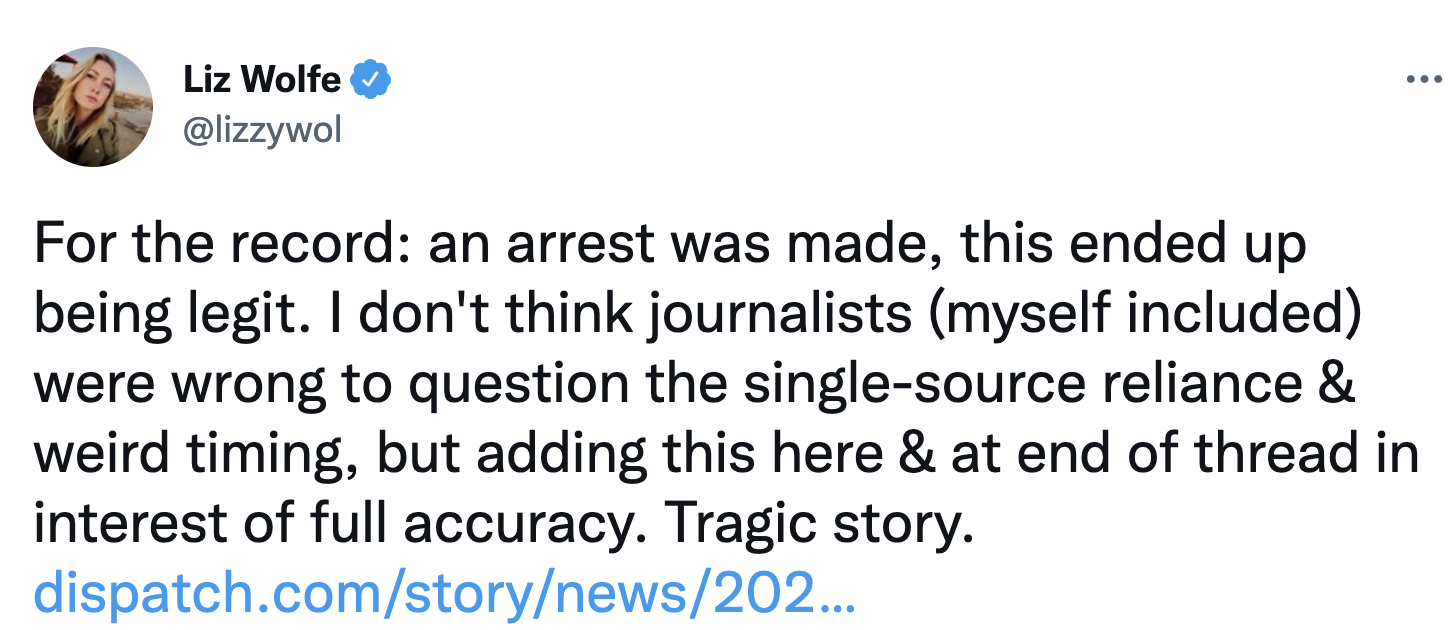
This has been the main meta-media response to the controversy: agreeing that there were "red flags" about the story such as its "weird timing" that meant we should all have taken very seriously the collective right-wing declaration that the story was a hoax, even though it turns out to have been horrifyingly true.

There were no significant "red flags" here. It is not suspicious that the Indianapolis Star did not publish the name, address, photograph, and social security number of a minor rape victim. It is not "weird" that stories of the horrible consequences of criminalizing abortion would begin to emerge shortly after abortion was criminalized. Obviously, if there is actual evidence of malfeasance or fabrication, one should look into that. But that wasn't present here.*

No, what happened here is very straightforward: A story was published that constituted an inconvenient fact for conservatives. So they declared it to be a lie. That's it. That's all that prompted the reaction. No "red flags", no "reasonable grounds to question". The story was inconvenient, and the response was to cry "liar!"

If we had to do meta-coverage of this story, that's what should have been the frame. It is, after all, the same basic instinct that motivated the cries that the 2020 election was "stolen". What prompted those cries was not any "evidence" or "suspicions" or "red flags". Biden winning was an inconvenient fact, and the default right-wing response to an inconvenient fact is to declare it a lie. Same reason why January 6 insurrectionists are declared to be "antifa". Same reason why mass shootings are alleged to be false flags. Same thing for global warming, same thing for whether Israeli soldiers shot Shireen Abu Aqleh, same thing for Trump's connections with Russia. This is not something occurring in isolation. It is a pattern of behavior, and a deeply dangerous one at that. It's always a lie, it's always "fake news".

So if the media wanted to soul-search its coverage, it should start there. What does it mean that conservatives now reflexively and instinctively declare any story that troubles their ideological waters to be a lie, and what does it mean that the media still views those cries as having credence?

This response, after all, is toxic to the proper functioning of democratic politics. Yet rather than identify it for what it is, let alone push back on it, the media aids and abets it with thumb-sucking self-abnegations agreeing "questions were raised." No they weren't! The mere fact that Republicans don't like a given fact or event or story about the world is not and should not be enough for the media to agree that its truth is up for dispute.

So that's the story I want to see. I want a deep dive into how conservatives have begun calling any inconvenient fact a lie. I want a clear and unvarnished explication of the pattern of behavior, contextualizing the most recent instance by reference to other prominent cases where they've run that same playbook. I want comments from self-reflective journalists about why these unevidenced cries of "liar" are given credence, and whether it is appropriate to continue to give credence to those cries going forward.

That's the metastory. Someone should get on it.

Oh, and for those of you wondering: now that the story has been fully confirmed, conservatives are sweeping into action ... by launching a criminal investigation of the doctor who cared for the child and proposing legislation that would criminalizing giving the child an abortion in Indiana. Because the current Republican orthodoxy is that adolescent rape victims should have to give birth or die trying.

* The closest exception I'll cop to is the Ohio Attorney General saying he hadn't heard of such a case, with the strong implication that if the case existed he would have known about it. But since it turned out there was such a case, the proper response for the media going forward is to treat Attorney General Yost as presumptively uncredible unless proven otherwise. Of course, the actual response will be to continue to treat uncorroborated declarations by Yost as rock-hard proof, while spinning in circles to explain why a doctor going on the record about an event they have first-hand knowledge about is too flimsy to take seriously.

Wednesday, July 13, 2022

Is Relief an Independent Emotion?

This may be one of those thoughts that made more sense at 2 AM last night, but I want to run with it.

The other day, I decided that "relief" was an emotion I felt very strongly. Some people get really angry, some people get really sad, some people get really happy -- I get really relieved.

And then I thought: does that make any sense? Doesn't "relief" necessarily have to piggyback on another emotion -- and that's the emotion you feel strongly or weakly?

If you're stressed about something, and that something resolves itself, you feel relief. If you feel a strong sense of relief, one might say that one has significant propensity for relief (in the same way that if you feel a strong sense of anger, you might say you have a propensity for anger). That was my initial thought -- relief hits me hard. But then I wondered whether that was a coherent thing to say, or whether the underlying stressor is what I feel strongly, and a strong sense of relief is simply the mirror image of that.

The answer must lie in whether it is possible to feel very relieved about something that is only moderately stressing you. I think that characterizes me -- I love the feeling of catharsis even without the underlying tension -- but it still doesn't quite feel like it makes sense.

Thoughts welcome.

Wednesday, July 06, 2022

Yes, the Attack on Jews for Engaging in a Jewish Ritual at a Jewish Holy Site was Antisemitic

As you might have heard, a few days ago ultra-Orthodox extremists disrupted Bar and Bat Mitzvah ceremonies that were being held at the Western Wall. The rioters called the ceremony attendees "animals" and "Nazis", one desecrated a Siddur by tearing out a page and blowing his nose with it.

In response, Deborah Lipstadt, in her role as Special Envoy for Monitoring and Combatting Antisemitism, tweeted the following:

Deeply disturbed by the troubling actions of a group of extremists last week at the Kotel. Let us make no mistake, had such a hateful incident — such incitement — happened in any other country, there’d be little hesitation in labeling it antisemitism.


Quite a few critics have pushed back on Lipstadt's tweet, contending that it was wrong to label the incident "antisemitic" (even if it was otherwise risible), presumably because it was a "Jew-on-Jew" incident. These include former Ambassador David FriedmanDavid Collier, and Ami Magazine. But there are also staunch progressives in the critical camp, such as Abe Silberstein and Joel Swanson

Some, in turn, have defended Lipstadt by suggesting that she did not actually call the incident "antisemitism", but rather said it was an incident of a sort that would be labeled antisemitism if it had "happened in any other country." (This somewhat more diplomatic framing, in turn, was seized on by a different set of critics -- including Mitchell Plitnick -- who thought Lipstadt was being too wishy-washy, thus proving once and for all that Lipstadt's position is absolutely unwinnable).

Whether or not Lipstadt's precise framing constitutes her calling this antisemitic, I will not say. But whether she said it or not, I will: yes, this incident was antisemitic, and we shouldn't have trouble saying so.

The argument against calling this attack antisemitic is, simply put, that it was an attack done by Jews. The problem is that, while it is fair to say we should be especially cautious in accusing Jewish actors of antisemitism, very few critics believe that it is impossible-in-concept for a Jew to act in an antisemitic fashion. Collier, for example, strongly believes that the Jews in organizations like "Jewish Voice for Labour" (a group dedicated to dismissing antisemitism allegations against Jeremy Corbyn as "smears") are antisemitic. Others believe similar things about, e.g., Tablet Magazine publishing a conspiratorial screed positing a shadowy cabal of Jewish financiers pushing a trans agenda. So then the question is whether this attack falls into the category -- limited but not null -- of Jews acting in an antisemitic fashion.

The answer, to me, seems a clear "yes". Indeed, I have trouble wrapping my head around the argument to the contrary. It is hard to imagine a cleaner case of antisemitism than violently attacking Jews for engaging in a Jewish religious ritual at a Jewish holy site. I will once again refer to the Nexus definition of antisemitism, because I think we get it right and we particularly get it right here:

Antisemitism consists of anti-Jewish attitudes, actions or systemic conditions. It includes negative beliefs and feelings about Jews, hostile behavior directed against Jews, and conditions that discriminate against Jews and impede their ability to participate as equals in political, religious, cultural, economic, or social life.

The attack on the Bar Mitzvah was a very clear and tangible attempt to "impede [Jews'] ability to participate as equals in ... religious life." It therefore is antisemitic. Full stop. A great virtue of our definition is that it is less concerned with mining people's psyches to determine whether they have the precise mental attitudes towards "Jews" in order to qualify as antisemitic, and instead looks to tangible effects on the equal standing of Jews in concrete spaces. Few can deny that the Jews who were seeking to engage in this sacred ritual were denied that equality by their attackers. And in our frame, it simply does not and should not matter what underlying ideology provided the attackers' particular apologia for their assault.

Lipstadt's critics' attempts to recast what happen as some sort of intra-communal theological debate miss the point. Orthodox, Conservative, and Reform Jews have all sorts of disagreements on matters of Jewish law and practice. Those disagreements, even if passionately stated, are not antisemitic and are not what drives labeling this incident antisemitic. What makes it antisemitic is the very direct and tangible obstruction of these Jews' ability to participate as equal in religious life -- an obstruction that targeted these Jews in their capacity as Jews and in the course of them living as Jews.

Some have sought to frame their problem via the risk of turnabout: what of certain liberal Jews who take a dim view of Haredi or other Orthodox compatriots? I don't find this objection compelling. If the claim is that it is conceptually impossible for a Jew to engage in discourse or practices directed at Orthodox Jews that are antisemitic, I don't believe it. If the claim is that Lipstadt's tweet will set a "precedent" whereby in a future DeSantis administration the bulk of American Jewry is deemed "antisemitic" because it dissents from Orthodox Jewish ideologies, I think it's irrelevant -- what Deborah Lipstadt does or doesn't tweet is utterly epiphenomenal to the inevitable abuse that will pour out of a DeSantis administration.

Better, then, to focus on the specifics of this case, and what happened to these Jews. They were vicious harassed and attacked for the sin of practicing their Judaism in a Jewish holy place. If it were any other country, or any other set of perpetrators, it'd be antisemitic without question. I fail to see compelling evidence that the extremists who attacked Jews at the Western Wall in Israel deserve some sort of special exemption from the general rule. Our concept of antisemitism is capacious enough to include them. And one that couldn't, I'd wager, is one too cramped to do much useful work at all.    

Monday, July 04, 2022

The Most American of July 4ths

Today, my wife and I continued the process of moving into our new home -- the "American dream". We also watched the Nathan's Hot Dog Eating contest, ate a slice of apple pie, and mourned a mass shooting.

Hard to imagine a more American day than that.

Saturday, July 02, 2022

Records!: A HIPAA Tragedy

HIPPA is not a real thing. But HIPAA is very real, and while it does not "protect" your right to wander through the public while carrying communicable diseases, it can cause headaches in other ways -- such as when you wish to send your medical records from one healthcare provider to another.

There are three characters in this play, aside from myself. As you may know, I have an eye condition called keratoconus. It was diagnosed when I was in Berkeley, and most of the care I've had surrounding it was done via my old Berkeley healthcare provider. Since moving to Portland, of course, I have a new healthcare provider. But they don't have the right resources to treat keratoconus in-house, so they have since referred me to a specialist. 

My quest is to transfer the medical records from my old healthcare provider to the specialist my current provider had referred me to. The problem is that these records are rather substantial -- 180 pages long, in fact.

Act I

Specialist: ... and if you could send us any records you have of your past keratoconus treatments, that'd be great.

Me: Sure, I'd be happy to.

[I go home]

Me: Let's see ... medical records. Oh yes, I remember -- I had Old Provider send them to me a few months ago. They're on a PDF on my computer. How convenient.

[calls specialist]

Me: Hello! I have the medical records you want. How can I send them over to you? Your web portal says the file is too large for me to attach to an internal message.

Specialist: Oh, sorry. Can you fax it to us?

Me: Pardon?

Specialist: Fax. Or snail mail it to us.

Me: Well, it's 180 pages of records, so ... no. Do you have email?

Specialist: No, we can't accept them by email. It's a HIPAA thing.

Me: Then how come old provider emailed them to me?

Specialist: I don't know. Maybe they're lawless anarchists. You could physically bring them to us, maybe?

Me: You want me to physically print and deliver 180 pages of records to you? When I already have it as a digital PDF?

Specialist: Yes, that'd be fantastic.

Me: No, it wouldn't. There's no way to electronically transfer the document?

Specialist: Well, there is one way. 

Me: Wonderful.

Specialist: You could put it on a CD for us, and mail that.

Me: ... a CD. 

Specialist: Yes, I think that would work.

Me: Since it is 2022, how about a USB thumb drive?

Specialist: No.

Me: [Incredulous silence]

Specialist: Might I suggest Kinko's?

Me: [Incredulity yielding to bubbling rage]

Specialist: Or you could call your current provider, and ask them to fax the records. They do it all the time.

Act II

[Calls current provider]

Me: Hello! Could you please check to see if you have my old medical records, and send them to specialist?

Current provider #1: Sorry, wrong department. You need the records department. Shall I transfer you?

Me: Yes, please and thank you.

[Hold music]

Current provider #2: You have reached the records department. For all medical records except dental and vision records, press 1.

Me: Well, I need vision records, so ...

Current provider #2: For dental records, or general inquiries, press 2.

Me: [Waits patiently for "vision records" option]

Current provider #2: ... Would you like to hear these options again?

Me: Um, I guess I fall under "general inquiries"? 

[Presses 2]

Current provider #3: Hello, you reached "general inquiries". Can I help you?

Me: I'd like some vision records released.

Current provider #3: Oh, sorry, you need our records department for that. This is just the general information line. Shall I transfer you?

Me: [sigh] ... yes.

[Hold music]

Current provider #2: You have reached the records department. For all medical records except dental and vision records, press 1....

[Presses 1]

Current Provider #4: Hello! How can I be of service?

Me: I'd like to have some vision records released.

Current Provider #4: Sorry, that's not our department. You need the "records release" office. Shall I transfer you?

Me: Death is so near, and yet so far.

Current Provider #4: What?

Me: Yes, please transfer me.

[Hold music]

Current Provider #5: Records release department!

Me: I'd like to have some vision records released.

Current Provider #5: I can help with that!

Me: Praise be!

Current Provider #5: When were the records created?

Me: From [date to date]

Current Provider #5: That's from before you were a member.

Me: Yes. But I believe you have a copy?

Current Provider #5: Maybe we do, maybe we don't, but I can't release them. They're not our records.

Me: I know -- they're my records. Can't I authorize you to release them?

Current Provider #5: No, sorry. You'll have to call your old provider and have them fax the records. They do it all the time!

Act III

Me: Hello?

Old Provider: Hello! We received your request to have your medical records faxed to specialist.

Me: Great!

Old Provider: The problem is, those records are 180 pages. 

Me: I know.

Old Provider: That's too many for us to fax. 

Me: You're kidding.

Old Provider: Can we email it instead?

Me: Somebody is going to die.

Fin.

Thursday, June 30, 2022

Machiavelli's Court

One thing the far-right Supreme Court has learned well, that Democrats in Congress would have done well to learn (it's probably too late now), is a lesson from Machiavelli about exercising power. To wit: if you feel compelled to take certain actions that you know are unpopular, or will engender backlash -- do them all, do them early, and do them all at once.

Do not try to spread them out. Do not feel the need to pull back on some to balance the others. Do not hem and haw with baby steps. Do everything you want to do early, and immediately. The backlash will come, but the backlash won't be materially different between one outrageous thing and ten outrageous things. Spreading them out just creates new moments of fresh anger. Purported sops won't make people forgive in the moment (are you feeling any less livid at the Supreme Court because of Biden v. Texas?). Get them all out of the way in one fell swoop. Once your opponents are crushed, then you can start indulging in gestures of peace. If you feel like it.

From abortion, to guns, to climate change, to funding religious schools, to prayer in school, to Indian sovereignty, to racial gerrymandering, the Supreme Court delivered an orgy of far-right fantasies over the course of barely a week. Liberals are furious. How could we not be? But we're also reeling. How could we not be? If a few of these decisions came out the other way, would we be materially less furious? Unlikely. If the decisions had been spread out, would our rage be dampened? No, if anything it would have been reignited anew each time. 

The Supreme Court acted decisively and without remorse. Its response to any notion of moderation or gesture of even-handedness was an enthusiastic middle finger. The strong take what they may, and the weak suffer what they must. Not exactly ideal behavior from a court, but for those who see themselves as princes -- well, Machiavelli would be proud.

And in turn, failing to follow this advice is the mistake Democrats made over the past two years (and of course, we can lay blame primarily at the feet of Synema and Manchin here, with some assist from the "Problem-Solvers Causers Caucus"). Democrats needed to do big things. Those things would be controversial. Talking them out indefinitely in a bid for a compromise that would never occur only would bleed resources (ask Barack Obama how that went with the ACA). Better to slam them through at the start. Voting rights, anti-gerrymandering, DC statehood, BBB, protecting abortion rights. Yeah, these things would be controversial. They wouldn't be any less controversial if they're spread out in drips and drabs. Do them all, do them together, weather the storm, and then spend the rest of your time consolidating your position. 

Alas, now its probably too late. This may be why, even after literally everything that's happened, if there was a single item I could slam through Congress before the turnover it'd be DC statehood. It's not necessarily more important than other candidates -- though DC's status as an American colony is a moral disgrace of epic proportions -- but it'd make it more likely Democrats would hold Congress through 2022 and so could try again next time. Democrats having power is not a sufficient condition for reversing these terrible trends, but it's a necessary one. It's hardly guaranteed they'll learn their next time around; but we'll never find out if there never is a "next time".

Law vs. Antisemitism Conference 2023: Call for Papers

 CALL FOR PAPERS: 2nd Annual Law vs. Antisemitism Conference (2023)

Lewis & Clark Law School, in association with the Lewis & Clark Law Review and the Law vs. Antisemitism Project, are proud to sponsor the 2nd Annual Law vs. Antisemitism Conference, to be held March 26-27 at Lewis & Clark Law School in Portland, Oregon. Conveners are David Schraub (Lewis & Clark), Robert Katz (Indiana University), and Diane Kemker (Southern University). The keynote speakers will include Eric K. Ward, Executive Director of the Western States Center and one of the nation’s foremost experts on the connection between antisemitism and White supremacy, as well as Steven M. Freeman, Vice President of Civil Rights and Director of Legal Affairs for the Anti-Defamation League. The Conference will begin on the afternoon of Sunday, March 26, and run throughout the day Monday, March 27, 2023.

The conference is interdisciplinary, and we welcome submissions on the intersection of law and antisemitism from academics and practitioners of all backgrounds and all statuses. Selected articles presented at the conference will be published as a symposium issue in Volume 27, Issue 4 of the Lewis & Clark Law Review (forthcoming in 2023).

Possible topics for conference presentations and papers may include, but are not limited to:

  • Contending definitions of antisemitism itself (International Holocaust Remembrance Alliance (IHRA), Nexus, Jerusalem Declaration on Antisemitism (JDA))
  • Legal history as it relates to the regulation of Jewish immigrants and Jews in colonial and antebellum America
  • Title VII and employment anti-discrimination law as a tool against antisemitism
  • Antisemitism in the legal profession
  • Intersections of antisemitism and anti-trans or homophobic movements
  • Jewish involvement/antisemitism in civil rights movements, including BLM
  • Holocaust reparations
  • First Amendment speech issues (hate speech online and elsewhere, Holocaust denialism)
  • First Amendment religious freedom issues as these relate to Jews and Judaism, including Establishment Clause and Free Exercise Clause controversies
  • Implications of recent Supreme Court decisions on abortion, guns, education, religious liberty, or other matters as they relate to Jewish equality
  • Jews and Whiteness, Jewish Anti-Black racism/Black antisemitism
  • Antisemitism and White nationalism/White supremacy
  • Antisemitism and antisemitic laws in American legal history
  • Intersectional issues (Jews as a religious/ethnic group; LBGTQ Jews; Black Jews, Jewish women)
  • The use of zoning and land-use law by and against Jewish communities, the regulation of physical space for Jews in America
  • The history of Jewish lawyers and organizations involved in impact litigation in cases involving Jews and others
  • The legal relationship between anti-Zionism and antisemitism
  • BDS and Israel boycotts on campus and by state/local governments, international boycott law as applied to Israel

If you are interested in presenting, please submit a one-page Abstract to lawvsantisemitism2023@gmail.com. Any questions can be sent to the conference organizers at dschraub@lclark.edurokatz@iupui.edu, and/or diane.klein@sulc.edu. Abstracts will be reviewed on a rolling basis but are due by October 1, 2023. We hope to be able to offer some travel grant support to cover expenses associated with attendance at the conference (plane/train fare, hotel, childcare) for persons who lack institutional sources of funding.

If you are interested in having your paper considered for the Law Review symposium issue, please indicate this in the abstract. Authors seeking to have their paper included in the symposium issue should have a full draft completed by February, 2023.

Law vs. Antisemitism Project Workshop for Legal Educators: Sunday, March 26, 2023

The 2nd Annual Law vs. Antisemitism Conference is part of a larger project which includes the development of a law school course in law and antisemitism and the creation of a first-of-its-kind casebook to support the course. If you are a legal educator and would be interested in participating in any part of this project, including Syllabus and curriculum development, casebook chapter creation or review, please consider arriving early to join the Workshop. If you are interested in participating in the Workshop, please indicate this in the email accompanying your Abstract, or send a separate message to Diane Kemker (diane.klein@sulc.eduno later than October 1, 2022.

Wednesday, June 29, 2022

Cannibalistic Precedent-Eating Leopards

There's a darkly amusing pattern that emerges during periods of Republican governance. As a general rule, Republicans support deregulating any arena to enable maximum exploitation and abuse of vulnerable people. In particular cases, though, individual Republicans might have personal reasons for opposing such exploitation and abuse. They have a niece who is diabetic, so they support limiting the price of insulin, or they have a sibling who is disabled, so they support expanding anti-discrimination protections for the disabled, or they have a parent with cancer, so they support enhanced government funding for cancer research, or they have a friend who died of gun violence, so they support reasonable gun control regulations.

The problem, though, is that while each Republicans has their personal exception, they don't have the same exceptions. So for each exception, the Republican is left alone with only Democrats backing his initiative, and is shocked and dismayed that his colleagues could be so heartless as to not even support insulin price limits/disability protections/cancer research/gun control. They then dutifully return back to the Republican mass and vote against their colleagues' exceptions, in accordance with the general rule, and so none of the exceptions ever pass. Rinse, wash, repeat forever.

One suspects we're about to see a similar dynamic on the Supreme Court, with a 6-3 conservative supermajority that is out to draw blood. For the most part, the six right-wing votes are aligned -- like all Republicans, they are eager to jump on any opportunity to hurt the vulnerable and historically marginalized. But on individual issues, there may be an exception for a particular Justice. And that Justice will make a plea for his or her colleagues to slow down, to respect precedent, to here make an exception to the general principle of "the Constitution means what the founding fathers Texas GOP platform committee says it means". And the colleagues will say "LOL no, get bent," and the typical 6-3 decision will just be a 5-4 decision instead.

Like with congressional Republicans, the "exceptional" justice will rotate depending on the issue. On abortion recently, it was Chief Justice Roberts, whose opinions in Dobbs and Jackson were summarily ignored by his colleagues. Today, it was Justice Gorsuch on Indian law, as the Supreme Court in Oklahoma v. Castro-Huerta, over a passionate Gorsuch dissent, radically undermined tribal sovereignty and cut off a signature Gorsuch opinion from just a few years back (McGirt v. Oklahoma) at the knees.

McGirt was a 5-4 opinion which held that much of Oklahoma remained tribal land, and that therefore under longstanding Court precedent the state of Oklahoma lacks criminal jurisdiction over crimes committed by Indians in those areas. Many of us, myself included, wondered whether McGirt would survive the new regime on the Court (nobody really knew Barrett's position on Indian Law issues). But boy were we thinking too small. The Court did not overrule McGirt, it overruled Worcester v. Georgia, the famous case that respected Cherokee tribal autonomy against attempts by Georgia (with a healthy assist from Andrew Jackson) to obliterate the tribe. Nixing Worcester was not to my knowledge on anyone's radar screen. But the YOLO Court must have asked itself why it should settle for overruling a case from 2020 when you can take down a seminal Indian Law case from 1830 and neuter the 2020 one in the process? Now states presumptively have criminal jurisdiction over crimes committed by Indians on tribal land, undoing nearly two centuries of law and precedent that respected tribal sovereignty in this area.

Justice Gorsuch's dissent is quite strong -- and, in fairness, this is an area where he's been consistently excellent on. But I can't help but feel like it is one big cry about precedent-eating leopards eating his precedent, when he himself is part of the same pack of precedent-eating leopards. Yes, they're cannibalistic precedent-eating leopards and they're coming for you too. You'll do the same to one of them shortly. What sympathy do you expect here?

This teeny, tiny bit of schadenfreude is the only bright spot in yet another grim day from the Supreme Court, which just is bestowing horror after horror upon the American people.

The "Plain Text" Threshold Requirement of Bruen

One aspect of the Supreme Court's recent Bruen decision I haven't heard a lot about is the apparent caveat that its "historical tradition" test only applies in circumstances where "the Second Amendment’s plain text covers an individual’s conduct." This, of course, suggests that there are other instances where the "plain text" does not cover the conduct, in which case a different, as-yet-unknown standard, applies. What sorts of gun regulations might skirt Bruen review because they are not covered by the "plain text"?

At one level, this inquiry is specious for at least two reasons. The first is that the Second Amendment's text is the furthest thing from "plain". It is notoriously one of the least well-written constitutional clauses, which perhaps is one reason why nobody "discovered" it covered an individual right to bear arms until over two centuries after its adoption, and why even following those decisions every lower court in the country adopted a method of interpretation that the Supreme Court summarily dismissed as incorrect in Bruen. Some plainness!

The second reason is that practically speaking the rule in Bruen will not be the rule in Bruen. Rather, the rule will be "strike down whatever gun regulations conservatives don't like", and no amount of lawyerly parsing of Bruen's language is going to change that. The Supreme Court or the Fifth Circuit, salivating at the prospect of pouring more guns onto the streets, is not going to even stutter just because it encounters a reading of Bruen that appears to stand in their way. Bruen is what they say it is, and what they'll say it is is a blank check to strike down gun regulations with wild abandon. So to that extent, this entire exercise is one of false hope.

But if we play make-believe for a moment, it seems to me that the majority of contentious gun regulations are not plainly covered by the Second Amendment, even under the Supreme Court's expansive view. "Plain", after all, is somewhat of a term of art in law. "Plain error" review doesn't cover all errors, only truly obvious, slap-you-in-the-face errors. The rule that tribal courts have, in the first instance, the right to determine whether they have jurisdiction over the case comes with an exception in cases where it is "plain" that they do not, but that exception is again does not cover all cases where tribal courts lack jurisdiction -- only the clear, indisputable cases.

The Court's recent gun cases -- Heller, McDonald, Bruen -- have all involved regulations that, more-or-less, effectuate a total bar on an individual's ability to keep and bear arms (where the former seems to cover one's home, and the latter the public sphere), or at least those arms which are common in the modern era such that they are effective as means of self-defense. Everyone in Chicago, and the average Manhattanite, cannot carry a gun at all. This, the Court says, plainly is covered by the Second Amendment's text. Laws which flatly prevent either a certain type of person or a person in a particular location from carrying any sort of (modern) armament can only be justified if they fit into historical categories where such absolute restrictions had been permitted.

The examples of gun regulations which the Court says should be assessed and may pass under Bruen also are of this sort. A ban on felons possessing guns is an absolute ban on that sort of person bearing arms. Can it be justified? Yes, the Court intimates, under the historical practice of limiting gun ownership by dangerous persons. A ban on carrying a gun into a courthouse is an absolute ban on bearing arms in that setting. Can it be justified? Yes again, the Court suggests, under the historical practice of limiting arms in "sensitive places". New York's "may issue" licensing regime means that large swaths of New Yorkers, based on largely discretionary bureaucratic judgment, cannot carrying a gun in public. Can that be justified? No, the Court says, one cannot call all of New York City a "sensitive place". All of these examples represent situations where one could say that the state is trying to create an absolute gun-free space for a particular class of person or location, an endeavor which the Court could say "plainly" implicates the Second Amendment's right to keep and bear arms.

But many important gun regulations are not of this sort. Consider California's assault weapons ban, which just was sent back to a district court to assess in the wake of Bruen. Most commentators, it seems, think the relevant inquiry after Bruen is whether an assault weapons ban represents the sort of gun regulation that has a historical parallel in the relevant constitutional time period (the typical claimed parallel is to rules governing "dangerous and unusual" weapons). I would argue, though, that there's a threshold question of whether Bruen applies at all based on whether the law plainly is covered by the Second Amendment. Unlike the rules at issue in Bruen, Heller, and McDonald, the assault weapons ban does not create or seek to create a "gun-free space". Individuals remain perfectly able to both keep and bear arms that can practically vindicate their personal right of self-defense outside the home. Being restricted from bearing the particular armament of their choice is not the same thing as being blocked from keeping or bearing arms in totality. So the "plain text" does not cover the California law, and accordingly the Bruen test is inapposite.

Again, it is important to stress that the position here is not that there is no argument that Second Amendment covers a right to possess assault weapons. There undoubtedly are such arguments, and I suspect such arguments are not at all frivolous. Perhaps they're even persuasive. But again, the issue is not whether the Second Amendment covers an assault weapons ban. The question is whether the plain text covers it. That can and should be viewed as a much narrower question, just as "plain error" is not remotely coterminous with "error".

Many other gun regulations are like this. Most licensing requirements (at least, those which aren't thinly veiled pretexts for banning guns altogether), magazine capacity limits, background checks, registration requirements -- none of these plainly are covered by the Second Amendment in the way that the laws at issue in Bruen and its predecessors are, and so none of them need to be justified by resort to Bruen's test.

I also don't think that the "plain text" language can be dismissed as a cavalier rhetorical flourish.  It is included at the top of Part II of Justice Thomas' majority opinion, where he announces the new text, the bottom of Part II, where he "reiterates" the test, and the top of Part III, where he applies the test. It also is notable that the portion of the opinion where Justice Thomas assesses whether the "the plain text of the Second Amendment protects Koch’s and Nash’s proposed course of conduct" (Part III.A) is quite brief, because he has "little difficulty concluding that it does [protect]" -- suggesting that the law at issue here is plainly under the Second Amendment's ambit in a way that other laws might not be. The vast majority of the Court's analysis applying the new test is not concentrating on whether the conduct is covered by the "plain text" (which it views as easy, in keeping with "plain" being "plain"), but on whether any of the historical examples of permissible gun regulations nonetheless warrant New York's statute. Again, this indicates that we are in the realm of a "plain" imposition on the Second Amendment; which in turn suggests that "plain text" is not superfluous verbiage.

I might even argue that treating "plain text" as a threshold requirement is necessary for Bruen's internal logic to make any sense at all. Bruen styles itself as a originalist/textualist opinion, but the "historical practices" test is embarrassingly atextual along two dimensions: (a) one could stare at the text of the Second Amendment indefinitely and never derive the test from it, and (b) looking at "historical understandings" is not the same thing as seeking to uncover the semantic meaning of the Second Amendment's words as they would have been understood at the time of ratification (which is what contemporary originalist textualism claims is its project). But if we view Bruen as doing what it says and only applying in cases where a gun regulation plainly is covered by the Second Amendment -- laws which seem to entirely prevent certain persons or places from being occupied by guns that practically can provide personal self-defense -- then the "historical practices" test makes a bit more sense from an originalist perspective. A pure textualist might struggle to justify even, say, the ex-felon ban on possessing weapons -- are they not "plainly" being deprived of the ability to keep and bear arms? Yes they are! But knowing that the framers did endorse at least some laws that incontestably limit certain persons' ability to keep and bear arms suggests limits on the original understanding of what the Second Amendment says that might otherwise be hard to square with the Amendment's "plain text". The utility of Bruen's test is considerably less apparent, however, in circumstances where there is not a "plain" imposition on the right to bear arms. In such cases, "historical practices" risks becoming a license for courts to cut bloody swaths through any law which happens to touch on the subject of guns whenever a suitably analogous regulation cannot be found (even when the reason it cannot be found is because the problem is novel and could not have had an obvious early-American analogue).

So I think there is good reason to view "plain text" as a threshold requirement before a court applies Bruen, and that many regulations which are categorized as "gun control" are not covered because they do not "plainly" impinge on the right to keep and bear arms. Indeed, if we take this seriously -- which, I again hasten to clarify, we almost certainly should not, because there is no way Bruen will serve as a license for gun regulation in any circumstance where conservatives don't want it -- Bruen could mark out a very interesting compromise: laws which "plainly" impinge on the Second Amendment (which is to say, seek to effectuate a total bar on possession of guns by certain people or in certain places) are subjected to the "historical tradition" inquiry. Laws which regulate guns but do not plainly fall under the Second Amendment's ambit (insofar as they leave space for significant practical ability to keep and bear arms) get rational basis review. That might actually be a compromise I could live with. 

But of course, this Court has not remotely signaled interest in compromise. Its maxim is that the strong take what they may, and the weak suffer what they must, and right now they are reveling in right-wing strength. So as much as I enjoyed this frolic into a fantasy where judges are constrained by law, in the real world I suspect the rule in Bruen will be whatever the far-right wants it to be.