Showing posts with label children. Show all posts

Tuesday, October 06, 2026

The Disappointment of a Man-Child

Last year, as I approached forty years old, I mused about one of the things I missed most about being a kid -- enthusiasm. Not having it, but people being responsive to it. Everybody loves when a kid is excited about something, and they'll often go out of their way to indulge in that excitement. The kid who loves flying gets a tour of a cockpit; the kid who loves cooking might get some tips from a chef. Adults don't get that. That's not wrong -- it's wholly understandable why not -- but it is something I miss.

The other day, I was reflecting on a corollary to that thought, which is as an adult, people don't typically care if you're disappointed. For example, I think the Supreme Court is doing a lousy job. Worse than that: I'm heartbroken at how they have, in my view, being downright cruel and capricious, wrecking lives in pursuit of a narrow partisan agenda. I also know that John Roberts does not care that I think that. Even if I were in a position to confront him (and I swear I was thinking about this before the NYT posted that article about John Roberts getting protested at his vacation island), he wouldn't really care. He'd think I was a schmuck. By contrast, if a child expressed disappointment, or fear, or grief -- "you made my friend's mom disappear" -- I think that would cut different. I'm not saying his heart would grow three sizes that day, but knowing that a kid sees him as their monster-under-the-bed would I bet affect him in a materially different way than knowing that I see him that way.

One of the shortfalls of modern democracy is that, even when we have (deservedly) big feelings about things, it is very hard to feel heard. We feel like we're screaming "this is hurting me", and it's impossible to get anyone to care. In the legal space, I'm more qualified and connected than 99% of Americans, and it's still impossible for me to imagine that my opinions could ever influence anyone with influence one whit. That's incredibly draining. It's also, again, largely unavoidable. This a problem that's been addressed by everyone from federalism enthusiasts to Michael Sandel's "Democracy's Discontent". But it's hard not to miss the sense that people care when you hurt.

Wednesday, May 20, 2026

We Hate To Do The Number Limbo


I was just a bit too old to have ever been into Barney. It came out in 1992; I was born in 1986 -- six years old is right at the edge of its target audience. For some reason, though, the opening riff to "The Number Limbo" has stuck with me as I round forty years old, periodically popping into my head at random intervals like a parasitic ear worm. I actually didn't even know it was a "Barney" song until I googled it last night. It is a mystery how it burrowed into my subconscious, but it has found its place and it will not be dislodged.

I was born too late to be into Barney itself, but I was also old enough to remember the absolutely mass social hatred people had for Barney. I'm not talking about six- and seven-year-olds performatively rejecting Barney to prove they're not babies. That's at least developmentally appropriate -- though the dirty secret they don't tell you is that this sort of performative rejection is actually a sure-shot indicator you're still a kid. One of my firmest beliefs about human development is that teenagers reject all their "kids" interests to prove they're adults because they're nervous they're not -- then they go off to college and realize the one thing they can be sure they have in common with their new roommate is that they both loved Teenage Mutant Ninja Turtles as a kid. Actual adulthood is reached when one doesn't feel the need to prove it.

Anyway, I digress. The Barney-hate we all saw was not the kid-appropriate version; it was society-wide and very much an adult phenomenon. And this practice -- I dunno. I don't like it. A society-wide propensity towards hating things whose primary sin is that they make a lot of people -- here, small children -- happy is not a phenomenon we should be proud of.

Perhaps with Barney young parents have an excuse for the haterade. Nathaniel isn't quite at the age where he's consuming children's media, but I can imagine in a few years after hearing the theme song to Bluey or whatever for the 9554th time I will laugh bitterly at my "who is it hurting" naivete. But this phenomenon is larger than Barney or children's media. The exhausted young parents story doesn't explain why we all decided to hate Anne Hathaway for awhile. Or Guy Fieri. Or Richard Simmons (okay, homophobia can explain that last one pretty easily).

The reality is, we do seem to pick out random pop culture figures who've done nothing wrong but be too earnest in making people happy and decide we're going to enjoy ourselves by collectively hating them. It is a society-wide digression towards adolescence and bullying behavior, styled (just as with actual adolescence) as a form of sophistication. We should be much more ashamed than we are of indulging in it.

Monday, May 11, 2026

How Parenting Changes Politics


It's a cliche to say that becoming a parent changes your politics. But maybe not in the same way for everyone. Parenting, I think, amplifies one's protective instincts. It accentuates vulnerability -- there's this tiny baby, who you want all the best things for, but whom you are painfully aware is dependent on not just you but the whole world to determine the trajectory of his or her life. You want to keep your child safe, and yet you know that it's not ultimately all up to you (or your child, for that matter). It's one of those banalities that feels ridiculous but is true; that it's almost impossible to imagine loving and caring about someone more than the baby in your arms.

There are some people for whom that protectiveness manifests in a form of conservatism -- suddenly becoming a lot less willing to "risk" harms befalling their child (where "risk" is less "letting them climb a tree" and more "letting them attend school with the riff-raff"). But for me, at least, this overwhelming, almost painful sense of protectiveness unlocked a new level of empathy. That feeling of terror at the thought of something terrible happening your baby -- the omnipresent Geiger counter of fear? Every parent has that. Every child (and I include here adult children) has loved ones who feel that way about them too. To see something bad happen to another person -- for them to be in a position where they need help and can't get it -- it hits me like a tidal wave; oddly, not fully on their own behalf, but on behalf of those who love them. I both can't and can imagine how that would feel if it happened to Nathaniel. And all the clever rationalizations and political machinations that explain why this suffering or deprivation or injustice or explosion is the just one wither in the face of that crushing wall of empathy.

The other day I had an idea for a painting series (that is, if I were a talented artist, which I am not), which was to take classic depictions of war and battle and replace all the faces of the soldiers with those of babies. The thought of the painting makes me want to shut my eyes to and run away from my own imagination (which, from an artistic standpoint, is a good sign -- good art makes you feel things after all -- but is less pleasant when one can't create and just has to live with it in your own mind). Each man charging, rearing, falling, crying, in agony, lying still -- they are all someone's baby. No matter what side they're on, they have loved ones grieving for them. How can we not do everything in our power to avert such grief? It is an awful experience even to imagine it, much less to live through it. Even if the rational part of me can fathom -- barely -- that this cannot always be the absolute number one priority, boy should it put one hefty thumb on the scale.

Monday, January 05, 2026

Care Day


Nathaniel had his first day of daycare today!

As is typical of these things, it was harder on mom and dad (mostly dad) than baby. Nathaniel was happy when we left him, and happy when we picked him up, and the daycare center sent some adorable photos of him playing and napping (sidebar: I cannot imagine how big a change the job of early childhood daycare provider has gone through since the dawn of the app era). Dad held it together during drop off but was sobbing in the car ride home, and then started tearing up again upon pick up once I saw that he had done well (I cry from relief).

Tears aside, though, this is good for everyone. It's good for Nathaniel to socialize with other kids, and it's good for us to have a bit more freedom during the day (it's terrible for our bank account, but there's not much to be done on that). Indeed, my main thought was to wonder, once again, how universal childcare isn't the #1 top voting priority of every American who has ever been a parent.

Today was just a half day -- tomorrow he stays through the afternoon. But for the time being, it's looking like an A+ adjustment from an A+ baby. I couldn't be prouder of the little guy.

Friday, October 31, 2025

The Enthusiasm of a Man Child


As I approach forty years old, it is natural to reflect on what one gains, and loses, by aging. It is, of course, cliche for a forty-something to look back longingly on their bygone youth, and I'm not immune to the impulse. Luckily, my nostalgia doesn't really take the form of wanting a fast car and/or a ponytail. In general, I remain quite comfortable in my own skin.

But there is one thing recently that struck me as a genuine loss and that I genuinely mourn -- enthusiasm. Not having it, but how it is received.

I like liking things. And I like getting excited about things. It is fun to discover a new thing, and to be excited about it, and for people "in the know" on that thing to respond positively to that excitement. As a kid, if you're excited to -- to pick a random example -- learn about airplanes, and you project that excitement next to a pilot, they'll be delighted and they'll usually gladly take you aside and explain some neat facts or give you an opportunity to check out a cockpit. If you're excited about cooking, and you meet a chef, they might let you watch them in the kitchen or give you some pointers on how to prep a meal. Enthusiasm is met with enthusiasm. It's nice.

As an adult, unbridled enthusiasm isn't met the same way. It's not (usually) looked down upon. But it isn't (usually) met with the same reflection back. To be clear, I don't begrudge anyone for this. The sort of investment we might give a single child as a reward for their enthusiasm isn't scalable; we couldn't give it to everyone.

Nonetheless, I can say with full honesty that I genuinely miss this response, because I actually do still try to relate to things that excite me with a sort of unguarded, exuberant, childish enthusiasm. Why wouldn't I? It's joyous, and why would I want to train myself to feel less joy just because I'm older and greyer? But this sort of enthusiasm, from a middle-aged man, understandably isn't met with the same affective glee from those in its path as it did when I was a kid. And I miss that, because it would still be cool to get the equivalent of the tour of the cockpit, and for the most part the days of getting that just because I'm excited about something are pretty well behind me.

Again, this isn't a claim of injustice or a call for something in the world to change. It is just a reflection, thinking about my own personality and my own (I'm realizing this more and more) determination not to let go of the things and practices that bring me joy just because I've gotten older.

Sunday, July 27, 2025

How Do You Watch Sad Kids' Movies With Your Kid?

When I was a kid, I didn't watch violent movies (violent defined broadly -- I'm not talking about gore, I mean even a PG-13 action movie). It wasn't really a "rule" -- I just wasn't interested. I remember being reticent to watch Renaissance Man because it had army men on the box cover and I thought it'd be a war movie (turns out, it was a silly comedy, which was exactly my speed).

Once I became a teenager, I was a little shocked when I saw young kids being allowed to watch violent movies -- again not gory ones, but just your standard PG-13 action flick. Is that okay? Are they going to be okay, seeing all that?

But now that I have a kid, and I think about kids' movies ... yeesh. They're so sad! They're all about watching your parents brutally die (Bambi, The Lion King), or desperately trying to find your missing child (Finding Nemo--after said child watches the other parent brutally die), or being abandoned by the one who you thought was your forever friend (Toy Story). Honestly, I'd rather see some baddies get popped in Mission Impossible.

Now, to be clear, I'm not saying these movies are inappropriate for children. I read research saying that these sorts of movies teach important lessons to young kids (about empathy, for instance), Nor am I saying I don't want or won't let me kid watch them (said lessons are important to learn, and in any event one of my parenting rules is that I don't want to pass on my neurosis to my child).

But boy howdy, I don't want to watch them myself, because I will be inconsolable and I can't imagine that's going to do Nathaniel any favors. We might have to create a household rule that mom is the one who takes Nathaniel to movies like that. She's made of sterner stuff than me.

Pictured: A movie I never have and never will see, no matter what


Sunday, May 11, 2025

Parental Sabbaticals


Today was Jill's first Mother's Day as a mom.

Tuesday, Jill returns to work after the end of her parental leave.

The end of her leave, and the beginning of a return to "normal" where we will both be working parents, underscores just how special these last four months have been. That we've both been off of work and have been able to just concentrate on being parents, on loving and cuddling and playing with our baby, has been a gift beyond measure.

It's also accentuated how important parental leave is. We've been very lucky in terms of support: we're financially stable, had both sets of parents come for extended visits, had night doulas for much of the first month, have a baby who basically started sleeping through the night immediately, and yet it still feels like this whole deal would have been absolutely impossible if even one (let alone both) of us were working. Even now, with four months of experience under our belt, the prospect of "daddy daycare" feels terrifying to me (and that's accounting for the fact that Jill works from home!).*

I do not understand how anyone who's ever been a parent doesn't support universal parental leave. Jill and I have joked about how "surprising" it is that not having to work and just being able to concentrate on helping your baby grow is so much more pleasant than toiling in the salt mines, but really, it is an experience that everyone deserves to have. Oregon, to its immense credit, does mandate (and fund) twelve weeks of paid parental leave -- this is a brilliant policy that should be nationwide.

In fact, I'm way beyond that -- I think we should have periodic parental sabbaticals. Not a sabbatical from parenting (that's what sleepaway camp is for, and I'm embarrassed that I didn't figure that out until well into adulthood). I just think that every six or so years, one should be able to take parental leave again just to ... parent. Obviously, the parenting demands of a baby are different from those of a six- or twelve- or eighteen-year-old. But no matter what age your child is, I cannot help but imagine that both parent and child would benefit if the former could set aside four months where all they have to do is be a mom or dad. Four months to dive into a parent-child art class. Four months to really concentrate on math tutoring. Four months to dedicate to college visits. I get why this incredible experience of parental leave is centered around the time when your baby is a baby. But really, why should it be so limited?

We live in a (for now anyway) incredibly rich society. This an investment we could make, and which could make so many lives so much better. A lot of people talk a big game about encouraging families to have children -- by which 98% of the time they mean "taking away choices from women so that they no longer have any option but to have children" -- but this is something that actually would be a great catalyst for thriving families.

So consider this my big Squad/Green New Deal-style pitch: universal paid parental sabbaticals, for any parent with children under the age of 19. Build families back better.

* My leave formally ends at the end of the semester, but I don't teach over the summer, so even though I will be "working" (e.g., writing papers), I'll be taking over primary childcare duties during the day.

Monday, April 28, 2025

Thrilling Over Dead Children


In a generally interesting column about Israel's war aims in Gaza, Raviv Drucker writes:

Today, the lust for revenge, an easy willingness to make use of the madman theory and the widespread view that "they're all terrorists" have led to many actions that cannot be explained or justified. It is immoral, inhumane and taints us all.

This jumped out at me, because of a response to my "Tenth Plague" post I had read a few hours earlier. The response took great delight in trying to come up with myriad thought experiments justifying the killing of children: Would you kill baby Hitler? Would you kill members of the Hitler Youth? Would you kill a neo-Nazi kid who would have voted for Trump? (The last was presented as some sort of gotcha, as if it presented some more difficult quandary than the others).

These meditations, of course, are fun little games one plays in order to rationalize killing children -- a still grimmer (if that's possible) example of refusing to lay down one's toys. They are misappropriations of the famous quip about knowing what one is and just haggling over the price -- the idea being that we're all actually okay with killing children, some are just more clear-eyed about it than others.

The uselessness of the "baby Hitler" hypothetical is obviously that we cannot know in advance who will turn out to be Hitler. The purported way around that is pure racist fatalism -- we do know that these children will grow up to be Hitler, because that is what they do. It is not irony at all that this is exactly the rationale of those who cheered the murder of the Bibas children -- claiming that they will grow up to massacre Palestinians because that is what they do. It's the same sickness, in a slightly different color palette. Let nobody deceive you into thinking that these people are not one and the same.

And what stands out at me, again, about people such as this is the desire -- the thrill -- that some have in finding a way to justify killing children. It reminds me once again of Bernard Henri-Levy's contention about the rise of the "New Antisemitism", speaking of people who want above all else to "feel once again the desire and, above all, the right to burn all the synagogues they want, to attack boys wearing yarmulkes, to harass large numbers of rabbis, to kill not just one but many Ilan Halimis...." It's not just about attacking kids, it's about feeling right to do it. And so they are never more thrilled than when they can tell themselves a story whereby the killing is righteous, and justified, and necessary, and beautiful.

A key part of the story they tell themselves, I think, is that everyone thinks this way. Everyone revels in killing the children of the enemy, some just put on a show of pretending otherwise. It is cynicism posing a "realism" that's actually cowardice. It continues to be a lie, and lie whose only purpose is to give despicable people moral license to promote despicable things.

Friday, November 01, 2024

Two-Thirds Excited, One-Third Terrified


I've alluded to it a couple of times before, but I don't think I've come out expressly and said: we're having a baby!

(It's a boy, due in January)

When people ask me how I'm doing, I have a stock answer: "Two-thirds excited, one-third terrified." It's always good for a laugh. But it's more or less accurate.

There's so much I'm excited about. I'm excited to share my favorite books. I'm excited to get him into Calvin & Hobbes. I'm excited to take him to hockey games. I'm excited to tell him stories. I'm excited to see him sit up, crawl, and walk for the first time. I'm excited to learn his passions. I'm excited to find out who he's going to be. I'm excited to be a dad, and I'm excited to watch my wife become a mom. This is, of course, only a very partial list.

But I'm also, admittedly, a bit terrified. And I know that's normal -- everyone says the moment the hospital discharges you and just ... sends you home with a baby generates a feeling of incredulous disbelief ("Who, me? I'm in charge now? You're just letting this happen?"). But I want to talk about the fear side in a bit more in depth.

One overall salutary development we've seen in society recently is that we've moved towards allowing women -- including women who very much want to have children -- to have a more complicated relationship with pregnancy and childrearing beyond "it's the greatest thing ever and if you have any misgivings you're a failure as a woman." There is at least some more space to acknowledge that pregnancy is uncomfortable, and labor painful, and parenting is exhausting. It doesn't mean you're a bad mother. It's an acknowledgment of reality, and it makes for stronger, not weaker, parents.

Meanwhile, for men, there's been a cultural push in the other direction, because the gendered social dynamics began in a different place. For men acculturated into thinking of children as either "seen not heard", or a sort of doomsday event ("baby trap"), the emphasis has been on accentuating both the positives of fatherhood but also the responsibilities of being a good partner. Parenting is equal parts our job. It's not okay to just leave it all to the missus. In fact, the missus almost certainly has it a lot harder than you (you're not the one gestating and then expelling a whole human being inside your body).

This, too, is a salutary development. But it has I think left a bit of a gap in men being able to talk earnestly about their legitimate fears -- in part precisely because those fears in some ways need to be subordinated to the more pressing needs of one's partner.

For example: one thing I'm really scared about is the process of labor. Leaving aside catastrophizing about medical complications, it's a terrible thing to see my person, whom I love more than anyone in the world, in pain. Under normal circumstances, that fear and fright solicits resources of care and concern -- probably from my wife, who is my main source of care and concern when I'm feeling fear or fright. But of course, in the context of labor, that resource is unavailable, and more broadly my need for care resources is obviously of lower priority than my wife's -- what kind of self-absorbed jerk would I be if I made the pain of childbirth about supporting me? My job in the delivery room is to support my wife however I can, not to horde care resources for myself. I don't want to reenact this scene from Brooklyn Nine Nine.

I've spoken about this before as an "empathy drought": circumstances where our care resources are overtaxed and so need to be triaged. And so again, I want to emphasize that the prioritization here is absolutely, 100% proper. There is no injustice here. And the lack of injustice is, in its way, the injustice -- or at least the loneliness: what is one supposed to do when one's genuine needs (because I don't think, in the abstract, that the pain of seeing a loved one in pain is not the sort of thing where one might need emotional support) are rightfully subordinated? It's hard, and it generates a lacuna.

Childbirth represents an especially clear case. But there is some carry over to fatherhood as well -- it's hard to talk about one's genuine fears and concerns without sounding like one wants to reach back into the not-so-misty past of overgrown man-babying where mom-wife just took care of everything. And again, it's a good thing that we're rearticulating manhood and fatherhood. But that doesn't change the fact that, just as a more complex relationship to childrearing for women that speaks to both the joys and the fears doesn't make one out as a bad mother, so too for fathers as well.

Because while I'm two-thirds excited, there is plenty that sits in that third of terror. I'm scared of not getting enough sleep. I'm scared of freezing up when my kid throws a tantrum. I'm scared of not knowing how to balance between transmitting my values and letting him be his own person. I'm scared of my two-person life suddenly adding a third. I'm scared of not having time for my own hobbies. I'm scared of raising a Jewish child in today's world. Hell, I'm scared of bringing any child in today's world. Again, only a partial list, and not one I claim is unique to men. But it's a real list, and I don't think it's one that is unreasonable in soliciting support. 

I'm not a parent yet, so I don't have some deep words of wisdom to offer on this. But I do believe, and I've always believed, that letting oneself be vulnerable and honest encourages others to be as well. Talking about these things openly lets others do so too. We don't have to work through these fears alone. We should not and need not present these fears as the number one priority of parenthood. But the more people who come out and speak, the more this burden can be shared, and the more room we all have to also turn our attention to the essential task of being great fathers and great partners. So this is me doing my part: being open, and being vulnerable, and trying to make everyone a little less alone -- because there's so much to be excited about.

Monday, August 21, 2023

Hickory Smoke


This weekend, Jill took a train trip up to Seattle to visit friends. It was a lovely time -- Seattle is a great city, we saw Liz Miele do stand-up -- just a pleasant weekend all around.

However. Our friends have a three-year-old, and consequently much of the car music over the weekend was an album of nursery rhymes. On its own, that didn't bother me at all. I'm sure that by the nine hundredth thousandth millionth iteration the songs would get aggravating, but seriously -- I had no problem singing along with "The Itsy Bitsy Spider" to a toddler.

The problem was Hickory Dickory Dock. Which, to my horror, I found out I -- and by "I", I mean "everyone else" -- have been singing wrong my entire life.

Here are the core lyrics as I always sang them as a kid:

Hickory, dickory, dock

The mouse ran up the clock

The clock struck one

And down he runs

Hickory, dickory, dock.

Notice that "one" rhymes with "runs". Which makes sense for a nursery rhyme. It's great.

But here is how it was sung on the album (and further research suggests this is a more common iteration):

Hickory, dickory, dock

The mouse ran up the clock

The clock struck one

The mouse runs down

Hickory, dickory, dock.

 What is this? "One" does not rhyme with "down". It's not even close enough to be a slant rhyme, but it is just close enough to be horribly jarring and discordant and wrong.

Also, I disapprove of the melody the album chose. I think the first two bars of the song should go:

G-A-G-F-E-D-C

C-E-E-F-D-E

But what we got was:

F#-G-A-A-B-D♭-D

A-F#-G-A-A-B-D♭-D

And of course, Wikipedia suggests that's the traditional melody choice as well. What is wrong with all of you?

As you can imagine by the fact that I'm still writing about it, this is driving me absolutely nuts -- to the point that I saw a recipe for "hickory rubbed watermelon" yesterday and almost flew back into a rage. The whole word is ruined for me.

Tuesday, August 15, 2023

Forcing Child Rape Victims To Give Birth Is Exactly What the Dobbs Justices Hoped Would Happen


This is a picture of a twelve-year old girl.


(I assume. It's from an article titled "Awesome Things About Raising 12 Year Olds." For obvious reasons I didn't want to spend too much time Google Image searching "12 year old girl").

This is an article about a different twelve year old girl.

Ashley just had a baby. She’s sitting on the couch in a relative’s apartment in Clarksdale, Miss., wearing camo-print leggings and fiddling with the plastic hospital bracelets still on her wrists. It’s August and pushing 90 degrees, which means the brown patterned curtains are drawn, the air conditioner is on high, and the room feels like a hiding place. Peanut, the baby boy she delivered two days earlier, is asleep in a car seat at her feet, dressed in a little blue outfit. Ashley is surrounded by family, but nobody is smiling. One relative silently eats lunch in the kitchen, her two siblings stare glumly at their phones, and her mother, Regina, watches from across the room. Ashley was discharged from the hospital only hours ago, but there are no baby presents or toys in the room, no visible diapers or ointments or bottles. Almost nobody knows that Peanut exists, because almost nobody knew that Ashley was pregnant. She is 13 years old. Soon she’ll start seventh grade.

In the fall of 2022, Ashley was raped by a stranger in the yard outside her home, her mother says. For weeks, she didn’t tell anybody what happened, not even her mom....

[Ashley's mother] Regina tentatively asked [Dr.] Balthrop if there was any way to terminate Ashley’s pregnancy. Seven months earlier, Balthrop could have directed Ashley to abortion clinics in Memphis, 90 minutes north, or in Jackson, Miss., two and a half hours south. But today, Ashley lives in the heart of abortion-ban America.... Within weeks [of the Dobbs decision], Mississippi and every state that borders it banned abortion in almost all circumstances.

Balthrop told Regina that the closest abortion provider for Ashley would be in Chicago. At first, Regina thought she and Ashley could drive there. But it’s a nine-hour trip, and Regina would have to take off work. She’d have to pay for gas, food, and a place to stay for a couple of nights, not to mention the cost of the abortion itself. “I don’t have the funds for all this,” she says. 

So Ashley did what girls with no other options do: she did nothing. 

It bears repeating what Scott Lemieux said: the very consistent Republican position on cases like Ashley's is that states should have more latitude to force child rape victims to give birth compared to the average women (and they very much believe the average women shouldn't have much in the way of rights either). Ashley's situation isn't a case of unintended consequences; it's the Dobbs ruling doing exactly what its proponents intended and wanted it to do.

Friday, May 05, 2023

Making the Grade Roundup

It's grading season at Lewis & Clark. I have the entire 1L day class this semester across two sections of Con Law I, so it's a bit of a bear. But I'm almost halfway done!

You get a roundup.

* * *

As a professor, I cannot fathom the hubris it takes to see one of your papers rejected from a journal -- the most normal possible experience for an academic -- and decide to parlay it into an entire New York Times column decrying "wokeness".

Florida is set to legalize kidnapping trans children from their families. But don't worry -- they'll only do it if the families love their kids and provide them with healthcare. Family courts in other states better start boning up on asylum law, because the phrase "well-founded fear of persecution" is going to become increasingly germane in cases where there's a possibility of the child being sent to Florida.

Local elections in the UK are seeing the Tories getting absolutely stomped. Over a thousand seats lost by the party, most of which are going to Labour and a healthy chunk of which are going to the LibDems and Greens. It's amazing what Labour can do when it isn't being led by a wildly unpopular antisemitic extremist!

Princeton under fire for hiring prominent BDS activist to a fellowship position. The twist? The activist is a member of the Israeli far-right. But the BDS thing is real -- he supported a divestment campaign against Ben Gurion University in retaliation for its allegedly "anti-Zionist" tilt.

The UAW has new leadership (I had half an eyeball on this, since I technically was a UAW member in my capacity as a UC-Berkeley graduate student instructor), and they're playing hardball against the Biden administration demanding compensation for how new electric vehicles may reduce the number of autoworker jobs.

Thursday, March 16, 2023

We're Grown-Ups Now, And It's Our Turn To Decide What That Means

Years ago, I wrote a review of a greasy spoon diner I ate at in Oakland called "Pretty Lady". My wife and I had intended to go to a trendy spot called "Brown Sugar" which specialized in contemporary twists on classic American blah blah blah, but the wait was two hours, we were hungry,  and so we just found a random restaurant nearby that sounded like it could cook a decent brunch. Pretty Lady was a small place, and its shtick was that the older Asian lady who ran the place would insist on giving every patron a fist bump before she took their order. It was corny and ridiculous, but it made me smile. So we both gave her a fist bump, and then we ordered our fried egg sandwiches, which were perfectly fine but nothing remarkable or especially distinct from any other reasonably competent fried egg I've had. 

Anyway, in my review I gave the place four stars -- remarking that while based on food quality alone, it was probably more of a three star, "there is something to be said for a nice hole-in-the-wall that just makes you feel happy from the moment you walk in to the moment you leave." It's possible that the highly accoladed Brown Sugar and its fancy, deep, sophisticated takes on the American brunch, would have been a life-altering experience. And perhaps giving plaudits to a restaurant for a fist-bump and a basic fried egg dish isn't as sophisticated as uncovering the sublime flavors and textures of this year's James Beard award chefs. But I was just happy to be happy, and I thought Pretty Lady deserved to lauded for the simple act of inspiring happiness.

James Greig in Dazed has an article criticizing "adult babies" who, even into their 20s and 30s, enjoy childlike things (Harry Potter, action movies, stuffed animals, etc.). His is not primarily an aesthetic critique, though. He thinks this is politically objectionable. The propensity of adults to consume child-culture -- which covers everything from young adult novels to acting "cute" -- is part of a broader pattern of self-endorsed helplessness; a way for people to come to terms with (rather than challenge) their lack of agency and take pleasure in failing to accept responsibility:

[E]ven if the economy is foisting an extended adolescence on us, we can still choose to assert our dignity and refuse to become “baby adults” or 26-year-old teenagers, helpless and dependent. Make no mistake: the capitalist elites want you to think of yourself as a silly little goose. “From a psychoanalytic perspective, self-infantilisation makes uncannily good sense. It is a kind of identification with one’s own powerlessness, and so gives it a veneer of active choice,” says [philosopher Josh] Cohen.....

What would rejecting this helplessness look like? The right see adulthood as a process of settling down, getting married and having children; in effect, conforming to conventional gender roles and being productive members of the workforce. We obviously don’t have to buy into that, at any age. But we can aspire towards a different form of maturity: looking after ourselves, treating other people with care, being invested in something beyond our own immediate satisfaction. Infantilising yourself can often seem like a plea for diminished responsibility. Most of us will have encountered someone who, when criticised for behaving badly, appeals to their own vulnerability as a way of letting themselves off the hook. No matter what they do or the harm they cause, it’s never fair to criticise them, because there’s always some reason – often framed through therapy jargon or the language of social justice – why it isn’t their fault. Childishness grants them a perpetual innocence; they are constitutionally incapable of being in the wrong. 

But we will never make the world better if we act like this. Thinking of yourself as a smol bean baby is a way of tapping out and expecting other people to fight on your behalf. 

So here's the thing: the purely political register of this, I endorse -- indeed, I've written regularly about the "infantilization of the American right", in terms that largely echo Grieg's. I absolutely agree that we each have a responsibility to make our own choices in fashions that care about our loved ones and those around us in a respectful fashion; we can't just throw up our hands and act as if we lack agency altogether. But once this political observation proceeds into a cultural critique -- grouchy assertions that kids adults these days are watching the wrong movies/listening to the wrong music/adopting the wrong hobbies -- then I think it is exactly as tendentious and dull as any other moral panic which adopts largely the same tenor.

For starters, one of my bedrock social principles is a strong presumption against begrudging people joy where they find it. There's not so much happiness in the world that we should be too keen on finding reasons to take away people's joy. In this, I think Grieg significantly misdiagnoses why it is that this "childlike" properties hold appeal for many adults. I don't think it is wholly or even predominantly about some fetishization of our own helplessness. I think we're seeing instead an appreciation for uncomplicated joy (and the parallel inability of some progressives to understand why joy-qua-joy is good). 

Not everything has to be a grimdark march through serious themes where every halfway decent character ends up brutally murdered by an uncaring universe. Nor, for that matter, does it have to be a complex and shaded exploration of deep philosophical precepts that can generate a dissertation or twelve. Some people do enjoy these things (I often do), and that's great! But other people enjoy other things, and that's fine too. People like Star Wars because it's fun, and it makes them smile, and it doesn't need to do more than that. To be clear: we need to do more than that in the totality of our lives. But that doesn't mean every constituent element of our lives must be a complete balanced diet all in itself. That something "just" sparks joy is absolutely a sufficient reason to like it. Grieg seems to view unmediated joy as the experiential equivalent of empty calories -- we should strive to consume more nutritious fare. I'm inclined to think of joy as an essential vitamin that is an indispensable part of this complete breakfast. How one ingests that vitamin is fundamentally up to us.

The link between the cultural and political critique presumably is that the consuming the "merely" joyful leads to the sort of political infantilization that we both agree is so toxic. But there is no reason why simply "taking joy in things" necessarily leads to the sort of self-infantilization that Grieg critiques. And that's true even if part of its appeal is harkening back to moments of fewer responsibilities and concerns. We go to baseball games in part because it reminds us of bonding moments with our parents, or of how simply meeting your favorite player could be enough to send you into a happy tizzy for a week. Does this nostalgic appeal mean that adults who remain baseball fans are indulging in "a way of learning to love your oppressor"? Is the best way of describing baseball fandom "tak[ing] an acute loss of agency and control and transform[ing] it into a state to be desired and enjoyed"? Or is the small-brain description -- that adults watch baseball because it makes them happy, and that's quite the sufficient justification on its own -- perfectly comprehensive? Some people can write epic narratives that connect baseball to the weighty philosophical themes of life -- some do the same for Star Wars or Harry Potter -- but realistically speaking that's not why most people watch baseball. But good news! That baseball is mostly enjoyed for simpler reasons doesn't mean that baseball fans are progressively losing the ability to take responsibility in other domains! We're perfectly capable of partitioning here.

Generational grousing notwithstanding, there is not anything new about most adults regularly enjoying the simpler pleasures (medieval jousts, too, largely demurred from exploring complex and morally shaded themes). Other than adjusting the relevant titles, there is no time period where pompous sniffing about the need to put down Harry Potter and pick up Henry James could not be heard. But the best thing about being adult is our capacity to choose for ourselves what makes us happy -- nobody forces us to play the piano or go to karate practice; we do those things or not because we are in a position to decide what fulfills us. When an adult enjoys Super Mario Brothers, that's not them "choosing" helplessness, it's them choosing joy. Our obligations in a political register extend well beyond this. But in terms of culture, hobbies, and pastimes, Grieg more or less is indignant because people are being happy wrong -- and that's a criticism I just refuse to share.


Thursday, July 14, 2022

The Default Conservative Response to Inconvenient Facts is to Cry "Liar!"

Many of you have probably been following the horrific story of a ten-year old rape victim from Ohio who was forced to travel to Indiana to have an abortion following her home state's criminalization of the procedure.

No doubt some of you witnessed a collective right-wing response to the story, which was simply to declare it a lie. The Wall Street Journal editorial board called the story "too good to confirm". Ohio Rep. Jim Jordan (R) called it "another lie". National Review contributor Michael Brendan Dougherty called it a "fictive abortion and a fictive rape." Ohio Attorney General Dave Yost suggested the story was a fabrication because he hadn't heard a "whisper" about such a rape case from local law enforcement officials. It was everywhere.

Then the story was (further) confirmed, and those who called it a lie retreated with various amounts of egg on their face. Which is to say, they mostly said they were right to assume the story was made up even though it wasn't.

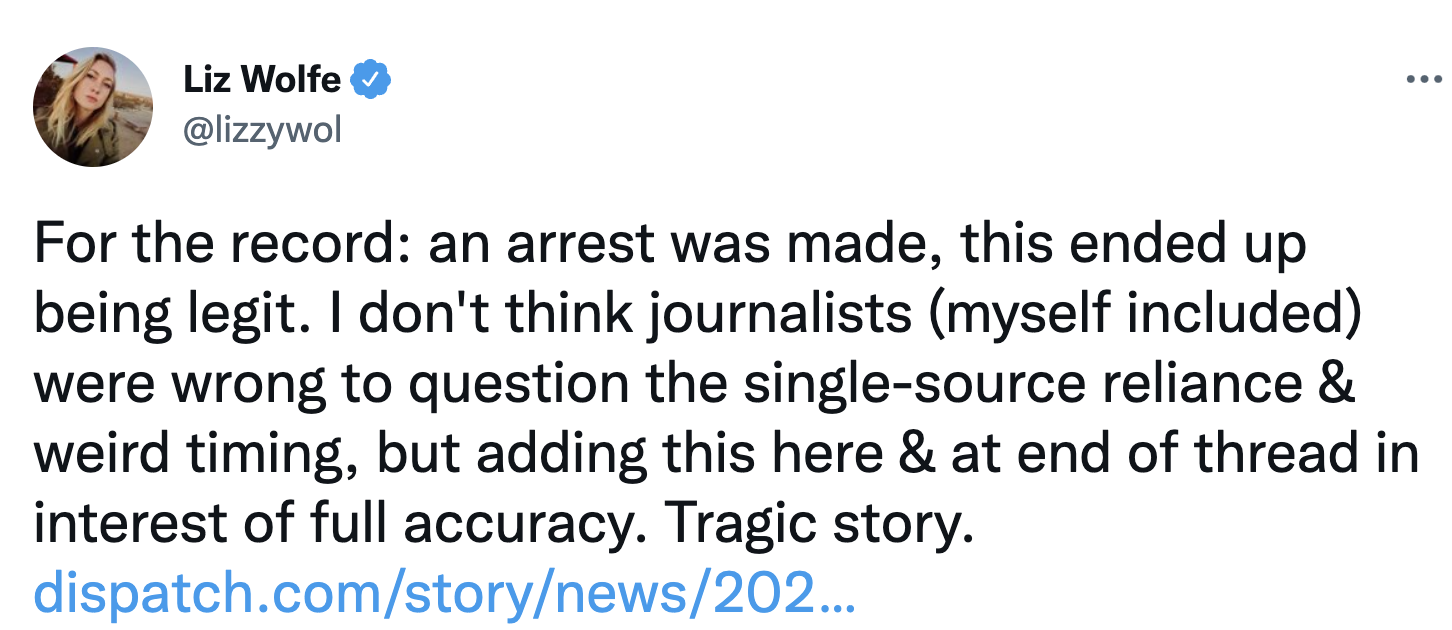
This has been the main meta-media response to the controversy: agreeing that there were "red flags" about the story such as its "weird timing" that meant we should all have taken very seriously the collective right-wing declaration that the story was a hoax, even though it turns out to have been horrifyingly true.

There were no significant "red flags" here. It is not suspicious that the Indianapolis Star did not publish the name, address, photograph, and social security number of a minor rape victim. It is not "weird" that stories of the horrible consequences of criminalizing abortion would begin to emerge shortly after abortion was criminalized. Obviously, if there is actual evidence of malfeasance or fabrication, one should look into that. But that wasn't present here.*

No, what happened here is very straightforward: A story was published that constituted an inconvenient fact for conservatives. So they declared it to be a lie. That's it. That's all that prompted the reaction. No "red flags", no "reasonable grounds to question". The story was inconvenient, and the response was to cry "liar!"

If we had to do meta-coverage of this story, that's what should have been the frame. It is, after all, the same basic instinct that motivated the cries that the 2020 election was "stolen". What prompted those cries was not any "evidence" or "suspicions" or "red flags". Biden winning was an inconvenient fact, and the default right-wing response to an inconvenient fact is to declare it a lie. Same reason why January 6 insurrectionists are declared to be "antifa". Same reason why mass shootings are alleged to be false flags. Same thing for global warming, same thing for whether Israeli soldiers shot Shireen Abu Aqleh, same thing for Trump's connections with Russia. This is not something occurring in isolation. It is a pattern of behavior, and a deeply dangerous one at that. It's always a lie, it's always "fake news".

So if the media wanted to soul-search its coverage, it should start there. What does it mean that conservatives now reflexively and instinctively declare any story that troubles their ideological waters to be a lie, and what does it mean that the media still views those cries as having credence?

This response, after all, is toxic to the proper functioning of democratic politics. Yet rather than identify it for what it is, let alone push back on it, the media aids and abets it with thumb-sucking self-abnegations agreeing "questions were raised." No they weren't! The mere fact that Republicans don't like a given fact or event or story about the world is not and should not be enough for the media to agree that its truth is up for dispute.

So that's the story I want to see. I want a deep dive into how conservatives have begun calling any inconvenient fact a lie. I want a clear and unvarnished explication of the pattern of behavior, contextualizing the most recent instance by reference to other prominent cases where they've run that same playbook. I want comments from self-reflective journalists about why these unevidenced cries of "liar" are given credence, and whether it is appropriate to continue to give credence to those cries going forward.

That's the metastory. Someone should get on it.

Oh, and for those of you wondering: now that the story has been fully confirmed, conservatives are sweeping into action ... by launching a criminal investigation of the doctor who cared for the child and proposing legislation that would criminalizing giving the child an abortion in Indiana. Because the current Republican orthodoxy is that adolescent rape victims should have to give birth or die trying.

* The closest exception I'll cop to is the Ohio Attorney General saying he hadn't heard of such a case, with the strong implication that if the case existed he would have known about it. But since it turned out there was such a case, the proper response for the media going forward is to treat Attorney General Yost as presumptively uncredible unless proven otherwise. Of course, the actual response will be to continue to treat uncorroborated declarations by Yost as rock-hard proof, while spinning in circles to explain why a doctor going on the record about an event they have first-hand knowledge about is too flimsy to take seriously.

Sunday, May 29, 2022

Schoolchildren Shouldn't Have To Live Like Jews

In the wake of the Uvalde massacre, the internet is replete with proposals on how to avoid or at least mitigate the risks of yet another school shooting. Some in the Jewish community have suggested adopting some of the measures we have taken to keep our schools, centers, and synagogues safe -- things like controlled entry, on-site security, and other forms of "hardening the target".

Some of these suggestions might be good ideas, and most are being made with the best of intentions. But I feel like they overlooking something very important.

Growing up Jewish, these sorts of security interventions are so normal one can almost forget how abnormal they are. Of course there is a noticeable police presence during high holiday services. Of course someone has to check you in at the door before you're allowed to even enter the synagogue. Of course there is onerous keycard entry requirements if you want to access the building for a evening Torah study session. It is jarring to encounter the freedom of places that don't have that sort of security because they don't operate with the background presupposition that someone could be trying to kill their patrons at any moment.

Because these interventions are so normalized, we forget that having to impose these sorts of security measures is bad. These measures make Jewish life worse -- less open and more stressful, less accessible and more cloistered. Does anybody think that the ideal synagogue experience is like this? They may nonetheless be necessary because of the dangers Jews face -- but that's just it: they are reflective of Jews being a persecuted minority who are regularly targeted with violent threats and assaults. What does it mean to cross-apply them to the context of public elementary schools? It's saying that every 5 - 11 year old in America is as vulnerable as a member of the minority group that is, per capita, the most common target of hate crimes in the country! That's terrible! That should be seen as a catastrophe! If that is indeed the state of being a student in America, that is an appalling failure!

The title of this post is deliberately provocative. Jews should not have to live like this either. We should be able to live our communal life open and without fear, not looking over our shoulders for the next active shooter. But we've resigned ourselves to an inability to eliminate the root cause of our problem, antisemitism. We can't do it on our own, and broader society is not interested in investing the effort to make the project a success. So stuck with the reality of persistent violent antisemitism, at least over the medium term, these measures are suboptimal ameliorations of the consequences of our continued marginalization.

If schoolchildren are in the same boat, that must mean we've reached the same conclusion for them: as a polity, we just have given up on our ability to actually eliminate the threat to schoolchildren. We cannot be bothered to make the social and political investments necessary so that the status of schoolchildren is not analogous to that of a persecuted minority regularly targeted by violent threats. We have resigned ourselves to that level of vulnerability for our children, and now just seek to ameliorate the effects. That is appalling. It is appalling that Jews are forced to accept this; and it is a perverse form of justice that this quiescence be extended to every family with minor children.

I do not claim that the experiences of the Jewish community cannot be helpful in building out better security for public schools, in this decidedly suboptimal world where we have apparently decided to just accept this terrible vulnerability as a baseline. But we should not lose sight of the fact that if our experiences are even analogous -- what a striking indictment that is of our society. People should not have to live like this.

Monday, September 24, 2018

Dinosaurs and Israel/Palestine

Have you ever met a five-year old who knows everything about one very specific thing?

Dinosaurs is a common candidate, but it also might be trains, or cars, or baseball. But we'll go with dinosaurs for our example.

You can talk to this kid, and he doesn't know the alphabet, or his address, or how to spell his name. But get him on dinosaurs, and suddenly he's using words like "pachycephalosaurus" and can tell you the dietary habits of every creature that lived in the Triassic period. Something about dinosaurs just causes him to collect knowledge like a packrat -- even though, underneath it all, he's still a five-year old with a five-year old's tiny five-year old brain. It's less knowledge than it is an obsession. And so, as fun as it is sometimes to listen to them talk breathlessly about the preferred habitat of the stegosaurus, it isn't really reflective of anything.

Very often, Israel/Palestine is "dinosaurs" for adults.

Obviously, there are plenty of people who do (really) know a lot about the issue, who have thought hard about Israel/Palestine affairs and given it the care and attention it deserves.

But for some reason, it is also true that there are seemingly infinite people who can't tell you their state's capital yet who know (or think they know) everything about it. They may not be able to tell you where the United Nations is located, but they can give you a six hour sermon about the 1922 partition plan or the relevance of the drafting history of U.N. Resolution 242 as it pertains to the final status of the West Bank. They haven't ever heard of John Locke, but they have intimate familiarity with Haj Amin Al-Husseini's public speeches or Ze'ev Jabotinsky's personal correspondence, and boy howdy do those letters tell you everything you need to know about Zionism or anti-Zionism in 2018.

It's a marvel to watch, in its way. And it exists on both sides, which means that internet spectators can, whenever the mood strikes, watch two figures with a combined nine emojis in their Twitter profiles go to war over whether Gaza is "occupied" under the legal framework set out by the Hague conventions.

But, underneath all that "knowledge", they still don't really know anything. It's an obsession, not knowledge. I've never once seen the sort of breathless recitation associated with this type result in a productive conversation. Not once. It's adults playing with their dinosaur dolls.

Tuesday, June 19, 2018

Loving the Children To Death

Right now, the Republican Party is trying to square a very nettlesome circle. On the one hand, they want to communicate that they care about the immigrant children the Trump administration is ripping away from their families. On the other hand, they want to do as little as possible to actually challenge Trump's policies or effectuate any meaningful change -- especially if it might mean (heaven forbid) some of these kids actually get to stay in the United States and build a safe and productive life here.

The latest bit of rhetoric emerging out of this impossible dynamic is the claim that it is for the children's own good that they are being ripped from their families and locked into cages. Moderate Republican(tm) Susan Collins kicked this off, wailing about how "dangerous" it is for parents try and cross the American border as cover for refusing to join Democratic efforts to end family separation.

More recently, that gambit has been extended to allege that the children in question are actually trafficking victims and that therefore efforts to prevent family separation are the real acts of child abuse. Arkansas Senator Tom Cotton, for example, tweeted the following today:
Meanwhile, his Nebraska colleague Ben Sasse took a more circuitous route -- sprinkled with many rhetorical condemnations of the family separation policy -- to arrive mostly at the same place:
This bad new policy is a reaction against a bad old policy. The old policy was “catch-and-release.” Under catch-and-release, if someone made it to the border and claimed asylum (whether true or not, and most of the time it wasn’t true), they were released into the U.S. until a future hearing date....
Catch-and-release – combined with inefficient deportation and other ineffective policies – created a magnet whereby lots of people came to the border who were not actually asylum-seekers. This magnet not only attracted illegal immigrants generally, but also produced an uptick in human trafficking across our border.... 
Human trafficking organizations are not just evil; they’re also often smart. Many quickly learned the “magic words” they needed to say under catch-and-release to guarantee admission into the U.S. Because of this, some of the folks showing up at the border claiming to be families are not actually families. Some are a trafficker with one or more trafficked children. Sometimes border agents can identify this, but many times they aren’t sure. 
Any policy that incentivizes illegal immigration is terrible governance. But even more troubling is that catch-and-release rewarded traffickers, who knew they could easily get their victims to market in the U.S.
Incidentally, "Ben Sasse takes a more circuitous route to arrive at the same place as Tom Cotton" basically describes the Republican Party dynamic on every noteworthy case of Trump administration extremism.

Anyway, first thing to say about the trafficking talking point is that it's basically bogus: DHS statistics indicate that 0.61% of family apprehensions at the border are even alleged to be cases where smugglers have falsely presented a trafficking victim as a family member.

But let's take the tiny minority of trafficking cases at face value. Those kids whom Collins and Cotton and Sasse are so concerned about? They're the ones the Trump administration is putting in cages. One might forget that the immigrant children are supposedly the victims in the GOP story, given how every Republican solution centers around keeping them incarcerated until they can be sent back to their countries of origin (where, remember, they were by stipulation abducted and smuggled across international borders -- so not a great place for them). Much like Syrian children, immigrant children (whether victims of traffickers or not) are good enough for Republicans to imprison, but not good enough to rescue.

It's no accident that the more honest voices of the Trump movement -- the Ann Coulters of the world -- are perfectly explicit in stating that the children are just as much of the enemy as their supposed "traffickers". Nothing the Republican Party has done over the past several years has been remotely consistent with the idea that they actual view immigrant children as valuable human beings whom we have an obligation to treat with respect. The priority is ensuring -- at any cost -- that they do not have the opportunity to build a dignified life for themselves in America. If that means ripping them from their parent's arms, so be it. If they means permanently destroying families, so be it. If that means sending them back to countries where they'll be executed by paramilitary gangs, so be it.

Republicans care a lot about immigrant children. It's a shame that all that care and concern goes mostly into destroying their lives.

Sunday, April 15, 2018

A New Environment Roundup

We're closing the political theory term with a unit on ecologism/environmentalism. In honor of that, a roundup that includes nothing on that topic whatsoever:

* * *

C. Thi Nguyen explains how echo chambers are like cults. The problem isn't lack of competing information per se, the problem is that the echo chamber has built-in narratives for why alternative information sources aren't trustworthy and can be discounted.

Eric Ward is interviewed by Tikkun on the subject of identity politics.

We often talk about a "free speech crisis" on liberal college campuses. But there are a slew of avowedly right-wing (generally Christian) universities that barely pretend to allow for a diversity of opinions on campus.

ICE's Philadelphia office seems out of control.

Two British intellectuals (one whom served on the Chakrabarti inquiry, no less) give a history of antisemitism on the British left -- one that by no means starts with Jeremy Corbyn.

As teachers walk out in Kentucky in a push for higher wages, Governor Matt Bevin (R) blames them for exposing children to drugs, sexual assault, and violence. You'd think if teachers were that important -- not just responsible for educating youth, but also the sole bulwark against them being physically and sexually abused -- they'd be worth paying more.

Wednesday, August 02, 2017

Flagging Principles

Some of you may have seen the story of a Conservative Jewish day camp which hosted a group of Palestinian youth from "Kids4Peace" and, as a gesture of welcome, hoisted a Palestinian flag alongside its usual American and Israeli flags. Right-wing Jews reportedly went ballistic (though I've seen little evidence any of them are affiliated with the camp or its campers), and the camp -- to its great shame -- apologized.

That the camp apologized rather than stand behind what ought to be a completely uncontroversial display of hospitality and welcoming is, of course, disgraceful. It's perhaps noteworthy that -- until this screed hit my inbox this morning -- the only commentary I'd seen from the Jewish press was dismay that the camp did apologize (e.g., here and here). Perhaps that generates some hope that, in the feature, the camp will model more of a backbone and not kowtow to the frothing right fringe. We could also talk, as several people have, about the sheer irony of throwing a fit about showing a Palestinian flag within a shouting distance of the Dyke March ban of Israeli (or "Israeli") flags. It's always nice to see just how fast some people reveal their ever-so-deeply-felt principles to be tickets good for this ride only.

But for me, the real thing to concentrate on is the tremendous bad faith of the conservative objectors in terms of what they purportedly expect out of Palestinians. Their argument is that it is wrong to raise a Palestinian flag insofar as Palestinians refuse to accept Jewish equality or relate to Jews on any basis but hate. The problem being, of course, that the flag was hoisted precisely to greet a contingent of Palestinian youth who were committed to doing just the opposite -- coming to a Jewish space in the spirit of friendship, equality, and respect.

In essence, the conservative demand of Palestinians is "you don't deserve acceptance until you start treating Jews with decency, respect, tolerance, and love, and if you do all of those things go fuck yourselves anyway."

It's grotesque and it's embarrassing. And it's a shonda that it carried the day.

UPDATE: I happen to know, from painful experience, that authors do not choose the headlines for their columns. So I really, really hope that whichever editor titled this piece "In raising the Palestinian flag, Jewish camp disrupts a safe space for Zionism" was making a sly jab at conservatives who proudly ride their high horse about the horror of "safe spaces" right up until the sight of red-white-and-green sends them into panicked whimpers about the existential threat to Jewish self-determination.

Honestly, if your Zionism is so weak that the mere presence of a Palestinian flag leaves you dazed and shaken, maybe it's time for you to take a break and leave the struggle to those of us with a bit more moxie.

Friday, June 03, 2016

Kids are Kids, Parents are Parents, and Tragedies are Tragedies

As you might have heard, a gorilla was recently shot in a zoo in order to protect a three year old kid who managed to get inside the enclosure. As was sadly predictable, the family has suffered the brunt of a massive online backlash predicated on how irresponsible they must have been to allow this to have happened.

Here's my take. Raising kids is hard. And things will always go wrong. Every parent, I imagine, has experienced a scenario where they look away for a second and suddenly their kid is nowhere to be found. Or their mind just slips and they leave an exhibit while Johnny's still there. Or somehow little Caroline managed to worm her way into an out of bounds area (how on earth did she do it?). Or something catches the tyke's eye and he breaks away right into a street crossing.

These things happen to everyone. And most of the time, they don't amount to anything. The kid who wandered away in the supermarket is found a few aisles later in the ice cream section. An usher notices the kid by himself and lets him play cell phone games until mom and dad circle back. The girl in the off-limits area is found by a security guard and is ushered back. The kiddo in the street is quickly pulled back while no cars are coming.

But sometimes, through sheer bad luck, they happen in more serious scenarios. The forgotten kid is forgotten in the back of a car. The breakaway child gets into a dangerous enclosure. The lost kid is lost in a dense forest. In these cases, the consequences can be quite serious. But they're no more blameworthy than their more prosaic cousins. They're just more tragic.

My suspicion is that we seek blame in these scenarios as a psychological defense mechanism to assure ourselves that it couldn't happen to us or our family. If these things happen because the universe can be cruel and capricious, well, it can be cruel and capricious to us as much as to anyone else. And that's a scary thought. But if these things happen because parents are negligent, we can rest assured that they won't happen to us (because we're good, caring parents). A much more comforting thought. But probably not a very fair one.