Showing posts with label defamation. Show all posts

Saturday, August 26, 2023

The Unique Vulnerability of Sexual Assault Victims Under Defamation Law


A former George Mason University law professor and FTC commissioner, Josh Wright, has sued several of his former students who accused him of sexual misconduct and exploitation for defamation. He's seeking over $100 million in damages. (As I understand Wright's position, he admits to having engaged in sexual relationships with several of his students but denies any form of abuse or exploitation). This has some resonance with Johnny Depp's lawsuit against Amber Heard where he largely successfully convinced a jury that Heard had defamed him upon accusing him of domestic abuse.

Cases like this have an interesting character; one that poses special danger towards defendants and, by extension, potentially make leveling accusations of things like sexual misconduct or domestic abuse especially fraught.

Truth is an absolute defense to a defamation claim. But establishing falsity is not normally sufficient for a plaintiff to win a defamation claim. Even a defendant who utters a false statement still can't be held liable for defamation unless they exhibited some sort of culpable disregard for the truth. Where the target is a public figure, the standard is known as "actual malice" -- a requirement that the false statement be uttered with either knowledge of its falsity or reckless disregard for whether it is true or not (for non-public figures, this standard may be relaxed). So there are many circumstances where a jury might believe that an allegedly defamatory statement is indeed false, but still will not assign liability -- for example, if they think the speaker made an honest mistake or a regular poor judgment.

But a sexual assault claim by the putative victim is different, because by definition the victim has firsthand knowledge of what happened. If the attack happened, then her accusation is true, and there's no defamation (truth as an absolute defense). But if the jury concludes the attack didn't happen, then the defamation claim essentially succeeds by default, because if the attack didn't happen then the "victim" must have known the attack didn't happen, rendering her allegation knowingly false. In other words, in a defamation case regarding a firsthand accusation of sexual assault, the entire case resolves down to the jury's judgment about whether they believe the accuser or the accused. If they believe the latter, then -- despite the additional hurdles normally put up by the "actual malice" standard and its cousins -- defamation is essentially a strict liability offense.

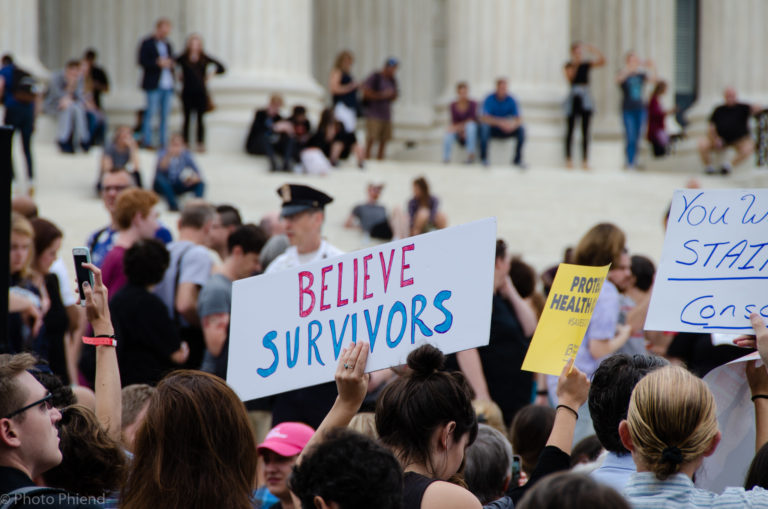
This prospect, one imagines, is yet another deterrent to sexual assault victims going public with their accusations. We speak a lot about the propensity (or not) to "believe women", and how widespread tendencies towards disbelief deters victims of sexual abuse from coming forward. In the public square, it is essentially inevitable that -- regardless of the underlying truth of the allegation -- there will be some cadre of observers who will believe the accusation and some cadre who disbelieve. One reason a victim might not directly seek legal recompense from their attacker is because they lack confidence that a jury will be comprised entirely of believers, and so the effort will come to naught. In the court of public opinion, a victim may in practice come to terms with the fact that some will believe her and others won't; speaking her piece and letting the chips fall where they may. She may, in other words, be well aware that some significant quotient of listeners will not believe even her true story and be willing to ensure that prospect as a cost of speaking her truth.

But the aspect of defamation law I'm flagging here means that victims cannot simply opt out of the legal process. The victim who wants to speak but do nothing else still is automatically exposed to potentially ruinous liability in any circumstance where a jury is comprised of disbelievers -- and disbelief is all it takes (the additional guardrails offered by doctrines like "actual malice" do not apply). The woman who is willing to endure a significant cadre of the public disbelieving probably will not be so sanguine about that disbelief translating into financial catastrophe.

If one has strong confidence in juries being able to sort truth from falsehood in cases like this, then this may not strike you as much of a problem. But in general, I suspect one reason why defamation law normally has these guardrails beyond "is the statement true or not" is because we understand juries are not perfect and that there needs to be wiggle room in hotly contested cases. And in specific, I suspect that defamation claims around sexual misconduct are cases where we may be especially likely to see significant error rates. Low confidence in accurate judgments surrounding truth or falsity, combined with an effective strict liability regime for statements adjudged to be false, equals a very strong deterrent to speaking out in the first place.

Wednesday, May 10, 2023

Enough With The Horse Racing

No, this isn't about the Kentucky Derby. This is about the jury that just found that former President Donald Trump sexually abused and defamed E. Jean Carroll. The jury did not find that Trump raped Carroll.

Shakezula found a particularly egregious example of a common media response to this ruling, and indeed, this entire lawsuit: framing it entirely in terms of the impact on Trump's political future. Will it hurt him? Help him? All be a wash?

How's this for a comment: it doesn't matter. I mean, obviously, it should matter in the sense that "a man whom a federal jury just found is a sexual predator and liar should have no political future, and it's appalling if that isn't the case." But beyond that, the idea that political calculations should play an iota of a role in terms of whether this case should have been brought, or how we respond to it, should appall us all.

The simple truth of that matter is that if E. Jean Carroll was sexually abused by Donald Trump, and then defamed by him, she deserved justice. A jury found that Trump did both of those things, and has now awarded her some measure of compensation and vindication. If it redounds to Trump's political advantage, it was worth it. If it redounds to Democrats' political advantage, it was also worth it. The political implications mean absolutely nothing in the face of ensuring that Ms. Carroll received the due a jury of her peers determined she was owed for being preyed upon by Trump. That's all there is to it.

Thursday, January 16, 2020

What's the Catch of Clickbait?

Harvard Law Professor Larry Lessig is suing the New York Times for defamation, stemming from a headline that read "A Harvard Professor Doubles Down: If You Take Epstein’s Money, Do It in Secret". The lede of the article, in turn, opens by saying "It is hard to defend soliciting donations from the convicted sex offender Jeffrey Epstein. But Lawrence Lessig, a Harvard Law professor, has been trying."

Lessig contends that this grotesquely misrepresents the position he was taking, which is to not condemn fundraisers when some of the donors they solicit turn out to be unsavory or disreputable. He also asserts that the Times refused to alter its headline or lede after Lessig complained, preferring a flashy and provocative (albeit misleading) title to one that more accurately (but dully) reflects Lessig's actual view. While the article does give a more balanced presentation of his argument later on, Lessig contends that many people never read past the headline and so will only come away with a false picture.

This is all very interesting to defamation scholars, I'm sure. But I want to focus on what has to be the least important aspect of Lessig's complaint: What does "click-bait" mean?
Defendant's actions here are part of a growing journalistic culture of click-baiting. . . . Defendants are fully aware that many, if not most, readers never read past the clickbait...The use of this tactic represents a uniquely troubling media practice as it relates to the harm to and destruction of the reputation of the target of the clickbait.
Here's my bone of contention: clearly there is an issue whereby readers see only a headline and read no further, rendering moot the presence of a more complex depiction in the body text.

But it strikes me as weird to use "clickbait" to characterize the phenomenon. "Clickbait" literally refers to the use of a provocative or flashy headline as means of prompting ("baiting") readers to access ("click") the whole article. The idea is that the title is so juicy and irresistible that the person who sees it on, say, Facebook cannot help but click the link and read the article.

Now to be sure, part of the function of click-bait is that the site owner only cares about the click, that is, that the reader accessed the page (and thereby juices the site's hit rate for ad revenue purposes). The site probably doesn't care if the reader actually ends up reading any of the article text, much less if she completes it. Indeed, it seems likely that many of the readers who are attracted by the title ("oh man, this I've got to see!") will drift away disappointed once they encountered the more prosaic story underneath.

Nonetheless, it strikes me as a weird to say that "readers never read past the clickbait", because the whole purpose of the clickbait is to drive them to the site with the full article. If they only read the clickbait, then the clickbait has failed, because the actual "clickbait" is the content that one can see without ever clicking through to the site. If the New York Times runs a headline like this, the last thing they want is for me to see that headline on Facebook and then read nothing more. They want the bait to catch me -- for me to click the link and actually head over to the NYT site (where I will, presumably, read at least a little more of the article before realizing I've been, well, baited).