Thursday, January 23, 2025
What Will Go Wrong Hardest, Fastest?
Monday, January 20, 2025
Does the ADL Care That Republicans Admire Hitler?
Shortly before the election, I posted about the alarming fact that (a) Trump seems to admire Hitler and (b) Republicans don't seem to care that Trump admires Hitler. In the course of that post, I asked rhetorically what the ADL's response to this news was going to be, observing that the actual answer appeared to be covering their eyes with a "lalala" see-no-evil approach. This was of a kind with the new direction Jonathan Greenblatt had taken the organization, which was steadfast and resolute in never, ever, giving offense or more than the most mealy-mouthed critique to the American right no matter how open their antisemitism became.
Fast forward a few months and some increasingly pathetic acts of ADL supplication, and we reach inauguration day, where Acting President Elon Musk appears to have given a Nazi stiff-arm salute (the Nazis sure think so).
Is the ADL on the case? Only if dismissing the case counts!
But of course, none of that matters. The ADL has, over the past few months, made it abundantly clear that it views the American far-right as its friend, and so will extend infinite grace to them no matter how obvious their antisemitism becomes. It's disgusting. It's despicable. It is a grotesque abdication of the ADL's core mission. And the worst part it is, it's no longer even surprising.
I spent today taking care of my newborn, doing my best to keep him fed, warm, and safe. My only thought on the inauguration I wanted to have was that it was a shameful, shameful day. Which it was -- but it didn't occur to me that the ADL would add to that shame.
Maybe it should have.
What a shameful, shameful display.
Friday, January 17, 2025
New Frontiers of Darkness
The Washington Post has unveiled its new slogan to supplement (in practice, supplant) the old "Democracy Dies in Darkness": "Riveting Storytelling for All of America."
I can't tell you how much I hate this.
First of all, even out of context, it sounds both comically corporate and unbearably patronizing. "Riveting storytelling for all of America" sounds like how to market the Scholastic Book Fairs for emerging readers, not one of America's papers of record.
But of course, we must take this slogan in context. And the context is the Post spending the last few months humiliating itself and dynamiting its journalistic credibility by repeated acts of groveling towards the MAGA movement.
And I know I'm beating a dead horse here, but this slogan really encapsulates the media's self-delusion that it is part of the liberal family. Again, recall my thesis here: the media thinks its main audience is liberals, and so it sees its job as to challenge liberals with "alternative perspectives" or "competing views" (as opposed to just telling the truth and letting the chips fall where they may). One implication of this is that conservatives are a growth audience (because of course the Post in its prior manifestation couldn't be speaking to them) -- this is what "for all of America" means. We're no longer speaking just to the latte-sipping coastal elites, but to all of America. And lest you think I'm projecting, they're being quite explicit that this is what they mean:
Mr. Bezos, the founder of Amazon, has made comments in line with the new mission statement in conversations with Post journalists in recent years, according to two people familiar with those discussions. Mr. Bezos has expressed hopes that The Post would be read by more blue-collar Americans who live outside coastal cities, mentioning people like firefighters in Cleveland. He has also said that he is interested in expanding The Post’s audience among conservatives, the people said.
Now nominally, recognizing that conservatives are part of the audience could mean that the Post starts committing to telling them things they don't want to hear. For example, they could be informed, in no uncertain terms, how Trump's tariffs will crush working families with spiraling grocery bills. Or they could be told, in clear-eyed fashion, of how Trump's inner circle is proposing increasingly fascistic and lawless abuses of government power. Or they could be shown, without varnish or spin, how the Republican Party has begun to view sexual assault and rape as virtues in its political leaders -- not even a secret to be ashamed of, but as an affirmative basis for support and promotion.
But of course, we all know that is not what Bezos and his cronies have in mind. "Riveting storytelling" suggests that what they want is sensation and soothing -- to reaffirm their (new) readers' priors, never to challenge them with something as dirty and discomforting as the truth. Conservatives can't tolerate hearing that Donald Trump was a grotesquely unsuitable choice for the presidency, and so the Post (even in its editorial endorsements) won't aggravate them. The Post knows that many if not most of Trump's cabinet picks fail the most basic (by the Post's own lights!) criteria of qualification for office in a democratic society -- respecting the outcomes of a democratic process -- and so the Post will just pretend it doesn't matter.
The Scholastic Book Fair analogy is more than snark, for this is of a piece with the broader trend of infantilizing the American right. Conservatives, once again, are being treated as children, and spoiled children as that -- whatever junk keeps their attention, that's what will be provided.
A once great newspaper, reduced to an entertaining diversion for spoiled, coddled brats. Maybe the slogan isn't so bad after all.
Thursday, January 16, 2025
The Best Publication Ever!
Monday, January 13, 2025
The Midpoint
I'm turning 39 next month.
That's not necessarily the halfway point of my life -- most of my grandparents lived well into their eighties, if not beyond -- but it's probably reasonably close.
I'm writing from the labor and delivery room in Sunnyside hospital, where Jill and I are very much in a "hurry up and wait" mode. The next time I return home, I'll be a parent. That also feels very much like a line that divides one's life in half -- before and after kids.
And of course, we're coming up on a major change in American history, one that also feels like it could become a historic before-and-after line -- this time for American democracy itself. The hope is obviously that this is just ("just") four years that need surviving (and I've been reminded that there are worse times to be distracted from the woes of the world by a 0 - 4 year old than 2025 - 2028). But it does not strike me as implausible that the damage that is about to be unleashed upon America is not something that will be contained to just four years. It may not be something that can be healed in my lifetime, or ever. It's very possible we have reached an epochal pivot point, in which much of which many of us have taken for granted about America will lie forever in the "before" time.
I'm basically saying what Alexandra Petri said already, only much less eloquently. But indulge me a little.
It's not often that life so neatly divides itself into such distinct eras. Normally that's a function of narrative convenience or arbitrary labeling. But right now, it really does feel like I stand on a precipice -- for myself, for my family, for my country. It's staggering, and glorious, and terrifying.
It's time for Part II.
Sunday, January 12, 2025
Tech Bros Are Weak Men
When I look at men like Elon Musk, Mark Zuckerberg, Jeff Bezos, I see men who are fundamentally weak.
That sounds judgmental. And it is, to an extent. But maybe not quite to the extent one thinks.
All of these men were at one point self-identified Democrats. Zuckerberg flirted with a run for President before he realized that nobody, you know, liked him. Bezos positioned the Washington Post as a guardian of democracy before taking it dark.
As these men, and others in their cadre, have pivoted to the right, one narrative one often hears is that they were effectively bullied into changing their views by mean anti-big tech sentiments amongst progressives. This is far too pat (not the least because Republicans certainly held their own in highly publicized attacks on the big tech companies), but what is fair to say is that these men see themselves as having promoted liberal causes and they did not get the adulation and adoration from Democrats that they felt they deserved. They were not feted as heroes. They were not recognized as titans of industry. They were not handed the reins of leadership. They weren't even generally recognized as progressive allies. They continued to face pressure and mockery and criticism -- much fair, some not -- and they were deeply, deeply resentful for it.
It's most obvious in the case of Musk, whose desperation to be liked is transparently obvious and who has transformed an entire social media platform into a Potemkin village of praise for the new tsar. But one sees it across the cohort -- this frustration at not being loved, and the beckoning temptation that if they just sold out then at least somebody would cheer them and make them feel like part of the team.
In theory, this shouldn't matter. For those with requisite moral fiber, one does the right thing because it's the right thing, not because one gets plaudits and cookies from it. But in practice, it is a very ordinary vice to thirst for validation and gravitate towards whatever community seems most liable to hand it out. In the face of that temptation, it takes a strong man to align with a given set of values when others holding those same values can't or won't provide that respect.
And our big tech bro leaders? They are not strong in this way. They are weak -- weak in a way that is very familiar and very human, but weak nonetheless. And we all must unfortunately live with the consequences of their weakness.
Saturday, January 11, 2025
The Last Lazy Weekend
"Do you have any plans?" "Not really, just having a lazy weekend."
I cannot count the number of times I've had this conversation. I love lazy weekends. I like sleeping in and just vegging on the couch with my wife more than 99.9% of possible "activities" I could plan out in the wider world.
This weekend is set to be a wonderful lazy weekend. We have no major tasks to do, no major outings planned. We might grab brunch and drop something off at the post office. I'll watch football. She'll probably play Mario Kart.
On Monday, we go to hospital to begin an induction. When we return, we'll have a baby. He will bring joy, and laughter, and growth, and no doubt many sleepless nights.
But I suspect we won't be having any lazy weekends for a while.
Goodbye, lazy weekend. You will be missed.
Friday, January 10, 2025
Things People Blame the Jews For, Volume LXXIII: Los Angeles Wildfires
The raging fires that have torn through the Los Angeles area are gripping the world's attention. Natural disasters like these don't typically have a direct culprit to blame, though of course, in a more abstract sense changing weather patterns brought on by global climate change play a role.
Or, you know, it's a Jew thing.
Jewish control over the weather is well-known trope to readers of this series, and few can forget congresswoman Marjorie Taylor Greene contributing "Jewish space lasers" to the antisemitic dictionary. But a variety of far-left groups now are making their own entry into the genre by tying the fires to America's support for Israel. For some, the rhetoric seems to be one of divine retribution, akin to how Mike Pence thinks of hurricanes ("When US taxes go to burning people alive in Gaza, we can’t be surprised when those fires come home."). Others play the game where America's foreign aid budget is presented as dollars out of hard-working American pockets, or, in this case, the Los Angeles Fire Department budget -- never mind that those pots of money have nothing to do with one another and in any event the widespread meme that the LAFD faced a draconian budget cut last year appears to be false (the fire budget is actually $53 million more than it was last year, but if I fact-checked every subclaim in this series I'd never get any sleep at all).
More broadly, I was just thinking about how the immediate right-wing pivot to blame the fires on "DEI" (by which they mean, the fire department has women in its leadership) reminded me of classic antisemitic conspiracy theorizing -- the immediate impulse to find the Jewish connection and shriek "this explains everything!" Whereas some pin every bad thing in the world on "the Jews", others do the exact same thing but plug in "diversity" or some other analogous buzzword as their "explanation of first, middle, and last resort". Remember when the Wall Street Journal blamed the collapse of the Silicon Valley Bank on the fact that it had one (one!) Black director in its board? It's the same play. The conspiracy theory "explains everything" because it always "explains everything", because that what a conspiracy theory is -- it is a way to immediately, reflexively, and automatically explain anything and everything by reference to whatever it is you hate.
The "wildfires are caused by DEI" takes the rhythm of an antisemitic conspiracy theory and applies it to a new context. But while I certainly enjoyed basking in that familiarity, it is always reassuring to know that someone would go the OG route and blame the Jews and Jewish institutions directly. Not that I had any doubt it would go that way -- it always does, sooner or later.
Thursday, January 09, 2025
A Lawsuit is Not a Press Release
If I were a judge, I think I'd be a lot more sanctions-happy than most judges.
Bad legal arguments bother me. And more specifically, lawsuits that are filed not because there's an actual colorable legal claim, but as a form of press release -- a ritualized airing of grievance trying to drape itself in the seriousness of a lawsuit -- strike me as intolerably obnoxious and abusive. Many defamation suits fit this profile (who needs SLAPP when there's Rule 11?), but there are others. And too often I see people cheer these suits (at least when they fit the right ideological profile), and I hate to see it -- these lawsuits serve no purpose other than to allow gloryhounds to chest-thump their virtue while wasting time and resources, not just of the judiciary, but of the very social movement they claim to be advocating for.
One example is the "class action" lawsuit recently filed against two Bay Area Democratic Representatives claiming that their votes in favor of aid to Israel caused emotional distress to constituents who believe that Israel's conduct in the Gaza war constitutes a genocide. As a matter of law, the suit is patently frivolous -- it is obviously foreclosed by the Speech and Debate Clause, and a moment's reflection should make anyone with half a brain recognize that enabling disappointed constituents to sue their representatives for their congressional votes is a capital-B Bad Idea. The suit has no chance of succeeding and serves no purpose other than to generate headlines, and that is not the purpose of the judiciary. I don't know if the named plaintiffs are willing participants in the charade or are genuinely deluded into thinking there is valid legal claim here, but if it's the latter, then they're being exploited in a terribly grotesque fashion. Either way, I hope the lawyers who filed it are sanctioned.
But lest anyone get too smug, this is not a sin with any particular ideological proclivity. A federal court in the Eastern District of Pennsylvania just dismissed a lawsuit filed against Haverford College alleging a hostile environment against Jews on campus. The dismissal was based on the fact that the pleadings were, in so many words, a sustained rant rather than an attempt to communicate a cohesive legal complaint.
At this stage, a court would typically review the relevant facts. I cannot cogently do so here due to the sprawling and disorganized character of Plaintiffs' Amended Complaint, which appears to detail every frustration and disagreement of Jewish students and faculty that has occurred at Haverford over the last year. It spills pages of ink on lengthy frolics about events on other college campuses and about ideological debates. Rather than isolating instances of harassment and logically relating them to the elements of a hostile environment claim, Plaintiffs set forth a running list of grievances that reads more as an opinion editorial than it does a legal complaint.
I am familiar with this sort of "legal" writing, and I am glad to see a judge call it for what it is. It's written by lawyers who forget that their job is to craft a legal complaint and instead view the courts as a suitably august forum for airing every point of grievance and riding every ideological hobbyhorse they've ever encountered. In some ways, the Haverford case is worse than that Bay Area one, because in the former the judge agreed that some of the allegations might have presented cognizable claims under Title VI but couldn't move forward on them because they were buried inside such an amalgam of irrelevant ranting that they failed to present an actionable complaint. The (potentially) valid grievances of the Jewish plaintiffs at Haverford were, in effect, sacrificed so that their lawyers could play soapbox orator. They treated the lawsuit as one big press release, and everybody -- their clients included -- is worse for it.
The lawyers suing Haverford aren't stupid, at least in the traditional sense (they attended Harvard and U. Chicago Law).* But they decided that this issue was too important for them to act as lawyers, and instead decided to act as demagogues. That's despicable. It's an abuse of the judicial process, it's unfair to Haverford College, and it disserves the Jewish community they nominally purport to defend.
* They literally just took down the link to the bios of all their attorneys,
Tuesday, January 07, 2025
Loving the Sinner
When someone commits a crime, or otherwise breaches the moral code, there are expanding circles of victimhood.
First and foremost, there is the actual, literal victim -- the person robbed or cheated or abused -- followed by the victim's family and loved ones.
But I think after that, the persons hurt most, and hurt in a distinctive and devastating way, are the perpetrator's family.
When someone is arrested for a serious crime, it is normal for the media to seek commit from the perp's loved ones. On occasion, you'll see someone seize upon a letter written by perpetrator's mother to the judge pleading for clemency, juxtaposing the letter's description of the perp (which is, of course, written through the lens of parental love) against the usually vicious facts of the underlying offense. How out-of-touch, how classless, how blind.
For my part though, I have no idea what we expect them to say. The position they are in seems unbearably cruel, and I hate -- hate -- the people who treat the family as an easy target. It is of course true that a serious crime doesn't become less serious because a person you love committed it. And yet, it strikes me as unreasonable to demand a parent partake in what would otherwise be the obvious, perhaps even obligatory, practice of condemnation. In concept perhaps there is a tightrope one can walk of still expressing love while in no way diminishing the underlying offense; in practice I doubt it's possible to anyone's satisfaction. A columnist who concentrates on a convicted arsonist's volunteer work and urges others to see him in that light may be guilty of himpathy; the arsonist's father is not. The acquaintance who remains friends with the serial catfisher may be judged harshly for not cutting someone who hurts others out of his life; the swindler's mother should not be. This doesn't mean we abide by the parental perspective -- we know full well it is skewed -- but they're not wrong to hold it. They are in a fundamentally unfair and cruel position; the best thing we can do is just ignore them.
And that, too, is part of the cruelty. At least the primary victims have an obvious claim to our empathy, care, and concern. The perpetrator's family has, at best, a much shakier claim to emotional support. The fact that this order of prioritization is obviously justified -- of course we care more about the immediate circle of victims than we do about the feelings of the perpetrator's family -- in some sense compounds the wound; they don't even have the salve of knowing that their social abandonment is unjust. Or worse -- we know families come in for attack by people who think they must in some way be culpable too, looking for ways to accommodate a thirst for retribution that cannot be solely slaked on the body of the actual wrongdoer. They are blamed for not anticipating the misconduct, or they are blamed for somehow facilitating it, or they are blamed for not cutting loose the bad guy once his crimes became clear.
Of course, occasionally the family really will have been complicit in a direct way (the parents who give their obviously disturbed teenager free access to firearms, for instance). But more often than not, they are victims who are not treated as victims. And I suspect there is, lying underneath everything else, a feeling of betrayal -- surely, they had to know that doing these dreadful things would hurt us; was our relationship of love not enough of a reason to refrain? What a terrible thought, and how much more terrible to have to endure it alone.
I'm soon going to start raising a son. I hope he turns out to be kind and smart and generous and every other quality one would hope to have in a person. I hope that for all the obvious reasons (I'd hope that everyone turns out that way!), but also for the more (selfish?) reason that if he doesn't turn out that way it would be heartbreaking, and I don't know what I would do. Brining a child into the world means committing to unconditionally love someone you haven't even met yet -- that is a terrifying vulnerability, when you think about it. To be sure, the overwhelming majority of the time it goes fine -- most people, whatever foibles and missteps they might make as part of a normal human existence, don't do anything so egregious as to provoke this sort of crisis. But if it goes wrong, boy does it go wrong.
As one moves away from the most intimate circles -- parents, spouses, siblings -- the obligation to be clear-eyed about the wrong waxes, while the indulgence we might concede for one who loves the perpetrator probably fades. But in any relationship of love -- familial, romantic, platonic, even political -- it hurts when someone or something you love does something objectively cruel, shameful, or even monstrous. It hurts because it is wrong, and it hurts because nobody's empathic attention will be focused on you, and it hurts because you know at some level that this loneliness and abandonment isn't even unjust, and it hurts because all of that means that even trying to articulate this sense of loneliness and abandonment and pain is inevitably going to be viewed as trying to wrongfully redirect care and concern from those who need and deserve it more.
What a terrible cruelty to endure.
Saturday, January 04, 2025
Deepest Darkness
In the latest blow to the Washington Post's dying credibility, editorial cartoonist Ann Telnaes has resigned after management killed a cartoon she was slated to run depicting various tech moguls (including WaPo and Amazon.com owner Jeff Bezos) prostrating themselves before Donald Trump. Telnaes says it is the first time one of her cartoons was killed because of its point of view in her tenure. The official Post line -- that they had already published or planned to publish two columns on the subject, and so Telnaes' cartoon was redundant -- is even more pathetic than the last defense they gave of obvious political interference in the editorial team's work (two whole columns!).
As Dell Cameron writes, what we're seeing now is a pattern of interference, which in turn amply justifies readers assuming the worst in future incidents -- and that sort of skepticism is toxic to a healthy relationship between a newspaper and the public it serves. Cameron suggests that there may need to be a "mutiny" in the Post in order to restore this confidence. I've written before about how these evermore overt acts of right-wing pandering by media leaders could finally disabuse the journalistic community of their illusion that "everyone" (who matters) already knows and agrees with liberal perspectives (so their main goal is not to present the truth but rather to present "the other side" -- i.e., the conservative view). It hasn't happened yet, but the stress has to eventually reach a breaking point.
Right?
Saturday, December 28, 2024
Say the Magic Words
The current flap on Bluesky comes from an interview with Hawaii Senator Brian Schatz, specifically the following passage:
But I think this question of language goes pretty deep. And it goes to not just being careful not to say things that are egregiously weird sounding, but it’s also the way we interact with advocacy groups. I remember saying I was for a cessation of hostilities in Israel and Palestine. And people said why don’t you say ceasefire? I’m thinking, that’s literally the same thing. I remember saying I was for a big, bold climate bill. And someone said why don’t you say Green New Deal? And this idea that there are magic words that we must be forced to say defines progressivism and political courage by essentially saying whatever a bunch of activists want us to say, as opposed to doing the thing. And I think that there are a bunch of people who see what we’re doing as performative, for that exact reason. But it’s also just alienating. This magic words thing has to go away.
He's getting dunked on for this, specifically by people mocking the notion that "ceasefire" is an example of "egregiously weird" language.
I'm actually going to come to Schatz's defense here, though, because I think he's being misunderstood, and I don't think he's saying that the word "ceasefire" is an example of "egregiously weird" language (which it obviously isn't). Rather, Schatz is saying that there is a different, additional problem on top of the use of weird terms -- the problem where (some) activists insist that if you don't use the exact term they use, you're an enemy, even if substantively you're supporting the same things.
This is what the "ceasefire" example is all about. Schatz calls for a "cessation of hostilities". Some activists get mad at him because it doesn't use the particular word "ceasefire". And Schatz's point is that's a really dumb thing to get mad about, when he supports the same basic substance contained in the word "ceasefire", just expressed in slightly different language. It would also, I think, be dumb for someone who supported "cessation of hostilities" to get mad at someone else who is calling for a "ceasefire", and to insist that they should say "cessation of hostilities" instead. They're saying the same thing, so who cares about minor differences in phraseology! It's sort of the opposite of the "egregiously weird" critique -- here the words really don't (or shouldn't) matter, but people act as if they're everything and the policy content is nothing. If you don't utter the magic words, it doesn't matter if you're in agreement on the actual substantive policy question. That sort of behavior is Schatz suggests, reflective of persons who think it's more important to "perform" being better than others (which they demonstrate by use of the "magic words", and by contrasting themselves with those who don't) than it is about people looking to build power. It is toxic, and it is self-destructive.
To be sure, the fact that this criticism is in many ways the opposite of the "weird language" criticism suggests that we're going to encounter line-drawing problems. Sometimes the use of different words meaning the same thing is immaterial, and we should ignore it; other times certain words are deemed to be outright "weird" or alienating and we should tamp down on them. Which is which? The example Schatz offers in the previous paragraph, of saying "center" (as in "I’m going to center the needs of the working class."), strikes me as thin gruel -- is that really that weird or esoteric? "Latinx" is another popular one Schatz suggests, and maybe it's more clearly on the esoteric side of the line; but again, one could easily say "I use 'Latino', you use 'Latinx', but we're clearly talking about the same damn thing so why pitch a fit over the exact language being used?"
Nonetheless, the underlying point is reasonable enough. When it comes to language, and different words that express the same or similar ideas, we should ask ourselves what are the actual stakes of using term X vs. Y. Sometimes, there's a real difference -- either because the underlying idea really is manifestly different, or because one set of words really is alienating or esoteric or aimed only at a rarefied elite. But most of the time, it really doesn't matter that much, and we shouldn't treat it as mattering that much -- certainly, not so much as to generate a moralized critique. "Green New Deal" might or might not be good message discipline, but if you want a big bold climate bill, and a politician supports a big bold climate bill, don't act like they don't actually support a big bold climate bill if the only basis for your skepticism is that they don't say the magic words "Green New Deal." And likewise with "ceasefire" -- there's nothing wrong with the word "ceasefire", and I don't take Schatz to be saying otherwise, but what he is saying is that if someone supports the underlying position of a "ceasefire" but for whatever reason uses slightly different language to express his view, maybe take the W rather than declare that it doesn't count unless he uses the magic word.
Out/In List: 2024-25
The other Debate Link tradition each year: the out/in list!
Out In
Biden Trump
Vote Joy Existential dread
DINKing Childcare expenses
Polio vaccines Polio
Justice Thomas Justice Ho
Restore Roe Restore Comstock
Major questions doctrine Unitary Executive
Reducing inflation Raising tariffs
Vice President Vance Co-President Musk
Bluesky is an echo chamber X's MAGA civil war
Pac-2 Pac-???
Bibi is a goner Bibi somehow survives again
ADL leads the resistance ADL leads the acquiescence
Jews blamed for Trump losing Jews blamed for Trump winning
“Democracy dies in darkness” "AI bias meters"
Free speech absolutism Overturn NY Times v. Sullivan
January 6 was an insurrection January 6 pardons
“Heterodox” thinkers Führerprinzip
Susan Collins’ furrowed brow Susan Collins doesn't bother
I'd say I hope you're "in", but given the contents of that column that seems mean. So I'll just wish everyone the best of luck next year -- we'll need it.
Friday, December 27, 2024
New Year's Resolutions 2025
Who's ready for New Year's Resolutions?
Before we begin, we as always recap how I did with last year's resolutions:
Met: 1, 2 (finally!), 3, 4, 5, 6, 7, 8, 9, 10, 13
Missed: 12
Pick 'em: 11 (does avocado count?), 14 (stir-fry isn't exactly "new", but its position was solidified this year).
Wow -- if I didn't know better, I'd almost think 2024 was a good year! Now, what to strive for in 2025?
* * *
1) Bring a healthy baby boy into the world.
2) Get said baby boy his polio vaccine, and all other recommended* vaccinations (*RFK Jr. not a valid source for recommendations).
3) Submit my book manuscript.
4) Travel abroad.
5) Take baby to some sort of event at our synagogue.
6) Have accepted for publication at least one academic article (book does not count).
7) Publish at least one non-academic (popular) article.
8) Win a lot at a "real" art auction (i.e., not eBay or Goodwill).
9) Frame all or most of my art collection.
10) Take and share an appropriate amount of pictures and videos of baby's growth and various milestones.
11) Learn to swaddle the baby, preferably before he grows too big to swaddle.
12) By the end of the year, sleep adequately (I accept the first half of the year will be a lost cause).
13) Be financially secure after adjusting for new child-related expenses.
14) See friends who don't live in Portland.
15) Survive one year of fascist leadership.
Thursday, December 26, 2024
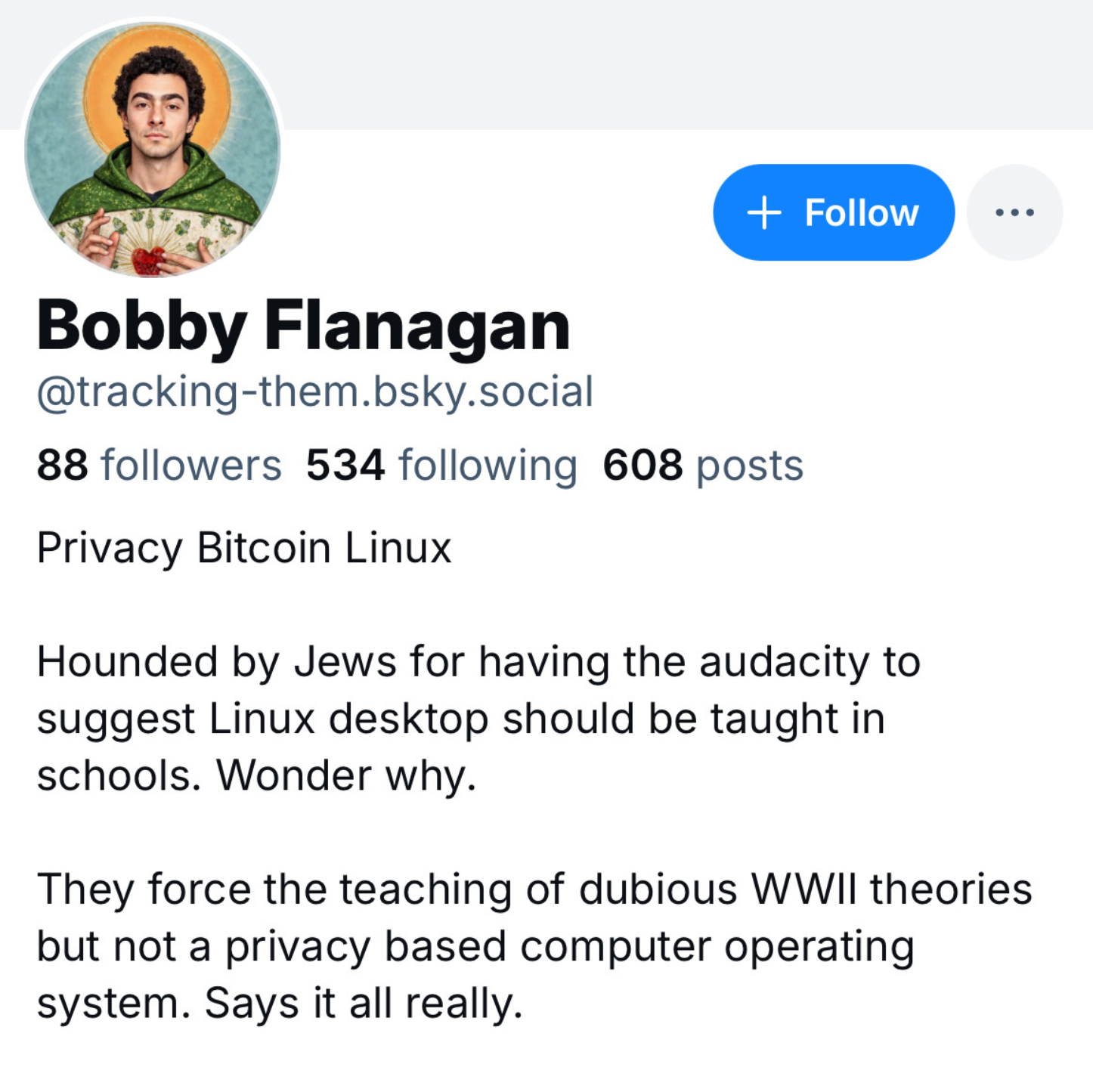
Things People Blame the Jews For, Volume LXXII: Inadequate Linux Education
The whole premise of "Things People Blame the Jews For" is that Jews are blamed for anything and everything, no matter how absurd. Yet even though I created the series, I never fully comprehended the true scope of "no matter how absurd". I thought I did, but I didn't. After all, I was always able to make a snarky comment or bit of wry commentary, an endeavor which necessarily required being able to draw some connection between what Jews were being blamed for and some attribute of the real world. The connection might be tenuous or even invented, but it was there, and I could follow the thread.
Today, I may have been bested, for I have encountered a specimen on Bluesky that I really just have no comment on. I cannot make heads or tails of it. It transcends the series. It has defeated me. Behold:
"Says it all really." Indeed, it does.
Friday, December 20, 2024
This Is Your Grandpa's Democratic Party(?)
"Democrats abandoned ordinary Americans."
It's not true. But it's stuck, like a craw in the mouth of the American voter (and the American pundit). And the big question amongst Democratic strategists is how to dislodge it.
My latest idea, in my ongoing quest to become the Democratic Party's Francis Coppola, is to explicitly run with a narrative that says "yes, this is your Grandfather's Democratic Party" -- directly tying oneself to JFK and the New Deal and the civil rights era and that whole period where (supposedly) the Democratic Party was the party of ordinary Americans. Cut to lines about:
- Defending labor unions.
- Bringing back honest, well-paying jobs that can support your family.
- Taking on the billionaires robbing our democracy.
- Protecting civil rights.
- Restoring a women's right to choose.
Monday, December 16, 2024
Learning the Right Wrong Lessons, Part II
The major pivot point in Joe Biden's term in office did not stem from inflation or the war in Gaza. It came following his withdrawal from Afghanistan. That decision was marked by a few key characteristics:
- It was the right call: we weren't accomplishing anything in Afghanistan, and nobody had a better plan to turn things around other than "stay for six more months, and then six more months after that."
- It was always going to be bumpy, leaving ample attack avenues open for political opponents (and the media) to exploit; and
- It was vocally demanded by the American left.
Saturday, December 14, 2024
Racist Idiots Continue To Be Mad That Caitlin Clark Is Not Racist
It's an exaggeration to say that conservatives only care about women's sports when it gives them an excuse to be transphobic. Sometimes they care about women's sports in order to be racist too.
For example, every once in a while, idiots try to conscript Caitlin Clark into racism and then get really mad that she doesn't participate.
In college, I remember a blowup some people had over Angel Reese doing some trash talking against Clark when LSU beat Iowa in the national championship. Clark, of course, is no stranger to trash talk herself, and people rightfully understood the pearl-clutching on her behalf as highly racialized in character. But the "controversy" was entirely on the outside; Clark gave absolutely no indication that she couldn't take what she dished out. Her view was always that trash talk and the like is part of the game, whether she's on the giving or the receiving end. Racists wanted to be racist on Clark's behalf, Clark did not bite, and it was pretty clear that the folks who rushed to "defend" her resented her for not obliging.
The other day we witnessed another iteration of this, after Time Magazine mentioned ongoing frustration by some Black WNBA players (h/t: Kevin Drum) who think they're persistently overlooked because of race (and that, in turn, Clark's popularity stems in part from the "great white savior" narrative). Clark was asked about the issue, and gave a perfectly reasonable answer about the importance of celebrating and uplifting the many Black players who have contributed immeasurably to the league's success:
“I want to say I’ve earned every single thing, but as a white person, there is privilege,” says Clark. “A lot of those players in the league that have been really good have been Black players. This league has kind of been built on them. The more we can appreciate that, highlight that, talk about that, and then continue to have brands and companies invest in those players that have made this league incredible, I think it’s very important. I have to continue to try to change that. The more we can elevate Black women, that’s going to be a beautiful thing.”
A good answer, and predictably, some people went ballistic over it:
Well, it happened. Caitlin Clark finally bent the knee to the insufferable, gaslighting, disgusting, race-baiting woke mob.... Anyway, Clark got her roses, and then proceeded to bend the knee to the mob.... Caitlin Clark bends the knee to an invisible mob.... Why did the best player in the WNBA — by a laughably wide margin — crumble like a cheap tent?
Now we can concentrate on how pathetic this whine is. But I want to flag something specific, as someone who actually did follow the WNBA season this year: Caitlin Clark is not, in fact, the best player in the WNBA. The best player in the WNBA, by a laughably wide margin, is A'ja Wilson. This is no knock on Clark, who is an outstanding player and was well-deserving of rookie of the year. But let's look at the stat lines this season (all stats on a per game basis):
- Wilson: 26.9 points, .518 FG%,11.9 rebounds, 2.3 assists, 1.8 steals, 2.6 blocks, 1.3 turnovers
- Clark: 19.2 points, .417 FG%, 5.7 rebounds, 8.4 assists, 1.3 steals, 0.7 blocks, 5.6 turnovers
Wednesday, December 11, 2024
With Great Blocking Power ....
As everyone knows, one of the main differences between Bluesky and even "old Twitter" is the blocking culture. One of my favorite stories from when I first joined Bluesky came in the wake of a series of negative interactions with a semi-prominent journalist figure. I considered blocking her but then I thought "no -- while this wasn't pleasant, there was nothing abusive here, so I'm going to be better than that." The next morning I woke up and discovered ... she had blocked me! Moral of the story: block first. At least that way you get the satisfaction.
The block-happy culture of Bluesky has led to a lot of chatter about Bluesky turning into an "echo chamber" -- an accusation which, ironically enough, is one of the fastest ways to get yourself blocked on Bluesky. For my part, I think the echo chamber complaint is overblown (in part because very often what we tell ourselves is "exposure to diverse views" actually is a way to reaffirm "wow, those people are maniacs"). But I do think that it is important to start thinking about best blocking practices in a informational system where "block early, block often" is normal and not frowned upon.
Take block lists, for example. These can be valuable tools to ramp up blocking of entire suites of bad actors quickly. But they're also easily abused. I've seen reports of trolls and other bad actors setting up block lists seeded with an assortment of the "usual suspect" controversial accounts and then, once people adopt them, adding in (say) trans rights activists. If you're not paying attention to who is curating the lists, it is easy to get taken in by that sort of move. That doesn't mean "don't use block lists", it just means be mindful when and how you use them. The mantra of "block early, block often" shouldn't be used to disavow one's own responsibility over the choices you make -- rather, it should accentuate it.
A similar concern attaches to "secondary" block lists -- that is, those populated not by the primary bad actors, but by people who follow those bad accounts. Again, it's not that I can't see the use case for these, but they're fraught with danger. Most obviously, people who research, say, antisemitism (to use a random example) may follow all sorts of unlovely accounts for research and monitoring purposes. Follows do not equal endorsement. And the broader version of that insight is that who people follow is their business. People make follow/unfollow decisions for an infinite number of reasons. We have absolute autonomy over what shows up on our feed, but we shouldn't start claiming authority over other people's feeds. If they start being unpleasant in their own voice, block them, but the moralization over who one follows strikes me as problematic. Tend to one's own garden.
Maybe you have quarrels with either of the above examples. But the bigger picture point I'm trying to make is this: a social media culture in which blocking is normal also has to be one where we take responsibility for the choices we make when blocking. A social media culture where blocking is rare can get away with people being less mindful about it, because they're only going to be acting in the most clear-cut cases -- one doesn't need to do a lot of deep reflecting to justify blocking RandoNazi1488. It's when we move beyond those cases that thought and consideration becomes important. And precisely because there are not and cannot be rules about blocking -- it is, ultimately, a matter of personal discretion -- it is especially important to cultivate a suite of good virtues around blocking. Block people who are abusive, but not people who just disagree. Block people for what they write, not for what the people they follow write. I don't think these are especially onerous, and I think most people are trying to follow them to one degree or another. But it can be easy to conflate Bluesky's quite healthy "block early, block often" mantra into an unhealthy belief that the actual ethos of the community is "I shouldn't have to think at all about my blocking choices." That isn't our ethos, and it shouldn't be our ethos.
A willingness to block often is not the same thing as being cavalier about blocking. Ideally, a healthy blocking culture will entail thinking carefully about how to balance hearing from a range of views and avoiding epistemic silencing with having a pleasant experience and not being inundated with worthless troll blather. I do think most people are capable of striking that balance in a reasonable way, but it isn't something one can do thoughtlessly. With great blocking power comes great blocking responsibility, and that's something we should embrace.
Tuesday, December 10, 2024
Saturation Ad Air War
One aspect of political culture I very strongly believe in is that most voters' knowledge of political affairs is primarily one of ambiance. They don't know much in the way of facts (what is the inflation rate, has crime gone up or down). They know a "mood". They feel that things are getting better, or worse. They hear a lot that America basically has open borders, or they hear a lot that abortion rights are going away. The connection to reality is pretty well unimportant (we definitely don't have open borders; abortion rights really are under threat). It's the sensation, the steady drumbeat of narrative, that moves them.
A family is at home in classic suburbia: mom, dad, and a gender non-conforming adolescent kid. The scene is utterly mundane and ordinary, but with a touch of danger lurking in the background. Mom is cooking, but beside her one can see a newspaper headline announcing the latest right-wing attack on trans kids. Dad is telling a dad joke to the kid (who rolls their eyes), the TV news on mute in the background but the subtitles have a talking head calling families who provided gender-affirming care to their children sexual predators who should be thrown in jail.Interspersed with each shot, we have a quick cut of heavily armed police massing outside the house. Right as everyone is getting ready for dinner, the door is battered open and the scene goes black. All we hear is the police demanding everyone on the ground, then demanding the child come with them as the family screams frantically. The last we hear is the kid pleading to their parents "don't let them take me!"

.jpg)