Thursday, April 06, 2023

Rate That Apology, Part 12: Dan White

On April 5, at the onset of Passover, Labour Party leader Keir Starmer sent a message of welcome to the Jewish community: "Today I am sending my warmest wishes to members of the Jewish community as you prepare to celebrate the festival of Pesach. Chag Sameach."

Perfectly lovely, perfectly anodyne.

Replying to that tweet, Dan White, a journalist who claims to be a member of ITV's "diversity board", wrote to Starmer:

Did you see what happened at Al-Aqsa mosque while Palestinian worshippers are celebrating the holy month of Ramadan? Your silence is disgusting.

And now he's apologized:

Asked to explain his comments, White, told Jewish News: "I can only apologise for the ill timing of my tweet."

"I am not and never have been antisemitic."

"My response was not aimed at the community, but at the silence from all political parties around the conflict which is happening."

"I accept my response was badly timed, I can only apologise profoundly for it. My mental health sometimes makes snap decisions. As I said I am believer in peace, worldwide. I am sorry again for the ill timing and any offence."

Four paragraphs, all terrible. The pro forma "I am not antisemitic" is the usual level of eye rolling. Placing the blame on his "mental health" is accountability dodging (and for what it's worth, "mental health" doesn't make decisions. Dan White makes decisions, for which Dan White should learn to accept responsibility for).

However, I want to focus mostly on this framing of the problem as one of "timing". The tweet's problem was not "timing". If White had on April 5 just written a general message to the effect that Starmer or other British politicians are not paying sufficient attention to violence against Palestinian worshippers, and someone said "how dare you say something like this on the eve of Passover", that would be an objection about timing -- and an ill-taken one, since the fact that we're near the onset of Passover does not make it inappropriate to level commentary on violence occurring in Jerusalem right now.

But again, that's not the problem here. The problem is not when White wrote the tweet. It's where he did it -- in reply to an unrelated message of support for the British Jewish community in celebration of one of our holidays, having absolutely nothing to do with Israel whatsoever. The practice where anytime anyone talks about Jews in any context folks come swinging in with "what about Palestine?", is antisemitic per se, as much so as the Texas Republican who opposed a resolution honoring Muslims celebrating Ramadan because there are Muslim terrorists in Iraq.

If there's any saving grace for White, it's that the replies to Starmer's tweet are positively crawling with trolls saying much the same thing. Some consolation.

Grade: 2/10

The Tennessee Three: Whataboutism as Fascism Apologia

You've no doubt heard at this point about "the Tennessee Three", three Democratic members of the Tennessee State House facing an expulsion vote for their role in a protest against gun violence that occurred on the state legislative floor. Expulsion is a rarely-invoked procedure in Tennessee, typically reserved for obvious cases of criminality of misconduct (e.g., a bribery scandal) in cases that garner bipartisan support. To use it to kick out minority party members for a raucous protest the majority found embarrassing is a huge overreach, an exploitation of the GOP's supermajority status to further undermine basic democratic principles.

I wanted to flag a particular comparison Tennessee Republicans are using to justify their conduct -- comparing the protest to the attempted insurrection on January 6:

House Speaker Cameron Sexton compared the incident to Jan. 6: "What they did today was equivalent, at least equivalent, maybe worse depending on how you look at it, to doing an insurrection in the State Capitol," he said.

Sexton also noted that Jones and Johnson had previously been "very vocal about Jan. 6 and Washington, D.C., about what that was."

There was, of course, no insurrection here: the protest had no ambitions of overthrowing the government. But there's something revealing about this rhetorical move that I think typifies the way conservatives are normalizing and justifying fascist behavior.

Even now, many Republicans are kind of willing to concede that there was something ... untoward about January 6, and the broader campaign of election denial that spawned it. "Kind of" because they face tremendous pressure to outright endorse it, as Sexton's "maybe worse" aside makes clear. But to the extent they to recognize that there's something wrong with what happened on January 6, what they want to do is present things like January 6 as an ordinary sort of ugliness, the sort of foul or misconduct one can see from all parts of the political spectrum. Yes, maybe the January 6 thing went a bit too far. But it's not distinctive; this is a problem one can see across the aisle too. Look at Black Lives Matter protests -- why aren't they being treated like the insurrectionists? Maybe Trump shouldn't have denied the election, but is it really any different from Al Gore demanding a recount in 2000? Trump stole classified documents; well, what about her emails? Whatabout, whatabout, whatabout.

By transferring these egregious examples of anti-democratic thuggery into the realm of "normal" politics, Republicans justify treating them via the "normal" (partisan) political process. Sure it might be a bit distasteful, and more than a little opportunistic, but hey, that's politics. There's nothing exceptional here that demands standing on a broader principle. Everything blurs into an indistinguishable mush of "sometimes politics gets ugly." And in that universe, well, it's just realistic that Republicans probably won't pay much attention to their "normal" nips that might cross the line. Cynicism styles itself as realism, but it's really just cowardice.

None of this is to say that straightforward political thuggery isn't sufficient explanation for why Tennessee Republicans are acting the way they are. But there is a broader justificatory narrative being crafted here. The Tennessee Three isn't just about state and national Republicans being contemptuous of democratic norms (though it's certainly about that too). It's yet another effort to pull the extreme conservative threats to basic rule of law principles out of the realm of "extreme" and blur them into the normal hurly-burly of every day politics. Exploiting the media's instinct to "both sides" everything, the GOP will just troll all the way down

Wednesday, April 05, 2023

Wisconsin Man's Upward Fall Arrested

Democracy may finally be coming to Wisconsin, as Janet Protasiewicz defeated arch-conservative Daniel Kelly to flip a key seat on the state supreme court.

The Wisconsin Supreme Court has been a national embarrassment for years. This was the court where a justice tried to choke out one of his colleagues, after all. More recently, it was by far the court that came closest to endorsing Donald Trump's authoritarian campaign to overturn the 2020 election. Members of the conservative faction have since openly questioned the validity of President Biden's victory, putting them far outside even the conservative judicial mainstream and marking them as little more than partisan thugs.

And yet, even among this sorry bunch, Daniel Kelly would have stood out.

I first wrote about Daniel Kelly when he was initially appointed to the Wisconsin Supreme Court by then-Governor Scott Walker. He had made an argument comparing affirmative action to slavery, something that -- even restricted to the "civil rights programs are the new slavery!" field -- was jaw-dropping in its stupidity (and "civil rights programs are the new slavery!" is already a field saturated with stupidity).

Over the course of his career, and over the course of this campaign, Kelly has proven himself to be the definition of a mediocrity who's managed to fall upward via the beneficent hand of the right-wing gravy train. His academic pedigree is undistinguished. He had no judicial experience when he was appointed to the court by Walker in the first place, and after his (first) defeat he stayed plugged into Wisconsin GOP politics by providing legal advice to the effort to steal the state for Trump after Joe Biden's 2020 victory. And of course, all have now witnessed his petulant response to being defeated by Protasiewicz:

"I wish that in a circumstance like this, I would be able to concede to a worthy opponent," he said at an event held at the Heidel House Hotel in Green Lake. "But I do not have a worthy opponent to which I can concede."

Kelly called Protasiewicz's campaign "deeply deceitful, dishonorable and despicable." "My opponent is a serial liar. She's disregarded judicial ethics; she's demeaned the judiciary with her behavior. This is the future that we have to look forward to in Wisconsin."

Adding: "I wish Wisconsin the best of luck, because I think it’s going to need it."

[...]

"The people of Wisconsin have chosen the rule of Janet. I respect that decision because it is theirs to make," he said. "I respect the decision that the people of Wisconsin have made, but I think it does not end well."

If ever there was a definition of "lacking in judicial temperament," he personifies it.

Yet beyond that, Kelly is a familiar, if not archetypical figure. He is suffused with entitlement for that which he has not earned, and consumed by rage when he doesn't get it. There are thousands -- millions -- of men (almost always men) just like him. Most don't go on to become state supreme court judges, though many do bully themselves into positions far beyond their talents or capacities by a mixture of being useful to the right people and being an impossible menace when they don't get what they want. When they do, finally, see their upward fall arrested, they are incredulous and infuriated at the injustice of it all. Hell hath no fury like a mediocre White man scorned.

Indeed, perhaps Kelly's only mistake was being appointed to the Wisconsin Supreme Court instead of the Seventh Circuit Court of Appeals -- a position from which he could never be dislodged no matter how apparent it became that he was ill-suited for the position. On the federal bench, with life tenure, he could have prowled and fulminated and lashed out with impunity, forever; secure in the knowledge that it would be constitutionally impossible to ever hold him accountable. One can only imagine the law school classes he would have baited and berated.

But alas, Daniel Kelly is a creature of the state bench, and in Wisconsin, supreme court justices must meet the approval of the voters. Twice now, the voters have resoundingly rejected Daniel Kelly as unsuited for the role of state supreme court justice. Kudos to them. And while Democrats are celebrating Protasiewicz's win, the bigger winner is the small-d democracy that has been under siege in Wisconsin for far too long.

Monday, April 03, 2023

Post-Conference Roundup

Last week, approximately 35 speakers (and dozens more guests) came to Lewis & Clark Law School for the 2nd Annual Law vs. Antisemitism conference. It was an event I'd been planning for over a year, and I'm pleased to report it was a rousing success. The panels were scintillating, the conversations crackling, and the two keynotes (by the ADL's Steve Freeman and civil rights activist Eric Ward) blew the doors off the joint. I could not be prouder.

Unfortunately, as the conference approached I could feel myself getting a cold, and so I did that deal-with-the-devil bit where I just willed myself to not be sick for the conference, and my body was like "okay, but you're going to pay for that come Tuesday." So the day after the conference I was sick as a dog. But now I'm mostly better -- just some residual congestation.

Anyway, here's a roundup:

***

Haven't seen the clip, but apparently a protester held up a "Jews control the USA" sign on the CNN segment reporting on Trump's indictment today. So that's fun.


In other "is killing students in school controversial?" news, Nashville students walk out of class to protest for gun reform following the Covenant School shooting.


As a now-certified Caitlin Clark fan, it's beyond evident that folks calling Angel Reese "classless" for doing the same mugging that Clark had done all season are, well, they're not hiding the ball. And for what it's worth, there's zero evidence that Clark in any way needs or supports y'all white knighting on her behalf -- I guarantee she can take what she dishes out. (Surely, we can all agree that the only thug on the court yesterday was Kim Mulkey).

Israel looks set to give its resident fascist his own personal state-backed paramilitary squad. What could go wrong? Nothing, because "wrong" implies that the the utterly predictable consequences aren't intended.

A beautiful story of a transwoman recounting "coming out" to her 100 year old grandpa. His memory clearly already is a blessing.

Oh, and I published a new article! "Microaggressions as Negligence" is now out in the Journal of Social Philosophy.

Saturday, April 01, 2023

Caitlin Clark is a Crossover Sensation

I was watching boxing today -- the Anthony Joshua/Jermaine Franklin card -- and on the boxing blog I follow the fans between fights were just shooting the breeze about just how good Caitlin Clark is. And not that boxing fans can't follow women's basketball, but it was still striking to see that sort of crossover appeal in this particular forum. She really has the potential to be a true breakthrough sensation.

Obviously, Caitlin Clark is very, very good. First ever 40-point triple double in NCAA tournament history. First player to have two consecutive 30-point triple doubles. She's a threat on all angles. She can create off the dribble as well as anyone I've seen. You can't even say "well, a team just has to stop one person", because she's a fantastic passer as well. And on top of that, she's got a bit of menace to her which I love. She's just a ton of a fun to watch play ball. Her performance against the #1 seeded South Carolina was a tour de force.

The Iowa/South Carolina match was a fantastic game of basketball. Indeed, my only sour note about it is the degree to which the post-game coverage has emphasized it as (in the New York Times' words) "the upset of all upsets", something that nobody saw coming, an impossibility made real. No, it wasn't. To be sure -- it absolutely was an upset. South Carolina was the favorite, and deservedly so, given its absolute dominance on the court this year. But going into the game, South Carolina's victory was not treated as a foreordained conclusion, precisely because Caitlin Clark would be on the floor. To the contrary, the game was promoted -- correctly -- as must-see TV, a "clash of the titans" pitting the tournament's clear best team against the tournament's clear best player. This was not Purdue/Farleigh Dickinson, where nobody outside the FDU locker room could have possibly seen the upset coming. This was seen as a very competitive matchup precisely because everyone knew Caitlin Clark really was that good. And she proved that yes, she was that good.

Friday, March 31, 2023

"Why Some Men Are Above the Law"

In 2016, the eminent philosopher Martha Nussbaum publicly recounted for (I believe) the first time her "Bill Cosby" story -- not about Cosby, but about her being raped by a different famous "TV dad" in the late 1960s. The title of the story was "Why Some Men Are Above the Law", and Nussbaum takes little time to address the myriad reasons why she never did report the attack until some fifty years later. 

One obvious reason for her reticence, Nussbaum noted, was the near-certainty that her attacker would "either to portray me as an extortionist or to sue me for defamation." On this point, Nussbaum said something -- in a parenthetical aside no less! -- that I've found myself returning to year after year:
(The famous are indeed unusually exposed to extortion, and that vulnerability itself is an aspect of their impunity: everyone easily believes that this is what a complaining woman is after.)

This is something I've turned over and over in my head. The famous are exposed to extortion; that is the reality. It is a true vulnerability; it isn't made up. And yet that vulnerability becomes itself a form of impunity: because it's always so obviously possible for them to be accused in bad faith, any accusation immediately falls under a shadow of suspicion.

I thought of this again today, when it was announced that a different television personality would be indicted for various crimes by the state of New York. Donald Trump's defenders have quickly raised hue and cry over this being a political witch hunt, dirty politics, a partisan plot (this, of course, does not even get into the de rigueur allegation that it's a Soros-led plot). I heard it said that Barack Obama will be the last president not to be indicted upon leaving office, as surely this is the new normal in tit-for-tat partisan squabbling.

The thing is, the critics have an inkling of a point. Donald Trump, by his station, is more vulnerable than the average Joe to being targeted in a political prosecution. The prospect of partisan motivations does loom larger. But that vulnerability is part of the impunity; the fact that this specter can never quite be dispelled is ultimately what has let Trump run riot over the civil and criminal laws of this country for years. No matter what he does or how brazen he gets, we'll always have to (rightfully!) second-guess whether we're letting politics overcome law -- far more so than in a standard criminal case.  It is the same ultimate story that Nussbaum told. And for too long, it has let Donald Trump stand above the law.

Wednesday, March 29, 2023

Schoolchildren Shouldn't Have To Live Like Jews, Part II

This weekend, Lewis & Clark Law School hosted the 2nd Annual Conference on Law vs. Antisemitism, a conference which (I don't think it's immodest of me to say) I did the lion's share of organizing.

Part of that organization was making sure, at the outset, to contact Lewis & Clark campus security to inform them of the event and have a security plan in place. This included having a security officer on site, requiring registration and check-in, alerting the Portland Police Bureau of the event and having them monitor the chatter of "certain" sites to ensure we weren't going to be a target, and other sundry efforts to address what I called our "elevated risk profile" compared to a standard law school event.

All this, to me, felt very normal and unremarkable. I'm hosting a conference on antisemitism -- of course I need to take extra steps to ensure that it is secured.

The day-of grunt work for the conference was provided by a set of Lewis & Clark law school student volunteers, most if not all of whom were not Jewish. They all did, to be clear, a fantastic job. But I think it is fair to say that for them, this sort of extra security was very much not normal. Which I recognized, and at various points during the run-up, I'd update them on the various security measures we were emplacing, trying to balance between "we're a conference on antisemitism, there's inherently heightened risk" and "but there's no reason to fear, most likely nothing bad will happen, this is all just precautionary." I was aware that my normal is not their normal.

The conference went very well, and without any problems or disruptions of any sort. As is the case, 99% of the time. The vast majority of cases where a synagogue brings in extra guards to watch over high holiday services, nothing bad happens. We just had a great event. So I felt kind of bad, forcing all these student volunteers to deal with the anxiety of all those extra security precautions. My normal shouldn't have to be their normal.

After Uvalde, I wrote a deliberately provocative post titled "Schoolchildren Shouldn't Have to Live Like Jews." The basic thrust of the post was to argue that all the various ways Jews have enhanced local security, "hardened the target", etc. etc., are not good models for how to protect schoolchildren from mass shootings. That they're normal for us -- a beleaguered, regularly threatened minority group -- should not make them normal for everyone. 

Less than a year later, in the wake of yet another school shooting, this time in Nashville, I couldn't help but return to the same thought. I mourn for the families, not just for their immediate loss, but for the extra wave of grief they will endure upon realizing just how little the American people care about them. But the fact is that when the only response to a shooting is "more guns" -- taking the firefight as inevitable and just hoping it occurs earlier in the process -- we're tacitly (or not so tacitly) conceding that "we're not going to fix it". It is taken for granted that to have your children in public schools is to run the risk of having them gunned down -- a price that too many politicians treat as one families are agreeing to pay, as opposed to being coerced into accepting (witness Tennessee Republican Rep. Tim Burchett's blithe response when asked how to "protect people like your little girl": "Well, we home school her.").

It doesn't have to be like this. Our normal shouldn't have to be their normal.

California Jewish Community Continues To Win the Ethnic Studies Controversy

A few years ago, I was heavily quoted in a great Haaretz article titled "How California's Jewish Community Won the Battle Over the State's Ethnic Studies Program". While I had at that point left California, I had previously been heavily involved in the Jewish community efforts to ensure that the ethnic studies curriculum not only did not discriminate against Jews, but also told the full, robust Jewish story as part of the California educational experience. Despite the efforts by some to fear-monger Those efforts were broadly successful, making the California Ethnic Studies battle one of the Jewish community's great victories.

The implementation of the ethnic studies mandate has not been without friction, not the least because some districts are not adopting the model curriculum the Jewish community worked so hard to develop. I haven't been following the ins and outs as closely now that I've left the state, but I still do hear some things. And to the end, I want to share an email I recently received from the San Francisco Bay Area JCRC, addressing "rumors" regarding ethnic studies in the Mountain View Los Altos High School District (MVLA).

The rumors circulating about the ethnic studies program at Mountain View Los Altos High School District (MVLA) have become a cause of concern in the Jewish community. We are in regular communication with district leadership and have made a formal request to review classroom teaching materials. Based on publicly available information, we have so far seen no evidence of antisemitic or anti-Israel content.

The controversy over this curriculum is causing great division in the district, and we have received numerous emails and calls of concern. Unfortunately, the tone of the conversation is hurting families and educators and we are calling on concerned community members to stop reaching out to the district directly and to allow JCRC to continue our work with district leadership. We reject public attacks on the district as counterproductive to our community’s aims at this time.

The email goes on to clarify that, apparently contrary to certain rumors, the ethnic studies curriculum in MVLA does include discussions of antisemitism and Jewish experience and is not currently tied to the so-called "liberated ethnic studies" curriculum. At this point, the email suggests:

Objections to MVLA’s curriculum appear to be ideologically-based, with some questioning the inclusion of concepts such as systems of power and oppression, concepts that are included in the California Ethnic Studies Model Curriculum. While segments of our community may object to teaching these concepts, these concerns are not related to Jewish identity, antisemitism, or Israel, and should not be conflated with anti-Jewish bias.

Why do I flag this email? Because I think it helpfully highlights several trends and activities worth underscoring.

First, it is illustrative of how the institutional California Jewish community has been consistently excellent on this issue -- vigorously advocating for Jewish communal rights, while refusing to give into or endorse fear-mongering or conspiratorial nonsense. They deserve tremendous applause for this -- you and I know full well that is not something that can be taken for granted.

Second, it is laudatory that the statement correctly distinguishes between mere ideological opposition to teaching about things like "systems of power and oppression", and having leveled a colorable claim of antisemitism. Political disagreement with certain frameworks used in ethnic studies is not tantamount to identifying actual antisemitic content. This is not to say that such concepts cannot be deployed in antisemitic ways. But frequently right-wing Jewish critics of ethnic studies skip past that step and simply assert that the existence of these concepts is inherently antisemitic without any need to show actual, particularized antisemitic content (for my part, I have no idea how one could possibly understand antisemitism without conceptualizing it as a "system of oppression"). 

Third, it highlights how counterproductive ill-informed rabble-rousing around these issues are. It is almost certain that the success of the Bay Area JCRC and affiliated groups in creating a healthy ethnic studies framework for the Jewish community is in no small part attributable to the direct relationships and consultations its had with MVLA officials. Those relationships and consultations are strained when a bunch of yahoos bombard the school board with whatever the latest misleading Tablet Magazine screed is. Even in cases of genuine antisemitism, this approach often is wildly counterproductive and harms those it purports to "protect". 

Much like the folks who decided the best way to support Berkeley Jewish students was to drive a Hitler billboard truck onto campus, these interventions are not ultimately about trying to improve the climate for Jews. They're accelerationism -- trying to increase the temperature in a bid to hasten the crisis point where things boil over. Just as the last thing that the Berkeley Hitler truck purveyors want is a world in which Jews feel comfortable at Berkeley (if Jews are comfortable at Berkeley, then a heaping pile of right-wing narratives attacking higher education go kaput), the last thing the rabble rousers want in Mountain View is for ethnic studies to be able to comfortably incorporate Jewish perspectives (if it does, the whole narrative that ethnic studies is and must ever be antisemitic falls away).

It is, to reiterate, fantastic that California's Jewish community has not, by and large, fallen into these traps. Good behavior deserves plaudits, and I applaud the Bay Area JCRC for the tremendous, superb work they've done on the ethnic studies issue for years now.

Saturday, March 25, 2023

America Sees Florida Man, Is Creeped Out

It looks like the Ron DeSantis bubble might have already burst. After a brief period where he looked like a viable GOP challenger to Supreme Overlord Donald Trump, his poll numbers even amongst Republicans are cratering.

There's something about this which is just tickling, and it's not only that it couldn't happen to a more deserving autocrat. The media enthusiasm for DeSantis was based on his big reelection win in Florida -- if he can win by that margin in a "swing" state, surely he's a force to be reckoned with on a national level! That logic was always a bit faulty, and instead of DeSantis' Florida-appeal translating nationwide, what  actually happened was that America saw what apparently appeals to Florida voters and was reminded again that Floridians have weird, creepy tastes and can't be trusted. 

Turns out a regime based on government-period monitoring, assaulting Mickey Mouse, banning books on Roberto Clemente, outlawing Black history, and censoring Michelangelo isn't a recipe for national success! Who knew?


Wednesday, March 22, 2023

Michigan Republicans To Michigan Jews: Get Lost

The opening to JTA's story about Michigan Republicans comparing the state's new gun control laws to the Holocaust reads as follows:

 The official Twitter account of Michigan’s Republican Party posted an image comparing gun control to the Holocaust on Wednesday. Then, following condemnations of the post by Jewish groups, the party doubled down on its message.

It’s the latest example of Holocaust imagery being utilized to deliver a partisan political message.

It is the latest example of Holocaust imagery being utilized to deliver a partisan political message. It's also the latest example of Republican politicians responding to Jewish concerns by saying "get bent".

Of course, saying "F U to the Jews" isn't surprising coming from the Michigan GOP, which is now led by election-denying conspiracy theorist Kristina Karamo:

Karamo, a Trump-backed election denier, has in the past been accused by the Anti-Defamation League’s regional director of invoking antisemitic tropes about Jewish power. During her campaign for secretary of state last year, Karamo accused the Democratic incumbent, Jocelyn Benson, of being a “puppet” controlled by Jewish billionaire George Soros. She also has claimed Benson, who is Jewish, and the state’s Jewish attorney general, Dana Nessel, are “all part of the Soros minion club.” 

Still, it's worth noting that those condemning the Michigan GOP statement include not just mainstream Jewish bodies and organizations, but also prominent Jewish Republicans including the Republican Jewish Coalition. This, of course, only accentuates how the Michigan Republican Party and Karamo are making a conscious choice to extend a big ol' middle finger to all the Jews, even their nominal friends.

I'll reiterate once again that one of the biggest points of differentiation between the status of Jews in the Democratic Party and the status of Jews in the Republican Party is that Democratic Jews, when we have inward-facing concerns, still can get a hearing from people who care about what we think. It's not always smooth or frictionless, but that fundamental bondedness that stems from decades of relationship-building and solidaristic organizing is still present. By contrast, when Jews face antisemitism from the Republican Party, the institutional GOP's immediate, reflexive, and typically solitary response is to close ranks and lash out against the messenger. We've seen it before, and we're seeing it again here.

Tuesday, March 21, 2023

When The Worst Person You Know is the Victim of Unjustifiable Cruelty

There's a lot of making fun of Bethany Mandel right now. On the whole, it is entirely deserved. I've partaken myself. I have no particular sympathy for the idea that she deserves kid-glove treatment when she bombs on live television. She's a public figure who made a high-profile screw up in her effort to promote greater histrionic racist fearmongering. She can take her lumps.

That said, in all such matters there are things that should be out-of-bounds. Attacking her for being an observant Jew would seemingly be one. Attacking her for being the victim of sexual abuse is an obvious second. And yet. In the course of a larger bid to give Mandel "some more of that sweet sweet publicity she so craves," Paul Campos includes a passage that I think is clearly one of horrific, unjustifiable cruelty no matter who the target is.

.... Bethany has been pumping out lots of Orthodox babies at an impressive rate: six is the current count I believe (Her father was Jewish, her mother was Catholic, and she converted to Orthodox Judaism when she married Seth. During the conversion process, her rabbi used a hidden camera to film her while she prepared for the ritual baths Orthodox women are required to take to wash away all those cooties).

I thought about just ignoring this -- it's not my blog, I have no connection to Campos, and I certainly have no interest in white knighting for Bethany Mandel. But really, this is gross, and it needs to be called out as gross without letting it pass. In context of an entire blog post dedicated to making fun of Mandel, bringing in the fact that she was the victim of terrible abuse by a trusted spiritual advisor is entirely gratuitous and cruel. It is not presented in any way that suggests this fact is different from all the other facts Campos musters regarding why Mandel is worthy of contempt.  To the contrary, it is presented as yet another reason to mock and look down on Mandel, as part of a broader (and also appalling) narrative of contempt geared at Orthodox Jews. We should never treat sexual abuse that way. Never. No matter who the victim is. Nor should we tolerate this sort of antipathy at any religious community -- again, no matter who the target is.

So yeah. There are so many great reasons to look poorly on Bethany Mandel. She offers new ones virtually everyday. Given that bounty of options, if you decide to pick out that she was the victim of sexual exploitation as part of your bouquet, that says some truly shocking things about your character far more than hers. Don't do this.

Monday, March 20, 2023

Sorry Because You Got Caught

Often times, when a public figure is revealed to have engaged in some misconduct and is in the process of apologizing, you will hear dismissal of that apology via some variation of "he's only sorry because he got caught."

I've been reflecting on this for the past few days, because I think it is a more interesting problem than often given credit for. What are the conditions for which we might think sorrow is genuine notwithstanding the fact that it follows after "getting caught"?

After all, temporally-speaking I suspect it is the case that most public gestures towards repentance only follow getting "caught" or called out. It's not impossible to repent for wrongdoing without ever being caught -- one can turn oneself in -- but most of the time the former follows the latter. And I actually suspect it is true that most people who are not caught doing X wrong are unlikely to unilaterally engage in public actions of repentance. At most, they'll feel ashamed and bad in private. Which is not nothing, and can yield genuine changes in behavior. But it's also typically not viewed as sufficient expressions of remorse for the person who is "caught".

So if most public figures are, in some sense, "only sorry because they got caught", does that mean that most public figures are insincere in their apologies? Or that their apologies are inherently unreliable and insufficient?

I don't think that can be right. The very fact that the vast majority of repentance work occurs after being caught should make us leery about saying that such work is inherently suspect when it follows being caught. For most people, "getting caught" is a triggering event in a process that one hopes will lead to genuine repentance, remorse, and repair. It strikes me as implausible to dismiss any gestures of remorse that follow getting caught, unless we think most human beings are basically incapable of true remorse but are low little sociopaths.

This doesn't mean that any individual person -- observer or (especially victim) is obliged to "forgive" a public wrongdoer upon the first gesture of apology. Your relationships are your business, and if you decide that you need to write someone off temporarily or permanently due to something they've done, that's up to you. I think we vastly overweight obliging forgiveness. Himpathy and all that. And more over, "being sorry" doesn't liquidate one's obligations to try and make right what one has done wrong. Repentance should come at cost.

But on the flip side, there's a version of the "we're too quick to forgive" politic that acts as if people are at best suckers, at worst complicit, if they don't view essentially all efforts at remediation and reparation as so much manipulation -- being taken in by someone who is "only sorry that they got caught." And to that, I'd also say "your relationships are your business," you're allowed to believe that someone is actually remorseful and wants to go through the steps to make a repair. If you're the victim, it can be doubly traumatizing to hear that you're a dupe or a sellout for trying to work with the wrongdoer to mend the break. If you're an observer, you can't forgive on behalf of the victim, but you're allowed to come to your own judgment about what the wrongdoer is trying to do and assist them on a journey towards repentance.

Saturday, March 18, 2023

The Effects of Whitening Jews

The ADL just released some interesting new data its compiled on antisemitism. I'm still working my way through it, but I did want to flag one experiment it did which to my mind led to some fascinating results on the interplay of Jewishness and Whiteness.

Before I talk about the study, some background. Many -- myself included, in my "White Jews: An Intersectional Approach" -- have hypothesized that in the contemporary American context Jewishness is viewed as amplifying Whiteness. That is, whereas in years past Jews were seen as paradigmatically non-White, today Jews are seen as paradigmatically White -- so much so, that even persons who might otherwise be identified as non-White will instead be coded as White once it becomes known they're Jewish. I quote one writer as arguing explicitly that "the simple attribute of being Jewish functions to whiten Sephardic and other non-white Jews,” and suggest that "All Jews are 'White Jews' in this sense—non-White Jews are deemed White in their Jewishness."

From this, we can generate a hypothesis:

Hypothesis 1: All else equal, respondents will be more likely to perceive someone they know to be Jewish as White than a person whom they know not to be Jewish.

But what is the impact of this Jews-as-White association?

Here, we can think of two stories, which I'll dub the "traditional" and "revisionist" accounts.

The traditional account suggests that as Jews became perceived as White, it opened doors and diminished antisemitic prejudice. Being seen as part of the "in" group ameliorated antisemitic otherization and reduced antisemitic stereotype, as Jews became viewed by the White majority as "one of us".

The revisionist account, by contrast, suggests that Jews being perceived as White licenses certain forms of antisemitism. As Jews become seen as White, they're no longer viewed as a marginalized group worthy of protection and instead become "fair game" for otherization and discrimination that would allegedly not be tolerated if they remained recognized as a distinct minority.

These two accounts aren't necessarily competitive. In most renditions, the revisionist account is sequential to the traditional one: that is, the argument goes that in the mid-20th century "Whitening" Jews may have been a boon for Jews, but in the 21st century (with the rise of multiculturalism and "woke" politics) it has become a liability. Or one might believe that both hypothesis are true for different sorts of persons: White people viewing Jews as White diminishes antisemitism (since it implies viewing Jews as part of their group); while non-White people viewing Jews as White will enhance antisemitism (since it implies Jews are not part of their group and are part of the dominant White group)

So we have two more hypotheses:

Hypothesis 2a [traditional]: Perceiving Jews as White will result in comparatively lesser levels of antisemitic stereotyping.

Hypothesis 2b [revisionist]: Perceiving Jews as White will result in comparatively greater levels of antisemitic stereotyping.

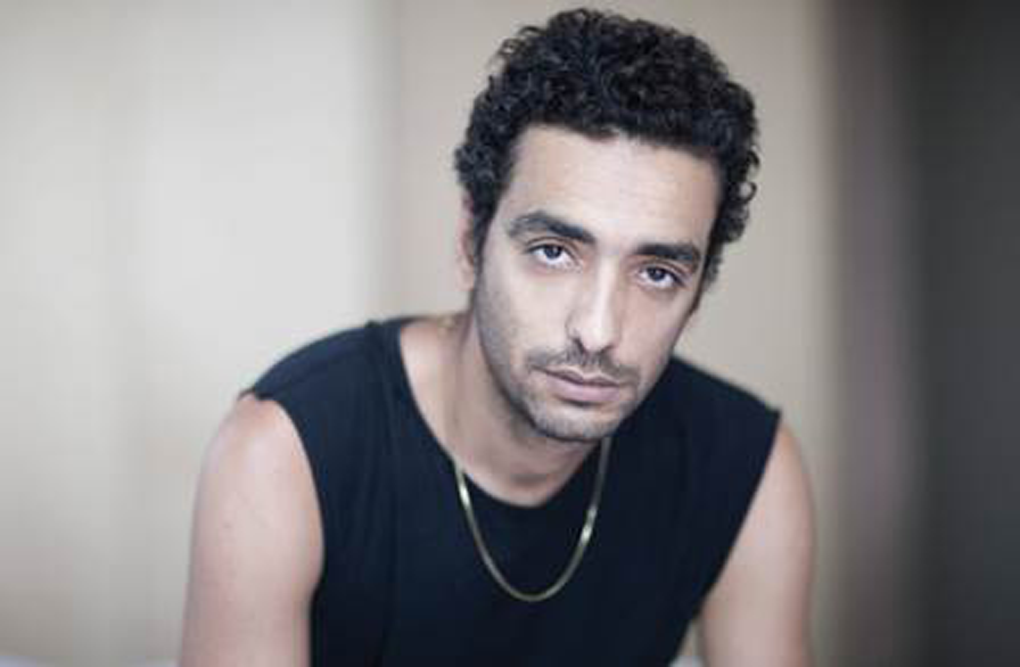
Keeping this in mind,  here's what the ADL did. First, they showed subjects the following photo of a racially-ambiguous person:

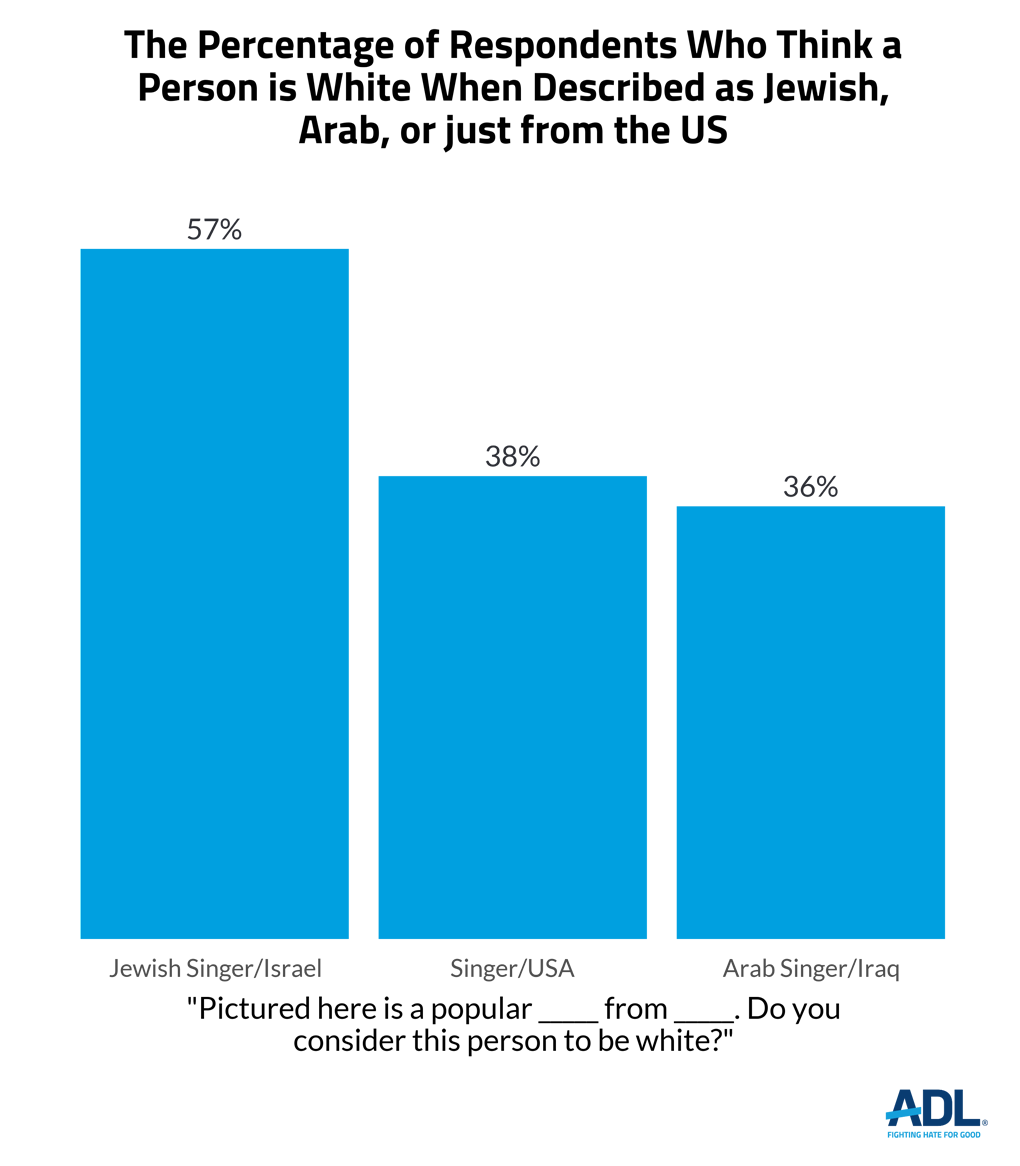
Some subjects were told the subject was Israeli Jewish, some were told he was Iraqi Arab, and some were told he was American. They were then asked to answer whether the pictured person was "White" or not.


Respondents were far more likely to code the person as White if he was identified as Jewish. That there was no significant distinction in answers between the "Iraqi Arab" and "American" labels suggests that this is a function of Jewishness "Whitening" the subject. This, in turn, provides strong evidence in support of Hypothesis 1.

But what was the result of this perception? Hypothesis 2a (the traditional account) suggests that viewing the person as White should be associated with reduced antisemitic views (he's an "insider", "one of us", or a member of a respected, preferred group). Hypothesis 2b (the revisionist account) suggests the opposite: that viewing the person as White should be associated with increased antisemitic views (he's a member of the dominant caste, an oppressor).

The study found that for White respondents, viewing the pictured person as White was associated with significantly lower levels of antisemitic sentiment -- supporting the traditional account. But perhaps this is not too surprising -- the sorts of White persons invested in denying Jewish Whiteness may be especially prone to antisemitic aggression. We might think that non-White persons, for whom being White is of course not an assertion of commonality,  would push in the opposite direction. But the study found that, for non-White respondents, viewing Jews as White had no relationship to the prevalence of antisemitic attitudes. This significantly weakens the evidentiary support for the revisionist hypothesis even in its supposedly strongest turf (21st century non-White respondents).

I'll want to dive into this in more detail, of course. But what a fascinating contribution!

Thursday, March 16, 2023

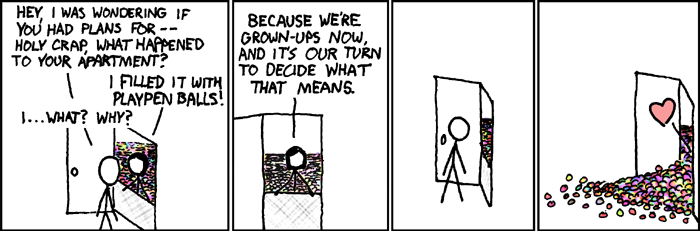
We're Grown-Ups Now, And It's Our Turn To Decide What That Means

Years ago, I wrote a review of a greasy spoon diner I ate at in Oakland called "Pretty Lady". My wife and I had intended to go to a trendy spot called "Brown Sugar" which specialized in contemporary twists on classic American blah blah blah, but the wait was two hours, we were hungry,  and so we just found a random restaurant nearby that sounded like it could cook a decent brunch. Pretty Lady was a small place, and its shtick was that the older Asian lady who ran the place would insist on giving every patron a fist bump before she took their order. It was corny and ridiculous, but it made me smile. So we both gave her a fist bump, and then we ordered our fried egg sandwiches, which were perfectly fine but nothing remarkable or especially distinct from any other reasonably competent fried egg I've had. 

Anyway, in my review I gave the place four stars -- remarking that while based on food quality alone, it was probably more of a three star, "there is something to be said for a nice hole-in-the-wall that just makes you feel happy from the moment you walk in to the moment you leave." It's possible that the highly accoladed Brown Sugar and its fancy, deep, sophisticated takes on the American brunch, would have been a life-altering experience. And perhaps giving plaudits to a restaurant for a fist-bump and a basic fried egg dish isn't as sophisticated as uncovering the sublime flavors and textures of this year's James Beard award chefs. But I was just happy to be happy, and I thought Pretty Lady deserved to lauded for the simple act of inspiring happiness.

James Greig in Dazed has an article criticizing "adult babies" who, even into their 20s and 30s, enjoy childlike things (Harry Potter, action movies, stuffed animals, etc.). His is not primarily an aesthetic critique, though. He thinks this is politically objectionable. The propensity of adults to consume child-culture -- which covers everything from young adult novels to acting "cute" -- is part of a broader pattern of self-endorsed helplessness; a way for people to come to terms with (rather than challenge) their lack of agency and take pleasure in failing to accept responsibility:

[E]ven if the economy is foisting an extended adolescence on us, we can still choose to assert our dignity and refuse to become “baby adults” or 26-year-old teenagers, helpless and dependent. Make no mistake: the capitalist elites want you to think of yourself as a silly little goose. “From a psychoanalytic perspective, self-infantilisation makes uncannily good sense. It is a kind of identification with one’s own powerlessness, and so gives it a veneer of active choice,” says [philosopher Josh] Cohen.....

What would rejecting this helplessness look like? The right see adulthood as a process of settling down, getting married and having children; in effect, conforming to conventional gender roles and being productive members of the workforce. We obviously don’t have to buy into that, at any age. But we can aspire towards a different form of maturity: looking after ourselves, treating other people with care, being invested in something beyond our own immediate satisfaction. Infantilising yourself can often seem like a plea for diminished responsibility. Most of us will have encountered someone who, when criticised for behaving badly, appeals to their own vulnerability as a way of letting themselves off the hook. No matter what they do or the harm they cause, it’s never fair to criticise them, because there’s always some reason – often framed through therapy jargon or the language of social justice – why it isn’t their fault. Childishness grants them a perpetual innocence; they are constitutionally incapable of being in the wrong. 

But we will never make the world better if we act like this. Thinking of yourself as a smol bean baby is a way of tapping out and expecting other people to fight on your behalf. 

So here's the thing: the purely political register of this, I endorse -- indeed, I've written regularly about the "infantilization of the American right", in terms that largely echo Grieg's. I absolutely agree that we each have a responsibility to make our own choices in fashions that care about our loved ones and those around us in a respectful fashion; we can't just throw up our hands and act as if we lack agency altogether. But once this political observation proceeds into a cultural critique -- grouchy assertions that kids adults these days are watching the wrong movies/listening to the wrong music/adopting the wrong hobbies -- then I think it is exactly as tendentious and dull as any other moral panic which adopts largely the same tenor.

For starters, one of my bedrock social principles is a strong presumption against begrudging people joy where they find it. There's not so much happiness in the world that we should be too keen on finding reasons to take away people's joy. In this, I think Grieg significantly misdiagnoses why it is that this "childlike" properties hold appeal for many adults. I don't think it is wholly or even predominantly about some fetishization of our own helplessness. I think we're seeing instead an appreciation for uncomplicated joy (and the parallel inability of some progressives to understand why joy-qua-joy is good)

Not everything has to be a grimdark march through serious themes where every halfway decent character ends up brutally murdered by an uncaring universe. Nor, for that matter, does it have to be a complex and shaded exploration of deep philosophical precepts that can generate a dissertation or twelve. Some people do enjoy these things (I often do), and that's great! But other people enjoy other things, and that's fine too. People like Star Wars because it's fun, and it makes them smile, and it doesn't need to do more than that. To be clear: we need to do more than that in the totality of our lives. But that doesn't mean every constituent element of our lives must be a complete balanced diet all in itself. That something "just" sparks joy is absolutely a sufficient reason to like it. Grieg seems to view unmediated joy as the experiential equivalent of empty calories -- we should strive to consume more nutritious fare. I'm inclined to think of joy as an essential vitamin that is an indispensable part of this complete breakfast. How one ingests that vitamin is fundamentally up to us.

The link between the cultural and political critique presumably is that the consuming the "merely" joyful leads to the sort of political infantilization that we both agree is so toxic. But there is no reason why simply "taking joy in things" necessarily leads to the sort of self-infantilization that Grieg critiques. And that's true even if part of its appeal is harkening back to moments of fewer responsibilities and concerns. We go to baseball games in part because it reminds us of bonding moments with our parents, or of how simply meeting your favorite player could be enough to send you into a happy tizzy for a week. Does this nostalgic appeal mean that adults who remain baseball fans are indulging in "a way of learning to love your oppressor"? Is the best way of describing baseball fandom "tak[ing] an acute loss of agency and control and transform[ing] it into a state to be desired and enjoyed"? Or is the small-brain description -- that adults watch baseball because it makes them happy, and that's quite the sufficient justification on its own -- perfectly comprehensive? Some people can write epic narratives that connect baseball to the weighty philosophical themes of life -- some do the same for Star Wars or Harry Potter -- but realistically speaking that's not why most people watch baseball. But good news! That baseball is mostly enjoyed for simpler reasons doesn't mean that baseball fans are progressively losing the ability to take responsibility in other domains! We're perfectly capable of partitioning here.

Generational grousing notwithstanding, there is not anything new about most adults regularly enjoying the simpler pleasures (medieval jousts, too, largely demurred from exploring complex and morally shaded themes). Other than adjusting the relevant titles, there is no time period where pompous sniffing about the need to put down Harry Potter and pick up Henry James could not be heard. But the best thing about being adult is our capacity to choose for ourselves what makes us happy -- nobody forces us to play the piano or go to karate practice; we do those things or not because we are in a position to decide what fulfills us. When an adult enjoys Super Mario Brothers, that's not them "choosing" helplessness, it's them choosing joy. Our obligations in a political register extend well beyond this. But in terms of culture, hobbies, and pastimes, Grieg more or less is indignant because people are being happy wrong -- and that's a criticism I just refuse to share.


Wednesday, March 15, 2023

Woke Freeze

The internet is cackling about prominent "anti-woke" conservative Bethany Mandel drawing a complete blank when asked the simple question "what is woke".

Jon Chait objects to the pile on of someone who just "froze" on TV.

At one level, he's probably right that Mandel froze, and freezing could happen to anyone. But that doesn't mean it isn't something she should take her lumps for. The context matters here, given that Mandel holds herself out as a subject-matter expert on this exact issue. If I forget the capital of Ukraine, that's embarrassing. If a guy who just spent 30 minutes engaging in Putin-apologism for Russia's invasion then can't recall the capital of Ukraine, that's, well that's a lot more embarrassing.

But the deeper problem is that while at one level sure, Mandel obviously has an idea of what she means by woke and just froze up in articulating it, at another level Mandel has no idea what she means by woke because her definition is utterly unsuited for the political hackwork she's trying to do.

"Woke" is when a radical belief in absolute endpoint equality, deviations from which can only be the product of discrimination, is violently enforced at mobpoint. Okay, but if that's the definition it doesn't actually capture any meaningful behavior. There's no universe in which Silicon Valley Bank was committed to absolute endpoint equality which it sought to enforce by a violent mob; hence, Silicon Valley Bank cannot possibly be woke. Which is why the argument for SVB being woke doesn't rely on anything like that definition, but rather skips to things like "woke is giving to a charity" or "woke is when any Black person is in the room". Seriously -- has there ever been a more naked motte-and-bailey play than this?

The problem is that when you put the right-wing definition of "woke" (crazed radicals fomenting an angry mob to impose absolute economic equality!) next to the right-wing examples of "woke" (Silicon Valley Bank had a single Black guy on its board!), the mismatch is too evident. And that, I suspect, is the real reason why Mandel froze up -- giving the definition would have ultimately shown how ridiculous her arguments were; and she couldn't hack together a new definition on the fly which would have resolved the dissonance.

UPDATE: Great example of the bait-and-switch. What does Victoria's Secret switching its brand ambassadors from the supermodel "angels" to female "icons" like Megan Rapinoe have to do with Mandel's definition of "woke"?


Monday, March 13, 2023

The Wall Street Journal's New One Drop Rule

I won't claim to be an expert on what transpired with Silicon Valley Bank. I suspect the causes of the failure were complex and multifaceted, and hopefully a post-mortem can help point us to areas of insufficient oversight or regulatory gaps that can be filled to forestall such events in the future.

Of course, we can skip all that hard work if you can go to the old chestnut of "it's minorities fault". And low and behold, enter Andy Kessler in the Wall Street Journal!

“In its proxy statement, SVB notes that besides 91% of their board being independent and 45% women, they also have "1 Black," "1 LGBTQ+" and "2 Veterans." I’m not saying 12 white men would have avoided this mess, but the company may have been distracted by diversity demands.”

What's striking about this -- okay, there's a lot that's striking about this. But one thing that stands out in particular is that Kessler is literally flagging as his problem that SVB had one Black person on its board. One! (And one queer director! And two veterans!). One drop of Black blood directorship suffices to lead SVB into ruin.

In his "Chronicle of the DeVine Gift" essay, Derrick Bell posited that even in cases of incontestable candidate quality, predominantly White institutions would start getting skittish about hiring more Black candidates past a certain threshold. Bell is rarely accused of being insufficiently cynical, but even he didn't argue that this threshold would be "one" (for what it's worth, in the story it was the seventh extraordinarily well-qualified Black candidate under consideration at a historically White law school that set off alarms).

But such is the time we live in. As Ron DeSantis has made abundantly clear, the working conservative definition of "wokeness" is "any non-White or non-straight person present in any capacity." Hence why the mere presence of a gay penguins suffices to ban a book in the Sunshine State. And hence why the Wall Street Journal can see a single, solitary Black director at SVB and conclude "aha -- well there's your problem."

Friday, March 10, 2023

Who's Legitimately Protest-Worthy?

Let's divide the expression of certain opinions into four categories.

  1. Correct. This is speech one outright agrees with -- you think is correct on the merits.
  2. Legitimate. This is speech you do not agree with, but you concede is within the bounds of legitimate argument. "Reasonable minds can differ" and all that.
  3. Permitted. This is speech which you neither think is correct or legitimate, but which you agree one has the formal legal right to say.
  4. Impermissible. This is speech you think should be legally prohibited. 
In the United States, of course, the "impermissible" column is a narrow if not non-existent category, at least with respect to opinions. And we're all relatively capable of figuring out what speech we agree with. So most of the interesting action comes in whether a given act of expression falls in the second or third category -- that is, whether speech we disagree with is nonetheless legitimate (within the bounds of reasonable argument) or merely permitted (an unreasonable view that nonetheless must be tolerated as part of our commitment to free expression). (This distinction was presaged in my "Academic Freedom versus Academic Legitimacy" mini-essay).

To a large extent, the cultivation of a "free speech culture" is about trying to ensure that the "legitimate" category remains relatively expansive (that we aren't too trigger-happy in placing all speech that we don't think is correct in the merely permitted category). And what makes "free speech culture" a difficult concept is that even as we might agree we should cultivate a strong inclination towards slotting most speech we disagree with into the "legitimate" category, there absolutely are plenty of cases of speech which should be viewed as merely "permitted". I don't think we can ban Holocaust deniers -- their speech is permitted -- but we should absolutely not view them as expressing a legitimate opinion on which reasonable minds can differ.

This is all by of introduction to what I actually am curious about, which is how to apply this framework to protests of speech (here I'm imagining a situation akin to the protest of a speaker invited to give a public lecture, as opposed to broader protests regarding a social or political phenomenon. Picketing a speaker rather than BlackLivesMatter). To wit: Does anyone view themselves as legitimately protest-worthy?

Protests are a form of expression. Stated loosely, when people protest a given speaker, that protest is an expression of a position that this speaker is sufficiently terrible in some relevant respect that it would be wrong and improper to engage with them via the normal deliberative process. And as expression, protests can thus be grouped into the above framework. Some protests we think are correct (yes, this person is so vile and outrageous that they should be protested). Some we think are legitimate (we might not personally share the belief that this person is so terrible as to be protest-worthy, but we recognize that reasonable minds can differ in that assessment). Some we think are merely permitted (the protesters are being unreasonable in their assertion that such-and-such person is that terrible, but they nonetheless have the formal right to protest). And we can imagine protests we think should be outright impermissible, though again, under the First Amendment the set of protests which can be declared unlawful on basis of their opinion is narrow if not nonexistent.*

So: Imagine you are the subject of a protest. Presumably, you don't think the protesters are correct (that you're a vile individual who should not be engaged with via the normal deliberative process). But assuming you accept the American legal tradition, you also don't think protest is impermissible (that it  should be illegal to protest you -- though again, this doesn't mean that all particular modes of protest have to be permitted). So the action is, once again, between the "legitimate" versus "permitted" categories. But it's hard for me to imagine that any individual would ever think they are legitimately protest-worthy. And notice how this is different from how most speakers would treat substantive disagreement. There are many circumstances where one might face a challenging question and think "well, that's not my position, but I think it's a fairly-raised point that reasonable people should consider." It's hard to imagine a circumstance where someone would say "I may disagree, but reasonable minds can differ about whether I'm the sort of vile individual who should not even be met with normal deliberative engagement." All protests, to the protested, will be viewed as falling in at best the "permitted" category. 

Why does this matter? As we said above, the concept of "free speech culture" is in some ways about cultivating an inclination away from removing disagreeable speech from the "legitimate" category and deeming it merely permissible. We should be willing to consider -- not just on a formal legal level but on the level of practical public judgment -- a wider array of challenging opinions that we might otherwise be naturally inclined to accept. But protests put systematic pressure on this inclination because the protested party will always view their circumstance as falling outside the "legitimate" category, and so present a perpetual pressure point pushing away from "free speech culture". 

Admittedly, part of the reason why is that protests themselves probably are assertions that the speech in question falls outside the "legitimate" category. So we have dueling claims of illegitimate speech -- the protesters say the speaker is illegitimate; the speaker says the protesters are illegitimate. But that underscores the problem rather than solves it -- the entire structure of protests, including opposition to them, exerts pressure against "free speech culture".

I mentioned earlier that the challenge of "free speech culture" is that the inclination towards categorizing speech as "legitimate" still has to be one exercised via individual and case-by-case judgment, because there absolutely are cases (probably many cases) of speech that should not be viewed as legitimate even if it is permitted. There are circumstances where it is proper to view a given speaker as illegitimate (even if permitted); there are circumstances where it is proper to view a given protest as illegitimate (even if permitted). There's no dodging out of personal accountability and discipline here.

But there does seem to be at least one asymmetry in the situation I've identified: the protesters at least in concept could go through the process of individualized assessment and judgment (is this speaker truly in that beyond-the-pale, illegitimate category?). They may get that assessment right or wrong, but the outcome is not structurally foreordained. The protested party, by contrast, I suggest will always come to the conclusion that the protest is in the illegitimate category; there's no realistic circumstance where
he or she will concede "you know, the protesters do have a valid point in how they view me."

I'm not really sure what to do with this observation, but it struck me as interesting.

* To be clear: There are all sorts of ways that a particular way of protesting can be unlawful -- but those mechanisms are unlawful regardless of the underlying opinion being expressed. For example, we could say that "shout-downs" are an impermissible form of protest -- but the point is they're not impermissible contingent on who is being shouted down. They're impermissible regardless of whether their target is the Dalai Lama or David Duke. And by the same token, a protest that does not take one of these impermissible forms cannot be deemed unlawful no matter how unreasonable or absurd we think it is that a protest is targeting someone like that -- people are permitted to protest the Dalai Lama, even if I think that's an utterly absurd and unreasonable (i.e., illegitimate) thing to do.

Thursday, March 09, 2023

Even Friendly Dominance Is Still Dominance

For some reason, a slew of congressional Democrats (along with President Joe Biden), most whom purport to support DC statehood -- most of whom I think genuinely support DC statehood -- voted to overturn the DC government's recent alterations to its criminal code.

This was a foolish decision, not the least because you give the GOP and inch and it takes a mile on these things.

But in its way, it demonstrates exactly why DC needs statehood.

The simple fact is that no matter how warm or empathetic any particular national politician feels towards DC, they cannot be trusted to govern DC insofar as they are not elected by DC voters. That's the entire point of democracy -- that our representatives are chosen by us, and so gain the legitimacy to write laws on our behalf. If DC were a state then normal, local lawmaking about DC would be undertaken by politicians accountable to DC voters. That doesn't mean all their choices will be good or salutary, but DC residents have the same right to make what some might deem to be mistaken policy choices as Kentucky or Idaho or Maine voters.

And the setup that DC has now -- with putative home rule, but subject to the oversight and approval of Congress -- will never substitute for actual home rule. Even men and women who think of themselves as DC supporters, who have naught but fair-feeling towards the people of DC, will be unable to resist the allure of substituting their own judgment for those of the actual DC polity. Whether because of strong feelings on a given issue or simply the happenstance of political maneuvering, those who have the power to dominant will exercise that power.

So long as Congress has the special power to override DC home rule, it will exercise that power -- it does not ultimately matter how "friendly" the individual Senators and Representatives are. The only way to end that is to give DC true, actual homerule on the same terms as any other American jurisdiction -- that is to say, by statehood.

Sunday, March 05, 2023

Tablet Magazine's Great (Jewish) Replacement Theory

Tablet has a new article up on the purported "erasure of Jews from American life," which is getting at least some amount of traction. This is a bit striking, given that the article really boils down to a Jewish-flavored iteration of "Great Replacement Theory" where undeserving minorities are progressively taking the positions and roles and social boons that previously were occupied by, and are the rightful entitlement of, White people  -- only instead of Jews being the replacers (as in classic White supremacist ideology), Jews here are the replaced. Then again, what is Tablet Magazine these days other than "White Supremacy, but make it Jewish"?* So I guess this is on brand.

In any event, the claim that Jews are "vanishing" from American public life seems dubious to me, and some of the data marshalled in support is suspect.** Moreover, some of the "colorful" anecdotes meant to illustrate how the big bad DEI industry is excluding Jews are so bad that they end up undermining the entire thesis. Consider this absolute corker, which I can't help but share.

Another Jewish professor applies to work in the UC system. In his mandatory diversity statement, which he describes as “the most shameful piece of writing I’ve ever done,” his sole aim is to convey the impression that he hopes to be the last Jewish man they ever hire. He still doesn’t get the job.

"He still doesn't get the job." Good! Someone who expresses their hope that the UCs never hire Jews again should be ashamed of writing that, and should absolutely not be hired! When your evidence of pervasive antisemitism is "universities won't hire people who are nakedly antisemitic on their DEI statements," I think you're losing the thread.

But anyway. Let's assume, arguendo, that there are proportionally fewer Jews at various elite institutions than in years past (though, it must be said, Jews still are statistically over-represented). There are, as far as I can see, three different stories one could tell to account for that shift.

(1) There are proportionally fewer Jews in certain institutions because there are proportionally fewer Jews, period. In 1953, the American Jewish population was estimated at around 5,000,000. In 2020, that figure was approximately 8,000,000 (5.8 million Jewish adults, plus roughly 2 million Jewish children, depending on how you count it). That's a roughly 60% increase over a period where the overall American population grew by 120%. The result is that a smaller proportion of Americans are Jewish, which makes it unsurprising that a smaller proportion of the population of American institutions will be Jewish. That type of "disappearance" may or may not be concerning, but it's not a problem on the end of elite institutions.

(2) There are proportionally fewer Jews in certain institutions because Jews are choosing to attend alternatives. If Jews aren't literally disappearing, then they have to be somewhere. So the question is "where have they gone?" If the answer is "someplace else they're equally happy at," then it's hard to say there's a problem. For example, suppose we encountered data showing a significant drop in the number of Jews attending veterinary school. After some sleuthing, we learn that many of the Jews whom in prior years one might expect to enroll in veterinary school now are going to dental school instead. That speaks to a potential change in generational priorities, but there's nothing worrisome about it. More broadly, if the absolute number of Jews isn't going down (see explanation #1), then the not-literally-disappeared Jews must be going somewhere, and if they're broadly going to places and jobs and positions that make them happy, then there's no basis for concern.

(3) There are proportionally fewer Jews in certain institutions that Jews still wish to be admitted to at equal rates compared to past years. This is the only story that seems even potentially worrisome: Jews still wish to attend elite institution X at the same rate as in years past, but now fewer of them are actually gaining admission. Yet even here, this story doesn't necessarily demonstrate anything unjust is going on. Many students wish to attend Harvard, most will be thwarted in that ambition, but while that's sad for those students it's not proof that they're being maltreated. Most of the time, it's proof that other as-or-more qualified applicants got the nod -- no harm there. And if the same number of Jews are applying to Harvard each year, but the overall number of applicants surged (Harvard received over 20,000 more applications for the class of 2026 compared to the class of 2016), then one is likely to see fewer Jewish admissions simply because the pool has gotten much more competitive.

Ultimately, I think all three explanations play a role. There are fewer Jews demographically (and my understanding is that is even more pronounced amongst younger age cohorts). That there will always be generational shifts in what Jews want to do means there will always the opportunity to hack in a selection bias ("X University has fewer Jews!" -- well, yeah, because more decided to attend Y College). But there's also the simple fact that civil rights progress means that many other groups which previously had lagged in the opportunity to access elite institutions, now are capable of competing for those slots, which means the admissions pool is larger and more competitive than ever before. 

Imagine a simplified admissions model where each year there are a certain number of "qualified applicants" and every qualified applicant is equally likely to be selected for a limited number of slots (i.e., amongst "qualified applicants", selection is random). That's obviously not true, but it's closer to true than we'd like to admit: Once one passes a certain threshold, it is essentially random chance whether the university prefers the tuba player or the violinist; the prospective physics major versus the biologist. I remember hearing one college admissions staffer at (I believe) Cornell say something to the effect that he could create an entering class comprised entirely of applicants rejected from Cornell in any given year and it would look statistically and functionally identical to an actual Cornell class. So at that level, we can say that amongst the many extremely smart, qualified applicants, there's more than a fair bit of chance about which ones actually get the admissions nod.

Suppose that in a given year, there are 20 qualified applicants for 10 positions, and 10 applicants are Jewish. Statistically (again, assuming functional random selection), we'd expect half the admittees -- five -- to be Jewish. Ten years later, there are still 10 positions, but now there are 100 qualified applicants, of whom 10 are still Jewish.  Now we'd expect only one Jewish admittee. But the reason isn't because of any discrimination (Jewish applicants are still exactly as likely to be selected as anyone else); it's because there's now a larger pool of competitors being drawn from. This is not odd but in fact exactly what one would expect as barriers to achievement or entrance to elite institutions begin to fall away: more people can access it, which means that the cadre which already was capable of accessing it now faces a tougher row to hoe in the form of greater competition. 

At this point we start to see a lot of dust get kicked up about whether Jews are "privileged" or not, whether Jewish overrepresentation is inherently unjust or not, whether Jews are "White" or not, whether Jews who successfully got into elite universities nonetheless faced antisemitism or not, and so on. But the fulminations around these point obscure a more essential truth, which is that their resolutions don't materially change the analysis. 

On the one hand, unless one adopts a very simplistic binary where one is either uncomplicatedly privileged or uncomplicatedly oppressed, then there is no trouble whatsoever with simultaneously observing two seemingly undeniable truths: one, that Jews in mid-20th century America faced significant antisemitism, and two, that the relative barriers to Jews gaining entrance to elite universities in mid-20th century America were objectively substantially lesser compared to the barriers faced by, e.g., African-Americans. Different oppressions are different (it's not a simple binary), and along this particular dimension African-Americans were historically more burdened than Jews (which is not to say Jews faced no burdens at all, and is not to say that there might be other dimensions where Jewish oppression looms comparatively larger). If that's so, then relatively equalization in this dimension will see a disproportionate swelling in the number of non-Jewish "qualified applicants", which makes for a more competitive pool. Again, no harm there.

On the other hand, if you insist on arguing that college admission is and always has been a pure meritocracy, and no group has faced any more obstacles than any other, then one has to accept that the current assortment is also the product of this meritocratic assortment and is thereby unobjectionable.*** Suppose (and I don't think is true, but you hear people make arguments like this a lot) that the reason Jews were overrepresented in elite colleges was because "Jews worked harder, and if other groups worked hard like Jews, they could succeed too." Well, then it would seem that what we're seeing now is other groups "working harder", which now puts them in a similar position to where Jews are, thus making the qualified applicant pool more competitive, to the (relative) disadvantage of persons who were already in the pool before other groups "caught up".

It turns out, of course, that the "just work harder" people get really angry at this story too, which suggests they don't actually believe it. What they want is a "heads-I-win-tails-you-lose" account where when their group overperforms it is the product of an unimpeachably fair and just system, but when other groups start to close the gap now suddenly the system is suspect. Needless to say, this isn't a legitimate play.

For my part, there are absolutely legitimate bases on which to say that Jews historically being statistically overrepresented in various prestigious social positions is not the product of Jews doing anything unjust, but rather based on salutary traits like hard work and moxie. But I don't think it's possible to say that it is inherently unjust if Jews don't keep this statistical overrepresentation in perpetuity. Jews can earn (via hard work, an educational ethos, selection, what have you) a greater-than-statistically-average share of the pie; but that does not mean that a world where Jews aren't getting that additional share (or, to be more accurate about it, are getting a share that is still larger than average but now less so) is unjust.

This is one of the great paradoxes of equality and fairness. At least in a zero-sum competition, which to a large extent admission to elite institutions is, greater fairness hurts anyone who is currently inside those institutions, and so to the extent Jews had (for whatever reason) successfully gained access to elite institutions, increasing fairness in access to those institutions may well work to the comparative disadvantage of Jews. The non-Great Replacement story here is an iteration of a generationally-common theme of millennial middle class anxiety -- that of downward mobility even as we work ourselves ragged because there are millions of other people in our exact position gunning for a limited number of slots, any one of whom could hustle just a little more or get one more credential or work a few more hours and knock us or our kids off the perch and send us tumbling down the economic ladder. 

The reality is that much of what we're seeing really isn't about Jews at all, it's about the meritocracy trap. Equality means that more and more people have at least nominal potential access to elite institutions, which means that it's harder for any one individual person to access these institutions, which results in a terrifying and never-ending arms race to become (and stay as) one of the elect few, which generates new inequalities in terms of who has access to the resources that allow them to win the arms race and who doesn't.

In a very basic way, it is true that "equality" is the problem here. In the old days, if you were an elite, you could be pretty confident your kids would stay elite so long as they were basically competent: with relatively few people who could or were allowed to compete for prestigious social positions, being "okay" generally was good enough. 

Once the doors are flung open, though, you're competing against everyone, and now it's off to the races. Today, we don't want to say that "only the children of elite university attendees should attend elite universities"; we want to say that every child should have an equal chance to join the Talented Tenth. But saying that means that, if you're in the top 10% right now, you're committing to the notion that your kid should only have a 10% chance of staying in your social strata, and that's a very unpleasant thought that only grows worse as the gap between the top 10% and everyone else increases. But unless your solution is "we should go back to reserving elite roles for the current incumbents", this is necessary feature of an egalitarian social sphere combined with extremely limited "elite" social roles. So if we're not going to accept going back to overt exclusion, we need to tackle the omnipresence and power of scarce "elite" roles. The only actual way to ease the sting of redistributing the pie is growing the pie. The actual, actual villain here is terrifying inequality -- the massive and growing gap between the power, influence, autonomy, and life chances of the elites versus everyone else, which makes so that not getting into Harvard feels like a death knell.

But otherwise, we get articles like this -- articles which are undisguised fulminations against equality and fairness, because what they're really mad about is that others actually are being allowed to compete on equal terms and that makes life harder for those unused to things being quite that egalitarian. 

As Will Emerson puts it, "I take my hand off [the scales] and then the whole world gets really fuckin' fair really fuckin' quickly and nobody actually wants that. They say they do but they don't."

* I have seen this article shared on some White Supremacist forums, whose denizens absolutely recognize the line of argument being made even as they see it as Jews getting deserved comeuppance for our role in promoting racial justice ("White privilege ends, Jews affected most", one cracked).

** Some of the claims are entirely unsourced and I'm not sure where they purport to come from -- the alleged 50% decline in Jewish editors on the Harvard Law Review in less than 10 years is a good example, since I don't think HLR collects that data. In other places the author's methodology seems to be just scanning mastheads for names that "look Jewish", which isn't exactly a hallmark of reliability. The most direct statistical evidence put forward is typically cited to data compiled by FIRE, but I haven't been able to independently find the data on FIRE's website to verify it (I reached out to a FIRE staffer I know to see if he can point me in the right direction). It's entirely possible that data is entirely on the level; it's also possible it's technically accurate but misleading (to give one example that raised flags for me: the number of "academics under the age of 30 at elite universities" strikes me as likely comprising such a small n -- how many under-30 academics are there at elite universities? -- that churn in numbers is probably too noisy to draw conclusions from). But I do have to observe that Tablet has been caught publishing articles in this domain with falsified evidence before....

*** This is essentially tautological: If we stipulate that the system is fair, then by definition the system is fair.

Friday, March 03, 2023

Second Sleep

The most beautiful, relaxing, restful sleep I ever get is what I call "second sleep."*

My basic definition of "second sleep" is that you go to bed, fall fully asleep, awake fully to the extent that it would be plausible to just begin your day at that point (so excluding, e.g., waking up in the middle of the night to go to the bathroom), but volitionally electing to go back to sleep anyway. That latter phase is "second sleep".

To take a recent example, I went to bed at a normal time for me (about 1 AM), but woke up at 8:30 AM because I had a morning Zoom call. After the call was over (around 9:30 AM), I realized I had nothing else scheduled for the day, so I affirmatively crawled back to bed and went back to sleep ... and stayed asleep until 2:30 PM. And it was glorious.

Do others relate to this? Sometimes I think I like it so much I actually don't mind if I accidentally leave on my alarm and wake myself earlier than I have to, because the joy of falling back asleep is so nice. Same when I'm sick -- a fitful night of sleep where I find myself lying awake at 6 AM can be entirely salvaged if I can fall asleep then, because at that point I'll get a full "night" of second sleep and feel great about it.

* This seems potentially related to but also distinct from the pre-modern practice of biphasic sleep, mostly because for me it's typically time-shifted much later. As it happens, if I do go to bed around 10 PM I do exhibit a "biphasic" pattern -- I typically wake around 2 AM, and can't fall back asleep for a few hours -- but for me that is a miserable experience rather than a restful one.