Saturday, May 06, 2023

In Shocking Twist, Republicans Consider Expelling Legislator For Actual Misconduct

We're all by now familiar with the scandals in Tennessee and Montana, where Republican-controlled legislatures sought to expel or otherwise silence Democratic colleagues for the crimes of having opinions while Black and trans (respectively). Now there's news of another proposed expulsion coming from a red state -- but in a shocking twist, Republicans are experimenting with using it to address actual misconduct!

A House committee has recommended the expulsion of Republican state Rep. Bryan Slaton after finding he had engaged in inappropriate sexual conduct with an aide, then acted to thwart an investigation into the matter.

A scathing report by the House General Investigating Committee, distributed to House shortly after noon Saturday, found Slaton did not dispute allegations that he had sex with the 19-year-old woman and provided alcohol to her, nor did he express regret or remorse for his conduct. Instead, the report said, Slaton’s lawyer argued the complaints should be dismissed because the behavior occurred in Slaton’s Austin residence, not the workplace.

That summary barely scratches the surface -- the report strongly suggests that Rep. Slaton raped his aide (the aide was reportedly sufficiently intoxicated that she "could not effectively consent to intercourse and could not indicate whether [Slaton’s conduct] was welcome or unwelcome" -- the word for that is rape) and then threatened her (showing her a message reading "nothing would happen as long as her and her friends keep quiet").

Rep. Slaton entered office after ousting a more moderate Republican with backing from a pair of far-right petro billionaires. And what was his signature issue? You'll absolutely guess:

Last year, he called for a blanket ban on minors at drag shows, saying it was necessary to protect children from “perverted adults.”

Of course.

Anyway, kudos to Texas Republicans for considering using expulsion as a tool to punish actual misconduct as opposed to as a political stunt to disenfranchise minorities.

Friday, May 05, 2023

Making the Grade Roundup

It's grading season at Lewis & Clark. I have the entire 1L day class this semester across two sections of Con Law I, so it's a bit of a bear. But I'm almost halfway done!

You get a roundup.

* * *

As a professor, I cannot fathom the hubris it takes to see one of your papers rejected from a journal -- the most normal possible experience for an academic -- and decide to parlay it into an entire New York Times column decrying "wokeness".

Florida is set to legalize kidnapping trans children from their families. But don't worry -- they'll only do it if the families love their kids and provide them with healthcare. Family courts in other states better start boning up on asylum law, because the phrase "well-founded fear of persecution" is going to become increasingly germane in cases where there's a possibility of the child being sent to Florida.

Local elections in the UK are seeing the Tories getting absolutely stomped. Over a thousand seats lost by the party, most of which are going to Labour and a healthy chunk of which are going to the LibDems and Greens. It's amazing what Labour can do when it isn't being led by a wildly unpopular antisemitic extremist!

Princeton under fire for hiring prominent BDS activist to a fellowship position. The twist? The activist is a member of the Israeli far-right. But the BDS thing is real -- he supported a divestment campaign against Ben Gurion University in retaliation for its allegedly "anti-Zionist" tilt.

The UAW has new leadership (I had half an eyeball on this, since I technically was a UAW member in my capacity as a UC-Berkeley graduate student instructor), and they're playing hardball against the Biden administration demanding compensation for how new electric vehicles may reduce the number of autoworker jobs.

Wednesday, May 03, 2023

A Local Shooting in SW Portland

Two people are dead after a reported shooting at a SW Portland strip mall approximately five minutes from my house.

I've been to this strip mall. I've eaten at the cafe where the bodies were reportedly found. The UPS store across the street is where we go when we need to send a package. This part of Portland is in my normal orbit.

Contrary to what you've heard, Portland is actually a relatively safe city. Our crime rates are remarkably unremarkable -- a recent survey ranked us 21st out of 40 major cities when it came to violent crime. And my neighborhood is almost certainly safer than the city as a whole. This shooting is not, I think, reflective of any trends. If anything, it is in defiance of a national downward trend in violent crime.

Nonetheless, it's sickening that this is even a tertiary part of my -- or anyone else's -- life. And it's infuriating that the Supreme Court has essentially decided that people like me must, as a matter of inviolable constitutional law, live under the scourge of infinitely proliferating guns forever. It's terrible to know that if my elected representatives ever tried to do anything substantial to stem the tide of gun proliferation, the Supreme Court would be on the case to wag a finger and say no.

By the same token, the Republican Party's response to gun violence is, of course, to promote more guns (and to teach eight-year olds battlefield trauma techniques). "The only way to stop a bad guy with a gun is a good guy with a gun". When you strip away all the window dressing, what this boils down to is saying the solution is getting into a shootout. But I don't want to get into a shootout! I don't want to shoot anyone, and I should be able to get a cheese omelet at a local diner without committing to reliving the OK Corral. That's not a solution, that's a capitulation -- gun violence accepted as a forever-scourge, and you're either dishing it out or you're the victim.

It doesn't have to be that way. In most developed countries, it isn't that way. That it is that way here is not an inevitability. It is a policy choice, imposed by a radical judiciary whose contempt for the people it rules is becoming increasingly more brazen.

Tuesday, May 02, 2023

The Intolerance of Being Unhappy When Extremists Succeed

There's an emergent line I'm seeing from the nationalist-conservative right, complaining about how, as their practical power increases, they and their ideas are no longer looked upon with the same degree of affability as when they were fringe activists chirping at the margins. Adam Mortara put it as follows after he and Jonathan Mitchell, architect of Texas' SB8 and some of the most radical anti-abortion pushes in the country, received an (allegedly) chilly reception by a liberal former mentor.*

“It was hurtful . . . and eye-opening,” Mortara said. “You’re fine when you’re just a yappy little dog that can’t bite. But, if you grow up to be a big dog that can actually do stuff, then you’re probably going to be put down.”

Justice Alito said something similar in his whine-terview in the Wall Street Journal last week -- he alleged that he's really no different than Antonin Scalia, but Scalia was tolerated by liberal elites because he was mostly in dissent. Now that Justice Alito commands a majority, things hit different.

"When you're in dissent," Justice Alito observes, "well, his ideas were amusing and interesting. He spoke at a lot of law schools and he was honored at law schools, but he wasn't a threat, because those views were not prevailing on issues that really hit home."

This line is presented as some sort of gotcha to the liberals. "Oh, you tolerated us when our ideas were basically just fascinating thought experiments, but now that we're winning it's dangerous." To which I say: yes! That's how it works! 

The whole point of liberal free speech commitments is that there is a sizeable gap between "views one is willing to consider and debate" and "views which it would be good, or even acceptable, to prevail in political life." We don't limit our consideration only to those positions which we're willing to endorse on-the-merits; which means that there is no conflict between engaging in such consideration in the abstract and being appalled when certain views actually start winning the day in "real" politics. The "gotcha" completely misunderstands the point of what liberal tolerance in the context of an abstract intellectual discussion is supposed to signify, or commit to.

For example, it is entirely plausible that one might assign, in a political theory class, works by Lenin, and consider/debate them in the classroom context. That's perfectly appropriate. But if the Leninists actually start seizing political power and instituting the purges, that would be bad! And if they said, "Oh, it was fine to debate our ideas in the classroom, but now that we're actually in charge and establishing gulags you have a problem with it," well, yeah, I do! Clearly! And I can think the same thing of compulsory pregnancy and forced childbirth. As a professor, it is important to debate these questions. But the actual political reality of it is catastrophic, and it's fine to say so.

It is not a failure of liberal tolerance to be unhappy when illiberal authoritarianism is on the march. A willingness to debate and consider these views as abstract intellectual exercises does not make said unhappiness hypocrisy. This isn't that complicated.

* Full disclosure: the mentor in question was David Strauss, who was my mentor in law school as well. I also got to know Mitchell when I was a law student, and can attest that he is a personally very pleasant person to interact with in addition to possessing a formidable intellect. Anyone who knows Professor Strauss is well aware of his commitment to nurturing and supporting law students from a range of different ideological backgrounds, and so I have no doubt he is genuine in feeling hurt that Mitchell has used his prodigious legal talents in service of dangerous, even lawless, public initiatives.

Friday, April 28, 2023

The Lawlessness is the Point: On Alito and Judicial Illegitimacy

"The Supreme Court," the old saw goes, "is not higher because it is right. It is right solely because it is higher."

The idea behind this aphorism is simple: while practically speaking we must have some actor with buck-stops-here final authority to interpret the law, that the nine justices of the Supreme Court occupy that position in no way suggests that they have some special insight or knowledge about the law that goes beyond that held by the average J.D.-holding-Joe. It is mostly a matter of happenstance that the sputtering machine of our constitutional order happened to spit out these nine in particular. There are any number of lawyers and legal professionals who could do as well or better at the task. 

When Ilya Shapiro infamously said that any nomination short of Sri Srinivasan to the Supreme Court would necessarily be one given to a "lesser Black woman" he was -- beyond the obvious racism -- making this mistake. The idea that there is some unified ordinal ranking we can give of all lawyers and judges, such that we can say with confidence this person is the "best" candidate to be a Supreme Court Justice, is fanciful. The idea that if such a ranking were possible, these nine individuals would rank #1-9 is even more facile.

I thought about this when reading an interview Justice Alito recently did with the Wall Street Journal, which broadly tackled the question of the Supreme Court's declining legitimacy, framed around the cavalcade of unpopular right-wing rulings that have been de rigueur for the Supreme Court over the past few years. In his inimitable style -- nobody can match his combination of sneer and self-pity -- Justice Alito laid blame for the Supreme Court's legitimacy crisis on everybody but him and his faction. It's the media, it's the Democrats, it's the legal community writ large. It has nothing to do with the content of the decisions. It's a wide-ranging conspiracy depriving them of their just public adulation.

At one level, this is little more than Alito reflecting the ideology of his tribe. Nothing unites the contemporary right more than the complete abdication of personal responsibility. It's always someone else's fault. They are but helpless atoms, involuntarily reacting to the jostlings of the universe.

But I particularly want to zero in on his complaint that the broader community is not coming to the Court's defense:

"And nobody, practically nobody, is defending us. The idea has always been that judges are not supposed to respond to criticisms, but if the courts are being unfairly attacked, the organized bar will come to their defense." Instead, "if anything, they've participated to some degree in these attacks."

This discussion, again, is framed around the Court issuing repeated unpopular decisions. Certainly, it is the case that sometimes judges are obligated to hand down rulings they know will be unpopular. An unpopular ruling is not, on its own, a marker of illegitimacy. That said, in my Sadomasochistic Judging article I observed that it's too easy for judges to swing out to the other extreme, and begin viewing their unpopularity as a marker of legitimacy -- they know they're right by how much they're hated. If good judges sometimes have to do unpopular things, then a judge who's always doing unpopular things must be a great judge! Who can argue with that logic?

Nonetheless, I don't disagree that among the duties of the bar is, where appropriate, to remind the public that judges sometimes have to issue decisions that they know will be unpopular but which are legally correct. And, as Justice Alito alludes to, historically, the bar has fulfilled that obligation and offered those explanations.

Which might be taken to suggest that, if these defenses are not on offer today, it's because the bar today does not see what's going on at the Supreme Court as unfair attacks stemming from a few unpopular rulings.

Indeed, it's noticeable that the criticism of the behavior of the judiciary isn't just stemming from the highest-profile, hot-button issues. There are increasingly dire complaints from specialists in the more "boring" sectors of law -- administrative law, standing doctrine, remedies -- that things are getting out of control, that the Supreme Court (and some lower court wannabes) are blowing past longstanding doctrinal principles in service of results-oriented judging in service of right-wing extremism. The era of conservative legal formalism is over. The stampede of cases come from every quarter and every issue -- guns, abortion, voting rights, religious freedom, gerrymandering, racism, environmental protection. And what unifies the conservative faction's voting pattern in those cases isn't textualism, or originalism, or precedent, or prudence, or deference to democracy, or professional consensus. The best -- not perfect, but best -- way to predict what the Court will do in nearly any legal arena is to ask "what do Republicans want."

The legal community, as Justice Alito says, may be obligated to defend the Court from unfair attacks. It is under no similar obligation to defend the Court from attacks it thinks are entirely fair.  The most consilient explanation for why the bar is withholding defenses it has historically proffered in circumstances of mere political unpopularity is that it does not identify the problem as political unpopularity; it has judged that the Court really is deviating increasingly sharply from basic rule of law principles in service of sloppy, results-oriented right-wing caprice.

A modest Court would take this reaction from the bar as a warning. Recognizing that it does not have a monopoly on, or even a superior vantage towards, legal truth, it would take very seriously indications that its peers in the legal community think it is going astray. By design, the Court has few formal guardrails that prevent it from simply becoming a blunt instrument of factional caprice. The collective feedback of the legal community is an informal mechanism for assessing the risk. When the bar is generally saying "look, we understand people might disagree with this decision, but sometimes unpopular decisions are part of a functioning legal system", that's a sign things are healthy. When the bar no longer feels capable of credibly making that apologia, that's a sign of rot. And in that register -- the register of professional assessment -- the Court cannot lay claim to special prerogatives because it is "higher". The Court is not necessarily right just because it is higher, and should take a long and deep pause if its professional peers are increasingly emphatic about how wrong it is.

But this Court is not modest. If the bar no longer has confidence in judicial legitimacy, then it's the bar children who are wrong

One can, of course, explain all of this away by deciding that the entirety of the federal bar has suddenly and en masse decided to abandon its historic commitment to American legal institutions in favor of blinkered ideological partisanship. But every bit of political theory and common sense we possess suggests that we're seeing the natural results of six individuals with life tenure and virtually nothing in the way of formal checks on their authority becoming power-drunk. 

It is among the prerogatives of that drunken, unfettered power that Justice Alito does not need to be "popular" to continue to impose his personal will onto society. Formally speaking, the bar can scream as loud as it wants that what he's doing is not normal, and is not compatible with the professional consensus on what the law is. Indeed, at one level, I think that -- protestations notwithstanding -- the lawlessness is the point. Judges are specialists masquerading as generalists; there might be a few issues where they really do know more than the rest of us, but most legal cases turn on doctrines that judges know virtually nothing about until the minute they open the first brief. But if one holds the legal community in the sort of open contempt that Justice Alito clearly does, there is a sort of thrill in defying of them -- of making it painfully clear that you do not care and it does not matter what the legal community say the rules are in a given case. L'etat, c'est moi. I decide what the law is.

It is the hallmark of an abuser, though, that they simultaneously thrill in degrading their victims and demand their victims consent to the abuse. For all that he enjoys gleefully soaring beyond the confines of legal professionalism, Justice Alito also insists that the legal profession owes him supplication. It's not enough to obey if we don't also recognize that he's right to do what he does to us. In this way, the aforementioned "thrill" is something of a lie Alito tells to himself. He does care and it does matter that the legal community thinks that he's a hack. I'm not saying it'd be better if he truly didn't care. But he does care. He's livid about it.

What Justice Alito wants is a contradiction -- he wants to bludgeon the legal community into freely accepting his preeminence. It's not enough for them to recognize him as higher, they have to recognize that he's right, and the beatings will continue until the morale improves. But this sort of "consent" -- recognition that the Court is right in what it says -- is not one the Court is entitled merely because it is "higher". The people -- whether the people of the United States as a whole or the legal community in particular -- may have to obey the Supreme Court. We do not have to like the Supreme Court. And if it is to be viewed as more than the capricious whims of six radical in robes, that is a public perception it must earn; it is not an entitlement.

Thursday, April 27, 2023

Assumption of Pregnancy Risk

A Nebraska Republican, State Senator Steve Halloran, has challenged the notion that the post-Dobbs world "forces women to be pregnant" by arguing the following:

“No one’s forcing anyone to be pregnant. Pregnancy’s a voluntary act between two consenting adults.”

Immediately, one might note that both the "consenting" and the "adults" parts of that sentence are not at all necessary. And that is no small elision! But beyond that, pregnancy isn't really an "act". It's a status. People who become pregnant consent to the status of being pregnant if and only if they are permitted to terminate that status and choose not to.

What Halloran is trying to gesture at is the notion that any person who consents to sex, also consents to becoming and staying pregnant. But we don't typically call that sort of downstream effect "consent". Rather, the phrase Senator Halloran really is going for, but doesn't want to use, is "assumes the risk".  We might say that if I mouth off at strangers in a seedy bar, I assume the risk of getting punched. That is not the same thing as saying I consent to participating in a bar fight.

Halloran, for his part, believes that if a woman has sex, she assumes the risk of becoming pregnant and can therefore be coerced into preserving that status regardless of her actual preferences or any intervening changes in circumstances (whether those changes be health-related, financial, emotional, familial, or anything else). In this, he is reflecting a common Republican view. Pregnancy, as far as the GOP is concerned, is a risk sexually-active women take. And having assumed that risk, any further consent they might want to offer or withdraw is wholly and utterly superfluous. Once a woman becomes pregnant, consent for Republicans is perhaps a nice to have, but absolutely not a need-to-have.

Tuesday, April 25, 2023

Things People Blame the Jews For, Volume LXIII: Transgender People

Many, many people have noticed the degree to which the ascendent anti-trans hysteria has been bathed in antisemitic subtext (or, just as often, text-text). A recent incident in metro Atlanta is barely even distinctive, it just happens be the one that happened within the past few days.

More antisemitic flyers have been distributed around metro Atlanta, about a month after the last time people found similar flyers in their neighborhood.

On Sunday, Atlanta police issued a statement about flyers found in East Atlanta titled “Who is behind the rise in transgenderism?” that feature a large rainbow-colored Star of David, and display QR codes with links to websites with anti-Jewish and anti-transgender statements.

Police said they were aware of the flyers and the Atlanta Police Department’s Homeland Security Unit was notified and is investigating.

The flyers' centerpiece is an attack on Magnus Hirschfeld, a German sexologist who was an early target of the Nazis. So it's nice we're circling all the way back to that. 

On the other hand, the flyers also make note of how the Talmud recognizes eight genders (which is accurate -- take that, "Judeo-Christian" tradition!) and Jewish families which have embraced trans youth with open arms. The flyer, of course, presents this as an indictment. But I prefer to think of it as giving credit where it's due.

Monday, April 24, 2023

A Great Replacement

Tucker Carlson is out at Fox News. His departure will be mourned by his loved ones, such as neo-Nazi Andrew Anglin and right-wing extremist Ben Shapiro.

The diabolical brilliance of his racist character was that he was able to occupy a grounds between traditional Republicans and actual Nazis, bridging the beliefs of both groups and winning the adoration of both. “Tucker Carlson is literally our greatest ally. I don’t believe that he doesn’t hate the Jews,” wrote neo-Nazi Andrew Anglin in the Daily Stormer, a white-supremacist publication. Ben Shapiro, a Jewish conservative, marked Carlson’s departure from Fox by calling him “immensely talented and one of the most important voices on the right, and he’s going to continue to be those things no matter what comes next.”

And while I have no doubt Fox will replace him with an ambitious right-wing go-getter who is eager to prove he can be just as racist as Carlson ever was, in this moment it's hard not to feel satisfaction.

Sunday, April 23, 2023

The Wages of Crying Wolf

Israel's Supreme Court has overruled the Defense Minister's attempt to block Palestinian participation in a joint memorial day ceremony hosted by the group "Combatants for Peace". This is the third time the Defense Ministry has sought to block Palestinians from entering Israel to participate in this event, each time citing "security" concerns. Each time the Court has overruled the ministry, and each time there have been no security incidents of note. The Court this time was reportedly sharper with its words than normal, calling out the Defense Minister for ignoring the prior rulings.

It seems pretty obvious that the putative "security" concerns are in fact a fig leaf for the actual rationale for trying to bar Palestinian participation in this event, which is political opposition by the Israeli right to anything that suggests parity or unity amongst Israelis and Palestinians. In that register, the attempt to bar Palestinains from participating is just another iteration of the right's attempt to leverage state power to censor messages and causes it disapproves of; yet another marker of the Israeli right's embrace of thuggish illiberalism.

But we should also take note of this case for another reason: It is relatively decisive proof that, at least some of the time, the Israeli government lies about its security needs.

We often hear arguments to the effect of "we can't second-guess Israel's own assessment of its security situation." There are, to be sure, good reasons to show this sort of deference (American courts, too, tend to be deferential to the political branches on questions of military or national security). Yet this deference is dependent on good faith -- that the invocation of "security" is a genuine one, not just political cover.

The Combatants for Peace event is a crystal-clear example that this trust cannot be taken for granted. It's not just that the "security" invocation always rang suspect on its face, given the raging right-wing attacks on the event which made no bones about their political character. But also, the event keeps happening notwithstanding the alleged "security threat" it poses, and the threat keeps on not panning out. We are seeing, in real-time, the falsification of the claim. And yet the government keeps on making these frivolous and disproven cries of "security"!

Such wolf-crying can and should diminish the government's credibility when it makes similar cries in other contexts. That's unfortunate, because there are absolutely are still wolves about. But it nonetheless is the case that the Combatants for Peace case is absolutely a measure of proof that Israeli assertions of security necessity cannot always be taken a face-value. They can and sometimes must be second-guessed.

Tuesday, April 18, 2023

The Inevitable Camp of the Show-Within-the-Show

Some shows have a show-within-the-show.

Sometimes, that meta-show is a central theme, as in 30 Rock's "TGS with Tracy Jordan". More often, it's peripheral.

Often, the meta-show is on the same "topic" as the main characters' profession or schtick -- as in House's "Prescription Passion" or Brooklyn Nine-Nine's "Serve & Protect." But again, not always -- think Community's "Inspector Spacetime" or Insecure's "Due North."

But what unites all of these shows is that, without exception, they are campier and cornier than the "original". I cannot think of one example of a show-within-a-show that takes a more serious or elevated tone than its host.

Why is that? At one level, perhaps the explanation is simply that if the writers have a genuinely good idea, they of course want to save it for the real thing. But I also think that a "better" show-within-the-show would be jarring. It wouldn't feel right; the audience (the real one, not the characters on the regular show) would reject it. A show that is less campy than its host undoes the suspension of disbelief that all shows (no matter how serious) rely upon to get audience buy-in. Once we accept that there can be, in the characters' world, more seriousness or realism, it makes visible all the ways the characters are flaunting realism. In a roundabout way, this was the dissonance I spotted in Brooklyn Nine-Nine's pentiultimate episode: once the show acknowledges that Jake Peralta playing "Die Hard" or "Speed" or whatever would actually get innocent people hurt, then the whole thing isn't funny anymore.

Anyway, no deeper insight. Just a thought I had.

Multimedia David: Intersectionality and Mifepristone Edition

A couple of non-blog media appearances for me (in case you haven't had your fill).

Two local Portland news affiliates interviewed me about the Texas anti-abortion decisions. You can watch the clip from the local NBC channel here, or read the story from the local ABC affiliate here. I'm always a bit skittish about doing television segments -- I hate the way I look/sound on TV, and there's always the anxiety over what clip or portion thereof they'll choose to run -- but on the whole I was reasonably pleased with how this went.

Meanwhile, a few weeks ago I gave a talk on my "White Jews: An Intersectional Approach" article to ENCATE, the European Network for Countering Antisemitism through Education. The talk was recorded; you can watch it here. It is an unexpected but pleasant surprise how resonant that paper has been for European audiences in particular (I fully admit I was thinking almost exclusively about the Anglo-American experience when I wrote it), and I really appreciated getting to speak before this group.

Sunday, April 16, 2023

Incredible Disappearing and Reappearing Authors

The Texas judge, Matthew Kacsmaryk who issued a trainwreck of a decision trying to ban the abortion pill is separately in the news for potentially hiding an article he authored while being considered for his judgeship. The basic gist of the story is that he submitted an article to the Texas Review of Law & Politics, a conservative law journal, attacking legal protections for trans Americans. While the article was being edited he removed his name from authorship and replaced it with two colleagues (Stephanie Taub and Justin Butterfield), allegedly so he could avoid disclosing the article to the U.S. Senate, which was in the process of considering his nomination to a life-tenured district court position.

Many people think this seems pretty sketchy. I'm inclined to agree. But I want to see if I can drill down as to why, because I have conflicting intuitions about some similar fact patterns, and so I'm not sure what's driving my judgments here. So let's work through some hypotheticals.

Let's call the two relevant authors K and J. Fact pattern number one is going to be essentially what Judge Kacsmaryk is accused of having done:

1. K writes an article, submits it to a law review, and has it accepted. After it is accepted, K decides he doesn't want his name associated with piece during the pendency of his judicial nomination, so he arranges to remove his name and have J -- not previously listed as an author -- be the public author on the piece.

And here is, as far as I can gather, the explanation of what happened from Judge Kacsmaryk's supporters -- i.e., this is his defense/apologia:

2. J writes an article, but K submits it to the journal under his name as a "placeholder". After it is accepted, K eventually removes his name and has it replaced by J, who was the legitimate author of the piece.

People are reasonably focusing on Kacsmaryk trying to hide information from the Senate. But there's also a more basic academic ethics problem here, that's present both in the accusatory and "defense" version of the story. Simply put, if J did sufficient work on the article to be legitimately credited as a co-author on the piece, why wasn't her name on draft to begin with? And if J didn't do sufficient work to credibly be deemed a co-author, it's dishonest to present her as having written the article. 

Indeed, at one level the "defense" story is worse, because the paper was initially submitted under false pretenses -- K is by stipulation not the actual author, but his name was the sole author listed on the piece when it was submitted and accepted. I have been a law review editor and advisor, and of course have written numerous law review articles (and have many colleagues in each of those roles) -- I have never heard of this "placeholder" authorship idea. The only reason I can imagine someone doing it is to try and get a paper accepted by a journal based on the prestige of the (non-)author's name. Absolutely not okay.

So from that vantage point, either way you slice it Judge Kacsmaryk seems to have done something shady. But I want to tweak the scenarios a bit, because as I said some small changes at least for me change my intuition sharply, and I'm not sure what to draw from that. Consider this variant:

3. J and K write an article together, and submit it with both their names on it. The article is accepted, but at some point in the editing process K decides he no longer wants his name on the piece. The article is ultimately published under J's name only.

This intuitively feels less problematic, but I'm not sure if my intuition is correct. The driver, I think, is twofold: J was always presented as an author of the piece, and the piece is being published under the authorship of someone who we know was (one of) the author(s). Is that enough to make this okay?

One reason I'm inclined to approve this is that the alternative seems odd to me: a piece that J co-authored can never be published if K doesn't want to move forward, even if K is fine with the article being published (so long as his name isn't on it). That seems wrong to me; I don't like that form of limbo. It's different if K was the only real author; I'm not convinced he can hand off his solo work to someone else and say "publish it in your name." But if J was already one of the authors on the piece, I don't feel as bad about letting her take over sole authorial credit (with K's permission) if K wishes to withdraw. Think of it as a sort of joint tenancy in the paper (or, if you prefer, joint and several liability over the paper's contents). Each co-author has full claim over the entire paper; we don't try to subdivide and say "this part is J's share, this part is K's share." And so if K pulls out of the paper, it is fine for the entire paper to revert to J.

If we do think of scenario 3 as problematic, then the question is what, if anything, can cure the problem.

4. J and K write an article together, and submit it with both their names on it. After it's accepted, K decides he no longer wants his name on the piece. They withdraw the piece from the journal it is accepted at. Later, J (with K's permission) submits it to another journal with J listed as the sole author.

To the extent our problem with #3 is that the accepting journal was under the impression that J and K were both authors, #4 fixes that by only representing J as the author from start to finish.  To the extent that we think that the problem is that K "really" was an author on the piece and it's misleading not to include him as such, then #4 fixes nothing, but then we still have this weird limbo problem.

Which brings us to scenario 5, which is some form of disclosure short of co-authorship:

5. J and K write an article together, and submit it with both their names on it. After it's accepted, K decides he no longer wants his name on the piece. J continues on with publication, but in the acknowledgements he states that he collaborated with K on an earlier version of the piece and that K gave permission for the piece to be completed on its own.

This seems like the appropriate move to make. 

For what it's worth, I was in a somewhat similar situation with my "Epistemic Dimension of Antisemitism" article. I initially was working on the project myself, later asked on a colleague as a co-author, and we submitted the piece to a journal under both our names. That publication venue petered out during the editing process (through nobody's fault), and my co-author in the interim changed jobs to one where it would have been awkward for her to be writing pieces like that. So, with her permission, I continued on with the project solo, and when it was finally published (in a different outlet) I included in the acknowledgements a line saying "Special recognition is due to [former co-author], with whom the author collaborated on an earlier version of this project and who graciously gave permission to the author to complete it on his own." 

That, to me, was an adequate resolution to the issue (though maybe people disagree): my name listed as the author, but with disclosure. And the disclosure solution, to be clear, only "works" (to the extent you think it does) insofar as I was always at least in a co-authorial position in the article. So it doesn't cover Kacsmaryk's case insofar as there was a complete replacement of authorship -- persons who were not listed as authors magically "became" the author (whether that's because the true author, Kacsmaryk, disappeared, or because the actual true authors, Taub and Butterfield, were inexplicably left off the draft in its initial submission).

But Taub and Butterfield's article also does not contain any acknowledgement or reference to Kacsmaryk whatsoever (which surprised me). And it is worth noting that, even had he been thanked in an acknowledgements section by the "new" authors, that probably would not have drawn Senate scrutiny (certainly not the same degree as if the article went out under his name). That is to say, leaving aside the "who are the true authors of this article" question, my solution to this problem probably would have "worked" as a means of throwing the Senate off the scent. Which maybe undermines it as actually a valid play; or it just suggests that the norms associated with being considered for a life-tenured judicial position are more stringent than normal academic conduct.

Friday, April 14, 2023

Corruption in the Family

By now, you've no doubt heard about the ongoing corruption controversy regarding Justice Thomas failing to disclose numerous financial gifts from a billionaire conservative friend. To a large extent, the usual suspects are lining up to criticize Justice Thomas and the usual suspects are organizing to defend him. But I want to focus on one thing in particular, embodied by this tweet from former Thomas clerk and Notre Dame Law Professor Nicole Garnett.


I am sympathetic to Professor Garnett here. I truly am. I've often pondered how I would respond if a loved one -- a mentor, relative, parent, friend -- was credibly accused of corruption or some other dire crime. How would I handle it if the judge I clerked for, the late Diane E. Murphy, whom I absolutely adored, turned out to have accepted millions of dollars in "gifts" without proper disclosures?

Even in writing that sentence, I wanted to hasten to add "now, I could never imagine Judge Murphy doing such a thing." Which is true, I can't imagine it. Judge Murphy was an extraordinarily kind, generous, and humble person; universally respected by peers of all ideological persuasions. She was the furthest thing from a financial grandstander.

But that's just the thing: in most cases like this, the crime is unimaginable to the perpetrator's loved ones right up until it's revealed. It is a myth, I think, that most wrongs of this nature are only committed by persons whom, once the truth comes out, their closest relations will be like "you know what? He did seem the type." It's always going to be a shock to someone.

Be honest with yourself: when it comes to the people closest to you, would you actually know if they were doing something wrong akin to what Justice Thomas is accused of? "Know" not in the loose sense of "I know their character," but in the strong sense of "I'm familiar with their accounting practices"/"I've seen their disclosures"/"I know what's going in and out of their bank accounts"? We don't know. It would come as a shock. If you woke up tomorrow and your parent was arrested for skimming money from their job, you'd be blindsided, and not really because you have a blind spot as far as your parents are concerned. The truth is, you would have probably had no way of knowing what they were up to until the investigation actually broke. It really would be unfathomable, even were it true.

So I do sympathize with Professor Garnett. I don't think she's myopic in identifying Justice Thomas as a personally warm and generous human being (something I've heard from multiple sources). I don't think it is a function of self-delusion that she didn't see this coming.

But the fact is that, for essentially every scandal like this, the perpetrator has loved ones for whom the scandal comes as a terrible, unfathomable surprise. That doesn't mean it didn't happen. That doesn't mean it wasn't wrong. For the individuals affected, the dissonance between the person they know and the crime alleged is beyond abnormal, it is a terrible, almost irresolvable discordance. From the vantage of broader society, that discordance is utterly and mundanely normal -- it characterizes every single case.


Wednesday, April 12, 2023

Why Does DEI Make Good Free Speech Advocates Go Bad?

Keith Whittington, Princeton professor and chief of the Academic Freedom Alliance, has been reviewing various state-level attacks on academic freedom. Today he visits Texas, which has a trio of bills under consideration that all put public universities under their sights in various ways. Whittington is generally skeptical of all these proposals, but he does have kind things to say about portions of one of the proposed laws, SB17.

That bill would shift greater authority to the university boards of trustees, would prohibit the use of diversity statements in faculty hiring, and would abolish the activities of diversity, equity and inclusion administrators. A similar prohibition was adopted as an appropriation rider in the House. Violating the DEI ban can be a cause for terminating even tenured members of the faculty. The bill would also require state universities to adopt as part of their mission statements a set of pledges regarding intellectual freedom, including a commitment to "viewpoint diversity" and "institutional neutrality."

[...]

From my perspective, the DEI ban and the institutional commitments are all to the good in enhancing the intellectual freedom on college campuses. The potential penalty for faculty who violate the DEI ban is worrisome, however, in both its chilling effect and its unjustified expansion of the bases upon which tenured professors can be terminated.

(Whittington also raises the alarm about shifting review power to the boards of trustees).

I want to flag Whittington's claim that the DEI ban is "all to the good" (even if, perhaps, too draconian in its enforcement mechanisms). It is not all to the good! It is very bad, and pointedly, it's very bad for reasons that Whittington identifies elsewhere in his post! This is yet another example of how the anti-DEI obsession amongst some "free speech" advocates has caused them to endorse policies and practices whose impingement on academic freedom would otherwise be nakedly obvious.

Among the things prohibited by this part of SB17, universities would be prohibited from soliciting or acting on any statement regarding an applicants "views on, experience with, or past or planned contributions to efforts involving diversity, equity, and inclusion, marginalized groups, antiracism, social justice, or views on or experience with race, color, ethnicity, national origin, or other immutable characteristics."

As a constitutional law professor whose work focuses significantly on questions of race, equity, inclusion, and so on, I shudder to think how an interview with me would go if the hiring committee were forbidden from asking about or considering my views on these topics. What, exactly, would we talk about -- the Dodgers? And while for someone in my shoes there is an obvious relationship between the banned topics and my disciplinary work, there are also areas where this is germane for professors of any academic affiliation -- most notably, in discussions of pedagogy. As I've written before, it cannot be the case that university actors are forbidden from caring about questions like "will the job candidate do a good job creating an equitable and inclusive environment for our diverse academic community?" But SB17 strongly suggests that such concerns would, in fact, be legally proscribed.*

This is why I've written before regarding how anti-DEI bans are inevitably academic freedom trainwrecks. They're justified as checks against "compelled speech", but in practice they serve (and intentionally so) as massive chills on important facets of academic conversation. And the thing is, Whittington is well aware of the mechanics here -- he explains them ably in his critique of the companion SB16 bill. SB16 purports to forbid professors from "compel[ling] or attempt[ing] to compel" an enrolled student "to adopt a belief that any race, sex, or ethnicity or social, political, or religious belief is inherently superior to any other race, sex, ethnicity, or belief." Here's what Whittington says to that proposal:

It would likely chill classroom speech as faculty try to avoid any appearance of compelling belief on various sensitive topics routinely discussed in college classrooms. To the extent that the law simply codifies the constitutional prohibition on compelled speech, then it accomplishes little other than attempting to chill speech. To the extent that it might be interpreted to prohibit professors from advocating certain views in the classroom or requiring students to correctly describe and analyze such views in their coursework, then it will invite controversy. Not hard to imagine students complaining that a professor attempted to compel them to believe that, for example capitalism is superior to socialism by assigning them to write an essay with that premise.

Emphasis added, because that's the rub. If it's just an attempt to forbid compelled speech -- someone being forced to swear allegiance to a particular ideological framework -- it's redundant except for its knock-on chilling effect. But of course, the law isn't just about the specific "compelled speech" case -- it is designed to and inevitably will curtail very normal academic conversations.

Yet this exact same problem besets the DEI ban. If it's just about forbidding a requirement that prospective professors genuflect before a graven image of Derrick Bell as part of the application process, then it's unnecessary and only serves to create an additional halo of chilling effect. But SB17's DEI ban doesn't "just" do that; it by its terms stretches to cover any "statement" on matters of diversity, equity, inclusion, race, or other like topics -- topics that a hiring committee regularly and appropriately should be considering. For example, as someone who has served on a hiring committee, I very much want to be able to inquire into whether (to pick a recent example) a candidate openly believes Jews should never be hired again. It is important and good that a person like that not get hired; I absolutely can and should be giving preference to candidates who do not take that sort of view! And more broadly, we can and should be able to consider and debate over whether given candidates will do a good a job facilitating an effective academic and pedagogical environment for diverse communities. That's normal, and that's salutary, and that would likely be either forbidden or at least significantly chilled by application of Texas' proposed DEI ban.

Again, the logic for why the DEI ban is problematic is contained in Whittington's own post. He should be able to spot it, and yet it says that the provision (absent the penalty provisions) is "all to the good." FIRE went through the same thing a few weeks ago, drafting a trainwreck proposal against DEI statements that -- were it on any other topic -- FIRE would be screaming bloody murder about the obvious academic freedom impingements. Something about the DEI issue is corrupting free speech advocates, causing them endorse obvious violations and ignore flagrant threats. They're going to need to address this blindspot sooner rather than later, because this fever doesn't seem to be going away.

* SB17 has a provision that exempts requests for information regarding "pedagogical approaches or experience with students with learning disabilities." That narrow and highly specific carveout strongly suggests that inquiring generally how a prospective professor would seek to facilitate an effective and inclusive classroom environment for students of diverse backgrounds would now be verboten.

Tuesday, April 11, 2023

Guns as Escalators, Guns as Deescalators

Professor McGonagall's face was pinched and angry. "You are not to use the Time-Turner in that fashion, Mr. Potter! Is the concept of secrecy not something that you understand?"

"They don't know how I did it! They just think I can do really weird things by snapping my fingers! I've done other weird stuff that can't be done with Time-Turners even, and I'll do more stuff like that, and this case won't even stand out! I had to do it, Professor!"

"You did not have to do it!" snapped Professor McGonagall. "All you needed to do was get this anonymous Slytherin back on the ground and the wands put away! You could have challenged him to a game of Exploding Snap but no, you had to use the Time-Turner in a flagrant and unnecessary manner!"

"It was all I could think of! I don't even know what Exploding Snap is, they wouldn't have accepted a game of chess and if I'd picked arm-wresting I would have lost!"

"Then you should have picked wrestling! "

Harry blinked. "But then I'd have lost -"

Harry stopped.

Professor McGonagall was looking very angry.

"I'm sorry, Professor McGonagall," Harry said in a small voice. "I honestly didn't think of that, and you're right, I should have, it would have been brilliant if I had, but I just didn't think of that at all..."

-- Harry Potter and the Methods of Rationality, Chapter 17

"Mr. Potter, you have taken to using the Time-Turner as your solution to everything, often very foolishly so. You used it to get back a Remembrall. You vanished from a closet in a fashion apparent to other students, instead of going back after you were out and getting me or someone else to come and open the door."

From the look on Harry's face he hadn't thought of that.

"And more importantly," she said, "you should have simply sat in Professor Snape's class. And watched. And left at the end of class. As you would have done if you had not possessed a Time-Turner. There are some students who cannot be entrusted with Time-Turners, Mr. Potter. You are one of them. I am sorry."

"But I need it!" Harry blurted. "What if there are Slytherins threatening me and I have to escape? It keeps me safe -"

"Every other student in this castle runs the same risk, and I assure you that they survive. No student has died in this castle for fifty years. Mr. Potter, you will hand over your Time-Turner and do so now."

-- HPMOR, Chapter 18

"Harry Potter," Professor Quirrell said.

"Yes," Harry said, his voice hoarse.

"What precisely did you do wrong today, Mr. Potter?"

Harry felt like he was going to throw up. "I lost my temper."

"That is not precise," said Professor Quirrell. "I will describe it more exactly. There are many animals which have what are called dominance contests. They rush at each other with horns - trying to knock each other down, not gore each other. They fight with their paws - with claws sheathed. But why with their claws sheathed? Surely, if they used their claws, they would stand a better chance of winning? But then their enemy might unsheathe their claws as well, and instead of resolving the dominance contest with a winner and a loser, both of them might be severely hurt."

Professor Quirrell gaze seemed to come straight out at Harry from the repeater screen. "What you demonstrated today, Mr. Potter, is that - unlike those animals who keep their claws sheathed and accept the results - you do not know how to lose a dominance contest. When a Hogwarts professor challenged you, you did not back down. When it looked like you might lose, you unsheathed your claws, heedless of the danger. You escalated, and then you escalated again. It started with a slap at you from Professor Snape, who was obviously dominant over you. Instead of losing, you slapped back and lost ten points from Ravenclaw. Soon you were talking about leaving Hogwarts. The fact that you escalated even further in some unknown direction, and somehow won at the end, does not change the fact that you are an idiot."

[...]

"The next time, Mr. Potter, that you choose to escalate a contest rather than lose, you may lose all the stakes you place on the table. I cannot guess what they were today. I can guess that they were far, far too high for the loss of ten House points." 

-- HPMOR, Chapter 19

Yesterday, the New York Post ran a story about an incident in Florida where two drivers got into a rolling gunfight with one another, exchanging fire that injured both drivers' daughters (a 14-year old and 5-year old girl). While both drivers were initially charged with attempted murder, one driver -- the one who opened fire first -- had the charges dropped after prosecutors decided he had a valid self-defense claim since the other driver was the initial aggressor (allegedly trying to "run him off the road" and hurling a water bottle at his truck).

Hale tried to run Allison [the driver who had the charges dropped] — who was driving a Nissan Murano with two passengers — off Highway 1 near Calahan with his Dodge Ram pickup truck, which had four passengers, police said.

At one point, Hale drove alongside the Murano, rolled down his window and began shouting at Allison to pull over as Hale’s wife made an obscene gesture.

Allison rolled down his window to shout back when a plastic water bottle was thrown from the truck into the SUV, according to the Nassau County Sheriff’s Office in Florida.

[...] 

[Then, Allison] fired a semiautomatic handgun at [Hale], hitting Hale’s daughter, who was sitting in the back seat, and then sped off, police said.

When Hale realized the girl was hit, he sped closer to the SUV and began firing several rounds from his semiautomatic — one of which struck the 14-year-old girl. 

I was thinking about this incident, and to a lesser extent the recent case in Texas where a man was convicted of killing a protester who allegedly brandished an assault rifle at his car after the shooter reportedly drove his car into the crowd (this is the case where the Governor has promised to pardon the killer), and thinking "what would happen if none of the parties had guns?"

In the Florida incident, I do not think -- even accepting that Allison was "acting in self-defense" -- "thank goodness Allison had a gun -- who knows what would have happened if he wasn't armed!" My strong intuition -- albeit not one that can be proven -- is that if Allison was not armed, this incident would have resolved as a "normal" case of road rage, and in particular, we would not have seen two young girls be shot in their parents' cars. To be clear: Allison seems to have been the victim of terrible, threatening behavior by Hale. But the presence of guns (and it was Allison who fired the first shot) escalated the situation. It did not keep anybody involved safe; it made a bad situation far, far worse.

If Allison had no gun, the most likely result is that he would have just had to endure Hale's predatory road rage (at least until a filing a police report later). There is something disconcerting, I imagine, to saying, in effect, that this would have been the right choice. It entails, to be very colloquial about it, agreeing to "lose" to a predator. Allison firing at Hale represents an (escalatory) effort to fight back; to continue to resist; to win. Should Allison have "picked wrestling", even though it allowed Hale's predations to prevail (at least in the immediate moment)?

I think the answer is yes. At the very least, it's the choice that doesn't result in two children being shot. More to the point, it's the choice that millions of Americans who don't have guns would have had to have made in that same situation. Millions of Americans go through life without guns. When we encounter a road rage scenario like the one in Florida, we can't use a gun "in self-defense" because we don't have one. But as much as it might be humiliating or scary or infuriating to feel impotent in that scenario, it seems clearly better than what happened here when guns did enter the picture.

Proponents of gun rights as a means of self-defense imagine a template case as a scenario where a person is threatened and, had they not had the gun, they would be subjected to severe bodily injury or death. The availability of the gun "deescalates" (that's not quite the right word, but I don't have a better one) the situation insofar as, instead of the innocent victim being severely injured and/or killed, it is the wrongful perpetrator that suffers that fate.

But there are no doubt some number of circumstances -- and I don't know how one could measure it, but I suspect it's a greater number -- where the availability of a gun, even under the "self-defense" rubric, does not deescalate but escalates a situation. A scenario that would have resolved as a lower-level indignity or violation becomes one where someone is shot or killed.

Sometimes, we might say that for some sorts of criminal activity, a violent response is justified and socially beneficial even if it is in some sense escalatory (e.g., many argue this for a homeowner shooting a burglar, notwithstanding the fact that robbery is a "lesser" violation than shooting someone). Nonetheless, when I think back to the occasions where I've been a victim of violent crime, I do not think "if only I had a gun." To the contrary, whether or not on those occasions I would have been legally permitted to "stand my ground", I think it is absolutely for the best that I did not blow away either the homeless man or the drunk college students who assaulted me. It is clear to me that in those circumstances, I should have done what I actually did do, which is pick myself up and walk away. I should have "lost".

Not everyone agrees with me -- a law school classmate told me that if he was shoved to the ground as I would, he would "legitimately fear for his life" and would be justified in responding with lethal force. Perhaps if he had been in my shoes and armed, four people who we know did not need to die would be dead. I lacked the means (or desire) to respond with lethal force, and the result was the people who we know did not need to die, didn't die. Where the presence of guns converts more scenarios like that -- ones where we could just walk away -- into ones where someone or multiple someones are shot or killed, that is I think a clear net loss for society.

Again, I don't know how to measure this. But it seems clear that, just as there are some circumstances where having and using a gun averts the more tragic outcome; there are other circumstances where having and using a gun causes the more tragic outcome -- and (this is important) even under cases which fall under the rubric of self-defense.

The opening excerpts from Harry Potter and the Methods of Rationality (which I highly recommend) are about instances where Harry is, in a brute moral sense, right to resist. Professor Snape and other Slytherins are wronging him, abusing him, in a manner that in a just world he should not have to tolerate. And yet, the moral of these passages is that reckless escalation even in response to injustice or wrongdoing has immense risks; it puts even more stakes on the table that aren't always justified or commiserate to the underlying, initial abuse. Hale seems to have badly abused Allison. But Allison could not just let it lie; he escalated dramatically by firing a gun from a moving vehicle into another car. The danger that posed -- to Allison's own family, to Hale's, to other travelers or passers-by -- is almost incalculable, and hardly seems proportionate to the (very real) wrong and abuse Allison endured. If Allison lacked a gun, he would not have been able to initiate that escalation. And at least two children would not have been shot.

Friday, April 07, 2023

You Can't Message Your Way Out of Your Own Heartfelt Extremism

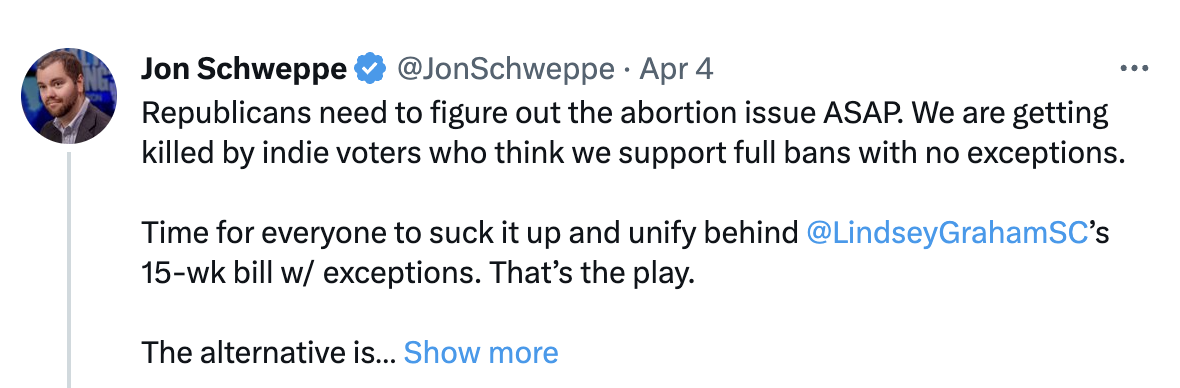
Following their preferred candidate getting absolutely blitzed in a swing-state judicial election due to his anti-abortion extremism, conservatives are now trying to argue that they need to pivot to better messaging on abortion


There are a whole host of reasons why this won't work, starting with the fact that their favored "moderate", "compromise", "good message" alternative is Lindsey Graham's proposed nationwide compulsory women-maiming law. But another reason why it won't work is that the Republican Party cannot control the behavior of its own membership -- most notably, those in the GOP's YOLO Joker caucus (federal judiciary division) -- who insist on nothing short of the absolute most draconian limits on reproductive care imaginable:

A federal judge in Texas blocked U.S. government approval of a key abortion medication Friday, siding with abortion foes in an unprecedented lawsuit and potentially upending nationwide access to the pill widely used to terminate pregnancies.

The highly anticipated ruling puts on hold the Food and Drug Administration’s approval of mifepristone, a medication first cleared for use in the United States in 2000. The ruling will not go into effect for seven days to give the government time to appeal.

U.S. District Judge Matthew J. Kacsmaryk, a nominee of President Donald Trump with long-held antiabortion views, agreed with the conservative groups seeking to reverse the FDA’s approval of mifepristone as safe and effective, including in states where abortion rights are protected.

On the one hand, Republicans need to find a way out of the abortion trap. On the other hand, unaccountable hack judges in Texas are banning abortion medication nationwide based on completely spurious, results-oriented reasoning, guaranteeing that the GOP's forced labor agenda stays front and center in all of its extreme, uncompromising splendor indefinitely.

The Texas injunction now is paired with a dueling injunction from a district court in Washington, which forbids any alteration by the FDA to the status quo (at least in the plaintiff states in that litigation; the judge declined to make his injunction nationwide). This means the case almost certainly is headed to the Supreme Court sooner rather than later. Will the Court actually follow the law for once, or will we get another (to borrow from Josh Blackman) "epicycle" as rule of law bends itself to satisfy the whims of anti-abortion extremists cloaked in Article III garb? Stay tuned.

Thursday, April 06, 2023

Rate That Apology, Part 12: Dan White

On April 5, at the onset of Passover, Labour Party leader Keir Starmer sent a message of welcome to the Jewish community: "Today I am sending my warmest wishes to members of the Jewish community as you prepare to celebrate the festival of Pesach. Chag Sameach."

Perfectly lovely, perfectly anodyne.

Replying to that tweet, Dan White, a journalist who claims to be a member of ITV's "diversity board", wrote to Starmer:

Did you see what happened at Al-Aqsa mosque while Palestinian worshippers are celebrating the holy month of Ramadan? Your silence is disgusting.

And now he's apologized:

Asked to explain his comments, White, told Jewish News: "I can only apologise for the ill timing of my tweet."

"I am not and never have been antisemitic."

"My response was not aimed at the community, but at the silence from all political parties around the conflict which is happening."

"I accept my response was badly timed, I can only apologise profoundly for it. My mental health sometimes makes snap decisions. As I said I am believer in peace, worldwide. I am sorry again for the ill timing and any offence."

Four paragraphs, all terrible. The pro forma "I am not antisemitic" is the usual level of eye rolling. Placing the blame on his "mental health" is accountability dodging (and for what it's worth, "mental health" doesn't make decisions. Dan White makes decisions, for which Dan White should learn to accept responsibility for).

However, I want to focus mostly on this framing of the problem as one of "timing". The tweet's problem was not "timing". If White had on April 5 just written a general message to the effect that Starmer or other British politicians are not paying sufficient attention to violence against Palestinian worshippers, and someone said "how dare you say something like this on the eve of Passover", that would be an objection about timing -- and an ill-taken one, since the fact that we're near the onset of Passover does not make it inappropriate to level commentary on violence occurring in Jerusalem right now.

But again, that's not the problem here. The problem is not when White wrote the tweet. It's where he did it -- in reply to an unrelated message of support for the British Jewish community in celebration of one of our holidays, having absolutely nothing to do with Israel whatsoever. The practice where anytime anyone talks about Jews in any context folks come swinging in with "what about Palestine?", is antisemitic per se, as much so as the Texas Republican who opposed a resolution honoring Muslims celebrating Ramadan because there are Muslim terrorists in Iraq.

If there's any saving grace for White, it's that the replies to Starmer's tweet are positively crawling with trolls saying much the same thing. Some consolation.

Grade: 2/10

The Tennessee Three: Whataboutism as Fascism Apologia

You've no doubt heard at this point about "the Tennessee Three", three Democratic members of the Tennessee State House facing an expulsion vote for their role in a protest against gun violence that occurred on the state legislative floor. Expulsion is a rarely-invoked procedure in Tennessee, typically reserved for obvious cases of criminality of misconduct (e.g., a bribery scandal) in cases that garner bipartisan support. To use it to kick out minority party members for a raucous protest the majority found embarrassing is a huge overreach, an exploitation of the GOP's supermajority status to further undermine basic democratic principles.

I wanted to flag a particular comparison Tennessee Republicans are using to justify their conduct -- comparing the protest to the attempted insurrection on January 6:

House Speaker Cameron Sexton compared the incident to Jan. 6: "What they did today was equivalent, at least equivalent, maybe worse depending on how you look at it, to doing an insurrection in the State Capitol," he said.

Sexton also noted that Jones and Johnson had previously been "very vocal about Jan. 6 and Washington, D.C., about what that was."

There was, of course, no insurrection here: the protest had no ambitions of overthrowing the government. But there's something revealing about this rhetorical move that I think typifies the way conservatives are normalizing and justifying fascist behavior.

Even now, many Republicans are kind of willing to concede that there was something ... untoward about January 6, and the broader campaign of election denial that spawned it. "Kind of" because they face tremendous pressure to outright endorse it, as Sexton's "maybe worse" aside makes clear. But to the extent they to recognize that there's something wrong with what happened on January 6, what they want to do is present things like January 6 as an ordinary sort of ugliness, the sort of foul or misconduct one can see from all parts of the political spectrum. Yes, maybe the January 6 thing went a bit too far. But it's not distinctive; this is a problem one can see across the aisle too. Look at Black Lives Matter protests -- why aren't they being treated like the insurrectionists? Maybe Trump shouldn't have denied the election, but is it really any different from Al Gore demanding a recount in 2000? Trump stole classified documents; well, what about her emails? Whatabout, whatabout, whatabout.

By transferring these egregious examples of anti-democratic thuggery into the realm of "normal" politics, Republicans justify treating them via the "normal" (partisan) political process. Sure it might be a bit distasteful, and more than a little opportunistic, but hey, that's politics. There's nothing exceptional here that demands standing on a broader principle. Everything blurs into an indistinguishable mush of "sometimes politics gets ugly." And in that universe, well, it's just realistic that Republicans probably won't pay much attention to their "normal" nips that might cross the line. Cynicism styles itself as realism, but it's really just cowardice.

None of this is to say that straightforward political thuggery isn't sufficient explanation for why Tennessee Republicans are acting the way they are. But there is a broader justificatory narrative being crafted here. The Tennessee Three isn't just about state and national Republicans being contemptuous of democratic norms (though it's certainly about that too). It's yet another effort to pull the extreme conservative threats to basic rule of law principles out of the realm of "extreme" and blur them into the normal hurly-burly of every day politics. Exploiting the media's instinct to "both sides" everything, the GOP will just troll all the way down

Wednesday, April 05, 2023

Wisconsin Man's Upward Fall Arrested

Democracy may finally be coming to Wisconsin, as Janet Protasiewicz defeated arch-conservative Daniel Kelly to flip a key seat on the state supreme court.

The Wisconsin Supreme Court has been a national embarrassment for years. This was the court where a justice tried to choke out one of his colleagues, after all. More recently, it was by far the court that came closest to endorsing Donald Trump's authoritarian campaign to overturn the 2020 election. Members of the conservative faction have since openly questioned the validity of President Biden's victory, putting them far outside even the conservative judicial mainstream and marking them as little more than partisan thugs.

And yet, even among this sorry bunch, Daniel Kelly would have stood out.

I first wrote about Daniel Kelly when he was initially appointed to the Wisconsin Supreme Court by then-Governor Scott Walker. He had made an argument comparing affirmative action to slavery, something that -- even restricted to the "civil rights programs are the new slavery!" field -- was jaw-dropping in its stupidity (and "civil rights programs are the new slavery!" is already a field saturated with stupidity).

Over the course of his career, and over the course of this campaign, Kelly has proven himself to be the definition of a mediocrity who's managed to fall upward via the beneficent hand of the right-wing gravy train. His academic pedigree is undistinguished. He had no judicial experience when he was appointed to the court by Walker in the first place, and after his (first) defeat he stayed plugged into Wisconsin GOP politics by providing legal advice to the effort to steal the state for Trump after Joe Biden's 2020 victory. And of course, all have now witnessed his petulant response to being defeated by Protasiewicz:

"I wish that in a circumstance like this, I would be able to concede to a worthy opponent," he said at an event held at the Heidel House Hotel in Green Lake. "But I do not have a worthy opponent to which I can concede."

Kelly called Protasiewicz's campaign "deeply deceitful, dishonorable and despicable." "My opponent is a serial liar. She's disregarded judicial ethics; she's demeaned the judiciary with her behavior. This is the future that we have to look forward to in Wisconsin."

Adding: "I wish Wisconsin the best of luck, because I think it’s going to need it."

[...]

"The people of Wisconsin have chosen the rule of Janet. I respect that decision because it is theirs to make," he said. "I respect the decision that the people of Wisconsin have made, but I think it does not end well."

If ever there was a definition of "lacking in judicial temperament," he personifies it.

Yet beyond that, Kelly is a familiar, if not archetypical figure. He is suffused with entitlement for that which he has not earned, and consumed by rage when he doesn't get it. There are thousands -- millions -- of men (almost always men) just like him. Most don't go on to become state supreme court judges, though many do bully themselves into positions far beyond their talents or capacities by a mixture of being useful to the right people and being an impossible menace when they don't get what they want. When they do, finally, see their upward fall arrested, they are incredulous and infuriated at the injustice of it all. Hell hath no fury like a mediocre White man scorned.

Indeed, perhaps Kelly's only mistake was being appointed to the Wisconsin Supreme Court instead of the Seventh Circuit Court of Appeals -- a position from which he could never be dislodged no matter how apparent it became that he was ill-suited for the position. On the federal bench, with life tenure, he could have prowled and fulminated and lashed out with impunity, forever; secure in the knowledge that it would be constitutionally impossible to ever hold him accountable. One can only imagine the law school classes he would have baited and berated.

But alas, Daniel Kelly is a creature of the state bench, and in Wisconsin, supreme court justices must meet the approval of the voters. Twice now, the voters have resoundingly rejected Daniel Kelly as unsuited for the role of state supreme court justice. Kudos to them. And while Democrats are celebrating Protasiewicz's win, the bigger winner is the small-d democracy that has been under siege in Wisconsin for far too long.

Monday, April 03, 2023

Post-Conference Roundup

Last week, approximately 35 speakers (and dozens more guests) came to Lewis & Clark Law School for the 2nd Annual Law vs. Antisemitism conference. It was an event I'd been planning for over a year, and I'm pleased to report it was a rousing success. The panels were scintillating, the conversations crackling, and the two keynotes (by the ADL's Steve Freeman and civil rights activist Eric Ward) blew the doors off the joint. I could not be prouder.

Unfortunately, as the conference approached I could feel myself getting a cold, and so I did that deal-with-the-devil bit where I just willed myself to not be sick for the conference, and my body was like "okay, but you're going to pay for that come Tuesday." So the day after the conference I was sick as a dog. But now I'm mostly better -- just some residual congestation.

Anyway, here's a roundup:

***

Haven't seen the clip, but apparently a protester held up a "Jews control the USA" sign on the CNN segment reporting on Trump's indictment today. So that's fun.


In other "is killing students in school controversial?" news, Nashville students walk out of class to protest for gun reform following the Covenant School shooting.


As a now-certified Caitlin Clark fan, it's beyond evident that folks calling Angel Reese "classless" for doing the same mugging that Clark had done all season are, well, they're not hiding the ball. And for what it's worth, there's zero evidence that Clark in any way needs or supports y'all white knighting on her behalf -- I guarantee she can take what she dishes out. (Surely, we can all agree that the only thug on the court yesterday was Kim Mulkey).

Israel looks set to give its resident fascist his own personal state-backed paramilitary squad. What could go wrong? Nothing, because "wrong" implies that the the utterly predictable consequences aren't intended.

A beautiful story of a transwoman recounting "coming out" to her 100 year old grandpa. His memory clearly already is a blessing.

Oh, and I published a new article! "Microaggressions as Negligence" is now out in the Journal of Social Philosophy.