Ammon Bundy and his cohort have been acquitted of all charges following their seizure of a federal Oregon Wildlife Refuge despite, you know, clearly having done it. A lot of people are upset about this, but I'm not. You want to know why?
Honestly, the O.J. Simpson trial had been getting a bit dated as a reference for "criminal trial where obviously guilty persons don't get convicted."* And with the Bundy acquittal, we can finally let the Simpson case go and focus our contempt for the criminal justice system and effective jury nullification on a more recent and topical case.
That's precisely how this will work, right? We are all equally outraged when high-profile White people escape punishment for the crimes they clearly committed?
* In many ways, this is worse than the Simpson case -- for while Simpson was almost assuredly guilty, at least he actually denied committing the crime. The Bundys more or less admitted to doing everything the government charged them with, with a defense justified by "but it's the government, so come on" -- a much more classic case of nullification.
Speaking of Republicans here at Berkeley, UC-Berkeley's own news site has an interesting piece on the particular challenges facing Berkeley Republican students this year. Of course, it's always a bit awkward being a conservative on the Berkeley campus. But Trump complicates things greatly, and the article interviews a range of perspectives -- from the Latino President of the Berkeley College Republicans (who had done border patrol work with the Coast Guard and was disturbed by Trump's rhetoric regarding immigrants), to a woman who is running a quixotic GOP bid for our local state assembly seat and agrees with the "locker room talk" explanation for Trump's rhetoric on women, to the child of Iranian refugees who was more of a "pox on both houses" sort. It's a good read.
One other thing I'll note on this is that my undergraduates this year are hardly the stereotypical collection of raging leftists one might expect. Certainly, they clearly lean left-of-center as a whole, and on issues like gay marriage they can barely even comprehend the argument that it should not be a national civil right. But on other issues, they're quite open to "conservative" arguments: many are deeply dubious of a strong federal government at the expense of states rights, and many at least had questions regarding the constitutionality of Obamacare. And -- in perhaps the starkest contrast to the contemporary zeitgeist of Kids These Days -- I've found them perfectly willing to contemplate and consider ideas which challenge their pre-existing belief systems (the African-American student who started by turning her nose up at the mention of Clarence Thomas, but eagerly gobbled up some of the resources I offered her about his judicial and political philosophy and its intersections with African-American political thought, was a striking and heartening example). By and large, I've found my undergraduate students to be a thoughtful, considerate, intellectually curious lot.
In entirely unrelated news, tomorrow some Berkeley students (and a few faculty members) will protest to demand that the University stop talking to Jews. You might think that's a little hyperbolic, but given that their final demand is that the University stop "coordinating" with, among other organizations, the ADL, the AJC, and the Jewish Community Relations Council, I feel okay with the descriptor.
I have, believe it or not, Republican friends (yes -- even here in Berkeley!). None of them "like" Donald Trump, so to speak. For some, that manifests in much the same way that grouchy Sanders voters feel about Clinton -- certainly not their ideal candidate, and they're happy to give off a laundry list of shortcomings, but not manifestly distinct from any other politician on their side of the spectrum who they view as unideal.
But others are very much on the #NeverTrump train, and have reacted to his nomination with a sort of staggered shellshock. They feel genuinely betrayed, completely adrift. Trump is not just an "unideal" candidate, he is the antithesis of everything that they identify with as conservatives.
I do feel bad for these people. Seriously -- I do. And it's worth noting that many of them have endured appalling levels of abuse -- grotesque, threatening, vicious abuse -- for their stance. I don't want to downplay that. But I'm watching and waiting to see if they will really come to terms with the fact that Trump is their baby. Not them, personally, but he is the outcropping of specific choices that Republicans have made over the past eight years (at least). He is not a bolt of lightning. He is not an act of God. He is not (to take the most pathetic rationalization of all) a "Democrat" (there are all manner of ways I could respond to "Trump is a Democrat", but my first instinct is simply to retort "yet note how we managed not to nominate him!").
Donald Trump -- racist, xenophobic, Islamophobic, bolstered by the alt-right and trumpeted by the anti-Semites -- is what you get when you spend years playing wink-and-nod with racist conspiracy theories while loudly dismissing any objections as just "playing the race card." Donald Trump -- paranoid, conspiratorial, unwilling to straight-forwardly commit to accepting the validity of an election he loses -- is what you get when you whip up an unsubstantiated frenzy about epidemics of "voter fraud." Donald Trump -- abjectly unconcerned with facts and openly derisive towards truth -- is what you get when you convince your followers that the media, academia, empirical research, and scholarly inquiry are all thinly-disguised liberal Trojan horses. Donald Trump -- out of control, completely unconstrained by Republican leaders (to say nothing of basic norms of decency), standing at the head of a movement that seems ready to burn it all down -- is what you get when you gleefully celebrate your base taking on the characteristics of an establishment-smashing mob.
It was very clear that many Republican elites thought they could tap into these sentiments and keep them under control. They convinced themselves that "everyone" knew it was rhetoric, it was hyperbole, it was red meat, it wasn't serious, it wasn't representative, it was only a few rubes or hot-heads who actually believed it. Until it wasn't. Until it turned out that most of the base did believe it. Donald Trump is the fruit of a decade of Republican labor. It is easier and more comforting to view him as a divine calamity, particularly for those for whom the Trump movement -- like the Frankenstein's monster it most resembles -- has turned on them with a vengeance. But his emergence is not cloaked in any mystery. And until my shellshocked Republican friends forthrightly grapple with how Donald Trump came to be the representative of contemporary American conservatism, they will never be able to either launch an effective counterattack or -- and this might be what is necessary -- accept that the contemporary conservative movement can no longer be their home.
The Washington Post has a fascinating profile on Derek Black, a young man who was raised in the White Supremacist movement and was considered a rising star in that community, who has since come to repudiate his old beliefs. The turning point was when -- after his racist affiliations became known to his college classmates -- an Orthodox Jewish classmate took it upon himself to invite Black to Shabbat dinners. It's a beautiful and touching story about how courageous acts of kindness really can make a difference even in very dark places.
The recent UK parliamentary report on anti-Semitism is a masterclass on how its done. It begins by adopting the MacPherson principle (that the starting point for when something ought to be deemed racist is when a member of the targeted group perceives it as such) for when it is appropriate to consider an anti-Semitism claim, which is correct; it then observes that more than just subjective sentiment of the aggrieved party is necessary to sustain a complaint of anti-Semitism, which is also correct. As Anshel Pfeffer put it: "British Anti-Semitism Report Declares War on ‘Goysplaining.’" I highly encourage everyone to read it in full.
Someone just sent me a link to Unite for Palestine, which is basically the internecine (and inverted) version of the Canary Mission -- an attempt by one wing of pro-Palestinian activists to name-and-shame anyone in their movement who is too concerned about anti-Semitism. JVP is a favored target, which is deliciouslypredictable. "First they came for Assange." Then, maybe, they'll come for some other accused sexual predators. We can only hope.
Today, I came across a very long investigative piece in Mother Jones by Andy Kroll of The Nation Institution on the connections between Israeli-American media mogul Haim Saban and Hillary Clinton. As I was reading it, I couldn't help but think it sounded very familiar. Was it an older article, moved to the top of MoJo's front page because it became topical? No, it's slated for the magazine's November/December 2016 issue. Did I somehow come across an early release copy? I don't think so -- where would I have gotten my hands on that? Yet the feeling persisted and persisted, until I got to this segment:
Saban says he still believes in a two-state solution, but his all-consuming concern is defending Israel and fortifying its relationship with the United States. "For me," he said several years ago, "bringing the American president closer to the people of Israel is a life goal."
One year at the Saban Forum, an annual conference featuring top officials and public figures from the United States and Israel (with the odd Arab leader), the mogul outlined his three-pronged approach for influencing American politics: fund political campaigns, bankroll think tanks, and control the media. In addition to the Saban Forum, he funded a Brookings Institution research center focused on US-Israeli relations. He has tried for years to buy media outlets in the United States and Israel; it wasn't a profit he was after, per se, but "a return with influence," as he once told a journalist.
That did it: I knew I had seen something like that line before (right down to "control the media"). And so I looked into it, and realized I had indeed read such an article -- in 2010 in the New Yorker, where Connie Bruck had published her own long profile piece on Saban. Compare the passage above to one from that article:
[Saban] remains keenly interested in the world of business, but he is most proud of his role as political power broker. His greatest concern, he says, is to protect Israel, by strengthening the United States-Israel relationship. At a conference last fall in Israel, Saban described his formula. His “three ways to be influential in American politics,” he said, were: make donations to political parties, establish think tanks, and control media outlets. In 2002, he contributed seven million dollars toward the cost of a new building for the Democratic National Committee—one of the largest known donations ever made to an American political party. That year, he also founded the Saban Center for Middle East Policy at the Brookings Institution, in Washington, D.C. He considered buying The New Republic, but decided it wasn’t for him. He also tried to buy Time and Newsweek, but neither was available. He and his private-equity partners acquired Univision in 2007, and he has made repeated bids for the Los Angeles Times.
Huh. Yes, I'd say "familiar" is one way to describe the relationship between those two passages. (The New Yorker profile is mentioned -- but not linked to -- once much deeper in Kroll's essay, on an unrelated point). That's probably the most stark overlap, but by and large Kroll's piece reads as basically a slightly rewritten and updated rehash of Bruck's older profile.
While we're on the subject, I remain curious about the "control the media" line. Obviously, "politically active Jewish billionaire says he wants to 'control media outlets'" is rather fraught territory to tread on. It would be one thing if Saban actually said as much -- and hey, brash Hollywood executives have been known to say alarming things -- but you'll note that it isn't actually placed in quotations (the "three ways to be influential in American politics" are apparently a direct quote, but the actual list is Bruck's paraphrase).
Kroll doesn't give a source for his own paragraph -- it certainly seems to track Bruck's closely -- and now we have two sources attributing to a powerful Jewish figure a desire to "control the media" without any indication of what, precisely, Saban said. And again -- maybe he did use the word "control". But the lack of a direct quote here is noteworthy given the decision to describe his position in terms that smack of a classic anti-Semitic trope. If Kroll -- who matter-of-factly describes Saban's "divided loyalties" in his very third paragraph -- has a direct quote from Saban wherein he says he wants to "control the media", he should provided it. If he simply is cribbing from Bruck's prior work, he should say so.
I have no particular desire to laud or indict Haim Saban. I find him an intrinsically interesting figure for a variety of reasons (not the least of which is his Egyptian-Jewish background -- given about a paragraph's worth of relatively similar attention in both essays), but his politics are more hawkish than my own and the beneficence of his influence is no doubt mixed. But I don't think it's too much to ask that an essay holding itself out as a major piece of novel investigative journalism should do more than give a glorified update of another profile published six years ago.
Sometimes, when we talk about racial injustice in America, we instinctively think about the American South. And sometimes, when trying to check that instinct, we say things like "sure, things are worse in the South -- but it's actually a problem nationwide."
But it's not always the case that the South is the worst offender. A very interesting post about comparative racial incarceration rates indicates that it may be the upper Midwest -- embodied by my beloved Minnesota -- that actually has the greatest incarceration problem.
The first graphic perhaps bolsters our intuitive notions about the South -- its overall incarceration rate seems far higher than the rest of the country. But if we zoom in solely on the Black male incarceration rate, that gets blurrier.
Here the evidence is more mixed: Some Southern states (Texas, Oklahoma, Louisiana) continue to do poorly -- but they're joined by states like Iowa, Wisconsin, and Pennsylvania. But even this graphic might be misleading, since it doesn't provide a comparative account of how many Black men are in jail versus their White fellows. Oklahoma, for example, seems to throw everyone in prison -- so it stands to reason that it puts a lot of Black people in prison too.
This graphic showcases the Black incarceration rate as compared to the White incarceration rate in each state. And here we can see how the center of gravity shifts decisively to the north, and particularly the upper-Midwest. Minnesota, for example, doesn't really imprison that many people -- but if you are in jail, you're almost certainly Black (or another racial minority -- Minnesota distinguishes itself for having a massive disparity not just for African-Americans, but for Latinos and Native Americans as well).
Now to be sure, we can debate whether the most important metric is the overall percentage of Black men put in prison, or the comparative Black/White figures. One could object that it is strange to excuse Oklahoma's mass incarceration of Black men by observing that it imprisons a ton of White men too. Much of the South performs "well" in the last graph simply because it has elected to pursue a mass incarceration strategy for everybody, and it's hardly a given that this decision is worth lauding. But certainly, these comparative figures are a relevant data point. And they're one where the South significantly outperforms many of its northern peer states. Those of us interested in racial justice need to own up to that.
Donald Trump's latest speech was notable for basically being a "best-of" compilation of anti-Semitic dogwhistles: A mysterious cabal of "international bankers" who are pushing for "radical globalization" and who have "virtually unlimited" financial, political, and media resources. This was after his second debate performance, where virtually every name he dropped as part of the nefarious Clintonite conspiracy was a Jewish one (Blumenthal, Soros, Gruber....). And that, in turn, follows from his more-or-less explicit promotion of a rabidly anti-Semitic alt-right led by David Duke and an array of other neo-Nazis whom Trump has barely brought himself to disavow.
Yet despite this, Donald Trump still has Jewish supporters. We shouldn't overstate the extent of this -- Jews on the whole are overwhelmingly Democratic to begin with, and even among Republicans Jews have been prominent members of the #NeverTrump movement. I simply observe that Trump continues to have some Jewish supporters. The Republican Jewish Coalition still hasn't pulled their endorsement, for example. Sheldon Adelson remains a high-profile backer. And the New York Jewish Week, in the course of endorsing Hillary Clinton for President (it's first endorsement in its history), especially chided the Orthodox Jewish community for being willing to back a candidate that so openly flouts their purported values of "piety, modesty in terms of sexual contact and respect for leaders with spiritual and intellectual authority."
So these Jews exist, albeit as a small minority of the whole. And to those Jews whom -- after all the contempt that Trump has ladled onto our community and our values -- continue to support Trump, I'll simply say this. I would never call you a "self-hating Jew". I loathe that term; I virtually never use it, and I won't use it here. But if you vote for Trump, you forfeit the right to ever call other Jews "self-hating".
What is complete repentance? It is so when an opportunity presents itself for repeating an offense and the offender refrains from doing so because he has repented, not out of fear or lack of strength. -- Maimonides
To be contrite in our failures is holier than to be complacent in perfection. -- Abraham Joshua Heschel
Another Yom Kippur has concluded, and as my dad likes to say, the best part is that we're never farther away from another Yom Kippur than we are at this moment. A favored pastime of Jewish intellectuals this time of year is to point out various sins of the Jewish community as a whole -- Israel is a frequent target, though not the only one -- and urge repentance.
I don't necessarily think this is a bad thing, framed properly. Over Rosh Hashanah, my home Rabbi gave a compelling sermon about the need to create a positive Jewish spiritual identity that went beyond "survive!", arguing that our communal Jewish institutions had given my generation the short shrift by failing to conceptualize Judaism as anything other than Fackenheim's 614th Commandment (a Commandment which, to be fair, actually does resonate with Millennial-generation-me). Repentance is about becoming better than we were before, and it's never a bad thing for the Jewish community to be better. The idea of being a "light unto nations" imposes a heavy burden on ourselves, but one we should be proud of striving towards even as we know our light could always shine brighter.
I thought about this while reflecting on Mira Sucharov's thoughtful column about the new "non-Zionist" synagogue that recently opened in Chicago. As Sucharov observes, the synagogue is not really "non-Zionist" in the way that she is a "non-NFL fan". It is by no means indifferent to Zionism. It has very strong opinions about Zionism and Israel generally. In a sense, they care a lot about Israel (in the same way that Sucharov does). But in a sense, it seems quite different. Perhaps they "care" about Israel in the same way they "care" about North Korea: "they simply think that Israel is responsible for a significant amount of evil in the world, and are working to try and rectify it -- there is no sentimentality behind it, anymore than efforts to end North Korean brutality are motivated by deep caring about North Korea."
Maybe that pushes too far -- the synagogue does seem to "care" especially about Israel because it is Jewish. But even here, the linkage to Jewishness is of a contingent and regretful kind: they don't want Israel to change so that it becomes a better emblem of Jewishness in the world, they view it as objectionable that it represents Jewishness to begin with -- that it is a Jewish state. They're concerned with Israel because it gives Jews a bad name, but they don't otherwise view Israel as legitimately part of a Jewish future. Instead, the synagogue is based around the concept of "Diasporism" -- that the Jewish home is everywhere and nowhere. Everywhere, because Jews should view their home as wherever they happen to reside. Nowhere, because there is no particular spot -- Israel included -- that we can claim as ours.
The ideal Jewish role in diasporism is a critical one -- we imagine ourselves as the conscience, the gadfly, the light unto that nation. Sometimes, of course, diasporism keeps us busy simply to remain a surviving group, a clinging-by-the-fingernails group, a deeply marginalized and vulnerable group. By definition we are not the dominant group, the powerful group, the in-control group. We certainly are not the oppressor group.
Prior to the establishment of Israel, the Jewish existence was diasporic. It did, largely, take on the qualities identified above. It can be and is romanticized, of course -- more focus on the first sentence (conscientiousness and critique) and less on the second (vulnerability and marginalization). The reason diasporism failed in the 20th century is that, between the roughly 50 years of having a state and 50 years of not having one, Zionism decisively beat diasporism on the all-important "not nearly being annihilated in a cataclysmic genocide" scoreboard. But there is no question that having a state, having a place where Jews were more than just a critical voice but a dominant voice, an in-control voice, a powerful voice was a very novel experience for Jews. And one upshot of having power is abusing that power. Of using that power to deeply, seriously, significantly wrong others. As Israel as done. As happens with power. Power gives one the opportunity to do things: terrible things and great things alike. The same dynamic that allows Jews to govern ourselves rather than exist as supplicants, also allows us to dominate others rather than coexist in equality. The same dynamic that allows Jews to save ourselves rather than pray for salvation, also allows us to hurt others rather than to respect their dignity. The coin of power allows either and both to be purchased -- one cannot have the opportunity for one without the opportunity for the other.
Diasporism sees Jewish wrongs -- genuine wrongs -- and yearns to go back to a time when Jews didn't act that way. And it is true: before there was an Israel, there was also no occupation, no Gaza incursions, no military law over Palestinians, no West Bank barrier, and so on. Jews in the diaspora did not need to worry about occupying anyone; we had no nation that could occupy. We would never be responsible for promulgating unjust laws; the laws were not ours to promulgate. We had no risk of significantly hurting others; the hand on the sovereign sword was not ours. Even our uprisings and resistances were blessed in their hopelessness. In Max Weber's terms, we could live a pure ethics of conviction, with zero concern for the ethics of responsibility. There is no true responsibility in diaspora, nothing really falls on our shoulders.
Diasporism is, at root, the Jewish fear of Jewish power. It knows that powerful Jews have the potential to be bad Jews -- in fact, it sees powerful Jews acting as bad Jews -- and its solution, its teshuvah, is to give up the trappings of power and return to the disempowered diaspora state. But as Maimonides observes, this is not repentance. The man who cuts off his tongue so that he cannot slander his neighbor has not repented, he has made true repentance impossible. Complete repentance must coexist with the opportunity, the strength, the power to commit the sin once again and the free choice not to. To "repent" for the sins derived from Jewish power by abolishing that power is no repentance at all -- it is a tacit belief that Jewish power will always, unavoidably, inherently be sinful power. It is a choice precisely to avoid the hard work of repentance, to avoid uncomfortable holiness of having to be contrite in our failures.
Diasporism is in some ways the mirror image of a completely self-satisfied Zionism, the sort that is convinced that nothing is Israel's fault, that all the problems and tribulations of the region are completely attributable to the malfeasance of Palestinians or other Arabs (or the UN, or the EU, or Iran....). In both cases, there is a complacency in (imagined) perfection. And both, in their own way, exhibit a preference for Jewish weakness, a desire to not have the choice to do right.
So on this Yom Kippur, I say we reject both. I say we recommit to Jewish strength -- including the strength to recognize and correct our sins, not because we have no choice, but because we once again are faced precisely with that choice.
But still worried. Here are three things that will keep me up at night until the moment Hillary Clinton gets a check mark next to her name on election day.
(1) From Brexit to the Columbia peace deal, this year it seems like polls have consistently underestimated the electoral allure of right-wing resentment. Do they underestimate it by enough to overcome an ever-widening Clinton lead -- and Clinton's far superior campaign organization and ground game? I don't think so, but who knows? This one boils down to "can I trust the polls", and while the answer to that isn't always yes, it's never reliably no, so I'm trying to put this one aside.
(2) If Trump wins, how much unrest will we see in America's streets? Trump's "Second Amendment" comment raised the question of whether his supporters would even accept a Clinton election (and it took a long time for him to say if he'd do so when answering that question directly in the first debate). But there is a simmering mix of anger and fear of a Trump presidency in many corners of America too -- anger that America has not been living up to its promises of equal justice under law, and fear that Trump is the manifestation of White Americans preference that we continue not to do so. If there are marches or demonstrations in American urban centers, we could see a genuine, military-style crackdown from a Trump administration. It's not like he has much care or respect for the bounds of law.
(3) Russians hacking the polling machines. This one might be my greatest fear, because even if we catch it, it would still throw our nation into chaos without clear route to recovery. The risk is real, and I'm honestly not sure why Russia wouldn't try it. Imagine how it would play out: We start seeing suspiciously high Trump numbers in precincts he shouldn't be close in. The President and the head of the CIA announce that they are sure that the polling machines have been compromised by a Russian intrusion. Does anyone think any Republican would believe it? They'd immediately go in on how Obama and Hillary are trying to steal the election! Even if the evidence of Russian tampering is clear, it will no doubt be technical and not amenable to "smoking gun" images or videos. Circumstances like this require trust in our governmental institutions, and the rise of Donald Trump is the rise of a large swath of Americans who have been willing to believe anything and everything about Obama, Clinton, and the entire federal government. There's no way they'd accept a hacking story, even if it was entirely true
I have never, in my life, seen a debate where expectations where set so low for one of the candidates. Donald Trump would have done "better than expected" if he managed to go the whole evening without being kicked off the ballot by his own party. And yet, at the start, he managed to possibly sink below a bar that was literally lying on the ground. He looked like hell. He could not stop sniffing. His answer to the question about his sexual assault braggadocio was beyond awful. His constant whining about the terrible biased moderators was simply pathetic. And then there was his horrifying promise to jail Hillary Clinton when the night was over -- a statement that goes well beyond "will Donald Trump be bad for America" and crosses into "will Donald Trump preserve democracy in America?"
He did, to be sure, get better as the night went on. For the most part, "better" just meant that he was merely incoherent -- repeating buzz words and talking points without even the semblance of substance behind them. Still, you could at least spot some potentially plausible themes (Clinton is all talk, no action) that could have resonance. And Clinton, for her part, didn't seem as comfortable with the format as she did in the first debate. Her big strength the first time around was basically acting as if Donald wasn't in the room -- refusing to engage him, refusing to give him oxygen. The more free-wheeling town hall format (and Trump's incessant interruptions) seemed to nudge her towards feeding the troll Trump, and not to her benefit. Finally, it has to be said that Trump's last answer ("say one nice thing about your opponent") was actually, genuinely, not-grading-on-a-curve excellent.
So right now, I'm less focused on the horse race aspects, and more on where we are as a nation. Ezra Klein got it right a few days ago:
But the question isn’t whether Trump has any decency. We’ve known for some time that he doesn’t. The question is whether we have any decency — whether we will elect this man, or even come close to electing this man, knowing all we know about him.
What's sad about tonight is the way it represents such a retrogression for our nation. The world is changing at a breakneck pace, and with these changes come new and novel concerns. The problems that have emerged -- getting universal health care for everyone, ensuring that equality is true in practice as well as creed, overcoming unprecedented environmental hazards that threaten our entire ecosystem (just to name a few) -- are both difficult but also solvable if we put our heads down and work on them. Yet what the Trump candidacy has shown -- even if he loses -- is that we're still stuck on the basics. "Do we jail our political opponents?" "Do we brag about our ability to assault women?" "Do we impose flat bans on entire religious groups?" This is all 101-level material, and yet this is what we are spending our political efforts on.
America deserves better than this. But we're not going to get it, not because Hillary Clinton isn't qualified to tackle these issues -- she absolutely is -- but because Trump has dragged us back from a mature democracy to a faltering, barely functioning one. And that is truly unforgivable.
Yesterday, I did the unthinkable. I not only left Google Chrome, I left it for a Microsoft browser (Edge). Chrome had basically stopped running Facebook and Twitter, and so far so good on Edge (though it seems to have trouble with Berkeley's proxy server).
Anyway, the high holidays and related travel kept me off the blog for awhile, so I have quite a few things to clear off the ol' browser.
* * * Yaacov Lozowick remarks on his Israeli Orthodox shul's experience with a newly-hired female Rabbi. It is fascinating reading.
An Israeli lawmaker for Kulanu is pregnant through IVF ... and the father is her gay best friend (I could write headlines for US Weekly)! And best news of all -- her colleagues and her country seem to support her regardless of whether they fall on the ideological spectrum.
There's a controversy burbling in some corners of the conservative "academic watchdog" (for lack of a better term) community regarding off-color remarks by Yale Philosopher Jason Stanley, and he's issued a response to that controversy that I found exceptionally thoughtful and perceptive.
One of the most important skills to develop as an academic is the ability to read things you disagree with and nonetheless recognize how they can be insightful, nuanced, and perceptive. Since Zionism and "settler-colonialism" is in the news (see my extensive remarks here), I thought I'd give a recommendation to one such paper I just read: "When Does a Settler Become a Native? (With Apologies to Mamdani)" by Tel Aviv University scholar Raef Zriek. It's a very interesting paper, even though I don't find all the analysis compelling (and I've communicated to the author that his argument would greatly benefit from engaging with the Mizrahi case).
"Ratfucking" is political slang for a dirty trick. Sometimes they're outright illegal (think, oh I don't know, hacking into an opponent's emails). But sometimes they're merely underhanded. One popular form of ratfucking, for example, is when a party runs ads in the opposing party's primary denouncing the (more moderate and electable) candidate as "not a true conservative/progressive". The hope is that this enflames the base to nominate a more extreme or polarizing candidate, who would in turn be an easier general election foe.
There has always been a gap between the Republican Party leadership -- which was always worried about Trump and thought he'd be a burden on the ticket -- and the base, which continues to adore him. The entire GOP side of the presidential race, after all, has been the sustained story of the party elites being unable to stop Trump (who -- to be perfectly clear -- I consider to be a beast of their creation. The GOP elite thought it could indefinitely whip up ever-more conspiratorial anti-Obama, anti-Clinton, anti-liberal, anti-government hysteria and yet still keep their base firmly under its own thumb. This entire election has been the story of that hubris blowing up in their face). But right now, it's perhaps more stark than ever: Party leaders actually abandoning their own nominee a month out from the election, while the Party cadre continuing to back him in earnest.
So what would happen if "someone" (probably some hitherto unknown group with a name like "People for a Greater America") started putting up some targeted ads urging Republican voters to not support the "traitors" who have turned on Trump? Label them RINOs, label them appeasers, label them tools of the wretched Hillary Clinton. Haven't we had enough of Republicans who knuckle under to the liberal media and PC culture? If they don't back Trump, why should Trump and his people back them? Throw a couple ads like that in select Nevada markets aimed at the folks who booed Heck, and watch the chaos blossom.
Of course, such a move would stand in tension with another Democratic objective: convincing anti-Trump swing voters that a vote for folks like Heck and Ayotte is akin to a vote for Trump. But with a sufficiently deft touch, it could be managed. There is a core of angry Trump supporters who are primed to hear this message, and they don't necessarily live in the same place or watch the same media as the suburban swing voters for whom Democrats very much want to harp on the "Trump = GOP" message. Hell, if one does it right one could probably get The Donald to tweet something out in favor. Every fiber of Trump's being probably wants to savage those turncoat Republicans who are urging him out of the race. Give him the opportunity, and I bet he'd lash out at them almost as a matter of reflex.
The GOP is fracturing wide open, and the Party's new strategy seems to be to throw Trump overboard in the hopes that it might save their downballot nominees. That might work ... if Trump's base continues to stay loyal to Republican politicians who just sold their candidate down the river. It seems to me that there are ample opportunities for a creative political operative to make that task much more difficult.
In our latest spin of the "outrageous Trump remarks" wheel, we landed on misogyny. Specifically, comments Trump made during taping for Access Hollywood where he graphically talked about sexually assaulting women:
During the lewd conversation captured by a microphone Trump was wearing on his lapel, Trump recounts how he tried to "fuck" an unidentified married woman before bragging that he is "automatically attracted to beautiful (women)" and just starts "kissing them." The conversation came just months after Trump married his third and current wife, Melania.
He also said: "When you're a star, they let you do it. You can do anything ... Grab them by the pussy. You can do anything."
How lovely. But this has stood out in that it has seemed to generate a particularly ferocious condemnation from Trump's fellow Republicans. Paul Ryan, set to campaign side-by-side with Trump for the first time, withdrew his invitation and declared himself "sickened". Reince Priebus was far more blunt than I've ever seen him: "no woman should ever be described in these terms or talked about in this manner. Ever." Jon Huntsman went from endorsing Trump to demanding that he drop out. Even Trump gave a non-apology-apology of the "I apologize if anyone was offended" variety (Jeb Bush: "no apology can excuse away Donald Trump's reprehensible comments degrading women.").
And while the comments themselves really cannot honestly surprise anyone, the reaction to them is a bit striking. Liberals have certainly noticed, and been quite wry -- "oh, it was okay to call Mexicans rapists, and to suggest banning all Muslims, and to fan a resurgent conservative anti-Semitism -- but this was the step too far?" Indeed, while there have been other moments where Trump has said outrageous things and political commentators have declared him dead, only for him to emerge stronger than before (think the John McCain "captured" comments), this feels different -- he is the Republican standard-bearer, there is no deluding oneself that by condemning Trump one can simply switch support to another conservative.
Honestly, it is hard to explain. And I'd be very curious to hear what someone like Kate Manne -- who has written very incisively on the role of misogyny in this election and in our society -- thinks of this development. Right now -- improbable as it may be -- it looks like Trump's misogyny might have finally closed the door on his candidacy. There's almost -- almost -- a sense in which it is heartening (though I won't pop any champagne until November 9).
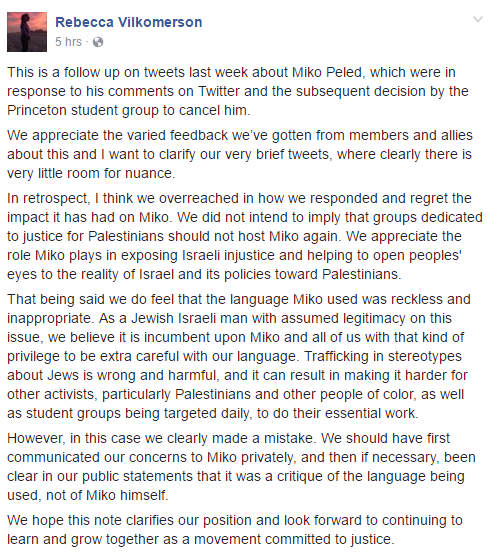
Peled was livid at the accusation of anti-Semitism, going so far as to threaten an SDSU student newspaper with a libel suit for publishing an editorial calling him anti-Semitic (lawyer's aside: he'd have no case, as assessments of anti-Semitism are matters of protected opinion immune from a libel action). With respect to JVP, he endorsed the sentiment that Vilkomerson was a "zionist in the closet" who needed "to be purged out of the movement for good."
What we have here is an example of the JVP's untenable position when it comes to anti-Semitism. The problem is not that they're "critical of Israel" or even that they're anti-Zionist. The problem is that their politics about anti-Semitism are predicated on the notion that "anti-Semitism" is, in nearly all cases, a hysterical charged lobbed in bad faith by evil Zionists wanting to suppress criticism of Israel. But, having spent years hammering this message home, they're somehow surprised to discover that when they call something anti-Semitic, they're subjected to the same treatment -- dismissed as "Zionists in the closet" (Peled's allies) or "turning priorities to suit Jewish interests" (Weir's backers). They want special dispensation as the "good Jews", and they don't get it. Instead, their "allies" treat them exactly the same as they treat every other Jew (and indeed, exactly as JVP says Jews -- other Jews, anyway -- should be treated) -- with derision, disdain, and dismissal anytime JVP tries to use its Jewish standing to challenge rather than validate their position.
Because they fail to actually acknowledge anti-Semitism as a serious and systematic problem -- indeed, because they encourage it insofar as they promote the general sentiment that Jews normally can't be trusted -- the JVP falls into a trap of its own devise. It cannot actually advocate against epistemic anti-Semitism because that would require giving credence to the bulk of the Jewish community which adopts positions they wish to see delegitimized. But having helped normalize Jewish status as epistemically unreliable, they find their pleas for a special exception (in recognition of their respectable selves) will fall on deaf ears. It turns out that, in actuality, "good behavior" doesn't in any way diminish the perceived entitlement non-Jews have to dictate Jewish behavior.
Eventually, the JVP is going to collapse under the weight of this contradiction. Again, the problem isn't that it's critical of Israel or even that it's anti-Zionist. The problem is that its power lies simultaneously in the view that Jews are untrustworthy and the view that they (JVP) are extra-trustworthy because they are Jews. The tension is sublimated so long as JVP stays in perfect lockstep with its non-Jewish allies -- JVP providing a Jewish patina to what non-Jews are already saying about Jews. But it emerges in full force and fury whenever JVP diverges from the opinions of its peers (as when they wish to challenge anti-Semitism in their movement). And the problem will only get worse. The general belief that Jews are untrustworthy, paranoid, hysterical, irrational, and/or blood-crazed cannot help but create more and more anti-Semitism of the sort that even JVP will find intolerable. But the more that JVP tries to adopt a critical rather than a vindicatory standpoint towards its "allies", the more it will see that its "credibility" as a Jewish anti-Zionist organization can't actually be drawn on.
There is space for good Jewish left-wing criticism of Israel (and plenty of groups better than JVP occupy that space: APN, J Street, and Third Narrative, to name three). But it can only work if it doesn't draw its power from a fundamentally anti-Semitic narrative of general Jewish malfeasance. For a Jewish group to take that as their foundation is wrong in its own right, of course, but it is also self-sabotaging -- a great example of De Tallyrand's famous quip that "it was worse than a crime, it was a blunder."
First things first: Under any definition of "winning" that goes beyond "did Donald Trump manage to stay coherent and under control for a single 90 second span", Hillary Clinton won this debate hands down. There's simply no question. No, Donald Trump did not spontaneously combust in a paroxysm of rage (though there were a few moments where I genuinely wondered if he was having a panic attack). Yes, he did manage to emphasize a few effective tropes, such the alleged mismatch between Clinton's rhetoric now and her record of accomplishment. But the overall effect was of a blustering, out of his league lunatic who could not stop interrupting, could not stop snorting, could not stop eye-rolling, and for much of the evening could barely string two coherent sentences together. That's just not going to fly on this level.
Of course, I'm biased -- but even the Republicans I've seen have scored the debate either a Clinton win or, at best, a draw. Their main complaint, of course, is to blame the refs -- the moderator, we're told, was biased! They point out that far less time was spent on Clinton's emails than on Trump's birtherism.
You want to know why that is? It's because Clinton's answer on emails was simple: she acknowledged a mistake, and left it at that. No attempt at a convoluted justification, no complaints that the whole thing was blown out of proportion, no conspiracy theory about how it was all in her opponent's head. And if you contrast that to Trump, you get what might have been his biggest problem all night: he could not let anything go. Birtherism? It was all Clinton's fault, and Trump actually did Obama a favor! Iraq war? An endless stream of consciousness demanding that we call Sean Hannity to verify that he was too an opponent. Racial discrimination? "We never admitted any guilt," and by the way, did I tell you about the time my club admitted Black people? It reached a peak when Trump started going off on how actually he had the better "temperament" compared to Clinton, and I was like "really dude? Is this the hill you want to die on?" Even Trump's supporters must have been groaning.
Clinton performed well because she actually possesses some self-discipline and was able to blunt potential problem areas early, sucking the air out of the issue. Trump was like a frenzied chihuahua on Adderall, chasing down anything and everything and hobbling himself with assertions that ranged from ludicrous (everything was "the worst deal ever") to self-sabotaging (did he just admit he paid no federal taxes?). And I have to think that every single woman watching that debate had their blood pressure rise in empathy each time Donald Trump insisted on talking over the calm, collected, prepared woman next to her.
The only thing that seems to be causing people to hesitate in awarding Clinton a total victory is the idea that "Trump is different." We thought he got eviscerated in the primary debates too, and his people loved him even more for it. I saw Nicolle Wallace make that point on NBC, and Kevin Drum said the same in his recap. To that, I simply observe that the GOP primary is not the general, and the same rules don't apply. GOP primary rules get you Sharron Angle and Christine O'Donnell. General election rules get those candidates annihilated as independents flee in terror.
This debate was the first time Americans really got a chance to see their 2016 choices side-by-side. It presented a stark choice, and not a particularly difficult one. I predict that when the full reactions are in, independents and swing voters will not react kindly to what Trump was selling.
Harold Pollack, responding to Barack Obama's declaration that no one over the age of eight should ever put ketchup on a hot dog, tweeted #FirstJewishPresident. Really, it just marks him as a man of Chicago.
But it did get me to thinking: In the same vein that people once called Bill Clinton our first Black President, could one say that Barack Obama was our first Jewish President?
In introducing that argument with respect to Bill Clinton, Toni Morrison argued as follows:
After all, Clinton displays almost every trope of blackness: single-parent household, born poor, working-class, saxophone-playing, McDonald’s-and-junk-food-loving boy from Arkansas. And when virtually all the African-American Clinton appointees began, one by one, to disappear, when the President’s body, his privacy, his unpoliced sexuality became the focus of the persecution, when he was metaphorically seized and body-searched, who could gainsay these black men who knew whereof they spoke? The message was clear: “No matter how smart you are, how hard you work, how much coin you earn for us, we will put you in your place or put you out of the place you have somehow, albeit with our permission, achieved. You will be fired from your job, sent away in disgrace, and—who knows?—maybe sentenced and jailed to boot. In short, unless you do as we say (i.e., assimilate at once), your expletives belong to us.
Morrison's argument mixed elements of Clinton's background, his personal style, and the particular way he was targeted and maltreated by his opponents. I think a similar connection can be made between Obama and the Jews.
I noted before he was even elected that Obama seemed to "get", in his bones, the Jewish connection to Zionism in a way that is rare to see among non-Jews. In terms of background, Obama initially rose to prominence through scholastic excellence, most prominently embodied when he was elected President of the Harvard Law Review. His cerebral style -- concerned with argument and persuasion, believing that we can reason our way through problems while being a bit uncomfortable with the back-slapping, good-ol'-boys club mentality of Washington politics -- seems quintessentially Jewish. In terms of how he handles himself, in terms of what he values, and in terms of how he approaches politics, Barack Obama could very easily pass for a Jew.
This particular form of oppression is very much Jewish in character. A few years ago, I joked that if you ever get "conspiracy theories" as a pub trivia category, you can save time by just putting down "Jews" for every answer -- odds are that, whatever the theory, somebody has pinned it on us. The conspiracy theory may well be the central organizing feature of anti-Semitism, and it may well also be the central distinctive component of the opposition to the Obama presidency -- managing to ramp up even the fevered "Clintons had Vince Foster murdered" pitch that prevailed at the end of the prior Democratic administration. On this front, Barack Obama -- presumed to be at the forefront of every domestic and global calamity, secretly plotting with shadowy cabals and foreign enemies to bring us into ruin -- was very much the first Jew in office
Finally, there's the fact that -- while Obama is overwhelmingly popular among most Jews -- about 25% loudly declare the man utterly detestable. Which is pretty Jewish in its own right, come to think of it.
As the days of the Obama presidency come to a close, I grow ever more impressed by all he accomplished in office, and proud that my community stood firmly and decisively beside him in two successful elections. One day, hopefully in my lifetime, we will have an actual Jewish President, just as we eventually got an actual Black President and how we'll soon (knock on wood) have an actual female President. But until that day, we could do far, far worse than to identify ourselves with the Obama legacy.
Last month, in Tablet Magazine, Paul Berman attempted to mount a defense of the French prohibition of Muslim veils (the infamous "Burkini" ban, or, earlier, forbidding headscarves in schools). There is a faint bit of cheekiness to it, in its appeal to French cultural history as the be-all-end-all of the argument. Why don't we respect their culture? This is just the way the French do things! Maybe it is time to check our American egos, and acknowledge that other countries have valid ideas of governance in their own right? To ban the veil is, Berman argues, simply an example of the French value of secularism -- sometimes referred to be its French term, laïcité. If his is meant to be a subtle jab at the lazy invocation of cultural relativism that some members of the left regularly indulge in, then well done. If it is meant to be more than a satire, though, there is a problem. The French ban on the veil is indeed an example of laïcité, though Berman actually objects to the use of the term since for him laïcité is nothing more than "the Jeffersonian principle of a wall between church and state, in its French version." This is true, in the same sense that the Revolutionary Courts are the "Marbury principle of judicial review, in its Iranian version." It may fill a similar niche, but it is shorn of all the limitations and checks that make the concept worth emulating. Laïcité is "separation of church and state" in the exact way that hyperbolic American conservatives have breathlessly condemned it: taking out the "state" and substituting in "public life." A ban on headscarves in public schools (or kippot -- oddly unmentioned by Berman given that they too are covered under the French law) would not be an example of separating church from the state --it is an effort to excise religion from public life. It does not govern statecraft, it governs individuals exercising their religion as individuals on those occasions where they step outside the home.
The reason why American (and French) liberals object to the ban on religious garb worn by private citizens who have the temerity to enter the public square is that this sort of compulsory secularism is not liberation even (in Berman's oh-so-vague clawback) "in principle". It is not compatible with religious equality for anyone, and in practice its burdens fall heavier on minority groups whose religious practices will always seem louder simply because they are different (notably, crucifixes are not banned so long as they are not "obtrusive"). If secularism takes this form, it is simply a different form of theocracy -- our personal rights stop to the extent they offend the (ir)religious orthodoxy.
If Berman is looking to build opposition to the veil, a misshapen argument that butchers liberal values of secularism is unlikely to do the trick. Perhaps he would do better to make common cause with an Egyptian MP who is pitching a veil ban on the grounds that it is a "Jewish" practice. After all, just as in certain circles it is sufficient to argue against a practice by labeling it "Islamic" (or "Islamist", which -- whatever merits it might have as a carefully-used term, here is not being used with care), in others there isn't any more powerful argument against a given behavior than persuading everyone that "it's Jewish".
Massachusetts Supreme Court concludes (a) that vague descriptions that a criminal suspect is a Black man wearing dark clothes is insufficient to justify a stop of any Black man wearing dark clothes and (b) that, given realities of racial profiling, the act of running from the police does not, in of itself, establish probable cause for a stop either.
Our constitutional jurisprudence surrounding legislative prayer is a two-step dance. In the first step, the judiciary tells legislatures that they can have prayers so long as the process for selecting them is not biased with respect to particular denominations or sects. In the second step, legislatures do everything they can to be biased with respect to particular denominations and sects.
The latest remix of this everlasting beat is a 4th Circuit decision in Lund v. Rowan County, where a county commission simply had its commissioners choose the prayer leaders it preferred -- unsurprisingly, leading to an overwhelmingly Christian bent. Ian Millhiser has commentary, but I'll be honest and say that I'm not convinced the decision is obviously wrong under either SCOTUS or 4th Circuit precedent. Indeed, its not even the worst 4th Circuit legislative prayer decision since the inception of this blog -- a distinction still unquestionably held by Simpson v. Chesterfield County Board of Supervisors.
The problem is that the demand for religious neutrality contained in step one founders upon the obvious fact that the upshot of step one is that legislatures might have to admit prayers by religion groups they dislike. Which means they do everything they can to channel who gets to say the prayers, which means that the "neutrality" principle immediately collapses.
It's not that there is a conceptual incoherence to the idea that legislative prayers are permissible so long as they do not discriminate in favor or against a particular sect. But it is clear that many if not most legislative bodies aren't really willing to pay that piper -- admit prayers from Jews and Muslims and Hindus and Wiccans and Satanists. And so perhaps its time to concede that the doctrinal rule we've set up just isn't going to work. There are plenty of opportunities to pray without relying on bureaucratic set asides, and some of us don't need government-sponsored training wheels before we feel secure in our faith.
A few days ago, Berkeley administrators suspended a course in progress titled "Palestine: A Settler-Colonial Analysis". As it happens, I'm relatively familiar with the course, and became aware of it well before it found itself in the middle of a national controversy. And so observing this chain of events has been like watching a car crash in slow motion. I knew it was coming, and knew it would be awful, but there was a depressing inevitability about the destruction.
I first became aware of the class when I spotted some advertisements for it which prominently featured those ridiculous maps. That inspired me to look into and read the syllabus, and what I saw was not exactly impressive. It was indeed entirely one-sided, taking a single conclusion as a given and not demonstrating an iota of interest in alternative vantages. Basically, it was not a course that did Berkeley proud in terms of its pedagogical merits.
At the same time, I also found out that the course was a "Decal" offering -- courses designed and led by undergraduates, for undergraduates (this also put an end to my brief consideration of enrolling or auditing -- they're not open to graduate students). My understanding is that faculty review and oversight of these courses is relatively minimal (though I'm not sure about the exact amount of standard supervision). Most of the classes are on relatively fluffy topics, really more of a way to secure a few easy credits and explore a fun topic. They are not representative of the standard Berkeley offering; they don't say much of anything about Berkeley as a whole other than that we let undergrads design some courses, and some undergraduate-designed courses won't wow me with their sense of depth or nuance. So I figured there really wasn't much worth saying. You give undergraduates power to design classes, and some of those classes won't perfectly embody recognized pedagogical ideals. Quelle surprise.
Then, a few days later, mention of this course started to burble up on my Twitter feed. I did my best to give a fair, non-alarmist description: Yes, the class looks pretty one-sided, no, it's not reflective of Berkeley as a whole -- it's an undergraduate-designed class that will only enroll a dozen or two. At the same time, the subliminal message I was trying to send was much more straight-forward: Let it go. Just let it go. LetItGoLetItGoLETITGO.
Alas, nobody ever lets these things go. The hysteria machine spun into action, and then the class was suspended. The official rationale is that it failed to get certain approvals. This reeks of pretext, and it might not even be that -- this post, though overwrought at times, proffers compelling evidence that the class in fact fulfilled all the procedural requirements it needed. And the thing is, every step in the process was eminently predictable. Of course Berkeley is the sort of place that would produce a class like this, and of course we have faculty members who don't care enough inculcating good pedagogical habits that they'll give it their unmitigated approval. And then of course it will get out, and of course the usual suspects on the Jewish right will blow up in a hysterical overreaction to a tiny undergraduate seminar. And then of course Berkeley administrators rush into the worst, most panicked response possible and suspend the class without even contacting the course facilitator, making a mockery of academic freedom in the process, and then of course that suspension will become proof that it is impossible for even the meekest "criticism of Israel" to be aired in academia. (And then of course someone will call for a sit-in, because this is Berkeley and every damn thing needs to be a sit-in, and then of course Simone Zimmerman will propose having it at Berkeley Hillel, as opposed to the university office that actually made the decision, because some people haven't met a forest fire they didn't ache to pour gasoline on).
So my basic position at the moment is that I hate everyone. This is not for me an uncommon sentiment when it comes to either Berkeley decision-making or discourse about Israel and Palestine, so I guess you could say I'm used to it. But now that this bonfire has well and truly surged out of control, I guess I'll offer my two cents after all.
Right now, the debate has fallen into the usual rut: either the class was great and thus canceling it was an academic freedom violation, or the class is awful and thus canceling it was no academic freedom violation whatsoever. This dichotomy conflates two separate questions -- "was the class pedagogically sound" and "was Berkeley justified in suspending it" -- and it is that conflation which is worth breaking down. A few years ago I wrote a very short essay entitled "Academic Freedom versus Academic Legitimacy", and I've analyzed a fewacademic freedomcontroversies through that lens. The basic thrust of the article is that "academic freedom is a constraint on remedies": It does not block criticism of bad academic choices -- the decision to invite a certain speaker, or to construct a one-sided syllabus, or to forward a terrible argument -- it simply takes off the table certain responses. You can't ban "bad" speakers, or punish those who invite them. You can't fire tenured academics for publishing awful arguments. And you can't cancel classes just because their design is pedagogically objectionable.
So, on the one hand, it is perfectly valid and legitimate to raise concerns about this course and how it was constructed. As I said, I read the course's syllabus, and it had plenty in it to object to. The problem was not that it adopted a "colonial" or "settler-colonial" analytical frame -- I think there is a very interesting course to be written along that dimension. The problem was that it adopted that frame in a remarkably narrow, ideologically-blinded way. "Balance" is an impossible goal, but good pedagogy demands that when one centers a course around a given theme, one at least acknowledge a range of views that properly bear on its complexity. The course as it stands is akin to a class titled "Palestinians: A Made-Up People?" with 15 weeks of readings all answering "yep." A class like that would be an embarrassment, a joke, an obvious failure to meet reasonable pedagogical standards.
This is why when I teach my seminar on anti-discrimination, my syllabus includes an array of thinkers ranging from Cheryl Harris to Gerald Rosenberg to Charles Lawrence to Antonin Scalia to (a whole unit on) Clarence Thomas. Anti-discrimination is a big, important topic, and while I can't expose my students to all views (let alone all views "evenly"), I would be embarrassed if I only relayed to them those arguments which mirrored my own. To do that would be to confuse being a teacher with being an advocate; it would represent a failure to meet basic standards of pedagogy and intellectual inquiry.
But on the other hand, these objections simply have no bearing from an academic freedom standpoint. Academic freedom means that, sometimes, people are going to teach classes that I think fail to meet basic standards of pedagogy and intellectual inquiry. That comes with the territory. Academic freedom is a constraint on remedies; it means that, whether warranted or not, objections that a class is "imbalanced" or "biased" or even just pedagogically terrible cannot be rectified with a suspension or ban. That option is (or should be) off the table. The decision to suspend the course is flatly incompatible with any legitimate understanding of what academic freedom entails. and Berkeley should be embarrassed that it did it.
To be sure, it is reasonable to demand of members of the Berkeley academic community that they try to meet certain basic pedagogical standards when designing courses -- that they at least try to avoid narrow and ideologically lazy course constructions and present topics with an eye towards their full nuance and complexity. Decal, in particular, should be a venue where we try to inculcate young students with these academic values -- namely, that one's role when designing and teaching a class is different than when one is participating in one (let alone leading a protest rally). It demands something different out of us, and what it demands can be especially difficult to give if one is personally close to the subject matter. To the extent that a significant portion of the Berkeley academic community is indifferent to those values -- simply does not care about courses being thinly disguised agitprop or forums for indoctrination -- that would indeed suggest a deep and serious failing in our university. But again, "academic freedom" means that we are limited in the remedies we can bring to bear against such failings. Right now any conversation we might have about these "cultural" failings will be drowned out, appropriately so, by the more obvious breach of academic freedom.
And let's be clear: the erosion of academic freedom norms has ramifications far beyond Berkeley. Sometimes, as here, it will be a "pro-Palestinian" course offering that is suppressed; elsewhere, it will be "pro-Israel" or Jewish or Zionist scholars who are threatened with exclusion from the academic community. Too many people are quick to cheer one while angrily crying "censorship!" at the other. But true academic freedom has no fair-weather friends. Either you back it, or you don't. The decision by the Berkeley administration to suspend the class was wrong. I suspect it will eventually be overturned (perhaps with some token modifications to the course; almost certainly with quintuple the attention paid to its offerings than would have resulted if the "pro-Israel" right had Just. Let. It. GO.), and it should be. That doesn't mean it wasn't a problematic offering, or that it adequately embodied the ideals we should aspire to as teachers and scholars. But academic freedom is not restricted only to those curricular offerings which meet my standards of ideal pedagogy. If we have a problem with a Berkeley undergraduate course, our solutions must be consistent with the basic ideals of academic freedom that enable open inquiry and free discussion in the modern university.
UPDATE: I have on good authority that the course has been reinstated. There may be some minor changes to the syllabus wording, but apparently no changes in the reading. More (linkable) information once I obtain it.
Sometimes lawyer, sometimes law professor, all the time awesome. Associate Professor, Lewis & Clark Law School.Follow me on Bluesky: @schraubd.bsky.social
"This is a weblog that is truly welcome in blogtopia — a new blog doesn't seem to be frantically trying to score points for any party. That does NOT mean it's afraid to take a stand or be critical....You really can't predict exactly where The Debate Link will come down on all issues. It's not chanting anyone's mantra." --The Moderate Voice
"[A]n emerging genius in legal scholarship and commentary." --Jim Chen
"It's on my 1st cup of coffee rss feed." --Hanno Kaiser
"I heart this blog.... he referenced Wittgenstein, and it was entirely appropriate and non-pretentious." -- kath.A.rine
The postings on this blog are not legal advice, and should not be construed as such or in any way indicate that the reader and I have formed an attorney/client relationship.