I presented my "White Jews: An Intersectional Approach" paper at the Western Political Science Association (intersectionality section) yesterday. It went quite well! I've now presented the paper to political theorists, to Jewish Studies folks, and to intersectionalists. If you haven't read it yet, I think it's pretty good.
But the prize for biggest professional accomplishment this week goes to the discovery that someone has created a website dedicated solely to informing the world that "David Schraub the UCLA Law Professor is a Disgusting Zionist Punk." That's how you know you've made it. I may not have the highest quality trolls ("UCLA"?), but at least they're mine. (I can't say I recommend reading the entire screed on the website, but it's worth browsing for a few laughs).
* * *
The African Muslim immigrant who saved a dozen Jews during the 2015 terrorist attack on a Paris kosher supermarket quietly arrived at the funeral of the elderly Holocaust survivor who was stabbed and burned to death in her apartment in an antisemitic hate crime. "I want to tell the Jews of France, you are not isolated. You are not abandoned. This is your country."
Jews and Muslims in America actually agree on quite a lot! And alignment increases alongside devoutness (more devout Jews and more devout Muslims share more in common), as well as contact (the more Jews and Muslims interact with each other, the more likely they are to perceive the two faiths as being similar in nature).
A former police officer turned criminal defense attorney discusses the Stephon Clark shooting, the way police are acculturated to fear (especially fear Black men), and the way poor instructions (e.g., "show me your hands" when your hands are holding a cellphone) can place innocent people in impossible situations.
Russian airline allegedly "deports" U.S. citizens of Indian descent back to India during a layover in Moscow. Great -- another reason for Trump to love the Russians.
Jewish News (UK) publishes an interview with Jeremy Corbyn. It's rare to see a conversation this long between two parties who so evidently loathe one another (it's really, really apparent in the interview).
Harvard Hillel is hosting a "liberation seder" focusing specifically on the ongoing injustices faced by Palestinians under occupation. The organizers worked closely with Jewish groups already affiliated with Hillel to ensure that it did not run afoul of the partnership guidelines. I'm all for this -- I have mixed feelings about the guidelines, but it's important to establish decisively that they will not be applied ad hoc to prohibit any criticism of Israel that's deemed too "sharp" in character. (Harvard Hillel has actually been consistently good on this issue -- refusing to allow the guidelines to metastasize to block, say, a program which has nothing to do with BDS because one participant backs the movement).
Sephardic Chief Rabbi in Israel may face criminal charges for likening a Black child born to White parents to a "monkey."
Friday, March 30, 2018


Wednesday, March 28, 2018
Two Standards of Opinion-Columnist Selection
Conservative writer Kevin Williamson, late of the National Review, has been hired by the Atlantic. This is proving controversial, possibly because he's conservative, or possibly because he compared a Black teenager to a primate and suggested women who have abortions should be hanged. Who can say?
In reality, the anxiety over Williamson's hiring is revealing a fissure in how we think opinion-column space should be distributed. We might think of two different rationales for why a magazine should publish a particular opinion columnist or column -- a reflective rationale and a legitimation rationale.
Under the reflective view, opinion columns should roughly mirror -- reflect -- the opinions that exist in the wider public around politics. We should have conservative columnists because many people are conservative, and it's important that the readership be exposed to that common view. Note that this makes no claim about whether this perspective is a good one, only that it's a common one.
Under the legitimation view, by contrast, opinion columnists should be chosen because the editors conclude that their views are affirmatively worth considering. This almost certainly falls short of requiring agreeing with the views -- I can think of many opinions I don't share but which I nonetheless think are worth wrestling with -- but it does represent some commentary on quality. Often (not always), the legitimation rationale for hiring a columnist cuts in the opposite direction from the reflective view -- as in the claim that so-and-so's perspective is one "you don't hear often" or is "novel and original" (though these are not in themselves reasons for publishing someone unless they're also paired with the ideas actually being decent. A string of gibberish isn't heard often in august editorial sections, but that doesn't mean it should be published).
One problem that's partially being illuminated by the Williamson hiring is that we're not sure what purpose we want opinion section editors to adopt. Some of the critics of Williamson's hiring note that, as a Never-Trump Republican, he's actually not reflective of conservative ideology as it's currently practiced -- wouldn't ideological diversity better be served by hiring an avowed Trump defender? But of course one can feel the anxiety in that sentence even as it's written -- do we really want the views of avid Trump supporters (Muslim ban, "shithole countries", and all) gracing more prominent media outlets? No, because we think it would legitimate them.
But if Williamson can't be defended as a reflective hire -- and a #NeverTrump Republican by definition isn't reflective (if even a fifth of American conservatives were of this ilk, Hillary Clinton wins in a landslide) -- he has to be justified based on legitimation. Yet it's really hard to justify him along that metric either. Certainly, the usual bromides about hearing "alternative points of view" won't do on their own. We need to know why "hang one quarter of American women" is the sort of keen social insight that is worthwhile on it's own right -- not simply as a "different" view but as an independently justifiable one.
So what do we want? The reflective case has one thing going for it, and that's that it would represent an honest portrayal of the state of conservative argumentation in America today -- which doesn't even carry Williamson's patina of #NeverTrump-ism. Yet going that route would have to mean consciously abandoning any legitimation justification for their publication -- and most editors don't really want to write that out of their job description. The fetishization of an objectively tiny branch of contemporary conservatism -- acting as if it is of more than trivial social influence -- is I think primarily grounded on how they let us deny what is before our eyes.
Seth Mandel suggests that one reason conservatives are skeptical of this reaction to Williamson is that -- even though some of the criticisms of him hold water in isolation -- it seems to happen to every conservative who joins a mainstream media outlet (cf. Bret Stephens). But the problem is that, given the state of conservatism today, an attempt to find a remotely representative yet not-terrible conservative voice will start to look like an error theory: it's possible in concept to imagine a representative conservative argument worthy of legitimation, but in practice none of them will qualify. Given where conservatism's center of gravity is right now, even if you step a standard deviation off the middle of the bell-curve, you're still likely to encounter at goodly chunk of the (again, wholly mainstream) conservative pathologies -- like "execute women" (Williamson) or "science is a hoax" (Stephens). But there's no reason -- at least once we stop grading conservatives on a curve -- why "I don't like Trump, but global warming is made up" should be thought to count as a good argument.
The sad fact is, the mean, median, and modal conservative argument in American politics today is not some deeply Burkean reflection on the need for cautious change and considered ponderings about the continuing legacy of racism coupled with healthy respect for historical American traditions. It is deep-set, gutter-level racism and xenophobia of the sort which gleefully catapults a know-nothing slur-tossing conspiracy theorist to the Oval Office and continues to enthusiastically back him to this very day. That's not fringe, that's central. We might be able to justify printing such views on the grounds that it's important to be crystal clear about what American conservatives actually believe. But if that's the rationale, there's no reason why editors should try to gussie them up to make them seem more considered and legitimate than they are on their own merits.
In reality, the anxiety over Williamson's hiring is revealing a fissure in how we think opinion-column space should be distributed. We might think of two different rationales for why a magazine should publish a particular opinion columnist or column -- a reflective rationale and a legitimation rationale.
Under the reflective view, opinion columns should roughly mirror -- reflect -- the opinions that exist in the wider public around politics. We should have conservative columnists because many people are conservative, and it's important that the readership be exposed to that common view. Note that this makes no claim about whether this perspective is a good one, only that it's a common one.
Under the legitimation view, by contrast, opinion columnists should be chosen because the editors conclude that their views are affirmatively worth considering. This almost certainly falls short of requiring agreeing with the views -- I can think of many opinions I don't share but which I nonetheless think are worth wrestling with -- but it does represent some commentary on quality. Often (not always), the legitimation rationale for hiring a columnist cuts in the opposite direction from the reflective view -- as in the claim that so-and-so's perspective is one "you don't hear often" or is "novel and original" (though these are not in themselves reasons for publishing someone unless they're also paired with the ideas actually being decent. A string of gibberish isn't heard often in august editorial sections, but that doesn't mean it should be published).
One problem that's partially being illuminated by the Williamson hiring is that we're not sure what purpose we want opinion section editors to adopt. Some of the critics of Williamson's hiring note that, as a Never-Trump Republican, he's actually not reflective of conservative ideology as it's currently practiced -- wouldn't ideological diversity better be served by hiring an avowed Trump defender? But of course one can feel the anxiety in that sentence even as it's written -- do we really want the views of avid Trump supporters (Muslim ban, "shithole countries", and all) gracing more prominent media outlets? No, because we think it would legitimate them.
But if Williamson can't be defended as a reflective hire -- and a #NeverTrump Republican by definition isn't reflective (if even a fifth of American conservatives were of this ilk, Hillary Clinton wins in a landslide) -- he has to be justified based on legitimation. Yet it's really hard to justify him along that metric either. Certainly, the usual bromides about hearing "alternative points of view" won't do on their own. We need to know why "hang one quarter of American women" is the sort of keen social insight that is worthwhile on it's own right -- not simply as a "different" view but as an independently justifiable one.
So what do we want? The reflective case has one thing going for it, and that's that it would represent an honest portrayal of the state of conservative argumentation in America today -- which doesn't even carry Williamson's patina of #NeverTrump-ism. Yet going that route would have to mean consciously abandoning any legitimation justification for their publication -- and most editors don't really want to write that out of their job description. The fetishization of an objectively tiny branch of contemporary conservatism -- acting as if it is of more than trivial social influence -- is I think primarily grounded on how they let us deny what is before our eyes.
Seth Mandel suggests that one reason conservatives are skeptical of this reaction to Williamson is that -- even though some of the criticisms of him hold water in isolation -- it seems to happen to every conservative who joins a mainstream media outlet (cf. Bret Stephens). But the problem is that, given the state of conservatism today, an attempt to find a remotely representative yet not-terrible conservative voice will start to look like an error theory: it's possible in concept to imagine a representative conservative argument worthy of legitimation, but in practice none of them will qualify. Given where conservatism's center of gravity is right now, even if you step a standard deviation off the middle of the bell-curve, you're still likely to encounter at goodly chunk of the (again, wholly mainstream) conservative pathologies -- like "execute women" (Williamson) or "science is a hoax" (Stephens). But there's no reason -- at least once we stop grading conservatives on a curve -- why "I don't like Trump, but global warming is made up" should be thought to count as a good argument.
Hard Left Jews Are Not "We Young Jews"
There's something just ... perfect about Annie Cohen writing a column in the Forward criticizing Jews for trying to hold Jeremy Corbyn accountable for his antisemitic associations under the title "Leave Jeremy Corbyn Alone. He’s The Leader We Young Jews Have Waited For."
Why?
Because last year, Annie Cohen ran for the presidency of the UK's Union of Jewish Students (as an avowedly non-Zionist candidate) -- a delightfully democratic mechanism for determining what, exactly, "young Jews" desire.
And she came in last place. With less than 9% of the vote.
Turns out, we have pretty compelling evidence that Annie Cohen doesn't have her finger on the pulse of what "young Jews" are waiting for.
Now, to be clear, Cohen has every right to dissent from the predominant view of her generation of Jews. She's absolutely entitled to say "while most young Jews believe A, I believe B, and here's why."
But what's troubling here is the pretension of being representative -- the claim of being right in the thick of a live controversy (if not on the leading side) as opposed to sitting way out on the marginal wings.
It's part of a disturbing trend among this sort of Jewish activist -- claiming to "speak for" communities that by all objective metrics want nothing to do with them. Ben Gladstone pointed out cases in the US, David Hirsh has written similarly about the function of groups like Jewish Voice for Labour in the UK. Groups and individuals whose modus operandi is to kick up dust to deny the existence of any "consensus" in the Jewish community around issues of antisemitism, to give third parties an excuse to simply pick the "side" that better matches their pre-existing priors.
The issue isn't of moral correctness, but simply of numbers. When Cohen writes vaguely that, "of those of us who voted Labour last year, many were Jewish," that might be technically true -- but only in the same way that "many" of Trump's voters were Muslim (Trump's level of Muslim support was in fact identical to Corbyn's rate of Jewish support). It's a classic example of how to tokenize with proportions. The sleight of hand isn't in acknowledging its existence of pro-Corbyn Jews, it's in implying that they're more than an obscure fringe that could satisfy any remotely robust obligation to "engage" with Jews as a group.
So this happens all the time. But normally it's obscured -- how can we really know who speaks for young Jews, or what politics they do and don't find appealing?
It is one of the many virtues of the UJS actually having democratic elections that here we get a crystalline case: where we know just how little support someone who claims to be representing "we young Jews" has among said "young Jews." That it didn't stop her from making the claim is testament to the hubris of the movement, and how little it cares whether its pretensions of authority map onto any reality.
I'm not sure which leader "young Jews" in the UK are waiting for. But they've been pretty emphatic in saying Annie Cohen isn't it.
Why?
Because last year, Annie Cohen ran for the presidency of the UK's Union of Jewish Students (as an avowedly non-Zionist candidate) -- a delightfully democratic mechanism for determining what, exactly, "young Jews" desire.
And she came in last place. With less than 9% of the vote.
Turns out, we have pretty compelling evidence that Annie Cohen doesn't have her finger on the pulse of what "young Jews" are waiting for.
Now, to be clear, Cohen has every right to dissent from the predominant view of her generation of Jews. She's absolutely entitled to say "while most young Jews believe A, I believe B, and here's why."
But what's troubling here is the pretension of being representative -- the claim of being right in the thick of a live controversy (if not on the leading side) as opposed to sitting way out on the marginal wings.
It's part of a disturbing trend among this sort of Jewish activist -- claiming to "speak for" communities that by all objective metrics want nothing to do with them. Ben Gladstone pointed out cases in the US, David Hirsh has written similarly about the function of groups like Jewish Voice for Labour in the UK. Groups and individuals whose modus operandi is to kick up dust to deny the existence of any "consensus" in the Jewish community around issues of antisemitism, to give third parties an excuse to simply pick the "side" that better matches their pre-existing priors.
The issue isn't of moral correctness, but simply of numbers. When Cohen writes vaguely that, "of those of us who voted Labour last year, many were Jewish," that might be technically true -- but only in the same way that "many" of Trump's voters were Muslim (Trump's level of Muslim support was in fact identical to Corbyn's rate of Jewish support). It's a classic example of how to tokenize with proportions. The sleight of hand isn't in acknowledging its existence of pro-Corbyn Jews, it's in implying that they're more than an obscure fringe that could satisfy any remotely robust obligation to "engage" with Jews as a group.
So this happens all the time. But normally it's obscured -- how can we really know who speaks for young Jews, or what politics they do and don't find appealing?
It is one of the many virtues of the UJS actually having democratic elections that here we get a crystalline case: where we know just how little support someone who claims to be representing "we young Jews" has among said "young Jews." That it didn't stop her from making the claim is testament to the hubris of the movement, and how little it cares whether its pretensions of authority map onto any reality.
I'm not sure which leader "young Jews" in the UK are waiting for. But they've been pretty emphatic in saying Annie Cohen isn't it.
Tuesday, March 27, 2018
Eighth Circuit: Go Ahead and Taze Him, Bro -- He's Mentally Ill
Today from the Eighth Circuit: "[N]o reasonable officer" would have concluded that tasering an unarmed, passive paranoid schizophrenic unsuspected of any criminal activity five times after a different police officer broke his arm because just sitting there "could have [been] interpreted" by the officer "as resistance" constitutes "excessive force."
As is always in cases like these, if this strikes you as obviously ludicrous, you really need to read up on your qualified immunity jurisprudence.
Incidentally, as the gun control debate shift in focus -- as it always tends to do -- towards "mental illness", it's worth reflecting on cases like this. The victim in this case probably did need mental health services -- his father wanted him to get evaluated after he stopped taking his medicine and began behaving erratically. His father almost certainly did not want his son to have his arm broken and be shocked into submission. But now that he's learned that's what happens when you try to get your son mental health services, he's presumably going to be far less likely to call in the future. Imagine that: Imagine that every time you had a medical emergency part of the calculus before calling 911 is asking "will the EMTs beat me up?" It isn't exactly a recipe for the ideal distribution of health care service.
The man in this case wasn't violent, but our cultural discourse increasingly is treating him like an inherent threat -- which means police officers (and all of us -- but officers are the ones empowered to use physical violence) will be more inclined to treat him as a threat, which means he's more vulnerable to having violence visited upon him when what he needed was medical assistance.
Police officers are often not trained to be front-line responders in cases like this. When we treat mental illness as a subcategory of crime control, though, this is a predictable result. I think we can have a conversation about the toxic interaction of mental illness and easily accessible firearms while recognizing that the stigmatization of those suffering from mental illness doesn't just obscure who's actually more at risk from whom; it in many ways produces these risks. And the result is that mentally ill individuals and their families -- when seeking the assistance they need to be healthy -- have to make a terrible risk calculation before they make the call.
As is always in cases like these, if this strikes you as obviously ludicrous, you really need to read up on your qualified immunity jurisprudence.
Incidentally, as the gun control debate shift in focus -- as it always tends to do -- towards "mental illness", it's worth reflecting on cases like this. The victim in this case probably did need mental health services -- his father wanted him to get evaluated after he stopped taking his medicine and began behaving erratically. His father almost certainly did not want his son to have his arm broken and be shocked into submission. But now that he's learned that's what happens when you try to get your son mental health services, he's presumably going to be far less likely to call in the future. Imagine that: Imagine that every time you had a medical emergency part of the calculus before calling 911 is asking "will the EMTs beat me up?" It isn't exactly a recipe for the ideal distribution of health care service.
The man in this case wasn't violent, but our cultural discourse increasingly is treating him like an inherent threat -- which means police officers (and all of us -- but officers are the ones empowered to use physical violence) will be more inclined to treat him as a threat, which means he's more vulnerable to having violence visited upon him when what he needed was medical assistance.
Police officers are often not trained to be front-line responders in cases like this. When we treat mental illness as a subcategory of crime control, though, this is a predictable result. I think we can have a conversation about the toxic interaction of mental illness and easily accessible firearms while recognizing that the stigmatization of those suffering from mental illness doesn't just obscure who's actually more at risk from whom; it in many ways produces these risks. And the result is that mentally ill individuals and their families -- when seeking the assistance they need to be healthy -- have to make a terrible risk calculation before they make the call.
Thursday, March 22, 2018
Hold It: Now Jews Talk About Antisemitism Too Little?
I don't really want to join the pile-on that greeted Jonathan Weisman's NYT column wondering why, in his view, American Jews aren't calling out antisemitism enough. If you'd like, here's commentary from Allison Kaplan Sommer and Andrew Silow-Carroll, as well as a follow-up interview Weissman did with the Forward.
I've actually written some things which might be thought of as in alignment with Weisman's thesis, e.g., praising the ADL but calling out other Jewish groups for going soft on Steve Bannon (the terrible revelation that many Jewish orgs kept quiet specifically to avoid alienating conservative donors would also fit very well here). That said, I think the story of whether Jews are or aren't sufficiently calling out antisemitism in America and globally is a complicated story; I don't think the answer is pat
But for now, all I want to add is this: How can we write a column on this subject, where the thesis is "Jews talk too little about antisemitism", without even acknowledging the trope that Jews talk too much about antisemitism? Isn't that the more pervasive stereotype? Certainly, it isn't dead yet -- as I found out a few years ago at an academic conference:
Just like conservatives started on "colleges indoctrinate impressionable youths with obscene smut and Marxist propaganda" and skipped on over to "colleges shield snowflake youths from controversial ideas and difficult viewpoints" without seeming to miss a beat. somehow we've hopped from "Jews always talk about antisemitism" to "Jews never talk about antisemitism" without even acknowledging the shift.
As it happens, I think I more-or-less agree with Weisman in that I think Jews aren't particularly vocal about antisemitism and that we should be louder on the subject. But one of the more plausible explanations for that observation is that Jews have grown gun-shy on raising the issues for fear of supporting the omnipresent narrative that Jews are too vocal and too loud on the matter. I find it baffling -- bordering on bizarre -- that one could write a column (hopefully not a whole book!) on this subject and just skip over that stereotype entirely.
I've actually written some things which might be thought of as in alignment with Weisman's thesis, e.g., praising the ADL but calling out other Jewish groups for going soft on Steve Bannon (the terrible revelation that many Jewish orgs kept quiet specifically to avoid alienating conservative donors would also fit very well here). That said, I think the story of whether Jews are or aren't sufficiently calling out antisemitism in America and globally is a complicated story; I don't think the answer is pat
But for now, all I want to add is this: How can we write a column on this subject, where the thesis is "Jews talk too little about antisemitism", without even acknowledging the trope that Jews talk too much about antisemitism? Isn't that the more pervasive stereotype? Certainly, it isn't dead yet -- as I found out a few years ago at an academic conference:
The folks questioning me seemed to think that the debate we were having was whether anti-Semitism is raised too often or just the right amount. But I don't think anti-Semitism is talked about the right amount; I think we talk about far too infrequently.... For all we have convinced ourselves that it is easy to cry anti-Semitism, that Jews don't have qualms about doing so when it's false let alone when it's real, the reality is far different. Pretty much all the Jews I know, especially those left-of-center (which is to say, most Jews), are keenly aware of the costs of anti-Semitism talk -- that each time they try to raise the subject (no matter the context or validity), they are feeding into this narrative of "there they go again."A good chunk of the comments responding to the (very good) Trayon White apology this past week also were in this vein -- "look at the Jews, crying antisemitism just because someone says the Rothschild's control the weather!"
Just like conservatives started on "colleges indoctrinate impressionable youths with obscene smut and Marxist propaganda" and skipped on over to "colleges shield snowflake youths from controversial ideas and difficult viewpoints" without seeming to miss a beat. somehow we've hopped from "Jews always talk about antisemitism" to "Jews never talk about antisemitism" without even acknowledging the shift.
As it happens, I think I more-or-less agree with Weisman in that I think Jews aren't particularly vocal about antisemitism and that we should be louder on the subject. But one of the more plausible explanations for that observation is that Jews have grown gun-shy on raising the issues for fear of supporting the omnipresent narrative that Jews are too vocal and too loud on the matter. I find it baffling -- bordering on bizarre -- that one could write a column (hopefully not a whole book!) on this subject and just skip over that stereotype entirely.
Employers Don't Make Passes ....
A new, very depressing study finds that women applying for jobs are penalized (compared to men) for getting good grades in college. Basically, employers value competence in men but likability in women, and so they reward men for getting better grades (associated with competence) while viewing high-achieving women with skepticism (assuming they're less likable). The effect is strongest among women majoring math, because of course it is.
Ugh, ugh, and ugh.
Ugh, ugh, and ugh.
Wednesday, March 21, 2018
Quote of the Day: Nozick on a REAL "Powerful Argument"
No joke, I had remembered Nozick said something like this but couldn't remember the exact quote -- then spent forever searching for it fruitlessly before someone completely randomly posted it on twitter today.
For the record, it's from Robert Nozick, Philosophical Explanations (Cambridge: Harvard UP 1981), p. 4.
The terminology of philosophical art is coercive: arguments are powerful and best when they are knockdown, arguments force you to a conclusion, if you believe the premises you have to or must believe the conclusion, some arguments do not carry much punch, and so forth. A philosophical argument is an attempt to get someone to believe something, whether he wants to believe it or not. A successful philosophical argument, a strong argument, forces someone to a belief.Though philosophy is carried on as a coercive activity, the penalty philosophers wield is, after all, rather weak. If the other person is willing to bear the label of "irrational" or "having the worse arguments," he can skip away happily maintaining his previous belief. He will be trailed, of course, by the philosopher furiously hurling philosophical imprecations: "What do you mean, you're willing to be irrational? You shouldn't be irrational because..." And although the philosopher is embarrassed by his inability to complete this sentence in a noncircular fasion - he can only produce reasons for accepting reasons - still, he is unwilling to let his adversary go.Wouldn't it be better if philosophical arguments left the person no possible answer at all, reducing him to impotent silence? Even then, he might sit there silently, smiling, Buddhalike. Perhaps philosophers need arguments so powerful they set up reverberations in the brain: if the person refuses to accept the conclusion, he dies. How's that for a powerful argument. Yet, as with other physical threats ("your money or your life"), he can choose defiance. A "perfect" philosophical argument would leave no choice.
For the record, it's from Robert Nozick, Philosophical Explanations (Cambridge: Harvard UP 1981), p. 4.
Tuesday, March 20, 2018
"I'm in a Book -- No, Not Because of That!" Roundup
The political theory class moves onto its feminism unit. I thought about recommending my students read Kate Manne's fantastic book Down Girl: The Logic of Misogyny -- after all, I'm in it! Upon reflection, telling my students that I'm "in" a book about misogyny may be a bad idea unless I provide considerably more context about the nature of my inclusion (I was discussant when she presented a chapter of the book at a Berkeley workshop; she was also generous enough to cite to my "Playing with Cards" article).
* * *
New Voices (a periodical promoting young Jewish writers) has a piece on Mizrahi Jews trying to find space for their stories in generally-Ashkenazi-dominated campus Jewish spaces.
Study: Middle School students (of all races) prefer teachers of color. Suggestive that implicit biases aren't as prevalent among tweens and young teens? Or that teachers of color who manage to overcome racialized barriers and mistrust to reach and keep their positions are particularly talented?
Oregon judge suspended after, among other things, putting up a picture of Hitler in his courthouse's "Hall of Heroes" (he also refused to marry same-sex couples, tried to use his judicial status to intimidate a youth soccer referee, and allowed a felon whose case he was adjudicating to handle a firearm in his presence).
BDS activists in Spain are suing an anti-BDS watchdog for "intimidation" stemming from the latter's successful legal efforts to overturn BDS ordinances passed in various Spanish municipalities. A judge is allowing the lawsuit to proceed. While there's something unnerving about a suit claiming that the counterparty winning discrimination suits constitutes a form of "discrimination", I try not to jump to conclusions about the meaning of pre-trial rulings in foreign legal cultures, because I have no idea what the relevant legal standards of review are in (in this case) Spain. So grain of salt.
Trump Secretary of State nominee Mike Pompeo is deeply tied to anti-Muslim bigots. There's a special place in hypocrisy hell for those in the Jewish community who went all-in on Tamika Mallory for her ties to Louis Farrakhan last week who back Pompeo this week (RJC, looking at you).
Professors in the Geography Department at the University of British Columbia successfully pressure their own students to cancel a gala that would've been held at the campus Hillel space. The gala would not (to my knowledge) have been Israel (or Jewish-related). Hey, I remember when we went through this at Brown!
* * *
New Voices (a periodical promoting young Jewish writers) has a piece on Mizrahi Jews trying to find space for their stories in generally-Ashkenazi-dominated campus Jewish spaces.
Study: Middle School students (of all races) prefer teachers of color. Suggestive that implicit biases aren't as prevalent among tweens and young teens? Or that teachers of color who manage to overcome racialized barriers and mistrust to reach and keep their positions are particularly talented?
Oregon judge suspended after, among other things, putting up a picture of Hitler in his courthouse's "Hall of Heroes" (he also refused to marry same-sex couples, tried to use his judicial status to intimidate a youth soccer referee, and allowed a felon whose case he was adjudicating to handle a firearm in his presence).
BDS activists in Spain are suing an anti-BDS watchdog for "intimidation" stemming from the latter's successful legal efforts to overturn BDS ordinances passed in various Spanish municipalities. A judge is allowing the lawsuit to proceed. While there's something unnerving about a suit claiming that the counterparty winning discrimination suits constitutes a form of "discrimination", I try not to jump to conclusions about the meaning of pre-trial rulings in foreign legal cultures, because I have no idea what the relevant legal standards of review are in (in this case) Spain. So grain of salt.
Trump Secretary of State nominee Mike Pompeo is deeply tied to anti-Muslim bigots. There's a special place in hypocrisy hell for those in the Jewish community who went all-in on Tamika Mallory for her ties to Louis Farrakhan last week who back Pompeo this week (RJC, looking at you).
Professors in the Geography Department at the University of British Columbia successfully pressure their own students to cancel a gala that would've been held at the campus Hillel space. The gala would not (to my knowledge) have been Israel (or Jewish-related). Hey, I remember when we went through this at Brown!
Monday, March 19, 2018
Things People Blame the Jews For, Part XLIV/Rate That Apology, Part 8: DC Weather Edition
It's another two-fer!
Yesterday, two separate people texted me asking if I'd see the D.C. Councilman, Trayon White Sr., who blamed the Rothschild's for manipulating the weather in Washington and causing recent snowstorms. And I'm like -- dammit, I just wanted to enjoy my weekend. But alas:
Anyway, because I'm old and slow and can't respond to things how I used to, I wasn't able to blog on this until after Councilman White issued his apology.
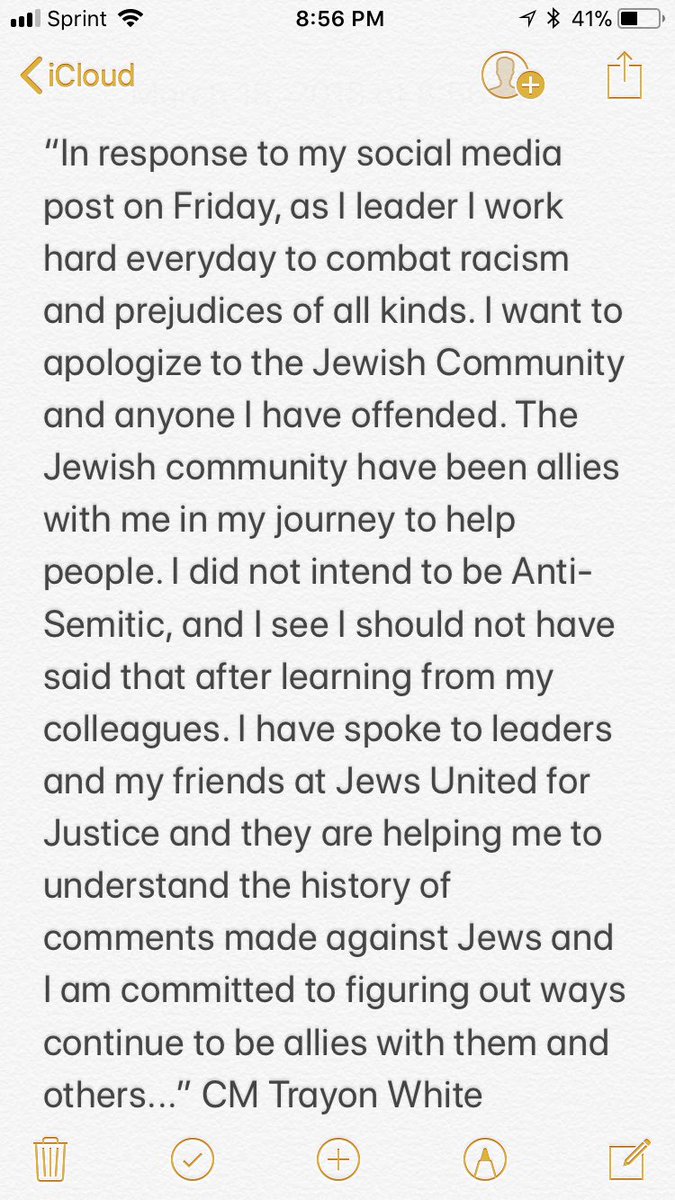
I actually really like this one. Let me explain why.
The first reason I like it is based on something perhaps not evident in the four corners of the apology itself, but which I've confirmed from other sources: White took it upon himself to reach out to Jews United for Justice (a DC-area Jewish group) to ask them what he had done wrong and how he should make amends. Now, just to be clear, this is not an "I-have-Jewish-friends" defense (that's bad). It wasn't even "after Jews reached out to me, I realized I was wrong" (better). It's "after realizing I hurt them, I took it upon myself to take the initiative and reach out to Jews to figure out what I should do better" (best).
But the bigger reason I like it is that it commits to the idea that White needs to learn. Yes, we can roll our eyes at the prospect that someone is utterly unaware of how "Rothschild" stands in for antisemitic conspiracies. But even if they somehow managed to be ignorant on the subject, that's no excuse unless it's coupled with a recognition that one clearly needs to learn more if one is to be a good ally to Jews. And that's what this apology does quite well. It speaks of how JUFJ is "helping me to understand," and that he is "committed to figuring out ways [to] continue to be allies with them." It doesn't claim that he's already exemplary on the subject, and that the video was some inexplicable blurt that shouldn't sully an otherwise perfect record. The contrast to, say, the Harvard Law Student who gave a decent apology for allegedly inadvertent antisemitism but didn't indicate that he thought he had more to learn on the subject is striking, and cuts strongly in White's favor.
One thing that it is often hard to remember for for those of us committed to fighting antisemitism is that our end-goal isn't to fight antisemitism, it's to beat it. And one corollary of that goal, then, is that any campaign against antisemitism worth its salt has to account for -- indeed, actively desire -- the possibility that some people who said or believe genuinely antisemitic things will, at some later date, change their minds. Put another way, we have to have strategies through which, when encountering antisemitism, we actually change minds. Naz Shah is a great example of how much power can emerge when this works.
I'm not saying that Councilor White has earned his stripes yet. That remains to be seen based on what he does going forward; one apology (even a genuine one) issued in the moment will not and should not suffice.
But it's a start. And as a start, it's a pretty good.
Grade: 9/10.
Yesterday, two separate people texted me asking if I'd see the D.C. Councilman, Trayon White Sr., who blamed the Rothschild's for manipulating the weather in Washington and causing recent snowstorms. And I'm like -- dammit, I just wanted to enjoy my weekend. But alas:
“Man, it just started snowing out of nowhere this morning, man. Y’all better pay attention to this climate control, man, this climate manipulation,” he says. “And D.C. keep talking about, ‘We a resilient city.’ And that’s a model based off the Rothschilds controlling the climate to create natural disasters they can pay for to own the cities, man. Be careful.”Okay, first of all, as a long-time resident of the DC metro area, I can attest that I don't care one bit about snowfall -- the weather pattern that's worth developing a conspiracy over is our 95 degree/9000% humidity summers. That's hell on earth. Second, I don't think we've had a weather-related entry in this series since Jews created the tsunami that hit the Fukushima reactor in Japan, so way to give us a throw-back!
Anyway, because I'm old and slow and can't respond to things how I used to, I wasn't able to blog on this until after Councilman White issued his apology.
I actually really like this one. Let me explain why.
The first reason I like it is based on something perhaps not evident in the four corners of the apology itself, but which I've confirmed from other sources: White took it upon himself to reach out to Jews United for Justice (a DC-area Jewish group) to ask them what he had done wrong and how he should make amends. Now, just to be clear, this is not an "I-have-Jewish-friends" defense (that's bad). It wasn't even "after Jews reached out to me, I realized I was wrong" (better). It's "after realizing I hurt them, I took it upon myself to take the initiative and reach out to Jews to figure out what I should do better" (best).
But the bigger reason I like it is that it commits to the idea that White needs to learn. Yes, we can roll our eyes at the prospect that someone is utterly unaware of how "Rothschild" stands in for antisemitic conspiracies. But even if they somehow managed to be ignorant on the subject, that's no excuse unless it's coupled with a recognition that one clearly needs to learn more if one is to be a good ally to Jews. And that's what this apology does quite well. It speaks of how JUFJ is "helping me to understand," and that he is "committed to figuring out ways [to] continue to be allies with them." It doesn't claim that he's already exemplary on the subject, and that the video was some inexplicable blurt that shouldn't sully an otherwise perfect record. The contrast to, say, the Harvard Law Student who gave a decent apology for allegedly inadvertent antisemitism but didn't indicate that he thought he had more to learn on the subject is striking, and cuts strongly in White's favor.
One thing that it is often hard to remember for for those of us committed to fighting antisemitism is that our end-goal isn't to fight antisemitism, it's to beat it. And one corollary of that goal, then, is that any campaign against antisemitism worth its salt has to account for -- indeed, actively desire -- the possibility that some people who said or believe genuinely antisemitic things will, at some later date, change their minds. Put another way, we have to have strategies through which, when encountering antisemitism, we actually change minds. Naz Shah is a great example of how much power can emerge when this works.
I'm not saying that Councilor White has earned his stripes yet. That remains to be seen based on what he does going forward; one apology (even a genuine one) issued in the moment will not and should not suffice.
But it's a start. And as a start, it's a pretty good.
Grade: 9/10.
Thursday, March 15, 2018
Things People Blame the Jews For, Volume XLIII: Uber Turkey
Where ever Uber goes, so go complaints from the local Taxi industry. I have some sympathy -- really, I do. Uber isn't exactly known for playing by the rules, and it seems reasonable enough to demand that Uber face the same regulations as taxis generally (whether that entails leveling regulations up or down, I'm agnostic to).
But regardless of how you feel about Uber, nobody should be surprised about who's being blamed for its disruptive effect (in Turkey, at least).
Anyway, I use Lyft, so presumably I'm exempt from blame here? (Obviously I'm kidding -- the whole point of this series is that there's no escape from blame for anything).
But regardless of how you feel about Uber, nobody should be surprised about who's being blamed for its disruptive effect (in Turkey, at least).
The president of the Chamber of Istanbul Taxi Businesses has accused Uber of being a targeted attack on his industry carried out by what he called “the Jewish lobby”, Turkish Jewish newspaper Şalom said .
“The global thieving Jewish lobby is carrying out commercial taxi piracy in Turkey,” Eyüp Aksu told a crowd of anti-Uber protesters outside an Istanbul courthouse.
He said the Turkish media were joining in, attacking taxi drivers with biased articles.For the record, "global thieving Jewish lobby" is offensive and inaccurate. We prefer the term "Guild of Jewish Thieves," which is much cooler.
Anyway, I use Lyft, so presumably I'm exempt from blame here? (Obviously I'm kidding -- the whole point of this series is that there's no escape from blame for anything).
Tuesday, March 13, 2018
Post- (and Pre-)National Roundup
No, this isn't about Tillerson (or Goldstein, or McEntee ... goodness, this was a hell of a morning). I delivered the lecture on Nationalism in our Political Theory class today -- which went fine, except that I also have to teach a section on Nationalism tomorrow and now I've used up all my knowledge on the subject. Time for many rounds of my old standbys -- "say more on that", "well, what do you think?", and of course "break off into small groups to discuss."
Anyway, roundup time!
* * *
Advances in turbine technology are making wind power a real player in electricity market -- and not grading on the "renewable energy" curve either.
A powerful story on a UC-Berkeley student living in an unheated trailer with no sewage hookup .... that he's about to be evicted from. This is an extreme story, but it gets to why I get very defensive when Berkeley students are attacked in the media as supposedly epitomizing careless, unserious millennial frivolity. Many of the students here are coming from places and backgrounds where they're well aware of what it means to be attending UC-Berkeley, and are behaving accordingly under conditions that God willing I'll never come close to. When they're lazily stereotyped as aimless hippie stoners, it disrespects them, their work ethic, their talent, and their perseverance.
U. Penn. Law Professor Tobias Barrington Wolff on his colleague, Amy Wax, whom he persuasively argues has converted into the academic equivalent of an Ann Coulter provocateur. This passage is also generally applicable:
Gretchen Rachel Hammond -- the half-Indian Jewish transwoman best known for breaking the story of the Chicago Dyke March expelling Jewish marchers and then being fired from her own newspaper for covering the story -- has a powerful piece detailing her experience and her "divorce" from the trans community in its wake. It is a poignant, cutting, and often very sad piece -- not the least because, for all her fulminations against "intersectionality", the concept in its original manifestation would be very well suited to articulating the sort of marginalization and exclusion Hammond details (one would not be off the mark in summarizing Hammond's experience as one of being "split at the root" -- Adrienne Rich's felicitous phrase which has often been approvingly quoted in the intersectionalist literature).
Anyway, roundup time!
* * *
Advances in turbine technology are making wind power a real player in electricity market -- and not grading on the "renewable energy" curve either.
A powerful story on a UC-Berkeley student living in an unheated trailer with no sewage hookup .... that he's about to be evicted from. This is an extreme story, but it gets to why I get very defensive when Berkeley students are attacked in the media as supposedly epitomizing careless, unserious millennial frivolity. Many of the students here are coming from places and backgrounds where they're well aware of what it means to be attending UC-Berkeley, and are behaving accordingly under conditions that God willing I'll never come close to. When they're lazily stereotyped as aimless hippie stoners, it disrespects them, their work ethic, their talent, and their perseverance.
U. Penn. Law Professor Tobias Barrington Wolff on his colleague, Amy Wax, whom he persuasively argues has converted into the academic equivalent of an Ann Coulter provocateur. This passage is also generally applicable:
What academic freedom does not provide, however, is a free pass entitling faculty who say inflammatory things to escape denunciation or to engage in toxic behavior without consequence. Invoking academic freedom to delegitimize sharp criticism or to claim impunity for improper conduct is a misuse of that principle.Many people have seen Adam Serwer's excellent commentary on Tamika Mallory's relationship with Louis Farrakhan (a sterling example, incidentally, of how to explain the NoI's appeal to certain segments of the Black community without washing away it's hideously bigoted track record), but Stacey Aviva Flint is another good addition to the list of Black Jews whose opinions you should read on this matter.
Gretchen Rachel Hammond -- the half-Indian Jewish transwoman best known for breaking the story of the Chicago Dyke March expelling Jewish marchers and then being fired from her own newspaper for covering the story -- has a powerful piece detailing her experience and her "divorce" from the trans community in its wake. It is a poignant, cutting, and often very sad piece -- not the least because, for all her fulminations against "intersectionality", the concept in its original manifestation would be very well suited to articulating the sort of marginalization and exclusion Hammond details (one would not be off the mark in summarizing Hammond's experience as one of being "split at the root" -- Adrienne Rich's felicitous phrase which has often been approvingly quoted in the intersectionalist literature).
Monday, March 12, 2018
Trump's Mideast Peace Plan is Going To Be YUGE!
The Trump administration is getting ready to announce its big Mideast Peace Plan. Details are sparse, but we already know a few things which won't be included:
According to the report, the officials said the plan does not have a set of guiding principles.Alright.
Also, they said, the plan also does not prescribe whether the outcome should be one states or two states, nor does it call a “fair and just solution” for Palestinian refugees.Hmm.
The White House must now figure out how to present the plan so that it is not immediately rejected by the Palestinians.I'll bet.
Things People Blame the Jews For, Volume XLII: Russian Meddling in American Elections
Vladimir Putin wants you to know that it might not be (ethnic) Russians behind the attempts to meddle in the U.S. elections. It might have been Ukrainians. Or Tatars.
Or Jews.
Of course Jews.
And of course, people have thoughts on Putin suggesting maybe all this election interference really traces back to the Jews.
There's a bad piece by David Klion trying to defend Putin from charges of antisemitism, which asks why Putin "singled out" Jews alongside Ukrainians and Tatars (the latter two are maybe easy to explain -- they're the two largest ethnic minorities in Russia. Jews are ... not in third place), answers "it's complicated", and then seems to entirely forget to explain what's "complicated" about it in favor of a stirring ode to the advances Jews have made since the era of the Tsars and a list of all of Putin's good Jewish friends.
There's a better piece by Anshel Pfeffer, which seeks to absolve Putin of personal antisemitism while noting that he has long been willing to tolerate it as a useful vector for stirring up anti-Western resentment.
And then there's the best piece by Talia Lavin, who agrees with Pfeffer that Putin generally "launders" antisemitism through allies or (in this case) trolling, but observes that this doesn't actually provide absolution for promoting antisemitism.
Read them in order, and feel yourself getting smarter.
Or Jews.
Of course Jews.
And of course, people have thoughts on Putin suggesting maybe all this election interference really traces back to the Jews.
There's a bad piece by David Klion trying to defend Putin from charges of antisemitism, which asks why Putin "singled out" Jews alongside Ukrainians and Tatars (the latter two are maybe easy to explain -- they're the two largest ethnic minorities in Russia. Jews are ... not in third place), answers "it's complicated", and then seems to entirely forget to explain what's "complicated" about it in favor of a stirring ode to the advances Jews have made since the era of the Tsars and a list of all of Putin's good Jewish friends.
There's a better piece by Anshel Pfeffer, which seeks to absolve Putin of personal antisemitism while noting that he has long been willing to tolerate it as a useful vector for stirring up anti-Western resentment.
And then there's the best piece by Talia Lavin, who agrees with Pfeffer that Putin generally "launders" antisemitism through allies or (in this case) trolling, but observes that this doesn't actually provide absolution for promoting antisemitism.
Read them in order, and feel yourself getting smarter.
Sunday, March 11, 2018
One Great Argument Against Anti-BDS Laws? Who Enforces Them
In the abstract, there are solid arguments for or against anti-BDS laws (so long as they're written narrowly and carefully to avoid impinging on constitutional free speech rights).
In practice, anti-BDS laws are enforced by state bureaucrats. And state bureaucrats -- well, state bureaucrats are often the worst.
Hence, putting said bureaucrats in a position to embarrass the anti-BDS cause with boneheaded applications that create PR disasters -- as we've seen in Texas, Kansas, and most recently Arizona State University -- maybe isn't the best tactical move for people who oppose BDS.
Read the full argument in my new column for the Forward.
In practice, anti-BDS laws are enforced by state bureaucrats. And state bureaucrats -- well, state bureaucrats are often the worst.
Hence, putting said bureaucrats in a position to embarrass the anti-BDS cause with boneheaded applications that create PR disasters -- as we've seen in Texas, Kansas, and most recently Arizona State University -- maybe isn't the best tactical move for people who oppose BDS.
Read the full argument in my new column for the Forward.
Thursday, March 08, 2018
Three Black Jews on the Women's March and Farrakhan
All three of these columns are excellent. I'm just linking to them here so they're in a convenient spot (and hopefully give them a bit more attention -- not just for the present controversy but as important voices generally in the Jewish community).
Nylah Burton
Ben Faulding
Elad Nehorai [UPDATE: While Elad is a JOC, he isn't Black. My bad. And while that shouldn't stop you from reading his piece, feel free to swap in Adam Serwer or Stacey Aviva Flint].
Give them all a read.
Nylah Burton
Ben Faulding
Elad Nehorai [UPDATE: While Elad is a JOC, he isn't Black. My bad. And while that shouldn't stop you from reading his piece, feel free to swap in Adam Serwer or Stacey Aviva Flint].
Give them all a read.
Tuesday, March 06, 2018
Danny Davis' Primary Opponent Tackles His Farrakhan Love
Many of you are no doubt aware of the recent controversy where a Women's March leader was cozying up to Louis Farrakhan (you can read my take on it here in Haaretz, or a complimenting one I wrote on this blog). After a lot of foot-dragging, the Women's March leadership has finally issued a statement that says Farrakhan's antisemitism, homophobia, and transphobia are not aligned with their values. Does it suffice? This thread gives a taste of my and others' reactions.
But sadly, the Women's March isn't the only progressive entity that just got caught playing footsie with Farrakhan.
Rep. Danny Davis (D-IL) told the Daily Caller (sidenote: who on his staff was dumb enough to let him speak to the Daily Caller?) that Farrakhan was an "outstanding human being", then said he was misquoted, then re-reversed course to say "I don’t have no problems with Farrakhan ... The world is so much bigger than Farrakhan and the Jewish question."
Davis actually has a Democratic primary challenger this year in Anthony Clark, and I guess it's not surprising that he'd be the main political figure to jump on this (Davis' colleagues in the Democratic caucus have kept quiet). But while beating an ousting an entrenched incumbent is always hard, it's revealing that Clark thinks that snuggling up to Farrakhan is a valid attack point in a Democratic primary in a plurality-Black district.
(Both Clark and Davis sit on the left-edge of the Democratic Party; Clark's primary pitch is that Davis has become too enmeshed in the establishment and has stopped actually working for the progressive reforms he claims to support).
UPDATE: J Street, which had previously endorsed Davis, is reaching out to his office for comment and may "reconsider" its endorsement.
But sadly, the Women's March isn't the only progressive entity that just got caught playing footsie with Farrakhan.
Rep. Danny Davis (D-IL) told the Daily Caller (sidenote: who on his staff was dumb enough to let him speak to the Daily Caller?) that Farrakhan was an "outstanding human being", then said he was misquoted, then re-reversed course to say "I don’t have no problems with Farrakhan ... The world is so much bigger than Farrakhan and the Jewish question."
Davis actually has a Democratic primary challenger this year in Anthony Clark, and I guess it's not surprising that he'd be the main political figure to jump on this (Davis' colleagues in the Democratic caucus have kept quiet). But while beating an ousting an entrenched incumbent is always hard, it's revealing that Clark thinks that snuggling up to Farrakhan is a valid attack point in a Democratic primary in a plurality-Black district.
(Both Clark and Davis sit on the left-edge of the Democratic Party; Clark's primary pitch is that Davis has become too enmeshed in the establishment and has stopped actually working for the progressive reforms he claims to support).
UPDATE: J Street, which had previously endorsed Davis, is reaching out to his office for comment and may "reconsider" its endorsement.
Friday, March 02, 2018
On the Women's March and Farrakhan
A Women's March leader, Tamika Mallory, attended a speech by Louis Farrakhan, notorious for antisemitic bigotry (which manifested itself in the speech). When called out on it, Mallory doubled-down with a remark ("If your leader does not have the same enemies as Jesus, they may not be THE leader!") that was less of a antisemitic dogwhistle than a bullhorn.
For the most part, the response of the other Women's March leaders has been to defiantly have her back (here's a particularly terrible intercession from Linda Sarsour). At the same time, there's been virtually no public justification as to why the rather obvious antisemitism of Farrakhan should be excused. There's been no effort to defend the things he says about Jews, no attempt to argue that his perspective on Jews is in fact in bounds.
This oddity -- defiant refusal to concede any ground on the antisemitism count, coupled with no attempt to actually rationalize the antisemitic content -- demands explanation. My hypothesis is this:
Leftists don't like thinking about antisemitism in their own ranks. At the same time, they'd never admit this is so. Fortunately, most antisemitism controversies that implicate the left relate to Israel in some fashion, and so they can respond with their favorite chestnut: "criticism of Israel isn't antisemitic." On face, this response assures the audience that they do care about antisemitism (the "real" antisemitism), but that the case at hand doesn't count as such (that it never seems to count as such is suspicious in its own right. But leave that aside.).
But Farrakhan's antisemitism isn't really tied to Israel. Which means that the stand-by response won't work. And these leftists are left flummoxed, because they don't really have another thought on antisemitism beyond "criticism of Israel isn't." Forced into a situation where it seems necessary to say something else, they find themselves at a loss. Suddenly, they can't play their get-out-of-talking-about-antisemitism-free card.
And this is revealing. If the problem really was Israel, the Farrakhan case shouldn't present any difficulty. But if the problem is that these leftists just don't want to have to reckon with antisemitism in their community (and Israel is a convenient but ultimately epiphenomenal factor), then Farrakhan presents a huge problem.
We're getting an excellent peek into who falls into which category here.
For the most part, the response of the other Women's March leaders has been to defiantly have her back (here's a particularly terrible intercession from Linda Sarsour). At the same time, there's been virtually no public justification as to why the rather obvious antisemitism of Farrakhan should be excused. There's been no effort to defend the things he says about Jews, no attempt to argue that his perspective on Jews is in fact in bounds.
This oddity -- defiant refusal to concede any ground on the antisemitism count, coupled with no attempt to actually rationalize the antisemitic content -- demands explanation. My hypothesis is this:
Leftists don't like thinking about antisemitism in their own ranks. At the same time, they'd never admit this is so. Fortunately, most antisemitism controversies that implicate the left relate to Israel in some fashion, and so they can respond with their favorite chestnut: "criticism of Israel isn't antisemitic." On face, this response assures the audience that they do care about antisemitism (the "real" antisemitism), but that the case at hand doesn't count as such (that it never seems to count as such is suspicious in its own right. But leave that aside.).
But Farrakhan's antisemitism isn't really tied to Israel. Which means that the stand-by response won't work. And these leftists are left flummoxed, because they don't really have another thought on antisemitism beyond "criticism of Israel isn't." Forced into a situation where it seems necessary to say something else, they find themselves at a loss. Suddenly, they can't play their get-out-of-talking-about-antisemitism-free card.
And this is revealing. If the problem really was Israel, the Farrakhan case shouldn't present any difficulty. But if the problem is that these leftists just don't want to have to reckon with antisemitism in their community (and Israel is a convenient but ultimately epiphenomenal factor), then Farrakhan presents a huge problem.
We're getting an excellent peek into who falls into which category here.
Thursday, March 01, 2018
#NeverAgain Means Constantly Packing Enough Firepower To Bring Down a Tank
Some of you have no doubt seen Rep. Don Young (R-AK)'s suggestion that the Holocaust wouldn't have happened had the Jews been armed.
On twitter, responding to a similar claim, I observed that the Warsaw Uprising (where some Jews did have guns) belies the notion that Jews simply having guns would have meaningfully obstructed the Nazi genocidal machine. To which the reply was -- well, clearly they didn't have enough guns. Which, given that the NRA's response to any gun violence is "there should have been more good guys with guns in the room", isn't that surprising.
Now, in a sense it is right to say that the reason the Warsaw Uprising failed is that the Jews didn't have enough firepower -- that is, enough firepower to singlehandedly defeat a modern state's war apparatus. But I think we should hone in on the precise claim being made here. When the NRA says "we need an armed populace to defend ourselves from potentially genocidal government", it can't be talking about a couple people with handguns in their house or even some AR-15s. The only way this logic works is if they think every social group in America should have at its disposal enough advanced weaponry to take out a tank battalion along with its air support.
That power is, should, and must be vested in states -- which means there is no alternative response to the risk of (domestic) state violence and oppression other than inculcating that state with liberal and rule-of-law values so that it can both have the capacity to defend itself against external threats while not using those capacities to oppress others. This is a far more plausible lesson to draw from the Holocaust compared to a world where we hand out Stingers and Hellfire Missiles as Bar Mitzvah presents.
Tuesday, February 27, 2018
Today in Middle Eastern Jewry Roundup
For whatever reason, an outsized number of interesting stories about Middle Eastern Jews are currently occupying my browser. I don't have time to write on them individually, so ... roundup!
* * *
A formerly-Islamist, now secular Tunisian political party places a Jewish candidate at the top of its list.
Interesting story of an Iranian Jew-by-choice, currently seeking legal status in America.
Libyan Jews worry that new American agreement restricting importation of ancient artifacts from that country will -- in effect -- ratify the expropriation of their property. This, incidentally, is a great example of "why intersectionality needs to include the Mizrahi case."
A step away from Middle Eastern Jews, but still germane: an interview with the Palestinian Director of the Alliance for Middle East Peace.
* * *
A formerly-Islamist, now secular Tunisian political party places a Jewish candidate at the top of its list.
Interesting story of an Iranian Jew-by-choice, currently seeking legal status in America.
Libyan Jews worry that new American agreement restricting importation of ancient artifacts from that country will -- in effect -- ratify the expropriation of their property. This, incidentally, is a great example of "why intersectionality needs to include the Mizrahi case."
A step away from Middle Eastern Jews, but still germane: an interview with the Palestinian Director of the Alliance for Middle East Peace.
Sunday, February 25, 2018
One Good Essay on "Immigrants Get the Job Done"
American Olympian Mirai Nagasu landed a triple axel at the Olympics. That's a big deal (apparently -- I don't really know a lot about figure skating).
New York Times columnist Bari Weiss reacted to the occasion by tweeting out: "Immigrants: They get the job done."
Problem: Nagasu isn't an immigrant. She was born in the United States.
Weiss suggested that "poetic license" was in order, as Nagasu's parents were immigrants. She also questioned what the big deal was.
The answer was that Weiss -- perhaps inadvertently -- stepped on the trope of Asian-Americans as "perpetual foreigners": never really American, always forced to answer the question "no, where are you really from."
From this conversation, internet hell predictably came down (Nagasu's own eventual statement was quite diplomatic. But between the fact that a huge chunk of the internet had already decided that even slightest showing of offense proved one was a deranged threat to American freedom as we know, and the fact that Nagasu almost certainly had no interest in wading into any sort of political controversy while she's, you know, focused on being an Olympian, I think it's easy to overread it).
The vast majority of the comments on l'affaire Weiss were stupid. This essay by Mari Uyehara is a welcome exception. I encourage you to read it.
As for me, my one contribution to the conversation was simple: Had Weiss simply acknowledged that the initial tweet was sloppy and let things lie, there would have been no storm. What made it a big deal was Weiss (and later, her defenders) continually doubling-down on the notion that no sane person could have possibly took exception to the tweet, that it was wholly innocuous, and that anyone who raised any questions about it whatsoever embodies trigger-happy internet "call out culture" that's toxic to free expression and the open discussion of ideas.
In a sense, it was a vindication of an oft-misunderstood maxim of "SJW" culture, which is that if an outgroup says you've done something that wounded them, take a moment to listen. Breathe, keep a level head, and assume that they're saying it not because of some gratuitous desire to take offense, but because there's at least some there there. Had that simple advice been taken, had Weiss simply said "I meant to honor Nagasu's immigrant parents, but I see how the tweet could be construed differently. I'll take it down," a lot of pain and a lot of frankly idiotic commentary could have been avoided.
New York Times columnist Bari Weiss reacted to the occasion by tweeting out: "Immigrants: They get the job done."
Problem: Nagasu isn't an immigrant. She was born in the United States.
Weiss suggested that "poetic license" was in order, as Nagasu's parents were immigrants. She also questioned what the big deal was.
The answer was that Weiss -- perhaps inadvertently -- stepped on the trope of Asian-Americans as "perpetual foreigners": never really American, always forced to answer the question "no, where are you really from."
From this conversation, internet hell predictably came down (Nagasu's own eventual statement was quite diplomatic. But between the fact that a huge chunk of the internet had already decided that even slightest showing of offense proved one was a deranged threat to American freedom as we know, and the fact that Nagasu almost certainly had no interest in wading into any sort of political controversy while she's, you know, focused on being an Olympian, I think it's easy to overread it).
The vast majority of the comments on l'affaire Weiss were stupid. This essay by Mari Uyehara is a welcome exception. I encourage you to read it.
As for me, my one contribution to the conversation was simple: Had Weiss simply acknowledged that the initial tweet was sloppy and let things lie, there would have been no storm. What made it a big deal was Weiss (and later, her defenders) continually doubling-down on the notion that no sane person could have possibly took exception to the tweet, that it was wholly innocuous, and that anyone who raised any questions about it whatsoever embodies trigger-happy internet "call out culture" that's toxic to free expression and the open discussion of ideas.
In a sense, it was a vindication of an oft-misunderstood maxim of "SJW" culture, which is that if an outgroup says you've done something that wounded them, take a moment to listen. Breathe, keep a level head, and assume that they're saying it not because of some gratuitous desire to take offense, but because there's at least some there there. Had that simple advice been taken, had Weiss simply said "I meant to honor Nagasu's immigrant parents, but I see how the tweet could be construed differently. I'll take it down," a lot of pain and a lot of frankly idiotic commentary could have been avoided.
Subscribe to:
Posts (Atom)


