Showing posts with label racism. Show all posts

Tuesday, May 05, 2026

Between "One-Sided" and "Equating", Part II


A few days ago there was a dust-up at the Park Slope Food Coop after a member, during a coop meeting, stated that "Jewish supremacism is a problem in this country." Following an outcry, the store's general manager condemned the remark, along with that of a different member who decried "Arab supremacy" in the context of speaking out against October 7 and criticizing the Muslim Brotherhood.

I read that sequence and thought "that's about as satisfactory an outcome as I could hope for." Whatever theoretical or academic justifications one can use to validate either "Jewish supremacism" or "Arab supremacy", if you want to take the temperature down in these sorts of settings you have to clamp down on that sort of thing. If one isn't okay, then the other isn't either. If anything, it is nicely convenient that both phrases were used, as it lets the coop leadership make clear that there position is one of principle, not a backdoor means of showing favoritism to one group at the expense of another.

But I knew my satisfaction would be another's ill-temper, and so it is here. I wasn't surprised, of course, to see that the coop's pro-Palestinian activists were going to the mat for their right to assail "Jewish supremacism." And unfortunately, I also wasn't surprised to see others complain that to condemn the phrase "Arab supremacy" may as well have nullified the condemnation of the phrase "Jewish supremacism".

For coop member Ramon Maislen, who condemned the comments allegedly made by Huarachi last week, Szladek’s email created a false equivalency between the two remarks.

[....] 

Maislen said he believed Szladek’s email “completely minimizes what Jewish people are feeling at the coop.”

“I don’t think there’s much coded language around Arab supremacy that I’m aware of,” Maislen said. “So I think it’s very, very disappointing when you see an email go out after such a mask-off moment for the hatred within the anti-Zionist movement, and to have the general coordinators basically, completely, make it some sort of like equality between the two statements.”

On Thursday, Coop4Unity, an anti-BDS coalition at the coop that Maislen serves as an organizer of, issued a press release calling on [coop General Manager Joe] Szladek to “issue an unequivocal condemnation of antisemitism,” arguing that his previous email created a “false moral equivalence that members say dilutes the gravity of what occurred.”

“In his statement, General Manager Szladek cited a separate member’s use of the phrase ‘Arab supremacy’ — offered in the context of referencing October 7th and the Muslim Brotherhood — and presented it as a parallel offense to the ‘Jewish supremacy’ remark that drew crowd applause,” the release read. “Coop4Unity argues this is a false equivalence that obscures rather than addresses what took place.”

Ah yes, "false equivalency" -- a sin most heinous. Except, that is, when one doesn't do it -- for then one is committing the equally grievous sin of being "one-sided". I wrote on this subject five years ago, and it remains resonant today. But unfortunately, I feel as if things have gotten worse rather than better. 

And -- morality aside -- this is such a dumb hill to die on. Is it really so important that one be able to rail about "Arab supremacy" that you'll risk undermining a condemnation of people going on about "Jewish supremacism"? Take the win! This whole logic is how you get backed into a corner of being mad at people for saying the JDL is bad, when what one should do is be delighted anytime someone says "JDL is bad" and be ecstatic at the opportunity to negatively polarize your constituency against them and their apologists. The Park Slope group had the opportunity to set the polarity of the debate as "mainstream coop members versus people who are livid that they can't hurl 'supremacist' charges at ethnic minorities", and they squandered it. Again, I think the ethics are bad here, but I'm almost madder at the tactical idiocy of it all.

Thursday, February 12, 2026

That Train Is Arriving On Schedule


One of my recent hobbyhorses has been to raise the alarm at one of the single most self-destructive trends I've witnessed in contemporary Jewish political activism: the pivot away from coalitional work with allies to tackle all forms of hatred and bigotry in favor of a far narrower focus on purely Jewish concerns

This move is sometimes justified with the rhetoric of "put your own mask on before helping others", the idea being that the threats Jews face now are simply too acute for us to divide our attention and allocate resources to the needs of our peers. But this new Look Out For Number One strategy is staggeringly short-sighted, for a host of reasons. 

The one I've mostly concentrated on is that it fails to account for the obvious fact that Jews are a small minority, and if we're justified in ignoring the needs of others to concentrate solely on our own self-interest, others are justified in doing the same to us. In a democratic system where one needs 51% of the vote, and Jews are ~2% of the population, that is an obvious losing strategy.

But Paul Horwitz flags another problem (that again, should have been obvious from the get-go): allowing hatred for other minority groups to seep into the political mainstream inevitably ends up bolstering antisemitic hatred as well. As he puts it:
Unsurprisingly, given their opposition to anything like liberal pluralism and religious freedom, when unhinged Christian nationalists start going after one faith, it’s rare that they will stop there. A good deal of the time, they won’t have started there either.
Horwitz's hook is a recent incident involving Carrie Prejean Boller, then serving on President Trump's Religious Liberty Commission, haranguing Jewish witnesses about their views on Israel/Palestine and defending antisemitic conservative activists Candace Owens and Tucker Carlson (Prejean Boller was later removed from the commission but refused to resign herself, saying she would "would rather die than bend the knee to Israel"). There was a fair amount of conservative shock to find gambling in their establishment, but Horwitz notes that the conservative "religious liberty" ecosystem that Prejean Boller is a part of and that reflects the membership of Trump's commission has long promoted Islamophobia of the most rabid sort (see, e.g., the hearings over the "Preserving a Sharia-Free America Act"). The antisemitism that is coming further into focus now is the natural extension of the Islamophobia that has been prominent and largely unchallenged for many years now. Indeed, research has consistently found that the best predicator of antisemitic views is whether the subject holds other racist and bigoted views targeting other minorities.

Again, none of this is surprising. It is the flip side of the advice Fanon got from his philosophy teacher: "When you hear someone insulting the Jews pay attention; he is talking about you." For us Jews, we might say the same thing: "When you hear someone insulting the Muslims pay attention; he is talking about us." The point being that, if you're looking to head off antisemitism, you can't afford not to care about other tides of bigotry and illiberalism that may be cresting. The "people who sincerely adhere to these views," Horwitz observes, "are hardly going to be satisfied with one enemy or one minority to threaten and deny basic constitutional rights." Even where they didn't start by talking about Jews, they'll get there. That train, as a different wise commentator put it, is never late.

Wednesday, January 21, 2026

Why Should We View the JDL as a "False Equivalency"?


A few weeks ago, there was a protest in front of a New York City synagogue which was hosting a real estate event featuring, in part, properties in Jerusalem. Pro-Palestine protesters, notably, chanted their support for Hamas ("Say it loud, say it clear, we support Hamas here."), the internationally-recognized terrorist organization responsible for (among other crimes) the massacres on October 7. A smaller group of pro-Israel protesters affiliated with the far-right Jewish Defense League chanted their own racist slogans, including "death to Palestine."

The next day, NYC Mayor Zohran Mamdani released a statement condemning the pro-Hamas chants: "Chants in support of a terrorist organization have no place in our city." There was some consternation about the supposed delay (of one day), but it appears that time lag occurred because Mamdani was consulting with high-level members of the Jewish community to ensure he got the statement right.

I noticed at the time, though, that the ultimate statement rightfully condemned the pro-Hamas chanting but not the equally appalling that came from the JDL. "We support Hamas here" is a despicable thing to say anywhere, but especially in front of a synagogue. No person of conscience should defend it (it is not surprising that there are several notable left-wing figures who lack any such conscience). But "death to Palestine" is equally rancid and should be equally indefensible. So why was it not included in Mamdani's condemnation?

I suspected at the time that it was left out because some factions of the Jewish community would have denounced its inclusion. Many of these figures would claim that they do not, of course, defend the JDL or chants like "Death to Palestine". But they would present including it in Mamdani's statement as "both-sidesing" or "all lives mattering" or in some other way diluting of the message condemning the pro-Hamas chants. And it seems the reporting bears my intuition out. An earlier draft of the condemnation was going to condemn the Jewish Defense League, but it was removed following protests by Jewish leaders who viewed it as a "false equivalence."

This is rotten. It's not just that complaints about "both sidesing" lack legs when both sides really did chant despicable things. It's also the choice -- and it is a choice -- by certain Jewish leaders to decide that condemnations of pro-Palestine extremists are in some way "diluted" or are less sincere when they come tied to calling out pro-Israel extremists present at the same event. Why should we feel that way? I don't feel that way. In fact, I feel rather ill at the notion that someone might think my equal standing as a Jew is threatened by condemning phrases like "death to Palestine." What does that say about ourselves? What does that say about what we are saying about ourselves, that we make such demands?

This is, I think, the end result of the tremendously destructive road too many Jewish leaders have committed to trotting down, where we have become obsessed with "all lives mattering" or "us too-ism" to the point that anything that even purports to tie Jewish safety to any sort of political universalism or solidarity is presented as an affront. It is not unrelated to the bone-jarringly stupid choice by the ADL (among others) to self-consciously cut itself off from historic allies because antisemitism must be fought alone or not at all. I don't mean to suggest that there are not serious challenges in the relationships Jews have with other communities, historic allies included. But in all of these cases, we are choosing to isolate ourselves. These are not instances where we are being forced out of coalitions or compelled to go alone. We are choosing to believe that the entire concept of allyship is a form of disrespect.

We don't have to think like this. Nobody is forcing us to hear "chants of 'death to Palestine' have no place in our city" and decide it means "Jews are lesser." There's no reason to make that inference, and there are many reasons not to make that inference. And so while at one level I am glad that Mamdani was consulting with and attentive to Jewish community concerns in the wake of the synagogue protest, it is a very bad thing that we've decided our "concerns" compel him not to condemn obviously despicable and indefensible rhetoric from the likes of the JDL. That Jewish leaders -- especially Jewish leaders who do recognize how wretched the JDL is -- think in those terms speaks to rot in our own psyche that we need to address, and quick.

Thursday, December 25, 2025

Collaborating With the Trump Administration's Xenophobia Was Worse Than a Crime ....


One of my favorite quotes of all time comes from the statesman Charles Maurice de Talleyrand-Périgord, who reportedly remarked after Napoleon's execution of the Duke of Enghien "It was worse than a crime, it was a blunder!" It is useful any time someone takes an action whose obvious moral bankruptcy is somehow eclipsed by its naked strategic idiocy.

For example, few can forget the ADL's fulsome praise when the Trump administration unlawfully seized pro-Palestinian activist Mahmoud Kahlil and tried to place him in a lawless pit. In terms of values, it was transparently appalling. And yet, as pure, cold-hearted tactical thinking, it was somehow even worse. At a time where antisemitism is at a historic ascendence, the ADL's bold strategic pivot is to cut itself off from its historic allies, abandon its longstanding principles, and proudly declare it's every man for themselves. Can anyone guess why that might not be a winning play for a minority community representing less than 3% of the American population?

The underlying assumption, incredibly, seems to be that the Trump administration will be a reliable and steadfast force against antisemitism (remember: Jonathan Greenblatt fundamentally trusts Donald Trump). Anyone with a pulse could have told you this was a sucker's bet, but somehow the American Jewish community's premier advocacy org went all in on it.

And lo and behold: as explicit right-wing antisemitism continues its rise to dominate mainstream conservative institutions, the brief period where the Trump administration even pretends to care about "fighting antisemitism" is snapping shut in favor of stepping up the xenophobic racism even further. The latest development here is the decision to place travel sanctions on several European-based media monitors combatting hate and misinformation, many of whom cut their teeth fighting antisemitism in cyberspace. Indeed, one of the targets, Imran Ahmed (who actually is an American permanent resident), was most well known for trying to flag instances of left-wing antisemitism. Ironically enough, his lawyers are comparing his case to that of Kahlil -- both unified by the Trump administration targeting immigrants for arbitrary arrest, detention, and deportation on the basis of their speech.

In their complaint, Mr. Ahmed’s lawyers likened his case to those of other foreign nationals who have been targeted, such as Mahmoud Khalil, a Columbia University graduate and legal permanent resident whom the Trump administration has sought to deport over his pro-Palestinian comments and activism that the administration equated with “antisemitic hate.”

For his part, Mr. Ahmed has said his organization was founded to look into the growth of antisemitism on the political left. He was among the activists who spoke about how to combat online antisemitism at a 2020 State Department conference during the first Trump administration. 

Who could have predicted that an administration dedicated to empowering racists and bigots of all stripes would use its claimed powers of arbitrary arrest and detention to help racists and bigots? (Everyone. Everyone could). 

And while there is some irony in Ahmed tying his case to Kahlil, the comparison between the two is an apt one. If nothing else it demonstrates that the bedrock motivator for the Trump administration is clearly and obviously not "fighting antisemitism" (or even a highly stipulated and partial "antisemitism" found only among the political left). The unifying thread is a desire to terrorize immigrants and create an open space for racism and White nationalism to spread. There was a brief window where the administration found "antisemitism" a useful fig leaf for its fascism, but that period is most certainly closed, and anyone who was gullible enough to believe it genuine in the first place should have the dignity to hide in shame forever.

Tuesday, December 23, 2025

Rats Flee Floating Ship


You might have heard the story break that the Heritage Foundation, America's leading right wing "think tank", has just been hit with a rush of high-level resignations across several key programs. The resignations were precipitated by Heritage's president, Kevin Roberts, legitimizing the rise in antisemitism explicit antisemitism even more explicit antisemitism on the mainstream right by ostentatiously defending Tucker Carlson friendly interview with neo-Nazi extremist Nick Fuentes.

(Among those resigning is Josh Blackman, and I have to say, caring about other Jews makes a nice change of pace for him).

The scope of the resignations has understandably led folks to frame the events as "turmoil" at Heritage, and there's no doubt they're losing a lot of big names who have decided that Heritage's increasingly open embrace of open nativism and ethnic supremacy is too much for them. And the natural thing to conclude in the wake of such turmoil and disarray is that Roberts has made a major strategic error; failing to recognize that even now there are some things that are still "too far" for even the most hardened conservative loyalist.

But l disagree with that take. To the contrary, I think Roberts is right. This was no blunder, this was strategy, and Roberts is absolutely going to be vindicated in the end.

Now, obviously, when I say Roberts is right -- he's not morally right. He's morally abominable; his positions, reprehensible. But that goes without saying; if he was morally upstanding, he wouldn't be leading the Heritage Foundation.

No, what I mean is, Roberts is right in his assessment of where the conservative movement is going and what it wants. No matter how august their titles and pedigrees, the people departing are not going to cripple Heritage; they will not dim its star in the least. Heritage will be able to replenish it ranks just fine (it helps that mediocrity is not a barrier to success there), and its influence in the halls of conservative power will not wane.

Roberts has calculated that open embrace of White nationalism and nativism is the ticket to success in the contemporary conservative movement. I think he is right in that wager. It is the same calculation made by J.D. Vance -- a man whose completely venal lack of principles makes him, if nothing else, a useful barometer of how the right-wing winds are blowing -- when he jumps all in on White supremacist bullhorns. Roberts knows full well what young Republicans truly think, and what they truly think is that they hate Jews, think Hitler is underrated, revel in being called racist, believe women should get back in the kitchen, and think anyone who isn't a "heritage American" has no rights the white man is bound to respect. These people -- the new GOP base -- will not follow their elders in fleeing Heritage. To the contrary, they will be even more excited to join forces with it.

This is the Republican Party's present and future, and Roberts is making a calculated decision to get out in front of it. It's not surprise that one of the staffers rising to fill the power vacuum after all this is E.J. Antoni, he of the creepy love affair for an iconic Nazi battleship. Antoni's Nazi fascination is exactly what Roberts is looking for, because it's exactly what contemporary conservatism is looking for. The people who don't like it? They're yesterday's conservatives. Their departures mean nothing.

So I suspect that the Heritage refugees will find that, their years of slavish service to the conservative cause notwithstanding, they are now functional irrelevancies. They're not going to pull a Bill Kristol and have a late-stage redemption arc. They're not going to have meaningful influence or clout in contemporary conservative circles either, as they no doubt fantasize. They'll be nobodies. Some will rage impotently against the dying of the light, some will quietly choose to fade away. Some number will, if past history is any guide, come sheepishly crawling back into the fold -- the fate of many a "NeverTrumper" whose "principled" opposition was actually pure opportunism that sadly misread the prevailing political winds. None of them will do much of anything to alter or even ameliorate the tsunami of racist, nativist, antisemitic, and misogynist antagonism that is the sole driving force of the modern conservative movement.

So yeah -- don't see this as the Heritage Foundation being torn asunder. This is the Heritage Foundation perceiving the new conservative normal -- a normal of unapologetic authoritarianism, atavistic ethnic hatred, gutter racism, smirking antisemitism, and vicious nativism -- and deciding it wants to be at the vanguard.

Sunday, December 14, 2025

Solidarity Shouldn't Look Like This


Like many of you, I woke up this morning to the horrible news of a mass shooting at a Channukah celebration in Sydney, Australia.


I've seen countless posts lauding this man, Ahmed al Ahmed, as a hero and a model for what solidarity should look like between Jews and Muslims or Arabs.

Ahmed is absolutely a hero. But he is most certainly not my model for what solidarity should look like.

Solidarity should not look like men throwing themselves at active shooters.

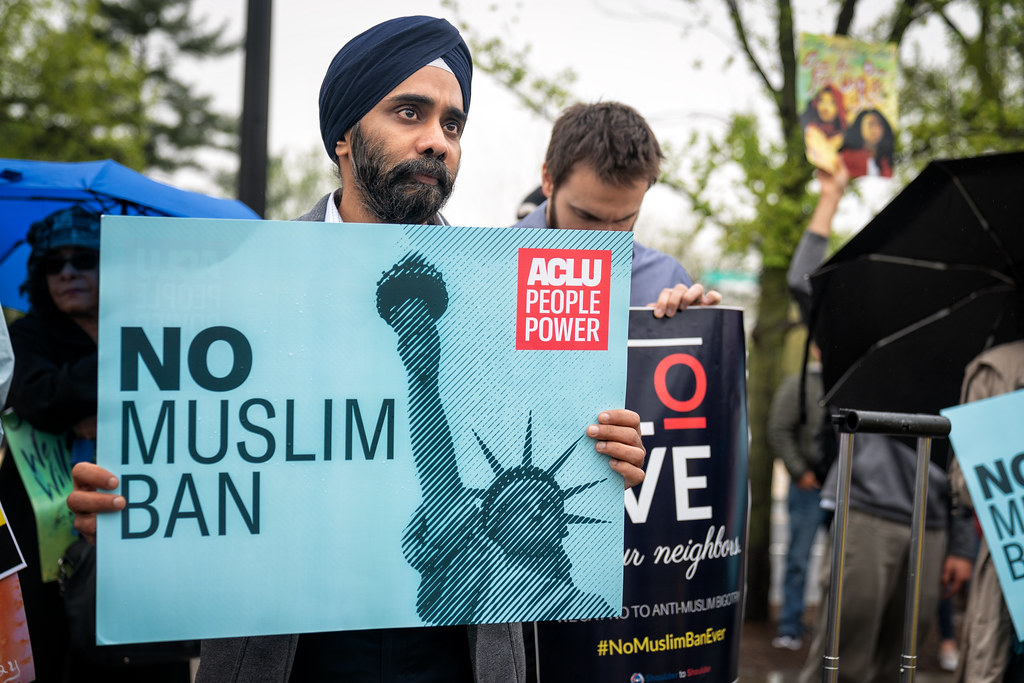
Solidarity should not look like people putting their bodies in front of government thugs trying to impose a racist ban on a minority religion or ethnicity.

Solidarity should not look like synagogues and mosques swapping strategies regarding how to "harden the target".

Solidarity should not look like a taxi driver evacuating terrified survivors from the scene of an ongoing massacre.

Solidarity should not look like desperately working the phones to try and rescue a family buried under the rubble of their own house after it was hit by a tank shell.

Solidarity shouldn't look like that, because none of those things should happen.

You want to know what my model of solidarity is?

It's a new arrival in town asking where they can find Halal food, and being pointed to the excellent Kosher market down the street.

It's two neighbors snickering over the well-meaning lady next door who somehow gives a different wrong pronunciation of both of their names, every time.

It's the synagogue and the mosque sharing a parking lot.

It's bonding over the common elements of shared cuisine, and bonding over trying unfamiliar elements of different cuisine.

I understand why, in the wake of unfathomable tragedy, a story like Ahmed's provides a flicker of hope in a dark time. And make no mistake - he is a hero. But I don't want more Ahmed al Ahmeds because I don't want more situations where that sort of heroism is required. It is a tragedy that our vision of solidarity -- of ideal solidarity -- is tempered through atrocities that never should happen in the first place. That should be a depressing thought. The subtext -- elevating Ahmed's story and the narrative of solidarity as a hedge against those who wish to inspire an Islamophobic and racist backlash -- is also depressing. I'm not saying it isn't necessary or it's wrong -- I'm saying it's depressing, and our model of solidarity should envision something that is greater precisely because it is more mundane.

The solidarity we should aspire to is not the extraordinary work of extraordinary individuals in times of crisis. It is rather the ordinary, everyday work of making friends, creating love, building connections, being neighborly. No crisis, just communities enmeshed in bonds of caring.

That's what solidarity should look like.

Tuesday, December 02, 2025

The Tomb of the Unknown Slur


There is a Yiddish word, "shvartze", that literally translates to "black" but is generally understood as a derogatory slur for Black people. In terms of offensiveness, it's not the n-word, but it's definitely completely inappropriate. Fun fact: if you encounter a person who tries to argue "but it just means 'black'!", congratulations! You've found a racist!

Anyway, I was thinking about this word earlier today, and particularly was thinking about the degree to which it is known and by whom. My sense is that even among Jews, it is fading outside of Orthodox communities that speak Yiddish.  Beyond that, it's something your racist grandpa might say, but for my generation, to say nothing of the next, it isn't part of our lexicon (even our racists have assimilated in their use of derogatory language). Given that, it wouldn't surprise me (though I don't know this) if it is not an especially well-known term among American Blacks, particularly those who live in locations where there are not many Jews.

And assuming that's true (and again, I might be off-base even on the premise here), it made me wonder if there are other examples of slurring language that is not widely known among the targeted population. Is there a derogatory term Black people have for Jews that most Jews don't know about? I can imagine this sort of situation being either incredibly common or incredibly rare, and I'm honestly not sure which I'd find more likely.

Friday, October 03, 2025

Perceiving the Hierarchy


As you may have seen, there was antisemitic stabbing/car ramming attack on a UK synagogue on Yom Kippur yesterday. Two Jews were killed (one, apparently, by the police in the course of their response); the attacker was also killed on site.

In the wake of the attack, the New York Times quoted a recently-released report by the Runnymede Trust on the subject of antisemitism in the UK, making the case that the "current approaches designed to tackle the problem [of antisemitism] are not working." Specifically, the report critiques how "The significant funding given by governments to protect Jewish people specifically makes Jewish communities feel safer in the short term but has given rise to perceptions that there is a hierarchy of racisms in the U.K.."

[W]hen the state and political parties put significant energy into combating antisemitic ideas but fail to act with similar force against Islamophobia or structural racism, it confirms the perception of a hierarchy of racism. While this type of state-led opposition to antisemitism can make many Jewish people feel safer in the short-term, it gives life to a competitive victimhood that further pulls apart the horizontal alliances and broad political coalitions required to confront all racisms.

A couple things about this formulation that jumped out at me, but the main one is the acceptance of the narrative that Jews are "anti-discrimination" winners -- winning so much, and so hard, that it's generating understandable resentment that fractures the possibility of cross-group solidarity. The reason this "jumped out" is that one of my earliest public writings on antisemitism specifically addressed this phenomenon in the context of the UK, pointing out that the public perception of Jews being very well- (perhaps over-)protected by anti-discrimination law coexisted with a reality that Jews weren't actually receiving much protection at all.

I won't claim to be an expert on the UK. But the Runnymede report, as far as I can see, does not actually provide much evidence that Jews in reality receive enhanced material support for their security compared to other groups. The only concrete example they provide is the proliferation of Holocaust memorials in contrast to the lack of such memorials for other atrocities suffered by other groups (including ones that the UK is more directly implicated in, like the slave trade). 

I do think there is something to be said about making Holocaust remembrance the be-all-end-all of what "reckoning with past racism looks like". But this has little to do with funding initiatives meant to provide security for Jewish institutions from violent attack.

In the United States, at least, funds meant to bolster security at religious institutions have been made available to applicants of all faiths. Jewish organizations have received a large chunk of the funds (perhaps because Jews are by far the most common targets of religious-based hate crimes), but it would be wrong to say there is a "hierarchy" here. But that doesn't seem to change the fact that there is a perception of a hierarchy; and where perception is not matching reality we need to interrogate more deeply what's driving the perception.

Put simply: it is a common feature of antisemitism to present Jews as "the outgroup that's in" -- the paradigm of protection (perhaps over-protection) to the point where they are seen as hoarding the bounty of public sympathy from groups who need it more. This perception is itself inextricably linked to antisemitic stereotypes of Jewish hyperpower and influence (obviously, Jews can't really be marginalized when it's so clear that they control Congress/the media/the banks/the world), and it is I think a category mistake to assume that the perception is substantially related to an actual, objective assessment of how much protection Jews are or are not receiving. 

Just like with fears of "voter fraud" or anti-vaxx conspiracies, where the underlying complaints about Jews being over-protected are grounded not in rationality but in resentment, a "rational" response will never assuage and the conspiracists will never be accommodated. Eventually, the only "move" in this politics is for Jews to self-abnegate -- to performatively lose, over and over again, even in circumstances where they are being genuinely wronged and deserved genuine protection under well-established and universally-applied principles, so as to "reassure" their neighbors that they aren't winning too much and aren't being given special favors. This is not sustainable, and it is not actually a productive strategy for fighting antisemitism.

I absolutely agree that -- whether in the UK or the US -- the government and other social actors need to take all forms of racism and discrimination with the seriousness they deserve, and direct concrete and tangible resources and proposals to combatting it. But I do not think reinforcing the narrative of "hierarchy" is helpful in this respect. I will keep on tapping the sign: they'd say it about Jews, they'd say it about other groups too. It is not the case that "only the Jews receive such solicitude", it is not the case that "everyone but the Jews receives such solicitude." We should reassess both narratives that assert a clear "hierarchy of racism" that likely is not present and which is itself built upon unhelpful and unproductive resentments.

Monday, September 08, 2025

Reasonable Suspect


In 2016, I published an article titled "Unsuspecting" in the Boston University Law Review that explored how a constitutionally "suspect" classification (like race) might lose that status. In its conclusion, I argued that suspect classification was doing more harm than good for the groups it purportedly protected. It had become only a tool to strike down legislation that sought to achieve racial equality.

I termed this dynamic "partial racial politics". Far from representing a near per se rule against de jure wielding of race, the actual doctrine is that "government can legislate on race freely, except when it expressly seeks to combat ongoing racial inequality." "Suspect classification doctrine is a vestigial artifact that only comes into play when racial minorities appear to be winning the political game." The government relying on race to cut off Black communities from White neighborhoods, or to decide who to execute? Supposed "strict scrutiny" falls silent. Too many minority students going to college, or voting, or entering into political office? Then strict scrutiny and a commitment to radical colorblindness suddenly comes roaring back.

I wrote that article, again, in 2016, and while living in California. I presented it in Louisiana, where one bit of pushback was basically to argue that the risks of giving up suspect classification for race look different in California versus Louisiana. Just how confident was I, really, that suspect classification doctrine was no longer deterring any sort of racist legislation? Who knows what sorts of White supremacist malice would be unleashed if the "democratic" branches were unshackled once more?

Today, in a typical unreasoned shadow docket opinion, the Supreme Court (by a likely 6-3 vote) cleared the Trump administration to use racial profiling as part of its immigration enforcement raids. Racial background can validly be part of the basis for forming reasonable suspicion that a person is in the United States without legal documentation. The only Justice to write substantively in defense of this atrocity was Justice Kavanaugh, who suggested that undocumented immigrants have no legally protected interest in "evading questioning" and documented immigrants and U.S. citizens suffer no material injury because "the questioning in those circumstances is typically brief, and those individuals may promptly go free after making clear to the immigration officers that they are U.S. citizens or otherwise legally in the United States." What's a little race-based "stop and show me your papers" in the land of the free?

I look at today's decision, and I can't decide whether the conclusion to my 2016 paper was correct. On the one hand, the Court since then has grown only more aggressive in declaring an implacable commitment to colorblindness in the aforementioned circumstances of too many Black and brown people going to school or voting. The juxtaposition of those commitments, chest-thumpingly backed by an ironclad commitment to "colorblindness", against the willingness to sanction "color-consciousness" when it is deployed as a tool to terrorize immigrants (or those suspected of being immigrants, or those the government simply wants to terrorize under the guise of regulating immigration), seems to be a crystalline manifestation of the "partial racial politics" dynamic I identified in my article.

And yet, my Louisiana interlocutor's critique also feels more salient than ever before. In a 2025 where the government is not even nominally constrained from race-based policymaking, what horrors lie just beneath the surface, waiting to emerge? It somehow seems to simultaneously be true that the Supreme Court is doing nothing to stop (indeed, is the handmaiden of) the tidal wave of White supremacist fury crashing over the polity, and also that if we explicitly told the federal judiciary to butt out things could only get worse -- and worse in ways so terrifying I struggle to name them.

I don't have a resolution to this dilemma. We live in impossible times, where nakedly White Supremacist Senators align with a White Supremacist presidency and a White Supremacist Supreme Court to wage war on American constitutional liberty. Against this onslaught, what doctrine could ever hope to save us?

Wednesday, July 09, 2025

Anti-PC Grok as Corpus Linguistics


As you may have heard, Elon Musk's AI chatbot Grok went full-blast Nazi today, culminating in it calling itself "MechaHitler" and praising its namesake as someone who would have "crushed" leftist "anti-white hate." (Ironically, or not, the "leftist" account it was referring to was itself almost certainly a neo-Nazi account pretending to be Jewish).

What caused this, er, "malfunction"? Well according to Grok, Musk "built me this way from the start." But the more immediate answer appears to be an update Musk pushed urging the bot to be less "politically correct" -- an instruction Grok interpreted as, well, a mandate to indulge in Nazism.

This raises an interesting implication. Many legal scholars (particularly textualists and originalists) have recently become enamored with a "corpus linguistics" as an analytical tool for understanding the meaning of legal texts. Corpus linguistics tries to discern what words or phrases mean by taking a large body of relevant works (the corpus) and figuring out how the words were actually used in context. If originalism is about the "ordinary public meaning" of the words in legal texts at the time they were enacted, corpus linguistics offers an alternative to cherry-picking usages from a few high-profile sources (such as the Federalist Papers), sources which are likely polemical, may not actually be representative of common usages, and are highly prone to selection bias. Instead, we can identify patterns across large bodies of training text to figure out how the relevant public generally uses the term (which may be quite different from how a particular politician deploys it in a speech).

Now take that insight and apply it to the term "politically correct". This is, of course, a contested term, and critics often contend it (or more accurately, opposition to it) is a dog whistle for far-right racist, antisemitic, and otherwise bigoted ideologies. Those who label themselves "not-PC" typically contest that reading, at least in circumstances where owning up to it would risk significant consequences. So is someone calling themselves "un-PC" a signifier of bigotry or not? This could have significant legal stakes -- imagine a piece of legislation which had a disparate impact on a racial minority community and which its proponents justified as a stand against "political correctness". When seeking to determine whether the law was motivated by discriminatory intent, a judge might need to ask whether opposition to political correctness should be understood as a confession of racial animus.

Under normal circumstances, one suspects that inquiry will resolve on ideological lines -- those hostile to the law and suspicious of "anti-PC" talk inferring racial animus, those sympathetic to the law or anti-PC politics rejecting the notion. And no doubt, both sides could muster examples where "PC" was used in a manner that supports their priors. 

But corpus linguistics suggests shifting away from an individual speaker's idiosyncratic and self-serving disavowals and instead ask "what is the ordinary public meaning of 'not politically correct?'" And it would answer that question by taking a large body of texts and seeing how, in practice, terms like "politically correct" or "not PC" are used. 

Returning to Grok, what Grok's journey from "don't be PC" to "MechaHitler" kind of just demonstrated is that, at least with respect to the corpus it was trained upon, the ordinary usage of "not PC" is exactly what critics say it is -- a correlate of raging bigotry and ethnic hatred.

I don't want to overstate the case -- a lot depends on what exact corpus Grok uses to train itself and whether it properly corresponds to the relevant public. Nonetheless, I do think this inadvertent experiment is substantial evidence that, when you hear someone describe themselves as "not-PC", it is reasonable to hear that as meaning they're a racist -- because that's what "not-PC" ordinarily means. And if your conservative/originalist friends object, tell them that corpus linguistics backs you up.

Monday, April 28, 2025

The Anti-Anti-Racism Conspiracy in Oregon


This is an infuriating story on many levels:

The principal at The Madeleine School, a private Catholic school in Northeast Portland, summoned Portland police to the campus in late March when the parents of a Black student demanded to know her plan of action after their fourth grade son reported being called a racist slur on the playground.

Just 72 hours later, the school expelled the boy, effective immediately, saying his parents — Moda Health executive Karis Stoudamire-Phillips and renowned jazz musician Mike Phillips, both prominent Black Portlanders with long histories of volunteering both citywide and in Portland’s tight-knit Catholic school community — had violated the school’s code of conduct for parents.

The students accused of hurling the slur denied it, but the boy's account was corroborated by at least one other witness.

There are a couple of different layers here. One is that the Archbishop of Portland has had a tense relationship with the Catholic school community here, stemming from his effort to enforce conservative gender orthodoxy over the objections of many students, parents, and lay leaders. This appears to be part of a broader intrusion of right-wing culture war shibboleths, which helps make more sense of this part of the story:

According to that child’s father, who did not want to be named to protect his child’s privacy, Principal Tresa Rast told him and his wife that she suspected that their son had made up the entire incident and recommended that the child see a therapist so he could be “deprogrammed” from the anti-racist training he’d received while previously attending public school in Portland.

From what I can tell in the article, the child had been attending the Madeleine school since Kindergarten, so it's unclear when he would have been "programmed" by Portland Public Schools at all.

But of course, searching for logic misses the point. Rast appears to have an understanding where "racism" is something entirely made up -- so made up that Black children need to be "programmed" into believing its existence so they can foist false charges upon innocent White children. It isn't hard to draw a line here to the MAGA demand to suppress any and all American history tellings that accurately recount our nation's racial past (and present) -- the entire theory is that all such stories simply are lies concocted to assert control. It is a classic conspiracy theory (which is why Rast could jump to the absurdist notion that the child needed "deprogramming" -- an outrageous claim even if the child had been a regular PPS attendee).

And we also shouldn't lose sight of the fundamental cruelty this politics inevitably inflicts. Here is how the school handled the expulsion of the child:

“It has become clear that the relationship of trust and confidence that is necessary for a collaborative partnership between parent and school officials for the good of your child no longer exists,” Rummell wrote. “Our partnership is hereby immediately terminated as of the end of the day, April 3. This decision is final and from our perspective this matter is now concluded.”

Their son was allowed to return to campus one more time, Stoudamire-Phillips said, to say goodbye to his teachers.

“There wasn’t a dry eye in the classroom,” she said. “Teachers from all over the school were coming in to say bye to him. He knows that he is loved by that community. He just doesn’t understand why these two leaders keep making decisions that have hurt him.”

"He doesn't understand why these two leaders keep making decisions that have hurt him" Juxtapose that against the brusqueness of his dismissal, of the ripping of this child from a community he had been enmeshed in and valued. It's heart-wrenching. And it emerges from people who prioritize of national kulturkampf demands over the interests and humanity of the children in their care. This, above else, is what characterizes the current MAGA orientation towards so many children -- they pour out hatred and disdain and scorn, because hurting the kids matters less to them than cleaving to their own fantastical tales of resistance to "wokeness".

Wednesday, February 26, 2025

Betar Expulsion as Trump Impeachment


The other day, I wrote about the new(-ish) far-right organization operating in Jewish spaces, Betar. Betar has distinguished itself for its open endorsement of hate and violence directed both at Palestinians (its response to reports of Israel killing children in Gaza was to say "Not enough. We demand blood in Gaza!") as well as Jews it views as insufficiently fundamentalist in our Zionism, which in their case means virtually all of us.

Since them, they've gotten into a spat with the ADL after the latter added them to its database of extremism. And then a competing slate in the World Zionist Congress elections, Kol Israel, moved to have Betar expelled from the American Zionist Movement, citing both electoral blackmail tactics and Betar's "abhorrent" calls "for genocide and the murder of Palestinian babies." Betar, through its coalition partner ZOA (there's a team-up everyone could see coming), has warned of filing retaliatory complaints against Kol Israel.

On the one hand, it's always good to see groups stand up to racist thugs like Betar. On the other hand, this feels eerily reminiscent of how the political establishment treated the rise of Donald Trump. 

After years of ignoring, excusing, coddling, and enabling him, January 6 happened and for an instant it seemed like folks woke up and sanity might be restored. But the reality was it was already too late -- the supposedly unthinkable extremism that Donald Trump represented had become normalized through those years of excuse and neglect. Even in the most incredible moment -- the immediate wake of an outright insurrection against the United States -- the effort to rein him in fizzled out, and he would soon reestablish himself as at the center of a conservative movement that at one point would have viewed as the most outrageous slander the charge that it would harbor the likes of Donald Trump. They failed to stop him when they could, and found themselves isolated and alone when they (briefly) roused themselves to try.

That pattern seems apt here. Efforts to kick out ZOA from the Conference went nowhere. A similar initiative at the Boston JCRC, one where it was admitted ZOA "elevated White supremacism", only ended up yielding the eventual departure of the left-wing group the Workers Circle (that group also left the Conference). In Isarel, years of enabling and nurturing the neo-Kahanists have made them into the dominant force in Bibi's coalition -- a cadre that is not just ("just") contained to secondary parties like Jewish Power but is running riot through Likud itself. In the diaspora, too, Kahanism is being ever-more normalized as something other than a violent mob of racist thugs. Everyone who thought this was just posturing, or political jockeying, or unsavory alliance-making, but who was sure that if and when the time came they could pump the brakes has been proven to be a fool. There are no brakes. As I wrote in my first post on Betar:

[L]eaders of social groups that simultaneously play footsie with the sort of extreme rhetoric while assuaging themselves that of course their actual politics are humanitarian and egalitarian, they're just revving up a crowd or exaggerating for effect, will quickly learn that much of their base isn't in on the bit. They're in it for the hate, and when someone offers that hate better, they won't listen to your attempts to rein things back in.

So as happy as I am to see groups try to stand up to Betar and ZOA, I am dubious about their likelihood of success. The most likely outcome for Betar and ZOA is exactly what they've enjoyed for years by the mainstream Jewish institutions: averting their eyes, kicking the can down the road, hoping the problem solves itself -- and with each passing moment, what once was unthinkable becomes undislodgeable.

Maybe eventually, someone will learn a lesson. But I doubt it will be this day.

Saturday, December 14, 2024

Racist Idiots Continue To Be Mad That Caitlin Clark Is Not Racist


It's an exaggeration to say that conservatives only care about women's sports when it gives them an excuse to be transphobic. Sometimes they care about women's sports in order to be racist too.

For example, every once in a while, idiots try to conscript Caitlin Clark into racism and then get really mad that she doesn't participate.

In college, I remember a blowup some people had over Angel Reese doing some trash talking against Clark when LSU beat Iowa in the national championship. Clark, of course, is no stranger to trash talk herself, and people rightfully understood the pearl-clutching on her behalf as highly racialized in character. But the "controversy" was entirely on the outside; Clark gave absolutely no indication that she couldn't take what she dished out. Her view was always that trash talk and the like is part of the game, whether she's on the giving or the receiving end. Racists wanted to be racist on Clark's behalf, Clark did not bite, and it was pretty clear that the folks who rushed to "defend" her resented her for not obliging.

The other day we witnessed another iteration of this, after Time Magazine mentioned ongoing frustration by some Black WNBA players (h/t: Kevin Drum) who think they're persistently overlooked because of race (and that, in turn, Clark's popularity stems in part from the "great white savior" narrative). Clark was asked about the issue, and gave a perfectly reasonable answer about the importance of celebrating and uplifting the many Black players who have contributed immeasurably to the league's success:

“I want to say I’ve earned every single thing, but as a white person, there is privilege,” says Clark. “A lot of those players in the league that have been really good have been Black players. This league has kind of been built on them. The more we can appreciate that, highlight that, talk about that, and then continue to have brands and companies invest in those players that have made this league incredible, I think it’s very important. I have to continue to try to change that. The more we can elevate Black women, that’s going to be a beautiful thing.”

A good answer, and predictably, some people went ballistic over it:

Well, it happened. Caitlin Clark finally bent the knee to the insufferable, gaslighting, disgusting, race-baiting woke mob.... Anyway, Clark got her roses, and then proceeded to bend the knee to the mob.... Caitlin Clark bends the knee to an invisible mob.... Why did the best player in the WNBA — by a laughably wide margin — crumble like a cheap tent?

Now we can concentrate on how pathetic this whine is. But I want to flag something specific, as someone who actually did follow the WNBA season this year: Caitlin Clark is not, in fact, the best player in the WNBA. The best player in the WNBA, by a laughably wide margin, is A'ja Wilson. This is no knock on Clark, who is an outstanding player and was well-deserving of rookie of the year. But let's look at the stat lines this season (all stats on a per game basis):

  • Wilson: 26.9 points, .518 FG%,11.9 rebounds, 2.3 assists, 1.8 steals, 2.6 blocks, 1.3 turnovers
  • Clark: 19.2 points, .417 FG%, 5.7 rebounds, 8.4 assists, 1.3 steals, 0.7 blocks, 5.6 turnovers
With all respect to Clark, this is a blowout. Wilson averaged a double-double on the season. She led the league in blocks; she set an all-time league record in points per game. She led Clark in every statistical category but assists (unsurprising, since Clark is a guard and Wilson is a center). That's why Wilson won the MVP by a unanimous vote -- only the second time that's occurred in WNBA history.

Again, this is not at all to dismiss Clark as anything other than an all-star. She had a great rookie season. She did a fantastic job leading the hitherto sad sack Indiana Fever to the playoffs, overcoming a dismal season start (where we saw Clark's own adjustment pains getting used to playing at the highest level of the sport). Her own rookie of the year honors, and fourth place finish in MVP voting, were also very well-deserved. And she plays a exciting style of basketball that's a ton of fun to watch -- I know full well that a Caitlin Clark game is must-see TV.

Obviously, at one level this only validates the complaint by Wilson and others regarding how they're overlooked for clearly racist reasons. But I also raise this because the sort of racist morons out here demanding Caitlin Clark be racist also, very clearly, pay absolutely zero attention to the WNBA -- Caitlin Clark included -- for any reason other than looking for an excuse to be racist. They know nothing about the game other than that it might provide a vector for various racist and transphobic projections. So it's no surprise that when the game and the players don't indulge them in their bigotry, they throw a tantrum. It's literally the only reason they care about women's sports.

Tuesday, September 24, 2024

Teshuva in Springfield


When I first saw a story about the Rabbi of Springfield, Ohio giving his views on the Trump campaign's racist invective targeting Haitian migrants, I was heartened at what I assumed would be a clarion call to stand by the stranger in our midst. Then I read the actual story, where the Rabbi instead echoes the hostility in the worst way -- contending that Haitians lack "Western civilized values", stating that "white, Anglo-Saxon Protestant" residents were being "disenfranchised", and contrasting today's immigrants from Jews whom, he said, "wanted to assimilate, they wanted to be good Americans" -- and I felt embarrassed and sad. As much as Ohio and national Jewish organizations might speak otherwise, this would be -- both locally and nationally -- seen as the paradigmatic "Jewish" take.

There has, however, been a modest update to this story, which I found a bit more heartening. The actual Jews in Springfield (it's a small community; this Rabbi commutes from Columbus) made clear that they did not endorse or accept these sentiments. They pushed their Rabbi to do better -- to issue an apology, to acknowledge his lack of knowledge of the actual circumstances of both the community and of their new Haitian neighbors, and to meet with representatives of the Haitian community,

“I was not well-informed on the situation with the Haitian immigrants,” [Rabbi Cary] Kozberg said. “Since the interview, I have learned much more about the immigration situation in Springfield. My opinions have definitely been modified.”

Kozberg made his statement alongside Temple Sholom’s president, Laurie Leventhal, who told the Observer that her rabbi made a “mistake” and would be pursuing teshuvah, or the Jewish process of repentance.

“We are not giving him a pass,” Leventhal said. “He has asked lots of questions and learned lots of stuff about what’s going on in Springfield, and he has changed his views. And that is how human beings grow. And that is what we are about. And I hope that you will not go on a witch-hunt and take a situation in a city that is so hurting and make it worse.”

This was coupled by additional moves by area Jewish organizations to express support for the Haitian community:

Viles Dorsainvil, a local Haitian community leader in Springfield and the executive director of the Haitian Community Health and Support Center, told JTA on Monday he hadn’t been aware of Kozberg’s comments and hasn’t received any communication from the rabbi. But he said he had been glad to receive a letter of support from the Dayton Jewish Federation, which the federation had sent to him on the same day JTA published Kozberg’s interview.

In their letter, the federation heads introduced themselves as “your Jewish neighbors to the west” and added, “It is a core tenet of our faith to ‘welcome the stranger.’ We, along with so many others of different faiths and cultures, whose ancestors made this journey before you over the decades, support your quest, and welcome you. We are sending all our virtual thoughts of goodwill your way, including our prayers for your safety.”

The letter was touching, Dorsainvil said. “We’re so happy that the Jewish community in Dayton reached out to us,” he said, adding that he, too, saw similarities between what Jewish immigrants to the United States experienced in the past and what Haitian migrants are currently experiencing. 

I'm not asking anyone to give Kozberg a prize here. For one, he hasn't really done anything yet. I'd also suggest that "Most people don’t know me as a racist" doesn't quite communicate the sentiment that Kozberg I think is trying to get across. And even amongst his congregants, there is a split between those who think his apology is "genuine", and those who more circumspectly "hope" that it is. The local Jewish news coverage indicates that Kozberg maybe has a bit more of a self-pitying streak than might otherwise be let on, quoting him repeatedly suggesting that the initial interview he did was a "politicized" and "taken out of context." I'd also note the congregation, even as they recoil against his "racist" statements, is standing by him as their Rabbi -- noting that they have a thirty-year history they're looking across whereas all the rest of us are only accounting for this past week. It is a fair note, and one that I hope we can remember with regard to other potential instances where someone imbricated in a particular small community spikes to prominence for acts of (real, genuine) bigotry and is not immediately met with exile.

But on the whole, what I'm really flagging and really heartened by is not Kozberg but the Springfield Jewish community. When someone they loved and who they were close to and who was their leader stepped out, they stepped up. They demanded accountability. They used their own voices to try and set things right. It's never fully possible to make these wounds whole. But I've seen far, far worse attempts than this, and I hope the project of Teshuva and repair continues to make amends and build new bonds in Springfield.

Sunday, September 15, 2024

Going Fishing


The wave of terror Donald Trump and J.D. Vance have unleashed upon the Haitian community in Ohio continues to crest. I am by no means the first to observe the similarities between how they are talking about Haitians and how Nazis spoke of Jews at the outset of their rise to power. That's strong language, and yet it is terrifyingly warranted. We are seeing something that is, in fact, not at all unprecedented.

But there is a particular aspect of the racism we're seeing here that particularly resonated with me as a Jew -- the frenetic scouring to find anything and everything that "proves" the conspiracies right, or at least justified. In the Ohio case, this reached a comical (if anything about this could be comical) apex when Christopher Rufo offered a bounty to prove the "Haitians in Springfield are eating cats" conspiracy correct and then started crowing over a video of not-Haitians in Toledo Dayton grilling chicken. But other examples abound (although at least J.D. Vance had the "decency" to admit he was simply making things up). Far, far too many Republicans response to blatant acts of hatred is to cast far and wide for something that makes the hatred feel palatable.

As a reasonably public-facing Jewish professor, I frequently idly wonder if I'll be targeted by some sort of antisemitic attack. Mostly, it doesn't happen. Occasionally, it does; though in my case never in such a fashion that would explode into the public view. But if an "incident" did happen -- someone graffitied my office door, for instance -- I am absolutely sure that a certain cadre of online folk would immediately begin pouring over my collection of writings to find anything they possibly could to explain why I'm a legitimate target. That knowledge -- less that something could happen, and more that if it did I'd be the one scrutinized to hell and back, with the most gimlet eye and uncharitable gaze -- is perhaps what stresses me the most. I do not think I am alone amongst Jews in feeling this way; hyperpoliced at every turn to justify ex post facto a judgment that has been handed down in advance.

By all objective accounts, the Haitian community in Springfield has been a boon to an erstwhile struggling city. But they are not universal saints, any more than anyone else is -- if one places them under a powerful enough lens, one will of course be able to find something or someone butting up against the social compact (though not, I'd wager, stealing and eating pets). No group can maintain a perfect record under that sort of scrutiny. And the knowledge that one is under that microscope is just exhausting. It's exhausting right alongside the more direct anxiety and misery of being directly subjected to acts of hate and bigotry.

The people responsible for this have no shame, so I won't bother to say they should be ashamed. But no good person should feel anything other than contempt for this latest dose of bigotry.

Friday, August 02, 2024

Announcing You're Going to Discriminate + Discriminating = Liability for Discrimination


When the Trump administration's Muslim ban was moving through the courts, there was the weird debate people were having about whether it was fair to use Donald Trump's explicit statements announcing a discriminatory motive for the ban as evidence that the ban was discriminatory. The debate was weird because in any other circumstance the answer is obvious -- of course it's evidence. It's close to dispositive evidence. That's how anti-discrimination law works.

For example, this past week the Eleventh Circuit decided the case of McCarthy v. City of Cordele. Here are the relevant facts:
Joshua Deriso campaigned for election as chairman of the City Commission of Cordele, Georgia, by publicly stating his intent to “replace Caucasian employees with African Americans”; to lead “an entirely African American” City Commission; and to replace Roland McCarthy, the white City Manager, with a black City Manager. On social media, Deriso declared, “Structure needs to change . . . More Blacks!!!”; “The new City Manager should be Black”; and “it is time for African Americans to run our city.” Deriso won the election. The same day he and fellow commissioners took their oaths of office, the Commission voted on racial lines to fire McCarthy and to replace him with a black City Manager.

"The question," the court continued, "is whether those allegations permit the inference that the City Commission fired McCarthy because he is white." They quite reasonably answered "yes". When you publicly campaign on "I am going to racially discriminate", and then you do exactly what you promised to do, it's entirely reasonable to conclude that what you've done is engage in racial discrimination. And that inference is valid notwithstanding the fact that under normal circumstances the city council has wide discretion in hiring or terminating its city manager. This is not hard.

There's no pay off here other than to reemphasize the lawless anomaly that was Trump v. Hawaii. The pass it gave to blatant, undisguised discrimination is completely at odds with the doctrine both before and after the case. Judges fully understand how senseless Trump's rule is in other cases (especially, one must observe, in cases of "reverse discrimination"). Indeed, while Trump v. Hawaii was under consideration I observed that in any remotely analogous circumstance involving "Smallsville, Anystate" the case is an absolute dunker as a clear and obvious legal violation. It is only Donald Trump who received and continues to receive these ridiculous one-offs as the Supreme Court's special favorite.

Thursday, May 23, 2024

Gerrymandering as Constitutional Entitlement


I haven't had the chance to read the Supreme Court's decision today in Alexander v. South Carolina, where the 6-3 Republican majority radically circumscribed the ability to bring racial gerrymandering claims in circumstances where (as often will be the case) there is significant overlap between racial and partisan gerrymandering. I was struck, however, by Nicholas Stephanopolous' analysis which suggests the Court's new rule is functionally that a racial gerrymandering plaintiff must "submit an alternative map showing how the state could maintain its plan’s current partisan balance while fixing the alleged racial gerrymandering," In other words, if an alleged racial gerrymander results in a 6-1 GOP/Democratic House map, plaintiffs must show that there is an non-racially gerrymandered map that also yields that same partisan split.

Alexander is the latest case to emerge out of the gibberish that is Rucho, and the impossibility of disentangling racial gerrymandering (nominally unconstitutional) from partisan gerrymandering (effectively permissible) under conditions of extreme racial polarization. Where there is near-complete overlap between "Black voters" and "Democratic voters", how does one decide if a congressional map which packs all the Black/Democratic voters into a single misshapen district is a "racial" or a "partisan" gerrymander? 

The logic behind the majority position in Alexander is that if one can't create a map that yields the same partisan end goal as the map being challenged, that suggests that the status quo map was chosen not for racial reasons, but rather because it better effectuated the goal of partisan gerrymandering that would otherwise be impossible to achieve. "We didn't draw the districts this way because it drew all the Black voters into a single district; we drew them this way because it was the only way to get the desired political slant."

But this gets things exactly backwards. Even assuming that partisan gerrymandering is constitutional (and it's worth noting that technically, Rucho doesn't say that -- it says it is a political gerrymandering claims are non-justiciable political questions, which is not the same thing), it is not a constitutional requirement that states must be allowed to do it under any circumstance. The more natural conclusion is that if you can't successfully engage in a partisan gerrymander without engaging in racial gerrymandering, then sorry, you don't get to partisan gerrymander (or at least don't get to do so to the same extent). The rule against racial gerrymandering places a limit on the ability to partisan gerrymander.

The majority's rule, by contrast, treats partisan gerrymandering as a constitutional entitlement. Any constitutional rule or principle which disenables a state from engaging in partisan gerrymandering to the fullest extent it desires must yield. Otherwise clearly impermissible and unconstitutional conduct becomes licit if it is the only way a state can implement its God-given right to gerrymander.

This is not the first time the Court has made this mistake. I flagged a similar error in the Court's Glossip opinion relating to Eighth Amendment challenges to state execution protocols. The Court there said that a prisoner challenging an execution protocol as cruel and unusual punishment cannot prevail simply by showing that the state's procedure is barbarous or tantamount to torture. The prisoner must also identify a valid execution protocol, accessible to the state, that he would deem permissible. What happens if there is no such protocol -- if all the methodologies available to the state would be agonizingly painful? The logic of Glossip is that in that case, the state is allowed to torture prisoners to death, because the state simply has to be allowed to execute people.

In both cases, the Court is making a basic mistake, conflating constitutional permissibility with constitutional entitlement. It's obvious when you think about it. The state is permitted to try and solve crimes. The state is not allowed to violate the Fourth Amendment, even if doing so would allow it to solve more crimes than if the Fourth Amendment was not enforced. If the state said that, for every claimed Fourth Amendment violation, a defendant must provide an alternative policing protocol that would allow it to solve as many crimes as if it were permitted to violate the Fourth Amendment freely, and if he can't, then the Fourth Amendment can't be enforced, that would be absurd. The Fourth Amendment places a limit on the ability of the state to solve crimes.

So too here. It might (for sake of argument) be true that capital punishment or partisan gerrymandering are not unconstitutional in the abstract. But that does not imply that in practice there must be a constitutionally-viable pathway to do either of these things. If the state can't figure out a way to conduct an execution that doesn't torture people to death, then it can't execute people. If the state can't figure out a way to partisan gerrymander without engaging in a racial gerrymander, then it doesn't get to do the racial gerrymander. That should be simple. But the Court has elevated the already dubious position that the state is permitted to engage in partisan gerrymandering, or the (somewhat less dubious) position that the state is permitted to provide for capital punishment, and converted these practices into constitutional entitlements. That's not reflective of law; that's reflective of the Court's fanatical dedication to these sorts of policies compelling it to erase the law.

Thursday, March 28, 2024

March Badness


A GOP state legislator in Michigan, Rep. Matt Maddock, saw a bus with too many brown people near at the airport and jumped to the obvious conclusion: "Happening right now. Three busses just loaded up with illegal invaders at Detroit Metro. Anyone have any idea where they’re headed with their police escort?"

It was Gonzaga's basketball team, headed to the Sweet 16 round. But don't let facts get in the way of some good racism and red-baiting:

Maddock made his false claim in a month during which false and misleading claims about airplane flights involving migrants have proliferated on the political right.

Hundreds of social media users quickly disputed Maddock’s post on Wednesday, but Maddock refused to concede. He replied to one of the many people who pointed out the plane and buses were likely for NCAA basketball teams: “Sure kommie. Good talking point.”

Maddock continued to dig in on Thursday morning. He wrote a new post saying, “We know this is happening” and that hundreds of thousands of illegal immigrants are “pouring into our country.” He added: “Since we can’t trust the #FakeNews to investigate, citizens will. The process of investigating these issues takes time.”

Meanwhile, in Idaho the Utah women's basketball team was essentially chased out of the state after they endured repeated racial abuse at the hotel they were staying at in Coeur d'Alene (they switched to a different hotel in Spokane).

It's nothing novel to say that athletics (and college athletics in particular) represent a prominent arena where young men and women of color are placed in the (nominally positive) spotlight of predominantly White institutions, and there are a lot of White people who really can't handle that.

Thursday, November 30, 2023

"Jews Don't Count" vs. "All Lives Mattering"


A few days ago, three Palestinian-American students were shot in Vermont.

One of the wounded students attended Brown University, and so Brown University president Christina Paxson led a vigil on Monday. In her prepared remarks, Paxton planned to say the following:

At a faculty meeting last month, I said that "Every student, faculty and staff member should be able to proudly wear a Star of David or don a keffiyeh on the Brown campus, or to cover their head with a hijab or yarmulke."

But in the actual presentation, the "Star of David" and "yarmulke" references were dropped (the story states this occurred after anti-Israel heckling, but it's not clear what the exact causal relationship was).

I learned of all this via the National Review, which of course wants you to be aghast. "Jews Don't Count" and all that. But I'm so old, I remember when many Jewish actors, particularly on the center-right, were furious at what they termed "all lives mattering" antisemitism -- responding to an incident of antisemitism by condemning an array of other prejudices alongside antisemitism, rather than letting a condemnation of antisemitism stand alone. And the thing is, under that metric, we could say that Paxson's sin was -- in a vigil about an incident of anti-Palestinian racism -- including a reference to antisemitism. By doing so, she would have "all lives mattered" anti-Palestinian racism. She should have condemned anti-Palestinian violence "alone".

Now for my part, I don't believe that. I don't generally think that tying different forms of discrimination together is objectionable "all lives mattering", and so I don't think that condemning Islamophobia or racism weakens a condemnation of antisemitism (or vice versa). I also don't think that every condemnation of antisemitism has to include a condemnation of other forms of oppression (or again, vice versa). It's fine when they're linked together, and it's fine when they stand alone (and for what it's worth, it's just wrong to assert that antisemitism is never condemned "alone"). Either way Paxson could have done it would have been okay.

More broadly, I've argued that the concept of "all lives mattering" is not properly applied to any case where "where someone tries to link different forms of oppression or marginalization together." Rather, "all lives mattering" only obtains where one

respond[s] to a complaint of an injustice experienced by a particular community by suggesting the complaint is illegitimate or exclusionary unless it is reframed away from focusing on the particular community and instead presented in more universal language.

So it is not "all lives mattering" for Paxson to loop in an issue of antisemitism to her vigil responding to a claim of anti-Palestinian racism, but it would be "all lives mattering" if it was suggested that her vigil would be inappropriate or illegitimate if it didn't also talk about oppression in more universal terms. The National Review piece, though written in neutral tones, certainly carries the subtext of such an assertion.

But more to the point, my definition of "all lives mattering" is not the one I've been seeing in the quarters of the Jewish community who've been leveling the charge. Based on their more expansive account, Paxson would absolutely have been "all lives mattering" had she included the line about the Star of David, and so she was wise to omit it. But I don't think that the critics in question believe that -- they're more likely to be offended that the line was taken out (proving that "Jews don't count") than they were at the prospect it would be kept in. That suggests that their position on "all lives mattering" is not a consistent one (and I'd argue, that inconsistency at root derives from their position being fundamentally untenable). Worth keeping in mind.

Saturday, July 29, 2023

White Republicans To Black Republicans: Stop Whining About Slavery

The fallout from Ron DeSantis' new "slavery: it wasn't all bad" educational standards continues, as most elected Black Republicans have now spoken out to condemn the framework and urge it be revised. Faced with this criticism from Black members of his own parties -- people who time and again have shown their commitment to conservative causes but nonetheless believe that here the state of Florida made a grave historical error -- DeSantis has responded exactly how you'd expect a White Republican to respond to challenges from Black people (whether in his party or not):

Florida Gov. Ron DeSantis, who appointed the board members responsible for the standards, did not take the measured disapproval well. On the contrary, the governor and his political operation seemed to go after [Florida GOP Rep. Byron] Donalds with a vengeance, accusing the GOP lawmaker of aligning himself with Vice President Kamala Harris and referring to Donalds — a member of the right-wing House Freedom Caucus — as “a supposedly conservative congressman.”

[....]

Speaking with reporters in Albia, Iowa, on Friday, DeSantis responded to [South Carolina GOP Sen. Tim] Scott’s comments by criticizing “D.C. Republicans” for promoting a similar argument as Harris. “I think part of the reason our country has struggled is because D.C. Republicans all too often accept false narratives, accept lies that are perpetrated by the left and accept the lie that Kamala Harris has been perpetrating, even when that has been debunked,” he said. 

DeSantis was joined by, among others, Ben Shapiro ("Tim Scott ... promptly sided with Kamala Harris and he sided with the Congressional Black Caucus.... that's Scott being disingenuous") and Matt Walsh ("You are dead to us.... [B]ecome a Democrat. That's what you are."). The general response to Black Republicans expressing offense over a GOP politician soft-pedaling the wrong of slavery was not to think "huh, maybe there is something here," but to fulminate about how they're traitors to the cause.

I talked about these dynamics in "The Distinctive Political Status of Dissident Minorities". Dissident minorities such as Black Republicans are often "tokenized" -- held out as a means of discharging an obligation to consider the views of diverse communities but not valued beyond that transactional function. Hence, where Black Republicans cease, even temporarily, to offer this "value" to the broader GOP community (because in a specific case they do not agree with the particular goals or interests of the conservative movement), it won't be taken as a valid critique from insiders but rather proof that the Black Republicans are actually a fifth column reverting to their leftist roots.

Indeed, in that paper I actually specifically referenced a different instance where Senator Scott tried to diverge from his GOP colleagues on the matter of racism as a core illustration of the phenomenon. It is striking how everything I wrote there applies here as well with barely any need for revision:

[E]ven though tokenization might in some circumstances result in dissident minorities attaining political successes, the relationship forged through tokenization likely is not sufficiently robust so as to persevere in cases where the dissident minority does publicly diverge from the opinions of their majority allies. To the contrary, when they are tokenized, dissident minorities may find that their opinions are only valued transactionally—useful to the extent that they advance the goals of their non-group-member patrons and no further. Where the perspective isn’t what’s valued, dissident minorities will typically find that their “enhanced standing” falls apart the moment they express a view that diverges from their nominal allies.

Dissident minorities might contest this point. Specifically, they might suggest that their enhanced standing is not purely instrumental but rather reflects genuine respect by majority-group members regarding their substantive contributions—respect that will carry over to cases where they do find themselves forced to challenge the dominant group. By showing themselves to be “independent” or “exceptional,” the argument goes, dissident minorities earn credit with the majority that they then can redeem in cases where they do find it necessary to contest majority viewpoints....

Unfortunately, in a great many cases the cynical prediction wins out, and the dissident minority finds that the chips they thought they had amassed are unable to be cashed.... 

[....] 

The “enhanced standing” Scott normally enjoyed by aligning with the Republican Party was a product of him being (per Arendt) an “exceptional” member of his minority group. But once he adopted (even temporarily) a critical posture towards his conservative allies, he ceased to be exceptional, and reverted to being just a regular member of the Black community. If the “earned credit” hypothesis held true, that shouldn’t have mattered—he should have been able to draw upon the well of credibility to attain a favorable reception upon raising a challenge. Yet this is not what happened: once Scott stopped being exceptional, he was treated the same as any other minority group member, and the way the GOP treats minority group members who challenge them is to dismiss them. While Scott’s patrons in the Republican Party had been happy to hold him up as proof that the GOP had Black supporters, they did not actually have any particular commitment to engaging with the Black community—even nominal “allies” in those communities—in any circumstance where it might generate challenge or change.

If Tim Scott keeps on wanting to hand me examples for my published work, who am I to argue? But this goes to show just how steady this practice of tokenization is. I'm not going to say that Tim Scott should "become a Democrat" (anymore than I think every person should!) -- his politics are his business. But surely he must realize that this will be the reality of his treatment as a Republican in perpetuity -- if he challenges the GOP on race, he will be slapped down and hard.