Showing posts with label rate that apology. Show all posts

Thursday, April 06, 2023

Rate That Apology, Part 12: Dan White

On April 5, at the onset of Passover, Labour Party leader Keir Starmer sent a message of welcome to the Jewish community: "Today I am sending my warmest wishes to members of the Jewish community as you prepare to celebrate the festival of Pesach. Chag Sameach."

Perfectly lovely, perfectly anodyne.

Replying to that tweet, Dan White, a journalist who claims to be a member of ITV's "diversity board", wrote to Starmer:

Did you see what happened at Al-Aqsa mosque while Palestinian worshippers are celebrating the holy month of Ramadan? Your silence is disgusting.

And now he's apologized:

Asked to explain his comments, White, told Jewish News: "I can only apologise for the ill timing of my tweet."

"I am not and never have been antisemitic."

"My response was not aimed at the community, but at the silence from all political parties around the conflict which is happening."

"I accept my response was badly timed, I can only apologise profoundly for it. My mental health sometimes makes snap decisions. As I said I am believer in peace, worldwide. I am sorry again for the ill timing and any offence."

Four paragraphs, all terrible. The pro forma "I am not antisemitic" is the usual level of eye rolling. Placing the blame on his "mental health" is accountability dodging (and for what it's worth, "mental health" doesn't make decisions. Dan White makes decisions, for which Dan White should learn to accept responsibility for).

However, I want to focus mostly on this framing of the problem as one of "timing". The tweet's problem was not "timing". If White had on April 5 just written a general message to the effect that Starmer or other British politicians are not paying sufficient attention to violence against Palestinian worshippers, and someone said "how dare you say something like this on the eve of Passover", that would be an objection about timing -- and an ill-taken one, since the fact that we're near the onset of Passover does not make it inappropriate to level commentary on violence occurring in Jerusalem right now.

But again, that's not the problem here. The problem is not when White wrote the tweet. It's where he did it -- in reply to an unrelated message of support for the British Jewish community in celebration of one of our holidays, having absolutely nothing to do with Israel whatsoever. The practice where anytime anyone talks about Jews in any context folks come swinging in with "what about Palestine?", is antisemitic per se, as much so as the Texas Republican who opposed a resolution honoring Muslims celebrating Ramadan because there are Muslim terrorists in Iraq.

If there's any saving grace for White, it's that the replies to Starmer's tweet are positively crawling with trolls saying much the same thing. Some consolation.

Grade: 2/10

Friday, June 17, 2022

Rate that Apology, Part 11: Lizzo

I will confess: I don't know much about Lizzo. But my wife is a fan -- she actually saw Lizzo in concert years ago before she was even the headlining act (she was opening for Haim at a show in Berkeley). So I have a cool wife, even if I remain a very nerdy husband.

Anyway. One of the songs in Lizzo's recently released album uses the word "spaz" in a somewhat unfriendly fashion, a slang for from being freaked out or uncontrollable ("I’m a spaz/ I’m about to knock somebody out/ Yo, where my best friend?/ She the only one I know to talk me off the deep end."). She was criticized by members of the disability community, who contended that "spaz" was an ableist slur. Here's her apology:

It’s been brought to my attention that there is a harmful word in my new song “GRRRLS”. Let me make one thing clear: I never want to promote derogatory language. As a fat Black woman in America, I’ve had many hurtful words used against me so I understand the power words can have (whether intentionally or in my case, unintentionally). I’m proud to say there’s a new version of GRRRLS with a lyric change. This is the result of me listening and taking action. As an influential artist I’m dedicated to being part of the change I’ve been waiting to see in the world. Xoxo, Lizzo.

This is, I think, superb. Seriously, it's a model. It is contrite in a way that is proportionate to the harm caused. While it gives some mitigating context (e.g., that the harm was unintentional), it is not primarily framed as an apologia, nor does it suggest that good intentions are the be-all-end-all of the relevant analysis. It takes responsibility and commits to a tangible action item that will ameliorate the wrong caused. It's hard to imagine what more one could ask for. Great work, Lizzo!

And on that note: one nice thing to observe here is that, as the linked article notes, Lizzo's apology seems to have been well-received.  She has not been "canceled"; it seems that most of her critics are satisfied with the response she made. Certainly, it helps that Lizzo has a broad base of goodwill she can draw upon -- most of her fans are not looking for an excuse to exile her from polite society. Nonetheless, it is notable that the histrionic cries that cancel culture is naught but a bloodthirsty mob out to destroy lives without possibility of redemption doesn't seem to be borne out. If you actually take the complaints seriously and respond in a way that shows you're taking responsibility, people will appreciate that.

Grade: 10/10

Wednesday, July 22, 2020

Rate That Apology, Part 10: Ted Yoho

I was going to do a "rate that apology" entry for Rep. Ted Yoho (R-FL), who reportedly called Rep. Alexandria Ocasio-Cortez (D-NY) a "fucking bitch" after a heated conversation about their differing policy views (Yoho denies saying that, claiming he instead called her comments "bullshit"). But Chris Cilliza in essence beat me to it. There's a transcript of Yoho's "apology" at the link, but in sum Yoho:

  • Says he apologizes for  "for the abrupt manner of the conversation I had," whatever that means.
  • Maybe denies saying the words at all, but maybe not? He says "The offensive name calling, words attributed to me by the press were never spoken to my colleagues and if they were construed that way, I apologize for their misunderstanding."
  • Concludes by affirmatively refusing to apologize "for my passion or for loving my God, my family and my country." Dude, nobody asked you to.
Ocasio-Cortez does not appear to have accepted this apology, pointing out that Yoho "didn't even say my name."

Grade: 2.5/10

Sunday, February 09, 2020

Rate That Apology, Part 9: AIPAC!

A few days ago, it emerged that AIPAC had ran some rather ... aggressive ads targeting Democrats. "The radicals in the Democratic Party," the ad text read, "are pushing their anti-Semitic and anti-Israel policies down the throats of the American people." Whoof. The ads also linked to a petition which said that "It’s critical that we protect our Israeli allies especially as they face threats from Iran, Hamas, Hezbollah ISIS and — maybe more sinister — right here in the U.S. Congress." Double whoof.

When I first saw these ads, they were so out-of-character for AIPAC (which -- reputation notwithstanding -- generally tries to avoid wading into partisan frays) that I assumed they were fake. But they were not, and AIPAC has apologized for running them.

So let's rate that apology, shall we?

The apology is four paragraphs long, and it is interesting while it starts off pretty good, each paragraph is worse than the one which comes before it. Let's take them one at a time:
We offer our unequivocal apology to the overwhelming majority of Democrats in Congress who are rightfully offended by the inaccurate assertion that the poorly worded, inflammatory advertisement implied.
That's not bad! What I like most about this is the phrase "rightfully offended". Not "those who were offended", not "if you were offended", not "read it as offensive". The apology owns up that the ad was, objectively, offensive. It also agrees that the ad was inaccurate and inflammatory. "Poorly worded" is a bit of a hedge, but in the context of the rest of the paragraph I don't think it detracts from the message.
We appreciate the broad and reliable support that Democrats in Congress have consistently demonstrated for Israel. The bipartisan consensus that Democrats and Republicans have established on this issue forms the foundation of the U.S.-Israel relationship.
This is also generally fine. It's less "apologetic" than the first paragraph, to be sure. But had these been the only two paragraphs, I think this would have been an overall pretty decent, unequivocal apology. Alas....
The ad, which is no longer running, alluded to a genuine concern of many pro-Israel Democrats about a small but growing group, in and out of Congress, that is deliberately working to erode the bipartisan consensus on this issue and undermine the U.S.-Israel relationship.
I understand the temptation to try to explain, in one's apology, why you said the thing you're apologizing for. I'm not going to say one should never do that, but it's a high-risk proposition and it rarely pays off. Mostly, that's because it comes off as an effort to dodge responsibility and to rehabilitate what actually matters, which is the underlying cause. But here we see pitfall of a different and more ironic sort. The purpose of the ad was to express concern about the erosion of a bipartisan consensus around Israel? Well gosh golly, what do they think this ad did if not contribute to that erosion? It'd be like writing an apology for cursing out prominent entertainer and then saying you did it only to draw attention about diminishing civility in public life.
We regret that the ad's imprecise wording distorted our message and offended many who are deeply committed to this cause. We look forward to continuing our work with friends in Congress to strengthen the U.S.-Israel relationship and oppose any efforts to undermine its deep, bipartisan support.
Oh how far we've fallen from the first paragraph. At the start, "poor wording" was contextualized in language that straightforwardly accepted responsibility. Here, it stands alone, suggesting that the only problem with the advertisement was in its choice in rhetoric and that it was expressing an important point poorly. Nooope. The advertisement called Democrats antisemites who were ramming anti-Israel politics down the throats of the American people in a fashion potentially more sinister than ISIS. We're a well ways past the point of poor wording here. AIPAC needs to actually reckon with what it did here, and why it was wrong. If the beginning of the apology seemed to gesture in that direction, it's gone by the end.

I'll add one more note. For the most part in this series we've rated the apology of individuals, not organizations. And there are certain additional elements of an institutional apology that don't make a lot of sense for an individual. An individual can't "discipline" or "fire" the person responsible, nor can they really implement processes to "guard against this happening again". But an institution can, and maybe should be expected to. I don't think AIPAC has said anything on either of these fronts -- who was responsible, what actions (if any) were taken to discipline them, and what guardrails have been put up to ensure we don't see a repeat. That's worrisome, and knocks them down a grade.

In general, my view of AIPAC differs substantially from the conventional wisdom. The latter sees AIPAC as this titan of Washington politics that brutally crushes even the slightest deviation from Likudnik policy. I see AIPAC as a paper tiger that generally seeks to cultivate relationships more than enforce dogma and has largely struggled to flex any concrete muscle in circumstances where there is significant political energy pushing against it. This truth is masked because for many years there rarely was any political energy pushing against -- but you see it in the case of, e.g., the Iran Deal, where AIPAC really did go all out to sink it and made pretty much zero headway.

The problem AIPAC is running into is twofold. First, it wants to be bipartisan in an era of increased polarization. And second, it has a staff which I suspect actually is mostly left-of-center paired with a donor base that is increasingly right-wing. As much as folks like me see AIPAC as engaging in partisan attacks against Democrats (for all its talk about how it "supports a two-state solution", one never sees it drop $40 million to attack Republicans for abandoning it), it's also under a lot of pressure from its right flank which wants to see it really take the gloves off and explicitly come out as an anti-Democratic actor. They are tired of what they see as AIPAC coddling Democrats and want it to announce what they already know: Democrats are the anti-Israel party. These ads almost certainly came either from actors within AIPAC who agree with that sentiment, or as a result of pressure from external donors who are pushing that narrative. Hyperpolarization cuts both ways: Republicans, too, have little use for even a politically-friendly organization if it continues to gesture at straddling the middle. They don't want earnest efforts at cultivating bipartisanship; they want an attack dog.

AIPAC isn't paying me for advice, but I'll offer some anyway: this would be a very short-sighted strategy. It's not just because explicitly aligning with the right would be perhaps a boon for the Republican Party but a disaster for pro-Israel politics. It's also that the right-wing actors AIPAC would embolden are ones whom AIPAC has surprisingly little influence over. Even as its reputation has drifted right-ward over the past few years, AIPAC has progressively lost influence among Republican elected officials who prefer to take their cues from more explicitly partisan outlets like ZOA or CUFI. AIPAC might rule the roost of "bipartisan" Israel talk, but it's hard to see what their niche is as just one explicitly right-wing group among many.

For better or for worse, though, I doubt AIPAC is going to be able to right ship. It's just too big, and archaic, and creaky, and doesn't have the institutional adroitness to adjust to the new era its finding itself in.

Unfortunately for people like me, these sorts of transitions are difficult, and there will be adjustment pains. Is it fun watching AIPAC get used as a punching bag, accused of forming an "unholy alliance" with Islamophobes and White Nationalists while prominent Democratic candidates nod along? Not for me -- but then again, perhaps AIPAC should have thought of that before handing out money to Frank Gaffney or putting Adam Milstein on its national board. More broadly, to the extent the pro-Israel movement aligns itself with Trump, that ipso facto represents allying with an Islamophobe and White Nationalist of the highest order.

The sad truth is that AIPAC is mostly reaping what it has sown here. We can wince at intemperate rhetoric all we want, but the fact is the claim that AIPAC has aligned itself with -- has supported and is supported by -- at least some Islamophobes and White Nationalists is just as strong as the case that Bernie Sanders has aligned himself with antisemites, and the folks getting themselves up in high dudgeon over Elizabeth Warren not rushing to AIPAC's defense hardly would blink at similar accusations being leveled at Sanders (the idea that, if a rally-goer prefaced a question by saying Sanders is "forming an alliance with antisemites and Communists", Donald Trump would do anything but cheer him on is almost as fanciful as the idea that the national media would view it as an unspeakable slander if Trump did nothing more than ignore it).

Anyway, I've digressed a bit from rating that apology. So: A good start is undermined, albeit not wholly erased, by a mediocre ending. 5.5/10

Monday, March 19, 2018

Things People Blame the Jews For, Part XLIV/Rate That Apology, Part 8: DC Weather Edition

It's another two-fer!

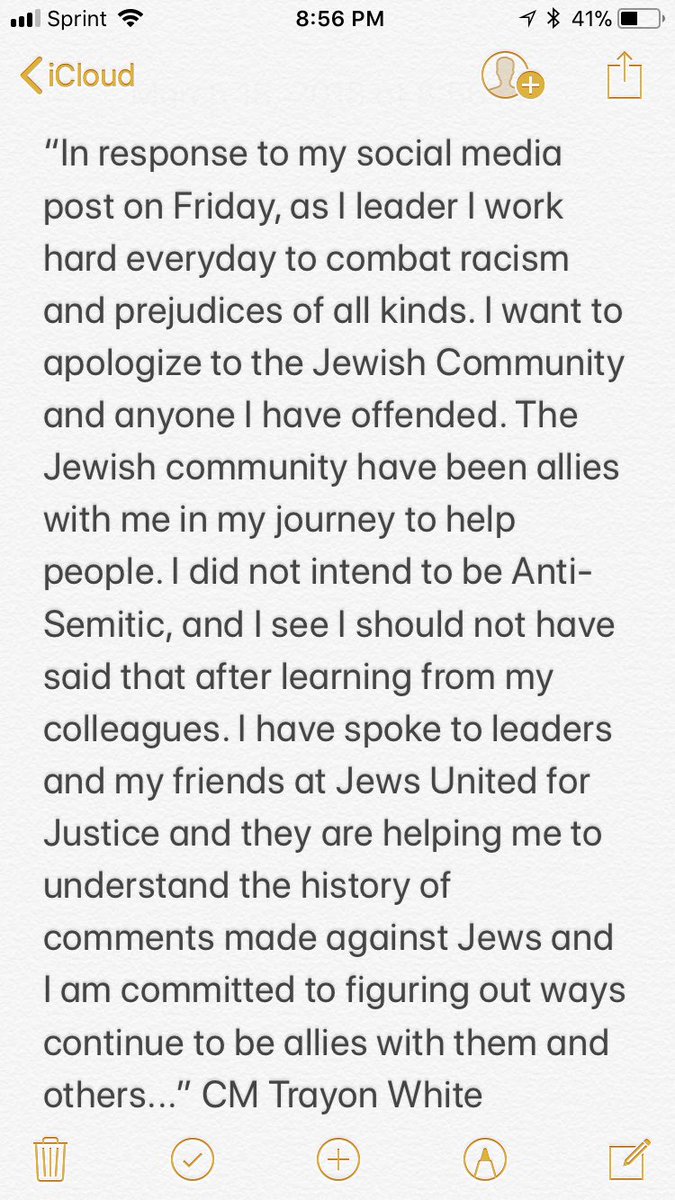
Yesterday, two separate people texted me asking if I'd see the D.C. Councilman, Trayon White Sr., who blamed the Rothschild's for manipulating the weather in Washington and causing recent snowstorms. And I'm like -- dammit, I just wanted to enjoy my weekend. But alas:
“Man, it just started snowing out of nowhere this morning, man. Y’all better pay attention to this climate control, man, this climate manipulation,” he says. “And D.C. keep talking about, ‘We a resilient city.’ And that’s a model based off the Rothschilds controlling the climate to create natural disasters they can pay for to own the cities, man. Be careful.” 
Okay, first of all, as a long-time resident of the DC metro area, I can attest that I don't care one bit about snowfall -- the weather pattern that's worth developing a conspiracy over is our 95 degree/9000% humidity summers. That's hell on earth. Second, I don't think we've had a weather-related entry in this series since Jews created the tsunami that hit the Fukushima reactor in Japan, so way to give us a throw-back!

Anyway, because I'm old and slow and can't respond to things how I used to, I wasn't able to blog on this until after Councilman White issued his apology.


I actually really like this one. Let me explain why.

The first reason I like it is based on something perhaps not evident in the four corners of the apology itself, but which I've confirmed from other sources: White took it upon himself to reach out to Jews United for Justice (a DC-area Jewish group) to ask them what he had done wrong and how he should make amends. Now, just to be clear, this is not an "I-have-Jewish-friends" defense (that's bad). It wasn't even "after Jews reached out to me, I realized I was wrong" (better). It's "after realizing I hurt them, I took it upon myself to take the initiative and reach out to Jews to figure out what I should do better" (best).

But the bigger reason I like it is that it commits to the idea that White needs to learn. Yes, we can roll our eyes at the prospect that someone is utterly unaware of how "Rothschild" stands in for antisemitic conspiracies. But even if they somehow managed to be ignorant on the subject, that's no excuse unless it's coupled with a recognition that one clearly needs to learn more if one is to be a good ally to Jews. And that's what this apology does quite well. It speaks of how JUFJ is "helping me to understand," and that he is "committed to figuring out ways [to] continue to be allies with them." It doesn't claim that he's already exemplary on the subject, and that the video was some inexplicable blurt that shouldn't sully an otherwise perfect record. The contrast to, say, the Harvard Law Student who gave a decent apology for allegedly inadvertent antisemitism but didn't indicate that he thought he had more to learn on the subject is striking, and cuts strongly in White's favor.

One thing that it is often hard to remember for for those of us committed to fighting antisemitism is that our end-goal isn't to fight antisemitism, it's to beat it. And one corollary of that goal, then, is that any campaign against antisemitism worth its salt has to account for -- indeed, actively desire -- the possibility that some people who said or believe genuinely antisemitic things will, at some later date, change their minds. Put another way, we have to have strategies through which, when encountering antisemitism, we actually change minds. Naz Shah is a great example of how much power can emerge when this works.

I'm not saying that Councilor White has earned his stripes yet. That remains to be seen based on what he does going forward; one apology (even a genuine one) issued in the moment will not and should not suffice.

But it's a start. And as a start, it's a pretty good.

Grade: 9/10.

Friday, January 12, 2018

Things People Blame the Jews For, Part XLI/Rate That Apology, Part 7: Puerto Rican Power Edition

It's a double-header!

As many of you know, Puerto Rico continues to suffer in the wake of a debilitating hurricane last year, with almost half of the island still lacking electricity. Island residents are justifiably angry at the lackluster federal response to their plight.

So why have repair efforts taken so long? Maybe it's because they're basically a colonized territory lacking full voting rights and so equal status as Americans. Maybe it's good old-fashioned racism (maybe explanations #1 and #2 are not mutually exclusive).

Or maybe, as an op-ed published in Puerto Rico's largest paper posited, it's the revenge of "the Jew":
Monday’s column by Wilda Rodriguez in the newspaper El Nuevo Día, titled “What Does ‘The Jew’ Want From The Colony?”, claimed that “Wall Street types” dictate U.S. policy, and that “Congress will do what ‘the Jew’ wants, as the vulgar prototype of true power is called.” 
“No offense to people of that religion,” she added. 
She went on to claim that Wall Street and “the Jew” are punishing Puerto Rico in order to get the island to pay its $70 billion debts.
I'm glad she added the "no offense" caveat. Who knows how it might have been interpreted otherwise?

Anyway, before I got to this Rodriguez issued an ... well, let's decide whether we'll call it an apology:
“I’m profoundly sorry that some have interpreted one of my pieces as anti-Semitism,” she wrote. “My career as a writer has been clear, and prejudice and racial and religious hostility have never been a part of it. I can understand the strong reaction that some of have had to the mere usage of the word ‘Jew.’ My intention was not to offend, but to provoke a public discussion. With that clear, I ask for forgiveness from those of good faith that were hurt by my political allusion. I have not and never will intend to offend them.”
Call me crazy, but I'm not convinced that the "mere usage of the word 'Jew'" was what set people off here. Had she written the sentence "At the age of 13, a Jew undergoes a Bar or Bat Mitzvah and becomes a full adult member of his or her community," I dare say everybody would be cool. I'd say the objection is 25% to the invocation of "the Jew" as a general archetype, and 75% to the content of that archetype being unbridled financial greed and power.

But hey -- public discussion provoked!

Grade: 2.5/10

Thursday, January 12, 2017

Rate That Apology, Part 6: Ira Madison III

During the Jeff Sessions confirmation hearing, MTV journalist Ira Madison III posted a tweet captioning a picture of Sessions holding his Asian-American granddaughter. The tweet has now been deleted, but it read:
Sessions, sir, kindly return this Asian baby to the Toys "R" Us store you stole her from.
After deleting the tweet, Madison posted the following "explanation" on Medium:
Hello. Yesterday saw the confirmation hearing of Jeff Sessions. As he was called to testify, Sessions placed his Asian American granddaughter on his lap. I made a joke alluding to the irony of a 70 year old career politician placing his post-millennial, multi-racial granddaughter on his lap to shield himself from criticism of his long standing record. My work is satirical and my words on my Twitter account have never represented MTV’s personal mission statement. But what was intended to be a provocative joke about Sessions’ record put his family in the crossfire and for that I am sorry. 
I am also sorry my joke unnecessarily distracted from the more serious matter at hand. I — and many many other Americans — genuinely believe that Jeff Sessions’ deeply troubling past on issues relating to race and immigration are disqualifying and look forward to holding him and other potential members of Donald Trump’s administration accountable for their actions. Sessions has already been rejected once by the United States Senate for his unfortunate racist comments, behaviors, and views, including praising a 1924 Immigration Law intended to end “acceptance of all races.” He was rebuked by Republicans and Democrats alike in the 1980s, unfortunately, he’s before us again. 
Going forward, we cannot be distracted from Sessions’ history, the histories of many of the men and women Trump wishes to appoint to his administration, or the online rhetoric designed to shut down debate and intimidate and terrify with violent threats and fear of doxxing. This is indicative of life on the internet for many endangered and marginalized groups right now and we must be vigilant. My writing, in part, will always be devoted to justice and I look forward to seeking it out wherever I can in the next four years and beyond.
Alas, this is not going to enter my annals of good apologies. One of the cardinal sins in a bad apology is when the author gets "on a soapbox about how [they're] really right about the core issue and just happened to express [themselves] poorly." That's definitely at work here -- a 2:1 ratio of "soapbox" paragraphs to "apology" paragraphs (and that's being generous in labeling the entire first paragraph as an "apology").

Moreover, the apology paragraph -- really more of a sentence -- is blurry and evasive. Sure, there's something intrinsically tacky about dragging a toddler into a political "joke" in this manner, and I guess that it is encompassed by talking about "put[ting] his family in the crossfire." But there's also a racialized element to the joke that can't be ignored and which this apology attempts to shunt aside. To characterize the joke as targeting "the irony of a 70 year old career politician placing his post-millennial, multi-racial granddaughter on his lap" beggars belief. Anyone with a pulse reading this joke saw it as a crude dismissal of multi-racial families among stereotypically conservative communities: "there's no way Jeff Sessions really has an Asian granddaughter, lol -- she must be a prop!" An apology which does not acknowledge and atone for that cadence, isn't one.

Grade: 3/10

Wednesday, April 27, 2016

Rate That Apology(/Apologies?), Part 5: Naz Shah

The latest in the ongoing torrent of anti-Semitism scandals to hit the UK relates to Bradford West MP Naz Shah. Shah actually started off the in good graces of the Jewish community for knocking off the truly odious George Galloway to take her seat. But this week bloggers uncovered several social media posts where she, among other things, called for Israel to be moved to the United States (the "transportation costs" would be less than the cost of foreign aid to Israel), said that Zionism was a tool to "groom" Jews to exercise power over other countries, and complained that "the Jews are rallying to" an online polls regarding the Gaza conflict.

She's been suspended from the party. And she also delivered an apology published in the Jewish News.
I am sorry. 
For someone who knows the scourge of oppression and racism all too well, it is important that I make an unequivocal apology for statements and ideas that I have foolishly endorsed in the past. 
The manner and tone of what I wrote in haste is not excusable. With the understanding of the issues I have now I would never have posted them. I have to own up to the fact that ignorance is not a defence. 
The language I used was wrong. It is hurtful. What’s important is the impact these posts have had on other people. I understand that referring to Israel and Hitler as I did is deeply offensive to Jewish people for which I apologise. 
When the “Gaza-Israel” conflict happened I played an active role in highlighting the plight of the Palestinian people, attended demonstrations to stop the bombing and called for equality in media reporting of the issues. 
Feelings were running high across the world and Bradford was no different. Hindsight is a wonderful thing and I’m shocked myself at the language I used in some instances during the Gaza-Israel conflict. 
For this I apologise. 
Since winning the seat of Bradford West I have made conscious efforts in areas around integration, building bridges and community development, in particular around Muslim and Jewish relations. Indeed one of my very first visits was to my local synagogue.  
Only last week I was learning and sharing over an interfaith Passover seder with Reform Movement Senior Rabbi Janner-Klausner, Vice Chair of Conservatives Friends Of Israel Andrew Percy MP and  others at the rabbi’s home. We all read from the Haggadah and learnt more  about Passover. 
I have been asked to consider joining the APPG, (All Party Parliamentary Group) on British Jews because of the work I’m doing locally, which includes building relations through my local synagogue. 
If politicians put their hands up when they get something wrong it would help to restore faith in politics. I hope that by writing to those who I have hurt, I am practicing as I preach and calling myself out. 
For those that I have caused hurt to, particularly the Jewish community, my constituents, friends and family, I sincerely hope my intentions and actions from here on in will win back your trust and faith in me. 
For my part I promise to have open and honest  conversations about such issues  and invite others to do that with me.
This isn't bad. Normally at this stage I'd do an in-depth analysis of the content and arrive at a rating, but this a rare circumstance where the content of the apology is not the most interesting matter to discuss.

Because this wasn't the only apology Shah considered.

Buzzfeed broke the news that Shah had also drafted an apology message that would have deployed far stronger language and commitments than what was found here.

Although the structure and much of the language remained the same in the published statement, Shah went much further in the draft apology seen by BuzzFeed News. 
That draft included this admission: “I helped promote anti-Semitic tropes. This was totally wrong.” 
But the line was dropped from the published version along with another mention of “anti-Semitism”. 
The draft statement – in which Shah talked at length about her personal shame regarding the comments and pledged her full commitment to fighting prejudice – also included a passage in which she said she wanted to take part in “an intersectional struggle, one where the concerns of Jewish individuals and communities are taken seriously and anti-Semitism is not dismissed out of hand or ignored”. This did not appear in the final version. 
Other sentences deleted from the draft included an apparent admission by Shah of a widespread problem of anti-Semitism among left-wing campaigners and deep concerns about the spread of “toxic conspiracy theories, group-blame and stereotyping”. 
“We on the left must stop procrastinating and tackle oppression within our own ranks, especially anti-Jewish oppression,” the draft said. The sentence did not appear in the published version. 
A reference to “Nazi Germany” was also changed to “Hitler”, prompting mockery from the editor of the Jewish Chronicle. 
“I accept that referencing Israel in a comparison to Nazi Germany was not only wrong, but totally inaccurate,” said the draft statement. “My other social media posts were also deeply offensive to Jewish people.” 
In the final version this appeared as: “I understand that referring to Israel and Hitler as I did is deeply offensive to Jewish people, for which I apologise.”
Initial reports suggested that this latter draft was rejected by Labour Party HQ, but apparently it was only circulated internally to Shah's office. Which raises the question: Why she didn't elect to use it?

Because the language in the Buzzfeed article was very strong. It's pretty close to exactly what I would look for an apology. It doesn't flinch from the problem, it doesn't seek to isolate it, it doesn't seek to excuse it, and it promises concrete steps to tackle it that begin with the very radical act of taking Jews seriously. Had Shah come out swinging with those words, I'd have said she'd done more than demonstrate contrition. She'd have identified herself as potentially a great ally in the fight against anti-Semitism.

But for some reason she elected to go a more timorous route. And again, it's not that the apology she did give was terrible. I probably would have given it a solid if unspectacular grade. In particular, it did seem to possess the quality that was missing in the last apology I rated: the recognition that there was a gap in her knowledge, that to do right by Jews she needed to know more than she did, and a promise to try and fill that gap. But knowing what was initially on the table, it can't help but be a disappointment.

Still, published or not, Naz Shah has offered up a template of what genuine introspection over anti-Semitism on the left might look like. And I think the Jewish community should take advantage of that. If they approach Shah, it should be on the terms of the draft. Is she willing to include Jews in an intersectional struggle? Is she willing to challenge those who don't want "the concerns of Jewish individuals and communities [to be] taken seriously" and do think anti-Semitism claims can be "dismissed out of hand or ignored"? Will she tackle the "toxic" conspiracy theories that run wild about Jews? Will she demand that her party stop procrastinating on these issues?

The jury is still out, obviously. I will say that our efforts to combat anti-Semitism cannot only be about finding the evildoers and excising them from the community. There must also be efforts at reform, about getting people to change their minds, about taking people who once would happily endorse the mass deportation of Jews to America and turning them into allies. We shouldn't be sentimental about it, but we shouldn't dismiss it as a possibility either. It's possible that Naz Shah could become a genuine and valuable ally to have. The Jewish community has every right to be skeptical; as she acknowledged in her (published) apology it is up to her, in word and deed, to "win back your trust and faith in me." But maybe she will. And that would be itself a victory worth celebrating.

Grade: N/A, scoring contaminated by the presence of the alternative draft.

Wednesday, April 20, 2016

Rate that Apology, Part 4: Something Smells at Harvard Edition

At an event hosting former Israeli Foreign Minister Tzipi Livni, a Harvard Law student stood up and asked her why she was so "smelly." Given the historical usage of the smelly, odorous Jew as a trope in anti-Semitic discourse (and the inappropriateness of asking such a question at an academic event), the student (who remains anonymous) has been roundly condemned by (among others) Dean Martha Minow, the Jewish Law Students Association, and the Middle East Law Students Association. Now the student has offered the following apology:
“I am writing to apologize, as sincerely as I can via this limited form of communication, to anyone who may have felt offended by the comments I made last week. To be very clear, as there seems to be some confusion, I would never, ever, ever call anyone, under any circumstances, a “smelly Jew”. Such a comment is utterly repugnant, and I am absolutely horrified that some readers have been led to believe that I would ever say such a thing. With regards to what I actually did say, I can see now, after speaking with the authors of this article and many other members of the Jewish community at HLS, how my words could have been interpreted as a reference to an anti-Semitic stereotype, one that I was entirely unaware of prior to the publication of this article. I want to be very clear that it was never my intention to invoke a hateful stereotype, but I recognize now that, regardless of my intention, words have power, and it troubles me deeply to know that I have caused some members of the Jewish community such pain with my words. To those people I say, please reach out. Give me an opportunity to make it right. I will assure you, as I have already assured many, that had I known it was even possible that some listeners might interpret my comments as anti-Semitic, there is absolutely no chance that I would have uttered them. I trust that those that know me and have engaged with me on a personal level will not find this at all difficult to believe. Many members of the Jewish community—some of whom hold strong differences of opinion with me—have reached out to me on their own to let me know that they did not interpret my words as anti-Semitic, because they know me well enough to know that that is not at all consistent with who I am as a person. I want to thank them and any others who have given me the benefit of the doubt, and I am writing this note in the hopes that more of you will do the same. I say this, however, fully cognizant of the fact that no amount of writing can serve as a substitute for genuine human interaction. So please, if there remains any doubt at all, do take me up on my offer above and reach out so that I can make this right to you on a more personal level.”
So we'll start with the positive -- the whole "words have power" thing, and the acknowledgment that subjective intent is not the be-all end-all of offensive speech. I suppose apologizing "to anyone who may have felt offended" is better than "I apologize if you were offended" but still not as good as "I apologize for my offensive remarks." I'm interested in the line at the end where he says that "no amount of writing can serve as a substitute for genuine human interaction." I think that's right, and I think there is something to be said for offering to interact with concerned students on a personal level. However, there were some reports that the student asked the "smelly" question as a means of protesting Livni's presence without dignifying it with an actual substantive question. Such genuine human interaction.

In any event, though, this apology to my ears is missing one very simple thing. Orlando Battista famously wrote that "an error doesn't become a mistake until you refuse to correct it." So what was the error here? If it was the use of the word "smelly", I actually believe the student when he says he was unaware of the anti-Semitic cadence of the term, would not have used it had he known about it, and will not do so in the future. In that sense, you could say he has corrected his error.

But the thing is, I don't think the error was in using the term "smelly". The fact that he wrongfully thought that calling Livni "smelly" would not be anti-Semitic shows that his instincts regarding what is and is not anti-Semitic are not as reliable as he had thought they were. That was his error -- he was speaking confidently about Jews and Jewish institutions without really knowing about them. The apology should have had two more lines:
I will assure you, as I have already assured many, that had I known it was even possible that some listeners might interpret my comments as anti-Semitic, there is absolutely no chance that I would have uttered them. However, I have now learned that my intuitions regarding what is and is not anti-Semitic are not as robust as I had thought. Clearly, this is an area I need to learn more about and one in which I need to reassess the reliability of my own intuitions and assessments, and I resolve to do so immediately.
This would correct the genuine error, which is not in my view a simple matter of verbiage. What was revealed in this event was that this student didn't know as much as he thought he did about Jews -- about our history, our experiences, and our oppression. That revelation should have more wide-reaching ramifications than simply dropping the word "smelly." Doing that is cheap grace, it costs the student nothing, and so I have no doubt he's glad to do it. Reassessing some of his more tightly-held attitudes about Jews and Jewish institutions? That's costly grace; something I've looked for in cases like these yet rarely found. But that would represent a genuine apology.

Grade: 5.5/10

Wednesday, January 07, 2015

Rate That Apology, Part 3: Kirby Delauter

I posted on Facebook, though not on the blog, about Kirby Delauter, the Frederick County councilman who became an internet sensation when he angrily told a local journalist that she was prohibited from using his name "without permission." The (above linked) Frederick News-Post editorial in response was a classic, and I highly encourage you to read it.

In any event, after a brief radio silence, councilman Delauter has issued the following statement:
“The first amendment is alive and well in Frederick County. As a public figure working to maintain and improve the county, it can be very frustrating to feel misrepresented or misinterpreted by a local media outlet.

“Over my career I have fired off my fair share of angry e-mails, which in hindsight I wish I hadn't. I can't think of one that had a positive effect. Usually, they only served to escalate the conflict. I thought I had long ago learned the lesson of waiting 24 hours before I hit the send key, but apparently I didn't learn that lesson as well as I should have.

“Of course, as I am an elected official, the Frederick News-Post has the right to use my name in any article related to the running of the county -- that comes with the job. So yes, my statement to the Frederick News-Post regarding the use of my name was wrong and inappropriate. I'm not afraid to admit when I’m wrong.

“I got elected to serve all the citizens of northern Frederick County, Democrats as well as Republicans. I look forward to the local papers covering my effort in that regard.”
Honestly, I think that's pretty solid. Kind of hangs his colleague Billy Shreve out to dry ("I think The News-Post is extremely biased and someone should sue them"), but that's on Shreve. This one takes responsibility for the wrong and admits that it was a wrong unequivocally. I don't take the notation of how "frustrating" it is to "feel misrepresented" to be an excuse, but simply a point of a context and one we can all relate to, particularly since he doesn't return to it (e.g., with some sly construction about how "everyone should strive to be fair" or like language that suggests there was mutual fault here). The closing sentence is appropriately conciliatory and stresses the right note, which is that the media can and should cover him as an elected official and that's part of what makes our democracy thrive.

So good job, Kirby. I think this hits all the right notes. 9/10.

Sunday, November 30, 2014

Rate That Apology! Part 2: Elizabeth Lauten

We're back with one of The Debate Link's favorite games, "Rate that Apology!" People sometimes say terrible things on the internet; later on, they often issue apologies. These range from the meaninglessly formulaic ("I apologize if anyone was offended. I don't have a racist bone in my body.") to the genuinely heartfelt to those which actually manage to make the original offense worse. I'm interested in how people apologize for a lot of reasons. Optimistically, apologies are an important part of moving forward and not replicating past wrongs. Pessimistically, apologies are an important part of moving forward while finding new ways to reinstantiate past wrongs.

In any event, today's entry comes from Elizabeth Lauten, a staffer for Tennessee Congressman Stephen Fincher. Some of you may have seen an image set of the Obama daughters at the annual Thanksigiving turkey pardon. They were, shall we say, not invested in the proceedings. And most people saw the pictures and chuckled at how even the First Daughters are still, at root, teenagers who think their dad does lame things and resent being stuck at boring and hokey public functions.

Lauten, however, thought the Obama daughters needed to show "a little class" and should try dressing "like you deserve respect, not a spot at a bar." This would have been a, dare I say, classless response even if they Obama girls had been doing anything remotely out of the ordinary for two teenage girls. It's especially bizarre here given that Lauten is the only person I've seen who saw those pictures and had that particular set of thoughts.

Of course, Lauten soon apologized, and that is the subject of our post (the original wrong is relevant in terms of judging the apology, but remember it's the latter that is the focus of the series):
I reacted to an article and quickly judged the two young ladies in a way that I would never have wanted to be judged myself as a teenager. After many hours of prayer, talking to my parents and re-reading my words online, I can see more clearly how hurtful my words were. Please know that these judgmental feelings truly have no place in my heart. Furthermore, I'd like to apologize to all of those who I have hurt and offended with my words, and pledge to learn and grow (and I assure you I have) from this experience.
It's perhaps worth pausing here to say what I look for in an apology. First, I want to see the person actually take responsibility for the wrong. This means none of that "if you were offended" non-sense, and certainly no complaining that one was manipulating into saying terrible things because grrrrObama!/I'm just so passionate about this issue/I'm the victim of trolling. Second, I'm suspicious of elements that seem to make it about you, the wrongdoer. This is not the time for you to talk about how wonderful you are; it certainly isn't the time to get on a soapbox about how you're really right about the core issue and just happened to express yourself poorly. Third, I don't want to hear about how the statement "doesn't at all reflect [you]." Clearly, it does -- at least somewhat. That's why you said it. If you don't like that element of self, then you should think about how you got to this place and what needs to change so you do too. Finally, one element that's typically impossible to judge at this stage but is of course worth noting is the follow-through. Anyone can say (or read off a PR-prepared card) a decent apology. It's another thing to see if it actually translates into meaningful behavioral change going forward.

Back to Lauten. She actually has a bunch of good things going for her. She does seem to accept that these words really were wrong and hurtful (not just in the ears of certain oversensitive beholders). And I like the "pledge to learn and grow" line too. That indicates that Lauten concedes that the fact that she wrote this indicates some bad thought process or malign attitudes on her part that need to be changed; that this can't be dismissed as some completely anomalous blip. Unfortunately, that passage stands in tension with "these judgmental feelings truly have no place in my heart," but at least we have that tension in the first place -- more often apologies take it as a given that obviously this wasn't the real them, so who needs introspection. Also on the potential "con" side is the "after many hours of prayer" bit, which to me seems to border precipitously on "making it about [Lauten]", but that might be a cultural bias on my part.

All in all, not bad. I'd have liked a clearer concession that this statement did say something about Lauten that she now realizes she needs to change, but that element is by far the rarest one you see in public apologies so there is a limit to how much I can mark down.

Grade: 6.5/10.

Tuesday, March 11, 2014

Rate That Apology!

Minnesota State Rep. Pat Garofalo (R) posted the following tweet a few days ago:
"Let's be honest, 70% of teams in NBA could fold tomorrow + nobody would notice a difference w/ possible exception of increase in streetcrime."
Booo! But that's old news. Garofalo has now, after initially playing defense, apologized:
"I sincerely apologize to those who I unfairly categorized," said Garofalo, who's seeking a sixth term in the fall. "The NBA has many examples of players and owners who are role models for our communities and for our country. Those individuals did not deserve that criticism and I apologize."
I find apologizes interesting, because there are some standard tropes which people typically use and which they are always criticized for. The most prominent is "I apologize if you were offended," which denies personal responsibility and foists the problem onto the (bizarrely) offended party. People always use this construction and it always goes over poorly, which makes me wonder when they're going to update whatever PR manual recommended it in the first place.

So off the bat, I give points to Garofalo for not saying that, and for specifically identifying the "criticism" itself as what was problematic, not the offense taken to it. If I was being uncharitably I could quibble with "those who I unfairly categorized" (arguably implying that there are a not-trivial number of persons fairly characterized as street criminals), but I'm feeling generous.

Garofalo proceeded to say:
"I don't have a racist bone in my body. I pride myself on the fact I've tutored in inner-city Minneapolis," Garofalo said, adding there are "no excuses. I apologize. I'm responsible for my actions."
Many people would say that the first part of that passage contradicts the second, but the instinct to try and contextualize is so strong that I don't think it's fair to automatically equate it with an "excuse". That being said, the "I don't have a racist bone in my body" is annoying defensive and not something Garofalo is necessarily in a position to verify -- certainly, his tutoring gig doesn't verify it. What would be ideal -- though it would never happen -- is for someone to acknowledge the possibility of latent racial prejudice and then commit to working to overcome it.

Anyway, all in all -- 6.5/10. Not bad, could be better, but still an improvement over the norm.