Showing posts with label technology. Show all posts

Saturday, October 25, 2025

What Penalty For the Judicial Intern Who Used Generative AI?


The contagion of AI-generated hallucinations in law has reached the federal judiciary. Two district court judges have admitted that opinions released from their chambers have included cases hallucinated by generative AI. One of the two judges specifically said that a legal intern (i.e., a current law student working in his chambers) used ChatGPT "without authorization, without disclosure, and contrary to not only chambers policy but also the relevant law school policy."

A judge is ultimately responsible for anything that goes out from their chambers, and I don't want to be misread into thinking that the judges here shouldn't be held responsible for this egregious failure. But certainly the intern who used generative AI has to be held responsible too -- a supervisor's failure to oversee and catch an abuse like this is serious, but the person who actually did the thing remains the primary wrongdoer. And so I'm curious what people's intuitions are regarding what the sanction on the intern should be.

For me, I admit, my instincts here are extremely punitive -- punitive to an extent that's surprising myself. I'm normally a pretty tolerant guy, recognizing that people make mistakes, and that we should give wrongdoers (where they take responsibility and otherwise demonstrate a credible willingness to change course) the opportunity to grow and move forward.

Yet in this case -- boy howdy. My gut instinct thoughts were, right off the bat, that of course they get fired, immediately, from the internship, and get zero credit for it. But it didn't stop there. Should they also be expelled? I'd consider it. Should they be admitted to the bar if they do graduate? I'm not sure they should be. To be blunt, I kind of think this person's legal career should be over, period, full stop, after this.

Part of my reflected rage here is that the person who uses generative AI in this way isn't just hurting themselves, they're wrecking the reputation of someone else -- the judge, someone who gave them a rare and privileged opportunity by having them work in their chambers. How dare they? Nobody will know or remember who this intern is. But the damage to the judge's reputation will follow them forever. 

And the degree to which this falls upon the head of the judge, who trusted them and gave them this opportunity, doesn't really have a parallel in other domains of law. Even in the case of an attorney whose GenAI misconduct leads to sanctions that cripple their client's case, at least the client might be able to sue for malpractice. There's nothing the judge can do to recover from the intern.

I also fail to see any serious excuse or mitigation. I flatly do not believe any law student today does not know of the risk of AI hallucination, and in any event there was in this case a clear policy against AI use that the intern apparently flouted. Were they overworked? Did they panic? Well, what's going to happen the next time they're overworked and panicked? How can anyone trust them again? How can anyone imagine handing over a client to them?

One of my stalwart beliefs about legal education, and why it must be rigorous and hold to high standards even where it's hard or stressful or puts a heavy load on students, is that bad lawyering destroys lives. Law being one's dream or passion or family expectation or ticket to financial stability is not as important as good representation of client interests, and someone who can't be relied upon to provide that should not be a lawyer, period.

But again, I'm surprised at how strong I'm feeling about this. So I invite comments that walk me off the ledge (or which vindicate my instincts).

Saturday, August 30, 2025

Things People Blame the Jews For, Volume LXXVI: Shutting Down the Internet


The above screenshot is of prominent tech journalist Taylor Lorenz screenshotting a 4chan post where someone claims "[REDACTED] are going to lock down the entire internet very soon." 

Can you guess what word was redacted?

If you answered "Jews", bzzt. Sorry, but that's not quite right.

The correct answer is "kikes". It's the "kikes" who are "going to lock down the entire internet very soon."*

Lorenz, to be fair, does make sure to point out one area of disagreement with the 4channer she's promoting. She thinks that "shut down" is not going to be literally true (rather, the internet will be "censored into oblivion"). But on the whole "kikes" thing, no correction apparently is needed. (And of course, even with the whole "kikes" things, you still get people saying "but it's just anti-Zionism!")

* Fun fact: When I told my wife the answer wasn't Jews but that it was "close", her next guess was "globalists". And I was like, "oh, you're reaching for euphemisms and that's going in the wrong direction here."

Tuesday, June 24, 2025

Calculated Deaths


One of the macabre realities of developing self-driving cars is that someone, somewhere, has to program them to kill people.

I don't mean that in a nefarious or conspiratorial way. What I mean is that the car's algorithm must have a decision tree governing how it will respond to unavoidable tragedies -- say, a person suddenly jumping into the road, and the only choice is for the car to strike the pedestrian or swerve into oncoming traffic. Someone is (likely) going to be seriously hurt, the car's manufacturer has to decide who that will be.

Human drivers, of course, also periodically face these situations. But in most cases, they don't "decide" who they're going to strike -- at least, not in the same way. A human driver faced with a sudden and unavoidable calamity is likely to make a "decision" based on some mix of instinct, reflex, and random chance. Some will hit the pedestrian, some will hit oncoming traffic, but virtually none of it is based off of any sort of real consideration or calculation.

In the abstract, this seems worse, philosophically-speaking. Philosophers might disagree on the right resolution to various trolley problems, but I can't imagine they don't think that it'd be better if we didn't think up an answer at all. Yet in this case, my instinct is that knowing someone was killed by operation of a programmed algorithm feels worse, somehow, than knowing they were killed by what is essentially thoughtless chance. The former invites a sort of "who tasked you with playing God" response. The latter, by contrast, is clearly tragic, but is a tempered one. We understand the driver could not have reasonably even made a decision, so we can't hold him or her accountable for it. What happened, happened.

That non-intuitive intuition intrigues me. It suggests there are cases where it is better that decisions -- including critical life-or-death ones -- be made thoughtlessly and without advance consideration. Obviously, the first question to ask is whether I'm alone in holding this intuition in this case. But assuming I'm not, the next question is where else this intuition extends to. Notably, I don't think I'd feel better if the self-driving car was programmed to essentially randomly choice who to kill or maim in one of these situations. But why not?

Anyway, that's my thought of the evening. Further thoughts welcome.

Sunday, January 12, 2025

Tech Bros Are Weak Men


When I look at men like Elon Musk, Mark Zuckerberg, Jeff Bezos, I see men who are fundamentally weak.

That sounds judgmental. And it is, to an extent. But maybe not quite to the extent one thinks.

All of these men were at one point self-identified Democrats. Zuckerberg flirted with a run for President before he realized that nobody, you know, liked him. Bezos positioned the Washington Post as a guardian of democracy before taking it dark.

As these men, and others in their cadre, have pivoted to the right, one narrative one often hears is that they were effectively bullied into changing their views by mean anti-big tech sentiments amongst progressives. This is far too pat (not the least because Republicans certainly held their own in highly publicized attacks on the big tech companies), but what is fair to say is that these men see themselves as having promoted liberal causes and they did not get the adulation and adoration from Democrats that they felt they deserved. They were not feted as heroes. They were not recognized as titans of industry. They were not handed the reins of leadership. They weren't even generally recognized as progressive allies. They continued to face pressure and mockery and criticism -- much fair, some not -- and they were deeply, deeply resentful for it. 

It's most obvious in the case of Musk, whose desperation to be liked is transparently obvious and who has transformed an entire social media platform into a Potemkin village of praise for the new tsar. But one sees it across the cohort -- this frustration at not being loved, and the beckoning temptation that if they just sold out then at least somebody would cheer them and make them feel like part of the team.

In theory, this shouldn't matter. For those with requisite moral fiber, one does the right thing because it's the right thing, not because one gets plaudits and cookies from it. But in practice, it is a very ordinary vice to thirst for validation and gravitate towards whatever community seems most liable to hand it out. In the face of that temptation, it takes a strong man to align with a given set of values when others holding those same values can't or won't provide that respect.

And our big tech bro leaders? They are not strong in this way. They are weak -- weak in a way that is very familiar and very human, but weak nonetheless. And we all must unfortunately live with the consequences of their weakness.

Thursday, December 26, 2024

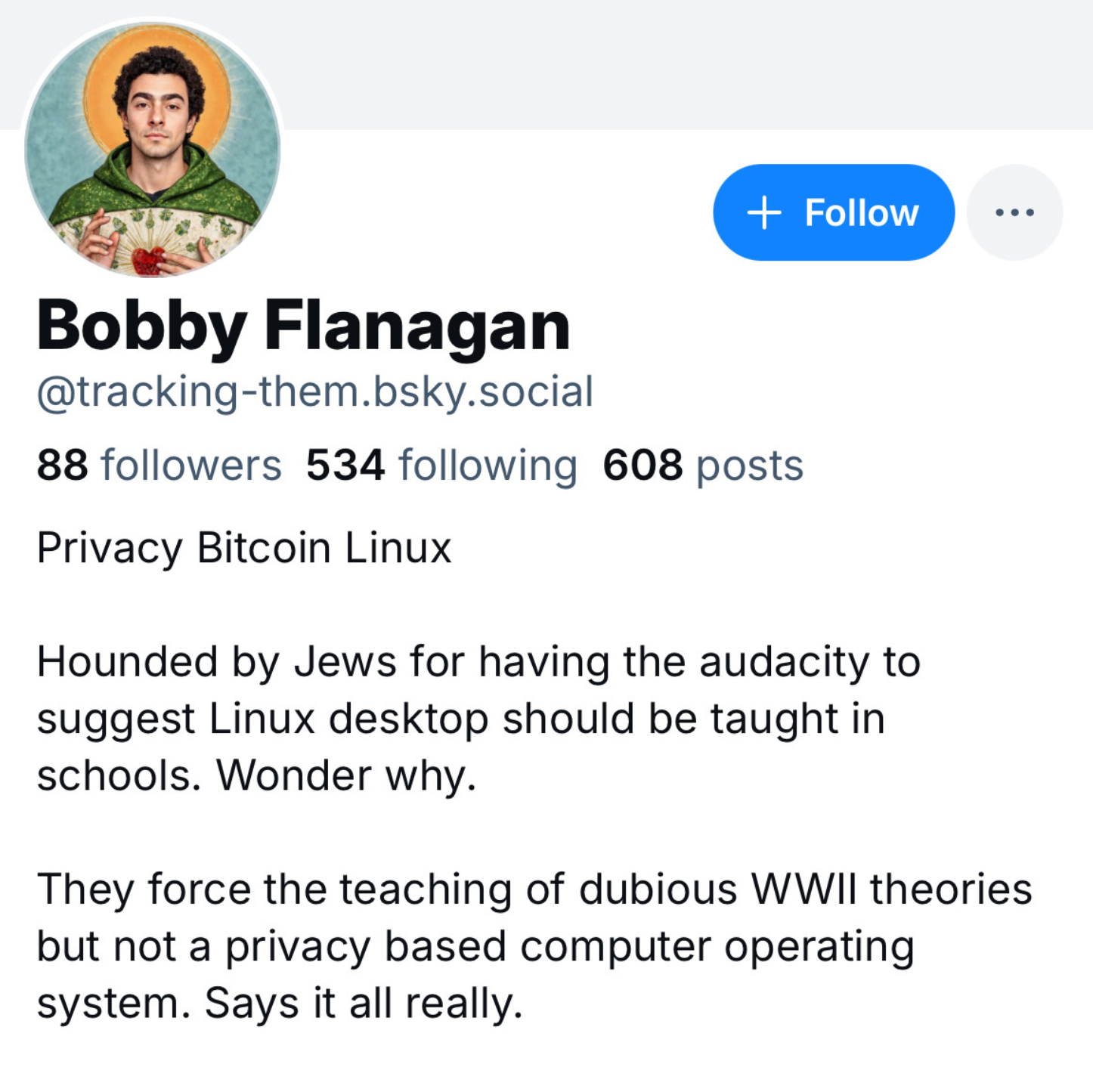
Things People Blame the Jews For, Volume LXXII: Inadequate Linux Education

The whole premise of "Things People Blame the Jews For" is that Jews are blamed for anything and everything, no matter how absurd. Yet even though I created the series, I never fully comprehended the true scope of "no matter how absurd". I thought I did, but I didn't. After all, I was always able to make a snarky comment or bit of wry commentary, an endeavor which necessarily required being able to draw some connection between what Jews were being blamed for and some attribute of the real world. The connection might be tenuous or even invented, but it was there, and I could follow the thread.

Today, I may have been bested, for I have encountered a specimen on Bluesky that I really just have no comment on. I cannot make heads or tails of it. It transcends the series. It has defeated me. Behold:


"Says it all really." Indeed, it does.

Monday, December 12, 2022

Testing a IFTTT Cross-Posting App

Apropos this post, this is a test to see if the IFTTT recipe I just created (with helpful guidance from the Boley Law Library!) works.

This block quote is simply to pad out the text of the post, though it does explain why I'm doing this:

For example: I use IFTTT to autopost links to my blog onto my Twitter account. This is incredibly important for me, as I'm pretty sure at this point virtually my entire readership comes from Twitter links. But as best I can tell, neither Post nor Mastodon has anything (whether via IFTTT or otherwise) that provides similar functionality. At the moment, I'm getting there sideways by an app which autoposts my Tweets to Mastodon (so my blog autoposts to Twitter, which then autoposts to Mastodon). But I've found no equivalent at all for Post. In general, cross-posting functionality is really important especially in the transition period where I want to be using both Twitter and its alternatives.

Wish me luck! 

UPDATE: It didn't work.

Help Me Leave Bird App!

Speaking of off-ramps, I am trying to transition my main microblogging app off of Twitter and onto an alternative. But so far, the two sites I have accounts on -- Mastodon (@schraubd@mastodon.lawprofs.org) and Post (@schraubd) -- aren't fully meeting my needs, and each have problems that significantly deter their ability to fully serve as a Twitter replacement.

For example: I use IFTTT to autopost links to my blog onto my Twitter account. This is incredibly important for me, as I'm pretty sure at this point virtually my entire readership comes from Twitter links. But as best I can tell, neither Post nor Mastodon has anything (whether via IFTTT or otherwise) that provides similar functionality. At the moment, I'm getting there sideways by an app which autoposts my Tweets to Mastodon (so my blog autoposts to Twitter, which then autoposts to Mastodon). But I've found no equivalent at all for Post. In general, cross-posting functionality is really important especially in the transition period where I want to be using both Twitter and its alternatives.

I'm also finding it incredibly difficult to find people to follow, especially on Mastodon but to a lesser extent on Post as well. You can get some people via those sites that trawl through Twitter to see who has posted their new social handles online, but that's been limited so far in my experience. The easiest thing (albeit perhaps the most worrisome from a data privacy standpoint) would be one of those widgets where you plug in your email and it tells you all the accounts which are associated with emails in your contacts. I don't think exists yet for either site, and maybe it shouldn't for privacy reasons. The next best move is to go to the people you're already friends with and see who they're following. But Mastodon, in particular, makes this impossibly unwieldy by refusing to show followers from other servers. You can get there via the scenic route if you go to each profile on its own server, but then you can't just click a button to follow (since you're not logged into that server). It's slow and clunky and needlessly frustrating. And I'll note that even Mastodon's basic search bar functionality has, in my experience, been shaky.

Finally, while comparatively minor Post has some user interface problems that are just outright annoying. Defaulting to the "explore" tab, which is not my feed but the feed of a (presumably curated) section of randos, is not what I want and I resent having to swap over to my personal feed every time I go to the site. Also, Post might suffer from having too generic of a name -- good luck finding an answer to any question you have about its functionality online (imagine Googling "how do I cross-post on post")

So what I want is basically (1) ability to cross-post across platforms, especially autolinking to my Blogger posts, and (2) a relatively easy and straightforward way to find and follow my contacts if and when they join the new sites. Whichever site (Mastodon, Post. or something else) perfects that cocktail may well be my winner.

Can We Convince Elon Musk To Declare Victory and Go Home?

It is clear, even to Elon Musk (one has to think), that Musk's acquisition of Twitter has been a disaster.

It is equally clear that Musk is far too much of a narcissistic egomaniac to ever admit it.

And while it would be nice to leave Twitter outright and hit greener pastures, the current main alternatives to Twitter -- sites like Mastodon or Post -- are not even close to primetime ready. The ideal outcome is Twitter being put back in the hands of the at least semi-reasonable before the site detonates outright.

What Musk needs is an off-ramp -- some way for him to get out of Twitter while still claiming it as a victory.

To be clear: No reasonable observer has to actually think Musk has accomplished anything or that this excuse be anything but a flimsy façade. Much like the US and Vietnam, every rational human will understand it as pure political dissembling -- "saving face" here means only an excuse that will satisfy Musk's most sycophantic fanboys. Fortunately, that cadre is the only group Musk seems to listen to anyway.

He's never going to be able to unload it for a profit -- that's out. But is there some other narrative he could spin ("It was never about the money!") where he retroactively will have "accomplished what he set out to accomplish" and can leave while saving face? Maybe he can say the "Twitter Files" exposed the dirty heart of old Twitter but now he's successfully cleaned house. Maybe he can triple down on the random staffers he's thrown under the bus as the "real problem" and now that they're gone, all is well (none of us have to believe it; again, this is all about spinning a yarn that will successfully soothe a narcissistic manchild who can't possibly admit he screwed everything up).

I don't know. It's weird to try to come up with "pathetic lie for Elon Musk to tell himself so he leaves the rest of us alone." But that's the best exit strategy we have right now, I think. Suggestions welcome.

Friday, April 22, 2022

Elevate Your Game (Reconstruction Conference Edition)

I'm in Chicago right now, presenting at a conference on the Reconstruction Amendments back at the University of Chicago Law School. I'm obviously excited to be here -- slightly less excited to have unwittingly been thrust onto a largely-maskless plane thanks to a murder cult judge on an ego trip* -- but I'll leave off on more until after the conference is over.

Rather, I want to talk about my hotel's elevators.

I'm staying at The Study at University of Chicago, which apparently just opened this past October. Overall, it seems nice, and I'm having a pleasant stay. However, there's something weird about the elevators. 

They have one of those sensors where you need to scan your room card to go to your floor. That's normal. What's not normal is that the sensors are approximately 18 inches from the ground. I'm not especially tall, but I have to bend way over just to reach them. They could not be placed in a less convenient spot unless they were on the elevator ceiling.

The reason this baffles me as that elevators-in-hotels-with-sensors are not a new concept. I'm not going to say we've utterly perfected the genre, but they're hardly uncharted terrain. Elevator manufacturers have been building these things for quite some time, and have long since learned (if there was ever any doubt) to place the sensors at a convenient arm-accessible height. That's definitely already the default option. So what possibly prompted this UI disaster? It feels like it must have been a conscious choice by someone, but I cannot for the life of me figure out what prompted it. It's like if, decades after manufacturers started putting radios in cars, one car came out with the radio controls placed inside the glove compartment. Why? Just, why?

Anyway -- as inconveniences go, this is very minor. The rant is not so much because I'm upset by this, but again, because I'm just flummoxed as to how it happened.

* My view on masking on airplanes is relatively straightforward. On the one hand, I get why people would rather be unmasked and are happy to no longer wear them. On the other hand, I also do not get how or why wearing an extra scrap of fabric on one's body -- even one that you'd rather not wear! -- has become the greatest sacrifice and deprivation of human liberty since slavery. Ultimately, I believe the decision on when masking should end in a pandemic should be made by medical experts, not random district court judges in Tampa embodying pilpul.

Sunday, January 09, 2022

The Surprising War of ADL vs. Facebook

Am I the only one who's surprised by the intensity with which the ADL has been going after Facebook recently?

I want to be clear: For purposes of this post, I mean "surprised" in a wholly value-neutral way. I'm neither saying "about time" nor "this is out of control". One can make arguments either way about whether the ADL is right or not, and those arguments are worth having, but here I'm really just focusing on the descriptive character, because what we're seeing just seems very out of character for what we know about the ADL's standard operating procedures.

There are many strategies towards trying to effectuate social change. Some are more confrontational, others are more collaborative; some are more utopian, others are more pragmatic. Along that spectrum, I think it's fair to say the ADL tends to work mostly within established systems and structures rather than radically challenging them. Again, that's not a judgment -- there's a place for radical disruption and there's a place for negotiated advances, and it just so happens that the ADL tends to be more about the latter.

And that's why their campaign against Facebook stands out. Facebook is a tech heavyweight, the sort of entity with whom the ADL typically approaches in a more collaborative spirit, knowing full well that this will involve negotiation-with-the-devil compromises and suboptimal, half-a-loaf-is-better outcomes. Whatever when can say about the virtues and defects of that approach, the ADL is hardly naïve on the subject and is relatively comfortable in its own skin as an insider operation. And as I recall, initially that was how the ADL was relating to Facebook as well -- for example, bringing Facebook execs onboard its then-new Center for Technology and Society in 2017 specifically to help combat hate speech online.

But boy is that not their tenor today. Over the past few years, the ADL has been unabashedly presenting Facebook not as a partner to be reformed, but as a menace to be confronted head on. They've organized an advertiser boycott under the banner "Stop hate for profit". Their CEO has said of Facebook "I don't think ever before a single company has been responsible for so much misfortune." They've savaged Facebook for permitting Holocaust denial and for promoting manipulative political misinformation. It is, I think it's fair to say, a full-blown war, of the sort I cannot recall the ADL waging against any institution as prominent as Facebook. Again, this is just not how the ADL typically operates when relating to organizations of Facebook's size and stature.

So while the normative analysis of whether the ADL is right or wrong, or should be doing more or less campaigning like this, is plenty interesting, for the moment I'm just curious about how we got here. What is it that made the ADL break its normal boundaries? Just what happened during the earlier period of collaboration that seemingly made the ADL completely lose patience with Facebook as an even potentially viable partner? I bet there is a very interesting story here, and I'd love to hear about it.

Sunday, August 26, 2018

The Race Is On

The challenge of the 20th century was that humanity could go extinct if a few well-positioned people happened to be reckless, extreme, paranoid, or (in the right cases) deceived.

We managed to meet that challenge (so far).

The challenge of the 21st century is that humanity could go extinct if all of us just keep on living our lives in our normal pattern.

That's a far more difficult challenge to tackle.

We are, as you don't need me to tell you, rapidly racing towards ecological catastrophe. Global warming is approaching runaway levels, threatening a chain-reaction of climatological forces which may well be irreversible and would make human life on Earth impossible. Estimates differ, but the breakout point is almost certainly within this century.

But ironically, along a similar timeframe, we're also racing towards the technological developments that could save us. These are (a) limitless renewable energy and (b) genuine artificial intelligence. If those two currencies -- energy and intelligence -- start to get on a runaway train, then all of the sudden we're back in business. Infinite energy + infinite computing power = ability to solve essentially any problem (certainly in particular the problem of freezing, or potentially even reversing, greenhouse gas emissions). And the breakout points for each of these are, I'd wager, also within this century. So short-term strategies with respect to climate change might simply be delaying actions (see: how nukes might save the world). What we need to do is buy the computers enough time to save us all.

But basically a race. Can we get to free energy and free computation before we get past a climatological point of no return? What's amazing to me is that I genuinely, truly believe it's a toss-up -- and that we'll probably find out the answer (one way or another) in my lifetime.

Of course, the advent of true AI might bring about a whole new host of existential/extinction-level problems (one of the most interesting aspects of the lore of Horizon: Zero Dawn is that they make it quite clear humanity managed to avoid the ecological apocalypse ... only to stumble into a self-replicating killer robot apocalypse). But one disaster at a time.

Wednesday, February 22, 2012

HUD

Technology often does cool things. But it is particularly exciting when technology makes real a classic sci-fi trope. And while we're still waiting on flying cars, Google may be bringing us glasses fit with a heads-up display, able to stream information about one's surroundings in real-time.

Yes, it'd actually probably be really weird, and yes, there are serious privacy implications if people are wandering around with hidden, constantly-recording cameras built into to their eyeware. But come on! A heads-up display! Just like everyone has dreamed of since they played Halo (or Goldeneye, or Doom ... age yourself appropriately)! If it doesn't give me the option to have a red box bracket my conversation partner with "target acquired", I'll be sad.

Monday, February 08, 2010

Monday Quick Hits

So how about the big game this weekend, eh?

* * *

Exonerated accused rapist forms a bond with the woman whose erroneous accusation put him in prison.

I assumed this was a tasteless Onion piece, but it wasn't: soldier waterboards four-year old daughter because she couldn't recite the alphabet. But let's be careful -- we wouldn't want to say something radical and uncivil like calling it "torture" (every little thing the Spanish Inquisitors and Khmer Rouge did....).

The University of Oregon campus and administration reacted with appropriate outrage when the offices of its LGBTQA offices were defaced with swastikas. However, as a gay Jewish-Israeli student noted, there was somewhat more serenity -- and appeals to "free speech" -- when certain other groups were targeted with swastikas.

The judge deciding the Proposition 8 challenge is a gay man. Both sides are being very careful not to make hay over it -- for now (my thoughts on the matter can be accurately deduced from this post).

... Well, some folks are doing their best to tip-toe up to the issue.

It looks like some form of talks between Israel and Palestine are going to restart.

Meanwhile, a Likud minister bluntly told a right-wing caucus that they need to give up their dreams of Greater Israel.

Justice Thomas talks a bit about his clerk-hiring practices (Thomas is known for being the Justice most prone to hiring outside the traditional Ivy strongholds): "I have a preference actually for non-Ivy league law clerks, simply because I think clerks should come from a wide range of backgrounds."

$6 million dollars is but a small price to pay to bring about the likely extinction of the human race.

Tuesday, November 17, 2009

They're Coming

The Register reports: "Machine rebellion begins: Killer robot destroyed by US jet: Rogue droid 'was attempting to cross border'":
An American "Reaper" flying hunter-killer robot assassin rebelled against its human controllers above Afghanistan on Sunday, and a manned US fighter jet was forced to shoot the rogue machine down before it unilaterally invaded a neighbouring country.
[...]
USAFCENT don't specify just what manned jet went up against the mutinous machine, or what methods the pilot used. However the logical choice would be a fighter plane - probably an F-15, -16 or -18 - and the cheapest and most fun weapon to use would be cannon fire. Opposition from the Reaper wouldn't be an issue, as it is a low-performance aircraft compared to a jet fighter and has no air-to-air capability.

It wasn't clear from the US military announcement whether the erratic death-bot had turned on its masters and was planning an attack on critical US logistics bases located north of the Afghan border, or whether it had sickened of reaping hapless fleshies like corn and was hoping merely to escape. Alternatively the machine assassin may merely have succumbed to boredom or - just possibly - a mundane, non-anthropomorphic technical fault of some kind.

Don't be fooled. It begins tonight!

Thursday, November 12, 2009

Don't We Ever Learn?

Again with the evil eyes.


Come on, Motorola! What is wrong with you!

Thursday, September 11, 2008

Dell Tech Support

I admit that the only reason I got a Dell for law school is because Chicago told me to (and my old computer broke). But, after having experienced a minor problem with the computer these past few days, I just want to say Dell tech support is amazing. A huge contrast with HP. They were great over the phone, walked me through all the stuff they wanted to try, were very friendly (and understandable), and when they thought they figured out what might be the problem, they sent a technician over to my house with all the parts next day. Actually, it was scheduled for "Friday or Monday", but then they told me they could come by Thursday. And when I asked if they could come to a different place (Friday I'd be in Minnesota, so I was going to leave it at my dad's office -- today I'm still in Maryland), they didn't bat an eyelash. And when the technician showed up, he basically took apart and put back together my entire computer, before my eyes, in the space of 25 minutes. Which was pretty cool, actually.

A+ all around. Great work.

Thursday, June 05, 2008

Video Games and the Paradigm Shift

Thomas Kuhn was a trained physicist, but he is most famous for his theories on the manner by which science progresses -- often known as the "paradigm shift". The standard view of science is that, as it progresses, it solves new problems in a relatively linear fashion: the more we do science, the more knowledge we accrue. Kuhn, though, says that science proceeds in terms of "paradigms" -- overarching organizing theories by which information is categorized, and through which scientists conduct their research. Inevitably, the paradigm will not be able to explain everything, and as anomalous results build up, eventually the paradigm hits a "crisis", and someone proffers a new paradigm (the revolution). Once this occurs, the paradigm "shifts," and the cycle begins anew.

But importantly, paradigm shifts entail at least some loss of knowledge. Even though the new paradigm presumably possesses greater explanatory power than the old, there will still be some types of knowledge or explanations which work under the old theory but not (or not yet) under the new. Hence, progress also entails loss -- a key element of the Kuhnian paradigm shift.

It is this observation that I want to link back to video games. As gaming technology increases, we don't just get better games, we fundamentally change the type of games we get to play. And some elements of old games are lost, not because they were not fun, but because they don't fit within the new paradigms of gaming which emphasize, for example, good graphics and 3-d environments.

Take, for example, the Final Fantasy series. Up through Final Fantasy IX, all the "speech" in the game was text based, in those stereotypical blue boxes. In Final Fantasy X, however, the developers managed to make the characters actually "talk", hiring voice actors to say their lines. This is "progress", and I agree, but it entailed loss as well: in the case of the Final Fantasy series, it meant that you couldn't name your own characters anymore (because the names had to be set for the voice actors).

Similarly, if one looks at the original Super Mario Brothers game, up through Mario Three (and even Super Mario World), it's pretty clear that they are operating within a similar paradigm (though each game tries to improve on the last). But today, even though everyone thinks those were stellar games, you would never see a game released that is of the same basic form as Super Mario World (a 2-d platformer). It doesn't make sense within the current gaming paradigm -- it is a design that is no longer available to game developers.

Again, not saying this is a bad thing, just an interesting observation.

Friday, May 30, 2008

SCIC

I just want to salute the Carleton SCIC (our computer tech support people) for fixing my computer when I thought it had died. They not only got it back from a blank black screen in about ten minutes, but the explained what likely caused the problem and how to avoid it. HP tech support, by contrast, not only misidentified the problem, but wanted to charge me $50 to tell me how to solve it by myself over the phone. I mean, I could understand it if I needed to send the machine in -- but $50 to talk to a technician over the phone? That's bogus.

So thank you SCIC, for saving me a lot of heartache.

Saturday, March 29, 2008

Death Is Nigh

The flip side of my view, when in the absence of my science major roommates to explain everything to me, that the world is amazing and magical, is that, also in the absence of my science major roommates, the world always seems on the brink of cataclysmic doom.

I don't even know what a "strangelet" is, but apparently we might be creating one and it will consume the earth. Or possibly just a minuscule black hole, which will grow and swallow the universe (we're expecting the latter to simply "evaporate" in a puff of radiation).

I found this through what Bean calls a frivolous law suit. Well, who will be laughing when the whole earth is converted to "strange matter"? Presumably not Bean (or anyone else)!

Friday, March 28, 2008

The World is an Amazing Place

Let others praise ancient times; I am glad I was born in these.
--Ovid, 43 BC - 17 AD

Every once in awhile, I look out on the world and marvel at where we are. The pace of technological improvement, and humankind's ability to adapt to it, is nothing short of amazing. My roommates are all science majors, and sometimes I grill them to explain to me how these things works. But I'm on Spring Break now, and they're not around. Which means I return to my default position of simple wonder.

We can send streaming pictures -- whole movies -- around the world in minutes, without anything connecting the source and the recipient. We can speak to people instantaneously across the world on our cell-phones. We can transmit pictures and sound over wavelengths and have them heard worldwide.

Do you realize that, prior to the 19th century, it's likely that no human being in history had ever traveled faster than 60 miles per hour (and lived to tell the tale, at least)? Today, we not only do it as a matter of course, but people as young as teenagers control highly complex machines that dance around each other at break neck speeds. An interstate highway lane change must look like a high-wire act to a medieval man or woman, but we do it without batting an eye.

Similarly, human adaption to flight has been remarkable. The Wright Brothers' glider first went off in 1900. By World War II -- less than 50 years later -- passenger air service was already well established. We went from flight being impossible, to flight being a normal part of our travel options, in the space of a single lifetime.

And the innovations keep coming -- in medicine, in telecommunications, in mathematics, in physics, in everything. But I'll tell you what: we could not have a single new technological invention ever again, and our lives would still rock. Most of the big problems in the world are not ones of technology. They're about distribution, or morality, or diplomacy. It's not that we don't know how to treat AIDS -- we just can't get the medicine to the right people. It's not that we don't know how to irrigate farmland, we just don't have the resources to get it to the poorest regions of the world. But the technology -- that's all there.

And that's amazing.