It's not true. But it's stuck, like a craw in the mouth of the American voter (and the American pundit). And the big question amongst Democratic strategists is how to dislodge it.
My latest idea, in my ongoing quest to become the Democratic Party's Francis Coppola, is to explicitly run with a narrative that says "yes, this is your Grandfather's Democratic Party" -- directly tying oneself to JFK and the New Deal and the civil rights era and that whole period where (supposedly) the Democratic Party was the party of ordinary Americans. Cut to lines about:
Defending labor unions.
Bringing back honest, well-paying jobs that can support your family.
Taking on the billionaires robbing our democracy.
Protecting civil rights.
Restoring a women's right to choose.
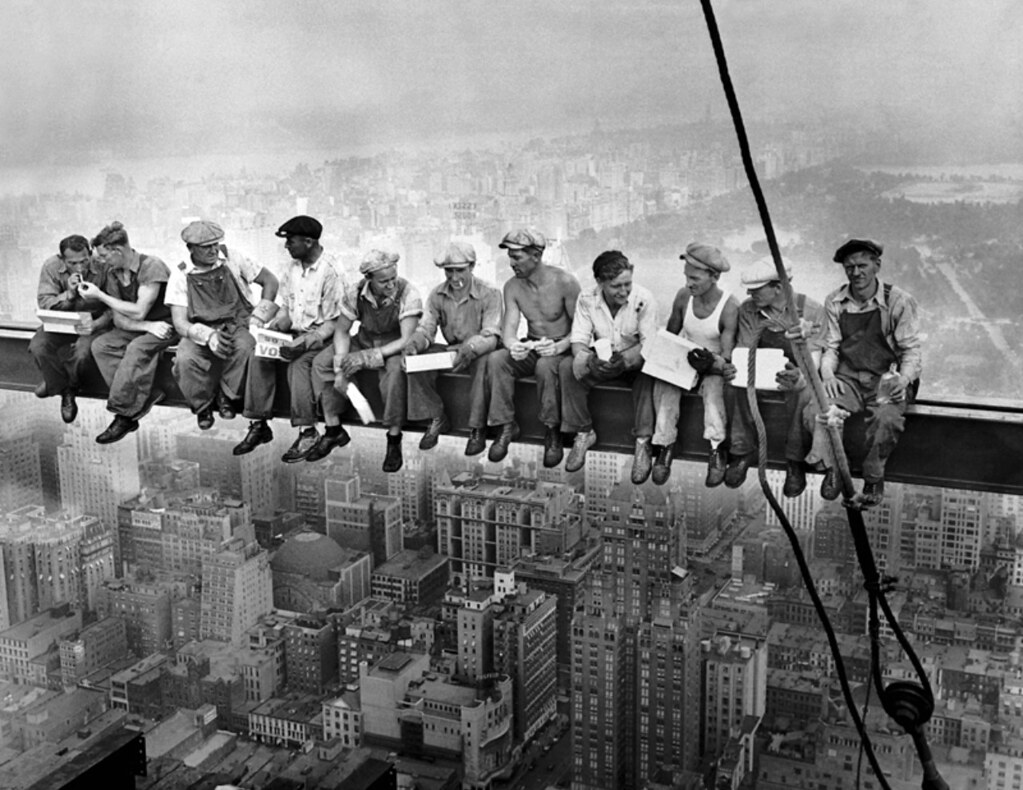
All intercut with images of modern workers interspersed with older imagery (the March on Selma, men on girders building skyscrapers, etc.) that evokes the good old days.
What's the point of the ad? Basically, it's to create a permission structure for people who have -- for whatever reason -- internalized the narrative of "the party left me" to tell themselves things have changed again. They're not voting for the modern Democratic Party that Fox News has created for them in their minds over the past few years (latte-sipping coastal elites blah blah blah), they're voting for the mythologized Democratic Party of yesteryear that the Fox News caricature is tacitly juxtaposed against -- the party of the New Deal and of JFK, the party that was a working-class party, the party that built things and fought for everyday Americans.
"Mythologized" is important. Obviously, in reality the Democratic Party of that era (or any era) was not some clarion beacon of the worker's voice; nor was it some uncomplicated bastion of civil rights and women's rights advocacy. I know that, you know that. I also know that "ordinary Americans" is a loaded term, that the past wasn't actually that great for a whole lot of people, and so on.
But we're not writing a history paper here, we're dealing with a mood, and that mood is not especially connected to historical reality. How many times have you heard someone say that the current Democratic Party "just keeps moving to the right" (when it is beyond obvious that the Biden administration is the most progressive Democratic administration in my lifetime)? Objectively, it is impossible to defend the notion that the Democratic Party leadership is more conservative now than it was during the Clinton administration. In reality, making a show of affirming people who think "well, back then Democrats were fighting for me" is worth playing a bit of make-believe. Nostalgia is a hell of a drug, and just the gesture of "this is a change in a direction that makes you feel fuzzy" can have an outsized impact. The past wasn't actually that great, and modern changes are good actually. But if you can make people feel as if the things we're pulling for now are simply a restoration of the hazy memories they have when things were inchoately "better" (or "less complicated" or "less divided" or whatever), you're in a very good position.
I'm not saying the idea is perfect. In particular, even as a subversion of the "not your grandpa's ..." frame, the tagline still is a rough one at a time when many people are aggrieved at the "gerontocracy" in American politics. So workshop the hell out of this. I'm not prideful about it. But I think there's something here. The great insight of the contemporary conservative movement is in how they manage to fuse their present-day reactionary values as if there were simply a restoration of the greatness of the founders (I read one constitutional commentator describe originalism as "ventriloquizing the present through the past"). Democrats can do it too -- and as the Republican Party falls deeper and deeper into the grip of billionaire oligarchs and weird paranoid extremists, there's an opening here we can and should exploit.
Certainly, it is not only stalwart progressives who get hit with the "bad boss" tales -- Amy Klobuchar was a prior subject, and she's very much on the moderate end of her party. Still, the Jayapal accounts do feel as if they're part of a trend of "progressive hero is actually a monster to her own workers" stories. What do we make of that trend? A few potential explanations:
There is no underlying trend. Progressive bosses are no more likely to be abusive than any other boss; if they are the target of more media stories on the subject, it is solely because of the tantalizing hypocrisy angle and/or other reasons the media targets progressives.
Something about progressive labor ideology lends itself to being a bad boss on a personal level (e.g., concentrating on formal labor rules and agreements encourages the implicit underselling of the importance of "soft" standards of interpersonal conduct).
Progressive bosses are more likely to be women and/or of color, and so are held to higher standards of conduct because of misogyny or racism (this seemed to be Jayapal's official response, and Klobuchar has echoed it too).
Progressive bosses are more likely to be under-resourced or over-demanded, and these additional burdens get passed along to staffers creating a disproportionately unbearable work environment.
Progressive employees are more likely to be sensitive to bad treatment and have a lower tolerance for it, and so are more likely to deem (and report) a given set of working conditions as bad or abusive (whether this is because they are overly sensitive and unrealistic about "the real world" or because they haven't had their internal sense of human worth beaten out of them yet is an exercise for the reader).
While I'm dubious that there are actually large numbers of people who will consciously avoid Corona beer because of coronavirus, I still can't fathom what their PR people are going to do with this. It's like all those apartment complexes called "The Isis" -- you hate to see pretty word get ruined like that.
Technically ex-Rep. Brenda Jones (it's complicated) is seeking a rematch against "Squad" darling Rep. Rashida Tlaib. One might think Jones' unabashed stanning of Louis Farrakhan would present a problem given literally every Jewish opinion piece on antisemitism that's run over the past three years; but you'd be surprised (or not) at how, er, "open-minded" some folks are suddenly capable of being given the opportunity to take out Tlaib (Jones' ongoing praise and admiration for Farrakhan and his organization vs. a solitary article written by Tlaib in an NoI publication 15 years ago -- these probably wash out, right?). The ultimate kicker: Tlaib almost certainly will crush Jones anyway, so all this selling out of deep-seated principles will be for naught.
I took my final subfield exam today, in the History of Political Thought. For those of you who don't know, "subfield exams" were introduced as a means of exploring the "chicken" game: the student really doesn't want to study (for obvious reasons), and the examiner really doesn't want to fail the student (since that would necessitate writing and grading another exam). The equilibrium is for the student to level a deeply mediocre exam, and the examiner in turn to excoriate the student in comments before passing him or her. How it made the jump to Political Theory remains unknown.
What I'm trying to say is, I'm feeling good about my History of Political Thought Exam. But I am very tired, and about to hop on a plane to celebrate a friend's engagement. So ... roundup!
* * *
Leon Wieseltier on Charlottesville, Trump, and the alt-right. He doesn't pull punches. Definitely worth a read.
Various permutations of this essay by Miya Tokumitsu, which attacks the concept of "Doing What You Love" (DWYL), has been making the blogospheric rounds to much applause. Allow me to dissent. Tokumitsu does not do nearly enough to demonstrate a causal link between the DWYL mentality and erasure of the lives of working class. Indeed, if anything DWYL is a valuable contributor to our understanding of "work", including for the "non-creative" working class.
Summarizing and simplifying, Tokumitsu observes that there only certain classes of jobs, typically held by certain classes of people, which are even candidates to be a job one might "love". The vast majority of jobs, including jobs necessary for the maintenance of "loved" jobs, are not going to be particularly fun or intellectually stimulating no matter what we do. Therefore, DWYL is inherently classist: "labor that is done out of motives or needs other than love--which is, in fact, most labor--is erased." Meanwhile, DWYL encourages exploitation -- it is basically a way to make workers content with getting less in the way of tangible proceeds in favor of nebulous emotional satisfaction.
As someone who has in the past few years done both a job that I loved (in the classic DWYL form), and a job that, we shall say, does not fit into that category, I feel well-positioned to discuss this issue. And given that the latter job paid triple the former (loved) one, I can even speak to the trade-off between tangible and intangible job benefits.
But let's not start with me; let's start instead with the claim that DWYL is class-divisive and "erases" workers whose jobs are not candidates to be loved. Put bluntly, I'm skeptical that the wealthy need the aid of a mantra to forget about the life and working conditions of the lower classes. That's really more of the default setting. The alternative to caring about how workers feel about their jobs emotionally is not necessarily caring about what workers get out of their jobs tangibly -- it can very easily be (and historically has been) caring about neither. A similar critique can be leveled at her claim that if someone does not obtain profit from pursuing their passion, DWYL implies that the fault must be in their enthusiasm. While I've never actually heard that assertion made, I admit I'm never surprised at the capacity of some people to attribute any deficiency in the lives of the working class to their own deficiencies. Suffice to say, this tendency predates DWYL, it is not caused by it.
What DWYL recognizes is that the tangible products of a job are not sufficient to provide for fulfilling lives. One can be tangibly provided for at market rates and still not have "enough". In other words, DWYL is in many respects a (admittedly inchoate) statement about a substantive entitlements -- that we are not owed just whatever dollar amount our employer puts in our pocket, but some level of happiness, dignity, and respect out of our job. Those values should be included in our calculus of what workers are provided.
Indeed, some of her treatment of improved intangible working conditions strikes me as almost incomprehensible. She quotes Marc Bousquet as saying that the "loved" academic job environment actually presents a model for corporations:
How to emulate the academic workplace and get people to work at a high level of intellectual and emotional intensity for fifty or sixty hours a week for bartenders’ wages or less? Is there any way we can get our employees to swoon over their desks, murmuring “I love what I do” in response to greater workloads and smaller paychecks? How can we get our workers to be like faculty and deny that they work at all? How can we adjust our corporate culture to resemble campus culture, so that our workforce will fall in love with their work too?
From this analysis, she concludes "Nothing makes exploitation go down easier than convincing workers that they are doing what they love."
Reading the above, one would think that the way a corporation makes people love what they do is by casting an incantation or spiking the cafeteria with hallucinogenic drugs. In reality, to make workers happy by means other than a pay raise, one has to do things that make workers happier with their jobs. Those are real benefits, not chimeras -- I'd take my less-paying but more loved job over my less-loved, better paying counterpart in a heartbeat. The trade-off isn't infinite, of course, but all that demonstrates is that neither the tangible nor intangible proceeds of work are sufficient for self-fulfillment.
Which cycles us back to those workers whose jobs are not and cannot be made loveable. We should say here that almost any job can be made, if not loveable, than at least more likeable -- by being treated fairly and with respect, for instance, or by having some security such that one isn't not in constant dread of being tossed on the street. But even to the extent these jobs lie beyond true DWYL, the concept still matters because it provides a contrast to the prevailing counternarrative -- "the value of a honest day's work." That mantra, which by my lights is far more likely to represent the real competitor to DWYL (as compared to some sort of cross-class solidarity pressing for higher salaries for everyone), cares neither whether the worker is happy or whether they getting significant tangible returns -- value comes from working whatever job the market provides at whatever rate the market pays. I'm reminded of the archetypical 50s parent who, upon hearing that his son isn't happy at work, bellows that "You hate your job? I hated my job too! That's the point of a job!"
DWYL recognizes, at the very least, that the emotional side is important -- and anytime the American cultural zeitgeist recognizes any form of substantive entitlement as necessary for a fulfilled life, I'm inclined to jump on it. And to the extent we do view DWYL as a form of substantive entitlement and we simultaneously reckon with the fact that certain people are not (and likely cannot get it), that does provide a fulcrum from which those people can leverage a claim for greater tangible benefits as compensation. Of course, I'm not saying it's a guarantee that thinking about DWYL will cause wealthier Americans to recognize the deprivations faced by their working class peers -- as I said, wealthy Americans hardly need any excuse to ignore others outside their class. But attribute the lack of cross-class consciousness to DWYL is difficult to justify.
The bottom line is that the notion that we can view work solely through the lens of the monetary returns workers get doesn't cohere to how people of any class actually view their work. We don't just want "fulfillment" or "respect", but we don't just want a dollar figure either. It's obviously true that if one is being paid little, the marginal value of each additional dollar is going to be higher compared to additional "respect" or whatnot. But that doesn't change the fact that thinking about work in a way that's helpful to workers requires a holistic approach. DWYL matters because it is a recognition about what workers are owed, and any sort of public understanding of the proceeds of work that starts from what workers deserve, rather than what the market deigns to give them, is in my book a good thing
Some folks are buzzing about the fact that Conde Nast is ending its internship program after being sued for not paying its workers. This has led to some gloating from libertarian sorts, who are elated to inform us that when government forbids for-profit employees from working for free (or for pennies), sometimes the opportunity to work at starvation wages goes away!
Color me unconvinced. I'm truly unconvinced that nobody at Conde Nast will now be doing ... whatever it is that the interns did that allegedly kept them in the office 12 hours at day at $12 a day. The difference is now the person (a) won't be called an "intern" and (b) will get something approximating an entry-level worker's salary. This is not a bad thing. Indeed, it is kind of the point. Whatever wonderful experiences one gets by being one's own Devil Wears Prada extra is now available to people who actually need their jobs to pay money.
Sarah Palin says Obama pines for pre-Civil War America. I have to say, anytime someone says "obviously, even the most hardened conservative wouldn't say such-and-such", I immediately have very little trouble envisioning a conservative saying it.
The Forward provides a brief profile of the most notorious anti-Semitic sign-waver at the Occupy Wall Street protests. Basically, he's a homeless man who long did things like hurl anti-Semitic abuse well before OWS started. So it was easy for him to stand around with his signs in Zuccotti Park. Fortunately, other members of OWS have taken to holding up signs next to him calling him a dick. Since the man has the same right to protest as anyone else, that's really all anyone can do.
One of the major questions that has floated around the "Occupy Wall Street" movement is the simple "what do they want?" Obviously, we can answer this in abstract terms: economic justice, easing of burdens on the lower and working classes, and (slightly more concretely) accountability for the people who got us into this mess in the first place (namely, Wall Street). But there has been very little in the way of specific policy proposals. Indeed, even the overall ideology is fuzzy -- supporters range from Ron Paulites (they are everywhere, aren't they) to socialists and communists, to mainstream unions, to some Democratic politicians, to relatively apolitical Americans who are simply overcome with frustration. My friend Matt Cole makes a decent defense of this mode of operation -- not making "demands" of the system but rather expressing itself in a more "aesthetic" or expressivist sense.
But Rorty Bomb has done some interesting work parsing the "We are the 99%" tumblr to try and figure out what the movement wants. And the results are sobering. OWS is not about mid-twentieth century liberalism -- increasing unionization leading to the suburban house and the two-car garage. Nor is it about socialist revolution -- smashing the capitalist state and redistributing power and dignity to the workers. What the 99% want, RB argues, is decidedly pre-modern -- bearing most in common with historical peasant revolts. They want to be free from the burden of crushing debt, have access to enough resources so they're not consistently living hand-to-mouth. That's it.
To people who think OWS is the first step to the opening a new horizon, this is profoundly demoralizing. There is nothing bold about these desires. They are ancient and basic; if anything, they are the result of people too downtrodden to dream of anything more.
But at the same time, the very simplicity of what is being asked for here also gives it greater moral punch. Surely, in a country as rich as ours, with the bounty we possess, we can give them this much.
Stellar local journalism by the Allentown Morning Call reveals rather brutal working conditions at the local Amazon.com warehouse. Things are rough in that section of Pennsylvania right now, which means Amazon.com is perfectly happy to plow through an ever-rotating mass of temporary workers lured with the promise of a full-time job, then put through a blistering pace until they can't keep up and are fired or quit (or simply are injured).
Follow this -- Norwegian heavy metal band "Slaves to Fashion" discovers a professor already wrote a book with the same title (about sweatshop labor). Embarrassed, they offered to make amends -- by writing a song about the book. Slaves to Fashion is now preparing to release "Slaves to Fashion" about Slaves to Fashion.
McDonald's, which must have laid off its entire PR department to screw up this badly, has denied a Worker's Comp claim stemming from an employee who took a bullet rescuing a patron who was being beaten inside the restaurant. The employee has needed several surgeries and has racked up $300,000 in medical damages.
This blog claims that a good Samaritan act while on the job makes one eligible for worker's compensation insofar as the act provides "good will" to the employer. I'm not sure how much goodwill McDonald's is reaping insofar as it is hanging this kid out to dry, but anything that takes them to the cleaners is okay with me at this point.
Same-sex marriage: good for the economy. How long until "pro-family" groups start up their victim complex by railing against "Big Marriage"?
Also on the marriage front, a New York court has thrown out a suit challenging Gov. David Patterson's (D) decision to recognize out of state gay marriages.
Police are charging several men with civil rights violations after shouting homophobic slurs and assaulting four men outside of a night club.
The Boston Globe reviews Mark A. Noll's new book, God and Race in American Politics: A Short History. Noll is an evangelical Christian who documents the way in which religion and race have always been intertwined on both sides of America's race question -- from slavery to civil rights. Also interesting: I didn't know that Harriet Beecher Stove became a White supremacist after the Civil War.
A New York area supermarket chain was found to have cheated some of its managers out of overtime pay. Basically, the company tried to claim they were salaried employees to avoid giving overtime, but then would treat them as hourly to dock them pay if they missed part of the day.
Third Circuit: Spanish-speaking workers bound by arbitration ruling written in English. The trial court had held the agreement unenforceable because the workers had no way of knowing that it had an arbitration clause at all.
Sometimes lawyer, sometimes law professor, all the time awesome. Associate Professor, Lewis & Clark Law School.Follow me on Bluesky: @schraubd.bsky.social
"This is a weblog that is truly welcome in blogtopia — a new blog doesn't seem to be frantically trying to score points for any party. That does NOT mean it's afraid to take a stand or be critical....You really can't predict exactly where The Debate Link will come down on all issues. It's not chanting anyone's mantra." --The Moderate Voice
"[A]n emerging genius in legal scholarship and commentary." --Jim Chen
"It's on my 1st cup of coffee rss feed." --Hanno Kaiser
"I heart this blog.... he referenced Wittgenstein, and it was entirely appropriate and non-pretentious." -- kath.A.rine
The postings on this blog are not legal advice, and should not be construed as such or in any way indicate that the reader and I have formed an attorney/client relationship.