Friday, June 07, 2019

When It Comes to Demographic Doom, Conservative Pundits Really ARE Whistling Dixie

Responding to David Brooks' fear of an upcoming GOP apocalypse, Daniella Greenbaum Davis might have written the least self-aware pollyanna account of Republican prospects I've ever read. It's almost -- not quite, but almost -- Liel Leibovitz-level bad.

Brooks' argument is simple: young people hate the Republican Party. And as this generation becomes the dominant force in American politics, it becomes a bigger and bigger problem if they hate the Republican Party. If there is to be a conservative appeal to this generation, it has to be one that can speak in the language of pluralism and diversity -- a project that the contemporary Republican Party is racing away from at top speed.

Davis is not convinced. First of all, we get the standard chestnut that even if Trump alienates the youth, he doesn't count because he isn't really "conservative". Specifically:
Trump is not conservative in the strict sense of the word; he’s a libertarian and a libertine.
Trump is a libertarian? Are you kidding me? Trump represents conservativism at roughly its furthest possible distance from libertarianism. His signature policy is a massive increase of state repression at the border. Most recently, he's wreaking havoc on the economy with a threatened tariff war. He pairs a massive ramp up of the security apparatus with targeted economic bailouts and distortions aimed to assist politically-connected and favored industries (like coal). This is the least libertarian posture imaginable.

Moving on:
We don’t need data to show us that young Americans are over-represented on the left. But it was a wise someone — not Winston Churchill, who usually gets credited, but the French historian and prime minister François Guizot — who coined the Burkean insight that anyone who is not a liberal at 20 years of age had no heart, and anyone who is still a liberal at 40 has no head.
Well, I'm glad we got it straight that it wasn't Churchill who said it! What's amazing about this is that Brooks directly addresses this point: He specifically observes that the popular belief that young are always more liberal is actually a myth (see: Israel). Instead, the first few elections a person votes in tends to calcify their political affiliation for the rest of their life -- so if young people learn early on to vote Democrat, it becomes much harder to dislodge them from Democratic affiliation later on.

So the GOP can't just wait for the kids to grow up and get more conservative. Indeed, the reason the younger generation is more liberal is because it is (a) more diverse and (b) more likely to have personal encounters with people of other backgrounds, races, etc. on a regular basis. But that's not going to change over time -- the youth might be older in fifteen years, but they're not going to become Whiter.

In any event, Davis thinks that the growing progressive bent among the youth will eventually implode on itself because it will be too socialist and, as time goes by, will eventually "consume its young". Of course, this directly contradicts the "young people will mellow out as they age" hypothesis, which would instead suggest that the harder edges of Millennial politics will instead get filed off as time goes by -- a more sustainable progressivism replacing certain youthful idealisms. It also has the convenient property of not necessitating a GOP response, since the failure of the progressive wave is axiomatically assured. So no need to tamp down on nativist or flatly racist elements in the GOP coalition -- which one would think would be a necessity if they're ever going to appeal to a generation that either is or is friendly with immigrants and either is or is friendly with non-White people. Instead, it allows the GOP to continue to respond to growing diversity in America by literally whistling Dixie.

Regardless, Davis foresees a purge where the radicals oust the moderates, who are left looking for someone -- anyone -- to carry the torch of classical liberal values. And enter the GOP!
Those exiles might abhor social conservatism, but they would be wrong to define conservatism purely by a handful of socio-religious issues, some of which exercise only the GOP’s powerful but numerically small Evangelical wing. It’s those other conservative specialties — defending free speech, championing a diversity of opinion and faith, defending free-market capitalism — that are the issues that can win back the voters.
This might have some plausibility except that the contemporary Republican Party has never been less well positioned to attract an "exile" interested in these values. We already noted that Trump -- with eager buy-in from the GOP caucus -- has pursued an economic policy of crony capitalism and a social policy of big government repression. And now we see a growing faction of conservative voices -- like Sohrab Ahmari and  Liel Leibovitz -- just openly declaring war against whatever remains of classical liberal conservatism. The ideology that wants to upend libel laws, ban entire academic disciplines, and wreck energy markets to protect polluters can no longer claim to "specialize" in free speech, diversity of thought, or even free markets.

Davis does allow that, eventually, Republicans will have to offer an agenda beyond opposing progressive "nihilism". But it speaks volumes that her survival plan for the GOP depends less on anything they might do, and instead relies on the unshakable faith that eventually Democrats will destroy themselves. Growing progressivism won't last because it can't last. That sort of outlook, ironically, is exactly the sort of docile quiescence that's allowed modern conservatism to decay into the shell of an ideology that it is today. Not free markets, not free speech, not free movement, and not free people. Just Cleek's Law, in ever-purer forms.

The Constructed Semiotics of Flags

Some Jews are uncomfortable when they see a Palestinian flag.

For some, that's due to naught but raw prejudice.

But there are some Jews -- queer and not -- who have directly experienced violence, harassment, displacement, and even death that has occurred under the auspices of the Palestinian flag, whether literally or, as a stand-in for anti-Zionism, symbolically.

For these Jews, I can imagine how seeing a Palestinian flag might be triggering or traumatic. They see people wave it, and they interpret it as a threat.

And to them, in the interest of sensitivity, I have a simple message:

Suck it up.

I'm not saying your trauma isn't real. But the Palestinian flag is much more than, and means much more than, your particular narrow experience, and there isn't any justifiable way to ban Palestinian flags in deference to these "sensitivities" that is compatible with allowing Palestinians to take pride in their identity and peoplehood. So suck it up.

This, of course, is also my posture towards those who see a Magen David and can only imagine it as a symbol of Israeli state repression. It's not that these associations aren't real. But they also by no means represent the totality of what the Magen David represents, and allowing this particular and narrow interpretation of the symbol to occupy the entire field is incompatible with allowing Jews to take pride in our identity and peoplehood. So suck it up.

The point is, we can say that these negative meanings are extant and say there is no need to privilege this particular, negative interpretation. And so one of the great sins of the DC Dyke March's position on the Jewish Pride flag is that it helps construct and bolster a semiotic meaning of the Jewish Star of David and the Jewish Pride flag as a form of aggression against Palestinians and Arabs. I'm not saying that potential meaning was wholly absent before -- obviously, there are people who really have experienced violence, harassment, displacement, and death under (literally or symbolically) a Magen David.

But in privileging that semiotic interpretation, the DC Dyke March enhances its power. It makes it so that more people are more likely to see this flag as more intensely expressing that message. And it won't just be in the eyes of the beholder. No doubt some people who bring a Star of David pride flag to a LGBT rally now do so not simply to express Jewish Pride, but also as a point of defiance -- "you hate this flag? Well nyah nyah nyah."

In a sense, it's like that time a Texas Republican put out an Israeli flag on her desk to ward off Muslim community members coming to visit her office. The sheer pettiness of the action -- as if an Israeli flag scatters Muslims like Vampires and the cross -- masked a deeper evil: the politician, by using the Israeli flag in this way, was constructing a meaning of the flag where one of its uses is to signal "I don't want Muslims to be comfortable here". That's terrible. But it is not, at the end of the day, much different from what the DC Dyke March is doing -- entrenching and congealing a meaning of the Jewish Pride flag whereby its symbolism is "aggression towards Muslims, Palestinians, and Arabs."

And as it generates this semiotic meaning for the Magen David, it does something similar to the semiotic meaning of a Palestinian flag. It bolsters its symbolic meaning as a gesture of defiance against the Jews, against those who would proudly carry a Star of David. If -- as I suspect is likely -- more Dyke Marchers carried Palestinian flags upon hearing that Jewish marchers were going to insist on carrying a Jewish Pride flag, part of the reason they're doing so is to communicate this reactive, aggressive posture: "You're coming in, with that flag? Well I've got my own flag for you right here!" Again, it's not that these meanings were wholly absent before. But actions like that taken by the DC Dyke March help congeal and entrench them, they create a world where they may well be the primary meaning -- and that's destructive.

Each time this happens, this antagonistic, deleterious meaning gets further amplified, and so each time it becomes harder and harder to say "suck it up".

But that's all the more reason why we have to hold the line now. The more controversies we have like the DC Dyke March, the more difficult it will be to ever extract ourselves and our symbols from these horrible semiotics.

Tuesday, June 04, 2019

Manny's: The Go-To Spot for Democratic Presidential Candidates in San Francisco

Even if you don't live in San Francisco, some of you might have heard of Manny's. It is a social justice oriented cafe and civic gathering space in the San Francisco Mission whose owner (the eponymous Manny, an Afghan-American Jew) committed the terrible sin of wishing Israel a happy birthday. For this, his establishment has been the subject of protests by an extreme-left fringe.

The protests are not exactly big, and they haven't stopped Manny's from thriving. Nonetheless, the story made the national Jewish press, as tales like this are wont to do. A progressive Mizrahi Jewish social activist creating an affordable cafe that employs formerly homeless individuals being set upon by far-left protesters as a "Zionist gentrifier"? I know click-bait when I see it.

But today, I saw another story about Manny's, one not reported in the Jewish press but just the local San Francisco CBS affiliate: Manny's is, by far, the biggest go-to venue in the city for prospective Democratic presidential candidates. He's already hosted or scheduled to host Pete Buttigieg, Julian Castro, Kirsten Gillibrand, John Hickenlooper, Jay Inslee, Amy Klobuchar, Seth Moulton, Beto O'Rourke, Eric Swalwell, Cory Booker, Steve Bullock, and Kamala Harris. It's a roster that apparently dwarfs any other similar venue in the city. If you're a Democrat and you've got national ambitions, Manny's is the hot spot in San Francisco.

The thing is -- I don't even view this as Democratic candidates bravely defying the hard left which sought to marginalize and degrade Manny's. Why? Because I doubt their protest frankly even hit the radar screen of your average Democratic presidential campaign. There's a version of this narrative where the Democrats are visiting Manny's in "solidarity" against the protesters, but I doubt this is even a case of that. The protest movement against Manny's, in terms of its ability to exert influence on mainstream Democratic politicians, is almost certainly so marginal as to be utterly irrelevant. The CBS story didn't even mention the boycott movement (which, to be honest, may have petered out anyway). It was literally a non-story in this story.

When we talk about the supposed creeping influence of the extreme anti-Israel left on Democratic Party politics, this really needs to be kept in mind. There are chicken littles who view every crank carrying a "Zio-Nazi" poster or campus activist calling Hillel an instrument of Zionist repression as the next head of the DNC. And then there's my position is that fringe is fringe, and that the breathless coverage such groups get by the Jewish press massively overstates their influence on anything that remotely approaches a mainstream liberal institution. The popularity of Manny's among visiting Democratic luminaries certainly seems to be powerful evidence in favor of the latter posture. This big scary far-left protest that got coverage across the national Jewish press? Turns out, it didn't even register as a blip in terms of Manny's viability as a Democratic organizing space.

I can't say I blame the extreme-left protesters for trying to portray themselves as bigger than they are -- the voice of the people! (What's the alternative: "We're a tiny fringe that has no real constituency but nonetheless ought to be viewed as the sole authentic representative of the people, because something-something-revolutionary-vanguard!"?). But we certainly don't have to indulge them.

We should struggle against the availability heuristic on our own time. Fringe remains fringe.

Monday, June 03, 2019

New Congressional Black-Jewish Caucus Announced: Will It Go Anywhere?

Apparently brokered by the AJC, Rep. Brenda Lawrence (D-MI) announced the creation of a new bipartisan Congressional Black-Jewish Caucus. The other co-founding members are Reps. John Lewis (D-GA), Debbie Wasserman Schultz (D-FL), Will Hurd (R-TX), and Lee Zeldin (R-NY). Its stated goals are to:

  • Raise awareness of each community's sensitivities and needs, in Congress and around the country.
  • Provide resources to members of Congress to empower them to bring African-American and Jewish communities together, combating stereotypes and hate and showcasing commonalities.
  • Support stronger hate crimes legislation and advocate for increased government resources to confront the threat of white supremacist ideology.
  • Support legislation and work to expand access to democracy and protect election integrity.
To be honest, I'm not entirely sure what to make of this. The concept is great, but I have to wonder whether initiatives like this ever do anything substantive beyond the press release.

I also find the list of founding congressmen and women to be interesting (are they seeking out additional members?). The list includes two Black Democrats (Lawrence and Lewis), one Black Republican (Hurd), one White Jewish Democrat (Wasserman-Schultz), and one White Jewish Republican (Zeldin).  Let's quickly run through who they are:

Rep. Brenda Lawrence (D-MI)

Lawrence is a third-term congresswoman from Michigan; holding the seat previously occupied by now-U.S. Senator Gary Peters. Prior to entering Congress, she was the first African-American woman to serve as mayor of Southfield. She also was a member of the unsuccessful Democratic gubernatorial ticket in 2010, serving as Virg Bernero's running mate. 

In Congress, she's a member of the Congressional Black Caucus and Congressional Progressive Caucus. I honestly don't know much about her, and don't think of her as a particularly high-profile member of Congress. But Lawrence's district has both a large Black and Jewish population, so it makes sense for her to try and take a leadership position on this question.

Rep. Debbie Wasserman Schultz (D-FL)

Former head of the DNC, Wasserman Schultz is probably best known as the favored target of 2016 Bernie dead-enders after they level up. That made her a target for a primary challenge from Sanders-backed Tim Canova, which got pretty nasty actually, but she ended up prevailing with 57% of the vote. She is one of the most high-profile Jewish Democrats in the House, and has what I consider to be a pretty standard political posture for a Jewish Democratic politician -- generally progressive voting record, while also being "establishment-friendly". Unfortunately, the 2016 election history means she is positively despised by the insurgent wing of the Democratic Party.

Rep. John Lewis (D-GA)

One of the legends of American politics and a civil rights hero, John Lewis has massive respect within the Democratic caucus and within the CBC in particular. He's also, throughout his career, been a stalwart friend of the Jewish people -- there's probably no more common "go-to" in Congress for Jewish-Black relations than Rep. Lewis. If anyone was going to join a cause like this, it'd be him. Unfortunately, that cuts both ways -- it is in many respects less interesting that John Lewis joined this caucus, because "of course he would". It doesn't actually signal the sort of broader buy-in one would hope for.

Rep. Lee Zeldin (R-NY)

I was honestly surprised to see he was onboard with this, as Lee Zeldin is -- how to put this gently -- a monster whose spent the past year gleefully tossing molotov cocktails all over the "Black-Jewish relationship". Ideally, being part of an initiative like this will tame Zeldin's wilder instincts -- someone can perhaps explain to him why taking an antisemitic voicemail left at his office and randomly demanding Ilhan Omar (who is never cited, mentioned, or alluded to in the message) denounce it is not how we play nicely with others. More likely, Zeldin will simply end up blowing this thing up from the inside.

What's really going on here, I imagine, is a stark example of the limits of trying to form a bipartisan caucus of Blacks and Jews. If one is simply looking to foster healthy relations between the Black and Jewish community in Congress, Republicans are, with all due respect, kind of irrelevant. But if you absolutely insist on having a Jewish Republican in the mix, Zeldin has the almost singular virtue of, well, being one (the only other Jewish Republican in Congress is Tennessee Rep. David Kustoff. He's a right-wing extremist too, though I still suspect he'd have been a better choice).

Rep. Will Hurd (R-TX)

Speaking of slim pickings, Hurd is who you get when you decide you also need a Black Republican -- he's the only one in the House (swing over to the Senate and you've got South Carolina's Tim Scott as well). He is, to be fair, a much less offensive figure than Zeldin. He also barely squeaked out re-election last cycle against Gina Ortiz Jones, who's already gunning for a rematch, so he might not be around Congress next cycle.

* * *

What do we make of this set? Leave Hurd and Zeldin aside -- they're there for obvious reasons but otherwise are non-important. We'll even assume for sake of argument that Zeldin doesn't torpedo the whole deal.

Well, Wasserman Schultz is well respected in the Jewish community but also is a lightning rod for the Bernie-supporting wing of the party. With all due respect to the Florida Congresswoman, whom I actually rather like, she's carrying a lot of weight as the only Jewish Democratic Representative in the group, and I'm skeptical of the vitality of representing the "Jewish" side of Congress through her and Zeldin. Meanwhile, Lawrence is not high-profile, and I don't think really will do much to bring in more support from the CBC more broadly. Lewis is, of course, very high-profile, but he's also in some ways uniquely ill-positioned to signal buy-in from the CBC writ large for the reasons given above.

What's more interesting, then, is who isn't in the caucus. Now again, this was just launched, and so it's entirely possible more people will join. But the question is, who are the sorts of people who, if they did join, would signal that there might be a potential for success here?

On the Jewish side of the equation, you'd want to see both someone from new generation -- say, Elissa Slotkin or Max Rose, or perhaps Jamie Raskin -- and/or a less polarizing member of the old guard (like Jerry Nadler or Jan Schakowsky). Andy Levin -- newly-elected, but part of the Levin political dynasty in Michigan -- would be a great bridging figure here too. Another obvious name to look out for is Rep. Steve Cohen of Tennessee, who actually represents a majority-Black district. If he joins, it suggests that this sort of initiative is actually being viewed as a positive. If he doesn't, well, it sends a different signal.

With respect to prospective Black members, you'd want to see something similar: someone from the old guard beyond Lewis, and then someone from the new wave. On the latter, I won't even bother mentioning she-who-must-not-be-named (though again, what does it say that Zeldin can be a member but she can't?). But Lauren Underwood, Lucy McBath, or (dare to dream) Ayanna Pressley would be outstanding additions. With respect to more senior figures, Karen Bass or Elijah Cummings or even my own Congresswoman Barbara Lee would be great. There's also a "middle seniority" group that contains some promising figures, like Andre Carson (he'd be a fantastic pick-up, as the other Black Muslim serving in Congress right now) and Hakeem Jeffries (Jeffries, sadly, seems to be at risk of becoming a new Wasserman Schultz or Tom Perez -- which is to say, someone with a solidly progressive voting record who gets identified as a barrier to the advancement of some further-left hero and therefore is transmogrified into a tool of the neoliberal neoliberalist's neoliberalism).

In particular: I see the point of a caucus like this as not just comprising of itself of people who already agree on everything, but also ones who can fairly and effectively communicate their respective community's "sensitivities and needs" -- a project which often will involve explaining why practices by the other community which might internally seem innocuous are actually hurtful. In the Omar dialogues, for example, this is where we get Jewish members explaining why Omar's comments -- perhaps seen as just making the anodyne point that "AIPAC has influence in Washington" -- were harmful and seemed to leverage antisemitic tropes; and also where we get Black members explaining why the unyielding fury of the backlash -- perhaps seen as just "calling out antisemitism" --  were harmful and seemed to reflect a minute policing of Black politicians.

In other words, if you're running through potential members of the caucus with a red pen and looking for all the heresies that should bar them from membership, I'd urge you to stop. Yes, some level of overt antagonism is probably incompatible with productively participating in a project like this (but then: see Zeldin, apparently). But not all disagreements are akin to "overt antagonism", and I don't think any of the names I've listed stand outside the realm of regular disagreement. A functioning caucus that is designed to be a space where both community's can communicate their respective concerns and sensitivities can and probably should have some people who do not start out on precisely the same page. Speaking from the Jewish angle, it is in particular not reasonable to expect this caucus be "Black politicians come into the room and agree that everything the Jewish community has been saying and doing vis-a-vis the Black community is correct and laudatory" (and, of course, neither vice versa).

Finally, I don't want to say any of the people I mentioned above are obligated to join this caucus, or that it reflects badly on them or signals they "don't care about Black-Jewish relationships" if they don't. Congress is a busy place, and these people have things to do. This is one cause among many -- it's one I happen to think is important, but there are lots of issues lots of people think are important. And of course, these Congressmen and women are almost certainly better positioned than I am to see if this caucus has even the potential to turn into something "real" beyond the press release. If it's going to be a waste of time anyway, there's no need for them to cede their limited time to be wasted.

All I am suggesting is that, for a caucus like this to actually succeed, it needs to gain a membership that signifies buy-in from a solid cross-sample of the relevant communities. I don't think the initial membership group does that on its own.

Saturday, June 01, 2019

Boxing Roundup: June 1, 2019

Haven't done one of these in awhile! But it was a big night of fights, even though I missed the PBC show on FS1. Oh, I recorded it -- it's just that virtually all of it ended up airing on FS2 because some college baseball game ran long, and then the main event came out after the bloc was already scheduled to have concluded. So quickly, before moving on to the far more interesting DAZN card....

Willie Monroe Jr. (24-3, 6 KOs) UD10 Hugo Centeno Jr. (27-3, 14 KOs)

We knew a lot more about Monroe coming in than we did Centeno. Monroe is a slickster who can generally outbox anyone on the B-level of the division, but really can't hang with the top dogs. Centeno was someone whose only losses came to some pretty elite fighters -- Maciej Sulecki and Jermall Charlo -- and so the question was whether he was an A-level fighter who happened to lose when matched at the very top, or was a B-level fighter who'd already seen his peak exposed. Looks like it's Door #2. This is a good win for Monroe, but it doesn't really change his position -- someone with basically zero chance to beat a Canelo or a Golovkin (who already smoked him), but might get the call to step-in as a semi-credible tune-up during a lull period.

Ivan Redkach (23-4-1, 18 KOs) KO6 Devon Alexander (27-6-1, 14 KOs)

Mild upset here. Alexander actually looked to be on the rebound after a long layoff battling painkiller addiction, which is an odd thing to say about a guy who was 0-1-1 in his last two fights, but most people thought he deserved the W against both Victor Ortiz and Andre Berto. Redkach was a one-time prospect who already seemed to have hit a ceiling and was seem more as a fun but limited action guy. But he caught Alexander good in round six, putting him down three times and earning the knockout. This probably ends Alexander's career at anything close to the top level, but it honestly doesn't make me feel ready to reevaluate Redkach just yet.

Okay, with that out of the way, onto ... DAZN!

Joshua Buatsi (11-0, 9 KOs) TKO4 Marco Antonio Periban (25-5-1, 16 KOs)

A good step up for Buatsi against a former title challenger, albeit one who hadn't fought in two years. Periban tried, but Buatsi was way too big and probably always too skilled to really ever be threatened. Periban is probably a permanent gatekeeper now, assuming he even decides to step back into the ring, which is far from clear. Buatsi is by no means a finished product, but he's got a lot of upside.

Chris Algeri (24-3, 9 KOs) RTD8  Tommy Coyle (25-5, 12 KOs)

Well, well. Someone finally let Chris Algeri out of the cage. After a long retirement lay-off following a beatdown from Errol Spence, Algeri looks rested, refreshed, and maybe a little more powerful than he did during his spotlight years following his upset win over Ruslan Provodnikov in 2014. He survived a bit of a scare in round two, and the body shot he put Coyle down with in round four was positively wicked. A fun action fight while it lasted, but Algeri definitely put his stamp on it. Can he compete with the top welterweights? No, it'd be the same slaughter we've already seen. Would, say, a fight against fellow Long Islander Cletus Seldin (assuming he gets past Zab Judah -- yep, that Zab Judah) be a fun time for all? I think so.

Coyle was already sounding like he had one foot out the door on his career, and this loss probably will hasten that process. He might do a farewell fight back home in the UK, but I suspect that'll do it.

Josh Kelly (9-0-1, 6 KOs) D10 Ray Robinson (24-3-2, 12 KOs)

Robinson spoils an up-and-comer for the second straight fight, and comes out of it with a draw for the second straight fight. Kelly seems like one of those dime-a-dozen Prince Naseem Hamed wannabes that always seem to be coming up the ranks. It's not that he has no skill (he does) or no athleticism (he does). But he's just not as good as he thinks he is, and it showed against Robinson. I wasn't judging too closely, but I might have thought Kelly nonetheless deserved the edge even as he clearly faded late. But I have no quarrels with a draw (and I know many other observers thought it was Kelly who got lucky here).

Callum Smith (26-0, 19 KOs) TKO3 Hassan N'Dam N'Jikam (37-4, 21 KOs)

Callum Smith is widely considered the best of the "fighting Smith brothers" (that'd be Callum, Liam, Paul, and Stephen). He certainly impressed here, although I'd say he pretty much did as expected. N'Dam -- who lacks a nickname as a fighter, which to this day baffles me since he should obviously be dubbed Hassan "Bam Bam" N'Dam N'Jikam -- is the real-boy equivalent of one of those punch-a-clown dummies. He goes down easy, but he always gets back up. He went down six times against Peter Quillin, was quite competitive during the rounds he stayed on his feet (I remember quipping at the time that "he's doing pretty well except for the times he's getting his ass kicked").

Anyway, Smith -- who had size and skill advantages over N'Dam -- put him down in each of the first three rounds. The third knockdown was particularly vicious, and while N'Dam naturally got to his feet, the referee waved it off. Unlike Willie Monroe, I think Callum Smith would make a genuinely interesting match-up against Canelo Alvarez if the latter felt like fully moving up.

Katie Taylor (14-0, 6 KOs) MD10 Delfine Persoon (43-2, 18 KOs)

There is an emergent narrative about women's boxing today, one I largely subscribe to. Basically, it holds that the women's amateur game right now is leaps and bounds ahead of where it was even a decade ago. Hence, the incoming crop of "prospects" coming out of the amateurs -- folks like Katie Taylor and Claressa Shields -- are just on a different level than even the "experienced" champions in the professional game. They're better schooled, they're stronger technically, and they've fought more consistent high-level opposition. We saw the difference when, in a highly-anticipated unification matchup, Claressa Shields ended up just running over long-time champion Christina Hammer. Yes, Shields is that good. But also her generation of fighter is just better than the one that came before, and that, as much as anything else, was what was on display in Hammer vs. Shields.

That narrative explains why Katie Taylor came in as a huge favorite against Delfine Persoon, despite the latter's glittering record and near-decade long title reign. Yes, Persoon was undefeated for the past nine years. But as Teddy Atlas would put it -- against who? Against who? There was probably nobody on Persoon's resume with skills anywhere close to the top amateurs Taylor had fought regularly.

Yet Persoon did her darndest to upset the story. And most observers -- myself included -- thought she ultimately deserved the nod, or at least a draw. Katie Taylor was very lucky to come away with a victory. And Delfine Persoon showed that she was every bit on the level of the very top, elite women fighting today.

To be sure, it was clear that Taylor was the more skilled and well-schooled fighter in the ring. But Persoon came in with an aggressive, gritty gameplan that sought to disrupt Taylor's rhythm and turn the fight into a brawl -- which she was successful at over large periods. Taylor was most effective when she could keep distance and run Persoon into check hooks on her way inside. But Persoon, though a bit dirty and more than a bit awkward, wasn't some mindless aggressor either -- she made adjustments, and by the end of the fight really had Taylor hanging for dear life. There's a fair case that, if this was a 12 round fight over 3 minute rounds, Persoon could have gotten a stoppage (side bar: women's boxing should have 3 minute rounds and the same number of rounds as the men's game. Full stop. The 2 minute round set-up is just the most prominent example of patronizing sexism that afflicts the women's game).

But let's not mislead: this wasn't the story of the talented but inexperienced starlet looking lost against the cagey, grizzled veteran and then getting gifted a decision. Taylor had a gameplan too, and had more than her share of moments. What we had was simply a great fight, perhaps the best fight we've seen to date in high-level women's boxing.

Persoon was absolutely crushed when the scores were announced, and left the ring almost immediately in tears. It was hard not to feel for her -- she had been toiling in obscurity for years, ignored while fighters like Katie Taylor got all the accolades and fortune. This was her big chance, and from her vantage (and many others) this should have been her night. She put on a hell of a performance, only to have it torn away from her by the judges. I'm not going to say it was a flat robbery, but the consensus view definitely saw more observers giving Persoon the win. I've seen plenty of draw cards as well, but very few folks (other than the two judges) score it for Taylor.

The good news is there's a strong case for a rematch. It was a great fight, a close fight, and one where there's still definitely unfinished business. There also aren't so many big money opportunities in women's boxing that a fight like this -- which now is pretty easy to market -- should be muscled out, though Taylor did mention a potential fight with Amanda Serrano instead. No disrespect to Serrano -- who is a great fighter in her own right -- but I hope she waits her turn. Persoon absolutely deserves a rematch, and it should come next.

Andy Ruiz Jr. (33-1, 22 KOs) TKO7 Anthony Joshua (22-1, 21 KOs)

A monster upset, as Ruiz becomes the first Mexican or Mexican-American fighter to win a heavyweight championship. Was it as big as Douglas over Tyson, as some commentators were breathlessly exclaiming after the fight? No. Joshua was very good but not viewed as an invincible destroyer as Tyson was at his peak, and Ruiz was more of a known quantity than Douglas was. But putting that unreachable height aside, this was a giant upset -- assuredly 2019's upset of the year.

Ruiz was a substitute for Jarrell Miller, who failed a drug test and thus lost his big break, but he still got a decent amount of time to train. Of course, with Ruiz it's always "who can tell?", as the guy just comes into every fight fat. I don't mean that as an insult or anything, and he'd be the first to agree -- Andy Ruiz is chubby around the middle. For pretty much any other fighter -- no matter how much they talk about being "comfortable at the weight" or whatever -- that's a big problem. Chris Arreola, the last Mexican-American to make a run at heavyweight glory, always made light of his weight, but it really did hold him back.

But for some reason Andy Ruiz is different. He's got genuinely fast hands for a heavyweight -- like, not just in the "you'd think as a fat guy he'd be a plodder, but he's actually deceptively quick", but objectively fast hands measured against any heavyweight you can think of. Ruiz throws really good combinations, quickly and accurately, and that was known coming into the fight.

Of course, we knew Joshua pretty well too -- a powerful guy who'd shown both skill and resilience in his breakout fight against Wladimir Klitschko, coming off the deck to knockout the aging legend in 11 rounds. I did not think the fight against Ruiz was quite the afterthought that most were making it out to be -- yet another detour from the Joshua-Fury-Wilder merry-go-round -- but I certainly thought Joshua would win it. I was prepared to be proud of myself when Ruiz made a better accounting of himself than expected.

Instead, we got a really impressive performance that included a strong round-of-the-year contender in round three. That's when Joshua dropped Ruiz and most people thought he was about to move in for the kill. Instead, Ruiz caught Joshua swinging wide and almost immediately returned the knockdown favor. A second knockdown towards the end of the round had Ruiz firmly in control and Joshua looking wobbly, fortunate to hear the bell ring.

Ruiz left Joshua off the hook, it seemed, in round four, and the question was whether he had missed his chance. But instead, Ruiz knocked down Joshua twice more in the seventh -- again, precipitated by Joshua landing a decent shot and then being countered in-between when he got a little too free going for the finish. The last knockdown saw Joshua's mouthpiece go flying, and Joshua retreated to his corner clearly expecting time to be called to replace it. The referee was not obliging, insisting that Joshua come out to fight with no mouthpiece, and I do think that resulted in some confusion as to why Joshua didn't "come forward" to make crystal clear he wanted to continue. But nonetheless, that's on Joshua, who had his arms draped over the ropes and wasn't making any motions towards stepping back into the fight. He was clearly surprised by the stoppage, but not too upset by it.

And on that score: I'm not wild about how Joshua reacted to the end of the fight. Yes, he was very classy in defeat, making no excuses and giving all due credit to Ruiz. Which is great, I like class. But it was a bit weird to see just how little Joshua seemed to be bothered by losing. It's not like I wanted to see a meltdown or anything, but there was a sense as the fight's tide turned in Ruiz's favor that Joshua kind of lost interest once it started to get hard in there. That doesn't really jibe with the heart he showed in the Klitschko fight, but it's something to keep an eye on going forward. Boxing is a tough business under the best of circumstances; it tends to chew up guys who -- however much natural talent they might possess -- have lost that inner drive to press back against adversity in the ring.

Anyway, Joshua losing actually simplifies things in the heavyweight division going forward. His next fight will be a rematch against Ruiz, and meanwhile Deontay Wilder and Tyson Fury are scheduled to fight each other assuming both get by their next opponent -- Luis Ortiz and Tom Schwarz, respectively. But a note of warning should be sounded there as well. I don't know anything about Schwarz, and frankly I expect Fury to truck him. But the Ortiz fight -- which got a lot of moans and groans because it wasn't Wilder facing Joshua or Fury -- is very much a real fight.

People forget that the first fight between Wilder and Ortiz was really good and, more importantly, really competitive. It wasn't controversial, because Wilder ended up winning in a knockout, but Ortiz very easily could have taken it. He had Wilder badly hurt and nearly ready to go. For me, I saw a fight where, if you ran it back again, I could very easily see a different man end up on top. So I wouldn't be too blase about Wilder necessarily coming out on top in the rematch. He'll be the favorite, and deservedly so, but Ortiz is a very live dog in there. Wilder/Ortiz is not just some medicine we have to take until we get to the good stuff, and the outcome of tonight's fight should give us all pause before writing the conclusion as foreordained.

Friday, May 31, 2019

Multicultural White Supremacy

Buzzfeed has an interesting piece up on the 4chan/ex-MAGA/reddit trolls who have been flocking to Andrew Yang's presidential campaign. Of course, being 4chan/MAGA/reddit trolls, they're also engaging in vicious harassment of a Yang staffer they've come to dislike.

But that's not what I want to talk about. Buzzfeed reports that Yang has gotten enthusiastic backing from some luminaries of the White supremacist right -- folks like Richard Spencer or the Daily Stormer. Despite, you know, clearly not being White.

And he's not the only one. Tulsi Gabbard already picked up an endorsement from none other than David Duke, who also infamously praised Ilhan Omar for supposedly being willing to tackle the "Israel lobby". Several far-right figures have reported being inspired by Ben Shapiro. The self-described "Imam of Peace" Mohammad Tawhidi garners endorsements from notorious Islamophobes like Tommy Robinson and Paul Joseph Watson. In his "Skin in the Game" article, Eric Ward recounted how he -- a Black man -- was able to be accepted in far-right White nationalist circles based on a presumed anti-Jewish alliance. And it cuts both ways: last year Arun Gupta had a fascinating article on young men of color outright joining far-right, White supremacist organizations.

I'm not saying in any of these cases that the White supremacist praise was invited by its recipients. There's no reason to think Yang or Gabbard or Omar or Shapiro are anything other than repelled by the prospect of being "endorsed" by White supremacists (Tawhidi is actually a potential exception). And often what one White supremacist hand giveth, another taketh away: the Yang story, after all, is about this same quadrant of "support" turning on his campaign with a misogynist vengeance. Omar is regularly targeted with death threats from the far-right, and Shapiro is the most harassed Jewish journalist online by some measures. So I'm also not saying that any of these figures are simply and without qualification beneficiaries of White supremacist grace.

But that's not the point. The point is that this sort of affinity -- in any form -- wasn't supposed to be even possible. White supremacists aren't supposed to be enthusiastic about non-White public figures. That's kind of their whole shtick. So what do we make of this seemingly bizarre phenomenon: multicultural White supremacy?

I am not the first to come up with that term -- as best I can tell, it was coined by Dylan Rodriguez at the cusp of the Obama presidency. But we are using it slightly differently. Rodriguez is speaking of how, in his view, the standard liberal multicultural political arrangement -- exemplified by someone like Obama -- nonetheless can uphold a broader structure of White supremacy. My focus, by contrast, is on "traditional" White supremacists who nonetheless come to praise and work with non-White public figures.

So what gives?

One answer is that it's all a form of trolling -- a way of leveraging their own toxicity against groups who they otherwise hate (think Richard Spencer calling his ideology "White Zionism"). There might be something to that -- I think something like that probably was in play when Duke "praised" Omar, for example -- but I don't think it's the whole story. The outright endorsement of Gabbard goes well beyond what can be explained by mere "trolling", for example. Likewise the favor with which many on the far-right hold Shapiro.

Another answer is that it falsifies the idea that the figures in question are truly "White supremacist".  Literally: how could they be White Supremacist if they're praising those whom are deemed non-White! Under this view, the fact that these supposed "White supremacists" sometimes praise and endorse non-Whites is a great big gotcha to the liberals tarring everyone they disagree with as bigots and cheapening the term "White supremacist" beyond recognition (hello, Laura Ingraham!). The problem here is that a good chunk of the figures I'm talking about describe themselves as "White supremacists" or use synonymous terms that are quite clear that they think specifically racial advocacy on behalf of Whites is an important part of their politics. If the Daily Stormer isn't "White supremacist", then nothing is.

My take is that this is best understood as a further disintegration of a Platonic Ideal of "White supremacy" which no longer (if it ever did) exists. The vision of the White supremacist as someone who simply, blindly, and uncritically hates all members of the racial outgroups, for no other reason than that they are members of that outgroup, is collapsing. In its place is someone who certainly sees inter-group conflict as central to their ideology, and views certain despised outgroups as avatars of that which they loathe in contemporary politics or society. But it's overlaid onto more complex set of political commitments (which could be anything, but often centers around a sort of paleo-conservative vision of isolationism and insularity), and so there's always the possibility that some individual member of the group will have (or be perceived as having) an aligned ideology. Such persons will be accepted as (literally) "exceptional" -- they may even be trotted out as proof that the supposedly blind haters are actually discerning and "meritocratic".

In reality, they prove the opposite: they demonstrate that occasional acceptance of certain "exceptional" outgroup members who meet highly specified criteria is perfectly compatible with even "traditional" White supremacy (let alone more subtle or ambivalent forms of racial inequity). If, as Bernard Williams reminded us, even the Nazis "pa[id], in very poor coin, the homage of irrationality to reason," this is the contemporary version of that. The Nazi anthropologists were speaking a particular language of an era that sought to warrant their hatred based on prevailing ideologies of the time. Today, the relevant ideologies have changed and thus so does the attempted payment.

There's something faintly inspiring about this -- that today even the most inveterate White supremacists nonetheless must concede some possibility of connection to or alliance with those they supposedly hate. Nonetheless, it hardly dissipates the danger. An antisemite who likes Ben Shapiro is still an antisemite. An Islamophobe who likes Mohammad Tawhidi is still an Islamophobe. A racist who likes Andrew Yang or Tulsi Gabbard is still a racist. It might be a little weird that White Supremacy could go multicultural. But such is the era we live in.

They Can't Be Trying, Because We Tried, and We're Amazing

There's a new women's organization out there -- Supermajority -- that's trying to succeed where the Women's March fragmented. And Linda Sarsour has some thoughts on them:
Sarsour says the Women’s March tried to be a space for all women, to be intersectional, but that “this never worked before” because when issues arose outside of gender equality, like racism or immigration, it made people uneasy.
“If another group wants to attempt it,” said Sarsour, “that must mean that they don’t want to have the hard conversations, because when we had the hard conversations, it was really uncomfortable and difficult for people.”
Is it just me, or does this come off as almost unbelievably petty?

Which isn't to say Sarsour doesn't feel good about her impact with the Women's March:
The formation of the Women’s March, said Sarsour, is a “very simple story.” After Donald Trump won the 2016 election, “white women started a Facebook page, and they called it the Million Women’s March.”
“These women started this Facebook page, but in order for this Facebook page to be translated into tangible, actual organizing, into actual marches, it required women of color leadership,” said Sarsour. “That’s when me, Carmen [Perez] and Tamika [Mallory] were called to come to the Women’s March. We were the only organizers, like actual seasoned organizers. Everyone else was a fashion entrepreneur. They worked in tech. They were yoga teachers. We had a woman who was a chef. Everyone had a different profession, and we were the ones that came in with the organizing background.”
The first Women’s March was a day after Trump’s inauguration. Sarsour and her co-chairs set out an agenda to harness the energy of the millions of women who took to the streets and turn it into political power. They, along with local, grassroots chapters, organized events to get women into office and voters to the polls.
“We watched the impact of activism of people who’ve never once went to a march, never called their member of Congress, all of a sudden engaging in activism at a level that we hadn’t seen in at least the last 20 years,” recounted Sarsour. “And then seeing in 2018 us winning back the House, putting over 110 women in Congress. I’m not saying that’s all Women’s March, but absolutely the Women’s March set the foundation for all of these things to happen.”
You know, I've long been content with my view on Sarsour, which is that while she doesn't deserve the frankly insane amount of attention and vitriol she receives from the American Jewish community, she's also just ... not that impressive. She's a decent rabble-rouser, but really more of a glory-hound -- everything is her her her. Thank goodness those fashion designers and yoga teachers had her to lead them! But there's not a lot going on past that.

The Washington Post just did a piece on the fractured friendship of Cory Booker and Shmuley Boteach and ... Boteach actually strikes me as a decent parallel to Sarsour. Boteach is a mediocrity who had his moment but now is seen mostly as a "he's still here?" sort of figure. He'll probably keep on getting media coverage because he has a natural knack for drawing attention to himself, but his time is past, and everyone knows it. And so too, I suspect, with Sarsour. She'll always have a cadre of folks who think she's the cat's meow, and her sheer status as a lightning rod will ensure that she can always get some amount of attention to herself (Sarsour exists in symbiotic relationship with her most inveterate haters, who also are marginal figures in the Jewish community that know the fastest way to get prime column placement if her name is in the title). But more and more, I think she'll be seen as of the past.

Who knows whether Supermajority will go anywhere. But I think Sarsour's star has faded, and she's going to be increasingly irrelevant from here on out. Just like Shmuley.

Thursday, May 30, 2019

More Fun With Anti-Discrimination Rules!

Some Jewish women were kicked out of an Uber after their Palestinian driver found out they were coming from an Israel Independence Day celebration. Uber has since terminated the driver and insisted they don't tolerate "any form of discrimination."

I doubt this will become anyone's cause celebre. That's mostly because taxis (or their replacements) are an arena where norms about serving as a common carrier -- which include broad non-discrimination requirements, far beyond what we think of normally by "non-discrimination" -- are at their strongest. There are excellent reasons why we have pretty sweeping requirements on airlines, taxis, buses, and so on that they can't pick and choose the customers they serve.

But one can certainly imagine how the case for the driver would go. The "speech" argument is already pretty familiar -- after all, he didn't object to "Jews", he objected to "people leaving an Israel Independence day celebration", which is not the same thing. Resurrect some gilded-age 19th century principles about free labor -- where the cab driver and the customer are just free contractors, both responsible for their own affairs and capable of entering into or cancelling a relationship at will --  and suddenly it sounds downright illiberal to "force" the Uber driver to transport customers when his conscience demands otherwise.

And remember: we have a judiciary that is probably more sympathetic to that outlook than at any point in the last century or so. These arguments are not as outlandish as one might think. The "New Lochnerism" already uses free speech as a wedge against huge swaths of the regulatory structure. And much of contemporary labor law -- discrimination or otherwise -- in particular involves not viewing employment as simply the atomistic interaction of free contractors who are at equal liberty to do or not do as they please. Pull that thread, and more might unravel than one intends.

Wednesday, May 29, 2019

Strange Flag-Bearers (and Burners) in Dayton

One thing that happened at the anti-KKK counterprotest in Dayton was that an Israeli flag was ripped to shreads and stomped on (after an unsuccessful attempt to burn it). How did this happen? Well, it's a weird story:
In an interview with The Observer, [Jen] Mendoza [of the Cincinnati Palestine Solidarity Coalition] said the incident occurred after she saw three young men with an Israeli flag and entered into what she described as a confusing discussion with them.
“And so recognizing the state of Israel as being of the same ideology (as) American capitalist imperialist settler colonialism, and seeing that flag on our side (counterprotesters area) was jolting,” Mendoza said of her reaction at the sight of the Israeli flag.
“One of them said that he was from Israel. And then the other two boys looked Arab,” she added. “The other kid, he was the one doing a lot of the talking, he made comments about God giving them the land, and at that point I was like, ‘Well, you’re on the wrong side of this fence if that’s what you believe.’”
Mendoza said that after the conversation went on and he said “some extremely Zionist, racist things,” he asked her if he should throw it on the ground and stomp on it.
She told him she’d be happy to burn it for him.
“And then he flipped and was like, ‘Yeah, let’s burn this flag right now,’” Mendoza added, “and he helped tear it apart — and then he told us that he was doing a social experiment to find out where people really stood on fascism. And then he began chanting ‘Free Palestine.’” 
So basically, somebody comes to an anti-KKK flag rally holding an Israeli flag and starts making racist comments wrapped in a Zionist guise. But wait: it turns out, he doesn't actually believe what he's saying -- he's impersonating an Israeli, enacting a stereotype designed to present Israelis as racist (though it's actually his words), in an effort to rile the crowd up and convince them to burn or mutilate the Israeli flag. Which the crowd then happily obliges. It's like a meat-world version of the Jewish impersonators Yair Rosenberg used to bust: "racists who pretend to be Jews—and other minorities—in order to defame them."

All at a rally that nominally was counterprotesting the KKK, which in turn was in large part targeting Dayton's Jewish community. Who then had to see a burning Israeli flag by people supposedly there to "protect" them; instigated by a person who (it seems falsely?) claimed to be Israeli in order to tar actual Israelis with his own racist performance. How lovely.

"Oh, We'd Fill It"

Of course, it surprises precisely zero people that Mitch McConnell has absolutely no problem confirming a Supreme Court nominee in an election year if the nominee is a Republican.

The only slightly interesting thing about him coming out and saying so is that he's willing to openly say so even before knowing if the situation would come up, which really hammers home just how little respect he has for even the pretense of principle. There's no tactical advantage to admitting this now, which makes it feel like he's almost playing a game to amuse himself. He's showing off how brazen and shameless he can be, knowing that not only can no one do anything to stop it, but that if push ever does comes to shove the media still almost certainly will credulously report whatever "principled" distinction GOP flacks come up with to explain why this is different from Garland, even though McConnell openly admitted there's nothing more complicated here than "because we can."

Tuesday, May 28, 2019

Quote of the Day: Shklar Translating Montesquieu on the Cruelty of the Spainards

Judith Shklar is my great-grand advisor (that is, she was the Ph.D advisor of the Ph.D advisor of my Ph.D advisor). I just picked up a copy of her book Ordinary Vices, and am reading its opening chapter on cruelty. Referring to the abject cruelties the Spainards imposed upon the indigenous population of the "New World", she writes (quoting Montesquieu):
Once the Spainards had begun their cruelties, it became especially important to say that "it is impossible to suppose these creatures [the indigenous population] to be men, because allowing them to be men a suspicion might arise that we were not Christian."
Judith Shklar, Ordinary Vices (Harvard Belknap Press, 1984), 12. She's translating Montesquieu's De l'Espirit des lois (The Spirit of the Laws), but it's her own translation.

It has become a refrain of progressives commenting on the Trump era that "the cruelty is the point" -- especially towards migrants being kept in inhumane conditions along the border or immigrants who've been quietly living in America for years terrorized by immigration enforcement. The contention that this behavior is "un-Christian", as a searing critique of the hypocrisy of the Christian right, is a common one, albeit one whose merits I'm ill-equipped to judge.

But it strikes me that the dehumanizing rhetoric towards immigrants that emanates so regularly from the right -- or perhaps, more "generously", the failure of the right to take seriously the full human robustness of immigrants as the sorts of persons who can experience fear, panic, and terror that is a regular accompaniment to the immigration regime they endorse -- is necessary precisely because of what would be implied by the reckoning. For if they are acknowledged as human, a suspicion might arise that those who endorse such terrible terrors upon them are not Christian. Or -- from my distinctly non-Christian vantage -- that they remain Christians, but that this is what Christianity is, or can be.

On Conservative "Support" for Intersectionality

Vox has an interesting profile interview by Jane Coaston with law professor Kimberlé Crenshaw, best known as the originator of the term "intersectionality", on the contemporary uses and misuses of her progeny. One of the most fascinating portions of it is when Coaston starts interviewing conservatives who have, over the past few years, treated intersectionality as their primary intellectual bogeyman. To a man, there response was basically identical: "intersectionality", as conceptualized by Crenshaw, is "relatively unobjectionable" (Ben Shapiro); even "indisputable" (David French).

What they say is that Crenshaw's ideas, themselves, as articulated in the late 1980s and early 90s, are unproblematic. Clearly, Black women experience forms of discrimination that differ in kind from those faced by White women or Black men. Who could argue? What's problematic is how intersectionality (is perceived to have been) extended in contemporary college debates, where it does allegedly stand in for some sort of inversion of hierarchy where White men are at the bottom of the pack.

This is something I've started to hear more and more frequently. In Gabriel Noah Brahm's essay on "Intersectionality" (in the infamous Israel Studies "Word Crimes" symposium), for example, Crenshaw's original 1989 essay is called a "modest, precise, and useful intervention in American jurisprudence." But things go quickly off the rails: "Over the last several years, it has become the watchword, shibboleth, and passkey to belonging on the "woke" left, among the "politically correct" who arrogate to themselves the duty of thought-policing the rest of us." Brahm contends that among intersectionality-skeptics, "A consensus that cuts across the liberal-conservative divide has emerged ... to the effect that the term's expanded uses as a metaphysical totem have outrun its otherwise valid, more limited definition." (the "liberal-conservative" is generous: Brahm lists nine critics he has in mind, of whom at most two -- Cary Nelson and, when he's in the right mood, Hen Mazzig -- can be described as "liberal").

Yet, like most conservative critics of intersectionality, Brahm's description of its contemporary effects is a self-contained system, remarkably insulated from the words or ideas of actual contemporary intersectionalists. Indeed, once he gets past the portion of the paper talking about Crenshaw's original essays, Brahm effectively ceases to cite any work on intersectionality by any self-described intersectional theorist.

Once or twice, an essay will be cited seemingly at random as offering "a representative piece of intersectional feminism", despite not meeting the seemingly minimum threshold of ever saying the words "intersectional" or "intersectionality" (this is especially hilarious given Brahm's insistence on the power of intersectionality the word as a "watchword, shibboleth, and passkey". Some passkey -- it needn't even be used to open the doors!). But for the most part, contemporary intersectionality is understood almost exclusively in terms of what it is stipulated to mean by popular conservative critics in outlets like Commentary and The Daily Caller. As we know, they hate it, even though they concede that the primary texts aren't actually problematic at all. In other words, conservatives are fine with what intersectionalists describe as intersectionality, but loathe what conservatives call intersectionality. So maybe the problem lies in the conservative descriptions?

And that raises the question: what do we make of the conservative contention that they are actually willing to endorse the "original", supposedly unproblematic intersectional claims? The basic form of the question is whether they think -- in harmony with Crenshaw's original argument -- that discrimination against "Black women", specifically, should be recognized as an independent basis for Title VII liability beyond "race" or "sex" discrimination. I've seen little evidence that they do back any legal or statutory reforms to provide clarity here, but perhaps I'm wrong.

More broadly, the question is whether conservatives object to research programs which seek to uncover the specified and particular modes of discrimination faced by, e.g., Black women, or other permutations of several marginalized identities. After all, to quote French, it's just "commonsense ... that different categories of people have different kinds of experience."

Yet in practice, I'm guessing the answer is no. The closest Brahm gets to citing a contemporary articulation of intersectionality by a backer rather than a critic is in the National Women's Studies Association declaration of what "Women's Studies" is:
Women's studies has its roots in the student, civil rights, and women's movements of the 1960s and 70s. In its early years the field's teachers and scholars principally asked, "Where are the women?" Today that question may seem an overly simple one, but at the time few scholars considered gender as a lens of analysis, and women's voices had little representation on campus or in the curriculum. Today the field's interrogation of identity, power, and privilege go far beyond the category "woman." Drawing on the feminist scholarship of U.S. and Third World women of color, women's studies has made the conceptual claims and theoretical practices of intersectionality, which examines how categories of identity (e.g., sexuality, race, class, gender, age, ability, etc.) and structures of inequality are mutually constituted and must continually be understood in relationship to one another, and transnationalism, which focuses on cultures, structures and relationships that are formed as a result of the flows of people and resources across geopolitical borders, foundations of the discipline.
This seems to be an articulation of intersectionality that is no more "problematic" than Crenshaw's original: "categories of identity" and "structures of inequality are mutually constituted  and must continually be understood in relation to one another." A little more jargon-y, perhaps, but not something that strays far from Crenshaw's original formulations. Yet Brahm cites this as his proof-text for the claim that "the majority of radical academic feminists today, in theory and in practice, hold to some version of this sort of 'post-essentialist' understanding of what it means to study gender" and therefore(?) the contemporary feminist project is irredeemably fascist, antisemitic, and racist. (Don't shed too many tears: feminism "achieved its proper goal long ago, when women gained equal rights under the law in the developed world"; now " we can all contribute toward restoring sanity in the academic arena by rejecting" contemporary feminism's "shrill, hectoring discourse").

So what we're really seeing is the classic historical pivot of contemporary conservatism: hating some feature of progressive discourse right up until it becomes too mainstream to effectively challenge, at which point critics say that the term they've just spent years assailing used to be valuable and important but only now has turned astray. The National Review did it with "civil rights", David French did it with "white privilege", and now they're all doing it with "intersectionality". It's bad scholarship and bad history, all wrapped together in a neat little bow.

Monday, May 27, 2019

Young Jews Might Really Be a Touch(!) More Conservative

I crowed a bit at the recent poll showing Donald Trump has an abysmal 29/71 approval among Jews, and a bit more at the effort by GOP Jewish groups to present this as good news.

But dig a little deeper into the data and you do find something more interesting: younger Jews are at least a little less anti-Trump than our older compatriots. Millennial Jews (35 and younger) give Trump his best net favorability rating -- and that's after Orthodox Jews are excluded (the pollsters actually don't give the breakout with Orthodox Jews included, but eyeballing it their inclusion would probably see Trump's favorables among Millennials rise to the mid-to-high 30s).

Now "best" is pretty relative -- it's still a wretched 33/67. But it beats Gen Xers (30/70), Boomers (25/75), and Greatest/Silent Generation (22/78). (The very youngest Jews -- just those under 30 -- are slightly more anti-Trump than "Millennials" writ large. So maybe it's my cohort -- the 30-to-35 year olds -- who are the problem, though more likely that's just a statistical blip).

I don't know exactly what to make of this. The narrative, of course, is that the youth are liberal and the elders are less so. Then again, maybe it's not surprising that the generation that lived through the Holocaust and its immediate aftermath would be even more aggressively anti-Trump than today's comparatively coddled kids.

The big question, for me, is the degree to which these opinions cut with or against other demographic correlations. For example, one possible explanation for more ambivalence among younger Jews is bad experiences with extreme left-wing politics in college. Yet this would cut against normal demographic findings where college education correlates to greater anti-Trump sentiment. Now, I'd be extremely surprised if Jews with college education were more pro-Trump than those without -- that would be stunning if it were true. But it's possible that the liberalizing effect of college education on young Jews is weaker than it is on non-Jews of the same generation -- and that would still be quite revealing.

Basically, it'd be interesting (it's always interesting, but unfortunately also expensive) to chop the sample up into finer bits. How do Jewish opinions on Trump compare when you start controlling for variables like college education (Jews are disproportionately well-educated, which in turn correlates to liberalism); race (Jews are disproportionately White -- yes, for this purpose we are -- which correlates to conservatism); wealth, urban residence, etc.? Such inquiries can overturn some considerable established wisdom (one recent study, for example, found that controlling for relevant social positionality American Jews are less politically-engaged than comparable non-Jews)

Indeed, similar questions can be asked about whether the "youth", generally, are actually more liberal, or just more diverse (a greater proportion of young people are non-White, but are White Millennials any less conservative than White people generally? What happens if we start controlling for urban residence, education, etc.?).

Anyway, it's easy to read too much into this -- especially since, again, we're talking about the difference between "overwhelmingly anti-Trump" and "really overwhelmingly anti-Trump". But it does present at least a slight corrective to the narrative that young Jews today are actually a vanguard of leftism compared to the staid centrism of their elders.

Saturday, May 25, 2019

Jewish Representation on Television: A Random Review

I've been thinking about Jewish representation on television series over the past few days. The trigger was actually an antisemite who was complaining that there are too many Jewish characters on television -- we apparently have taken over his TV. That struck me, because my naive view was that Jewishness actually doesn't get a lot of attention on TV series (even Seinfeld, if I recall correctly, rather famously did not actually say its characters were Jewish).

But I decided to actually think about it more, and look into how Jews are portrayed on the shows I watch. This is therefore not remotely scientific -- though I do watch a fair bit of TV -- and some obvious choices (Broad City!) thus aren't included. I'm most interested in shows that are not primarily about Jews, but nonetheless have Jewish characters whose Jewishness is fleshed out in a substantive way.

I include shows that have no Jewish characters. This is not necessarily a critique -- not every show has to include Jews -- but it is worth including to get a sense if there is any pattern to what sorts of shows have Jews and what don't. That said, I'm not necessarily a superfan of all these shows, so it's possible that I could miss something (though it hardly counts if deep in Season 6 a show briefly mentions so-and-so is Jewish, only to never bring it up again before or since).

* * *

30 Rock: On a show about New York City comedy writers, only Josh -- Josh! -- might be Jewish. This entire show is a case of "just say Jewish, this is taking forever!" C-

Big Bang Theory: Of the major characters, only Howard (and his mother) are Jewish. Neither are exactly positive representations -- Howard, in particular, manages to be the most perverted, awkward and creepy of a cadre of young male scientists whose whole shtick is that they're kind of perverted, awkward, and creepy around women. Interestingly, Bernadette is portrayed as super-goyish even though Melissa Rauch is actually Jewish (Mayim Bialik is more famously Jewish, but to my knowledge Amy Farrah-Fowler is not depicted as a tribe member). D-

Billions: At first I thought this show had no Jewish characters, a decision I chalked up to maybe wanting to step lightly around the whole "ruthless billionaires manipulating the financial system" thing. But then I remembered: Spyros is Jewish! Spyros! By far the worst character on the show along pretty much any metric you might consider, including that he's portrayed as a serial sexual predator. Literally every character is at least written in shades of grey, and we get Spyros. Ugh. D

Brooklyn Nine-Nine: Jake Peralta is Jewish. It pretty much only comes up when he has flashbacks to his Bar Mitzvah (curse you Jenny Gildenhorn!), but at least it is acknowledged as a part of his character with substance. That said, it almost never is visible in his adult life -- most strikingly, there's no portrayal of it being discussed with Amy in terms of how their family will or won't be Jewish. B-

Buffy the Vampire Slayer (and Angel): Willow is Jewish, but it gets almost no attention -- I think by the end of the series she's outright celebrating Christmas. C

The Chilling Adventures of Sabrina: No Jewish characters.

Community: Annie is Jewish, but it is almost entirely downplayed. Indeed, it basically never comes up outside the first season. Missed opportunity. C+

Crashing: This is a tough one to judge, since so many of the characters are playing themselves. I know Sarah Silverman is Jewish. I think Artie Lange is? I don't know if Ali Reissen is supposed to be Jewish, but the actress who plays her definitely is. I do know Pete Holmes is not Jewish. I can't give a rating here.

Dollhouse: No Jewish characters.

Elementary: No Jewish characters.

Firefly: No real Jewish characters, though they do briefly show a postmaster wearing a yarmulke. It's actually a really neat moment of casual Jewish inclusion that I really appreciate.

Fresh off the Boat: I don't think any of the regulars (including Eddie's friends) are Jewish, but Evan's arch-rival Phillip Goldstein is definitely Jewish -- and definitely portrayed as a massive asshole. C

Game of Thrones: No Jewish characters (outrageous!).

The Good Place: No Jewish characters (actual sad face here -- though I can see how incorporating actual religious faith into this show might be hard).

I Feel Bad: Probably not worth including -- it was canceled after one season, and I'm not sure it even fully aired the one -- except to give one last plug to my headcanon where it is Sarayu Blue's side of the family that is Jewish. Brian George -- who plays her father -- is Jewish! He should get to play a Jewish character some time. Alas, the show goes down the more predictable route of making Paul Adelstein's side of the family the Jewish one. It does a good job with that. I guess. Still salty. B

Insecure: I don't think any characters are Jewish. Frieda might be Jewish, which would be okay. Joanne also might be Jewish, which would be a less attractive proposition.

iZombie: No Jewish characters.

Mad Men: Rachel Mencken is great. She also stands pretty much alone. B+

Marvelous Mrs. Maisel: This is the only show that is explicitly Jewish in focus, and as I said that's not my main concern here. In any event, not everyone likes the portrayal of Jewishness, but I actually find it quite warm on the whole. A.

Marvel's Agents of S.H.I.E.L.D.: No Jewish characters.

Mozart in the Jungle: No Jewish characters (really?).

New Girl: Full disclosure: I did not watch this show all the way to the end. Anyway, Schmidt is one of the more famous Jewish portrayals of contemporary television. I'm not his greatest fan -- in particularly, that he's a proud Republican is, shall we say, statistically anomalous -- but once I started comparing him to the competition above he turns out pretty decent. Still, he, too -- especially in the early seasons -- doesn't exactly stand out on the "treats women with respect" metric. B

Parks and Rec: The main Jewish characters are the Saperstein twins -- John-Ralphio and Mona Lisa. They are each, in their own way, "the worst person in the world." And with John-Ralphio, we get yet another creepy Jewish harasser. D

The Orville: There are no Jews in space.

The West Wing: This show actually comes out great. Toby and Josh are Jewish, visibly so, yet in very distinctive ways. It comes up, though it isn't obsessed over, in ways that feel authentic to their character. And the pilot includes one of my favorite "Jewish" scenes in all of television. A+

* * *

In sum, I'd say that -- outside of shows where Judaism is a central focus (Marvelous Mrs. Maisel), there are a dearth of characters whose Jewishness is portrayed (a) positively and (b) as a substantive (not all-encompassing) presence in their lives. It seems that sci-fi and fantasy shows are the least likely to have Jewish characters, which is understandably, though it includes series set on Earth or otherwise "near-real world" conditions. This might reflect anxiety around how to portray Jews in juxtaposition with the occult and/or dystopian authoritarianism without reenacting antisemitic tropes.

On the positive side, The West Wing, in my view, stands head-and-shoulders above the crowd; other solid performers include Brooklyn Nine NineNew Girl, and (for what it's worth) I Feel Bad. But these are exceptional, for the most part, the Jewishness of characters either isn't established much beyond its mere mention. And the main exception is when Jewish male characters are portrayed as perverts, creeps, or sexual harassers -- indeed, this might be the most common way of "marking" a character as Jewish, which is worrisome.

Friday, May 24, 2019

A Bleg For Two Judicial Quotes

In my head, I remember two striking quotes from judicial opinions -- neither of which I can remember the source or even the precise verbiage of. In my mind, they're both from Judge Easterbook, though I can't confirm that.

The first goes something like this:
"On appeal, [Party] raises four issues, three of which won't survive the end of this paragraph...."
The second goes something like this:
"This case pits [Constitutional right], which is in the Constitution, against [other constitutional doctrine -- perhaps the Dormant Commerce Clause?], which is not."
Any help? Did they come from Will Baude? Did Will Baude used to have a personal website with favorite quotes? Am I completely hallucinating?

UPDATE: We got one! Bridenbaugh v. Freeman-Wilson (and yeah, it was a Judge Easterbrook opinion):
This case pits the twenty-first amendment, which appears in the Constitution, against the "dormant commerce clause," which does not.

Thursday, May 23, 2019

Why is This Antisemitic?

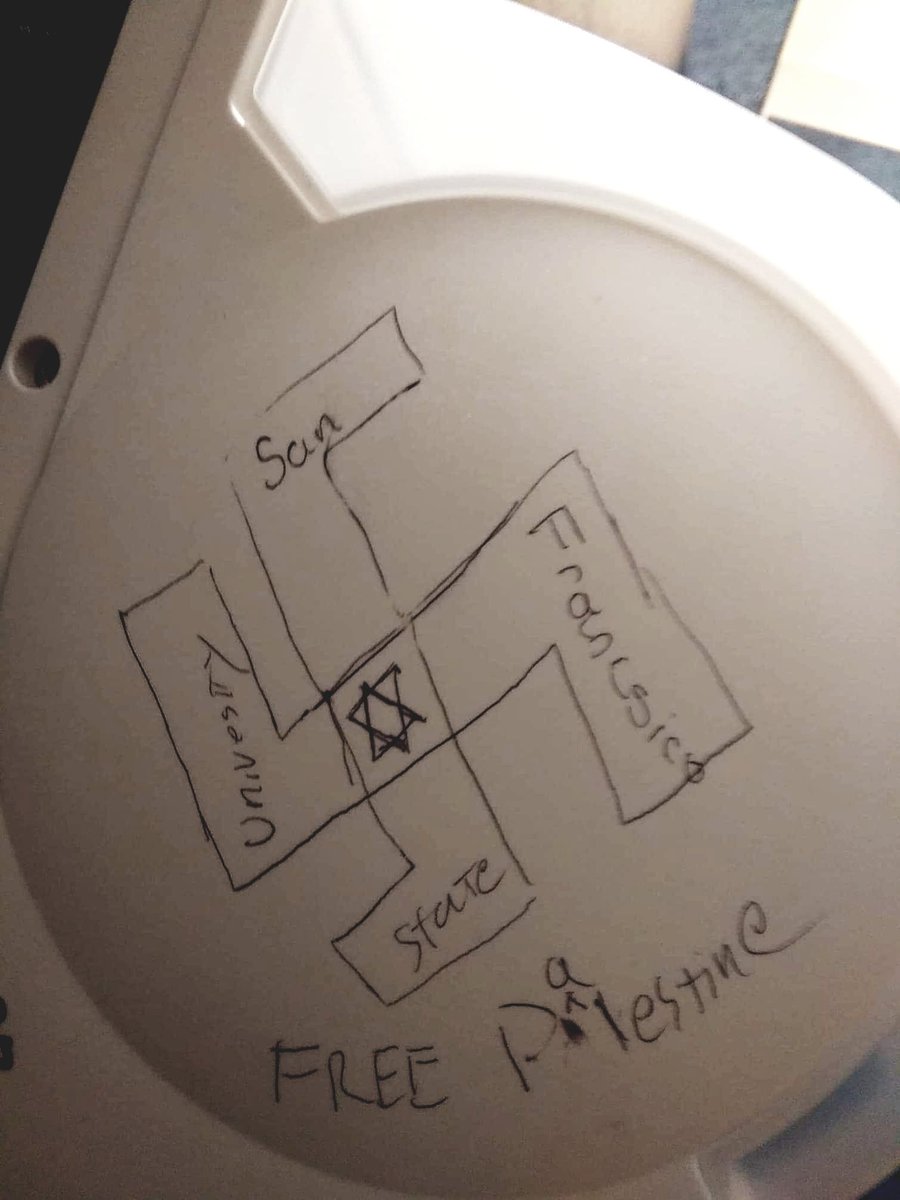
This was discovered in a bathroom at San Francisco State University this week.


For those who can't see an image, it is a swastika labeled "San Francisco State University", with a Star of David in the middle. Below it, the author wrote "Free Palestine".

Most people have condemned this as antisemitic. I agree. But I want to actual go through the steps. In particular, I want to challenge some of the antisemitism skeptics -- the people who think too much is called antisemitic, particularly in the "criticism of Israel" subspecies -- why this is properly deemed antisemitic (or, perhaps, for them to forthrightly assert that it is not).

In doing so, I want to insist on keeping the focus on the graffiti being a case of antisemitism. Certainly, it is vandalism, and therefore is a crime regardless of whether it is specifically antisemitic or not. Likewise it might be described as rude, uncouth, overwrought, insensitive, or any number of other bad things that nonetheless are distinct from antisemitism. David Hirsh describes this pivot as "pleading guilty to the lesser charge" -- admitting that a challenged piece of conduct is wrong in some way while holding the line that it was not antisemitic. I fully accept that many people will agree that this graffiti was "wrong", in some way, but I want to concentrate on establishing it specifically as an antisemitic wrong.

We spend a lot of time insisting that "criticism of Israel is not necessarily antisemitic", which is true. We spend considerably less time establishing that criticism of Israel is not necessarily not antisemitic either. Yet both are important; and in particular, it is useful to test whether our proposed demarcation lines between what is antisemitic and what is not can capture cases such as this.

So, why is the above antisemitic? Here are some candidates:

  • The phrase "Free Palestine". But surely this can't suffice on its own, at least if the "pro-Palestine =/= antisemitic" formulation is to have any legs at all. The fact that the speaker claims to desire a "free Palestine" would not, on its own, establish antisemitism.
  • The Star of David. This is perhaps the clearest hook that the target is Jews, not Israel -- but then, we know that some say it is being used not as a Jewish symbol but an Israeli symbol (this was the justification for expelling the Jewish marchers from the Chicago Dyke March -- their Rainbow flag with a Star of David was coded as "an Israeli flag superimposed on a rainbow flag"). One can certainly imagine the "artist" here making that case -- after all, by saying "Free Palestine" they at least implicitly cast their target as being Israel, specifically.
  • The swastika. Again, we might think this suffices to establish the drawing as antisemitic. But note that the swastika could be symbolically representing two different things here. One possibility is that it is meant to evoke sympathy for Nazis (the artist saying, in effect, "I am a Nazi; I am making a Nazi point"). In that case, the antisemitism becomes pretty undeniable. But the other possibility is that the artist is intending to saying "Israel is a Nazi state, and Nazis are awful" (the artist is putatively making an "anti-Nazi" point, while associating Israelis or Zionists with the terrible Nazis). Is this formulation antisemitic? Note we just went through this, to some extent, with Eli Valley and the "kapos" controversy (and before that, with David Friedman) -- many people are very insistent that it is perfectly fair game, or at least not antisemitic, to compare Israelis or Zionist Jews to Nazis.
If we think that this scrawl was antisemitic, we implicitly reject at least some of these defenses. We have to commit to the position that using the Star of David to denote a group that you hate is antisemitic, or that comparing Israel to Nazism is antisemitic. And that, in turn, should constrain us come other cases. The fact is, if we think this was an antisemitic act, then we can't be so blithe in asserting that other perhaps more elegant acts whose alleged antisemitism rests on similar presuppositions (e.g., that Israel = Nazi comparisons are antisemitic) are mere "criticism of Israel". And, by contrast, if we want to hold the line and say that it is not antisemitic to compare Israel to Nazis, then we are far harder pressed to agree that even an act like this is an antisemitic act.

Wednesday, May 22, 2019

It's Just a Flesh Wound!

Donald Trump does not poll well among Jews.

His favorables are a miserable 29/71. His re-elect statistics against a generic Democratic opponent stand at 23/67. Jews overwhelmingly oppose him on virtually every policy: from abortion (40/60) to immigration (33/67) to healthcare (31/69) to the Iran Deal (36/64 -- take note, American Jewish leadership) to antisemitism (29/71 -- really take note, American Jewish leadership). Even his handling of US/Israel relations -- supposedly his strongest suit -- barely squeaks into positive territory (55/45).

Yet if you're the Republican Jewish Coalition, these figures are good news!
Matt Brooks, the Republican Jewish Coalition’s executive director, said the news was good for Trump.
“The Jewish numbers for Trump are a floor and generic Dem numbers are a ceiling,” Brooks said on Twitter. “No one who now says they’re for Trump are going to change their minds. He will get a higher share of the Jewish vote than this.”
Higher than 23%! Can you feel the Jexodus yet?

Oh, and Barack Obama? He stands at a cool 70% favorable, 23% unfavorable spread.

(Another fun bonus stat: Israeli Prime Minister Bibi Netanyahu inspires deep ambivalence, currently sporting a 45/38 favorability spread. That's worse than Bernie Sanders -- 51/43 -- and far worse than Joe Biden's 66/29. But he's still net positive, so hey, congrats on that).

Monday, May 20, 2019

What Did Eurovision Do To Israel?

This is a truly stellar analysis piece by Abigail Nussbaum on the impact Eurovision had on Israel and -- in particular -- the blow it struck against Netanyahu and his brand of politics.

One thing it does very well, which many analyses do not, is that it understands and recognizes Israel as a fully-fleshed out place -- with factions, institutions, power dynamics, and all the rest that are exactly as deep and complex as any other modern state and society. Israel is a "they", not an "it", and the blithe assumption that "if Eurovision succeeds, that's a win for Bibi" is naive to actual facts on the Israeli ground. To the contrary, Nussbaum does great work in establishing how Netanyahu and his allies have all but declared war on Israel's cultural institutions and sought to instead foster a hermit-nation, "us against the world" mentality that is disdainful (if not outright antipathic) to any sort of effort at global communal engagement. Eurovision does not ratify Bibi's view of Israel; it is a direct challenge to it.

In hosting Eurovision, the Israeli government had little choice but to give Israel's cultural institutions their due and resources (as much as Miri Regev might resent it). It featured a presenter descended from both Holocaust survivors and Palestinian refugees, delivering a greeting in Hebrew and Arabic; it featured the grand success of a public media corporation that Bibi had been desperately trying to kill, and yes, it even featured those little Israeli and Palestinian flags on the backs of Madonna's dancers.

Most importantly, in the context of a cooperative, international event, Eurovision also offered a daybreak, however brief, from the "everyone hates us and will always hate us" insistences of the Israeli political right. Against those forces counseling retreat and insularity in the face of an implacably hostile world, Eurovision showed the promise of continued cosmopolitan engagement. As Nussbaum puts it:
[The success of Eurovision] proves that the horror stories we’ve been told about the hatred that awaits us in Europe are nonsense (not to mention cover for Netanyahu’s increasing coziness with actual Nazis, just because they share his authoritarian tendencies). These are messages that the Israeli public has desperately needed to hear, and maybe for some people, they got through.

Sunday, May 19, 2019

Game Over

*Warning: Spoilers for the Game of Thrones finale*

So Game of Thrones is finally over. While I'm certainly in the majority camp that the series seriously stumbled down the stretch, all in all it still was a fun ride. And -- taking into account the corner that the writers had painted themselves into -- I actually think the series finale was a pretty decent episode. Yet quibbles are more fun than compliments, so here are my final scattered thoughts:

* I didn't mind the Daenerys heel turn at the end, though I agree it didn't have quite enough run-up. But the group that really suffered, character-wise, was the Unsullied. If we now view Dany as a fanatical would-be tyrant who casually murdered innocents, what do we make of her most loyal footsoldiers who unquestioningly carried out the slaughter? There's a story that could have been told here that carries an arc from their freedom from slavery to their status as a murderer's shock troops, but we never got it because the Unsullied -- even Grey Worm, outside his love for Missandei -- were never developed beyond mere arms of Daenerys.

* But at least there was a vague gesture at trying to resolve the Unsullied's thread: they were offered the Reach, and ended up sailing to Naath (to do what?). The Dothraki didn't even get that much. And to be honest -- they're a much bigger threat than unhappy Unsullied. Unsullied are at least disciplined -- they wouldn't move unless someone ordered them to. Indeed, once the Queen was killed, you could almost see how they froze up -- not executing Jon or Tyrion in the days(?) it took for the Lords of the Realm to gather at King's Landing, and scarcely thinking to contemplate the argument that they had claim to be rulers of King's Landing now. But the Dothraki are a mounted band of marauders whose default setting is to rampage over the countryside pillaging everything in sight, in a land where much of the security infrastructure has been decimated. They're a recipe for chaos.

* That said, the main Dothraki question is clearly "Where did these alive Dothraki come from?"

* I'm not entirely sure why Arya wants to get on a boat and sail west. But I'm sad that Yara didn't appear to be joining her (yes, yes, objectively she should be running the Iron Islands. I still can be sad).

* Bran as King is ... okay, I guess. I think the main thrust of the choice is that he's more of a figurehead who will leave the day to day management to his advisers. It's part of the slow "democratization" process (poor Sam -- your actual democratization process got laughed out of the room).

* If the North secedes, Dorne obviously would secede too. There wasn't really any way to build that into the show and not sap Sansa's speech of all its drama, but it's still true.

* Littlefinger may be dead, but someone successfully lived out his "Chaos is a Ladder" motto. From sellsword to Lord of Highgarden and Master of Coin -- well done Bronn! (Though what would have happened at the Unsullied taken the offer to be ceded the Reach -- which includes Highgarden?)