Monday, October 24, 2022

Humility vs. Hate

When it comes right down to it, we're not sure how to fight hate and hateful ideologies.

Should it be called out loudly, wherever and whenever its seen? Or does that mean giving oxygen to cranks, amplifying their influence to places they could not reach on their own?

Should bigots be deplatformed? Or does that simply make them more alluring? Should we debate them? Or does that only give them credibility? Should we rally forces against them? Or does that give sustenance to the notion that they are resisting the dreaded establishment? 

Should we punch Nazis? Or are they thereby converted into martyrs? Should haters be ostracized, wholly excluded from all elements of social life as demonstration that their views will not be tolerated? Or should we reach out to them, trying to pull them back from the abyss and convert them to the side of right?

Figuring these questions out is tremendously important. Indeed, there may be little more important than figuring out which interventions against hate are most effective.

But the fact is, we don't seem yet to know what works and what doesn't. So perhaps we can all stand to show a little more humility on the subject. I see so often people very confidently declare their answers to the above questions as if anyone who acts otherwise is a Nazi sympathizer, and I simply do not know where that confidence stems from. Because the fact is, we don't know yet which tactics work and which do not. And so while I'm fine debating the tactics, I'd rather not treat tactical disagreement under conditions of extreme uncertainty as tantamount to be a Fifth Column.

Friday, October 21, 2022

An Apology

I'll be brief. In some old posts on this blog, I wrote words to the effect that Dennis Prager, a right-wing Jewish commentator, was "really" Christian or secretly "wished to be Christian", due to the overlap of his beliefs with right-wing Christian precepts.

This was wrong. I disagree with Prager on nearly every issue, including on what it means to be Jewish and the best articulations of Jewish value. Nonetheless, it is wrong to tell a Jew -- any Jew -- that they are any less of a Jew because of political or social disagreement. Jews are Jews are Jews -- including the Jews I or Prager really, really dislike. As these sorts of attacks on Jews for not "really" being Jewish become more common (and, in particular, seep into the mainstream where even non-Jews feel comfortable challenging the Jewish identities of Jews they dislike), it is especially important to practice what one preaches.

I've endeavored to delete these comments from my archives; it's possible I've missed some. Again, the practice of denying the authentic Jewishness of Jews one dislikes is wrong, full stop, and I was wrong to do it to Prager.

Thursday, October 20, 2022

The (Hopefully More Symmetrical) Future of Congress' Black-Jewish Caucus

Rep. Brenda Lawrence (D-MI) was one of the key forces behind the founding of Congress' Black-Jewish caucus. The caucus is nominally bipartisan, though with regard to both "Black" and "Jewish" Congress offers slim pickings amongst Republicans. The only Black GOP member, Rep. Will Hurd (R-TX), has already left Congress, and the only GOP Jewish member, Rep. Lee Zeldin (R-NY) will depart at the end of this term. All other members are Democrats.

But now Rep. Lawrence is retiring (redistricting scrambled her district -- Lawrence endorsed Rep. Haley Stevens in the district that's the closest to being its successor), and the JTA has an interesting article about the vitality of the caucus in the future.

One unfortunate fact about the caucus, Lawrence suggested, is that it has been almost entirely silent on matters of racism. Despite the fact that its existence is nominally about providing a vector where both Black and Jewish members can learn about and be responsive to the sensitivities of the other, in practice the caucus has almost exclusively tackled matters of antisemitism and made little progress in addressing issues of racism.

In addition to the antisemitism she has confronted throughout her tenure, another disappointment, she said, has been the reluctance of her Republican colleagues to call out anti-Black racism. 

“They just put their head down because they’re so committed to a Republican agenda,” she said. “They are not willing to stand up and call a colleague out if their rhetoric is one that promotes racism or antisemitic behavior.”

A review of statements from the caucus suggests that it has only substantially addressed antisemitism, and its most egregious expressions — the hostage-taking at a synagogue in Colleyville, Texas this year; the stabbing attack at a Hanukkah celebration in Monsey, New York, in 2019; and the anniversary of the 2018 massacre of Jewish worshippers in Pittsburgh. 

When the group has made references to anti-Black racism, the caucus talks about it as if it were a thing of the past — in commemoration of the 1960s civil rights cooperation between Jews and Blacks at an opening session in 2019, or in a celebration of Juneteenth, the holiday marking the end of slavery.

Lawrence described with frustration her attempts to get Republicans to talk more about anti-Black racism. She recalled that one Black Republican she would not name said “Look at me, I’m a Black and I made it,” and how conversations with other Republicans devolved into calls on Democrats to condemn Antifa, the loose-knit network of far-left protesters, or the Black Lives Matter movement.

This was always going to be a point of concern.  And it is tremendously disappointing, and a discredit to the hard work persons like Rep. Lawrence have put into this initiative, that the caucus thus far has been so overtly asymmetrical in its focus.

A Black-Jewish caucus is unabashedly a good thing. But it has to be a relationship of equals, not one of Jewish tutors and Black pupils. Ilhan Omar should learn from her Jewish colleagues some things about antisemitism she perhaps hadn't thought of before. But also and equally, Lee Zeldin should learn some things about racism from his Black colleagues that he perhaps was insufficiently attuned to (like why it's offensive for the Capitol Building to honor men who committed treason in defense of slavery). It's absolutely good to come together to denounce contemporary instances of antisemitism such the attacks at Colleyville and Monsey. But it is troublesome that this is not paired with denunciations of contemporary instances of anti-Black racism. In a Black-Jewish caucus neither component should be the junior partner. If the caucus is going to carry forward and do justice to Rep. Lawrence's vision, things need to change.

Wednesday, October 19, 2022

On Loving "Campus Jews" While Hating Campus Jews

It is no revelation to say that Jews on campus experience their share of antisemitism, and deserve our support. But one of the more frustrating aspects of that reality is how that "support" often manifests in a fashion that is almost tauntingly unconcerned with what the Jews on campus actually want. "Support", too often, is not support at all -- it is a way for outsiders to exploit a headline or to ride their own hobbyhorses, and the campus Jews themselves are an afterthought. I do not know if Berkeley Jews wanted Noa Tishby to pay a visit to Sproul Plaza. I am very sure they did not want a Hitler billboard truck parked outside their door.

But those who drive the Hitler truck "in solidarity" do not at all care whether the Jews they "support" find their intervention all that supportive. By golly, Berkeley Jews are going to get this allyship whether they like it or not! And this is hardly an isolated event. Jewish students at the University of Michigan were livid at the Canary Mission putting their campus under the spotlight, complaining that it was making the environment for Jewish students on campus worse rather than better. No matter. Canary Mission's support for campus Jews is cheerfully indifferent to whether campus Jews feel supported.

So we should ask: Why are the actual Jewish students so often an afterthought in campaigns nominally about protecting Jewish students?

Part of the answer goes back to the story I told a few weeks ago, about the man who became furious with me when he found out my experience at Berkeley wasn't the hellscape he insisted it must be. What kind of self-hating Jew doesn't hate it at Berkeley?

Jews on campus are a diverse bunch, and even as individuals often have complicated feelings. They are typically not, contra some very vocal activist groups, a collective of screaming anti-Zionists. They also typically are not eager to spend their collegiate days engaged in ideological trench warfare on Israel's behalf. They do not appreciate "allyship" that forces them into a combative posture they may not wish to take and may not think is warranted or effective under the circumstances.

And the tragedy is that too many of their would-be supporters won't defer to that judgment. No, it's worse than that -- they actively reject it. They are aghast at the university Jews who do not support their form of support. They view those Jews as craven, cowards, or perhaps even (as my troll thought of me) antisemitic sympathizers. Incredulity becomes resentment becomes rage, at these terrible campus Jews who are refusing to cooperate with the best-laid plans for keeping them safe.

At the extreme, the loudest voices outside of campus waging war against campus antisemitism sometimes seem as if they're almost as angry at the Jewish students themselves as they are at the antisemitism the students endure. Those who have invested so much into their identity as protectors of the Jews cannot easily accept the idea that they are, in fact, making Jewish lives worse. Far easier to decide that if one is fighting antisemitism, than the only persons who could have a problem are the antisemites, and if the Jewish students have a problem, then ergo.... 

In this way, the Jewish students become just another enemy -- and an enemy far more vulnerable and easily targeted than the antisemites are. It is another iteration of the theme I wrote about in "On Loving 'Jews' and Hating Jews": the defense of "campus Jews" is a defense of an imagined "campus Jew". If actual campus Jews turn out to be more complicated than the imaginary picture; if they don't want to play the role they've been assigned -- well, love for "campus Jews" very easily can breed hatred for actual campus Jews.

None of this is to say that campus antisemitism isn't real, terrible, and destructive. It creates a toxic environment for Jews at our nation's colleges and universities. But how much more toxic that environment is, when those afflicted by it know that too often the banner of solidarity will actual just generate a new vector of dismissiveness, disdain, or even hatred. Such is the terrible, tragic circumstance of being a Jew on campus.

Sunday, October 09, 2022

The Endless Futile Quest for "Incontestable" Antisemitism

It's never good when "Jews" are trending, the saying goes, and the latest trend has been some pretty nasty antisemitism from celebrity rapper Kanye West. What began with a "White Lives Matter" shirt, continued with a Tucker Carlson interview where he claimed Jared Kushner promoted the Abraham Accords in order to make money, and concluded with a series of social media posts decrying Jewish "control" ("Ima use you as an example to show the Jewish people that told you to call me that no one can threaten or influence me"; "On JEWISH PEOPLE ... You guys have toyed with me and tried to black ball anyone whoever opposes your agenda").

It was obvious antisemitism. And yet, if one wanders around social media spaces, you see plenty of people denying the obvious. All the usual permutations are there -- from the "Full Livingstone" to "false accusations only diminish the true antisemitism" -- to the shock of many Jewish and non-Jewish commentators who cannot fathom how this isn't the clearest of cases.

I think there's an important lesson here, and it's something I talk about in my Epistemic Antisemitism article. As any Jew knows, antisemitism allegations are regularly met with pushback -- claims that the allegations are false, smears, bad faith, or political opportunism. Arguing against such retorts takes up tremendous time and energy, and is deeply depressing to boot. Moreover, the fact of contestation leads to second-guessing and doubt -- is this a real case of antisemitism? Or am I being unfair, too sensitive, too trigger-happy, too censorial. 

Hence, there is a deep desire for incontestable cases of antisemitism -- the cases that everyone agrees are antisemitic and thus will circumvent this pushback. These cases are ones we can be absolutely sure are antisemitic precisely because there is universal agreement about their antisemitism. Said agreement validates the initial judgment and so avoids that process of recrimination and second-guessing that plagues antisemitism discourse generally. By contrast, the fact of contestation is thought to at least potentially raise the specter that the charge is unfair, subject to dispute, and not a fair target for being called antisemitism.

But here's the problem: There are no incontestable cases of antisemitism. From my article:

[W]ith no single agreed-upon definition of the phenomenon of antisemitism itself, no antisemitism allegations can ever be truly “incontestable,” leaving all of them open to accusations that they are in bad faith. Or, put differently, there might be some truly “incontestable” cases of antisemitism—but if they’re actually uncontested then we don’t need any regulative principles governing how to deliberate over them. It is only where there is a dispute, where some people are denying—perhaps passionately denying—the antisemitism claim, that it matters that we “take seriously” Jewish claims (167-68).

The fight against antisemitism has to be willing to call things antisemitic even when others deny it. The fact of contestation cannot be enough to defeat the claim. All antisemitism claims that are the subject of controversy will, by definition, be contested. There are no universally agreed-upon cases, no matter how obvious they might be. Someone will always be there to say its actually legitimate discourse or an arguable point, and that the accusation is unfair, goes too fair, is silencing, or is a slander.

This doesn't mean that every accusation of antisemitism must be accepted on faith either. Rather, it means there is no getting around the hard work -- that to fight against antisemitism means engaging in critical appraisals of antisemitism even in cases where there are very loud voices screaming "HOW DARE YOU CALL THIS ANTISEMITIC." Because that will be all cases. The quest for the incontestable will never be fulfilled.

Saturday, October 08, 2022

Is the ADL Losing Its Liberal Base?

The ADL is America's preeminent Jewish civil rights organization.

That position comes with an inevitable share of gripes. Jews who think the ADL is misusing its position. Non-Jews who don't like the idea of a "preeminent Jewish" (or "civil rights") anything. The day where somebody isn't complaining about something the ADL is doing is a day that doesn't end in "y".

That said, the inevitability and ubiquity of complaints faced by the ADL doesn't mean none of them have merit. Moreover, said inevitability and ubiquity doesn't mean there aren't things to be gleaned from patterns -- who is complaining, how they're complaining, and what they're complaining about.

The latest ADL related flare-up came when chieftain Jonathan Greenblatt seemed to laud Elon Musk's potential takeover of Twitter and compared Musk (positively!) to Henry Ford in the process. Using Henry Ford -- one of America's most notorious antisemites -- as a compliment was bad enough. But Musk's prime motivator for buying Twitter, by his own admission, is that he thinks Twitter has been too heavy-handed in "censoring" or tamping down on hate speech on the platform. This flies in the face of the ADL's social media policy, which has been to this point aggressive in demanding that social media platforms do more to combat hateful speech and conspiracies proliferating on their sites. So why on earth would Greenblatt think Musk's purchase of Twitter is a cause for optimism? The impression many got was that, in an effort to curry favor with the right's new fair-haired plutocrat, Greenblatt was selling out his organization's stated committed to fight extremism and hate online. The right-wing loves Musk, so Greenblatt felt obliged to love him too.

Greenblatt has since apologized for the Henry Ford comparison. He also suggested that what he was really doing was "laying down a gauntlet about what we expect Elon Musk to do," which -- talk about don't piss on my leg and tell me it's raining. Greenblatt was not "laying down a gauntlet," he was very clearly trying to butter up Musk now that Musk has become a right-wing hero. I'd be delighted if he changed course on that. But don't patronize me by pretending you weren't doing what was obvious to all of our eyes.

Again, it must be stressed that Musk has become a right-wing hero because he's sworn to make it easier for the far-right to spread extremism and hate on a major social media platform. The reason this is such a scandal isn't solely or even primarily because of an ill-advised comparison; it is because it seemed as if Greenblatt either no longer had the stomach or no longer had the desire to stand against a truly dangerous development for the safety of Jews online if it meant standing up to a powerful and popular figure on the American right. That failure -- whether of nerve, of will, or of interest -- represents a serious problem for the ADL's credibility.

Now, it isn't at all surprising that the Jewish left would jump all over Greenblatt's miscue. And to the extent that the complaints were coming from the usual "drop the ADL" suspects, there would not be much new to be said under the sun. The source of the critique wouldn't make it wrong (as I like to say, if you fail so badly that JVP can fairly dunk on you, that's a you problem, not a JVP problem), but it wouldn't reflect any broader political shift.

But it did seem to me that this latest incident with Musk was evincing a notable and qualitatively different type of response, both in terms of what was being said and who was saying it. Most specifically, I've been seeing a lot more chatter taking the form of (at least consideringcalling for Greenblatt to resign.

Why is that noteworthy? It's not just that it's a relatively drastic demand to make. The bigger story is that resignation calls suggest that discontent with the ADL's direction has migrated over from the aforementioned "usual suspects" to a more moderate liberal tranche. The complaints and frustrations are boiling over not from those who've always hated the ADL and will take any opportunity to stick a knife in, but from those who think the ADL has done and continues to do much good work, but has over the past few months gone badly off the rails.

Simply put, one doesn't call for new leadership in organizations one thinks are intrinsically risible. I detest Mort Klein and ZOA, but I never say "Mort Klein must resign from ZOA". Practically speaking, I don't care who runs ZOA because I think ZOA is at its core a terrible organization. It'd be like me calling for "new leadership" from Hamas. By contrast, I was very vocal in calling for David Harris to resign from helming the AJC because, as annoying as I sometimes find the AJC, they lie on a fundamentally different tranche for me than does ZOA and I do care that about who leads them and what direction they go.

The fact is that the Musk incident is part of a pattern of gaffes and controversies from Greenblatt over the past few months which have infuriated Jewish liberals, virtually all of which have come from attempts to placate or cozy up to right-wing actors. To give a few more examples:

And while I wouldn't characterize it as a "gaffe" per se, all of this has gone hand-in-hand with Greenblatt taking a far more aggressive tone in characterizing anti-Zionism as antisemitism -- a pivot that many observers described as evincing greater "combativeness" by the ADL towards the left. Put it all together, and the pattern from the last few months have been one of a noticeable pivot by the ADL towards the right. And Jewish liberals -- again, mainstream Democrat types, not the far-left -- are noticing this pivot, noticing the associated gaffes, and are increasingly fed up by it.

For their part, the Jewish right has always hated Greenblatt and wanted him out, and nothing about the ADL's more recent change in practice is going to change that. And the Jewish far-left just doesn't like the ADL, period, and so Greenblatt inherited their disdain. Those polar oppositions perhaps could be taken for granted. But it means that if Greenblatt is also losing normcore Jewish liberals, then his base of support starts to look awfully narrow.

For my part, I take no position on whether Greenblatt should call it quits (in part because I share concern that the ADL's next leader might come from even more conservative quarters). I certainly don't endorse the view that the ADL is an irredeemably flawed or toxic organization; I continue to believe they do much great and necessary work. But I do agree that the ADL has been a ship adrift over the past few months -- making decision after decision that are morally indefensible and practically insulting to the mainstream liberal Jews who have historically comprised the core of the ADL's support base. 

One of the most compelling diagnoses of why Bernie Sanders' failed to secure the Democrat nomination was simple: you cannot be the standard-bearer of a party you despise. It doesn't matter how many loud voices on Twitter laud you, it doesn't matter how many donors shower you with resources. If you're going to lead Democrats, you have to like the average Democrat. The ADL would do well to internalize a similar lesson: you cannot be, and will not stay, the preeminent Jewish leader if you disdain the median American Jew. And the median American Jew is politically left-of-center -- not on the far-left, but a mainstream liberal. That might not characterize who trends on Twitter, and that might not characterize the most profligate donors. But it characterizes most Jews, and the ADL chases right-wing clout at our expense at its peril.

The "good news", as it were, is that this is hardly the first time that the ADL has sold out liberal Jews. Relationships can be mended, courses can be corrected. Nonetheless, there does seem to be a sea change occurring, and patience finally wearing thin. If the ADL doesn't change its trajectory quickly, it is far from clear what the future holds for America's preeminent Jewish civil rights organization.

Thursday, October 06, 2022

Things People Blame the Jews For, Volume LXI: Protests in Iran

A recurrent theme in this series is people "blaming the Jews" for activity that is, in all relevant respects, absolutely praiseworthy. Before the series even launched, for instance, I flagged instances where the dictator of Sudan "blamed" Jews for causing the world to pay attention to the Darfur genocide. I'm dubious we were behind that trend, but certainly it'd be nothing to be ashamed of. Jews helping support worthy causes is a good thing!*

But sometimes, we can't take credit even where credit is extended. And so it is in Iran, where Ayatollah Ali Khamenei has finally spoken out about the roiling protests against gender apartheid that have torn through his nation. Does he know what's driving these demonstrations? You bet he does!

“I openly state that the recent riots and unrest in Iran were schemes designed by the U.S.; the usurping, fake Zionist regime; their mercenaries; and some treasonous Iranians abroad who helped them,” Khamenei said Monday in a speech to police cadets in Tehran, remarks which were later posted in English on his official Twitter account.

As much as I might want to tip my cap in thanks, I don't think there's any basis to assume the Zionists or their "mercenaries" are behind these protests. To say otherwise would disserve the brave Iranian women and girls who really have been taking the lead here.

But if we were involved, there'd be nothing but pride to report. All solidarity to the people of Iran demanding freedom from state repression.

* There is a somewhat serious point here, which is that an impact of antisemitic conspiracy theorizing is to constrain Jews from even valid political participation, as any tangible and/or successful intervention into the political sphere can and will be coded as validating the conspiracy. If there were widespread Jewish efforts to extend resources and support to the Iranian protesters, for instance, it probably would not be viewed as positive solidarity but rather would quickly be leveraged as proof that the protests were a Jewish plot and the protesters Zionist stooges. This can quickly become a double-bind: Jews who don't extend themselves politically are faulted for not being sufficiently solidaristic towards others, those who do are indicted for exerting undue political control and influence.

Saturday, October 01, 2022

The Counterrevolution Eats Its Own: Conservatives Turn On Yale Law Conservatives

A few years ago, I had the distinctly bizarre experience of being the target of a particularly devoted internet troll.

The interesting thing about him, though, was that he initially presented himself as an ally. He saw that I was publicly Jewish and was (at the time) a graduate student at UC-Berkeley, and was eager to hear tale of how horrible my life must be, stuck in such an antisemitic cesspool as Berkeley.

I answered honestly: my experience was mixed. There were definite problems with being Jewish at Berkeley, and I had little patience for those who denied it. I had some discomforting encounters, and I had a particularly tense relationship with my own graduate student union. But at the same time, being Jewish at Berkeley also was not nearly as bad as sometimes portrayed in the media. Berkeley is a big place, and every department is different. What happens in the anthropology department didn't necessarily travel to my home in the political science department. There were professors I had read about who had done terribly antisemitic things, but I had never met them (again, big place!). And my professors were generally quite supportive of my work on antisemitism, even when it may have clashed with some presumed progressive shibboleths. On the whole, the portrayal of Berkeley as a sort of warzone for Jews, where one could not reveal one's faith or (God forbid!) interest in Israel and antisemitism without being ripped to pieces by one's peers, was quite far from my experience; even as I could not say either that there was no fire whatsoever behind the smoke. As I said: a mixed experience.

This, I rapidly found out, was the wrong answer. My interlocutor quickly decided that the only way I could be a Jew at Berkeley and not be beaten down, miserable, and ready to flee for my life was if I was an antisemitic sympathizer myself. And so, a troll was born.

I'm reminded of this story via Josh Blackman's defense of Judge James Ho's announcement that, going forward, he will refuse to hire any Yale Law School graduates as clerks. Judge Ho objects to what he sees as Yale's indulgence of a campus protest culture which he believes has created a toxic and unproductive intellectual climate for campus conservatives. His boycott is an effort to induce and/or coerce Yale into adopting a harsher line (one wonders, if the boycott fails, will divestment and sanctions follow?).

The immediate irony, of course, is that the students most directly effected by Judge Ho's announcements are the putative victims of the campus culture he decries -- the beleaguered Yale Law conservatives. After all, the presumably liberal protesters likely were neither applying to nor would have been hired by Judge Ho even before now. And the irony goes deeper. Refusing to evaluate applicants from Yale "as individuals" and instead impute to them the sins of their broader group rests uneasily with the putative meritocratic individualism extolled by Ho and his allies. After all, isn't it precisely that form of rugged individualism that at least allegedly marks off the core of Ho's ideological disagreement with Yale liberals? Perhaps, channeling Ilya Shapiro, we might ask whether, by enacting a preemptive group-based exclusion that limits the pool of candidates to be considered, Judge Ho has ensured that the "lesser" clerks he does hire "will always have an asterisk attached" to their accomplishment (surprising no one, Shapiro has enthusiastically endorsed Ho's decision to depart from strictly individualist meritocratic consideration).

But so it goes. Perhaps these Yale conservatives, though victims, must necessarily be victimized still further for the greater good. Excluding them is a necessary sacrifice for the cause of restoring Yale's good name and academic reputation. There may be bigger values at stake here that meritocratic individualism.

Enter Blackman. Blackman does not view Yale conservatives as victims. Blackman wants them to know that they deserve what's coming to them. They deserve to be excluded, they are getting no more than their just deserts. 

How can this be? And how can it be reconciled with allegedly defending Yale Law conservatives from the predations of their peers?

The answer is simple. Blackman thinks there is one and only one reason why a conservative student would attend Yale in the year 2022: because they're prestige whores. That, to Blackman, is the singular and defining feature of a Yale conservative. And as prestige whores they can and should be punished for their failure of moral character.

That's harsh, but that's the argument. Read for yourself:

Imagine you are a senior in college. You were accepted to Yale Law School, as well as several other top-tier schools. Mazal tov! Now you have a choice. How do you choose between Yale, Harvard, Columbia, Stanford, Chicago, and Virginia? Perhaps there are financial constraints–some schools may give more aid than others. There may also be personal constraints, such as the need to be close to family. More likely than not, neither of these factors would tip in favor of Yale. I doubt that YLS gives substantially more generous financial aid packages, and New Haven is a pain to get to. Instead, I think an applicant would choose Yale over those other schools because of prestige....

Knowing how inhospitable Yale is to conservatives, why would an applicant still pick Yale over other more tolerant places? The answer, again, is prestige. And the desire to obtain that prestige trumps a commitment to values like free speech and academic openness.

How, then, should a judge assess a conservative applicant who chooses to go to Yale? This person knowingly walked into the traphouse for the sake of an elite degree. I think it is reasonable for a judge to conclude that the applicant exercised poor professional judgment. Indeed, the judge may not want to rely on someone who would sacrifice their principles for prestige. In this regard, the Judge would choose to not hire any conservative YLS graduates because they are unreliable, and maybe even untrustworthy. They have already sold out on their values to go to YLS, and will likely sell out in similar ways in the future. In this view, choosing to go to Yale, with full information, is a failure of moral character.

There are, of course, many reasons why a conservative student might elect to choose Yale over Harvard or other competitors. Perhaps there are particular professors they are eager to work with and learn from. Perhaps they are attracted to Yale's small size. Perhaps they are eager to test their beliefs inside a true bastion of liberalism (this, running in the opposite direction, was part of why liberal me decided to attend the University of Chicago, with its reputation as a conservative citadel). Or perhaps -- and I suspect this is the most unforgivable sin of all -- they do not find Yale's intellectual climate to be quite as inhospitable as it is portrayed in the sensationalist media. Perhaps they, while being conservative, disagree with the conservative orthodoxy on this subject. Perhaps they've come to a different conclusion from the "politically correct" answer, just as I came to my own conclusions about the state of life of being a Jew at Berkeley.

But just as with my assessment of Berkeley, all of these are, of course, the wrong answers. If you are a conservative and you are not fleeing Yale as fast as your legs will take you, the only explanation is you are a morally bankrupt sellout. As Blackman illustrates, there is no tolerance for deviation from the right-wing orthodoxy on this point. If you are a conservative and you do not subscribe to this orthodoxy via your continued attendance at Yale, you are a villain, you are a traitor, you are a RINO, you are an enemy of the movement, and you deserve what is coming to you. And this from the supposed allies of conservatives on campus! How quickly the alleged defenders of intellectual heterodoxy collapse back into singular, ideologically convenient explanations which can brook no departure.

We have seen how quickly alleged concern for "free speech" on campus collapses into calls for censorship, ostracization, and exclusion that dwarfs any of original sins allegedly enacted against campus speech in the first place. This is of a piece with that trend. The counterrevolution eats its own. It always has, and it always will.

Tuesday, September 27, 2022

The Aesthetics of Election Rigging

Russia has announced the results of the totally free and fair referenda conducted in occupied Ukrainian territory and wouldn't you know it: everybody is just beside themselves with excitement at joining the Russia Federation.
The Russian state news media was reporting what it described as results showing enormous levels of support for joining Russia in four occupied territories. Tass, the Russian news agency, reported 92.68 percent in favor in Zaporizhzhia, 86 percent in Kherson in the south, and 93.95 percent in Donetsk and 98.53 in Luhansk in the east.

When it comes to these sorts of obviously rigged elections (remember when Azerbaijan accidentally released its election results the day before anyone had actually voted?), I always wonder how these figures are decided. Which bureaucrat is deciding that, yeah, 98.53% is the right figure for Luhansk? Not 98.52,% god help us not 97%, but 98.53%? There must be some thought that goes into it, yes? I wonder who has that job.

The other aspect of it is why the margins in these rigged elections are so ludicrously lopsided. I get wanting to have (the illusion of) a resounding consensus, but everyone knows results in the upper 90s are not even remotely credible. If they had made up a 60/40 victory spread, the news coverage probably would have concentrated on it being "surprisingly close", but it might have actually treated the election itself as if it wasn't transparently fixed. Sometimes less is more, people!

Sunday, September 25, 2022

If Russians Want Out, Let Them In

As the Russian government announced new military mobilization decrees to reverse their faltering Ukraine campaign, the world has witnessed a sharp spike in young Russian men attempting to flee the country and avoid a military call-up. This immediately poses the question: should other countries open their borders to Russians attempting to skirt military service?

One way this question is commonly debated is whether the Russians in question are morally culpable for their nation's actions in Ukraine. A common form of the argument goes something like "many of those trying now to flee Russia are hardly conscientious objectors or paragons of moral virtue. Most Russians support Putin and support the Ukraine war; they just are trying to save their own skin now that the war is going badly." While it might be one thing to give refugee status to those who've genuinely and consistently resisted Russia's war of aggression, it's another entirely to reach out and protect persons who actually support the war but simply don't like the idea of fighting in it.

One response to this argument is to observe that the people now being called up to fight are disproportionately being drawn from historically-oppressed ethnic minority groups in Russia's hinterlands -- an attempt, as one commentator grimly put it, for Russian nationalists to wage "two ethnic cleansings for the price of one."

But I'll go further: when it comes to Russians seeking to evade military mobilization, I'm less concerned about judging any individual's moral character than I am about thwarting and sabotaging the Russian war machine to the greatest degree possible. If the Russian military is feeling starved for manpower right now, I want to burn some of their grain silos to turn the screws even more. The fewer military-aged Russian men the Russian army has available to it to deploy to the front, the happier I am.

I certainly don't want to give sanctuary to out-and-out war criminals. But consider the marginal case -- the Russian man who had no problem with the Ukraine war right up until it became a live prospect that he'd have to fight in it. I wouldn't exactly nominate that man for a Nobel Peace Prize, and no doubt many would say that a trip to the front lines would be nothing more than just deserts. Perhaps they're right -- but I care significantly less about him getting that particular form of comeuppance than I do about Russian having one fewer soldier firing bullets at Ukrainian men, women, and children.

The easier it is for Russian men to choose not to fight in this war, the harder it will be for the Russian government to get them to fight in this war. And that's my lodestar for approaching this question. Every Russian who wants out of Russia right now is another dent in an already battered Russian war machine. So if they want out, I say let them in.

Friday, September 23, 2022

A "Grand Bargain" on Israel and Antisemitism Discourse

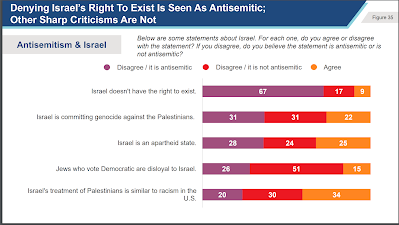
Apropos of the controversy over Rep. Rashida Tlaib's (D-MI) declaration that those who back "Israel's apartheid government" cannot be progressives, I saw quite a few folks pointing to polling data which suggests most American Jews don't find "Israel is an apartheid state" to be an antisemitic statement. That's not to say that most Jews agree with that assessment, but only 28% disagree and find it to be antisemitic (25% agree with the statement, and 24% disagree but don't deem it antisemitic -- the remainder are unsure). The fact that many American Jewish organizations seem potentially out-of-step with median Jewish opinion was certainly a powerful rejoinder to their quick allegations that Tlaib's apartheid allegation was per se antisemitic.

The poll in question is one I've long found fascinating, and not the least because it offers a rare deep dive into what, exactly, American Jews think is and isn't antisemitic with respect to Israel. And the payoff is that Jews actually don't tend to think even most harsh critiques of Israel are antisemitic ... with one exception.


The huge outlier here is "Israel doesn't have a right to exist."  That statement simply blows all of its competitors out of the water -- a full two-thirds of American Jews find it antisemitic when no other statement (even some highly inflammatory ones about "genocide" or "apartheid") pushes much higher than 30%. It also has far fewer Jews agreeing with it, suggesting that "Israel has no right to exist" is viewed differently even by the nation's harshest critics. It's not, in other words, just a shuffling among Israel's supporters -- the other statements are disagreed with but aren't viewed as antisemitic; this one is disagreed with and is viewed as antisemitic. There appears to be a substantial portion of the American Jewish community that agrees with statements like "Israel is committing genocide" who nonetheless draw the line at "Israel doesn't have the right to exist."

A large part of me is just curious who that last group of Jews are and what their story is. But for the time being, this divergence suggests a potential "grand bargain" in how we talk about antisemitism and Israel: anti-Israel folks agree that opposing Israel's right to exist is antisemitic, and pro-Israel folks concede that all the other charges -- whether agreed to or not -- are fair play.

Now, as is the case of all "grand bargains", I fully expect this one to go nowhere because neither side has any particular need or desire to accept it. As much as this poll made for a nice "gotcha" moment in the context of the Tlaib controversy, anti-Israel commentators do not actually think the legitimacy of antisemitism allegations hinges much on what Jews think, and have been stubbornly insistent on going whole-hog on denying Israel's very validity as a state despite the fact that this seems to be a distinctive redline for the Jewish community over and beyond views that might be fairly categorized as (extreme) policy disagreement. But in fairness, pro-Israel organizations have not been especially interested in hitching their wagon to median Jewish opinion either, and -- for all the talk about "criticism is fine, but opposing Israel's existence isn't", they have been far from reliable in actually adhering to that line, viewing certain vitriolic criticisms as tantamount to "opposing Israel's right to exist" even as most Jews apparently draw a distinction between the two.

So my grand bargain proposal is not predictive: I don't think we actually will reach a détente along these lines. But in concept, it sure does present an interesting one, doesn't it?

Wednesday, September 21, 2022

The "Context" of Tlaib's PEP Talk Before American Muslims for Palestine

At a forum hosted by the group American Muslims for Palestine, Rep. Rashida Tlaib (D-MI) made waves by declaring that supporters of "Israel's apartheid government" cannot be allowed to call themselves progressive. The full quote is below:

"I want you all to know that among progressives, it’s become clear that you cannot claim to hold progressive values, yet back Israel’s apartheid government, and we will continue to push back and not accept that you are progressive except for Palestine."

Unsurprisingly, this is garnered quite a bit of pushback from many Democrats (especially Jewish Democrats), who contended that there was nothing incompatible with supporting "Israel’s right to exist as a Jewish and democratic state" (to quote Rep. Jerry Nadler (D-NY), criticizing Tlaib) and being progressive.

Now, in fairness, there is some ambiguity around the precise phrasing: backing "Israel's apartheid government" (Tlaib) could be distinguished from, e.g., a more general belief that Israel should not exist as "a Jewish and democratic state" (Nadler). Perhaps the former is about specific policies, while the latter is more conceptual and metaphysical. How far, in other words, does Tlaib's view actually extend?

We can't, of course, know for sure. But perhaps the venue offers a clue. Rep. Tlaib said these words at an event hosted by American Muslims for Palestine. Last year, AMP produced a comprehensive document "intended to provide the American-Muslim community with a set of criteria by which to determine whether or not to work with various Jewish organizations" (emphasis added; they were clear that the subject of the memo was specifically the Jewish community). And AMP's conclusion was that Muslims who support Palestine should refuse to work with virtually every Jewish organization, on any subject, for any purpose. Not the ADL, not the AJC, not local JCRC or JFeds, and not even most synagogues (a list totaling about two dozen synagogues nationwide were whitelisted as permissible). A nearly absolute, totalizing attempt to extirpate the entirety of the Jewish community from fellowship or coalition.

That is context. Does it decisively establish that Tlaib, herself, thinks things should go that far? No. But under circumstances where it has already become clear that the train has no brakes, it is legitimate context for discerning where this line of reasoning will take us. Context isn't always exculpating, after all.

Wednesday, September 14, 2022

Is the Jewish World Ready for Itamar Ben-Gvir?

In 2009, Marty Peretz called Avigdor Lieberman a fascist.

My how the world turns.

Today, of course, Lieberman is effectively a centrist figure in Israeli politics, who seems more inclined to form coalitions with the left-of-center bloc than the right-wing. 

Some of that reflects changes in Lieberman -- he has moderated somewhat from where he started and moved towards the center since bursting onto the Israeli political scene. But a lot of it is attributable to changes in Israel's political center of gravity, which has been lurching to the right for decades. Opinions and beliefs which were outlandish and outrageous in 2009 don't even qualify as right-wing in 2022. In 2018, Batya Ungar-Sargon could hold Naftali Bennett's feet to the fire over his open opposition to democratic rights for Palestinians. Fast forward just a few years, and Bennett is the savior figure who managed to oust the even more odiously anti-Palestinian Bibi Netanyahu out of office. What was once the extreme right in Israel now is the "moderate" bulwark against an ascendant and even further-extreme right. The world keeps turning.

And so we get to the present day, and the rise of a new extremist powerbroker in Israel: Itamar Ben-Gvir. Ben-Gvir is more than a terrorist-sympathizer, he actually was convicted of providing support to a terrorist organization. He wants to expel Arabs, he had a shrine to Baruch Goldstein, he's a disciple of Kahanism. His political character has been described as a "pyromaniac", given his lust to take combustible situations and pour gasoline on them. He's been described as a "David Duke"-like figure in Israeli politics, except unlike Duke he's actually winning office. He makes even the original flavor of Bennett or Lieberman look positively moderate. And in the very plausible event that the right-wing bloc wins the next Israeli election, Itamar Ben-Gvir is likely to receive a very prominent ministry position in the Israeli government.

The establishment of the Jewish diaspora isn't ready for this. In 2019, when Netanyahu first entered into a deal with Ben-Gvir, it received widespread condemnation from American Jewish groups (even AIPAC!). They characterized his party "racist and reprehensible". Three years later, Ben-Gvir's influence has only grown. If he does enter into government at a high level, does anyone believe groups like AIPAC are going to hold the line? That they'll follow their own logic and concede that Israel's governing coalition is seeded with the racist and the reprehensible? Or will the world turn once more, and Ben-Gvir become accommodated?

By and large, the American Jewish community has been covering its eyes regarding the surging ascendency of far-right extremism amongst the Israeli Jewish community. The tendency has been to dismiss this sort of extremism as marginal, as outliers, as the province of fringe cranks that one might find in any pluralistic political community. There is a terrified refusal to acknowledge the larger pattern, which is that folks like Ben-Gvir are not outliers, and things are getting worse, not better. "A little patience," they say "and we shall see the reign of witches pass." But it isn't passing. The cavalry isn't coming. It can happen (t)here.

The American Jewish community does not want to see Israel descend into far-right fascism. It wants, desperately, that folks like Ben-Gvir are outliers and are repudiated and can be rendered into fringe irrelevancies. But that's not happening. So what next? Unfortunately, the problem with not wanting to see something is that there's always the option to cover your eyes. Squeeze them shut and pretend the problem isn't there. Start whatabouting on Hamas or Iran or this or that. Figure out a way to accommodate and appease the new normal, in the hopes that after this, we won't go any further. Soon the reign of the witches has to pass. That is, more or less, what the global Jewish community has done for the past few decades -- it has just pretended not to see the rise of Israel's extreme right in the hopes that if it is ignored long enough, it will go away.

It's not going away. It is getting worse. And sooner or later, we have to starting thinking about what steps we need to take to arrest and reverse its momentum, rather than vainly hoping it will correct itself. I am not convinced that the American Jewish community is ready to have that conversation. But if we don't have it, folks will start having it without us.

Tuesday, September 13, 2022

Republicans Propose Nationwide Compulsory Women-Maiming Law

It's abortion/privacy week right now in my Constitutional Law class (Griswold and Roe today, Casey and Dobbs on Thursday). After class this morning, a student came up to me and showed a headline regarding the new Republican proposal to ban abortion nationwide after 15 weeks. He was surprised, since all the judicial rhetoric he had read thus far had been emphatic about "returning the issue to the states" -- how was that consistent with a federal ban? I answered, as politely as I could, that anyone who actually believed anti-abortion activists would settle for "leaving it to the states" once Roe was overturned is someone I'd like to sell bridges to. And, in fairness, that makes sense from their vantage -- if you think abortion is murder, you're hardly going to be content with allowing some states to murder to their heart's content.

That being said, as philosophically unsurprising as a federal abortion ban may be for anti-abortion activists, it seems like political suicide under circumstances where abortion is already supercharging Democratic intensity. Yet say what you will about the GOP bill, it dares venture boldly into new domains of terrorizing women and girls.

Authored by South Carolina Senator Lindsey Graham, the Republican bill not only bans abortions after 15 weeks, it does so without any exemption for the health of the mother. While "life-endangering" pregnancies are exempt, those which only risk severe bodily injury to the pregnant vessel person remain subject to the ban. The bill also goes out of its way to clarify that "emotional" or "psychological" harms cannot be the basis of labeling the pregnancy "life-endangering". In circumstances where there is an extreme suicide risk, the Republican law's mandate is apparently "let her die". A nationwide abortion ban with no health exemption is, stunningly (or not), being cast as an attempt at "unifying Republicans" who have been placed on the back foot after finally catching the car that is overturning Roe. After all, views may differ on whether government is permitted to murder pregnant women, but Republicans are united behind the principle that they can be maimed without consequence.

Other exemptions in the bill, most notably for rape and incest are highly circumscribed. Rape victims, for instance, must have obtained government-approved counseling at least 48 hours prior to the abortion proceeding. Child victims of rape or incest must have reported the incident to government authorities in advance. On that point, the statute helpfully gives the parents of said minor rape/incest victims the right to sue if such reporting does not happen -- a fantastic provision that I have no doubt will not at all be used to help chill and retaliate against child victims of sexual violence.

Those who do not consent to compulsory federal maiming of women face up to five years of jail time. This is the new, nationwide GOP policy on abortion. And it is on the ballot in November.

Sunday, September 11, 2022

A Synagogue in New Mexico

You may have seen the story bandying about the internet: "A tiny New Mexico Jewish community is trying to buy back its historic synagogue building". The community in question is Las Vegas, New Mexico -- what I affectionately dub "the other Las Vegas". I have an affectionate dubbing because, as it happens, there was a possibility that I'd be moving to that town of that 13,000 souls 88 miles away from Albuquerque.

My last year on the job market, before I ended up accepting a position at Lewis & Clark, the position I was "furthest" along in was a political science/legal studies job at New Mexico Highlands University, which is located in Las Vegas. I was far enough into the process there that I started to research facts about the city in question (such as its distance from the nearest large city and -- of utmost importance to my wife -- the distance to the nearest Target). I also looked into the city's Jewish community in history, where I learned many of the facts the rest of the internet picked up over the past few days -- the historic synagogue (the oldest in New Mexico), and the fact that the synagogue is no longer in Jewish hands following the gradual diminution of the town's Jewish population.

I don't have any substantive commentary to add. It was just an interesting bit of overlap between the current news and a near-miss in my life, and the unique challenges and history of being Jewish in a town that may have Jewish history, but does not have many in the way of Jews.

Wednesday, September 07, 2022

It's Not Cheating for Republicans To Lose: Ranked-Choice Voting Edition

I know it's not worth it to engage in Republican histrionics about how ranked choice voting is anti-majoritarian after Democrats won an Alaska House seat last week. The actual objection, as Republicans have made manifestly clear in their behavior over the past few years, is to "Democrats winning elections", and there's nothing deeper than that going on under the surface.

But the arguments they're making about how ranked choice systems are anti-democratic because "60% of the voters in Alaska voted for the Republican agenda" are so transparently ridiculous, and are being repeated with such vigor, that they need to be addressed.

Of course, it is a misnomer off the bat to say that a majority of Alaskans voted for "the Republican agenda". Voters don't vote for "agendas", they vote for candidates. And leave aside the notion that Republicans suddenly care about majoritarianism in a electoral system riddled with anti-democratic elements ranging from gerrymandering to the Senate to the Electoral College.

Nonetheless, it is the case that something feels off when more voters choose candidates from party X but, because they're divided, a single candidate from party Y prevails with a plurality. This can afflict Democrats as well as Republicans (witness worries about Democratic "lock outs" in California's top-two primary system). And it's worth noting that this circumstance is actually very common in a multi-candidate field with first-past-the-post rules. Indeed, Mary Peltola won a plurality of first-choice votes -- she would have won the election without a ranked-choice run-off! (Peltola had 41% of the initial vote, with Palin receiving 31% and Begich 28%).

But here's the thing: when we see voting patterns where 40% of the electorate backs a Democrat, 35% back Republican A, and 25% back Republican B, the reason we think it's unfair that the Democrat wins is that we assume if we asked the supporters of Republican B "if you had to choose, would you back Democrat or Republican A", they'd pick the latter. It's a reasonable enough assumption in a party system, to be sure, and in many occasions I suspect it's an assumption that'd be borne out. But all ranked choice voting does is actually ask the question rather than assume its answer. And it turns out that in Alaska, enough supporters of "Republican B" (Begich) did not prefer Republican A (Palin) over Democrat (Peltola). So the Democrat won, for the simple democratic reason that most Alaska voters preferred her over the most popular Republican competitor. That's not cheating, that's an election!

Put simply, if a majority of Alaska voters' preference was to elect a Republican -- any Republican -- over a Democrat, the voting system in Alaska gave them ample opportunity to make that choice. They chose otherwise, because it turns out that their preferences weren't that simple. And ultimately, that's what's driving Republican rage here: they think the voters' preferences were wrong, and so it is cheating for their will to have prevailed. Hard to think of a pithier summary of contemporary GOP attitudes towards democracy.

Sunday, September 04, 2022

MESA Objects to the Most Milquetoast Possible Manner of Addressing Member's Conspiracy-Mongering

Shortly after the attempted assassination of Salmon Rushdie, a Denver University professor went on a podcast to opine on the assailant's possible motivations. The professor, Nader Hashemi, suggested that it was "more likely" that the attacker was duped into his conduct by the Mossad as a backdoor means of scuttling nascent talks to reenter the Iran deal. This unfounded conspiratorial assertion was, in turn, roundly blasted by the Jewish community.

Of course, it is the case that members of an academic community have the right to forward unfounded conspiratorial assertions. Perhaps cognizant of that right, Denver University issued an extremely mild and tepid response to the controversy. Here's what they wrote:

Professor Hashemi spoke as an individual faculty member and does not speak for the university. While we wholeheartedly respect academic freedom and freedom of speech, his comments do not reflect the point of view of the university, nor are we aware of any facts that support his view. The safety of every speaker and every student on our campus, and all campuses, is critical to our society. We condemn the stabbing of Salman Rushdie. And it goes without saying that we remain committed to assuring that the experience of our Jewish students, faculty and staff is safe, supportive, respectful and welcoming.

One cannot get more milquetoast than that. That's not necessarily a criticism -- there are, again, academic freedom concerns in play here that militate against a more robust response. In any event, all this statement does is (a) affirm Hashemi didn't speak for the university (true), (b) he has academic freedom (true), (c) there is no factual foundation to his unsupported musing about Mossad involvement (true), (d) the stabbing of Rushdie is bad (true), and they are committed to maintaining a respectful, supportive, welcoming, and safe experience for Jewish students on campus (hopefully true). That is utterly unremarkable.

It was also far too much for the Middle Eastern Studies Association, which wrote a seven paragraph letter to the President of the University demanding the statement be retracted and an apology rendered to Prof. Hashemi.

What's especially stunning about the MESA letter is it seems to admit that Hashemi's "speculations" are entirely foundationless and lacking in evidence, yet takes that fact as an argument for why Hashemi should be immune from even the most tepid of critical response. The scenarios Prof. Hashemi spun out, the letter concedes, "were all obviously entirely speculative, as to our knowledge no evidence has thus far emerged about the attacker’s motivation or connections." But precisely because Hashemi's arguments were pure unfounded speculation, the university should not have "publicly distanced itself from one of its own faculty members for having engaged in legitimate speculation about the politics surrounding the attempted assassination of Salman Rushdie."

It's not actually the case that no evidence has emerged about the attacker's motivations -- putting aside the fact that Iran had put a hit out on Rushdie, the attacker had made social media posts sympathetic to Iran's Revolutionary Guard and reportedly had a fake driver's license featuring the name of an Iran-backed Hezbollah commander -- but the argument is staggering on its own terms: "Hashemi knew absolutely nothing, so any wild speculations he might have engaged in are therefore legitimate." Mossad did it -- legitimate. George Soros did it -- legitimate. Antifa did it -- legitimate. Lizard people did it -- legitimate. A secret underground network of American Mosques plotted simultaneously to help do it -- legitimate. It's speculation! Who can say what's true or not?

To state this is to refute it. And of course, it is fanciful to think that these other "speculations" would be treated so sanguinely by MESA. The reason why utterly unfounded speculations about the Mossad is considered fair game, while utterly unfounded speculations about, say, antifa is not, is because for some Israel is at least on the suspect list for any evil that occurs in the world until proven otherwise. This is why lack of evidence makes it legitimate to "speculate" about Israel's involvement. No matter how seemingly distant or fanciful, Israel is always guilty till proven innocent. In a world where we know nothing, Israel is responsible for everything.

On that note, MESA is clearly most upset that the university statement even gestured sideways at the prospect of antisemitism by committing to provide a supportive environment for Jewish students, since antisemitism allegations "as we know all too well have not infrequently been weaponized by organizations and media outlets seeking to suppress the expression of opinions with which they disagree" (paging JILV!). Even the indirect promise of supporting Jews served to "validate the attacks to which Professor Hashemi has been subjected while also compromising his academic freedom."

On the latter part: the attacks do not compromise Prof. Hashemi's academic freedom, because Prof. Hashemi has no academic freedom entitlement to be free of criticism -- including criticism that contains the dreaded "antisemitism" allegation -- for engaging in completely unfounded conspiratorial allegations about the Mossad. On the former, MESA's statement fails because there is nothing wrong with "validating" the notion that completely unfounded "speculation" about the Mossad being behind unrelated acts of evil in the world is potentially antisemitic. It's antisemitic for the same reason "the Mossad was behind 9/11" is antisemitic, and I defy MESA to offer a principle that distinguishes the former from the latter. Even the JDA suggests that "grossly exaggerating [Israel's] actual influence can be a coded way of racializing and stigmatizing Jews" -- surely, a clause which encompasses screeching "it's a Mossad plot!" any time something bad happens in the world.

Ultimately, one can criticize the Denver University statement for being too mild, or you can think it struck the right tone in recognizing Prof. Hashemi's academic freedom while appropriately distancing the university from his ramblings and promising to support those hurt by them. MESA's argument that the statement goes too far is absurd on its face, and speaks to the profound lack of seriousness with which that organization takes matters of antisemitism and Jewish equity.

Friday, September 02, 2022

On the Vice of the Right of Exclusion

Inspired no doubt by recent news out of UC-Berkeley Law, Ken Stern published a column arguing that student groups have the right -- as destructive as it may be -- to exclude "Zionists" (and vice versa -- student groups also have the right to exclude anti-Zionists). It is not a good decision, it is not a noble decision, it is certainly a hurtful decision, but it is a decision that is within the right of a student groups to make.

Still, this was unsurprisingly a controversial take. I think it is right -- but with some very significant qualifiers.

On Twitter, Blake Flayton drew the analogy to arguing that "campus groups have a right to exclude Chinese students who want China to continue existing." It's not quite right -- the exclusion would be of any students who want China to continue existing, regardless of whether they are Chinese or not -- but it's close enough for our purposes to help clarify quite a bit.

Ideological groups have to have the right to set boundaries of inclusion -- the Student Dems can say "no Trumpists" and the Student MAGA club can say "no Democrats". How could it be otherwise? And once we accept that case, it's very, very hard to explain why other declarations of ideological necessity can be forbidden.

Moreover, these ideological exclusions are distinguishable from a status-based ban, even where the status is very closely tied to the belief. Yet noting that distinction, which may be the entire ballgame from a legalistic or rights-based perspective, in no way obviates or renders incorrect the feeling by the group that they're enduring discrimination. Chinese students are not unreasonable in viewing a rule that says "all members of a group must support the dissolution of China" as discriminatory; all the more so in the case of a group that seems to have little to do with China. Jews are entitled to view the same thing regarding compulsory anti-Zionism. The more such exclusions proliferate, the more they practically act to squeeze out Chinese or Jewish students from campus life. And these remain true notwithstanding the existence of dissident minority views within the group.

Perhaps the most common example we see regularly is a student group that does not say "no gays", but does demand all members affirm the ideology that homosexual conduct is an abomination or that marriage is solely between a man and a woman (one sees things like this regularly in campus Christian groups; Stern's analogy to the Hurley case where an Irish-American gay rights group was excluded from an "Irish Pride" parade is also well taken). These are conceptually distinct, even though gay individuals could and would clearly be justified in feeling targeted by the rule (and if all or nearly all campus groups imposed such a rule, it would represent a structural impediment to gay inclusion in campus life even as it operated in the space protected by the groups' free association rights). 

Put differently: "No Zionists" and "no gay rights apologists" are both conceptually distinct from "no Jews" and "no gays"; perhaps dispositively so, but to go further and say that the former rules are not even related to discrimination against Jews or gays, it's just a idiosyncratic coincidence that Jews and gays happen to be disproportionately excluded, is patronizing nonsense. The discrimination here is perhaps protected, but it isn't a "conflation" or a hypersensitivity for Jews or gays to view it as discrimination. And the more commonplace such exclusions are, the more they can be said to represent a structural inequity afflicting the relevant groups.

It is no revelation that individuals and groups can exercise their rights in harmful and destructive ways. The Berkeley student group which invited Milo to campus had the right to do so, and Milo himself has the right to express his deeply racist and misogynist views, we can and should view both as behaving badly for doing so.

So to say that student groups have the right to exclude Zionists does not mean they are right to do so. Indeed, they are behaving quite wrongly, and we should have no qualms in saying so. Something can be in the realm of rights and yet nonetheless be nasty, discriminatory, counterproductive, and antipathic to community building, and a "no Zionists" rule is all of these things even where it is an exercise of a student group's "rights". Rather than speaking in terms of rights, we should be speaking in terms of certain virtues that we wish to inculcate in our student communities -- virtues of open-mindedness, pluralism, and free inquiry. We have a right to narrow the boundaries of who we are willing to stand in community with, just as we have a right to only read newspapers and articles and twitter accounts of people who already agree with us. But neither choice is a virtuous choice, even if it cannot be articulated in the language of rights. That we cannot be compelled by principle to live out these values makes it more important, not less, that they be impressed as matters of moral virtue and vice.

For example, even Blake I imagine does not think that Students for Justice in Palestine has to admit Zionists, any more than Students Supporting Israel has to admit anti-Zionists. The trouble comes when we're not talking about SJP or SSI, but "Women of Cal" or "the Ice Cream Lovers of America Club" that decides excluding Zionists or anti-Zionists is core to the group's ideological mission. Conceptually speaking, there might not be a way of distinguishing these cases so as to be able to craft a rule that says "SJP and SSI can exclude while Woman of Cal and the ICLAC cannot". As a matter of practical moral logic, these cases are obviously distinctive, and the more the exclusions migrate into the latter type of case, the more toxic they are to the aforementioned virtues of open-mindedness and pluralism.

Does this mean that rules such as this can never be legally discriminatory? No. The example Blake used, where the rule is specifically applied only to Jewish (or Chinese) students, would be an obvious example. More subtle would be circumstances where the rule is nominally applicable to all, but is enforced with greater care or scrutiny against Jews than others. Everyone supposedly has to be anti-Zionist, but Jews have to prove they're anti-Zionist. That heightened scrutinization should be seen as a form of discrimination as well, and one that is very much associated with "rules" such as this.

Yet on the whole, I think the focus on "rights" is misleading here. We would be better off concentrating on the virtues and vices of how student groups should behave, rather than on what they have the right to do. And in the exercise of their rights, these student groups are behaving poorly. They are not embodying the virtues we hope to inculcate in young minds regarding how they handle issues of pluralism and disagreement. In practice, their actions function to discriminate against Jews, even if it is in a manner that must be legally protected. There is the same right to exclude Zionists as there is the right to exclude proponents of gay rights; and we should view the decision to exercise one's right in that way as vicious in the same way.

Saturday, August 27, 2022

Are States Allowed to Murder Pregnant Women? Views Differ!

One of the Biden Administration's responses to the Dobbs decision was to issue an interpretation of the Emergency Medical Treatment and Labor Act (EMTALA) that basically says doctors have to provide necessary medical care to pregnant persons in emergency situations -- including abortion care, if that is necessary to protect the mother's life or health. Since EMTALA is a federal law, it would preempt state laws which purport to prohibit abortion care in those circumstances.

Consequently, various red states have sued to vindicate their sovereign entitlement to require by law that hospitalized pregnant patients be left to die even when their life could easily be saved by surgical intervention. Two courts, one in Texas and the other in Idaho, have now opined on the Biden executive order. They've split in their decision -- the former striking down the new guidance, the latter upholding it and preempting Idaho law to the extent it conflicts with the guidance.

The belief that Dobbs would remove the judiciary from the thicket of deciding abortion cases was always a mirage (if it was believed at all). It just changes what courts will have to decide. Right now, they're deciding whether states are allowed to require, under pain of criminal penalty, that pregnant women and girls be maimed or killed when their bodies and lives could be easily saved. And as we're seeing, on that novel legal question, "views differ". Such is the burden of having a uterus in the post-Dobbs world.

Thursday, August 25, 2022

Republicans Now Standing Up To the Jewish "Thought Police"

It's so nice to see Republicans finally showing the courage of their convictions, by not just making spurious Holocaust comparisons, but refusing to back down when the Jewish "thought police" cry foul:

“I want to speak to a little bit of a hubbub that’s been in the media lately about whether or not I was insensitive in regards to the Holocaust. I don’t believe I was,” [Scott] Jensen said in a Facebook video. “When I make a comparison that says that I saw government policies intruding on American freedoms incrementally, one piece at a time, and compare that to what happened in the 1930s, I think it’s a legitimate comparison.”

“It may not strike your fancy — that’s fine. But this is how I think, and you don’t get to be my thought police person.” 

For those unaware, Jensen is the GOP candidate for Governor in Minnesota this cycle.

Holocaust trivialization -- what antisemitism monitor Deborah Lipstadt calls "softcore Holocaust denial" --- is becoming epidemic in the Republican Party. That's not especially new, but what is at least newer (and reflective of the GOP's Corbynization problem) is that increasingly GOP politicos aren't even pretending to apologize when Jews call them out. Instead, they're rallying around the notion that their grotesque and inaccurate Holocaust comparisons are only being attacked by censorial PC thought police who can't stand free dialogue. Such a heartening development.