Wednesday, September 27, 2023

Striking(ish) Findings About Zionism Amongst Portland Jews


The other day, I came across a study conducted by the Jewish Federation of Greater Portland that surveyed the various attitudes and characteristics of the local Jewish community (full study here; executive summary here). I initially read it because I was naturally curious about the Jewish attributes of my new hometown. 

But inside the study, I found the kernel of something very interesting, because the Portland JFed actually asked some questions about Jews' affiliation with "Zionism". This, I can tell you, is actually quite rare -- most surveys of Jews do not expressly ask about "Zionism". Instead, most discourse about Jewish attitudes towards Zionism takes more general questions (like "do you support Israel's right to exist") and then uses that to draw inferences about Zionism. A study which expressly asks its respondents "do you identify as a Zionist" is extremely rare. So while admittedly a survey of Portland Jews, specifically, only tells us so much (more on that in a second), it is a droplet of liquid in a parched data desert -- and I do think the findings are worthy of remark. Specifically: 

Twenty-six percent of Jewish adults in Greater Portland self-identify as Zionists. Fifty-two percent do not identify as Zionists, and the remaining 22% either are not sure how they identify or prefer not to say.

That is a striking topline finding. Now, it can and should be complicated quite a bit, and I'll talk through that in a moment. But just on its own -- yeah, that's a potentially startling finding.

Before I go further, though, we should take stock of the limits. Obviously, Portland Jews are not necessarily a microcosm of American Jews. That said, the Portland Jewish population is approximately 56,000 individuals, against a metro population of approximately 2.51 million. That translates to the Portland area being a little over 2% Jewish, which is in line with the national average and what I'd expect to see from a mid-sized urban area that isn't especially known as a Jewish center. In short, we're not New York, Los Angeles, or D.C. -- but we're not Boise either. There's a real, sizeable Jewish community here. And generally perusing the data, our overall responses don't seem massively far off from national Jewish averages -- maybe a bit more liberal, but not massively so; maybe a bit more Israel-skeptical, but not massively so. For example, 46% of Portland Jewish adults report feeling "somewhat" or "very" attached to Israel, which is less than the national average (58%), but not by a massive margin. 77% of Portland Jews describe themselves as liberal or very liberal, against 10% who identify as conservative -- again, definitely more liberal than the Jewish population writ large, but not by a giant margin.

In other words, if you want to make a mental adjustment for Portland being Portland, you can -- but it's not enough to explain a nearly thirty point advantage for "not-Zionists" over "Zionists".*

So what do we make of the data?

To a large extent, the findings here resonate with the essay I wrote a few weeks ago for Third Narrative questioning the continued utility of the term "Zionism". It means so many things, to so many people, that it's hard to nail down what exactly people mean when they say they are, or are not Zionist. Indeed, if we look at the questions which track those typically used to infer someone is a "Zionist", the Portland picture looks very different. For example, 87% of respondents agree that "I consider it important for Israel to exist as a refuge for the Jewish people, now and in the future." 65% agree that "I consider it important for Israel to be a Jewish state." Hell, even a 57% majority agreed that "caring about Israel is an essential part of being Jewish"! Many people would say -- I might say! -- that those are the views that mark one out as a Zionist. Yet it seems there is a sizeable chunk of Jews who think it's important for Israel to exist as a refuge for the Jews and to remain a Jewish state, but who do not identify as Zionist. Indeed, it seems probable that most of those Jews who do not identify as "Zionist" still are agreeing with at least some of these archetypical "Zionist" sentiments.

Presumably, then, those Jews (unlike me) do not take "Zionism" to mean someone who believes in Israel as a Jewish democratic** state. Perhaps they instead see "Zionism" as meaning support for right-wing anti-Palestinian policies,*** or perhaps they think it means a personal loyalty to the state of Israel as their primary political affiliation. Or perhaps it's something else entirely. I won't get into the descriptivist vs. prescriptivist debate about whether they are "wrong" in their understanding. I will say that the fact that a majority of participants say they do not identify as Zionist, rather than marking that they are "unsure", suggests that the respondents have a reasonably clear idea of what Zionism is in their own heads -- albeit a definition that might differ from that used by Jewish community professionals or academics. And surely, at the very least, if there is this much muddling about the contours of Zionism amongst Jews, we can forgive similar or greater confusion amongst non-Jews.

In short, this little glimpse of data is one that cries out for follow-up. On the one hand, the top line figures give sustenance to those who cry again and again that we ought not conflate "Zionism" and "Judaism", that the attempt to posit an identity between the two is a bogus political maneuver. I'm a bit surprised I didn't see some of the usual suspects blasting out a headline "Survey: Majority of Jews 'Explicitly' Reject Zionism", with a lot of crowing about how this proves how out-of-touch the various communal institutions are and demonstrates that the true Jewish rank-and-file want nothing to do with the oppressive Zionist entity.

On the other hand, the answers to the more specific questions strongly suggest that, for Jews, not identifying as "Zionist" is not generally reflective of the sorts of positions associated with movement anti-Zionism. If anything, their answers confirm that the term "Zionism" isn't being used in a uniform way, making it very dangerous to make assumptions just based off affinity (or not) with the word. All of this, to me, is further evidence that "Zionism" as a term may be doing more to confuse than to clarify, and might be better off dropping it. But at the very least, it suggests a desperate need for more research.

* Indeed, the partisan divide here, while present, isn't as meaningful as one might suspect. 25% of "very liberal" respondents identify as Zionist, while 36% of conservatives do (the bigger divide is on the other end -- most of the very liberals who don't identify as Zionist explicitly say they don't identify as Zionist, while most of the conservatives who do not identify as Zionist simply say they "don't know"). The only political cadre for whom identifying as a Zionist carries a plurality is the moderates, at 44%.

** 97% of respondents "consider it important for Israel to be a democratic state," a figure which unsurprisingly blows the doors off all the other questions asked. For all intents and purposes, we can assume the virtually all the respondents who think Israel should be a Jewish state also think it should be a democratic state.

*** Just 43% of respondents agreed that "Israel lives up to its values with respect to human rights", against 58% who disagree. Aside from "American Jews have the right to criticize Israel’s government", this was effectively the only statement where the "pro-Israel" side did not carry a majority.

Sunday, September 24, 2023

The Wrong Skills at the Wrong Time


Kathleen Parker is getting pilloried on social media for this column on John Fetterman's relaxed Senate dress codes, and particularly for this passage:

As little as I have loved Republicans the past few years, coinciding with the rise of our own little autocrat, at least Donald Trump knows how to dress. I can’t imagine that even he would demean his office or his country by dressing down, as is now the “code” for senators.

"Democracy dies in darkness" indeed. 

I do have a twinge -- just a twinge -- of sympathy for Parker, however.  Sometime recently (I can't find it), I wrote a post about the misfortune when a given person's particular skills or virtues are not suited to the historical era they live through. At some times we might need the bold charge-ahead fearlessness of a martial warrior; at others, the crafty prudence of a backroom negotiator. It's unfortunate for the person who has all the virtues necessary for the former situation if it turns out they are living in an epoch where the latter is called upon, and vice versa. It's a cosmic unfairness, but not an actual one: history does not owe it to us to bend itself to our talents. But that doesn't mean we can't sympathize with the people caught on the wrong side of history's weave.

With respect to Parker, the heat she's taking -- and rightfully so -- is about the profound silliness and tone-deafness to focus on this now. The juxtaposition of a failure to maintain a certain sartorial standard against "our own little autocrat" underscores its own ridiculousness.

The thing is, perhaps there was a time when this sort of commentary would be appropriate and make sense. I don't agree with Parker on the merits anyway, but maybe if it were the 1990s there would be valid space for this sort of fashion-commentary to be a part of our political discourse. Or perhaps not. I was pretty contemptuous of the journalists salivating over taking a piece out of "earth-tone" Al Gore, and Jonathan Chait ten years ago delivered the fatal knockout punch to Sally Quinn's dewy reminiscence about the days of Georgetown Dinner Parties solving our all political crises. Maybe politics is always too serious for this sort of commentary to be anything but a juvenile distraction.

But if things aren't always too serious, well, they're too serious now. And that means that, sadly for Parker, the skills she brings to the table are just not suited for the moment we're living in. It's unfortunate for her, and again, I do feel for her a little bit. But history is not going to bend to accommodate her on this.

Tuesday, September 19, 2023

ACS Oversights and the Unconstrained Court


In the Atlantic, Caroline Frederickson, until recently head of the American Constitution Society, proffers a "mea culpa" for the ACS generally not during her tenure focusing on economic issues. Over at PrawfsBlawg, Paul Horwitz ventures several guesses as to what caused this longstanding oversight in the ACS' prioritization.

Without challenging any of Horwitz's explanations, all of which are plausible, I'll offer one more: the ACS, like most liberal legal institutions of its era, focused on issue areas where the judiciary would intervene to stop bad actions by other branches of government. On gay marriage, for example, the liberal focus was on judges striking down legislative prohibitions on same-sex marriage. On policing the goal was for judges to hold accountable instances of officer brutality and abuse. On gerrymandering the idea was for judges to invalidate imbalanced or unfair maps. In all of these cases, courts are in an antagonistic posture to other facets of the government and intervene to in some thwart or ameliorate some policy or practice implemented by another branch.

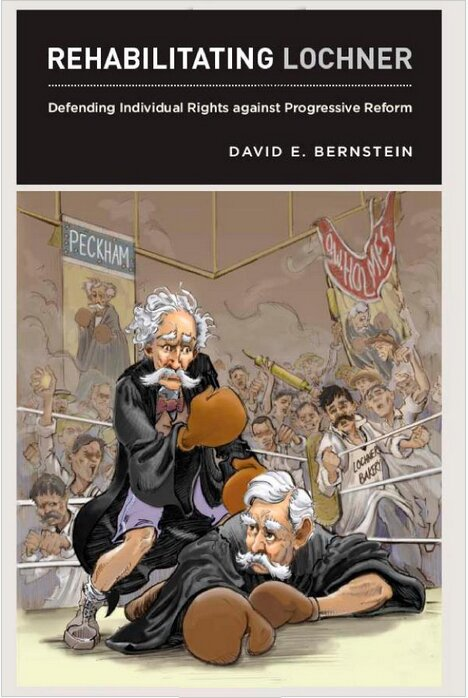
From this vantage, "economic issues" would not have been seen as a natural fit for an organization like ACS. From a template of judicial intervention against other branches, liberals still labor under the ghost of Lochner which holds that judicial overrides of democratic decision-making in the economic realm, in particular, is the sine qua non of illegitimate judicial activism.

Of course, in many cases the liberal desire out of judges in these economic realms (like competition policy and anti-trust) is for judges to stay out of the way and let the democratic or administrative branches do their thing. But here a different bias or blindspot of groups like the ACS emerges: the assumption that liberals don't need to urge the courts towards judicial restraint. Even as the conservative takeover of the judiciary marched along, liberals tended to react to it with dismay that courts might not intervene in areas where liberals believed they should. They wouldn't strike down gay marriage bans, they wouldn't curb abuses of post-9/11 surveillance, they wouldn't combat partisan gerrymandering. Some of these concerns proved prescient, others didn't pan out. But the framing was still in terms of seeking judicial intervention. Restraint was taken for granted.

It took a long time for liberals to fully grok the threat of judicial conservatism not manifesting as too much restraint, but of a complete lack of restraint -- a counter-activism. There were plenty of warning signs that liberals should be worried. But old habits die hard. For example, surely one of the most important liberal legal victories of the past two decades was the Supreme Court upholding Obamacare. Yet Frederickson did not say, and I think most legal liberals still would not say, that one of ACS' priorities either is or should have been "health care". In terms of judicial intervention, health care is seen as an inappropriate, Lochner-esque subject. And in terms of judicial restraint, well, liberals took judicial restraint for granted.

Now, finally, this ingrained presumption is cracking. We are in an era where the conservative judiciary's primary sin is not at all taking restraint too far, but its indulgence in wild interventionist non-constraint. In this epoch, where Chevron and the entire administrative state are under siege, where First Amendment Lochner-ism is roaring back to life, it becomes absolutely essential for liberals to reassert boundaries on judicial arrogance. And so now there is a lot of room for a group like ACS to make economic policy a priority. Today, efforts to shore up the vitality of administrative bodies seeking to police the economic realm isn't a redundancy, but a dire necessity.

When I first started teaching constitutional law, I spent a lot of time trying to pour some cold water on my liberal students' Warren Court idealism and have them consider the risks of judicial activism and the virtues of democratic deference. This was not so much because I was especially inclined towards judicial restraint or minimalism, but rather because the entire concept that courts shouldn't be vanguards of social change was effectively alien to the average student such that the only way I could give them anything new was by trying to at least partially counterbalance the narrative. In 2023, it has become less necessary for me to explain the perils of unconstrained judicial intervention and the dangers of an activist court; now, to some extent, the counterintuitive pitch I have to make sometimes is to explain why and how courts can still be useful forces for good in the world.* But the point is that the conventional wisdom amongst liberals is finally stopped viewing restraint and democratic deference as something they are entitled to on demand. In a world of rampant conservative judicial activism, there is a lot more space for legal liberals to pay attention to the economic realm. 

* Though I will say that I'm surprised, in a world where Brett Kavanaugh is the median SCOTUS vote, just how resilient my students' faith in judicial interventionism remains.

Shana Tova, Jewish Traitors!


As part of his holiday greetings, Donald Trump wishes a happy new year to, and I quote, the "liberal Jews who voted to destroy America & Israel".

Again, that is a direct quote:

Former U.S. president Donald Trump launched his latest broadside against liberal Jews — while wishing them a happy Rosh Hashanah.

“Just a quick reminder for liberal Jews who voted to destroy America & Israel because you believed false narratives!” read the text of the image Trump posted Sunday night, near the end of the holiday marking the Jewish new year. “Let’s hope you learned from your mistakes and make better choices moving forward! Happy New Year!”

This man is an antisemitic menace. 

Image above taken from this Times of Israel article, captioned "‘No way’ six-point star in Trump tweet was sheriff’s badge, white supremacist says."

Things People Blame the Jews For, Volume LXVIII: Thunderstorms in Tunisia


Today's entry will not be the first in the "Jews control the weather" subseries. It is only the latest. Tunisia's president, Kais Saied, has blamed the damage caused by a recent storm on a Zionist conspiracy. The proof? Well, "Daniel" is such a Jew-y name:

Tunisia's president on Tuesday blamed the destruction wreaked by the deadly storm which devastated North Africa in early September on Zionist infiltration and "attack on the mind and thought” as evidenced, he claimed, by the fact that it was named after the “Hebrew prophet” Daniel.

The president, in a sort of a "greatest hits" compilation, also has played an adaptation of the "migrant caravans"/"great replacement" charge,

Saied also made statements reminiscent of the antisemitic conspiracy “great replacement theory.” Speaking to his National Security Council on February 21, Saied claimed that “there is a criminal arrangement that has been prepared since the beginning of this century to change the demographic composition of Tunisia … There are parties that received huge sums of money after 2011 in order to settle irregular migrants from sub-Saharan Africa in Tunisia.”

The goal of the project, he said, after changing the demographic structure of Tunisia, was to continue on, infiltrating Europe and making it Black.

How nice to see that particular trope crossing international borders. (Cut to Mort Klein sweating furiously as he tries to decide whether Saied is an antisemite or his new best friend). 

Thursday, September 14, 2023

What Good is "[Anti-]Zionism"?

For the Third Narrative blog, I was asked to answer the question "is anti-Zionism antisemitic?" But, not having a death wish, I kind of traversed the issue. The better question, I think, is "what good does the word '[Anti-]Zionism' do in most contemporary practical debates about Israel?" And the answer, I think, is "not much".

From the conclusion:

For the “Zionists,” framing contemporary controversy as questions of Zionism vs. anti-Zionism dramatically raises the stakes of basic political disputes, making anything and everything a matter of existential survival. For the “anti-Zionists,” the ambiguity behind the term “Zionism” is regularly exploited as a mechanism of exclusion; they smuggle in broad-based attacks on the Jewish community as a whole while pretending to target only a narrower band of reactionary conservatism. Neither maneuver has lent itself to salutary debate over justice in Israel and Palestine. So perhaps it’s best we find a way to move past it.

Sunday, September 10, 2023

The Right Not To Keep and Bear Arms


Earlier this month, a district court judge upheld a West Virginia statute which required private property owners to allow guns to be locked in employee or customer cars while in a parking lot (h/t: Volokh). The court rejected general property-rights and expressive association challenges to the statute. One argument it did not consider, however, is that West Virginia's law might violate the Second Amendment as interpreted by Bruen.

At first blush, this may seem to be a strange argument (which is probably why it wasn't made): this is a law expanding gun rights protections; and Bruen concerns attempts to restrict gun rights. But on closer inspection, I think it is quite likely (contingent on the historical record) that laws like West Virginia's violate the Second Amendment as that provision was interpreted in Bruen.

Start with first principles. Bruen, along with the other members of the "Roberts Trilogy" on guns, was emphatic that the Second Amendment is not a "second-class" constitutional right. And a critical component of other constitutional rights is that they all contain a robust negative component. The right to free speech includes the right not to speak (this is the locus of the "compelled speech" doctrine). The right to free association includes the right not to associate. The right to freedom of religion includes the right not to profess religious belief. And so, by extension, it seems evident that the right to keep and bear and arms includes a right not to keep or bear arms on one's own property.

Once that observation is made, then West Virginia's law plainly implicates property owners' Second Amendment right not to "keep" arms on their property. At that point, Bruen insists, the only question courts are permitted to ask is whether or not the law in question has historical analogues dating from the enactment of the Second and/or Fourteenth Amendment. I won't claim to have canvassed the history exhaustively, but my sense is that there aren't such laws (there certainly were plenty of laws protecting an individual's right to keep arms on his or her own property, but it doesn't seem like there were many laws which expressly forbade property owners from prohibiting arms on their own property). This is especially noteworthy because this is not a "novel" Second Amendment situation -- the issue of allowing property owners to forbid guns on their property was perfectly cognizable at the time of the framing, it is not an issue that only later sprang into existence based on some social or technological development. So if the historical record doesn't turn up a pattern of state laws akin to West Virginia's, then West Virginia's law must be struck down.

To be sure, West Virginia could argue that its law strikes a reasonable balance between the interest of gun owners being able to keep and carry their own arms for self-defense, and the desire of property owners to keep guns out. After all, the gun owner who wishes traveling in the public with his weapon will be significantly deterred from doing so if they're not even permitted to keep their gun locked in their car the moment they enter the parking lot of the "wrong" business or enterprise. In practice, a world in which gun owners can't enter even a parking lot with their guns locked in their car is one where they are significantly limited in their ability to travel anywhere with guns. 

But while this argument might have considerable purchase under traditional "balancing" review, Bruen expressly forecloses that sort of inquiry. As the Court emphasized, the Second Amendment's historical test is "the very product of an interest balancing by the people." History is what sets the "balance"; any additional weighing of policy considerations is impermissible. Ultimately, West Virginia's concerns that private limitations on gun possession may spillover to lessen the prevalence of guns is no different than New York's worries that striking down its gun control measures will result in too many guns on the streets. At root, West Virginia seeks to intrude on the Second Amendment in order to effectuate its policy judgment favoring more guns. A state like New York seeks to intrude on the Second Amendment to have fewer guns. Either state may or may not be correct as a matter of policy; but under Bruen both states' arguments must fall on deaf ears.

Nor can West Virginia's statute be defended as a means of securing the Second Amendment from infringement. Just as the First Amendment does not create an interest in forcing a newspaper to publish your op-ed, the Second Amendment protects against government infringements, not acts of private individuals. The only germane Second Amendment interest here -- the only actor threatened by government impingements -- is the negative interest of property owners who wish not to keep and bear arms on their property. Admittedly, cases like PruneYard do suggest that in the First Amendment context some government regulations protecting speakers on private property may be permissible, notwithstanding the property owners' own interest in declining to speak. But leaving aside whether that extension should carry to a law like this (West Virginia's attorney general made this argument; the court did not end up addressing it) under First Amendment balancing tests, it does not carry any weight under the Bruen regime, which again boils the question down solely to an inquiry into history. If West Virginia's law has proper historical analogues, it survives. If it doesn't, it doesn't, no matter how strong the policy argument in its favor may be.

Of course, we've already seen courts bend the "no policy" principle of Bruen when policy arguments seem to favor increased gun access, and it's entirely possible we'd see a similar move here as well. This is especially so since the "negative Second Amendment" idea the argument hangs on -- while I think one that has to be correct as a matter of constitutional interpretation -- is a bit novel and certainly cuts against the grain of what we expect the Second Amendment to do in cases like this. Nonetheless, in theory Bruen both gives and taketh away -- there will be times when Bruen strikes down even well-warranted laws and times when it upholds repellent ones. West Virginia's law strikes me as a good example of an enactment that is absolutely defensible as a matter of policy, but which probably cannot withstand Bruen's harsh review. The only question, as always, is whether Bruen's goose will ever apply to its gander.

One other thought: If you're looking for a viable progressive "bounty" program to counter the shenanigans anti-abortion activists are pulling in Texas, this seems like it could set one up.

  1. Write an ordinance that says guns are forbidden on private property unless consent is granted by the owner (an "opt-in" rule). These laws are being challenged, but I genuinely think they should survive constitutional scrutiny because all they do is establish a default rule, and for the reasons stated above the Second Amendment doesn't protect the right to bear arms on others' property.
  2. Create a civil cause of action for violating the ordinance.
  3. Add in all the abusive nonsense that Texas pioneered (no governmental enforcer, anyone can sue anyone, imbalanced attorneys fees, and so on).
  4. Lie in wait for anyone who pulls into a Wal-Mart parking lot with a gun in their trunk, and have at them.
To be clear: I think a law like this would be terrible and destructive, notwithstanding my own views on guns. These "bounty" laws are recipes for chaos. But to the extent that the only way we'll see them curbed is by showing that they'll exact costs on both political camps, I offer it as a way of establishing deterrence: mutually assured destruction.

Update: Turns out this article has already been written. Oh well -- at least I wasn't the only one with the thought!

Saturday, September 09, 2023

To Infinity and Beyond


Well, I bought an Xbox. And Starfield. Basically, I've decided to write off the rest of the month of September (at least). Wish me luck!

[Very early thoughts: It's definitely overwhelming to begin. I'm a semi-Bethesda veteran -- yes to Skyrim, Oblivion, and Morrowind, but no Fallout -- and I'm not sure if that experience is truly helping me. There's little question the game overwhelms with menus and options. Already, the ship-based portions of the game are far more involved than I anticipated (contrast a game like Mass Effect, where your ship is basically a glorified fast travel nexus). Planetside traveling is extremely difficult to navigate because the local area maps are truly terrible. But the scope of the game already feels breath-taking, and it does feel like the sort of game where once you get past a somewhat-stiff learning curve, it will be worth your while. I'm excited!]

Wednesday, September 06, 2023

Vivek Ramaswamy: I Didn't Know My Host Was Antisemitic Until After I Made My Own Antisemitic Statements


Upstart GOP presidential candidate Vivek Ramaswamy has come under scrutiny after appearing on an antisemitic podcast (the host has said, for example, that Jews "own almost everything" and that we pay Black celebrities to attack White people).

Ramaswamy's campaign has defended him by saying he didn't know the host's views on Jews prior to coming on the show.

Problem #1 is that, given Ramaswamy's campaign is built primarily around "anti-woke" hysteria that's shot through with antisemitism, it's inevitable that the waters he swims in will regularly include antisemites. This was not bad luck. Scratch an anti-woke extremist, and it's a very good bet you're going to find an antisemite.

But larger problem #2 is that Ramaswamy decided to give his own antisemitic riff on the podcast. Responding to the fact that he was a recipient of a Soros Fellowship (sidenote: LOLOL), Ramaswamy took pains to distinguish Paul Soros (the funder of the fellowship) from his brother George Soros. What's the difference, you might ask? Answer: George Soros is, according to Ramaswamy, “the bogey man pulling the strings.”

Subtle! And to think Ramaswamy belted out that dogwhistle foghorn without even knowing his host was an antisemite too! It's so nice when things work out.

Sunday, September 03, 2023

Media Alt-Centrists in Disarray


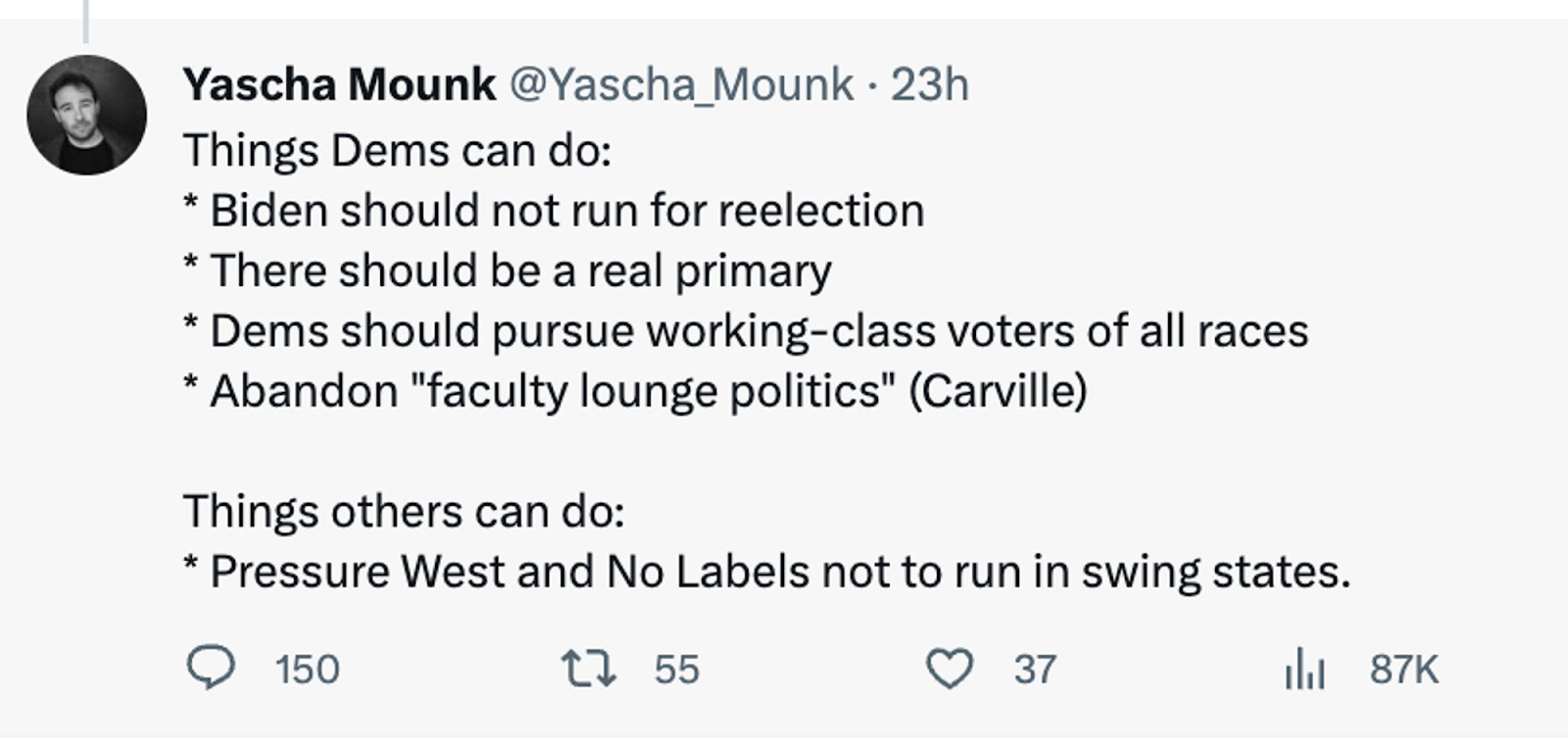
When I first saw this Tweet (Xeet?), my eye was drawn to "Dems should pursue working-class voters of all races." It's a great example of something that is simultaneously (a) alt-center conventional wisdom and (b) utterly inane. What are the sorts of policies Dems should pursue to working-class voters of all races? Answer: the ones they're already supporting! 


Price negotiations for prescription drugs is a great, obvious example of a policy that's geared to the interest of working-class voters of all races. Standing with the incipient wave of labor mobilization is another. The infrastructure bill was yet another. All of these are centerpiece items of the Democratic Party's economic agenda. But the alt-center punditry acts as if they don't exist. The "advice" on offer is "do what you're already doing, but make me pay attention to it." And one cannot help but think that the price the pundits have put on "make me pay attention to it" is "stop distracting me by also supporting policies that are distinctively to the benefit of specific historically marginalized communities."

At the same time, there is a separate vapidity in the "advice" that Biden shouldn't run for reelection. Again, as advice this is just terrible: Biden has a proven electoral track record and has already beaten Trump once. There's no universe where a chaotic primary free-for-all would actually be healthy for the Democratic Party or the broader prospect of ensuring that Trump or any of his lackeys stay out of the White House. The desire for "a real primary" is just thinly-disguised thirst for the good old days of "Dems in disarray" and the chaotic intraparty knife fights that aren't happening on the GOP side because virtually all of Trump's "challengers" can't help but cozy up to him (with a not-so-subtle wink to the various factions within the Democratic Party whose definition of a "real primary" excludes any primary where their preferred candidate doesn't march to victory).

Finally, "faculty lounge" politics is also a meaningless phrase. If it's meant to refer to the notion that Democratic party politics take their cues from whatever petition is currently being passed around the Wesleyan anthropology department email list, it's delusional. If it's meant to be a general referent to so-called "culture war" politics, then it's horribly outdated -- we are long past the days where the main "culture" wedge issues favored Republicans over Democrats. Republicans are getting absolutely blitzed on reproductive rights as their radical campaigns to imprison, maim, and murder women are predictably reviled. And their anti-LGBTQ agenda doesn't fare much better. Democrats have a lot of room to punish Republicans for their extremism here, and absolutely should.

Biden should run for reelection, and in the process will no doubt trounce token primary opposition. He should promote his policies which will improve the lives of working class voters of all races, and he should absolutely torch Republicans for their unabashed extremism in desiring to take American "culture" back to the 19th century.

Saturday, September 02, 2023

Steeled for Stealing


Last night, I had -- well, epiphany is probably too strong of a word. Crystallization, perhaps. A thought I already basically knew just became clearer in my mind. Namely: that the next time a major Republican candidate tries to overturn the results of an election, they're going garner a lot more support from the Republican establishment (in particular, the GOP judiciary).

Oddly enough, it was the 5th Circuit's latest ivermectin ruling that triggered the realization. Even at the start of the pandemic, we wouldn't see right-wing judges pulling stunts like this. The seals were still in place; it takes time for them to crack. But as they start to come undone, there's no backstop of legal or ethical duty to hold them in place.

Despite Trump's regular warnings (dating back to 2016) that he would not respect the results of an election that he lost, few in our political and legal elite really believed that he would go through with an overt plan to steal the election. Remember "What's the downside for humoring him?" It wasn't real until suddenly it was. And as a consequence, Republican elites hadn't really braced themselves to go all in for election theft. It's not just that it was too much, it was that it came too fast. They weren't ready.

But with time and distance, the Republican Party has come to assimilate Trump's actions as justified (same as they've done for every other one of Trump's abuses). Those who actually did unashamedly oppose Trump's actions have been ruthlessly purged from the party. Nascent momentum to support consequences for Trump during the second impeachment trial have entirely disappeared as far as the GOP is concerned. The unthinkable became thinkable, and Republicans have had four years to come up with clever rationalizations and apologias for why actually overturning democratic elections is fair play and What The Founders Would Have Wanted.

I've remarked before that GOP election theft attempts are akin to the carnival game where you swing a hammer and try to ring the bell. They weren't strong enough to ring it the first time. But they're getting stronger. It's not just that the next attempt will be less slap-dash and more well-organized (though it is that). It's also that the GOP has had time to mentally brace itself that stealing elections is appropriate, even necessary, and certainly just.

In 2020, virtually all GOP judicial actors refused to go along with Republican efforts to steal the election. Come 2024, I do not expect to see that unanimity anymore. They've steeled themselves for stealing, and next time they will come harder than before.

Friday, September 01, 2023

.... And Getting Worse Roundup

This will not be my cheeriest roundup. But there are a bunch of links burning a hole in my pocket, so here you go.

* * * *

Apropos yesterday's post on Fugitive Uterus Laws, a Washington Post article on similar efforts underway to set up checkpoint towns in Texas designed to capture any pregnant women who has designs on leaving the state for freedom.

North Carolina Republicans considering impeaching a state supreme court justice because she talked about racism. While I can't fault Slate for juxtaposing this against the undisclosed largesse heaped upon Justice Thomas, my mind more rapidly went to efforts in Wisconsin to impeach a state supreme court justice because she might vote for democracy.

A politically engaged fifteen year old kid asked a (not even that tough!) question that made Ron DeSantis uncomfortable on the campaign trail. So he sent his goons to rough him up.

You see, the real problem with the "War on Drugs" is that it's too metaphorical.

The latest Fifth Circuit crack-pottery: it's probably illegal for the FDA to tell humans they're not horses (yes, this is the latest conservative institution to burn its remaining dignity in defense of ivermectin conspiracies).

Georgia school district: saying the word "gay" around fifth graders is like graphically describing the horrors of the Holocaust to kindergarteners. 

Thursday, August 31, 2023

Are States Allowed To Trap Pregnant Women Inside Their Borders, Berlin Wall Style? Views Differ!


In his Dobbs concurrence, Justice Kavanaugh took pains to argue that even after the right to reproductive freedom was stripped from the constitution, it was still forbidden for "a State [to] bar a resident of that State from traveling to another State to obtain an abortion." It was a very, very small sop given to the predictable calamity the Court unleashed upon women of reproductive age, who were otherwise told in no uncertain terms that their body is not their own when the state has a different agenda for them.

But Justice Kavanaugh's opinion was not signed onto by any other justice. And, much like the question of whether states can murder pregnant women, views differ as to whether they can criminalize pregnant women leaving their borders. Right now, Alabama is in court arguing that it is entitled to criminally prosecute those who aid Alabama women in leaving the state to have an abortion. After all, if Alabama has a valid interest in forcing its women into labor, then surely it has an equally valid interest in thwarting those women who might try to escape their wardens and find freedom over their bodies in other states. The term Fugitive Uterus Act is absolutely fitting and appropriate, and the passage and enforcement of such laws is a top priority for the current Republican Party.

Justice Kavanaugh's concurrence notwithstanding, the entire point of Dobbs is that a woman's right to control her own body has zero constitutional significance. That said, if we take Justice Kavanaugh at his word (far from clear we should), and if Chief Justice Roberts goes along with him (far from clear he will), then maybe this is a bridge too far for the current Supreme Court. If, if, and maybe.

[Source for the above image]

Tuesday, August 29, 2023

Another Case of Self-Inflicted BDS


Some of you are familiar with the "Deadly Exchange" allegation -- an effort by JVP and allied groups to block cross-training programs between Israeli and American police officers on the grounds that such programs really are just avenues for Israel to transmit brutality and oppression to their American counterparts. It's a signature campaign of the BDS movement, albeit one that -- like most BDS activities -- hasn't gotten much traction.

But today comes the news that Itamar Ben-Gvir, the notorious far-right racist who also happens to be Israel's National Security Minister, has taken it upon himself to bar Israeli police from partaking in programs run by the Wexner Foundation for Jewish Leadership. Wexner programs have hosted an array of significant figures in Israel's security establishment, but as is becoming increasingly passe they have come under predictable fire from the Israeli right upon allegations that they are a tool of leftist indoctrination and the ever-shadowy "deep state". So a ban was announced, and yet another screen of isolation falls upon the Israeli public vis-a-vis the outside world (and here, in particular, the Jewish diaspora world).

The Wexner programs are not, to be sure, exactly the sorts of police cross-training programs that "deadly exchange" targets. Nonetheless, this is yet another data point to the proposition that Israeli right is far more successful at actually instantiating a BDS regime than BDS activists ever have been.

Saturday, August 26, 2023

The Unique Vulnerability of Sexual Assault Victims Under Defamation Law


A former George Mason University law professor and FTC commissioner, Josh Wright, has sued several of his former students who accused him of sexual misconduct and exploitation for defamation. He's seeking over $100 million in damages. (As I understand Wright's position, he admits to having engaged in sexual relationships with several of his students but denies any form of abuse or exploitation). This has some resonance with Johnny Depp's lawsuit against Amber Heard where he largely successfully convinced a jury that Heard had defamed him upon accusing him of domestic abuse.

Cases like this have an interesting character; one that poses special danger towards defendants and, by extension, potentially make leveling accusations of things like sexual misconduct or domestic abuse especially fraught.

Truth is an absolute defense to a defamation claim. But establishing falsity is not normally sufficient for a plaintiff to win a defamation claim. Even a defendant who utters a false statement still can't be held liable for defamation unless they exhibited some sort of culpable disregard for the truth. Where the target is a public figure, the standard is known as "actual malice" -- a requirement that the false statement be uttered with either knowledge of its falsity or reckless disregard for whether it is true or not (for non-public figures, this standard may be relaxed). So there are many circumstances where a jury might believe that an allegedly defamatory statement is indeed false, but still will not assign liability -- for example, if they think the speaker made an honest mistake or a regular poor judgment.

But a sexual assault claim by the putative victim is different, because by definition the victim has firsthand knowledge of what happened. If the attack happened, then her accusation is true, and there's no defamation (truth as an absolute defense). But if the jury concludes the attack didn't happen, then the defamation claim essentially succeeds by default, because if the attack didn't happen then the "victim" must have known the attack didn't happen, rendering her allegation knowingly false. In other words, in a defamation case regarding a firsthand accusation of sexual assault, the entire case resolves down to the jury's judgment about whether they believe the accuser or the accused. If they believe the latter, then -- despite the additional hurdles normally put up by the "actual malice" standard and its cousins -- defamation is essentially a strict liability offense.

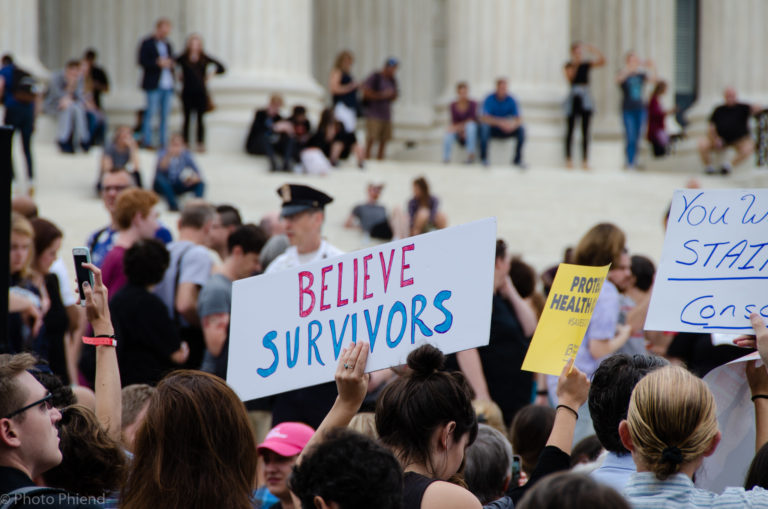
This prospect, one imagines, is yet another deterrent to sexual assault victims going public with their accusations. We speak a lot about the propensity (or not) to "believe women", and how widespread tendencies towards disbelief deters victims of sexual abuse from coming forward. In the public square, it is essentially inevitable that -- regardless of the underlying truth of the allegation -- there will be some cadre of observers who will believe the accusation and some cadre who disbelieve. One reason a victim might not directly seek legal recompense from their attacker is because they lack confidence that a jury will be comprised entirely of believers, and so the effort will come to naught. In the court of public opinion, a victim may in practice come to terms with the fact that some will believe her and others won't; speaking her piece and letting the chips fall where they may. She may, in other words, be well aware that some significant quotient of listeners will not believe even her true story and be willing to ensure that prospect as a cost of speaking her truth.

But the aspect of defamation law I'm flagging here means that victims cannot simply opt out of the legal process. The victim who wants to speak but do nothing else still is automatically exposed to potentially ruinous liability in any circumstance where a jury is comprised of disbelievers -- and disbelief is all it takes (the additional guardrails offered by doctrines like "actual malice" do not apply). The woman who is willing to endure a significant cadre of the public disbelieving probably will not be so sanguine about that disbelief translating into financial catastrophe.

If one has strong confidence in juries being able to sort truth from falsehood in cases like this, then this may not strike you as much of a problem. But in general, I suspect one reason why defamation law normally has these guardrails beyond "is the statement true or not" is because we understand juries are not perfect and that there needs to be wiggle room in hotly contested cases. And in specific, I suspect that defamation claims around sexual misconduct are cases where we may be especially likely to see significant error rates. Low confidence in accurate judgments surrounding truth or falsity, combined with an effective strict liability regime for statements adjudged to be false, equals a very strong deterrent to speaking out in the first place.

Wednesday, August 23, 2023

Whither #TeamVaccineNanoBot?


The COVID vaccines have been widely available for well over two years now. Surely, if Biden/Soros/Gates/the Rothschilds were going to flip a switch and take over our bodies with the nefarious nanobot technology they deviously microchipped us with via the vaccine, it would have happened by now. So I'll ask: what happened to team nanobot?

In all seriousness: how do the conspiracy theorists explain that none of their dire predictions have come to pass? In even greater seriousness, I know the answer is: they won't bother to explain; conspiracy theorists happily skip to the next mania without bothering to look back whenever their last round of doomsayings come to nothing. But I still feel a deep urge to hold their feet to the fire and say "where are your nanobots now, huh?"

Alas, that is likely to remain just a fantasy. But we can still take the opportunity to reflect on just how stupid anti-vaxx activists are and ever will continue to be. Remember: they're always wrong, until finally, they're still wrong.

Monday, August 21, 2023

Hickory Smoke


This weekend, Jill took a train trip up to Seattle to visit friends. It was a lovely time -- Seattle is a great city, we saw Liz Miele do stand-up -- just a pleasant weekend all around.

However. Our friends have a three-year-old, and consequently much of the car music over the weekend was an album of nursery rhymes. On its own, that didn't bother me at all. I'm sure that by the nine hundredth thousandth millionth iteration the songs would get aggravating, but seriously -- I had no problem singing along with "The Itsy Bitsy Spider" to a toddler.

The problem was Hickory Dickory Dock. Which, to my horror, I found out I -- and by "I", I mean "everyone else" -- have been singing wrong my entire life.

Here are the core lyrics as I always sang them as a kid:

Hickory, dickory, dock

The mouse ran up the clock

The clock struck one

And down he runs

Hickory, dickory, dock.

Notice that "one" rhymes with "runs". Which makes sense for a nursery rhyme. It's great.

But here is how it was sung on the album (and further research suggests this is a more common iteration):

Hickory, dickory, dock

The mouse ran up the clock

The clock struck one

The mouse runs down

Hickory, dickory, dock.

 What is this? "One" does not rhyme with "down". It's not even close enough to be a slant rhyme, but it is just close enough to be horribly jarring and discordant and wrong.

Also, I disapprove of the melody the album chose. I think the first two bars of the song should go:

G-A-G-F-E-D-C

C-E-E-F-D-E

But what we got was:

F#-G-A-A-B-D♭-D

A-F#-G-A-A-B-D♭-D

And of course, Wikipedia suggests that's the traditional melody choice as well. What is wrong with all of you?

As you can imagine by the fact that I'm still writing about it, this is driving me absolutely nuts -- to the point that I saw a recipe for "hickory rubbed watermelon" yesterday and almost flew back into a rage. The whole word is ruined for me.

Saturday, August 19, 2023

Are Red State Universities Starting to Feel the Pressure? An Anecdotal Account


As a member of academia, I periodically get inquiries from other law schools asking if I'm interested in lateraling. This is quite flattering, though I know full well that such messages aren't only being sent to me and that there is a long road from "email of interest" to actually getting a job offer.

Recently, though, I've noticed that the schools making such inquiries of me are disproportionately located in deep red, southern states. It could be a statistical artifact, of course -- I don't get so many solicitations so as to negate the possibility of random clustering. But it does make me wonder if the decaying political climate in those states means that these schools are experiencing more pressure in terms of faculty outflow, which they're trying to replace via laterals.* 

Both the specific anti-academia initiatives (crusades against "controversial topics"; attacks on tenure), and the broader threat to political and civil rights (abortion bans, threats to democracy) that are characteristic of these states make working there -- and to be clear, I hold the universities in question in the highest esteem -- a far less attractive proposition. And from the other side of the fence, serving on our school's appointments committee this year it did seem to me like we were getting an uptick in "red state refugee" lateral applications -- though again, that's just an impression, and I have no data to back it up. For another bit of anecdotal evidence, see Sapna Kumar's recent interview explaining why she elected to leave Houston Law for the University of Minnesota.

I'm curious, though, if others are noticing this pattern as well. Other junior law professors -- are you getting disproportionate interest from "red state" schools? Any other sense that these schools are indeed facing faculty outflow pressure?

For what it's worth, I'm very happy in Portland and at Lewis & Clark, and have no interest in decamping anywhere. My wife and I have bought a house, we've settled down, I like my students and my colleagues, I've got the course package I want -- life is good and I see no need to mess with a happy status quo.** But my wife and I have also decided that, even beyond any generic inertial resistance, we're in particular not interested in moving to schools in places where our basic rights don't feel secure. We're at the phase of life where we're thinking of starting a family, and doing that in a place where pregnancy turns my wife into a vessel for the state would be horribly unfair to her. And for my part, I teach constitutional law -- a course that, rumor has it, sometimes veers into "controversial topics". I don't want to go to jail because some yahoo right-wing prosecutor decides I'm teaching Roe and Dobbs wrong.

* It might say something about my professional self-esteem that I assume the only reason these schools would be interested in the likes of me is that they're in the midst of a political crisis.

** All that said, I want to be very clear that if Harvard Law School wanted to entice me to move to Cambridge by tripling my salary, they can feel free to mess away.

Thursday, August 17, 2023

The Sunset of Women's Rights


Going off my post from yesterday, I'm quoted in today's Bloomsburg Law article about Judge Ho's wild opinion in the mifepristone case -- particularly his ruminations on the "aesthetic injury" pro-life doctors endure from women being allowed to control their own reproduction.

“I absolutely get and agree with the idea that there is something degrading about treating women as, you know, akin to kind of the natural splendor of a sunset,” David Schraub, an constitutional law professor at Lewis & Clark Law School, said noting the criticism Ho’s argument has gotten on social media.

[....] 

Schraub said Ho is “a standard-bearer for a new generation of conservative jurists” who recognize and believe in the judiciary as a vanguard for right-wing social change. This generation, he said, isn’t afraid to attack in bold language anyone who’s advocating for a more constrained, traditional view of the judicial role.

Ho “likes the bombast and it’s a very, very common feature of the opinions he writes,” Schraub said. 

Not quite sure how I became the mifepristone guy, but here we are. 

Wednesday, August 16, 2023

Scientists Aren't Gods. Fifth Circuit Judges Are Gods


The Fifth Circuit has released its decision in the mifepristone case. In essence (and I read this quickly, so take with a grain of salt), the court did not overturn the initial FDA approval of mifepristone or the approval of generic variants (the former because the claim was time-barred; the latter because the plaintiffs showed no specific evidence that they were additionally injured by generic approvals). However, it upheld the district court's stay on subsequent FDA decisions which made mifepristone more readily accessible (e.g., allowing it to be prescribed by telemedicine). The new FDA regulations were, the court concluded, "arbitrary and capricious" primarily because while the agency did analyze the risks latent in the individual alterations it was making to the regulatory schema and found them to be negligible, the FDA did not specifically analyze how all these changes might interact when aggregated together.

The decision is, as the panel took pains to repeatedly note, stayed until the Supreme Court has an opportunity to act.

In May, I proffered three possibilities of what the Fifth Circuit would do in this case. The first was that they would take the Supreme Court's hint and reverse the district court. The second was that they would largely affirm the district court but try to file off the "rougher edges" to make it more likely the Supreme Court would uphold the ruling. And the third would be to let their freak flag fly and go all in on defending the extremity of the district court ruling.

What we got was mostly in that middle camp. The court didn't accept the most extreme iterations of the district court's ruling which would have completely taken mifepristone off the shelves nationwide. And its analysis, for the most part, styles itself as sober review of the administrative record and standing doctrine. But the end result was still the court stretching the law to force a substantial rollback in its accessibility. The hope, I think it is clear, is to present this ruling as the "reasonable" conservative position that doesn't go as far as the district court and so one that liberals can't really complain about if it is upheld (spoiler: we can and should).

Judge Ho concurred in part and dissented in part because he would have upheld the district court's decision in its entirety, and in contrast to the majority his opinion was squarely in the realm of possibility number three. He went whole hog on every possible avenue for showing his right-wing culture warrior bona fides, including florid discussions of the importance of the doctor's "conscience rights" to be mad that they have to treat patients who are suffering from medical emergencies they disapprove of and a full-scale defense of the applicability of the Comstock Act to block any sort of approval for abortion medication.

There is stiff competition for who is the worst federal appellate judge. But I'm not sure there's any competition for who the most arrogant federal appellate judge is (and it's no surprise, perhaps, that it's a University of Chicago Law alum taking the crown). In that vein, one passage of Judge Ho's opinion especially stood out to me -- his strident defense of the judiciary refusing to accord deference to the scientists at the FDA.

In this appeal, neither the FDA nor Danco is content to simply argue that the district court erred. They disparage the ruling as “an unprecedented judicial assault on a careful regulatory process.” The “non-expert” district court issued an “unprecedented order countermanding the scientific judgment of the Food and Drug Administration.” 

Their message is simple: The scientists at the FDA can do no wrong. So courts have no business reviewing their actions. 

That’s mistaken on multiple levels.  

[....] 

Scientists have contributed an enormous amount to improving our lives. But scientists are human beings just like the rest of us. They’re not perfect. See, e.g., Whole Woman’s Health v. Paxton, 10 F.4th 430, 464–70 (5th Cir. 2021) (en banc) (Ho, J., concurring). None of us are. We all make mistakes.

And the FDA has made plenty....

The scientists at the FDA deserve our respect and our gratitude, but not our blind deference. That would defy Congress’s clear directive that courts conduct independent legal review of FDA action under the APA. 

Of course it is true that scientists can make mistakes. Judges can make mistakes too (this case is replete with them). And since "we all make mistakes," the actual germane question is who is more likely -- scientific experts or generalist judges -- to make a mistake when it comes to assessing highly technical medical and scientific decisions on drug approval. And the answer there is obvious: judges are far more likely to be mistaken. Hence why the standard of review is "arbitrary and capricious". The agency doesn't get blind deference, but it still gets regular deference. Absent blatant, smack-you-in-the-face mistakes -- the sort that go beyond disputes about best practices or disagreements on matters of judgment and slide all the way into "arbitrary" or "capricious" conduct -- judges defer to the scientists because judges know that in normal circumstances they're more likely to cause a mistake than to correct one.

In this case, the FDA analyzed the risks of its new regulations enhancing public access to mifepristone and found that they were negligible. Would it have been better if it is specifically analyzed how these risks might change when all the regulatory changes were aggregated? I have no idea (since again, I'm not a scientific expert, and I'm modest enough not to venture a guess). But it is hard to argue that the decision to rely on the individual negligibility of the risks is either "arbitrary" or "capricious". That sort of pot-shot second-guessing of scientific judgment is exactly what normal judicial modesty and deference should foreclose. 

But Judge Ho's eagerness to emphasize the fallibility of the FDA's scientists is quite predictably paired with a blind refusal to recognize his own parallel status as a mere mortal. In our constitutional system, it seems, scientists aren't gods; only Fifth Circuit judges are.