Saturday, October 05, 2024

The Sermon Every Jew But Me Heard Every Week


One supposedly ubiquitous aspect of millennial Jewish upbringing that I do not at all relate to is the storyline where their Jewish education was a completely uncritical and unsophisticated "Israel right-or-wrong" drumbeat, one which eventually shattered upon the reality of going to college or meeting Palestinian friends or visiting Israel and the occupied territories. This story is omnipresent amongst Jews of my generation, and it just never resonated with me. I never felt like my Israel education was so inflexible, and so I never had the experience of it crashing into the real world.

The synagogue I grew up in was, admittedly, in many ways atypical. It wasn't especially liberal (no more so than is normal for a Jewish congregation, anyway), but its location in the DC suburbs meant it did have quite a few genuine experts on Israel and the Middle East (well beyond the armchair experts I imagine one can find in any synagogue pew). Their views were by no mean unchallengeable and the environment was certainly unabashedly "pro-Israel", but it did mean we perhaps avoided some of the more nakedly crude manifestations of pro-Israel politics.

This apparent idiosyncrasy in my upbringing has really jumbled my ability to connect with the zeitgeist. On the one hand, I hear the aforementioned tales of Rabbis giving these near-comical caricatures of the "true" contours of the Israel/Palestine conflict, and I can't help but be skeptical -- that's certainly not how I remember it. On the other hand, you hear it often enough and you have to think that maybe I'm just the weird one. While I certainly wouldn't characterize myself as detached from the organized Jewish community, it is the case that my connection to a synagogue has been sporadic in my adult life (if only because I moved around so much) -- so I have little in the way of comparison to juxtapose against the synagogue I grew up with.

But the imminent arrival of a little one in our family has finally prompted us to begin synagogue shopping in earnest, and over the high holidays we've been surveying various congregation's services. One congregation in particular checks a lot of our boxes -- a vibrant community, lots of young families, excellent early childhood resources, and we were excited to try out their services for the first time.

At the same time, I was seeing a flurry of posts and resources talking about how anti-Zionist or Israel-critical Jews were struggling to find welcoming Jewish communal spaces -- where could they go to high holiday services where they wouldn't be bombarded with hasbara defenses of the war in Gaza? And I will admit -- I was feeling skeptical. "Bombarded"? Come on. My own experiences made me exceptionally dubious that there would be much beyond the anodyne and unobjectionable. There'd probably be an Israeli flag on the bimah, and a prayer for the state of Israel, and statements of concern for the hostages and spiking antisemitism on college campuses. If that's what passes for an unwelcoming atmosphere, I'd say deal with it.

And so I attended services, which were quite lovely, and then the Rabbi stood to give his sermon. And it didn't take long for me to realize "oh, so this is the sermon that every Jew of my generation but me is talking about."

My first thought -- since I was synagogue-shopping and so had recently seen exactly how much it costs to join a synagogue -- was "I could just subscribe to Commentary and save a lot of money!" The second thought was to remember all the wonderful programs and suddenly understand why people join megachurches ("I may not agree with the pastor's politics, but my goodness what a preschool!"). I asked my wife her thoughts, and she said "honestly, I just tuned him out" (probably another regular facet of Jewish experience that I don't relate to -- the Rabbi at my childhood synagogue may well be the single most compelling orator I've ever met in my life).

In terms of the sermon itself, I'm not going to go to deep into the substantive details. The nicest thing I could say about the speech was that it was, at best, a good twenty-plus years out of date in speaking of an Israeli government that of course wants nothing more than peace, but alas must deal with the reality that the Palestinians will settle for nothing less than maximal and total victory. This does not, to say the least, aptly characterize the current Israeli government; much of the ideology the Rabbi imputed to Hamas and Hezbollah resonated just as strongly with Ben-Gvir, Smotrich, or yes, Netanyahu -- all of whom have proven entirely willing to sabotage prospects of peace for a chance at complete and utter dominion between the river and the sea.

At root, the sermon read as an attempt to rally a wavering audience to continue to back a war without end whose suffering has been immeasurable, because the belief that a peaceful solution can be achieved is just so much Western naivete. And it was made worse because the sermon did contain the periodic rhetorical gestures in a liberal direction -- a concession that the occupation is a problem here, a willingness to admit Bibi hasn't been perfect there. Hearing such sentiments expressed as brief asides amidst a sea of "we are fighting a culture of death" jeremiads made me understand why so many of my peers view such positions as meaningless smokescreens -- they were not actual concessions; they were balms meant to reassure the audience of its own virtue. And more broadly, if this was the Israel-outlook that I was exposed to as a teenager, then I absolutely would've gotten clobbered when reality hit in adulthood.

Again, I was not prepared for this. In fact, I had a different blog post ready to roll that was all about there being a spectrum of Jewish opinion out there and the broad tent had room for a variety of voices. The week before I had just been invited to give a talk at the Eastside Jewish Commons, and nobody had any qualms about my own harsh critiques of the Israeli government (and indeed on the bulletin board in the space I saw a posting for the Center for Jewish Non-Violence, advertising its work of "co-resistance and solidarity against Israeli occupation and apartheid."). I was planning to buttress that experience by reference to my High Holiday experience, which (I was already drafting in my mind) was a High Holiday experience, not a Bibi Netanyahu appreciation tour.

Now, to be sure, I'm still not convinced my initial instincts regarding communal pluralism were fully off-base. Leaving aside the wrongness of making judgments off of an n of 1, even at this very synagogue, the other Rabbi had just written a column about the importance of choosing peace even as her colleague was delivering an ode to the virtues of war. So one might say that Jews engaging in aggressive pro-war politicking is just as much part of a pluralism as Jews organizing to demand a ceasefire is. And again, as much as people say that any "whiff" of dissent results in an insta-purge from mainline Jewish spaces, I feel like I have dissented more than a whiff and I remain unpurged. So what am I doing that's so special? 

But nonetheless, I had a prediction of how I expected the High Holidays to go, and it was falsified. I could have just kept that to myself, of course -- none of you would have been the wiser. But it felt more honest to relay the experience.

Monday, September 30, 2024

We Don't Know What a Fast Garland World Would've Looked Like


It is almost certain that Donald Trump is going to run out the clock on facing real legal consequences for his myriad 2020 election related crimes before the 2024 election occurs. Consequently, many are blaming Attorney General Merrick Garland for being too slow and cautious in his prosecution of Trump. By taking so much time before bringing his case, Garland enabled Trump's various delaying tactics -- aided, of course, by loyalist judges at both the trial level and Supreme Court -- to stretch the cases out until after election day. Had he moved faster and more aggressively, things would have been different.

Maybe. But the thing about alternate futures is that we can't live there; and if we did live there, we wouldn't know here. Suppose that Garland did move fast and aggressive on Trump right at the outset of Biden's term. And suppose that right-wing judges such as the current Supreme Court majority, or Judge Cannon, issued the same rulings that they did in our timeline -- providing broad immunity to Trump designed to shield him from legal accountability. I suspect that, in that timeline, there would be a lot blame cast at Garland for moving too quickly -- he rushed things, he let political expediency get in the way of methodically building a case, and so he gave the courts an excuse to slow things down or even to cast his investigation as a witch-hunt rather than a genuinely legalistic inquiry. Had he been more temperate, things would've gone differently

Now, since we live in our timeline, we know that a more temperate and methodical approach would not have led to a success story. But the point is not just that it's always easy to speak with the benefit of hindsight. It is that we actually don't know what alternative paths-not-taken would look like, and if we did know we wouldn't know what was happening in our path. This is a ubiquitous problem, and while it is entirely reasonable given what we know now to say that Garland made the wrong judgment, it is not hard to imagine a very plausible timeline where Garland made the judgment we (in the prime timeline) say is clearly "right" and it is widely viewed (in the alternate timeline) as a terrible and eminently avoidable miscalculation.

Tuesday, September 24, 2024

Teshuva in Springfield


When I first saw a story about the Rabbi of Springfield, Ohio giving his views on the Trump campaign's racist invective targeting Haitian migrants, I was heartened at what I assumed would be a clarion call to stand by the stranger in our midst. Then I read the actual story, where the Rabbi instead echoes the hostility in the worst way -- contending that Haitians lack "Western civilized values", stating that "white, Anglo-Saxon Protestant" residents were being "disenfranchised", and contrasting today's immigrants from Jews whom, he said, "wanted to assimilate, they wanted to be good Americans" -- and I felt embarrassed and sad. As much as Ohio and national Jewish organizations might speak otherwise, this would be -- both locally and nationally -- seen as the paradigmatic "Jewish" take.

There has, however, been a modest update to this story, which I found a bit more heartening. The actual Jews in Springfield (it's a small community; this Rabbi commutes from Columbus) made clear that they did not endorse or accept these sentiments. They pushed their Rabbi to do better -- to issue an apology, to acknowledge his lack of knowledge of the actual circumstances of both the community and of their new Haitian neighbors, and to meet with representatives of the Haitian community,

“I was not well-informed on the situation with the Haitian immigrants,” [Rabbi Cary] Kozberg said. “Since the interview, I have learned much more about the immigration situation in Springfield. My opinions have definitely been modified.”

Kozberg made his statement alongside Temple Sholom’s president, Laurie Leventhal, who told the Observer that her rabbi made a “mistake” and would be pursuing teshuvah, or the Jewish process of repentance.

“We are not giving him a pass,” Leventhal said. “He has asked lots of questions and learned lots of stuff about what’s going on in Springfield, and he has changed his views. And that is how human beings grow. And that is what we are about. And I hope that you will not go on a witch-hunt and take a situation in a city that is so hurting and make it worse.”

This was coupled by additional moves by area Jewish organizations to express support for the Haitian community:

Viles Dorsainvil, a local Haitian community leader in Springfield and the executive director of the Haitian Community Health and Support Center, told JTA on Monday he hadn’t been aware of Kozberg’s comments and hasn’t received any communication from the rabbi. But he said he had been glad to receive a letter of support from the Dayton Jewish Federation, which the federation had sent to him on the same day JTA published Kozberg’s interview.

In their letter, the federation heads introduced themselves as “your Jewish neighbors to the west” and added, “It is a core tenet of our faith to ‘welcome the stranger.’ We, along with so many others of different faiths and cultures, whose ancestors made this journey before you over the decades, support your quest, and welcome you. We are sending all our virtual thoughts of goodwill your way, including our prayers for your safety.”

The letter was touching, Dorsainvil said. “We’re so happy that the Jewish community in Dayton reached out to us,” he said, adding that he, too, saw similarities between what Jewish immigrants to the United States experienced in the past and what Haitian migrants are currently experiencing. 

I'm not asking anyone to give Kozberg a prize here. For one, he hasn't really done anything yet. I'd also suggest that "Most people don’t know me as a racist" doesn't quite communicate the sentiment that Kozberg I think is trying to get across. And even amongst his congregants, there is a split between those who think his apology is "genuine", and those who more circumspectly "hope" that it is. The local Jewish news coverage indicates that Kozberg maybe has a bit more of a self-pitying streak than might otherwise be let on, quoting him repeatedly suggesting that the initial interview he did was a "politicized" and "taken out of context." I'd also note the congregation, even as they recoil against his "racist" statements, is standing by him as their Rabbi -- noting that they have a thirty-year history they're looking across whereas all the rest of us are only accounting for this past week. It is a fair note, and one that I hope we can remember with regard to other potential instances where someone imbricated in a particular small community spikes to prominence for acts of (real, genuine) bigotry and is not immediately met with exile.

But on the whole, what I'm really flagging and really heartened by is not Kozberg but the Springfield Jewish community. When someone they loved and who they were close to and who was their leader stepped out, they stepped up. They demanded accountability. They used their own voices to try and set things right. It's never fully possible to make these wounds whole. But I've seen far, far worse attempts than this, and I hope the project of Teshuva and repair continues to make amends and build new bonds in Springfield.

Saturday, September 21, 2024

Jonathan Greenblatt Trusts Donald Trump


Yesterday, I flagged one of the scarier entries in my "Things People Blame the Jews For" series when Donald Trump baldly asserted that if he lost, it would be the Jews' fault. It was a clear foundation for a "stabbed in the back" narrative that puts Jews at tremendous risk in an environment where far-right antisemitism increasingly isn't all that "far", but has penetrated every nook and cranny of the modern conservative movement.

Unsurprisingly, these comments were met with outrage by many Jewish institutions and leaders. That's appropriate and well-earned. Donald Trump and the MAGA movement he leads is a menace to the American Jewish community, and Jews have never hesitated to identify it as exactly what it is. But in that context, I have to flag the particular statement by ADL chief Jonathan Greenblatt, which stood out for its unimaginable fecklessness, particularly from the putative leading voice against antisemitic hate. Here's what Greenblatt wrote:

Here we go again.

I appreciate that former President Trump called out antisemitism and recognized its historic surge. 

He's right on that. 

But the effect is undermined by then employing numerous antisemitic tropes and anti-Jewish stereotypes — including rampant accusations of dual loyalty.

Preemptively blaming American Jews for your potential election loss does zero to help American Jews. It increases their sense of alienation in a moment of vulnerability when right-wing extremists and left-wing antizionists continually demonize and slander Jews. This is happening on college campuses, in public places, everywhere. There are threats on all sides, period.

Let’s be clear, this speech likely will spark more hostility and further inflame an already bad situation. Calling out hate is important, but I can’t overstate how the message is diluted and damaged when you employ hate to make your point.

What is striking about this is how it bends over backwards to assume Trump is actually an ally of the Jews. He's a good guy! He's our friend! It opens, incredibly enough, by lauding Trump for having "called out antisemitism", and closes by praising him for "calling out hate". The framing is entirely centered around a premise that Trump is trying his level best to help the Jews, but is sadly undercutting his own best efforts by ill-chosen rhetoric or misplaced blame.

This is the theme. His efforts against antisemitism are "undermined" by his antisemitic tropes -- not that his antisemitic tropes are promoting exactly the sort of antisemitism he intends to promote. His setting up Jews to take the blame "does zero to help American Jews" -- again, assuming the goal is to help American Jews and he's failing, not that he's trying to threaten American Jews and succeeding. There's the de rigueur (for Greenblatt) pivot to taking a shot at left-wing antizionists who, whatever their sins, have nothing to do with this conversation. And finally, he concludes by saying that Trump's efforts are "diluted" and "damaged" by his forays into hate -- again, a framing that takes as a given that Trump is intending to be a friend of the Jews but is inexplicably hurting his own cause.

This is a framing I've seen regularly in how Greenblatt talks about Trump's antisemitism (and Elon Musk, for that matter). And it stands in obvious contrast to how he speaks of perceived antisemitism on the left -- say, from campus pro-Palestine encampments -- whom, it should be said, also frame their actions as in pursuit of a broader paradigm of opposing bigotry and inequality, antisemitism included. Needless to say, antizionist protesters accused of antisemitism are not given Trump's courtesy treatment of a compliment sandwich. One cannot imagine Greenblatt opening his remarks about antisemitic invective in collegiate encampments by frontloading his appreciation that they "called out antisemitism." One can scarcely fathom him framing his criticisms of antisemitic tropes or actions in terms of the protesters "undermining" their attempts at showing solidarity with Jews, or "doing zero to help" the Jews on campus, or "diluting" their anti-racist message, or anything else that suggests that the protesters' antisemitism is some sort of accidental stumble at odds with their true intention of being allies of the Jews.

Now one could say that the reason Greenblatt doesn't speak of the campus protesters in those terms is that he does not see any basis to credit their self-avowed bona fides as opponents of antisemitism. They have not earned such trust in the face of their actions. Leave aside whether that's a fair dismissal; leave aside whether he's right in what he adjudges antisemitic at all. The point is that if the defense of Greenblatt not giving the anti-Zionist left praise and gratitude before criticizing their usage of antisemitic tropes is that he does not believe they have earned Jews' trust, then it follows the reason he's so gentle with Donald Trump is that Greenblatt believes Trump is fundamentally trustworthy. I can think of no more damning indictment of his judgment, as a putative leader in the fight against antisemitism, than that. And that colossal failure of judgment is ultimately why Greenblatt has proven himself utterly incapable of effectively rallying against the rapidly rising tide of antisemitism overtaking the American right. 

As an organization, the ADL, I have to reemphasize, has many people doing absolutely invaluable work on antisemitism. They have some incredible staff who are doing amazing things. I still do not see any other group in the American Jewish space capable of replacing what the ADL does for us.

But as the ADL's head, Greenblatt has proven, time and time again, that when it comes to Donald Trump and mainstream conservative antisemitism he cannot rise to the demands of the moment. Ultimately, despite all the evidence, despite all the history, despite all the hatred, Jonathan Greenblatt fundamentally trusts Donald Trump to be a friend of the Jews. So long as he cleaves to that nightmarish delusion, he will never oppose Trump's bigotry with the moral clarity and decisiveness the Jewish people need.

Thursday, September 19, 2024

Things People Blame the Jews For, Volume LXXI: Trump Losing


Back in 2020, I suggested that Jews needed -- in the event that Trump lost his re-election bid -- to prepare for a "stabbed in the back" narrative. The fact that Jews consistently vote Democratic, I observed, would assuredly not make Republicans reconsider their arrogant assumption that they're the best friends of the Jews. The fact that Jews consistently vote Democratic would instead make Republicans fly into paroxysms of rage at the fact that the ungrateful Jews don't recognize what wonderful friends Republicans are.

Well, it took a little longer, but come 2024 Donald Trump is expressly laying this gauntlet down:

Speaking at antisemitism event on Thursday, Donald Trump doubled down on attacks on American Jews — those who do not vote for him.

He suggested that Jews would be to blame if he loses in November. He also said American Jews who vote for Democrats harm American interests, in an escalation of his standard rhetoric.

[....]

“I will put it to you very simply and gently. I really haven’t been treated right, but you haven’t been treated right, because you’re putting yourself in great danger, and the United States hasn’t been treated right,” he said. “The Jewish people would have a lot to do with the loss if I’m at 40%. I mean, think of it, that means 60% voting for Kamala.”

Obviously, this sort of "the Jews betrayed us" narrative is extraordinarily dangerous, -- the stabbed-in-the-back narrative was central to how the Nazis whipped up an antisemitic frenzy that ultimately led to the Holocaust. And it's particularly scary given a MAGA base that's already primed towards White supremacism and extreme right-wing nationalism, and has been increasingly open in accepting and promoting antisemites of all stripes (oh hi, NC GOP gubernatorial nominee Mark Robinson, I didn't see you I totally did see you there, because the revelation that you called yourself a "Black Nazi" was only the latest iteration of an antisemitic record that was already widely known when you were nominated!).

The comments came at an event titled "Fighting Antisemitism". This might seem ironic, but I believe observers were missing the point: It's "Fighting Antisemitism" like "Fighting Irish" -- the promise of a more pugnacious, in-your-face style of antisemitism. Not limp-wristed Genteel Antisemitism or bookish and wordy Academic Antisemitism, but Fighting Antisemitism. That's the MAGA way.

Sunday, September 15, 2024

Going Fishing


The wave of terror Donald Trump and J.D. Vance have unleashed upon the Haitian community in Ohio continues to crest. I am by no means the first to observe the similarities between how they are talking about Haitians and how Nazis spoke of Jews at the outset of their rise to power. That's strong language, and yet it is terrifyingly warranted. We are seeing something that is, in fact, not at all unprecedented.

But there is a particular aspect of the racism we're seeing here that particularly resonated with me as a Jew -- the frenetic scouring to find anything and everything that "proves" the conspiracies right, or at least justified. In the Ohio case, this reached a comical (if anything about this could be comical) apex when Christopher Rufo offered a bounty to prove the "Haitians in Springfield are eating cats" conspiracy correct and then started crowing over a video of not-Haitians in Toledo Dayton grilling chicken. But other examples abound (although at least J.D. Vance had the "decency" to admit he was simply making things up). Far, far too many Republicans response to blatant acts of hatred is to cast far and wide for something that makes the hatred feel palatable.

As a reasonably public-facing Jewish professor, I frequently idly wonder if I'll be targeted by some sort of antisemitic attack. Mostly, it doesn't happen. Occasionally, it does; though in my case never in such a fashion that would explode into the public view. But if an "incident" did happen -- someone graffitied my office door, for instance -- I am absolutely sure that a certain cadre of online folk would immediately begin pouring over my collection of writings to find anything they possibly could to explain why I'm a legitimate target. That knowledge -- less that something could happen, and more that if it did I'd be the one scrutinized to hell and back, with the most gimlet eye and uncharitable gaze -- is perhaps what stresses me the most. I do not think I am alone amongst Jews in feeling this way; hyperpoliced at every turn to justify ex post facto a judgment that has been handed down in advance.

By all objective accounts, the Haitian community in Springfield has been a boon to an erstwhile struggling city. But they are not universal saints, any more than anyone else is -- if one places them under a powerful enough lens, one will of course be able to find something or someone butting up against the social compact (though not, I'd wager, stealing and eating pets). No group can maintain a perfect record under that sort of scrutiny. And the knowledge that one is under that microscope is just exhausting. It's exhausting right alongside the more direct anxiety and misery of being directly subjected to acts of hate and bigotry.

The people responsible for this have no shame, so I won't bother to say they should be ashamed. But no good person should feel anything other than contempt for this latest dose of bigotry.

Thursday, September 12, 2024

Couch Fucking is not the Same as Cat Eating


Try explaining that headline in 2019!

Despite it featuring in Donald Trump's disastrous debate performance on Tuesday, Republicans appear to be committing to "immigrants are eating your pets!" as a central part of their campaign message. What a wild time to live in.

One thing I've heard in response to this is that "cat eating" is just the GOP version of the "J.D. Vance fucks couches" meme that bounced around the liberal blogosphere a few weeks ago. In either case, the argument went, it was a "humorous" falsehood that speaks to an overall decay in our informational climate, and so if you're uncomfortable with the one, you have no grounds to justify the other.

This comparison seems too cute. For starters, as others have noted, one extremely important difference between the two memes is that nobody is worried about extremists deciding to go out and terrorize Ikea shoppers based on misinformation about sofa sex acts occurring therein. That alone is enough to work as a distinction.

But also, the more fundamental difference is that nobody -- left, right, or center -- ever purported to believe J.D. Vance actually had sex with couches. It was self-conscious absurdism from the get-go. If there was a progressive out there who earnestly, genuinely believed J.D. Vance copulated with a couch, that person would be viewed with contempt by everyone else sharing the meme -- it was not meant to be believed, and there was no effort to make it something that would be believed.

By contrast, conservatives can't quite decide whether they believe the "cat eating" stories are real or not. The neo-Nazis who initially promulgated the claim certainly hoped and expected people would believe it. And Vance himself described the potential truth of the claim in deliberately waffling fashion "It’s possible, of course, that all of these rumors will turn out to be false" -- a formulation which indicates a comparably strong possibility that these "rumors" are in fact true. Comparing the two "stories" is like saying an Onion article and 2024 election trutherism are both examples of "misinformation".

What we're seeing from the right here isn't self-conscious absurdism but rather a sort of empirical edgelording -- dancing around the edge of "do I believe it/am I joking" to try and get the best of all worlds. If the listener is shocked, then they're just messing around; if the listener buys in, well, then they're being totally serious. People often cite Sartre's remarks on the way Nazis like to "play" with words, but the comparison that immediately jumped to my mind is Nelly suggesting to a female friend that he has a "pole in the basement". The shocked "what?" from said friend is met with "I'm just kiddin' ... Unless you're gon' do it." It's not a serious statement, except for those who take it seriously. 

The irony, though, is that precisely because Republicans can't fully commit to "cat eating" being obviously made up, it can't serve the function they want from it -- which is to be the counter to the "Republicans are weird" narrative Democrats have been so effectively impressing upon them (and of which couch fucking was a satirical encapsulation of). They're hoping for "you think we're weird -- well you eat cats!" The problem, though, is that the sort of person who actually thinks (or even is unsure) whether gangs of immigrants are abducting and devouring household pets in Ohio is ... a weird person! That is a weird thing to think, and it comes off as a weird thing to think. When Donald Trump publicly promotes cat-eating conspiracies in a debate, the response isn't "ooh, what a great zinger", it's "what on earth is he babbling about?" If you're not already in the fever swamp, it's a line that just reinforces that Trump is profoundly abnormal. He actually seems to believe too many things that regular Americans, at a gut-level, view as ridiculous.

Today's Republicans may be alarmingly good at stoking hate and fear and xenophobia. But they are very bad at avoiding being weird. Their commitment to spreading absurd nonsense about immigrants eating pets, more than anything else, just accentuates that weirdness.

Wednesday, September 11, 2024

There But For the Grace of God

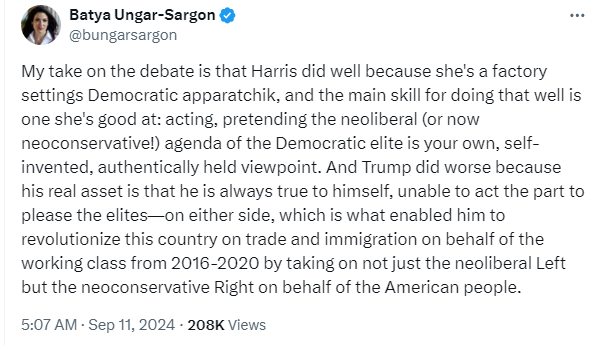
Over at the bad place, Batya Ungar-Sargon is mainlining copium to explain Donald Trump's debate performance.


Ah yes, that explains it. Donald Trump is just too pure authentic for this world. His raw untamable independent streak just couldn't be corralled to please "the elites" ("on either side"!). Harris gets "if anything, she was too prepared" version 2.0. It's amazing how hard one has to work to avoid the Occam's Razor explanation* that Trump sounded like a madman because he is one; that Trump's inability to articulate a concept of a plan for America beyond crude xenophobic nativism is because he lacks one.

Batya's descent into utter madness brain worms territory (which has been ongoing for years, including being a key player making Newsweek the house journal for the alt-right and antisemitic White supremacists and parroting the crudest Putinist propaganda about how funding of "Zelensky's War" is why Americans don't have manufacturing jobs) legitimately frightens me, because I don't know what zombie bit her and so I don't know how to ensure it doesn't bite me too. My main inference right now is "don't become opinion editor for a Jewish media outlet", because it was her experience at the Forward that seemed to drive her into the arms of madness, but I'm terrified that if exposed to the wrong trauma I too might go from being a reasonably intelligent and thoughtful commentator to a true believer in every fever swamp inanity imaginable.

I'm not really exposed to Batya these days, since she's not on BlueSky. There's a line on BlueSky that it's an echo chamber, and that's something I worry about too -- isn't it important that I be exposed to more views like Batya's, to ensure that I'm not cocooning myself in an epistemic bubble? The problem, though, is that while when I expose myself to the Batyas of the world I may pat myself on the back for being a good, virtuous epistemic citizen willing to challenge myself with views-not-my-own, in reality exposing myself to the likes of Batya feels less challenging than it is confirmatory. Reading her takes only makes me feel incredibly relieved that I don't have her takes. She is anti-persuasive. 

If the point of reading diverse views is to have that "huh, I never thought of it that way" moment, reading these people makes me go "huh, turns out that the caricatured mental model I have of brain-rotted right-wingers isn't a caricature at all." They're saying exactly what I expect them to say; there are no surprises. I'm unconvinced that confirming that instinct is actually healthier, even along the axis of remaining open-minded to divergent opinions.

* Of course, this circle also struggles mightily to understand what an "Occam's Razor" explanation is.

UPDATE: Matt Taibbi got bit as well.

UPDATE 2x: The Taibbi piece, in particular, reminded me of an exchange I had with an old high school buddy of mine who sadly has also gone off the deep end. He posted a collage of various media outlets all reporting on the travails of Twitter/X under Elon Musk -- that it had cratered in value and become a haven for bigots and extremists. He decided that the fact that similar reporting was appearing across many different media outlets could only mean one thing: a conspiracy by the legacy media to collude in order to slander Elon Musk's reputation. I sarcastically wondered if he saw a similar conspiracy in the fact that every atlas will tell you the capital of Norway is Oslo, or every science textbook will inform you that the Earth rotates around the Sun. 

He said "I bet you think you're so smart." I assured him that I never dreamed that my observation required any intelligence whatsoever.

Thursday, September 05, 2024

The Ethic of Responsibility and Working on Antisemitism


A few days ago, I wrapped up work with several Nexus-affiliated colleagues on a white paper seeking to provide guidance to college administrators about how various Israel-related buzzwords (think "apartheid", "settler-colonialism", "anti-Zionism") do and do not intersect with antisemitism. It was a group effort, and while I was a contributor, I was not the lead author. But my name will be on the finished product.

The paper is good. It is not perfect. Now, typically when people write that, they're damning with faint praise. I'm being literal. It is the work of a committee, and that means it is inherently going to be imperfect by the lights of any individual member. As in any group project, there are choices I would have made that were not acceded to be others; no doubt there were choices I made that other group members would not have incorporated had they had their lights.

In many ways, though, a project like this is out of character for me -- and it has given me newfound respect for anyone who engages in institutional political work (legislators, bureaucrats, etc.).

I've written before about how I'm an "institutionalist non-joiner" -- that is, I believe deeply in established institutions, but I also have little interest in directly participating in them. The reason for my reluctance stems from a strong desire to be in control of my own message, paired with the knowledge that any large institution will necessarily not perfectly reflect my own sentiments. It's the same reason why I rarely sign petitions -- unless I wrote the petition, it probably isn't going to say precisely what I want to say. And I don't like being a position where my name is on something that I wasn't wholly in control of. What do you do when someone say "well what about X clause", and you're like "well, I don't agree with X, but the totality was good enough"? My general answer is to avoid the problem -- I have a job and a life where I'm privileged to mostly be able to speak entirely in my own voice, and that's great.

Which makes this Nexus project, honestly, somewhat unnerving -- more so because it cuts to the heart of my own expertise. When this white paper is released, any critic can seize upon any portion of it they find suspect and say "Oh ho! How do you defend endorsing this!" And it will read as a limp reply to say "well, I didn't necessarily like that part" or "I would have phrased it differently." My name is on the document; it is natural to hold me responsible for what I signed onto. And so some part of my public reputation on my main area of scholarly specialization falls partially out of my control. Outside critics, not bound by the strictures of operating within a group, can snipe from the high ground.

Why did I agree to participate in drafting this document anyway? Well, I thought the issue was important, and I thought my contribution would make the resulting product better. I could have let others write the paper and then upon completion write a solo "here's what it should have said" rejoinder -- preserving my own unblemished voice at the expense of allowing a worse product to go through. But for whatever reason (and against all of my natural instincts), I decided to make the trade: I would participate in the collective endeavor to improve the document, and in exchange I would sacrifice some of my ability to control my own message.

The aforementioned inherent imperfection of group work applies to any political document -- and the more people involved and the higher the stakes are, the worse the problem gets. Our white paper involved less than a dozen people and has no tangible import other than whatever suasive authority we can muster. If one imagines a piece of legislation voted on by hundreds, or an administrative rule crafted by staff across countless government agencies, the problem multiplies. That work is simultaneously far more important than what I do, and also necessarily far more the product of innumerable compromises. For them, too, the realities of getting collective support and sign-off undoubtedly result in edits and alterations that they'd struggle to defend "on the merits". For them, too, the outside critic has a huge advantage in pot-shotting the most vulnerable elements and asking "how could you"?

But if there is to be political change, people have to be willing to take that fall. The extreme version of this is the government official in the Trump administration who knew the administration was evil, who knew that history would view them as a collaborator, but genuinely felt that if they stepped out they'd be replaced by someone who would do yet worse. But my thesis is that this core problem is not extreme at all, it is in fact ordinary and ubiquitous. Legislators have to be willing to vote for bills they know are imperfect, agency experts have to sign off on regulations they know are compromised. This is why Max Weber says that a pure "Ethic of Conviction" is incompatible with actual governance. Every academic who spends time in government leaves a record which a critic can peck away at as incompatible with their professed convictions, and they'll be right -- but not because the academic is a hypocrite. It is because political action is an inherently compromised endeavor, that needs to occur anyway.

For the most part, I don't have the stomach for it -- hence why this Nexus project is really an exception for me. But having gotten a tiny taste, I have more respect for those that are willing to engage, in good-faith, in the compromised and imperfect practice of governance -- knowing that at every point along the way they'll be forced to take hits to their reputation that in many ways they will not be able to truly defend.

UPDATE: The document in question is out

Sunday, September 01, 2024

Blame To Share


Just the other day, I was rejoicing at the news that one of the hostages -- Qaid Farhan Al-Qaid -- had been redeemed from Hamas captivity.

Today, I mourned the news that at least six more hostages, including Israeli-American Hersh Goldberg-Polin, were found dead -- reportedly executed by Hamas moments before their rescue.

First and foremost, responsibility for these deaths falls on the heads of those who kidnapped and murdered them. Hamas has agency, and this is how it has chosen to exercise it.

But past that, there is plenty of blame to share.

Blame falls in part on Bibi Netanyahu and his blood-soaked government, who have displayed reckless disregard for the lives of Israeli hostages in order to prolong their ruinous bombardment of Gaza and potentially stave off their political reckoning for a little while longer.

Blame falls in part on those who've cheer-led a never-ending Israeli assault on Gaza, taking the mantra of "Bring Them Home" -- in Israel, a plea to concentrate on securing the well-being of the hostages -- and converting it into a chant for a war of indefinite duration with no plan of exit.

Blame falls in part on those who pronounced themselves "exhilarated" by the "great victory" of October 7 and have made clear their desire to see it happen again, and again, and again, at every chance and opportunity, regardless of the costs it exacts on Israeli and Palestinian innocents alike.

There's blame enough to go around, and one would be tempted to say that those who share the blame deserve one another.

But more often than not, it is not they who reap the consequences of their reckless bloodlust. It is innocents, countless innocents, Israeli and Palestinian alike, of whom Goldberg-Polin is only the most recent.

May his, and their, memory be a blessing.

Tuesday, August 27, 2024

Does the NYT Know What a "Progressive" Is?


The NYT reports on the integration of Tulsi Gabbard and RFK Jr. into the Trump campaign. This is news, though it's essentially news that "conservative cranks support the supreme conservative crank." But instead, the NYT frames it this way:

Donald J. Trump plans to name his former rival, Robert F. Kennedy Jr., and Tulsi Gabbard, a onetime Democrat, as honorary co-chairs of a presidential transition team that will help him select the policies and personnel of any second Trump administration, according to a campaign senior adviser.

Mr. Kennedy ended his independent campaign for president and endorsed Mr. Trump on Friday. Both he and Ms. Gabbard spent most of their public life as progressive Democrats, and Mr. Kennedy had started his presidential run as a Democrat, before renouncing his party and running as an independent instead. Ms. Gabbard left the Democratic Party after her 2020 presidential run and has rebranded herself as a celebrity among Trump’s base of support.

Excuse me?

Until recently, RFK Jr. was known for two things (aside from his name). First, water-related environmental causes; second, being an anti-vaxx nut. The former I'll agree is a progressive issue. The latter ... well, I guess there was a time when anti-vaxxers were partially associated with the crunchy granola left (you know, before it stopped being funny and started being a Serious Issue of Principle We All Must Respect). But this isn't exactly the profile of a progressive champion.

Yet Gabbard is even worse -- she's been widely recognized as a conservative for years! Anti-choice, anti-gay marriage, a friend of dictators and authoritarians the world over ... what, exactly, is supposed to be her "progressive" rep? The answer is that there continues to be a small number of "progressives" (and, I guess, NYT writers) who are absurdly easy to dupe by anyone who makes some vague "anti-establishment" (especially "anti-war") rumblings. But aside from that, nobody actually ever thought that Tulsi Gabbard was any kind of progressive -- she has always been in a class of her own.

And the thing is -- Democratic voters have made this conclusion very obvious, by emphatically rejecting both Gabbard and RFK Jr. every time they tried to hop onto the national stage. Their defeats were not situations where the "progressive" faction of the party happened to get outvoted by more moderate or establishment cadres (compare, say, Bernie Sanders). RFK and Gabbard both failed to get any discernable support from any substantial wing of the Democratic electorate -- left, right, or center. Progressive Democrats didn't see either as progressive choices, they saw them for what they were -- conspiratorial right-wing cranks. And now they've found their natural home alongside Trump. No news there.

The Shut It Down Strategy at the University of Michigan


This is a really interesting article about goings-on at the University of Michigan, where a "Shut It Down" party won effective control of the campus student government in elections last spring (they have the presidency and vice presidency, and 22 of 45 student council seats). They ran on a platform of refusing to distribute student activity money unless and until the university administration acts on their demands for divestment. The funds not being dispersed include everything from subsidies for the airport shuttle to money for the Ballroom Dance team to rent rehearsal space. As many of the effected groups have noted, these consequences tend to fall on the most vulnerable and marginal students (who are dependent on subsidies and support to access the full panoply of campus offerings).

As far as "protests" go, it's hard to argue that this one is out-of-bounds. The students who ran on the shut it down platform made no secret about what they planned to do, and they were able to convince enough of their peers to vote for them (I don't know if 20% turnout is low or not for a student government election, where turnout often is thin even by America's comparatively low bar). "Democracy," as the saying goes, "is the theory that the people know what they want and deserve to get it, good and hard." We know well that political movements predicated on anti-"establishment" backlash and throwing sand in the gears of the "system" can generate genuine appeal -- at least temporarily -- and so too here. Whether that enthusiasm is sustainable once the machine actually starts sputtering to a halt is another question.

Practically speaking, the most obvious strategic analogue for what the students are doing is the recent choices of House Republicans, who have also regularly threatened to shut down government unless their political rivals cede to their demands. It is not clear, to say the least, that this strategy has worked out for the GOP -- either materially or politically -- and there are some reasons to think it will be even less successful in this context.

For one, House Republicans had the "advantage" of genuinely not caring about all the suffering their chaos play was going to cause. That sociopathic lack of empathy may or may not characterize the student political leadership at Michigan; it is quite plausible to me that they will feel more pressure to back down if and when the consequences of their defunding start to actually land on their fellow students. And I should be clear that when I say this sort of strategy isn't "out-of-bounds", I mean that it doesn't break any formal rules. Obviously, one can still criticize it for how it hurts vulnerable student in order to (perhaps not even effectively!) make a predominantly symbolic statement about a war occurring thousands of miles away.

For two, I don't see where the actual leverage over the university administration comes from. The tangible pain the Shut It Down caucus is proliferating falls almost entirely on the heads of students -- it doesn't (arguably in contrast to some of the protest activities) make the administration's life significantly more difficult. Faced with student frustration over, say, airport shuttles that have doubled in price, they can pretty easily lean back and say "we hear you, and the student council can release those funds any time it wants." Fairly or not, the comparative lack of democratic accountability for the administration compared to the student council means that any student frustration will probably be channeled towards the student council, since they're the ones who can be most easily ousted and they're the ones who are most obviously holding up distribution of the funds.

Indeed, the article suggests that there's already been some kind of side deal where the central campus will fund the frozen student activities, with the promise that the student government will pay them back later. On the one hand, this insulates the Shut It Down caucus from the consequences of their demands, perhaps making their protest more sustainable over the long-term. On the other hand, it also obviates the theoretical leverage they're trying to exploit (i.e., immiserating the campus), returning the "protest" to the level of the near-totally symbolic (for what it's worth, the Shut It Down leaders appear to be opposed to this deal -- they do not want the pain to be symbolic).

So on the whole, I'm skeptical that this strategy will work, and I think there is a solid chance -- particularly if the funding freezes actually are allowed to play out -- that there will be a substantial backlash against the Shut It Down caucus whenever the next elections are. But as "protests" go, this one is clearly one that is playing inside the rules of the game. In contrast to "shout downs" or violent disruptions or indefinite occupations of campus buildings, there is absolutely no question that students are permitted to run for and win elections in their student government and then decide to freeze their own budgets. I'm very interested to see how this plays out.

Wednesday, August 21, 2024

The Joy of Being a Democrat


One of the things I'm enjoying most about the Harris/Walz campaign, and the current Democratic mood more broadly, is how joyful it is. A common critique of progressives has always been that we're joyless, and while that attack has never been entirely fair, it doesn't come wholly from nowhere either. There's a generalized version of the old Futurama joke ("I'm sorry, but if it's fun in any way, it's not environmentalism!") -- if you're not trudging along in grimdark misery, then you don't understand the stakes/don't care about the oppressed/aren't a true believer in the revolution. It's exhausting to live out, and it isn't a lifestyle anyone really wants to join.

But that isn't us right now! It's the right that is wallowing in its own self-induced machine of rage and fear and misery. The Olympics were a great example -- conservatives spent their time searching for their calipers and reliving their frustration that Simone Biles didn't snap her neck in 2021; meanwhile liberals just enjoyed watching some of the greatest athletes on Earth do incredible things under the American banner. Who would you rather be? 

And this divide is present all over the 2024 race. The complete inability of conservatives to make anything stick on Tim Walz stems from their complete bafflement that a basic cishet white guy can just be happy in 2024. Doesn't he know that trans-CRT-illegal-abortionists are coming for his daughter?!? The RNC was a miserable slog of one apparatchik after another warning us that we're all going to die unless the God-king Trump is restored; the DNC was a dance party featuring your favorite tunes from middle school. Hell, one of the primary attack lines Republicans have been trying against Kamala Harris is her laugh! Democrats now are literally the party of laughing (and football, and Bud Light)!

It's really nice. And for what it's worth, I do understand the stakes, and I do understand that many people are hurting, and I do understand there's a lot of work to be done. But joy counts for something. And it feels really good to be part of a joyful Democratic coalition.

Saturday, August 10, 2024

Israel's Forever War


As the war between Israel and Hamas grinds on in Gaza, we've seen various moments where both Israel and Hamas have been deemed the barrier to a ceasefire. At the moment, the pendulum appears to be swinging Israel's way, as reports grow from multiple parties accusing Israel -- and Netanyahu in particular -- of sabotaging peace talks.

Ultimately, Israel's problem is this: once the war ends, it's put up or shut up about the day after plan. And Bibi's conundrum is that he doesn't have a plan for the day after that would result in an equilibrium anyone either in Palestine or in the international community would accept, and he knows it. This is why we get bombastic but vague bleatings about "total victory". Even assuming, for sake of argument, that it would be possible to completely destroy Hamas -- what then? An independent Palestinian state? We know the answer for Bibi is no. Some sort of inferior dependency status? That's a non-starter. Occupation forever? That's just another way of saying the war continues.

But those are the choices, and ending the war means making a choice that Israel -- or at least, this government of Israel -- simply does not want to make.  Whenever one questions the possibility of destroying Hamas, one gets dismissive snorts about how we managed to destroy Nazism in Germany, and didn't stop until we achieved "total victory" there. But the end of World War II didn't coincide with ending Germany as a country -- it was always taken for granted that Germany would, within the confines of the new world order, remain a sovereign state (indeed, we dedicated unprecedented resources to rebuilding Germany post bellum in the form of the Marshall Plan -- a commitment that proponents of this analogy seem strangely uninterested in extending). If the Allies' approach towards the Axis powers was that they just never get to exercise sovereign powers again, but remain under perpetual occupation and subjugation ever-outward in time, that's not an end to the war at all -- that's maintaining the war indefinitely.

So long as the war continues, the legal, political, and diplomatic framework allows Israel considerably greater freedom of action vis-a-vis Palestine than would be available under any peacetime scenario. When you're at war, you can occupy, you can raid, you can detain, you can violate normal rules of sovereignty. That's what war is, and ending the war means either giving those opportunities up or explicitly endorsing the logic of conquest and/or apartheid. Remaining at war punts the decision down the road, remaining at war indefinitely punts the decision down the road indefinitely. This, I think, is a large part of what motivated the ICJ's decision regarding the unlawfulness of the occupation -- its conclusion being that the occupation had become a delaying mechanism, an attempt to retain the prerogatives of belligerency indefinitely. Bibi's interest in prolonging the war in Gaza now is a concentrated version of the choice Israel has made off-and-on since 1967: a forever war to avoid an undesirable peace.

This isn't to pretend that Palestinian factions have been eager partners for peace, stymied only by Israel's intransigence. But it is to say that Israel's interest in blocking Palestinian statehood is fundamentally incompatible with securing a lasting peace, because any durable peace cannot avoid the question of Palestinian independence. Bibi is probably more ideologically opposed to Palestinian statehood and equality than any modern Israel leader, so even if he didn't have a partisan interest in prolonging the war to delay his own electoral reckoning, it should not surprise anyone that his orientation towards the war in Gaza is to keep it going as long as possible. He simply cannot answer the questions posed by its end.

Friday, August 09, 2024

I Say This Book is Going To Burn -- First Here, Then in Hell


Utah is banning books (via). That, sadly, is barely even news anymore. But Utah's law has two unique properties to it. 

First, Utah's rule is that any book that is banned in at least three districts must also be banned statewide. Utah has over 600,000 students enrolled in its public schools, but its three smallest districts contain less than 700 children. So the entire state is at the mercy of its three most conservative districts, which may enroll a tiny percentage of the overall school-aged population.

Second, once a book is banned Utah wants to be very clear. It is not to be stored. It is not to be donated. It is not to be sold. It is not to be distributed. It is to be "disposed" of. There's no compromise where maybe the books can be given to people who would enjoy or appreciate them. No -- quoth one board member: "I don’t care if it’s shredded, burned, it has to be destroyed one way or another."

So a uniquely grotesque and censorial law, even by red state standards. I only appreciate that it lets me reference a great Parks & Rec episode.

8th Circuit Reaffirms Constitutionality of Bans on Felons Bearing Arms


The Eighth Circuit Court of Appeals has reaffirmed its earlier decision in United States v. Jackson, concluding that it is constitutional to prohibit felons from possessing firearms even if the felony they were convicted of was non-violent (the case was on remand following Rahimi). The court observed that there was ample evidence of historical precedent permitting disarmament of non-law abiding individuals even in absence of evidence they were "violent", as well as pointing to the Supreme Court's repeated insistence that its Heller/McDonald/Bruen line of cases repeatedly emphasized it was not disturbing longstanding prohibitions on felon disarmament laws.

It also reiterated a point it made in its initial ruling: that while it may be the case that prohibiting gun ownership by non-violent offenders would fail the more traditional "means/ends" scrutiny that prevailed pre-Bruen (and in most other areas of constitutional law), Bruen flatly forecloses such "policy" analysis. Bruen does not care about a law's fairness any more than it cares about your due process rights.

Tuesday, August 06, 2024

May I Have This Walz?


Minnesota Governor Tim Walz has been selected as Kamala Harris' running mate.

I thought all of the major names floating for VP would have been fine picks. But now that Walz has gotten the official nod, I can say that I'm really enthusiastic about him joining the ticket. 

What do I like about him? To begin, he's got the support of the base while not doesn't seeming to have any particular clique or bloc of voters with a beef against him. In terms of immediate reaction and instinctual enthusiasm, he's all upside. He's already proven himself an effective messenger against Trump and Vance, which is really a VP candidate's number one job. His presentation is a best-of-all-worlds: moderate affect, but progressive results. What's not to like?

As a member of congress representing a swing district, he had a relatively moderate voting record. But his moderation never took the form of hippie-punching for its own sake. In contrast to a Sinema or Manchin type, he wasn't randomly looking to sabotage progressive priorities just so he could grandstand about how he's constraining the left. He just wasn't interested in putting on a show of being a bold maverick bucking the party.

That approach really has come through in his tenure as Minnesota Governor, where he's delivered a long list of progressive priorities that have made Minnesota a model for other states to follow. Some people were surprised at Walz's leadership, again taking cues from his moderate reputation. But Walz's progressivism is really a lot like his moderation -- it wasn't part of some big performance about taking on The Democratic Establishment or being leftier-than-thou, it was just the honest, grinding work of making progress when you can. And it turns out that when you have that orientation, you really can accomplish a lot that makes a lot of people's lives better.

In short, Walz is a pragmatist in the best possible sense: someone who concentrates on getting things done. And I've realized that I lot of what I like about Walz is what I like about Joe Biden. Sure, there's the folksy demeanor and the "moderate" reputation, and the underlying warmth and human decency. But fundamentally, Walz seems like someone who is in politics to actually make things happen -- not to talk about them, not to ride the talk show circuit and get a big book contract, and not to impotently fulminate about how the system makes any real change impossible. And when he's put in a position to make positive change, he's taken it. Just as Joe Biden surprised a lot of people with the muscularity of his domestic agenda (coming from a "moderate"), so too did Tim Walz as Governor of Minnesota. In both cases, the surprise was a product of mistaking an affect and a pragmatic orientation for antipathy to progressivism. And in both cases, the results speak for themselves. I have absolutely zero qualms about carrying that tradition forward.

So I'm delighted to have this Walz on the Democratic ticket. To victory in November!

Monday, August 05, 2024

Things People Blame the Jews For, Volume LXX: Democracy Protests in Venezuela


To my knowledge, Venezuela has not yet featured in my "Things People Blame the Jews For" series. This, alas, is not for lack of antisemitism. But if this series was going to be comprehensive, I wouldn't be able to hold down a day job.

Anyway, Venezuela recently had an election, and there are two competing slates of results. The independently-reviewed data suggests that incumbent Nicolas Maduro lost in a landslide. The "official" results, by contrast, have Maduro winning by a 52% to 43% margin. The discrepancy is in large part due to the "official" results conspicuously refusing to release the actual precinct-tallies, with a variety of dog-ate-my-homework style excuses.

Unsurprisingly, Maduro's apparent attempt to steal the election is resulting in widespread protest and unrest. Equally unsurprising is where Maduro lays the blame for the protests

At a press conference on Saturday, Maduro blamed what he termed the “extremist right” for the unrest that has swept the country. He accused these groups of being “supported by international Zionism.” He alleged that Jews were manipulating social networks, media outlets and even satellite technology in an attempt to “steal the presidential election” from his socialist government....

Classic.

I do want to compliment Maduro on one thing, however. I've occasionally written on the aesthetics of election-rigging -- if you're just going to make up election results, how do you decide what your margin of victory should be? Too close and you emphasize your tenuous grip on power. Too wide and things just look ridiculous. To my eyes, 52 to 43 is a pretty good choice -- it is a comfortable margin of victory, while still looking to the uninformed eye like the sort of result one might expect to see in a genuinely contested race. My congratulations to the Maduro regime for showing their authoritarian peers how it is done!

Who's Heard of Tim Walz's H. Res. 11 Vote? (Not You)


In December of 2016, the UN Security Council passed resolution number 2334, affirming the view that Israel's settlements in occupied Palestinian territories were unlawful. The United States abstained from voting -- the first and only abstention on an Israel-related vote during Barack Obama's entire tenure in office.

Shortly thereafter, Congress passed H. Res. 11, condemning this Security Council resolution. In doing so, the resolution specifically denounced "politically motivated acts of boycott, divestment from, and sanctions against Israel" and expressed opposition to the resolution's insistence on distinguishing "between the territory of the State of Israel and the territories occupied since 1967."

The vote tally on H. Res. 11 was 342-80. Among those voting in favor was Tim Walz, then the Democratic representative from Minnesota's first congressional district.

I do not reveal this detail to undermine Walz's case for joining the Democratic presidential ticket. I like Tim Walz. I liked him as a congressman, and I certainly liked him better than the antisemite who succeeded him representing my in-laws' home congressional district. And I've liked him even more as Governor. As far as I'm concerned, he'd make an excellent addition to the ticket.

Moreover, while this vote was not great, I don't think it suggests that Walz is some uniquely bad figure on matters of Israel/Palestine. Certainly, if one framed it the right way and possessed the right priors one could easily make the case: He openly attacked BDS! He was opposing even condemning Israeli settlements! He can't even claim the defense of "well, everyone was doing it back then" -- Walz was to the right of the Obama administration on this, and seventy-six Democrats voted against the resolution he supported! If one was looking to attack Walz on matters of Israel/Palestine, H. Res. 11 offers a very viable angle of attack. If one's primary concern regarding Harris' VP pick is avoiding Democratic politicians with a history of hostility towards either BDS or a record of unblinking support for Israel, then H. Res. 11 generates a very valid reason for concern.

But as far as I know, nobody has taken this angle. In fact, as best I can tell, nobody has even raised Walz's H. Res. 11 vote before I wrote this blog post. This is despite the fact that, as we know, questions about Israel policy have been front and center in why many have rallied aggressively against Josh Shapiro as a potential VP pick.

So here's the question that does motivate this post: how do you think it came to be that we learned about Josh Shapiro's collegiate op-ed columns written as a 20 year old before we started considering Tim Walz's actual voting record?

The position I took last week on Shapiro as VP nominee remains the position I'll take this week: I think Shapiro would be fine as VP, and I don't think he should be picked. On the former side of the ledger, I don't think his positions on Israel are substantially different from those of other potential members of the Democratic ticket (Harris included) -- the differences that exist are matters of degree, not kind (see also: Mark Kelly supporting police breaking up pro-Palestine protests). In that post, I argued that 

the congealing anti-Shapiro backlash smacks of a very predictable and unlovely hyperpolicing of Jews-qua-Jews on Israel, whose every jot and tittle on the matter will be pored over with exacting and unforgiving scrutiny in a manner that just isn't imposed upon non-Jews. Non-Jews can have unacceptable positions on Israel, but only Jews become unacceptable for things like "her book has an Israeli in it." Shapiro is getting heightened scrutiny here not because his positions on Israel are significantly different from those of Kelly or Beshear or Cooper, but because he's a very visibly Jewish politician and so is presumed to need greater scrutiny.

The fact that Shapiro is having his college views scrutinized while nobody even bothered to look at what Tim Walz actually voted for as a congressman I think pretty emphatically proves the point. Noting that Shapiro really has done X Y and Z potentially problematic things vis-a-vis Israel cannot explain why one didn't even think to look at Walz at all.

My point is not, to be clear, that Walz is actually "worse" than Shapiro on Israel/Palestine. It's not even that they're identical. While I don't think it is clear-cut, I have zero problem with someone who is highly motivated by pro-Palestine/anti-Israel sentiment looking at Walz's H. Res. 11 vote, and the remainder of his record in Congress and as Governor, comparing it to that of Shapiro, and say "on net, I think Walz is comparatively better on the issue, and so I prefer him to Shapiro."

But the difference in affect we're seeing directed towards Walz (and all the other plausible Democratic contenders) versus Shapiro, centered around Israel, is not one of "I think so-and-so is comparatively better." What differences exist between Shapiro and Walz cannot bear the weight of justifying being ecstatic about Walz, or even just thinking of Walz as adequate, and viewing Shapiro as cataclysmically unacceptable. If what Shapiro's done on Israel while in office is outright unacceptable, then it's hard to argue that Walz's objecitvely similar record is hunky-dory. They might be different, but they're not that different, and the only reason they're viewed as that different is because of an instinctual suspicion of Shapiro that is largely based on his identity. And I'm further saying that the reason why people immediately fixated on digging into the deepest recesses of Shapiro's Israel record while being completely uninterested in learning the first thing about Walz's is because Shapiro is vocally and publicly Jewish, and so became a target.

Does any of this change my opinion on whether Shapiro should be selected as VP? No. Why not? Because even if it is the case that some of the attacks Shapiro has faced are unfair, vice presidential selection is not about "fair". It's about maximizing one's chances to win, and fairly or not Shapiro seems to be a problem for some important swaths of voters. Harris also doesn't seem to be considering any women for her running mate, presumably because it is thought that having two women on a ticket will turn off certain voters. Is that "fair"? No, any voter who thinks that way is indulging in rank misogyny. And yet, it would be facile to suggest that Harris should pick a woman just to vindicate that these voters are wrong. They are wrong, but the purpose of a vice presidential candidate is not to even justifiably say to certain influential voting blocs "you're wrong."

But we shouldn't delude ourselves as to what's happening here. Everybody reading this has seen a slew of commentary analyzing Josh Shapiro's Israel record from top to bottom. Nobody reading this had seen a droplet of ink spilled on Tim Walz's H. Res. 11 vote. Likewise, it is quite clear that what is an unforgivable heresy for Shapiro will be easily (and quite literally) overlooked when it comes to Walz. That difference is not random. It manifests for exactly the reason you'd expect it to.

Friday, August 02, 2024

Announcing You're Going to Discriminate + Discriminating = Liability for Discrimination


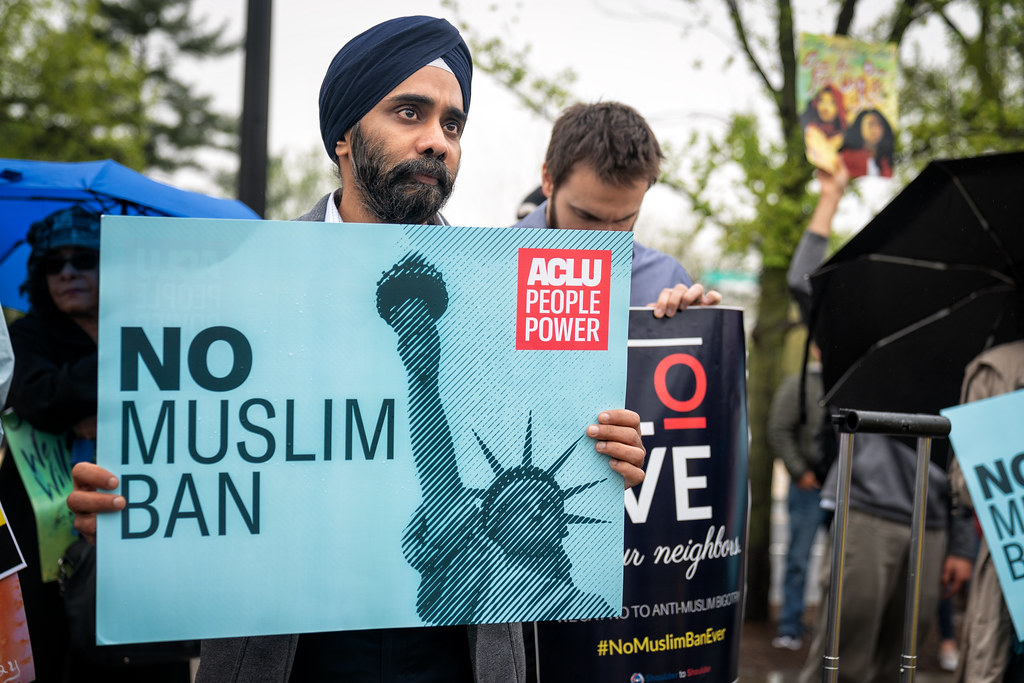
When the Trump administration's Muslim ban was moving through the courts, there was the weird debate people were having about whether it was fair to use Donald Trump's explicit statements announcing a discriminatory motive for the ban as evidence that the ban was discriminatory. The debate was weird because in any other circumstance the answer is obvious -- of course it's evidence. It's close to dispositive evidence. That's how anti-discrimination law works.

For example, this past week the Eleventh Circuit decided the case of McCarthy v. City of Cordele. Here are the relevant facts:
Joshua Deriso campaigned for election as chairman of the City Commission of Cordele, Georgia, by publicly stating his intent to “replace Caucasian employees with African Americans”; to lead “an entirely African American” City Commission; and to replace Roland McCarthy, the white City Manager, with a black City Manager. On social media, Deriso declared, “Structure needs to change . . . More Blacks!!!”; “The new City Manager should be Black”; and “it is time for African Americans to run our city.” Deriso won the election. The same day he and fellow commissioners took their oaths of office, the Commission voted on racial lines to fire McCarthy and to replace him with a black City Manager.

"The question," the court continued, "is whether those allegations permit the inference that the City Commission fired McCarthy because he is white." They quite reasonably answered "yes". When you publicly campaign on "I am going to racially discriminate", and then you do exactly what you promised to do, it's entirely reasonable to conclude that what you've done is engage in racial discrimination. And that inference is valid notwithstanding the fact that under normal circumstances the city council has wide discretion in hiring or terminating its city manager. This is not hard.

There's no pay off here other than to reemphasize the lawless anomaly that was Trump v. Hawaii. The pass it gave to blatant, undisguised discrimination is completely at odds with the doctrine both before and after the case. Judges fully understand how senseless Trump's rule is in other cases (especially, one must observe, in cases of "reverse discrimination"). Indeed, while Trump v. Hawaii was under consideration I observed that in any remotely analogous circumstance involving "Smallsville, Anystate" the case is an absolute dunker as a clear and obvious legal violation. It is only Donald Trump who received and continues to receive these ridiculous one-offs as the Supreme Court's special favorite.