Buzzfeed has an interesting piece up on the 4chan/ex-MAGA/reddit trolls who have been flocking to Andrew Yang's presidential campaign. Of course, being 4chan/MAGA/reddit trolls, they're also engaging in vicious harassment of a Yang staffer they've come to dislike.
But that's not what I want to talk about. Buzzfeed reports that Yang has gotten enthusiastic backing from some luminaries of the White supremacist right -- folks like Richard Spencer or the Daily Stormer. Despite, you know, clearly not being White.
And he's not the only one. Tulsi Gabbard already picked up an endorsement from none other than David Duke, who also infamously praised Ilhan Omar for supposedly being willing to tackle the "Israel lobby". Several far-right figures have reported being inspired by Ben Shapiro. The self-described "Imam of Peace" Mohammad Tawhidi garners endorsements from notorious Islamophobes like Tommy Robinson and Paul Joseph Watson. In his "Skin in the Game" article, Eric Ward recounted how he -- a Black man -- was able to be accepted in far-right White nationalist circles based on a presumed anti-Jewish alliance. And it cuts both ways: last year Arun Gupta had a fascinating article on young men of color outright joining far-right, White supremacist organizations.
I'm not saying in any of these cases that the White supremacist praise was invited by its recipients. There's no reason to think Yang or Gabbard or Omar or Shapiro are anything other than repelled by the prospect of being "endorsed" by White supremacists (Tawhidi is actually a potential exception). And often what one White supremacist hand giveth, another taketh away: the Yang story, after all, is about this same quadrant of "support" turning on his campaign with a misogynist vengeance. Omar is regularly targeted with death threats from the far-right, and Shapiro is the most harassed Jewish journalist online by some measures. So I'm also not saying that any of these figures are simply and without qualification beneficiaries of White supremacist grace.
But that's not the point. The point is that this sort of affinity -- in any form -- wasn't supposed to be even possible. White supremacists aren't supposed to be enthusiastic about non-White public figures. That's kind of their whole shtick. So what do we make of this seemingly bizarre phenomenon: multicultural White supremacy?
I am not the first to come up with that term -- as best I can tell, it was coined by Dylan Rodriguez at the cusp of the Obama presidency. But we are using it slightly differently. Rodriguez is speaking of how, in his view, the standard liberal multicultural political arrangement -- exemplified by someone like Obama -- nonetheless can uphold a broader structure of White supremacy. My focus, by contrast, is on "traditional" White supremacists who nonetheless come to praise and work with non-White public figures.
So what gives?
One answer is that it's all a form of trolling -- a way of leveraging their own toxicity against groups who they otherwise hate (think Richard Spencer calling his ideology "White Zionism"). There might be something to that -- I think something like that probably was in play when Duke "praised" Omar, for example -- but I don't think it's the whole story. The outright endorsement of Gabbard goes well beyond what can be explained by mere "trolling", for example. Likewise the favor with which many on the far-right hold Shapiro.
Another answer is that it falsifies the idea that the figures in question are truly "White supremacist". Literally: how could they be White Supremacist if they're praising those whom are deemed non-White! Under this view, the fact that these supposed "White supremacists" sometimes praise and endorse non-Whites is a great big gotcha to the liberals tarring everyone they disagree with as bigots and cheapening the term "White supremacist" beyond recognition (hello, Laura Ingraham!). The problem here is that a good chunk of the figures I'm talking about describe themselves as "White supremacists" or use synonymous terms that are quite clear that they think specifically racial advocacy on behalf of Whites is an important part of their politics. If the Daily Stormer isn't "White supremacist", then nothing is.
My take is that this is best understood as a further disintegration of a Platonic Ideal of "White supremacy" which no longer (if it ever did) exists. The vision of the White supremacist as someone who simply, blindly, and uncritically hates all members of the racial outgroups, for no other reason than that they are members of that outgroup, is collapsing. In its place is someone who certainly sees inter-group conflict as central to their ideology, and views certain despised outgroups as avatars of that which they loathe in contemporary politics or society. But it's overlaid onto more complex set of political commitments (which could be anything, but often centers around a sort of paleo-conservative vision of isolationism and insularity), and so there's always the possibility that some individual member of the group will have (or be perceived as having) an aligned ideology. Such persons will be accepted as (literally) "exceptional" -- they may even be trotted out as proof that the supposedly blind haters are actually discerning and "meritocratic".
In reality, they prove the opposite: they demonstrate that occasional acceptance of certain "exceptional" outgroup members who meet highly specified criteria is perfectly compatible with even "traditional" White supremacy (let alone more subtle or ambivalent forms of racial inequity). If, as Bernard Williams reminded us, even the Nazis "pa[id], in very poor coin, the homage of irrationality to reason," this is the contemporary version of that. The Nazi anthropologists were speaking a particular language of an era that sought to warrant their hatred based on prevailing ideologies of the time. Today, the relevant ideologies have changed and thus so does the attempted payment.
There's something faintly inspiring about this -- that today even the most inveterate White supremacists nonetheless must concede some possibility of connection to or alliance with those they supposedly hate. Nonetheless, it hardly dissipates the danger. An antisemite who likes Ben Shapiro is still an antisemite. An Islamophobe who likes Mohammad Tawhidi is still an Islamophobe. A racist who likes Andrew Yang or Tulsi Gabbard is still a racist. It might be a little weird that White Supremacy could go multicultural. But such is the era we live in.
Friday, May 31, 2019


They Can't Be Trying, Because We Tried, and We're Amazing
There's a new women's organization out there -- Supermajority -- that's trying to succeed where the Women's March fragmented. And Linda Sarsour has some thoughts on them:
Which isn't to say Sarsour doesn't feel good about her impact with the Women's March:
The Washington Post just did a piece on the fractured friendship of Cory Booker and Shmuley Boteach and ... Boteach actually strikes me as a decent parallel to Sarsour. Boteach is a mediocrity who had his moment but now is seen mostly as a "he's still here?" sort of figure. He'll probably keep on getting media coverage because he has a natural knack for drawing attention to himself, but his time is past, and everyone knows it. And so too, I suspect, with Sarsour. She'll always have a cadre of folks who think she's the cat's meow, and her sheer status as a lightning rod will ensure that she can always get some amount of attention to herself (Sarsour exists in symbiotic relationship with her most inveterate haters, who also are marginal figures in the Jewish community that know the fastest way to get prime column placement if her name is in the title). But more and more, I think she'll be seen as of the past.
Who knows whether Supermajority will go anywhere. But I think Sarsour's star has faded, and she's going to be increasingly irrelevant from here on out. Just like Shmuley.
Is it just me, or does this come off as almost unbelievably petty?Sarsour says the Women’s March tried to be a space for all women, to be intersectional, but that “this never worked before” because when issues arose outside of gender equality, like racism or immigration, it made people uneasy.“If another group wants to attempt it,” said Sarsour, “that must mean that they don’t want to have the hard conversations, because when we had the hard conversations, it was really uncomfortable and difficult for people.”
Which isn't to say Sarsour doesn't feel good about her impact with the Women's March:
The formation of the Women’s March, said Sarsour, is a “very simple story.” After Donald Trump won the 2016 election, “white women started a Facebook page, and they called it the Million Women’s March.”
“These women started this Facebook page, but in order for this Facebook page to be translated into tangible, actual organizing, into actual marches, it required women of color leadership,” said Sarsour. “That’s when me, Carmen [Perez] and Tamika [Mallory] were called to come to the Women’s March. We were the only organizers, like actual seasoned organizers. Everyone else was a fashion entrepreneur. They worked in tech. They were yoga teachers. We had a woman who was a chef. Everyone had a different profession, and we were the ones that came in with the organizing background.”
The first Women’s March was a day after Trump’s inauguration. Sarsour and her co-chairs set out an agenda to harness the energy of the millions of women who took to the streets and turn it into political power. They, along with local, grassroots chapters, organized events to get women into office and voters to the polls.
“We watched the impact of activism of people who’ve never once went to a march, never called their member of Congress, all of a sudden engaging in activism at a level that we hadn’t seen in at least the last 20 years,” recounted Sarsour. “And then seeing in 2018 us winning back the House, putting over 110 women in Congress. I’m not saying that’s all Women’s March, but absolutely the Women’s March set the foundation for all of these things to happen.”You know, I've long been content with my view on Sarsour, which is that while she doesn't deserve the frankly insane amount of attention and vitriol she receives from the American Jewish community, she's also just ... not that impressive. She's a decent rabble-rouser, but really more of a glory-hound -- everything is her her her. Thank goodness those fashion designers and yoga teachers had her to lead them! But there's not a lot going on past that.
The Washington Post just did a piece on the fractured friendship of Cory Booker and Shmuley Boteach and ... Boteach actually strikes me as a decent parallel to Sarsour. Boteach is a mediocrity who had his moment but now is seen mostly as a "he's still here?" sort of figure. He'll probably keep on getting media coverage because he has a natural knack for drawing attention to himself, but his time is past, and everyone knows it. And so too, I suspect, with Sarsour. She'll always have a cadre of folks who think she's the cat's meow, and her sheer status as a lightning rod will ensure that she can always get some amount of attention to herself (Sarsour exists in symbiotic relationship with her most inveterate haters, who also are marginal figures in the Jewish community that know the fastest way to get prime column placement if her name is in the title). But more and more, I think she'll be seen as of the past.
Who knows whether Supermajority will go anywhere. But I think Sarsour's star has faded, and she's going to be increasingly irrelevant from here on out. Just like Shmuley.
Thursday, May 30, 2019
More Fun With Anti-Discrimination Rules!
Some Jewish women were kicked out of an Uber after their Palestinian driver found out they were coming from an Israel Independence Day celebration. Uber has since terminated the driver and insisted they don't tolerate "any form of discrimination."
I doubt this will become anyone's cause celebre. That's mostly because taxis (or their replacements) are an arena where norms about serving as a common carrier -- which include broad non-discrimination requirements, far beyond what we think of normally by "non-discrimination" -- are at their strongest. There are excellent reasons why we have pretty sweeping requirements on airlines, taxis, buses, and so on that they can't pick and choose the customers they serve.
But one can certainly imagine how the case for the driver would go. The "speech" argument is already pretty familiar -- after all, he didn't object to "Jews", he objected to "people leaving an Israel Independence day celebration", which is not the same thing. Resurrect some gilded-age 19th century principles about free labor -- where the cab driver and the customer are just free contractors, both responsible for their own affairs and capable of entering into or cancelling a relationship at will -- and suddenly it sounds downright illiberal to "force" the Uber driver to transport customers when his conscience demands otherwise.
And remember: we have a judiciary that is probably more sympathetic to that outlook than at any point in the last century or so. These arguments are not as outlandish as one might think. The "New Lochnerism" already uses free speech as a wedge against huge swaths of the regulatory structure. And much of contemporary labor law -- discrimination or otherwise -- in particular involves not viewing employment as simply the atomistic interaction of free contractors who are at equal liberty to do or not do as they please. Pull that thread, and more might unravel than one intends.
I doubt this will become anyone's cause celebre. That's mostly because taxis (or their replacements) are an arena where norms about serving as a common carrier -- which include broad non-discrimination requirements, far beyond what we think of normally by "non-discrimination" -- are at their strongest. There are excellent reasons why we have pretty sweeping requirements on airlines, taxis, buses, and so on that they can't pick and choose the customers they serve.
But one can certainly imagine how the case for the driver would go. The "speech" argument is already pretty familiar -- after all, he didn't object to "Jews", he objected to "people leaving an Israel Independence day celebration", which is not the same thing. Resurrect some gilded-age 19th century principles about free labor -- where the cab driver and the customer are just free contractors, both responsible for their own affairs and capable of entering into or cancelling a relationship at will -- and suddenly it sounds downright illiberal to "force" the Uber driver to transport customers when his conscience demands otherwise.
And remember: we have a judiciary that is probably more sympathetic to that outlook than at any point in the last century or so. These arguments are not as outlandish as one might think. The "New Lochnerism" already uses free speech as a wedge against huge swaths of the regulatory structure. And much of contemporary labor law -- discrimination or otherwise -- in particular involves not viewing employment as simply the atomistic interaction of free contractors who are at equal liberty to do or not do as they please. Pull that thread, and more might unravel than one intends.
Wednesday, May 29, 2019
Strange Flag-Bearers (and Burners) in Dayton
One thing that happened at the anti-KKK counterprotest in Dayton was that an Israeli flag was ripped to shreads and stomped on (after an unsuccessful attempt to burn it). How did this happen? Well, it's a weird story:
All at a rally that nominally was counterprotesting the KKK, which in turn was in large part targeting Dayton's Jewish community. Who then had to see a burning Israeli flag by people supposedly there to "protect" them; instigated by a person who (it seems falsely?) claimed to be Israeli in order to tar actual Israelis with his own racist performance. How lovely.
In an interview with The Observer, [Jen] Mendoza [of the Cincinnati Palestine Solidarity Coalition] said the incident occurred after she saw three young men with an Israeli flag and entered into what she described as a confusing discussion with them.
“And so recognizing the state of Israel as being of the same ideology (as) American capitalist imperialist settler colonialism, and seeing that flag on our side (counterprotesters area) was jolting,” Mendoza said of her reaction at the sight of the Israeli flag.
“One of them said that he was from Israel. And then the other two boys looked Arab,” she added. “The other kid, he was the one doing a lot of the talking, he made comments about God giving them the land, and at that point I was like, ‘Well, you’re on the wrong side of this fence if that’s what you believe.’”
Mendoza said that after the conversation went on and he said “some extremely Zionist, racist things,” he asked her if he should throw it on the ground and stomp on it.
She told him she’d be happy to burn it for him.
“And then he flipped and was like, ‘Yeah, let’s burn this flag right now,’” Mendoza added, “and he helped tear it apart — and then he told us that he was doing a social experiment to find out where people really stood on fascism. And then he began chanting ‘Free Palestine.’”So basically, somebody comes to an anti-KKK flag rally holding an Israeli flag and starts making racist comments wrapped in a Zionist guise. But wait: it turns out, he doesn't actually believe what he's saying -- he's impersonating an Israeli, enacting a stereotype designed to present Israelis as racist (though it's actually his words), in an effort to rile the crowd up and convince them to burn or mutilate the Israeli flag. Which the crowd then happily obliges. It's like a meat-world version of the Jewish impersonators Yair Rosenberg used to bust: "racists who pretend to be Jews—and other minorities—in order to defame them."
All at a rally that nominally was counterprotesting the KKK, which in turn was in large part targeting Dayton's Jewish community. Who then had to see a burning Israeli flag by people supposedly there to "protect" them; instigated by a person who (it seems falsely?) claimed to be Israeli in order to tar actual Israelis with his own racist performance. How lovely.
"Oh, We'd Fill It"
Of course, it surprises precisely zero people that Mitch McConnell has absolutely no problem confirming a Supreme Court nominee in an election year if the nominee is a Republican.
The only slightly interesting thing about him coming out and saying so is that he's willing to openly say so even before knowing if the situation would come up, which really hammers home just how little respect he has for even the pretense of principle. There's no tactical advantage to admitting this now, which makes it feel like he's almost playing a game to amuse himself. He's showing off how brazen and shameless he can be, knowing that not only can no one do anything to stop it, but that if push ever does comes to shove the media still almost certainly will credulously report whatever "principled" distinction GOP flacks come up with to explain why this is different from Garland, even though McConnell openly admitted there's nothing more complicated here than "because we can."
The only slightly interesting thing about him coming out and saying so is that he's willing to openly say so even before knowing if the situation would come up, which really hammers home just how little respect he has for even the pretense of principle. There's no tactical advantage to admitting this now, which makes it feel like he's almost playing a game to amuse himself. He's showing off how brazen and shameless he can be, knowing that not only can no one do anything to stop it, but that if push ever does comes to shove the media still almost certainly will credulously report whatever "principled" distinction GOP flacks come up with to explain why this is different from Garland, even though McConnell openly admitted there's nothing more complicated here than "because we can."
Tuesday, May 28, 2019
Quote of the Day: Shklar Translating Montesquieu on the Cruelty of the Spainards
Judith Shklar is my great-grand advisor (that is, she was the Ph.D advisor of the Ph.D advisor of my Ph.D advisor). I just picked up a copy of her book Ordinary Vices, and am reading its opening chapter on cruelty. Referring to the abject cruelties the Spainards imposed upon the indigenous population of the "New World", she writes (quoting Montesquieu):
It has become a refrain of progressives commenting on the Trump era that "the cruelty is the point" -- especially towards migrants being kept in inhumane conditions along the border or immigrants who've been quietly living in America for years terrorized by immigration enforcement. The contention that this behavior is "un-Christian", as a searing critique of the hypocrisy of the Christian right, is a common one, albeit one whose merits I'm ill-equipped to judge.
But it strikes me that the dehumanizing rhetoric towards immigrants that emanates so regularly from the right -- or perhaps, more "generously", the failure of the right to take seriously the full human robustness of immigrants as the sorts of persons who can experience fear, panic, and terror that is a regular accompaniment to the immigration regime they endorse -- is necessary precisely because of what would be implied by the reckoning. For if they are acknowledged as human, a suspicion might arise that those who endorse such terrible terrors upon them are not Christian. Or -- from my distinctly non-Christian vantage -- that they remain Christians, but that this is what Christianity is, or can be.
Once the Spainards had begun their cruelties, it became especially important to say that "it is impossible to suppose these creatures [the indigenous population] to be men, because allowing them to be men a suspicion might arise that we were not Christian."Judith Shklar, Ordinary Vices (Harvard Belknap Press, 1984), 12. She's translating Montesquieu's De l'Espirit des lois (The Spirit of the Laws), but it's her own translation.
It has become a refrain of progressives commenting on the Trump era that "the cruelty is the point" -- especially towards migrants being kept in inhumane conditions along the border or immigrants who've been quietly living in America for years terrorized by immigration enforcement. The contention that this behavior is "un-Christian", as a searing critique of the hypocrisy of the Christian right, is a common one, albeit one whose merits I'm ill-equipped to judge.
But it strikes me that the dehumanizing rhetoric towards immigrants that emanates so regularly from the right -- or perhaps, more "generously", the failure of the right to take seriously the full human robustness of immigrants as the sorts of persons who can experience fear, panic, and terror that is a regular accompaniment to the immigration regime they endorse -- is necessary precisely because of what would be implied by the reckoning. For if they are acknowledged as human, a suspicion might arise that those who endorse such terrible terrors upon them are not Christian. Or -- from my distinctly non-Christian vantage -- that they remain Christians, but that this is what Christianity is, or can be.
On Conservative "Support" for Intersectionality
Vox has an interesting profile interview by Jane Coaston with law professor Kimberlé Crenshaw, best known as the originator of the term "intersectionality", on the contemporary uses and misuses of her progeny. One of the most fascinating portions of it is when Coaston starts interviewing conservatives who have, over the past few years, treated intersectionality as their primary intellectual bogeyman. To a man, there response was basically identical: "intersectionality", as conceptualized by Crenshaw, is "relatively unobjectionable" (Ben Shapiro); even "indisputable" (David French).
What they say is that Crenshaw's ideas, themselves, as articulated in the late 1980s and early 90s, are unproblematic. Clearly, Black women experience forms of discrimination that differ in kind from those faced by White women or Black men. Who could argue? What's problematic is how intersectionality (is perceived to have been) extended in contemporary college debates, where it does allegedly stand in for some sort of inversion of hierarchy where White men are at the bottom of the pack.
This is something I've started to hear more and more frequently. In Gabriel Noah Brahm's essay on "Intersectionality" (in the infamous Israel Studies "Word Crimes" symposium), for example, Crenshaw's original 1989 essay is called a "modest, precise, and useful intervention in American jurisprudence." But things go quickly off the rails: "Over the last several years, it has become the watchword, shibboleth, and passkey to belonging on the "woke" left, among the "politically correct" who arrogate to themselves the duty of thought-policing the rest of us." Brahm contends that among intersectionality-skeptics, "A consensus that cuts across the liberal-conservative divide has emerged ... to the effect that the term's expanded uses as a metaphysical totem have outrun its otherwise valid, more limited definition." (the "liberal-conservative" is generous: Brahm lists nine critics he has in mind, of whom at most two -- Cary Nelson and, when he's in the right mood, Hen Mazzig -- can be described as "liberal").
Yet, like most conservative critics of intersectionality, Brahm's description of its contemporary effects is a self-contained system, remarkably insulated from the words or ideas of actual contemporary intersectionalists. Indeed, once he gets past the portion of the paper talking about Crenshaw's original essays, Brahm effectively ceases to cite any work on intersectionality by any self-described intersectional theorist.
Once or twice, an essay will be cited seemingly at random as offering "a representative piece of intersectional feminism", despite not meeting the seemingly minimum threshold of ever saying the words "intersectional" or "intersectionality" (this is especially hilarious given Brahm's insistence on the power of intersectionality the word as a "watchword, shibboleth, and passkey". Some passkey -- it needn't even be used to open the doors!). But for the most part, contemporary intersectionality is understood almost exclusively in terms of what it is stipulated to mean by popular conservative critics in outlets like Commentary and The Daily Caller. As we know, they hate it, even though they concede that the primary texts aren't actually problematic at all. In other words, conservatives are fine with what intersectionalists describe as intersectionality, but loathe what conservatives call intersectionality. So maybe the problem lies in the conservative descriptions?
And that raises the question: what do we make of the conservative contention that they are actually willing to endorse the "original", supposedly unproblematic intersectional claims? The basic form of the question is whether they think -- in harmony with Crenshaw's original argument -- that discrimination against "Black women", specifically, should be recognized as an independent basis for Title VII liability beyond "race" or "sex" discrimination. I've seen little evidence that they do back any legal or statutory reforms to provide clarity here, but perhaps I'm wrong.
More broadly, the question is whether conservatives object to research programs which seek to uncover the specified and particular modes of discrimination faced by, e.g., Black women, or other permutations of several marginalized identities. After all, to quote French, it's just "commonsense ... that different categories of people have different kinds of experience."
Yet in practice, I'm guessing the answer is no. The closest Brahm gets to citing a contemporary articulation of intersectionality by a backer rather than a critic is in the National Women's Studies Association declaration of what "Women's Studies" is:
So what we're really seeing is the classic historical pivot of contemporary conservatism: hating some feature of progressive discourse right up until it becomes too mainstream to effectively challenge, at which point critics say that the term they've just spent years assailing used to be valuable and important but only now has turned astray. The National Review did it with "civil rights", David French did it with "white privilege", and now they're all doing it with "intersectionality". It's bad scholarship and bad history, all wrapped together in a neat little bow.
What they say is that Crenshaw's ideas, themselves, as articulated in the late 1980s and early 90s, are unproblematic. Clearly, Black women experience forms of discrimination that differ in kind from those faced by White women or Black men. Who could argue? What's problematic is how intersectionality (is perceived to have been) extended in contemporary college debates, where it does allegedly stand in for some sort of inversion of hierarchy where White men are at the bottom of the pack.
This is something I've started to hear more and more frequently. In Gabriel Noah Brahm's essay on "Intersectionality" (in the infamous Israel Studies "Word Crimes" symposium), for example, Crenshaw's original 1989 essay is called a "modest, precise, and useful intervention in American jurisprudence." But things go quickly off the rails: "Over the last several years, it has become the watchword, shibboleth, and passkey to belonging on the "woke" left, among the "politically correct" who arrogate to themselves the duty of thought-policing the rest of us." Brahm contends that among intersectionality-skeptics, "A consensus that cuts across the liberal-conservative divide has emerged ... to the effect that the term's expanded uses as a metaphysical totem have outrun its otherwise valid, more limited definition." (the "liberal-conservative" is generous: Brahm lists nine critics he has in mind, of whom at most two -- Cary Nelson and, when he's in the right mood, Hen Mazzig -- can be described as "liberal").
Yet, like most conservative critics of intersectionality, Brahm's description of its contemporary effects is a self-contained system, remarkably insulated from the words or ideas of actual contemporary intersectionalists. Indeed, once he gets past the portion of the paper talking about Crenshaw's original essays, Brahm effectively ceases to cite any work on intersectionality by any self-described intersectional theorist.
Once or twice, an essay will be cited seemingly at random as offering "a representative piece of intersectional feminism", despite not meeting the seemingly minimum threshold of ever saying the words "intersectional" or "intersectionality" (this is especially hilarious given Brahm's insistence on the power of intersectionality the word as a "watchword, shibboleth, and passkey". Some passkey -- it needn't even be used to open the doors!). But for the most part, contemporary intersectionality is understood almost exclusively in terms of what it is stipulated to mean by popular conservative critics in outlets like Commentary and The Daily Caller. As we know, they hate it, even though they concede that the primary texts aren't actually problematic at all. In other words, conservatives are fine with what intersectionalists describe as intersectionality, but loathe what conservatives call intersectionality. So maybe the problem lies in the conservative descriptions?
And that raises the question: what do we make of the conservative contention that they are actually willing to endorse the "original", supposedly unproblematic intersectional claims? The basic form of the question is whether they think -- in harmony with Crenshaw's original argument -- that discrimination against "Black women", specifically, should be recognized as an independent basis for Title VII liability beyond "race" or "sex" discrimination. I've seen little evidence that they do back any legal or statutory reforms to provide clarity here, but perhaps I'm wrong.
More broadly, the question is whether conservatives object to research programs which seek to uncover the specified and particular modes of discrimination faced by, e.g., Black women, or other permutations of several marginalized identities. After all, to quote French, it's just "commonsense ... that different categories of people have different kinds of experience."
Yet in practice, I'm guessing the answer is no. The closest Brahm gets to citing a contemporary articulation of intersectionality by a backer rather than a critic is in the National Women's Studies Association declaration of what "Women's Studies" is:
Women's studies has its roots in the student, civil rights, and women's movements of the 1960s and 70s. In its early years the field's teachers and scholars principally asked, "Where are the women?" Today that question may seem an overly simple one, but at the time few scholars considered gender as a lens of analysis, and women's voices had little representation on campus or in the curriculum. Today the field's interrogation of identity, power, and privilege go far beyond the category "woman." Drawing on the feminist scholarship of U.S. and Third World women of color, women's studies has made the conceptual claims and theoretical practices of intersectionality, which examines how categories of identity (e.g., sexuality, race, class, gender, age, ability, etc.) and structures of inequality are mutually constituted and must continually be understood in relationship to one another, and transnationalism, which focuses on cultures, structures and relationships that are formed as a result of the flows of people and resources across geopolitical borders, foundations of the discipline.This seems to be an articulation of intersectionality that is no more "problematic" than Crenshaw's original: "categories of identity" and "structures of inequality are mutually constituted and must continually be understood in relation to one another." A little more jargon-y, perhaps, but not something that strays far from Crenshaw's original formulations. Yet Brahm cites this as his proof-text for the claim that "the majority of radical academic feminists today, in theory and in practice, hold to some version of this sort of 'post-essentialist' understanding of what it means to study gender" and therefore(?) the contemporary feminist project is irredeemably fascist, antisemitic, and racist. (Don't shed too many tears: feminism "achieved its proper goal long ago, when women gained equal rights under the law in the developed world"; now " we can all contribute toward restoring sanity in the academic arena by rejecting" contemporary feminism's "shrill, hectoring discourse").
So what we're really seeing is the classic historical pivot of contemporary conservatism: hating some feature of progressive discourse right up until it becomes too mainstream to effectively challenge, at which point critics say that the term they've just spent years assailing used to be valuable and important but only now has turned astray. The National Review did it with "civil rights", David French did it with "white privilege", and now they're all doing it with "intersectionality". It's bad scholarship and bad history, all wrapped together in a neat little bow.
Monday, May 27, 2019
Young Jews Might Really Be a Touch(!) More Conservative
I crowed a bit at the recent poll showing Donald Trump has an abysmal 29/71 approval among Jews, and a bit more at the effort by GOP Jewish groups to present this as good news.
But dig a little deeper into the data and you do find something more interesting: younger Jews are at least a little less anti-Trump than our older compatriots. Millennial Jews (35 and younger) give Trump his best net favorability rating -- and that's after Orthodox Jews are excluded (the pollsters actually don't give the breakout with Orthodox Jews included, but eyeballing it their inclusion would probably see Trump's favorables among Millennials rise to the mid-to-high 30s).
Now "best" is pretty relative -- it's still a wretched 33/67. But it beats Gen Xers (30/70), Boomers (25/75), and Greatest/Silent Generation (22/78). (The very youngest Jews -- just those under 30 -- are slightly more anti-Trump than "Millennials" writ large. So maybe it's my cohort -- the 30-to-35 year olds -- who are the problem, though more likely that's just a statistical blip).
I don't know exactly what to make of this. The narrative, of course, is that the youth are liberal and the elders are less so. Then again, maybe it's not surprising that the generation that lived through the Holocaust and its immediate aftermath would be even more aggressively anti-Trump than today's comparatively coddled kids.
The big question, for me, is the degree to which these opinions cut with or against other demographic correlations. For example, one possible explanation for more ambivalence among younger Jews is bad experiences with extreme left-wing politics in college. Yet this would cut against normal demographic findings where college education correlates to greater anti-Trump sentiment. Now, I'd be extremely surprised if Jews with college education were more pro-Trump than those without -- that would be stunning if it were true. But it's possible that the liberalizing effect of college education on young Jews is weaker than it is on non-Jews of the same generation -- and that would still be quite revealing.
Basically, it'd be interesting (it's always interesting, but unfortunately also expensive) to chop the sample up into finer bits. How do Jewish opinions on Trump compare when you start controlling for variables like college education (Jews are disproportionately well-educated, which in turn correlates to liberalism); race (Jews are disproportionately White -- yes, for this purpose we are -- which correlates to conservatism); wealth, urban residence, etc.? Such inquiries can overturn some considerable established wisdom (one recent study, for example, found that controlling for relevant social positionality American Jews are less politically-engaged than comparable non-Jews)
Indeed, similar questions can be asked about whether the "youth", generally, are actually more liberal, or just more diverse (a greater proportion of young people are non-White, but are White Millennials any less conservative than White people generally? What happens if we start controlling for urban residence, education, etc.?).
Anyway, it's easy to read too much into this -- especially since, again, we're talking about the difference between "overwhelmingly anti-Trump" and "really overwhelmingly anti-Trump". But it does present at least a slight corrective to the narrative that young Jews today are actually a vanguard of leftism compared to the staid centrism of their elders.
But dig a little deeper into the data and you do find something more interesting: younger Jews are at least a little less anti-Trump than our older compatriots. Millennial Jews (35 and younger) give Trump his best net favorability rating -- and that's after Orthodox Jews are excluded (the pollsters actually don't give the breakout with Orthodox Jews included, but eyeballing it their inclusion would probably see Trump's favorables among Millennials rise to the mid-to-high 30s).
Now "best" is pretty relative -- it's still a wretched 33/67. But it beats Gen Xers (30/70), Boomers (25/75), and Greatest/Silent Generation (22/78). (The very youngest Jews -- just those under 30 -- are slightly more anti-Trump than "Millennials" writ large. So maybe it's my cohort -- the 30-to-35 year olds -- who are the problem, though more likely that's just a statistical blip).
I don't know exactly what to make of this. The narrative, of course, is that the youth are liberal and the elders are less so. Then again, maybe it's not surprising that the generation that lived through the Holocaust and its immediate aftermath would be even more aggressively anti-Trump than today's comparatively coddled kids.
The big question, for me, is the degree to which these opinions cut with or against other demographic correlations. For example, one possible explanation for more ambivalence among younger Jews is bad experiences with extreme left-wing politics in college. Yet this would cut against normal demographic findings where college education correlates to greater anti-Trump sentiment. Now, I'd be extremely surprised if Jews with college education were more pro-Trump than those without -- that would be stunning if it were true. But it's possible that the liberalizing effect of college education on young Jews is weaker than it is on non-Jews of the same generation -- and that would still be quite revealing.
Basically, it'd be interesting (it's always interesting, but unfortunately also expensive) to chop the sample up into finer bits. How do Jewish opinions on Trump compare when you start controlling for variables like college education (Jews are disproportionately well-educated, which in turn correlates to liberalism); race (Jews are disproportionately White -- yes, for this purpose we are -- which correlates to conservatism); wealth, urban residence, etc.? Such inquiries can overturn some considerable established wisdom (one recent study, for example, found that controlling for relevant social positionality American Jews are less politically-engaged than comparable non-Jews)
Indeed, similar questions can be asked about whether the "youth", generally, are actually more liberal, or just more diverse (a greater proportion of young people are non-White, but are White Millennials any less conservative than White people generally? What happens if we start controlling for urban residence, education, etc.?).
Anyway, it's easy to read too much into this -- especially since, again, we're talking about the difference between "overwhelmingly anti-Trump" and "really overwhelmingly anti-Trump". But it does present at least a slight corrective to the narrative that young Jews today are actually a vanguard of leftism compared to the staid centrism of their elders.
Saturday, May 25, 2019
Jewish Representation on Television: A Random Review
I've been thinking about Jewish representation on television series over the past few days. The trigger was actually an antisemite who was complaining that there are too many Jewish characters on television -- we apparently have taken over his TV. That struck me, because my naive view was that Jewishness actually doesn't get a lot of attention on TV series (even Seinfeld, if I recall correctly, rather famously did not actually say its characters were Jewish).
But I decided to actually think about it more, and look into how Jews are portrayed on the shows I watch. This is therefore not remotely scientific -- though I do watch a fair bit of TV -- and some obvious choices (Broad City!) thus aren't included. I'm most interested in shows that are not primarily about Jews, but nonetheless have Jewish characters whose Jewishness is fleshed out in a substantive way.
I include shows that have no Jewish characters. This is not necessarily a critique -- not every show has to include Jews -- but it is worth including to get a sense if there is any pattern to what sorts of shows have Jews and what don't. That said, I'm not necessarily a superfan of all these shows, so it's possible that I could miss something (though it hardly counts if deep in Season 6 a show briefly mentions so-and-so is Jewish, only to never bring it up again before or since).
* * *
30 Rock: On a show about New York City comedy writers, only Josh -- Josh! -- might be Jewish. This entire show is a case of "just say Jewish, this is taking forever!" C-
Big Bang Theory: Of the major characters, only Howard (and his mother) are Jewish. Neither are exactly positive representations -- Howard, in particular, manages to be the most perverted, awkward and creepy of a cadre of young male scientists whose whole shtick is that they're kind of perverted, awkward, and creepy around women. Interestingly, Bernadette is portrayed as super-goyish even though Melissa Rauch is actually Jewish (Mayim Bialik is more famously Jewish, but to my knowledge Amy Farrah-Fowler is not depicted as a tribe member). D-
Billions: At first I thought this show had no Jewish characters, a decision I chalked up to maybe wanting to step lightly around the whole "ruthless billionaires manipulating the financial system" thing. But then I remembered: Spyros is Jewish! Spyros! By far the worst character on the show along pretty much any metric you might consider, including that he's portrayed as a serial sexual predator. Literally every character is at least written in shades of grey, and we get Spyros. Ugh. D
Brooklyn Nine-Nine: Jake Peralta is Jewish. It pretty much only comes up when he has flashbacks to his Bar Mitzvah (curse you Jenny Gildenhorn!), but at least it is acknowledged as a part of his character with substance. That said, it almost never is visible in his adult life -- most strikingly, there's no portrayal of it being discussed with Amy in terms of how their family will or won't be Jewish. B-
Buffy the Vampire Slayer (and Angel): Willow is Jewish, but it gets almost no attention -- I think by the end of the series she's outright celebrating Christmas. C
The Chilling Adventures of Sabrina: No Jewish characters.
Community: Annie is Jewish, but it is almost entirely downplayed. Indeed, it basically never comes up outside the first season. Missed opportunity. C+
Crashing: This is a tough one to judge, since so many of the characters are playing themselves. I know Sarah Silverman is Jewish. I think Artie Lange is? I don't know if Ali Reissen is supposed to be Jewish, but the actress who plays her definitely is. I do know Pete Holmes is not Jewish. I can't give a rating here.
Dollhouse: No Jewish characters.
Elementary: No Jewish characters.
Firefly: No real Jewish characters, though they do briefly show a postmaster wearing a yarmulke. It's actually a really neat moment of casual Jewish inclusion that I really appreciate.
Fresh off the Boat: I don't think any of the regulars (including Eddie's friends) are Jewish, but Evan's arch-rival Phillip Goldstein is definitely Jewish -- and definitely portrayed as a massive asshole. C
Game of Thrones: No Jewish characters (outrageous!).
The Good Place: No Jewish characters (actual sad face here -- though I can see how incorporating actual religious faith into this show might be hard).
I Feel Bad: Probably not worth including -- it was canceled after one season, and I'm not sure it even fully aired the one -- except to give one last plug to my headcanon where it is Sarayu Blue's side of the family that is Jewish. Brian George -- who plays her father -- is Jewish! He should get to play a Jewish character some time. Alas, the show goes down the more predictable route of making Paul Adelstein's side of the family the Jewish one. It does a good job with that. I guess. Still salty. B
Insecure: I don't think any characters are Jewish. Frieda might be Jewish, which would be okay. Joanne also might be Jewish, which would be a less attractive proposition.
iZombie: No Jewish characters.
Mad Men: Rachel Mencken is great. She also stands pretty much alone. B+
Marvelous Mrs. Maisel: This is the only show that is explicitly Jewish in focus, and as I said that's not my main concern here. In any event, not everyone likes the portrayal of Jewishness, but I actually find it quite warm on the whole. A.
Marvel's Agents of S.H.I.E.L.D.: No Jewish characters.
Mozart in the Jungle: No Jewish characters (really?).
New Girl: Full disclosure: I did not watch this show all the way to the end. Anyway, Schmidt is one of the more famous Jewish portrayals of contemporary television. I'm not his greatest fan -- in particularly, that he's a proud Republican is, shall we say, statistically anomalous -- but once I started comparing him to the competition above he turns out pretty decent. Still, he, too -- especially in the early seasons -- doesn't exactly stand out on the "treats women with respect" metric. B
Parks and Rec: The main Jewish characters are the Saperstein twins -- John-Ralphio and Mona Lisa. They are each, in their own way, "the worst person in the world." And with John-Ralphio, we get yet another creepy Jewish harasser. D
The Orville: There are no Jews in space.
The West Wing: This show actually comes out great. Toby and Josh are Jewish, visibly so, yet in very distinctive ways. It comes up, though it isn't obsessed over, in ways that feel authentic to their character. And the pilot includes one of my favorite "Jewish" scenes in all of television. A+
* * *
In sum, I'd say that -- outside of shows where Judaism is a central focus (Marvelous Mrs. Maisel), there are a dearth of characters whose Jewishness is portrayed (a) positively and (b) as a substantive (not all-encompassing) presence in their lives. It seems that sci-fi and fantasy shows are the least likely to have Jewish characters, which is understandably, though it includes series set on Earth or otherwise "near-real world" conditions. This might reflect anxiety around how to portray Jews in juxtaposition with the occult and/or dystopian authoritarianism without reenacting antisemitic tropes.
On the positive side, The West Wing, in my view, stands head-and-shoulders above the crowd; other solid performers include Brooklyn Nine Nine, New Girl, and (for what it's worth) I Feel Bad. But these are exceptional, for the most part, the Jewishness of characters either isn't established much beyond its mere mention. And the main exception is when Jewish male characters are portrayed as perverts, creeps, or sexual harassers -- indeed, this might be the most common way of "marking" a character as Jewish, which is worrisome.
But I decided to actually think about it more, and look into how Jews are portrayed on the shows I watch. This is therefore not remotely scientific -- though I do watch a fair bit of TV -- and some obvious choices (Broad City!) thus aren't included. I'm most interested in shows that are not primarily about Jews, but nonetheless have Jewish characters whose Jewishness is fleshed out in a substantive way.
I include shows that have no Jewish characters. This is not necessarily a critique -- not every show has to include Jews -- but it is worth including to get a sense if there is any pattern to what sorts of shows have Jews and what don't. That said, I'm not necessarily a superfan of all these shows, so it's possible that I could miss something (though it hardly counts if deep in Season 6 a show briefly mentions so-and-so is Jewish, only to never bring it up again before or since).
* * *
30 Rock: On a show about New York City comedy writers, only Josh -- Josh! -- might be Jewish. This entire show is a case of "just say Jewish, this is taking forever!" C-
Big Bang Theory: Of the major characters, only Howard (and his mother) are Jewish. Neither are exactly positive representations -- Howard, in particular, manages to be the most perverted, awkward and creepy of a cadre of young male scientists whose whole shtick is that they're kind of perverted, awkward, and creepy around women. Interestingly, Bernadette is portrayed as super-goyish even though Melissa Rauch is actually Jewish (Mayim Bialik is more famously Jewish, but to my knowledge Amy Farrah-Fowler is not depicted as a tribe member). D-
Billions: At first I thought this show had no Jewish characters, a decision I chalked up to maybe wanting to step lightly around the whole "ruthless billionaires manipulating the financial system" thing. But then I remembered: Spyros is Jewish! Spyros! By far the worst character on the show along pretty much any metric you might consider, including that he's portrayed as a serial sexual predator. Literally every character is at least written in shades of grey, and we get Spyros. Ugh. D
Brooklyn Nine-Nine: Jake Peralta is Jewish. It pretty much only comes up when he has flashbacks to his Bar Mitzvah (curse you Jenny Gildenhorn!), but at least it is acknowledged as a part of his character with substance. That said, it almost never is visible in his adult life -- most strikingly, there's no portrayal of it being discussed with Amy in terms of how their family will or won't be Jewish. B-
Buffy the Vampire Slayer (and Angel): Willow is Jewish, but it gets almost no attention -- I think by the end of the series she's outright celebrating Christmas. C
The Chilling Adventures of Sabrina: No Jewish characters.
Community: Annie is Jewish, but it is almost entirely downplayed. Indeed, it basically never comes up outside the first season. Missed opportunity. C+
Crashing: This is a tough one to judge, since so many of the characters are playing themselves. I know Sarah Silverman is Jewish. I think Artie Lange is? I don't know if Ali Reissen is supposed to be Jewish, but the actress who plays her definitely is. I do know Pete Holmes is not Jewish. I can't give a rating here.
Dollhouse: No Jewish characters.
Elementary: No Jewish characters.
Firefly: No real Jewish characters, though they do briefly show a postmaster wearing a yarmulke. It's actually a really neat moment of casual Jewish inclusion that I really appreciate.
Fresh off the Boat: I don't think any of the regulars (including Eddie's friends) are Jewish, but Evan's arch-rival Phillip Goldstein is definitely Jewish -- and definitely portrayed as a massive asshole. C
Game of Thrones: No Jewish characters (outrageous!).
The Good Place: No Jewish characters (actual sad face here -- though I can see how incorporating actual religious faith into this show might be hard).
I Feel Bad: Probably not worth including -- it was canceled after one season, and I'm not sure it even fully aired the one -- except to give one last plug to my headcanon where it is Sarayu Blue's side of the family that is Jewish. Brian George -- who plays her father -- is Jewish! He should get to play a Jewish character some time. Alas, the show goes down the more predictable route of making Paul Adelstein's side of the family the Jewish one. It does a good job with that. I guess. Still salty. B
Insecure: I don't think any characters are Jewish. Frieda might be Jewish, which would be okay. Joanne also might be Jewish, which would be a less attractive proposition.
iZombie: No Jewish characters.
Mad Men: Rachel Mencken is great. She also stands pretty much alone. B+
Marvelous Mrs. Maisel: This is the only show that is explicitly Jewish in focus, and as I said that's not my main concern here. In any event, not everyone likes the portrayal of Jewishness, but I actually find it quite warm on the whole. A.
Marvel's Agents of S.H.I.E.L.D.: No Jewish characters.
Mozart in the Jungle: No Jewish characters (really?).
New Girl: Full disclosure: I did not watch this show all the way to the end. Anyway, Schmidt is one of the more famous Jewish portrayals of contemporary television. I'm not his greatest fan -- in particularly, that he's a proud Republican is, shall we say, statistically anomalous -- but once I started comparing him to the competition above he turns out pretty decent. Still, he, too -- especially in the early seasons -- doesn't exactly stand out on the "treats women with respect" metric. B
Parks and Rec: The main Jewish characters are the Saperstein twins -- John-Ralphio and Mona Lisa. They are each, in their own way, "the worst person in the world." And with John-Ralphio, we get yet another creepy Jewish harasser. D
The Orville: There are no Jews in space.
The West Wing: This show actually comes out great. Toby and Josh are Jewish, visibly so, yet in very distinctive ways. It comes up, though it isn't obsessed over, in ways that feel authentic to their character. And the pilot includes one of my favorite "Jewish" scenes in all of television. A+
* * *
In sum, I'd say that -- outside of shows where Judaism is a central focus (Marvelous Mrs. Maisel), there are a dearth of characters whose Jewishness is portrayed (a) positively and (b) as a substantive (not all-encompassing) presence in their lives. It seems that sci-fi and fantasy shows are the least likely to have Jewish characters, which is understandably, though it includes series set on Earth or otherwise "near-real world" conditions. This might reflect anxiety around how to portray Jews in juxtaposition with the occult and/or dystopian authoritarianism without reenacting antisemitic tropes.
On the positive side, The West Wing, in my view, stands head-and-shoulders above the crowd; other solid performers include Brooklyn Nine Nine, New Girl, and (for what it's worth) I Feel Bad. But these are exceptional, for the most part, the Jewishness of characters either isn't established much beyond its mere mention. And the main exception is when Jewish male characters are portrayed as perverts, creeps, or sexual harassers -- indeed, this might be the most common way of "marking" a character as Jewish, which is worrisome.
Friday, May 24, 2019
A Bleg For Two Judicial Quotes
In my head, I remember two striking quotes from judicial opinions -- neither of which I can remember the source or even the precise verbiage of. In my mind, they're both from Judge Easterbook, though I can't confirm that.
The first goes something like this:
UPDATE: We got one! Bridenbaugh v. Freeman-Wilson (and yeah, it was a Judge Easterbrook opinion):
The first goes something like this:
"On appeal, [Party] raises four issues, three of which won't survive the end of this paragraph...."The second goes something like this:
"This case pits [Constitutional right], which is in the Constitution, against [other constitutional doctrine -- perhaps the Dormant Commerce Clause?], which is not."Any help? Did they come from Will Baude? Did Will Baude used to have a personal website with favorite quotes? Am I completely hallucinating?
UPDATE: We got one! Bridenbaugh v. Freeman-Wilson (and yeah, it was a Judge Easterbrook opinion):
This case pits the twenty-first amendment, which appears in the Constitution, against the "dormant commerce clause," which does not.
Thursday, May 23, 2019
Why is This Antisemitic?
This was discovered in a bathroom at San Francisco State University this week.
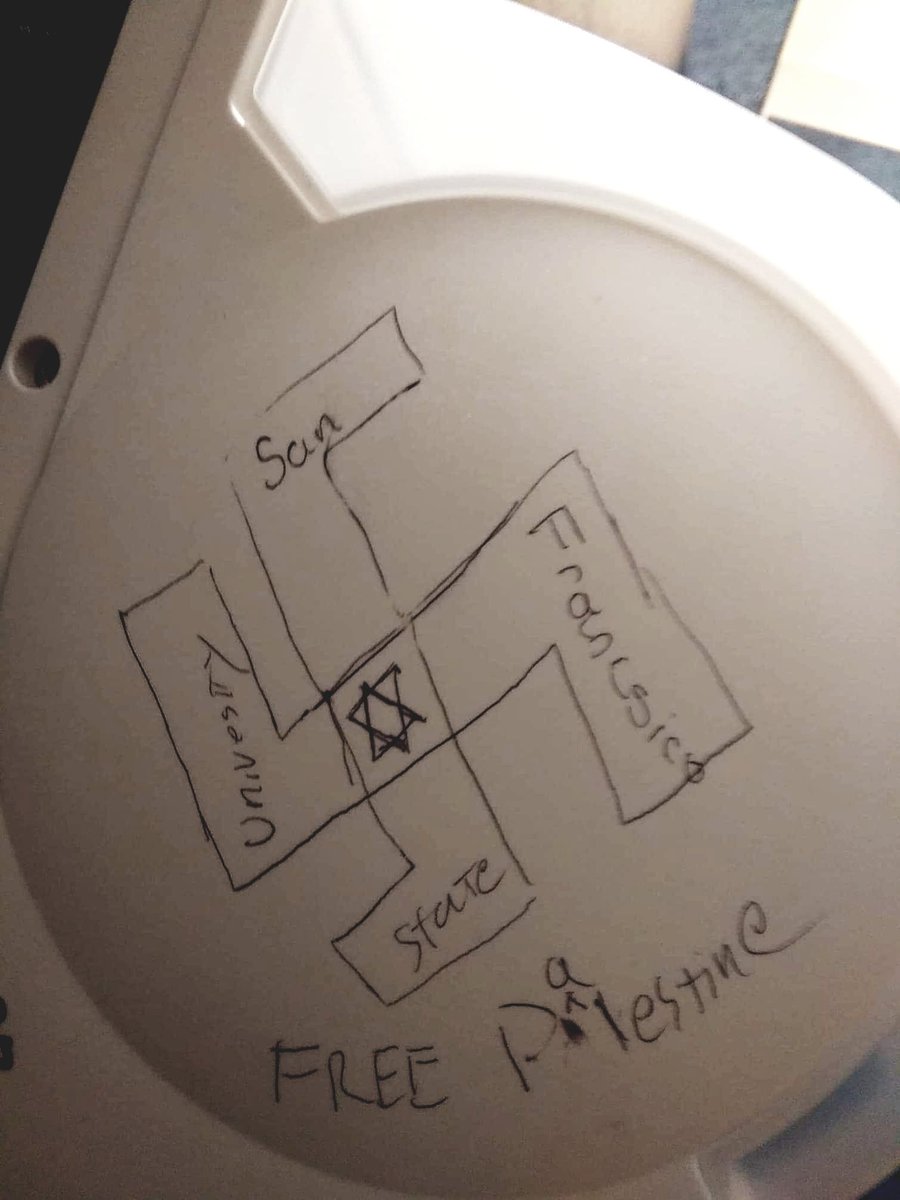
For those who can't see an image, it is a swastika labeled "San Francisco State University", with a Star of David in the middle. Below it, the author wrote "Free Palestine".
Most people have condemned this as antisemitic. I agree. But I want to actual go through the steps. In particular, I want to challenge some of the antisemitism skeptics -- the people who think too much is called antisemitic, particularly in the "criticism of Israel" subspecies -- why this is properly deemed antisemitic (or, perhaps, for them to forthrightly assert that it is not).
In doing so, I want to insist on keeping the focus on the graffiti being a case of antisemitism. Certainly, it is vandalism, and therefore is a crime regardless of whether it is specifically antisemitic or not. Likewise it might be described as rude, uncouth, overwrought, insensitive, or any number of other bad things that nonetheless are distinct from antisemitism. David Hirsh describes this pivot as "pleading guilty to the lesser charge" -- admitting that a challenged piece of conduct is wrong in some way while holding the line that it was not antisemitic. I fully accept that many people will agree that this graffiti was "wrong", in some way, but I want to concentrate on establishing it specifically as an antisemitic wrong.
We spend a lot of time insisting that "criticism of Israel is not necessarily antisemitic", which is true. We spend considerably less time establishing that criticism of Israel is not necessarily not antisemitic either. Yet both are important; and in particular, it is useful to test whether our proposed demarcation lines between what is antisemitic and what is not can capture cases such as this.
So, why is the above antisemitic? Here are some candidates:
For those who can't see an image, it is a swastika labeled "San Francisco State University", with a Star of David in the middle. Below it, the author wrote "Free Palestine".
Most people have condemned this as antisemitic. I agree. But I want to actual go through the steps. In particular, I want to challenge some of the antisemitism skeptics -- the people who think too much is called antisemitic, particularly in the "criticism of Israel" subspecies -- why this is properly deemed antisemitic (or, perhaps, for them to forthrightly assert that it is not).
In doing so, I want to insist on keeping the focus on the graffiti being a case of antisemitism. Certainly, it is vandalism, and therefore is a crime regardless of whether it is specifically antisemitic or not. Likewise it might be described as rude, uncouth, overwrought, insensitive, or any number of other bad things that nonetheless are distinct from antisemitism. David Hirsh describes this pivot as "pleading guilty to the lesser charge" -- admitting that a challenged piece of conduct is wrong in some way while holding the line that it was not antisemitic. I fully accept that many people will agree that this graffiti was "wrong", in some way, but I want to concentrate on establishing it specifically as an antisemitic wrong.
We spend a lot of time insisting that "criticism of Israel is not necessarily antisemitic", which is true. We spend considerably less time establishing that criticism of Israel is not necessarily not antisemitic either. Yet both are important; and in particular, it is useful to test whether our proposed demarcation lines between what is antisemitic and what is not can capture cases such as this.
So, why is the above antisemitic? Here are some candidates:
- The phrase "Free Palestine". But surely this can't suffice on its own, at least if the "pro-Palestine =/= antisemitic" formulation is to have any legs at all. The fact that the speaker claims to desire a "free Palestine" would not, on its own, establish antisemitism.
- The Star of David. This is perhaps the clearest hook that the target is Jews, not Israel -- but then, we know that some say it is being used not as a Jewish symbol but an Israeli symbol (this was the justification for expelling the Jewish marchers from the Chicago Dyke March -- their Rainbow flag with a Star of David was coded as "an Israeli flag superimposed on a rainbow flag"). One can certainly imagine the "artist" here making that case -- after all, by saying "Free Palestine" they at least implicitly cast their target as being Israel, specifically.
- The swastika. Again, we might think this suffices to establish the drawing as antisemitic. But note that the swastika could be symbolically representing two different things here. One possibility is that it is meant to evoke sympathy for Nazis (the artist saying, in effect, "I am a Nazi; I am making a Nazi point"). In that case, the antisemitism becomes pretty undeniable. But the other possibility is that the artist is intending to saying "Israel is a Nazi state, and Nazis are awful" (the artist is putatively making an "anti-Nazi" point, while associating Israelis or Zionists with the terrible Nazis). Is this formulation antisemitic? Note we just went through this, to some extent, with Eli Valley and the "kapos" controversy (and before that, with David Friedman) -- many people are very insistent that it is perfectly fair game, or at least not antisemitic, to compare Israelis or Zionist Jews to Nazis.
If we think that this scrawl was antisemitic, we implicitly reject at least some of these defenses. We have to commit to the position that using the Star of David to denote a group that you hate is antisemitic, or that comparing Israel to Nazism is antisemitic. And that, in turn, should constrain us come other cases. The fact is, if we think this was an antisemitic act, then we can't be so blithe in asserting that other perhaps more elegant acts whose alleged antisemitism rests on similar presuppositions (e.g., that Israel = Nazi comparisons are antisemitic) are mere "criticism of Israel". And, by contrast, if we want to hold the line and say that it is not antisemitic to compare Israel to Nazis, then we are far harder pressed to agree that even an act like this is an antisemitic act.
Wednesday, May 22, 2019
It's Just a Flesh Wound!
Donald Trump does not poll well among Jews.
His favorables are a miserable 29/71. His re-elect statistics against a generic Democratic opponent stand at 23/67. Jews overwhelmingly oppose him on virtually every policy: from abortion (40/60) to immigration (33/67) to healthcare (31/69) to the Iran Deal (36/64 -- take note, American Jewish leadership) to antisemitism (29/71 -- really take note, American Jewish leadership). Even his handling of US/Israel relations -- supposedly his strongest suit -- barely squeaks into positive territory (55/45).
Yet if you're the Republican Jewish Coalition, these figures are good news!
Oh, and Barack Obama? He stands at a cool 70% favorable, 23% unfavorable spread.
(Another fun bonus stat: Israeli Prime Minister Bibi Netanyahu inspires deep ambivalence, currently sporting a 45/38 favorability spread. That's worse than Bernie Sanders -- 51/43 -- and far worse than Joe Biden's 66/29. But he's still net positive, so hey, congrats on that).
His favorables are a miserable 29/71. His re-elect statistics against a generic Democratic opponent stand at 23/67. Jews overwhelmingly oppose him on virtually every policy: from abortion (40/60) to immigration (33/67) to healthcare (31/69) to the Iran Deal (36/64 -- take note, American Jewish leadership) to antisemitism (29/71 -- really take note, American Jewish leadership). Even his handling of US/Israel relations -- supposedly his strongest suit -- barely squeaks into positive territory (55/45).
Yet if you're the Republican Jewish Coalition, these figures are good news!
Higher than 23%! Can you feel the Jexodus yet?Matt Brooks, the Republican Jewish Coalition’s executive director, said the news was good for Trump.“The Jewish numbers for Trump are a floor and generic Dem numbers are a ceiling,” Brooks said on Twitter. “No one who now says they’re for Trump are going to change their minds. He will get a higher share of the Jewish vote than this.”
Oh, and Barack Obama? He stands at a cool 70% favorable, 23% unfavorable spread.
(Another fun bonus stat: Israeli Prime Minister Bibi Netanyahu inspires deep ambivalence, currently sporting a 45/38 favorability spread. That's worse than Bernie Sanders -- 51/43 -- and far worse than Joe Biden's 66/29. But he's still net positive, so hey, congrats on that).
Monday, May 20, 2019
What Did Eurovision Do To Israel?
This is a truly stellar analysis piece by Abigail Nussbaum on the impact Eurovision had on Israel and -- in particular -- the blow it struck against Netanyahu and his brand of politics.
One thing it does very well, which many analyses do not, is that it understands and recognizes Israel as a fully-fleshed out place -- with factions, institutions, power dynamics, and all the rest that are exactly as deep and complex as any other modern state and society. Israel is a "they", not an "it", and the blithe assumption that "if Eurovision succeeds, that's a win for Bibi" is naive to actual facts on the Israeli ground. To the contrary, Nussbaum does great work in establishing how Netanyahu and his allies have all but declared war on Israel's cultural institutions and sought to instead foster a hermit-nation, "us against the world" mentality that is disdainful (if not outright antipathic) to any sort of effort at global communal engagement. Eurovision does not ratify Bibi's view of Israel; it is a direct challenge to it.
In hosting Eurovision, the Israeli government had little choice but to give Israel's cultural institutions their due and resources (as much as Miri Regev might resent it). It featured a presenter descended from both Holocaust survivors and Palestinian refugees, delivering a greeting in Hebrew and Arabic; it featured the grand success of a public media corporation that Bibi had been desperately trying to kill, and yes, it even featured those little Israeli and Palestinian flags on the backs of Madonna's dancers.
Most importantly, in the context of a cooperative, international event, Eurovision also offered a daybreak, however brief, from the "everyone hates us and will always hate us" insistences of the Israeli political right. Against those forces counseling retreat and insularity in the face of an implacably hostile world, Eurovision showed the promise of continued cosmopolitan engagement. As Nussbaum puts it:
One thing it does very well, which many analyses do not, is that it understands and recognizes Israel as a fully-fleshed out place -- with factions, institutions, power dynamics, and all the rest that are exactly as deep and complex as any other modern state and society. Israel is a "they", not an "it", and the blithe assumption that "if Eurovision succeeds, that's a win for Bibi" is naive to actual facts on the Israeli ground. To the contrary, Nussbaum does great work in establishing how Netanyahu and his allies have all but declared war on Israel's cultural institutions and sought to instead foster a hermit-nation, "us against the world" mentality that is disdainful (if not outright antipathic) to any sort of effort at global communal engagement. Eurovision does not ratify Bibi's view of Israel; it is a direct challenge to it.
In hosting Eurovision, the Israeli government had little choice but to give Israel's cultural institutions their due and resources (as much as Miri Regev might resent it). It featured a presenter descended from both Holocaust survivors and Palestinian refugees, delivering a greeting in Hebrew and Arabic; it featured the grand success of a public media corporation that Bibi had been desperately trying to kill, and yes, it even featured those little Israeli and Palestinian flags on the backs of Madonna's dancers.
Most importantly, in the context of a cooperative, international event, Eurovision also offered a daybreak, however brief, from the "everyone hates us and will always hate us" insistences of the Israeli political right. Against those forces counseling retreat and insularity in the face of an implacably hostile world, Eurovision showed the promise of continued cosmopolitan engagement. As Nussbaum puts it:
[The success of Eurovision] proves that the horror stories we’ve been told about the hatred that awaits us in Europe are nonsense (not to mention cover for Netanyahu’s increasing coziness with actual Nazis, just because they share his authoritarian tendencies). These are messages that the Israeli public has desperately needed to hear, and maybe for some people, they got through.
Sunday, May 19, 2019
Game Over
*Warning: Spoilers for the Game of Thrones finale*
So Game of Thrones is finally over. While I'm certainly in the majority camp that the series seriously stumbled down the stretch, all in all it still was a fun ride. And -- taking into account the corner that the writers had painted themselves into -- I actually think the series finale was a pretty decent episode. Yet quibbles are more fun than compliments, so here are my final scattered thoughts:
* I didn't mind the Daenerys heel turn at the end, though I agree it didn't have quite enough run-up. But the group that really suffered, character-wise, was the Unsullied. If we now view Dany as a fanatical would-be tyrant who casually murdered innocents, what do we make of her most loyal footsoldiers who unquestioningly carried out the slaughter? There's a story that could have been told here that carries an arc from their freedom from slavery to their status as a murderer's shock troops, but we never got it because the Unsullied -- even Grey Worm, outside his love for Missandei -- were never developed beyond mere arms of Daenerys.
* But at least there was a vague gesture at trying to resolve the Unsullied's thread: they were offered the Reach, and ended up sailing to Naath (to do what?). The Dothraki didn't even get that much. And to be honest -- they're a much bigger threat than unhappy Unsullied. Unsullied are at least disciplined -- they wouldn't move unless someone ordered them to. Indeed, once the Queen was killed, you could almost see how they froze up -- not executing Jon or Tyrion in the days(?) it took for the Lords of the Realm to gather at King's Landing, and scarcely thinking to contemplate the argument that they had claim to be rulers of King's Landing now. But the Dothraki are a mounted band of marauders whose default setting is to rampage over the countryside pillaging everything in sight, in a land where much of the security infrastructure has been decimated. They're a recipe for chaos.
* That said, the main Dothraki question is clearly "Where did these alive Dothraki come from?"
* I'm not entirely sure why Arya wants to get on a boat and sail west. But I'm sad that Yara didn't appear to be joining her (yes, yes, objectively she should be running the Iron Islands. I still can be sad).
* Bran as King is ... okay, I guess. I think the main thrust of the choice is that he's more of a figurehead who will leave the day to day management to his advisers. It's part of the slow "democratization" process (poor Sam -- your actual democratization process got laughed out of the room).
* If the North secedes, Dorne obviously would secede too. There wasn't really any way to build that into the show and not sap Sansa's speech of all its drama, but it's still true.
* Littlefinger may be dead, but someone successfully lived out his "Chaos is a Ladder" motto. From sellsword to Lord of Highgarden and Master of Coin -- well done Bronn! (Though what would have happened at the Unsullied taken the offer to be ceded the Reach -- which includes Highgarden?)
So Game of Thrones is finally over. While I'm certainly in the majority camp that the series seriously stumbled down the stretch, all in all it still was a fun ride. And -- taking into account the corner that the writers had painted themselves into -- I actually think the series finale was a pretty decent episode. Yet quibbles are more fun than compliments, so here are my final scattered thoughts:
* I didn't mind the Daenerys heel turn at the end, though I agree it didn't have quite enough run-up. But the group that really suffered, character-wise, was the Unsullied. If we now view Dany as a fanatical would-be tyrant who casually murdered innocents, what do we make of her most loyal footsoldiers who unquestioningly carried out the slaughter? There's a story that could have been told here that carries an arc from their freedom from slavery to their status as a murderer's shock troops, but we never got it because the Unsullied -- even Grey Worm, outside his love for Missandei -- were never developed beyond mere arms of Daenerys.
* But at least there was a vague gesture at trying to resolve the Unsullied's thread: they were offered the Reach, and ended up sailing to Naath (to do what?). The Dothraki didn't even get that much. And to be honest -- they're a much bigger threat than unhappy Unsullied. Unsullied are at least disciplined -- they wouldn't move unless someone ordered them to. Indeed, once the Queen was killed, you could almost see how they froze up -- not executing Jon or Tyrion in the days(?) it took for the Lords of the Realm to gather at King's Landing, and scarcely thinking to contemplate the argument that they had claim to be rulers of King's Landing now. But the Dothraki are a mounted band of marauders whose default setting is to rampage over the countryside pillaging everything in sight, in a land where much of the security infrastructure has been decimated. They're a recipe for chaos.
* That said, the main Dothraki question is clearly "Where did these alive Dothraki come from?"
* I'm not entirely sure why Arya wants to get on a boat and sail west. But I'm sad that Yara didn't appear to be joining her (yes, yes, objectively she should be running the Iron Islands. I still can be sad).
* Bran as King is ... okay, I guess. I think the main thrust of the choice is that he's more of a figurehead who will leave the day to day management to his advisers. It's part of the slow "democratization" process (poor Sam -- your actual democratization process got laughed out of the room).
* If the North secedes, Dorne obviously would secede too. There wasn't really any way to build that into the show and not sap Sansa's speech of all its drama, but it's still true.
* Littlefinger may be dead, but someone successfully lived out his "Chaos is a Ladder" motto. From sellsword to Lord of Highgarden and Master of Coin -- well done Bronn! (Though what would have happened at the Unsullied taken the offer to be ceded the Reach -- which includes Highgarden?)
Friday, May 17, 2019
Who's Afraid of Valerie Plame's Antisemitism?
Two years ago, Valerie Plame -- previously best known as the CIA officer whose cover was blown by Bush administration officials in the run-up to the Iraq War -- got into a bit of trouble for sharing an article titled "America’s Jews Are Driving America’s Wars," published on the far-right White Supremacist website Unz Review.
Plame went through the usual cycle of "it's worth considering!" to "some of my best friends are Jewish!" to "I'm sorry -- but how could I have known an article titled 'America's Jews Are Driving America's Wars' might be antisemitic?" And then she disappeared again.
Now, she's reappeared, announcing a run for Congress in New Mexico's 3rd district. The New York Times did a 12-paragraph piece reporting on this reemergence -- and somehow "forgot" to mention the relatively recent antisemitism scandal she had been embroiled in.
As Yair Rosenberg points out, this is ridiculous and should be unacceptable. I'm actually more forgiving of the Times for not "contextualizing" Alice Walker's antisemitic book recommendation -- it was part of a series with a very particular structure that never included providing comment on the recommendations, so there the editors could plausibly say they were just following procedure. But this was a free-form story written on their own initiative -- it was entirely up to the writer and editors what information should be deemed important enough to include. That Plame's most recent emergence as a public figure came in the form of a high-profile antisemitism scandal should have garnered mention.
Plame went through the usual cycle of "it's worth considering!" to "some of my best friends are Jewish!" to "I'm sorry -- but how could I have known an article titled 'America's Jews Are Driving America's Wars' might be antisemitic?" And then she disappeared again.
Now, she's reappeared, announcing a run for Congress in New Mexico's 3rd district. The New York Times did a 12-paragraph piece reporting on this reemergence -- and somehow "forgot" to mention the relatively recent antisemitism scandal she had been embroiled in.
As Yair Rosenberg points out, this is ridiculous and should be unacceptable. I'm actually more forgiving of the Times for not "contextualizing" Alice Walker's antisemitic book recommendation -- it was part of a series with a very particular structure that never included providing comment on the recommendations, so there the editors could plausibly say they were just following procedure. But this was a free-form story written on their own initiative -- it was entirely up to the writer and editors what information should be deemed important enough to include. That Plame's most recent emergence as a public figure came in the form of a high-profile antisemitism scandal should have garnered mention.
Thursday, May 16, 2019
Let the Race for Hillel Presidency Begin!
Eric Fingerhut has announced he's leaving his post as head of Hillel International in order to assume the role of CEO of the Jewish Federations of North America. Fingerhut has led Hillel since 2013.
With his departure, Jewish students are gearing up for an exciting race to see who will be elected as the next Hillel President. Like the annual UJS elections, it should be a great opportunity for young Jewish students to make clear their priorities and exercise democratic oversight over the most important Jewish institution on American campuses.
Just kidding: Hillel isn't a democratic association, and so the students whom Hillel nominally serves will play virtually no substantive role in selecting who runs their organization. Fingerhut's successor will be chosen by a non-student body based on his or her appeal to non-student donors.
With his departure, Jewish students are gearing up for an exciting race to see who will be elected as the next Hillel President. Like the annual UJS elections, it should be a great opportunity for young Jewish students to make clear their priorities and exercise democratic oversight over the most important Jewish institution on American campuses.
Just kidding: Hillel isn't a democratic association, and so the students whom Hillel nominally serves will play virtually no substantive role in selecting who runs their organization. Fingerhut's successor will be chosen by a non-student body based on his or her appeal to non-student donors.
71% of Jews Must Be Very Confused
It feels like a lifetime ago that a Greek newspaper, writing on Barack Obama's 2008 election, heralded it as "the end of Jewish domination" (in fact, it was over a decade ago). I remarked then that if Obama was the loyal opposition to the Jewish people, then the 78% of us who voted for him must have been very confused.
Today, President Trump's approval ratings by Jews hover somewhere south of abysmal -- he's rocking a 71% disapproval rate (against 26% approvals).
And yet over and over again, I hear people -- usually non-Jews -- describe Trump as "the most pro-Jewish President in American history". Their rationale, I imagine, is that Trump has willingly backed the right-wing tendencies of the Netanyahu government, and that is all they think it takes to be "pro-Jewish".
Of course, it fails to register that many Jews don't actually like the Netanyahu government and thus don't view this joined-at-the-hip quality to be a perk. And beyond that, since American Jews are -- you know -- American, we understandably care far more about how Trump has affected the status of American Jews in America than we do about Trump's self-professed love for us when we're citizens of another country half the world away.
But if I were to describe American philosemitism ("a philosemite is an antisemite who [thinks he] loves Jews") in a nutshell, it's non-Jews completely ignoring what Jews thinks in order to anoint their own hero as the Jews' beloved. In the philosemitic imagination, the opinions of actual Jews are utterly unnecessary (if not actively obtrusive) to the project of declaring what is good for the Jews.
(Cf.: Alabama citing the Holocaust to justify its draconian anti-abortion ban without any regard to actual Jewish teaching and practice on abortion).
Today, President Trump's approval ratings by Jews hover somewhere south of abysmal -- he's rocking a 71% disapproval rate (against 26% approvals).
And yet over and over again, I hear people -- usually non-Jews -- describe Trump as "the most pro-Jewish President in American history". Their rationale, I imagine, is that Trump has willingly backed the right-wing tendencies of the Netanyahu government, and that is all they think it takes to be "pro-Jewish".
Of course, it fails to register that many Jews don't actually like the Netanyahu government and thus don't view this joined-at-the-hip quality to be a perk. And beyond that, since American Jews are -- you know -- American, we understandably care far more about how Trump has affected the status of American Jews in America than we do about Trump's self-professed love for us when we're citizens of another country half the world away.
But if I were to describe American philosemitism ("a philosemite is an antisemite who [thinks he] loves Jews") in a nutshell, it's non-Jews completely ignoring what Jews thinks in order to anoint their own hero as the Jews' beloved. In the philosemitic imagination, the opinions of actual Jews are utterly unnecessary (if not actively obtrusive) to the project of declaring what is good for the Jews.
(Cf.: Alabama citing the Holocaust to justify its draconian anti-abortion ban without any regard to actual Jewish teaching and practice on abortion).
Monday, May 13, 2019
Inartfulness is a Human Condition
One thing we're going to have to learn, as Palestinian voices finally start to become a part of mainstream American politics through figures like Rashida Tlaib, is that they are going to be imperfect. And inartful, and awkward, and sometimes wrongheaded. It is a foolish myth to think that when voices-previously-unheard emerge onto the public scene, they do so in a pristine state of innocence and insight -- perfectly clear-eyed, universalist, and humanistic in orientation. Whether this purity is taken as a descriptor (as it is on parts of the naive left) or a criterion (as it is on parts of the reactionary right), it is equally unreasonable and distorted.
The historical fact is that Palestinians did not, in any meaningful systematic capacity, want to assist Jews during the Holocaust or provide them refuge. For the most part, they were actively against it. Haj Amin Al-Husseini is an extreme figure, and his "leadership" over Palestinians can be overstated, but he's not unimportant, and he implicates genuine collaborationist attempts between Palestinians and Nazis. That history needs reckoning with.
Yet the broader historical fact is that virtually no nation or people performed well on the metric of "giving Jews refuge". Not Americans, not Brits, not Australians, and not Palestinians. If it is self-soothing pablum for Palestinians to tell themselves that they tried to give Jews refuge from the Nazis, it is little more so than the British patting themselves on the back for the kindertransport as a means of ignoring their much broader hostility to taking in Jewish refugees -- a hostility which was explicitly antisemitic in character. Everyone prefers to think of themselves as solely the part of the hero (or at least the noble victim), but part of growing up means accepting the warty parts of one's own history.
But again, this is a very human foible. Awkward attempts at historical revision to make oneself feel better, but which have the effect of minimizing or downplaying the wrongs done to others, are an ever-present feature of political life. That doesn't make them unreal, it just makes them ordinary. If you're Jewish and Zionist, think of all the times you've heard and perhaps repeated the mantra "a land without a people for a people without a land." Imagine what someone like Rashida Tlaib thinks when she hears that. It is a mantra which downplays hurt caused to another -- people who very much were also of that land. Eventually, upon encountering the narratives which inform us of how it hurts, the better among us shift to new language -- but that awkward moment of transition will always be there. And so when we hear tales of how Palestinians "gave" Jews refuge, and bristle as to the historical illiteracy of the claim, we are indeed experiencing something. The point, though, is that it is nothing different from what many others -- Palestinians (and Jews, for that matter) included -- have experienced before.
In reality, imperfection and awkwardness and partiality and belief in comforting myths that make one out to be the hero of the story is a human condition, not a specifically Palestinian one. The sooner we attribute it to being typically human rather than atypically monstrous, the better of we'll be.
Yet the broader historical fact is that virtually no nation or people performed well on the metric of "giving Jews refuge". Not Americans, not Brits, not Australians, and not Palestinians. If it is self-soothing pablum for Palestinians to tell themselves that they tried to give Jews refuge from the Nazis, it is little more so than the British patting themselves on the back for the kindertransport as a means of ignoring their much broader hostility to taking in Jewish refugees -- a hostility which was explicitly antisemitic in character. Everyone prefers to think of themselves as solely the part of the hero (or at least the noble victim), but part of growing up means accepting the warty parts of one's own history.
But again, this is a very human foible. Awkward attempts at historical revision to make oneself feel better, but which have the effect of minimizing or downplaying the wrongs done to others, are an ever-present feature of political life. That doesn't make them unreal, it just makes them ordinary. If you're Jewish and Zionist, think of all the times you've heard and perhaps repeated the mantra "a land without a people for a people without a land." Imagine what someone like Rashida Tlaib thinks when she hears that. It is a mantra which downplays hurt caused to another -- people who very much were also of that land. Eventually, upon encountering the narratives which inform us of how it hurts, the better among us shift to new language -- but that awkward moment of transition will always be there. And so when we hear tales of how Palestinians "gave" Jews refuge, and bristle as to the historical illiteracy of the claim, we are indeed experiencing something. The point, though, is that it is nothing different from what many others -- Palestinians (and Jews, for that matter) included -- have experienced before.
In reality, imperfection and awkwardness and partiality and belief in comforting myths that make one out to be the hero of the story is a human condition, not a specifically Palestinian one. The sooner we attribute it to being typically human rather than atypically monstrous, the better of we'll be.
Thursday, May 09, 2019
"And Never Rat on Your Friends!": NYC Sexual Harassment Edition
If you've ever taken a company- or university-mandated sexual harassment seminar, you probably remember those multiple-choice quizlets they always hand out. The option set usually comes with one or two reasonable-sounding answers, one answer which the facilitator drummed into you is the wrong answer, and then one answer that's just flat bonkers. For example:
Sadly, he's also not a complete nobody. Diaz is running in the Democratic primary to replace retiring Rep. Jose Serrano in a deep-blue district. You'd think a guy who campaigned with Ted Cruz and talked about how much he liked Donald Trump would be toxic in New York City, but for whatever reason Diaz seems to have strong local backing in his corner of the Bronx. We'll see if it translates to an entire congressional district though -- Serrano, for his part, is a member of the House Progressive Caucus and sports an A "progressive punch" rating, so it's hard to see the district as a whole voting for a self-described "conservative" like Diaz.
[New York City] councilmembers were presented with a hypothetical scenario in which they were “asked what they should do if they overheard a chief of staff making sexually inappropriate comments in an elevator” that “visibly upset” a female staffer.... According to multiple city councilmembers present, [Ruben Diaz Sr.] interrupted the presentation to scream, “I’m not gonna rat my people out! This place is full of rats!”Oooookay. And Diaz is not even close to a first-time offender here.
Sadly, he's also not a complete nobody. Diaz is running in the Democratic primary to replace retiring Rep. Jose Serrano in a deep-blue district. You'd think a guy who campaigned with Ted Cruz and talked about how much he liked Donald Trump would be toxic in New York City, but for whatever reason Diaz seems to have strong local backing in his corner of the Bronx. We'll see if it translates to an entire congressional district though -- Serrano, for his part, is a member of the House Progressive Caucus and sports an A "progressive punch" rating, so it's hard to see the district as a whole voting for a self-described "conservative" like Diaz.
Wednesday, May 08, 2019
Things People Blame the Jews For, Volume LII: Extra Fizzy Drinks at Ramadan
Ramadan has begun, and with it a month of daytime fasting. Speaking as a Jew, that doesn't sound fun (I only fast for one day -- during Yom Kippur -- but we go for the full 24 hours). But at least at night you can eat and drunk what you want.
Just watch out for fizzy drinks, apparently:
But then again, I rarely consume fizzy drinks -- an admission which in the antisemitic imagination probably ranks right up there with saying that I skipped work in New York on 9/11. So take my advice with a grain of salt.
Anyway, if you're Muslim and fasting this month, I hope it is an easy one. And if you do like to break fast with a soda, I'm pretty sure you're in the clear.
Just watch out for fizzy drinks, apparently:
I don't know much about the health effects of fizzy drinks -- though to the extent they're unhealthy I suspect it's the sugar more than the carbonation that's doing the work, so increasing the gas content seems like more of an annoyance than a devious plot.A man speaking in Urdu talks about the importance of not having fizzy drinks to open your fast.He goes on to say cold and fizzy drinks can have a negative effect on your long-term health and could even cause death.But then a link is made to the fact that many of the major fizzy drinks companies are owned and run by Jews. The speaker also claims that according to the Quran, Muslims are not permitted to have relations or friendships with Jews in any way.It further adds that during the month of Ramadan they have ‘purposely planned’ to increase the gas content in fizzy drinks so whoever consumes them will be affected.
But then again, I rarely consume fizzy drinks -- an admission which in the antisemitic imagination probably ranks right up there with saying that I skipped work in New York on 9/11. So take my advice with a grain of salt.
Anyway, if you're Muslim and fasting this month, I hope it is an easy one. And if you do like to break fast with a soda, I'm pretty sure you're in the clear.
Tuesday, May 07, 2019
Quote of the Day: Sartre on Just Remembering Jews
See if this one resonates with anyone:
In my Lettres Francaises without thinking about it particularly, and simply for the sake of completeness, I wrote something or other about the sufferings of the prisoners of wars, the deportees, the political prisoners, and the Jews. Several Jews thanked me in a most touching manner. How completely must they have felt themselves abandoned, to think of thanking an author for merely having written the word "Jew" in an article!Jean-Paul Sartre, Anti-Semite and Jew: An Exploration of the Etiology of Hate (New York: Schoken 1995 [1948]), 72.
Why Bringing a Swastika To An Israeli Independence Day Celebration is Antisemitic (Really)
A student brought a swastika sign to an Israeli Independence Day celebration at UW-Milwaukee.
Confronted, he said the reason he brought the sign was actually not to make any commentary about Israel or Jews, but rather "because he knew it would draw attention at such a gathering and allow him to talk to the media about issues such as the rise in single mother homes, the opioid addiction and the high number of abortions."
Some might argue that this therefore was not an antisemitic act: the student was not motivated by a desire to hurt Jews, he was flying a swastika for idiosyncratic reasons. But these people are wrong. Though the student was not motivated by anti-Jewish animus, he still acted in a way that foreseeably and unreasonably would cause distress to Jews. He decided that this distress and hurt was less important than drawing media attention to himself and promoting his (unrelated) hobby horse. That sort of devaluing of Jewish sensibilities is itself antisemitic, albeit of a different kind from the explicitly-motivated sort. A person who acts in this way is a person who has shown themselves to be unreasonably cavalier and unconcerned with Jewish feelings.
It is an antisemitism of negligence, perhaps, but it is still antisemitic.
Confronted, he said the reason he brought the sign was actually not to make any commentary about Israel or Jews, but rather "because he knew it would draw attention at such a gathering and allow him to talk to the media about issues such as the rise in single mother homes, the opioid addiction and the high number of abortions."
Some might argue that this therefore was not an antisemitic act: the student was not motivated by a desire to hurt Jews, he was flying a swastika for idiosyncratic reasons. But these people are wrong. Though the student was not motivated by anti-Jewish animus, he still acted in a way that foreseeably and unreasonably would cause distress to Jews. He decided that this distress and hurt was less important than drawing media attention to himself and promoting his (unrelated) hobby horse. That sort of devaluing of Jewish sensibilities is itself antisemitic, albeit of a different kind from the explicitly-motivated sort. A person who acts in this way is a person who has shown themselves to be unreasonably cavalier and unconcerned with Jewish feelings.
It is an antisemitism of negligence, perhaps, but it is still antisemitic.
Monday, May 06, 2019
Israeli Supreme Court Overturns Ban on Palestinians Attending Joint Memorial Event (Again)
Last year, the Israeli government tried to ban Palestinians from attending a joint memorial service with Israelis from Tel Aviv. The Israeli Supreme Court overturned the decision. This year, Bibi Netanyahu tried to do the exact same thing. And the Israeli Supreme Court reversed him again, in a "re-run".
"It is not for the defense minister to intervene in how a family chooses to express their private bereavement, the sadness and grief that is present with the loss of a loved one," [Justice Isaac] Amit said, "The petitioners before us have gathered bereaved families who have chosen to express their pain and commemorate their dear ones in a joint ceremony, it isn't for us to intervene in that decision."In court, the government claimed that the reason for the refusal was -- naturally -- "security", an argument which the court rejected and which Netanyahu pretty much abandoned following the decision in favor of the explicitly political rationale:
Netanyahu responded to the decision on Twitter, writing, "Today's High Court decision was wrong and disappointing. There is no place for a memorial ceremony that equates our blood with the blood of terrorists. That is why I refused to allow entry to the ceremony participants and I believe that the High Court has no place intervening in that decision."Note that has nothing to do with security, and everything to do with to do with an ideological objection to Israelis and Palestinians grieving together. Whatever one thinks of that as a personal view, in a liberal society that state has no business imposing its judgment on individuals who view differently, and I'm glad the Supreme Court vindicated that right.
Quote of the Day: Sartre on Argument and the Antisemite
This is a pretty famous quote, but it tends to get cut off. I wanted to include the entire paragraph:
The anti‐Semite has chosen hate because hate is a faith; at the outset he has chosen to devaluate words and reasons. How entirely at ease he feels as a result. How futile and frivolous discussions about the rights of the Jew appear to him. He has placed himself on other ground from the beginning. If out of courtesy he consents for a moment to defend his point of view, he lends himself but does not give himself. He tries simply to project his intuitive certainty onto the plane of discourse. I mentioned awhile back some remarks by anti‐Semites, all of them absurd: "I hate Jews because they make servants insubordinate, because a Jewish furrier robbed me, etc." Never believe that anti‐Semites are completely unaware of the absurdity of their replies. They know that their remarks are frivolous, open to challenge. But they are amusing themselves, for it is their adversary who is obliged to use words responsibly, since he believes in words. The anti‐Semites have the right to play. They even like to play with discourse for, by giving ridiculous reasons, they discredit the seriousness of their interlocutors. They delight in acting in bad faith, since they seek not to persuade by sound argument but to intimidate and disconcert. If you press them too closely, they will abruptly fall silent, loftily indicating by some phrase that the time for argument is past. It is not that they are afraid of being convinced. They fear only to appear ridiculous or to prejudice by their embarrassment their hope of winning over some third person to their side.Jean-Paul Sartre, Anti-Semite and Jew: An Exploration of the Etiology of Hate (New York: Schoken 1995 [1948]), 19-20.
Wednesday, May 01, 2019
A Very Jewish Week Roundup
I'm having a very Jewish week.
It started, mostly, with the column I published in Haaretz calling "bullshit" on the claim that the New York Times presents a greater antisemitism threat than contemporary mainstream conservatism.
That led to a completely out-of-the-blue call from none other than ADL chief Jonathan Greenblatt. Like, literally, I was sitting on my couch and the phone rang and it was him. We've never conversed or connected in any other way (I've bent the ear of the San Francisco ADL office more than a few times), and there didn't seem to be any other motive behind the call other than to say he liked the Haaretz piece.
Then today, I had another phone call with a different prominent Jewish public figure -- I won't say who, since the project she was asking my take on isn't yet public, but let's just say that if Greenblatt is part of the "establishment" wing of the Jewish community, this person is more on the "insurgent" side. Somehow, I seem to be bridging that gap -- at least a little bit.
Tomorrow, I have a conference call to discuss my participation on a panel at the Goethe-Institut on resurgent antisemitism and White nationalism. Then Friday, I'm meeting with a student who sought me out to discuss how one researches issues of antisemitism in contemporary academia.
Oh, and Jill and I went to Talmud study for the first time last night.
* * *
Jews are the religious group most likely to view Muslims favorably. And wouldn't you know it -- but those positive sentiments are reflected right back at us -- Muslims also overwhelmingly view Jews favorably!
Very interesting new article in the Yale Law Journal experimentally measures whether people feel free to refuse intrusive search requests. Answer: they don't, which doesn't surprise. What might surprise a little is that even explicitly telling people "you're free to refuse this search" doesn't move the needle much.
Radical settler Rabbis caught on type expressing admiration for Hitler and racism. Nice.
Robert Farley thinks Team Living actually had decent military strategy in the Battle for Winterfell.
Trump pick Stephen Moore might not have the votes to get a Fed seat -- which is weird because, if he's a crank extremist too far gone to even get through this pliant GOP Senate, how did he occupy all these respectable conservative sinecures for all these years? Such a mystery.
Artist behind NYT's antisemitic cartoon denies it's an antisemitic cartoon, says controversy is a product of the "Jewish propaganda machine." Checks out!
It started, mostly, with the column I published in Haaretz calling "bullshit" on the claim that the New York Times presents a greater antisemitism threat than contemporary mainstream conservatism.
That led to a completely out-of-the-blue call from none other than ADL chief Jonathan Greenblatt. Like, literally, I was sitting on my couch and the phone rang and it was him. We've never conversed or connected in any other way (I've bent the ear of the San Francisco ADL office more than a few times), and there didn't seem to be any other motive behind the call other than to say he liked the Haaretz piece.
Then today, I had another phone call with a different prominent Jewish public figure -- I won't say who, since the project she was asking my take on isn't yet public, but let's just say that if Greenblatt is part of the "establishment" wing of the Jewish community, this person is more on the "insurgent" side. Somehow, I seem to be bridging that gap -- at least a little bit.
Tomorrow, I have a conference call to discuss my participation on a panel at the Goethe-Institut on resurgent antisemitism and White nationalism. Then Friday, I'm meeting with a student who sought me out to discuss how one researches issues of antisemitism in contemporary academia.
Oh, and Jill and I went to Talmud study for the first time last night.
* * *
Jews are the religious group most likely to view Muslims favorably. And wouldn't you know it -- but those positive sentiments are reflected right back at us -- Muslims also overwhelmingly view Jews favorably!
Very interesting new article in the Yale Law Journal experimentally measures whether people feel free to refuse intrusive search requests. Answer: they don't, which doesn't surprise. What might surprise a little is that even explicitly telling people "you're free to refuse this search" doesn't move the needle much.
Radical settler Rabbis caught on type expressing admiration for Hitler and racism. Nice.
Robert Farley thinks Team Living actually had decent military strategy in the Battle for Winterfell.
Trump pick Stephen Moore might not have the votes to get a Fed seat -- which is weird because, if he's a crank extremist too far gone to even get through this pliant GOP Senate, how did he occupy all these respectable conservative sinecures for all these years? Such a mystery.
Artist behind NYT's antisemitic cartoon denies it's an antisemitic cartoon, says controversy is a product of the "Jewish propaganda machine." Checks out!
Tuesday, April 30, 2019
Big Media David: We Need To Talk About Right-Wing Antisemitism -- For Real This Time
I'm in Haaretz today, spitting fire on our collective failure to tackle mainstream right-wing antisemitism on the spurious grounds that "everyone knows its bad" (whereas we can obsess endlessly over an antisemitic cartoon in the New York Times because, apparently, people "defend" that). In reality, "not everyone knows" right-wing antisemitism is bad, the right is massive denial about the prevalence and danger of right-wing tropes it regularly deploys at the highest level, and the reason we don't talk about it isn't because it's redundant, it's because we are (in Max Rose's felicitious term) chickenshit.
The editors chose to headline the piece "The New York Times Fuels More anti-Semitism Than Trump and Republicans? That's Bullshit". That wouldn't be a problem, except on Twitter the headline is cut off well before the question mark and it is not redounding to my benefit. So if you only saw it there, and thought "oh God, when did David become a MAGA-apologist?" -- click through the link and breathe a sigh of relief.
The editors chose to headline the piece "The New York Times Fuels More anti-Semitism Than Trump and Republicans? That's Bullshit". That wouldn't be a problem, except on Twitter the headline is cut off well before the question mark and it is not redounding to my benefit. So if you only saw it there, and thought "oh God, when did David become a MAGA-apologist?" -- click through the link and breathe a sigh of relief.
Monday, April 29, 2019
TV Timeout
Quick thoughts on some of the television I'm watching right now. Warning -- spoilers ahead for any of these shows:
Game of Thrones
Game of Thrones
- The last episode was basically unwatchable. Not because it was bad -- although it wasn't great -- but literally: it was so dark and blurry you basically couldn't see anything.
- It's rare one says this about Game of Thrones but -- they were too skimpy on the character killing. Pretty much every major character came out alive. The big exceptions -- Theon, Jorah -- were at the end of redemption arcs anyway. There were no "shocking" or even particularly tragic deaths. Jaime, Brienne, or Grey Worm would've worked fine. Maybe GoT has gone soft in its old age.
- I like Arya killing the Night King. I'd have liked it more if she had directly used some of the shape-shifting assassin skill she'd been developing, rather than sort of jumping out of ... nowhere? How did she get there? Is that supposed to be the assassin skill?
Billions
- While I continue to think this is one of the best shows on television right now, I must admit I'm not enjoying this season quite as much as some of the others. Chuck's plot, in particular, seems to be spinning its wheels a bit. But the Taylor/Axe fight, which I think holds a lot of potential, still for me seems to mostly involve them circling each other and sending out skirmishers. I want a real battle.
- You know who's due for a plot? Sacker.
- I also don't like the direction they've taken the Rhodes' sex life. Showtime has often been weirdly good about handling non-normative sexuality in the least likely places (see also: a gender-fluid teenager in "House of Lies"), and I appreciated how it treated BDSM as non-pathological. This season? Definitely pathological. And that's putting aside Chuck's reveal on national television -- I'm talking about him physically mutilating himself because he "needs" the pain.
- I do like that they quickly and, I hope, permanently disposed of the Russian oligarch character. One thing I've liked about Billions is that it resists the easy play that rich = utterly amoral such that they'd all just be willing to kill people to get what they want. Yes, they destroy lives via other means, but it is more realistic characterization that they think of what they do as very distinct from violent crime, and willingness to do the one does not translate to the other. The Russian plotline threatened to upset that, and I'm glad it went away.
- Wendy is a straight-up monster, it turns out. Was she always so, or is this character development? I'm not sure, and I don't think that speaks well of how the arc has charted out. But Mafee sure earned that rant.
- Speaking of Mafee, I'm worried about him. He's one of the very few "good guys" left on this show, which makes him a prime target for Axe to destroy/Taylor to betray. I don't want to see him get hurt.
- Above notwithstanding, I absolutely do want to see him in a boxing match with Dollar Bill.
- Taylor's dad = B+. Axe's new girlfriend = A+. Dollar Bill's "final solution" for the chicken problem = A++++.
American Ninja Warrior Junior
- Just renewed for Season Two! This was a great show -- the kids were both adorable and talented, and the conceit of the show transitioned well.
- While I won't say she's destined for a career on television, Laurie Hernandez worked as a sideline reporter. Also, placing Laurie -- who is basically defined by being "small" and "graceful" -- next to a bunch of nine-year-olds who make her look like a lumbering giantess is a never-ending source of visual comedy for me.
- One point of adjustment: the pacing of the show on a season-wide level. The prelims lasted forever. And then there was no change to the course even in the semifinal or final round. Give those who advance a new challenge!
Brooklyn Nine-Nine
- I'd say the jump to NBC is a success. There hasn't been a huge shift in tone, though it does seem like perhaps we're getting a bit more fan service than normal (hey -- we earned it for saving the show).
- Oh, also NBC allows bleeping, which allowed the writers to set-up Santiago's fantastic "This B wants a C in her A" moment.
- Obviously sad to see Gina go -- but happy that Scully and Hitchcock made the main credits!
Project Runway
- I have to say, I like Karlie Kloss -- she who, as I've taken to putting it, "married one of the good Kushners" -- more than I thought I would. Like Heidi, she's sooooo pretty, but also seems fun and nice. She's doing a good job. Way to represent team Jew, Karlie!
- The new judges are forgettable and should just let Nina run things. More surprising is that Christian Siriano isn't popping on screen at all. He's definitely no replacement for Tim Gunn.
- I am enjoying the budding Hester/Tessa rivalry. I'm on Team Tessa -- I like her clean, sharp looks. Hester sometimes does cool things, but also sometimes seems like a Rainbow Brite doll who got locked in a rave for six years.
- Surprisingly, the producers have done a decent job keeping the challenges feeling fresh and novel. Good job, producers!
Sunday, April 28, 2019
Trump, Trumpism, and Antisemitism
Much like the Pittsburgh synagogue shooter, the Poway synagogue shooter claims to not be a fan of Donald Trump because Trump is supposedly too deep in the pocket of the Jews. From this, Trump's defenders argue that it is a slander to tie Trumpism to the shooting or to associate him with any form of antisemitism whatsoever.
While there certainly is direct antisemitism in Donald Trump's behavior -- mostly centered around "globalists", Soros, and "Sheriff's stars", it is true that Trump in his own words is not aggressively antisemitic at the level he is Islamophobic or xenophobic. This, in my view, is almost purely a matter of familial fortune -- the brand of right-wing politics he promotes goes hand-in-glove with antisemitism, and if his daughter didn't happen to be Jewish, I think we'd see far more explicit forms of antisemitic appeals out of Trump.
One implication of that is that Trumpism, if you will -- the political movement of which Trump is an avatar but ultimately only one member -- is a lot more antisemitic than Trump himself is (to take one example: Ann Coulter). And so it is perfectly compatible for people who are in all relevant respects Trumpist, and who inspired by the political movement Trump help usher into the mainstream, to find Trump himself to have sold them out on "the Jewish question". They know what this movement actually stands for, and they know that Trump is holding back on living it out when it comes to the Jews.
The weird analogy I have might well be to Jon Lansman of Momentum. Momentum is an antisemitic movement. Lansman himself is certainly not good on antisemitism, but he has not personally joined in the sort of direct, vicious antisemitic harassment that has characterized the movement he founded. And because he hasn't -- and because he's Jewish -- many backers of Momentum, the movement, detest Lansman, the movement's titular founder. But it would nonetheless be weird to say that because this or that Momentum-esque antisemite publicly avows that they hate Jon Lansman, that therefore Lansman did not help inaugurate a deeply antisemitic movement in the UK. Of course he did.
And of course Trump did here in America. It is basically a historical accident that Trump is not personally more antisemitic than he is (just as it is a historical accident that Momentum happened to have been founded by a Jew). That accident has an effect -- but not as large of one as you might think. Ultimately, Trumpism is a movement that has done more than anything else to mainstream antisemitic violence as a feature of American Jewish life. The types of conspiracies and tropes and anti-"globalist" paranoia that Trump helps stoke -- aided by Republican allies like Steve King and Mo Brooks and Kevin McCarthy -- maybe doesn't go far enough for antisemitic extremists' tastes. But it definitely helps create the environment where they thrive.
Whether they like Trump or not, they're Trumpists. And Trump should be held squarely responsible for the threats he's created.
While there certainly is direct antisemitism in Donald Trump's behavior -- mostly centered around "globalists", Soros, and "Sheriff's stars", it is true that Trump in his own words is not aggressively antisemitic at the level he is Islamophobic or xenophobic. This, in my view, is almost purely a matter of familial fortune -- the brand of right-wing politics he promotes goes hand-in-glove with antisemitism, and if his daughter didn't happen to be Jewish, I think we'd see far more explicit forms of antisemitic appeals out of Trump.
One implication of that is that Trumpism, if you will -- the political movement of which Trump is an avatar but ultimately only one member -- is a lot more antisemitic than Trump himself is (to take one example: Ann Coulter). And so it is perfectly compatible for people who are in all relevant respects Trumpist, and who inspired by the political movement Trump help usher into the mainstream, to find Trump himself to have sold them out on "the Jewish question". They know what this movement actually stands for, and they know that Trump is holding back on living it out when it comes to the Jews.
The weird analogy I have might well be to Jon Lansman of Momentum. Momentum is an antisemitic movement. Lansman himself is certainly not good on antisemitism, but he has not personally joined in the sort of direct, vicious antisemitic harassment that has characterized the movement he founded. And because he hasn't -- and because he's Jewish -- many backers of Momentum, the movement, detest Lansman, the movement's titular founder. But it would nonetheless be weird to say that because this or that Momentum-esque antisemite publicly avows that they hate Jon Lansman, that therefore Lansman did not help inaugurate a deeply antisemitic movement in the UK. Of course he did.
And of course Trump did here in America. It is basically a historical accident that Trump is not personally more antisemitic than he is (just as it is a historical accident that Momentum happened to have been founded by a Jew). That accident has an effect -- but not as large of one as you might think. Ultimately, Trumpism is a movement that has done more than anything else to mainstream antisemitic violence as a feature of American Jewish life. The types of conspiracies and tropes and anti-"globalist" paranoia that Trump helps stoke -- aided by Republican allies like Steve King and Mo Brooks and Kevin McCarthy -- maybe doesn't go far enough for antisemitic extremists' tastes. But it definitely helps create the environment where they thrive.
Whether they like Trump or not, they're Trumpists. And Trump should be held squarely responsible for the threats he's created.
Friday, April 26, 2019
Texas Anti-BDS Law Struck Down
This is an extremely methodical and well-reasoned opinion that I suspect will become the touchstone for future courts examining this issue. And not to pat myself on the back too hard, but it pretty much represents a line-by-line validation of my essay laying out the faults in anti-BDS laws and how they might be avoided.
1) The court makes much of the fact that the law applies to sole proprietorships who have no independent existence from their "owner", meaning that the anti-boycott provisions seemingly apply to their personal, individual choices. I suggested that anti-BDS laws should probably exempt sole proprietorships for this reason (Texas is already gearing up to amend the law along these lines, which is likely to moot the proceedings since I don't think any of the plaintiffs are large enough or do enough business with the state to qualify under the new law);
2) The court notes that the law does not clearly limit itself to forbidding boycott activity that occurs in the course of fulfilling the contractor's work with the state; I suggested that implementing such a limitation would more clearly link the law to the state's interest in managing its contractors' work performance.
3) While Texas tried to defend its law as a protection against national origin discrimination, the court observed that the law as written is both massively under- and over-inclusive along that score. I suggested that, if a state wants to write a national origin discrimination ban, just do that instead of trying to gerrymander an Israel-only one-off.So yes, the moral of the story continues to be that these laws are massive own-goals by the pro-Israel movement and they're reaping what they've sown by allowing sloppy, politically-motivated legislation to become the face of the anti-BDS cause and then blow up in their faces. The other moral of the story is to listen my legal analysis.
What To Make Of Sanders' Appeals to Conservative White Men?
It was an interesting fact of the 2016 primary that Bernie Sanders performed best among two sorts of voters: those who thought Barack Obama was too conservative, and those who thought he was too liberal. The first makes intuitive sense -- Sanders was running to the left, and so it stands to reason that he would be appealing to voters who wished Obama was more left than he was. The second seems strange and contradictory to the first (but it explains Sanders' big wins in states like West Virginia). What gives?
One way of telling the story is that Sanders' narrative of unapologetic economic populism and uncompromising attacks on establishment power brokers -- including those in the Democratic Party itself -- speak a language that can turn (White) working class voters into progressives. This is an appealing narrative particularly for Sanders' more Marxist-oriented backers, for whom it remains a nettlesome embarrassment that the White working class doesn't seem that interested in backing progressive candidates. The idea that the problem was just that "we haven't tried it yet" obviously has its allure.
Another way of telling the story, however, is that Sanders' approach attracts conservative White men not because it compels them to abandon their conservatism, but rather qua their conservatism. The anti-establishment tenor simply meshes well with their conservative priors, which includes a deep belief that "the system" is out to get them and is stacked against them. It is of a kind with, not disassociated from, racial resentment and misogynist backlash -- they are very willing to believe that women and minorities are part of the big bad power structure that's intruding on their turf and responsible for their ongoing misery.
Part of this boils down to what I think is an intuitive-but-mistaken understanding of how political coalitions form. If we think of voters on a continuum from most liberal to most conservative, then political campaigns have two plausible routes to increasing their vote share: they can seek to pick off the marginal voter (i.e., Democrats should target the most liberal voters who voted Republican in the last cycle -- which is to say, centrist swing voters) or they can boost turnout among their partisans (i.e., the "mobilize women of color" approach). It would be weird to think of building a coalition of "liberals and a chunk of reactionary right-wingers", skipping over moderates entirely. But in reality, most citizens' political identities are fragmented, and so there is plenty of room for "reactionary right-wingers" to back unconventional progressives (or vice versa) if they organize their campaigns along the right axis -- anti-establishment populism being a very good candidate for that axis. "Horseshoe theory" is a version of this, though I think it oversimplifies -- but it is no accident the continued affiliations we see between, e.g., Melenchon and Le Pen backers, most recently in the "Yellow Vest" protests. Melenchon and Le Pen backers see something in common with each other and each other's politics (see also: Corbyn's obvious preference for Brexit). That means that either one probably could do better at attracting the voters of the other than their more "moderate" peers -- but when they do so, it isn't because Le Pen voters are really closet socialists if only given the chance to express it.
The thing is, I think Sanders backers are right to both think it is plausible that Sanders can uniquely appeal to a class of voters that Democrats have long written off as unwinnable, and that his ability to do that can rightly be viewed as a major asset in a game where the goal is to win as many votes as possible (the question is whether his gains amongst that cadre will be offset by losses among "centrists", but I think it is plausible that he'll come out ahead). But I also think they are too optimistic in thinking that the reason he'd win those votes is because these voters are attracted to a "progressive" vision as they probably understand it. In reality, a Sanders-led progressive coalition would almost certainly include a significant reactionary strain -- a contingent of voters for whom Sanders is attractive because the "establishment" they take him to be tackling is one that includes uppity women and overbearing people of color and snotty intellectuals and, yes, liberal academics.
Democracy, one might say, is about uncomfortable coalitions sometimes, and certainly the "standard" Democratic coalition also entails its share of unsavory compromises. So I don't think this should be viewed as some unforgivable flaw in his electoral organizing. But I do think it's important to be clear-eyed about it.
One way of telling the story is that Sanders' narrative of unapologetic economic populism and uncompromising attacks on establishment power brokers -- including those in the Democratic Party itself -- speak a language that can turn (White) working class voters into progressives. This is an appealing narrative particularly for Sanders' more Marxist-oriented backers, for whom it remains a nettlesome embarrassment that the White working class doesn't seem that interested in backing progressive candidates. The idea that the problem was just that "we haven't tried it yet" obviously has its allure.
Another way of telling the story, however, is that Sanders' approach attracts conservative White men not because it compels them to abandon their conservatism, but rather qua their conservatism. The anti-establishment tenor simply meshes well with their conservative priors, which includes a deep belief that "the system" is out to get them and is stacked against them. It is of a kind with, not disassociated from, racial resentment and misogynist backlash -- they are very willing to believe that women and minorities are part of the big bad power structure that's intruding on their turf and responsible for their ongoing misery.
Part of this boils down to what I think is an intuitive-but-mistaken understanding of how political coalitions form. If we think of voters on a continuum from most liberal to most conservative, then political campaigns have two plausible routes to increasing their vote share: they can seek to pick off the marginal voter (i.e., Democrats should target the most liberal voters who voted Republican in the last cycle -- which is to say, centrist swing voters) or they can boost turnout among their partisans (i.e., the "mobilize women of color" approach). It would be weird to think of building a coalition of "liberals and a chunk of reactionary right-wingers", skipping over moderates entirely. But in reality, most citizens' political identities are fragmented, and so there is plenty of room for "reactionary right-wingers" to back unconventional progressives (or vice versa) if they organize their campaigns along the right axis -- anti-establishment populism being a very good candidate for that axis. "Horseshoe theory" is a version of this, though I think it oversimplifies -- but it is no accident the continued affiliations we see between, e.g., Melenchon and Le Pen backers, most recently in the "Yellow Vest" protests. Melenchon and Le Pen backers see something in common with each other and each other's politics (see also: Corbyn's obvious preference for Brexit). That means that either one probably could do better at attracting the voters of the other than their more "moderate" peers -- but when they do so, it isn't because Le Pen voters are really closet socialists if only given the chance to express it.
The thing is, I think Sanders backers are right to both think it is plausible that Sanders can uniquely appeal to a class of voters that Democrats have long written off as unwinnable, and that his ability to do that can rightly be viewed as a major asset in a game where the goal is to win as many votes as possible (the question is whether his gains amongst that cadre will be offset by losses among "centrists", but I think it is plausible that he'll come out ahead). But I also think they are too optimistic in thinking that the reason he'd win those votes is because these voters are attracted to a "progressive" vision as they probably understand it. In reality, a Sanders-led progressive coalition would almost certainly include a significant reactionary strain -- a contingent of voters for whom Sanders is attractive because the "establishment" they take him to be tackling is one that includes uppity women and overbearing people of color and snotty intellectuals and, yes, liberal academics.
Democracy, one might say, is about uncomfortable coalitions sometimes, and certainly the "standard" Democratic coalition also entails its share of unsavory compromises. So I don't think this should be viewed as some unforgivable flaw in his electoral organizing. But I do think it's important to be clear-eyed about it.
Monday, April 22, 2019
The Importance of Being Earnest (About Impeachment)
Maybe I'm naive, but I think Democrats have gotten baited into the wrong set of questions regarding impeachment. The debate terms seem to be "Trump is awful, and it's imperative to remove him" on the one side, versus "Republicans control the Senate, and they'll never go for it" on the other.
It should go without saying that, in a functioning democratic system, these would not be the questions. On the one hand, impeachment is not a remedy for generically awful people, it's a remedy for high crimes and misdemeanors. It shouldn't be a tool for exacting political vengeance. On the other hand, precisely because impeachment should ideally be about rule of law, not political vengeance, it should be equally appalling the prejudged confidence by Republicans that of course they'd never impeach their own President. That's simply them closing ranks around a political compatriot -- it represents an obvious abdication of democratic duty.
So the right move, for Democrats, is not to promise impeachment. It's to be very earnest about impeachment. Impeachment is not about politics. It's about rule of law, wherever that takes us. The Mueller Report (among other sources) plausibly raises some very worrisome acts of misconduct by the President, which Congress should investigate. If that investigation leads to the discovery of an impeachable offense, then Congress should impeach. If it doesn't, then it shouldn't.
Any time a media figure tries to pivot the conversation back to "but Republicans in the Senate won't ever convict", be aghast -- not because they won't convict, but because they've prejudged the investigation. How could they say, in advance, that they won't convict the President unless they were admitting that partisan motives would take precedence over the outcome of the investigation?
The thing is -- this isn't just me being a starry-eyed idealist. This is a strategic thing, albeit strategic as a poor substitute for the ideal thing (where there was a chance in hell that Republicans cared about actual oversight).
If we learned anything from Benghazi and email-gate and all the rest, it's really that the outcome of the investigation doesn't matter. The constant, steady, drip-drip-drip of scandal is what matters. It helps if you've got something real to go on -- and in Trump's case, we clearly do -- and it really helps if it isn't seen as a mere political stunt (though, as Benghazi and email-gate also teach us, neither of those are really necessary either). Be earnest about impeachment -- not as a prejudged gambit in a political chess match, but as a procedural step in an investigative process. Then bleed the man dry.
From a strategic standpoint, it doesn't really matter whether the investigation ends in impeachment (let along conviction) or not. What matters is the cloud. And the longer it can be dragged out, the more consecutive days "Trump" and "corruption/obstruction/Russia" are in headlines next to each other, the better.
Drip-drip-drip.
It should go without saying that, in a functioning democratic system, these would not be the questions. On the one hand, impeachment is not a remedy for generically awful people, it's a remedy for high crimes and misdemeanors. It shouldn't be a tool for exacting political vengeance. On the other hand, precisely because impeachment should ideally be about rule of law, not political vengeance, it should be equally appalling the prejudged confidence by Republicans that of course they'd never impeach their own President. That's simply them closing ranks around a political compatriot -- it represents an obvious abdication of democratic duty.
So the right move, for Democrats, is not to promise impeachment. It's to be very earnest about impeachment. Impeachment is not about politics. It's about rule of law, wherever that takes us. The Mueller Report (among other sources) plausibly raises some very worrisome acts of misconduct by the President, which Congress should investigate. If that investigation leads to the discovery of an impeachable offense, then Congress should impeach. If it doesn't, then it shouldn't.
Any time a media figure tries to pivot the conversation back to "but Republicans in the Senate won't ever convict", be aghast -- not because they won't convict, but because they've prejudged the investigation. How could they say, in advance, that they won't convict the President unless they were admitting that partisan motives would take precedence over the outcome of the investigation?
The thing is -- this isn't just me being a starry-eyed idealist. This is a strategic thing, albeit strategic as a poor substitute for the ideal thing (where there was a chance in hell that Republicans cared about actual oversight).
If we learned anything from Benghazi and email-gate and all the rest, it's really that the outcome of the investigation doesn't matter. The constant, steady, drip-drip-drip of scandal is what matters. It helps if you've got something real to go on -- and in Trump's case, we clearly do -- and it really helps if it isn't seen as a mere political stunt (though, as Benghazi and email-gate also teach us, neither of those are really necessary either). Be earnest about impeachment -- not as a prejudged gambit in a political chess match, but as a procedural step in an investigative process. Then bleed the man dry.
From a strategic standpoint, it doesn't really matter whether the investigation ends in impeachment (let along conviction) or not. What matters is the cloud. And the longer it can be dragged out, the more consecutive days "Trump" and "corruption/obstruction/Russia" are in headlines next to each other, the better.
Drip-drip-drip.
Sunday, April 21, 2019
The Passover Primary
Greetings all!
I just returned from the Schraub family Passover in Florida. This is an annual gathering of my dad's side of the family, but one that I've missed for the past few years because getting to Florida from California is a bear of a trip. This year, it entailed a red eye flight Thursday night (which landed at noon Friday), a lot of random napping, and then a more reasonable flight back this morning. I can't even fathom what my body thinks its sleep schedule is right now.
While I would hate to make Passover political, politics did come up (as it is wont to do in 2019 when the holiday is centered primarily around the command "not to oppress the stranger, for you were a stranger in the land of Egypt"). The extended Schraub family is pretty much all Democrats (with one #NeverTrump Republican thrown in for spice), ranging from "lifelong Democrat who became radicalized after Trump's election" (my mom) to "I have no philosophical objection to the GOP; it's genuinely unfortunate that the party is currently entirely controlled by lunatics" (my brother). Jill and I probably sit towards the leftward edge of the family.
I do not claim they are representative of Democrats or even Jews more broadly, but I thought their patterns might be of interest, since there was actually a fair amount of consistency in their likes and dislikes regarding the Democratic primary candidates. I'm also excluding myself and Jill from the pack.
Tier 1 (universal praise): Joe Biden, Pete Buttigieg. Man, my family is pro-Joe. My dad was even one of the apparently 33 people who voted for him in '88. But it's not just generational: he was my younger brother's favorite as well. They weren't bothered by the handsiness for the most part -- viewing him as "of a time". In terms of the present time, people really had come away impressed by Buttigieg -- viewing him as a uniquely unifying figure. I was surprised how many people weren't worried about him being too green.
Tier 1.5: Kamala Harris. Also universally well-liked; the only difference between her and the tip-top set was that her name was less likely to come up unprompted. That is, the answer to the question "who do you like best" was usually "Biden or Buttigieg", it took asking "what do you think about Harris" to yield "oh, I like her too." Stacey Abrams also would fall into this category if she were running -- the one concern on her is that it was seen as dangerous to nominate anyone who lost their last election (even if it was in a red state).
Tier 2 (mixed-to-positive): Cory Booker, Amy Klobuchar. Booker was mostly liked, though clearly being a bit overlooked. The "baby bond" idea got a split reception between those who thought it was a creative way to address inequality and those who thought handing 18 year olds a check for $50,000 on their birthday was a recipe for disaster. Klobuchar was also viewed generally positively -- the "monster boss" thing didn't seem to be a problem -- but didn't generate much enthusiasm.
Tier 3 (mixed-to-negative): Kirsten Gillibrand, Elizabeth Warren. Some thought Gillibrand was phony, others were against her for her supposed role taking out Al Franken. Warren was generally viewed as Sanders-esque, and that apparently was not to her credit (see below).
Tier 4 (negative): Beto O'Rourke. They just think he's weird.
Tier 5 (loathed): Bernie Sanders. I was a bit surprised at just how intensely he was disliked across the board. I'm "fine" with Sanders, and that made me by far his biggest fan around the table. Most of the rest of the family viewed him as basically akin to pond scum.
Oh, and if Bibi Netanyahu was an American politician, he'd be down here too (obviously, Donald Trump is in whatever hell lies beneath this cellar).
Overall, it's pretty clear my family is pretty classic "establishment" Democrats. But even though they were broadly at least "okay" with the great majority of candidates, they were also convinced that the Democratic primary would be a bloodbath and that we were going to rip ourselves apart and blow our shot at 2020. It wasn't the most optimistic group.
So that's one holiday snapshot. What does it mean? Almost certainly nothing!
I just returned from the Schraub family Passover in Florida. This is an annual gathering of my dad's side of the family, but one that I've missed for the past few years because getting to Florida from California is a bear of a trip. This year, it entailed a red eye flight Thursday night (which landed at noon Friday), a lot of random napping, and then a more reasonable flight back this morning. I can't even fathom what my body thinks its sleep schedule is right now.
While I would hate to make Passover political, politics did come up (as it is wont to do in 2019 when the holiday is centered primarily around the command "not to oppress the stranger, for you were a stranger in the land of Egypt"). The extended Schraub family is pretty much all Democrats (with one #NeverTrump Republican thrown in for spice), ranging from "lifelong Democrat who became radicalized after Trump's election" (my mom) to "I have no philosophical objection to the GOP; it's genuinely unfortunate that the party is currently entirely controlled by lunatics" (my brother). Jill and I probably sit towards the leftward edge of the family.
I do not claim they are representative of Democrats or even Jews more broadly, but I thought their patterns might be of interest, since there was actually a fair amount of consistency in their likes and dislikes regarding the Democratic primary candidates. I'm also excluding myself and Jill from the pack.
Tier 1 (universal praise): Joe Biden, Pete Buttigieg. Man, my family is pro-Joe. My dad was even one of the apparently 33 people who voted for him in '88. But it's not just generational: he was my younger brother's favorite as well. They weren't bothered by the handsiness for the most part -- viewing him as "of a time". In terms of the present time, people really had come away impressed by Buttigieg -- viewing him as a uniquely unifying figure. I was surprised how many people weren't worried about him being too green.
Tier 1.5: Kamala Harris. Also universally well-liked; the only difference between her and the tip-top set was that her name was less likely to come up unprompted. That is, the answer to the question "who do you like best" was usually "Biden or Buttigieg", it took asking "what do you think about Harris" to yield "oh, I like her too." Stacey Abrams also would fall into this category if she were running -- the one concern on her is that it was seen as dangerous to nominate anyone who lost their last election (even if it was in a red state).
Tier 2 (mixed-to-positive): Cory Booker, Amy Klobuchar. Booker was mostly liked, though clearly being a bit overlooked. The "baby bond" idea got a split reception between those who thought it was a creative way to address inequality and those who thought handing 18 year olds a check for $50,000 on their birthday was a recipe for disaster. Klobuchar was also viewed generally positively -- the "monster boss" thing didn't seem to be a problem -- but didn't generate much enthusiasm.
Tier 3 (mixed-to-negative): Kirsten Gillibrand, Elizabeth Warren. Some thought Gillibrand was phony, others were against her for her supposed role taking out Al Franken. Warren was generally viewed as Sanders-esque, and that apparently was not to her credit (see below).
Tier 4 (negative): Beto O'Rourke. They just think he's weird.
Tier 5 (loathed): Bernie Sanders. I was a bit surprised at just how intensely he was disliked across the board. I'm "fine" with Sanders, and that made me by far his biggest fan around the table. Most of the rest of the family viewed him as basically akin to pond scum.
Oh, and if Bibi Netanyahu was an American politician, he'd be down here too (obviously, Donald Trump is in whatever hell lies beneath this cellar).
Overall, it's pretty clear my family is pretty classic "establishment" Democrats. But even though they were broadly at least "okay" with the great majority of candidates, they were also convinced that the Democratic primary would be a bloodbath and that we were going to rip ourselves apart and blow our shot at 2020. It wasn't the most optimistic group.
So that's one holiday snapshot. What does it mean? Almost certainly nothing!
Subscribe to:
Posts (Atom)


