Sunday, September 03, 2023

Media Alt-Centrists in Disarray


When I first saw this Tweet (Xeet?), my eye was drawn to "Dems should pursue working-class voters of all races." It's a great example of something that is simultaneously (a) alt-center conventional wisdom and (b) utterly inane. What are the sorts of policies Dems should pursue to working-class voters of all races? Answer: the ones they're already supporting! 


Price negotiations for prescription drugs is a great, obvious example of a policy that's geared to the interest of working-class voters of all races. Standing with the incipient wave of labor mobilization is another. The infrastructure bill was yet another. All of these are centerpiece items of the Democratic Party's economic agenda. But the alt-center punditry acts as if they don't exist. The "advice" on offer is "do what you're already doing, but make me pay attention to it." And one cannot help but think that the price the pundits have put on "make me pay attention to it" is "stop distracting me by also supporting policies that are distinctively to the benefit of specific historically marginalized communities."

At the same time, there is a separate vapidity in the "advice" that Biden shouldn't run for reelection. Again, as advice this is just terrible: Biden has a proven electoral track record and has already beaten Trump once. There's no universe where a chaotic primary free-for-all would actually be healthy for the Democratic Party or the broader prospect of ensuring that Trump or any of his lackeys stay out of the White House. The desire for "a real primary" is just thinly-disguised thirst for the good old days of "Dems in disarray" and the chaotic intraparty knife fights that aren't happening on the GOP side because virtually all of Trump's "challengers" can't help but cozy up to him (with a not-so-subtle wink to the various factions within the Democratic Party whose definition of a "real primary" excludes any primary where their preferred candidate doesn't march to victory).

Finally, "faculty lounge" politics is also a meaningless phrase. If it's meant to refer to the notion that Democratic party politics take their cues from whatever petition is currently being passed around the Wesleyan anthropology department email list, it's delusional. If it's meant to be a general referent to so-called "culture war" politics, then it's horribly outdated -- we are long past the days where the main "culture" wedge issues favored Republicans over Democrats. Republicans are getting absolutely blitzed on reproductive rights as their radical campaigns to imprison, maim, and murder women are predictably reviled. And their anti-LGBTQ agenda doesn't fare much better. Democrats have a lot of room to punish Republicans for their extremism here, and absolutely should.

Biden should run for reelection, and in the process will no doubt trounce token primary opposition. He should promote his policies which will improve the lives of working class voters of all races, and he should absolutely torch Republicans for their unabashed extremism in desiring to take American "culture" back to the 19th century.

Saturday, September 02, 2023

Steeled for Stealing


Last night, I had -- well, epiphany is probably too strong of a word. Crystallization, perhaps. A thought I already basically knew just became clearer in my mind. Namely: that the next time a major Republican candidate tries to overturn the results of an election, they're going garner a lot more support from the Republican establishment (in particular, the GOP judiciary).

Oddly enough, it was the 5th Circuit's latest ivermectin ruling that triggered the realization. Even at the start of the pandemic, we wouldn't see right-wing judges pulling stunts like this. The seals were still in place; it takes time for them to crack. But as they start to come undone, there's no backstop of legal or ethical duty to hold them in place.

Despite Trump's regular warnings (dating back to 2016) that he would not respect the results of an election that he lost, few in our political and legal elite really believed that he would go through with an overt plan to steal the election. Remember "What's the downside for humoring him?" It wasn't real until suddenly it was. And as a consequence, Republican elites hadn't really braced themselves to go all in for election theft. It's not just that it was too much, it was that it came too fast. They weren't ready.

But with time and distance, the Republican Party has come to assimilate Trump's actions as justified (same as they've done for every other one of Trump's abuses). Those who actually did unashamedly oppose Trump's actions have been ruthlessly purged from the party. Nascent momentum to support consequences for Trump during the second impeachment trial have entirely disappeared as far as the GOP is concerned. The unthinkable became thinkable, and Republicans have had four years to come up with clever rationalizations and apologias for why actually overturning democratic elections is fair play and What The Founders Would Have Wanted.

I've remarked before that GOP election theft attempts are akin to the carnival game where you swing a hammer and try to ring the bell. They weren't strong enough to ring it the first time. But they're getting stronger. It's not just that the next attempt will be less slap-dash and more well-organized (though it is that). It's also that the GOP has had time to mentally brace itself that stealing elections is appropriate, even necessary, and certainly just.

In 2020, virtually all GOP judicial actors refused to go along with Republican efforts to steal the election. Come 2024, I do not expect to see that unanimity anymore. They've steeled themselves for stealing, and next time they will come harder than before.

Friday, September 01, 2023

.... And Getting Worse Roundup

This will not be my cheeriest roundup. But there are a bunch of links burning a hole in my pocket, so here you go.

* * * *

Apropos yesterday's post on Fugitive Uterus Laws, a Washington Post article on similar efforts underway to set up checkpoint towns in Texas designed to capture any pregnant women who has designs on leaving the state for freedom.

North Carolina Republicans considering impeaching a state supreme court justice because she talked about racism. While I can't fault Slate for juxtaposing this against the undisclosed largesse heaped upon Justice Thomas, my mind more rapidly went to efforts in Wisconsin to impeach a state supreme court justice because she might vote for democracy.

A politically engaged fifteen year old kid asked a (not even that tough!) question that made Ron DeSantis uncomfortable on the campaign trail. So he sent his goons to rough him up.

You see, the real problem with the "War on Drugs" is that it's too metaphorical.

The latest Fifth Circuit crack-pottery: it's probably illegal for the FDA to tell humans they're not horses (yes, this is the latest conservative institution to burn its remaining dignity in defense of ivermectin conspiracies).

Georgia school district: saying the word "gay" around fifth graders is like graphically describing the horrors of the Holocaust to kindergarteners

Thursday, August 31, 2023

Are States Allowed To Trap Pregnant Women Inside Their Borders, Berlin Wall Style? Views Differ!


In his Dobbs concurrence, Justice Kavanaugh took pains to argue that even after the right to reproductive freedom was stripped from the constitution, it was still forbidden for "a State [to] bar a resident of that State from traveling to another State to obtain an abortion." It was a very, very small sop given to the predictable calamity the Court unleashed upon women of reproductive age, who were otherwise told in no uncertain terms that their body is not their own when the state has a different agenda for them.

But Justice Kavanaugh's opinion was not signed onto by any other justice. And, much like the question of whether states can murder pregnant women, views differ as to whether they can criminalize pregnant women leaving their borders. Right now, Alabama is in court arguing that it is entitled to criminally prosecute those who aid Alabama women in leaving the state to have an abortion. After all, if Alabama has a valid interest in forcing its women into labor, then surely it has an equally valid interest in thwarting those women who might try to escape their wardens and find freedom over their bodies in other states. The term Fugitive Uterus Act is absolutely fitting and appropriate, and the passage and enforcement of such laws is a top priority for the current Republican Party.

Justice Kavanaugh's concurrence notwithstanding, the entire point of Dobbs is that a woman's right to control her own body has zero constitutional significance. That said, if we take Justice Kavanaugh at his word (far from clear we should), and if Chief Justice Roberts goes along with him (far from clear he will), then maybe this is a bridge too far for the current Supreme Court. If, if, and maybe.

[Source for the above image]

Tuesday, August 29, 2023

Another Case of Self-Inflicted BDS


Some of you are familiar with the "Deadly Exchange" allegation -- an effort by JVP and allied groups to block cross-training programs between Israeli and American police officers on the grounds that such programs really are just avenues for Israel to transmit brutality and oppression to their American counterparts. It's a signature campaign of the BDS movement, albeit one that -- like most BDS activities -- hasn't gotten much traction.

But today comes the news that Itamar Ben-Gvir, the notorious far-right racist who also happens to be Israel's National Security Minister, has taken it upon himself to bar Israeli police from partaking in programs run by the Wexner Foundation for Jewish Leadership. Wexner programs have hosted an array of significant figures in Israel's security establishment, but as is becoming increasingly passe they have come under predictable fire from the Israeli right upon allegations that they are a tool of leftist indoctrination and the ever-shadowy "deep state". So a ban was announced, and yet another screen of isolation falls upon the Israeli public vis-a-vis the outside world (and here, in particular, the Jewish diaspora world).

The Wexner programs are not, to be sure, exactly the sorts of police cross-training programs that "deadly exchange" targets. Nonetheless, this is yet another data point to the proposition that Israeli right is far more successful at actually instantiating a BDS regime than BDS activists ever have been.

Saturday, August 26, 2023

The Unique Vulnerability of Sexual Assault Victims Under Defamation Law


A former George Mason University law professor and FTC commissioner, Josh Wright, has sued several of his former students who accused him of sexual misconduct and exploitation for defamation. He's seeking over $100 million in damages. (As I understand Wright's position, he admits to having engaged in sexual relationships with several of his students but denies any form of abuse or exploitation). This has some resonance with Johnny Depp's lawsuit against Amber Heard where he largely successfully convinced a jury that Heard had defamed him upon accusing him of domestic abuse.

Cases like this have an interesting character; one that poses special danger towards defendants and, by extension, potentially make leveling accusations of things like sexual misconduct or domestic abuse especially fraught.

Truth is an absolute defense to a defamation claim. But establishing falsity is not normally sufficient for a plaintiff to win a defamation claim. Even a defendant who utters a false statement still can't be held liable for defamation unless they exhibited some sort of culpable disregard for the truth. Where the target is a public figure, the standard is known as "actual malice" -- a requirement that the false statement be uttered with either knowledge of its falsity or reckless disregard for whether it is true or not (for non-public figures, this standard may be relaxed). So there are many circumstances where a jury might believe that an allegedly defamatory statement is indeed false, but still will not assign liability -- for example, if they think the speaker made an honest mistake or a regular poor judgment.

But a sexual assault claim by the putative victim is different, because by definition the victim has firsthand knowledge of what happened. If the attack happened, then her accusation is true, and there's no defamation (truth as an absolute defense). But if the jury concludes the attack didn't happen, then the defamation claim essentially succeeds by default, because if the attack didn't happen then the "victim" must have known the attack didn't happen, rendering her allegation knowingly false. In other words, in a defamation case regarding a firsthand accusation of sexual assault, the entire case resolves down to the jury's judgment about whether they believe the accuser or the accused. If they believe the latter, then -- despite the additional hurdles normally put up by the "actual malice" standard and its cousins -- defamation is essentially a strict liability offense.

This prospect, one imagines, is yet another deterrent to sexual assault victims going public with their accusations. We speak a lot about the propensity (or not) to "believe women", and how widespread tendencies towards disbelief deters victims of sexual abuse from coming forward. In the public square, it is essentially inevitable that -- regardless of the underlying truth of the allegation -- there will be some cadre of observers who will believe the accusation and some cadre who disbelieve. One reason a victim might not directly seek legal recompense from their attacker is because they lack confidence that a jury will be comprised entirely of believers, and so the effort will come to naught. In the court of public opinion, a victim may in practice come to terms with the fact that some will believe her and others won't; speaking her piece and letting the chips fall where they may. She may, in other words, be well aware that some significant quotient of listeners will not believe even her true story and be willing to ensure that prospect as a cost of speaking her truth.

But the aspect of defamation law I'm flagging here means that victims cannot simply opt out of the legal process. The victim who wants to speak but do nothing else still is automatically exposed to potentially ruinous liability in any circumstance where a jury is comprised of disbelievers -- and disbelief is all it takes (the additional guardrails offered by doctrines like "actual malice" do not apply). The woman who is willing to endure a significant cadre of the public disbelieving probably will not be so sanguine about that disbelief translating into financial catastrophe.

If one has strong confidence in juries being able to sort truth from falsehood in cases like this, then this may not strike you as much of a problem. But in general, I suspect one reason why defamation law normally has these guardrails beyond "is the statement true or not" is because we understand juries are not perfect and that there needs to be wiggle room in hotly contested cases. And in specific, I suspect that defamation claims around sexual misconduct are cases where we may be especially likely to see significant error rates. Low confidence in accurate judgments surrounding truth or falsity, combined with an effective strict liability regime for statements adjudged to be false, equals a very strong deterrent to speaking out in the first place.

Wednesday, August 23, 2023

Whither #TeamVaccineNanoBot?


The COVID vaccines have been widely available for well over two years now. Surely, if Biden/Soros/Gates/the Rothschilds were going to flip a switch and take over our bodies with the nefarious nanobot technology they deviously microchipped us with via the vaccine, it would have happened by now. So I'll ask: what happened to team nanobot?

In all seriousness: how do the conspiracy theorists explain that none of their dire predictions have come to pass? In even greater seriousness, I know the answer is: they won't bother to explain; conspiracy theorists happily skip to the next mania without bothering to look back whenever their last round of doomsayings come to nothing. But I still feel a deep urge to hold their feet to the fire and say "where are your nanobots now, huh?"

Alas, that is likely to remain just a fantasy. But we can still take the opportunity to reflect on just how stupid anti-vaxx activists are and ever will continue to be. Remember: they're always wrong, until finally, they're still wrong.

Monday, August 21, 2023

Hickory Smoke


This weekend, Jill took a train trip up to Seattle to visit friends. It was a lovely time -- Seattle is a great city, we saw Liz Miele do stand-up -- just a pleasant weekend all around.

However. Our friends have a three-year-old, and consequently much of the car music over the weekend was an album of nursery rhymes. On its own, that didn't bother me at all. I'm sure that by the nine hundredth thousandth millionth iteration the songs would get aggravating, but seriously -- I had no problem singing along with "The Itsy Bitsy Spider" to a toddler.

The problem was Hickory Dickory Dock. Which, to my horror, I found out I -- and by "I", I mean "everyone else" -- have been singing wrong my entire life.

Here are the core lyrics as I always sang them as a kid:

Hickory, dickory, dock

The mouse ran up the clock

The clock struck one

And down he runs

Hickory, dickory, dock.

Notice that "one" rhymes with "runs". Which makes sense for a nursery rhyme. It's great.

But here is how it was sung on the album (and further research suggests this is a more common iteration):

Hickory, dickory, dock

The mouse ran up the clock

The clock struck one

The mouse runs down

Hickory, dickory, dock.

 What is this? "One" does not rhyme with "down". It's not even close enough to be a slant rhyme, but it is just close enough to be horribly jarring and discordant and wrong.

Also, I disapprove of the melody the album chose. I think the first two bars of the song should go:

G-A-G-F-E-D-C

C-E-E-F-D-E

But what we got was:

F#-G-A-A-B-D-D

A-F#-G-A-A-B-D-D

And of course, Wikipedia suggests that's the traditional melody choice as well. What is wrong with all of you?

As you can imagine by the fact that I'm still writing about it, this is driving me absolutely nuts -- to the point that I saw a recipe for "hickory rubbed watermelon" yesterday and almost flew back into a rage. The whole word is ruined for me.

Saturday, August 19, 2023

Are Red State Universities Starting to Feel the Pressure? An Anecdotal Account


As a member of academia, I periodically get inquiries from other law schools asking if I'm interested in lateraling. This is quite flattering, though I know full well that such messages aren't only being sent to me and that there is a long road from "email of interest" to actually getting a job offer.

Recently, though, I've noticed that the schools making such inquiries of me are disproportionately located in deep red, southern states. It could be a statistical artifact, of course -- I don't get so many solicitations so as to negate the possibility of random clustering. But it does make me wonder if the decaying political climate in those states means that these schools are experiencing more pressure in terms of faculty outflow, which they're trying to replace via laterals.* 

Both the specific anti-academia initiatives (crusades against "controversial topics"; attacks on tenure), and the broader threat to political and civil rights (abortion bans, threats to democracy) that are characteristic of these states make working there -- and to be clear, I hold the universities in question in the highest esteem -- a far less attractive proposition. And from the other side of the fence, serving on our school's appointments committee this year it did seem to me like we were getting an uptick in "red state refugee" lateral applications -- though again, that's just an impression, and I have no data to back it up. For another bit of anecdotal evidence, see Sapna Kumar's recent interview explaining why she elected to leave Houston Law for the University of Minnesota.

I'm curious, though, if others are noticing this pattern as well. Other junior law professors -- are you getting disproportionate interest from "red state" schools? Any other sense that these schools are indeed facing faculty outflow pressure?

For what it's worth, I'm very happy in Portland and at Lewis & Clark, and have no interest in decamping anywhere. My wife and I have bought a house, we've settled down, I like my students and my colleagues, I've got the course package I want -- life is good and I see no need to mess with a happy status quo.** But my wife and I have also decided that, even beyond any generic inertial resistance, we're in particular not interested in moving to schools in places where our basic rights don't feel secure. We're at the phase of life where we're thinking of starting a family, and doing that in a place where pregnancy turns my wife into a vessel for the state would be horribly unfair to her. And for my part, I teach constitutional law -- a course that, rumor has it, sometimes veers into "controversial topics". I don't want to go to jail because some yahoo right-wing prosecutor decides I'm teaching Roe and Dobbs wrong.

* It might say something about my professional self-esteem that I assume the only reason these schools would be interested in the likes of me is that they're in the midst of a political crisis.

** All that said, I want to be very clear that if Harvard Law School wanted to entice me to move to Cambridge by tripling my salary, they can feel free to mess away.

Thursday, August 17, 2023

The Sunset of Women's Rights


Going off my post from yesterday, I'm quoted in today's Bloomsburg Law article about Judge Ho's wild opinion in the mifepristone case -- particularly his ruminations on the "aesthetic injury" pro-life doctors endure from women being allowed to control their own reproduction.

“I absolutely get and agree with the idea that there is something degrading about treating women as, you know, akin to kind of the natural splendor of a sunset,” David Schraub, an constitutional law professor at Lewis & Clark Law School, said noting the criticism Ho’s argument has gotten on social media.

[....] 

Schraub said Ho is “a standard-bearer for a new generation of conservative jurists” who recognize and believe in the judiciary as a vanguard for right-wing social change. This generation, he said, isn’t afraid to attack in bold language anyone who’s advocating for a more constrained, traditional view of the judicial role.

Ho “likes the bombast and it’s a very, very common feature of the opinions he writes,” Schraub said. 

Not quite sure how I became the mifepristone guy, but here we are. 

Wednesday, August 16, 2023

Scientists Aren't Gods. Fifth Circuit Judges Are Gods


The Fifth Circuit has released its decision in the mifepristone case. In essence (and I read this quickly, so take with a grain of salt), the court did not overturn the initial FDA approval of mifepristone or the approval of generic variants (the former because the claim was time-barred; the latter because the plaintiffs showed no specific evidence that they were additionally injured by generic approvals). However, it upheld the district court's stay on subsequent FDA decisions which made mifepristone more readily accessible (e.g., allowing it to be prescribed by telemedicine). The new FDA regulations were, the court concluded, "arbitrary and capricious" primarily because while the agency did analyze the risks latent in the individual alterations it was making to the regulatory schema and found them to be negligible, the FDA did not specifically analyze how all these changes might interact when aggregated together.

The decision is, as the panel took pains to repeatedly note, stayed until the Supreme Court has an opportunity to act.

In May, I proffered three possibilities of what the Fifth Circuit would do in this case. The first was that they would take the Supreme Court's hint and reverse the district court. The second was that they would largely affirm the district court but try to file off the "rougher edges" to make it more likely the Supreme Court would uphold the ruling. And the third would be to let their freak flag fly and go all in on defending the extremity of the district court ruling.

What we got was mostly in that middle camp. The court didn't accept the most extreme iterations of the district court's ruling which would have completely taken mifepristone off the shelves nationwide. And its analysis, for the most part, styles itself as sober review of the administrative record and standing doctrine. But the end result was still the court stretching the law to force a substantial rollback in its accessibility. The hope, I think it is clear, is to present this ruling as the "reasonable" conservative position that doesn't go as far as the district court and so one that liberals can't really complain about if it is upheld (spoiler: we can and should).

Judge Ho concurred in part and dissented in part because he would have upheld the district court's decision in its entirety, and in contrast to the majority his opinion was squarely in the realm of possibility number three. He went whole hog on every possible avenue for showing his right-wing culture warrior bona fides, including florid discussions of the importance of the doctor's "conscience rights" to be mad that they have to treat patients who are suffering from medical emergencies they disapprove of and a full-scale defense of the applicability of the Comstock Act to block any sort of approval for abortion medication.

There is stiff competition for who is the worst federal appellate judge. But I'm not sure there's any competition for who the most arrogant federal appellate judge is (and it's no surprise, perhaps, that it's a University of Chicago Law alum taking the crown). In that vein, one passage of Judge Ho's opinion especially stood out to me -- his strident defense of the judiciary refusing to accord deference to the scientists at the FDA.

In this appeal, neither the FDA nor Danco is content to simply argue that the district court erred. They disparage the ruling as “an unprecedented judicial assault on a careful regulatory process.” The “non-expert” district court issued an “unprecedented order countermanding the scientific judgment of the Food and Drug Administration.” 

Their message is simple: The scientists at the FDA can do no wrong. So courts have no business reviewing their actions. 

That’s mistaken on multiple levels.  

[....] 

Scientists have contributed an enormous amount to improving our lives. But scientists are human beings just like the rest of us. They’re not perfect. See, e.g., Whole Woman’s Health v. Paxton, 10 F.4th 430, 464–70 (5th Cir. 2021) (en banc) (Ho, J., concurring). None of us are. We all make mistakes.

And the FDA has made plenty....

The scientists at the FDA deserve our respect and our gratitude, but not our blind deference. That would defy Congress’s clear directive that courts conduct independent legal review of FDA action under the APA. 

Of course it is true that scientists can make mistakes. Judges can make mistakes too (this case is replete with them). And since "we all make mistakes," the actual germane question is who is more likely -- scientific experts or generalist judges -- to make a mistake when it comes to assessing highly technical medical and scientific decisions on drug approval. And the answer there is obvious: judges are far more likely to be mistaken. Hence why the standard of review is "arbitrary and capricious". The agency doesn't get blind deference, but it still gets regular deference. Absent blatant, smack-you-in-the-face mistakes -- the sort that go beyond disputes about best practices or disagreements on matters of judgment and slide all the way into "arbitrary" or "capricious" conduct -- judges defer to the scientists because judges know that in normal circumstances they're more likely to cause a mistake than to correct one.

In this case, the FDA analyzed the risks of its new regulations enhancing public access to mifepristone and found that they were negligible. Would it have been better if it is specifically analyzed how these risks might change when all the regulatory changes were aggregated? I have no idea (since again, I'm not a scientific expert, and I'm modest enough not to venture a guess). But it is hard to argue that the decision to rely on the individual negligibility of the risks is either "arbitrary" or "capricious". That sort of pot-shot second-guessing of scientific judgment is exactly what normal judicial modesty and deference should foreclose. 

But Judge Ho's eagerness to emphasize the fallibility of the FDA's scientists is quite predictably paired with a blind refusal to recognize his own parallel status as a mere mortal. In our constitutional system, it seems, scientists aren't gods; only Fifth Circuit judges are.

Tuesday, August 15, 2023

The Conservative Experiment at New College is Failing on Easy Mode


I'll admit: when Ron DeSantis and Christopher Rufo announced their intention to convert the New College of Florida into a conservative indoctrination camp, I thought they might succeed. Not just in the enshrining conservative orthodoxy part, but in doing so while maintaining or increasing New College's numbers along traditional metrics of academic excellence.

Simply put, the New College is a small place (fewer than 700 students). And so my logic was straight-forward: are there 700 young conservatives with reasonably good test scores who are eager to devote their college experience to a crusade in owning the libs? Probably! Especially given the largesse that undoubtedly would be funneled to them by the DeSantis administration in support! And given the high profile of DeSantis' and Rufo's machinations, it would be easy to attract that sort of young right-wing zealot to the New College campus. Any right-wing culture warrior who would find this sort of endeavor appealing no doubt would have heard of the New College and what's being done there, and would quickly put it at the top of their application list.

The problem, I thought, was always going to be one of scalability. Sure there may be 700 such students who could make the New College experiment into a "success". But are there 10,000? 100,000? The factors which would make the New College experiment work could not be replicated across the education sector as a whole. Try this at the University of Florida and you'd just have the academic wrecking ball of mass faculty departures and an enraged student body, and nothing to show for it. So my prediction would be that some of the "cream of the crop" currently going to Liberty or Patrick Henry might redirect themselves to the New College, thus giving a false impression that there was untapped demand for the product Rufo was selling, and then we'd have to explain that redistributing the small set of baby conservative crusaders is not actually evidence of a plan that can work at scale.

But it turns out I was still giving Rufo and DeSantis too much credit. Because the early returns are in, and while they've certainly done a number in terms of destroying the New College's academic reputation and standing (over a third of the faculty have departed, alongside dozens of transferring students), the new crop of students coming in are actually less impressive than those the college attracted before the takeover.

Rufo speaks a lot about academic excellence and the virtues of a classical liberal education. But as Steven Walker of The Sarasota Herald-Tribune reported in a damning July story, the incoming class recruited by the new administration has lower average grades, SAT scores and ACT scores than last year’s class. “Much of the drop in average scores can be attributed to incoming student-athletes who, despite scoring worse on average, have earned a disproportionate number of the school’s $10,000-per-year merit-based scholarships,” wrote Walker.

With all the publicity, and all the conservative cheerleading, and all the momentum of the right's latest culture war, the New College couldn't even attract a few hundred talented right-wing youth to create the impression of a successful reform? Hilarious.

And it gets better. Rufo defends the recruitment of underperforming athletes on the grounds that -- wait for it -- there are too many ladies at the New College.

Rather than reviving some traditional model of academic excellence, then, it looks as though New College leaders are simply trying to replace a culture they find politically hostile with one meant to be more congenial. The end of gender studies and the special treatment given to incoming athletes are part of the same project, masculinizing a place that had been heavily feminist, artsy and queer. When I spoke to Rufo last weekend, he offered several explanations for New College’s new emphasis on sports, including the classical idea that a healthy body sustains a healthy mind. But an important part of the investment in athletics, he said, is that it is a way to make New College more male and, by extension, less left wing.

In the past, about two-thirds of New College’s students were women. “This is a wildly out-of-balance student population, and it caused all sorts of cultural problems,” said Rufo. Having so many more women than men, he said, turned New College into “what many have called a social justice ghetto.” The new leadership, he said, is “rebalancing the ratio of students” in the hopes of ultimately achieving gender parity.

But gender parity is not necessarily compatible with a pure academic meritocracy, which Rufo claims to prize. Women are outpacing men in education in many parts of the world, including Saudi Arabia and Iran. In Hungary, nearly 55 percent of university students are women, leading the government to warn about the “feminization” of higher education. Selective American colleges tend to have more female than male applicants; to maintain something approaching a gender balance, some have adopted lower standards for men. In other words, it often takes deliberate intervention — one might call it affirmative action — to create a student body in which women don’t predominate. New College isn’t jettisoning gender ideology. It’s just adopting a different one.

Oh buddy, I hope upon hope someone sues the New College for sex discrimination based on these passages. 

It's entirely appropriate to call Rufo's endeavors an affirmative action program for men. And while the SFFA opinion is about race-based affirmative action, even before that case conservative lower courts had been reflexively applying their affirmative action skepticism to sex-based programs (for example, in Vitolo v. Guzman, the 6th Circuit struck down preferences for women in COVID relief programs using essentially identical analysis to why it struck down race-based preferences). The logic of SFFA should, if fairly applied (I know, I know: that's one hell of a caveat), cover a case like this as well.

But even absent SFFA, the sex discrimination here is worse than a standard affirmative action case. Not only does the quoted language from Rufo suggest that the New College's decisions were taken "because of, not in spite of", the effect they'd have on women, they also demonstrate that explicit hostility to women -- a belief that too many women leads to "a social justice ghetto" and creates "cultural problems" -- was a motivating factor in the decision. This is far more powerful evidence of discriminatory intent than one would find in, say, the Thomas Jefferson High School for Science & Technology case (where race-neutral changes to admissions policies were alleged to be motivated by discriminatory animus against Asians). Even defenders of affirmative action have never agreed that an affirmative action program could be justified by disdain for the overrepresented class. And one would struggle to find a more overt admission of misogynistic motivations than what one has here -- all in the service of further degrading the New College's academic quality in service of an ideological indoctrination effort.

There's still time for Rufo to, er, "right ship". If you dump enough money and resources into the New College, it will attract students no matter how bad its academic reputation gets. A lavishly funded subsidy program for right-wing kids really should be able to find an audience even if it's being run by incompetents.

But for now, this is just delightfully embarrassing. What a joke.

UPDATE: I believe it's paywalled, but this article has a lot more detail on the utter chaos that's overtaken the New College as it prepares for the next academic year.
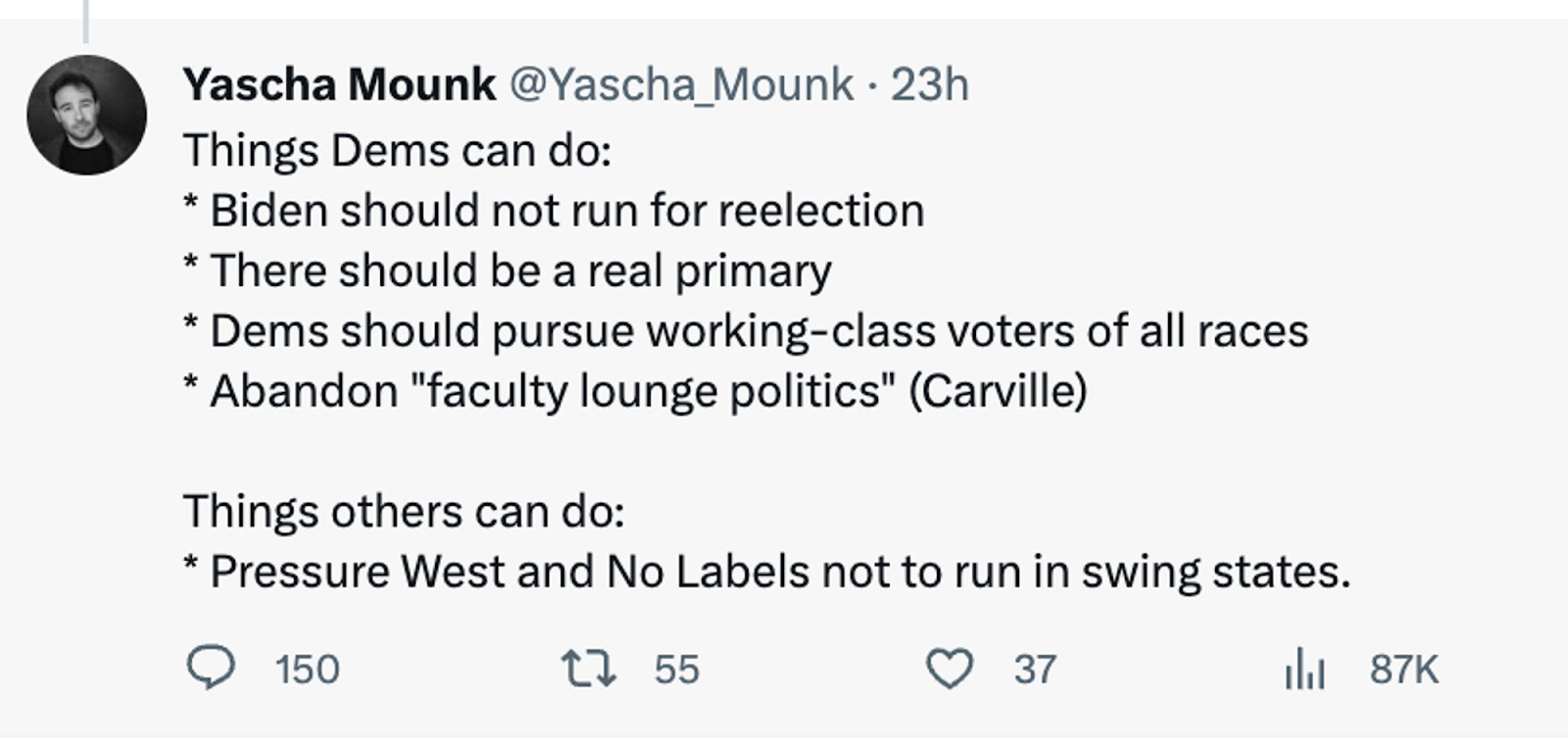
Forcing Child Rape Victims To Give Birth Is Exactly What the Dobbs Justices Hoped Would Happen


This is a picture of a twelve-year old girl.


(I assume. It's from an article titled "Awesome Things About Raising 12 Year Olds." For obvious reasons I didn't want to spend too much time Google Image searching "12 year old girl").

This is an article about a different twelve year old girl.

Ashley just had a baby. She’s sitting on the couch in a relative’s apartment in Clarksdale, Miss., wearing camo-print leggings and fiddling with the plastic hospital bracelets still on her wrists. It’s August and pushing 90 degrees, which means the brown patterned curtains are drawn, the air conditioner is on high, and the room feels like a hiding place. Peanut, the baby boy she delivered two days earlier, is asleep in a car seat at her feet, dressed in a little blue outfit. Ashley is surrounded by family, but nobody is smiling. One relative silently eats lunch in the kitchen, her two siblings stare glumly at their phones, and her mother, Regina, watches from across the room. Ashley was discharged from the hospital only hours ago, but there are no baby presents or toys in the room, no visible diapers or ointments or bottles. Almost nobody knows that Peanut exists, because almost nobody knew that Ashley was pregnant. She is 13 years old. Soon she’ll start seventh grade.

In the fall of 2022, Ashley was raped by a stranger in the yard outside her home, her mother says. For weeks, she didn’t tell anybody what happened, not even her mom....

[Ashley's mother] Regina tentatively asked [Dr.] Balthrop if there was any way to terminate Ashley’s pregnancy. Seven months earlier, Balthrop could have directed Ashley to abortion clinics in Memphis, 90 minutes north, or in Jackson, Miss., two and a half hours south. But today, Ashley lives in the heart of abortion-ban America.... Within weeks [of the Dobbs decision], Mississippi and every state that borders it banned abortion in almost all circumstances.

Balthrop told Regina that the closest abortion provider for Ashley would be in Chicago. At first, Regina thought she and Ashley could drive there. But it’s a nine-hour trip, and Regina would have to take off work. She’d have to pay for gas, food, and a place to stay for a couple of nights, not to mention the cost of the abortion itself. “I don’t have the funds for all this,” she says. 

So Ashley did what girls with no other options do: she did nothing. 

It bears repeating what Scott Lemieux said: the very consistent Republican position on cases like Ashley's is that states should have more latitude to force child rape victims to give birth compared to the average women (and they very much believe the average women shouldn't have much in the way of rights either). Ashley's situation isn't a case of unintended consequences; it's the Dobbs ruling doing exactly what its proponents intended and wanted it to do.

Monday, August 07, 2023

Is the President Congress' Babysitter?

A newly-ascendent doctrine the Supreme Court has used to strike down disfavored executive regulations is the so-called "Major Questions Doctrine". The MQD, in essence, says that we should not assume that Congress has legislated on issues of major social or economic importance unless it does so very, very clearly. This means that even where the plain statutory text seems to authorize presidential action, courts can still nullify it if they decide that Congress' language was not "clear" enough given the magnitude of the policy at issue.

For example, in NFIB v. OSHA, the Supreme Court invalidated the Department of Labor's vaccine mandate despite statutory text authorizing OSHA to issue emergency rules when necessary to protect employees against "grave danger from exposure to substances or agents determined to be toxic or physically harmful or from new hazards." COVID-19, of course, is an "agent" which poses "grave danger" to employees, so it would appear based on the plain language that Congress had authorized this course of action. But no, said the Supreme Court -- if Congress wanted to authorize OSHA issuing blanket rules covering essentially all employers across the entire economy, it needed to be even clearer than that.

Many critics have assailed the MQD as the Court abandoning textualism when it conflicts with conservative policy preferences. In response, conservatives have tried to argue that the doctrine can be reconciled with textualism because the MQD comports with how ordinary readers read texts. In the student loan case, Justice Barrett made a popular version of this argument:

Consider a parent who hires a babysitter to watch her young children over the weekend. As she walks out the door, the parent hands the babysitter her credit card and says: "Make sure the kids have fun." Emboldened, the babysitter takes the kids on a road trip to an amusement park, where they spend two days on rollercoasters and one night in a hotel. Was the babysitter's trip consistent with the parent's instruction? Maybe in a literal sense, because the instruction was open-ended. But was the trip consistent with a reasonable understanding of the parent's instruction? Highly doubtful. In the normal course, permission to spend money on fun authorizes a babysitter to take children to the local ice cream parlor or movie theater, not on a multiday excursion to an out-of-town amusement park….

Problem one with this defense is that it turns out Justice Barrett's intuitions may not be accurate. A new article actually empirically tested Justice Barrett's example and found that most respondents did not find the babysitter's actions to be unreasonable. Whoops. (Kudos to Ilya Somin for at least acknowledging that this study is countervailing evidence against his own affinity for the MQD).

But my problem with this analogy is a little different: is it really fair to characterize the President as akin to Congress' babysitter? The Executive and Congress are coequal branches of government. Their relationship is not as one-sidedly hierarchical as the parent who makes a one-off hire of a babysitter. If we adjusted the hypothetical so it was two parents, one leaving on a business trip and who tells the other "make sure the kids have fun this weekend!", I doubt anyone would find the choice of the stay-at-home parent to take the kids to an amusement park to be even remotely problematic.

Now, I'll concede a potential problem with the revised hypothetical: the relationship between two parents doesn't generally involve delegations of authority. Mom and dad both are generally authorized to make choices about the kids on their own initiative. By contrast, nominally under our separation of powers system the executive is only empowered to act upon authorization by Congress.

I'm not sure this objection fully holds, however, and in any event it can be easily traversed. It doesn't necessarily hold because -- as any couple knows -- lack of a formal hierarchy between spouses does not mean that it's impossible for there to be instructions and acrimony where they're not followed. If mom says "make sure the kids take a bath", and dad lets them get away with just running through the sprinkler -- well, woe is about to fall upon dad, and it'll be worse for him still if he comes back with "as a co-equal parent, I am equally authorized to make parenting decisions on my own initiative."

But even if we think the parent-to-parent relationship doesn't quite work, it still seems clear that the relationship between Congress and the President is still more distant from a parent and babysitter. So how about parent and grandparent. Take Justice Barrett's hypothetical, but it's grandma watching the kids for the weekend. Grandma, unlike dad, does only have delegated authority to look after the kids. But nonetheless, I think very few people would think that grandma's amusement park trip would be unreasonable or out-of-bounds. The fact that grandma is herself part of the family, and not some random acne-faced fifteen year old, makes a huge difference in terms of what should be deemed reasonable.

When Congress passes laws for the executive to enforce, it is not "delegating" power to some ad hoc temporary babysitter who may or may not ever be hired again for $20/hour plus tips. It is interacting with an intimate family member with whom it has a long-standing relationship that will continue across a multitude of cases into perpetuity. That sort of relationship, it seems to me, makes the MQD less feasible. That Congress wouldn't be presumed give some random stranger authorization to make "major" alterations to social or economic policy does not mean that Congress wouldn't be presumed to give the President of the United States such alterations -- particularly when we're talking about legislation that is by its nature inherently imbricated in issues of major social and economic concern (workplace safety, environmental protection, educational access, and so on).

College Football is Ruining College Sports


[Graphic: Washington Post]

Another huge wave of conference consolidation just hit, as eight schools just departed the PAC-12. Oregon, USC, Washington, and UCLA are headed to the Big Ten, while Arizona, Arizona State, Colorado, and Utah are moving to the Big 12 (the schools currently remaining in the rump PAC-12 are Stanford, Cal, Washington State, and Oregon State).

These conference realignments and consolidations are entirely being driven by college football. Even men's college basketball -- the other marquee moneymaker -- really doesn't play a role (we saw that when Maryland moved from the ACC to the Big Ten, a clear sacrifice of basketball rivalries for football dollars even though Maryland's outstanding basketball program is far more storied than its pedestrian football team). And all the other sports are complete afterthoughts -- there is no advantage whatsoever to UCLA's baseball team flying all the way across the country to play Rutgers.

The thing is, I don't know of anyone who's defending this on any basis other than the football cash grab.  And given the titanic sums in play, one can even understand that the schools in question feel like they've got no choice but to make the moves. I do feel a twinge -- just a twinge -- of sympathy for Florida State, which is missing out on massive payouts because it's stuck in the comparatively uneconomical ACC.

But the fact is that outside of football these conference realignments are just terrible for college sports. It makes me wonder whether there is a way to spin off the Big Ten and Big 12 as football-only conferences, so that in all other sports universities play in their traditional and more regional home bases. I can't imagine the Big Ten actually cares if they're still Oregon's home for gymnastics, so long as they're getting those big football games. If the NCAA or whomever could step in and basically broker a compromise where these conferences get whatever football teams they want but leave the other sports programs alone, you'd think something could be worked out. 

To be sure, I think even for football these realignments are doing real damage -- but with the money in question I'm dubious there's any way to put up resistance. It might be more feasible to just give up on college football being anything but a soulless cash grab and work to make it so that "what makes sense for football" doesn't end up dragging all the other sports down with it.

Sunday, August 06, 2023

The LLM Blues


LLMs depress me.

It's not so much the existential threat to my profession and livelihood (though that does lurk in the background, at least over the midterm).*

Rather, right now the depression stems from the fact that LLMs are almost inevitably going to diminish the importance of teaching writing skills in my law school classes. And helping people become better writers is one of my great joys as a professor. It's something I truly love doing. Yet the take-home essay -- essential to providing the sort of close reading and feedback I use to develop people as writers -- feels like one of those assignments that LLMs are going to make largely obsolete, or at least shift dramatically in terms of structure. I'm already pivoting in my syllabus -- this year is going to be a relatively experimental in terms of how to accommodate the existence of LLM -- and while I still expect that I'll do some amount of writing coaching, it definitely feels like the ground is shifting, and I'm already mourning what I anticipate losing.

* On the more existential threats, there does seem to be a bit of literary irony here for persons in the highly-educated literati contingent. I don't think I've personally engaged in this, but on a class level it certainly seems that the intelligentsia often blithely responded to the risks of tech disruption with "learn to code!" bromides, back when we thought that the machines were going to displace largely blue-collar workers. It turns out that while it's hard for a machine to develop the fine motor coordination necessary to serve as your plumber, one thing the robots are really great at is being smarter than the smart people. Whoops. "Learn to woodwork, radiologists!"

Friday, August 04, 2023

Two Trip Roundup

I have two trips coming up -- one to Colorado to visit my brother and parents, and the second to Seattle to visit friends (and see Liz Miele). I've been shirking my blogging duties of late, and the travel won't help, so here's a roundup to at least get something moving again.


* * * *

JIMENA (Jews Indigenous to the Middle East and North Africa) has launched a new journal, Distinctions, focusing on Jewish issues through a Sephardic and Mizrahi lens.

Nice to see some big Hollywood A-Listers step up and support the SAG-AFTRA's strike relief fund.

Ironically, Twitter deciding to become a site solely appealing to grifters and trolls is making it increasingly useless for grifters and trolls.

Does Cornel West actually want Donald Trump to win, or is his vanity presidential campaign a grift to dig out of his tax debts? Hard to say!

There's a new HuffPo "expose" revealing that Richard Hanania had a history of overt White supremacist writings, and I can be 100% honest in saying that it never occurred to me that Hanania ever presented himself as anything but an overt White supremacist (but yeah, apparently there were folks who tried to push the line that he was a "centrist").\

A new, if long-anticipated, frontier of artificial intelligence has hit, as an Indian politician hit with alleged leaks of scandalous material says that the recordings were actually deep fakes -- and it's really hard to figure out who's telling the truth.

Not really a "roundup" item, but I want to give a quick promotion to the internet series "Jet Lag: The Game". It's an online series where each season basically creates a new, full-scale travel board game -- "tag" but across all of western Europe, or "Connect Four" using the western United States. It's wholesome, entertaining, and just a lot of fun. Jill and I have been binging it for the past few weeks, and I'll recommend to all of you as well.

Saturday, July 29, 2023

White Republicans To Black Republicans: Stop Whining About Slavery

The fallout from Ron DeSantis' new "slavery: it wasn't all bad" educational standards continues, as most elected Black Republicans have now spoken out to condemn the framework and urge it be revised. Faced with this criticism from Black members of his own parties -- people who time and again have shown their commitment to conservative causes but nonetheless believe that here the state of Florida made a grave historical error -- DeSantis has responded exactly how you'd expect a White Republican to respond to challenges from Black people (whether in his party or not):

Florida Gov. Ron DeSantis, who appointed the board members responsible for the standards, did not take the measured disapproval well. On the contrary, the governor and his political operation seemed to go after [Florida GOP Rep. Byron] Donalds with a vengeance, accusing the GOP lawmaker of aligning himself with Vice President Kamala Harris and referring to Donalds — a member of the right-wing House Freedom Caucus — as “a supposedly conservative congressman.”

[....]

Speaking with reporters in Albia, Iowa, on Friday, DeSantis responded to [South Carolina GOP Sen. Tim] Scott’s comments by criticizing “D.C. Republicans” for promoting a similar argument as Harris. “I think part of the reason our country has struggled is because D.C. Republicans all too often accept false narratives, accept lies that are perpetrated by the left and accept the lie that Kamala Harris has been perpetrating, even when that has been debunked,” he said. 

DeSantis was joined by, among others, Ben Shapiro ("Tim Scott ... promptly sided with Kamala Harris and he sided with the Congressional Black Caucus.... that's Scott being disingenuous") and Matt Walsh ("You are dead to us.... [B]ecome a Democrat. That's what you are."). The general response to Black Republicans expressing offense over a GOP politician soft-pedaling the wrong of slavery was not to think "huh, maybe there is something here," but to fulminate about how they're traitors to the cause.

I talked about these dynamics in "The Distinctive Political Status of Dissident Minorities". Dissident minorities such as Black Republicans are often "tokenized" -- held out as a means of discharging an obligation to consider the views of diverse communities but not valued beyond that transactional function. Hence, where Black Republicans cease, even temporarily, to offer this "value" to the broader GOP community (because in a specific case they do not agree with the particular goals or interests of the conservative movement), it won't be taken as a valid critique from insiders but rather proof that the Black Republicans are actually a fifth column reverting to their leftist roots.

Indeed, in that paper I actually specifically referenced a different instance where Senator Scott tried to diverge from his GOP colleagues on the matter of racism as a core illustration of the phenomenon. It is striking how everything I wrote there applies here as well with barely any need for revision:

[E]ven though tokenization might in some circumstances result in dissident minorities attaining political successes, the relationship forged through tokenization likely is not sufficiently robust so as to persevere in cases where the dissident minority does publicly diverge from the opinions of their majority allies. To the contrary, when they are tokenized, dissident minorities may find that their opinions are only valued transactionally—useful to the extent that they advance the goals of their non-group-member patrons and no further. Where the perspective isn’t what’s valued, dissident minorities will typically find that their “enhanced standing” falls apart the moment they express a view that diverges from their nominal allies.

Dissident minorities might contest this point. Specifically, they might suggest that their enhanced standing is not purely instrumental but rather reflects genuine respect by majority-group members regarding their substantive contributions—respect that will carry over to cases where they do find themselves forced to challenge the dominant group. By showing themselves to be “independent” or “exceptional,” the argument goes, dissident minorities earn credit with the majority that they then can redeem in cases where they do find it necessary to contest majority viewpoints....

Unfortunately, in a great many cases the cynical prediction wins out, and the dissident minority finds that the chips they thought they had amassed are unable to be cashed.... 

[....] 

The “enhanced standing” Scott normally enjoyed by aligning with the Republican Party was a product of him being (per Arendt) an “exceptional” member of his minority group. But once he adopted (even temporarily) a critical posture towards his conservative allies, he ceased to be exceptional, and reverted to being just a regular member of the Black community. If the “earned credit” hypothesis held true, that shouldn’t have mattered—he should have been able to draw upon the well of credibility to attain a favorable reception upon raising a challenge. Yet this is not what happened: once Scott stopped being exceptional, he was treated the same as any other minority group member, and the way the GOP treats minority group members who challenge them is to dismiss them. While Scott’s patrons in the Republican Party had been happy to hold him up as proof that the GOP had Black supporters, they did not actually have any particular commitment to engaging with the Black community—even nominal “allies” in those communities—in any circumstance where it might generate challenge or change.

If Tim Scott keeps on wanting to hand me examples for my published work, who am I to argue? But this goes to show just how steady this practice of tokenization is. I'm not going to say that Tim Scott should "become a Democrat" (at least, any more than I think every person should!) -- his politics are his business. But surely he must realize that this will be the reality of his treatment as a Republican in perpetuity -- if he challenges the GOP on race, he will be slapped down and hard.

Thursday, July 27, 2023

Fear of a Good Economy


The following is one of the posts where I don't actually know anything about the subject matter, but I'm going to exercise my God-given right as an internet-denizen to opine anyway.

The Fed raised interest rates again yesterday, putting rates at their highest level in decades. It also left the door open for yet another hike later in the year. The rationale is that there is a continued need to combat inflation. But inflation rates are down significantly. The Fed's stated inflation target of 2% would be quite low by historical standards -- not absurdly low, but well below average. And on the whole, it feels like we were already at mission accomplished.

So why did we need another rate hike? I can't help but feel as if the Fed's rate decisions aren't directly about inflation, but about fear that the economy is running better than expected. Now to be clear, I don't mean this in some sort of conspiratorial "the rabble are getting too much of the pie and as guardians of capital we can't have that" sort of way. Rather, it seems as if the Fed simply won't believe it's truly gotten inflation under control unless we see significant slackening of economic growth. Inflation has been lowered, but the Fed doesn't trust the resilience of that accomplishment unless and until there's an economic downturn to "confirm" the effect.

It doesn't strike me as a good thing that "the economy is still purring along" gets translated as "whelp, better crank those rates higher." Even if the Fed eventually starts believing its own lyin' eyes on inflation, the lagging effects of potentially gratuitous rate hates could end up doing significant unnecessary damage a year from now. That would be very much not good, for a host of reasons (not the least of which being "badly timed economic slide + likely fascist on the ballot" has not augured well for democracy, historically speaking).

But again -- I actually don't know anything about this, so this is me talking completely out of my own behind. Buyer beware.

Tuesday, July 25, 2023

The Holocaust Was Not Summer School; Slavery Was Not Trade School.


Someone -- I can't find who -- once said, in relation to claims that Jews had "failed to the learn the lessons of Auschwitz", that "the Holocaust was not summer school."

The retort there was in relation to claims that Jews had not imbibed the correct moral sentiments following our genocide. But I was reminded of it upon hearing the recent defenses of Florida's "anti-woke" efforts to whitewash slavery by lauding the "skills" slaves allegedly acquired -- apologias which, unsurprisingly, have spilled over to Holocaust minimization as well.

Fox News star Greg Gutfeld, whose latest book debuted on Tuesday, is currently under fire over his recent observation that Jewish people “had to be useful” in order to survive concentration camps, prompting the Auschwitz Museum to rebuke his comments as an “oversimplification” of the Holocaust. 

[....] 

During Monday’s broadcast of Fox News’ The Five, which both Watters and Gutfeld co-host, the panel raged against Vice President Kamala Harris’ condemnation of the Florida curriculum as racist. Watters, for instance, blasted the veep for not wanting “African-Americans and white Americans to know that Black Americans did learn skills despite being enslaved.”
The heated discussion, however, took an uncomfortable turn when lone liberal panelist Jessica Tarlov drew a parallel between slavery and the Holocaust, wondering if Florida schools would also teach that Jewish people received some benefits from the Nazis systematically murdering them in death camps.
Gutfeld, referencing a famous book by Holocaust survivor Viktor Frankl, took Tarlov’s challenge and ran with it.
“Did you ever read Man’s Search for Meaning?” Gutfeld wondered. “Vik Frankl talks about how you had to survive in a concentration camp by having skills. You had to be useful. Utility! Utility kept you alive!”

The slide from "anti-CRT" to Holocaust trivialization is nothing new, of course. And here in particular we have one of those moments where an ounce of truth helps generate a ton of falsehood. It is true that, comparatively speaking, a Jewish inmate who had skills that happened to be useful for the Nazi war effort (or otherwise coveted by the local commander) was more likely to survive. Likewise, it's true that having enough wealth to pay for bribes actuarially increased one's life span compared to the destitute. It is not true that "utility kept you alive" (a phrase that is eerily adaptive of arbeit macht frei). Plenty of people with "utility" were murdered by the Nazis. It is not true that having money insulated Jews from the Nazis. Plenty of Jews with means were nonetheless rounded up and slaughtered. The relationship of "utility" to the Jewish experience in the camps was not one of moxie and grit overcoming incredible odds; anymore than the relationship of wealth was one of frugality and financial stewardship steering one to safety. There is no favor done to the oppressed that they can sometimes leverage opportunities to resist.

But again, this is the inevitable byproduct of the anti-woke panic. The obsession with never speaking forthrightly and honestly about oppression and discrimination -- always viewing it as a "both sides" initiative -- means one has to find ways to render Nazism, if not benign, then at least filed down. Others have written about the gentile obsession with telling feel-good Holocaust stories where plucky protagonists show their wiles and skills to secure a happy ending. This is a myth that non-Jews need to tell themselves to evade reckoning with the Holocaust in its full horror; the Holocaust did not come with happy endings.

And the same is true of slavery. Slavery was not a somewhat-unsavorily-run trade school. It was a form of White supremacist oppression. Trying to find the "happy endings" is an attempt to avoid reckoning with its horrors. And the thing is, if we actually took seriously the "nobody should be made to feel guilty based on the color of their skin" pablum, there'd be no quarrel with teaching the history in its full terrible glory. Learning of the horrors of slavery doesn't and shouldn't make White people feel guilty. The guilt comes from learning those facts and then wanting to carry on as before -- no change in affect, no change in politics, as if it never happened. The dissonance between the historical knowledge and the desire to pretend as if the history didn't happen or didn't matter -- that's what creates the guilt. But that's guilt based on one's own choices, and history class needn't and shouldn't have an interest in absolving you of that.

Friday, July 21, 2023

Leaving the Mess for Later

Gfp-messy-kitchen-sink

One thing that's come up in a few of the Supreme Court's recent blockbuster decisions is the shakiness of the fact pattern in the underlying case. Mr. Kennedy in Kennedy v. Bremerton School District wasn't really just an average citizen whose desire to privately pray on his own was stymied by the evil liberal school district. Ms. Smith of 303 Creative v. Elenis might have outright falsified documents suggesting that a gay couple asked to engage her services. The Supreme Court's conservative majority did not care, blitzing ahead in decisions that made dramatic alterations to major areas of constitutional law doctrine.

At one level, I actually understand the perspective here. When it comes to abstract, "philosophical" question regarding the scope of the Establishment Clause or whether anti-discrimination law must sometimes yield to free speech commitments, the details of the individual case don't really matter. If it wasn't Kennedy, it'd be someone else. If what you care about is the broad, sweeping change -- interring Lemon v. Kurtzman for good, or laying a marker that public accommodations laws must yield to businesses' right to "expressively" discriminate -- the details don't affect the underlying arguments all that much. The same claims and counterclaims that would be made in any case would be aired here. 303 Creative probably already felt like the can that was kicked down the road from Masterpiece Cakeshop. Similar impatience was seen in some of the concurrences in Fulton v. City of Philadelphia -- we know we're going to have to decide whether to revisit Employment Division of Oregon v. Smith, and we know the arguments for and against preserving the precedent, so why delay the inevitable? Just make the decision one way or the other and get it done.

At another level, though, this speaks to how the current conservative judicial cadre really doesn't care about the formalities of law and legal doctrine. It's movement conservatism through and through -- the important thing is the bottom-line results, and the Court will shoot first and let others clean up the mess later. This especially stood out for me in 303 Creative, a case where it was striking how much more legalistic Justice Sotomayor's dissent was compared to Justice Gorsuch's majority opinion. The former, whether one agrees with the result or not, worked through the relevant First Amendment doctrine via the same methodology I'd teach my students -- explaining the relevant doctrinal framework, explaining why this case falls into a particular part of the framework, and explaining the implications thereof. The majority opinion was basically an abstract ode to the importance of free expression but skipped past significant swaths of the seemingly essential legal analysis (often by vague gestures at party "stipulations" or just treating as gospel certain holdings of the Tenth Circuit). It was hard to escape the sense that the nitty-gritty details of Lorie Smith's case were not at all what interested the majority, and so they were disinclined to spend significant time on them. They wanted to make a big statement about the interplay of free speech and anti-discrimination law, so that's where they devoted their attention. 

From that vantage, the fact that Lorie Smith's case may not have been the cleanest vehicle isn't really all that important. Of course, from the vantage of lower courts trying to figure out what the hell 303 Creative actually means, it's extremely important, because nobody actually knows the concrete rule that 303 Creative is actually establishing, and the blurry fact pattern means that trying to infer it from Lorie Smith's situation is a doomed initiative. But again, that's someone else's mess to deal with. I honestly believe that the Justices in the 303 Creative majority did not care if Lorie Smith, personally, deserves the exemption from anti-discrimination law under the doctrine that will eventually lay out. What they cared about is being decisive in defending the existing of these exemptions in concept. Lorie Smith just had the good fortune to be the next case in line that could be plucked onto the docket.

I've written before of the Machiavellian character of the current Supreme Court, specifically, it's absorption of Machiavelli's advice to tyrants: that they should take their big oppressive swings early, in full force, and all at once. You won't gain any advantage from dragging things out, and you'll probably get credit if you cut back later. And the repeated pattern we've seen is of the Court taking these huge right-wing swings that delight conservatives on the level of ideology, but without much care for how they can be operationalized as a workable legal doctrine, and leaving it lower courts to clean up its mess. And to give an inch of silver lining, there is the chance (this follows from Machiavelli too) that as that "mess" resolves itself the Court will then quietly file down some of the roughest edges. The Bruen decision, which reads as a right-wing ideological fantasy document but which has unleashed utter chaos in lower courts, may be an example if the Court uses the Rahimi case to cut back the most extreme interpretations. Take the big swing, make the chest-out assertion of insisting that no amount of public necessity can weigh against robo-originalism, and then later on at their discretion maybe pick and choose a few morsels to dial back on and claw back some legitimacy.

But nonetheless, it really is striking the degree to which the conservative legal movement just no longer cares that much about the law. As a law professor, it makes for depressing teaching. As a citizen, it makes for depressing living. Just depression all around.

Tuesday, July 18, 2023

Could RFK Jr. Succeed as a Republican?


[Patrick Semansky / AP]

The utterly unsurprising news that the majority of Robert F. Kennedy Jr.'s major financial backers are dyed-in-the-wool Republicans, and that his "surging" poll numbers are being driven primarily by newfound love from Republican voters, makes me wonder: how would he fare if he actually ran as a Republican?

Obviously, on the issues he's a much closer match to the GOP these days. The anti-vaxx paranoia and overall conspiracy mindset goes without saying. His foreign policy stances are called "tankie" when they're nominally coming from the left, but if you're a Republican they're just bog-standard "isolationist" Putin-worship. Even some of his seemingly more "progressive" government spending ideas could easily be folded into a MAGA-style "build baby build" argument; the same goes for his railings against big business vis-a-vis a Josh Hawley style of politics (it's all easier once you remember that all of these positions -- whether held by Kennedy or Trump or Hawley -- are all vibes, no content, so it's no struggle to assimilate them into a new host).

And symbolically, I think he has a lot to offer to the GOP. It's not just the high-profile "defector" thing (as absurd as that label is to apply to someone like Kennedy). He also -- again, symbolically, not substantively -- harkens back to "my granddaddy's Democratic Party", feeding into the larger grievance narrative of older White voters who retain some nostalgia for the mid-20th century glory days but are convinced that "the party left them". And even in presentation, Kennedy has some Trumpian vibes: the superficial visage of power and influence, paired with the superficial visage of being a "rebel" who's standing up to his own "class" (I can't keep repeating that this is all nonsense, but nonsense is very appealing to GOP primary voters).

Do I think he could oust Trump? No, because I don't think anybody can oust Trump in a GOP primary. Do I think he could become a serious player -- more so than the shooting star crashing meteor that is Ron DeSantis? Absolutely. And as, for example, a Trump VP pick, RFK Jr. makes an alarming amount of sense. The biggest question might be whether the delusions that prompted Kennedy to run in the first place will obscure the greener grass that awaits him on the GOP side of the fence; because otherwise going GOP seems like the obvious play for him.