Showing posts with label Indiana. Show all posts

Monday, April 20, 2026

Seventh Circuit Accidentally Tells Truth About Voter ID Laws


There is no "right to vote" in the United States Constitution.

This is a fact that surprises many people, given the centrality of democracy to our national ethos. But it's true. The Constitution prohibits certain specific types of restrictions on the franchise -- for example, limits based on race (15th Amendment), sex (19th amendment), or, in federal elections, failure to pay a poll tax (24th Amendment). However, there is no general, textual protection for a right to vote.

That said, the Supreme Court has recognized some heightened scrutiny that applies to limitations on suffrage. The "interest of the State when it comes to voting," the Supreme Court held in 1966, "is limited to the power to fix qualifications." The Court in that case concluded that wealth was not a valid qualification the state could impose on the franchise -- the state has no interest in preventing an otherwise qualified voter from casting a ballot because of his or her income. The broader principle is that the state has no valid interest in voter suppression -- preventing validly qualified voters from casting ballots. By contrast, a law which is related to enforcing a legitimate qualification -- say that the voter who presents themselves at the poll is in fact who they say they are -- may be permissible.

This distinction has been critical in more recent litigation over voter ID laws. Critics say that these laws are about voter suppression -- they are attempts to prevent lawful and qualified voters from casting their ballots by throwing up extraneous and burdensome obstacles in their path. Proponents, at least officially, deny any such motive -- they contend that such laws are simply about ensuring "election integrity" by preventing fraudulent votes from being cast. Any resident who actually is a valid voter should still be able to cast their ballot (all they need to do is show a valid ID! How hard is that?).

Now, it's always been evident that the latter, "anti-fraud" justification was a lie. The alleged "fraud" was essentially non-existent; and demanding voter ID wouldn't generally even forestall the tiny amount of fraud that did occur. But when the Supreme Court later upheld laws like Indiana's voter ID statute in Crawford v. Marion County against a facial challenge, it relied on this distinction between wrongfully trying to disenfranchise qualified voters and the legitimate state authority to fix qualifications. Voter ID laws are permissible because they are not about blocking qualified voters from voting, they are about ensuring that only qualified voters vote.

Recently, Indiana modified its voter ID law to prevent student IDs (but not VA, military, or tribal IDs) from being used as "voter ID". A district court had enjoined the law, ruling that it would unconstitutionally suppress the votes of young Indianans (and to reiterate -- young Indianans who are entirely legitimate and valid voters in Indiana elections). Earlier today, though, the Seventh Circuit stayed that injunction under the so-called Purcell principle, which cautions against court injunctions that change election rules too close to election day (ballots in Indiana's primary elections have already been mailed out).

The district court analyzed Purcell but concluded it did not apply, given that Indiana had permitted student IDs as a valid form of ID for decades and so would have to do nothing more complicated than revert to the system it had been using in every election up to the present one. But the Seventh Circuit disagreed, and in doing so it said something very revealing:

We view the risk of disruption to Indiana’s primary election as very serious. In no uncertain terms, the district court’s injunction will alter who can cast a ballot in this election (emphasis added).

This is a very revealing line. In theory (very, very naive theory), Indiana's law should not "alter who can cast a ballot in this election." The students who were eligible to vote before the ID law was passed are still fully eligible to vote after the law was passed. All Indiana is doing is tightening up security to ensure that only eligible voters vote -- but these students are eligible voters. In practice, of course, the court is absolutely right: some voters -- qualified, eligible voters -- who would be able to satisfy Indiana's voter ID law with a student ID will no longer be able to do so under the new rules, and so will not be able to cast a ballot. The function of the law is not to simply fix legitimate qualifications -- it is to prevent eligible, lawful voters from voting. The critics were right all along. 

Worse, the court's logic here manifestly treats as an injury (a "serious" injury; a "disruption" demanding emergency judicial action) the inability of Indiana to suppress valid, legitimate votes. Indiana did not change who was formally eligible to vote in its elections, meaning that the class of voters whose ability to "cast a ballot in this election" will be altered is comprised entirely of legitimate, registered voters. That cannot be stressed enough. One could imagine Purcell analysis that goes entirely to the procedural difficulties of changing voter ID eligibility rules midstream (such an argument might be plausible given that ballots had already been mailed, though the district court found that all Indiana would have to do to come into compliance is delete a single line in its election guidance documents). But that's not what the panel said. The court's articulation of the problem here is not one of administrative strain. The court's problem, "in no uncertain terms", is that certain eligible, registered voters who would be prevented (in spite of their eligibility) from casting a ballot if the student ID prohibition was in effect would now be allowed to cast a ballot in the primary. People who are eligible to vote will now not be blocked from voting. In essence, the court treats voter suppression as tantamount to a compelling state interest -- a stunning perversion of even our meager "right to vote" jurisprudence.

One might say I am reading too much into a single line in a hastily-filed emergency ruling. But I would say the Seventh Circuit's opinion is the epitome of a judicial Kinsley gaffe. Everybody knew that voter ID laws were not about concocted concerns about "fraud" but rather about trying to suppress lawful votes from Democratic constituencies. The Seventh Circuit just finally got around to admitting it.

Thursday, July 14, 2022

The Default Conservative Response to Inconvenient Facts is to Cry "Liar!"

Many of you have probably been following the horrific story of a ten-year old rape victim from Ohio who was forced to travel to Indiana to have an abortion following her home state's criminalization of the procedure.

No doubt some of you witnessed a collective right-wing response to the story, which was simply to declare it a lie. The Wall Street Journal editorial board called the story "too good to confirm". Ohio Rep. Jim Jordan (R) called it "another lie". National Review contributor Michael Brendan Dougherty called it a "fictive abortion and a fictive rape." Ohio Attorney General Dave Yost suggested the story was a fabrication because he hadn't heard a "whisper" about such a rape case from local law enforcement officials. It was everywhere.

Then the story was (further) confirmed, and those who called it a lie retreated with various amounts of egg on their face. Which is to say, they mostly said they were right to assume the story was made up even though it wasn't.

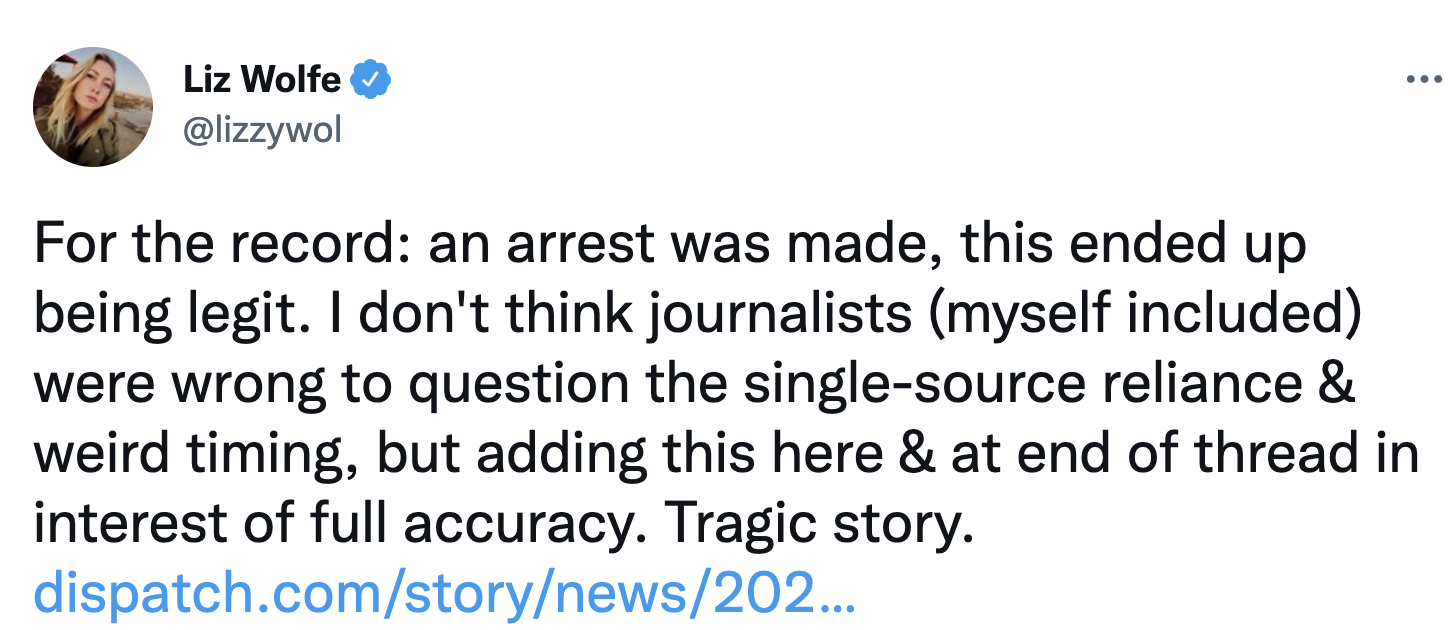
This has been the main meta-media response to the controversy: agreeing that there were "red flags" about the story such as its "weird timing" that meant we should all have taken very seriously the collective right-wing declaration that the story was a hoax, even though it turns out to have been horrifyingly true.

There were no significant "red flags" here. It is not suspicious that the Indianapolis Star did not publish the name, address, photograph, and social security number of a minor rape victim. It is not "weird" that stories of the horrible consequences of criminalizing abortion would begin to emerge shortly after abortion was criminalized. Obviously, if there is actual evidence of malfeasance or fabrication, one should look into that. But that wasn't present here.*

No, what happened here is very straightforward: A story was published that constituted an inconvenient fact for conservatives. So they declared it to be a lie. That's it. That's all that prompted the reaction. No "red flags", no "reasonable grounds to question". The story was inconvenient, and the response was to cry "liar!"

If we had to do meta-coverage of this story, that's what should have been the frame. It is, after all, the same basic instinct that motivated the cries that the 2020 election was "stolen". What prompted those cries was not any "evidence" or "suspicions" or "red flags". Biden winning was an inconvenient fact, and the default right-wing response to an inconvenient fact is to declare it a lie. Same reason why January 6 insurrectionists are declared to be "antifa". Same reason why mass shootings are alleged to be false flags. Same thing for global warming, same thing for whether Israeli soldiers shot Shireen Abu Aqleh, same thing for Trump's connections with Russia. This is not something occurring in isolation. It is a pattern of behavior, and a deeply dangerous one at that. It's always a lie, it's always "fake news".

So if the media wanted to soul-search its coverage, it should start there. What does it mean that conservatives now reflexively and instinctively declare any story that troubles their ideological waters to be a lie, and what does it mean that the media still views those cries as having credence?

This response, after all, is toxic to the proper functioning of democratic politics. Yet rather than identify it for what it is, let alone push back on it, the media aids and abets it with thumb-sucking self-abnegations agreeing "questions were raised." No they weren't! The mere fact that Republicans don't like a given fact or event or story about the world is not and should not be enough for the media to agree that its truth is up for dispute.

So that's the story I want to see. I want a deep dive into how conservatives have begun calling any inconvenient fact a lie. I want a clear and unvarnished explication of the pattern of behavior, contextualizing the most recent instance by reference to other prominent cases where they've run that same playbook. I want comments from self-reflective journalists about why these unevidenced cries of "liar" are given credence, and whether it is appropriate to continue to give credence to those cries going forward.

That's the metastory. Someone should get on it.

Oh, and for those of you wondering: now that the story has been fully confirmed, conservatives are sweeping into action ... by launching a criminal investigation of the doctor who cared for the child and proposing legislation that would criminalizing giving the child an abortion in Indiana. Because the current Republican orthodoxy is that adolescent rape victims should have to give birth or die trying.

* The closest exception I'll cop to is the Ohio Attorney General saying he hadn't heard of such a case, with the strong implication that if the case existed he would have known about it. But since it turned out there was such a case, the proper response for the media going forward is to treat Attorney General Yost as presumptively uncredible unless proven otherwise. Of course, the actual response will be to continue to treat uncorroborated declarations by Yost as rock-hard proof, while spinning in circles to explain why a doctor going on the record about an event they have first-hand knowledge about is too flimsy to take seriously.

Saturday, January 08, 2022

The New Holocaust Minimization from Europe to America

It is a common cliché to claim that 21st century American antisemitism will follow the trajectory of 21st century Europe's, lagging only by a couple of years. I hear it most often in claims that the Democratic Party will inevitably Corbynify (I never hear the follow-up of what is supposed to be the American iteration of "... and then Corbyn is trounced in the general and summarily tossed from his leadership post"). Far less frequently is attention paid to how the American right can and will follow in the footsteps of its European peers.

On that note, I want to put two stories in conversation with one another. The first is a right-wing party in Romania under attack for dismissing Holocaust education as a "minor topic". The second is a Republican legislator in Indiana, State Sen. Scott Baldwin, taking flak for insisting that, under his proposed "anti-CRT' law, educators must and should take a "neutral" stance on Nazism.

The Indiana incident is hardly the first of its kind. From the outset, the anti-CRT push has undercut Holocaust education initiatives -- an utterly predictable consequence that thus far has barely even registered an iota of worry amongst Republicans who just a few months ago were holding themselves as the last hope against an incipient tidal wave of antisemitism (then again, it was barely a year ago when Republicans were still holding themselves out as defenders of free speech in education -- who can keep up?).

But it is worth putting these developments in America in conversation with what's happening in Europe, and why it is exactly that they find the Holocaust to be so disposable. For the most part, it is not that I think that the legislators in Indiana or Texas are secret Hitler admirers. However, I do think they may possess, and be acting on, a sort of annoyed indifference to the Holocaust's preeminence. Much like Republican frustration over how all political scandals end in -gate, there is frustration over how the main "shared" exemplar of pure political evil is a right-wing phenomenon. Sometimes this frustration manifests in absurd attempts to pretend that Nazism was "actually" a left-wing ideology. But another play is to seek to undercut the Holocaust as "just another" historical event, one that shouldn't receive undue attention or be subject to special condemnation. Who cares about the Holocaust when somewhere, someone is reading a book on how to provide support to LGBT youth? It's not pro-Nazi so much as it's anti- expending any resources to fight Nazism or inculcate the view that Nazism is bad. 

On the European side, the new far-right parties are not (yet) outright praising Hitler, but they're very much taking the view that we obsess too much over Hitler. Nazism is a minor blemish, an inkblot, a footnote in an otherwise glorious White European history, and bringing it up is just an obnoxious distraction from the "real" threats posed by immigrants, Muslims, and multiculturalism. And of course, the American right is increasingly lining up with these parties -- Steve King was just a touch ahead of the curve, but the snuggling up to Viktor Orban in Hungary has long since passed into the GOP mainstream. Why should the view of the Holocaust resist the trend? Indeed, the Indiana and Texas cases already show the GOP is happily galloping along with it.

Friday, July 01, 2011

Don't Drink and Be Driven Home

Orin Kerr points out a perplexing case out of Indiana, where the state Supreme Court ruled that a passenger in a vehicle stopped by the police on the highway is "in public" for purpose of a public intoxication statute (the case is Moore v. State).

Professor Kerr observes that the case is easily distinguished from the precedent the Indiana Supreme Court relies upon (Miles v. State), where the police found the drunken defendant parked by the side of the car with his windows rolled down. Here, by contrast, the defendant was only "by the side of the road" pursuant to the police's seizure of the car pursuant to a traffic stop. He notes the famous case of Martin v. State, an Alabama state case taught in law schools nationwide for the proposition that the police cannot take an intoxicated person into "the public", then arrest him for public intoxication (so much of the 1L curriculum is about shattering student's prior conceptions of fairness as irrelevant to the law; Martin is memorable if for no other reason than as a pleasant break from that routine).

But aside from the seemingly specious legal reasoning of the decision, it also seems rather disastrous from a policy perspective. The state has a substantial interest in keeping intoxicated drivers off the road. One of the main ways it seeks to accomplish this is by encouraging drunk individuals to become intoxicated passengers instead. The whole point of a designated driver program is for non-intoxicated persons to drive their intoxicated friends home, rather than letting them drive drunk themselves. This decision seems to fly in the face of that public policy and, to the extent that it discourages the practice of designated driving, makes the state of Indiana considerably less sake safe [Though my friend Mike is right that it was much better in the original. --DS].

Wednesday, February 23, 2011

Indiana Assistant Attorney General Advocates "Live Ammo" Against Protesters

Absolutely shocking:
On Saturday night, when Mother Jones staffers tweeted a report that riot police might soon sweep demonstrators out of the Wisconsin capitol building—something that didn't end up happening—one Twitter user sent out a chilling public response: "Use live ammunition."

From my own Twitter account, I confronted the user, JCCentCom. He tweeted back that the demonstrators were "political enemies" and "thugs" who were "physically threatening legally elected officials." In response to such behavior, he said, "You're damned right I advocate deadly force." He later called me a "typical leftist," adding, "liberals hate police."

Only later did we realize that JCCentCom was a deputy attorney general for the state of Indiana.

I mean, I've enjoyed the solidarity messages coming from North Africa to the American Midwest, but I'd really prefer the similarities end before we have state officials advocating the massacre of unarmed protesters.

UPDATE: The official in question has been fired.

Thursday, September 17, 2009

The Battle of New Orleans

Last April, the Supreme Court uphold an Indiana voter ID law which disenfranchised folks for literally no tangible reason. The intangible reason was to prevent voter fraud. I call that reason "intangible" because Indiana had never, in its history, had a prosecuted case of voter fraud of a form this law would address. Indeed, the state had seen voter fraud in absentee balloting before, so naturally, absentee ballots were exempt from the law. It was a rare case of the Supreme Court allowing a fundamental right to burden based on nothing more than mythology and Republican hysterics. Not their proudest moment.

But having lost the war, it looks like voting rights advocates may have nonetheless managed to win a battle after the fact. The Indiana Court of Appeals has struck down the voter ID law the US Supreme Court upheld, holding it to be a violation of the state constitution by not treating all voters alike (particularly with regards to the aforementioned exception for absentee ballots).

More coverage here and here. Also worth noting is that this is an intermediate appellate opinion, so it can and likely will be appealed to the state Supreme Court.

Thursday, May 08, 2008

Round Four

Amazingly, the Indiana 9th District is looking at the fourth consecutive battle between the same opponents, with Democratic Rep. Baron Hill defending his seat against former Rep. Mike Sodrel. Sodrel challenged Hill in 2002 but lost, but then won the re-match in 2004. Hill got his seat back in 2006 and now the race is on again 2008. It's expected to be negative -- 6 years of running against each other has created some bad blood.

I'm curious: what's the record for most consecutive cycles where the same two major party candidates faced off?

Wednesday, April 30, 2008

Compel This!

Monday the Supreme Court, in a 6-3 decision, upheld Indiana's voter ID law. You remember that one: the law which was justified to combat voter fraud, despite the fact that Indiana has never had a voter fraud prosecution in the history of the state? Now, to be fair, Indiana did recently have a problem with fraud in a local mayoral election. But it was perpetuated by absentee ballots -- the only type of voting exempted from the voter ID requirement. In general, the voter fraud "epidemic" is a myth used to suppress legitimate voting by Democratic-leaning voters. So we have a situation where the "interest" Indiana uses to pass a voter-suppression law is literally mythological. Maybe we can convince Maryland to pass a law prohibiting Republicans from voting on the grounds that they're more likely to secretly be fire-breathing dragons. It's no less removed from reality.