Showing posts with label art. Show all posts

Tuesday, July 28, 2026

There's a Print Club, and I'm In It


As some of you know, my recent hobby-obsession is art collecting. And while I don't limit myself to one particular medium, to the extent I have a concentration, it's on prints.

Being the self-reflective sort, I wondered why editioned prints in particular appeal to me so much. The standard "pitch" for prints is that they are a cheaper and more accessible point of entry into the fine art world than other mediums. We've talked before about how the same A-tier artists whose paintings go for a million dollars-plus have editions available you can snag for a thousand dollars or less.

Being a cost-conscious sort (and certainly not a megamillionaire), that's definitely playing a role. But there are some other things I like about prints in particular.

One is that prints are limited editions, but not one-of-a-kind. People who are purists about paintings over prints often harp on the uniqueness of the former. But I actually kind of like the communal aspect of sharing in a particular work -- at least, to a limited extent. A club that anyone can join is pointless, but a club that only has one member is pretty boring. Print ownership is like being part of an exclusive but still interesting club.

For example, the image pictured above is an etching I recently acquired by Leonard Baskin, titled "Artemis". In addition to his "regular" artistic career, Baskin founded and owned the Gehenna Press, which published limited edition fine arts books. One such book was an edition of the Greek tragedy Hippolytus, of which only 200 copies were made, and included with the book were ten illustrations, "Artemis" being one of them. Outside those 200, Baskin created a supplemental edition of 90, which is where my copy comes from. So 290 total -- not too many, in the scheme of things. And even better is who else is in that small circle. For "Artemis", I now know that a piece on my wall also is in the collection of (among other locales) the Delaware Art Museum and the Cornell University Art Museum. That's pretty neat! I won't claim that all or even most of the works I own are represented in museums, but I do have pieces that also are found in the National Gallery of Art, the Walker, the National Gallery of Australia, and Cambridge's Fitzwilliam Museum. That's a pretty good club to be a member of!

And lest we find all this talk of museums and exclusive clubs a bit too posh, there's a related phenomenon that I am quite sure plays a large role in my love for prints: they're numbered. "Artemis", for instance, is numbered 68/90 (the 68th example from the edition of 90). And I love those numbers.

Why? Well, you see, long before I was an art collector, I was a baseball card collector. That was my big childhood hobby, and while I've long since gotten out of that game, I still have my old collection. Interestingly, even as a child one of my favorite things to collect were vintage cards from the 1950s and 60s. But in terms of contemporary cards, the coolest ones were the rare inserts. And the coolest of the inserts were the cards with an individual serial number.

We in the baseball card collecting biz were very naive when this started to become a thing. The 1998 SPx Finite set's common cards were individually numbered to 9000 -- huge, by art world standards, but I remember thinking it was the coolest thing in the world. And of course, some cards were rarer, and some were a lot rarer. I have a Greg Maddux numbered to 11 and a Scott Rolen numbered to 25 that I kept in a bank deposit box for decades, less because of their value than because I was freaked out at the prospect of losing them.

Anyway, the point is that seeing a limited edition print numbered X of Y pulls on a deep, deep well of childhood excitement and enthusiasm and nostalgia. A painting may be unique, but it doesn't have the number attached to it. And while that might not be the most sophisticated impetus for a collecting interest, I think there are worse grounds for a building a hobby than that.

Wednesday, August 13, 2025

The Audacity of Jeanine Pirro

Yesterday, the Washington Post published an editorial by Washington D.C.'s Trump-appointed U.S. Attorney Jeanine Pirro, where she demands the elimination of various D.C. laws that provide leniency to juvenile offenders under the guise of making D.C. "safe." These include the Youth Rehabilitation Act, which suspends mandatory minimums for many crimes when the defendant is under the age of 25, and the Incarceration Reduction Amendment and Second Look Amendment Acts, which lets persons imprisoned for crimes committed while under the age of 25 to petition for resentencing after 15 years of incarceration.

I've written before about my art collection, and in particular the story of Halim Flowers (whose work in large part prompted my interest). Flowers was the beneficiary of the laws Pirro is indicting here -- he committed his crime when he was sixteen, sentenced to life in prison, but was eventually released after serving 22 years (when he was nearly forty). If Jeanine Pirro had her way, he would still be locked up, and we would have lost the beauty he has created as a sacrifice to our misplaced pride -- the arrogance to know that these children can never and will never have anything to offer society, and that we lose nothing by keeping them caged forever. Halim Flowers is testament to why laws like this must exist. 

Whenever I think about laws insisting on the lifetime incarceration of juvenile offenders, I think: would we as a society really be better off if he was still warehoused? How much else in the way of beautiful art are we depriving ourselves of by locking away so much of our human potential? Or forget art -- or business, or writing, or anything else externalized by the outside world. How much love are we giving up? How many relationships are we stymying? How many families are we poisoning? Who does this help? Perhaps there are some criminals who are truly incorrigible (though most age out of violent criminality by forty or so), but for any individual kid it's hard to imagine knowing that with so much advance confidence that one will refuse to even let the child have a chance to become a different person. Our assumptions about which children are incorrigible criminals are very often wrong, and we should have the humility to allow ourselves to be proven wrong.

The retort, of course, is the put oneself in the shoes of the victims. It's of course hard for me to imagine  a world where my wife or my son was murdered -- my brain sort of does an emergency shut-off at the thought. My best guess is that it would turn me into a broken shell of a man, and nothing would resurrect me from my nightmarish hell. It would be too cheap to say that's freeing (why bother imposing any punishment if, either way, I'll still be a broken shell of man trapped in an inescapable nightmare?) -- I certainly think I'd want the wrongdoer to be held accountable in some fashion for what they've done. But I imagine (and again, this is only imagination) that eventually, all I'd want is to not have to think about the murderer again. I don't know if I could ever forgive him. But nor would I want to expend energy hating him. The gravest injustice someone could do to me, twenty years after the fact, would be to make the murderer my mental responsibility -- whether it's the responsibility to declare "he should he go free" or the responsibility to insist "he must stay locked up." Just let me pretend that I can forget. Is that too much to ask?

What Pirro is doing here is not to the benefit of the victims or their families. They deserve better than to be pulled into this debate. The people who want leniency will urge them to show forgiveness, the people who want punitiveness will lean on them to recount their trauma. Both demands are torturous. It is an injustice on top of an injustice that we ask this of them. Just leave them alone. They've suffered enough.

Impossible questions don't yield easy answers, and I don't pretend these answers are easy. But their very impossibility makes it more essential that D.C. residents be the ones to decide for themselves -- not an outsider commissar imposed on a subjugated population deprived of its democratic rights. Jeanine Pirro does not want what's best for D.C. residents. Jeanine Pirro does not care about D.C. residents. Crime in D.C. is in fact falling (and the most prominent recent incident of mass criminality in D.C. was of course orchestrated on Trump's behalf and the site of mass pardons by Trump to inaugurate his second term), but this was never actually about what's good for one of the American colonies anyway. Jeanine Pirro is literally inventing more misery so that she can inflict more misery on the world. What a despicable human being.

One other side note: When I clicked the link to open Pirro's column, I saw with bittersweet amusement a banner informing me that my Washington Post subscription will expire in one more day (I canceled in October following their Harris non-endorsement fiasco, but I had renewed last August for a year). Even now, this is a hard moment -- I grew up with the Post, I loved it dearly, and even now I know its reporters do some great journalism. But it is, in a way, helpful to get a reminder of the feckless, Vichy nihilism that the paper now embodies (the publication of this editorial wouldn't have offended me so much if the Post hadn't just announced new ideological limits on the opinion pieces it would run -- tell me, is Pirro's lock-up-the-kids crusade in the category of "personal liberties" or "free markets"?). No principles, no values, just crass accommodation of the worst people in power. Who could really miss a newspaper like that? For that, and that alone, I'm grateful to the Post for giving me a perfect sendoff as my time as a subscriber draws to a close.

Friday, July 18, 2025

Timeless Pop


The Wall Street Journal has an article about the faltering art market. Of course, they're talking about the ultra-high end -- "sales of $10 million-plus paintings" -- which is completely irrelevant to the art I'm interested in. I caught myself trying to caveat that with some logic like "except that it nudges higher-end collectors downward to the sorts of pieces I could afford, pushing their prices up," but the truth is even that's delusional. There are many, many levels between me and the sort of collector who might even consider an $80 million sculpture.

But there was one line in the article that interested me:

Art is vulnerable to shifts in taste. Baby boomers who favor abstract expressionists and pop art may find it hard to offload their collections to younger buyers. Millennial and Gen Z collectors aren’t showing interest in the same artists. Cultural signals have moved on: Warhol’s screen prints of Jacqueline Kennedy or Marilyn Monroe may not carry the same potency for coming buyers.

I like pop art, and I'd certainly be delighted if the heavies came down. Of course, the last art auction I followed saw a Lichtenstein ("Blonde", from the surrealist series) go for double the pre-auction estimate, so, you know, maybe not quite falling to pieces yet (to be clear: "Blonde" is a print, and so it's worth nowhere near the mega-millions paintings talked about in the WSJ article).

But this passage did make me think that we're probably at a pivot point for 20th century art, including pop. Specifically, I think we're approaching the point of post-speculation. It's less and less of a question "who are the (very few) figures who are genuinely going to stand the test of time as THE artists of their generation?" The pecking order might shuffle a little bit, but not by all that much. And so there's less bubble pressure buying someone in the hopes that they'll be "the next big thing". Yes, there's always revisitations and attempts to pull up someone unappreciated in their time, but odds are if someone hasn't broken through by now, they're probably not going to.

For pop, if you ask me who the consensus "THE artists" are, I'd say the convergence is on Lichtenstein and Warhol. And from that vantage point, the above quoted passage suggests a potential vulnerability in the latter compared to the former. Warhol's cachet is tied to cultural icons whose potency, I suspect, is rapidly fading. This is the risk of pop -- its whole point is to comment on the ephemeral nature of popular culture, and little of popular culture, even that which seems immortal, is truly timeless (see also: Elvis).

Lichtenstein, by contrast, I think is much better positioned simply because he isn't as tied to such period-specific figures. His cachet is tied to comics, a medium rather than an icon, and that gives him more staying power, I think. The short version of this is that in 2065, I think society is much more likely to still be interested in comics than it is to be interested in Marilyn Monroe.

Thursday, July 03, 2025

Number 2 Ranked Baby in a One Baby House


A few evenings ago, Jill was awakened in the middle of the night because someone spit up all over the bedsheets in their sleep.

That someone was me. I must have eaten something that didn't agree with me, and the Pepcid I took before bed proved insufficient for the task.

Nathaniel slept soundly through the night, as he does almost every night. 

But spit-up? Seriously? I'm nearly forty. And it's a bit embarrassing, as a near-forty-year-old, to not even be the lowest-maintenance "baby" in the house.

Then again, in other respects it's a lot better when it's me than him. When something's wrong with me, I can self-regulate, and I can usually understand what it is and communicate what I need. Nathaniel, of course, lacks those capacities. So on the rare occasions when he does start crying without a clear cause, Jill and I just sort of haphazardly throw comfort-ideas at him in the hopes that something sticks (pick him up, put him down, leave the room, stay in the room, stay just outside the room but in eyeshot, give him toys, try to give a nap, feed him, change him, burp him ... it goes on).

The other day, Nathaniel had probably his worst meltdown since he was born -- even worse than vaccine day. The day started normal, except that he was unusually uninterested in his bottle (normally he takes it with no trouble whatsoever). But he was cheery enough as the day progressed, so I didn't think much of it. We have our next door neighbor's kid come over once a week to watch Nathaniel (we stay home, it just lets us catch up on work or chores or sleep), and when we passed him off to her Nathaniel started crying. Even that isn't too unusual -- he'll usually cry for a minute or so on such a handoff -- but this time it didn't really stop. To her credit, the sitter tried everything she could think of (playing, bouncing, carrying, music), until eventually I suggested maybe we try to put him down for a nap.

Bzzt. Dad guessed wrong, and Nathaniel absolutely blew up. Crying turned into flat out hysterical screaming, and finally I pushed the big red abort button and got Jill. Mom managed after a lot of cuddles and soothing to calm Nathaniel down and eventually get him to sleep, and we let the sitter go home early.

We still aren't sure what set him off. Right now, our best guess is a mix of separation anxiety and an upset stomach (he took a mega-poop shortly after the sitter left), that sort of fed on itself until he spiraled. But we're not sure, and of course we never will know for sure. What we do know is that there's little that's more awful than seeing your kiddo uncontrollably upset and not knowing how to help him. Even when you're pretty sure it's nothing (and we did take his temperature and check for anything that might be causing pain or discomfort), it's still awful -- though I'm thankful it was nothing, since it'd be far worse if it was caused by something.

Oh, and lest anyone worry -- he was back to better after his nap. And today we discovered that he really likes beer ads (at least in fine art form). So there's that.

Saturday, May 31, 2025

You Can’t Theorize a Hand

When we last left off my artist's journey, I was making mediocre (and that's okay!) renditions of a fruit stand. But since then, I've started taking an introductory drawing class at the Multnomah Arts Center (good news -- it looks like we saved it!), and I'm actually very pleasantly surprised by my progress!

We've drawn something different each week. For example, in week two we did self-portraits -- mine would haunt your nightmares insofar as it makes me look like a serial killer. But I do think it's clearly a rendition of me as a serial killer, so that's something.

Last week, we focused on drawing hands, which I know are the bane of every artist. But I think mine turned out pretty good! A little meaty, but to be honest my hands are chonky boys. So good job me!

Moreover, while I was drawing, I think I said something quite profound (in the sense that I said something very obvious, but in a manner that wraps around into being profound). Namely:

You can't theorize a hand.

What does that mean?

I know what a hand looks like. If you asked me to describe it, I'd start with the palm, thumb, and four additional fingers. Going into more detail, there are the fingernails, the knuckles, and the palm lines. And so it's easy to think, when you're trying to draw a hand, to just take the parts of the hand that you know a hand has, and try to render them onto a page.

But that's not actually how one draws a hand.

To draw a hand, you can't just have in your mind the theoretical components of a hand. You have to actually look at your hand, and draw what you see. Not "a fingernail" or "a knuckle", but a darker spot here against a lighter spot there. When you think not in terms of a theoretical hand, but in terms of what you're actually seeing, a lot of what you see actually won't seem to line up with your theoretical image of a hand. The dark shadow here isn't a knuckle or a fingernail, it's just present. It's there whether you imagine it being there or not. So you actually have to resist the part of you that's only looking to draw the theoretical hand, and draw what's actually in front of you.

This is really quite bracing, since for awhile it looks like you're just drawing random lines and dark spots that don't correspond to anything. It takes a lot of trust in the process to believe that, when it all comes together, you'll have a hand. But you will! Whether or not you think the above hands are "good", they are a lot better than if I tried to just draw what my mind's eye imagines a "hand" to look like.

A good lesson for me to learn. Onward!

Thursday, May 22, 2025

The Joy of Being a Mad, Ignorant Citizen


I'm still learning about the fault lines of local Portland politics. Everyone is a Democrat here, so that's no help. We just completely revamped our city governmental structure, abandoning the "commission" model (where elected city commissioners were responsible for particular bureaus of city governance) in favor of city council featuring three elected members each from four geographic districts. I think that's an improvement, though the last election was a bit of a free-for-all.

Anyway, Portland is in a time of budget cuts, and the city council is deciding what to slash. One proposed cut is to permanently close the Multnomah Arts Center (MAC), where I happen to be currently taking an introductory drawing class (if you want a charcoal self-portrait that will haunt your nightmares, hit me up). Since I'm enjoying my class (and am anticipating taking my son to family art classes when he's a bit older), I was horrified at the prospect that the center might close -- it's got a lot of great programming and it's five minutes from my house. So I wrote to my city councilors urging they keep the MAC open and find other places to make budget cuts (I apparently wasn't the only one).

Congratulate me on being an engaged public citizen? Maybe. But the thing is, here's the relevant information I was bringing to the table in forming this opinion and deciding to yell at my councilors about it:

  1. I like the MAC.
End of list. 

Obviously, in the abstract the MAC is a nice thing and worthy of support. But in times of scarcity, the question is about relative priorities -- the money has to come from somewhere. And for my part, I have no idea what other things might be cut instead of the MAC is kept open, nor do I have any insight in how to weigh potential competing priorities even if I was told of potential alternatives. And moreover, I don't really have any interest in learning more. "There must be another way", I say, while having no idea what those alternatives might be and no interest in finding out.

To be clear, I'm not saying it's likely that the MAC is actually a good place to cut. The hue and cry to save it makes me feel more confident that there really are better places to trim from. And the proposal to close the MAC came from one councilor -- it's not a situation where all the experts agree this needs to be done while I stubbornly refuse to accept it. 

But the point is that I'm getting to be an uninformed voter (for real this time!) and it is glorious. I just get to see something I don't like and be mad about it! Do you know how much more relaxing that is compared to when you do know the difficulties and complexities of an issue? I can also decide that the reason we're facing the need for such cuts is Donald Trump. Do I know that? No, but I can't imagine his slash and burn attack on effective governance is doing Portland any favors, and that's good enough for me!

This could get addictive. I have to be careful.

Tuesday, May 20, 2025

The Audacity To Love


As many of you know, one of the artists I collect (in fact, the artist who got me into art collecting) is Halim Flowers. Halim's backstory is incredible: he was convicted of felony murder as a juvenile in DC  after an accomplice shot a man during a home invasion of a rival drug dealer (Halim was not the trigger man and had already left the house when the killing occurred). He was sentenced to life in prison, eventually being released after twenty years thanks to a law targeting life sentences handed out to juvenile offenders. Since then, he has become a very successful artist showing internationally (his solo exhibition was featured at a Paris gallery this month).

Some people who promote Halim have described his story as "going to prison for a crime he didn't commit." I understand why they might say that, given confusion over what "felony murder" is,* but it isn't really true (and to be clear, I've never seen Halim say this or in any way try to skirt responsibility for his actions).

In any event, Halim has published a letter to "Face", the alias he went by on the streets as a kid (so-named because of his babyface). 


It's powerful reading. What impacted me the most is, again, how it doesn't try to avoid accountability, but also doesn't adopt the cliched narrative that prison was necessary to make him the man he is today. Rather, the theme of his letter is that none of this needed to happen. He didn't have to partake in crime. He didn't have to do the home invasion. There were, always, people who loved him. There were, always, people who wanted him to be the man he was always meant to be. He could've been that guy from the get-go.

The letter resonated with the post I wrote a few weeks ago about the American parents grieving their son who died after volunteering to fight for Russia against Ukraine, as part of a misguided tankie-ish "anti-imperialism", and also last year's article in Mother Jones about the mother of the UC-Santa Barbara mass shooter. These cases are all about the terrible maelstrom where unconditional parental love slams into commission of terrible crimes. You'd think something would have to give -- either denial of the crime, or abandonment of the love -- but the reality is that in many cases both persist and coexist in a terrible, chaotic symphony.

Those of us lucky enough not to be directly connected to the principals still can experience a pale echo of this. Halim's life, even after he was implicated in a serious crime, is precious -- the tremendous beauty he has created since his release is testament to that, though I don't want to say one has to be an artist of his talent for his life to matter. The man Halim's accomplice killed, even though he was also involved in the drug trade, is also precious -- we don't know what he would have done with his life, but I have no doubt he also had people who loved him and who he loved in return. The impossible necessity is to hold those truths together at the same time.

In my post, I wrote about
a nineteen-year old man arrested in Berkeley for attempted murder after stabbing someone during a fight outside a bar (as it happens, a bar I periodically frequented). When I read that, I was hit with a wave of despondency -- in part over the senseless of the stabbing, but in part as a sort of third-party grief on behalf of his parents. Didn't he know he had people who loved him? Didn't he realize how much him doing this would hurt them? How awful they must feel, and how alone, given that (understandably, and reasonably) the bulk of the community's care and concern will be directed at the victim and his family, not the perpetrator.
Part of what makes Halim's letter so powerful is that -- without being saccharine or wide-eyed -- just seeks to suffocate the problem it identifies in love. The audacity to keep loving, and the wherewithal to understand that one is loved, could alleviate and avert so much pain. In the overwhelming majority of cases, the love is already there, like a precious resource waiting to be tapped.

* Simplified, "felony murder" is the charge when a murder occurs in the course of a dangerous felony you're taking part in. It is not the same thing as "the felony of murder", which is confusing. In Halim's case, only the triggerman could be prosecuted for first-degree murder, but all accomplices to the felonious home invasion could get hit with a felony murder charge.

Image: Halim Flowers, "Audacity to Love (IP) (Blue)", silkscreen (ed. 10), 30" x 22" (2023). This print was executed shortly after October 7, and features the colors of the Israeli and Palestinian flags (there is a color-swapped white version as well). Even -- or especially -- in that moment, the audacity to love is an essential prerequisite to healing and providing for a just future.

Tuesday, April 29, 2025

Fine Art is Ridiculously Cheap/Expensive

Over the past year or so, I've developed a new passion and hobby in collecting art. I deeply resent this, since it flies in the face of one my cardinal life rules I've abided by for as long as I can remember: do not develop expensive tastes. And fine art is an expensive hobby.

Or is it? Well, yes, in many ways. But in other ways, it's ludicrously cheap. Let me explain.

First of all, I'm not talking about the headline-making auction prices of masterworks that involve more money than some countries' GDP. Robert Rauschenberg's "Buffalo II" silkscreen painting, for instance, auctioned for $88.1 million dollars in 2019. That is expensive under any definition. It's also functionally irrelevant to my life.

Go down to the other end of the spectrum. If I want to buy a decent-sized painting from an "emerging" artist -- a term that generally encompasses artists who have gallery representation but are at an early career stage, aren't in any museums or public collections, and haven't otherwise made any major "mark" in the art world -- it generally will cost in the low four-figures. That is expensive. It is a price I have paid for things, but it immediately becomes one of if not the most expensive thing in my house that I can physically lift with my own hands. At that price, there's not a lot of room for dabbling or experimenting or dilettantism. If I buy it, it better be something that I want on my wall for at least a decade.

And again, that's entry-level. What happens if you want to move up in the world?

Well, here's where the "ludicrously cheap" comes into play. Because you can absolutely get a Robert Rauschenberg print -- not a reproduction, a genuine, vetted, real-deal limited editioned Rauschenberg -- in that same price range. Earlier this year, Christie's auctioned a numbered Rauschenberg lithograph (edition of 31) from 1969 titled "Gulf" for $2,142. That is not cheap. But that is a price a normal human could imagine paying for something. My wife and I are financially doing reasonably well, but we are by no means 1-percenters. We couldn't toss out two grand on a lark. But could we do it periodically, for something we really loved? Yes, absolutely.

And Rauschenberg is an indisputable A-tier artist. What happens if you go the next step down?

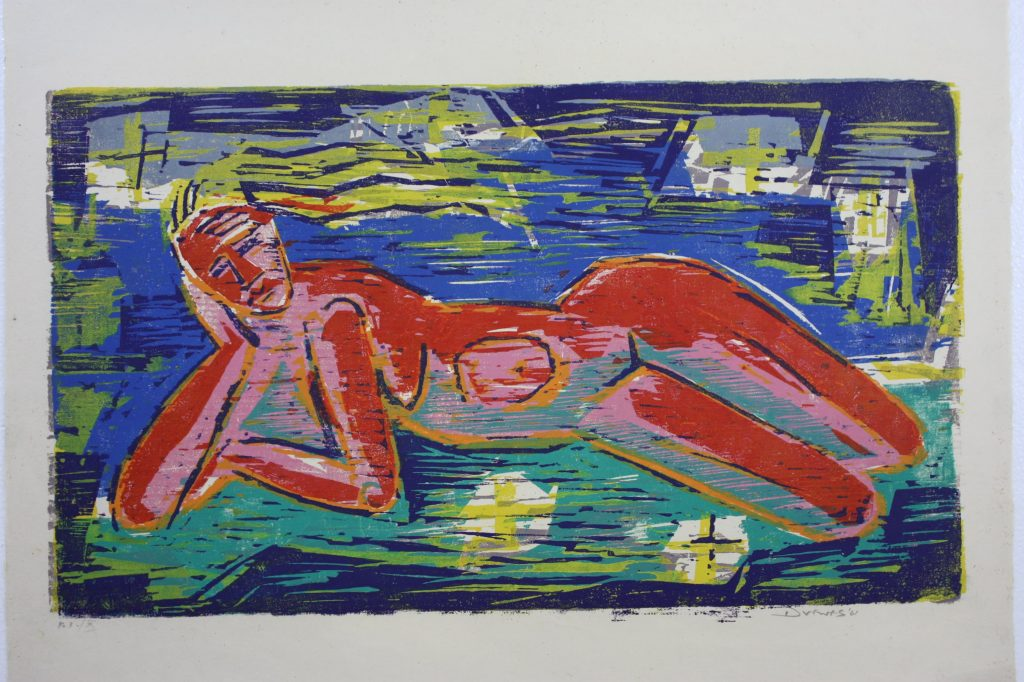
This is a woodcut by Werner Drewes, titled "Goddess of the Night":


It was executed in 1961 as an edition of 10; one of those editions is in the Smithsonian's American Art Museum. Drewes himself is no small figure: he is credited with bringing the Bauhaus movement to America, and he coined the phrase "It Can't Happen Here" as the title of a 1934 portfolio of works critiquing the rise of fascist repression in his native Germany (Sinclair Lewis would use it a year later for the title of his famous book).

"Goddess of the Night" recently auctioned for $924. Two other Drewes woodcuts sold together as a lot at that same auction for $826.

There's just something about that particular price range that I can't wrap my head around. It is simultaneously so expensive, and so accessible. It's so expensive in the sense that it is a figure that I would need to think about, and I'm far more financially secure than the vast majority of Americans. It's so cheap in the sense that it's a figure I can feasibly pay, which feels absurd to me when we're talking about historically significant artists whose works are in major museums.

Wednesday, February 05, 2025

How Many Robert Indianas Are Lost Per Year?


This is Robert Indiana's screenprint "Autumn", from the "Four Seasons of Hope (Gold)" portfolio. Executed in 2012, it was produced in an edition of 82. There were also some printer's proofs and hors commerce proofs set aside, so let's say that a total 100 of these prints were created.

Robert Indiana is a prominent artist and he has an active secondary market. A copy of this piece, for instance, is up for auction next week with an estimate of $3,000 - $5,000. That's far from jaw-dropping by art world standards, but it's definitely something worth keeping around if it's in your house.

So here's my question: of the circa 100 copies of this print that were created, how many do we think are "lost" per year? Or put differently, how many copies of this print still are, functionally speaking, "in existence" in the art world?

By lost, I mean to include things like:

  • The work being damaged beyond reasonable repair.
  • The work being thrown away or otherwise disposed of.
  • The work being in a location where it is forgotten about, or its owner not knowing what it is, such that it is unlikely that it would ever reemerge into the art world.
The last category does not include circumstances where the work is in someone's private collection and they have no interest in selling it (but they know what they have), but does include situations where someone just puts it in a box in their garage and forgets about it because they don't realize it is a prominent work by a prominent artist.

Presumably, all editioned art (or all art by a given artist, if we consider their entire career production as a whole) has an attrition rate. Once the edition is produced (or the artist dies), no more is created. Meanwhile, as life goes on and entropy takes its course, work progressively gets lost. Pieces in museum collections are, relatively speaking, safe from becoming "lost". But pieces in private hands are a different story -- it gets gifted to someone who doesn't realize the work is important, or someone dies and the print is tossed while the house is being cleaned up, or it is ruined a natural disaster. Stuff happens, in short, and so practically speaking that 100 figure is going to progressively tick down as time passes.

But I'm curious what people think the rate is. When one sees an editioned work by a prominent artist, how many of those works have disappeared?

Maybe 2012 is too recent for much of this particular edition to have been lost. Robert Indiana was very well-established by then; one would imagine most people who obtained his work would be people who knew what they were getting. The proportion of "lost" pieces for earlier works may be higher -- in part simply because of the passage of time, but in part because earlier in his career his work was more likely to end up in the hands of people who didn't really think of it as an artifact to be preserved.

My parents have a couple of great limited edition prints by some of the most famous artists from the mid-20th century, and last year I did a little project where I tried to "account for" as many copies of those pieces as possible -- looking at auction records, museum collections, gallery inventories, and so on. Even for the most prominent work with the smallest edition size (28 with 7 asides), I was only able to find info on less than half; for most of the works the number was far less. That doesn't mean those unaccounted for prints are "lost" as I defined it above -- I suspect many are in private hands with owners who know full well what they are* -- but it was still interesting to witness how much of even the most famous artwork in the world is, in practical terms, missing.

Anyway, no deep thought here, just a musing of the day.

* For example, my research would not have revealed anything about my parents' ownership of these prints, but for the fact that I obviously knew what they had.

Wednesday, April 17, 2024

The Submission is the Point


The Venice Biennale is an annual art exhibition designed to showcase the work of artists around the world. Open to exhibitors from any country with diplomatic relations with Italy, the event includes an official Israeli exhibit -- a fact which has unsurprisingly drawn the ire of those demanding a complete cultural boycott of Israel.

This year, though, there was a bit of a twist on that tale: the Israeli representative, Ruth Patir, elected to close her own exhibit until "a cease-fire and hostage release agreement is reached."

Patir -- who has been a regular participant in pro-ceasefire/anti-Bibi protests in Israel -- is not characterizing her decision as endorsing a boycott of Israel, which she emphasized she opposes, and I think we should respect her framing of her own actions. Much like with Natalie Portman, there's no reason to think that Patir does not know or understand the choices she's made.

But I don't really want to focus on the what Patir did, exactly. Rather, I want to take a look at how her decision was received by those who were demanding the removal of the Israeli exhibit. Consistent with the above, it would not be right to say that Patir was joining the boycotters. But it certainly seems like her actions were aligned with what the boycotters seem to want. 

Yet their reaction is, well, I would say it is very interesting and very revealing. What it reveals, in particular, is how the goal of this campaign is very clearly not to create a space where Israelis come out in opposition to the violent practices of their government, or more broadly one that creates space for an imagined future where Israelis and Palestinians relate to one another as equals. They do not see Israelis as potential partners even in an imagined futures. They see Israelis as enemies who must be made to submit. The submission, above all else, is the point.

Here's how they characterize Patir's decision vis-a-vis their campaign:

“The artistic team of the Israeli pavilion has retreated as a direct consequence of widespread pressure and our collective campaign.”

Note the framing. Patir "retreated" in the face of "pressure". She did not, under this telling, voluntarily align with -- even partially -- the effort to end the war in Gaza. She is not an example of someone stepping out from an (under this telling) benighted framework to see the essential need to speak out. She did not even make a volitional choice on her own. She was forced, coerced, compelled to back down. That's the victory -- not "Israeli publicly demands ceasefire", but "Israeli publicly forced to yield."

And having secured the dominant position, are the boycotters magnanimous in their claimed victory? Not at all. Her will may have been bent; but it must be broken. Referring to the fact that the closed exhibit can still be seen through the windows, the boycotters make clear that Patir remains firmly in the camp of an enemy to be crushed:

The Genocide Pavilion has been forced to respond to 24,000 signatories who condemn the Israeli genocide against Palestinians in Gaza but, contrary to the artistic team’s claims, they have not withdrawn, the pavilion has not been closed. 

ANGA reiterates its demand to shut down the pavilion in its entirety.

ANGA does not applaud empty and opportunistic gestures timed for maximum press coverage, and leaving video works on view to the public....

Leave aside the almost absurd richness of complaining about "gestures timed for maximum press coverage" (how is that a bad thing in this context?). The boycotters will not be satisfied until it is clear that Patir has yielded, that her choices are not her own, that what happens to her is something imposed upon her against her will. It is not elevating the call for a ceasefire, it is not even (really) the closure of the exhibit, that was desired here. It is the submission that is the point, and that has not yet adequately been achieved.

This type of politics rings familiar. It called to mind Justice Alito's contradictory desire "to bludgeon the legal community into freely accepting his preeminence." It's not enough for him to prevail on the formal terrain of saying what the law is, the legal community must yield to his superiority. I saw a similar dynamic in some circles of the 2020 Bernie Sanders campaign -- when it looked like he was on the path to victory, some of his backers looked ecstatically at the prospect that the Democratic Party establishment would be forced to "bend the knee". They were less excited about winning the Democratic primary than they were about defeating the Democrats. The submission of the enemy was the point.

This politics, fundamentally, demands not just victory but domination over the enemy. And as a result, it cannot tolerate -- it is infuriated by -- possibilities of agreement or reconciliation from the putative enemy. Often, the substantive issues supposedly being fought over are besides the point. If you wonder why some parts of the left can't seem to take "yes" for an answer, this is why: for Democrats to simply agree to some progressive proposal, without it being seen as somehow wrested from the party over its most primal objections, deprives these persons of the visceral sensation of domination -- it cheats them of their victory. So the framing will never be "I'm happy that they've moved closer to what I want," it can only ever be "they've retreated as a direct response to our pressure and collective campaign." The submission of the enemy was the point.

That's what's happening here in Venice. Some might naively argue that the message of the boycotters to Patir's decision is "counterproductive" -- why are they responding with such hostility and negativity towards an Israeli who is publicly stepping forward to demand a ceasefire? But as I often say, what's counterproductive depends on what you're trying to produce. If what you're trying to produce is more Israelis recognizing the imperative of a ceasefire, a collective change in Israeli outlook to alter the current bloody course, then yes this response might be counterproductive. But if what you're trying to produce is a world in which Israelis are stripped of autonomous choice entirely, are no longer in a position to self-determine at all or even be one agential part of a broader collective movement, then the boycotters' choice of action is entirely productive -- Ruth Patir's choice to close her exhibit, precisely because it was her choice, is just as threatening to that vision and equally must be crushed.

And just so we're clear: there's an Israeli parallel to this horrible political approach. There's a significant channel of right-wing Israeli thought which insists that peace can only occur when Palestinians acknowledge they've been beaten, that they've lost. From that position of submission, Israel can impose a new state of affairs that is vaguely and magnanimously promised to be just. But no deal can be reached under any terms if it is a deal made amongst equals, because the very notion of Palestinian equality is incompatible with them accepting they've been thoroughly defeated. Indeed, the whole idea of a deal that's agreed to by the Palestinians itself becomes automatically suspect -- if they agree, then it was not imposed, and if it was not imposed, then there was not truly submission.

But if your politics demands submission on a national or collective level -- Israelis or Palestinians as a whole forced to yield, forced to accept dominance, it is almost by definition not going to be one that actually is centered around equal respect for all. At most, it will promise to magnanimously dole out justice (more than they deserve) onto the vanquished party once it is well and clear that they are vanquished. But the vanquished will not be seen as candidates for equal participation in the future community. Indeed, any efforts they might make to participate -- even in ways that might superficially suggest they are aligned with one's own vision of what just equality might look like -- will only confirm that they have not fully submitted, and must be crushed further. The submission is the point.

To reiterate, this sort of toxic politics is not unique nor does it fully characterize the desires of either pro-Israel or pro-Palestinian actors. But it does seem like this particular campaign in Venice is one whose politics take this form of demanding complete and total Israeli submission above and to the exclusion of all else. And the results are exactly what one would expect.

Sunday, April 14, 2024

The Fruit Stand: A Mediocre Artistic Journey (And That's Okay!)

I consider myself a very creative person. But I don't have a lot of traditional creative outlets. I've always had very high expectations of myself, and as a corollary I didn't enjoy things I wasn't "good at". This would be so even if, under any reasonable adjustment for context/age/time/whatever, I was in fact "good at" the thing. I've talked a bit before about my math journey, for instance, and how I quickly self-identified as "bad at math" because it didn't come as easily to me as some other subjects, even though under any objective metric I was actually very good at math.

In the creative realm, this was if anything even worse. We'd get assignments to write a short story in English class, and my parents would always be so proud and want to read mine aloud. I hated that, not because I necessarily disliked the attention, but because I thought all my stories were terrible. I was ten years old, but I was absolutely assessing myself against both the actual books I was reading and the vivid adventure I was playing out in mind. As against either metric, my stories were sorely lacking -- which, of course they were, it'd be absurd if they didn't, but it still was something I found frustrating to point of feeling actual, physical pain.

The same would be true in art class. I liked the idea of art and creation, but there was a huge mismatch between the vivid ideas I had in my imagination and what I was physically capable of transmitting onto a page. I didn't (don't) have great fine motor skills, and every time I'd draw something or make something it would never come anywhere near the mental image I had in mind, and that constant failure was deeply unpleasant.

Of course, some people take that feeling of frustration as fuel to practice, improve, get better. Alas, I'm made of flimsier stuff, and so my takeaway was to instead concentrate on things that I had more of a natural knack for. And while I'm very lucky that I've found things that I both love and which come easy to me, I don't think the overall mentality of just hating doing things I'm not already good at is a healthy one. It's stilted my growth as a person, it has blocked off avenues I'd like to explore, and of course it is a self-fulfilling prophecy in terms of never actually improving or developing new skills I would very much like to possess.

So, in keeping with the art kick I've recently been on, I decided to try my hand at making some art. I set several mental ground rules for myself. The first was simple: it is allowed to be bad. In fact, it almost certainly will be. What I create will not match the image in front of me or in my head. And that's okay. What I'm doing is diagnostic -- a test. What would happen if I tried to make something? What can I do and not do? Is there potential here? Is this enjoyable?

That last point led to the other ground rule: I didn't have to enjoy it. That doesn't mean I was committed to slogging through while hating myself. But I was going to make a good faith effort to complete the projects I started, even if I wasn't getting the immediate "I'm great at this, hurray for me" dopamine hit. It was okay to struggle and not especially enjoy that feeling of struggling, but -- within reason -- I was going to persevere.

I started with this: 


The original model

Just so we're clear: I did not make this. This is a tchotchke my parents got years ago when traveling -- a small model of a fruit stand. Rather, I decided that I would just put this in front of me and try to draw it with a colored pencil set as best I could. I liked the bright colors, it was three-dimensional without being too complex, and it had some "flat" details that I thought I'd be better capable of replicating. The result was this:

"The Fruit Stand"


I will be honest: this is far, far better than I expected, given that I hadn't tried to draw anything more complex than a doodle in twenty years. My approach was very much in the "start with a slab of rock and then remove everything that isn't an elephant" vein: just draw what you see, and nothing you don't. It worked okay: I liked the overall color choice, the yellow and red lettering looks nice, the roof is fine, and I think the ombre effect on the bottom left of the building is decent enough. On the other hand, the small details of the three-dimensional fruit were completely beyond me -- in fact, pretty much all the three-dimensional components other than perhaps the building itself are pretty weak-sauce. I also didn't really like how obvious the pencil strokes were -- they felt so clearly drawn, even in the areas that were not especially detailed at the top of the building (again, my mental metric was basically a photorealistic depiction. Did I expect to come anywhere close to that? No. Did I view anything that fell short of that goal as something to be improved upon? Yes. I told you -- high standards).

There is one part of this drawing, though, that I genuinely like liked: the chalkboard. Ironically, that was the place where I was most intentional in departing from "try to draw exactly what you see", since I didn't have a tool that could "draw" in white over the black chalkboard. Instead, I got the desired effect by under-shading small splotches of the "board" with my black colored pencil, and then vigorously erasing those portions. I had discovered that erasers don't really erase colored pencil marks, but they did create a nice smearing that I think actually evokes a chalk board pretty well.

With one creation in the bag, I took stock as to where to go next. Well, I still have bad fine motor skills and I can't do anything with three-dimensions or tiny details. How about try a version as an abstract? Every detail that was too difficult for me to render, I could just turn into a block! Instead of using colored pencils, this time I'd use magic markers, which I thought would allow for more saturated color that wouldn't look as obviously "drawn" -- an even rectangle of blue, rather than a rectangle with blue strokes scribbled in. That got me this:

"The Fruit Stand" (abstract, in marker)

Despite committing to the concept of an abstract, I had a lot of trouble sticking to it -- I kept on being like "well how do I add this detail", and having to remind myself that the point of the abstract was that I wasn't going to incorporate every detail.

The markers didn't quite yield the even tone I was hoping for. I forgot how much markers bleed (that I was drawing on regular printer paper didn't help). I ended up using the unevenness of the marker to decent effect on the "roof", though I still can't decide whether that was in keeping with or pulling against the "abstract" theme. The red marks on the yellow (to evoke the lettering) was not as successful as I had hoped, and I wasn't able to replicate the chalkboard effect at all. That said, I think the "fruit" was much better, if only because it was at least a choice to render it as geometric shapes rather than (failed) literal depictions.

Ultimately, though, I thought the markers didn't work out as well as I hoped. So I tried the abstract again, but this time switched back to colored pencils:

"The Fruit Stand" (abstract, colored pencils)

I think this was a net improvement, though it still had the same benefits and drawbacks of the colored pencil medium vis-a-vis the markers. Once again, I loved the effect I was able to get on the chalkboard. Once again, I didn't find the red hash marks on the yellow to work as well as they did in my head. And once again, I didn't really love the lack of saturation in the colors. It worked okay in the dirt and wood chalkboard stand, because those felt like they should be more textured anyway, but even there that felt like I was again straying away from the idea of the abstract. For the most part, the colored pencils made it too obvious that this was a drawing.

I returned once more to the core question: how I could improve on the problem areas constrained by limited resources and skillset? At this point, I felt like I had tapped out the potential for the colored pencils. Instead, for my final iteration, I skipped out of drawing entirely. Instead, I decided to do a collage.

"The Fruit Stand" (abstract, collage)

This version, I think, was the most successful. It is the only one where I think the red marks on the yellow come close to what I hoped to see. The colors are even and fully saturated. The "fruits" all look nice, especially the grapes (on top of the pink bag). I don't like the chalkboard as much as I did with the colored pencils, but it still probably is objectively my favorite part.

Is any of this reaching the full depths of my imagination? No. Is any of it even good? I'll be generous and say that is in the eye of the beholder. Am I proud of what I did? Kind of -- I do like them (all of them), and I'm proud that I saw the project through. I also think the progression from the original model through the "literal" drawing and into different iterations of abstract is pretty neat. But the broader point of this exercise is that not everything has to meet sky-high expectations. Not everything has to be a home run off the first pitch. I'm okay with what I made, and that's okay. And being okay with okay is step for me that I am absolutely very proud of.

Tuesday, April 09, 2024

You Can't Accept Me If I Reject You Second!


There are many instances where I think BDS protests are misguided, problematic, or even morally abhorrent. But I'm not sure I've ever seen a case that more exemplifies BDS in its most petty, penny-ante self-aggrandizing form than this story coming out of San Francisco's Contemporary Jewish Museum, where seven anti-Zionist Jewish artists withdrew accepted pieces from a scheduled exhibition:

In a statement posted Friday on Instagram, the artists said they responded to the museum’s open call for works “to make visible the existence of anti-zionist Jewish artists in California.” They anticipated that curators would reject their pieces, which included explicitly pro-Palestinian messages such as “Free Palestine.” Several of the artists openly identified as anti-Zionists in their statements. They were surprised when guest curator Elissa Strauss accepted pieces by seven of the artists in the collective.

Following this "surprise" acceptance, the anti-Zionist artists fired off a list of demands in an obvious attempt to concoct an excuse to withdraw from an exhibition they never intended to join in the first place: 

In addition to demanding that CJM divest from pro-Israel funders, the artists sought extraordinary control over their artwork. They requested that the museum amend the terms they agreed to by giving them the ability to modify or withdraw their works from the exhibit at any time, and to have autonomy over wall texts, artists statements and other framing. (In their Instagram statement, the artists wrote that they were concerned about “potential curatorial both ‘sides-ism’” and about the possibility that their pieces would appear next to ones that “grieve Jewish deaths without acknowledging the genocide of Palestinians.”)

The museum, which communicated to all the artists in the exhibit that their work might be "presented in proximity to artwork(s) by other Jewish artists which may convey views and beliefs that conflict with [their] own", refused to accede to these demands, and the anti-Zionist artists subsequently announced their withdrawal from the exhibition.

So just to recap what went down:

  1. A bunch of anti-Zionist artists submitted works to a Jewish museum convinced that they would be summarily rejected, because of course the Zionist Entity would never permit their bold dissenting vision to see light of day.
  2. The museum accepted their proposals because it wanted to present a range of contemporary Jewish voices, which included anti-Zionist perspectives.
  3. The artists, clearly stunned to see their bluff called, followed up by demanding the museum kick out pro-Israel stakeholders and that their work not be displayed in the proximity of the Zionist artists.
  4. The museum refuses the demands, and the artists storm off in a manufactured "huff" -- in quotes because they very clearly did not want to be part of this exhibition to begin with and were hoping to make some sort of statement about Zionist censorship, only to have the tables turned and have it made quite evident that they were the ones trying to thwart representation of the diverse range of Jewish perspectives.
The museum, incidentally, will display prominent blank spaces where the artists' works would have hung, to symbolize their non-presence and draw attention to their decision to withdraw from the relevant community, which I think is fabulous. It also more concretely demonstrates the value of responding to the stilted, cloistered demands of BDS with a genuine commitment of openness and receptive engagement. Had the museum simply summarily rejected the artists, they would have no doubt issued one of those classic disappointed-ecstatic statements about how they were being censored and the hegemony of Zionist in the Jewish world leaving no room for alternatives. Instead, they were caught bluffing, it being obvious that they were the ones seeking censorship and narrowness, and that their non-presence in this community event was entirely a function of their own choices. There's a lesson to be learned here; though I'm unconvinced that many of the Jewish entities who may be faced with similar choices will internalize it.

And for what it's worth, I don't think the Contemporary Jewish Museum was (counter-)bluffing here -- "accepting" the anti-Zionist art pieces only in the expectation that the artists would do exactly what they did and withdraw -- and I hope they weren't. There are a range of Jewish voices on matters of Israel and Zionism right now, and works which are otherwise meritorious but express dissident views should be permitted their place in our communal conversations. Had the works been put on display, I would hope that everyone crowing about how the CJM sure showed those BDSers what's what would have been equally emphatic in defending the CJM's right to include those voices as part of a larger exhibit. Speaking as someone who recently helped organize a collective Jewish event whose contributors adopted a range of views, not all of which I personally agree with, I very much object to the notion that the right standard for inclusion in collective affairs is bounded by my personal ideological preferences. The CJM adopted the right approach, and should be lauded for its commitment to Jewish representation irrespective of a lack of similar commitment from other members of our community.

Wednesday, May 19, 2021

Three Rooms: An Immersive Jewish Experience

Years ago -- I think I was still in college -- I had an idea for an exhibit about a particular Jewish experience. It is by no means comprehensive, it does not tell a complete story. That's not its ambition. Its purpose would be to try and simulate a specific feeling or anxiety that I think many Jewish people have for a non-Jewish audience that often seems unable to understand it.

My idea for this exhibit never got beyond the level of an idea -- sadly, a fate that befalls many of my "ideas" -- but it's always been crystal clear in my head. So I describe it here. Who knows? Maybe one day it will be created somewhere?

The basic layout is a series of rooms. Attendees would enter the exhibit in small groups, one group at a time, starting in the first room. The room would have various exhibits, writings, pictures, and other illustrations of Jewish history in Israel -- both contemporaneous and of the deep past. Nothing especially out of the ordinary.

After some amount of time -- not immediately, but just quick enough to feel like an imposition -- an attendant would emerge to politely tell people it was time move on to the next room. They'd be ushered in to see another room, similar in many ways to the first, except this time with exhibits illustrating Jewish experience in the diaspora -- in Europe, in the Middle East, in America, and around the world. The attendant would leave them there, and return back to the first room.

Soon, however, a second attendant would come out. He would not be rude, but perhaps a bit brusque. This room, the second room, was not ready for them. Please return to the first room. He'll let you know when this room was prepared.

Upon filing back into the first room, the original attendant would evince surprise, then annoyance. What are you doing here? Didn't he already tell you it was time for you to leave? Go back to where you came from! This room is closed now. Protests about what the other attendant said would be ignored or brushed aside, as the group is shooed back into the second room.

The attendant in the second room would show himself immediately. He is no longer "brusque", or surprised, or annoyed. He is furious. Are you deaf? How dare you come back here! This is not your room! Get out, now, all of you. I'm done playing games with you. If you can't be here, and you can't be there, then go over there -- he would point to a different door from the one dividing the first and second room. The group -- trapped between the first attendant and the second attendant, seemingly unable to do right -- would scamper to escape, and enter the third room.

The third room would have no attendants. The third room would be entirely quiet and still. The third room would simply be pictures and exhibits of Jewish genocide: the Holocaust, the pogroms, the Inquisition, the Farhud. In that room, the group would finally be left alone, unbothered, for as long as it desired.

At some point, the attendants would reemerge, just to confirm that the attendees had not actually done anything wrong, they had done exactly what they were expected to have done, and the attendants were just playing a role. But the sensation of being chased, of being told that wherever you are, you are wrong for being there, buffeted back and forth between "homeland" and "diaspora", until the only place you're allowed to be left alone in peace is your own grave -- that sensation, so familiar to Jews, so seemingly foreign to so many non-Jews would, I hope, have been evoked just a little bit.

Tuesday, June 26, 2012

Iraq Cuts Arts Ties to the US over Jewish Artifacts

America's refusal to turn over Jewish artifacts recovered from Iraqi archives has caused that country to cut archaeological cooperation with the United States. I wrote about the dispute in more detail here, but basically there are three major elements:

First, the possibility that Jewish artifacts in Iraq won't be safe due to anti-Semitic pressure in Iraq. Second, the possibility that preserving and displaying such artifacts in Iraq will play an important role in humanizing Jews to Iraqis and reminding Iraqis of the long and vibrant Jewish history there prior to their effective expulsion in the wake of Israel's Independence. And third, the interests of the Iraqi Jewish community itself, many of whom live in Israel and thus would likely not be able to access their own history if it was hosted in Iraq (which refuses to admit Jewish visitors).

Sunday, October 10, 2010

The Sunday Return Roundup

Jill's been out of town this week, which means we missed both Project Runway and Hell's Kitchen. Tonight will be epic.

* * *

Tennessee Mosque opponents plan to argue that Islam is not a religion.

Pam Geller is, as Jeffrey Goldberg correctly adduces, a "vile, racist creature".

A Colorado woman is charged with destroying a controversial piece of art which she says demeaned Jesus.

Dana Milbank argues that Glenn Beck is the conspiracy-theorists go-to source for mainstream validation.

Jon Chait shoots down a ridiculous Christopher Hitchens post attributing the passage of a resolution condemning the Armenian genocide to the nefarious "Isreal Lobby". I'd also refer back to this post.

I find it quite outrageous the fury with which some Orthodox groups react to calling ordained (whoops, apparently that word is taboo too) female religious leaders "Rabbas".

Sunday, August 12, 2007

Overheard in New York

I had to repost this one:

In Fact, I Strongly Suspect We're an Invention of the Liberal Media

Black boy #1: Yo, how come there's only white people in these paintings?
Black boy #2: Mmm... Guess they were painted in 1750-something. They didn't have no brothers back then.

--The Met