Friday, February 26, 2016

On Pain

Pain is your body's way of telling you something's wrong.

There are other ways to do this. I, for one, am enamored with a sort of "damage report" pop up like I imagine Robocop or a TIE Fighter gets. It would have an outline of my body, with the effected portion in yellow or red, and say something like "thigh at 84%". That would also get me the information I need, but in a much cooler way.

Of course, pain does have some unique uses. It's relatively immediate feedback, for one -- you know right away to jerk your hand away from that hot stove (though my understanding is that the reflexive jerk actually occurs before the pain sensation is processed -- the latter is more of a punishment mechanism for your stupidity). CIP is a dangerous condition precisely because those who have it often don't even notice they've been damaged until it is too late. So as much as I hate to admit it, I concede that pain probably has a role to play in my body's damage alert system.

But still, sometimes it just seems ridiculous. Like, if I'm being burned at stake -- I already know something is wrong. I don't need pain receptors firing full tilt. It's sort of like a car alarm you can't turn off -- it's like, I get it! Shut up already! Other times, you feel pain for ailments that you have no ability to affect the relief of. Like (anybody who knows me knows what's coming) a kidney stone. Kidney stones suck.* But there's nothing I can do to ease the process. I just want to tell my body to handle it and stop complaining. A kidney stone would be a great candidate for getting a damage report I could peruse at my leisure.

Anyway, the point isn't to completely knock the current system. I get why it makes sense given the constraints of our meat sacks. But I am telling future designers of our transhumanist future that there's a lot of improvements to be had. So, you know, if you could get on that, that'd be cool.

* Fortunately, I haven't had another one since last year.

Thursday, February 25, 2016

Rasmieh Odeh Case Remanded By the Sixth Circuit

The United States Court of Appeals for the Sixth Circuit has ordered the district court to reconsider an evidentiary ruling against Rasmieh Odeh, who was convicted of lying to immigration officials in her naturalization documents (failing to disclose a terrorism conviction in Israel) and sentenced to 18 months in prison (followed by deportation back to Jordan).

While the majority rejected most of Ms. Odeh's contentions, it concluded that the district court erred in "categorically" excluding evidence of her alleged PTSD which -- Odeh argued -- caused her not to know her statements were false because she would have mentally suppressed all memory of her time in Israel (Ms. Odeh alleges that she was tortured by Israeli authorities in the process of extracting her confession). The Court did not rule that this evidence necessarily had to be admitted, only that the district court made a mistake in holding that evidence of this sort had to be excluded categorically (that is to say, the Court left open the possibility that the evidence should have been excluded for case-specific reasons).

The terrorism conviction regarded Ms. Odeh's role in bombing a supermarket, an attack which killed two civilians. I have obviously zero sympathy for her actions (there is no serious dispute that Ms. Odeh was involved in the bombing, the only question is regarding the extent); I likewise think that torture -- including of terrorism suspects -- is categorically wrong. Ms. Odeh's conviction, however, is not based on the Israeli conviction itself but on her failure to disclose it in response to a direct question by immigration authorities: "Have you EVER been charged with committing any crime or offense?” (a failure which, on its face, has nothing to do with either the bombing itself or her allegations of torture during interrogation). And while I am quite dubious of her claim that PTSD caused her to simply "forget" the conviction and ensuing prison term every occurred, the opinion by Judge John M. Rogers (a George W. Bush appointee) is reasonable enough in suggesting that such evidence could at least theoretically negate an element of the offense and therefore required more fine-grained analysis by the district court.

The other two judges on the panel were Karen Nelson Moore (Clinton appointee) and Alice Batchelder (George H.W. Bush); the presiding district court judge was Gershwin Drain (Obama). For all you "law is politics" fans, note that not only was this opinion written by a Republican reversing a Democratic appointee, it was in fact Judge Batchelder (the elder Bush appointee well-known for her staunch conservatism) that authored the most "pro-Odeh" opinion of all. She would have vacated the conviction entirely on the basis that admitting the details of Odeh's particular offense (the terrorist bombing) was unduly prejudicial. Since the conviction was simply about whether Odeh lied on her documents or not, there was nothing probative (but much inflammatory) in the jury knowing specifically that the conviction she had failed to disclose was for murdering two civilians in a terrorist bombing.

The case has been remanded back to the district court, which was left to reconsider its evidentiary ruling on alternative grounds and -- if it ultimately sides with Ms. Odeh -- whether a new trial is necessary.

Wednesday, February 24, 2016

Back in Black Roundup: 2/24/16

I've returned from a very pleasant vacation in Las Vegas. If my gambling record is any omen about how my thirties will proceed, I'm in good shape -- I actually finished up on the trip. The New Jersey Devils, by contrast, will never win another hockey game. Other highlights of the trip include eating at a Michelin-starred restaurant, watching Cirque du Soleil Zarkana before it closed, and reading "The Communist Manifesto" at the Bellagio Hotel (a decision which seemed insulting to both Marx and the Bellagio).

* * *

A Rabbi wins a parliamentary seat ... in Uganda. Putting aside the important symbolism for Uganda's tiny Jewish community, the Rabbi in question has stood out for being openly favorable towards gay rights.

A bizarre story out of Canada got an even stranger (but happier) ending. The Jewish National Fund of Canada pulled its sponsorship of the Jewish Federation of Vancouver's Israeli Independence Day celebration, citing the participation of Israeli singer Noa. JNF-Canada (wrongly) alleged that Noa was a supporter of the BDS movement. JF-Vancouver refused to budge, and guess who stepped in to replace the JNF as sponsor: the Israeli embassy! I hope the folks at JNF-Canada are duly humiliated, and have learned a valuable lesson about listening to right-wing trolls.

Protesters disrupted planned speeches by Palestinian human rights activist Bassam Eid at several Chicago-area universities. The protesters objected to Eid's opposition to BDS and his focus on both Israeli and Palestinian rights violations, and questioned his legitimacy as a Palestinian voice. Remember, though, BDS targets institutions, not individuals.

On the one hand, I find the argument that "I'm not voting for either Clinton or Sanders because neither one of them makes feel fuzzy about myself" to be ludicrously self-indulgent. On the other hand, if someone really is far "left" enough such that neither Sanders nor Clinton is more meaningfully attractive than Trump or Cruz, I can't really object to not voting for them. Merging those two arguments together, though, I think people who style themselves so far left that there's no meaningful difference between Sanders or Clinton versus Trump or Cruz are ludicrously self-indulgent.

I'm always interested in legal interpretations which (properly, in my view) cast blanked boycotts against Israel (or any other country, for that matter) as a form of national origin discrimination.

Intersectional discourse has its failings when it comes to Jews (stayed tuned for more exciting information on this!), but James Kirchick really needs to stop writing on a topic he knows nothing about.

Monday, February 22, 2016

Who Will Be Trump's VP?

As much as many hate to admit it, at this point Donald Trump has to be seen as the significant favorite to win the GOP presidential nomination. Which raises a question I hadn't thought of before -- who would be his VP choice?

It's a tough question. Obviously, the Republican primary has been one of the nastiest in recent memory -- I think we can rule out a Trump/Bush or Trump/Cruz ticket, for example. And Trump is notably disconnected from the establishment, which gives him little leverage with high-profile elected Republicans on the outside of the nomination race. His only gubernatorial-level endorser is Sarah Palin, and even Trump can't be dumb enough to repeat that disaster (can he?).

Basically, I see three possibilities:

1) One of the seven dwarves. There were so many Republican candidates for President, but a large swath of them never really emerged from obscurity and so didn't really catch the brunt of a Donald Trump temper tantrum (or at least, it happened long enough ago that we'll all have forgotten about it by now). So even though it can't be any of the "front-runners" -- Bush, Rubio, Cruz, Walker, etc. -- a Pataki or a Jindal would be reputable enough without being saddled by a week of footage of Trump calling them "losers" (maybe just an hour or so).

2) Another businessman sort -- a Lee Iacocca type. Trump obviously doesn't care for Republican politicians, and it's not like he's going to run away from his lack of political experience. So why not double-down? Are two rich white Wall Street Captains of Industry really any less electable than one?

3) Former Massachusetts Senator Scott Brown. He's literally one of two (former) federal-elected officials to have endorsed Trump, and the other, former Virginia Rep. Virgil Goode, isn't even a Republican anymore. Brown actually seems like he would make a strong pick -- he cut a moderate enough profile to briefly hold a Massachusetts Senate seat -- but it could further inflame the "he's not a true conservative" contingent of the GOP (though surely at some point that branch has to engage in some self-reflection about what "true conservative" is, right?). If I had to venture a prediction, he'd be it.

But those are just off-the-cuff thoughts. Who are your predictions?

Saturday, February 20, 2016

Terrible Speakers from Williams to Vassar

The President of Williams College, Adam Falk, has prevented a student group from hosting a speech by right-wing pundit John Derbyshire. I've actually written once before about a similar flare-up concerning speeches at Williams, concerning the same student group ("Uncomfortable Learning"). But whereas in the last post I argued that the student protesters had struck the right note (protesting the decision to invite the speaker in question, Suzanne Venker, but not demanding that she be "banned"). President Falk's decision is a whole different kettle of fish. It is an outrageous assault on academic freedom, despite the fact that I whole-heartedly agree that Derbyshire's views (and the likely content of his speech) are abhorrent and racist.

The distinction between what happened previously versus in the instant case is simple. As I explained in my Academic Freedom versus Academic Legitimacy essay, academic freedom is a constraint on remedies -- when academics engage in terrible speech, it takes certain responses (banning the speaker, punishing the host group) off the table. It does not, however, preclude arguments that the hosts made a mistake in extending their invitation to someone who ought not be considered a useful contributor to academic discourse; nor does it preclude efforts to convince (not require) the group to reconsider its invitation once extended. These latter moves still need to be justified, of course, and we can fairly object in cases when they seem to be abused. But I don't think they are in of themselves academic freedom violations -- they are academic counterspeech, vital to the project of academic exchange.

By all accounts, it was this latter set of moves that were deployed in the Venker case. And, as Ken White lucidly argues, these arguments would have had considerable purchase against Derbyshire as well (though one significant -- though not necessarily dispositive -- counter-argument is that the African-American President of "Uncomfortable Learning" wanted the opportunity to confront and refute Derbyshire in person). But instead of forceful counterspeech the college administration jumped straight to one of the prohibited remedies. It banned Derbyshire in defiance of the wishes of a student group generally authorized to invite such speakers. There's simply no way to justify such a blunt exercise of administrative coercion against members of the academic community within the constraints of academic freedom.

In reflecting on this case, what jumped to mind was another recent case of a seemingly-terrible, bigoted speaker being invited to present at a northeastern liberal arts college -- Jasbir Puar at Vassar College. Dr. Puar was also invited by duly authorized members of the college community; her hosts (presumably cognizant that she would prove "controversial") even pleaded with the audience not to record her speech (a request, which, incidentally, I find independently outrageous and wholly unwarranted under the circumstances). Her talk was apparently a litany of vicious accusations of Israeli barbarity -- virtually none of which were supported by anything other than raw speculation buttressed by "knowledge" of the innately depraved hearts of Zionist Jewry. She complained that Jews had effectively hijacked the language of victimhood to box off global knowledge of their genocidal tendencies, that Israeli scientists engaged in widespanning medical experiments on Palestinian children to stunt their development and wage genetic warfare against them, and that accordingly boycotting Israel should be part and parcel of a broader strategy of violent attacks against it. The speech appears to be entirely beneath the standards of legitimate academic dialogue. That many academic departments at Vassar considered her to be a worthy contributor to such discourse speaks poorly of their judgment as academics (an assessment which is hardly challenged by the response of one of the inviting professors when challenged as to whether he believed Dr. Puar's allegations: "You prove to me that anything she said wasn’t true." This is an academic talking?).

I do not think Dr. Puar's speech should have been banned. I am perfectly content with responses of the sort I identified above: critiquing the judgment of the invitation while affirming the right of the invitation to be extended. Of course, that's cheap for me to say since her speech already has occurred. And it's possible that the reason the option of an outright ban doesn't appeal to me is simply because I know it's not viable for people in my community; the check President Falk writes is one I know I'm not entitled to cash. I don't think my position is merely a case of sour grapes, but I do think that line of analysis points to a real problem -- what Eugene Volokh has termed "censorship envy". If we are going to censor certain offensive speakers, those outgroups who still are forced to endure speech they find hateful can fairly wonder why they aren't entitled to the protections extended to others. The Jewish student at Vassar can read the goings-on at Williams College and justly ask "why not us? Why should we have to endure what others don't?" It's a fair question. I'm not sure it's an answerable question.

Better, then, to make it a moot question. The fact that we cannot have confidence that college officials or other authorities will distribute the fruits of censorship fairly or equitable is one excellent reason (among many) to deny them that power. Perhaps John Derbyshire should not have been invited to Williams in the first place; perhaps the same can be said about Jasbir Puar. There is much that can be said and perhaps should be said in defense of those points. But academic freedom means respecting the difference between a critique and a prohibition. When that distinction isn't acknowledged, the harm does not just extend to the community deprived of the right to confront those views, or even to to the barred speaker whose views have been deemed out of bounds. It is also felt by the members of all the other communities who know that they will be forced to endure their particular slings and arrows, that hurting them or spewing hate at them is apparently perfectly in bounds. Simply put, Williams College should be just as tolerant (and no further) of John Derbyshire as Vassar College should have been towards Jasbir Puar.

Thursday, February 18, 2016

The Issue is Mizrahi Power

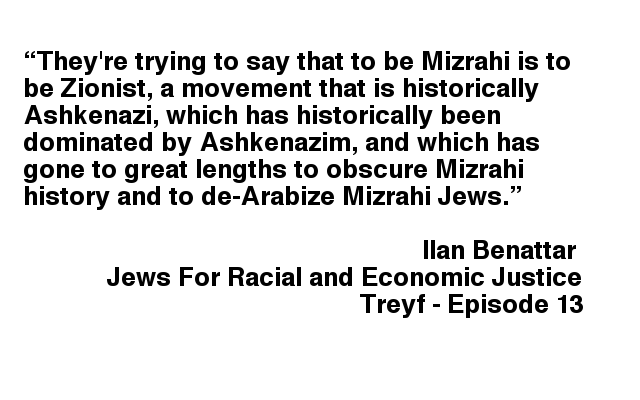
The article Analucia Lopezrevoredo and I wrote on the general failure of intersectional analysis to account for Mizrahi Jewish experience (and, more generally, how Mizrahi Jewish experience is erased in broader discourse about Jews -- regardless of whether the speaker falls on the ideological spectrum) has been featured on the Treyf podcast. They brought on llan Benattar from Jews for Racial and Economic Justice’s Mizrahi caucus to comment; he was ... not a fan. The podcast hosts themselves alluded to finding many of our points interesting, but never really got to say which ones -- one gets the sense, though, that their position is that "the article raised a lot of good points right up until the parts where it implicated us in the problem."

In any event, speaking for myself and not Analucia or JIMENA (who are capable of correcting the misapprehensions Benattar has about JIMENA's mission), I found that Benattar's comments were an excellent encapsulation of our core thesis regarding Mizrahi Jewish inclusion (or lack thereof) in broader patterns of discourse.

Let's put two excerpts side by side. Here is how Benattar charaacterizes the core argument of our article, which he terms a case of "Mizrahi-washing":
And here is the part of our article that is most directly germane: 
When asked to speak at certain Zionist functions, many Jewish refugees from the Middle East and North Africa are asked to focus on the mistreatment they experienced under Arab rule—not the ways in which they successfully coexisted with Muslims, or the serious discrimination they have faced in Israeli society after arriving in the Promised Land. In anti-Zionist circles the situation inverts: the hosts are delighted to hear tales of Israeli malfeasance but are deeply hostile if the topic turns to the oppression and expulsion of Jews from Arab countries or if the Jews proclaim a proud connection to Israel. Either way, non-Ashkenazi Jews are engaged with only as far as they support someone else’s narrative. Once they seek to speak in their own voice, their putative allies disappear.
Not only are we perfectly cognizant of the manner in which Ashkenazim have historically been dominant in Zionist circles and have sought to deemphasize the interconnection many Mizrahi Jews have had with Arab history, particularly when they clash with Zionist narratives, we lead with it. Our sin is nothing more than the concurrent observation that the same is true of the anti-Zionist movement: also historically Ashkenazi dominated (at least in its Jewish manifestation), also quite prone to deemphasizing aspects of Mizrahi identity when they conflict with anti-Zionist shibboleths. The sins are identical: "non-Ashkenazi Jews are engaged with only as far as they support someone else’s narrative." None of this is to say that there have not been significant Zionist and anti-Zionist Mizrahi voices, none of this is to say that "to be Mizrahi is to be Zionist" (or not). To frame the question in this way misses the point entirely. We are quite clear that the crucial obligation for non-Mizrahim is to confront the community as it is, on its terms, irrespective of whether those terms are Zionist. It's not us that are seeking to essentialize Mizrahim into one mode of being vis-a-vis Zionism.

The reason we link this up to certain practices in anti-Zionist circles isn't because "to be Mizrahi is to be Zionist", it's simply because as a matter of raw numerical fact many are, and "irrespective of whether those terms are Zionist" cuts both ways. If one excises the Zionist part of the Mizrahi community from the part one is willing to talk to, one is left with a lot fewer Mizrahim. That is no doubt to the benefit of Ilan Benattar, since it means a lot more people will be talking to him. But it is not a viable nor a progressive proposition for engaging across difference; it inscribes the very sort of exclusion we critique.*

Indeed, I think we need to interrogate the move being made here more closely. It is highly reminiscent of Herman Cain's plantation politics: Most Blacks are being duped and deceived by the Democratic Party which wants to keep them "on the plantation," their condition is used as a tool to support politics "we" (those like Cain) know are bad, but a few Blacks, like Cain, "can think for themselves" and are the ones you should listen to. And likewise, Benattar casts contemporary Mizrahi politics as being obscured from itself, the product of a Zionist-Ashkenazi effort to make it in its own image for its own ends, such that it is okay to generally ignore Mizrahi Jews (who largely remain on the Zionist plantation) in favor of the few, like him, who see past the ruse and can tell you what's what.

Now here I want to be very careful about the point being made. It is not that Jews (Mizrahi or otherwise) are not entitled to critique or dissent from the prevailing orthodoxies in the community. I do not believe that Ilan Benattar or Herman Cain (or Ben Carson or Clarence Thomas or Marco Rubio or Ted Cruz) have any particular obligation to adopt the political posture of their broader community. I have always firmly taken the stand that there is no legitimate politics (based on solidarity or anything else) that writes such dissent out; and that means (among other things) that it is flatly wrong to claim that Jewish anti-Zionists have forfeited their Jewishness by virtue of their position. From my personal vantage point, such a stance would make me a terrible Zionist -- I view Zionism as about Jewish self-determination, and that includes the right of a Jewish self to determine that Zionism is incompatible with their assessment of the Jewish condition or Jewish obligations. One can argue against the positions on their merits; but the fact of adopting the positions doesn't mean the speaker "isn't Jewish" or is a "self-hating Jew" or whatnot (for the same reasons I object to referring to Cruz or Thomas as race traitors or Uncle Toms or what have you). Jews should have the same right as anyone else to come to positions that you or I think are wrong.

So the problem isn't the critique itself, that's fair game. The problem rather is in the final step -- the proffer that one can justly ignore most members of the outgroup and instead only speak to the dissident wing. That silencing -- really tokenizing -- move is what's objectionable; the forwarding of oneself as a substitute for engagement with the broader community constructed as defective and unworthy of deliberative inclusion. When outgroups (whether we're talking about Jews generally, or Mizrahi Jews specifically, or Blacks, or Latinos, or Palestinians for that matter) say things that are hard to hear or which raise difficult critiques of passionately-held positions, the right move is not to race off to find your friend who agrees with you and be assured that everything's alright. One need not assent, but one should at least listen and think. And so here I will cop to at least one of the many motives that Benattar ascribes to Analucia and myself: We do need to engage with Mizrahi perspectives in Israel, even when they seem quite distant from our own ethnic, political, or cultural priors. Why? Because that's what one does when trying to ethically encounter difference -- particularly difference that is paired with historical patterns of marginalization.

In terms of substantive responses to our article, I think that covers it. But I did also want to make a note of one of the particular rhetorical stylings that was deployed. Throughout his segment, Benattar accused Analucia and I of "co-opting" the language of intersectionality for our own supposedly right-wing ambitions. He used this word so many times I think he must have hired Marco Rubio's speech coach. And on one level, I find this amusing: I've sometimes remarked that intersectionality brings out my inner hipster -- I was reading it way before it was cool (before Benattar even got to college, in fact) -- so who's really appropriating what here?

But the bigger point is, once again, about exclusion. The language of "co-option", obviously, is intricately connecting to the language of standing -- who is authorized to use terms like "intersectionality" and who is trespassing? We already knew, of course, that Jews generally have no standing to utilize such terms on our own behalf, we now know the same is true of non-Ashkenazi Jews specifically (at least when they do so in ways that are not ideologically amenable to particular elements of the left). Our alleged deficiency is that we are insufficiently "progressive"; left unsaid is who established the metric of "progressive" and who installed Benattar as its arbiter. Why should Analucia or myself cede him, or anyone else, that authority? Why is it just accepted that Jewish entry into progressive spaces is always on a probationary basis?

One can see a very particular sort of anti-Semitic exclusion operating here: Jews are not equal members of political communities (progressive or otherwise) we inhabit; we are members to the extent that others permit us to be; which typically manifests as membership to the extent that we affirm the understandings of the dominant groups. Hence, when we level what we take to be a progressive critique at a progressive discourse surrounding Jews, the fact of our dissent is itself sufficient to exile us from the relevant interpretative community. We are not entitled to stake independent claims on progressive concepts when doing so conflicts with how the "real" progressives, the people empowered to govern the borders of "progressive", conceptualize the understanding of "progressive." It's the same damn sin again, we are entitled to partake in discourse "only as far as [we] support someone else’s narrative."

The issue, as Melanie Kaye/Kantrowitz wrote so long ago, is power. Who has it, who wants it. In both the substantive and rhetorical formulations, one can see how Benattar's goal is to delegitimize wide swaths of deliberative contributions from progressive consideration and concentrate progressive discursive power in the hands of people like himself. There is no space for an internal progressive critique by Jews of progressive discourse, because once it emerges it ceases being progressive (now right-wing trolling). There is no space for a Mizrahi critique of anti-Zionist practices because once it emerges it ceases being Mizrahi (now Ashkenazi false consciousness). Hence how Analucia and JIMENA can each be dismissed here as co-opters and appropriators -- what credential exactly are they missing such that their deployment of the term intersectionality is inauthentic? For other readers, of course, the problem is inverted -- there is no space for a Mizrahi critique of Jewish Zionist practices because once it emerges it ceases to be Jewish (what, exactly, are they missing?). All of this is the same politics -- just swapping out whose ox is gored. Progressivism, as I understand it (and we already know how much that's worth) is about breaking down such patterns of power and domination. Progressivism, as many others understand it, seems to be more about reshuffling the deck.

The issue is power -- who has it, who wants it. I do not think that Mizrahi Jews, or any Jews, need to be Zionist, I do not think that it is my place to tell Mizrahi Jews what to be. I think that Mizrahi Jews, like all Jews, should be decide for themselves how they conceptualize their condition and their situation; as it happens, many have decided that Zionism fits, some have come to a contrary conclusion. And then I think that other people should be willing to listen and engage with their reckoning, regardless of whether it coheres to the narratives we began with or not.

* Here Benattar accuses us of ignoring the BDS movement's long-stated principle that it targets "institutions, not individuals". The reason I ignore it is that it is impossible to credit. First, I'm dubious that the alleged principle is even a coherent one, as if in multilayered and stratified societies any of us come in as atomized individualized disconnected from surrounding social, cultural, or academic institutions (such a libertarian way of looking at human experience is particularly difficult to swallow in a discussion of intersectionality, which is quite concerned with how we are bound up in a multitude of overlapping identity affiliations that cannot be disaggregated from our core "individual" selves). And second, even if the principle could be expressed coherently it has been breached so often in practice that I can't view it as anything other than rhetorical. There is no serious likelihood that the BDS movement will, in fact, engage with the Israeli Mizrahi community as currently constituted regardless of whether they try to speak "individually" or "institutionally"; more likely (as in the "A Wider Bridge" fiasco -- an organization which, incidentally, has been far better than most about incorporating Mizrahi voices) any efforts to bring such "individual" voices to the fore will be deemed "institutionally" suspect (Benattar even throws out the term "Mizrahi-washing") and thus subject to boycott.

Tuesday, February 16, 2016

Anti-Semitism at the Oxford Labour Club

The (now-former) co-chair of the Oxford University Labour Club announced his resignation, citing rampant anti-Semitism within the organization: 
"Despite its avowed commitment to liberation, the attitudes of certain members of the club towards certain disadvantaged groups was becoming poisonous," [Alex] Chalmers wrote.

"Whether it be members of the Executive throwing around the term 'Zio' (a term for Jews usually confined to websites run by the Ku Klux Klan) with casual abandon, senior members of the club expressing their 'solidarity' with Hamas and explicitly defending their tactics of indiscriminately murdering civilians, or a former Co-Chair claiming that 'most accusations of antisemitism are just the Zionists crying wolf,’ a large proportion of both OULC and the student left in Oxford more generally have some kind of problem with Jews," Chalmers continued. 
 Oxford's Jewish Society (JSoc) released the following statement of its own:

Oxford University Jewish Society is saddened by the anti-semitic reports coming out of Oxford University Labour Club, and stands fully in support of Alex Chalmers' decision to resign.
We are, however, unsurprised by this news. It is not the first time that Oxford JSoc has had to deal with anti-semitic incidents within the student left and it will not be the last. It is a significant and worrying issue and one that on many occasions, Jewish students have felt that they are fighting alone. We are grateful that Alex Chalmers has made the statement that he did and has brought the issue of anti-semitism to the fore in a way that Jewish students have so far been denied.
Oxford JSoc strongly rejects any accusation that Jewish students are inventing claims of anti-semitism to discredit Palestinian solidarity politics. This is a repeated trope that has been used to silence Jewish students and it will carry weight no longer. When anti-semitism intersects with Palestinian solidarity politics, it is not the job of Jewish students to be quiet, but the job of Palestinian solidarity activists to rid their movement of anti-Jewish prejudice.
Many of Oxford’s Jewish students who hold progressive views have long felt excluded from left-wing political spaces. Jewish students who raised the issue of anti-semitism at the OULC meeting were laughed at and mocked. It is high time that this issue is confronted. We hope Alex’s resignation triggers a broader awakening amongst student political movements, and that anti-semitism, particularly on the student left, is finally taken seriously.
That third paragraph is critical, and needs to be repeated over and over again. Jews have been too deferential to the Livingstone Formulation for too long, and it's high time it stopped carrying weight. Our sense of alienation and maltreatment is entitled to the same respect and concern as any other outgroup; casting it as a bad faith ploy is no less reactionary than when any other group is claimed to be "playing a card".

Monday, February 15, 2016

Jane Kelly For SCOTUS?

I've been hearing murmurings that Eighth Circuit Judge Jane Kelly might be the President's SCOTUS nominee. And there are a lot of dimensions along which that makes a lot of sense.

I've never actually met Judge Kelly, but I'm quite familiar with her. She arrived on the Eighth Circuit in 2013 midway through my clerkship with Judge Murphy, finally ending the latter's streak as the only woman ever to serve on that court nearly 20 years after she was first appointed. Kelly's confirmation was unusually easy in this day and age -- a 96-0 vote taken three months after her nomination -- apparently because she is very well liked by Iowa Senator Chuck Grassley. The Republican chairman of the Senate Judiciary Committee is no small ally for a prospective Obama nominee to have. And it would be difficult for Republicans to justify blocking a nominee they quickly and unanimously confirmed to the Eighth Circuit barely three years ago.

Beyond the purely tactical concerns, Judge Kelly is an interesting choice for another reason: Prior to her elevation to the bench, she was a career public defender, working in the Northern District of Iowa from 1994 to 2013. That background is extraordinarily uncommon on the federal bench, and I believe entirely unheard of on the Supreme Court. Her nomination would certainly have particular resonance in the current political moment where overstretches of the police state have been a central issue occupying progressive activist thought.

Now normally, what that background giveth, it also taketh away -- it is very easy to caricature a federal public defender as "soft on crime" (pluck out the most gruesome murderer she ever defended and ask why she wanted to keep him on the streets). But -- and not to get too macabre -- Judge Kelly has a personal story here too that helps insulate her from that particular angle of attack: she was beaten unconscious and left for dead in an unsolved 2004 assault. She is far more intimately familiar with the ravages of violent crime than nearly any other high-level government official in the United States.

Of course, if Judge Kelly were nominated and confirmed, that would restore Judge Murphy as the sole woman on the Eighth Circuit (and -- perhaps even more amazingly -- would also leave her the only active Democratic-appointee on it). But I get the sense she wouldn't mind. Judge Kelly would certainly put a lot of pressure on Senator Grassley and the wing of the GOP Senate that still isn't 100% comfortable with government-via-tantrum. And beyond that, I don't think she'd make a half-bad Justice either.

UPDATE: Speaking of Grassley, he's stepped back from the edge a bit, saying he won't decide whether to hold hearings on President Obama's nominee until the nomination is announced. Admittedly, other quotes from the same interview are less promising. But if this is a slight step towards rapprochement, a Kelly nomination could be just the way for Obama to respond in kind.

(I'm going to just say I'm predicting a Kelly nomination now. It's a bit of a dark horse pick, but I'm undefeated so far in Obama SCOTUS predictions so why not roll the dice a bit?).

Saturday, February 13, 2016

Justice Antonin Scalia Dies at 79

Justice Antonin Scalia, the senior-most Associate Justice on the Supreme Court, has died. He was 79. Scalia served on the Court for 30 years, following stints on the D.C. Circuit and time as a professor at the University of Chicago Law School.

Obviously, this comes with significant political and legal ramifications. Not only was Justice Scalia considered the intellectual powerhouse of the Court's right wing, his departure converts a 5-4 conservative majority into an equally divided Court. Even if the Senate refuses to confirm any Obama nominee, this matters -- in the event of an evenly divided vote, lower-court decisions stand 

Still, there will be time enough to delve into the gritty, necessary task of judicial politics later. For now, it's worth reflecting on the mark Justice Scalia has left on the legal landscape. It is considerable. I think there are very few law students who, exhausted from slogging through some of the more stultifying prose that often graces the United States Reports, did not find Justice Scalia's writing to be a breath of fresh air. He was witty, often cuttingly so, and his dissent in PGA Tour v. Martin may be the funniest Supreme Court opinion ever written. Writing aside, Scalia had a flair for taking bold stands that demanded a response if not agreement, and which often set the tone for what would become the consensus conservative position in the years to come.

My friend Kim Smith put it best: "Antonin Scalia was often brilliant and occasionally right." There are worse epitaphs for a Supreme Court justice to have. Rest in peace, and condolences to his friends and family.

The First Post of the Rest of My Life

I just turned 30 (on Thursday). Happy birthday to me!

Arguably, that's part of why the blog has been quiet these past couple days -- a mix of celebration and mourning. But in reality, I just haven't really found anything that grabs my eye. In any event, I didn't want folks to get the wrong impression -- that now that I've officially entered my old age this blog would be shutting down. I have no plans of that. Just a normal lull, as is prone to happen. I'm not as quick as I used to be, after all.

Monday, February 08, 2016

Why I'm (Lean) Clinton

I have stressed before, and I will again, that Democrats are extraordinarily fortunate to have two excellent candidates competing for our nomination. I will happily vote for either, not just because "God help us if a Republican wins", but because I think both are decent, smart, progressive individuals who will make fine Presidents. There are good reasons to vote for either Clinton or Sanders in the primary; I begrudge nobody of their choice (so long as it isn't followed up with the incredibly stupid choice of refusing to vote for the Democratic nominee if the other one wins).

All that said, I have considered myself "lean Clinton" for the duration of this race, and perhaps it's time to explain why. I do think my reasoning is a bit idiosyncratic.

Let's start with what I like about Sanders. First, he's an unabashed progressive, and I am too. So right off the top, that's nice. Likewise, I will happily admit that it is meaningful to me to have a high-profile Jewish candidate in the race (and one with a classic Brooklyn Jewish accent, no less). And I actually think there is a solid case to be made that he's the more electable candidate vis-a-vis Clinton: He's the only candidate -- Republican or Democrat -- with positive favorables (48/37; Clinton is 42/53; Marco Rubio has the best spread among Republicans at 37/41).

Moreover, whether or not Sanders ends up winning the nomination, I definitely think it's an unadulterated good that he's in the race. Senator Sanders has been a godsend in giving voice to perspectives that have for too long been marginalized in American politics. Much of political discourse is afflicted by what Elisabeth Noelle-Neumann called "spirals of silence": given perspectives are not aired, and because they're not aired people assume they're marginal, and because they're viewed as marginal even people who might privately be amenable to the perspective still do not air it. When a high profile member of society does give voice to this outlook, suddenly it sends a signal that actually it is "in bounds" and can cause other people to poke their heads out as well. In this respect, Senator Sanders is sort of the light-side version of Donald Trump. Just as Trump has made clear that there is a non-negligible portion of the American electorate that is openly attracted to racist appeals, Sanders has shown there is a real constituency for genuine economic liberalism in America that has punch to it.

What about Clinton? Well, It is true that she has far more executive and foreign policy experience than does Sanders, and that matters. But what matters more to me is that I respect the hell out of her. I think Hillary Clinton is smart as a whip and a tireless worker. I also trust her ability to win a knife fight with Republicans -- important given that the GOP shows no signs of shrugging off its apocalyptic streak in the near future. Her performance during the Benghazi hearing was a thing of beauty and showed the difference between a genuine political professional and a clown-car of amateurs racing to see who can be the biggest embarrassment.


I never liked Hillary Clinton more than in that moment.

But by far the biggest thing about Clinton is that I believe in her ability to get shit done. Perhaps this is the D.C. native talking, but the most important thing about controlling the executive branch is not the soaring speech or the sweeping policy initiative. It's deep in the trenches of the federal bureaucracy: the obscure EPA rule being actually implemented, the right people running the NLRB, the OSHA rules being vigorously enforced for once, the District Court vacancies being filled with solid judges who respect the American constitutional tradition. I think Hillary Clinton gets that. Her pragmatism appeals not because I like compromise for compromise's sake, but because I think she understands all the little ways to move the ball forward, and I think she'll be excellent at doing that. I was never disappointed that Barack Obama didn't transform American politics or end money in elections or obliterate public racism -- I never expected him to do any of those things. But I was disappointed that he seemed slow to grasp the importance of nominations and appointments (in the executive branch and the judiciary). I can't imagine Clinton making that mistake.

So how do these factors shake out? Many of the things I like about Sanders manifest whether he gets elected or not. He's already put pressure on Clinton to move to the left, and he's already demonstrated that progressives are a political constituency that any Democratic presidency must be attentive to (just as Republican elected officials have learned to court to the Tea Party). On electability, I'm not sure if Sanders' current advantages will hold through the general election once a billion dollars of "He's a Socialist!" ads come pouring in. This is particularly worrisome to me because I think the media -- always looking to balance the Scales of Broder -- will jump all over the narrative of "both Democrats and Republicans have nominated extremists!"

On policy, I really don't expect a ton of difference in the broad proposals that a President Clinton and a President Sanders would offer. Maybe I'll like the exact words Sanders puts in his speech a little more. But I do think there will be a big difference between their ability to actualize them into concrete outcomes. I think Clinton knows how to play and win the Washington game, and that on that metric Sanders is at best unproven.

And that's what holding office is about. I don't vote for the President as an expression of "solidarity" or feeling good about myself or "being part of something bigger." I want a President who makes things better. It doesn't matter if it's low profile or obscure or is a victory of a hundred thousand inches instead of a mile long leap. You vote for a President who will get shit done. And that's the arena where I believe, in my bones, that Clinton is the better choice.

Saturday, February 06, 2016

Interviewing My Friends: Sunny Yang

While I have known her since high school (we went to an enrichment camp together), today Sunny Yang is an Assistant Professor of English at Louisiana State University. She received her B.A. from Swarthmore College and her Ph.D from the University of Pennsylvania. Sunny’s research and teaching interests include ethnic and African American literatures, critical race theory, law and literature, and U.S. empire. Her current book project, “Fictions of Territoriality,” examines the competing narratives of race, rights, and governance that arose from U.S. imperial and territorial expansion in the long nineteenth century.
Sunny Yang: What happens if I'm incredibly boring and there is nothing to post? Then we'll just have a nice catchup?
David Schraub: Well I'll throw in a few swear words and see if I can get you fired. I hear that's a thing now at LSU.
Sunny Yang: I had two people send me that article! Right before I went to LSU, I mean. I'm pretty sure I'm allowed to swear outside of the classroom. Malign Mike the Tiger or the football team though and then I could have some problems…
David Schraub: Okay, first thing's first -- let's get the quick biographical sketch. Where were you born and raised?
Sunny Yang: I was born in Guangzhou, China, moved to the U.S. (specifically Memphis, TN) when I was two years old, then moved to Carmel, Indiana in sixth grade. So I don't know which counts as the place I was "raised": the South or the Midwest. Both gave me politeness and passive/aggressiveness though.
David Schraub: I considered myself pretty nice for the DC area, but once I moved to the Midwest I realized people were playing on a whole different level.
Sunny Yang: Like the way of saying "I'll let you go now" when I'm on the phone. When really I mean: PLEASE STOP TALKING NOW. The Midwest and South are definitely next level -- and next level for throwing shade
David Schraub: Well, you think that, but you have to realize nobody on the outside is picking it up. It was several years into my relationship before I could reliably tell when Jill was angry or annoyed with me.
Sunny Yang: My partner is British so I'm running into the same issues; only it's also trying to convince him that every time I slightly raise my voice, I am not in fact having a rage meltdown.
David Schraub: One thing I've discovered about having a partner with a cute accent is that, unfortunately they often sound more adorable when they're upset.
Sunny Yang: You strike me as someone who would try to exploit that.
David Schraub: "Exploit" is such a harsh word. I just take joy where I find it.
Sunny Yang: Does she have the stereotypical Minnesota accent?
David Schraub: Not usually. It comes out more if she's talking to her family; especially her grandmother.
Periodically those "o" sounds do stretch a bit.
Sunny Yang: I love that too! Malleable accents (I mean, less lovable obviously when it's a class thing and a shaming code-switch-y thing).
David Schraub: For sure. Though I do not apologize for teaching her the proper way to pronounce "bagel" (first syllable is like "bay", not like the sound a sheep makes).
Sunny Yang: BAH-GUHL? But think about how much joy you would have had every time you rolled up to a coffeeshop. The funny thing I've discovered with an English accent: urinal is pronounced yur-eye-nuhl
David Schraub: I hadn't heard that one I knew about "al-loo-MINium" of course.
Sunny Yang: It's totally unacceptable and hilarious. Speaking of weird accent quirks
During my faculty orientation day they had a powerpoint slide of "common Louisiana names and how to pronounce them." They had your typical french last names, things with "eaux" at the end (as everything here does), and then, in the middle, "Martinez." Which is pronounced "martin-ez" here. I was so horrified
David Schraub: Is that because there is a clan of "Martin-ez"s who have lived in Louisiana for a long time and the pronunciation has just changed? Or is it simply that people here really don't know how to pronounce "Martinez"?
Sunny Yang: My guess is it's a local deviation (though I still assume that choosing not to pronounce it a particular way is at the root of that shift). I'm still learning about the different ethnic groups of Louisiana. It's a super rich history
David Schraub: It seems like it. It has a really unique history both with regard to America generally and the American South specifically. I do want to get the chance to turn to some of your work though before we pivot back to the bayou.
Sunny Yang: Ok, sure.
David Schraub: You went to Swarthmore for undergrad, which is a decent enough liberal arts college for folks who don't attend Carleton (Sunny: HAH!), and then UPenn for graduate school in English. Why English? What grabbed you?
Sunny Yang: So my undergrad degree was actually in sociology/anthropology; and really, more focused on anthropology. After I decided I wasn't going to law school (in fact, I got tattoos to shame myself if I ever sold out), I realized I wasn't comfortable with navigating the power dynamics involved with field work. I realized that the kinds of issues of race and equality that I wanted to do with anthropology, I could do with English. Only these people had already written their narratives and shaped them how they wanted them
David Schraub: That makes a lot of sense. It's interesting you mention law school, though, since a lot of your research interests (Law & Literature, Critical Race Theory) are legal or come out of legal academia. Do you ever feel like formal legal training could be of use in those areas? I'll admit, as a lawyer, I get very nervous when I see non-lawyers do law-related work.
Sunny Yang: Oh absolutely! And I still wonder if that's something I ought to do I think part of the problem si that I did attempt to take a law class in grad school. It was an upper level seminar on property theory
And i absolutely hated it. I think it's in part because Penn's law school is...lets just say more practice-based? But I remember an entire semester of talking about property and even reading Locke
And no one wanted to talk about race besides me!
David Schraub: Well, also Property Law is horrifically boring.

Sunny Yang: To be fair to law schools, I do think that part of the disconnect is the kind of training Penn specifically aims to provide. I mean, I look at that UCLA Critical Race Theory program and drool. I think the problem is that Cheryl Harris' “Whiteness as Property” is one of those foundational texts for me, and for some reason I didn't realize that a property law course would not be discussing issues like that. But again, we were assigned Locke! And still no one wanted to talk about the fact that his whole model for property was the "New World". I mean, I get that the dispossession of Native Americans is kind of a downer, but come on!
David Schraub: You should have enrolled in my anti-discrimination seminar. "Whiteness as Property" was absolutely on my syllabus.Though I have to say, for whatever reason it did not resonate with my students at all. I was really surprised.
Sunny Yang: Why do you think your students didn't enjoy it? Did they think it was "old hat" or...?
David Schraub: I don't know. They were very interested in other CRT texts I assigned. That class just seemed to be a whiff. Have you read Patricia Williams' story on renting apartments and the importance of formal contracts?
Sunny Yang: No I haven't! Only The Alchemy of Race & Rights.
David Schraub: It's in her "Alchemical Notes" article (pp. 406-408) upon which that book was based,
but that passage was actually assigned in my first-year Contracts Class. (I very quickly discovered that nothing makes U.Chicago Law Professors happier than arguing that strict adherence to hard formal rules operates to the advantage of the marginalized).

In many ways, I still consider myself more of a "Chicago" guy than a "Berkeley" guy, even now; not because I necessarily adopt the a Chicago approach to solving problems, but because I deeply value the different vantage points Chicago gave me for considering them.
Sunny Yang: I totally respect that. I think going to Swarthmore (famously dubbed "Kremlin on the Crum"; a place that didn't have a young republicans club until my senior year--and it was run by libertarians) insulated me in a way that I think has still made it difficult for me to debate certain topics/ideas
David Schraub: Yeah. I worry about that tendency in academia generally, and I particularly worry about it in the humanities.
Sunny Yang: I think it's a valid concern because we should be prepared to have those conversations with our students
David Schraub: So you get your Ph.D. in English and then a tenure-track position at LSU--which, congratulations, since I kind of thought tenure-track English jobs didn't exist anymore.
Sunny Yang: They barely do, it's totally depressing. My first year on the market I was the only person in my cohort who got a tenure-track job. The model seems now to go through one or two postdocs, or adjunct for x number of years.
David Schraub: It's awful throughout academia, but English is sort of the poster child for where it has gotten really dire.
Sunny Yang: Yeah, I mean out of the eleven women who initially entered with my cohort, two of us have tenure-track jobs. The rest have either left academia, are adjuncting, or are on fellowships. And Penn has one of the best placement records in English.
David Schraub: Obviously you're incredibly smart and talented, but did you feel like there were any specific elements of the academic package you presented that helped you along?
Sunny Yang: Oh absolutely. First of all, I'm a 19th century Americanist, but I do "long 19th century" which meant that I could apply for both 19th and 20th century jobs. I also do multi-ethnic literature. I've taught Asian American literature and I could do a general ethnic American literature course. I have a certificate in Africana studies as well and can teach African American literature. So I think part of my ability to get a job definitely had to do with the fact that I can cover a huge range of courses.
David Schraub: That certainly is a perk! And what, in turn, attracted you to LSU? Other than the football, of course.
Sunny Yang: I think there are a couple of things. I mean, first I like the fact that it's a big flagship state university. I only have had experiences with small liberal arts colleges and Ivies, so it's nice to have a big and super diverse student body to engage with. This is going to sound ridiculously cheesy, but I also like the vibe of the department. There are some amazing scholars there, but it's a more relaxed place. It's not super cutthroat, there seems to be a genuine community.
David Schraub: I don't think that's cheesy at all. I think finding a good academic home is incredibly important
Sunny Yang: Plus, I mean let's be real: New Orleans being an hour and 20 mins away did not hurt. Mardi Gras season is actualy going down right now.
David Schraub: I'm sure Baton Rouge natives love hearing that refrain.
Sunny Yang: HAH! I mean Baton Rouge is a pretty nice place to end up. The weather is insane, I mean it's 70 degrees right now. And I was on fellowship in Boston last year [with the American Academy of Arts & Sciences] and it just wouldn't stop snowing (which is also the other thing I like about LSU. Since it's an R1 they are super supportive on the research front. I got the fellowship and the job at the same time and they let me go that first year before coming back to LSU to teach).
David Schraub: I noticed that -- that was really cool. So I have to ask this -- it's something I've been wondering for years and I finally have a live English prof in front of me to do it…
Sunny Yang: Uh oh...sinister drum roll.
David Schraub: The scholarship that comes out of English departments has a bit of reputation in terms of how it is written: really dense, obscure, jargon-laden -- what I would simply call terrible writing (irrespective of the merit of the underlying ideas). Why is that? And why in English departments, of all places, does awful writing seem to find a redoubt? (Or is this an unfair stereotype?)
Sunny Yang: I think this is a bit of an unfair stereotype now; I think there was definitely a moment when critical theory was all the rage and you had all this awful, dense writing. Obviously, this is program-specific; Penn tends to be very historicist and Marxist, so you have--I think!--way clearer writers. And in more recent years (perhaps with the tanking of the market?), you have more and more English PhDs trying to write for popular forums—Los Angeles Review of Books or Public Books.
David Schraub: I think that's a heartening development, and it's possible this stereotype is out of date.
Sunny Yang: Yeah, I think the newer generation is way more conscious about needing to write more clearly, especially since many of them end up writing for public venues.
David Schraub: I've dipped a toe into the freelancing life recently -- it's not bad. Definitely recommend.
Sunny Yang: How did you get started? I always wonder about this. Did you have connections?
David Schraub: Well, I've had the blog for over a decade now, so I've had a web presence that at least a few people knew about. One of the editors of Tablet Magazine (a Jewish periodical) took a shining to my work and has tossed me some gigs. Most of my popular writing is trying to situate anti-Semitism inside progressive understandings of oppression analysis. Which -- and given your research interests I'm very interested to hear your thoughts on this -- is I think a massively important and underserved area of discussion. There is, right now, an extraordinarily deep sense of alienation felt by large swaths of the Jewish community vis-a-vis this branch of academia, and it is just devastating.
Sunny Yang: I think that's definitely an interesting issue and I wonder how that alienation can be reconciled. Unfortunately this issue is just way out of my area of expertise, but obviously these issues won't be going away soon and there needs to be more conversation about it.
David Schraub: I think that's a fair response. But it isn't it in some ways reflective that one of your areas of expertise includes "ethnic literature" generally, and yet the way academic lines are drawn "Jewish" issues are seen as external rather than internal?
Sunny Yang: So this is actually a generational thing; and broadly speaking "Jewish literature" (along with early Irish and Italian American literature) is considered ethnic literature. But my intuition is also that funding structures shape how departments/programs are set up. So for example, Penn doesn't have an ethnic studies program or department (in fact you mostly only see those on the West Coast), but there is the Katz Center for Advanced Judaic Studies at Penn. In other words, I take your point about the general separation of Jewish literature and ethnic literature as it's commonly understood today. But I wonder if part of that comes from how universities and hiring lines have been set up.
David Schraub: It's possible, although I do have some familiarity with the genealogy of these departments emerging and I know that Judaic Studies has never really been viewed as part of the "ethnic studies" pantheon. Now, there is a more prosaic point to be said here, which is that people are allowed to be interested in what they're interested in, and I don't think that everyone (or everyone doing "ethnic studies" or "ethnic literature") has to be thinking about Jews all the itme or even a significant part of the time.
Sunny Yang: No; but I think you're right in pointing out the lack of theorization going on between these experiences.
David Schraub: I think the alienation is less from the absence and more the sense that it isn't even viewed as a regrettable absence; and sometimes is even viewed as a feature. We are better off if Jews aren't heard from. I read an account the other day about someone at an MLA session who tried to raise the issue of anti-Semitism on campuses and the audience broke out laughing at him. I mean, that's truly chilling.
Sunny Yang: I haven't heard about that instance so I don't know about the specific context, but obviously that is terrible. That said, it's also interesting that this supposedly happened given that so much of the MLA this year (or at least the organizing committee, which I'm not part of) was devoted to discussing the potential of supporting BDS.
But going back to your earlier point, I don't think it's true that there's the thought “we are better off if Jews aren't heard from.” But what it is, and what i think is also a problem, is that "oh, Jewish issues are separate" and there are specifically Jewish studies courses that explore those issues. But I think you're absolutely right that that's a problematic way of thinking about it (This is also the issue of not thinking about inter-ethnic or comparative ethnic studies).

On the east coast at least, the tendency tends to be oh, you do "ethnic studies" by having a class that does one month of Asian American issues and then one month of Chicano, then Native, etc., without theorizing them together or thinking about how these histories are interrelated (and it's not like African American literature ever gets brought up in all of that either).
David Schraub: Interesting! That's really surprising to me actually.
Sunny Yang: Yeah. It's why I actually organized an Afro-Asian American studies conference when I was at Penn. I mean, one of the academics I met through ACLS [American Council of Learned Societies]/Mellon is a woman working on Black and Jewish studies. And I remember her talking about how she got strange looks when she described her project. I think part of that is this rigid way of thinking about disciplines and specializations that you have.
David Schraub: That kills me because I hear that and I'm like "that's such an interesting project!"
Sunny Yang: RIGHT? And this work is slowly coming out. You have more and more Afro-Asian books
and Afro-Native books. I do think that in certain ways, the way the job market is structured makes it more difficult to pursue these kinds of comparative projects. You can see how ads are framed -- they are horrifically specific. (And, for example, oftentimes the "Ethnic American" jobs will ask specifically for specializations in Chicano/Native but not really Asian American. So if you're an Asian Americanist you generally can't apply for many of the "Ethnic" positions).

Once you’re hired I think you can publish whatever but you have to be legible enough to be hired in the first place. Like if I suddenly decided to publish on American modernism or whatever, I don't think LSU would care as long as I still taught ethnic American literature courses occasionally. But the initial job ad was specifically for that.

I think it does lead to the problems we were discussing of not branching much beyond your field. Though I think there are attempts in the last couple of years to change this like the category of "global anglophone" or hirings that don't specify a period (like Penn this year is doing an open-field and time period "literature and science" hire).
David Schraub: Hyper-specialization is definitely a problem and I'm not really sure how to resolve it other than to be clearer that wide research interests are okay. Incidentally, I also thinks this relates to the "bad writing" problem -- if one is only writing for the 12 or so people who do exactly what you do, it is perfectly okay to write in a manner only intelligible to that dozen.
Sunny Yang: Oh absolutely! I think in certain ways that's also why I identify myself as someone who does American Studies Which is an interdisciplinary field. And, you know, the articles in American Quarterly (the main journal) are usually very legibly written.
David Schraub: Before we conclude -- we still haven't talked at all about your projects! Give us the rundown of what you're working on nowadays
Sunny Yang: So right now I'm in the midst of revising an article on the unexpected system of racial labor management in the Panama Canal Zone during canal construction; I've got another article I'm working on (out of my time period!) on the cross-racial solidarities imagined in Yusef Komunyakaa's collection of poems, Dien Cai Dau. And, as always, still working on revising my book manuscript.

The book project is currently titled "Fictions of Territoriality," and I'm looking at the legal and popular debates that emerged over race and citizenship as a result of U.S. expansion in the long 19th century. I examine four locations: extraterritorial zones in China, the Mexican Cession, Indian Territory, and the Panama Canal Zone. In each space, I analyze how legal and literary texts deployed certain narratives to rationalize the refusal to extend rights to non-white subjects. At the same time, I'm interested in seeing how these marginalized people drew on alternate legal, cultural, and sometimes imperial systems in order to propose alternate ways of thinking about race, rights, and governance.
David Schraub: That sounds like a really interesting project.
Sunny Yang: Each chapter is interested in pursuing a slightly different issue (though the California and Indian Territory chapters are about different ways of thinking about sovereignty/governance)
David Schraub: That's really cool. I've all of the sudden found myself thinking a ton about "sovereignty" as a political idea. So as far as I'm concerned, you're on-trend.
Sunny Yang: I love it! Only at MLA I found myself going to all these early modern panels, because apparently sovereignty & empire are just too passe now for later periods!
David Schraub: I know you have to run, but look -- three hours of interesting material!

Sunny Yang: Are you sure? Who's going to want to read this? Literature professor swears: we're not all bad writers! The end.
This interview was conducted on gChat, and has been edited for length and clarity.