I linked to it on Facebook and Twitter, but it deserves a mention here: John Strawson has written an outstanding essay on the ongoing "one state" versus "two state" debate with respect to Israel and Palestine. I've noted my admiration for Professor Strawson before (he's on the law faculty at the University of East London, and has also visited at Birzeit University in Palestine), but this is truly an extraordinary work. I don't even want to excerpt it; it should be read in full and distributed widely.
Strawson's essay is part of a Fathom symposium responding to Perry Anderson's "The House of Zion" essay published in the December edition of the New Left Review. Other contributors include Michael Walzer, Shany Mor, Cary Nelson, and Einat Wilf. All are worth reading, but I consider Strawson to have delivered a truly standout critique.
Saturday, March 12, 2016


Wednesday, March 09, 2016
Worse Arguments About Anti-Semitism (Or, "Fighting Anti-Semitism Like Any Other Form of Racism")
Erik Loomis tackles a Roger Cohen column on campus anti-Semitism, which he labels as "Bad Arguments About Israel." I wouldn't really say Cohen's column is "about" Israel except in the barest sense of "The decision to partition this region of the world into both a Jewish and Palestinian state was a good faith effort at resolving valid but competing national and historical claims. Jewish presence in the Holy Land predates 1881, and Jews didn't elect to move there because a dart hit that portion of the globe at a drunken Elders of Zion social event." In reality, Cohen's column is "about" anti-Semitism, and it's alarming how few people can tell the difference.
But that's neither here nor there. Loomis' perspective is a familiar one, and perhaps it's worth exploring just how familiar it is. Loomis' opening gesture waves aside all of the examples Cohen gives.in one fell swoop:
based on the empirical data I do have*my own gut instinct that minorities like to make up tall tales about their own experiences to elicit ill-gotten sympathy, coupled with the social power that elevates that instinct into a valid argument as opposed to a raw manifestation of hierarchical dominance.
And even if this a thing beyond the fevered Jewish imagination, hey, sticks and stones am I right? Perhaps Loomis can set up a dinner date with Erika Christakis and they can commiserate together about oversensitive minorities who don't realize that "College students sometimes say stupid things." College is about experimentation and being open to other views; if Jewish students aren't willing to experiment with the view that they were personally responsible for shooting down that Malaysian Air flight, then they're a threat to the very essence of academic inquiry itself.
The next several segments are an extended discourse on colonialism and why U.N. Resolution 181 doesn't count. I have little to say here (since, as mentioned, I view this discussion as properly being about anti-Semitism, not Israel), except to note the sharp eurocentricity. Recognizing that there is an anti-Zionist Mizrahi minority just as there is an anti-Zionist Ashkenazi minority (speaking of cherry-picking, we'll return to that contingent in a moment), I still can't fathom just how tremendously alienating it must be for most Mizrahim to have their presence in the middle east so consistently and casually labeled as a foreign colonial imposition. It alienates me as an Ashkenazi Jew, but there's no question that the level of erasure it entails when applied to non-Ashkenazi Jews dwarfs what I experience.
Back to the main:
All that's left is an obligatory "Ted Cruz Ben Carson 'BDS has plenty of Jewish supporters' decisively refutes any claim of prejudice worth considering" reference, and we can call it a day: a perfect encapsulation of a particular way of, er, "fighting anti-Semitism like any other form of racism."
* Incidentally, if one does want some data, Jews of college age are more likely than any other age cohort to have been called anti-Semitic names, and more than half report having experienced an anti-Semitic incident within the academic year. Admittedly, the persuasive impact of all of this is dependent on the view that Jewish self-reporting of anti-Semitism is valid. Which is to say, probably invalid to those people who generally think Jews are dishonest and disingenuous in reporting anti-Semitism.
But that's neither here nor there. Loomis' perspective is a familiar one, and perhaps it's worth exploring just how familiar it is. Loomis' opening gesture waves aside all of the examples Cohen gives.in one fell swoop:
What follows [in Cohen's column] is the classic cherry picking from bad campus newspaper articles and student statements used time and time again to generate worry about what the kids are doing on college campuses. Guess what? College students sometimes stay [sic] stupid things! News at 11.Stupid college students; they have the temerity to express hurt at being subject to ethnic slurs and marginalization without providing rigorous empirical data first! What about all the women on campus who aren't being assaulted? What about all the students of color who aren't being profiled? It must be cherry-picked,
And even if this a thing beyond the fevered Jewish imagination, hey, sticks and stones am I right? Perhaps Loomis can set up a dinner date with Erika Christakis and they can commiserate together about oversensitive minorities who don't realize that "College students sometimes say stupid things." College is about experimentation and being open to other views; if Jewish students aren't willing to experiment with the view that they were personally responsible for shooting down that Malaysian Air flight, then they're a threat to the very essence of academic inquiry itself.
The next several segments are an extended discourse on colonialism and why U.N. Resolution 181 doesn't count. I have little to say here (since, as mentioned, I view this discussion as properly being about anti-Semitism, not Israel), except to note the sharp eurocentricity. Recognizing that there is an anti-Zionist Mizrahi minority just as there is an anti-Zionist Ashkenazi minority (speaking of cherry-picking, we'll return to that contingent in a moment), I still can't fathom just how tremendously alienating it must be for most Mizrahim to have their presence in the middle east so consistently and casually labeled as a foreign colonial imposition. It alienates me as an Ashkenazi Jew, but there's no question that the level of erasure it entails when applied to non-Ashkenazi Jews dwarfs what I experience.
Back to the main:
Anti-Semitism is a real thing and it needs to be fought like any other form of racism or prejudice. But you can’t take a few idiotic comments by a few random students here and there and then create a huge scare about it in a major newspaper. I’m sorry but there’s no “demonization of Israel” on the left that is worth discussing.Admittedly "Anti-Semitism needs to be fought like any other form of racism or prejudice: By denying that it exists in non-trivial quantities and vigorously denouncing anyone who presents it as a problem 'worth discussing'" does track some prominent stratagems for "fighting" other forms of racism. I wonder if Ms. Christakis can make room at the table for Reince Priebus and the rest of the RNC to join?
All that's left is an obligatory "
* Incidentally, if one does want some data, Jews of college age are more likely than any other age cohort to have been called anti-Semitic names, and more than half report having experienced an anti-Semitic incident within the academic year. Admittedly, the persuasive impact of all of this is dependent on the view that Jewish self-reporting of anti-Semitism is valid. Which is to say, probably invalid to those people who generally think Jews are dishonest and disingenuous in reporting anti-Semitism.
Monday, March 07, 2016
Do Jews Need a Protest Politic?
I don't like protesting.
I don't like sit-ins or marches or chanting or lists of ultimatums. Perhaps some of this is that I don't feel comfortable in these spaces -- you never know when you think you're objecting to high tuition only to find out that it's really all the Zionists' fault -- but it's also temperamental. Odd as this may be to say, I don't like confrontation. I'm an introvert and a writer, I like to take my time and consider various positions and grapple with other perspectives, and much of the performance of protesting seems orthogonal to all of that. So protesting has never been a big part of my political M.O..
And yet, I've begun to wonder whether Jews -- the Jewish majority, that is -- need to develop more protest tactics to counter rising tides of anti-Semitism.
When one thinks about why protests "work", there are two main considerations. Sometimes, protests succeed because of their direct coercive effects:a boycott inflicts enough economic pain to force a change in policy, a sit-in is sufficiently inconveniencing that an administration has to yield. More frequently, protests exert indirect power: they put an issue "on the map", demonstrating the depth of feeling that exists behind it and its significance as a issue of concern to the relevant protesting community.
Neither of these map on well for Jews. Protests rarely can muster enough coercive power to mandate direct change, and in any event if Jews tried to utilize such power we'd immediately run into a hammerfist of "World Dominating Zionist Conspiracy strikes again!" In terms of indirect effects, well, whatever other problems afflict the Jews, people being unaware that we see a link between certain segments of anti-Zionist practice and anti-Semitism isn't one of them. The issue isn't that people aren't aware of our broad-stroke position, it's that they're utterly dismissive of it as a valid concern.
But I think there is another potential dimension to protest politics that the foregoing doesn't capture. The great legal scholar Robert Cover (I think) once said something to the effect that minorities must act in a manner that demonstrates that they believe they are entitled to equal rights and equal standing in the relevant social communities. They must take those steps that clearly assert that they are here and part of the community that they are making a claim on, equal in value to everyone else.
At least on campuses, it seems that certain brands of protest have become the language through which communities communicate that they are part of the circle of progressive concern. We can identify an issue as a "progressive" one by reference to how its advocates perform their demands -- the medium rather than the message. If something is demanded through a sit-in or a march, that's an issue that's in the progressive pantheon. Something that is pressed through a Board of Trustees resolution, not so much.
Thus far, Jewish groups on campus have almost never organized their political activities this way. They've mostly done things the way that I would like to do them -- letters to the editor and newspaper columns, blog posts and editorials, and when all else fails urging the political branches to step in and be that brute hedge against outright marginalization. And while I don't want to say these tactics have met with no success, they have acted to further isolate Jews from the space of progressive concern. Communities progressives are concerned about don't get Board resolutions passed. Indeed, such resolutions can be dismissed as proof that the Jews are really in the dominant camp; they are part of the structure of power to be smashed rather than a fellow marginalized group to be engaged with.
And so I wonder: What would happen if Jews started acting through the medium of contemporary progressive protest? What would happen if Jews occupied the office of UCSD's Curtiz Marez, demanding that he take anti-Semitism seriously and renounce the anti-Semitic elements latent in the BDS movement he champions (why target Prof. Marez when there are many academics who support BDS? "One has to start somewhere".)? What would happen if Jewish campus institutions voted no confidence in their student governments when they passed BDS resolutions? What would happen if Sephardic and Mizrahi Jews staged sit-ins in Middle Eastern student spaces, demanding that they stop perpetuating their marginalization and accord them equal standing to articulate what Middle Eastern identity means? What would happen if Jews rallied on campus lawns and occupied the quad and said they weren't going anywhere until student government and administration alike took forceful steps to integrate Jewish perspectives into the multicultural curriculum and concretely demonstrate that anti-Semitic conspiracy theories and exclusion are wholly intolerable on a modern campus?
I honestly don't know. The cynic in me thinks that we'd get the same old rolls of the eyes, with a healthy dose of "co-opting" and "appropriating" charges ladled on top. But maybe not. There's a lot of talk about how progressive Jews need to speak in progressive language, but language is about the medium as much as it is the message. It might be the speaking in a medium that is identifiably-left, that suggests that Jews will no longer treat anti-Semitism as politics-as-usual, might make a dent.
As I said, I don't like any of this one bit. Not occupying professors' offices, not staging sit-ins at another group's meetings, not rallies and marches on the quads (resolutions of no confidence is maybe the closest to what I'd generally be okay with). They aren't my style, and they aren't what I'm comfortable doing. I'm certainly not endorsing any of this. But if someone like me -- who really instinctively recoils at this sort of practice -- is nonetheless having these thoughts, perhaps that's a very big sign that they are thoughts worth taking seriously (even if they shouldn't be converted into concrete action).
I don't like sit-ins or marches or chanting or lists of ultimatums. Perhaps some of this is that I don't feel comfortable in these spaces -- you never know when you think you're objecting to high tuition only to find out that it's really all the Zionists' fault -- but it's also temperamental. Odd as this may be to say, I don't like confrontation. I'm an introvert and a writer, I like to take my time and consider various positions and grapple with other perspectives, and much of the performance of protesting seems orthogonal to all of that. So protesting has never been a big part of my political M.O..
And yet, I've begun to wonder whether Jews -- the Jewish majority, that is -- need to develop more protest tactics to counter rising tides of anti-Semitism.
When one thinks about why protests "work", there are two main considerations. Sometimes, protests succeed because of their direct coercive effects:a boycott inflicts enough economic pain to force a change in policy, a sit-in is sufficiently inconveniencing that an administration has to yield. More frequently, protests exert indirect power: they put an issue "on the map", demonstrating the depth of feeling that exists behind it and its significance as a issue of concern to the relevant protesting community.
Neither of these map on well for Jews. Protests rarely can muster enough coercive power to mandate direct change, and in any event if Jews tried to utilize such power we'd immediately run into a hammerfist of "World Dominating Zionist Conspiracy strikes again!" In terms of indirect effects, well, whatever other problems afflict the Jews, people being unaware that we see a link between certain segments of anti-Zionist practice and anti-Semitism isn't one of them. The issue isn't that people aren't aware of our broad-stroke position, it's that they're utterly dismissive of it as a valid concern.
But I think there is another potential dimension to protest politics that the foregoing doesn't capture. The great legal scholar Robert Cover (I think) once said something to the effect that minorities must act in a manner that demonstrates that they believe they are entitled to equal rights and equal standing in the relevant social communities. They must take those steps that clearly assert that they are here and part of the community that they are making a claim on, equal in value to everyone else.
At least on campuses, it seems that certain brands of protest have become the language through which communities communicate that they are part of the circle of progressive concern. We can identify an issue as a "progressive" one by reference to how its advocates perform their demands -- the medium rather than the message. If something is demanded through a sit-in or a march, that's an issue that's in the progressive pantheon. Something that is pressed through a Board of Trustees resolution, not so much.
Thus far, Jewish groups on campus have almost never organized their political activities this way. They've mostly done things the way that I would like to do them -- letters to the editor and newspaper columns, blog posts and editorials, and when all else fails urging the political branches to step in and be that brute hedge against outright marginalization. And while I don't want to say these tactics have met with no success, they have acted to further isolate Jews from the space of progressive concern. Communities progressives are concerned about don't get Board resolutions passed. Indeed, such resolutions can be dismissed as proof that the Jews are really in the dominant camp; they are part of the structure of power to be smashed rather than a fellow marginalized group to be engaged with.
And so I wonder: What would happen if Jews started acting through the medium of contemporary progressive protest? What would happen if Jews occupied the office of UCSD's Curtiz Marez, demanding that he take anti-Semitism seriously and renounce the anti-Semitic elements latent in the BDS movement he champions (why target Prof. Marez when there are many academics who support BDS? "One has to start somewhere".)? What would happen if Jewish campus institutions voted no confidence in their student governments when they passed BDS resolutions? What would happen if Sephardic and Mizrahi Jews staged sit-ins in Middle Eastern student spaces, demanding that they stop perpetuating their marginalization and accord them equal standing to articulate what Middle Eastern identity means? What would happen if Jews rallied on campus lawns and occupied the quad and said they weren't going anywhere until student government and administration alike took forceful steps to integrate Jewish perspectives into the multicultural curriculum and concretely demonstrate that anti-Semitic conspiracy theories and exclusion are wholly intolerable on a modern campus?
I honestly don't know. The cynic in me thinks that we'd get the same old rolls of the eyes, with a healthy dose of "co-opting" and "appropriating" charges ladled on top. But maybe not. There's a lot of talk about how progressive Jews need to speak in progressive language, but language is about the medium as much as it is the message. It might be the speaking in a medium that is identifiably-left, that suggests that Jews will no longer treat anti-Semitism as politics-as-usual, might make a dent.
As I said, I don't like any of this one bit. Not occupying professors' offices, not staging sit-ins at another group's meetings, not rallies and marches on the quads (resolutions of no confidence is maybe the closest to what I'd generally be okay with). They aren't my style, and they aren't what I'm comfortable doing. I'm certainly not endorsing any of this. But if someone like me -- who really instinctively recoils at this sort of practice -- is nonetheless having these thoughts, perhaps that's a very big sign that they are thoughts worth taking seriously (even if they shouldn't be converted into concrete action).
Sunday, March 06, 2016
Arguments from Mediocrity
Scott Lemieux does a brilliant job dissecting Steve Salaita's cliched "voting is primarily about feeling good about myself, and voting for Hillary Clinton won't give me a fuzzy" presentation. Such arguments, as Lemieux observes, are deeply selfish and consumerist (I doubt most people vote because they are "inspired" by their politicians; I vote because I hope the politicians I vote for will make the world materially better compared to the ones I don't vote for. It's not about my feelings.). They also elide completely the very real and material differences in life circumstances for many that would result in a Trump versus Clinton administration -- an elision that no doubt makes sense to someone in Salaita's position because they primarily will impact people not him. That basic fact doesn't change no matter how many times one intones "liberal" or "neoliberal" as if that constituted an actual argument.
I'd only add that Steve Salaita, of all people, should be reticent to disturb those "mythograph[ies]" which have "conditioned us to treat mediocrity as superior." At this stage it's the only thing keeping his professional career afloat.*
* Usual caveats apply about how I consider Illinois' unhiring of Salaita to have been a breach of academic freedom; the university made its bed and should have had to lie in it, etc..
Saturday, March 05, 2016
What a Dumb Way To End It All
Democracy means your side loses. Which stinks, when you like your side and dislike the other. But that's the way the cookie crumbles. You can't piss and moan about how the system is irrevocably broken everytime you don't win an election. And so while I think Ted Cruz and Marco Rubio would be awful, awful presidents who would do disastrous things to this country -- well, that's what happens with voting sometimes. Tough cookies.
Donald Trump is potentially different. With him you really do see the potential for non-hyperbolic apocalypse. Shooting off nuclear weapons at random countries, refusing to respect the rule of law ... he is the first serious presidential candidate in my lifetime who genuinely threatens the fabric of American democracy (and, in its way, global stability, since a destabilized American democracy would also be a global catastrophe).
And if that is the case -- what a stupid way to go! All great powers eventually decline, but one would at least hope that America's would be a little dignified. But the history books about Trump's ascendancy would have to conclude that the greatest, most powerful country in the history of the planet unraveled because it couldn't tolerate someone from the wrong ethnic group being president and decided to throw a collective temper tantrum by electing in the most absurd overt demagogue possible.
Most Democrats continue to think Donald Trump is unelectable come November. I'm inclined to agree -- the case of candidates like Sharron Angle and Christine O'Donnell in the otherwise-GOP-wave year of 2010 indicates that enthusiastic Republican fury manifesting in the nomination of crazy turns off most American voters even in environment's broadly favorable to the GOP -- but who knows? It's all fun and games until somebody gets elected.
Thursday, March 03, 2016
A Claim of Anti-Semitism is an Argument, not a "Smear"
My (first ever!) column for Ha'aretz is online, titled "The anti-Semitism Problem of pro-Palestinian Progressive" (I would have picked the title I used for this post instead -- hey, nobody ever said I knew how to sell copy). It is directly a response to Mira Sucharov's "Crying Wolf on Campus Anti-Semitism" editorial, but more broadly it provides a public exposition of the argument I explore in "Playing with Cards: Discrimination Claims of the Charge of Bad Faith".
Readers of the blog know the drill. Responding to claims of racism, sexism, anti-Semitism, etc., with the presumption that they're "made in bad faith" or are the product of hypersensitivity or parahoia, is a response built on prejudicial foundations. It is the key move in the right-wing playbook regarding race ("You're just playing the race card!"), and it is migrated without a hitch over to many on the left regarding anti-Semitism (The Livingstone Formulation). In neither case is it fair play. Anti-Semitism claims are arguments; they may be right or wrong, but they should be addressed on their merits, not swept aside as part of a supposed pattern of Jewish perfidy and dishonesty.
Readers of the blog know the drill. Responding to claims of racism, sexism, anti-Semitism, etc., with the presumption that they're "made in bad faith" or are the product of hypersensitivity or parahoia, is a response built on prejudicial foundations. It is the key move in the right-wing playbook regarding race ("You're just playing the race card!"), and it is migrated without a hitch over to many on the left regarding anti-Semitism (The Livingstone Formulation). In neither case is it fair play. Anti-Semitism claims are arguments; they may be right or wrong, but they should be addressed on their merits, not swept aside as part of a supposed pattern of Jewish perfidy and dishonesty.
Wednesday, March 02, 2016
Will the Neo-Cons Return to the Democratic Party?
Neo-conservatives were liberals, once (much as Saruman described orcs: "They were elves, once"). Might they become Democrats again? With Donald Trump presaging a potential outright crackup in the Republican Party, I think it's a very realistic prospect. Trump is, to say the least, not the neo-conservative candidate of choice, but the threat he poses to neoconservatives runs deeper than most. To see why, it's worth digging into exactly how the neo-conservatives originally switched sides.
The origin story of modern neo-conservativism is that some liberals, in the 1970s, grew frustrated with what they took as their cohorts indulging in new age argle-bargle that made them soft in pursuing their own values. Internationally, they perceived concerns about "imperialism" or military overreach as preventing America from being a force for good in the world. They were hawks, but hawks justified by the justness of the American cause. Domestically, they had often supported the civil rights movement in the 1960s but saw little difference between the "old" Jim Crow racial politics and "new" left identity politics of groups like the Black Panthers. They styled themselves as hard-headed social scientists who believed in equality but measured it via data. There's a reason neo-conservatives view themselves as their side's intellectual wing (There are excellent reasons to contest these self-assessments, I'm just going with how the neo-cons viewed themselves).
From this vantage, Trump is conservatism out of the neo-cons' worst nightmare. Domestically, he primarily plays on the social fears of the white base in ways that do not even allow the facade of egalitarianism . His foreign policy is not internationalist in orientation at all and seems entirely uninterested in even pretending to project American goodness abroad. He's openly racist, openly anti-intellectual, and openly fear-mongering.
And against him will almost certainly be ... Hillary Clinton. Someone who absolutely seems to have hawkish tendencies. Someone who seems to surround herself with smart people with good intellectual pedigrees. Someone whose New Democrat husband at least gained the respect, if not the support, of neo-cons in the 90s (they were never among the true rabid Clinton-haters). Someone whose social liberalism is hardly a deal-breaker (neo-conservatives tended to be far more socially moderate than the rest of the GOP).
The GOP that Trump has built has no real space for neoconservatives. But they could easily find a home as the moderate wing of a Clinton-led Democratic Party. If there is any faction within the GOP that I predict to defect not just en masse, but permanently, over to the Democrats following a Trump nomination, it's them.*
* Disclaimer: This post in no way should be read as suggesting that Democrats should alter their position to be more amenable to neo-conservative views. It is pure prognostication; no normative or prescriptive suggestions should be inferred.
The origin story of modern neo-conservativism is that some liberals, in the 1970s, grew frustrated with what they took as their cohorts indulging in new age argle-bargle that made them soft in pursuing their own values. Internationally, they perceived concerns about "imperialism" or military overreach as preventing America from being a force for good in the world. They were hawks, but hawks justified by the justness of the American cause. Domestically, they had often supported the civil rights movement in the 1960s but saw little difference between the "old" Jim Crow racial politics and "new" left identity politics of groups like the Black Panthers. They styled themselves as hard-headed social scientists who believed in equality but measured it via data. There's a reason neo-conservatives view themselves as their side's intellectual wing (There are excellent reasons to contest these self-assessments, I'm just going with how the neo-cons viewed themselves).
From this vantage, Trump is conservatism out of the neo-cons' worst nightmare. Domestically, he primarily plays on the social fears of the white base in ways that do not even allow the facade of egalitarianism . His foreign policy is not internationalist in orientation at all and seems entirely uninterested in even pretending to project American goodness abroad. He's openly racist, openly anti-intellectual, and openly fear-mongering.
And against him will almost certainly be ... Hillary Clinton. Someone who absolutely seems to have hawkish tendencies. Someone who seems to surround herself with smart people with good intellectual pedigrees. Someone whose New Democrat husband at least gained the respect, if not the support, of neo-cons in the 90s (they were never among the true rabid Clinton-haters). Someone whose social liberalism is hardly a deal-breaker (neo-conservatives tended to be far more socially moderate than the rest of the GOP).
The GOP that Trump has built has no real space for neoconservatives. But they could easily find a home as the moderate wing of a Clinton-led Democratic Party. If there is any faction within the GOP that I predict to defect not just en masse, but permanently, over to the Democrats following a Trump nomination, it's them.*
* Disclaimer: This post in no way should be read as suggesting that Democrats should alter their position to be more amenable to neo-conservative views. It is pure prognostication; no normative or prescriptive suggestions should be inferred.
Tuesday, March 01, 2016
There's No Liberal Obligation To Prevent Trump from Being Nominated
Donald Trump would be an embarrassment, a disaster, and an outright danger if elected President of the United States. This creates a joint obligation shared by all Americans to try and stop him from being elected. For Republicans, that's easily satisfied in the primaries (vote for another Republican) but very painful to do so in November. For liberals, there is an equally strong obligation to stop him from becoming President in November.
There is, however, no liberal obligation to stop him from being nominated. I have no intention of crossing over and voting in the GOP primary (even assuming the race is still undecided by the time my state rolls around).
Now don't get me wrong: I hope beyond hope that the Republican Party does not select Donald Trump as their nominee, though that hope is becoming increasingly dim. I hope that because even if it is true that Trump would be "easier to beat" than Rubio or Cruz, I still prefer that the forces of unhinged xenophobic racism be weaker rather than stronger, and a Trump nomination would indicate they are far stronger than previously anticipated. So I certainly prefer that Trump loses.
But the Republican nominee should be the person who reflects the preferences of Republican voters. One important function of democracy is aggregative -- it gives a rough sense of people's raw preferences. And it is valuable information to know that open racism, bigotry, anti-intellectualism, and thuggery have significant appeal across the base of a major political party. Again, I hope that it turns out that their appeal is not strong enough to carry a nomination. But already the persistent appeal of Trump has been forcing Republican intellectuals to grapple with facts about their rank-and-file that they've long been in denial about. Democratic cross-over voting would only serve to blur the truth and stall the day of reckoning.
Donald Trump has already forced Americans of all stripes to seriously reckon with a revived and rejuvenated racist movement in the United States. That effect would be magnified if he were the nominee, and it would accentuate the threat that this movement represents. But it still only a difference in degree, rather than kind, from what he's already accomplished. As President he could do far worse, and that is a terrifying prospect that should unite everyone. But the call to prevent Trump's nomination, as opposed to his election, seems to be justified based on little more than saving the Republican Party from additional embarrassment. And that isn't any duty Democrats are obliged to take upon themselves
There is, however, no liberal obligation to stop him from being nominated. I have no intention of crossing over and voting in the GOP primary (even assuming the race is still undecided by the time my state rolls around).
Now don't get me wrong: I hope beyond hope that the Republican Party does not select Donald Trump as their nominee, though that hope is becoming increasingly dim. I hope that because even if it is true that Trump would be "easier to beat" than Rubio or Cruz, I still prefer that the forces of unhinged xenophobic racism be weaker rather than stronger, and a Trump nomination would indicate they are far stronger than previously anticipated. So I certainly prefer that Trump loses.
But the Republican nominee should be the person who reflects the preferences of Republican voters. One important function of democracy is aggregative -- it gives a rough sense of people's raw preferences. And it is valuable information to know that open racism, bigotry, anti-intellectualism, and thuggery have significant appeal across the base of a major political party. Again, I hope that it turns out that their appeal is not strong enough to carry a nomination. But already the persistent appeal of Trump has been forcing Republican intellectuals to grapple with facts about their rank-and-file that they've long been in denial about. Democratic cross-over voting would only serve to blur the truth and stall the day of reckoning.
Donald Trump has already forced Americans of all stripes to seriously reckon with a revived and rejuvenated racist movement in the United States. That effect would be magnified if he were the nominee, and it would accentuate the threat that this movement represents. But it still only a difference in degree, rather than kind, from what he's already accomplished. As President he could do far worse, and that is a terrifying prospect that should unite everyone. But the call to prevent Trump's nomination, as opposed to his election, seems to be justified based on little more than saving the Republican Party from additional embarrassment. And that isn't any duty Democrats are obliged to take upon themselves
Monday, February 29, 2016
The Army Veteran Muslim Rights Activist Voting for Trump Because Zionism
If you wanted to find the antithesis of every bit of conventional wisdom/stereotyping out there, you'd do worse than to point to Farhaj Hassan. He's a devout Muslim U.S. Army reservist suing the city of New York for its police surveillance program of Muslims who is supporting Donald Trump for President because it stands opposed to "Hillary Clinton’s classically Zionist-run foreign policy." My head hurts
In conclusion, because we've found a Muslim who supports Trump, any claims of Islamophobia against the Trump campaign are now null and void (this argument brought to you by Jewish Voice for Peace). Indeed, a January CAIR poll finds that 7% of American Muslims support Trump -- more than all other Republican candidates combined (Hillary Clinton pulls 52% and Bernie Sanders takes 22%).
North Carolina's Prison Minyan Requirement
Eugene Volokh points to an interesting case, Ben-Levi v. Brown, which challenged North Carolina prison regulations governing religious study. North Carolina generally allows group religious study by its inmates, but for Jews it requires either a minyan (ten adult male Jews) or the presence of a Rabbi. As one can imagine, either can be difficult to obtain in North Carolina penitentiaries, and Ben-Levi sued complaining of a First Amendment violation.
Like Professor Volokh (and Justice Alito), it seems to me that this is a clear Free Exercise violation. The state of North Carolina has no business telling Jews how they can and cannot practice Judaism. No doubt for many Jews the minyan requirement is a prerequisite to observing certain religious rites. But it is up to the Jew in question, not the state, to determine whether and how that rule applies to their individual circumstances. That's the essence of church/state separation: the state has no business interjecting itself into questions of theology. A general policy restricting group religious study (North Carolina mentioned a concern about it becoming a cloak for gang meetings) might present a tougher case, but there is no valid argument I can see for creating a specially restrictive rule for Jews -- even (especially) one based on North Carolina's interpretation of Jewish religious doctrine.
Unfortunately, the Supreme Court declined to hear the case (over a dissent by Justice Alito). Note that such a decision, while upholding the lower court rejection of Ben-Levi's claim, does not itself establish any precedent. Far more cases are appealed to the Supreme Court than it elects to hear, so one should be very cautious about reading too much into it. But a legitimate tsk-tsk can go out to the District Court and Fourth Circuit, who seem to have gotten it badly wrong here.
Like Professor Volokh (and Justice Alito), it seems to me that this is a clear Free Exercise violation. The state of North Carolina has no business telling Jews how they can and cannot practice Judaism. No doubt for many Jews the minyan requirement is a prerequisite to observing certain religious rites. But it is up to the Jew in question, not the state, to determine whether and how that rule applies to their individual circumstances. That's the essence of church/state separation: the state has no business interjecting itself into questions of theology. A general policy restricting group religious study (North Carolina mentioned a concern about it becoming a cloak for gang meetings) might present a tougher case, but there is no valid argument I can see for creating a specially restrictive rule for Jews -- even (especially) one based on North Carolina's interpretation of Jewish religious doctrine.
Unfortunately, the Supreme Court declined to hear the case (over a dissent by Justice Alito). Note that such a decision, while upholding the lower court rejection of Ben-Levi's claim, does not itself establish any precedent. Far more cases are appealed to the Supreme Court than it elects to hear, so one should be very cautious about reading too much into it. But a legitimate tsk-tsk can go out to the District Court and Fourth Circuit, who seem to have gotten it badly wrong here.
Friday, February 26, 2016
On Pain
Pain is your body's way of telling you something's wrong.
There are other ways to do this. I, for one, am enamored with a sort of "damage report" pop up like I imagine Robocop or a TIE Fighter gets. It would have an outline of my body, with the effected portion in yellow or red, and say something like "thigh at 84%". That would also get me the information I need, but in a much cooler way.
Of course, pain does have some unique uses. It's relatively immediate feedback, for one -- you know right away to jerk your hand away from that hot stove (though my understanding is that the reflexive jerk actually occurs before the pain sensation is processed -- the latter is more of a punishment mechanism for your stupidity). CIP is a dangerous condition precisely because those who have it often don't even notice they've been damaged until it is too late. So as much as I hate to admit it, I concede that pain probably has a role to play in my body's damage alert system.
But still, sometimes it just seems ridiculous. Like, if I'm being burned at stake -- I already know something is wrong. I don't need pain receptors firing full tilt. It's sort of like a car alarm you can't turn off -- it's like, I get it! Shut up already! Other times, you feel pain for ailments that you have no ability to affect the relief of. Like (anybody who knows me knows what's coming) a kidney stone. Kidney stones suck.* But there's nothing I can do to ease the process. I just want to tell my body to handle it and stop complaining. A kidney stone would be a great candidate for getting a damage report I could peruse at my leisure.
Anyway, the point isn't to completely knock the current system. I get why it makes sense given the constraints of our meat sacks. But I am telling future designers of our transhumanist future that there's a lot of improvements to be had. So, you know, if you could get on that, that'd be cool.
* Fortunately, I haven't had another one since last year.
Thursday, February 25, 2016
Rasmieh Odeh Case Remanded By the Sixth Circuit
The United States Court of Appeals for the Sixth Circuit has ordered the district court to reconsider an evidentiary ruling against Rasmieh Odeh, who was convicted of lying to immigration officials in her naturalization documents (failing to disclose a terrorism conviction in Israel) and sentenced to 18 months in prison (followed by deportation back to Jordan).
While the majority rejected most of Ms. Odeh's contentions, it concluded that the district court erred in "categorically" excluding evidence of her alleged PTSD which -- Odeh argued -- caused her not to know her statements were false because she would have mentally suppressed all memory of her time in Israel (Ms. Odeh alleges that she was tortured by Israeli authorities in the process of extracting her confession). The Court did not rule that this evidence necessarily had to be admitted, only that the district court made a mistake in holding that evidence of this sort had to be excluded categorically (that is to say, the Court left open the possibility that the evidence should have been excluded for case-specific reasons).
The terrorism conviction regarded Ms. Odeh's role in bombing a supermarket, an attack which killed two civilians. I have obviously zero sympathy for her actions (there is no serious dispute that Ms. Odeh was involved in the bombing, the only question is regarding the extent); I likewise think that torture -- including of terrorism suspects -- is categorically wrong. Ms. Odeh's conviction, however, is not based on the Israeli conviction itself but on her failure to disclose it in response to a direct question by immigration authorities: "Have you EVER been charged with committing any crime or offense?” (a failure which, on its face, has nothing to do with either the bombing itself or her allegations of torture during interrogation). And while I am quite dubious of her claim that PTSD caused her to simply "forget" the conviction and ensuing prison term every occurred, the opinion by Judge John M. Rogers (a George W. Bush appointee) is reasonable enough in suggesting that such evidence could at least theoretically negate an element of the offense and therefore required more fine-grained analysis by the district court.
The other two judges on the panel were Karen Nelson Moore (Clinton appointee) and Alice Batchelder (George H.W. Bush); the presiding district court judge was Gershwin Drain (Obama). For all you "law is politics" fans, note that not only was this opinion written by a Republican reversing a Democratic appointee, it was in fact Judge Batchelder (the elder Bush appointee well-known for her staunch conservatism) that authored the most "pro-Odeh" opinion of all. She would have vacated the conviction entirely on the basis that admitting the details of Odeh's particular offense (the terrorist bombing) was unduly prejudicial. Since the conviction was simply about whether Odeh lied on her documents or not, there was nothing probative (but much inflammatory) in the jury knowing specifically that the conviction she had failed to disclose was for murdering two civilians in a terrorist bombing.
The case has been remanded back to the district court, which was left to reconsider its evidentiary ruling on alternative grounds and -- if it ultimately sides with Ms. Odeh -- whether a new trial is necessary.
While the majority rejected most of Ms. Odeh's contentions, it concluded that the district court erred in "categorically" excluding evidence of her alleged PTSD which -- Odeh argued -- caused her not to know her statements were false because she would have mentally suppressed all memory of her time in Israel (Ms. Odeh alleges that she was tortured by Israeli authorities in the process of extracting her confession). The Court did not rule that this evidence necessarily had to be admitted, only that the district court made a mistake in holding that evidence of this sort had to be excluded categorically (that is to say, the Court left open the possibility that the evidence should have been excluded for case-specific reasons).
The terrorism conviction regarded Ms. Odeh's role in bombing a supermarket, an attack which killed two civilians. I have obviously zero sympathy for her actions (there is no serious dispute that Ms. Odeh was involved in the bombing, the only question is regarding the extent); I likewise think that torture -- including of terrorism suspects -- is categorically wrong. Ms. Odeh's conviction, however, is not based on the Israeli conviction itself but on her failure to disclose it in response to a direct question by immigration authorities: "Have you EVER been charged with committing any crime or offense?” (a failure which, on its face, has nothing to do with either the bombing itself or her allegations of torture during interrogation). And while I am quite dubious of her claim that PTSD caused her to simply "forget" the conviction and ensuing prison term every occurred, the opinion by Judge John M. Rogers (a George W. Bush appointee) is reasonable enough in suggesting that such evidence could at least theoretically negate an element of the offense and therefore required more fine-grained analysis by the district court.
The other two judges on the panel were Karen Nelson Moore (Clinton appointee) and Alice Batchelder (George H.W. Bush); the presiding district court judge was Gershwin Drain (Obama). For all you "law is politics" fans, note that not only was this opinion written by a Republican reversing a Democratic appointee, it was in fact Judge Batchelder (the elder Bush appointee well-known for her staunch conservatism) that authored the most "pro-Odeh" opinion of all. She would have vacated the conviction entirely on the basis that admitting the details of Odeh's particular offense (the terrorist bombing) was unduly prejudicial. Since the conviction was simply about whether Odeh lied on her documents or not, there was nothing probative (but much inflammatory) in the jury knowing specifically that the conviction she had failed to disclose was for murdering two civilians in a terrorist bombing.
The case has been remanded back to the district court, which was left to reconsider its evidentiary ruling on alternative grounds and -- if it ultimately sides with Ms. Odeh -- whether a new trial is necessary.
Wednesday, February 24, 2016
Back in Black Roundup: 2/24/16
I've returned from a very pleasant vacation in Las Vegas. If my gambling record is any omen about how my thirties will proceed, I'm in good shape -- I actually finished up on the trip. The New Jersey Devils, by contrast, will never win another hockey game. Other highlights of the trip include eating at a Michelin-starred restaurant, watching Cirque du Soleil Zarkana before it closed, and reading "The Communist Manifesto" at the Bellagio Hotel (a decision which seemed insulting to both Marx and the Bellagio).
* * *
A Rabbi wins a parliamentary seat ... in Uganda. Putting aside the important symbolism for Uganda's tiny Jewish community, the Rabbi in question has stood out for being openly favorable towards gay rights.
A bizarre story out of Canada got an even stranger (but happier) ending. The Jewish National Fund of Canada pulled its sponsorship of the Jewish Federation of Vancouver's Israeli Independence Day celebration, citing the participation of Israeli singer Noa. JNF-Canada (wrongly) alleged that Noa was a supporter of the BDS movement. JF-Vancouver refused to budge, and guess who stepped in to replace the JNF as sponsor: the Israeli embassy! I hope the folks at JNF-Canada are duly humiliated, and have learned a valuable lesson about listening to right-wing trolls.
Protesters disrupted planned speeches by Palestinian human rights activist Bassam Eid at several Chicago-area universities. The protesters objected to Eid's opposition to BDS and his focus on both Israeli and Palestinian rights violations, and questioned his legitimacy as a Palestinian voice. Remember, though, BDS targets institutions, not individuals.
On the one hand, I find the argument that "I'm not voting for either Clinton or Sanders because neither one of them makes feel fuzzy about myself" to be ludicrously self-indulgent. On the other hand, if someone really is far "left" enough such that neither Sanders nor Clinton is more meaningfully attractive than Trump or Cruz, I can't really object to not voting for them. Merging those two arguments together, though, I think people who style themselves so far left that there's no meaningful difference between Sanders or Clinton versus Trump or Cruz are ludicrously self-indulgent.
I'm always interested in legal interpretations which (properly, in my view) cast blanked boycotts against Israel (or any other country, for that matter) as a form of national origin discrimination.
Intersectional discourse has its failings when it comes to Jews (stayed tuned for more exciting information on this!), but James Kirchick really needs to stop writing on a topic he knows nothing about.
* * *
A Rabbi wins a parliamentary seat ... in Uganda. Putting aside the important symbolism for Uganda's tiny Jewish community, the Rabbi in question has stood out for being openly favorable towards gay rights.
A bizarre story out of Canada got an even stranger (but happier) ending. The Jewish National Fund of Canada pulled its sponsorship of the Jewish Federation of Vancouver's Israeli Independence Day celebration, citing the participation of Israeli singer Noa. JNF-Canada (wrongly) alleged that Noa was a supporter of the BDS movement. JF-Vancouver refused to budge, and guess who stepped in to replace the JNF as sponsor: the Israeli embassy! I hope the folks at JNF-Canada are duly humiliated, and have learned a valuable lesson about listening to right-wing trolls.
Protesters disrupted planned speeches by Palestinian human rights activist Bassam Eid at several Chicago-area universities. The protesters objected to Eid's opposition to BDS and his focus on both Israeli and Palestinian rights violations, and questioned his legitimacy as a Palestinian voice. Remember, though, BDS targets institutions, not individuals.
On the one hand, I find the argument that "I'm not voting for either Clinton or Sanders because neither one of them makes feel fuzzy about myself" to be ludicrously self-indulgent. On the other hand, if someone really is far "left" enough such that neither Sanders nor Clinton is more meaningfully attractive than Trump or Cruz, I can't really object to not voting for them. Merging those two arguments together, though, I think people who style themselves so far left that there's no meaningful difference between Sanders or Clinton versus Trump or Cruz are ludicrously self-indulgent.
I'm always interested in legal interpretations which (properly, in my view) cast blanked boycotts against Israel (or any other country, for that matter) as a form of national origin discrimination.
Intersectional discourse has its failings when it comes to Jews (stayed tuned for more exciting information on this!), but James Kirchick really needs to stop writing on a topic he knows nothing about.
Monday, February 22, 2016
Who Will Be Trump's VP?
As much as many hate to admit it, at this point Donald Trump has to be seen as the significant favorite to win the GOP presidential nomination. Which raises a question I hadn't thought of before -- who would be his VP choice?
It's a tough question. Obviously, the Republican primary has been one of the nastiest in recent memory -- I think we can rule out a Trump/Bush or Trump/Cruz ticket, for example. And Trump is notably disconnected from the establishment, which gives him little leverage with high-profile elected Republicans on the outside of the nomination race. His only gubernatorial-level endorser is Sarah Palin, and even Trump can't be dumb enough to repeat that disaster (can he?).
Basically, I see three possibilities:
1) One of the seven dwarves. There were so many Republican candidates for President, but a large swath of them never really emerged from obscurity and so didn't really catch the brunt of a Donald Trump temper tantrum (or at least, it happened long enough ago that we'll all have forgotten about it by now). So even though it can't be any of the "front-runners" -- Bush, Rubio, Cruz, Walker, etc. -- a Pataki or a Jindal would be reputable enough without being saddled by a week of footage of Trump calling them "losers" (maybe just an hour or so).
2) Another businessman sort -- a Lee Iacocca type. Trump obviously doesn't care for Republican politicians, and it's not like he's going to run away from his lack of political experience. So why not double-down? Are two rich white Wall Street Captains of Industry really any less electable than one?
3) Former Massachusetts Senator Scott Brown. He's literally one of two (former) federal-elected officials to have endorsed Trump, and the other, former Virginia Rep. Virgil Goode, isn't even a Republican anymore. Brown actually seems like he would make a strong pick -- he cut a moderate enough profile to briefly hold a Massachusetts Senate seat -- but it could further inflame the "he's not a true conservative" contingent of the GOP (though surely at some point that branch has to engage in some self-reflection about what "true conservative" is, right?). If I had to venture a prediction, he'd be it.
But those are just off-the-cuff thoughts. Who are your predictions?
It's a tough question. Obviously, the Republican primary has been one of the nastiest in recent memory -- I think we can rule out a Trump/Bush or Trump/Cruz ticket, for example. And Trump is notably disconnected from the establishment, which gives him little leverage with high-profile elected Republicans on the outside of the nomination race. His only gubernatorial-level endorser is Sarah Palin, and even Trump can't be dumb enough to repeat that disaster (can he?).
Basically, I see three possibilities:
1) One of the seven dwarves. There were so many Republican candidates for President, but a large swath of them never really emerged from obscurity and so didn't really catch the brunt of a Donald Trump temper tantrum (or at least, it happened long enough ago that we'll all have forgotten about it by now). So even though it can't be any of the "front-runners" -- Bush, Rubio, Cruz, Walker, etc. -- a Pataki or a Jindal would be reputable enough without being saddled by a week of footage of Trump calling them "losers" (maybe just an hour or so).
2) Another businessman sort -- a Lee Iacocca type. Trump obviously doesn't care for Republican politicians, and it's not like he's going to run away from his lack of political experience. So why not double-down? Are two rich white Wall Street Captains of Industry really any less electable than one?
3) Former Massachusetts Senator Scott Brown. He's literally one of two (former) federal-elected officials to have endorsed Trump, and the other, former Virginia Rep. Virgil Goode, isn't even a Republican anymore. Brown actually seems like he would make a strong pick -- he cut a moderate enough profile to briefly hold a Massachusetts Senate seat -- but it could further inflame the "he's not a true conservative" contingent of the GOP (though surely at some point that branch has to engage in some self-reflection about what "true conservative" is, right?). If I had to venture a prediction, he'd be it.
But those are just off-the-cuff thoughts. Who are your predictions?
Saturday, February 20, 2016
Terrible Speakers from Williams to Vassar
The President of Williams College, Adam Falk, has prevented a student group from hosting a speech by right-wing pundit John Derbyshire. I've actually written once before about a similar flare-up concerning speeches at Williams, concerning the same student group ("Uncomfortable Learning"). But whereas in the last post I argued that the student protesters had struck the right note (protesting the decision to invite the speaker in question, Suzanne Venker, but not demanding that she be "banned"). President Falk's decision is a whole different kettle of fish. It is an outrageous assault on academic freedom, despite the fact that I whole-heartedly agree that Derbyshire's views (and the likely content of his speech) are abhorrent and racist.
The distinction between what happened previously versus in the instant case is simple. As I explained in my Academic Freedom versus Academic Legitimacy essay, academic freedom is a constraint on remedies -- when academics engage in terrible speech, it takes certain responses (banning the speaker, punishing the host group) off the table. It does not, however, preclude arguments that the hosts made a mistake in extending their invitation to someone who ought not be considered a useful contributor to academic discourse; nor does it preclude efforts to convince (not require) the group to reconsider its invitation once extended. These latter moves still need to be justified, of course, and we can fairly object in cases when they seem to be abused. But I don't think they are in of themselves academic freedom violations -- they are academic counterspeech, vital to the project of academic exchange.
By all accounts, it was this latter set of moves that were deployed in the Venker case. And, as Ken White lucidly argues, these arguments would have had considerable purchase against Derbyshire as well (though one significant -- though not necessarily dispositive -- counter-argument is that the African-American President of "Uncomfortable Learning" wanted the opportunity to confront and refute Derbyshire in person). But instead of forceful counterspeech the college administration jumped straight to one of the prohibited remedies. It banned Derbyshire in defiance of the wishes of a student group generally authorized to invite such speakers. There's simply no way to justify such a blunt exercise of administrative coercion against members of the academic community within the constraints of academic freedom.
In reflecting on this case, what jumped to mind was another recent case of a seemingly-terrible, bigoted speaker being invited to present at a northeastern liberal arts college -- Jasbir Puar at Vassar College. Dr. Puar was also invited by duly authorized members of the college community; her hosts (presumably cognizant that she would prove "controversial") even pleaded with the audience not to record her speech (a request, which, incidentally, I find independently outrageous and wholly unwarranted under the circumstances). Her talk was apparently a litany of vicious accusations of Israeli barbarity -- virtually none of which were supported by anything other than raw speculation buttressed by "knowledge" of the innately depraved hearts of Zionist Jewry. She complained that Jews had effectively hijacked the language of victimhood to box off global knowledge of their genocidal tendencies, that Israeli scientists engaged in widespanning medical experiments on Palestinian children to stunt their development and wage genetic warfare against them, and that accordingly boycotting Israel should be part and parcel of a broader strategy of violent attacks against it. The speech appears to be entirely beneath the standards of legitimate academic dialogue. That many academic departments at Vassar considered her to be a worthy contributor to such discourse speaks poorly of their judgment as academics (an assessment which is hardly challenged by the response of one of the inviting professors when challenged as to whether he believed Dr. Puar's allegations: "You prove to me that anything she said wasn’t true." This is an academic talking?).
I do not think Dr. Puar's speech should have been banned. I am perfectly content with responses of the sort I identified above: critiquing the judgment of the invitation while affirming the right of the invitation to be extended. Of course, that's cheap for me to say since her speech already has occurred. And it's possible that the reason the option of an outright ban doesn't appeal to me is simply because I know it's not viable for people in my community; the check President Falk writes is one I know I'm not entitled to cash. I don't think my position is merely a case of sour grapes, but I do think that line of analysis points to a real problem -- what Eugene Volokh has termed "censorship envy". If we are going to censor certain offensive speakers, those outgroups who still are forced to endure speech they find hateful can fairly wonder why they aren't entitled to the protections extended to others. The Jewish student at Vassar can read the goings-on at Williams College and justly ask "why not us? Why should we have to endure what others don't?" It's a fair question. I'm not sure it's an answerable question.
Better, then, to make it a moot question. The fact that we cannot have confidence that college officials or other authorities will distribute the fruits of censorship fairly or equitable is one excellent reason (among many) to deny them that power. Perhaps John Derbyshire should not have been invited to Williams in the first place; perhaps the same can be said about Jasbir Puar. There is much that can be said and perhaps should be said in defense of those points. But academic freedom means respecting the difference between a critique and a prohibition. When that distinction isn't acknowledged, the harm does not just extend to the community deprived of the right to confront those views, or even to to the barred speaker whose views have been deemed out of bounds. It is also felt by the members of all the other communities who know that they will be forced to endure their particular slings and arrows, that hurting them or spewing hate at them is apparently perfectly in bounds. Simply put, Williams College should be just as tolerant (and no further) of John Derbyshire as Vassar College should have been towards Jasbir Puar.
The distinction between what happened previously versus in the instant case is simple. As I explained in my Academic Freedom versus Academic Legitimacy essay, academic freedom is a constraint on remedies -- when academics engage in terrible speech, it takes certain responses (banning the speaker, punishing the host group) off the table. It does not, however, preclude arguments that the hosts made a mistake in extending their invitation to someone who ought not be considered a useful contributor to academic discourse; nor does it preclude efforts to convince (not require) the group to reconsider its invitation once extended. These latter moves still need to be justified, of course, and we can fairly object in cases when they seem to be abused. But I don't think they are in of themselves academic freedom violations -- they are academic counterspeech, vital to the project of academic exchange.
By all accounts, it was this latter set of moves that were deployed in the Venker case. And, as Ken White lucidly argues, these arguments would have had considerable purchase against Derbyshire as well (though one significant -- though not necessarily dispositive -- counter-argument is that the African-American President of "Uncomfortable Learning" wanted the opportunity to confront and refute Derbyshire in person). But instead of forceful counterspeech the college administration jumped straight to one of the prohibited remedies. It banned Derbyshire in defiance of the wishes of a student group generally authorized to invite such speakers. There's simply no way to justify such a blunt exercise of administrative coercion against members of the academic community within the constraints of academic freedom.
In reflecting on this case, what jumped to mind was another recent case of a seemingly-terrible, bigoted speaker being invited to present at a northeastern liberal arts college -- Jasbir Puar at Vassar College. Dr. Puar was also invited by duly authorized members of the college community; her hosts (presumably cognizant that she would prove "controversial") even pleaded with the audience not to record her speech (a request, which, incidentally, I find independently outrageous and wholly unwarranted under the circumstances). Her talk was apparently a litany of vicious accusations of Israeli barbarity -- virtually none of which were supported by anything other than raw speculation buttressed by "knowledge" of the innately depraved hearts of Zionist Jewry. She complained that Jews had effectively hijacked the language of victimhood to box off global knowledge of their genocidal tendencies, that Israeli scientists engaged in widespanning medical experiments on Palestinian children to stunt their development and wage genetic warfare against them, and that accordingly boycotting Israel should be part and parcel of a broader strategy of violent attacks against it. The speech appears to be entirely beneath the standards of legitimate academic dialogue. That many academic departments at Vassar considered her to be a worthy contributor to such discourse speaks poorly of their judgment as academics (an assessment which is hardly challenged by the response of one of the inviting professors when challenged as to whether he believed Dr. Puar's allegations: "You prove to me that anything she said wasn’t true." This is an academic talking?).
I do not think Dr. Puar's speech should have been banned. I am perfectly content with responses of the sort I identified above: critiquing the judgment of the invitation while affirming the right of the invitation to be extended. Of course, that's cheap for me to say since her speech already has occurred. And it's possible that the reason the option of an outright ban doesn't appeal to me is simply because I know it's not viable for people in my community; the check President Falk writes is one I know I'm not entitled to cash. I don't think my position is merely a case of sour grapes, but I do think that line of analysis points to a real problem -- what Eugene Volokh has termed "censorship envy". If we are going to censor certain offensive speakers, those outgroups who still are forced to endure speech they find hateful can fairly wonder why they aren't entitled to the protections extended to others. The Jewish student at Vassar can read the goings-on at Williams College and justly ask "why not us? Why should we have to endure what others don't?" It's a fair question. I'm not sure it's an answerable question.
Better, then, to make it a moot question. The fact that we cannot have confidence that college officials or other authorities will distribute the fruits of censorship fairly or equitable is one excellent reason (among many) to deny them that power. Perhaps John Derbyshire should not have been invited to Williams in the first place; perhaps the same can be said about Jasbir Puar. There is much that can be said and perhaps should be said in defense of those points. But academic freedom means respecting the difference between a critique and a prohibition. When that distinction isn't acknowledged, the harm does not just extend to the community deprived of the right to confront those views, or even to to the barred speaker whose views have been deemed out of bounds. It is also felt by the members of all the other communities who know that they will be forced to endure their particular slings and arrows, that hurting them or spewing hate at them is apparently perfectly in bounds. Simply put, Williams College should be just as tolerant (and no further) of John Derbyshire as Vassar College should have been towards Jasbir Puar.
Thursday, February 18, 2016
The Issue is Mizrahi Power
The article Analucia Lopezrevoredo and I wrote on the general failure of intersectional analysis to account for Mizrahi Jewish experience (and, more generally, how Mizrahi Jewish experience is erased in broader discourse about Jews -- regardless of whether the speaker falls on the ideological spectrum) has been featured on the Treyf podcast. They brought on llan Benattar from Jews for Racial and Economic Justice’s Mizrahi caucus to comment; he was ... not a fan. The podcast hosts themselves alluded to finding many of our points interesting, but never really got to say which ones -- one gets the sense, though, that their position is that "the article raised a lot of good points right up until the parts where it implicated us in the problem."
In any event, speaking for myself and not Analucia or JIMENA (who are capable of correcting the misapprehensions Benattar has about JIMENA's mission), I found that Benattar's comments were an excellent encapsulation of our core thesis regarding Mizrahi Jewish inclusion (or lack thereof) in broader patterns of discourse.
Let's put two excerpts side by side. Here is how Benattar charaacterizes the core argument of our article, which he terms a case of "Mizrahi-washing":
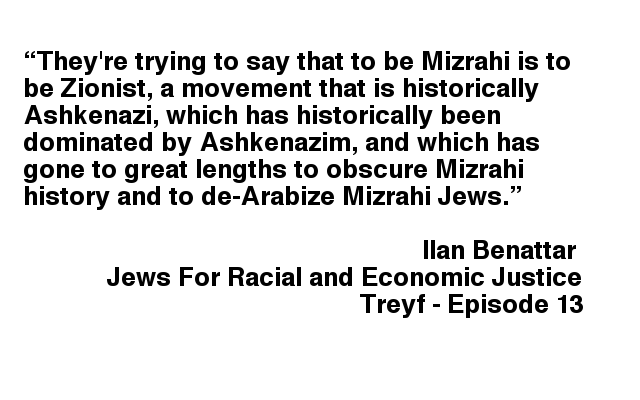
The reason we link this up to certain practices in anti-Zionist circles isn't because "to be Mizrahi is to be Zionist", it's simply because as a matter of raw numerical fact many are, and "irrespective of whether those terms are Zionist" cuts both ways. If one excises the Zionist part of the Mizrahi community from the part one is willing to talk to, one is left with a lot fewer Mizrahim. That is no doubt to the benefit of Ilan Benattar, since it means a lot more people will be talking to him. But it is not a viable nor a progressive proposition for engaging across difference; it inscribes the very sort of exclusion we critique.*
Indeed, I think we need to interrogate the move being made here more closely. It is highly reminiscent of Herman Cain's plantation politics: Most Blacks are being duped and deceived by the Democratic Party which wants to keep them "on the plantation," their condition is used as a tool to support politics "we" (those like Cain) know are bad, but a few Blacks, like Cain, "can think for themselves" and are the ones you should listen to. And likewise, Benattar casts contemporary Mizrahi politics as being obscured from itself, the product of a Zionist-Ashkenazi effort to make it in its own image for its own ends, such that it is okay to generally ignore Mizrahi Jews (who largely remain on the Zionist plantation) in favor of the few, like him, who see past the ruse and can tell you what's what.
Now here I want to be very careful about the point being made. It is not that Jews (Mizrahi or otherwise) are not entitled to critique or dissent from the prevailing orthodoxies in the community. I do not believe that Ilan Benattar or Herman Cain (or Ben Carson or Clarence Thomas or Marco Rubio or Ted Cruz) have any particular obligation to adopt the political posture of their broader community. I have always firmly taken the stand that there is no legitimate politics (based on solidarity or anything else) that writes such dissent out; and that means (among other things) that it is flatly wrong to claim that Jewish anti-Zionists have forfeited their Jewishness by virtue of their position. From my personal vantage point, such a stance would make me a terrible Zionist -- I view Zionism as about Jewish self-determination, and that includes the right of a Jewish self to determine that Zionism is incompatible with their assessment of the Jewish condition or Jewish obligations. One can argue against the positions on their merits; but the fact of adopting the positions doesn't mean the speaker "isn't Jewish" or is a "self-hating Jew" or whatnot (for the same reasons I object to referring to Cruz or Thomas as race traitors or Uncle Toms or what have you). Jews should have the same right as anyone else to come to positions that you or I think are wrong.
So the problem isn't the critique itself, that's fair game. The problem rather is in the final step -- the proffer that one can justly ignore most members of the outgroup and instead only speak to the dissident wing. That silencing -- really tokenizing -- move is what's objectionable; the forwarding of oneself as a substitute for engagement with the broader community constructed as defective and unworthy of deliberative inclusion. When outgroups (whether we're talking about Jews generally, or Mizrahi Jews specifically, or Blacks, or Latinos, or Palestinians for that matter) say things that are hard to hear or which raise difficult critiques of passionately-held positions, the right move is not to race off to find your friend who agrees with you and be assured that everything's alright. One need not assent, but one should at least listen and think. And so here I will cop to at least one of the many motives that Benattar ascribes to Analucia and myself: We do need to engage with Mizrahi perspectives in Israel, even when they seem quite distant from our own ethnic, political, or cultural priors. Why? Because that's what one does when trying to ethically encounter difference -- particularly difference that is paired with historical patterns of marginalization.
In terms of substantive responses to our article, I think that covers it. But I did also want to make a note of one of the particular rhetorical stylings that was deployed. Throughout his segment, Benattar accused Analucia and I of "co-opting" the language of intersectionality for our own supposedly right-wing ambitions. He used this word so many times I think he must have hired Marco Rubio's speech coach. And on one level, I find this amusing: I've sometimes remarked that intersectionality brings out my inner hipster -- I was reading it way before it was cool (before Benattar even got to college, in fact) -- so who's really appropriating what here?
But the bigger point is, once again, about exclusion. The language of "co-option", obviously, is intricately connecting to the language of standing -- who is authorized to use terms like "intersectionality" and who is trespassing? We already knew, of course, that Jews generally have no standing to utilize such terms on our own behalf, we now know the same is true of non-Ashkenazi Jews specifically (at least when they do so in ways that are not ideologically amenable to particular elements of the left). Our alleged deficiency is that we are insufficiently "progressive"; left unsaid is who established the metric of "progressive" and who installed Benattar as its arbiter. Why should Analucia or myself cede him, or anyone else, that authority? Why is it just accepted that Jewish entry into progressive spaces is always on a probationary basis?
One can see a very particular sort of anti-Semitic exclusion operating here: Jews are not equal members of political communities (progressive or otherwise) we inhabit; we are members to the extent that others permit us to be; which typically manifests as membership to the extent that we affirm the understandings of the dominant groups. Hence, when we level what we take to be a progressive critique at a progressive discourse surrounding Jews, the fact of our dissent is itself sufficient to exile us from the relevant interpretative community. We are not entitled to stake independent claims on progressive concepts when doing so conflicts with how the "real" progressives, the people empowered to govern the borders of "progressive", conceptualize the understanding of "progressive." It's the same damn sin again, we are entitled to partake in discourse "only as far as [we] support someone else’s narrative."
The issue, as Melanie Kaye/Kantrowitz wrote so long ago, is power. Who has it, who wants it. In both the substantive and rhetorical formulations, one can see how Benattar's goal is to delegitimize wide swaths of deliberative contributions from progressive consideration and concentrate progressive discursive power in the hands of people like himself. There is no space for an internal progressive critique by Jews of progressive discourse, because once it emerges it ceases being progressive (now right-wing trolling). There is no space for a Mizrahi critique of anti-Zionist practices because once it emerges it ceases being Mizrahi (now Ashkenazi false consciousness). Hence how Analucia and JIMENA can each be dismissed here as co-opters and appropriators -- what credential exactly are they missing such that their deployment of the term intersectionality is inauthentic? For other readers, of course, the problem is inverted -- there is no space for a Mizrahi critique of Jewish Zionist practices because once it emerges it ceases to be Jewish (what, exactly, are they missing?). All of this is the same politics -- just swapping out whose ox is gored. Progressivism, as I understand it (and we already know how much that's worth) is about breaking down such patterns of power and domination. Progressivism, as many others understand it, seems to be more about reshuffling the deck.
The issue is power -- who has it, who wants it. I do not think that Mizrahi Jews, or any Jews, need to be Zionist, I do not think that it is my place to tell Mizrahi Jews what to be. I think that Mizrahi Jews, like all Jews, should be decide for themselves how they conceptualize their condition and their situation; as it happens, many have decided that Zionism fits, some have come to a contrary conclusion. And then I think that other people should be willing to listen and engage with their reckoning, regardless of whether it coheres to the narratives we began with or not.
* Here Benattar accuses us of ignoring the BDS movement's long-stated principle that it targets "institutions, not individuals". The reason I ignore it is that it is impossible to credit. First, I'm dubious that the alleged principle is even a coherent one, as if in multilayered and stratified societies any of us come in as atomized individualized disconnected from surrounding social, cultural, or academic institutions (such a libertarian way of looking at human experience is particularly difficult to swallow in a discussion of intersectionality, which is quite concerned with how we are bound up in a multitude of overlapping identity affiliations that cannot be disaggregated from our core "individual" selves). And second, even if the principle could be expressed coherently it has been breached so often in practice that I can't view it as anything other than rhetorical. There is no serious likelihood that the BDS movement will, in fact, engage with the Israeli Mizrahi community as currently constituted regardless of whether they try to speak "individually" or "institutionally"; more likely (as in the "A Wider Bridge" fiasco -- an organization which, incidentally, has been far better than most about incorporating Mizrahi voices) any efforts to bring such "individual" voices to the fore will be deemed "institutionally" suspect (Benattar even throws out the term "Mizrahi-washing") and thus subject to boycott.
In any event, speaking for myself and not Analucia or JIMENA (who are capable of correcting the misapprehensions Benattar has about JIMENA's mission), I found that Benattar's comments were an excellent encapsulation of our core thesis regarding Mizrahi Jewish inclusion (or lack thereof) in broader patterns of discourse.
Let's put two excerpts side by side. Here is how Benattar charaacterizes the core argument of our article, which he terms a case of "Mizrahi-washing":
And here is the part of our article that is most directly germane:
When asked to speak at certain Zionist functions, many Jewish refugees from the Middle East and North Africa are asked to focus on the mistreatment they experienced under Arab rule—not the ways in which they successfully coexisted with Muslims, or the serious discrimination they have faced in Israeli society after arriving in the Promised Land. In anti-Zionist circles the situation inverts: the hosts are delighted to hear tales of Israeli malfeasance but are deeply hostile if the topic turns to the oppression and expulsion of Jews from Arab countries or if the Jews proclaim a proud connection to Israel. Either way, non-Ashkenazi Jews are engaged with only as far as they support someone else’s narrative. Once they seek to speak in their own voice, their putative allies disappear.Not only are we perfectly cognizant of the manner in which Ashkenazim have historically been dominant in Zionist circles and have sought to deemphasize the interconnection many Mizrahi Jews have had with Arab history, particularly when they clash with Zionist narratives, we lead with it. Our sin is nothing more than the concurrent observation that the same is true of the anti-Zionist movement: also historically Ashkenazi dominated (at least in its Jewish manifestation), also quite prone to deemphasizing aspects of Mizrahi identity when they conflict with anti-Zionist shibboleths. The sins are identical: "non-Ashkenazi Jews are engaged with only as far as they support someone else’s narrative." None of this is to say that there have not been significant Zionist and anti-Zionist Mizrahi voices, none of this is to say that "to be Mizrahi is to be Zionist" (or not). To frame the question in this way misses the point entirely. We are quite clear that the crucial obligation for non-Mizrahim is to confront the community as it is, on its terms, irrespective of whether those terms are Zionist. It's not us that are seeking to essentialize Mizrahim into one mode of being vis-a-vis Zionism.
The reason we link this up to certain practices in anti-Zionist circles isn't because "to be Mizrahi is to be Zionist", it's simply because as a matter of raw numerical fact many are, and "irrespective of whether those terms are Zionist" cuts both ways. If one excises the Zionist part of the Mizrahi community from the part one is willing to talk to, one is left with a lot fewer Mizrahim. That is no doubt to the benefit of Ilan Benattar, since it means a lot more people will be talking to him. But it is not a viable nor a progressive proposition for engaging across difference; it inscribes the very sort of exclusion we critique.*
Indeed, I think we need to interrogate the move being made here more closely. It is highly reminiscent of Herman Cain's plantation politics: Most Blacks are being duped and deceived by the Democratic Party which wants to keep them "on the plantation," their condition is used as a tool to support politics "we" (those like Cain) know are bad, but a few Blacks, like Cain, "can think for themselves" and are the ones you should listen to. And likewise, Benattar casts contemporary Mizrahi politics as being obscured from itself, the product of a Zionist-Ashkenazi effort to make it in its own image for its own ends, such that it is okay to generally ignore Mizrahi Jews (who largely remain on the Zionist plantation) in favor of the few, like him, who see past the ruse and can tell you what's what.
Now here I want to be very careful about the point being made. It is not that Jews (Mizrahi or otherwise) are not entitled to critique or dissent from the prevailing orthodoxies in the community. I do not believe that Ilan Benattar or Herman Cain (or Ben Carson or Clarence Thomas or Marco Rubio or Ted Cruz) have any particular obligation to adopt the political posture of their broader community. I have always firmly taken the stand that there is no legitimate politics (based on solidarity or anything else) that writes such dissent out; and that means (among other things) that it is flatly wrong to claim that Jewish anti-Zionists have forfeited their Jewishness by virtue of their position. From my personal vantage point, such a stance would make me a terrible Zionist -- I view Zionism as about Jewish self-determination, and that includes the right of a Jewish self to determine that Zionism is incompatible with their assessment of the Jewish condition or Jewish obligations. One can argue against the positions on their merits; but the fact of adopting the positions doesn't mean the speaker "isn't Jewish" or is a "self-hating Jew" or whatnot (for the same reasons I object to referring to Cruz or Thomas as race traitors or Uncle Toms or what have you). Jews should have the same right as anyone else to come to positions that you or I think are wrong.
So the problem isn't the critique itself, that's fair game. The problem rather is in the final step -- the proffer that one can justly ignore most members of the outgroup and instead only speak to the dissident wing. That silencing -- really tokenizing -- move is what's objectionable; the forwarding of oneself as a substitute for engagement with the broader community constructed as defective and unworthy of deliberative inclusion. When outgroups (whether we're talking about Jews generally, or Mizrahi Jews specifically, or Blacks, or Latinos, or Palestinians for that matter) say things that are hard to hear or which raise difficult critiques of passionately-held positions, the right move is not to race off to find your friend who agrees with you and be assured that everything's alright. One need not assent, but one should at least listen and think. And so here I will cop to at least one of the many motives that Benattar ascribes to Analucia and myself: We do need to engage with Mizrahi perspectives in Israel, even when they seem quite distant from our own ethnic, political, or cultural priors. Why? Because that's what one does when trying to ethically encounter difference -- particularly difference that is paired with historical patterns of marginalization.
In terms of substantive responses to our article, I think that covers it. But I did also want to make a note of one of the particular rhetorical stylings that was deployed. Throughout his segment, Benattar accused Analucia and I of "co-opting" the language of intersectionality for our own supposedly right-wing ambitions. He used this word so many times I think he must have hired Marco Rubio's speech coach. And on one level, I find this amusing: I've sometimes remarked that intersectionality brings out my inner hipster -- I was reading it way before it was cool (before Benattar even got to college, in fact) -- so who's really appropriating what here?
But the bigger point is, once again, about exclusion. The language of "co-option", obviously, is intricately connecting to the language of standing -- who is authorized to use terms like "intersectionality" and who is trespassing? We already knew, of course, that Jews generally have no standing to utilize such terms on our own behalf, we now know the same is true of non-Ashkenazi Jews specifically (at least when they do so in ways that are not ideologically amenable to particular elements of the left). Our alleged deficiency is that we are insufficiently "progressive"; left unsaid is who established the metric of "progressive" and who installed Benattar as its arbiter. Why should Analucia or myself cede him, or anyone else, that authority? Why is it just accepted that Jewish entry into progressive spaces is always on a probationary basis?
One can see a very particular sort of anti-Semitic exclusion operating here: Jews are not equal members of political communities (progressive or otherwise) we inhabit; we are members to the extent that others permit us to be; which typically manifests as membership to the extent that we affirm the understandings of the dominant groups. Hence, when we level what we take to be a progressive critique at a progressive discourse surrounding Jews, the fact of our dissent is itself sufficient to exile us from the relevant interpretative community. We are not entitled to stake independent claims on progressive concepts when doing so conflicts with how the "real" progressives, the people empowered to govern the borders of "progressive", conceptualize the understanding of "progressive." It's the same damn sin again, we are entitled to partake in discourse "only as far as [we] support someone else’s narrative."
The issue, as Melanie Kaye/Kantrowitz wrote so long ago, is power. Who has it, who wants it. In both the substantive and rhetorical formulations, one can see how Benattar's goal is to delegitimize wide swaths of deliberative contributions from progressive consideration and concentrate progressive discursive power in the hands of people like himself. There is no space for an internal progressive critique by Jews of progressive discourse, because once it emerges it ceases being progressive (now right-wing trolling). There is no space for a Mizrahi critique of anti-Zionist practices because once it emerges it ceases being Mizrahi (now Ashkenazi false consciousness). Hence how Analucia and JIMENA can each be dismissed here as co-opters and appropriators -- what credential exactly are they missing such that their deployment of the term intersectionality is inauthentic? For other readers, of course, the problem is inverted -- there is no space for a Mizrahi critique of Jewish Zionist practices because once it emerges it ceases to be Jewish (what, exactly, are they missing?). All of this is the same politics -- just swapping out whose ox is gored. Progressivism, as I understand it (and we already know how much that's worth) is about breaking down such patterns of power and domination. Progressivism, as many others understand it, seems to be more about reshuffling the deck.
The issue is power -- who has it, who wants it. I do not think that Mizrahi Jews, or any Jews, need to be Zionist, I do not think that it is my place to tell Mizrahi Jews what to be. I think that Mizrahi Jews, like all Jews, should be decide for themselves how they conceptualize their condition and their situation; as it happens, many have decided that Zionism fits, some have come to a contrary conclusion. And then I think that other people should be willing to listen and engage with their reckoning, regardless of whether it coheres to the narratives we began with or not.
* Here Benattar accuses us of ignoring the BDS movement's long-stated principle that it targets "institutions, not individuals". The reason I ignore it is that it is impossible to credit. First, I'm dubious that the alleged principle is even a coherent one, as if in multilayered and stratified societies any of us come in as atomized individualized disconnected from surrounding social, cultural, or academic institutions (such a libertarian way of looking at human experience is particularly difficult to swallow in a discussion of intersectionality, which is quite concerned with how we are bound up in a multitude of overlapping identity affiliations that cannot be disaggregated from our core "individual" selves). And second, even if the principle could be expressed coherently it has been breached so often in practice that I can't view it as anything other than rhetorical. There is no serious likelihood that the BDS movement will, in fact, engage with the Israeli Mizrahi community as currently constituted regardless of whether they try to speak "individually" or "institutionally"; more likely (as in the "A Wider Bridge" fiasco -- an organization which, incidentally, has been far better than most about incorporating Mizrahi voices) any efforts to bring such "individual" voices to the fore will be deemed "institutionally" suspect (Benattar even throws out the term "Mizrahi-washing") and thus subject to boycott.
Tuesday, February 16, 2016
Anti-Semitism at the Oxford Labour Club
The (now-former) co-chair of the Oxford University Labour Club announced his resignation, citing rampant anti-Semitism within the organization:
"Despite its avowed commitment to liberation, the attitudes of certain members of the club towards certain disadvantaged groups was becoming poisonous," [Alex] Chalmers wrote.Oxford's Jewish Society (JSoc) released the following statement of its own:
"Whether it be members of the Executive throwing around the term 'Zio' (a term for Jews usually confined to websites run by the Ku Klux Klan) with casual abandon, senior members of the club expressing their 'solidarity' with Hamas and explicitly defending their tactics of indiscriminately murdering civilians, or a former Co-Chair claiming that 'most accusations of antisemitism are just the Zionists crying wolf,’ a large proportion of both OULC and the student left in Oxford more generally have some kind of problem with Jews," Chalmers continued.
Oxford University Jewish Society is saddened by the anti-semitic reports coming out of Oxford University Labour Club, and stands fully in support of Alex Chalmers' decision to resign.
We are, however, unsurprised by this news. It is not the first time that Oxford JSoc has had to deal with anti-semitic incidents within the student left and it will not be the last. It is a significant and worrying issue and one that on many occasions, Jewish students have felt that they are fighting alone. We are grateful that Alex Chalmers has made the statement that he did and has brought the issue of anti-semitism to the fore in a way that Jewish students have so far been denied.
Oxford JSoc strongly rejects any accusation that Jewish students are inventing claims of anti-semitism to discredit Palestinian solidarity politics. This is a repeated trope that has been used to silence Jewish students and it will carry weight no longer. When anti-semitism intersects with Palestinian solidarity politics, it is not the job of Jewish students to be quiet, but the job of Palestinian solidarity activists to rid their movement of anti-Jewish prejudice.
Many of Oxford’s Jewish students who hold progressive views have long felt excluded from left-wing political spaces. Jewish students who raised the issue of anti-semitism at the OULC meeting were laughed at and mocked. It is high time that this issue is confronted. We hope Alex’s resignation triggers a broader awakening amongst student political movements, and that anti-semitism, particularly on the student left, is finally taken seriously.That third paragraph is critical, and needs to be repeated over and over again. Jews have been too deferential to the Livingstone Formulation for too long, and it's high time it stopped carrying weight. Our sense of alienation and maltreatment is entitled to the same respect and concern as any other outgroup; casting it as a bad faith ploy is no less reactionary than when any other group is claimed to be "playing a card".
Monday, February 15, 2016
Jane Kelly For SCOTUS?
I've been hearing murmurings that Eighth Circuit Judge Jane Kelly might be the President's SCOTUS nominee. And there are a lot of dimensions along which that makes a lot of sense.
I've never actually met Judge Kelly, but I'm quite familiar with her. She arrived on the Eighth Circuit in 2013 midway through my clerkship with Judge Murphy, finally ending the latter's streak as the only woman ever to serve on that court nearly 20 years after she was first appointed. Kelly's confirmation was unusually easy in this day and age -- a 96-0 vote taken three months after her nomination -- apparently because she is very well liked by Iowa Senator Chuck Grassley. The Republican chairman of the Senate Judiciary Committee is no small ally for a prospective Obama nominee to have. And it would be difficult for Republicans to justify blocking a nominee they quickly and unanimously confirmed to the Eighth Circuit barely three years ago.
Beyond the purely tactical concerns, Judge Kelly is an interesting choice for another reason: Prior to her elevation to the bench, she was a career public defender, working in the Northern District of Iowa from 1994 to 2013. That background is extraordinarily uncommon on the federal bench, and I believe entirely unheard of on the Supreme Court. Her nomination would certainly have particular resonance in the current political moment where overstretches of the police state have been a central issue occupying progressive activist thought.
Now normally, what that background giveth, it also taketh away -- it is very easy to caricature a federal public defender as "soft on crime" (pluck out the most gruesome murderer she ever defended and ask why she wanted to keep him on the streets). But -- and not to get too macabre -- Judge Kelly has a personal story here too that helps insulate her from that particular angle of attack: she was beaten unconscious and left for dead in an unsolved 2004 assault. She is far more intimately familiar with the ravages of violent crime than nearly any other high-level government official in the United States.
Of course, if Judge Kelly were nominated and confirmed, that would restore Judge Murphy as the sole woman on the Eighth Circuit (and -- perhaps even more amazingly -- would also leave her the only active Democratic-appointee on it). But I get the sense she wouldn't mind. Judge Kelly would certainly put a lot of pressure on Senator Grassley and the wing of the GOP Senate that still isn't 100% comfortable with government-via-tantrum. And beyond that, I don't think she'd make a half-bad Justice either.
UPDATE: Speaking of Grassley, he's stepped back from the edge a bit, saying he won't decide whether to hold hearings on President Obama's nominee until the nomination is announced. Admittedly, other quotes from the same interview are less promising. But if this is a slight step towards rapprochement, a Kelly nomination could be just the way for Obama to respond in kind.
(I'm going to just say I'm predicting a Kelly nomination now. It's a bit of a dark horse pick, but I'm undefeated so far in Obama SCOTUS predictions so why not roll the dice a bit?).
I've never actually met Judge Kelly, but I'm quite familiar with her. She arrived on the Eighth Circuit in 2013 midway through my clerkship with Judge Murphy, finally ending the latter's streak as the only woman ever to serve on that court nearly 20 years after she was first appointed. Kelly's confirmation was unusually easy in this day and age -- a 96-0 vote taken three months after her nomination -- apparently because she is very well liked by Iowa Senator Chuck Grassley. The Republican chairman of the Senate Judiciary Committee is no small ally for a prospective Obama nominee to have. And it would be difficult for Republicans to justify blocking a nominee they quickly and unanimously confirmed to the Eighth Circuit barely three years ago.
Beyond the purely tactical concerns, Judge Kelly is an interesting choice for another reason: Prior to her elevation to the bench, she was a career public defender, working in the Northern District of Iowa from 1994 to 2013. That background is extraordinarily uncommon on the federal bench, and I believe entirely unheard of on the Supreme Court. Her nomination would certainly have particular resonance in the current political moment where overstretches of the police state have been a central issue occupying progressive activist thought.
Now normally, what that background giveth, it also taketh away -- it is very easy to caricature a federal public defender as "soft on crime" (pluck out the most gruesome murderer she ever defended and ask why she wanted to keep him on the streets). But -- and not to get too macabre -- Judge Kelly has a personal story here too that helps insulate her from that particular angle of attack: she was beaten unconscious and left for dead in an unsolved 2004 assault. She is far more intimately familiar with the ravages of violent crime than nearly any other high-level government official in the United States.
Of course, if Judge Kelly were nominated and confirmed, that would restore Judge Murphy as the sole woman on the Eighth Circuit (and -- perhaps even more amazingly -- would also leave her the only active Democratic-appointee on it). But I get the sense she wouldn't mind. Judge Kelly would certainly put a lot of pressure on Senator Grassley and the wing of the GOP Senate that still isn't 100% comfortable with government-via-tantrum. And beyond that, I don't think she'd make a half-bad Justice either.
UPDATE: Speaking of Grassley, he's stepped back from the edge a bit, saying he won't decide whether to hold hearings on President Obama's nominee until the nomination is announced. Admittedly, other quotes from the same interview are less promising. But if this is a slight step towards rapprochement, a Kelly nomination could be just the way for Obama to respond in kind.
(I'm going to just say I'm predicting a Kelly nomination now. It's a bit of a dark horse pick, but I'm undefeated so far in Obama SCOTUS predictions so why not roll the dice a bit?).
Saturday, February 13, 2016
Justice Antonin Scalia Dies at 79
Justice Antonin Scalia, the senior-most Associate Justice on the Supreme Court, has died. He was 79. Scalia served on the Court for 30 years, following stints on the D.C. Circuit and time as a professor at the University of Chicago Law School.
Obviously, this comes with significant political and legal ramifications. Not only was Justice Scalia considered the intellectual powerhouse of the Court's right wing, his departure converts a 5-4 conservative majority into an equally divided Court. Even if the Senate refuses to confirm any Obama nominee, this matters -- in the event of an evenly divided vote, lower-court decisions stand
Still, there will be time enough to delve into the gritty, necessary task of judicial politics later. For now, it's worth reflecting on the mark Justice Scalia has left on the legal landscape. It is considerable. I think there are very few law students who, exhausted from slogging through some of the more stultifying prose that often graces the United States Reports, did not find Justice Scalia's writing to be a breath of fresh air. He was witty, often cuttingly so, and his dissent in PGA Tour v. Martin may be the funniest Supreme Court opinion ever written. Writing aside, Scalia had a flair for taking bold stands that demanded a response if not agreement, and which often set the tone for what would become the consensus conservative position in the years to come.
My friend Kim Smith put it best: "Antonin Scalia was often brilliant and occasionally right." There are worse epitaphs for a Supreme Court justice to have. Rest in peace, and condolences to his friends and family.
The First Post of the Rest of My Life
I just turned 30 (on Thursday). Happy birthday to me!
Arguably, that's part of why the blog has been quiet these past couple days -- a mix of celebration and mourning. But in reality, I just haven't really found anything that grabs my eye. In any event, I didn't want folks to get the wrong impression -- that now that I've officially entered my old age this blog would be shutting down. I have no plans of that. Just a normal lull, as is prone to happen. I'm not as quick as I used to be, after all.
Arguably, that's part of why the blog has been quiet these past couple days -- a mix of celebration and mourning. But in reality, I just haven't really found anything that grabs my eye. In any event, I didn't want folks to get the wrong impression -- that now that I've officially entered my old age this blog would be shutting down. I have no plans of that. Just a normal lull, as is prone to happen. I'm not as quick as I used to be, after all.
Subscribe to:
Posts (Atom)


