Friday, May 13, 2016

....I Suppose I'm Proving the Point?

Though I don't really have anything novel to add, I suppose as a fan of boxing and a fan of commentator on anti-Semitism, I should remark on heavyweight champ Tyson Fury's addition of naked anti-Semitism to his already known array of misogyny and homophobia.
"Everyone just do what you can, listen to the Government, follow everybody like sheep, be brainwashed by all the Zionist, Jewish people who own all the banks, all the papers all the TV stations. Be brainwashed by them all. You’re all going to heaven - oh, sorry, there isn’t a heaven in a modern day world. So just crack on.
Fury then followed up by tweeting:
I see all the Zionist media outlets are on my back, because I speak the truth! u will all see the truth soon enuf, they killed my lord jesus
But don't worry! Because he concluded
I can confirm there is no hatred from me agents [sic -- probably "against"] the jewish people just the Zionist media.
A clarification which, according to the UK's National Union of Students, renders the whole thing entirely inbounds.

Anyway, as I said, I really don't have anything to add to this. We already knew Fury was an excellent boxer, and this doesn't reflect on his athletic prowess. We also knew that, as a person, Fury is complete scum, and this is only further verification of that. I'm just hoping that someone comes along to knock him off the heavyweight pedestal sooner rather than later.

Thursday, May 12, 2016

Things People Blame the Jews For, Volume XXIV: Beheading Charles I

The burgeoning scandal of anti-Semitism through the UK's Labour Party could have promoted any number of entries in this series. But for the most part, the anti-Semitism on offer -- while appalling -- has also been relatively uncreative. Jews control the media? Cliche. Jews control ISIS? Been there.

But Musabbir Ali, a former London Labour official, managed to get himself suspended with a truly inspired entry: Jews were responsible for the beheading of King Charles I in 1649.
On Tuesday, Ali posted on Twitter a link to a blog post titled “Timeline of the Jewish Genocide of the British People.” The blog claims that Jews “financed Oliver Cromwell’s overthrowing and beheading of Stuart King Charles I after he refused them control of England’s finances” 
Fun historical fact: Jews were not legally allowed to reside in England from 1290 until 1657 (and even then their legal status was ambiguous and precarious).

Ali also called British leaders including Neville Chamberlain, Winston Churchill and Tony Blair “jewish puppets" (I have to point out that if Neville Chamberlain was on our strings we really need to work on our puppeteering skills).

I have to say that I don't know enough about English history to know why it would be a mark against the Jewish people to have supported Cromwell and the parliamentarians against King Charles' royal absolutism (even if there were any proof that "the Jews" had anything to do with it). One would think that contemporary Brits of all stripes would be fans of parliamentary supremacy.

In any event, the important thing to remember is that this anti-Semitism "scandal" is really just an excuse to suppress criticism of Israeli policies -- like the policy of committing regicide against foreign monarchs 300 years before the foundation of the country. That is exactly the sort of Zionist policy whose validity should not be squelched by frivolous accusations of "anti-Semitism."

Wednesday, May 11, 2016

Playing with Cards: Malia Bouattia and the Double Down

Perhaps the single most ubiquitous response to a claim of discrimination or other biased treatment is to allege that the claimant is proceeding in bad faith. "You're just playing the race card!" "Stop hiding behind your gender!" "Yet another case of Jews crying anti-Semitism to stifle criticism!" This retort is notable because it does not listen to the claim and then provide a substantive, on-the-merits response -- "I actually don't think you were discriminated against for X, Y, and Z reasons". Rather, the response is a statement that one will not even entertain the claim in question. It is so transparently ludicrous, or so obviously made with illicit, instrumental motives, that it is not even worth considering.

Earlier this spring I published my first peer-reviewed article, Playing with Cards: Discrimination Claims and the Charge of Bad Faith, on this topic. I argued that the "bad faith" response is problematic for a host of reasons: For one, it disrespects the discrimination claimant by presenting them as presumptively untrustworthy and not worth engaging with, often implicitly or explicitly because of their group membership (those people are always crying discrimination). For two, it evinces far too much faith in our prediscursive intuitions regarding what does and does not constitute "discrimination" (or "bias", or "oppression"), particularly when dealing with marginalized outgroups. And for three, it is far too tempting of a well to draw upon for persons with strong psychological or ideological motives to think of discrimination as rare, aberrant, or uncommon. If we want to believe that racism, sexism, anti-Semitism, Islamophobia (or what have you) is not a major problem in our community or does not implicate our own commitments, one way of protecting that belief is to preemptively write off such claims as bad faith hogwash. The "bad faith" response, after all, is typically the retort of first resort -- it does not come after we have fully and charitably explored the allegation and ultimately found it lacking, it comes as an initial gambit designed to delegitimize the claim as one worth thinking about at all. And so I conclude that we should not dismiss discrimination claims by arguing that they're leveled in bad faith. We should instead give them full and fair investigation. The conclusion of that investigation, of course, might still be that the argument was wrong, even bogus. But there is a marked difference between reaching that conclusion at the end of an inquiry versus at its beginning.

Last month brought an interesting permutation and difficult test case for my theory, when the UK's National Union of Students elected Malia Bouattia as its new president.Ms. Bouattia has a history of statements and positions that at least create a reasonable inference of anti-Semitism, including condemning her home Birmingham University as a "Zionist outpost in higher education" because it has "the largest J-Soc [Jewish Society] in the country," attacks on "mainstream Zionist-led media outlets," and a tepid endorsement of BDS -- tepid because she worried it would supplant and delegitimize violent "resistance" by Palestinians against Israelis. As a result of these statements and others, 57 leaders of UK university J-Socs signed an open letter expressing concerns over Ms. Bouattia's views, and several universities are contemplating disaffiliating with the NUS (Lincoln University became the first to do so today, though student leaders denied Ms. Bouattia's election was the precipitating cause of the move).

Ms. Bouattia's response to these claims has generally been to contend that the Jewish student leaders have falsely conflated Zionism and Judaism, crafting a "false" claim of anti-Semitism that is really about insulating Israel from criticism. We can of course quibble with whether that's true (particularly when part of the objection was to the number of Jews at Birmingham), but for present purposes the more interesting issue came at the end, where she -- the first Muslim and first black woman to be elected president of the NUS -- said "I am deeply concerned that my faith and political views are being misconstrued and used as an opportunity to falsely accuse me of antisemitism, despite my work and dedication to liberation, equality and inclusion saying otherwise." In effect, she accused the Jewish students of Islamophobia in the course of their anti-Semitism allegation.

And that presents a very interesting permutation of the phenomenon I'm talking about: Ms. Bouattia used a discrimination claim (Islamophobia) to try to delegitimize another discrimination claim (anti-Semitism). My initial instinct, of course, is to roll my eyes and think that her response was, well, made in bad faith -- a way of avoiding reckoning with serious complaints registered by the Jewish student community. But of course, that response -- "oh, she's making the charge in bad faith" -- is precisely what I claim is illicit in my article. Hoisted by my own petard!

On reflection, I've fallen back into line with the argument my article makes -- namely, that Ms. Bouattia's should not be dismissed as bad faith posturing and should be considered seriously (just as the Jewish students' claims of anti-Semitism should likewise be taken seriously). Before I go into why, though, I want to quickly dispense with one argument one might use to distinguish Ms. Bouattia's discrimination claim -- to wit, that she was using it to respond (or perhaps more accurately, avoid responding) to another discrimination claim. We might say that in such circumstances the discrimination claim is being leveraged as a means of avoiding other discrimination claims and thus ought to lose its protected status. But I don't think that argument works, because I don't think our deliberative obligation actually depend upon what order various claims and counterclaims are made. If we tweaked one of Ms. Bouattia's original statements a little so it said something like "large Jewish societies like the one at Birmingham are the main purveyors of Islamophobic sentiment in higher education today," then she would have gotten off the blocks first but I nonetheless would not want to say a Jewish response that called such a statement anti-Semitic should be viewed as prima facie illegitimate. Going down this route ends up arriving at something like the "doctrine of the preferred first speaker" -- whoever claims discrimination first gets protection -- and that just isn't tenable.

With respect to Ms. Bouattia's claim, it actually seems quite plausible that currents of racism and Islamophobia are playing a role in how the controversy shakes out. It hardly seems unfeasible that someone with her background might be viewed with extra suspicion. Ambiguous statements might not be given benefit of the doubt, or nuances presumed not to exist. We might be more stingy with forgiveness or recognition of evolving views. Ms. Bouattia has reported facing a barrage of violent threats online, and given the fact that she's a woman of color on the internet her account seems almost assuredly accurate in this respect. Notably, while Ms. Bouattia frames all of this in terms of a "false" accusation of anti-Semitism, it is equally important to engage in these interrogations even if the claim is a true or reasonable one. Prejudice doesn't only afflict saints; an important of egalitarian treatment is how we treat persons who are accused of or have actually committed moral or social wrongs. In the discussion over Ms. Bouattia's attitudes and behavior towards the Jewish community that we find oppressive, we should absolutely be thinking about how racism and Islamophobia can channel the discussion. Likewise, in discussions regarding Israeli behavior that we think worthy of scorn and condemnation, we should absolutely be thinking about the ways in which anti-Semitism may affect or interact with our evaluations. Instead of thinking of the one as falsifying the other -- if the anti-Semitism claim is valid than the Islamophobia one is false, or vice versa -- we should think of both anti-Semitism and Islamophobia as part of the broader discursive current which inescapably channels how issues related to Jews and Muslims are understood and are cashed out in public settings.

Put another way, we often frame the question as "Is criticism of Israel or Zionism anti-Semitic," a question which is ridiculous for the same reason the question "Is criticism of Malia Bouattia Islamophobic" is ridiculous. They're both ridiculous because the answer is both (a) obvious and (b) near-universally agreed-upon: "Sometimes -- it depends." Whether or not a given criticism of a Jewish person or institution is anti-Semitic or a Muslim person or institution is Islamophobic can't be answered universally; it depends on the particular criticism in its particular context, and so should analyzed and evaluated on its particular merits (which was, of course, the basic demand of my article). But there's no way to talk about any Jewish body or institution in a way that wholly extracts it from a system of anti-Semitic domination, just as there is no way to talk about any Muslim body or institution in a way that wholly extract is from a system of Islamophobia. So we can say that while it is obviously true that there are plenty of criticisms of Israel that are not anti-Semitic, there is no worthwhile, non-trivial statement one can make about Israel (positive or negative) that does not take seriously anti-Semitism as a central facet of its analysis; and likewise no statement one can make about the first black Muslim woman to lead the NUS that does not take seriously the impact of Islamophobia and racism. This was in many respects the point I was trying to make in my post on Mizrahi Jews and intersectionality -- not that any opposition to the political desires of the Mizrahi community is racist, but the more mundane point that if you're talking about Middle Eastern Jewish institutions and history inside and outside of Israel without grappling with the particularities of Mizrahi Jewish oppression and marginalization (by both Ashkenazi Jews and Arab Muslims and Christians), you're probably talking these things poorly.

So where does this all leave us? Ms. Bouattia did not really "respond" to the anti-Semitism claim against her in a meaningful sense, instead seeking to traverse the issue by suggesting that there is a hermetical seal between anti-Semitism versus speech that attacks Zionism or Zionists. This is a non-response: since any reasonable person must agree that some anti-Zionist speech is anti-Semitic, the operative question is whether hers, specifically, was or was not. And while I think one can colorably answer that question in the affirmative, the far more productive angle of approach is to consider how her rhetoric and positions -- with talk of Zionist-run media and hordes of Jews taking over certain universities -- interact with and leverage anti-Semitic structures in ways incompatible with equal Jewish standing in the British and global community. And in terms of Islamophobia, I think it is pretty clear -- particularly in light of the broader scandal over anti-Semitism in Labour and several other goings-on at the NUS (delegates applauded a proposal for the union to stop commemorating Holocaust Memorial Day, though ultimately did not vote for it; earlier this year the union eliminated what had been the solitary guaranteed spot of Jewish representation on a union committee) -- that the Jewish community is equal-opportunity in finding remarks such as Ms. Bouattia's objectionable and views her election as part of a broader wave of social marginalization that is not attributable to a particular color or creed. Likewise, I did not see anything in their statement that seemed to leverage Ms. Bouattia's faith against her or play upon traditional stereotypes regarding either Muslims or people of color to accentuate their arguments (though I'm open to the possibility that I'm wrong here). That notwithstanding, it remains important, valid, indeed essential to situate the progression of this discourse inside patterns of Islamophobia and racism, because they will always play a channeling role in determining how arguments gain leverage, how issues are covered publicly, and so on.

It is very easy for people to demand egalitarianism for their preferred side while being derisive and dismissive towards the other. And for the same reason, it is very easy for these debates to turn into dueling charges of hypocrisy. But there's no way forward other than a principled way. There is, to be sure, a "principled" argument that all groups are really just whiners when it comes to oppression and we should generally ignore all of them (the problem with that position is not that it's unprincipled, it's that it is wrong). But there is no principled reason to suggest that we should take Jewish claims of anti-Semitism seriously, but dismiss Muslim claims of Islamophobia. And likewise there is no principled reason to contend that we should be careful, considerate, and charitable listeners to Muslim claims of Islamophobia, while denigrating Jewish claims of anti-Semitism as bad faith card playing.

Cross-posted on The Faculty Lounge, where I am guest-blogging this month. While most of the content I'm putting up is unique to one blog or the other, this post in particular I thought might have resonance to both readerships.

Tuesday, May 10, 2016

Emory Free Expression Committee Protects Pro-Trump Chalking

Back in March, I commented on "two tales of free speech at Emory". The first was an opinion by the university's "Standing Committee on Open Expression", which affirmed the right of pro-Palestinian protesters to put up an "Israeli apartheid" display (notwithstanding reports from Jews that it made them feel uncomfortable, offended, or threatened) and consequently sanctioned student vandalism of the display. The second related to pro-Donald Trump "chalking" on campus, and reports of students demanding that the university investigate and sanction the authors.

The open expression committee has now issued an opinion on that case as well, and it likewise affirms the right of Donald Trump supporters on campus to chalk in favor of their preferred candidate (notwithstanding potential feelings of discomfort, offense, or threat by, among others, Latino students).

Both of these outcomes strike me as exactly right, and while I might quibble with bits and pieces of some of the analysis, that's really not relevant. Students have the right to present controversial, offensive, or even hateful ideas. That doesn't mean we must or should stand silent or awestruck against hateful speech, it just means that our remedy should come in the form of challenging it rather than obstructing it, blocking it, vandalizing it, or otherwise censoring it.

Sunday, May 08, 2016

.... And By "Dialogue", We Mean Shut Up

Last April, the UN's Educational, Scientific and Cultural Organization (UNESCO) passed a resolution that functionally denied any Jewish connection to Jerusalem whatsoever. It went as far as to accuse Israel of planting fake graves and ritual sites to fabricate a mythical Jewish history in the city. It was, by any objective measure, a amalgamation of paranoid conspiracy theories and anti-Semitism. So of course it passed overwhelmingly, because most UN states will reflexively vote for any resolution that is "critical" of Israel.

Of course, Israel cried foul. And so UN officials tried to calm tensions, and asked for "respect and dialogue" over the question of whether the Jews are just pretending to have even heard of this "Jerusalem" place prior to 1947.


And so the Israeli government in fact offered to host a seminar detailing Jewish connection to Jerusalem, because apparently now that's a thing we need to "dialogue" about. And of course, UN officials promptly rejected the invitation, perhaps not realizing that "dialogue" means Jews get to participate in the conversation too.

Friday, May 06, 2016

The State of the UC Jews

Haaretz has a truly wonderful article on the state of Jews on UC campuses. It really gets the situation right, as far as I'm concerned -- avoiding tired cliches of either extreme panic or derisive brush off. There's a middle ground between histrionic calls not to send Jewish kids to Irvine, and snide dismissal that anti-Semitism on campus is not a problem "worth discussing."

The basic mood one gets from the piece is pretty straightforward: First of all, the vast majority of the time, Jewish students are fine on UC campuses. It's not a warzone. We're not under siege. We're not terrified that someone will find out we're Jewish and bash our head into a wall. Yes, there are occasional flare-ups of true nastiness. But the vast majority of the time, we're students, doing student things, and it's pretty unremarkable.

What is true, though, is that there is just that bit of hesitation in being openly -- or too openly -- Jewish. I alluded to this in my reflection on wearing Hebrew letters in Berkeley last year. It's not that if you wear a Jewish t-shirt something bad will happen to you. The vast majority of the time, nothing bad will happen to you. But there's that nagging worry in the back of your head that it might, that there is that little bit of heightened risk and provocation in being "out" in that way, which doesn't happen if you just put on a Minnesota Wild t-shirt inside.

In other words, there's a sense that open Jewishness at UC requires work, that if one decides to be Jewish in any active way you can't just be Jewish but you might have to expend energy -- sometimes quite a bit of energy -- justifying it. And clearly, that's more true in some circles than others; it was quite clear that many Jews didn't feel comfortable articulating a conventional set of Jewish views on our history or our oppression in many leftist circles. So many people just don't. They cover (to use Kenji Yoshino's wonderful concept) their Jewishness.

The Haaretz article mostly spoke to undergraduates, and I've been both a graduate student and a faculty member. So obviously my perspective is different. But I think we're mostly in accord, and that accord is that ... it's complicated. The baseline is just like that of the undergraduates -- the vast majority of the time, I don't feel remotely awkward being a Jew in my department. I've had discussions about Jewish issues and anti-Semitism that I thought have been thoughtful, stimulating and productive. I couldn't ask for a better group of colleagues.

And beyond that baseline, it's a patchwork. On the one hand, I don't have the slightest bit of confidence that, if something bad to happen to me that related to my study of contemporary anti-Semitism, my union would have my back. My sense is that they are rhetorically committed to opposing anti-Semitism but are deeply suspicious of it in practice; having entirely bought into the notion that its mostly a ginned-up attempt at "silencing" criticism of Israel. So it seems that their instinctive reaction, upon hearing a request to fight anti-Semitism, is to assume the caller is an ideological enemy and that the call has been made in bad faith; everyone is innocent until proven Nazi. One could say it is more "anti-anti-anti-Semitic" than it is "anti-Semitic".  And it stinks that I don't feel like I can rely on my own union that way.

On the other hand, I'm friends with both the union stewards in my department, and I've periodically communicated my sentiments to them. They've been receptive and affirming, though generally non-committal (there's not much they can do or promise anyway, particularly about non-specified future conjectures). But it's not like they were hostile or dismissive. They didn't shun or ostracize me. If something bad did happen to me that related to anti-Semitism, I'd feel comfortable going to them, and at the same time I'd be pretty sure they'd be able to do nothing for me. Patchwork.

Likewise in classroom settings. Have I caught myself self-censoring? Yes, it has happened. I thought about using BDS as an example of what Weber had in mind regarding persons who let their "ethics of conviction" run roughshod over their "ethics of responsibility". but I ultimately couldn't bring myself to do it in a room full of critical theorists. But in other classes, I've felt freer -- free enough to speak, anyway, if not free from that twinge of hesitation. And two of my seminar papers have explicitly and sympathetically addressed Zionism, and I have no concerns that they'll be fairly and charitably evaluated by the two (quite-left-of-center) professors who received them.

So it's a mix. It's mostly fine. There are areas of genuine concern. One need not blow them out of proportion to realize that they have proportions, meaning, and impact.

Wednesday, May 04, 2016

Sigal Samuel on the Jews of Color Conference

Sigal Samuel (@SigalSamuel -- follow her) provides powerful reflections on the recent conference for Jews of Color (including Sephardic and Mizrahi Jews). I highly encourage you to read it. There's a lot to be said about it. Some of it is heartening -- it was obvious that for many participants this conference filled a significant void in their Jewish experience which is overwhelmingly dominated by European Ashkenazim. Some of it is disheartening -- Samuel relates how Jews who identified as pro-Israel or Zionist did not feel comfortable voicing those opinions (progressive inclusiveness only gets you so far), and notes the marked absence of Israeli Jewish participants which (in the words of one of the few Israelis in attendance) created an "America-centric" program. Some of it is uncertain, like the promise from an executive at a prominent Arab-American organization that Mizrahi Jews are welcome in her group (are they welcome if they're Israeli-American Mizrahi Zionists who challenge the prefigured understanding of what "Arab" self-determination means? If so, that would be a huge step towards genuine allyship).

Samuel's account makes it clear that this was a conference of a particular political vibe -- lots of talk of "privilege" and "triggering" -- and so one can shake one's head about whether it is truly representative of Mizrahi, Sephardic, or Jews of Color as broader communities. But if one is to register that complaint, one has to interrogate why it was the leftist branch of the community which organized the conference, and why the "representative" Jewish establishment has failed to do so. One can't complain about a slanted conference if one isn't having any conference at all.

It seems that, by and large, this conference was a success, and I'm happy to report that fact. It should be followed up with more. More meetings, more organizing, more latitude, more perspectives. If one is worried that voices outside the ultra-left are uncomfortable in this space, organize spaces where they too feel free to speak. If you're unhappy about the paucity of Israeli voices in this conversation, then put in the work to get more Israelis to the table. Put in the work, or don't complain when others don't do the work to your liking.

I've been hoping for some time to organize a conference on non-European and non-Ashkenazi Jews here at Berkeley (albeit probably more academic than activist-y). It's a daunting task, but it would help shed light on a daunting struggle. I wouldn't see it as a response to this event but the next step following from it. As far as I'm concerned, a thousand flowers should bloom, and Jews of all backgrounds and all political persuasions should have a home in the Jewish community to voice their perspective.

Monday, May 02, 2016

BDS, Snitching, and Solidarity

Peter Beinart had a column a few days ago which tried to explain the Jewish BDS community in terms of personal morality versus Jewish solidarity. It's better than it sounds, given how conditioned we are to think that morality should trump solidarity. Beinart's point was that simply acting according to one's personal conscience will necessarily fray the bonds of communal fraternity. When Jews elect to cut off large swaths of the Jewish community from the currents of political conversation, they are making a choice that carries consequences they should be prepared to accept. He analogizes it to "calling the cops on your drug-addicted brother." Maybe it really is for his own good. But you can't necessarily expect your family to love you for it.

I think the analogy is decent. But I'd add one more element: It's like calling cops on your drug addicted brother, when those cops are part of an institutionally-biased system.

If one thinks about the "stop snitching" movement, the motivating force behind it isn't that crime is okay when black people do it. Rather, it is based on the sense that each time one brings the police into a community of color, one is allocating power over black bodies to an entity which does not necessarily have the well-being of those bodies at heart. Maybe the cops show up and they're great -- they resolve the problem, they mete out justice justly, and people feel content. Maybe they don't -- they come in guns blazing and kill someone, or they slap your "drug-addicted brother" with a charge that carries an outrageous mandatory minimum. The point is, it's not up to you. It's up to them. And they aren't accountable to you.

One does not have to full-throatedly endorse "stop snitching" (and I don't) to understand that this reality makes calling the police a decision with significant gravity in communities of color. It's not just about making sure wrongdoers get punished. It's also about handing over yet more power to external actors who -- not always, but often enough -- use that power to oppress. Each call to the police is a roll of the dice, and the caller isn't just (or often even primarily) gambling with his own life.

BDS is similar. BDS, we can stipulate, responds to real Israeli wrongs (it also sometimes concocts Israeli wrongs, but there are real and serious wrongs too). And it responds to those wrongs by appealing to external authorities to (literally) sanction the Jewish wrongdoers. These authorities are not Jewish, are not accountable to Jews, and have historically proven themselves to be not particularly invested in treating Jews as equals. BDS amplifies the power non-Jews exercise over Jews, and under conditions of anti-Semitic domination that is a decision that always carries with it gravity. I made this point in more detail when critiquing the "Zionist BDS" case forwarded by Steven Levitsky and E. Glen Weyl
[T]he sequence of events Levitsky and Weyl hope to see happen is that a bunch of people boycott Israel in order to exert pressure that will change the status quo vis-a-vis the Palestinians; Israeli policymakers feel the pinch and adopt policies desired by Levitsky and Weyl; and then the conflict is resolved and the boycott dissolved. That middle step has a big problem, which is that the authors fail to explain why Israeli policymakers will be responsive to the expressed desires of Levitsky and Weyl specifically as against other boycotters who -- by their own admission -- are seeking to send a very different message and have very different objectives.... 
And this is where the claims that the authors are not signing up for the BDS movement fall apart -- not because they secretly share the same motivations, but because their entire program depends on leveraging the BDS movement proper to make their own boycott sufficiently expansive so as to compel an Israeli response. The whole reason why Levitsky and Weyl don't see themselves as two cranks yelling at clouds, but actually engaged in a potentially consequential political project, is that it is not just them but all these other people boycotting Israel too. But it is "all these other people", not Levitsky and Weyl, who will dictate the message sent by the boycott campaign. The only function of Levitsky and Weyl will be to boost the signal of the BDS movement as a whole; their idiosyncratic expressive desires won't come across and won't dictate Israel's response.... 
Levitsky and Weyl certainly will object that by talking about non-Jews exercising coercive authority over a Jewish institution in the context of critiquing their column, I'm acting as if they are not Jewish (that they're the non-Jews seeking dominion over Jewish lives). But that misses the point. Levitsky and Weyl are absolutely Jewish -- but once again, they're not the ones who will be holding the leverage in the event their boycott movement succeeds. It will be a non-Jewish institution that is in a position to make demands, whether that be the United States, or the EU, or the UN, or Israel's Arab neighbors, or the PA, or PACBI, or someone else. It may be the case that a boycott will successfully force Israel to listen, but there is no plausible universe where a boycott will force Israel to listen to progressive Jews. The best progressive Jews could hope for is that whatever non-Jewish third party which ends up holding the cards will exhibit policy preferences mirroring those of progressive Jews. History suggests that this is a dim hope.
The difference between group solidarity and simple chauvinism is that the former is seeking to undermine a broader structure of dominating power. One thing BDS does is that it amplifies the global historical trend of placing decisions about Jews in the hands of non-Jews. This is a power that has typically not been exercised justly, and solidarity is justified as a means of resisting that domination and reasserting a self-determination right that has, for Jews, not generally been acknowledged. Palestinians have experienced the same thing, which is why there can be no just solution to the Israeli/Palestinian conflict that does not provide them space for genuine self-determination, free from Jewish and Israeli control (this, in short, is why I'm a committed two-stater).

To be sure, one can't go all in on one or the other. A world in which we simply obeyed the dictates of our community would be dead if not fascist, a world in which we threw off all communal bonds in favor of our own personal moralities would be chaotic and anarchic. What Robert Cover would call the imperial and paedaic attributes of our lives must be kept in careful balance.

And so the point isn't that Jews must always be entirely inward forcing because any appeal to the goyim means reinscribing anti-Semitic domination. But it does mean recognizing that reality as an ubiquitous fact of Jewish standing in the global community. It is always one of the stakes on the table. It might not always trump. But it always must be taken seriously.

Thursday, April 28, 2016

Staying Classy in San Diego

I'm happy to announce I'll be spending this month guest-blogging at The Faculty Lounge. I may still post independent content here -- we'll see how things go -- but I'll certainly be sure to provide pointers to any content I put up over there. I opened my stint with a reflection on the talk I gave (with Analucia Lopezrevoredo) this past Monday at San Diego State on Mizrahi Jews and intersectionality. It's a bit of a heavy opener, but I've never been afraid to come out swinging.

Wednesday, April 27, 2016

Rate That Apology(/Apologies?), Part 5: Naz Shah

The latest in the ongoing torrent of anti-Semitism scandals to hit the UK relates to Bradford West MP Naz Shah. Shah actually started off the in good graces of the Jewish community for knocking off the truly odious George Galloway to take her seat. But this week bloggers uncovered several social media posts where she, among other things, called for Israel to be moved to the United States (the "transportation costs" would be less than the cost of foreign aid to Israel), said that Zionism was a tool to "groom" Jews to exercise power over other countries, and complained that "the Jews are rallying to" an online polls regarding the Gaza conflict.

She's been suspended from the party. And she also delivered an apology published in the Jewish News.
I am sorry. 
For someone who knows the scourge of oppression and racism all too well, it is important that I make an unequivocal apology for statements and ideas that I have foolishly endorsed in the past. 
The manner and tone of what I wrote in haste is not excusable. With the understanding of the issues I have now I would never have posted them. I have to own up to the fact that ignorance is not a defence. 
The language I used was wrong. It is hurtful. What’s important is the impact these posts have had on other people. I understand that referring to Israel and Hitler as I did is deeply offensive to Jewish people for which I apologise. 
When the “Gaza-Israel” conflict happened I played an active role in highlighting the plight of the Palestinian people, attended demonstrations to stop the bombing and called for equality in media reporting of the issues. 
Feelings were running high across the world and Bradford was no different. Hindsight is a wonderful thing and I’m shocked myself at the language I used in some instances during the Gaza-Israel conflict. 
For this I apologise. 
Since winning the seat of Bradford West I have made conscious efforts in areas around integration, building bridges and community development, in particular around Muslim and Jewish relations. Indeed one of my very first visits was to my local synagogue.  
Only last week I was learning and sharing over an interfaith Passover seder with Reform Movement Senior Rabbi Janner-Klausner, Vice Chair of Conservatives Friends Of Israel Andrew Percy MP and  others at the rabbi’s home. We all read from the Haggadah and learnt more  about Passover. 
I have been asked to consider joining the APPG, (All Party Parliamentary Group) on British Jews because of the work I’m doing locally, which includes building relations through my local synagogue. 
If politicians put their hands up when they get something wrong it would help to restore faith in politics. I hope that by writing to those who I have hurt, I am practicing as I preach and calling myself out. 
For those that I have caused hurt to, particularly the Jewish community, my constituents, friends and family, I sincerely hope my intentions and actions from here on in will win back your trust and faith in me. 
For my part I promise to have open and honest  conversations about such issues  and invite others to do that with me.
This isn't bad. Normally at this stage I'd do an in-depth analysis of the content and arrive at a rating, but this a rare circumstance where the content of the apology is not the most interesting matter to discuss.

Because this wasn't the only apology Shah considered.

Buzzfeed broke the news that Shah had also drafted an apology message that would have deployed far stronger language and commitments than what was found here.

Although the structure and much of the language remained the same in the published statement, Shah went much further in the draft apology seen by BuzzFeed News. 
That draft included this admission: “I helped promote anti-Semitic tropes. This was totally wrong.” 
But the line was dropped from the published version along with another mention of “anti-Semitism”. 
The draft statement – in which Shah talked at length about her personal shame regarding the comments and pledged her full commitment to fighting prejudice – also included a passage in which she said she wanted to take part in “an intersectional struggle, one where the concerns of Jewish individuals and communities are taken seriously and anti-Semitism is not dismissed out of hand or ignored”. This did not appear in the final version. 
Other sentences deleted from the draft included an apparent admission by Shah of a widespread problem of anti-Semitism among left-wing campaigners and deep concerns about the spread of “toxic conspiracy theories, group-blame and stereotyping”. 
“We on the left must stop procrastinating and tackle oppression within our own ranks, especially anti-Jewish oppression,” the draft said. The sentence did not appear in the published version. 
A reference to “Nazi Germany” was also changed to “Hitler”, prompting mockery from the editor of the Jewish Chronicle. 
“I accept that referencing Israel in a comparison to Nazi Germany was not only wrong, but totally inaccurate,” said the draft statement. “My other social media posts were also deeply offensive to Jewish people.” 
In the final version this appeared as: “I understand that referring to Israel and Hitler as I did is deeply offensive to Jewish people, for which I apologise.”
Initial reports suggested that this latter draft was rejected by Labour Party HQ, but apparently it was only circulated internally to Shah's office. Which raises the question: Why she didn't elect to use it?

Because the language in the Buzzfeed article was very strong. It's pretty close to exactly what I would look for an apology. It doesn't flinch from the problem, it doesn't seek to isolate it, it doesn't seek to excuse it, and it promises concrete steps to tackle it that begin with the very radical act of taking Jews seriously. Had Shah come out swinging with those words, I'd have said she'd done more than demonstrate contrition. She'd have identified herself as potentially a great ally in the fight against anti-Semitism.

But for some reason she elected to go a more timorous route. And again, it's not that the apology she did give was terrible. I probably would have given it a solid if unspectacular grade. In particular, it did seem to possess the quality that was missing in the last apology I rated: the recognition that there was a gap in her knowledge, that to do right by Jews she needed to know more than she did, and a promise to try and fill that gap. But knowing what was initially on the table, it can't help but be a disappointment.

Still, published or not, Naz Shah has offered up a template of what genuine introspection over anti-Semitism on the left might look like. And I think the Jewish community should take advantage of that. If they approach Shah, it should be on the terms of the draft. Is she willing to include Jews in an intersectional struggle? Is she willing to challenge those who don't want "the concerns of Jewish individuals and communities [to be] taken seriously" and do think anti-Semitism claims can be "dismissed out of hand or ignored"? Will she tackle the "toxic" conspiracy theories that run wild about Jews? Will she demand that her party stop procrastinating on these issues?

The jury is still out, obviously. I will say that our efforts to combat anti-Semitism cannot only be about finding the evildoers and excising them from the community. There must also be efforts at reform, about getting people to change their minds, about taking people who once would happily endorse the mass deportation of Jews to America and turning them into allies. We shouldn't be sentimental about it, but we shouldn't dismiss it as a possibility either. It's possible that Naz Shah could become a genuine and valuable ally to have. The Jewish community has every right to be skeptical; as she acknowledged in her (published) apology it is up to her, in word and deed, to "win back your trust and faith in me." But maybe she will. And that would be itself a victory worth celebrating.

Grade: N/A, scoring contaminated by the presence of the alternative draft.

Why Chris Van Hollen Won

Last night, Chris Van Hollen defeated fellow DC-area representative Donna Edwards to become the Democratic nominee for Maryland's Senate seat. Since Maryland is a deep blue state, that means he is likely to become Maryland's next Senator.

The race was hard-fought. Both are staunch progressives. Van Hollen is a white man, Edwards is a black woman. Van Hollen is more of an establishment type, Edwards has more of an insurgent flavor. Ultimately, Van Hollen won by 14 points -- 53% to 39%.

What accounts for Van Hollen's win? The Nation put up its take on the matter, which is worth reading. But as a native Marylander who has followed both Van Hollen and Edwards throughout their careers, and who has supported each from their very first congressional primary, I think I can provide some more fine-grained analysis. The short version, though, is this: Donna Edwards is a fine progressive and a fine politician. But Chris Van Hollen is the type of political talent that only comes along a few times in a generation. He won because he is very, very good at what he does.

A bit of background on the candidates. Chris Van Hollen was born in Karachi, Pakistan to diplomatic parents, and came up through the ranks of the Maryland state legislature. I first became aware of Van Hollen in 2002, when he was running in the Democratic primary to challenge my incumbent congressional representative, Connie Morella (R). I remember that race distinctly because I was very excited at our prospects of beating Morella that year -- because "she's being challenged by a Kennedy!" The Kennedy in question was state delegate Mark Shriver, and he started the race as a front-runner (as Kennedys are prone to do in Democratic primaries). But as I did more research, I became more and more impressed with Van Hollen. The guy is smart, a true policy wonk. That might be enough to make me swoon, but of course being a wonk is only one attribute of an ideal politician. You also want someone who can actually get things done -- a legislator, a dealmaker. And you also, of course, want someone who can connect with the voting population, who cares about what everyday people think and can sell his proposals on the ground. A lot of politicians only have one of these skills. Very good ones have two. Chris Van Hollen has all three. I sensed that in 2002, and jumped ship to support him in the primary, which he won (and then did unseat Morella in the general). And my instincts have been 100% confirmed by his tenure in the House, where he has been both a staunch progressive and a guy who gets things done.

Donna Edwards emerged on the political scene in 2006, when she challenged a Democratic incumbent -- Albert Wynn -- in Maryland's 4th congressional district. Wynn was out-of-touch, perceived as in the pocket of big business, and way too conservative for his district. Edwards barely lost the 2006 primary, but came back to rout Wynn in 2008 and entered Congress. I was glad to see her -- again, it is a good thing when staunch progressives replace out-of-touch conservatives. And the fact that she was the first black woman elected to Maryland's congressional delegation was worth cheering for too. In Congress, Edwards' voting record has been nearly identical to Van Hollen's -- unabashedly progressive. But as befits someone who came to power by challenging an incumbent in her own party, Edwards has been more of a confrontational figure. That's not necessarily a bad thing, and it has certainly helped her popularity in some quarters. But it does mean that she -- and even her backers will concede this -- did not build up the same level of relationships as did Van Hollen and was less concerned with the nuts and bolts of getting things through Congress. In a sense, she's much like Bernie Sanders -- great at rallying a crowd, but less concerned with the in-the-weeds work of making things happen.

Chris Van Hollen has been laying the foundation of a Senate bid for a long time. And that meant he had been cultivated allies throughout Maryland for years. There's a reason why most of the Democratic establishment lined up behind Van Hollen, and there's a reason why most of the establishment that didn't stayed out entirely (for example, only three members of the Congressional Black Caucus endorsed Edwards, the caucus as a whole stayed neutral). It's because he had spent years putting in the time and effort to work Marylanders of all stripes and all backgrounds. He didn't just rely on his progressive record in the abstract, strong as it was. He put in the work.

There's another thing to remember about the "establishment" support Van Hollen earned in Maryland. Maryland is unique state in American political life. There are six states in the U.S. where more than 25% of the population is Black. Maryland is one of them. The other five are Mississippi, Louisiana, Georgia, South Carolina, and Alabama. One of these states is not like the others. One of these states is solid blue. There are many states where the state Democratic Party has a large and influential Black base. And there are many states where the state Democratic Party effectively runs the show, because the state is reliably Democratic. Maryland is the only state that is in both column "a" and column "b". And what that means is that Van Hollen being backed by Maryland's Democratic establishment meant getting a lot of backing from a lot of powerful Black officials. And that, ultimately, is what proved to be the difference.

The easy way of putting this is by noting that Van Hollen did better among Black voters (Edwards won them 2:1) than Edwards did among White voters (Van Hollen took them 3:1). But, while true, even that's misleading. There are two main knots of Black voters in the state of Maryland: Prince George's County and Baltimore City. PG County is Edwards' base, and she ran up the score there (as Van Hollen did in his base of Montgomery County). But Baltimore was neutral turf -- neither one represented the city in Congress. And in Baltimore Edwards barely got over 50% of the vote, even though the city is 2/3 African-American.

Edwards remarked at some point -- I think it was in her concession speech -- that it is not enough for Democratic politicians to parachute into Black churches the Sunday before election day and call it a day. And she's right! And the reason that Chris Van Hollen won, ultimately, is that he didn't do that. He had been working with the Black community, and many other communities throughout Maryland, for years -- in all the small and miniature ways that don't make headlines but do add up come election time.  He put in the work. And if there's another White progressive out there who's hoping to follow in the footsteps of Bernie Sanders, he or she could do better than to look to Chris Van Hollen on how to earn the support of a diverse community, not just assume it as a birthright.

Monday, April 25, 2016

Kansas' Same Day Reversal

When I was an appellate clerk on the 8th Circuit, we decided the case of United States v. Bruguier, 703 F.3d 393 (8th Cir. 2012). The case involved the interpretation of a sexual assault statute applicable to Indian reservations, specifically, a provision that prohibited a person from "knowingly"
(2) engag[ing] in a sexual act with another person if that other person is — 
(A) incapable of apprising the nature of the conduct; or
(B) physically incapable of declining participation in, or communicating unwillingness to engage in, that sexual act....
The question was whether the "knowingly" requirement only applied to "engaging in a sexual act" (one had to know one was engaging in such an act) or also applied to the subsection (one had to know that the victim was incapable of consent). By a 2-1 vote, the court decided that the knowledge requirement only applied to the former, and therefore upheld Bruguier's conviction.

There's nothing remarkable about that -- except that on the same day, a different 8th Circuit panel considered the same issue and came to the exact opposite conclusion in United States v. Rouillard, 701 F.3d 861 (8th Cir. 2012). Two opinions, released on the same day, with contradictory legal rulings. It was, to say the least, unusual.

But it wasn't an accident. Under normal circumstances, a prior panel decision binds a later one. But once the judges become alerted that two different panels were considering an identical challenge at the same time (and coming to opposite conclusions), it seemed silly to determine the law based on who managed to rush their opinion out first. Instead, we released the opinions on the same day, with the understanding that the case would go en banc and be decided by the whole court.  Which we did -- and in a 6-5 vote (could it be any closer?), the court decided that knowingly applied to both sections of the law -- one could only be convicted of sexual assault under this section if you knew that you committing a sexual act and knew that the person was incapable of consent.

I didn't think that story could be topped. But the Kansas Supreme Court just outdid us -- releasing a constitutional ruling, and then overturning that ruling in the same day. The cases involved a Kansas statute which requires certain felons to register with the state -- including those who were convicted of crimes before the registration act was passed. The question was whether this was an ex post facto law. The first decision said yes. And then that decision was subsequently overruled the same day. Both rulings were by a 4-3 vote.

This bizarre circumstance occurred because of a vacancy on the Kansas Supreme Court. The first case was briefed and argued while the seat remained vacant, and the Court had tapped a district court judge to sit "by designation" to fill the slot. He was in the majority that determined that the registration law was unconstitutional. But the second case was argued after the vacancy had been filled, and that judge switched sides -- reversing the ruling that was handed down that day.

Putting aside whatever one thinks about the proper application of stare decisis in such a case (let alone the right legal outcome), this has to rank as one the more bizarre legal turns of events I've ever come across. At least our court's mutually-contradictory opinions were released by design. This, by contrast, gives off the feeling of complete arbitrariness.

"An Intersectional Failure" Comes to SDSU Tonight

7 PM tonight at San Diego State University, Analucia Lopezrevoredo and I will be presenting a talk based off our Tablet article "An Intersectional Failure: Situating Mizrahi and Sephardic Jews in Contemporary Jewish Discourse" (we've retitled it from the original). Details on the event are here, and it is open to the public if any readers are San Diego denizens. This is actually the first time I've been specifically invited to give a talk like this, so I'm excited to see how it goes.

Saturday, April 23, 2016

The Master's Tools versus The Master's House

"The master's tools," Audre Lorde wrote, "will never dismantle the master's house." It's one of her more famous lines. I appreciate the appeal. I appreciate the poetry.

I've just never been convinced that it's right.

For starters, what tools aren't the master's? One of the perks of being master, it seems, is that one can grab any or all of the tools. Even if the slaves develop a tool of their own, the masters have proven quite adept at appropriating or co-opting it to preserve and ratify their own regime. "Color-blindness," for instance, didn't start off as one of the master's tools -- it was a radical attack on the very structure which underwrote slave power and white supremacy. A century and a half of ideological drift later, and now colorblindness is the ultimate master's tool.

Or take race itself. Lorde's essay is focused on the need to take race and racial identity (among other things) seriously if we are to remedy structures of racist exclusion. I couldn't agree more -- but isn't race the ultimate master's tool? It was the original instrument used to forge our system of racial supremacy itself. And again, I agree with Lorde that it would be impossible to tear down that structure without utilizing race as a central category of analysis. But that gets us to the opposite position: The master's tools are the only way to dismantle the master's house.

I was reflecting on this point when thinking about why I'm so committed to using the tools of progressive analysis against the problem of anti-Semitism, when so often those tools have been employed to justify, legitimize, and ratify anti-Semitic domination. One cannot be a progressive Jew today and not hear the sing-song snickers of the Jewish right calling you a deluded fool -- "why bother? What does the left have to do to prove they're not your friend?"

At one level, this betrays a naivete of the Jewish right, for the conservatives aren't their friends either. But I don't necessarily disagree with them that "the left", as constituted as a largely non-Jewish social movement, is not a friend of the Jews. It's long become clear to me that for the most part, people only care about anti-Semitism when the victims are people they like, and will excuse it when it happens to people they don't like. This isn't really different from how I view anti-racism commitments -- it's no accident that progressives don't seem to care about racism directed at Clarence Thomas, and it's no accident that conservatives seem to care about racism only when it's directed at Clarence Thomas. Most people are at most fair-weather friends. "Allies", primarily, exist in the mythical space that develops when a group's high-salience members and activities are generally liked by the ally.

The reason I use these tools, then, isn't because of some belief that the people who developed them or who mostly use them today are my friends. I use these tools because they work. Because they provide a more robust and realistic account of discrimination and oppression than their competitors, and anti-Semitism desperately needs to accounted for in a robust and realistic manner. If Jews ceded every instrument that had helped construct the edifice of anti-Semitic domination, we'd left with a rather pale and impotent toolbox. Why on earth would I be foolish enough to handicap myself so?

Lorde's essay, for example, makes a powerful argument for why the perspective of women like her -- and not just her, not simply a token -- is indispensable to doing progressive analysis right. If we're worried that people now feel they can exclude or marginalize Jewish voices (or at least, all but a few token Jewish voices who will tell non-Jewish audiences what they want to hear about Jews), this is an important tool in our toolkit. When progressive writers asked us to look at modern associations and to see how norms of exclusion and oppression are often woven into their histories without ever having been excised -- well, more than a few academic disciplines could stand to be reminded of that vis-a-vis the Jews. When progressive writers urged the broader community to stop reflexively assuming that all discrimination claims were just minorities "playing the race card", goodness knows that's a norm Jews are well accustomed to.

I am not a panglossian. I don't know if anti-Semitism will be cured in my lifetime, or even if we will see a net change in the right direction. But I do know that if anything is going to dismantle the house of anti-Semitism, it will be the tools the left has pioneered -- not because the left hasn't mastered anti-Semitism too, but because I believe we can use the tools better to liberate us than others can use  them to oppress us.

Friday, April 22, 2016

The Stanford Anti-Semitism Experiment, Part 3

Stanford's student council has unanimously passed its resolution condemning anti-Semitism. Now, one can always be skeptical of these resolutions -- as a student in the UK noted, they can come off as box-checking rather than a genuine attempt to grapple with the injustice -- but on my read of the text it is strong enough. The decision to not just mandate yearly anti-Semitism training, but enlist the ADL to assist in the project, is particularly welcome. The decision to recognize "the collective rights to self-determination of the Jewish people that are no different than any other people" is also very good.

There was nothing in there that directly or indirectly tackled the blood libel or the propensity to promulgate such conspiracies, which is a shame given that this apparently holds appeal to at least one Stanford professor, but I suppose that was a long-shot. While there was no specific mention of the comments by a Stanford senator earlier regarding the legitimacy of debating "Jewish power", he had already been censured by the senate and the resolution preserves the language he objected to condemning "the myth about a world Jewish conspiracy or of Jews controlling the media, economy, government or other societal institutions."

Wednesday, April 20, 2016

Rate that Apology, Part 4: Something Smells at Harvard Edition

At an event hosting former Israeli Foreign Minister Tzipi Livni, a Harvard Law student stood up and asked her why she was so "smelly." Given the historical usage of the smelly, odorous Jew as a trope in anti-Semitic discourse (and the inappropriateness of asking such a question at an academic event), the student (who remains anonymous) has been roundly condemned by (among others) Dean Martha Minow, the Jewish Law Students Association, and the Middle East Law Students Association. Now the student has offered the following apology:
“I am writing to apologize, as sincerely as I can via this limited form of communication, to anyone who may have felt offended by the comments I made last week. To be very clear, as there seems to be some confusion, I would never, ever, ever call anyone, under any circumstances, a “smelly Jew”. Such a comment is utterly repugnant, and I am absolutely horrified that some readers have been led to believe that I would ever say such a thing. With regards to what I actually did say, I can see now, after speaking with the authors of this article and many other members of the Jewish community at HLS, how my words could have been interpreted as a reference to an anti-Semitic stereotype, one that I was entirely unaware of prior to the publication of this article. I want to be very clear that it was never my intention to invoke a hateful stereotype, but I recognize now that, regardless of my intention, words have power, and it troubles me deeply to know that I have caused some members of the Jewish community such pain with my words. To those people I say, please reach out. Give me an opportunity to make it right. I will assure you, as I have already assured many, that had I known it was even possible that some listeners might interpret my comments as anti-Semitic, there is absolutely no chance that I would have uttered them. I trust that those that know me and have engaged with me on a personal level will not find this at all difficult to believe. Many members of the Jewish community—some of whom hold strong differences of opinion with me—have reached out to me on their own to let me know that they did not interpret my words as anti-Semitic, because they know me well enough to know that that is not at all consistent with who I am as a person. I want to thank them and any others who have given me the benefit of the doubt, and I am writing this note in the hopes that more of you will do the same. I say this, however, fully cognizant of the fact that no amount of writing can serve as a substitute for genuine human interaction. So please, if there remains any doubt at all, do take me up on my offer above and reach out so that I can make this right to you on a more personal level.”
So we'll start with the positive -- the whole "words have power" thing, and the acknowledgment that subjective intent is not the be-all end-all of offensive speech. I suppose apologizing "to anyone who may have felt offended" is better than "I apologize if you were offended" but still not as good as "I apologize for my offensive remarks." I'm interested in the line at the end where he says that "no amount of writing can serve as a substitute for genuine human interaction." I think that's right, and I think there is something to be said for offering to interact with concerned students on a personal level. However, there were some reports that the student asked the "smelly" question as a means of protesting Livni's presence without dignifying it with an actual substantive question. Such genuine human interaction.

In any event, though, this apology to my ears is missing one very simple thing. Orlando Battista famously wrote that "an error doesn't become a mistake until you refuse to correct it." So what was the error here? If it was the use of the word "smelly", I actually believe the student when he says he was unaware of the anti-Semitic cadence of the term, would not have used it had he known about it, and will not do so in the future. In that sense, you could say he has corrected his error.

But the thing is, I don't think the error was in using the term "smelly". The fact that he wrongfully thought that calling Livni "smelly" would not be anti-Semitic shows that his instincts regarding what is and is not anti-Semitic are not as reliable as he had thought they were. That was his error -- he was speaking confidently about Jews and Jewish institutions without really knowing about them. The apology should have had two more lines:
I will assure you, as I have already assured many, that had I known it was even possible that some listeners might interpret my comments as anti-Semitic, there is absolutely no chance that I would have uttered them. However, I have now learned that my intuitions regarding what is and is not anti-Semitic are not as robust as I had thought. Clearly, this is an area I need to learn more about and one in which I need to reassess the reliability of my own intuitions and assessments, and I resolve to do so immediately.
This would correct the genuine error, which is not in my view a simple matter of verbiage. What was revealed in this event was that this student didn't know as much as he thought he did about Jews -- about our history, our experiences, and our oppression. That revelation should have more wide-reaching ramifications than simply dropping the word "smelly." Doing that is cheap grace, it costs the student nothing, and so I have no doubt he's glad to do it. Reassessing some of his more tightly-held attitudes about Jews and Jewish institutions? That's costly grace; something I've looked for in cases like these yet rarely found. But that would represent a genuine apology.

Grade: 5.5/10

Sunday, April 17, 2016

Reflexive UN Votes

I often hear people complain about the United States "reflexively" voting against any UN resolution critical of Israel. I think such complaints are overstated -- at the very least, they should explain which part of the Negroponte Doctrine they object to -- but there is a certain abstract sense to them. There's no reason to think that every resolution that is critical of Israel is worth voting against.

But it is telling that there is no equal ire -- indeed, no commentary at all -- on the 150 countries or so who "reflexively" vote for any UN resolution critical of Israel, no matter how outrageous or even outlandish. Those decisions are just taken to be part of the diplomatic fabric of the universe, I suppose. Here's the latest one that got through a UNESCO committee:
 A UNESCO resolution does not recognize a Jewish connection to the Western Wall and the Temple Mount and calls Israel an “occupying power.”
[...] 
The resolution, which condemns Israeli actions in eastern Jerusalem, the West Bank and Gaza Strip, accuses Israel of being an “occupying power,” of “planting Jewish fake graves in other spaces of the Muslim cemeteries” and of “the continued conversion of many Islamic and Byzantine remains into the so-called Jewish ritual baths or into Jewish prayer places,” according to Israeli newspaper reports.
It also criticizes Israel for its decision to build an egalitarian prayer area in the Western Wall Plaza and for “illegal measures against the freedom of worship” at the “Muslim holy site of worship.” The resolutions refers to the cities of Hebron and Bethlehem as solely Muslim, and raps Israeli control over the Tomb of the Patriarchs and Rachel’s Tomb, both in Hebron.
Maybe the United States would be more inclined to favor an "even-handed" approach at the United Nations if "even-handedness" had even the most trivial constituency in its favor in Turtle Bay. But since it doesn't, it doesn't bother me too much that we have basically decided to write that august institution off when it comes to resolutions related to Israel.

Saturday, April 16, 2016

Pluralistic Ignorance: Gay Marriage, Racism, Israel, and Anti-Semitism

I vaguely remember the first time I thought about gay marriage as a political issue. I was either in middle school or early high school (so around the year 2000). As I recall it, my main thoughts on the matter were:
  1. I couldn't think of any particular reason to oppose it; and
  2. Supporting gay marriage was, descriptively, a fringe position that was outside the bounds of mainstream political discourse.
Being 14 years old or so, the second point was enough to at least keep me quiet on the matter. Who wants to be a non-serious outsider?

A few years later, of course, things had changed. Well before Obergefell, gay marriage crossed over into being at least a plausible political position -- one that people in my circle could openly avow without embarrassment or fears of being shunned or excluded. And once that happened, reason #1 was left alone and asserted itself without trouble. I never looked back.

I suspect that many people experienced an evolution like mine. Most people are reticent to radically break from their social neighbors -- not necessarily something to be proud of, to be sure, but descriptively accurate. And it's not simple bandwagoning -- the privately held position is genuine, but it just doesn't manifest until we are confident that expressing the position won't cause us to be expelled from our relevant social groups. Of course, the "relevant social group" would differ from person to person. The sorts of signals which demonstrate that a position is no longer fringe in legal academic circles, differ from those which provide the same message to judicial elites, versus to Democrats, versus to Mississippians. Nonetheless, I think a story of this sort accounts for the astonishingly rapid shift in attitudes about gay marriage over the course of only a few years. From 2001 to 2015, support for gay marriage gained a whopping 38 points (from net-negative 22% to net-positive 16%).

One way of formalizing the story I just told is through the lens of pluralistic ignorance. Pluralistic ignorance exists when people may personally reject a given social norm but sharply overestimate the degree to which their fellows support it. So I personally have no problem with gay marriage, but I assume all my neighbors do (and many of them, privately, are thinking the exact same thing). Since people frequently won't articulate opinions they believe are unpopular within their peer group, this can result in the maintenance of archaic social norms even when many people privately would be fine with abandoning them. It also explains why, under the right circumstances, these norms can disintegrate with astounding rapidity. If some peer members do articulate the supposedly taboo "dissident" opinion and nothing bad happens to them, then it opens the door for everyone else to articulate their own true views.

 The example I just used is a happy one -- people rapidly changing their minds to favor gay equality. But pluralistic ignorance does not always dam up progressive social reform. A few months ago, I told a story about racism and the Donald Trump campaign that moves to a very similar beat. I hypothesized that a significant swath of Americans had learned to cover up their racial prejudices under the belief that such views would be seen as unacceptable by their fellows. If they expressed them, they would be ostracized and shunned (perhaps by the ever-mythic "PC police"). And then Donald Trump came along and said all of the outrageous, biased, bigoted, racist things these covert racists had been yearning to yell out themselves.

...And nothing happened. Sure, the media fulminated and Trump's opponents cried foul. But it didn't sink Trump's campaign. If anything, it strengthened it. There certainly was no social banishment, no exile to the fringe corners of outcasts and misfits. Instead, the racists found that there were in fact plenty of people who believed the same things they did, that they held a non-trivial swath of public opinion and political power. And once they realized that, the dam broke. All that suppressed racial ressentiment came pouring out in full force and fury, shocking even conservative political pundits. The outlook which had been the joke, the province of fringe lunatics, suddenly was looking like the dominant force in one half of America's two-party system.

This pluralistic ignorance story may apply to views on Israel as well. CNN may have overstated things when it declared that "Bernie Sanders Smashed the Israel Status Quo" -- as J.J. Goldberg and Gershom Gorenberg, among others, has pointedly observed, Bernie lies well within a perfectly recognizable strand of contemporary Israel advocacy that has never been troubled by "criticism of Israel" -- but it was hardly entirely wrong either. In academia, the rise of BDS is perhaps a more clear demonstration of the effect. It's less about whether they win or lose, and more about signaling that positions on Israel hitherto regarding as extreme -- challenging its entire existence, declaring the entire Jewish national project to be a form of illicit domination -- are not in fact fringe ones. Anti-Israel activists like to tell a story about how marginalized and muzzled they are, but in many ways they're experiencing the exact opposite -- they can give their blood libel spiel, spout vicious anti-Semitic slurs, even falsify their data, and they'll still have a loud and raucous band of petition-signers ready to have their backs. Just like the formerly covert racist who attends the Trump rally and discovers that he was not, in fact, exiled to become a complete social outcast, the extreme anti-Israel activists have discovered that there is a place for them in mainstream discourse. And that means that all those who were privately outraged that Jews dared have a state to call their own but assumed such thoughts could not be expressed aloud, now have an accepted public outlet for their fury. Ressentiment rides again.

And what of outright anti-Semitism (which, of course, is distinct from hostile attitudes towards Israel but certainly often comes clothed in anti-Israel garb)? While it is standard-issue nowadays to claim that anti-Semitism is over, that Jews have officially won the anti-discrimination game (look at how well we poll!), there is a potential pluralistic ignorance story to be told here as well. If it is widely assumed that it's "not okay" to hate on the Jews, then most people will not admit to doing so. The question is -- what happens if that consensus is broken? If people express anti-Semitic attitudes, is it viewed as unacceptable? Does it shatter their reputation, the way it is so often assumed to do?

Right now, things stand on uncertain ground. A Stanford student leader says it is important to consider whether Jews really do control the banks and media -- but then again, the reaction by his peers was clear and unambiguous (yet, on the other other hand, will there be any reputation lost for the Stanford professor who wants people to get their news from blood libel advocates?). An Oberlin professor posts a slew of anti-Semitic conspiracy theories, and the university administration seemed barely able to muster up a response. But then a majority of Oberlin faculty did sign a letter denouncing them. But a significant minority of the faculty pointedly refused to do so, expressing "outrage[] at the irresponsible hostility drummed up against [Karega] as a scapegoated target." And round and round we go.

Pluralistic ignorance is by its nature a very speculative story to tell (at least projecting forward). And it depends on the peer groups one inhabits -- liberal college activist groups or conservative white nationalist communities are not every community (and it's worth noting that even in those communities pluralistic ignorance might manifest in its own way -- for example, progressive college students might feel compelled to sign on to far harsher condemnations of Israel than they personally feel are warranted because they jointly assume that is the norm position among progressive college students). But it is one reason I don't think one can rely on the stability of a "norm" against racism or anti-Semitism. It's possible it reflects genuine egalitarian commitments, free from misconceived notions about the attitudes of their peers. But it's possible it doesn't. And if not, the constructed edifice of respect and equality can all come tumbling down very, very quickly.

Wednesday, April 13, 2016

People Who Object To Basic Norms of Academic Integrity Shouldn't Be Academics

Academia requires some very basic norms for it to function. Don't falsify data. Don't plagiarize sources. Don't misquote sources. Label your graphs. Use consistent metrics within a single graphic or chart.

Take the requirement that one use consistent metrics when labeling a graphic. This is a very basic norm of academic integrity, the sort of thing you learn in middle school. If I'm creating a chart of "Nobel Prize winners by country", we might reasonably question whether winners of the Sveriges Riksbank Prize in Economic Sciences in Memory of Alfred Nobel should count. But it is obvious that I should disclose my decision, and it is even more obvious that I can't say "they count for Russia but not for any other country." Likewise, if I'm doing a series of charts on the subject (say, one for each decade), I can't alternate between counting the Economics prize for the 1971-80 graph but not for the 1981-90 graph. And I certainly can't do any of that without disclosure -- making it clear that "I counted Russian winners of the Economics prize but not those from other countries" and/or "I included the Economics prize winners for the 1971-80 decade but not for the 1981-90 decade".

Adherence to rules such as these does not end academic disagreement. It does not even end a significant share of academic disagreement. It does not even end a significant share of academic disagreements that stem from the fact that academics, too, sometimes make terrible, misleading, biased arguments that show them off to be hacks. Playing by the above rules excludes a tiny, tiny sliver of outright academic misconduct. It doesn't make one a good researcher or even a competent one. It is the bare minimum requirement for counting yourself among the community of academic scholars.

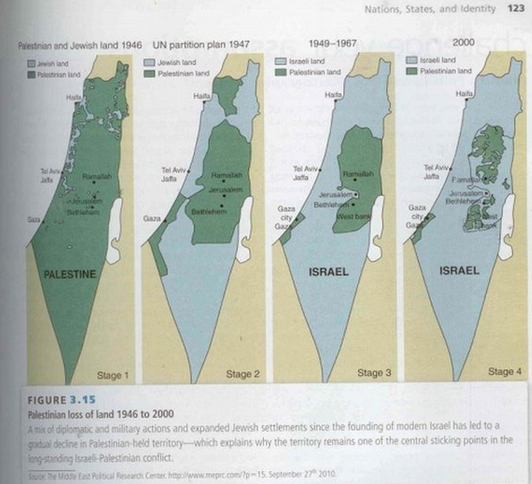
Last month, McGraw Hill withdrew a textbook because it contained a series of inaccurate maps that purported to show changes in Jewish versus Palestinian land possession over the course of the mid-20th century. Jewish Voice for Peace has a letter signed by several professors protesting that decision. It provides a convenient list of academics whose graphical representations we now know shouldn't be trusted. In all honesty, it provides a convenient list of academics who shouldn't be in academia.

Now, before we go into the details of the map series at issue, let's step back a bit. Suppose you are a conscientious academic who wanted to create a map series showing changes in "Palestinian land" and "Jewish land" over the course of the 20th century. The first thing you would do, obviously, is decide what metric you're using -- that is, what is the criteria through which lands are labeled "Jewish land" or "Palestinian land."

One possibility is "de jure authority": land is "Jewish land" if a Jewish state (i.e., Israel) exercises de jure sovereign authority over it, and is "Palestinian land" if a Palestinian state exercises de jure sovereign authority over it. The resulting map series might start before WWI and show that, at that time, none of the land was Jewish or Palestinian -- it was all under Ottoman authority. In 1946 it would all be under British control. Following Israel's War of Independence we would finally see some "Jewish land", alongside Jordanian and Egyptian land (as they exercised sovereign authority over the West Bank and Gaza strip), but still no "Palestinian land" (since a Palestinian state exercising de jure sovereign authority had yet to emerge). After 1967, all of the land in question would be Jewish land (and then some, if the date we picked included the years when Israel controlled Sinai). By 2000, though, the Palestinian Authority, would have (arguably) begun exercising sovereign authority over portions of the West Bank (and, for a time, Gaza) -- and so the map would adjust to remove those spots from "Jewish Land" and instead label them "Palestinian Land."

Of course, "de jure sovereign control" is not the only way to measure changes in Jewish versus Palestinian land. Another possibility is to look at private land ownership -- who owns the deed to particular parcels of land. This would be more difficult, but it's still theoretically doable. And we'd see some land owned by Jews, and some land owned by Palestinians, and some owned by neither (because its owned by a third party, or because it is state- rather than privately-controlled), and we could see how those proportions evolved over time. We could also do a map series defining whose land it is by reference to various international proposals that purport to allocate various lands to one group or the other. Any of these could be justified, so long as we were clear which we used and did not mix-and-match different metrics willy-nilly.

Importantly, doing this would not remove questions of interpretation or even bias. For example, if you started the "de jure control" map in 1975 and moved it to the present, it would look like the Israelis had actually ceded large swaths of territory to various groups, including the Palestinians. That would craft a very different, and arguably misleading, story compared to what emerges if you started the map series in 1946. By contrast, if you skip over the year 1975 entirely, you ignore a significant Israeli expansion in territory that it later contracted from, and that too could be said to be misleading. Likewise, the choice of one metric rather than another could be challenged for all sorts of reasons. As I said above, obeying the basic rules of academic integrity does very little to eliminate sources of academic controversy and disagreement. It is the bare minimum we can truly demand out of anyone who calls themselves a scholar.

Having said all of that, here are the maps that were challenged:


If it is hard to see, the green is labeled "Palestinian land" and the blue "Jewish land". The maps cover four periods --1946, 1947 (the Partition Plan), 1949-67, and 2000.

Pulling these maps, in all honesty, should not have been a controversial decision no matter what views you have on Israel and Palestine. The issue isn't that they tell an inconvenient story or pose difficult questions about the occupation. It isn't even that they are "misleading" or "biased" (though they are those things too). The issue is very straightforward: they don't use a consistent metric for what counts as "Jewish" and "Palestinian lands" (they also didn't disclose what metrics they did use -- presumably because doing so would have by necessity forced disclosure of how the metrics shift). That is flatly unacceptable for an academic work. Full stop.

Of course, since the metrics aren't disclosed, it isn't 100% clear what actually does provide the basis for why any individual plot of land on any given graph is consider "Jewish" or "Palestinian." But I think I can pretty well parse it out:

  • The right-most graphic (2000) seems to label as "Palestinian land" that land which is under the de jure control of the Palestinian Authority. And it shows as "Jewish land" the land that is under the de jure control of Israel. So it looks like we're getting a series showing who had de jure control of what land at what time. That's great!
  • Moving left, the next graph (1949-67) shows as blue "Jewish land" all the land under Israeli control during that time period. So far so good. But the green "Palestinian land" is not territory under control of a Palestinian sovereign. Those territories, at that time were under Egyptian and Jordanian sovereignty. The metric for "Palestinian land" now has switched from "land under Palestinian sovereignty" to "land not under Jewish sovereignty". Technically, one could say that's still the metric in the first graph (land that is or isn't under Israeli de jure control). That'd be more than a little shady (why should land under Jordanian control be labeled "Palestinian land"?), but I suppose technically it's not an inconsistency.
  • The next map shows the proposed 1947 partition plan. It has nothing to do with who has de jure control over anything. Neither Jews nor Palestinians had sovereign authority over any of that land at that time -- it was under British dominion. We've completely left the realm of "de jure control" for both Jews and Palestinians alike.
  • The final map, in 1946, is the most difficult for me to parse. It's obviously not about de jure control (again, it was entirely in British hands at the time). From what I can tell, it labels as Jewish land any land under private Jewish ownership -- a completely new metric. And is the green then "any land under private Palestinian ownership"? Nope -- the green is "everything else." Like the 1949-67 map, it's not even an internally consistent metric (let alone consistent across the four graphics).

In short, we have an inconsistent (and unlabeled) hodgepodge of standards, ranging from "private ownership" to "de jure control" to "international proposals" to "anything that isn't 'Jewish land'". There is no basis -- none -- for supporting this as a remotely valid piece of academic scholarship. If a student gave me these graphics, I would probably fail them, and I'd at least consider reporting them for academic misconduct (though I'd likely end up just  giving them a stern talking-to). If a professor defends it, they're basically saying that they can't be trusted to present information in accordance with basic standards of academic integrity -- or at best, that they can't identify basic academic malpractice in cases where the sources appear to advance to their preferred political outlooks. That any professor of any ideological outlook would stand in support of this is a disgrace to our entire profession.