Friday, October 27, 2023

Airstrikes While You Wait


On October 13, Israeli defense officials made the infamous announcement giving Gaza residents "24 hours" to evacuate the northern Gaza Strip in advance of an imminent ground invasion.

Three hundred thirty-six hours later, the ground invasion still hasn't materialized. The Israeli government appears internally divided about the feasibility of a ground invasion -- how it could be managed, whether it can practically achieve the objective of "destroying Hamas", how it interacts with the objective of freeing the hostages, is it possible to accomplish without unacceptable losses. And so, weeks after the invasion seemed to be imminent with the space of a day, we continue to wait on an uneasy precipice.

[T]he government called up around 360,000 reservists and deployed many of them at the border with Gaza. Senior officials soon spoke of removing Hamas from power in the enclave, raising expectations of an imminent ground operation there.

But nearly three weeks later, the Netanyahu government has yet to give the go-ahead, though the military says that it has made a few brief incursions over the border and that it will make still more in the days ahead.

The United States has urged Israel not to rush into a ground invasion, even as it pledges full support for its ally, but domestic considerations have also played a role in the delay. Beyond the hostages, there is concern about the toll of the operation and uncertainty about what exactly it might mean to destroy Hamas, a social movement as well as a military force that is deeply embedded in Gazan society.

When asked what the military objectives of the operation are, an Israeli military spokesman said the goal was to “dismantle Hamas.” How would the army know it had achieved that goal? “That’s a big question, and I don’t think I have the capability right now to answer that one,” the spokesman, Lt. Col. Richard Hecht, said at news briefing a week after the attack.

At one level, this looks like yet another illustration of the Netanyahu government's broader pattern of dithering and incompetence that has characterized its response to this entire crisis. Yet while I bow to no one in viewing Netanyahu as an ineffectual and criminal buffoon, on this narrow point I won't fully agree: if one doesn't yet have a workable plan for how an invasion will destroy Hamas, it is better to hold off on the invasion than to do it just in order to do "something". The only thing worse than dithering about in uncertainty because you don't have a plan is doing a full-scale invasion of a neighboring territory because you don't have a plan, and given the choice between the two I'm glad the Israeli government has so far chosen the former route.

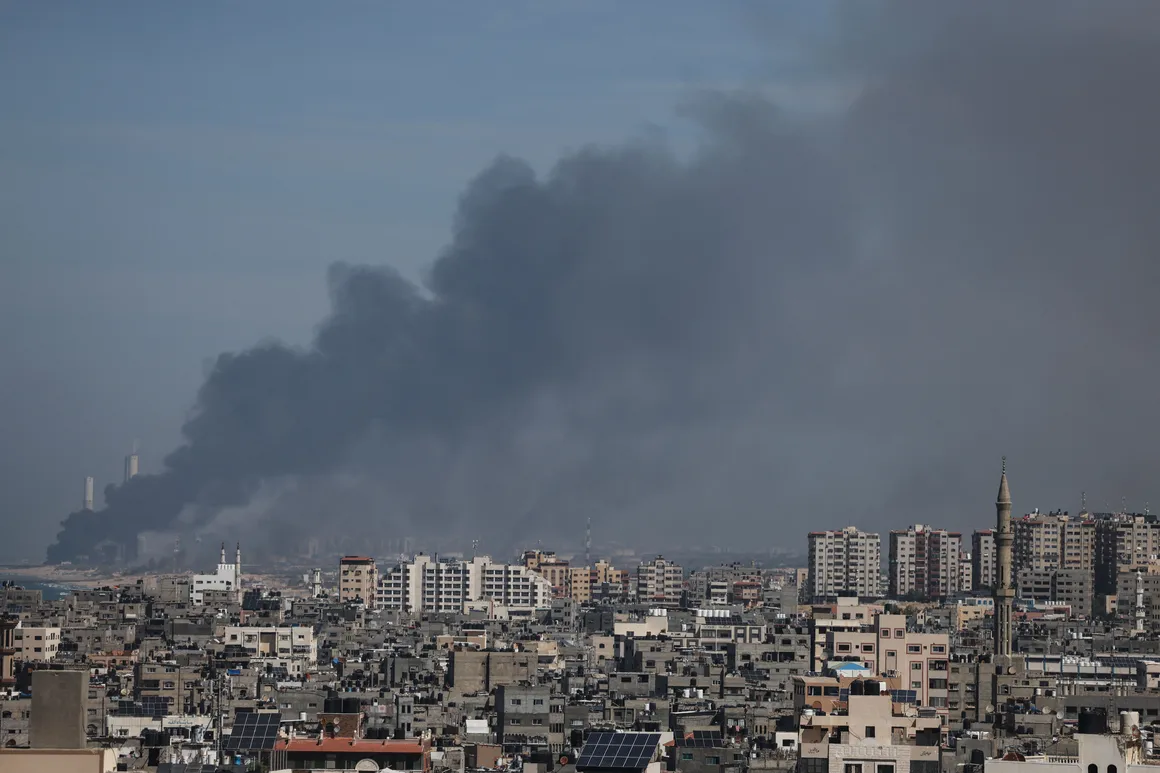
That being said, this puts the Israeli aerial strikes into Gaza in a different light. With the Israeli government locked in paralysis over how to resolve the current crisis, the airstrikes have all the appearance of a deadly holding pattern -- a "something" to do while the army waits for the politicians to figure out an actual plan. Taken that way, it's hard to justify the airstrikes -- and the massive devastation they've caused to Gaza's civilian population -- as justified. 

The airstrikes are cast as necessary to a campaign of "destroying Hamas", and maybe if they actually would accomplish that end they could be warranted. But in reality, when you drill down to it, there's virtually no evidence presented that the airstrikes are at all effective at securing that goal. The airstrikes are not "destroying Hamas". Rather, it seems like Israel doesn't yet have a plan for how to "destroy Hamas" and is lobbing missiles into Gaza while it tries to figure it out. The term "proportional" is often misused in international conflicts -- it's not a requirement that all military violence be meted out at a 1:1 ratio -- but here the actual legal meaning is illustrative: the question is whether the expected military benefit is proportionate to the anticipated civilian cost. There's been little evidence presented that these airstrikes actually have much in the way of expected military benefit vis-a-vis the objective of destroying Hamas, and so is hard to justify against the damage dealt to innocent civilians.

One name given to Netanyahu's overall failed strategy for relating to Palestinians was "managing the conflict". The term, like "mowing the lawn", was a self-conscious abdication of any effort to actually resolve the conflict; it accepted that the conflict would exist in perpetuity and tried to tamp down on the costs (to Israel) to acceptable levels. Hamas' attack on Israel on October 7 is a genuine crisis for Israel, but to a large extent the Netanyahu government's response can be characterized as "managing the crisis", because they have no idea how to resolve it. The goal of destroying Hamas is unquestionably just, but they can't figure out how to accomplish it. They can't give Hamas a win by just capitulating to its demands. They have a justifiably furious populace for whom they've got nothing to show, and an international community that's running out of patience. They're stuck. A "better" government than them would also probably be stuck, but this dilemma is certainly beyond the capacities of the pathetic rabble  of fascists and lickspittles that comprises Netanyahu's coalition. And so again, the airstrikes really seem more than anything like a stalling tactic. They are not a route out of the crisis, they do not even move Israel materially in the direction of emerging from the crisis. Rather, they are a relatively costless (for Israel; for Palestine the costs are devastating) measure it can dole out to do something while it gropes for an actual way out of the crisis that has eluded it thus far.

It is infuriating that the proximate villains of the atrocities on October 7 are largely inaccessible to be brought to justice. At some level, what we're seeing is an interplay between Israel's immense power (in the form of bombs and missiles and tanks) and terrible impotence (to have stopped the attacks in the first place, to bring justice to their actual perpetrators).

And yet: airstrikes on Gaza cannot be justified in perpetuity on the basis of "we can't figure out how to bring Hamas to justice, and we can't think of anything else to do." It is, I'll repeat, infuriating that we can't figure out a way compatible with basic human rights standards to make it so that Hamas pays its deserved price for the atrocities it committed on October 7. This is why I've been repeating ad nauseum that we need to devote a lot more of our creative energy to thinking about alternatives that can secure Israel's existential security interests in the wake of those attacks (including the interest in not sending the message that brutal massacres of civilians are the best way to secure boons for the Gaza population, which is why even from a left-humanist perspective "just give Gaza everything it wants" is horrifyingly less feasible now than it was on October 6). But it's also the case that the argument against a ceasefire, insofar as it takes the form "we can't cease our fire precisely because we haven't figured out yet how our continuing to fire will secure our valid security interests" simply does not work as an argument, and with each passing day it grows less and less persuasive.

To put it in stark terms: when do the airstrikes have to stop? When "Hamas is destroyed"? We've already said that the airstrikes don't seem like they'll do much to advance that agenda, so if that's the answer then it merges with "never". Just a perpetual bombing of Gaza until the "rubble bounces". But, as horrifying as October 7 was, it does not and cannot serve as a foundation for "Israel can bomb Gaza forever for no apparent significant military gain or purpose." The mismatch between the conceptual justification ("Hamas must be destroyed") and the actual practice (airstrikes which nobody seems to think will actually do much to destroy Hamas) means that the two categories will never actually merge, and that is a direction of perpetual, endless war.

I've spoken critically about the calls for a "ceasefire" which really aren't about a "ceasefire" at all, but boil down to the desire for "a flat rule that Israel is not permitted to pursue any of its security objectives via projection of military power". But the notion that, if Israel cannot figure how to actually pursue its valid security objectives via projection of military power it shouldn't be given license to simply exert military power indefinitely for its own sake, has a lot more purchase. The simple fact is that if Israel can show an actual plan for how a military operation -- whether we're talking airstrikes, a ground invasion, special forces raids, or something else -- actually will accomplish the end of "destroying Hamas", that's a conversation, and is not something that should be preemptively and categorically ruled impermissible. But right now, Israel doesn't seem to have any such plan, and the notion that it can indefinitely immiserate Palestinian civilians as a sort of holding pattern while it tries to figure one out is harder to stomach. 

Put differently: it is understandably infuriating to those who were directly and indirectly terrorized by Hamas' violence to witness Israel dithering about in uncertainty because it doesn't have a workable plan to resolve this crisis. But it's still better than Israel lofting bombs into Gaza indefinitely because it doesn't have a workable plan to resolve this crisis. If Israel can't determine how a military operation will actually translate into significantly advancing its legitimate security objectives, then it should cease fire unless and until it can figure it out.

DeSantis, ADL Call for SJP Ban


A few days ago, Gov. DeSantis ordered Florida universities to "deactivate" campus chapters of Students for Justice in Palestine, on the grounds that SJP provides "material support" to an international terrorist organization (i.e., Hamas). Yesterday, the ADL (along with the Brandeis Center) sent a letter to nearly 200 university presidents effectively urging them to do the same: demanding that the universities investigate their SJP chapters for "potential violations of the prohibition against materially supporting a foreign terrorist organization."

That the ADL has joined this campaign is, at this point, probably overdetermined, given the confluence of:

  1. The ADL's general rightward turn on matters relating to Israel and Zionism over the past year;
  2. The genuine decay in the campus environment for young American Jews, for which SJP bears more than a share of the responsibility; and
  3. The long-standing intense (mutual) loathing between the ADL and SJP, where either one would sell out the constitutional rights of the other for a quarter and give back two dimes in change.

Nonetheless, this call is an obvious flouting of the First Amendment (for public universities) and academic freedom (for privates). As Howard Wasserman puts it, I resent being "[forced] to side with people who want to see me and my family dead," but thanks to DeSantis and the ADL, I'm now in that position.

To be clear: the "material support for terrorism" claim is -- with respect to the evidence presented -- absolutely spurious (FIRE's letter to Florida universities explains why). While the ADL claims to "recognize and support students’ First Amendment rights to freedom of speech, even odious speech," it flags nothing in its letter that goes beyond "odious speech" in support of Hamas. The sole example of alleged "material support" provided by SJP is rhetoric in its toolkit stating:

“We must act as part of this movement. All of our efforts continue the work and resistance of the Palestinians on the ground.” The toolkit refers to the Hamas-led terrorist attack in Israel as “the resistance.” 

This in no way supports an inference of "material support" under the statute. "Material support" has to include more than just advocacy in support of the terrorist organization or rhetorical claims of alignment -- it must entail things like transfer of funds or the provision of a tangible, material benefit. As the Supreme Court made clear in Humanitarian Law Project v. Holder, as expansive as the "material support" statute may be, the prohibition on providing material support to terrorism nonetheless cannot encompass "a regulation of independent speech ... even if the Government were to show that such speech benefits foreign terrorist organizations." "Material" requires actual materials, not just speech.

Just a few weeks ago, there was a virtual consensus that campus SJP actors were a disreputable fringe that nobody should take seriously (this was how the left justified their complaints that we were paying too much attention to "letters sent from Harvard" -- they conceded the letters were gross, but argued that they represented a piddling and insignificant political faction toiling in deserved marginality. Intentional or not, I appreciated the concession!). Now, thanks to DeSantis and his buddies, the SJP can adopt the far more comfortable mantle of First Amendment martyrs. Of course, if there is evidence of actual "material support" -- SJP funneling funds to Hamas, for example, the ADL should provide it (and I'd add, the proper investigators of such claims are law enforcement officials, not university bureaucrats). But as it is presented here, the effort to ban SJP is nothing more than an effort to ban a noxious organization on the basis of its noxious viewpoint, and one cannot support that and claim to be comporting with either the First Amendment (for public universities) or academic freedom.

Thursday, October 26, 2023

The Dangerous Weave of Historical Maximalism


The principle that it is wrong to slaughter civilians -- going house-to-house with the express agenda of gruesomely murdering the men, women, and children you find there -- is seemingly so obvious it seems impossible imagine it must be "taught". Surely, it is a principle we all understand at some intuitive, base level. And yet, history is replete with such murders and massacres -- in all parts of the world, in every time period, amongst persons of every social strata and political proclivity -- a history that somehow must be compatible with our knowing, at some deep level, that it is wrong. As a species, we are good at murder. But we're experts at rationalizing it.

It's important to know history. But arguments from history are dangerous things. History offers a near-infinitely rich and diverse series of threads, from which one can weave virtually any tapestry one desires. For a species that excels at rationalizing brutality of the worst forms, this should concern us, for all of us can easily be seduced by a historical narrative that eases us back into apologia, justification, or even celebration of unthinkable atrocities. 

The experience of the past few weeks has been, to a large extent, the witnessing of folks -- sometimes our colleagues, sometimes our friends -- weaving tapestries of death in real time. There is little more depressing than reading Facebook posts and op-eds and blog posts by people you know and, on most days, like, and watching them work through the process by which they become apologists for massacres.

None of us should be too confident in our immunity from the pattern. Indeed, there's a degree to which this danger is most prominent for the well-informed, the educated, the "experts". There's research that suggests that education increases ideological polarization, because every bit of knowledge -- every book you read or conference you attend -- is, or can be, the raw materials through which one can support and fortify one's own preferred narrative against challenge or refutation. It is no accident, I think, that many of the worst voices on Israel and Palestine are "the professionals" who've steeped themselves in the debate for years -- the PhD students, the organizational warriors. It's not just that the debate itself is so toxic that it can't help but have a corrupting effect (though it is that). It's that the process of learning more, if one isn't careful, paradoxically becomes a mechanism to hate better and more righteously than would otherwise be possible.

One can easily tell a historical tale through which Israel is naught but a savage European colonial imposition, to which any form of resistance is necessary and appropriate. Tell this narrative frequently and loudly and univocally enough, and it degrades one's ability to call atrocity "atrocity", potentially beyond repair, as we saw over the past few weeks:

Suddenly forced to decide whether, in the wake of occupation and besiegement, a Palestinian response of "a systemic campaign of house-to-house kidnappings, rapes, and executions" is a valid one, we saw far, far too many individuals unable to say "no" (or at least, say it with any level of decisiveness). This failure stems directly from the tempting broth that assures us that, if the provocation is severe enough and the injury severe enough, no amount of "response" could ever be disproportionate. And so we see that, if you refuse to let yourself think that anything could be "too far", there's no end to the depths of hell you may find yourself apologizing for.

But to be clear: others can tell other tales, wherein Israel is naught but Jewish decolonization and liberation, for which any measures are justified to valorize and defend (there's a story, I've said, where revanchist Zionism is what happens when Fanon wins in a rout); or where Palestine (in quotes) is itself a colonial invasion which cannot be permitted to exist and must be extirpated by any means necessary. All of these tales weave history differently, and all of them (this is important) pull from portions of "reality" (neither the colonial or decolonial elements of Zionism are simply made up), but in their maximalism and extremity they are seductresses back to the pattern of atrocity justification.

That I used some version of "(de)colonialism" in all of those stories is no accident, but not because I think the concept of "(de)colonialism" is inherently diseased. To the contrary, we speak in the argot of the times, and so it is unsurprising (albeit not especially revelatory) that today's maximalist narratives will try to bootstrap them onto those terms which seem most vibrant in the potential for justifying radical action (and what are atrocities if not radical?). In different times and contexts, the argot will be different, and once again that very polysemous character of history is part of what enables it to so easily serve as raw materials for justificatory atrocity. Monsters justify the infliction of atrocities via many words -- "decolonialization", "self-defense", "averting genocide", "patriotism," "turnabout", "just deserts", "liberation" -- and their usage neither discredits the words, nor does their use of the words mean we must credit their atrocity.

So what do we do, when confronted with this vast, untamable polysemousness of history and ideology? One choice is to try to assert, with evermore earnest, desperate, or self-righteous vigor, the One True Story (Zionism IS ethnonationalist colonialism, Palestinian nationalism IS exterminationist antisemitism) that can supply the threads necessary to weave our tapestries of death; that can explain why it is okay (or understandable, or a tragic necessity, or commensurable tit-for-tat) to machine-gun concert-goers or to torch olive trees, or to permanently deprive millions of Palestinians citizenship rights on the land where they live, or to eradicate the one political space on the planet where Jews have control over their own destiny. That so many find that path appealing is, I think, precisely because of the destination it promises -- the seduction of being able to hate and murder and pillage and deface and expropriate and have it all be justified.

But that is not the only choice. We should know history well enough to respect it, and respect it enough to know that it cannot truly be mastered for the service of any one political cause. Historical maximalism is, ultimately, a corruption of history, and for that reason it will never persuade anyone not already primed to be persuaded. In cases of protracted group conflict, what one inevitably gets is dueling maximalists; two sides both utterly convinced of their righteousness and ready to scorch the earth on the path to heaven. 

Precisely because the path of historical maximalism promises everything, it can ultimately offer nothing: "a moral race to the bottom" that is inevitably a path towards death. Acknowledgment of the pluripotent strands of history can be the means through which we resist maximalism and extremity, resist the siren's call of boundless violence, and instead reform around a pragmatic humanism whose very lack of complete self-assuredness serves as a bulwark against our instinct to rationalize atrocity.

One does not need to behead infants near Sderot. One does not need to set fire to Huwara. These are choices, as is the choice to serve as apologists for them. They're choice made inside a weave of history that sings out with the false promise that they are justified or inevitable or in some way not as bad as we know, in our heart of hearts, they truly are. 

It is a terrible thing, to watch people you know and love and care about submit the temptation of history and ideology to defend brutality in the service of maximalism. I hope more people make better choices.

Tuesday, October 24, 2023

The Third Stage of Road Construction


Years ago, I remember reading a Dave Barry column that was centered around the various stages of road construction. The first stage entailed closing down the road and making everyone's life impossibly inconvenient. "In the second stage", he continued, "nothing happens. This stage may last for several years."

This old column came to mind recently as I was navigating my own commute to Lewis & Clark. This past summer, some signs went up saying that the street which anchors my normal route to work would be closed from July 13 to October 13. Why? I couldn't find any information (finally, just a few days ago, I found this). But no matter -- the detour wasn't too extensive, and of course, most of the work would be done over the summer when I wasn't going into the office that frequently.

July, August, and September go by. I drive past the work site, and I never once see anybody doing anything. There's just a lonely sign announcing a road closure and a promise that the route will reopen on October 13.

Finally, October 13 rolls around. I drive past the work site to see if the closure has ended, and I see two things: (1) People finally doing something that looks like work (at the very least, some construction vehicles and folks in orange vests; and (2) a sign saying that now the road is closed through November 1.

As far as I can tell, for three months from the time the road was closed until the time it was scheduled to be reopened, nothing happened. Work didn't actually start until after it was scheduled to have finished.

Come on Portland -- get it together.

Sunday, October 22, 2023

In the Middle of It All


Shaul Magid has a very interesting, provocative, and thoughtful essay in Religion Dispatches about the current state of affairs in Israel and Palestine -- where it came from, and where it is going. Magid is an author for whom my general orientation is that I rarely agree with everything he says, but always find him worth reading, and so it is here. But one point in particular that he makes that very much resonates is that Hamas' attack on Israel "is not the beginning, nor the end, but as with most things, somewhere in the horrifying middle."

Nothing in geopolitics comes on a fresh slate, and there will always be history trailing behind us (and laid out in front of us). It is not justification or excuse to observe the obvious truth that Hamas' attack did not emerge ex nihilo. The same, of course, goes for the responses to that attack, which also cannot be viewed as wholly discrete, isolated events that can be analyzed and approved of/condemned atomistically. But one thought I keep returning to, as I read both justifications for Israel's campaign against Hamas and calls for that campaign to end in a ceasefire, is that a lot of people seem to think that we're not in the middle, that we could be on the verge of (if we make the right moves, anyway) the end. And in doing so, I think they're skipping past some essential but difficult question about what comes after whatever comes next.

Start with Israel's backers, for whom the call of the day is that things cannot proceed as they did before vis-a-vis Hamas in Gaza. I agree. As I said in my very first post on these atrocities, they were (among other things) a catastrophic failure of Israeli security policy; a complete discrediting of what came before. But before we go into what might change, we need to correctly identify what it is that was "before".

For most of the time following Israel's disengagement from Gaza and Hamas' ensuing takeover of the territory, Israel's policy has been one colloquially dubbed "mowing the lawn." In this metaphor, "the lawn" is Hamas' military capacity and willingness to inflict violence against Israelis across the border. When that capacity/willingness gets too dangerous (the grass grows too high), Israel launches an attack that depletes Hamas' stockpiles of men and munitions (the grass is cut), forcing Hamas to recuperate and recover. As time passes, Hamas inevitably replenishes its stockpiles of weaponry and its willingness to use them (the grass starts growing again), and the cycle repeats itself.

Notice that this policy is not one even aimed at securing a durable peace. It presupposes an ongoing and essentially endless cycle of violence; albeit one controlled at levels that are presumptively tolerable (for Israelis, anyway). That each Israeli attack inevitably will be followed by another one however many months or years later is not a failing of the strategy, it is the point of the strategy (just as it is not a "failure" when mowing the lawn that you'll have to do it again in a few months).

This was the strategy that failed and was decisively discredited on October 7. It is a failure both in its view that an endless cycle of low-grade violence could be kept at "tolerable" levels indefinitely, and in its broader apathy towards actually pursuing something that looks like a just and durable peace.

So now we move to today. The call to "destroy Hamas" is presented as a change from the prior policy of mowing the lawn; it's no longer about temporarily depleting Hamas' capacity to inflict violence, it is a decisive resolution -- the end of the story.

But how is it different, really, from "mowing the lawn"? To be clear, I shed no tears for Hamas' destruction; they're an evil terrorist organization who've inflicted untold misery on Israelis and Palestinians alike. But it's hard to imagine what "destroying Hamas" means in practice. If we're just talking about degrading the actual, social-political-military organization's specific ability to conduct operations, then maybe it's feasible -- but only because another organization will rise to take its place (and if "Hamas" is in 2024 replaced by "Babas" which does all of the same things, what has actually been accomplished?). If the goal is to permanently obliterate the ability of any actor, under any name, in the Gaza Strip to engage in insurgent violence against Israel, then it's not feasible at all -- surely, at this point, we've discredited the notion that Gaza can be bombed into permanent acquiescent quietude vis-a-vis Israel.

Put differently, a call to "destroy Hamas", without more, is just another iteration of mowing the lawn -- cutting the grass shorter, perhaps, but otherwise a repetition of the same failed strategy. It is not an end, it is a middle, and if left to its own devices it will continue the endless immiseration of the Palestinian people in service of eventually leading to another repetition of the terror we saw on October 7. So anyone calling to "destroy Hamas" has to have some plan for what to do afterwards. Those who say "destroy Hamas" and then stop there are committing the fallacy of assuming that "destroying Hamas" is the end of the problem in Israel and Gaza, and that's just obviously untrue.

So what is the "more" I propose? Simple: massive aid and reconstruction for Gaza. I spoke a few days ago of the grimmest silver lining of terrible war sometimes finally yielding a comprehensive peace, and if the terrible war is already upon us, we might as well try to leverage it to get the lasting peace.  Call it realistic, call it an ego-salve, but exploit the opportunity to say "now that Hamas has been destroyed, we can do ...." X, where X is good, humanitarian, reconstructive policies that break the pattern of entrapment and immiseration that has characterized the Gaza Strip for decades. 

There will be plenty of people who resist this; who say "how can you propose giving billions to Gaza after what happened on October 7?" Worse, Hamas -- being a terrorist organization -- isn't as prone to being "destroyed" in the way that, say, a corporation or even a state government could be. It'd likely be impossible to fully obliterate them; there will always be someone with a gun and a commitment to Hamas' ideology running around somewhere.

But my mind returns to the Marshall Plan after World War II, which surely was one of the greatest foreign policy decisions in modern history. No doubt, one could say, no country deserved less in the way of repair and support than Germany after World War II. Yet there's little doubt, comparing the outcome of post WWII to post WWI, that the choice to invest in reconstruction and repair paid off in incalculable dividends. The decision to focus less on retribution ala the Treaty of Versailles -- or, perhaps more accurately, to let "retribution" be in the military defeat and in the Nuremburg Tribunals, not in the post-war occupation of Germany (on the western side, at least) -- and more on creating future conditions of prosperity and fraternity seems, in context, almost impossibly humanistic, and yet it paid off beyond I imagine even the wildest hopes of its architects. If we can do it for Germany in 1946, we can do it for Gaza in 2023. Otherwise, we're just going to relive the same cycle again and again. 

So that has to be the deal: if you're going to destroy Hamas, then once you've declared "mission accomplished" there has to be a commitment to reconstruction. And moreover, one cannot use the impossibility of fully, completely, and in toto destroying Hamas as an excuse to never declare "mission accomplished". There's no universe in which a commitment to reconstruction doesn't take some leap of faith, but that has to be part of the deal.

That's the short-sightedness I see on the pro-Israel side of things. But there's actually something similar happening from those calling for a "ceasefire". Now, ceasefire can mean many things, and at its most literal it can mean nothing more than an intentionally temporary and short-term reprieve of hostilities to permit humanitarian aid to enter and medical and civilian evacuations to proceed without danger. It also can be temporary in the sense of a hope that the objectives which parties might rightfully be able to pursue in war could also be achieved via peaceful negotiation, so we should at least try the latter before (if talks fail) resorting to the former. 

But my sense is that most people calling for a "ceasefire" want something more durable than a few days where aid trucks can go in and out of the territories unmolested. Nor are they, in any realistic sense, hoping that with a few days of conversation Israel will be able to achieve its valid security objectives through a process of negotiation, while recognizing that a military option remains validly on the table. They think that any Israeli military response is inherently unjust and must be opposed, under any circumstances. "Ceasefire" is in some ways a misnomer; the actual demand is something closer to "the international community's position should be a flat rule that Israel is not permitted to pursue any of its security objectives via projection of military power".

A few days ago I wrote about why the call for a cease-fire seemed so futile. The basic thrust of my argument was that (a) Israel existentially cannot allow Hamas to view October 7 as a net victory, and (b) nobody has yet come up with a credible alternative beyond a bruising military response that would prevent Hamas from seeing October 7 as a net victory. An "everyone, go back to your corners" ceasefire would, at this point in time, still be seen by Hamas as it coming out ahead. Horribly, this sense would be amplified, not diminished, the more "ceasefire" is conjoined with new momentum for aid to the Gaza Strip or alleviations of the Israeli blockade -- it would suggest that brutally and shockingly massacring Israeli civilians is the most effective strategy at convincing the international community to come to Palestine's aid. And internalizing that lesson, as I said, really would be an existential threat to Israel -- it's something that the state absolutely cannot allow to happen.

But what I've come to realize over the past few days is that, just as many of Israel's supporters thinking "destroying Hamas" will be the end, rather than the middle, of the story; many of its detractors also think that we could be close to the end. Anyone who went to Hebrew School is familiar with an old saw, repeated ad nauseum in certain circles, that goes "If the Palestinians laid down their weapons there would be no more war; if the Israelis laid down their weapons there would be no more Israel." And it occurs to me that many of the pro-ceasefire commentators genuinely believe this, but in the reverse. They really believe, with absolute, 100% confidence, that if Israel just stands down and turns the other cheek, and presumably does various other pro-Palestine actions (which might include anything from "end the blockade of Gaza" to "permit a right of return for descendants of refugees"), this whole thing will be over. In a sense, Israel has no valid security interests going forward because it always, at any point it chooses, has the immediate and unconditional capacity to end the situation of security threat at its sole discretion.

From that vantage point, proponents of a ceasefire don't have to come up with an "alternative" to military action that will prevent Hamas from viewing October 7 as a net victory, because the whole thing will be moot. It wouldn't matter if Hamas "internalized the message" that brutally and shockingly massacring Israeli civilians is the most effective strategy at convincing the international community to come to Palestine's aid, because they'd have already achieved all that they wanted, and wouldn't have need to resort to that tactic again. We'd be at the end of the story, not the middle.

Framed that way, the logic -- indeed, the moral imperative -- of a ceasefire becomes undeniable. But it all depends on believing, with 100% certainty, that all Hamas wants is whatever boons and succor would result from a ceasefire and any ensuing alleviation of Gaza's humanitarian conditions. That seems unrealistic on two levels. First, of course, a ceasefire could not realistically provide conditions that represent a permanent and durable end to the conflict. But second, it is based off a dogmatic and unsustainable believe that all Hamas wants and all Hamas is fighting for is justice. It fails to take seriously the seemingly undeniable reality that Hamas actually, genuinely wants unjust things vis-a-vis Israeli Jews, and will be inclined to keep fighting in order to attain these unjust ends. It's not all they want, but it is the height of naivete to think that Hamas will be satisfied -- that the story would end -- if only Israel agreed to the demands of justice as conceptualized by western peace activists. And again, that belief is essential to the project, because if we're still in the "horrifying middle", then we do have to think about the risks and consequences of enabling Hamas to view October 7 as a winning strategy, and we do have to figure out what alternative to a military campaign could prevent that being the moral of the story.

That last part is an earnest plea. War is awful in general, and will be especially awful here to innocent Palestinian civilians who are functionally trapped in a zone of active hostilities. Moreover, as alluded to above I'm dubious this war, for all the death and destruction it will ladle onto an already overflowing pile of human misery, will even achieve the (not-so-)modest objective of permanently degrading the ability of Palestinians in the Gaza Strip to inflict violence on Israeli civilians. Nobody should be excited for this, nobody should think this is a good thing.
What's needed now is an off-ramp, something that can plausibly induce Israel to not go down a seemingly inexorable path without it being seen as giving Hamas a win. How do we, to alter the sardonic advice given to the U.S. as it found itself stuck in Vietnam, convince Israel to declare victory and then stay home? Keep in mind that, with respect to everything I just said about the strategic necessity of shifting the moral of the story, none of it at all alters the initial set of observations that an Israeli ground campaign in Gaza would be disastrous for Israel, to say nothing of Palestinians. The whole problem is that this terrible option still seems to be "better" than all the alternatives, and if that is to change it will only be if an alternative that successfully convinces Israel that Hamas didn't win and won't perceive itself as having won.
If someone can propose a genuine off-ramp that can credibly avert this calamity, they deserve a Nobel Peace Prize and everyone's support. And I'll say I'm not opposed to a ceasefire that's meant to hold the peace while that solution is generated. But to come up with an alternative, it's necessary to recognize that we're in the middle of the story, not the end. As much as we might like to, we cannot skip to the conclusion.

Thursday, October 19, 2023

A Purely Federated U.S. "State" of Territoria?


This is one of those thoughts I had in the shower that might not go anywhere, but I wanted to run with it a bit.

As many of you know, one of my pet issues is statehood for all American territorial possessions. Not just DC statehood, but statehood for Guam, the U.S. Virgin Islands, American Samoa -- the whole shebang. I'm actually a bit of a hardliner on this in that I don't think the territories should have the option of remaining territories -- either statehood or independence. There's no justification, in a modern democracy, for there to be territorial possessions permanently under the domain of a sovereign but lacking full democratic rights and representation in that sovereign.

One problem with my vision is that many of the territories in question are quite small -- much smaller than any current state. Leaving aside Puerto Rico, which is somewhat of a special case, the largest American territory by population is Guam, with a little over 150,000 residents. By comparison, the smallest U.S. state is Wyoming, with a population of approximately 578,000.

Now, in theory I have no problem with a little state-packing of territories with trivial populations (that's in part how we got two Dakotas). But it's also the case that if you add all the non-Puerto Rico U.S. territories together, the population totals close to 340,000 -- still considerably smaller than Wyoming, but not absurdly so. If the only objection to territorial statehood is population, I don't think that objection holds to the combined state of "Territoria".

Of course, it might seem absurd to combine into one state the U.S. Virgin Islands (in the Caribbean) with Guam, the Northern Marianas Islands, and American Samoa (half a world away in the Pacific Ocean). Hell, even Guam and American Samoa, despite both being "Pacific Island Territories", are more than 3,600 miles apart. How would "state" government even work in that context?

But that made me wonder -- is there any problem with a "state" deciding to organize itself on a completely federated level -- total autonomy for each traditional "territory", with no or virtually no power in the "state" legislature? Could there be a "state" of Territoria which exists only to have a Representative and two Senators, but which otherwise is an empty shell comprising the actually active and empowered "local" governments of the constituent territories?

I don't claim this is a miracle drug solution. For starters, it would end the distinctive (albeit non-voting delegate) representation of each individual territory. Especially given that Guam would comprise almost 45% of the population of "Territoria" on its own, I can certainly imagine the other territories crying foul at that. And as I said, I don't actually have a problem with the "pure" state-packing play of giving the U.S. Virgin Islands and its 87,000 denizens full statehood on its own.

But it's an interesting thought, no -- the concept of a "state" that exists only as a vector for national representation, but otherwise makes no claims to be the governing body for its constituent territories? I at least find it a bit intriguing, if only as a thought experiment that might open other doors.

Tuesday, October 17, 2023

What Will the Moral of the Story Be?


Daniel Drezner has a good piece up on the futility of external "calls for a ceasefire" between Israel and Hamas, that helped crystallize some of my feelings on the subject. Many people, as Drezner observes, have written eloquently and persuasively about the disaster that would be sustained Israeli ground campaign in Gaza -- an operation that will endanger countless Israeli and Palestinian lives while simultaneously being unlikely to meaningfully alter Israel's long-term security posture and severely escalating the risk of regional conflagration. Drezner links to articles by Marc Lynch and Daniel Levy and Zaha Hassan as good examples. And like Drezner, I agree with this assessment. The prospect of more war and more killing and more devastation is sickening to me. It won't bring back the dead. It probably won't even permanently degrade Hamas' combat capacities. It just feels like meeting death with more death.

And yet, Drezner observes, few of these commentators have much in the way of practical suggestions for what Israel should be doing instead to respond to Hamas' attack. other than intoning the word "cease-fire". He continues:

Understand that Israel is going to respond because they see no other option after the loss of their deterrent power against Hamas. This is precisely what any other state in the international system would do if it possessed similar capabilities. The intentional attacks on Israeli civilians was heinous. No government could not retaliate, could not demonstrate the severe consequences of such an assault, and still remain a government. This is Politics of National Security 101.

[....] 

For example, I do not disagree with anything Lynch writes in his Foreign Affairs essay. What is less clear to me is what Marc is proposing as a suitable alternative. And this is what keeps nagging at me whenever I am asked if there is anything that can be done to reduce the loss of life. A ground invasion will be grueling in and of itself. It might widen the conflict to include the West Bank, Lebanon, and Iran. But I cannot necessarily think of another policy option that produces a superior outcome for Israel.

Many people have made arguments of the form "no government could not retaliate" over the past few days, but I think Drezner is getting at an important clarification here. Arguments of this sort sometimes are made in emotional terms -- a country which faced such a terrible wound cannot be expected to turn the other cheek towards it. And against that position, those promoting a cease-fire often reply -- correctly -- that no amount of retaliation or bombing is going to bring back the Israeli dead. If the only argument for a military campaign was one of vengeance, of the inchoate sense that Israel has to do ... something to avenge those Hamas murdered, then I would agree that the calls for a cease-fire have purchase. As understandable as that boil for vengeance might be, it's not a good enough reason for the death and devastation that will inevitably follow a ground invasion of Gaza.

But there's more than a mere emotive desire to do "something" at work here. As a matter of pure, cold strategic logic, Israel cannot allow the moral of the story of Hamas' attack to be "this is a winning move." The attack itself was catastrophic on its own terms. If it is seen by Palestinian militant groups as winning strategy, that's more than catastrophic, that's an actual existential threat. The phrase "reestablish deterrence" may be overused (this post by Cheryl Rofer was a helpful corrective), but if it ever had resonance it does here. When faced with a situation like what Israel just went through, a state must demonstrate that the massacre of its civilians is a capital-letter Bad Idea for the massacrers. And so Israel's response, whatever it is, must in some way effectively communicate that message.

And the fact of the matter is, we're not there yet. Imagine that Israel tomorrow announced a suite of policy alterations towards the Gaza Strip that are the dream of all those signing cease-fire petitions: an end to the siege, a release of prisoners, a commitment to reconstruction, the works. What would be the result? It would be to suggest that, as terrible as Hamas' actions were, they were ultimately what shocked the Israeli government out of its torpor and forced it to the negotiating table. Anyone reading this blog probably can name a half-dozen people in their orbit who already have their "Power Cedes Nothing Without a Demand!" Instagram posts ready to roll. And while the prospect of celebratory postings by really annoying people also is not a good enough reason to blow things up (somewhere I had a post about how any Israeli/Palestinian peace agreement worth its salt is going to involve some people you can't stand being happy, and that can't be a reason to torpedo the agreement), the problem is they'd have a point, and a point that if internalized would be incredibly dangerous in any circumstance where the Israeli/Palestinian conflict doesn't end tomorrow. I'm not sure I agree with Ilya Somin that the Gilad Shalit deal laid the groundwork for Hamas' attack twelve years later, but the risk he's flagging isn't invented. Israel at some level needs to devastate Hamas because the alternative is that Hamas learns that operations like these are winning strategies that should be repeated as frequently as possible.

The fact is that, as much suffering as the people of Gaza have already endured, if an actual cease-fire was imposed today Hamas would almost certainly view its operation as a net win, and Israel cannot allow it to come to that conclusion. So the question for those promoting a cease-fire, as Drezner alludes to, is what pathway other than an overwhelming military response changes the moral of the story? What realistic and enforceable proposal would avoid the death and destruction of a military campaign while nonetheless making clear that operations such as the one Hamas just launched are a Bad Idea?

It's not clear what that alternative could be, and that's the problem that makes the military assault feel so inevitable. Maybe Hamas' leadership turning itself in to be prosecuted for war crimes at the Hague could qualify, but that's obviously not on offer (though I've seen some people suggest it be added to the various petitions floating around anyway -- after all, if they're not limiting themselves to things that might realistically come to pass ....). Some form of reparation (what would that look like?)? A long-sought after diplomatic boon (Saudi recognition)? I don't know. None of these seem plausible, let alone sufficient.

To be sure, this doesn't mean there isn't any space for any public or diplomatic discourse urging restraint on the part of Israel. The need to change the moral doesn't license any and all measures; not every possible Israeli action can be justified based on the need to prevent Hamas from claiming a win. The example I gave last week of saying no to starvation policies is one obvious example, as is opposing the flatly sadistic "bounce the rubble" position of militaristic zealots like Tom Cotton. Ensuring an actual, not just pro forma, opportunity for civilians to evacuate is another (that the initially reported "24 hour" deadline has long since come and gone without the ground campaign beginning suggests that something got through regarding the insufficiency of that timeline). And on the point of evacuation, it also is imperative that the United States extract ironclad assurances that evacuated civilians will be able to return to their homes at the conclusion of hostilities -- a requirement that is demanded by the provisions of international law that permit temporary evacuations of civilians from combat zones, but one can forgive Gaza civilians if they are more than a bit mistrustful of Israel's commitment to that principle). All of these are viable and salutary interventions, and Israel has no justification for opposing them, even if they do make its military endeavors more difficult. 

(It's also worth noting that Hamas must allow, and cannot obstruct, civilian evacuations. Hamas has openly urged Palestinians civilians not to leave the northern Gaza Strip, and there are reports it is actively impeding evacuation efforts).

But the terrible truth is that what's needed now probably isn't public calls for a cease-fire. What's needed now is an off-ramp, something that can plausibly induce Israel to not go down a seemingly inexorable path without it being seen as giving Hamas a win. How do we, to alter the sardonic advice given to the U.S. as it found itself stuck in Vietnam, convince Israel to declare victory and then stay home? Keep in mind that, with respect to everything I just said about the strategic necessity of shifting the moral of the story, none of it at all alters the initial set of observations that an Israeli ground campaign in Gaza would be disastrous for Israel, to say nothing of Palestinians. The whole problem is that this terrible option still seems to be "better" than all the alternatives, and if that is to change it will only be if an alternative that successfully convinces Israel that Hamas didn't win and won't perceive itself as having won. Simply intoning "ceasefire" is not, on its own, such an alternative. If you don't care about any of that and just want to express a message that war is bad, then go ahead and intone. But if you're actually serious about trying to effectuate a change of course, then these are the questions you need to consider.

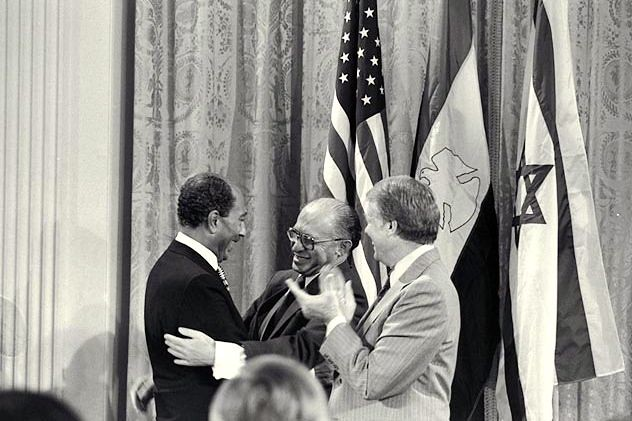
It is a commentary on the twisted state of the world that the closest thought I have to something optimistic is also somehow among the grimmest. In 1979, Israel and Egypt signed a historic peace treaty. History is not monocausal, but one common narrative about the treaty notes how it came in the aftermath of the 1973 Yom Kippur War, Israel's bloodiest conflict since independence. The key was that both parties viewed themselves as negotiating from a position of strength -- as having "won" something. Israel had successfully repulsed the invasion and had shown that it would not be dislodged from the region. Egypt, though, had -- in contrast to the humiliation of the Six Day War -- fought well and significantly bloodied the nose of their Israeli counterparts, showing they were a military force to be reckoned with. The most cynical way of putting it is that the Egyptians killed enough Israelis, and the Israelis killed enough Egyptians, that both sides could view the peace deal as something they had "won", something they'd extracted through strength, not ceded through capitulation.

So the grimmest silver lining would be to imagine that maybe, after Israel's sure-to-be cataclysmic operation in the Gaza Strip, maybe both sides will see themselves as having killed enough of the other so they can call it a victory. Israel can say it's lopped off Hamas' head and so now a true reconstruction can begin. Whatever Hamas-substitute inevitably rises to take its place can say that the Palestinian resistance forced the Zionists to come to heel. Both sides claim a terrible victory, and so can say that the ensuing peace is something they won rather than capitulated to.

It is, again, a twisted and grim "silver lining". The only thing worse would be for all that's happened to happen, and then for nothing to change at all.

Monday, October 16, 2023

Passing Solidarity's Acid Test


I am honored to have co-authored a piece in the Forward with Alan Solow, former chair of the Conference of Presidents of Major American Jewish Organizations, on how the Biden administration's national strategy for combatting antisemitism -- in particular, its focus on building solidarity among diverse groups in the fight against antisemitism -- is facing an early acid test in the aftermath of Hamas' horrific terrorist attack on southern Israel.

And my honest assessment is that the focus on solidarity is bearing fruit. Yes, there have been some high-profile incidents from certain segments of the left that have excused or even valorized antisemitism. We've all seen them, and I (along with many others) haven't hesitated to call them out. But these cases -- as large as they loom -- have objectively been drowned out by a much larger and unified chorus of condemnation. The grotesque behavior of a few is important to identify, but it should not obscure the larger pattern: 

Though vocal, the cadre of extremists who publicly cheer antisemitic terror finds itself increasingly isolated. Though shaken, the community of Jews and non-Jews who have committed to standing together in solidarity against terror have risen to the moment, forging a stronger and more vibrant bond with each passing day.

This doesn't mean that maintaining these bonds will be easy or can be left to autopilot. The events of the last week tested us in terrible ways, and the events of the coming weeks will no doubt continue to do so. But that is exactly why plans must be put in place before the moment of reckoning, and why a politics of isolation, ostracism, exclusion, and division constitutes a luxury we cannot afford. 

We're facing an acid test for solidarity, in circumstances more horrible than almost anyone could imagine. But we can, and we will, pass it.

Friday, October 13, 2023

Grief Over Dead Jews is not the Cause of Palestinian Suffering


At Dissent Magazine, Gabriel Winant has an essay arguing for why it is wrong to grieve murdered Israelis, in response to Joshua Leifer's call for a "humane left" that recognizes the atrocities inflicted upon the Israeli people even as it mobilizes to defend Palestinian rights (Leifer authors a searing response of his own here). 

Winant's argument against grieving dead Israelis is not exactly the one you're thinking of -- that the dead are "colonists" or "settlers" and so got what was coming to them. It's slightly more roundabout, though ultimately still rather straightforward. 

Israel, Winant says, is "a machine for the conversion of grief into power." In the context of Israel and Zionism, to grieve dead Jews is -- no matter the intentions of the bereft -- a means of providing fuel to the Israeli war machine, "an enormous grief machine, the best in the world, up and running, feeding on bodies and tears and turning them into bombs." Winant's argument is not, to be clear, the position that certain forms of grief and grieving lend themselves to the promotion and justification of future atrocities. It is that any type of grief, no matter how humanistic in spirit, is ultimately a choice to "participate in the ideological project of the Israeli state," and so all grief over dead Israelis should be interpreted as complicity in the deaths of Palestinians.

The Israeli government doesn’t care if you, a principled person, perform your equal grief for all victims: it will gobble up your grief for Jews and use it to make more victims of Palestinians, while your balancing grief for Palestinians will be washed away in the resulting din of violence and repression.

And so we are obligated to not grieve for massacred Israelis so to starve the apparatus of its fuel.

Winant is a historian, a discipline of the humanities. It is moments like this when I'm glad my own training is in the social sciences, where even as a political theorist I gained some capacity to look for causality before making causal claims. It is a curse of academia that it tempts us to make smart arguments for stupid things, or sometimes smart arguments for horrific things. Certainly, the seemingly unanswerable question Winant is trying to answer -- "Who can begrudge tears for those lost to violence?" -- is, in fact, exactly as obvious a moral (non-)dilemma as it first appears. But elegant pedigree and august publication venue aside, the mistake Winant is making is not a smart one. It is an error that anyone with even the slightest instinct towards causal inference would have spotted immediately.

The imperative to not grieve dead Jews, Winant argues, boils down to the following:

[I]n the several days that we spent arguing about whether the left was sufficiently decent about Hamas’s victims, Israel geared up its genocide machine—which it now is releasing. Presumably sometime next week, Western leaders will begin to express concerns, by which time it will be too late.

"By which time it will be too late." The argument, apparently, is that if only the world had hardened its heart towards dead Israelis last week, we could have averted the horrors set to befall Palestinians next week. As a causal claim, this is ludicrous to the point of farce -- to the point where I can't imagine Winant actually believes it. Does he truly believe that, if the collective global reaction to massacred Jews was a stoic shrug, that would have deterred an Israeli response? That it would have even ameliorated it? That it would have spouted greater humanism? It is absurd on face; even (maybe especially?) an anti-Zionist should realize the Israeli state would not be deterred so easily.

The brute fact is that the world electing to grieve, or not, over dead Israelis almost certainly made and will make no causal difference whatsoever in how Israel will respond to their deaths. And if grief over dead civilians is an impotent force with respect to the next round of deaths -- if it plays no role in making them more or less likely -- well, then one might as well be humane, be human, and grieve.

Once one identifies the absurd causal premise in Winant's argument, the entire thing falls apart. Grieving for dead Jews does not in fact sweat bombs and excrete bullets; boldly refusing to grieve would play absolutely no role in how many bombs are dropped and bullets are fired. The entire argument is a whirlwind of rhetoric and misdirection to try and obscure the obviousness of "Who can begrudge tears for those lost to violence?" And while I said the argument is not quite the obvious "Israelis are colonists and settlers and so got what's coming to them," I suspect the motive of the argument isn't all that far from that -- it is to give people who desperately don't want to accede to the overwhelming power of "Who can begrudge tears for those lost to violence?" an excuse, an apologia they can wield to begrudge, begrudge, begrudge.

If there is even the slightest truth in Winant's framework, it is not that Israel transmutes grief into power. It's that Israel transmutes grieving alone into power. The impetus behind Zionism -- I've been in enough of these conversations to speak confidently here -- is not (just) that bad, dreadful things happen to Jews. It's that bad, dreadful things happen to Jews and Jews are the only ones who will ever care. The only people who will grieve dead Jews are Jews; the only people who will rally to the defense of threatened Jews are Jews; the only people who will feel empathy (or anything at all, really) towards frightened or traumatized Jews are Jews; the only people who will erect fortresses to protect Jews are Jews; and so ultimately the only people who can be entrusted to protect and ensure the lives of Jews are Jews. It is not grief alone, but grief alone, that fuels these instincts.

Taken from that vantage point, the scenes of collective global grief over dead Jews represent what might be the closest thing Israelis can get to a non-violent catharsis for their trauma -- the knowledge that Jews aren't actually alone, that others do care when we are pricked and bleed. If you want something that might actually sap the machine of violence and vengeance of some of its forward momentum, that's by far your best bet -- not enforced loneliness, but unconditional embrace and empathy in the moments where it is needed most.

The last week or so hasn't had a lot of laughing moments with respect to the situation surrounding Israel and Palestine, but perhaps the only time I genuinely snickered was when Italy decided to express its solidarity by lighting up the Arch of Titus, of all places, with an Israeli flag. As far as historical ironies go, that one was hard to beat. But it also, in its ridiculous fashion, did illustrate the wheel of history turning in an important way. From celebrating dead Jews, to standing in public grief with dead Jews -- as symbolism goes, that's massive. And if that symbolic shift occurred everywhere, well, maybe Jewish history would be in a very different place than where it is today.

And so I wish I could take the final step of the argument, and say that maybe Winant has everything backwards -- that if the world had grieved hard enough and uniformly enough and passionately enough, it would have sapped the fuel of loneliness and isolation that makes Israel believe that nobody but itself can ever be entrusted to protect Jewish life, and could have knocked us off the seemingly inexorable course to the hell that is about to descend. 

But I'm enough of a social scientist that if I'm going to make a causal claim, I have to actually believe it, and I don't really believe this one. The wounds and fears that nurture Jews' feelings of abandonment run too deep to be dislodged in such a short period, even if it were possible to get everyone on board with the program (which it isn't). What I actually believe is what I said above, that how the world grieved, or didn't, over dead Israelis almost certainly made and will make no causal difference whatsoever in how Israel will respond to their deaths.

And given that absolute impotent immateriality, I also think it's clear that the basic, innocent, human impulse -- that one should grieve dead civilians -- is exactly as obvious and unanswerable as it appears at first blush. There is nothing impressive at coming up with smart (or not-so-smart) arguments to circumvent such an obvious truth.

Wednesday, October 11, 2023

The Epistemic Turn of the Week's Antisemitism


When I published my article on epistemic antisemitism last year, the very first paragraph carried an important disclaimer: epistemic antisemitism "is by no means the only form of antisemitism, nor (necessarily) the most important or foundational type." It is a type, one amongst many, and I wrote about it mostly because I didn't really see others writing about it.

Certainly this week, it is beyond evident that epistemic antisemitism is not the most important type. It pales in comparison to the violence, death, and dismemberment that has afflicted southern Israel, and the apologias for the same. Yet it still remains the case that epistemic antisemitism is a type, and one sees it, too, rearing its ugly head in the discourse that's surrounded the preceding week's events.

Epistemic injustice, as Miranda Fricker describes it, is the wronging of persons in the capacity as knowers. In its antisemitic dimension, it is the persistent presentation of Jewish claims and claimants as untrustworthy, deceptive, or plots -- never to be taken at face value, always in service of some higher game. Inevitable features of contested discourse -- disagreements, differing interpretations, misunderstandings, ambiguities in meaning, or even flat honest mistakes -- are all collapsed into a more sinister narrative of intentional manipulation. The result is that, even where Jews are speaking on matters central to our own experience, the default is to not take us seriously -- indeed, to assume anyone who does take us seriously, who treats us as making an earnest contribution, is a sucker or in on the agenda.

I'll give two examples from the past few days, one short, the other longer. 

First, one theme one has heard from many Jewish commentators -- some well to my left -- has been despair over witnessing others in their camp who've been at best indifferent, if not celebratory, towards murdered Jews. All of us have seen iterations of this (Eric Levitz collects some receipts, including from Students for Justice in Palestine). But the replies to such cries of despair are increasingly overrun by persons who insist that nothing of the sort is happening. "I've seen nobody praising the attacks". "Show me examples [no, the examples you just shared don't count]". And on and on.

The point is to present a wide-ranging Jewish testimonial experience as incredible and a sort of collective defamation of the left. What appears to be a repeated experience Jews have had in the past few days is actually a calculated initiative to spread falsehoods, gin up undeserved sympathy, and discredit ideological opponents (the last part is true even if the speakers are themselves part of the same broad ideological camp). Remember what Bruce Robbins said so many years ago: "The real issue here is anti-Semitism; that is, accusing people of it." When Jews say they see antisemitism, epistemic antisemites immediately see real issue as those victimized by an undoubtedly false allegation. There are clear analogue to how Jewish members of Labour who testified about antisemitism in the Corbyn era were maligned, and I feel like I've definitely seen some persons who I know were offenders in the Corbyn affair making similar moves today.

Second, there were reports that among the atrocities committed by Hamas terrorists during their assault there were instances of beheaded infants. These stories were shared and spread over social media, but initially they were not easy to confirm. Sheera Frankel of the New York Times has a great account regarding how the claim emerged and how responsible journalists tried to confirm it or otherwise figure out its provenance. The summary of the timeline goes, more or less, something like this:

  • There was an initial report of beheadings of babies from an Israeli news source; this appears to be what kicked off the story.
  • Further investigation suggested that these reports might have been based off a misinterpretation of a soldier's first-hand testimony. Other sources who were contacted were unable to provide first-hand confirmation of the "beheading" claim.
  • Some of the reporters who had initially repeated the allegation accordingly began to pull back, leading still other commentators to claim that the initial story had been "debunked".
  • As time passed, more reports did begin to flow in with additional first-hand testimony claiming to have seen beheaded infants, leading to the story reappearing on reputable media websites.
We may never know exactly all of the details. The Israeli government has reportedly said that it will not investigate the matter further -- the eyewitness testimony it has received is evidence enough, and whatever evidentiary gains might emerge from meticulously documenting the exact state of dismemberment of each infant corpse were negligible when weighed against the additional pain and agony such an investigation would impose on the victims' families. This forbearance, unsurprisingly, has been viewed with extreme suspicion by those who found the initial claim to lack credibility and who continue to believe that the reports are untrue. For my part, I think that right now the balance of evidence suggests -- sickeningly -- that it likely is true that there were some children with beheaded corpses found amongst the bodies in Israel.

But my point is actually not about how one assesses the current state of the evidence. Rather, it is to emphasize that -- specific depraved details aside -- a sequence like this should not feel especially abnormal. We had a fast-moving, chaotic, uncontrolled event that was chock full of incidents and abuses that 24 hours earlier would have been impossible to imagine. Even if social media sites like X/Twitter hadn't completely imploded into engines of greater misinformation, moments like these are the furthest thing from a healthy informational ecosystem. There will be rumors, and uncertainties, and panic, and hearsay. Some of it will be fully borne out, some of it will carry a grain of truth but be misshapen in some way, some of it will be entirely bogus. In the immediate chaotic froth of the event, that's to be expected.

Yet -- and this is the epistemic antisemitism link -- that was not how things were portrayed. Some social media commentators, recognizing that the situation was in flux and early reports could not be confirmed, urged caution in the face of sensational allegations. That is entirely in the right. But some social media commentators raced as fast as possible to the position that any reports of "beheadings" were pure propaganda, an intentional trick to discredit Hamas (as if they needed the help!), and those who shared them were either unwitting pawns or willing participants in a Zionist conspiracy. The most plausible explanation consistent with the claim being untrue -- that this was the sort of rumor and hearsay that one would fully expect to see bouncing about in the chaotic first moments following a surprise attack -- was blown past in favor of an explanation predicated on the most malicious possible inferences. That move -- not, to reiterate, any professional insistence on needing more confirmation before resharing the allegations -- seems to me directly linked to holding a default position of skepticism if not antipathy towards Jewish claim-makers (which is why, even though now we are seeing multiple different direct eyewitness accounts confirming the story, plenty still are holding fast to the notion that they can't be trusted).

In either case, the thrust of this branch of discourse -- and lest I be clear, it is only a branch, the vast majority of people have not indulged in this depravity -- is laser-focused on ensuring that nobody be too ready to take Jews seriously. The goal is to present Jewish testimony as presumptively suspect -- not just the baseline "skepticism" that might greet any claim before proof is supplied, but a specific insistence that Jewish testimony in particular is probably part of a plot. As I wrote in my article, the epistemic antisemite -- in addition to whatever other negative beliefs they have about Jews, tends to carry

 a concurrent belief that Jews can’t be trusted, that they’re always plotting something or working the angles, that all of their public action is in service of a deeper game. A person who believes such things about Jews may be considerably less likely to take Jewish claims made to the public seriously. Even if she does not reject them out of hand, she may be extra-alert for a hidden agenda or secret meaning, and may be unwilling to credit Jewish testimony (even—or especially—on matters where Jews might be thought to possess first-hand knowledge) to the same degree she does other actors.

This -- on top of everything else -- is something Jews are facing right now. The rapid assumption that any reporting of atrocities out of Israel is Zionist propaganda until ironclad-proven otherwise is one form of it. The dismissive derision towards Jewish testimony regarding apologism for Hamas atrocities is another. It's not on par with violence, or even verbal justifications for violence. But it is still something, and something terrible, and it is a regular feature of Jewish life in the world.

Monday, October 09, 2023

What Will You Say "No" To?


We are still processing the fallout of the past week's brutal assault by Hamas on southern Israel, a vicious attack whose only tactical objection was the infliction of terror and death on a civilian population. At the moment, it appears that Israel has reestablished control over most if not all of its territory, but the situation remains fluid and the military and government response remains shockingly disorganized. We also don't know yet exactly how Israel plans to respond to Hamas' attack, but few seem to harbor hopes for anything that could be remotely characterized as positive.

Right now, it seems, we sit in the relative calm before -- or more accurately, between -- the storm. And so right now, those of us who rightfully are aghast at Hamas' wanton murder of Israeli civilians, and who've pledged to stand with Israel as a result, must force ourselves to think through a very difficult thought:

What will we say "no" to?

What form of Israeli retaliation or response to Hamas' sadistic campaign of slaughter we will commit to saying we won't support? This is not a roundabout way of saying Israel is not entitled to respond at all; a military response here is warranted and justified. But warranted and justified military responses still carry limits, and it's important to be clear about what those limits are even in the wake of an unimaginable atrocity.

Indeed, I say to those standing with Israel that we need to think about this right now because we just witnessed in real-time a catastrophic failure to grapple seriously with this question on the part of those who've pledge to stand with Palestinians and Palestine. Suddenly forced to decide whether, in the wake of occupation and besiegement, a Palestinian response of "a systemic campaign of house-to-house kidnappings, rapes, and executions" is a valid one, we saw far, far too many individuals unable to say "no" (or at least, say it with any level of decisiveness). This failure stems directly from the tempting broth that assures us that, if the provocation is severe enough and the injury severe enough, no amount of "response" could ever be disproportionate. And so we see that, if you refuse to let yourself think that anything could be "too far", there's no end to the depths of hell you may find yourself apologizing for.

For example, today the Israeli defense minister announced that one response Israel was committing to vis-a-vis Hamas was a "complete siege" upon the Gaza Strip, including a blockade on the delivery of food. Starvation of civilian populations is expressly forbidden as a violation of the laws of war. We can  consequently expect to hear, very shortly, calls from a variety of sources -- perhaps even the U.S. government -- that contravene Israel's announced policy of "complete siege", and insist that Israel cannot be permitted to block the entry of food, water, and medical supplies into the Gaza Strip. And we already know exactly one form of response that will be leveled at such calls: 

"How dare you tell Israel how it can respond to the unspeakable atrocity Hamas just committed? Hamas should have thought about food security in Gaza before it decided to slaughter Israeli civilians en masse! It's up to Hamas to free the hostages and submit to justice for their crimes; until they do that, any civilian deaths brought upon by Israel's blockade are on their heads, not ours."

There will, in short, be immeasurable pressure brought to bear to silence anyone who says "this is too much"; the waving of the bloody shirt of countless dead, dismembered, and abducted Israeli children and daring anyone to stare that bloodshed in the face and say "this is too much" in response.

Which is why it is so important to commit in advance to what we'll say in the thick of that inevitable discourse. If the Biden administration does step out and try to say "this choice -- not every choice, but this choice -- is too far", what will we say in the face of the inevitable backlash? How will navigate the hue and cry of those who are furious -- furious -- that anyone could have the temerity of telling Israel it is going too far? But the truth is that if your answer is to say "I'm sorry, but in this moment, at this time, in this situation, I cannot bring myself to tell Israel what it can and cannot do" -- then you've committed yourself to the same catastrophic failure we saw just days ago of those who could not, in the midst of sickening massacres, bring themselves to tell Palestinians what they could and could not do. It is the same failure of those who could not bring themselves to oppose Japanese internment after Pearl Harbor; the same as those who could not stand up for the rights of Muslims to build Mosques in New York after 9/11. No matter what flag you fly or how you think of yourself, you are cut from identical cloth.

The picture above is of Jacob Argamani. His daughter, Noa, was among those abducted by Hamas militants. Her kidnapping was broadcast, and even the description of it is sickening beyond words. These are the words Jacob spoke the other day, as her daughter's whereabouts remain unknown:

Let us make peace with our neighbors, in any way possible. I want there to be peace; I want my daughter to come back. Enough with the wars. They too have casualties, they too have captives, and they have mothers who weep. We are two peoples to one Father. Let’s make real peace.

If he can say it, then we can say it. But we have to commit to it now.

Saturday, October 07, 2023

Ghouls, Failures, Fatalism and Responsibility


I doubt I need to inform you of the horrific news coming out of Israel, where a large-scale Hamas attack -- perhaps the single largest military incursion Israel has experienced in my lifetime -- has resulted in hundreds of Israeli deaths, thousands wounded, and an untold number of abductions. Terrifying reports of house-to-house executions and kidnappings are emerging on the ground, and even as we speak, Israeli forces still have reportedly not retaken all of towns and outposts that were overrun by Hamas militants.

I don't have much that's novel to say, in part because so much of what I could say seems so obvious. 

First, this is a brutal, criminal act. Full stop. The fact that people on the internet are celebrating it is unsurprising to anyone who has been on the internet -- the murdered Israelis are dying politically, with all the normal consequences that follow -- but that doesn't make it any less ghastly. The same goes for those people on the internet calling for genocidal violence in Gaza in "retaliation". Those people are in the exact same moral category as the murderers who slaughtered civilians today, they only fly a different flag. It's not a material distinction.

And on that note: you are under no obligation to not think of the people celebrating murders as anything other than ghouls. You don't have to twist yourself into knots to tell yourself why they may have a point or they're not adopting the right tone but... or any other apologia of the sort. You can, and should, just recognize that there are ghouls out there, and figure out how to assimilate that reality without sacrificing one's own broader commitment to humanism and justice for Israelis and Palestinians.

Second, this is a complete and abject failure of the Israeli government at every level.

Zoom in, and it's a massive intelligence and operational failure the likes of which Israel's security services have never seen in my lifetime. An operation of this size should not have been able to be launched without something being tipped; and once it was launched the IDF should not have been caught so flat-footed. 

At the middle, the above failings, in turn, can be directly attributed to Bibi and the current Israeli government's single-minded obsession about ripping the country's national fabric to pieces. In service of this mania they (among other things) placed incapable lickspittles in key security posts whose only "qualification" was that they were even more aggressively fascistic than Bibi is. Said fascists, in turn, spent all their time gleefully egging on settler violence in the West Bank, forcing the IDF to expend disproportionate resources putting out forest fires price taggers set on behalf of settler expansionism, and diverting their attention from goings-on in Gaza. It is no exaggeration to say, as one of my Facebook friends commented, that the reason nobody in the IDF was there to respond to cries for help in Israel's south was that they were too busy doing settlers' bidding in the north.

And if you zoom out, Hamas' operation represents an explosive repudiation of the notion that Gaza and Hamas could be besieged into obedience. The right-wing fantasy-nightmare that Israelis could (only) be kept safe through ever-greater oppression of Palestinians has been finally and completely falsified. From an Israel security standpoint, the rightwing playbook has only accomplished an unprecedented endangerment of Israeli lives in service of the furthest right-wing fringe. At what point do we say these policies are leading to nowhere but universal damnation? 

Finally, there is almost no chance that the fallout from this assault has any consequence other than catastrophe for innocent Israelis and Palestinians alike. And yet, we must resist the sort of fatalism about that seeming inevitability that leads to an abdication of responsibility. Too many voices I've seen today have, in one way or another, expressed sentiments to the effect that the events of today and/or those to come are the inevitable consequence of history's weave. How could you expect Hamas wouldn't seize an opportunity to massacre Israeli civilians en masse? How could you expect Israel won't respond with zero regard for Palestinian life?

No. There is agency here. The word of the day I'm already growing to hate is "(un)provoked", as in an emergent discourse which wants to be absolutely sure we all know that whatever hideous crime Hamas just committed or whatever overwhelming military incursion Israel may be about to launch, there is a reason behind it -- it didn't just happen out of air. Which -- no kidding. In the context of a conflict that's resulted in a half dozen international wars in the space of less than century, nothing is ever "unprovoked". But that doesn't absolve anyone of agency. Hamas made a choice to launch this attack -- a brutal, violent, targeted assault on a civilian population whose only tactical objective was the sowing of terror. They are not the passive receptacles of historical forces beyond their ken. And Israel's choices too (both those that preceded today's events and those that will follow) are choices -- they are not the inevitable consequence of some immutable historical arc.

I don't mean to downplay the real difficulties here. There is purchase in the armchair activist complaint "well, what is the right way for Palestinians to resist the occupation", even as it reaches a parodic pinnacle when it takes the form of "if Palestinian terror cells can't go house-to-house kidnapping and executing Israeli families, why, you might as well say Palestinians can't do anything at all!" And likewise, Israel's security needs absolutely require a robust military response to Hamas' attack for reasons that are by no means reducible to mere vengeance or bloodlust, even as too many commentators use the reality of the former as a preemptive apologia for the latter. But all of that emphasizes the need to acknowledge agency, it doesn't obviate it. Decisions taken in tough times are still decisions.

That's a lot of words, but I continue to think that the principles here are quite simple. Hamas is responsible for this murderous assault, and we should view it as nothing other than a murderous assault. Israel's policy choices in the orbit of these events have been demonstrated to be catastrophic failures at every level -- the sort of disaster that should permanently wreck the political careers of every functionary in power who let authoritarian thuggery and anti-democratic hate blind them to emergent danger. And ultimately, the most essential line to be drawn is not between "Israel" and "Palestine". It is between all those horrified by the kidnapping and butchering of civilians and all those, of any political stripe, who are excited at the prospect of dead civilians. No matter what flag they fly, all those in the latter camp are fundamentally on the same side. And in the final analysis, they are together -- not as opponents but as fundamental allies -- the truest enemy of all those who dream of justice, peace, democracy, and self-determination for Jews and Arabs, Israelis and Palestinians, alike.