Thursday, September 05, 2024

The Ethic of Responsibility and Working on Antisemitism


A few days ago, I wrapped up work with several Nexus-affiliated colleagues on a white paper seeking to provide guidance to college administrators about how various Israel-related buzzwords (think "apartheid", "settler-colonialism", "anti-Zionism") do and do not intersect with antisemitism. It was a group effort, and while I was a contributor, I was not the lead author. But my name will be on the finished product.

The paper is good. It is not perfect. Now, typically when people write that, they're damning with faint praise. I'm being literal. It is the work of a committee, and that means it is inherently going to be imperfect by the lights of any individual member. As in any group project, there are choices I would have made that were not acceded to be others; no doubt there were choices I made that other group members would not have incorporated had they had their lights.

In many ways, though, a project like this is out of character for me -- and it has given me newfound respect for anyone who engages in institutional political work (legislators, bureaucrats, etc.).

I've written before about how I'm an "institutionalist non-joiner" -- that is, I believe deeply in established institutions, but I also have little interest in directly participating in them. The reason for my reluctance stems from a strong desire to be in control of my own message, paired with the knowledge that any large institution will necessarily not perfectly reflect my own sentiments. It's the same reason why I rarely sign petitions -- unless I wrote the petition, it probably isn't going to say precisely what I want to say. And I don't like being a position where my name is on something that I wasn't wholly in control of. What do you do when someone say "well what about X clause", and you're like "well, I don't agree with X, but the totality was good enough"? My general answer is to avoid the problem -- I have a job and a life where I'm privileged to mostly be able to speak entirely in my own voice, and that's great.

Which makes this Nexus project, honestly, somewhat unnerving -- more so because it cuts to the heart of my own expertise. When this white paper is released, any critic can seize upon any portion of it they find suspect and say "Oh ho! How do you defend endorsing this!" And it will read as a limp reply to say "well, I didn't necessarily like that part" or "I would have phrased it differently." My name is on the document; it is natural to hold me responsible for what I signed onto. And so some part of my public reputation on my main area of scholarly specialization falls partially out of my control. Outside critics, not bound by the strictures of operating within a group, can snipe from the high ground.

Why did I agree to participate in drafting this document anyway? Well, I thought the issue was important, and I thought my contribution would make the resulting product better. I could have let others write the paper and then upon completion write a solo "here's what it should have said" rejoinder -- preserving my own unblemished voice at the expense of allowing a worse product to go through. But for whatever reason (and against all of my natural instincts), I decided to make the trade: I would participate in the collective endeavor to improve the document, and in exchange I would sacrifice some of my ability to control my own message.

The aforementioned inherent imperfection of group work applies to any political document -- and the more people involved and the higher the stakes are, the worse the problem gets. Our white paper involved less than a dozen people and has no tangible import other than whatever suasive authority we can muster. If one imagines a piece of legislation voted on by hundreds, or an administrative rule crafted by staff across countless government agencies, the problem multiplies. That work is simultaneously far more important than what I do, and also necessarily far more the product of innumerable compromises. For them, too, the realities of getting collective support and sign-off undoubtedly result in edits and alterations that they'd struggle to defend "on the merits". For them, too, the outside critic has a huge advantage in pot-shotting the most vulnerable elements and asking "how could you"?

But if there is to be political change, people have to be willing to take that fall. The extreme version of this is the government official in the Trump administration who knew the administration was evil, who knew that history would view them as a collaborator, but genuinely felt that if they stepped out they'd be replaced by someone who would do yet worse. But my thesis is that this core problem is not extreme at all, it is in fact ordinary and ubiquitous. Legislators have to be willing to vote for bills they know are imperfect, agency experts have to sign off on regulations they know are compromised. This is why Max Weber says that a pure "Ethic of Conviction" is incompatible with actual governance. Every academic who spends time in government leaves a record which a critic can peck away at as incompatible with their professed convictions, and they'll be right -- but not because the academic is a hypocrite. It is because political action is an inherently compromised endeavor, that needs to occur anyway.

For the most part, I don't have the stomach for it -- hence why this Nexus project is really an exception for me. But having gotten a tiny taste, I have more respect for those that are willing to engage, in good-faith, in the compromised and imperfect practice of governance -- knowing that at every point along the way they'll be forced to take hits to their reputation that in many ways they will not be able to truly defend.

UPDATE: The document in question is out

Sunday, September 01, 2024

Blame To Share


Just the other day, I was rejoicing at the news that one of the hostages -- Qaid Farhan Al-Qaid -- had been redeemed from Hamas captivity.

Today, I mourned the news that at least six more hostages, including Israeli-American Hersh Goldberg-Polin, were found dead -- reportedly executed by Hamas moments before their rescue.

First and foremost, responsibility for these deaths falls on the heads of those who kidnapped and murdered them. Hamas has agency, and this is how it has chosen to exercise it.

But past that, there is plenty of blame to share.

Blame falls in part on Bibi Netanyahu and his blood-soaked government, who have displayed reckless disregard for the lives of Israeli hostages in order to prolong their ruinous bombardment of Gaza and potentially stave off their political reckoning for a little while longer.

Blame falls in part on those who've cheer-led a never-ending Israeli assault on Gaza, taking the mantra of "Bring Them Home" -- in Israel, a plea to concentrate on securing the well-being of the hostages -- and converting it into a chant for a war of indefinite duration with no plan of exit.

Blame falls in part on those who pronounced themselves "exhilarated" by the "great victory" of October 7 and have made clear their desire to see it happen again, and again, and again, at every chance and opportunity, regardless of the costs it exacts on Israeli and Palestinian innocents alike.

There's blame enough to go around, and one would be tempted to say that those who share the blame deserve one another.

But more often than not, it is not they who reap the consequences of their reckless bloodlust. It is innocents, countless innocents, Israeli and Palestinian alike, of whom Goldberg-Polin is only the most recent.

May his, and their, memory be a blessing.

Tuesday, August 27, 2024

Does the NYT Know What a "Progressive" Is?


The NYT reports on the integration of Tulsi Gabbard and RFK Jr. into the Trump campaign. This is news, though it's essentially news that "conservative cranks support the supreme conservative crank." But instead, the NYT frames it this way:

Donald J. Trump plans to name his former rival, Robert F. Kennedy Jr., and Tulsi Gabbard, a onetime Democrat, as honorary co-chairs of a presidential transition team that will help him select the policies and personnel of any second Trump administration, according to a campaign senior adviser.

Mr. Kennedy ended his independent campaign for president and endorsed Mr. Trump on Friday. Both he and Ms. Gabbard spent most of their public life as progressive Democrats, and Mr. Kennedy had started his presidential run as a Democrat, before renouncing his party and running as an independent instead. Ms. Gabbard left the Democratic Party after her 2020 presidential run and has rebranded herself as a celebrity among Trump’s base of support.

Excuse me?

Until recently, RFK Jr. was known for two things (aside from his name). First, water-related environmental causes; second, being an anti-vaxx nut. The former I'll agree is a progressive issue. The latter ... well, I guess there was a time when anti-vaxxers were partially associated with the crunchy granola left (you know, before it stopped being funny and started being a Serious Issue of Principle We All Must Respect). But this isn't exactly the profile of a progressive champion.

Yet Gabbard is even worse -- she's been widely recognized as a conservative for years! Anti-choice, anti-gay marriage, a friend of dictators and authoritarians the world over ... what, exactly, is supposed to be her "progressive" rep? The answer is that there continues to be a small number of "progressives" (and, I guess, NYT writers) who are absurdly easy to dupe by anyone who makes some vague "anti-establishment" (especially "anti-war") rumblings. But aside from that, nobody actually ever thought that Tulsi Gabbard was any kind of progressive -- she has always been in a class of her own.

And the thing is -- Democratic voters have made this conclusion very obvious, by emphatically rejecting both Gabbard and RFK Jr. every time they tried to hop onto the national stage. Their defeats were not situations where the "progressive" faction of the party happened to get outvoted by more moderate or establishment cadres (compare, say, Bernie Sanders). RFK and Gabbard both failed to get any discernable support from any substantial wing of the Democratic electorate -- left, right, or center. Progressive Democrats didn't see either as progressive choices, they saw them for what they were -- conspiratorial right-wing cranks. And now they've found their natural home alongside Trump. No news there.

The Shut It Down Strategy at the University of Michigan


This is a really interesting article about goings-on at the University of Michigan, where a "Shut It Down" party won effective control of the campus student government in elections last spring (they have the presidency and vice presidency, and 22 of 45 student council seats). They ran on a platform of refusing to distribute student activity money unless and until the university administration acts on their demands for divestment. The funds not being dispersed include everything from subsidies for the airport shuttle to money for the Ballroom Dance team to rent rehearsal space. As many of the effected groups have noted, these consequences tend to fall on the most vulnerable and marginal students (who are dependent on subsidies and support to access the full panoply of campus offerings).

As far as "protests" go, it's hard to argue that this one is out-of-bounds. The students who ran on the shut it down platform made no secret about what they planned to do, and they were able to convince enough of their peers to vote for them (I don't know if 20% turnout is low or not for a student government election, where turnout often is thin even by America's comparatively low bar). "Democracy," as the saying goes, "is the theory that the people know what they want and deserve to get it, good and hard." We know well that political movements predicated on anti-"establishment" backlash and throwing sand in the gears of the "system" can generate genuine appeal -- at least temporarily -- and so too here. Whether that enthusiasm is sustainable once the machine actually starts sputtering to a halt is another question.

Practically speaking, the most obvious strategic analogue for what the students are doing is the recent choices of House Republicans, who have also regularly threatened to shut down government unless their political rivals cede to their demands. It is not clear, to say the least, that this strategy has worked out for the GOP -- either materially or politically -- and there are some reasons to think it will be even less successful in this context.

For one, House Republicans had the "advantage" of genuinely not caring about all the suffering their chaos play was going to cause. That sociopathic lack of empathy may or may not characterize the student political leadership at Michigan; it is quite plausible to me that they will feel more pressure to back down if and when the consequences of their defunding start to actually land on their fellow students. And I should be clear that when I say this sort of strategy isn't "out-of-bounds", I mean that it doesn't break any formal rules. Obviously, one can still criticize it for how it hurts vulnerable student in order to (perhaps not even effectively!) make a predominantly symbolic statement about a war occurring thousands of miles away.

For two, I don't see where the actual leverage over the university administration comes from. The tangible pain the Shut It Down caucus is proliferating falls almost entirely on the heads of students -- it doesn't (arguably in contrast to some of the protest activities) make the administration's life significantly more difficult. Faced with student frustration over, say, airport shuttles that have doubled in price, they can pretty easily lean back and say "we hear you, and the student council can release those funds any time it wants." Fairly or not, the comparative lack of democratic accountability for the administration compared to the student council means that any student frustration will probably be channeled towards the student council, since they're the ones who can be most easily ousted and they're the ones who are most obviously holding up distribution of the funds.

Indeed, the article suggests that there's already been some kind of side deal where the central campus will fund the frozen student activities, with the promise that the student government will pay them back later. On the one hand, this insulates the Shut It Down caucus from the consequences of their demands, perhaps making their protest more sustainable over the long-term. On the other hand, it also obviates the theoretical leverage they're trying to exploit (i.e., immiserating the campus), returning the "protest" to the level of the near-totally symbolic (for what it's worth, the Shut It Down leaders appear to be opposed to this deal -- they do not want the pain to be symbolic).

So on the whole, I'm skeptical that this strategy will work, and I think there is a solid chance -- particularly if the funding freezes actually are allowed to play out -- that there will be a substantial backlash against the Shut It Down caucus whenever the next elections are. But as "protests" go, this one is clearly one that is playing inside the rules of the game. In contrast to "shout downs" or violent disruptions or indefinite occupations of campus buildings, there is absolutely no question that students are permitted to run for and win elections in their student government and then decide to freeze their own budgets. I'm very interested to see how this plays out.

Wednesday, August 21, 2024

The Joy of Being a Democrat


One of the things I'm enjoying most about the Harris/Walz campaign, and the current Democratic mood more broadly, is how joyful it is. A common critique of progressives has always been that we're joyless, and while that attack has never been entirely fair, it doesn't come wholly from nowhere either. There's a generalized version of the old Futurama joke ("I'm sorry, but if it's fun in any way, it's not environmentalism!") -- if you're not trudging along in grimdark misery, then you don't understand the stakes/don't care about the oppressed/aren't a true believer in the revolution. It's exhausting to live out, and it isn't a lifestyle anyone really wants to join.

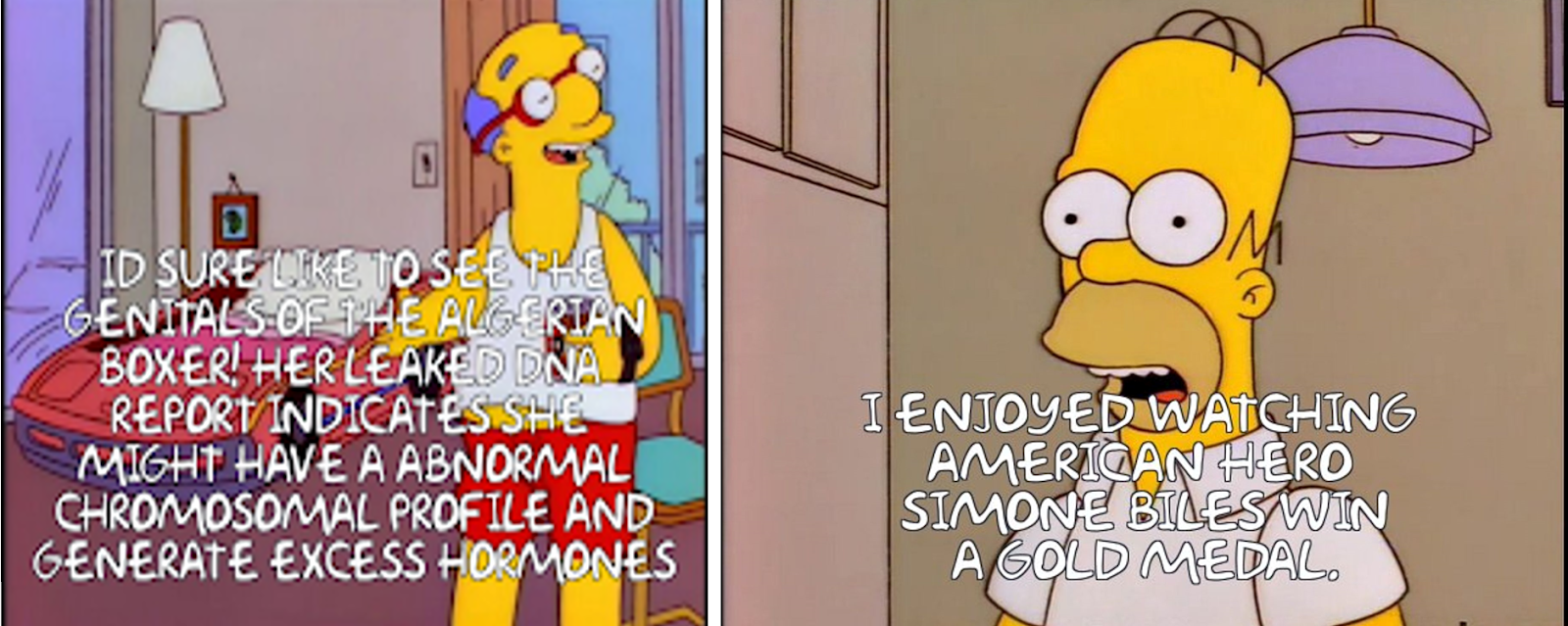
But that isn't us right now! It's the right that is wallowing in its own self-induced machine of rage and fear and misery. The Olympics were a great example -- conservatives spent their time searching for their calipers and reliving their frustration that Simone Biles didn't snap her neck in 2021; meanwhile liberals just enjoyed watching some of the greatest athletes on Earth do incredible things under the American banner. Who would you rather be? 

And this divide is present all over the 2024 race. The complete inability of conservatives to make anything stick on Tim Walz stems from their complete bafflement that a basic cishet white guy can just be happy in 2024. Doesn't he know that trans-CRT-illegal-abortionists are coming for his daughter?!? The RNC was a miserable slog of one apparatchik after another warning us that we're all going to die unless the God-king Trump is restored; the DNC was a dance party featuring your favorite tunes from middle school. Hell, one of the primary attack lines Republicans have been trying against Kamala Harris is her laugh! Democrats now are literally the party of laughing (and football, and Bud Light)!

It's really nice. And for what it's worth, I do understand the stakes, and I do understand that many people are hurting, and I do understand there's a lot of work to be done. But joy counts for something. And it feels really good to be part of a joyful Democratic coalition.

Saturday, August 10, 2024

Israel's Forever War


As the war between Israel and Hamas grinds on in Gaza, we've seen various moments where both Israel and Hamas have been deemed the barrier to a ceasefire. At the moment, the pendulum appears to be swinging Israel's way, as reports grow from multiple parties accusing Israel -- and Netanyahu in particular -- of sabotaging peace talks.

Ultimately, Israel's problem is this: once the war ends, it's put up or shut up about the day after plan. And Bibi's conundrum is that he doesn't have a plan for the day after that would result in an equilibrium anyone either in Palestine or in the international community would accept, and he knows it. This is why we get bombastic but vague bleatings about "total victory". Even assuming, for sake of argument, that it would be possible to completely destroy Hamas -- what then? An independent Palestinian state? We know the answer for Bibi is no. Some sort of inferior dependency status? That's a non-starter. Occupation forever? That's just another way of saying the war continues.

But those are the choices, and ending the war means making a choice that Israel -- or at least, this government of Israel -- simply does not want to make.  Whenever one questions the possibility of destroying Hamas, one gets dismissive snorts about how we managed to destroy Nazism in Germany, and didn't stop until we achieved "total victory" there. But the end of World War II didn't coincide with ending Germany as a country -- it was always taken for granted that Germany would, within the confines of the new world order, remain a sovereign state (indeed, we dedicated unprecedented resources to rebuilding Germany post bellum in the form of the Marshall Plan -- a commitment that proponents of this analogy seem strangely uninterested in extending). If the Allies' approach towards the Axis powers was that they just never get to exercise sovereign powers again, but remain under perpetual occupation and subjugation ever-outward in time, that's not an end to the war at all -- that's maintaining the war indefinitely.

So long as the war continues, the legal, political, and diplomatic framework allows Israel considerably greater freedom of action vis-a-vis Palestine than would be available under any peacetime scenario. When you're at war, you can occupy, you can raid, you can detain, you can violate normal rules of sovereignty. That's what war is, and ending the war means either giving those opportunities up or explicitly endorsing the logic of conquest and/or apartheid. Remaining at war punts the decision down the road, remaining at war indefinitely punts the decision down the road indefinitely. This, I think, is a large part of what motivated the ICJ's decision regarding the unlawfulness of the occupation -- its conclusion being that the occupation had become a delaying mechanism, an attempt to retain the prerogatives of belligerency indefinitely. Bibi's interest in prolonging the war in Gaza now is a concentrated version of the choice Israel has made off-and-on since 1967: a forever war to avoid an undesirable peace.

This isn't to pretend that Palestinian factions have been eager partners for peace, stymied only by Israel's intransigence. But it is to say that Israel's interest in blocking Palestinian statehood is fundamentally incompatible with securing a lasting peace, because any durable peace cannot avoid the question of Palestinian independence. Bibi is probably more ideologically opposed to Palestinian statehood and equality than any modern Israel leader, so even if he didn't have a partisan interest in prolonging the war to delay his own electoral reckoning, it should not surprise anyone that his orientation towards the war in Gaza is to keep it going as long as possible. He simply cannot answer the questions posed by its end.

Friday, August 09, 2024

I Say This Book is Going To Burn -- First Here, Then in Hell


Utah is banning books (via). That, sadly, is barely even news anymore. But Utah's law has two unique properties to it. 

First, Utah's rule is that any book that is banned in at least three districts must also be banned statewide. Utah has over 600,000 students enrolled in its public schools, but its three smallest districts contain less than 700 children. So the entire state is at the mercy of its three most conservative districts, which may enroll a tiny percentage of the overall school-aged population.

Second, once a book is banned Utah wants to be very clear. It is not to be stored. It is not to be donated. It is not to be sold. It is not to be distributed. It is to be "disposed" of. There's no compromise where maybe the books can be given to people who would enjoy or appreciate them. No -- quoth one board member: "I don’t care if it’s shredded, burned, it has to be destroyed one way or another."

So a uniquely grotesque and censorial law, even by red state standards. I only appreciate that it lets me reference a great Parks & Rec episode.

8th Circuit Reaffirms Constitutionality of Bans on Felons Bearing Arms


The Eighth Circuit Court of Appeals has reaffirmed its earlier decision in United States v. Jackson, concluding that it is constitutional to prohibit felons from possessing firearms even if the felony they were convicted of was non-violent (the case was on remand following Rahimi). The court observed that there was ample evidence of historical precedent permitting disarmament of non-law abiding individuals even in absence of evidence they were "violent", as well as pointing to the Supreme Court's repeated insistence that its Heller/McDonald/Bruen line of cases repeatedly emphasized it was not disturbing longstanding prohibitions on felon disarmament laws.

It also reiterated a point it made in its initial ruling: that while it may be the case that prohibiting gun ownership by non-violent offenders would fail the more traditional "means/ends" scrutiny that prevailed pre-Bruen (and in most other areas of constitutional law), Bruen flatly forecloses such "policy" analysis. Bruen does not care about a law's fairness any more than it cares about your due process rights.

Tuesday, August 06, 2024

May I Have This Walz?


Minnesota Governor Tim Walz has been selected as Kamala Harris' running mate.

I thought all of the major names floating for VP would have been fine picks. But now that Walz has gotten the official nod, I can say that I'm really enthusiastic about him joining the ticket. 

What do I like about him? To begin, he's got the support of the base while not doesn't seeming to have any particular clique or bloc of voters with a beef against him. In terms of immediate reaction and instinctual enthusiasm, he's all upside. He's already proven himself an effective messenger against Trump and Vance, which is really a VP candidate's number one job. His presentation is a best-of-all-worlds: moderate affect, but progressive results. What's not to like?

As a member of congress representing a swing district, he had a relatively moderate voting record. But his moderation never took the form of hippie-punching for its own sake. In contrast to a Sinema or Manchin type, he wasn't randomly looking to sabotage progressive priorities just so he could grandstand about how he's constraining the left. He just wasn't interested in putting on a show of being a bold maverick bucking the party.

That approach really has come through in his tenure as Minnesota Governor, where he's delivered a long list of progressive priorities that have made Minnesota a model for other states to follow. Some people were surprised at Walz's leadership, again taking cues from his moderate reputation. But Walz's progressivism is really a lot like his moderation -- it wasn't part of some big performance about taking on The Democratic Establishment or being leftier-than-thou, it was just the honest, grinding work of making progress when you can. And it turns out that when you have that orientation, you really can accomplish a lot that makes a lot of people's lives better.

In short, Walz is a pragmatist in the best possible sense: someone who concentrates on getting things done. And I've realized that I lot of what I like about Walz is what I like about Joe Biden. Sure, there's the folksy demeanor and the "moderate" reputation, and the underlying warmth and human decency. But fundamentally, Walz seems like someone who is in politics to actually make things happen -- not to talk about them, not to ride the talk show circuit and get a big book contract, and not to impotently fulminate about how the system makes any real change impossible. And when he's put in a position to make positive change, he's taken it. Just as Joe Biden surprised a lot of people with the muscularity of his domestic agenda (coming from a "moderate"), so too did Tim Walz as Governor of Minnesota. In both cases, the surprise was a product of mistaking an affect and a pragmatic orientation for antipathy to progressivism. And in both cases, the results speak for themselves. I have absolutely zero qualms about carrying that tradition forward.

So I'm delighted to have this Walz on the Democratic ticket. To victory in November!

Monday, August 05, 2024

Things People Blame the Jews For, Volume LXX: Democracy Protests in Venezuela


To my knowledge, Venezuela has not yet featured in my "Things People Blame the Jews For" series. This, alas, is not for lack of antisemitism. But if this series was going to be comprehensive, I wouldn't be able to hold down a day job.

Anyway, Venezuela recently had an election, and there are two competing slates of results. The independently-reviewed data suggests that incumbent Nicolas Maduro lost in a landslide. The "official" results, by contrast, have Maduro winning by a 52% to 43% margin. The discrepancy is in large part due to the "official" results conspicuously refusing to release the actual precinct-tallies, with a variety of dog-ate-my-homework style excuses.

Unsurprisingly, Maduro's apparent attempt to steal the election is resulting in widespread protest and unrest. Equally unsurprising is where Maduro lays the blame for the protests

At a press conference on Saturday, Maduro blamed what he termed the “extremist right” for the unrest that has swept the country. He accused these groups of being “supported by international Zionism.” He alleged that Jews were manipulating social networks, media outlets and even satellite technology in an attempt to “steal the presidential election” from his socialist government....

Classic.

I do want to compliment Maduro on one thing, however. I've occasionally written on the aesthetics of election-rigging -- if you're just going to make up election results, how do you decide what your margin of victory should be? Too close and you emphasize your tenuous grip on power. Too wide and things just look ridiculous. To my eyes, 52 to 43 is a pretty good choice -- it is a comfortable margin of victory, while still looking to the uninformed eye like the sort of result one might expect to see in a genuinely contested race. My congratulations to the Maduro regime for showing their authoritarian peers how it is done!

Who's Heard of Tim Walz's H. Res. 11 Vote? (Not You)


In December of 2016, the UN Security Council passed resolution number 2334, affirming the view that Israel's settlements in occupied Palestinian territories were unlawful. The United States abstained from voting -- the first and only abstention on an Israel-related vote during Barack Obama's entire tenure in office.

Shortly thereafter, Congress passed H. Res. 11, condemning this Security Council resolution. In doing so, the resolution specifically denounced "politically motivated acts of boycott, divestment from, and sanctions against Israel" and expressed opposition to the resolution's insistence on distinguishing "between the territory of the State of Israel and the territories occupied since 1967."

The vote tally on H. Res. 11 was 342-80. Among those voting in favor was Tim Walz, then the Democratic representative from Minnesota's first congressional district.

I do not reveal this detail to undermine Walz's case for joining the Democratic presidential ticket. I like Tim Walz. I liked him as a congressman, and I certainly liked him better than the antisemite who succeeded him representing my in-laws' home congressional district. And I've liked him even more as Governor. As far as I'm concerned, he'd make an excellent addition to the ticket.

Moreover, while this vote was not great, I don't think it suggests that Walz is some uniquely bad figure on matters of Israel/Palestine. Certainly, if one framed it the right way and possessed the right priors one could easily make the case: He openly attacked BDS! He was opposing even condemning Israeli settlements! He can't even claim the defense of "well, everyone was doing it back then" -- Walz was to the right of the Obama administration on this, and seventy-six Democrats voted against the resolution he supported! If one was looking to attack Walz on matters of Israel/Palestine, H. Res. 11 offers a very viable angle of attack. If one's primary concern regarding Harris' VP pick is avoiding Democratic politicians with a history of hostility towards either BDS or a record of unblinking support for Israel, then H. Res. 11 generates a very valid reason for concern.

But as far as I know, nobody has taken this angle. In fact, as best I can tell, nobody has even raised Walz's H. Res. 11 vote before I wrote this blog post. This is despite the fact that, as we know, questions about Israel policy have been front and center in why many have rallied aggressively against Josh Shapiro as a potential VP pick.

So here's the question that does motivate this post: how do you think it came to be that we learned about Josh Shapiro's collegiate op-ed columns written as a 20 year old before we started considering Tim Walz's actual voting record?

The position I took last week on Shapiro as VP nominee remains the position I'll take this week: I think Shapiro would be fine as VP, and I don't think he should be picked. On the former side of the ledger, I don't think his positions on Israel are substantially different from those of other potential members of the Democratic ticket (Harris included) -- the differences that exist are matters of degree, not kind (see also: Mark Kelly supporting police breaking up pro-Palestine protests). In that post, I argued that 

the congealing anti-Shapiro backlash smacks of a very predictable and unlovely hyperpolicing of Jews-qua-Jews on Israel, whose every jot and tittle on the matter will be pored over with exacting and unforgiving scrutiny in a manner that just isn't imposed upon non-Jews. Non-Jews can have unacceptable positions on Israel, but only Jews become unacceptable for things like "her book has an Israeli in it." Shapiro is getting heightened scrutiny here not because his positions on Israel are significantly different from those of Kelly or Beshear or Cooper, but because he's a very visibly Jewish politician and so is presumed to need greater scrutiny.

The fact that Shapiro is having his college views scrutinized while nobody even bothered to look at what Tim Walz actually voted for as a congressman I think pretty emphatically proves the point. Noting that Shapiro really has done X Y and Z potentially problematic things vis-a-vis Israel cannot explain why one didn't even think to look at Walz at all.

My point is not, to be clear, that Walz is actually "worse" than Shapiro on Israel/Palestine. It's not even that they're identical. While I don't think it is clear-cut, I have zero problem with someone who is highly motivated by pro-Palestine/anti-Israel sentiment looking at Walz's H. Res. 11 vote, and the remainder of his record in Congress and as Governor, comparing it to that of Shapiro, and say "on net, I think Walz is comparatively better on the issue, and so I prefer him to Shapiro."

But the difference in affect we're seeing directed towards Walz (and all the other plausible Democratic contenders) versus Shapiro, centered around Israel, is not one of "I think so-and-so is comparatively better." What differences exist between Shapiro and Walz cannot bear the weight of justifying being ecstatic about Walz, or even just thinking of Walz as adequate, and viewing Shapiro as cataclysmically unacceptable. If what Shapiro's done on Israel while in office is outright unacceptable, then it's hard to argue that Walz's objecitvely similar record is hunky-dory. They might be different, but they're not that different, and the only reason they're viewed as that different is because of an instinctual suspicion of Shapiro that is largely based on his identity. And I'm further saying that the reason why people immediately fixated on digging into the deepest recesses of Shapiro's Israel record while being completely uninterested in learning the first thing about Walz's is because Shapiro is vocally and publicly Jewish, and so became a target.

Does any of this change my opinion on whether Shapiro should be selected as VP? No. Why not? Because even if it is the case that some of the attacks Shapiro has faced are unfair, vice presidential selection is not about "fair". It's about maximizing one's chances to win, and fairly or not Shapiro seems to be a problem for some important swaths of voters. Harris also doesn't seem to be considering any women for her running mate, presumably because it is thought that having two women on a ticket will turn off certain voters. Is that "fair"? No, any voter who thinks that way is indulging in rank misogyny. And yet, it would be facile to suggest that Harris should pick a woman just to vindicate that these voters are wrong. They are wrong, but the purpose of a vice presidential candidate is not to even justifiably say to certain influential voting blocs "you're wrong."

But we shouldn't delude ourselves as to what's happening here. Everybody reading this has seen a slew of commentary analyzing Josh Shapiro's Israel record from top to bottom. Nobody reading this had seen a droplet of ink spilled on Tim Walz's H. Res. 11 vote. Likewise, it is quite clear that what is an unforgivable heresy for Shapiro will be easily (and quite literally) overlooked when it comes to Walz. That difference is not random. It manifests for exactly the reason you'd expect it to.

Friday, August 02, 2024

Announcing You're Going to Discriminate + Discriminating = Liability for Discrimination


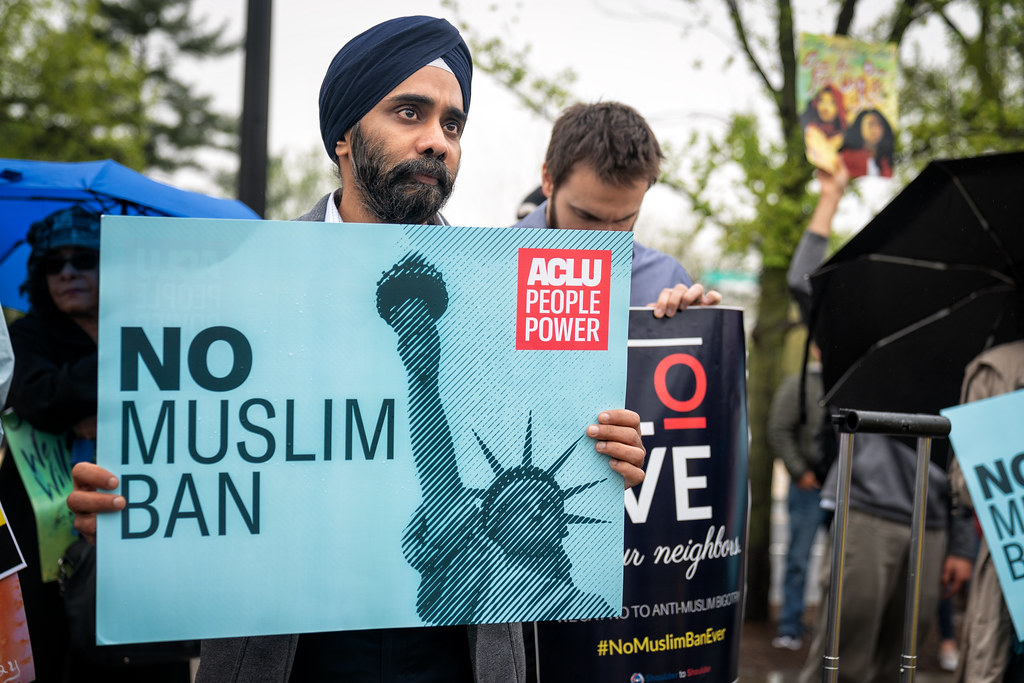
When the Trump administration's Muslim ban was moving through the courts, there was the weird debate people were having about whether it was fair to use Donald Trump's explicit statements announcing a discriminatory motive for the ban as evidence that the ban was discriminatory. The debate was weird because in any other circumstance the answer is obvious -- of course it's evidence. It's close to dispositive evidence. That's how anti-discrimination law works.

For example, this past week the Eleventh Circuit decided the case of McCarthy v. City of Cordele. Here are the relevant facts:
Joshua Deriso campaigned for election as chairman of the City Commission of Cordele, Georgia, by publicly stating his intent to “replace Caucasian employees with African Americans”; to lead “an entirely African American” City Commission; and to replace Roland McCarthy, the white City Manager, with a black City Manager. On social media, Deriso declared, “Structure needs to change . . . More Blacks!!!”; “The new City Manager should be Black”; and “it is time for African Americans to run our city.” Deriso won the election. The same day he and fellow commissioners took their oaths of office, the Commission voted on racial lines to fire McCarthy and to replace him with a black City Manager.

"The question," the court continued, "is whether those allegations permit the inference that the City Commission fired McCarthy because he is white." They quite reasonably answered "yes". When you publicly campaign on "I am going to racially discriminate", and then you do exactly what you promised to do, it's entirely reasonable to conclude that what you've done is engage in racial discrimination. And that inference is valid notwithstanding the fact that under normal circumstances the city council has wide discretion in hiring or terminating its city manager. This is not hard.

There's no pay off here other than to reemphasize the lawless anomaly that was Trump v. Hawaii. The pass it gave to blatant, undisguised discrimination is completely at odds with the doctrine both before and after the case. Judges fully understand how senseless Trump's rule is in other cases (especially, one must observe, in cases of "reverse discrimination"). Indeed, while Trump v. Hawaii was under consideration I observed that in any remotely analogous circumstance involving "Smallsville, Anystate" the case is an absolute dunker as a clear and obvious legal violation. It is only Donald Trump who received and continues to receive these ridiculous one-offs as the Supreme Court's special favorite.

Monday, July 29, 2024

The Storm and the Calm


Many of you have no doubt seen horrible images out of Israel, following an arrest by IDF military police of several reservists suspected of torturing and sexually assaulting military detainees. This led to a full-scale riot by far-right forces in Israel, including military police and joined in by several right-wing coalition MKs, who successfully stormed several IDF military bases. Among those who joined in the riots are MKs Amichay Eliyahu (Otzma Yehudit), Zvi Sukkot (Religious Zionism), and Nissim Vaturi (Likud). Others who praised either the riots themselves, or the underlying justice of their cause, include Itamar Ben Gvir (Otzma Yehudit), Tally Gotliv (Likud), Bezalel Smotrich (Religious Zionism), Yariv Levin (Likud), and Yuli Edelstein (Likud).

The image of Israel effectively at war with itself, with one faction -- well-represented in the current government -- violently protesting on behalf of the right to torture and rape Palestinian prisoners with impunity -- is sickening, and demonstrates the fundamental disgrace that is Netanyahu's government. That goes without saying, and I'll say no more on that.

The IDF's top brass is, unsurprisingly, incensed at the anarchic violence targeting the very core of its authority and ability to self-regulate. The response from Israel's civilian leadership has been more muted; calls for "calm" have featured heavily. Bibi, for instance, issued "an immediate calming of passions in the Sde Teiman base." President Isaac Herzog likewise urged elected officials "to show leadership — to relax and calm down," in response to the growing chorus of parliamentarians speaking out in support of the riots and in defense of the soldiers accused of torture (and in opposition, it must be said, to the other soldiers seeking to actual enforce order and rule of law).

The term "calm" grabbed me, since anyone familiar with Israel and security issues is well-familiar with the refrains for "calm" that follow this or that provocation. See, for example, the United States urging "calm" after Hezbollah's rocket attack on the Golan Heights that killed a dozen Druze teenagers. I have no quarrel with "calm" -- I think there are very good reasons to pause and take a beat rather than just rush headlong into potential escalation, even where the target is unquestionably a malign actor. But if one is tuned into the channels of pro-Israel rhetoric, one also knows how these calls for calm are received -- with contempt, as effectively a demand for appeasement and turning the other cheek in response to outrageous misconduct. "Calm" is what one says when one intends to just let the aggressor act without consequence.

Again, that's not my view. But for the people who do think that way, one wonders what it means to hear the Israeli government's response to violent attacks on the IDF in support of suspected war criminals being a plea for "calm". For them, it must sound like a prelude to acquiescence, no? Surely, they must be as repulsed by this form of appeasement as all the others. Right?

Thursday, July 25, 2024

Josh Shapiro Would Make a Fine VP and Probably Shouldn't Be Picked


There's a job opening for the position of Democratic Vice Presidential candidate, and a list of possibilities is beginning to emerge. The main names I've seen floated are Pennsylvania Governor Josh Shapiro, Arizona Senator Mark Kelly, Secretary of Transportation Pete Buttigieg, Kentucky Governor Andy Beshear, Michigan Governor Gretchen Whitmer, Illinois Governor, J.B. Pritzker, North Carolina Governor Roy Cooper, and Minnesota Governor Tim Walz.

As far as I'm concerned, all of these are fine choices. None of them are blue dog quasi-GOPers. None of them are DSA-adjacent fire breathers. They're all solid, mainline Democrats with a lot to offer. Anecdotally, the name that seems to get the most enthusiasm in my circles is Senator Kelly; a poll of DNC delegates gave a plurality to Shapiro (albeit lagging significantly behind "undecided").

With respect to Shapiro, the case in favor is pretty obvious. He stomped to victory in the keystone key swing state of Pennsylvania in 2022, and remains quite popular in what is still a battleground state. He's generally done a good job a governor, and his out-and-proud Jewishness not only helps dissipates bad faith GOP grandstanding about protecting the Jews, it has also provoked plenty of "show us how you really feel" antisemitism on the part of Republicans whose love for "Jews" is matched only by their hatred for (actual, real-life) Jews. Plus, he provides a model of liberal religiosity which helps challenge the monopoly right-wing conservative Christians have sought to claim over the mantle of faith. It will not surprise you that I like Shapiro a lot, and his was the first name that came to mind for me when I thought of my preferred VP choice.

Unfortunately, Shapiro also seems to be getting the most amount of pushback of any VP contender from the single-issue (anti-)Israel voter crowd, who have tagged Shapiro has having an especially problematic pro-Israel outlook.

The entire dynamic surrounding the Biden-to-Harris switch and how it relates to the burbling pro-Palestinian sentiment amongst many younger Democrats is interesting. Over the past few months we saw quite a few people loudly aver they could never bring themselves to vote for "genocide Joe" because of the way in which he and his administration have enabled Israel's assault in Gaza. The closer we got to election day, the higher stakes this game of chicken became -- will they blink or will they actually usher in Trump 2.0 -- but now that Biden is off the ballot many of these persons seem to be happy to return to the Democratic column. Now, objectively speaking, Kamala Harris is part of the Biden administration and, minor rhetorical gestures aside, has not meaningfully separated herself from Biden's Israel policy -- if you genuinely believe that the Biden administration's policy regarding Israel is monstrous and unforgivable, Harris, as the second-highest ranking official in that administration, should be tainted too. Practically speaking, though, not having Biden be the name on the ballot has offered people who had perhaps overindulged in self-righteous chest thumping and consequently talked themselves into a corner a face-saving offramp. If they were fully genuine in what they say they believe about the Biden administration's choices being "unforgivable",* they'd be equally indignant about voting for Harris. That they're not suggests there was no small measure of performance going on, but for my part, I'm happy not to look a gift horse in the mouth. Welcome back.

But while this cadre may be willing to let bygones be bygones with Harris, many of them have seemingly decided that Shapiro is going to be the stand-in for the type of pro-Israel Democrat they cannot stand. Part of me recoils at this. Shapiro's positions actually don't seem that far off-line from those of his peers (he enforced an anti-BDS law that also exists in 37 other states?!?), and the effort to try and draw distinctions from how he has spoken of, e.g., antisemitism at pro-Palestine protests compared to how other analogous Democrats have spoken about it feels very thin. To be honest, the congealing anti-Shapiro backlash smacks of a very predictable and unlovely hyperpolicing of Jews-qua-Jews on Israel, whose every jot and tittle on the matter will be pored over with exacting and unforgiving scrutiny in a manner that just isn't imposed upon non-Jews. Non-Jews can have unacceptable positions on Israel, but only Jews become unacceptable for things like "her book has an Israeli in it." Shapiro is getting heightened scrutiny here not because his positions on Israel are significantly different from those of Kelly or Beshear or Cooper, but because he's a very visibly Jewish politician and so is presumed to need greater scrutiny.

That's not good. But even though it's not good, I think that for better or for worse it does give a good reason not to pick Shapiro as Harris' VP. Under circumstances where there are many good choices for the VP candidate, the fact that one in particular runs the risk of cheesing off a substantial contingent of wavering Democratic voters is reason enough not to choose him, regardless of whether the reason he runs that risk is "fair" or not. It'd be different if we were in a situation where there was a dearth of good options, or Shapiro was somehow the obvious best choice, or if the "anti-Shapiro" cadre was declaring itself ready to fight to the death over every remotely plausible mainstream Democratic choice or trying to sabotage any potential VP who wasn't all in on BDS. But we're not in that situation. The other Democratic alternatives to Shapiro are also good. Their positions on Israel are probably not that meaningfully distinct from Shapiro's. If I'm happy with a lot of people, and some people whose votes matter are particularly unhappy with one person, there's little reason not to pick someone that makes us all happy.

Throughout this electoral cycle, people in my position have insisted to fellow progressives that the importance of winning in 2024 is too important to take one's ball and go home the instant things don't go your way. That applies here too, but what it means right now -- when no VP has been picked -- is that it'd be unreasonable for me to die on the hill of picking Josh Shapiro for VP, even if I think he'd be a good pick, and even if I think the rationale upon which people are anti-Shapiro is wrongheaded or even pernicious. I may well be right. But winning in 2024 is more important than vindicating my correctness is. If Shapiro gets picked, I'll happily rally behind him and I hope everyone else does too. But there's no shame in Kamala Harris picking someone else if she thinks they will do a better job uniting the progressive community towards the goal of winning this November.

* On that note, I'll give, if not credit, then at least points for consistency to Rep. Rashida Tlaib, who is one of the few Democrats who self-consciously declined to endorse Harris following Biden's withdrawal. Agree with it or not, her position was not a performance.

Wednesday, July 24, 2024

The Israeli Right Wants to End America's Israel Bipartisanship


Bibi spoke before Congress today, giving his usual bluster in the face of growing Democratic discontent over his hard-right governance and naked disregard for Palestinian life and rights. Well over a hundred congressional Democrats boycotted his speech, and even some who attended gave scathing reviews (my favorite comment came from Rep. Jerry Nadler, who bluntly described Netanyahu as "the worst leader in Jewish history since the Maccabean king who invited the Romans into Jerusalem over 2100 years ago.").

One comment I've heard many times is that Bibi has been recklessly pissing away the historic bipartisan support Israel has enjoyed in Congress to tie himself ever closer to the GOP. This has been occurring since at least the Obama administration and only seems to be accelerating. Why is he taking this step? At the bad place, Abe Silberstein hypothesizes that this is a "calculated" decision, predicated on the notion that Democrats will eventually abandon Israel anyway. I agree it is calculated (which doesn't mean it isn't reckless), but I actually might make an even more controversial point -- Bibi wants to drive Democrats away. The breakdown of the consensus is, for him, a positive good.

The rationale is straightforward. Certainly, in an "ideal" world, both American political parties would support Israel in whatever it does, all the time. But in reality, a bipartisan "consensus" around Israel is going to be inherently moderating -- Democrats prevent it from drifting too far to the right, and Republicans from it drifting too far to the left. It's no accident that in the early 2000s (the apex of the consensus), Democrats and Republicans alike generally coalesced around things like support for two states, veneration of Oslo, and so on. There was, certainly, a lot less in the way of Democratic support for sharp and harsh Israel critique, but you were also less likely to see Republicans openly come out in favor of occupation forever. It was the epitome of a mushy middle.

The problem is that Bibi is not part of the mushy middle, and it is affirmatively bad for him if American politics on Israel sit on moderate, middle ground. A theme I've hit on repeatedly in my writing is that polarization actively benefits extremists, and will be pursued by them, even if it reduces overall levels of popular support for their broadly-defined "camp". Polarization gives more space for extremists to flourish, and Bibi is nothing if not a right-wing extremist.

Imagine you're Bibi and you have a choice between two worlds: one where 8 out of 10 Americans support Israel, but they're evenly divided between "left" and "right", and another where only 5 out of 10 Americans are pro-Israel, but 4 of them are conservative. He's going to pick the latter, because in the latter universe the pro-Israel faction is dominated by conservatives, and so will be a far more hospitable environment to his brand of unabashed and unapologetic conservatism. In the first world, the parameters of pro-Israel are set via a balance of liberal and conservative interests. In the second, they're set solely by conservatives -- even as the median position of Americans shifts away from support for Israel, the median position of self-described pro-Israel Americans shifts sharply to the right. 

For that reason, it should not surprise to see Bibi and his allies seemingly doing everything they can to alienate American Democrats even in the face of stalwart support from Joe Biden. Are they spitting in his eye? Yes, and intentionally so. For them, having Democrats as part of the "pro-Israel" camp is more constraining than it is enabling. They'd much rather the parameters of pro-Israel be set solely by the right -- the better to consolidate their own power.

Sunday, July 21, 2024

Harris '24


To be honest, I didn't have strong feelings about whether Biden should or shouldn't drop out of the race. But his decision to step down should be seen as an incredible act of selflessness and statesmanship. Joe Biden has had an amazing array of accomplishments as President. But this step was entirely about ensuring that the fascist maniac atop the cult of personality that's become the GOP does not return to the White House in January, and he deserves great praise for that.

The media, it seems clear, is not ready for the circus to leave town. It is bombarding us with calls for an open convention or speed primary or some nonsense about picking Mitt Romney -- anything to maintain the frenzy of Democrats in chaos. But overwhelmingly, the reaction I'm seeing from most Democrats is relief: relief that we have a resolution, and relief that we're in good hands with Harris. Whereas the drumbeat to get Biden out the race, while partially media generated, did reflect at some level of genuine concern from actual Democrats of note following the debate disaster, right now it's going to be very hard to maintain a narrative of Dems in Disarray given the rapidity with which the party coalesced behind Harris. Indeed, virtually all the chatter I've seen about the need to Avoid A Coronation!!! comes from the usual pundit has-beens -- I'm seeing essentially no appetite from any Democrat of note to offer themselves up as an alternative to Harris, and she's rapidly securing endorsements from every sector of the party. Kamala Harris is going to be the nominee, Democrats seem very happy that Harris is going to be the nominee, and I'm excited to rally behind her and return her to the White House.

The next few months won't be easy. For example, we can expect the media's interest in the age of candidates to disappear as rapidly as its interest in classified document security. But Harris is a good woman, a good leader, and a good politician. We can do this. Let's get to it.

Friday, July 19, 2024

The Settlements Gave Us the ICJ Decision


The International Court of Justice has released a long-anticipated advisory opinion regarding the status of Israel's occupation of the Palestinian territories. You can read all of the opinions here, but the top-line conclusion is that the occupation is at this point unlawful, because Israel's actions have made clear that it is not acting in the context of a military occupation at all -- it is acting as if to acquire the underlying territory as part of its own domain. And my overall conclusion is that, while the opinion sprawls and has wide implications, ultimately the vast majority of its conclusions can be laid at the feet of the settlement project. That's what gives the opinion its analytical force, the subject of the main "remedy", and that's what makes it not ultimately a matter of Israel's genuine self-defense and security interests.

To be sure, there is more to the opinion than just an indictment of the settlement project, or even the occupation-qua-occupation. Another aspect sure to get much commentary is the gesture at characterizing Israel's conduct in the West Bank as potentially apartheid -- the opinion was (it seems almost certainly intentionally) ambiguous on this point, and amongst the concurrences one sees both "yes, that's absolutely what it's saying" and "no, we're definitely not saying that". There's also the question of how to apply the ruling to the Gaza Strip -- while nominally covering all of the Palestinian territories, the opinion is primarily focused on the situation in the West Bank, recognizing that Gaza is a different and more complex circumstance for a host of reasons, ranging from Israel's withdrawal in 2005 to the current ongoing war. For the most part, the opinion largely accepts that different analysis will need to be applied there, and so it's fair to bracket that off.

Still, even "just" talking about the illegality of the occupation of the West Bank, the ruling is bombshell enough. Ultimately, the opinion reflects an essential and oft-misunderstood attribute of Israel's relationship with the Palestinian territories: while pro-Israel commentators often treat the language of "occupation" as delegitimizing Israel's activities (cf. Bibi's response to the ruling: "The Jewish people are not conquerors in their own land"), in reality occupation is the most plausible justification for Israel's activities in the Palestinian territories. When one is in the midst of military hostilities with another power, one is allowed to have a military presence on their territory, and one is allowed to impose not infinite but substantial restrictions on the local civilian population to account for security necessities, and one is certainly not required to give the civilian nationals of the opposing power citizenship in your country.

But those prerogatives are predicated on the occupation not being permanent; it is not a claim of permanent jurisdictional right over the underlying territory, it is a temporary state of affairs tied to ongoing hostilities with another power. The ruling of the ICJ can be summarized as a conclusion that Israel is no longer acting as if that was the case. The settlement enterprise, in particular, is the smoking gun evidence here: it is not only clearly impermissible under the law of occupation, but it has nothing to do with effectuating military security in the context of an ongoing state of belligerency and everything to do with acting as if the territories in question are part of Israel's normal domestic territory -- the settlers are, in most every respect, treated identically as if they were Israeli citizens in Tel Aviv. Through the settlements, Israel is taking actions that are fundamentally at odds with it treating the West Bank as being under a temporary occupation, and so it cannot claim the protections international law accords to occupying powers to take actions that otherwise would be obvious breaches of principles of sovereignty and Palestinian self-determination.

For my part, I've only had the opportunity to quickly skim the various opinions, and I'm not an international law expert. There were a cluster of judges who sought to distinguish in various ways between the illegality of Israel's conduct in the West Bank (which they find conclusively established) and the inherent illegality of Israel's presence in the West Bank (which they would not reach), and on my quick read they make a valid distinction. The idea, in essence, is that while it is clear enough that what Israel is actually doing in the West Bank cannot be justified via the security framework of a belligerent occupation (indeed, it openly defies this framework) -- the settlement enterprise being the obvious example -- this doesn't mean that it's impossible in concept for Israel to do things in the Palestinian territories that would be consistent with a genuine military occupation. Israel and Palestine are still in a state of belligerency, and in such a context there likely will be causes where actions could be justified under the framework of a (genuine) military occupation. This probably has more salience in Gaza than in the West Bank, and it further ratifies a point I've made earlier -- that as horrible as the happenings are in Gaza, the West Bank if anything represents an easier case of Israeli injustice: the former at least nominally can be fitted into the framework of a military confrontation subject to a national right of self-defense, the latter appears to be a pure unadulterated land grab.

But it's worth emphasizing how little this matters. Several judges chastised the majority for not paying due heed to Israel's genuine security concerns. It's a fair shot, but the payoff is that even being attentive to these concerns would not actually change much (as evidenced by the fact that even the aforementioned "cluster" of judges ended up agreeing with the majority on all or nearly all substantive points). One can wholeheartedly agree that Israel has valid self-defense rights that are operative in the Palestinian territories, and nonetheless conclude "but there are a host of Israeli actions in the West Bank that have nothing to do with security; it's about taking over territory" (indeed, the fact that recognizing the security concerns would have been more or less "free" does, arguably, validate the Israeli suspicion that the ICJ majority genuinely doesn't care about them -- they do not downplay Israel's security needs as a necessary component of their legal analysis, but rather wholly gratuitously).

Once again, the settlements are central to the point: one can wholeheartedly acknowledge that Israel has a raft of genuine security concerns vis-a-vis the Palestinian territories, and still easily come to the conclusion that the settlements evidence an orientation towards those territories that is acquisitive in character. After all, does anyone truly believe that the settlements are a security measure, as opposed to what they manifestly appear to be on face: an effort to establish Israeli civilian control over new swaths of territory? Once in a blue moon one hears the argument (something about setting a "buffer"), but any jurist would be fully justified in dismissing it as specious; and in any event it is a tactic decisively forbidden by the international legal framework that recognizes many other ways in which an occupying power can entrench its security (just not via the transfer of its civilian population into the occupied territory).

Over and over again, we return to the same point: it's all about the settlements. It is the settlements that show Israel doesn't view its occupation as temporary; it is the settlements that demonstrate the unequal treatment of the two civilian populations that reside in the Palestinian territories; it is the settlements that falsify the notion that the deprivation of Palestine's self-determination rights is solely attributable to the regrettable necessities of ongoing military belligerency. The settlements are the problem. Saying that doesn't make figuring out what to do about them any clearer -- if anything, the deep ties the settlement enterprise has to the "regular" Israeli state only accentuates the magnitude of the crisis -- but nonetheless: the settlements are what makes this entire machine run. I don't know what the Israeli/Palestinian conflict would look like if there were no settlements, but it would look different and would and should be treated differently under international law.

There are many facets of the Israeli/Palestinian conflict which are "complicated", which raise difficult questions of security versus self-determination, where compelling but seemingly irreconcilable national narratives stand at an impasse. But the settlements are simple. They are not annexes of a military occupation, justified by an ongoing state of belligerency. They are an attempt by Israel to exercise permanent control over territories it acquired by force, in defiance of clear international legal rules that prohibit exactly that. One can quibble around the edges of bits and pieces of the ICJ's ruling. But the core conclusion that the settlement project is not part of a military belligerency but an effort by Israel to establish indefinite control over Palestinian territories under a separate and unequal legal regime is to my mind impossible to gainsay.

The ICJ's decision is a bitter pill for many friends of Israel to swallow. But if there is one bit of solace they can take, it lies once again in recognizing the true significance of occupation -- it presupposes two states, both of which have unquestionable legitimacy and a right to exist in their own sphere, neither of which has the right to displace the other. Israel has no right to settlements in Palestinian territories, but Israel in its pre-1967 borders is neither a settlement nor a colony: it is a validated member of the community of nations, whose existence is exactly as sacrosanct as any other country, Palestine included. In his separate opinion, ICJ President Nawaf Salam observed this reciprocity: the entirety of the international legal framework which governs this opinion, including the notion that Palestine is being unlawfully occupied by Israel, is based on the original UN partition resolution in 1948 which "provided for the creation of two independent states on the territory of Palestine, one Arab and the other Jewish."

It was on the basis of [this] resolution ... that both Israel and Palestine proclaimed their existence.... This resolution forms a whole, whose terms must be read together and inseparably. In other words, neither Israel nor Palestine can claim to derive rights from the resolution while rejecting or ignoring the rights of the other party enshrined in the same text.

Emphasis added. The same commitment to self-determination that validated the creation of a Jewish state in Israel demands acknowledgment of the Palestinians' right to their own state. And vice versa. Those who indulge in nightmarish fantasies of the expulsion and extirpation of Israel-qua-Israel, who see the entirety of Israel as an "occupation" and the entirety of the land as Palestinian by right, are not implementing today's decision, they are flouting it.

The ICJ's opinion is a historic victory for the cause of Palestinian independence. But -- or, in my preference, and -- it continues to insist that the legal grounding for both Palestinian and Israeli liberation depends on, and cannot be separated from, parallel recognition of the other. In this critical -- albeit sure to be overlooked point -- the ICJ's decision is emphatic and unimpeachable in holding that freeing Palestine not only need not, but must not, take the form of replacing, displacing, or otherwise eliminating the state of Israel.

Tuesday, July 16, 2024

Giving In to Fascism

"We have to fight the impatience with the pace of change that makes us look nostalgically on the days of the Empire. Yes, there might have been a bit more food available. Yes, power outages might have been fewer. Yes, you might have been insulated from the misery of others--but at what cost? The security you thought you had froze into an icy lump of fear in your gut whenever you saw stormtroopers walking in your direction. With the liberation of Coruscant that fear can melt, but if you forget it once existed and decide things were not so bad under the Emperor, you'll be well on your way to inviting it back."

-- Wedge Antilles, "X-Wing: The Krytos Trap" 

I've been reflecting on why it is that so many Americans are so willing to just accept the return of the thuggish brand of fascist authoritarianism embodied by Donald Trump. Of course, the answer for some is "because they're excited about it!" But a substantial portion of persons who are considering voting for Trump, or are going to sit out voting against him, don't seem enthusiastic about it. They bemoan the "incivility", they look askance on the targeting of minorities, they wish politicians would focus on "solving problems" rather than political stunts. They really, truly, don't seem to like the political world Donald Trump has wrought and promises to further entrench. And yet, they seem resigned to, if not accommodating towards, a man who epitomizes crass bluster, chauvinistic bigotry, and theatrical grandstanding. Why?

I always thought the Wedge Antilles quote above (like everything about Wedge) was helpful (though it actually gives Trumpism too much credit -- we don't have less food, or more power outages, or any thing of the sort, under Biden compared to Trump. Overwhelmingly, life is better on most tangible metrics for most regular Americans under Biden than Trump!). With even a little distance, the terribleness of living under Trump fades -- everyone reading this, by definition, survived it -- while the stresses of the present loom larger. Eventually, it all starts blending together: yeah, things weren't great then, but on the other hand, things aren't great now either. What's the difference? Why stress? This, incidentally, is why I deeply and fervently believe that all "both parties are the same!" caterwauling is inherently a handmaiden of fascism. Arendt's core insight that the origins of totalitarianism lie not in people believing lies, but becoming indifferent towards lying (because after all, don't all politicians lie?), looms large here. The two parties are not the same, and pretending like they are is a huge part of the permission structure that lets people accommodate themselves to the likes of Donald Trump.

Another part of the answer is exhaustion. Trumpism requires responsible citizens to be "on" far more frequently than many are used to, locked in a pitched struggle of the highest stakes. As a polity, we literally fought off an insurrection attempt, and by a narrower margin than any would care to admit -- the inability to impose any tangible consequences on the ringleaders, and the soaring political fortunes of the cheerleaders, bodes exceptionally poorly for the inevitable next attempt. And just a few years after we barely managed to scrape by hanging on to the most basic feature of American democracy -- the winner of the election taking office -- we're faced with having to do that pitched battle all over again? People are tired. They need a break, and Trumpism refuses to give them one. In this context, it is easy -- even, at some level, understandable -- that some would rather just surrender and take their chances. The specter of the loss of democracy feels terrifying, but it's a lot more terrifying if you care about democracy. If you just decide ... not to care anymore -- to resign yourself to the possibility that we'll devolve into a semi-authoritarian quasi-democracy, and preemptively agree that it isn't great but also not the worst thing in the world -- well, isn't that soothing? Isn't that, in its way, a coping mechanism?

One of the mantras of the anti-authoritarian playbook is "don't obey in advance," and while this isn't exactly what's being referred to, it's related. The looming vision of authoritarianism feels so awful, and so terrifying, that we mentally accommodate it in advance -- figure out how we're going to be okay and okay with it. And doing that necessarily and by design eases the path to giving in -- what once may have seemed awful and terrifying, now is merged into the ordinary bumps and travails that afflict all of us in life. It's not that it's good, it's that it's a regular bad, of a kind and category of the bads we're experiencing now, so why subject ourselves to all this extra stress?

And on that note, it has to be said -- and this will be controversial -- that for many of us, life under authoritarianism will go on roughly as normal. This is another point many have harped on: that even under conditions most of us would recognize as dictatorial, people still go to work, have babies, take vacations, hang out with friends, make memories, and so on. Ordinary people live ordinary lives. They may feel that so long as they keep their heads down and don't make waves, they'll be largely left alone -- and more often than not, they'll be right. Even in the most repressive authoritarian states, most people aren't imprisoned, most people aren't executed, most people aren't blacklisted. Most people live a life. The image of the 1984 hellscape does a lot more harm than good.

Now certainly, not everyone fits under the "many" -- there are plenty of people who are most certainly not part of the herrenvolk, who know full well that "keeping their heads down" won't be enough. They are the open and explicit targets of the ascendant authoritarian impulse, and don't have the luxury to play make-believe. For those of us who are not in that category, the question is whether we care enough about our friends and neighbors who are to say "it doesn't matter that I might be able to 'chance it', because democracy is a collective project and they matter to me too."

Yet even for those who do seem to be squarely in the realm of the targets, I would bet that there is more denialism than one might expect. I suspect that many German Jews in the early 1930s, while certainly not thrilled at the rise of Hitler, assumed that "he isn't talking about us." He's looking for the rabble-rousers, the radicals, the resistance. We're just regular people; we're not troubling anyone. And so long as we don't trouble anyone, why would anyone trouble us? Once again, there's that notion that we can just make ourselves "fine" by just deciding that we will be fine. It's a lie -- the security we thought we had turns into an icy lump of fear in our gut the moment that the newly-empowered fascist state turns its eye in our direction -- but pretending it's true lets us temporarily paper over the gnawing anxiety of the present.

So this is part of what we're fighting against -- the notion that it's exhausting and scary and immiserating to fight, and if we just give in and stop resisting we can stop feeling this way, is intoxicating. It'd be so easy to just give up. How do we turn back that tide? I'm not sure. But it needs to happen.

Monday, July 08, 2024

"Us Too-ism" Turns Off the Normies


You may have heard that a group of Columbia University administrators were sacked after someone posted screenshots of text messages where they were snarking at a panel on campus antisemitism they were in the audience for.

When that story broke, I was (and largely remain) of two minds on this. On the one hand, all of us have snarky texts that ripped out of context probably look pretty bad -- this sort of policing really doesn't end well for anyone. On the other hand, university administrators have a pretty grim reputation right now of treating antisemitism claims as trivial annoyances by bad faith actors, and these messages fit into that paradigm. There's a fundamental trust problem: many Jews do not trust that Columbia administrators are interested in seriously tackling antisemitism, and see these texts as verifying that disdainful dismissal; many academics do not trust Columbia's leadership to respond to antisemitism complaints with anything but reflexive brute force, and see this response as yet more kowtowing to an unappeasable media feeding frenzy. Both camps, in all honesty, have reasons for their mistrust.

But that's not what I what to concentrate on here, exactly. Rather, I want to take stock of one response in particular -- that of Kevin Drum. I'm a longtime fan of Drum's writing, which I think is a good exemplar of reasonably thoughtful and well-informed center-left "normie" politics. Seeing how he was responding to Israel's Gaza campaign was a good barometer of what people not in the hothouse of terminally-online left politics were thinking; in particular, it suggested that the belief that the current Israeli government is a fundamentally bad actor is not one confined to the "usual suspects" on the far-left.

In any event, one component of the Columbia controversy was the claim that the administrators themselves indulged in an antisemitic "trope" -- the suggestion that the panelists were hyping up instances of antisemitism as a "fundraising" opportunity allegedly feeding into claims about Jewish greed and/or perfidy. To this, Drum gave the textual equivalent of a giant eyeroll. He explained that he's long been suspicious of the word "tropes", which he said "in practice [is] used exclusively to imply someone has said something vaguely offensive without having the receipts." And this case, for him, fell squarely into that category:

I took a look at these text messages a couple of weeks ago and came away believing there wasn't much there. Since then the entire text conversation has been released, but it doesn't change things. During a panel discussion about antisemitism, the three deans in question shared private texts that you could fairly describe as snarky or irreverent. But that's about it.

To the Columbia administration, however, which was under siege from outraged alumni demanding that the three deans (plus a fourth) be fired immediately, the texts conveyed "a lack of seriousness about the concerns and the experiences of members of our Jewish community."

This is precisely backward. What the deans did was fail to show unconditional earnestness and obeisance toward every last grievance lodged by a particular community, no matter how ridiculous or overstated. This is apparently the price of admission to progressive society these days.

This whole thing is bonkers. The grievances of specific communities deserve to be given fair consideration, but they don't automatically demand absolute deference. In this case, the deans privately exhibited moderate skepticism toward a few of the claims from the panelists, some of it expressed a little bit caustically. None of it could reasonably be called antisemitic, and at most they deserve a verbal reprimand. Instead they're all out of jobs.

Drum thinks that antisemitism allegations here are thin gruel. Maybe you disagree. But one argument I've often heard, as against the claim that Columbia is overreacting here, is to say in essence "maybe so, but that ship has sailed -- every other group gets this sort of response when they claim to be the victims of discrimination, so it's only right that we the Jews do too." It's a version of what I've termed "us too-ism", and I've already outlined many of its pitfalls, not the least of which is the fact that the perception of what "every other group gets" is often not matched by reality. 

But Drum's reaction illuminates yet another problem: for many of the people who do perceive that this is what colleges "normally" do, they don't view that as a good thing. They view it as a bad, toxic practice they at best generally roll their eyes at. Indeed, I suspect most of the "normie" center-leftish Jewish commentators take that general perspective: when we're not talking about antisemitism, they view this sort of heavy-handed administrative response as indicative of wokeness gone wild, which is why when we are talking about antisemitism they defend similar behavior not on its own merits but rather via the us-too bank shot of "well, it's what everyone else gets." The problem is that when non-Jewish normies see this happening, they don't think "aha -- now the chickens have come home to roost, for the Jews also get to claim this bounty!" They think "oh great, yet another instance of overzealous activists peddling a grievance scoring one for cancel culture," and just slot Jews and anti-antisemitism politics into their mental category of "minorities who face some genuine discrimination but are taking things too far."

Again, all of this is aside from whether Drum is right "on the merits" to dismiss the antisemitism angle here. The point, rather, is to emphasize yet another problem with the "us too" argument -- more often than not, its reception outside the Jewish community is not going to be "well, fair is fair"; it's going to be to associate Jews with whatever malformed and exaggerated perception of identity politics gone wild already prevails within the broader public. It still might be a hit worth taking if one genuinely can defend the practices and arguments in question on their own merits, without relying on the crutch of what other groups are imagined to get. But if one's main basis for trying to draw blood is simply the "us too" entitlement, then it's definitely a fool's errand.