Saturday, May 31, 2025

You Can’t Theorize a Hand

When we last left off my artist's journey, I was making mediocre (and that's okay!) renditions of a fruit stand. But since then, I've started taking an introductory drawing class at the Multnomah Arts Center (good news -- it looks like we saved it!), and I'm actually very pleasantly surprised by my progress!

We've drawn something different each week. For example, in week two we did self-portraits -- mine would haunt your nightmares insofar as it makes me look like a serial killer. But I do think it's clearly a rendition of me as a serial killer, so that's something.

Last week, we focused on drawing hands, which I know are the bane of every artist. But I think mine turned out pretty good! A little meaty, but to be honest my hands are chonky boys. So good job me!

Moreover, while I was drawing, I think I said something quite profound (in the sense that I said something very obvious, but in a manner that wraps around into being profound). Namely:

You can't theorize a hand.

What does that mean?

I know what a hand looks like. If you asked me to describe it, I'd start with the palm, thumb, and four additional fingers. Going into more detail, there are the fingernails, the knuckles, and the palm lines. And so it's easy to think, when you're trying to draw a hand, to just take the parts of the hand that you know a hand has, and try to render them onto a page.

But that's not actually how one draws a hand.

To draw a hand, you can't just have in your mind the theoretical components of a hand. You have to actually look at your hand, and draw what you see. Not "a fingernail" or "a knuckle", but a darker spot here against a lighter spot there. When you think not in terms of a theoretical hand, but in terms of what you're actually seeing, a lot of what you see actually won't seem to line up with your theoretical image of a hand. The dark shadow here isn't a knuckle or a fingernail, it's just present. It's there whether you imagine it being there or not. So you actually have to resist the part of you that's only looking to draw the theoretical hand, and draw what's actually in front of you.

This is really quite bracing, since for awhile it looks like you're just drawing random lines and dark spots that don't correspond to anything. It takes a lot of trust in the process to believe that, when it all comes together, you'll have a hand. But you will! Whether or not you think the above hands are "good", they are a lot better than if I tried to just draw what my mind's eye imagines a "hand" to look like.

A good lesson for me to learn. Onward!

Obtuse Corneal Hydrops


Well, my corneal hydrops are back. And just in time for me to get on a nine-hour flight to London with a four-month-old baby!

I've done some of my own research, which I know are among the scariest words a non-medical professional can speak (but like being a mad, ignorant voter, it's so fun!), but really I don't think I was able to do much damage, because it doesn't seem like much is known about the condition by anyone. 

Corneal hydrops occur when a layer of your cornea called Descemet's membrane rips, letting fluid leak where it shouldn't and resulting in extreme tearing and eye swelling. It is an uncommon side-effect of my already uncommon keratoconus -- don't I feel special -- and nobody really seems to know what causes it or how to prevent it. Likewise, in terms of treatment the prevailing medical opinion seems to be summarized as "suck it up, buttercup". There are some saline drops to draw out the fluid, and you can take Tylenol for the pain, and other similar OTC medications for other secondary symptoms (e.g., Sudafed for sinus congestion) but that's about it.

There was one interesting thing I did find, though. Virtually every source on corneal hydrops appends "acute" in front of it ("acute corneal hydrops"). The "acute" means that it presents suddenly and without warning. But that doesn't describe mine -- in my case, I start noticing symptoms progressively over the course of a week or so. In fact, even that's a bit misleading, since the "symptoms" that correlate with hydrops for me -- essentially, sinus-like symptoms on the left side of my face -- are not as far as I can tell normally associated with hydrops at all. But for me, they always go hand-in-hand, and they predict a forthcoming hydrops event with alarming accuracy.

So a week ago I started noticing those symptoms start to appear and wrote my doctor asking if there was anything I could do to forestall the hydrops before my trip. He replied, in so many words, "nope -- good luck!" I was able to manage the sinus-symptoms with OTC medication, but last night my eye finally -- for lack of a better word -- exploded. Have you ever woken up feeling dehydrated because of the amount of fluid you've lost leaking out of your eyeball? Because I have!

This is the third time I've had hydrops in the past year. The first time occurred while I was on a plane from Portland to Tallahassee, and it was deeply unpleasant (as in, the flight attendants who saw me asked if I needed paramedics to meet me at the gate). I think the dry airplane air exacerbates the effects dramatically. So you can imagine how excited I am to get on a nine-hour international red-eye flight with an infant while ailing with this particular condition.

We leave on Wednesday evening. Saturday, Sunday, Monday, Tuesday ... basically, four and a half days for my condition to improve.  I'll stock up on eye drops and other palliative interventions, but still -- pray for me. (And remember, all of this could have been averted if we had a functioning health care system).

Thursday, May 29, 2025

I Dream in Generative AI


I've always been a lucid dreamer. I typically know when I'm dreaming, and am able to exert some level of control over the course of the dream.

Recently, though, my dreams have become, for lack of a better word, more mundane. It'll be morning (in the real world), and I'll think "I wonder what time it is", and then I will dream that I checked my clock. Then I will start thinking in accordance with what the "clock" said, up until I remember that I didn't actually check the clock and it could be essentially any time. 

But when I "see" the "clock", why does my brain pick the time that it does? My wife said that my brain is basically acting like ChatGPT -- collating together a mesh of experience to level a prediction of the time it most expects to correspond with me checking my clock while lying in bed asleep. So, for example, this morning I dreamt it was 9:45 AM, which is around when I usually wake up -- in fact, this time I actually genuinely wasn't sure if I had actually checked the clock or had dreamt doing so, since it was quite plausible that I would wake up around 9:45 and check my clock.

Another example: sometimes I encounter text when I dream. I'll see a newspaper or come across a plaque on the wall. Of course, my brain knows a newspaper or plaque should have text on it, and I am congenitally incapable of passing by text without reading it. Yet it would ask a lot out of my brain to put together a full and cogent newspaper article on the fly while I'm dreaming. So it does what image-generative AI does in that situation -- it creates a sort of hazy swirl of jumbled together letters -- a really disorienting effect when I'm trying to read something in the dream. It's really a fascinating effect.

Anyway, this all led to me having one of my dumber thoughts, which was to describe my brain as "like a kind of biological A.I.". Maybe the machines should replace us.

Tuesday, May 27, 2025

Faithless in Gaza


The other day I was enmeshed in a Facebook thread, as one does, where a colleague was complaining about a post that equally condemned the Capital Jewish Museum shooting by a pro-Palestinian terrorist and the bombing of family homes by the IDF (the sin of "equating", not to be confused with the sin of "one-sided"). The argument was a familiar one: the DC shooter was intentionally seeking to murder civilians (true), while the killing of Palestinian families is an "undesired", tragic byproduct of fighting an urban counterinsurgency.

My response to this argument was not to contest it, exactly. It was to ask my colleague a more basic question: what would falsify his belief? He believes that, for Israel, the deaths of Palestinian civilians are undesired. What evidence would suffice so that he would no longer believe that?

He wouldn't answer.

To be sure, he gave an answer -- but it was just more arguments for why it was still correct to think that these deaths were "undesired". Pressed again to say, okay, but what evidence would make you think otherwise, and I was met with silence.*

That was when it was clear the issue wasn't one of belief, but of dogmatic faith. The bottom line -- "Israel does not desire civilian deaths" -- was written in stone. Everything above that could and would be erased and rewritten to cohere to the bottom line. The "what would falsify" question was impossible to answer, because he knew deep down that if he committed to any non-ludicrous answer, there was a real chance his criteria would be met, and then what would he do?

This does not work. I am familiar with the arguments why the spiraling death toll in Gaza does not mean that Israel "desires" those deaths. I don't find them especially compelling anymore,** but I'm familiar with them. But one argument that has no purchase is the pure tautology: "these civilian deaths are undesired because Israel does not desire civilian deaths". That boils down to rejecting the claim because accepting it would make you feel sad. It does not work.

Nir Hasson had a powerful column the other day about how much of the Israeli media has responded to the IDF killing nine Palestinian children. The media is obsessed with every fuzzy detail or misplaced accent, every AI-generated image or overwrought recharacterization -- but all in order to kick dust around the acknowledged truth that the IDF did kill those children. It is a mirror-image of 10/7-denialism, and, as one expert observes, it is in its perverted way a form of moral self-policing:

"Denying the atrocities that your side has committed is an attempt to maintain your humanity," [Dr. Assaf David, of the Forum for Regional Thinking and the Van Leer Institute] explains. "When you say, 'There are things that my side cannot do,' it is actually a statement saying that I cannot justify these things. It's true that it's a lie and that we do do these things, but denial is trying to set a moral standard."

Denial and justification go hand-in-hand. If it was unjustified then it didn't happen, and if it happened it was justified. Flit back and forth between those positions, and one can keep the faith indefinitely.

But it doesn't work. As one side of the fulcrum grows increasingly untenable, unbearable pressure grows on the other. Here is where one starts to see either absurd exercises in denialism (most 10/7 victims were gunned down by Israel; the images of Gaza destruction are "Pallywood" concoctions) or sickening excursions into justifications (the Bibas children would have grown up to be monsters anyway; Gaza's population are tantamount to Nazi collaborators). Such maneuvers are soul-destroying, but they are inevitable when one's dogmatic faith matters more than truth.

So to my pro-Israel friends, this is my challenge to you. If you still believe that Israel is only acting in the interests of self-defense, that its overall policy and practice is one that provides Palestinian civilians with the protections they are due under international law and as human beings, that the scenes of death and destruction are not "desired" but a regrettable byproduct of the inevitabilities of urban warfare against a terrorist entity like Hamas, I won't argue with you. I'll simply ask you to ask yourself, earnestly and without flinching, what would cause you to think otherwise. Commit to something, now, so that if the evidence does come to pass you don't rationalize it away later.

And if you can't bring yourself to do that simple thing, ask yourself what that really means about the status of your faith.

* The closest he did come to an answer was by citing to civilian:combatant casualty ratios which, he said, were lower in the Gaza campaign compared to other analogous counterinsurgencies (e.g., the anti-ISIS campaign in Mosul, which he said had a ratio of 2.5:1). The Gaza ratio, he said, was closer to 1.5:1 or 1.2:1; so if the Mosul campaign wasn't one of desired civilian death, neither was Gaza. But when I pressed him as to what ratio would flip that intuition (particularly given that the 10/7 ratio was slightly worse than 2:1), he refused to commit to a number -- I suspect because he was not as confident in that 1.2 - 1.5:1 ratio as he made himself out to be and knew that if he, say, matched the 10/7 2:1 figure, he might end up being put to the proof (for my part, I've seen the 1.2 and 1.5:1 ratios cited but I've also seen much worse estimates pegging the ratio at closer to 4:1). The cynic, I suggested, might suspect that the only number he'd commit to is .5 higher than whatever ends up being the real number.

** My view is that the prevailing outlook in both the IDF and the Israeli political establishment is, at best, utter indifference to Palestinian civilian life. To the extent Palestinians civilian safety poses any impediment to a military or political objective -- which always centered around "keeping Bibi in power", and which now includes "conquering" Gaza to boot -- that interest is given virtually zero weight. As the value of children's lives approaches zero, the number of children one can justify killing to get at one Hamas operative (or keep Bibi out of prison one more day) approaches infinity.

Among the bits of evidence that buttresses that view are the spiraling death tally itself (and the individual instances of horrifying death and destruction that are virtually impossible to justify), the regular statements by top-level Israeli officials evincing criminal intentions towards the Palestinian people, the credible reports that the IDF has greatly relaxed its operational controls previously meant to assure adherence to rules of distinction and proportionality in favor of establishing effective "free-fire" zones, and the prevalence of deeply racist attitudes towards Arabs and Palestinians that polling suggests are present in Israel's military-aged populations. 

There may be individual units or actors holding themselves to higher standards; there also are no doubt those holding themselves to a lower one where the death and destruction is itself a desired and terminal end. And none of this is incompatible with the belief that Hamas also is utterly indifferent to the wellbeing of the Palestinian population under its de facto rule, that it operates in civilian areas in a manner designed to further imperil the non-combatant population, and is effectively holding Gaza's population hostage in service of a crude desire to retain power. But in any case, it is wrong to say the deaths Israel inflicts on innocent Palestinians are "undesired", as that implies some level of care and concern for which there is little evidence of.

Friday, May 23, 2025

A Lifetime of Pride Awaits


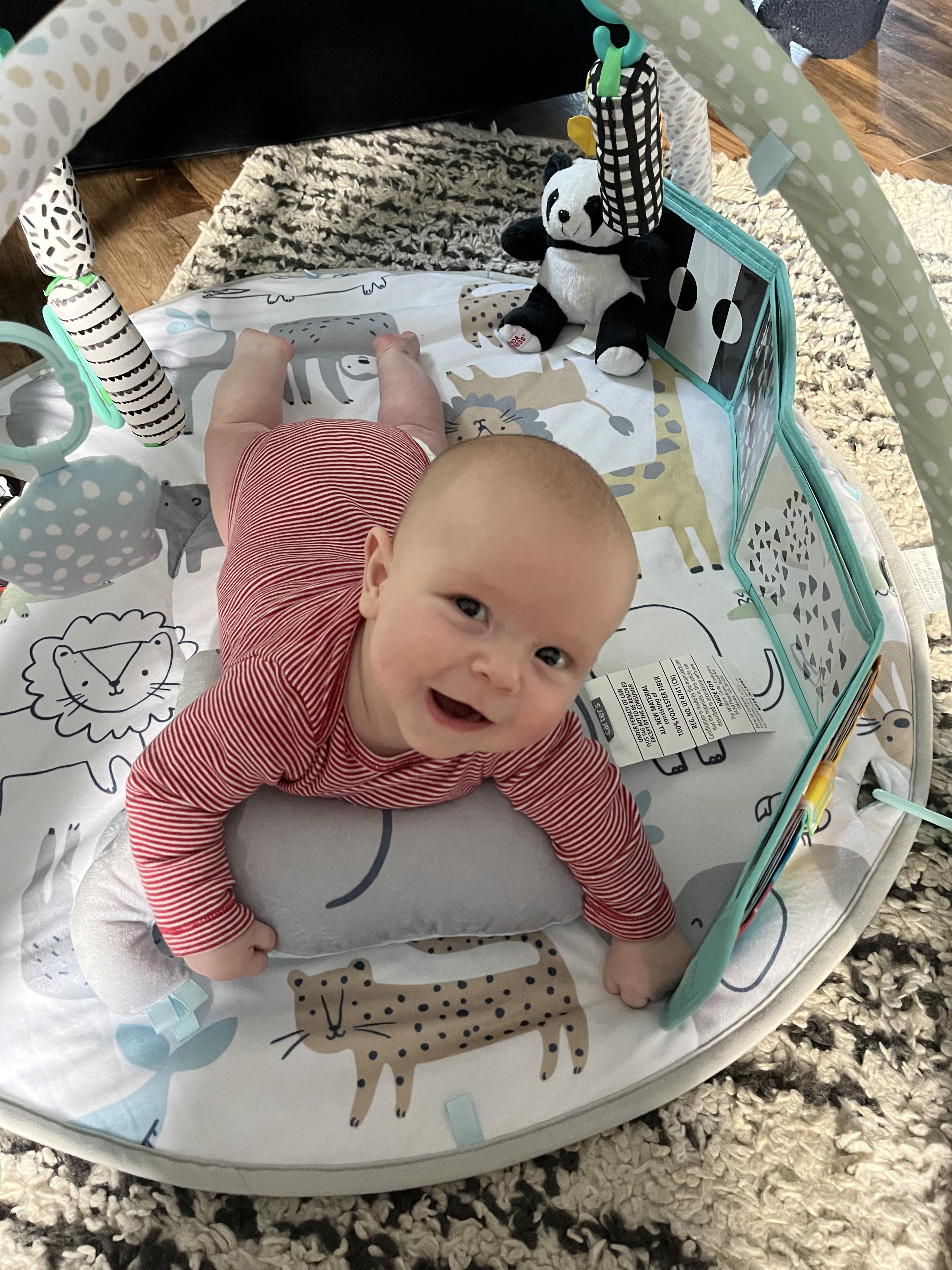
Nathaniel turned four months old last week.

And I’m already a proud papa.

Of course, he isn’t really doing that much right now. But why should I let that stop me?

Here’s a list of some of things I’m proud about my baby:

I’m proud of how big he is: Nathaniel scared us a bit at the hospital—he lost a lot of weight after he was born, and wasn’t waking up for feedings. But now he’s a veritable giant! 96th percentile for weight, and literally off the charts for height (28 inches long!). Anyone have advice for raising a jock baby?

I’m proud of what a great observer he is: Whenever we go out, Nathaniel is incredibly well-behaved. He almost never fusses in public, but he also rarely smiles in public either. Instead, he gets this thoughtful, observant look on his face and just silently soaks everything in.

Then we get home and it’s silly-town. But not in public. He’s not an animal.

I’m proud of how strong he is: Almost from the get-go, Nathaniel has been very strong. He was holding his neck up and looking around even while we were still in the hospital.

I’m proud of what a great sleeper he is: Don’t kill me, fellow parents, but Nathaniel basically started sleeping through the night immediately. I can count on one hand the number of times we’ve been woken up by him crying. He’ll take a midnight bottle, but sleep right through it—I don’t even have to rock him back down. And otherwise, he sleeps consistently from 7 to 7. Daytime naps are a little dicier, but he’s getting better, and in any event I’ll take that trade all day.

I’m proud of how patient he is: For awhile, Nathaniel had no interest in waiting even a second for a bottle once he got hungry (our running joke trying to soothe him while the bottle warmed was to agree “we’ve never fed you once in your life”). But now he’s much more understanding. It’s even more pronounced when he wakes up in the morning—no tears, no yelling, he’ll just happily entertain himself in the crib until mom is ready to get him.

I’m proud of how resilient he is: This is a big one, because it is not my forte. But when he got his shots, mom and dad were upset for longer than he was. And we’re already seeing him develop self-soothing practices to help him fall back asleep or get through a challenging time. I could learn from him.

I’m proud of how joyful he is: He may not show it in public, but Nathaniel has the best smile. He loves to giggle when being tickled, he loves to jabber while on his playmat, and he loves to dance when we sing him songs (we hold him upright as he bounces about). There’s nothing I love more than watching him take joy in the world around him.

This is just a short list. And it will only grow as he grows older. I’m not going to lie and say there’s nothing he could do that wouldn’t make me proud; but what is true is that there are an infinite number of ways he can make me proud, and I can’t wait to discover what they all will be.

Thursday, May 22, 2025

The Joy of Being a Mad, Ignorant Citizen


I'm still learning about the fault lines of local Portland politics. Everyone is a Democrat here, so that's no help. We just completely revamped our city governmental structure, abandoning the "commission" model (where elected city commissioners were responsible for particular bureaus of city governance) in favor of city council featuring three elected members each from four geographic districts. I think that's an improvement, though the last election was a bit of a free-for-all.

Anyway, Portland is in a time of budget cuts, and the city council is deciding what to slash. One proposed cut is to permanently close the Multnomah Arts Center (MAC), where I happen to be currently taking an introductory drawing class (if you want a charcoal self-portrait that will haunt your nightmares, hit me up). Since I'm enjoying my class (and am anticipating taking my son to family art classes when he's a bit older), I was horrified at the prospect that the center might close -- it's got a lot of great programming and it's five minutes from my house. So I wrote to my city councilors urging they keep the MAC open and find other places to make budget cuts (I apparently wasn't the only one).

Congratulate me on being an engaged public citizen? Maybe. But the thing is, here's the relevant information I was bringing to the table in forming this opinion and deciding to yell at my councilors about it:

  1. I like the MAC.
End of list. 

Obviously, in the abstract the MAC is a nice thing and worthy of support. But in times of scarcity, the question is about relative priorities -- the money has to come from somewhere. And for my part, I have no idea what other things might be cut instead of the MAC is kept open, nor do I have any insight in how to weigh potential competing priorities even if I was told of potential alternatives. And moreover, I don't really have any interest in learning more. "There must be another way", I say, while having no idea what those alternatives might be and no interest in finding out.

To be clear, I'm not saying it's likely that the MAC is actually a good place to cut. The hue and cry to save it makes me feel more confident that there really are better places to trim from. And the proposal to close the MAC came from one councilor -- it's not a situation where all the experts agree this needs to be done while I stubbornly refuse to accept it. 

But the point is that I'm getting to be an uninformed voter (for real this time!) and it is glorious. I just get to see something I don't like and be mad about it! Do you know how much more relaxing that is compared to when you do know the difficulties and complexities of an issue? I can also decide that the reason we're facing the need for such cuts is Donald Trump. Do I know that? No, but I can't imagine his slash and burn attack on effective governance is doing Portland any favors, and that's good enough for me!

This could get addictive. I have to be careful.

Wednesday, May 21, 2025

What Internet Randos Are Saying About the DC Jewish Museum Shooting


Earlier this evening, two staffers with the Israeli embassy were shot and killed while leaving an event at the Capital Jewish Museum in Washington, DC. The event was a multifaith and multinational gathering exploring "how a coalition of organizations - from the region and for the region - are working together in response to humanitarian crises throughout the Middle East and North Africa (MENA) region." The attacker reportedly shouted "free Palestine" after committing the killings.

(Tomorrow, the Museum was scheduled to host an event on "Pride: The Policy Accomplishments of the LGBTQ+ Movement", but this doesn't seem related to that).

Whenever events like this happen to the Jewish community, I have the macabre habit of trawling through the comment sections of my favored social media outlets, looking for people to block. I say macabre, but I actually find it quite cathartic: every block is another terrible person I don't ever have to deal with. Is it an endless and Sisyphean task? Of course. But you know that story about the kid throwing starfish back into the ocean and being told "why bother -- there's so many, you'll never make a difference throwing them back one by one", and he throws another one back in and says "I made a difference to that one?" It's like that, but oppositional.

I digress. After hearing the news, I did my perusing on Bluesky, and I have some anecdata to report.

First, a positive: Most people are reacting with what I would consider basic normalcy and decency. Just generally expressing horror and sadness or worry about how actings of political violence are only going to make a bad situation worse. Sometimes people I think exaggerate the pervasiveness of the "bad" takes on Bluesky -- and at one level I get why: if 1000 people are commenting on a political event, and 10% have a repellant take, that's simultaneously only 10% (a pretty small minority) and also that's 100 repellant comments, which can feel very overwhelming, very quickly. So while I don't begrudge anyone who can't look past the bad actors, I want to put it in some perspective. To everyone who had a normal response to a terrible tragedy: you get a sticker.

On the "bad" side, I sort the bad actors into a few groups. The number of people I saw affirmatively cheering the murders was very small. More common was either an overacted performance of yawning indifference ("huh -- anyway, did you see the Pacers game?"), or a dashed off "I'm not saying I support this..." followed by a very long "but...."

To be honest, though, none of these surprised me (either in their content or their relative numbers). The response I saw which did surprise me in terms of the frequency I encountered it was the number of people suggesting the shooting may have been a false flag, designed to justify either complete ethnic cleansing in Gaza and/or further authoritarian repression here at home. 

To be clear: I'm not including in this group people suggesting the Trump and Netanyahu administrations will attempt to exploit this shooting to further their malign agenda. That goes without saying. I'm talking about people who think the shooter was himself an Israeli operative, or otherwise acted at the behest of the Israeli government.

This is "the paranoid style", leftist version, and I was stunned at how many people seemed ready to indulge in it.  I probably shouldn't have been -- one still sees people arguing that Israel intentionally let October 7 happen (and massacred its own people) in order to justify its invasion of Gaza -- but still, it stood out. A lot of people really are prone to believing these sorts of conspiracies.

Anyway, that's my impressionistic take on what random reply-guys are saying. Mostly normal, some cheerers or apologists, and a bit more conspiracy theorists than I was comfortable seeing. Your mileage may vary.

UPDATE: One other thing I noticed -- the replies are much worse in the replies to politicians' posts (compared to news stories). Chris Van Hollen's skeet is overrun with people screaming "but you don't have a word to say about Gaza, you AIPAC-bought bastard!", which suggests they're either bots or aren't paying attention.

Tuesday, May 20, 2025

The Audacity To Love


As many of you know, one of the artists I collect (in fact, the artist who got me into art collecting) is Halim Flowers. Halim's backstory is incredible: he was convicted of felony murder as a juvenile in DC  after an accomplice shot a man during a home invasion of a rival drug dealer (Halim was not the trigger man and had already left the house when the killing occurred). He was sentenced to life in prison, eventually being released after twenty years thanks to a law targeting life sentences handed out to juvenile offenders. Since then, he has become a very successful artist showing internationally (his solo exhibition was featured at a Paris gallery this month).

Some people who promote Halim have described his story as "going to prison for a crime he didn't commit." I understand why they might say that, given confusion over what "felony murder" is,* but it isn't really true (and to be clear, I've never seen Halim say this or in any way try to skirt responsibility for his actions).

In any event, Halim has published a letter to "Face", the alias he went by on the streets as a kid (so-named because of his babyface). 


It's powerful reading. What impacted me the most is, again, how it doesn't try to avoid accountability, but also doesn't adopt the cliched narrative that prison was necessary to make him the man he is today. Rather, the theme of his letter is that none of this needed to happen. He didn't have to partake in crime. He didn't have to do the home invasion. There were, always, people who loved him. There were, always, people who wanted him to be the man he was always meant to be. He could've been that guy from the get-go.

The letter resonated with the post I wrote a few weeks ago about the American parents grieving their son who died after volunteering to fight for Russia against Ukraine, as part of a misguided tankie-ish "anti-imperialism", and also last year's article in Mother Jones about the mother of the UC-Santa Barbara mass shooter. These cases are all about the terrible maelstrom where unconditional parental love slams into commission of terrible crimes. You'd think something would have to give -- either denial of the crime, or abandonment of the love -- but the reality is that in many cases both persist and coexist in a terrible, chaotic symphony.

Those of us lucky enough not to be directly connected to the principals still can experience a pale echo of this. Halim's life, even after he was implicated in a serious crime, is precious -- the tremendous beauty he has created since his release is testament to that, though I don't want to say one has to be an artist of his talent for his life to matter. The man Halim's accomplice killed, even though he was also involved in the drug trade, is also precious -- we don't know what he would have done with his life, but I have no doubt he also had people who loved him and who he loved in return. The impossible necessity is to hold those truths together at the same time.

In my post, I wrote about
a nineteen-year old man arrested in Berkeley for attempted murder after stabbing someone during a fight outside a bar (as it happens, a bar I periodically frequented). When I read that, I was hit with a wave of despondency -- in part over the senseless of the stabbing, but in part as a sort of third-party grief on behalf of his parents. Didn't he know he had people who loved him? Didn't he realize how much him doing this would hurt them? How awful they must feel, and how alone, given that (understandably, and reasonably) the bulk of the community's care and concern will be directed at the victim and his family, not the perpetrator.
Part of what makes Halim's letter so powerful is that -- without being saccharine or wide-eyed -- just seeks to suffocate the problem it identifies in love. The audacity to keep loving, and the wherewithal to understand that one is loved, could alleviate and avert so much pain. In the overwhelming majority of cases, the love is already there, like a precious resource waiting to be tapped.

* Simplified, "felony murder" is the charge when a murder occurs in the course of a dangerous felony you're taking part in. It is not the same thing as "the felony of murder", which is confusing. In Halim's case, only the triggerman could be prosecuted for first-degree murder, but all accomplices to the felonious home invasion could get hit with a felony murder charge.

Image: Halim Flowers, "Audacity to Love (IP) (Blue)", silkscreen (ed. 10), 30" x 22" (2023). This print was executed shortly after October 7, and features the colors of the Israeli and Palestinian flags (there is a color-swapped white version as well). Even -- or especially -- in that moment, the audacity to love is an essential prerequisite to healing and providing for a just future.

Monday, May 19, 2025

The Religious Liberty Commission's Coming Attack on (Non-Orthodox) Jews


Donald Trump has named a set of appointees to his newly formed Religious Liberty Commission. This article does a good job covering much of the "Jewish" angle of the appointees, noting their general Orthodox slant and connections to various right-wing advocacy groups. None of that is surprising, particularly given the sharp split within the Jewish community where the Orthodox minority strongly supports Trump while the non-Orthodox supermajority despises him.

But there was one name that wasn't mentioned in the above story that I think deserves special attention from the American Jewish community: Josh Blackman, a professor at South Texas College of Law, who was appointed to the committee's legal advisory board. And the reason his appointment deserves special mention is simple: Blackman has argued that non-Orthodox Jews -- which is to say, the vast majority of American Jews -- should be categorically barred from making religious liberty claims. A "religious liberty" commission with him guiding the ship is a commission that presents a clear and present danger to the basic standing of American Jews like myself.

Blackman's argument against permitting non-Orthodox Jews access to religious liberty protections is breathtaking in its audacity and sweep. His view is that since only Orthodox Jews consider themselves bound by halacha, they are the only Jews who can ever sincerely claim to ever be "burdened" by impositions on their religious exercise. Non-Orthodox Jews are, in his view, relegated to little more than a cultural grouping or philosophical debate club; we are dismissed as incapable of having legally cognizable religious commitments at all. And when we dare purport otherwise, Blackman suggests, we should be seen essentially as liars -- opportunistically "gerrymandering" their claims to fit the Supreme Court's new free exercise jurisprudence.

Blackman's position represents an extreme version of burgeoning hostility on the political right towards non-Orthodox Jews perceived as politically liberal. It's no accident he was a central figure I highlighted in my "Liberal Jews and Religious Liberty" article as providing the "intellectual" architecture for de jure discrimination against non-Orthodox Jews, In particular, I argued in that article that a key component of the new conservative orientation regarding Jews was a decided belief that non-Orthodox Jews are not really Jews at all. In an ironic recreation of Karl Lueger's infamous "I decide who is a Jew!" declaration; conservatives are now declaring that the Jews they don't like don't count as Jews to begin with. 

Consider Trump's recent claim that Chuck Schumer was "not Jewish anymore" because of his opposition to Trump's MAGA agenda. It wasn't just random flailing. It was part of a pattern of denying that liberal Jews are properly viewed as Jews at all. This denial is critical to metabolizing the dissonance between conservative's imagined identity as warriors against antisemitism and the reality that they loathe the overwhelming majority of American Jews. Where they can successfully deny that most Jews even count as "Jews", this dissonance can be relieved, and their love for "Jews" can coexist with their hatred of actual Jews. 

Blackman is a leading figure seeking to promote a vicious and reactionary form of "religious liberty" where the bulk of the Jewish community are not only not protected, but are in fact among the primary enemies, all while draping itself in the mantle of "fighting antisemitism". It's despicable, and to anyone with a modicum of respect for the Jewish community as it is actually constituted it should be viewed as a form of antisemitism in its own right.

Blackman's appointment thus should be seen as a dramatic escalation of President Trump's war on the Jewish community. If adopted, Blackman's position would exclude the vast majority of American Jews out of the protections of the First Amendment and other religious liberty protections. At the very least, his appointment further underscores the degree to which the Trump administration's rhetorical claims about opposing "antisemitism" are coupled with disdain, even outright hostility, to most American Jews. But if his legal views are accepted, it would officially codify discrimination against non-Orthodox Jews into the body of American law.

This is not a drill. The Jewish community needs to know: if you are Reform, Conservative, Reconstructionist -- if you're a member of any or all but one preferred denomination of Jewish religious practice -- the Trump administration is laying the groundwork to strip you of your Jewishness and treat you as an enemy. Plan accordingly.

Thursday, May 15, 2025

Building a Better Scotsman


Here's one of my least favorite evergreen internet donnybrooks:

Person A: So-and-so isn't a real Christian [or insert identity here]. Real Christians care about the poor/don't commit adultery/aren't racist [or insert other "good" qualities here].

Person B: I've got bad news for you: lots of real Christians are greedy/adulterous/racist etc.. Stop trying to bowdlerize the reputation of Christianity by pretending the bad parts don't exist!

The reason I hate this is that both "sides" are not just attempting to do wholly salutary things, but they often know the salutary point the other side is trying to make and just pretend not to.

Person B is certainly right in trying to check against an illicit cleansing of Christianity's moral reputation. There are lots of people who are and are recognized as Christians who do bad things, and one can't wave that history away by playing games with definitions.

But Person A is also right in that the public meaning and understanding of Christianity is a perpetually contested concept, and it is a good thing when people try to align that concept with other good qualities. It is good when people who are Christian understand that identity to encompass good things. It is a constant push-pull struggle, and Person A is fighting the good fight in trying to push "Christianity" in a positive direction.

So yes, it would be bad if we just collectively glaze over the bad attributes of various identity/ideologies in a misplaced desire to define ourselves into innocence. But it would also be bad if we sabotaged efforts to present alternative and more salubrious accounts of these identities by acting as if they're forms of cheating.

In theory, a bit of nuance lets these positions coexist. One important lodestone I'd turn to here is Richard Rorty's maxim that "there is nothing deep down inside us except what we have put there ourselves." The inherent nature of Christianity (or again, fill in your favored blank) is not homophobia, nor is it LGBT-inclusion. There's nothing deep down inside the concept save what we put there ourselves. If we put in homophobia, then it’s homophobic. If we take out homophobia and replace it with LGBT inclusion, then it’s LGBT inclusive. It is not definitionally wrong when people put in homophobia, nor is it cheating when people try to take out homophobia.

In the field, I think a good rule of thumb is to ask what the speaker is reacting to. If someone is criticizing Donald Trump by saying he's "a bad Christian", I'm not convinced it's helpful to swoop in and say "actually, Christians can be bad." If someone is criticizing Donald Trump for imposing Christian nationalism upon the population, I'm not convinced it's helpful to swoop in and say "what he's doing isn't really 'Christian' at all." 

Likewise, I don't have a lot of patience for people who try to deny the real strands of homophobia in Christianity by simply saying "that's not real Christianity". That is, to borrow from Bonhoeffer, "cheap grace"; it takes work to excise those strands, it's not something that can be accomplished by proclamation alone. But I also don't have much patience for people who pooh-pooh the notion of doing that work at all because they insist homophobia is inherent to Christianity and anyone who tries to dislodge that attribute is lying -- and importantly, standing up and presenting a different vision of Christianity is an important form of doing the work. Indeed, there aren't many other ways.

Sunday, May 11, 2025

Parental Sabbaticals


Today was Jill's first Mother's Day as a mom.

Tuesday, Jill returns to work after the end of her parental leave.

The end of her leave, and the beginning of a return to "normal" where we will both be working parents, underscores just how special these last four months have been. That we've both been off of work and have been able to just concentrate on being parents, on loving and cuddling and playing with our baby, has been a gift beyond measure.

It's also accentuated how important parental leave is. We've been very lucky in terms of support: we're financially stable, had both sets of parents come for extended visits, had night doulas for much of the first month, have a baby who basically started sleeping through the night immediately, and yet it still feels like this whole deal would have been absolutely impossible if even one (let alone both) of us were working. Even now, with four months of experience under our belt, the prospect of "daddy daycare" feels terrifying to me (and that's accounting for the fact that Jill works from home!).*

I do not understand how anyone who's ever been a parent doesn't support universal parental leave. Jill and I have joked about how "surprising" it is that not having to work and just being able to concentrate on helping your baby grow is so much more pleasant than toiling in the salt mines, but really, it is an experience that everyone deserves to have. Oregon, to its immense credit, does mandate (and fund) twelve weeks of paid parental leave -- this is a brilliant policy that should be nationwide.

In fact, I'm way beyond that -- I think we should have periodic parental sabbaticals. Not a sabbatical from parenting (that's what sleepaway camp is for, and I'm embarrassed that I didn't figure that out until well into adulthood). I just think that every six or so years, one should be able to take parental leave again just to ... parent. Obviously, the parenting demands of a baby are different from those of a six- or twelve- or eighteen-year-old. But no matter what age your child is, I cannot help but imagine that both parent and child would benefit if the former could set aside four months where all they have to do is be a mom or dad. Four months to dive into a parent-child art class. Four months to really concentrate on math tutoring. Four months to dedicate to college visits. I get why this incredible experience of parental leave is centered around the time when your baby is a baby. But really, why should it be so limited?

We live in a (for now anyway) incredibly rich society. This an investment we could make, and which could make so many lives so much better. A lot of people talk a big game about encouraging families to have children -- by which 98% of the time they mean "taking away choices from women so that they no longer have any option but to have children" -- but this is something that actually would be a great catalyst for thriving families.

So consider this my big Squad/Green New Deal-style pitch: universal paid parental sabbaticals, for any parent with children under the age of 19. Build families back better.

* My leave formally ends at the end of the semester, but I don't teach over the summer, so even though I will be "working" (e.g., writing papers), I'll be taking over primary childcare duties during the day.

Friday, May 09, 2025

The Debunkers


Once, when I was in middle school, a friend and I saw a picture of a border guard from some eastern European country inside a Scholastic Magazine and decided it was a fake.

We had a grand time picking out details in the photo that "proved" it wasn't real. The guard's uniform had English on it, not Cyrillic. The rifle he was carrying was wrong (how we knew what rifle he was supposed to be carrying, I don't know). There were other "problems" as well that I can't remember now. But I do remember feeling very proud of ourselves for figuring out that the magazine ran a fake photo; when the reality is that the photo was almost certainly real. We were vastly overreading minor "discrepancies" that probably weren't ultimately discrepancies at all.

The New York Times has a really interesting (and long) profile on a TikTok star who announced she had cancer, and then faced an organized community committed to "proving" that she was lying about it for influence, clout, or clicks.

The story doesn't hide the ball for long: unless her oncologist is in on the grift, the woman really has cancer. Nonetheless, it was fascinating to see how many people got so committed, for so long, into being sure she was faking it.

In particular, I noticed the deployment of a sort of Potemkin expertise. The debunkers seized on little details and discrepancies which they persistently viewed as the critical cracks in an otherwise elaborate facade. The tenor was an interesting mix of obviousness ("anyone could spot this is a fake, look at the rubes falling for such a clear con") and sophistication ("look how meticulous my investigation is; the story falls apart when an expert looks at it"). The latter component I think does more work than the former: it concocts an aura of authority that both reassures other readers that the claims are backed up by evidence, and also makes them feel good about being critical consumers not taken in by ruses and cons (when the irony, of course, is that they've talked themselves into not believing the truth).

When I read this story, it reminded me of a similar army of "debunkers" who pore over any claim of atrocity or calamity in Israel/Palestine to "prove" that a claim forwarded by seemingly credible sources (doctors, international media outlets, and so on) is actually a hoax or a lie. For example, this account is dedicated to minute analysis of videos or pictures that purport to show, say, famine in Gaza or bombed out civilian infrastructure, picking out bits and pieces that "prove" it's being staged. There's a whole ecosystem of people on this beat (and not just on the "pro-Israel" side), and their tenor and behavior is very reminiscent of the fanatical debunkers described in the NYT article above. They project expertise via hyper-fixation on detail, and present themselves as simply trying to uncover the truth. But they're obviously not dispassionate; the tiny nits and picks they make to "debunk" adverse narratives are never paired with a similar fine-toothed comb aimed at stories more to their taste. It's not even real skepticism, let alone critical analysis. Yet they have an eager audience from those eager to believe they're seeing through a ruse, who revel in the twin joys of faux-sophistication and confirmation bias.

Now, to be sure, the TikTok case is in many ways simpler: it doesn't have any clear political valence, and it is a single incident capable of being definitively declared true or false. Across the many, many reported incidents of catastrophe and calamity in Israel and Palestine, things tend to be muddier, with more obvious incentives to slant (or invent) claims for political purposes, and there will be inevitably a distribution of results following initial claims. Some will be borne out, some will turn out to be overstated, not what they are initially claimed to be, or even outright falsified. There is value in actual critical assessment and reassessment of what people say is happening inside a war zone -- not the least because even among perfectly good faith actors the chaos of a war zone doesn't lend itself to the conjunction of perfect accuracy and immediate reporting.

Nonetheless, I can't help but think part (though not all) of the deception relies on a persistent assumption that every social calamity is complete and totalizing, such that if there's anything interrupting the grimness then it just cannot be cancer/fascism/famine whatever.

And that's not true. There are times one is living with cancer and yet isn't an emaciated patient confined to her bed. That can be part of cancer, one of the scariest parts of cancer, but a picture that doesn't fit that template doesn't prove the cancer is made up. There are times one is living in a fascist state but does not see jackbooted thugs grabbing people off the streets. That is one of the scariest parts of fascism, but a day one just goes to the market as normal and doesn't see any secret police at all doesn't necessarily falsify the fascism. Cancer isn't always like that, fascism isn't always like that. And famine, too, doesn't always look like "The Vulture and the Little Girl"; a picture of a market with some food in it does not necessarily mean there isn't a famine.

That's why those little bits and pieces aren't the smoking guns they purport to be. Reality isn't as clean as we think it is. People with cancer still go to parks. People under fascism still enjoy nights out on the town. Places afflicting by famine still typically have some food somewhere. Buildings that have been bombed still have unexpected pieces that remain standing.

Each of those faux-"discrepancies" becomes grist for the debunking mill. But it's not real critical analysis; it's just food to keep believing what one already wants to believe.

Monday, May 05, 2025

Requiem for a POB


One of the great traumas of my youth, as my mother tells it anyway, was when a favorite brand of gummy bear oatmeal was discontinued. It was one of my favorite breakfast treats, and learning that it was gone -- and gone forever -- was devastating to my tiny brain. I was heartbroken; sufficiently so that this calamity is still spoken of in the Schraub household thirty-plus years later. It did eventually come back when I was teenager, but by then the magic was gone.

Fast forward to the present, and one of David's favorite contemporary treats is Dole's pineapple orange banana juice (or "POB", rhyming with "lobe"). I had this off-and-on as a kid as well, but my true love affair with it didn't begin until I was an adult. It is a beautiful mixture of the holy trinity of smoothie fruits, and having it in my fridge is tantamount to being able to get a delicious smoothie whenever I want. Since David loves smoothies, this is a major selling point.

Unfortunately, POB has become increasingly hard to find.* And today I deigned to ask someone at the grocery store if they had it, and he said it had been discontinued. I don't know if he just means only that store no longer carries it, or it's no longer produced anywhere, but given my trouble finding it at any of the myriad grocery stores near my house, I fear the latter.

Upon getting this news, I remarked to my wife that this was even worse than the gummi bear oatmeal fiasco, because I'm an adult now and "there's less time". She replied "doesn't that mean it's better?" And I just want to explicitly trace out both of our logics here:

  • My idea was that less time is "worse", because there's less time for someone to reproduce the product and return it to the grocery shelves.
  • Her idea was that less time is "better", because I'm closer to death and so will have to suffer for less time.
Grim.

Anyway, I am heartbroken. Bring back POB!

* I have no idea if this is anything Trump and/or tariff related -- I'm actually inclined to doubt that it is -- but I'm happy to blame him for it anyway. If other voters can crankily decide every bad thing in their life is the fault of the incumbent party, why can't I?

Thursday, May 01, 2025

Like Wildfire


The first I heard of wildfires in Israel, it was in the context of an allegation that the fires were the result of Israeli settlers committing arson while attacking Palestinian farmers.

As best I can tell, that allegation traces back to a stray Haaretz tweet that reads "As wildfire rages in Israel, security source tells Haaretz settlers set Palestinian agricultural land on fire in the West Bank." There doesn't seem to be any further corroboration, and the link in the post doesn't go to any article or news item elaborating (as best I can tell, it was either taken down or never existed in the first place).

Meanwhile, the right-wing coalition running the show in Israel was also quick to blame the fires on arson -- specifically, that caused by Palestinian militants. This, too, seems thinly supported and already has the hallmarks of a smear campaign. Netanyahu, for instance, claimed that 18 individuals had already been arrested for suspected arson; the true figure is three. And one of those three is a sixty-three-year old man with no criminal record who was found with the smoking-gun evidence of a tobacco pipe and some cotton to clean it.

Finally, there are the experts, who posit that the wildfires raging across an arid region of the eastern mediterranean that just had its driest winter on record are probably attributable to ... the climate crisis. Fancy that.

In recent years, right-wing politicians have frequently blamed Palestinians for arson in the wake of wildfire outbreaks, but no one has ever been indicted for nationalist-motivated arson leading to large-scale fires. Most major fires investigated were ultimately attributed to negligence.

The Carmel disaster in 2010 was sparked by a discarded hookah coal. Two of the major fires that scorched parts of the Jerusalem hills in 2016 were caused by a flare gun and welding work. Other large fires were found to have been started by farmers burning waste or hikers making coffee.

The phenomenon of blaming minorities for starting wildfires is not unique to Israel: in Turkey, Erdoğan blamed the Kurds; in Europe, migrants were accused of arson; and in California, claims emerged that LGBTQ individuals in the fire services were responsible for the failure to contain the fires.

It does all hang together, doesn't it. 

Tuesday, April 29, 2025

Fine Art is Ridiculously Cheap/Expensive

Over the past year or so, I've developed a new passion and hobby in collecting art. I deeply resent this, since it flies in the face of one my cardinal life rules I've abided by for as long as I can remember: do not develop expensive tastes. And fine art is an expensive hobby.

Or is it? Well, yes, in many ways. But in other ways, it's ludicrously cheap. Let me explain.

First of all, I'm not talking about the headline-making auction prices of masterworks that involve more money than some countries' GDP. Robert Rauschenberg's "Buffalo II" silkscreen painting, for instance, auctioned for $88.1 million dollars in 2019. That is expensive under any definition. It's also functionally irrelevant to my life.

Go down to the other end of the spectrum. If I want to buy a decent-sized painting from an "emerging" artist -- a term that generally encompasses artists who have gallery representation but are at an early career stage, aren't in any museums or public collections, and haven't otherwise made any major "mark" in the art world -- it generally will cost in the low four-figures. That is expensive. It is a price I have paid for things, but it immediately becomes one of if not the most expensive thing in my house that I can physically lift with my own hands. At that price, there's not a lot of room for dabbling or experimenting or dilettantism. If I buy it, it better be something that I want on my wall for at least a decade.

And again, that's entry-level. What happens if you want to move up in the world?

Well, here's where the "ludicrously cheap" comes into play. Because you can absolutely get a Robert Rauschenberg print -- not a reproduction, a genuine, vetted, real-deal limited editioned Rauschenberg -- in that same price range. Earlier this year, Christie's auctioned a numbered Rauschenberg lithograph (edition of 31) from 1969 titled "Gulf" for $2,142. That is not cheap. But that is a price a normal human could imagine paying for something. My wife and I are financially doing reasonably well, but we are by no means 1-percenters. We couldn't toss out two grand on a lark. But could we do it periodically, for something we really loved? Yes, absolutely.

And Rauschenberg is an indisputable A-tier artist. What happens if you go the next step down?

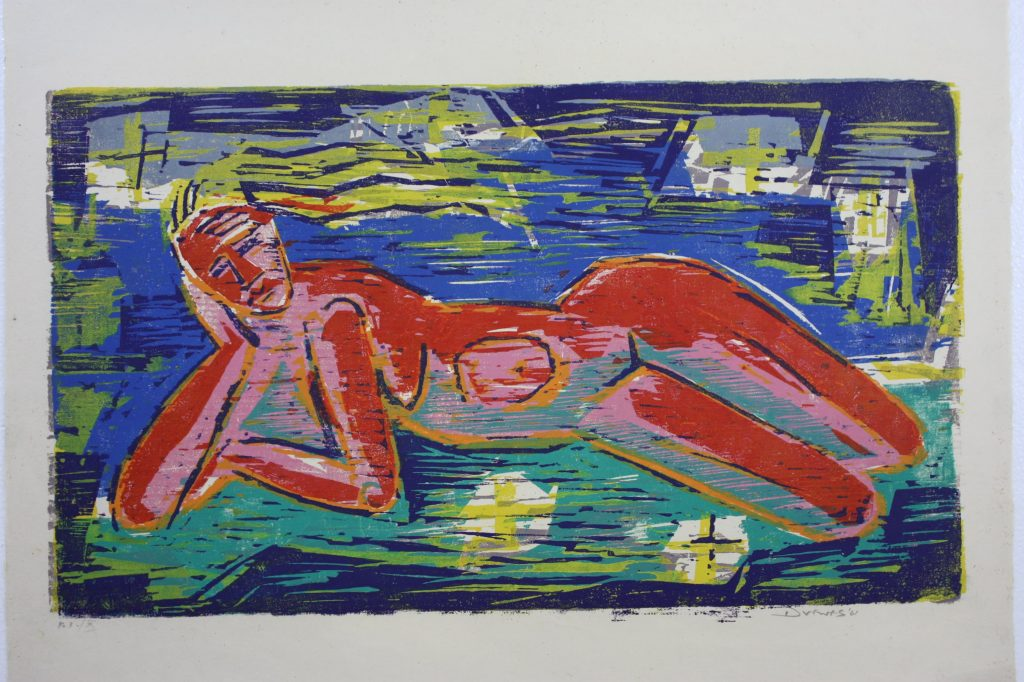
This is a woodcut by Werner Drewes, titled "Goddess of the Night":


It was executed in 1961 as an edition of 10; one of those editions is in the Smithsonian's American Art Museum. Drewes himself is no small figure: he is credited with bringing the Bauhaus movement to America, and he coined the phrase "It Can't Happen Here" as the title of a 1934 portfolio of works critiquing the rise of fascist repression in his native Germany (Sinclair Lewis would use it a year later for the title of his famous book).

"Goddess of the Night" recently auctioned for $924. Two other Drewes woodcuts sold together as a lot at that same auction for $826.

There's just something about that particular price range that I can't wrap my head around. It is simultaneously so expensive, and so accessible. It's so expensive in the sense that it is a figure that I would need to think about, and I'm far more financially secure than the vast majority of Americans. It's so cheap in the sense that it's a figure I can feasibly pay, which feels absurd to me when we're talking about historically significant artists whose works are in major museums.

Monday, April 28, 2025

The Anti-Anti-Racism Conspiracy in Oregon


This is an infuriating story on many levels:

The principal at The Madeleine School, a private Catholic school in Northeast Portland, summoned Portland police to the campus in late March when the parents of a Black student demanded to know her plan of action after their fourth grade son reported being called a racist slur on the playground.

Just 72 hours later, the school expelled the boy, effective immediately, saying his parents — Moda Health executive Karis Stoudamire-Phillips and renowned jazz musician Mike Phillips, both prominent Black Portlanders with long histories of volunteering both citywide and in Portland’s tight-knit Catholic school community — had violated the school’s code of conduct for parents.

The students accused of hurling the slur denied it, but the boy's account was corroborated by at least one other witness.

There are a couple of different layers here. One is that the Archbishop of Portland has had a tense relationship with the Catholic school community here, stemming from his effort to enforce conservative gender orthodoxy over the objections of many students, parents, and lay leaders. This appears to be part of a broader intrusion of right-wing culture war shibboleths, which helps make more sense of this part of the story:

According to that child’s father, who did not want to be named to protect his child’s privacy, Principal Tresa Rast told him and his wife that she suspected that their son had made up the entire incident and recommended that the child see a therapist so he could be “deprogrammed” from the anti-racist training he’d received while previously attending public school in Portland.

From what I can tell in the article, the child had been attending the Madeleine school since Kindergarten, so it's unclear when he would have been "programmed" by Portland Public Schools at all.

But of course, searching for logic misses the point. Rast appears to have an understanding where "racism" is something entirely made up -- so made up that Black children need to be "programmed" into believing its existence so they can foist false charges upon innocent White children. It isn't hard to draw a line here to the MAGA demand to suppress any and all American history tellings that accurately recount our nation's racial past (and present) -- the entire theory is that all such stories simply are lies concocted to assert control. It is a classic conspiracy theory (which is why Rast could jump to the absurdist notion that the child needed "deprogramming" -- an outrageous claim even if the child had been a regular PPS attendee).

And we also shouldn't lose sight of the fundamental cruelty this politics inevitably inflicts. Here is how the school handled the expulsion of the child:

“It has become clear that the relationship of trust and confidence that is necessary for a collaborative partnership between parent and school officials for the good of your child no longer exists,” Rummell wrote. “Our partnership is hereby immediately terminated as of the end of the day, April 3. This decision is final and from our perspective this matter is now concluded.”

Their son was allowed to return to campus one more time, Stoudamire-Phillips said, to say goodbye to his teachers.

“There wasn’t a dry eye in the classroom,” she said. “Teachers from all over the school were coming in to say bye to him. He knows that he is loved by that community. He just doesn’t understand why these two leaders keep making decisions that have hurt him.”

"He doesn't understand why these two leaders keep making decisions that have hurt him" Juxtapose that against the brusqueness of his dismissal, of the ripping of this child from a community he had been enmeshed in and valued. It's heart-wrenching. And it emerges from people who prioritize of national kulturkampf demands over the interests and humanity of the children in their care. This, above else, is what characterizes the current MAGA orientation towards so many children -- they pour out hatred and disdain and scorn, because hurting the kids matters less to them than cleaving to their own fantastical tales of resistance to "wokeness".

Thrilling Over Dead Children


In a generally interesting column about Israel's war aims in Gaza, Raviv Drucker writes:

Today, the lust for revenge, an easy willingness to make use of the madman theory and the widespread view that "they're all terrorists" have led to many actions that cannot be explained or justified. It is immoral, inhumane and taints us all.

This jumped out at me, because of a response to my "Tenth Plague" post I had read a few hours earlier. The response took great delight in trying to come up with myriad thought experiments justifying the killing of children: Would you kill baby Hitler? Would you kill members of the Hitler Youth? Would you kill a neo-Nazi kid who would have voted for Trump? (The last was presented as some sort of gotcha, as if it presented some more difficult quandary than the others).

These meditations, of course, are fun little games one plays in order to rationalize killing children -- a still grimmer (if that's possible) example of refusing to lay down one's toys. They are misappropriations of the famous quip about knowing what one is and just haggling over the price -- the idea being that we're all actually okay with killing children, some are just more clear-eyed about it than others.

The uselessness of the "baby Hitler" hypothetical is obviously that we cannot know in advance who will turn out to be Hitler. The purported way around that is pure racist fatalism -- we do know that these children will grow up to be Hitler, because that is what they do. It is not irony at all that this is exactly the rationale of those who cheered the murder of the Bibas children -- claiming that they will grow up to massacre Palestinians because that is what they do. It's the same sickness, in a slightly different color palette. Let nobody deceive you into thinking that these people are not one and the same.

And what stands out at me, again, about people such as this is the desire -- the thrill -- that some have in finding a way to justify killing children. It reminds me once again of Bernard Henri-Levy's contention about the rise of the "New Antisemitism", speaking of people who want above all else to "feel once again the desire and, above all, the right to burn all the synagogues they want, to attack boys wearing yarmulkes, to harass large numbers of rabbis, to kill not just one but many Ilan Halimis...." It's not just about attacking kids, it's about feeling right to do it. And so they are never more thrilled than when they can tell themselves a story whereby the killing is righteous, and justified, and necessary, and beautiful.

A key part of the story they tell themselves, I think, is that everyone thinks this way. Everyone revels in killing the children of the enemy, some just put on a show of pretending otherwise. It is cynicism posing a "realism" that's actually cowardice. It continues to be a lie, and lie whose only purpose is to give despicable people moral license to promote despicable things.

Friday, April 25, 2025

Every Parent Grieves


Michael Gloss, a twenty-one year old American, was reported killed fighting for Russia in its war on Ukraine. This is news primarily because Gloss is the son of a relatively high-ranking official with the CIA.

In his obituary, his parents noted his love for "JRR Tolkien and his depiction of fellowship among heroes", and described him as "forging his own hero’s journey" when he was killed in "Eastern Europe."

It's easy to make fun of this. And Gloss' "journey", which took the form of a particular virulent type of anti-American tankie-ism that saw him volunteering to fight for a reactionary imperialist invasion of a democratic nation, is repellant to me.

But perhaps it's a function of being a parent, that I cannot fault any parent for how they grieve their child. When I saw that obituary, all I could think of was how Gloss was twenty-one years old, which meant that his fascination with J.R.R. Tolkien probably began only five or ten years ago. Twenty-one is an adult, but it wasn't that long ago he was a child, and no doubt his parents still vividly see him as a bright-eyed adolescent jabbering about orcs and hobbits and wizards and Gollum.

This doesn't mean he wasn't an adult now, or that he shouldn't be judged for his choices. Many other people, and from far less advantaged backgrounds, have been judged as severely or more for the choices they've made at similar ages. 

But if anything that makes it worse for those who are grieving him; knowing that in some way the rest of the world cannot join them in their grief. Like all parents, I have a persistent background fear of someone hurting my baby; of something terrible happening to him. But I also have nightmares of him growing up to hurt others, of him being in a position where something terrible would happen to him and in the eyes of the world it being warranted. What a horrible, helpless, lonesome feeling that must be.

Everyone is someone's child. The victims are someone's child and the perpetrators are someone's child. I read today about a nineteen-year old man arrested in Berkeley for attempted murder after stabbing someone during a fight outside a bar (as it happens, a bar I periodically frequented). When I read that, I was hit with a wave of despondency -- in part over the senseless of the stabbing, but in part as a sort of third-party grief on behalf of his parents. Didn't he know he had people who loved him? Didn't he realize how much him doing this would hurt them? How awful they must feel, and how alone, given that (understandably, and reasonably) the bulk of the community's care and concern will be directed at the victim and his family, not the perpetrator.

Does this mean that people who stab others should be let off without consequence? Of course not. But I can't expect the parents to abstain from fully grieving a child who is (or is practically) lost to him.

Monday, April 21, 2025

The 615th Commandment: Thou Shalt Not Let Trump Define What it is To Be a Jew

Tradition holds that there were 613 Commandments given to the Jews at Sinai.

A more recent tradition, pioneered by Emil Fackenheim, identified a 614th Commandment: "Thou shalt not give Hitler a posthumous victory." There are several interpretations of what this means, but the basic gist is that Hitler tried to eradicate the Jewish people and failed, but we cannot let him win in death by allowing the Jewish people to disappear. Be religious, be secular, be in Israel, be in the diaspora, but don't stop being Jewish or transmitting your membership in the Jewish community forward.

As many have remarked, we seem now to be in the twilight of a Jewish "golden era" that began out of the ashes of World War II. Old hatreds that slumbered now are past stirring and roar awake, and new threats emerge on all sides. And a large part of that threat (though not all of it) emanates from Donald Trump and his MAGA movement.

Of course, the connections between Trump and his lackeys and far-right antisemites of the worst sort are easy to document. But one of the more insidious features of their antisemitism is how they anoint themselves speakers for the Jews. It's more than just the old saw "a philosemite is an antisemite who likes Jews". Trump and his followers arrogate to themselves the right to define what being Jewish is in the public eye. Right now, most people in America only encounter the concept "Jew" in the context of various MAGA policies that pretend to be about fighting "antisemitism" -- the deportations, the funding cuts, the speech cancellations. Whether they support or oppose these initiatives, these events swamp any other context in which they might encounter something that is (or claims it is) Jewish. Through his efforts, many people understand "Jewishness", in its public persona, exclusively through the lens of Trumpism -- Jewishness is free speech crackdowns and mass deportations and destroying the academy and promising to turn Gaza into a beachside resort.

I wrote about a form of this in my "Liberal Jews and Religious Liberty" article under the moniker "the new supersessionism": "the ability of non-Jews to possess, as against actual Jews, a superior entitlement to declare what Jewishness is." Certainly (albeit regrettably) it's true that some Jews support some or all of the above things Trump is seeking to place under the umbrella of Jewishness. But the point is that Jewish endorsement or not is largely irrelevant to this popular perception -- it is a seizure of control of Jewishness from the Jews.

Against this, though, I feel like I'm witnessing an organic and largely inchoate emergence of a potential 615th Commandment: a compulsion to not let Trump define what it is to be a Jew. The various cries, against Trump's attempt to make us into fig leaves for his fascism, "not in my name!" is a version of this -- but I think it goes deeper than that. I'm seeing more and more liberal Jews making a point of being publicly Jewish not (or not just) in a political context, but simply out of desire to reclaim the public meaning of Jewishness. It's not cynical, and it's not opportunism. If anything, it's inspiring in its earnestness -- the category "Jewish" matters to us, and where we see that category being purloined out from under us, the best way to fight back is to claim it louder.

Every time a public-facing Jew talks about eating bread again after Passover, it resists this. Every time a Jew mentions their Bar or Bat Mitzvah, it resists this. Every time a Jew casually drops in the Yiddish slang they grew up with, it resists this. I'm not saying the "political" displays -- talking about what Jews actually think about reproductive freedom, or marching with the families of the hostages enraged that Netanyahu has kept this war going not to redeem the captives but to save his own skin at their peril -- doesn't matter. They matter a lot. But it is very important that it's not just that. It's not as-a-Jew-ing. It's not being indifferent to one's Jewish identity except as an occasional political cudgel. It is people for whom being Jewish matters to deeply, at every level, and who cannot countenance letting a sick antisemitic authoritarian steal that identity away from us and claim it for his own project.

Perhaps placing this in the realm of one of the Commandments is too august. But the instinct, I think, is one I'm not alone in feeling. Being Jewish is meaningful, and beautiful, and historic, and a privilege. It is our obligation, as Jews, not to let this intruder seize our very identity from his and redirect it to his perversions. To borrow a very non-Jewish concept, we have a duty to bear witness to our Jewishness every day, simply by being Jews others see, so that they have something that stands against the torrent of articles and news stories and press releases that relentlessly associate "Jewish" with ... that. In doing so, we resist. In doing so, we assert that it is Jews -- not Donald Trump or his minions, not right-wing media outlets, not conservative Christian "allies", but Jews -- who determine what it means to be a Jew.

Wednesday, April 16, 2025

Bill Kristol: Warrior for Light


One of my favorite subplots of what has been an overall awful political season has been the redemption arc of Bill Kristol.

For people of my generation or a bit older, it is genuinely hilarious to watch him sound not just like a NeverTrumper, but as a full-blast Resistance Lib.

At one level this didn't come completely out of nowhere. Back in 2016, I predicted the possibility that the neoconservatives might return to the Democratic fold. For those who know their history, neocons were liberals once (as I said then -- not to mix media properties -- this is much like Saruman describing the orcs: "they were elves, once"). They turned away from the progressive movement based on aversion to what they saw as reflexive anti-westernism and a deep, almost messianic, belief in America's ability to spread democracy and liberal values worldwide. 

The latter commitment in particular took them to some pretty dark places, and a lot of, shall we say, "compromises" occurred along the way. But as we reach a crisis point for democracy here at home, some of them -- Kristol being the most prominent -- reached back deep into themselves and remembered what nominally was motivating them as idealistic youngsters.

It's not, of course, like Kristol has some profound influence on the right these days (or the left, or the center). And it should be obvious that none of this requires one to view Kristol as some sort of heroic figure or forget his past "interventions" (forgive the pun).

But as a narrative arc, I can't help but enjoy watching it. And there's so little joy these days; please don't begrudge me for indulging in this one.