Saturday, March 22, 2008

Subjective Orientation

Matt Yglesias and Rob Farley made a point yesterday about how liberals and conservatives are looking at foreign affairs that I hadn't thought of. Here's Matt:
It's striking how much of conservative thinking about national security these days centers around subjective factors -- determination, emboldening, "claiming victory" -- rather than on objective assessments. Objectively speaking, withdrawing from Iraq would cut off a major line of recruiting for al-Qaeda while simultaneously freeing up vast quantities of American manpower and other resources. How "bold" that makes al-Qaeda leaders feel (and you've got to figure these fuckers were pretty "emboldened' already when they blew up the twin towers, right?) has nothing to do with anything.

Farley goes on to argue that this is actually a rather common thread in America. Personally, it reminds me a lot of the so-called Green Lantern Theory of American foreign policy (that America, as the hegemon, can accomplish anything it wishes so long as the Will of the American People stands behind it). But insofar as these terms take primacy in our discussion of such issues as the war in Iraq -- such that we're more concerned about showing "resolve" than we are about actually creating a safer and more democratic role -- we begin to run into trouble.

DeMarcus Nelson

DeMarcus Nelson is my favorite player on the Duke Basketball team. Plagued by injuries, he seemed to have been around forever. But with Duke getting knocked out in round two by #7 West Virginia (who would have thought missing 15 straight 3s would lead to such problems?), Nelson's career is finally over. And worse yet, he ended it on a terrible slump -- really having off games both against Belmont and the Mountaineers.

Speaking as someone who ended his own competitive days (in high school debate) on a really rough run, I know how much that sucks. It's obviously tough to lose, and tough to end your career, but there is special agony to knowing that you finished on the down slope.

So Nelson, just know that you've still got a fan, and I wish you luck in whatever you do for the rest of your life (basketball or otherwise).

Friday, March 21, 2008

Boxing Blogging: 3/21/08

Sure, everyone is watching March Madness. And I am too. But I'm also making time to watch the boxing, and was treated to one of the biggest upsets ever to air on Friday Night Fights: Andy Lee getting stopped by Contender Alum Brian Vera.

But first the undercard:

Aaron Pryor, Jr. (9-0, 6 KOs) UD8 Alphonso Williams (10-4, 8 KOs)

I thought the fight was a draw, but I can't really protest Pryor eking out a tight unanimous decision victory (I can protest the ludicrous 79-73 card one judge gave though). But Pryor, a very tall middleweight, was sorely tested by a game Williams, who had him hurt in rounds one and seven. Williams had a tendency to throw wide and smother himself, which limited his effectiveness, but Pryor couldn't keep him on the outside -- a problem for someone as tall and lanky as the undefeated prospect. Ultimately, Pryor gets the nod, but he needs a lot more time in the gym if he's going to step any further as a professional.

Matt Remillard (13-0, 7 KOs) UD4 Jesus Salvador Perez (25-19-3, 14 KOs)

Yawn. Remillard looked ordinary, and Perez looked like someone who is now 2-17-1 in his last 20 (which the former title challenger is). Remillard did knock down Perez once in the first, but aside from that it was a rather drab affair (I'll admit flipped over to catch the basketball for much of it).

Brian Vera (16-1, 10 KOs) TKO7 Andy Lee (15-1, 12 KOs)

First of all, congratulations to Vera, who fought an outstanding fight. I admit, I did not give him a chance against Lee, who many thought was a burgeoning star. The first time I saw Vera fight, it was a majority decision win against Samuel Miller that I thought had a whiff of home cooking to it. The second time, it was him getting blitzed in two rounds by Jaidon Codrington. Lee, being a class ahead of both of these guys, looked to blow out Vera, and that's precisely what I thought would happen.

And in the first round, all signs pointed to my prediction being accurate, with Lee scoring a knockdown. But Vera stormed back and began to hurt Lee, simply through constant pressure and a good chin. I thought Lee blew some chances by not jumping on Vera when he had the chance -- he was repeatedly stunning the smaller fighter with lefts, but didn't follow up. Vera's heart kept him coming forward, and it's always a mistake to let someone like Vera stay in the fight.

In round seven, Vera had Lee hurt and was battering him around the ring. Now, I'll join the chorus of folks who question the stoppage as early. Lee was getting hit and was clearly hurt, but he was throwing back. In fact, he landed the last punch of the fight -- a solid counter reacting to a flush shot Vera placed that ultimately prompted the referee to step in. The ref had been giving Lee a look for quite awhile, but I'm not sure how I feel about waving the fight off in the middle of the ring when both fighters are trading. It's a controversial way for a rising star like Lee to lose his "0", and this sport has enough controversy already.

But none of that should be used to take anything away from Vera. He came back from on the canvas, walked through some brutal left hands, and took the fight to Lee. He earned a lot of respect from me tonight.

Expulsion

This is a great story about how biologist P.Z. Myers was expelled from a screening of "Expelled." Apparently, the producer of the movie (which is about how "big science" is suppressing creationism) left specific orders that Myers -- a prominent critic of the creationist movement -- was not to be let in. But they did unknowingly admit Myers' companion that day -- atheist writer Richard HDawkins.

Thursday, March 20, 2008

Friends and Lovers

A new study shows that guys mistake friendly gestures by women as sexual come-ons, and sexual come-ons as friendly gestures. Thus guaranteeing us a life of misery and solitude unless by sheer dumb luck we're tackled on the sofa by our to-be paramour. So to all my female "friends" who really were just willing me to jump them, much apologies.

Also, Ezra's right: examples of which signals were which would have been a nice addition to the article.

(Men, of course, as so tastefully commented by LitBrit, er, "wear their hearts on their sleeves", if you will).

Power Couple

Rumor on the street is that super-prof Cass Sunstein, who recently announced he is leaving Chicago for Harvard Law School, is involved with former Obama adviser and all-around BAMF Samantha Power. Power, of course, is based out of the Kennedy School.

Sunstein was previously linked with Chicago Professor Martha Nussbaum -- who, coincidentally, just turned down an offer from Harvard Law School and will remain at Chicago.

[This is my equivalent of celebrity gossip]

What Goes Around

Over at the new Convictions blog, Richard Ford makes a point I hadn't thought about with regards to the development of conservative race jurisprudence:
The equal protection clause is now as likely, if not more likely, to block race conscious efforts to remedy racial injustice as it is to block racial discrimination as conventionally understood. And so ironically, making it difficult to establish an equal protection violation-- once a conservative position--may soon be in the way of conservative efforts to reverse and prohibit race conscious remedial policies.

There are three directions this can go. The first is a loosening of the standards, making it easier for both traditional civil rights plaintiffs to show proof of discrimination but also easier for those blocking efforts to remedy racial injustice. Observing the recent Snyder case, this is how Professor Ford sees things progressing. The second option is that the rules remain tight, and conservative advocacy groups find it harder than they initially suspected to undermine affirmative action and other such programs because the bar is set really high for proving intentional, specific discriminatory patterns.

The third option, of course, is that the bar is set low for those attacking racial remedies and high for everyone else. I won't say that's the most likely outcome, but it's not impossible either.

Post-Election Huckabee

I wanted to post this yesterday, but I want to reiterate how impressed I am by Mike Huckabee's defense of Rev. Wright:
And one other thing I think we've gotta remember. As easy as it is for those of us who are white, to look back and say "That's a terrible statement!"...I grew up in a very segregated south. And I think that you have to cut some slack -- and I'm gonna be probably the only Conservative in America who's gonna say something like this, but I'm just tellin' you -- we've gotta cut some slack to people who grew up being called names, being told "you have to sit in the balcony when you go to the movie. You have to go to the back door to go into the restaurant. And you can't sit out there with everyone else. There's a separate waiting room in the doctor's office. Here's where you sit on the bus..."

And you know what? Sometimes people do have a chip on their shoulder and resentment. And you have to just say, I probably would too. I probably would too. In fact, I may have had more of a chip on my shoulder had it been me.

Back when Huckabee was running, I described him someone with "a lot of personal charm and charisma" but "a lot of positions that are -- bluntly -- crazy." And that's true. But the thing about crazy people is sometimes they're crazy in the best possible way. Huckabee has a lot of good stances on many issues (such as immigration). On the campaign trail, trying to get the GOP nod, he walked a lot of them back. But now that he's free from pursuing the nomination, he can go back to saying things like this -- things that you rarely hear institutionally powerful Republicans say, but things that have a lot more power coming from someone like Huckabee than even an orator as powerful as Obama.

Wednesday, March 19, 2008

More Fun With Killing Hitler

Time Travel rookie mistakes (via Reason).

This is getting to be a trend.

Black Conservatism Revisited

First of all, I want to thank all of the folks who have helped touch off this conversation and have given me so many kind words, particularly Andrew Sullivan for the original link, Rod Dreher at Crunchy Con and the Dallas Morning News, Jim Buie, Robert George, Rafique Tucker (who gets special shout-out as a fellow Marylander), and all the other folks who have left comments or emailed me. I really think this is an important conversation to be had, and I'm particularly gratified that so many people have been so willing to accept with an open mind the existence of parallel Black political orientations which don't perfectly map on to what we normally think of as "liberal" and "conservative".

I wanted to take this opportunity to tie up a couple loose threads in my brief exposition of Black Conservative ideology, the most glaring of which was relying a bit too heavily on separatism as a unifying factor of Black Conservativism. To be sure, I think that it is a very important strand in Black Conservative thought, and one that exists left and right. But someone inquired how Clarence Thomas (who is quite tied in with an important "White" institution, after all) fits into this metric. And he doesn't -- at least, not quite. Justice Thomas is clearly not a separatist. But he does, I believe, subscribe to the more critical aspect of Black Conservatism -- a deep skepticism that Whites will abandon racism, particularly due to high-minded moral appeals. But unlike the separatists, Thomas' Black Conservatism simply urges Black people to accept that racism will be there and will always be there -- and win anyway. Elsewhere I called it the "hit me with your best shot" strain of Black Conservatism -- that which does not kill Black people makes them stronger, so rather than complain or fruitlessly war against the existence of racist people and racist institutions in American life, just grit your teeth, lower your shoulder, and win the game.

Now, this may make sense for Black people. The reason I say I respect Black Conservatism is that -- in a world where racism still is an important constricting force -- it's important to let Black people decide for themselves how they want to adapt to it. I don't think I have the right to ask Black folks to constantly be warriors for integration. But, I don't think White folks can take this same position. It's one thing for a Black person to say to his fellows, "look, Whites are always going to be racist, so you got to figure out a way to survive in that world rather than wasting your energy on a fruitless quest to end racism." It's quite another for a White guy to tell Blacks, "look, we're always going to be racist, so you have to figure out how deal with that and thrive anyway." Black conservatism is a very convenient philosophy for White people, because it essentially assumes the worst in us, absolving us of our duty to overcome racism. I think our response to Black Conservatives has to be one of respect, but also of a burning desire to prove them wrong -- to show them that, yes, we can and will extend the hand.

But anyway. Ultimately, then, the unifying force in Black Conservatism is not separatism (though many are, to varying degrees), the unifying force is the belief in the permanence of racism. Black Liberals seek ways to obliterate racism, Black Conservatives seek ways to thrive in spite of it.

So that's the main thing. The other quick point I wanted to expand on was where conservative Black Conservativism differs from conservatives who are Black (someone asked why I wouldn't characterize Ward Connerly as a Black Conservative). The short answer is that the latter simply doesn't believe that racism is a major factor in affecting the life chances of Black people anymore -- their problems lie on other axes. Needless to say, these can start to bleed into each other -- the line between saying racism exists but you should simply push past it through the will to succeed and saying that racism is not really that important is thin, but it is there. Blacks who are conservative don't necessarily believe that racism continues to be a big player in the affairs of Blacks, Black Conservatives think it's a permanent feature of the landscape, but that can't be an excuse for failing.

Job Huntin'

I have a job interview today. Wish me luck as I venture from the warm confines of the intertubes into the harsh reality of the real world (although, ironically enough, this job might entail me blogging).

Tuesday, March 18, 2008

Obama's Speech

It's here, it's brilliant. I think it particularly shows the complexity of the interplay between Black Liberals (Obama) and Black Conservatives (Wright) that I explored in this post. Obama is not in Wright's camp. But he understands why folks are, and he and his coalition see their goal not to disrespect or stomp on them for their lack of faith in White people, but to simply go out, and prove them wrong.

Monday, March 17, 2008

Bear Bottom

As someone who keeps a casual eye on the stock market (and who, of course, wants a functioning economy upon graduation), obviously I'm concerned with Bear Stearns sudden collapse. When a titan that big falls, the shock waves are going to be massive no matter how swiftly the government moves to stem the damage. One hopes that our public institutions are up to that task -- but the track record of this administration hardly inspires confidence in that respect.

But the other thought that persistently nagged on me was the very fact that Bear Stearns (through J.P. Morgan and the U.S. Federal Government) was getting bailed out in the first place. Obviously, I superficially see why this is so -- if they didn't, we'd be faced with a massive economic meltdown. But something rings uncomfortable to me that the powerful are insulated from the risks that they take by virtue of their power. If I kidnap folks and enslave them, I face life in prison at least. If a corporation does it, they're faced with a fine. A stiff fine, perhaps -- but shouldn't the executives and officials who concocted this deal also face criminal charges? Cigarette companies knowingly released a poison on the market without telling anyone of the risks. Yes, they get sued -- but the CEOs aren't being arraigned for manslaughter. Powerful actors consistently get to privatize the gains and publicize the busts. It's only the little people who have to worry about their own skin.

Like Darren Hutchinson, I'm not opposed to the Bear Stearns bail-out per se. But when I see it juxtaposed against strident opposition to public aid for other folks, who haven't behaved nearly as irresponsibly as Bear Stearns and whose mistakes have not wreaked nearly the havoc on American society, I grow white with anger. All this talk about "personal responsibility" and "welfare queens" and "no hand-outs", it's utter bogus. If you matter enough, the government will be there to back you up in the end. It's merely a question of who we think matters.

Obama's Race Speech

This looks interesting:
Far from putting the controversial issue of race behind him, Barack Obama has decided to address the issue head on in a speech Tuesday.

"I am going to be talking not just about Reverend Wright, but the larger issue of race in this campaign — which has ramped up over the last couple of weeks," Obama told reporters in Monaca, Pennsylvania.

Obama's chief strategist David Axelrod characterized the speech, to be delivered in Philadelphia, as "a discussion on race and politics."

It'll be interesting to see which direction he goes with this. The momentum, obviously, towards going even more aggressively post-racial. Obama remains well positioned to do this, and it's the politically safe choice given the continued fallout from his affiliation with Rev. Wright.

But -- while I think it's important for Obama to sound themes of racial reconciliation, and I have no doubt he will -- I hope he displays enough political courage to remind (White) American voters that race is not a non-issue in America, that significant gaps still exist between our ideals and our reality, and that it does nobody any favors to simply slide on past the continued effects of racism in the American polity. If he manages to say that, without antagonizing a primarily White audience, it would be an impressive display even for someone blessed with Obama's considerable political gifts.

Saturday, March 15, 2008

Black Conservatives in Large and Small Caps

About a year ago, I penned a post entitled "Taking Thomas Seriously", about the particularly political ideology held by U.S. Supreme Court Justice Clarence Thomas. In it, I noted that both liberals and conservatives misunderstood Thomas' orientation because they tried to map him onto "standard" (White) political categories. Thomas is a conservative, yes, but specifically he is a Black Conservative, which is a very particular philosophical tradition that does not perfectly align with plain old vanilla White conservatives.

Not all Black conservatives are Black Conservatives (that is, there are conservative Black people, such as Ward Connerly, who I would not identify as part of the Black Conservative tradition), and, more importantly, not all Black Conservatives are conservative (in that, on our "traditional" left/right axis, some would be placed on the left). However, because most people, particularly most Whites, aren't familiar with Black Conservative ideology, it leads to significant misunderstanding about where its adherents are coming from when they do show up on the national stage. All this is preface to point out that the Rev. Jeremiah Wright, he who has nearly derailed Obama's campaign, is a Black Conservative. To be sure, he's not a conservative (needless to say, capitalization matters in this post). But he's not a "liberal" either -- his political alignment doesn't comfortably fit onto models premised on White ideological positioning. Black Conservatism, like Black Liberalism, is not wholly divorced from "standard" Conservatism and Liberalism -- but at best they intersect at odd angles.

Black Conservatism essentially operates off the premise that racism is an ingrained and potentially permanent part of White-dominated institutions. As a result, Black Conservatives essentially tell Blacks they can only rely on themselves to get ahead in America -- counting on White people to be moral or "do the right thing" is a waste of time. Politically, this means building tight-knit communities that emphasize the patronizing of identifiably Black institutions, with the end result being social independence from White America. In this, it mixes at least partial voluntary self-segregation with a significant aversion to external dependency, with Whites and White institutions being defined as outsiders who can't be trusted. Every dollar that flows out of the Black community and into the hands of White America is a dollar that is in the control of a group that, at best, has a unique set of interests that can't be counted on to converge with those of Black people. Contained within this school are thinkers as far-ranging as Derrick Bell, Booker T. Washington, Marcus Garvey, Clarence Thomas, Huey P. Newton, and Malcolm X. Black groups and leaders who were/are not Black Conservatives include W.E.B. Du Bois, Martin Luther King, the NAACP, Thurgood Marshall, and yes, Barack Obama.

Black Conservatism holds obvious parallels with traditional paleo-conservatism (hence the name): the mistrust of outsiders, looking out for one's own people first (and concurrently, self-reliance over dependency), lack of faith in high-minded moralism and ideology. But since African-Americans are a minority people in the United States, some other qualities are grafted on which are less familiar to majoritarian conservatism: most notably, the nation is considered to be an outsider, making the ideology significantly less inclined towards patriotism than the average White conservative. The "anti-American" elements, normally associated as a far-left belief, actually are a closer relative to conservative xenophobia: the analogy would be White American Conservative: United Nations :: Black American Conservative : United States. Each represents a distant governmental body, run by outsiders, which represents a putative threat to group autonomy. The mistrust of authority, often characterized as a left-belief, becomes a right-ward belief once its conceptualized as mistrust of foreign authority -- within their own communities, Black Conservatives often create very rigid hierarchal models (particularly on gender issues). Ultimately, though, what Black Conservatives preach is independence: As Marcus Garvey, an key Black Conservative writer in the early 20th century put it, "No race is free until it has a strong nation of its own; its own system of government and its own order of society. Never give up this idea."

Virtually all the controversial statements said by Rev. Wright make the most sense as expositions on Black Conservative ideology. His disclaimer of the pursuit of "middle-class-ness" is a term of art; he's flaming Black people who are more concerned about looking good to White people than they are about insuring the health of their own community -- including those who haven't yet moved up the ladder. His extraordinarily grim predictions about the state of racism in America are textbook Black Conservative arguments, as are his efforts to break down the idea that America is a particularly moral government that can be trusted (rightly, when he notes that America too has engaged in state-sponsored terrorism in Latin America and supported it in South Africa; wrongly when he alleges that we infected Black folk with the AIDS virus).

I'm not saying I agree with all of his points -- I'm not a Black Conservative, and as I outlined in the Thomas post, I'm not sure that a White person can morally adopt the premises of Black Conservatism. But we can't understand what we're yelling about until we properly position it within its philosophical school. This is why I feel confident in asserting that Obama and Wright are not of a political kind -- they operate from totally different ends of the Black Conservative political spectrum. Obama is an integrationist, the very act of running for President means that he believes that there is a space for Blacks in our hitherto White-dominated government, and all of his speeches, policies, and writings have indicated he believes that there is hope for an America that is not separated and divided on racial lines. All of these positions would be derided as doe-eyed idealism by a true Black Conservatism. And if there is one thing Obama can't be accused of, it's of being too much of a pessimist.

UPDATE: Welcome, Andrew Sullivan readers! One thing I wanted to get at in this post, but didn't get to, was how Wright's remarks fit into a particular model of Black theology, which I also identify as fundamentally in line with Black Conservatism. Wright's Jeremiads differ not at all from classic White Evangelism, except in who they condemn.

Ultimately, as I told Andrew, the interplay between Black Conservatism and Liberalism is, I believe, representative of the Janus-face in the Black political psyche. All but the most hardened Black Conservatives would, I believe, admit that they would prefer a world in which racism had ended, where people of all backgrounds could live in trust and harmony. They just think of it as an idyllic fantasy; one that distracts Blacks from the every day need to survive and flourish in a world where the fantasy is not the reality. And Black Liberals, in their more despondent moments, wonder if the Conservatives are right -- if their long struggle is ultimately futile; if White people ever will truly accept Blacks as equals, brothers and sisters. Wright is more than Obama's crazy uncle -- he's the other side of Obama's message of hope. Obama represents those Blacks who still have faith in the ability of America to ultimately overcome racial stratification. Wright represents those who can no longer believe.

UPDATE #2: I wrote a follow-up post to tie up some loose ends -- primarily how Clarance Thomas' vein of Black Conservatism fits into this model (basically, I leaned too heavily on separatism as the defining element of Black Conservatism, when its really skepticism of America overcoming racism on the basis of moral appeals).

Post-Finals, Pre-Breakdown Roundup

I'm feeling ill, and I've canceled my trip to Berkeley. I'm also extraordinarily high-strung given that I just finished all my finals. Maybe a round-up will cheer me up.

Right-wingers are playing a sick game of one-upsmanship on the Obama/Wright controversy (the winner questioned whether Obama is a good father of his kids).

Speaking of which, Hilzoy nails me precisely when she says "I do not feel, myself, like lecturing African Americans about the precise level of anger they should feel towards this country, or the extent to which they should identify with it....any more than I would want to tell a rape victim that she is, frankly, just a little too upset by her experience."

A Maryland bill which would enhance the rights of gay couples advanced in the legislature, but advocates think that bills which would legalize gay marriage or civil unions outright won't make it this session.

Bear Stearns is teetering on the edge of collapse, bringing the market down on top of it.

The head of the Pittsburgh City Council has written a scathing letter to Oklahoma State Rep. Sally Kerns (R), who cited the body as an example of council "taken over" by gay activists.

Out of Arkansas: "A bailiff who forgot about a woman locked in a courthouse holding cell and left her there for four days without food, water or access to a bathroom has been suspended for 30 days but will keep his job, officials said Wednesday." The women was an illegal immigrant, which the cynic in me thinks might have something to do with the wrist-slap punishment.

The 10 worst products for men ever created is out. It makes me cross my legs in sympathy.

Finally, most new law partners remain male. But I thought the gender gap was just a matter of letting the new, "equal" generation come down the pipeline?

Friday, March 14, 2008

Burning that Candle Power

Eric Johnson wonders if we're wasting intelligence on law students:
For every extra bit of talent that matriculates into business school, real wealth will be created, our economy will grow stronger, and people will be better off. For every extra IQ point that heads to medical school, more lives will be saved, more pain will be soothed, and people will be healthier.

But, since justice in America is based on the adversarial system, isn’t every bright law student just cancelled out by another equally bright classmate? Is the legal profession just an arms race that squanders talent in the overall scheme of things?

These questions are not limited to the litigation context. Think of the tens of thousands of hours of brilliance that goes into outsmarting the tax code. I sure don’t blame folks for doing it. But does the effort leave us all better off?

Of course, the nine billion posts warning anyone with a pulse to stay away from law school strikes me as proof that you can't be too smart to enter a field everyone appears to hate.

But I'm different -- I want to teach, not practice. Of course, there's an equally strong case I'm just option F on Amber's taxonomy of law school attendees.

Thursday, March 13, 2008

That'll Show 'Em

Ezra Klein on the FAA's fine of Southwest for being a bit too lax on their safety inspections:
This is why we need government in certain industries. The Libertarian solution here -- that a plane would crash and the market would punish the irresponsible -- would be sort of shitty for all involved.

As someone who used to fly ValuJet, allow me to concur full-throatedly.

Wednesday, March 12, 2008

They Have No Gay People

ABC News reports:
Mehdi Kazemi, a gay Iranian teenager fighting to stay in Europe after his boyfriend was reportedly executed in Iran, has lost a plea for asylum in the Netherlands and will be sent back to Britain, where he could face deportation to Iran....
[...]
Kazemi, 19, came to Britain to study in 2005. He has said he intended to return to his country until he learned that his boyfriend in Tehran, whom he had been dating secretly since he was 15 years old, had been arrested for sodomy and hanged, according to Kazemi's lawyer.

Kazemi appealed for asylum in Britain, writing in a letter accompanying his request, "I wish to inform secretary of state that I did not come to the U.K. to claim asylum. But in the past few months my situation back home has changed. The Iranian authorities have found out that I am a homosexual and they are looking for me."

He continued, "I cannot stop my attraction to men … If I return to Iran I will be arrested and executed like [my boyfriend]. Since this incident … I have been so scared."

A British court denied Kazemi's request in 2006 on the grounds that Iran does not systematically persecute homosexuals.

I have no idea who in their right mind thinks Iran's persecution of homosexuals is not "systematic", but the upshot is this kid probably will hang.

Of course, some of the commenters to this post probably think he was a criminal for trying to escape in the first place.

And the New Champion...

The Washington Post scores major points for not just analogizing the Democratic war for the nomination to a boxing match, but actually interviewing legendary trainer Angelo Dundee to get his "expert" opinion.

Sad Congressmen

Is Rep. Neil Abercrombie (D-HI) really opposing the new House ethics legislation because it'd hurt Congressional self-esteem?:
Rep. Neil Abercrombie (D-Hawaii), a senior member of the Armed Services Committee, registered his displeasure with the proposal by using a parliamentary tactic to delay the vote. Just after 8 p.m., Abercrombie forced a vote on a motion to adjourn, which only served to delay the vote on the ethics resolution until an hour later. The vote failed 177 to 196, with 14 Democrats voting in favor of it.

Afterward, Abercrombie railed against the proposal to resounding applause on both sides of the aisle.

“With this proposal we are indicting ourselves, yielding and retreating to those who would tear this House down and denigrate us as crooks and knaves and hustlers…we cringe before our critics,” he said. “If we have no respect for ourselves—how to we expect it from anybody else?”

Abercrombie is normally a pretty solid progressive, making this all the more ridiculous. Here's a thought: people will think higher of you if you set high standards of conduct and are transparent about meeting them.

How Do Suicide Bombers Level Up?

US intelligence agencies are going to start monitoring online games for terrorist activity.

Tuesday, March 11, 2008

What If?

The Geraldine Ferraro flap is actually old terrain in this campaign. Responding to the same charge (that Obama wouldn't be where he was today if he wasn't Black), Cass Sunstein rejoined:
I have no idea how Obama would be regarded if he were white. (He might be regarded as this generation's Jack Kennedy; the two have a similar quickness, youth, charisma, and capacity for humor.) But for any successful politician, there are many necessary conditions for their success. Would George W. Bush be president if his last name were not Bush? Would Al Gore have become vice-president if his last name had not been Gore? Would Senator McCain be a serious candidate for the presidency if he had not been held prisoner in Vietnam? Would Bush, Gore, or McCain be where they are today if they were African-American or Hispanic? (What kinds of questions are these?)

This time around, Klein applies the what if machine to Ms. Clinton:
[I]f Hillary Clinton were a black man, it's unlikely that she would have been a national political figure for the past 15 years, as it's unlikely that she would have married another man from Arkansas, and unlikely that the country would have put an interracial, same sex couple in the White House. But so what? This is an election, not Marvel's "What If?" series.

The candidates are who they are. Obama is a fantastic candidate as a Black man. Clinton is a fantastic candidate as a White woman. It's impossible to know where they'd be if their identity axes were differently located. But that's true of all our politicians. We just only seem to care when they're not White men, because those are the "strange" politicians.

Of course, if I believed there was anyway to transubstantiate personality wholesale onto another identity, it would seem more likely that someone from a traditionally politically marginalized group -- Black or female -- would be more likely to become a successful politician if they were a White man, because they'd have all their talent, drive, and ambition, but wouldn't have to deal with dumb questions like this. Maybe we should ask ourselves if every White male candidate is talented enough so they'd still be seen as a contender even if they were a Black woman.

Monday, March 10, 2008

Phone-Hating

Kevin Drum collects a bunch of bloggers saying how much they hate using the phone. Count me in their number, though until now I didn't realize I had company. I don't mind talking in person, and I'm a big fan of AIM, but I loathe calling folks on the telephone.

I think the problem is that phones imply intentionality. If you're IMing someone, it's very spontaneous -- "oh, you're online, so why don't we chat?" Even email is very casual. But you know exactly what you're doing when you call someone on the phone. You know you want to speak to the receive, and they know it, which for introverts makes every phone call like asking your crush on a date. You're always afraid they'll wonder why this loser is bothering them.

Manchild in the Prison Land

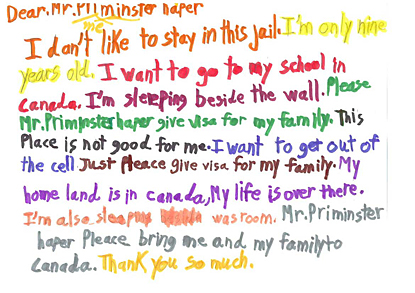
Here's a picture drawn by a nine-year old Canadian boy (or as Colorado state representative Debbie Stafford would call him, the next generation of terrorists), currently incarcerated in Hutto Prison in Texas. It's where we keep folks with immigration issues. Not crimes, usually, just administrative proceedings, but it's a prison anyway -- and one with a long record of abuse. Some of them are American citizens, who have done nothing wrong. Others are simply waiting for outstanding immigration questions (such as an amnesty application) to be resolved. It's the first time since Japanese Internment that we've imprisoned children.


UPDATE: More information about Hutto Prison can be found in this heart-wrenching New Yorker article.

One of the things that scares me about housing innocent people -- including children -- in these prisons is that the American prison system, even in its normal operations, is hardly a model of human rights enforcement. The folks operating Hutto prison, as the New Yorker article points out, have their background in guarding prisons, not social services. Brutal things happen in prison: torture officially-sanctioned rape, Abu Gharib-esque behavior -- it's well beyond what can be justified even for hardened criminals. That it may be happening to innocent children -- many who were fleeing this sort of brutality in their home countries -- terrifies me.

UPDATE #2: Since some folks are calling his parents "criminals", and blaming them for coming to the US illegally, a quick overview about this kid's case specifically. His family is from Iran, but the fled to Canada after credible threats of political persecution (the father had allowed a friend to use his print shop to make copies of The Satanic Verses). During this time, the son was born in Canada, and is a Canadian citizen. However, Canada eventually rejected their asylum application, and they were all sent back to Iran, where they were predictably tortured. They paid $20,000 to forge some documents and try again. However, their plane was grounded in Puerto Rico after a passenger had a heart attack, and a US customs official spotted their forged documents. They were told they had to make their asylum application in the US, which they proceeded to do. However, while the process was pending, they were held in Hutto Prison.

My understanding of asylum applications is that they are made after one crosses the border. There are excellent reasons for this to be so: first, I'm not sure how one would apply for asylum while still inside a country (such as Iran) that doesn't have diplomatic relations with the US, and second, even if relations did exist it'd be rather cruel to force folks to stay in a place where they have credible fears of persecution (up to and including torture) while they wait for American bureaucratic machinery to grind along its way. So they come here, and make their pitch from within our borders.

This kid's family, of course, didn't even want to come to the US in the first place (and really, after they way they've been treated, who could blame them), but asylum seekers as a class aren't going to come with visas. If they were in a position where they could wait for a visa, they probably wouldn't be needing asylum. Calling folks such as this "criminals" is an example of a malfunctioning soul.

Spitzer-fire

On NY Governor Elliot Spitzer's "links" to a recent prostitution bust, what LGM says:
# If I were in charge of writing laws, I do not believe that anyone belongs in jail for procuring or (certainly) selling sex for money, or that any criminal offense more severe than a ticket for the purchaser should be involved.

# If poor sex workers are thrown in jail under existing laws, then affluent white johns sure as hell should be too. This goes double for people who have positions that might allow them to work to repeal laws they don't feel are just

Unlike, say, David Vitter, Spitzer hasn't made a career over making one's sex life a political issue, but he has as AG broken up quite a few prostitution rings. That's hypocrisy enough for me to call him out.

Sunday, March 09, 2008

Modern Day Slaves

The U.S. Federal Court for the Southern District of Florida has agreed to hear, under the Alien Tort Statute, the case of three Cuban nationals who were trafficked by the Cuban government to Curacao and held there as slaves.
The Defendant and the Cuban government trafficked the Plaintiffs from Cuba to Curaçao under threat of physical and psychological harm including the threat of imprisonment. Upon arrival in Curaçao, the Plaintiffs' passports were taken and they were held on the grounds of the Defendant, along with scores of their compatriots. The workers were only allowed to leave those grounds under the guard of Cuban government agents. They were forced to work in slave-like conditions for 112 hours per week performing drydock services on ships and oil platforms. The pay for their work, the complaint alleges, was paid to the Cuban government. (In discovery, Defendant admitted that it credited Cuba on a debt it was owed by Cuba in exchange for the labors of the Cuban workers). The complaint alleges a situation in which the government of Curaçao was likely complicit due to the circumstances in which the Plaintiffs were transported to Curaçao and held there. Further, the Plaintiffs were denied all protections of the laws of Curaçao for injuries they suffered there, and, when any of the workers were injured or complained, they were promptly deported to Cuba and treated as enemies of the state. If they escaped and were caught, they were likewise deported to Cuba and punished. Plaintiffs, however, successfully escaped the Defendant's drydock facility, and were hunted by Defendant and agents of the Defendant within Curaçao and by the agents of the Cuban government all the way to Colombia, where they were granted political asylum. The United States then granted Plaintiffs parole to enter the United States.

In the 19th Century, slave trafficking was punishable by death. I don't support the death penalty anymore, but for greed-saturated corporations that cooperate with totalitarian regimes to acquire slave labor, it makes a tempting argument for itself.

Friday, March 07, 2008

Southern Appeal

The conservative -- but lovely -- blog Southern Appeal is back online. Yet another blogger finds that retirement does not suit them.

Welcome back, Feddie!

Boxing Blogging: 3/07/08

I'm blogging tonight's FNF, but also giving notice to one of the fights showcased by GoFightLive, which is a welcome addition to the boxing universe and lets the casual fan watch a few extra fights online they wouldn't get anywhere else.

Curtis Stevens (18-2, 13 KOs) TKO8 Thomas Reid (35-22-1, 13 KOs

This was the GoFightLive bout, and it was surprisingly entertaining. Reid is one of those guys whose fought and lost to every name in his division: Librado Andrade, Jaidon Codrington, Shaun George, Prince Badi Ajamu, Montell Griffin (twice), Lou Del Valle. He's a wily veteran who gets brought in teach young guys a few good tricks. Stevens, by contrast, is a young prospect coming off a loss to fellow up-and-comer Andre Dirrell (his only other loss was a TKO to Marcos Primera which he avenged in his next fight).

Reid made the fight interesting by dropping Stevens at the end of round two. It was one of those shots where it was clear that, had the round not been over, Reid easily could have finished Stevens off. And though Stevens steadied himself and began to take control of the fight, he was hurt again in round seven, and going into the eighth and final round, I was thinking "this could be interesting to score."

It never made it to final bell. Stevens turned on the power and blasted out Reid, having him out on his feet in the corner before the ref wisely stopped the fight.

One can be of two minds about this. On the one hand, one can worry about Stevens struggling with a guy like Reid -- someone the top guys in the 168 and 175 pound picture should be able to handle with relative ease. On the other hand, Stevens showed a lot of mental fortitude. Coming off a high profile loss, knocked down and in a shootout with a journeyman -- these are how downward career spirals start. Stevens dug deep, and came up with the late knockout -- exactly how you want to see someone in his position respond.

Both fighters, I think, earned some respect in this fight. Reid will continue to do what he's always done -- make a career out of testing rising prospects. And Stevens probably could use a few more light fights to make sure he's totally back in the game, but now he knows that he can come back from adversity, and that's huge for a young fighter working his way back up.

Jose Gonzalez (11-2-1, 9 KOs) D10 Jason LeHoullier (21-0-1, 8 KOs)

Teddy was right: this was a gift draw for the New England based LeHoullier in a New England venue. But the fight was not as lopsided as he made it out to be. Gonzalez was more active, but LeHoullier was landing the harder shots, which made for some difficult rounds to score. Ultimately, I had it 97-93 Gonzalez (in comparison to Teddy's 99-91 card). But I freely admit I leaned a bit towards LeHoullier on the close rounds -- there wasn't all that much more room to push in his direction. The judge who scored it 96-94 for the Maine native was watching another fight, or engaging in a little home town cooking.

Gonzalez fights well on the inside for a tall guy, but it still probably isn't a wise tactical move. I'm also skeptical of his ability to carry power into the 154 pound division (he started his career at light welterweight). But he's likable, with a good work rate and decent skills, so he'll do alright for himself. LeHoullier needs to work better on the inside -- he did okay tonight because against a much taller opponent he was allowed to get in with ease, but he didn't seize the opportunity with the gusto that he needed. Next up for Gonzalez is a rematch of the entertaining six round majority decision loss he received against Carson Jones earlier this year. That should be fun to watch.

Cristobal Cruz (36-11-1, 23 KOs) MD12 Thomas Mashaba (20-2-4, 12 KOs)

First, can we now agree that Cruz's dreadfully boring fight with Zahir Raheem was not his fault? I remember that fight, and I remember Atlas blaming both guys for tying up. After watching the whirlwind activity of Cruz tonight against Mashaba (he set a divisional record for most punches thrown), I think it's clear that if anything is stopping the action, it's not him.

Second, what does Teddy Atlas have against Cristobal Cruz? In the last fight, he unfairly blamed him for the dullness. In this fight, he was starting to make murmurs around round 10 about how the fight should be stopped. Now, to be fair, Cruz is a guy who comes full steam ahead and leaves himself wide open to get hit. And hit he was. But he hit Mashaba more! One can make the case that Mashaba was landing the harder shots, but Cruz was landing plenty of excellent punches, and far more of them. The thing about Cruz is, even though he has no defense, he throws so much that short of getting into a hug-fest like Raheem did, it's difficult not to simply be overwhelmed.

Based on his activity during the second half of the fight, I gave Cruz the decision by one point -- an upset victory I think he earned. But you'd never know it by listening to Atlas (who I normally think is right on the money).

Cruz has been fighting since he was 14(!), and has lived the life of a tough, hard-scrabbled journeyman. This victory gave him the IBO Featherweight Title -- a great achievement for a game, hard-working fighter.

Power Resigns

Samantha Power has resigned from Obama's campaign after she called Hillary Clinton "a monster" in an interview with The Scotsman.

It's disappointing that she's leaving, but it was also the right thing to do. Hillary Clinton, though I do not support her over Obama, is no monster. These types of attacks cannot and should not be tolerated, and she had to go. MSNBC has her statement:
“With deep regret, I am resigning from my role as an advisor the Obama campaign effective today,” Power said in a statement released by the campaign. “Last Monday, I made inexcusable remarks that are at marked variance from my oft-stated admiration for Senator Clinton and from the spirit, tenor, and purpose of the Obama campaign. And I extend my deepest apologies to Senator Clinton, Senator Obama, and the remarkable team I have worked with over these long 14 months.”

Hopefully, after some time in the cold and some penance, she can make her way back.

Thursday, March 06, 2008

Note To Self: Don't Enroll at IUPUI

I may at some point have told the story of my self-consciousness when reading books about Critical Race Theory in public spaces. It's not as bad as it used to be, but I was always afraid that, to the uninformed observer, it will look like a racist tract. So I covered the title with my hand, and if I was asked what I was reading, I'd answer
"Critical Race Theory: An Introduction. It's kind of a cutting edge, progressive theory on ending racism in the United States.

The second part, of course, is meant to be the crucial check -- I'm assuring folks it's not the latest brochure from the Knights of the White Camellia.

But in my scariest nightmares, the worst I imagined was I'd get a glare or a hostile encounter. I never thought I might get tagged with racial harassment for reading a book opposed to racism. But Paul Secunda at Concurring Opinions tells us that it appears to be what happened at IUPUI, where an employee (and student) was disciplined for reading a book entitled Notre Dame vs. the Klan: How the Fighting Irish Defeated the Ku Klux Klan.
First, a shop steward told Sampson that reading a book about the KKK was like bringing pornography to work (apparently this holds true in his eyes regardless of the context in which a book discusses the KKK, the position it takes, and so on). Likewise, a co-worker who happened to be sitting across the table from Sampson in the break room remarked that she found the KKK offensive. On both occasions, Sampson tried to explain what the book was really about. Both times, the other individual refused to listen.

A few weeks later, Sampson was notified by Marguerite Watkins of the school's Affirmative Action Office (AAO) that a co-worker had filed a racial harassment complaint against him for reading the book in the break room. Once again, he attempted to explain the book's content, but Watkins too had no interest in hearing it. Despite his not being given a chance to defend himself, he subsequently received a letter from Lillian Charleston of the AAO, dated November 25, 2007, informing him that AAO had completed its investigation of the matter. The letter stated,
You demonstrated disdain and insensitivity to your coworkers who repeatedly requested that you refrain from reading the book which has such an inflammatory and offensive topic in their presence...you used extremely poor judgment by insisting on openly reading the book related to a historically and racially abhorrent subject in the presence of your Black coworkers.

It went on to say that according to "the legal 'reasonable person standard,' a majority of adults are aware of and understand how repugnant the KKK is to African-Americans..." As a result of AAO's findings, Sampson was ordered to refrain from reading the book in the immediate presence of his co-workers and to sit apart from them whenever reading it.

In the comments at CC, Michael Manister notes how the particular nexus of laws in play here -- mixed with legal precedent decimating employee free speech rights -- makes a suit by the employee nearly impossible to pull off. Because of that, Howard Wasserman argues that the incentive structure of anti-discrimination law pushes the university to act in this way specifically because the sanction employee is in a weaker position and likely can't fire back.

It appears that the University has now walked its position back (sort of), but in a way that still leaves open the chance for serious abuse. Just a stupid situation by the university.

Proving the Point

Oppressive regimes are ruled by (to use an all too crude term) douchebags. One of the ways we know this is that if their charges dare call them such, they are punished and repressed for their temerity.

Right now, the 2nd Circuit is hearing a student speech case out of Connecticut, Doninger v. Niehoff. Mitchell Rubenstein summarizes the case as follows:
A Connecticut High School Student used vulgar slang on an Internet blog which was sent from her personal computer while at home. Specifically, she criticized the administration by saying "Jamfest is canceled due to douchebags in central office." The school, in turn, refused to allow plaintiff to run for re-election as class secretary. She then won with write in ballots, but was not allowed to serve.

This, of course, seems to validate the student's original assertion, but whatever. It's fantastically frightening to me that schools think they can assert this much influence over their student's private speech, in their own home. It's frankly authoritarian, and the message of disrespect it sends to the student body far exceeds what the student did in the first place.

Texans are Idiots

They made their caucus reporting scheme voluntary! Apparently, we're not likely to see any more results.

Can I bang my head on the desk, pleases?

Wednesday, March 05, 2008

Gunner Student

In the wake of the school shootings at NIU and Virginia Tech, some states are considering laws which would allow more guns on campus, the theory being an armed populace could intercept shooters. I think anyone who's observed drunk football players at a party knows why it's a bad thing to put guns in their hands, so count me opposed.

Anyway, some of the laws would give the gun rights to just faculty, others faculty and students. However, Daniel Drezner observes that in Oklahoma, only the students will have the right to carry arms, thus giving a whole new meaning to the "gunner" in class.

Latecomers

For those of y'all who have been through the law and graduate school process, I have a question for you.

As you might already know, I applied to 20 programs -- 9 law, 11 Ph.D. Of those, I have as of today heard back from 12 (6 law, 6 Ph.D). We're entering March now -- getting towards the end of the process.

My thought process thus far regarding the late places has been essentially that I am, in some ways, a difficult candidate. My test scores place me a good bracket or so higher than my GPA does -- in fact, for the remaining law schools, my GPA is well below their admitted 25th percentile while my LSAT scores are comfortably above their 75th. My non-numerical profile is strong, but not invincible -- I can see how it'd be really appealing, and I can see how it'd be run of the mill. So, I assumed, the delay was simply that I'm a tough choice, and they're putting it off.

Now I'm wondering if there isn't a more mundane explanation: schools are simply not in as big of a hurry to get back to those they rejected (or, to be more charitable, they are less excited to reject folks than they are to accept them). This is, to some extent, anecdotal -- I started the process off red-hot, but four of the last six decisions I've received have been denials. That could be explained by lots of things or nothing or paranoia on my part. And I want to stress that the places I have been admitted to are fantastic programs -- I am in a great situation even if I don't get into a single other school.

But I do wonder -- do programs still admit folks this late? Or is what I see all I've got? I just don't want to put off thinking about where I should go next year in the vain hope that I still have a chance in the tardy schools.

Advice appreciated.

Tuesday, March 04, 2008

Heartfelt Lines, Housing, and Superobligations

Against my better judgment, I want to return to the topic of the "line through the heart" -- Mark Olson's beloved quote on what it means to be moral which I explored a bit in a post last week. Today, I want to talk about it specifically in the context of housing segregation and the effect it has on Black Americans, and generally in the context of "superobligations."

First, some background. There exists a massive wealth (net worth) disparity between Blacks and Whites in America today. Net worth is simply the value of all the things you own subtracted by all your debts. On average, Whites have 8x the net worth of Black Americans, and this disparity has actually risen since the Civil Rights movement of the 1960s. The wealth disparity holds true even for people of similar educational backgrounds, as well as for people of similar income levels. The primary cause of this is rather simple: housing. Most Americans' wealth is in their home. That's a huge nest egg for people.

Historically, the avenues of home ownership were closed to Blacks. The big influx of individual home ownership occurred after WWII with the Federal Housing Administration, which greatly reduced the barriers to buying a home and made it affordable, for the first time, for the average working family. But the FHA explicitly encouraged developers to a) forbid racial integration in the new suburban communities and b) only give out loans to White communities. "Red-lining" meant that Blacks were effectively shut out of the post-war home boom, and instead were shunted into inner city public housing. These barriers, of course, were specifically race-based -- with localized exceptions, Whites of all national backgrounds were able to partake in the bounty relatively freely.

After the FHA dropped its opposition to integration per se in the 1950s, real estate agents developed a new tactic called "block busting." As Black families moved into a neighborhood, developers preyed on racial fears to get White owners to sell their homes way below market value, then resold the homes to Black residents. This exerted significant downward pressure on real estate prices, which developers used to influence more Whites to leave, telling them that their home values were only going to plummet further if they stayed. As people observed this spectacle in the communities around them, it created a panic: even one Black family moving into a neighborhood would instigate a torrent of "for sale" signs, as every White family tried to get out before the bottom fell out of the market. "White flight" was the name of the game, and the turnover of a neighborhood from Black to White could be frighteningly quick: Law professor Patricia Williams recalls moving to a mostly White Boston suburb that -- within a year of her move -- became nearly all Black.

The upshot of this was to utterly wreck the ability of Black families to build equity through real estate. Of course, there is the simple fact that they simply haven't had the equal opportunity to own houses for as long and couldn't transfer the corresponding wealth generationally. But beyond that, as soon as a Black family was able to grab that piece of the suburban dream, they were cut off at the knees -- their home investment foundered as demand for the neighborhood plummeted and the value of their home collapsed around them. And it essentially never came back: homes which are "in demand" by, at most, 20% of the market (non-Whites) are never going to have the same value as neighborhoods in which everyone wants to live. Consequently, the cycle has been set: Homes in Black areas are worth less than those in White ones, and because of this the presence of more than a marginal population of Black families rapidly causes a neighborhood to "tip" and White families to flee (crushing the equity of Black families all over again).

This is all a preface for a broader discussion I want to have about morality and individuals. The mechanics of housing segregation, "voluntary" or not, are perhaps the element that perpetuates racial inequality in America. By placing a high wall between millions of Americans and equal opportunity, it is one of the great evils of our society. But in the aforementioned story, no individual White family is at fault. Many of the White families who engaged in White flight, when interviewed, said that they didn't have a problem with integration per se, they just couldn't afford to stay in a house whose real estate value was about to collapse. Asking people to sacrifice their own nest egg, their own financial security, their own family for the sake of others is what's known as a superobligation. A superobligation is something that we would praise someone for doing, that would unquestionably make the world a better place, but is above and beyond what we can legitimately ask of the average person (falling on a hand grenade is a good example). J.O. Urmson further explains:
If we are to exact basic duties...and censure failures, such duties must be, in ordinary circumstances, within the capacity of the ordinary man. It would be silly for us to say to ourselves, our children and our fellow men, 'this and that you and everyone else must do,' if the acts in question are such that manifestly few could bring themselves to do them, though we may ourselves resolve to try to be of that few....So, if we were to represent the heroic act of sacrificing one's life for one's comrades as a basic duty, the effect would be to lower the degree of urgency and stringency that the notion of duty does in fact posses. The basic moral code must not be in part too far beyond the capacity of the ordinary men or ordinary occasions, or a general breakdown of compliance with the moral code would be an inevitable consequence; duty would seem to be something high and unattainable, and not for 'the likes of us.' [J.O. Urmson, "Saints and Heroes," in Essays in Moral Philosophy, edited by A. Melden. (Seattle: University of Washington Press, 1958), 211-212.]

From my standpoint, I do not find individualism a useful lens for analyzing housing segregation. The families in question are not "evil", they are not doing anything but trying to make sure that they have a financially secure base from which to raise their families. Rather, the problem -- the evil -- is structural: it's about the systematic incentives White people have to live in predominantly White neighborhoods. The problem is systemic, and the solution should similarly be systemic -- we should switch the structure so that Whites have an incentive to live with people of color. One solution I've heard which I don't like would be to eliminate the tax write-off for mortgages for any homes that are not in neighborhoods with at least a 30% population of color. Another solution I've heard which I like a lot better is for universities to start offering affirmative action to students of all racial backgrounds who attend diverse schools (or at least schools that are not overwhelmingly White).

But these solutions only make sense because they separate the evil of housing segregation from individual action. If we're talking solely about the "line through the heart", the case becomes murkier, and we have two options. On the one hand, we can say that because each family is individually innocent, there is no moral question here. The line through their heart was not implicated, they bear no guilt. Under this paradigm, the question of housing segregation is rendered beyond the pale of moral discourse entirely. Convenient for the people who are comfortable in the current arrangement, perhaps, but hardly satisfactory for those who are trapped outside the gates of wealth. I simply don't accept that there is no moral element to a system which consigns millions of Americans to never experience true financial security.

The second option is to swing wildly in the other direction. All this stuff about "reasonable expectations" and "I had to protect my family" -- these are irrelevant. You had a choice. The line is through your heart, and you chose to live in predominantly White areas, and you chose to move if the neighborhood got too Black for you. Would staying in Roosevelt, NY have creamed you financially? Well, guess what -- that's the prospect Black Americans face every day. Under this view, we essentially demand the superobligation. And hence, any White person who lives in a predominantly White community -- regardless of the motive, reason, or circumstance -- by contributing to problem, is to be regarded as consciously choosing the evil. The line is through their heart, after all, and they made choices which perpetuate the evil of racial inequality indefinitely.

As I said, I don't find either scenario compelling, because I don't think we should force ourselves into the individualism box at all costs. But if we do so, if we can only conceptualize evil as running through the hearts of men and having no other arteries or thoroughfares, this is the choice we're left with: Total absolution, or complete damnation.

Monday, March 03, 2008

Distinctively David

It's been a tumultuous few months, and we're not quite out of the woods yet, but I can see light at the end of the tunnel. Most notably, today I presented and defended my senior thesis (you might be familiar with it). As of today, I will officially graduate Carleton College with distinction in Political Science.*

This was a big time commitment. And while I still have the normal coursework and final papers for this term to do, getting this done will free up a lot of mental energy. Hopefully, you'll see me back around these parts soon enough -- at least until I dedicate myself full time to visiting grad programs.

* Carleton gives the typical Latin honors based on cumulative GPA, and individual departments have the discretion to award "distinction" to their denizens based on criteria which vary from department to department.

Friday, February 29, 2008

Disaster

This does strike me as one of those things that will never end well. The Telegraph reportsthat:
A senior Israeli politician provoked controversy today when he warned that Palestinians firing rockets from Gaza would be punished with a "bigger holocaust" from Israeli armed forces. The use of the Hebrew word for holocaust, "shoah", tends to be used exclusively in Israel to describe the Nazi persecution of Jews.

But this isn't accurate. "Shoah" means "disaster". "Ha-shoah" means "the disaster", which is shorthand for The Holocaust (which is "the disaster"), but Shoah alone is just a word, and in this context the proper translation is that Gazan rocket fire would be met with a "bigger disaster" for the Palestinians. Not exactly hearts and flowers, but pretty standard tit-for-tat military rhetoric.

Of course, now that the narrative is out there, it will never die, and we'll be treated to innumerable books and articles saying that Israel threatened to reprise the Holocaust on Palestine.

Identification, Please

Thank you Ann Friedman:
It's high time we acknowledge that every candidate has an identity: a race, a gender, a cultural background. It may not make or break every voter's decision, but a candidate's identity is always an electoral factor -- even when that identity is white and male. Clinton's female supporters and Obama's black supporters don't get enough credit. They are making tough decisions on how to reconcile their political beliefs with their gut reactions upon seeing someone who looks like them up on the dais. In fact, all Democratic voters are wrestling with this. Very few Americans have ever had the opportunity to vote for anyone other than a white man for national office. After so many years with "white male" as the default political identity, we're all suddenly forced to think about how much a candidate's race, gender, and background should matter.

Let's make this election about the issues, everyone says -- and rightfully so. Our presidential nominee should be chosen primarily on the issues. But most of us don't separate issues from identity as cleanly as we'd like to believe. When it comes down to it, everyone is an "identity politics" voter. The problem is that phrase, as commonly used by right-wingers and some on the left who are tone-deaf on issues of race and gender, has the effect of cutting down the political choices and involvement of women, people of color, and gays and lesbians.

After all, Clinton and Obama and their supporters aren't playing "identity politics" any more than John Kerry's supporters did in 2004, or George W. Bush's did in 2000. It's absurd to suggest that the Andover-Yale-Harvard-bred Bush adopting a swagger and thickening his Texas accent, or John Kerry riding a borrowed Harley onto The Tonight Show set, was anything other than identity politics. And after several early primaries, as it became clear that white men most strongly supported John Edwards, nobody accused them of playing identity politics. Nope, that distinction is reserved for people who have historically not been in positions of political power. In short, you can't be a white guy voting for another white guy and still play the identity game.

See also me, back in November, on this same issue.

Thursday, February 28, 2008

Mirror of Mirror of Justice

In the latest addition to the blog arena, Less Than The Least has emerged as the handiwork of Bill Stuntz and David Skeel. The description runs as follows:
We are both law professors and evangelical Protestants – a weird combination in our time. We hope it’s also an interesting combination. We plan to write about the things that interest us, professionally and personally: crime and criminal justice (Stuntz), corporate governance, credit, and bankruptcy (Skeel), the culture wars, politics, literature and the arts, and other topics.

Of course, it isn't a precise analogue to the Catholic Legal Theory blog Mirror of Justice. But anyone who's read MoJ wouldn't turn down the compliment, and I happen to know that Stuntz, at least, is a pretty cool guy (Skeel I simply don't know).

So welcome!

Less Black Babies

I spend a lot of free time blasting the FRC, often for concocting phony-scandals, so credit where it's due: this is genuinely appalling. I was at first hesitant to give a link, because I frankly don't trust the FRC further than I can throw them, but mainstream press (in the form of the Idaho Statesman) has picked it up, so tragically, this looks real. Basically, a pro-life activist masqueraded as a donor who wanted to give a gift to Planned Parenthood of Idaho, earmarked for the specific purpose of aborting Black babies.
The call to Idaho came in July to Autumn Kersey, vice president of development and marketing for Planned Parenthood of Idaho.

On the recording provided by The Advocate, an actor portraying a donor said he wanted his money used to eliminate black unborn children because "the less black kids out there the better."

Kersey laughed nervously and said: "Understandable, understandable. ... Excuse my hesitation, this is the first time I've had a donor call and make this kind of request, so I'm excited and want to make sure I don't leave anything out."

This is, in a word, appalling. It's flagrantly racist, and Planned Parenthood should be ashamed. As Feministing notes, it plays right into the right-wing talking points about race and abortion. PP refuses to say whether it's taken any further action against the offending employee. Is there seriously any question over whether he should still have a job?

It's Still Wrong, Paul

One of Paul Mirengoff's recent pet projects is viciously smearing Obama foreign policy adviser Samantha Powers. In the wake of no less of a conservative voice than Max Boot telling Mirengoff-source Noah Pollack to chill, Paul hesitated a half-step before reiterating the same bogus claims he's forwarded the last several go-arounds.

The first two points of contention -- the ones Power now describes as "weird" -- came out of a 2002 interview where she was asked about the Israeli/Palestine situation. Here's her quote:
Putting something on the line might mean alienating a domestic constituency of tremendous political and financial import; it may more crucially mean sacrificing -- or investing, I think, more than sacrificing -- billions of dollars, not in servicing Israel's military, but actually investing in the new state of Palestine, in investing the billions of dollars it would probably take, also, to support what will have to be a mammoth protection force, not of the old Rwanda kind, but a meaningful military presence.

Paul says that this shows that she wants to invade Israel and cut off all funding to its military.

I have two jabs and a haymaker here. My right jab is that, as Boot himself notes, many Israelis would be pleased if a NATO protection force was available to actually protect them from Palestinian intrusions. It'll never happen, because the international community will never put its own bodies on the line to protect Jews, but Power takes seriously at least as a moral matter this obligation to protect. My left jab is simply that Power is not saying we should cut Israel's military aid. She's saying that we should invest billions in creating a Palestinian state, as opposed to simply beefing up Israel's security yet more. I read her statement as saying we need to do both -- sure, Israel needs to be secure, but that's not going to fix the problem short- or long-term. Long-term, we need to invest in state building, not in giving Israel the option to occupy indefinitely.

But here's the haymaker: Look at the question she was asked!
Let me give you a thought experiment here, and it is the following: without addressing the Palestine - Israel problem, let's say you were an advisor to the President of the United States, how would you respond to current events there? Would you advise him to put a structure in place to monitor that situation, at least if one party or another [starts] looking like they might be moving toward genocide?

Notice anything peculiar? Like, say, the the last clause? If a genocide breaks out, then damn straight I think an international military presence should move in on the scene, and I don't care whether its the Israelis, Palestinians, Iranians, or Sudanese perpetuating the slaughter. This may be why Power finds this whole discussion "weird" -- aside from the most fervent anti-Zionist contingent, it's weird to think of Israel suddenly engaging in genocidal rampage. If Paul's point is that even in the face of genocide we should leave the Israelis (or Palestinians, for that matter) be, then I think we depart company, and he departs civilized company.

The second set of allegations stem from a 2007 interview where Power is accused of saying that Israel is responsible for the war in Iraq. This is maliciously false, as demonstrated by looking at the full text of the question and answer, where she says nothing of the sort, although if you cherry-pick the parts where she talks about Iraq and Israel, and omit the parts where she talks about broader structural forces these are examples of (along with Halliburton, which is the clearer link to Iraq), maybe it can look that way. This is not a matter of interpretation. This is a matter of Paul Mirengoff lying through his teeth without the slightest sense of guilt about it.

The final two cases are Power quoted a UN leader calling Israelis "bastards" without, apparently, swearing to personally desecrate his grave for it, and Power wondering why, if the New York Times believed there were war crimes in Jenin (and she doesn't say who committed then), why didn't the NYT lead with that as its headline? The last one doesn't come with any link to original source material, which is something Paul's friends have played fast and loose with before. But in any event, this is thin gruel for Mirengoff to say someone is reviving "the blood libel", but there you go.

Concludes Paul: "To me, it seems clear that, collectively, these positions overwhelmingly show Power to be anti-Israel."

Concludes me: "To me, it seems clear that, collectively, these statements overwhelmingly show Mirengoff to be a party hack who is willing to lie without compunction."

That's It! You're All Going to Jail!

The New York Times reports that the US has crossed a wonderful threshold: more than 1 in every 100 American adults is in prison. Crooked Timber links to another paper showing that:
in the cohort born between 1965 and 1969, thirty percent of black men without a college education—and sixty percent of black men without a high school degree—had been incarcerated by 1999. Recent cohorts of black men were more likely to have prison records (22.4 percent) than military records (17.4 percent) or bachelor’s degrees (12.5 percent).

Could there be...racism? No...Black people are just morally defective!

And the land...of the "free"....

Also of interest: The VC has a line graph up on the amount of people put in either prison or mental institutions from 1934 to the present day. Up through the 1960s, mental institutions dwarfed prisons. But starting around 1970, the amount of people held in mental institutions crashed, and prison populations began to skyrocket starting in the 1980s, such that the relative proportions are nearly completely reversed from where they were in 1934.

Part of this, of course, is that we've gotten better at diagnosing and treating mental illnesses so that they don't require institutionalization (or that they're not mental illnesses at all). But part of it is probably that people who do have mental illnesses are being shuttled off into prison instead of getting the care that they need.

"Every Lecture Has a Lie"

This is actually a fascinating pedagogical model, though I can't imagine I'd have the stones to do it in my own classrooms.

Wednesday, February 27, 2008

D&G Wear Combat Boots

This is one of the more bizarre articles I've read in a long time. It's like reading a Tom Clancy novel mixed with a policy debate round.

Tuesday, February 26, 2008

Who Needs To Watch?

When I was at UVA this weekend, one of the folks I met asked why I don't watch the Presidential debates. I said simply that I find them dull affairs, like dueling press conferences, and if anything important happened I'd see on the blogs. So why waste my time?

For example, what possibly could top Daniel Drezner's live blogging of the debate tonight?
10:08 PM: Russert tells Obama, "You have to react to unexpected events in this campaign." I half-expect him to then leap over the table, stab Obama with a shiv, and then say, "like that!!"

Anyone else with debate comments, leave 'em below the fold.

Maybe They Know Something We Don't

How horrible am I for finding this comic hilarious? Answer: pretty horrible.

Collective "Punishment"

George Mason University law professor Michael Krauss takes issue with the claim that Israel's economic sanctions on Gaza constitute collective punishment. He notes that, unlike the classic examples of collective punishment (Nazis massacring entire villages for resistance activities), Israel's alleged crime is merely that refuses to trade with its enemy. If Canada was lobbing missiles onto Buffalo, would we still have to send them cars from Detroit?

Close, but no cigar. While I certainly don't think Israel's actions rise to the level of Nazi barbarism, or close to it, my understanding is that Israel -- as an occupying power -- has special obligations towards Gaza compared to that of two unrelated belligerents. The closer analogy would be the US refusing to trade with Puerto Rico due to violent separatist activity in that state.

Electricity is a legitimate military target though, and as Krauss notes, Israel is merely restricting the flow of juice, not cutting it off, so that "Hamas will have to decide whether to provide electricity to hospitals or weapons lathes." That might be a legitimate move, except we all know Hamas' counter: give it to militants, then film sick kids outside of hospitals to showcase Israel's horrific cruelty. Who wins this battle? Usually not Israel.

In general, I don't think law or even morality is exhaustive of wisdom: one can make a legal or moral decision that isn't necessarily the best one. Israel has to ask itself whether the marginal (if present at all) boost in safety is actually getting them any closer to a long term solution to the conflict. I'm not convinced that it is.

Expanding Pro-Israel

In a meeting with Ohio Jewish leaders, Barack Obama argued that one can be pro-Israel without adhering to a specific right-wing vision of what Israel's future should look like:
"I think there is a strain within the pro-Israel community that says unless you adopt an unwavering pro-Likud ap-proach to Israel, then you're anti-Israel, and that can't be the measure of our friendship with Israel," leading Democratic presidential contender Illinois Senator Barack Obama said Sunday.

"If we cannot have an honest dialogue about how do we achieve these goals, then we're not going to make progress," he said.

He also criticized the notion that anyone who asks tough questions about advancing the peace process or tries to secure Israel by anyway other than "just crushing the opposition" is being "soft or anti-Israel."

Matthew Yglesias says "music to my ears", and Spencer Ackerman adds:
Now that is the sort of thing that a real friend of Israel says. Not a fair-weather fake friend who'd rather not risk angering your buddies, but the kind of friend who takes your car keys from your hand at the bar. Let's see the Rubins of the world twist his words, so we can demonstrate how little they actually care about the actually-existing state of Israel.

Agreed. One of the things I've tried to stress recently on the Israeli/Palestinian question is that it's not "pro-Israel" to envision it in perpetual, apocalyptic conflict with its neighbors. Jews die when Americans (usually American Christians) use Israel to reenact their favorite Crusade. And whatever else my personal religious or cultural beliefs regarding my obligation as a Jew toward the land of Israel entail, positioning myself as a tyrannical occupier depriving people of self-determination is not part of that vision.

None of this, obviously, is to say that I think Israel is the root cause of all evil in the region, or that Palestinians do not possess a major chunk of the blame for their own predicament by indulging in maximalist demands (including the destruction of Israel) and constant terrorist assaults. But I do think it's important to reiterate that there is no long term solution to the conflict that doesn't provide both people with a stable, secure, productive state, and that any move towards peace necessarily entails risk. "Crush them" can't always be the option of choice if things are to move forward, and it will take an American President who a) makes both sides understand that and b) makes both side understand that if one party exploits that trust, the US will not tolerate it, to really see progress on the issue.

Monday, February 25, 2008

Pop Culture, Then and Now

Herbert Spencer: The Britney Spears of the 1900s.

You Go To The Polls With Electoral System You Have

...not the one you wish you had. Ralph Nader supporters need to remember that, when they get on their kick of "if we only had instant run-offs, Nader wouldn't throw the election to anyone, so it's not his fault that he's vanity runs are threatening more years of GOP domination."

Sunday, February 24, 2008

Of Fugitive Slaves, Gay Rights, and The Line Through My Heart

The latest salvo in my and Mark's ongoing debate on questions of race focused specifically on whether states qua states should apologize for past moral atrocities (slavery, Jim Crow, the "lost generation", Native American genocide, the Holocaust, etc.). I argued that insofar as state actors are often instrumental in the promulgation and implementation of these atrocities, the state bears a share of the responsibility for which it must atone for. This is especially true when the victims conceptualize the wrongdoing as emanating from (at least in significant part) the state, as oppose to disorganized or irregular individuals (as in all four of the examples I mentioned above). Moreover, governmental sanction channels, directs, and legitimates power and violence. I can't sentence a person to jail no matter how snappy a black robe I buy, and I can't keep them there just because I own a natty blue uniform. It is the weight of governmental authority, in the form of a judge or a police officer, that grants me such authority. Indeed, this imprimatur transfers moral authority beyond our own personal knowledge and experience. A prison guard doesn't "know" that his wards deserve to be locked up -- he conducted no fact-finding mission, he held no trial. Yet he is morally allowed to imprison them (through threat of violence) because another governmental actor (a judge) tells him that this one committed murder, that one treason, that one robbery. That transfer of knowledge is only considered legitimate because it is governmental -- if a random person off the street points out a pedestrian and says "he's a murderer", the moral authority does not carry.

Mark responded that states are really just "phantasms", mere collections of individuals, and that there is no absolution or even relevancy in that "the state" (which, Mark would argue, is actually just individual legislators, bureaucrats, judges, etc.) is urging you to kill the Jews. He put forth, once again, his beloved quote by Solzhenitsyn about how the line between good and evil is drawn through every human heart. "[I]t is every human heart," Mark writes, "that needs to repent for things done, not those heartless state organs."

Unfortunately, I had to drop the thread while I was traveling to Virginia. I still think that it is more than obvious that the state in its own right creates power that did not exist before, which is why Judge John Anderson in chambers can sentence me to prison (and the guard will listen) but Mr. John Anderson on the street cannot. But I want to pick up this discussion of state relevancy, and the idea that the only thing that matters is the line through the heart, because I think it will lead to some positions Mark will be quite uncomfortable with.

The one of the main works of the late, great Robert Cover was an exploration of how Northern, anti-slavery judges reacted when they were asked to enforce the Fugitive Slave Act. The Fugitive Slave Act, I think we'd all agree, is an unambiguously monstrous law. It also, at least as far as lower court judges were concerned, was almost definitely constitutional under Article IV, Section 2 of the constitution. What does Mark think that these judges -- in their capacity as judges -- should have done?

One answer is to simply refuse to enforce the law. The law is evil, even if (in the words of Mark Graber) it is a "constitutional evil", and ultimately they must be guided by that line through their heart. If government demands evil, government must yield.

But let's take that idea and apply it to the modern day. I don't know Mark's position on Lawrence v. Texas (which outlawed prohibitions on sodomy in America). I suspect, however, that he does not believe that there is a constitutional right to gay marriage. For my part, laying the legal question aside, I find laws which prohibit gay marriage to be profoundly, monstrously evil. Not evil on the scope of slavery, but comparable to laws prohibiting inter-racial marriage, with the difference being only that of the number of people affected. Many people agree with me. Many people disagree with me quite profoundly -- they find the prospect of gay marriage to be that which is evil. Were I a federal court judge, would Mark advise that I push the legal questions aside and decide a prospective gay marriage case solely based on the "line through my heart" (which would lead me to invalidate the prohibition with extreme prejudice)? What of my colleagues who believe the reverse, and would prohibit gay marriage regardless of law if they follow their own line? Is Mark willing to allow for this sort of legal anarchy? And we could observe this same paradox in other cases -- most notably abortion -- where advocates on both sides see the alternative universe as being not just "wrong" but utterly and profoundly evil.

Of course, the prevailing rhetoric out of the right points in the precise opposite direction. They are outspokenly opposed to deciding cases based on the judge's personal moral precepts. Apply the law, don't make the law. Don't legislate from the bench. Don't impose your agenda on society. Mark has seemed to buy into this theory as presented by Scalia before, albeit more in the context of "dumb" laws than of evil ones (but then, I truly consider the laws at stake in Lawrence, to which he and Scalia were referring, to be evil, not stupid). And yet, as far as I can tell, from Mark's perspective this is letting the mechanics of government supersede the line through my heart. The legislature, the polls, the laws, the precedent, the constitution -- these are all the work of people. They have no special hold on me. Their power is phantasmic. And insofar as they point me towards the evil of anti-gay discrimination, I should simply ignore them.

But I do believe that I-as-a-judge have some obligation to the government, of fidelity to my position. It is a fidelity with limits, but it does exist, it is not a phantasm, and at times it will force me to write decisions I think are at odds with my vision of a moral society. And it is because of that, that I do not believe we can simply push away the question of governmental responsibility. The line may be through my heart, but government can influence the stroke of the pen. At the very least, governments know that their status as government is almost assured to alter the course of history. That's power. Power can be abused. And abuses require apologies and atonement.