Showing posts with label Whites. Show all posts

Sunday, December 03, 2023

The Baggage of Whiteness


There's a new essay being passed around by Megan Wachspress on "The 'New Antisemitism and the Logic of Whiteness." As one might imagine,* I have thoughts. The essay raises some interesting and useful points; it isn't bad by any means. But I do think its core hypothesis is not just wrong, but actually backwards. 

Wachspress argues that the panic amongst young Jews on campus stems from "the unconscious recognition that American Jews’ contingent whiteness may be threatened if 'the Jewish state' becomes a means by which other white people can disavow their own complicity in European colonialism," and that the Jewish response seeking safety from these emergent campus phenomena represents an effort to "double down" on their White status.

The notion that Israel is "a means by which other white people can disavow complicity" is, I think, an important one. But I don't think the Jewish response is aptly characterized as an effort to cleave to besieged Whiteness. Jews right now aren't worried about losing their White status, and they're certainly not trying to "double down" on it. To the contrary, they're worried that they're going to be left holding the bag for Whiteness.

To some extent, the wrongness of characterizing the Jewish call for safety as a plea to have their Whiteness respected is obvious -- it's hard to imagine a slogan less likely to be effective on contemporary college campuses than that one. But more to the point, what Jews are seeking to emphasize right now isn't "we're just like you" assimilation into dominant modes of discourse; they're emphasizing points of differentiation and separation, and asking for those to be respected and acknowledged -- to understand Israel and Zionism as Jewish categories, not "White" ones. To "double down" on Whiteness would not assist the campaign of campus Jews, it thwarts it.

To be clear, there absolutely are important ways in which American Jews are implicated into Whiteness -- in my essay, I reject both the simplistic notion that Jews are naught but White as well as the view that Jews are inherently and eternally non-White. I'm not here to endorse the slipshod view one sometimes sees asserting that it's wrong or antisemitic to ever identify a Jew with Whiteness. But with respect to the particular dynamics that Wachspress is analyzing, I do think more of the pressure she identifies is emanating from "over-Whiteneing" Jews compared to "under-Whitening" us.

Far from seeking inclusion under the umbrella of Whiteness and finding ourselves unceremoniously tossed out, what's happening on campuses today is that Jews are seeking to distinguish ourselves from Whiteness but are being involuntarily conscripted in. The very mechanism Wachspress talks about -- the utility of "'the Jewish state' [as] a means by which other white people can disavow their own complicity in European colonialism", an opportunity for young people to "work[] through their own discomfort with whiteness" -- only works if "the Jewish state" is categorized as a White one. Far from doubling down on Whiteness, Jews are being locked into it; ironically by other very-much-unconditionally White folk who are seeking to displace their Whiteness onto Jews. Jews aren't at risk of losing our Whiteness right now, because non-Jewish Whites need us to be White more than ever. They need us to be White so they can transcend their own Whiteness.

But even this, I think, is only part of the story. I've never met a progressive White person who holds any affinity for their identity as White. To be clear, they may hold quite a bit of affinity for their White privilege. But to be identified as White holds no positive valence for them -- there's no "White" traditions that they wish to pass down to the next generation, no "White" holidays they fondly reminiscence about celebrating. "Whiteness" holds no meaning for them other than as a repository of privilege. At most, there is a sort of a contingent pride in "acknowledging their Whiteness" as an awareness of their social positionality, the pride in not indulging in denialism surrounding their implication in White supremacist systems. But this is quite obviously a very different sort of "pride" than one might have in being, say, "Irish", or "Norwegian", or "Black", or -- at least in theory -- "Jewish". It's not pride in the substantive identity of Whiteness as something worth cheering and preserving; it's pride in recognizing a sometimes-obscured wrong and being committed to rectifying it.

This logic undergirds those who've argued for "abolishing Whiteness" -- as an identity, Whiteness lacks substantive content aside from its status as an organization point for unjust privilege. So the only thing that those raced-as-White would miss if "Whiteness" went away would be those privileges, and since those privileges have no right to exist, there's no legitimate loss in eliminating Whiteness altogether. Norwegian, Irish, French -- these at least conceptually have some genuine cultural content that isn't solely about domination and hierarchy, so why not revert to those registers and let Whiteness wither? And in a different register, the lack of affinity towards "Whiteness" as an identity is what buttresses many White people's support for radical colorblindness: they don't care any which way about being identified as "White" (the identity); they just want to keep the privileges. So if they can jettison the identity ("I'm just a person") while preserving all the privileges that Whiteness historically offered, that's a cost-free deal.

For Jews, though, things may be different. Notice, first of all, that the conscription of Jewish into White is not operating in the same way as it does for, say "Irish", where the ethnic identity demarcates the proper place to retreat to after the racial identity is abandoned. Irish may be associated with Whiteness, but Irish isn't conflated into whiteness; one might or might not characterize Ireland as a "white supremacist state" because of this or that policy, but I don't think it's common to say that the very concept of an Irish state is "white supremacist" by definition. By contrast, for Jews the "retreat" into the particular Jewish identity is taken to be the problem; paradoxically, it is taken to represent an embrace of Whiteness rather than a means of distinguishing oneself from it. In this way, while there are many ethnic groups which have in various ways been incorporated under Whiteness' umbrella, few if any have been so entirely conflated into Whiteness as has Jewishness, such that essentially any collective Jewish expression (no matter who does it, and in particular no matter the phenotype or social positionality of the expressor) can be immediately recategorized as "White" with no perceived loss of data (this also fits with what I'll talk about below, about Jews being seen as the paradigm or extreme case of Whiteness).

And to the extent that Jewishness gets conflated and forcibly assimilated into Whiteness, then Jews who are asked to slough off their "White" identity are being asked to dispense with something important. Even if we think that the existence of Israel means that Jewishness grants "privilege" (in Israel, perhaps; in America, hardly so -- as Wachspress observes, Israel doesn't seem to actually be making diaspora Jews all that much safer), Jewishness does have substantive content as an identity that, unlike Whiteness, is not reducible merely to privilege. And part -- not all, but part -- of that identity relates to a connection to Israel. Indeed, one can see how the efforts to present Israeli culture as entirely invented and concocted -- purely a product of theft or appropriation -- is an attempt to forcibly locate it into "Whiteness" by depriving of it any genuine substance that might carry value aside from structuring a form of domination. It's no accident how often the more extreme anti-Israel activists return to this well of fictiousness -- "Israel" in quotes, "the Zionist entity", any way of denying that Israel has any authenticity or truth to it, a tangibility that might engender real and thick bonds. It's an effort to slot Israel into the Whiteness framework; other identities may have bitter parts of their history or practice along with the sweet, but Israel, like Whiteness, only has existence as a tool of violently unjust hierarchy. But the lie of this move illuminates the truth of the problem: unlike Whiteness, Israel is a part of many Jews' substantive identity, it is not simply a manifestation of colonial privilege made real. And therefore, it is not cost-free -- not remotely -- to be asked to jettison it.

For non-Jewish Whites, disassociating from Israel is the best of all worlds: it removes oneself from an identity they do not care about, in service of abandoning "privileges" that they do not actually possess.  Wachspress understands this: as she says, "for these non-Jewish white students, Israel presents a way to condemn whiteness without implicating oneself, to support anti-racist ideology in a way that doesn’t lead to shame and self-abnegation." Or as I wrote back in 2010, "all the joy of liberal guilt-induced self-flagellation, except the wounds show up on someone else's body."

But for Jews, things land differently. Disassociating from Israel may or may not, depending on the circumstance, abandon privileges some Jews possess; but it almost always does represent cutting oneself off from a live, vibrant, and meaningful aspect of Jewish identity -- again, not the whole identity, and not one shared by all to the same degree, but also not a concocted or invented identity either. So at one level, we can see how for the White non-Jews, it is essential that the Jew = White conflation be retained -- that's how Israel can serve as this ideal, cost-free mode of disassociating from Whiteness. But even to the extent White non-Jews do offer a pathway for diaspora Jews to follow them, it's demanding a very different form of sacrifice. "Join us," they say, "all you need to do is cut yourself off from Israel, just as we cut ourselves off from Whiteness." But these choices are not the same. Non-Jews are asked to remove themselves from an identity they do not care about in order to dislodge privileges they have not earned. Jews are asked to remove themselves from an identity they are absolutely within their rights to care about in order to dislodge privileges that are, to say the least, far more ambivalently held.

At the end of the day, there's almost no chance that Jews will be able to do this. For one, non-Jews actually don't want Jews to do it since, to reiterate, Jews successfully disassociating ourselves from Whiteness threatens the coherency through which being not-like-the-Jews lets other White people work through and past their own Whiteness. The pressure from progressive non-Jewish Whites is not for Jews to cease "doubling down" on Whiteness, it is for Jews to obediently accept their new anointment as the paradigmatic Whites. For two, the forcible conflation of Jews and Whiteness makes the implied demand that we slough off not just our Whiteness but a large part of our Jewishness (almost half the world's Jewish population! A land that is and always has been the centerpiece of Jewish liturgy, theology, and cultural reference!) an impossible one to realize -- to quote Du Bois, we would not leave it if we could, and we could not leave it if we would. And of course, the functional impossibility of the "choice" on offer is in service of the implied desire that the choice not be made; it is better for non-Jewish Whites that Jews remain White, so they can serve as an exemplar of the demon they've successfully wrestled within themselves.

So what we're left with, perhaps, is a world where everybody but the Jews is able to successfully work through and past their Whiteness. Whether this would actually entail diminution of those privileges hitherto associated with "Whites", or if it would be closer to the aforementioned radical colorblindness, is an exercise I'll leave to the reader. The point is, when the music stops and the reshuffling is complete, the only people who the left can agree are still unambiguously White will be the Jews. Just as historical antisemites viewed modern Jewry as a fossilized relic that contrasts to Christianity's superior evolution, Jews-as-White will stand as the paradigm case of that which the more civilized, enlightened (former) White people have left behind.

At the end of this road, Jewishness exists as Whiteness' crystallized, undislodgeable core -- Whiteness at its absolute apex. This, too, is a well-established trope: in my "White Jews" essay, I wrote about those who see Jews as the "iciest of the ice people"; and how this hyper-Whiteness allows "'Jewish [to] simply displace[] white.' Jews ... stand in for those Whites who are irredeemably supremacist in orientation; we end White supremacy at the point where Whites stop acting like Jews." This displacement can awkwardly be described as Jews losing conditional White privilege; but it much more straightforwardly is characterized as White people trying to pin "Whiteness" on the Jews whilst escaping out the back door.

Again, Wachspress is aware of this mentality, speaking of those who see "Jews in Palestine" as "whiteness concentrated." She clearly understands how the way non-Jewish progressive Whites speak of Jews is often takes the form of accentuating rather than problematizing their Whiteness. But again, this entire framing seems to run exactly opposite of her ultimate thesis: here, too, the problem is not that Jews are choosing Whiteness, the problem is that non-Jews are imposing Whiteness on the Jews, are in fact gaining significant benefits from impressing Whiteness upon the Jews, and Jews are not being permitted to escape from it.

My "White Jews" essay doesn't actually talk that much about Israel (by design), but it does have a short portion addressing it. In the conclusion of that section, I write:

I am not suggesting that non-Jews should not critique Israel, whether moderately or sharply. I am suggesting that such critiques are neither critiques of the self nor of an undifferentiated “(Judeo-)Christianity,” “Western-ness,” or “Whiteness,” and ought not be conceptualized that way. When non-Jewish Whites assimilate Jewish entities or practices into Whiteness for purposes of criticizing them, they circumvent the need to put in the hard work of understanding Jewish experience as a distinct entity that they do not simply “know” by virtue of an assumed shared Whiteness. They also substitute out the genuinely necessary work of self-examination in favor of a literal Jewish scapegoat. It is a product of Jewish Whiteness that allows it to occupy this ambivalent role—included so that it can be virtuously excluded.

So too now. There is much in the way of critique -- moderate and sharp -- that might be made about Israel in 2023. But that does not mean it is appropriately used as a vector for young people to "work[] through their own discomfort with whiteness", and predictable problems emerge when it is used as such. It is the conflation of these two roles -- one very legitimate, the other all-too-convenient -- that is responsible for the anxiety that Wachspress identifies and the bad behavior that she acknowledges. But this problem is simply not one of Jews being too attached to Whiteness. It's one of non-Jews refusing to see Jews as anything other than White. And I think it is very fair to say to non-Jewish White people that the terrible circumstances in Israel and Gaza are not, and should not be, your gymnasium for working out your own relationship to Whiteness. Deal with that on your own time.

* I wrote a somewhat influential (if I do say so myself) essay in 2019 titled "White Jews: An Intersectional Approach," that worked through many of the themes I'll be exploring here.

Saturday, March 18, 2023

The Effects of Whitening Jews

The ADL just released some interesting new data its compiled on antisemitism. I'm still working my way through it, but I did want to flag one experiment it did which to my mind led to some fascinating results on the interplay of Jewishness and Whiteness.

Before I talk about the study, some background. Many -- myself included, in my "White Jews: An Intersectional Approach" -- have hypothesized that in the contemporary American context Jewishness is viewed as amplifying Whiteness. That is, whereas in years past Jews were seen as paradigmatically non-White, today Jews are seen as paradigmatically White -- so much so, that even persons who might otherwise be identified as non-White will instead be coded as White once it becomes known they're Jewish. I quote one writer as arguing explicitly that "the simple attribute of being Jewish functions to whiten Sephardic and other non-white Jews,” and suggest that "All Jews are 'White Jews' in this sense—non-White Jews are deemed White in their Jewishness."

From this, we can generate a hypothesis:

Hypothesis 1: All else equal, respondents will be more likely to perceive someone they know to be Jewish as White than a person whom they know not to be Jewish.

But what is the impact of this Jews-as-White association?

Here, we can think of two stories, which I'll dub the "traditional" and "revisionist" accounts.

The traditional account suggests that as Jews became perceived as White, it opened doors and diminished antisemitic prejudice. Being seen as part of the "in" group ameliorated antisemitic otherization and reduced antisemitic stereotype, as Jews became viewed by the White majority as "one of us".

The revisionist account, by contrast, suggests that Jews being perceived as White licenses certain forms of antisemitism. As Jews become seen as White, they're no longer viewed as a marginalized group worthy of protection and instead become "fair game" for otherization and discrimination that would allegedly not be tolerated if they remained recognized as a distinct minority.

These two accounts aren't necessarily competitive. In most renditions, the revisionist account is sequential to the traditional one: that is, the argument goes that in the mid-20th century "Whitening" Jews may have been a boon for Jews, but in the 21st century (with the rise of multiculturalism and "woke" politics) it has become a liability. Or one might believe that both hypothesis are true for different sorts of persons: White people viewing Jews as White diminishes antisemitism (since it implies viewing Jews as part of their group); while non-White people viewing Jews as White will enhance antisemitism (since it implies Jews are not part of their group and are part of the dominant White group)

So we have two more hypotheses:

Hypothesis 2a [traditional]: Perceiving Jews as White will result in comparatively lesser levels of antisemitic stereotyping.

Hypothesis 2b [revisionist]: Perceiving Jews as White will result in comparatively greater levels of antisemitic stereotyping.

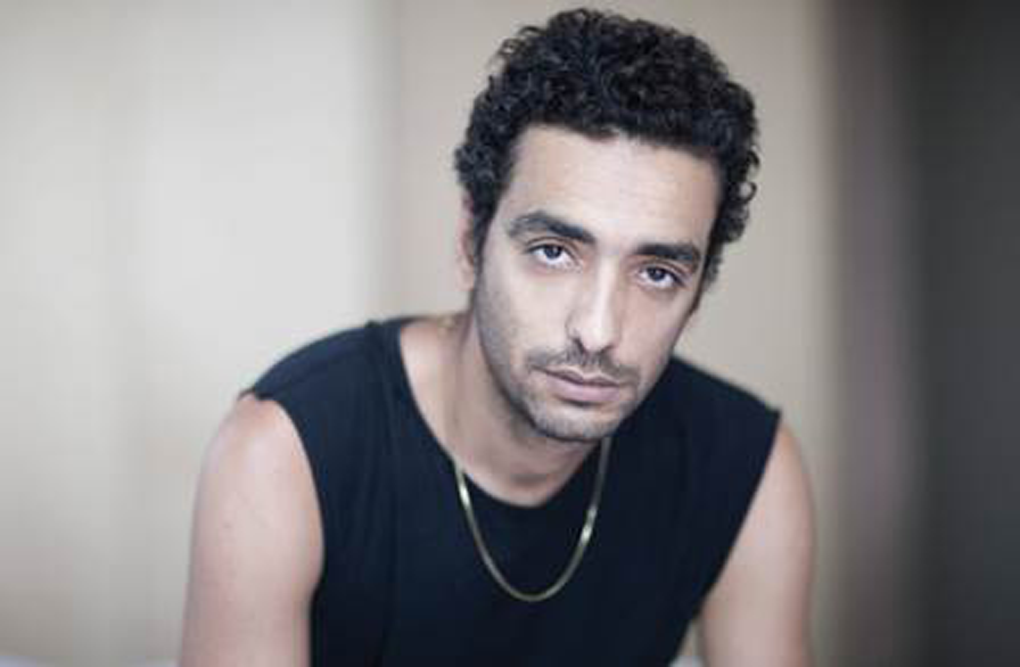
Keeping this in mind,  here's what the ADL did. First, they showed subjects the following photo of a racially-ambiguous person:

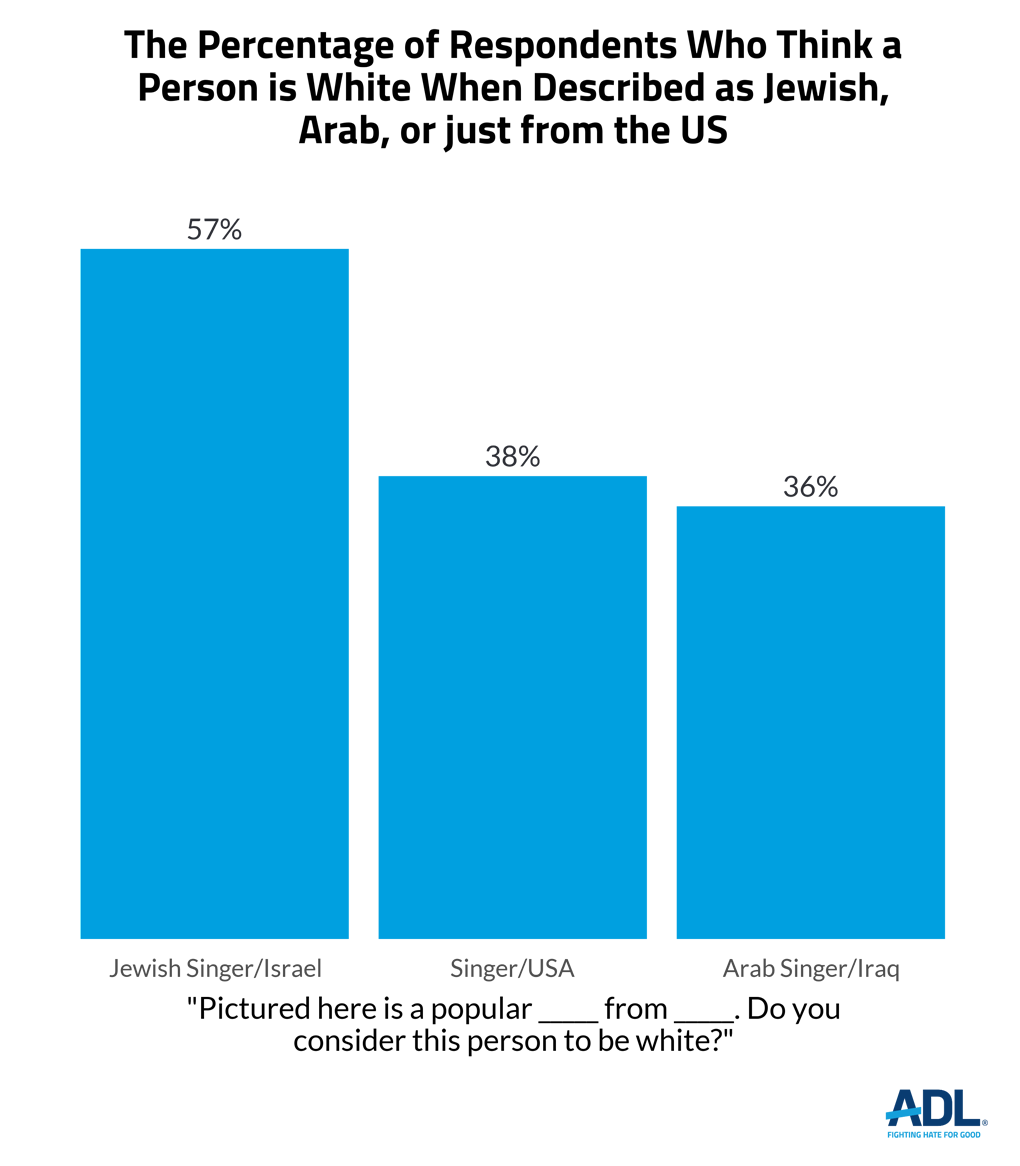
Some subjects were told the subject was Israeli Jewish, some were told he was Iraqi Arab, and some were told he was American. They were then asked to answer whether the pictured person was "White" or not.


Respondents were far more likely to code the person as White if he was identified as Jewish. That there was no significant distinction in answers between the "Iraqi Arab" and "American" labels suggests that this is a function of Jewishness "Whitening" the subject. This, in turn, provides strong evidence in support of Hypothesis 1.

But what was the result of this perception? Hypothesis 2a (the traditional account) suggests that viewing the person as White should be associated with reduced antisemitic views (he's an "insider", "one of us", or a member of a respected, preferred group). Hypothesis 2b (the revisionist account) suggests the opposite: that viewing the person as White should be associated with increased antisemitic views (he's a member of the dominant caste, an oppressor).

The study found that for White respondents, viewing the pictured person as White was associated with significantly lower levels of antisemitic sentiment -- supporting the traditional account. But perhaps this is not too surprising -- the sorts of White persons invested in denying Jewish Whiteness may be especially prone to antisemitic aggression. We might think that non-White persons, for whom being White is of course not an assertion of commonality,  would push in the opposite direction. But the study found that, for non-White respondents, viewing Jews as White had no relationship to the prevalence of antisemitic attitudes. This significantly weakens the evidentiary support for the revisionist hypothesis even in its supposedly strongest turf (21st century non-White respondents).

I'll want to dive into this in more detail, of course. But what a fascinating contribution!

Tuesday, November 02, 2021

White Jews: An Intersectional Approach -- Presenting to the Germans

Tomorrow (well, I suppose later today -- Nov. 2, at any rate) at 11:30 AM (Pacific), I'll be presenting "White Jews: An Intersectional Approach" before the Alliance Against Antisemitism -- Cologne. I believe I'm just one of two English-language speakers on their event list this season, so this is quite an honor.

A link to the livestream is here. It'll be in English, of course, so feel free to tune in!

Thursday, October 28, 2021

The Original Understanding of the Fourteenth Amendment is Not Just the Original Understanding of White People

Earlier today, I was having an internet discussion about a tweet from Ibram X. Kendi where he said that one element of racism "is to see books by White authors on White people as pertaining to *people* not race." This was in response to efforts in Texas to investigate and potentially ban a huge list of books that are on the subject of race (and/or sexuality).

Kendi's point, clearly, was not to say that books about White people are actually about aliens (I thought this was obvious, but some apparently need persuasion). Rather, his point was that books about White people are about White people, not "people" simpliciter. They are exactly as "raced" as books by Black authors about Black people. But the latter are pigeon-holed into being "Black" literature, while the former are thought just to be books about "people". And this is a very bad thing, that yields predictable distortions. 

Think of all the times that articles about "working class Americans" only talk to White working class Americans. The conflation gives a sharply skewed account of "working class Americans" -- for example, it makes them out to be far more conservative than they are. To be clear, a poll that sampled only Black Americans' political attitudes also would give us skewed picture of "Americans'" political attitudes (it would tell us, for example, that 90% of "Americans" vote Democrat, which is ... not correct). But it is not an accident that nobody makes that mistake -- there are plenty of good reasons to poll Black Americans as to their views, but nobody thinks that a poll which sampled only Black respondents is giving a comprehensive picture of American political attitudes.

By coincidence, I was having this discussion at approximately the same time I came across a new article by James W. Fox on how Black Americans originally understood the 13th Amendment. This is an important contribution because very often "originalist" investigations of the Constitution -- those which look to see how people of the framing era understood the meaning of giving constitutional clause -- look almost-exclusively at the understandings of White Americans at that time. That isn't self-conscious or intentional -- to the contrary, it is almost entirely unthinking. But nonetheless, investigations that sample near-exclusively White Americans are used to generate inferences about the original understandings held by Americans, as a whole. And this feels very natural, just the way of doing "neutral" originalist thinking, such that we don't even notice until it's pointed out just how skewed our sample is.

In reality, it is not remotely surprising that Black Americans and White Americans in the 1860s may have had different understandings of what the 13th Amendment was supposed to do. There are absolutely important historical reasons to look specifically at what White people thought; there are certainly are good historical reasons to look specifically at what Black people thought. From an originalist perspective, there may be a good reason to try and synthesize these thoughts into a cohesive whole that does capture a unified "American" understanding of the document, if that is indeed possible. But you have to be self-conscious about it -- if you're only looking at what White people thought, you're not looking at what "Americans", as an undifferentiated whole, thought. The racism that Kendi is articulating is the racism that assumes that proper taxonomy is one where an investigation of Black perspectives on the 13th Amendment is categorized as specifically "Black", while an investigation of White perspectives on the 13th Amendment is categorized as just "people's" perspectives or "American's" perspectives.

Tuesday, June 02, 2020

Are Americans Grasping the Reality of Police Violence?

As the nation continues to be gripped by protests against police brutality, I've been struck by the near-constant footage of excessive police force against journalists and civilians who seem to be doing nothing more than exercising their constitutional rights. For me, it powerfully communicates the reality of a central theme of the protests: that the police are out of control and are acting as a tool of repression and violence against the Americans they nominally are there to protect.

But my vantage is only a partial one, and I've been waiting to see evidence about how the American people as a whole are reacting. We all still are living in the shadow of 1968, and there is the constant fear that the narrative that emerges will be one where the police are the victims and "law and order" must be restored. Is that what's happening?

Today, Kevin Drum links to new polling that gives cause for optimism: Asked over the weekend whether "police violence against the public" or "violence against the police" was a more serious problem, Americans picked the former by a 55/30 margin. Independents answered at roughly the same margin -- 54/27. Even White Americans agreed by a 50/35 margin (for Black Americans, the gap was a whopping 85/8).

It's just one poll, and just one question. But it does seem to point to a potential sea change (also on that note: a Minneapolis city councilor talking seriously about trying to disband the Minneapolis Police Department outright).

Meanwhile, it's primary night in several states across America -- off-hand, none of the marquee races seem like they'd be particularly impacted by the protests (maybe the effort to take out White Supremacist GOP Rep. Steve King), but I suppose we'll see.

Wednesday, January 09, 2019

It Wasn't a Bomb Roundup

unnamed (31).jpg


Unbelievably, this package -- which randomly arrived at the offices of The Jewish Daily Forward for me (I do not work at the Forward, for the record) -- didn't contain a bomb. The truth was actually weirder -- it was (eight copies of) a pamphlet on Jews, marijuana, and prostitution, given to "strengthin [sic] you and your friends."

What a weird world we live in sometimes.

* * *

The Tarrant County, Texas GOP prepares to vote on whether to remove a party official for that most heinous crime of ... being Muslim. Tarrant County is not some tiny speck -- it's where Fort Worth is.

Two Black men have turned up dead in the house of a prominent California Democratic Party donor -- another man who was hired to do drugs and sexual activity shares his story.

Carly Pildis has an insightful column on how to tighten synagogue security while recognizing that a police presence won't necessarily make all congregants feel safe (picking up on a conversation Bentley Addison helped start last November).

Tema Smith has a good essay in the Forward on the history of Jewish Whiteness in America.

Andrew Silow-Carroll does an excellent job parsing the issue of Rep. Rashida Tlaib's "dual loyalty" insinuation from a few days ago.

An ADL staffer reports on a recent interfaith trip he organized with African-American pastors to Israel and the Palestinian territories. Though I think the term "Third Narrative" has already been taken.

The Chronicle of Higher Education reports on the outcome of a significant sexual harassment investigation involving a Michigan State political scientist (though -- lawyer's tic -- the article is incorrect to say that the "preponderance of the evidence" standard used in the investigation wouldn't be used in court. "Preponderance of the evidence" is the normal standard used in non-criminal judicial proceeding).

Senator Kamala Harris comes out in favor of legalizing marijuana and expunging the convictions of non-violent offenders.

And, to complete the "not a bomb" circuit, a Berkeley man was arrested after leaving a fake bomb laced with antisemitic slurs on the UC-Berkeley campus

Friday, January 04, 2019

Jews and Whiteness in America: The Spectrum of Opinions

"Are Jews White"? If you're Jewish -- or, it seems, even if you're not -- you have an opinion on this question. Those opinions lie on a spectrum, and I'm pretty sure I've seen every single possible iteration of views regarding the "White" status of Jews in America.

* * *

1) "No Jews are White. 'Jews', though, means pale-skinned Ashkenazi Jews who live in or immigrated from Europe -- which has nothing to do with 'White'. Persons who claim to be Jews but have different heritages or skin tones are probably not real Jews to begin with; at best, they can be accepted as Jews if and only if they perfectly accept and mimic the practices, beliefs, and ideologies of 'real' Jews. And if this sort of differentiated treatment appears to systematically benefit those Jews who appear White, that has to be a misnomer, since Jews are not White."

2) "No Jews are White. There are no distinctions of importance within the Jewish community along the axis of race. Antisemitism is the only relevant oppression a Jew can experience; it is racism with Jews as its target, consequently, any claim regarding 'racism' in America necessarily must apply with equal force to antisemitism. It is impossible for a Jew to benefit from Whiteness, because Jews are not White."

3) "No Jews are White, but some Jews, mistaken for White folk, might accidentally and idiosyncratically reap certain undefined and inchoate advantages of Whiteness outside of the Jewish community. However, these advantages disappear if and when they're recognized as Jews, and the dominant antisemitism reasserts itself. Within the Jewish community, there are no racial divisions of note, and only those who seek to stoke divisiveness try to argue otherwise."

4) "No Jews are White, but there are some Jews -- those who would, but-for their Jewishness, be seen as White in contemporary society -- who nonetheless benefit from some elements of what might be called 'White privilege', both inside and outside the Jewish community. These benefits, while real, are at the same time sharply limited by the antisemitism they experience."

5) "Some Jews are people of color. Some are White in a conditional or functional way. The latter possess some, but not all, elements of White privilege, both inside and outside the Jewish community. They might also face antisemitism, and this antisemitism mediates and modulates how they experience Whiteness (and vice versa)."

6) "Some Jews are people of color. Some are White. The latter possess most if not all elements of White privilege, both inside and outside the Jewish community, but might also experience antisemitism as a separate and distinct -- though still significant -- phenomenon from the advantages they receive from their Whiteness."

7) "Some Jews are people of color. Some are White. The latter's Whiteness is generally indistinguishable from other Whites, though in a few idiosyncratic cases White supremacists might nonetheless hate them. Outside those rare scenarios, however, only Jews of color face any racialized form of discrimination. In general, White Jews not only sit at an advantage inside the Jewish community, they are also identically situated to other Whites in their social positioning outside the Jewish community."

8) "All Jews are White (if anything, they're extra-White). Even those who'd otherwise appear to be people of color are, in effect, White insofar as they're Jewish. Antisemitism is a minor problem of an otherwise-advantaged White group. It is impossible for Jews to experience any serious deprivation from antisemitism, because their defining feature is Whiteness."

* * *

I sit right in the middle of that spectrum (I'd probably line up as a "5", so if you want a full accounting of that vantage, I dunno, read the rest of my work), but I think any position that's between 4 and 6 is basically defensible. 

The "4s" are those who want to defend the view that no Jews are White while still acknowledging a material difference between pale-skinned Jews of proximate-European descent and those who are more unambiguously "of color". Unlike the smaller numbers, they don't fundamentally deny the reality that pale-skinned Jews benefit in many ways from the advantages of Whiteness, though they might be uncomfortable with actually adopting the "White" label.

The "6s" are those who think that pale-skinned Jews of proximate-European descent simply are White in the American context, but recognize that antisemitism nonetheless remains a very real and dangerous element of these Jews' lives (just one that is conceptually separate from their Whiteness). Unlike the larger numbers, they acknowledge that antisemitism is real and significant, and in that sense Jews are very importantly differentiated from "other" White folk.

"8s" almost exclusively consist of antisemites who dislike Jewishness and think that tying it to Whiteness justifies this dislike. Position 7 is the moderate version of that view, nodding at the theoretical possibility of antisemitism materially effecting how Jews relate to Whiteness while cabining it to its narrowest possible dimensions.

The "1s" are generally those in the Jewish community who are flatly racist. The "2s" are the color-blind cousins of "1s", and is thus mostly comprised of Jews who are, at best, utterly in denial about racism within the Jewish community or the differentiated social position of pale-skinned Jews of proximate-European descent Jews versus those racialized as Black, Latino, or Asian. Like many professions towards color-blindness, it also works just fine as a disguise for simple racism. It's also, oddly enough, the closest view to that of far-right antisemites (minus the concern about antisemitism). 

"3s" include those who kinda-sorta accept that maybe there's a difference between the social position of a Jew who looks like Natalie Portman and a Black person, but insist that it's fleeting and pales in comparison to the similarities between the two. It's the mirror of Position 7, where the existence of White supremacist hatred at Jews is kinda-sorta acknowledged but viewed as basically sporadic and unimportant.

Spend enough time on the internet, though, and you'll see every variant at least a million times. It's a fun game -- try to catch them all!

Friday, December 28, 2018

(How) Do White Jews Uphold White Supremacy? (Part II)

In my post this morning, I explained how -- given the understanding of "White supremacy" and "upholding" that Tamika Mallory was using -- it is perfectly coherent to state, as Mallory did, that White Jews may "uphold White supremacy" even while we are (as Mallory also acknowledged) targeted by White supremacy. I argued that -- putting aside Mallory's own checkered history on the subject -- much of the present controversy was terminological in nature and that while such a semantic debate isn't unimportant, it is a far cry from the sort of overheated rhetoric whereby Mallory was accusing Jews of being tantamount to Klansmen.

In America, pale-skinned Jews of proximate European descent receive many (not all) of the day-to-day advantages of Whiteness. Insofar as White supremacy is understood more as a social condition than a social movement -- the state of affairs whereby White persons are systematically advantaged, not the cluster of individuals and organizations consciously and overtly ideologically committed to promoting the explicit ideal that Whites are superior -- it is fair to say (and almost unquestionably true) that White Jews who look like me are net beneficiaries of that system, and may well act in ways that (implicitly or explicitly) reenact or perpetuate that advantageous state of affairs.

This doesn't mean we don't also face antisemitism (any more than White women don't also face misogyny), and it is also wholly compatible with hating and being hated by groups like the Klan. And if you think the above paragraphs are reasonable, but blanch at labeling them "White supremacy", then the debate you're having is -- again -- primarily one of semantics, not substance.

That said, if the purpose of the first post was to work through how it is fair to think of White Jews "as Whites" (and thereby implicated in White supremacy), at the end of that post I suggested that there was a more layered and complicated discussion to be had about the relationship between Jews and Whiteness, one that can help explain why so many Jews react so fiercely against the label "White" and which puts important limits on the utility of "White Jews" as a concept.

This is a conversation that is short-circuited when people act as if White Jews are not White in any capacity -- a position which, as applied to American Jews with my skin tone, seems wholly at odds with reality. But it is also a conversation that can only occur if it is acknowledged that Whiteness is "of a different color" as applied to Jews -- that the characteristics of Whiteness, including what Jews can "do" with Whiteness, are different than how we might understand Whiteness simpliciter.

Start with the question of why many Jews who by all appearances look White seem to so fiercely reject the association. One explanation for this behavior is that it is a rather uninteresting permutation on the practice of many White people to deny the privileges they receive through Whiteness. The retreat to ethnic identity ("I'm not White, I'm Irish") or deracinated individualism ("I'm just a person") are ways to occlude the reality of how Whiteness continues to operate in America. And so, it might be thought, when Jews say "we're not White, we're Jewish", they're simply pulling their own version of that maneuver. Those who are familiar with Whiteness, are familiar with this move, and have long since learned not to take it very seriously.

Now sometimes, something like this account might suffice as the explanation for Jews who resist being labeled White -- particularly in cases where there is the most uncompromising insistence that White Jews are completely unassociated with Whiteness in America, that we gain nothing from America's racial bargain. But often, there's more to it than that. As someone who once rode the "I'm not White, I'm Jewish" train (and who tries to remember the I before I changed my mind), I know there's more at work here.

One problem with Jews-as-White, which has been raised quite a bit in response to Mallory or anyone else who tries to associate Jews with Whiteness in America, is that Jews have often been oppressed precisely because we haven't been viewed as White. White supremacist violence is an obvious case, the Nazi Holocaust is its apex. Given this history, there is something hurtful and insulting to cavalierly declare that Jews are simply "White". Anyone should understand why statements to the effect of "the Holocaust was White-on-White crime" or "we only care about the Holocaust because the victims were White" provoke an apoplectic reaction in the Jewish community. It is a disgusting erasure, and one that is teed up when Jewish Whiteness is assumed as an uncomplicated truth.

It shouldn't surprise, then, that many Jews rebel against being labeled "White" as a means of carving out and preserving space for full recognition of the realities of this persecution. As much as I say an American Jew like me today is functionally White in my day-to-day interactions, that hasn't always been true, it isn't always guaranteed to be true, and it isn't even wholly true right now. To the extent that insisting on Jewish Whiteness denies or diminishes the reality of very real and very live instances of antisemitism, it needs complication.

Another problem with Jews-as-White, less discussed but I think potentially more important, is that Jews are sometimes perceived as excessively White. Particularly in the Nation of Islam brand of antisemitism that Mallory has been associated with, Jews are often cast as embodying or exemplifying Whiteness -- the "iciest of the ice people", in Henry Louis Gates, Jr.'s summation. Bootstrapping onto antisemitic tropes of Jewish hyperpower and control, Jews become a convenient and accessible stand-in for Whiteness at its worst -- its most domineering, its most overprivileged, and its most bloodthirsty (this is a problem I explore in detail in my "White Jews: An Intersectional Approach" article). Hence, calls to focus on Jewish Whiteness are sometimes heard as (and sometimes function as) calls to cast a very specific spotlight on Jews as the worst offenders of Whiteness (and look how they try to slither out of responsibility for it!), or as the focal point for an assault on Whiteness and White privilege. What is cast as a general critique of "White supremacy" ends up being a specific, concentrated attack on Jews as its supposedly paradigmatic constituency.

Hence, if one reason Jews try to downplay their Whiteness is that the concept of White Jews denies circumstances and scenarios where even pale-skinned Jews are not viewed as White, another reason is that concept of White Jews accentuates tropes and understandings whereby Jews are viewed as the most extreme, blinding iteration of White -- generally via exaggerated notions of Jewish hyperpower and privilege. These can and do very easily slip into their own forms of antisemitism, and so it shouldn't surprise that many Jews view the entire discourse quite warily.

These are some reasons why Jews have, I think, an earned skepticism towards Whiteness discourse directed at them, even as I continue to maintain that the concept of Whiteness is fairly and coherently applied to the life trajectory of Jews like me. But I suggested at the outset that I was making a more ambitious claim: not just that we need to be careful when speaking of Jewish Whiteness (lest we stumble into antisemitic tropes of Jewish hyperpower, or erase historical or contemporaneous cases where Jews really aren't being viewed as White), but that Whiteness is different in kind even for those Jews who are (in the American context) raced-as-White.

To drill down on this point, let's return to Mallory's original statement. One way of parsing her words -- and how I think many people think of the relationship between Jews and Whiteness -- is something like the following:
White Jews in America are White in all respects save the important fact that White supremacists want to murder them.
I don't mean for that to sound flip -- being the target of violent hatred by a domestic terrorist movement is no small thing! Rather, what characterizes this view is that the Whiteness of White Jews is identical to the Whiteness of any other White person in America save for a discrete and well-demarcated carve-out. Hence, whatever discourse is validly spoken of "Whites", generally, also applies to "White Jews", specifically (save, again, for the highly specific case of "being targeted for murder by White supremacists"). With very limited exceptions, there's nothing about how we talk about Whiteness that isn't applicable or needs alteration in the specifically White Jewish case.

But I think this view is wrong. Jews, even as White, are differently situated than other Whites, such that it doesn't always make sense to simply cross-apply a Whiteness frame even onto White Jews.

For example, one way it is often said that White people (particularly White women) "uphold White supremacy" is that the majority (or at least a plurality) voted for Donald Trump. To all the White women marching in their pink hats and calling themselves the "resistance", this fact has created a rather compelling demand that they "tend to [their] own garden." As a class, White women are not particularly progressive and not particularly reliable even in the really easy, straightforward case of "don't vote for a naked bigot and unqualified buffoon like Donald Trump."

Yet it should be very obvious why it's troublesome to extend this logic to Jews. Jews voted overwhelmingly against Trump in 2016 (and again against Republicans in 2018) -- 70% voting for Clinton overall (and, given typical gender breakdowns in voting behavior, Jewish women almost certainly went against Trump by even wider margins). With the exception of African-American voters, Jews are and have remained one of the most consistently progressive voting blocs in American politics -- voting Democratic at rates equal to or better than women, Latinos, and Asian-Americans.

I'm not saying that a Hillary Clinton voter can't be racist, of course. But if voting against Trump is one obligation (perhaps the bare minimum obligation) that any decent person must meet in order to not "uphold White supremacy", then it is fair to say Jews have by and large done our job discharging at least that one duty. That part of our garden looks pretty healthy, all told. So it is fair for White Jews to bristle a little bit when they're lumped in with a broader White demographic which has backed Trump. At least as far as voting behavior, "White Jewish" identity has not, by and large, obstructed White Jews from standing against the avatars of White supremacy.

And speaking of tilling your own garden, one common feature of Whiteness discourse is the assertion that White people have a particular obligation to challenge and dismantle racist practices by other Whites. This obligation inheres in part because Whites, as beneficiaries of these practices, have special duties to disgorge any ill-gotten gains, but also because in White supremacist system Whites often are accorded greater power, influence, and credibility enabling them to more effectively disrupt White supremacist practices. Claims or arguments that are made and ignored when raised by people of color are often able to gain consideration when raised by Whites (for example, if you read the arguments in my last post and thought "finally, someone making sense" -- without recognizing that my analysis wasn't really that different from how many Jews of Color had responded to Mallory (see, e.g.) -- (a) thanks for the compliment, and (b) welcome to the problem!).

So it could be said that White Jews, as Whites, have heightened obligations to publicly challenge and confront White racism, because (for better or worse) we're viewed as "insiders" with greater credibility and pull than non-Whites when making those challenges.

But is that actually true of White Jews? I'm skeptical. And, perhaps oddly, my skepticism has been most clearly crystallized through observing the Twitter experience of Sophie Ellman-Golan.

Among the many social justice campaigns and priorities of the indefatigable Ellman-Golan, one in particular she often promotes is that need to #ConfrontWhiteWomanhood. It is, as one might expect, a campaign centered around the need for White women to take stock of the ways in which their practices reify White supremacy and other oppressive institutions.

And pretty much every time Ellman-Golan tweets under the hashtag #ConfrontWhiteWomahood, she's immediately hit with a torrent of antisemitic abuse of the form "who you calling White, Jew?"

It seems (and not just from Ellman-Golan's case) that White Jews who try to confront other White people about racism "from the inside" ... pretty quickly cease to be viewed as insiders. We are in fact presented as the epitome of outside agitators, rabble-rousers, and elitist corrupters. The White Jew who confronts White racism becomes a lot less White, and a lot more Jewish, very quickly.

To be sure, I'm not saying its impossible to brush aside an "insider" anti-racism critique made by a White Christian American. But it sure is easier to do it if you can unleash a whole flotilla of "Soros-funded coastal elitist cosmopolitan cultural Marxist corrupting the youth committing White genocide and what about Israel!" antisemitic tropes at the drop of a hat. As it a result, Jews seem particularly poorly situated to engage in these sort of confrontations. Not just because we're at heightened risk of explicitly violent retaliation (though there is that), but because our White-insider status doesn't extend that far: Jews who challenge Whites, aren't recognized as White.

Consequently, if White Jews are not or are not successfully "confronting Whiteness", it might not be because we're indifferent to the project or half-assing it. It might be because even White Jews don't have full access to certain features of Whiteness; we are not White in the same way that other Whites are. And while I don't have direct evidence to support this, my strong suspicion is that if and when White identity becomes a more explicitly marked and salient feature of American discourse (whether via progressive efforts to remove it from an unmarked default and "confront" it, or by reactionary programs to reinvigorate avowed White identity politics), the perception of Jewish Whiteness will become considerably more tenuous.

In sum: clearly it is the case that White Jews in America are White in important respects -- including benefiting from many elements of White privilege and at least sometimes acting to maintain and buttress that advantaged status. At the same time, the frame of Whiteness is not one that can be plopped down on the heads of even White Jews uncritically or without alteration. For one, Whiteness discourse often genuinely does erase important facets of Jewish experience where we aren't deemed White. For two, Whiteness discourse, as applied to Jews, can act as an accelerant for antisemitic tropes insofar as Jews are cast not just as White but as hyper-White -- the epitome or apex of Whiteness via privilege, power, and domination.

Finally, White Jews simply do not experience Whiteness in the same way as do other Whites. If race is, in Sara Ahmed's words, "a question of what is within reach, what is available to perceive and to do ‘things’ with", then Jews simply are able to "do" less with Whiteness. We don't have the same capacities to "challenge from the inside", our position as White is too precarious -- and the allure of antisemitic dismissal too powerful -- to allow it.

What's necessary, then, is an analysis of White Jews as a specific case, one that isn't fully known even to those who are well-versed in the contours of "Whiteness" generally. A proper situating of Jews into Whiteness will not deny obvious realities about the racial positioning of Jews who look like me in America. But neither will it easily slide into the default modes of understanding of Whiteness, or assume that Jews like me are "simply" White save for a few piercing but ultimately idiosyncratic exceptions emanating from White supremacists.

The fact is, a lot of people like to talk about Jews without really knowing about Jews. And they're often buttressed by interpretive frames -- Whiteness very much included -- which purport to fill in those epistemic gaps for "free", without needing any specific knowledge about Jews. But knowing Whiteness doesn't mean you know Jews -- even White Jews. And consequently, if the hostile response by many Jews to being labeled "White" rings familiar to many experts on Whiteness, that familiarity is likely a deception. It seduces us into thinking that we already know what needs to be known about White Jews -- that we can draw on the same explanations, that we can identify the same behaviors, and that we can demand the same duties, without putting in any additional specific work.

The virtue of Mallory's statement is that it recognizes both that Jews can back and benefit from White supremacy and also be targeted and hurt by it -- an assertion that, in broad strokes at least, is clearly correct. Zoom in and there is a lot more work that needs to be done: first and foremost, the work of recognizing that there is a lot of work left to be done -- groundwork, foundational work where it accepted that most of us do not yet know what we need to know about the contours of antisemitism and Jewish experience.

If you enjoyed these two posts, you might find interesting my essay "White Jews: An Intersectional Approach", forthcoming in the Association for Jewish Studies (AJS) Review.

(How) Do White Jews Uphold White Supremacy? (Part I)

The fallout to the latest Women's March antisemitism controversy yielded a brand new Women's March antisemitism controversy, centering around the following statement by organizational co-leader Tamika Mallory:
[W]e’ve all learned a lot about how while white Jews, as white people, uphold white supremacy, ALL Jews are targeted by it.
I'm not exactly a Tamika Mallory fan on the subject of antisemitism. Nonetheless, I didn't really share the outrage that this particular quote engendered among many of my Jewish compatriots. That's not to say I think she's demonstrating some sort of penetrating insight or vision on the subject. But I did view the statement as representing a forward rather than a backward step for her.

Much of the negative reaction to Mallory centers on her relatively broad usage of "White supremacy" and "uphold". Many people hear those terms and think of consciously organized endeavors of racial terrorism designed to declare and enforce White dominance. The social movements who most clearly embody these practices -- the KKK, the Aryan Nation, etc. -- almost always target Jews as well. So, the argument goes, it is inaccurate, insulting, and hurtful to accuse Jews of being part of these movements and these practices. Indeed, it is so implausible that Jews are mass supporters of these sorts of far-right extremist organizations that the argument otherwise rings antisemitic -- how could one think that but through a sort of 7-dimensional "the Jews are behind all our misfortunes" conspiracy theory?

But that response relies on that particular understanding of "upholding White supremacy" as meaning overt participation in these sort of far-right violent movements, and Mallory was almost certainly thinking of those terms differently. For her, White supremacy less describes a movement, and more a social condition. White supremacy is the state of affairs where White people systematically occupy a superior social position vis-a-vis non-White people along the axis of race. Put differently, there can exist White supremacy (the social condition where White people are systematically advantaged) even in contexts where few if any people are White supremacists (avowedly ideologically committed to a state of affairs where Whites-qua-Whites are systematically advantaged). Consequently, the fact that White supremacists hate Jews doesn't necessarily mean that those Jews who are -- to most everyone else -- viewed as White will fail to reap the (majority of the) benefits of White supremacy.

Likewise, "uphold" might be thought to imply a conscious effort to facilitate and buttress conditions of White domination -- again, most obviously instantiated by membership in overt White Power organizations. But here too it seems clear that Mallory means to speak more broadly. There are all manner of ways to uphold an extant status quo without making that one's primary mission in life.

Most obviously, persons who are beneficiaries of a set of privileges -- for example, White people who benefit from living in a society where they are systematically favored -- might have little interest in disturbing that state of affairs, an indifference that manifests as apathy rather than public support. They might not notice the advantages they receive, and thus unknowingly reenact or support social practices that reify those advantages. They might deprioritize the struggle against racism, acknowledging the reality of certain unjust practices but viewing them as comparatively unimportant as sites for investing their energy and attention. Or they might recognize and frown upon certain practices they acknowledge as racist but be willing to overlook them in pursuit of more important agenda items (think the proverbial Trump voter who genuinely doesn't like all the racism, but just cares about getting his taxes cut more).

These all represent ways one can be complicit in, perpetuate, and uphold White supremacy that fall far short of joining the Klan -- that are, in fact, quite compatible with both hating the Klan and having the Klan hate you right back. If you're Jewish, think of all the times you've read something like "if you're marching in the Women's March" (or voting UK Labour) "that doesn't make you an antisemite -- it just makes you someone who doesn't care that they support antisemites". These are ways of talking about people "upholding" antisemitism without themselves necessarily being antisemitic or desiring antisemitism. They are targeted at people who do not share Mallory or Corbyn's views on Jews, and may in fact be repelled by them, but nonetheless think that on net that matters less than whatever other factors drive them towards the Women's March or Labour. If it is at least coherent to speak of that as "upholding antisemitism", then one should also grasp how one could speak of similar complicity in movements or practices that (among other things) rely upon, perpetuate, or act out a system where Whites are advantaged over non-Whites "upholding White supremacy".

The point is, upholding White supremacy, in this context, is not meant to solely encompass people "running around in white hoods or marching with tiki torches". There are no doubt extraordinarily few Jews playacting as Klansmen. But White Jews in America absolutely receive many -- not all, but many -- of the benefits accorded to White people in our society. We don't tend to be shadowed in department stores, we don't tend to be randomly stopped-and-frisked by police, we don't tend to have our murder victims cast as "not exactly angels". And so it is quite possible and plausible that White Jews can and do "uphold" White supremacy in that they are relatively content with a state of affairs where they don't (but others do) experience shadowing, stop-and-frisks, and insinuations that our crime victims were nothing but trash anyway.

When I frame the controversy in this way, many of my Jewish friends are relatively receptive to the basic thrust of these arguments -- but suggest that they aren't the things people generally associate with a phrase like "upholding White supremacy". Mallory's terms are misleading; the connotation is all wrong, suggesting far more explosive allegations than this. Sure, it is fair to say that many White Jews benefit from many White privileges, and may even act in ways that perpetuate this status quo, and all of that is worthy of critique. But to label it a case of Jews "upholding White supremacy" implies that they're doing something far worse than that -- something tantamount to being a Klansman or a White Power activist -- and that's wrong.

As it happens, I have some sympathy for this view -- persuasive definitions can be dangerous things. But note that if this is the gravamen of the controversy, then what we really have here is a semantic argument about terminology. I'm not saying terminological debates don't matter -- they can help avoid fiascoes like this -- but they're different debates than what we've been having, and hardly deserve the level of venom that's being directed towards Mallory. If we agree that White Jews can and do benefit from the prerogatives of Whiteness in our society, and that we often are complicit in allowing the social condition where that racially unequal distribution of prerogatives exists, then we agree with the thrust of Mallory's underlying point (even if we might have expressed it differently).

These are all ways of suggesting that it is entirely appropriate, even necessary, to consider (under whatever label) the fact that White Jews gain many (not all) of the privileges of Whiteness in America and are perfectly capable of acting in ways which perpetuate the continuation of that racialized hierarchy. None of this requires denying that White Jews also face antisemitism -- but that should be a mundane point. There are all sorts of oppressions that one can experience while nonetheless being White: White women still face misogyny, queer Whites still face homophobia, and White Jews still face antisemitism. Being White doesn't displace those oppressions; and those oppressions don't displace being White.

Simply put: those who flatly deny that White Jews in America are White in any capacity -- as if a Jew who looks like me is identically situated to an African-American in my interactions with the police, employers, universities, landlords ... -- are denying reality. They are only obstructing badly-needed reckonings with our community's relationship with racism and racial hierarchy, both in terms of how we relate to community outsiders as well as those Jews of Color inside our community.

But another thing they obstruct is a more nuanced conversation about the precise contours of the relationship between Whiteness and Jewishness. If it isn't the case that it's nonsensical to apply the label "White" to a Jew who looks like me, it's also not the case that one can uncritically apply it to those Jews who look like me -- that anything we know about "Whiteness", generally, we consequently know about the Whiteness of White Jews, specifically.

The obvious example is, of course, that unlike most White people, White supremacists hate me and want me dead. That's a rather significant deviation from standard-issue Whiteness!

But I suggest that it's much deeper than that. White Jews are not simply White people in all respects but-for the bizarre and inexplicable fact that White supremacists want to murder us. Jewishness does things to Whiteness (and vice versa). Understanding the unique cocktail that's created when these identities intersect is critical to understanding the limits of the "White Jew" frame and comprehending why so many Jews resist it with such ferocity. This is the project I will take up in Part II (which I plan to put up shortly).

UPDATE: Part II is now available here.

Monday, April 23, 2018

Term Limited Roundup

My last class meeting is on Wednesday. After that (and grading finals), I'm free of teaching obligations for the next two (two!) years. All I have to do in that time is write a dissertation. Should be easy-peasy!

* * *

I've been meaning to share this outstanding essay by C. Thi Nguyen on "echo chambers", and how we discount information from "the other side", for some time now. It's really, really good.

Several Labour MPs, including Luciana Berger, give heart-wrenching descriptions of the antisemitism they continue to face in British society. J.K. Rowling comes in with an assist (though the article doesn't link to her best moment).

Great conversation in Slate by several Black writers about being Black in White spaces in America. Starbucks, Waffle Houses, golf courses .....

J Street is the future of Democratic Party pro-Israel work. How do I know? Because on the one hand, Ben Cardin was welcome there, despite being a high-profile opponent of the Iran Deal and a backer of the Israel Anti-Boycott Act. And on the other hand, Ben Cardin's message at J Street was basically in line with the broader progressive Zionist camp. Those who want to keep excluding J Street from the pro-Israel camp do so at their own peril.

The L.A. Times has an interesting piece on Latinos joining the Border Patrol (note: Border Patrol and ICE are distinct agencies). The Border Patrol either is now or soon will be majority Latino in personnel.

You know you're spending too much time following American antisemitism when a new story breaks about an antisemitic professor at Knox College and you're like "I bet I know who!" (my guess was "the guy who said that Michael Twitty wants 'to be everything but [his] African sel[f]' because Twitty is a Black Jew". I guessed right).

Sarah Jones interviews Michael Kimmel on deradicalization and reintegration of former White Supremacists. Also apropos: San Francisco anti-racism trainings that are for White Men only. Good example of "owning your shit" and not demanding that POCs serve as educators, or bad example of White Fragility and refusal to tolerate discomfort? You decide.

Are the Koch-brothers (the famous right-libertarian billionaires pumping money into academia and think tanks) spearheading a new insertion of paleo-con anti-Israel ideology back into the political right?

Two interesting pieces on Mizrahi Jews and the ongoing failure to fully grapple with their differentiated history vis-a-vis European/Ashkenazi Jews. The first centers on the documentary series "The Ancestral Sin", regarding how Mizrahi Jews were systematically marginalized by bigoted (largely secular) bureaucrats in Israel's early days. The second is a call for Mizrahi Jews to be given an equal seat at the table in Jewish conversations today.

Thursday, November 16, 2017

On Trusting White People, Redux

Ekow Yankah has a column in the New York Times about whether his children will be able to be friends with White people. People are reacting with the usual levels of charity and grace, and so I thought it might be worthwhile re-up this post I wrote on the subject back in 2008. It was inspired by the following passage from W.E.B. Du Bois' Darkwater (1920), responding to the question, from a roomful of students, "Do you trust White people?"
You do not and you know that you do not, much as you want to; yet you rise and lie and say you do; you must say it for her salvation and the world’s you repeat that she must trust them, that most white folks are honest, and all the while you are lying and every level, silent eye there knows you are lying, and miserably you sit and lie on, to the greater glory of God. 

Saturday, October 21, 2017

Egregious Professor Roundup

I got an email from an academic in Italy addressed to "Egregious Professor David Schraub." Apparently, that's a common issue because "egregio" has a meaning closer to "excellent" in Italian. Nonetheless, I kind of want to change my Twitter handle to "Egregious Professor."

* * *

This is a from last year, but Jacob Levy gives a qualified defense of "safe spaces" in the academic context that is really fantastic, and well-worth a read.

Fifteen Jewish extremists arrested in Israel for threatening Arabs, including the notorious Bentzi Gopstein.

The Montana Republican Party is the sort of place where, if you bodyslam a reporter, you'll have to fend off criticism -- from those who say you should have shot him.

Kevin Williamson has an interesting piece on the pathologies of poor White communities. I don't necessarily endorse it, but it is a rare example of someone taking the way we talk about poor Black communities and earnestly applying those same standards to Trump-backing Whites.

Bezalel Smotrich is a dick in every single possible aspect, so his remarks on the "me too" campaign are entirely on-brand.

Remember how I said "Not Knowing "Zio" is a Slur is an Indictment, Not a Defense"? Yeah, same thing applies to not knowing that portraying George Soros as tentacle-monster encircling the globe is antisemitic.


Saturday, August 26, 2017

Boxing's Not Dying, You're Just "Colorblind"

I, of course, am watching the big fight tonight -- Miguel Cotto vs. Yoshihiro Kamegai. Why, what are you watching?

In all seriousness, I do think Mayweather/McGregor is a sideshow. That didn't stop me from putting money on Mayweather (half on Mayweather to win straight, and half on Mayweather plus the "over" on rounds), but as a boxing match it's only competitive if Mayweather has gotten old since his last fight. And that's not that interesting to me. While Cotto/Kamegai isn't exactly a toss-up fight, it should be exciting and at least it's a match-up of boxers. Plus it won't cost me $100.

But since we have another moment where boxing is in the public eye, I wanted to flag this article in the Washington Post about the future of the sport. For a long time, the conventional wisdom has been that boxing is "dying", now restricted to an older fan base who are not interesting as advertising demographics. The real energy, the line goes, is behind MMA. And certainly, the latter sport has seen explosive growth over the past decade. But the WaPo article reveals that the CW about boxing has been largely misconceived. 18-29 year olds are the most likely to call themselves boxing fans (39%), and at similar rates to MMA (37%). Overall, boxing and MMA have roughly the same proportion of fans (25% for Americans call themselves MMA fans, 28% boxing fans).

So what's driving the narrative on boxing? While the article doesn't harp on this, the big difference is along the dimension of race. Non-whites are far more likely to consider themselves boxing fans than are whites. While just 17% of white people identify as boxing fans, for blacks that jumps to 52% and for Latinos its 61%. Amongst women, just 8% of white women are boxing fans, compared to 40% of nonwhite women (a significantly higher rate than the 25% of white men who characterize themselves as boxing fans).

To be sure, boxing was in some ways shooting itself in the foot by keeping so many of its big fights on premium cable networks or PPV, where younger fans often didn't have access to them. That consideration was a major factor in Top Rank's just-announced four year deal with ESPN, part of a larger shift in recent years of boxing over to basic cable and even network television.

But it's hard not to think that a large part of why people thought "boxing is dead" was because white people were less invested in the sport. Amongst black and Latino communities, boxing is still incredibly popular; it was just that their interest didn't "count" in assessing the vitality of the sport.

Thursday, August 17, 2017

Subbing Out Roundup

I took my final subfield exam today, in the History of Political Thought. For those of you who don't know, "subfield exams" were introduced as a means of exploring the "chicken" game: the student really doesn't want to study (for obvious reasons), and the examiner really doesn't want to fail the student (since that would necessitate writing and grading another exam). The equilibrium is for the student to level a deeply mediocre exam, and the examiner in turn to excoriate the student in comments before passing him or her. How it made the jump to Political Theory remains unknown.

What I'm trying to say is, I'm feeling good about my History of Political Thought Exam. But I am very tired, and about to hop on a plane to celebrate a friend's engagement. So ... roundup!

* * *

Leon Wieseltier on Charlottesville, Trump, and the alt-right. He doesn't pull punches. Definitely worth a read.

Somebody finally did a profile piece on rural people of color.

Fascinating article on Egyptian Israeli Arabs, and their strained relationship with a state nominally at peace with Israel.

Zachary Braiterman gives his spin on the perennial "are Jews White" topic.

Phoebe Maltz Bovy on why antisemitism needs to be seen as a distinct axis of oppression.

Very much enjoying this article by Rae Langton on "Blocking as Counterspeech."

What's worse than refusing to pay out valid worker's compensation claims to undocumented immigrants? Refusing it and using the claim as an excuse to deport them from the country. Grotesque.


Sunday, August 13, 2017

On Asking Jews To Be More Anti-Nazi

The second job I wanted to be when I grew up was a cartoonist (the first was omelet chef at a Marriott. Little kids have weird goals). I loved Calvin & Hobbes, and later Dilbert, Doonesbury, Foxtrot, The Boondocks, and many others. My ambition, alas, quickly foundered against the reality that I have no artistic talent whatsoever. But occasionally I still draw cartoons in my head (where their artistry and technical virtues are unimpeachable).

My most recent imagined cartoon is set in Auschwitz, 1944, where a portal opens up and a time-traveler steps through. It is a literal "Social Justice Warrior" -- from the future, armed to the teeth, and ready and eager to "punch some Nazis". After completing his task, some Jewish inmates approach to thank him for rescu--

BAM!

He clocks them too. "Did I say 'Zio-Nazis excepted'?"

I was thinking about this after reading this tweet by Ferrari Sheppard, where he says "Can't be anti Nazi pro Israel."


I read that tweet, in turn, shortly after reading this thread by Sophie Ellman-Golan urging White Jews to "join" the fight against the neo-Nazi resurgence we saw in Charlottesville.


It is, she says, a fight Jewish institutions have been "shamefully late" in adopting as our own.

I reflect on this, and I'm torn. My thoughts are scattered; they fly all over the place.

Consider the ADL -- called out by name by Ellman-Golan. I recall excoriating them for selling out liberal Jews in their appalling silence on David Friedman's "kapo" comments. Then I think of the immense pressure the ADL has come under from the right, which accuses it of taking too hard a line on right-wing racism. I remember the shamefully equivocating tweet ADL chief Jonathan Greenblatt put out yesterday, drawing equivalence between Nazi and "antifa" violence. Then I remember the following tweet thread which was so much better. I also remember how a sizable chunk of the negative responses to Greenblatt's original equivocation somehow managed to work "Israel" into the message -- because that's what it's always about, isn't it? I consider how it seems many of the ADL's critics are eager, even happy, to infer the worst about it. They like the idea of "Jews who don't really oppose Nazis". They seem to revel in the idea that the Jews aren't anti-Nazi to their satisfaction.

The Jewish community -- institutionally and otherwise -- is a varied and diverse bunch. That variation and diversity applies as much to our presence in social justice organizing as anything else. The explanations for this diversity will be similarly varied.

After all, I, too, have written fusillades decrying the tepidity of many Jewish groups in calling out the ascendant tide of right-wing racism. So clearly I concur there's a problem here.

At the same time, I also think that there's something truly grating at the idea that Jews have to prove themselves "anti-Nazi." Mia Steinberg wrote something very telling about how this debate plays out for Jews: "Instead of 'would I have stood up to Nazis in WW2', the thought experiment for me has always been 'would I have survived?'" The Holocaust was not an arena for Jews to prove our moral valor, and when our reaction to Nazism doesn't adopt appropriately heroic tones that is not proof of Jewish "complicity" in anything. The celerity with which people seem eager to tell Jews we're the new Nazis, or we don't care about Nazis, or we're not responding to Nazis in a way that gives non-Jews sufficient confidence that we're really anti-Nazi, is degrading and infuriating.

Yet again -- I can't fully go down that road either. Surely, the groups like ZOA who have explicitly lined up behind the Trump/Bannon alt-right wing have no moral legs to stand upon. And even as I bow to no one in downplaying the seriousness of the growing clouds of antisemitism, Ellman-Golan is simply right -- I refuse to tolerate people denying this -- that in its current manifestation in the United States Black people are more violently targeted by the forces of White supremacy than are Jews. That doesn't mean Jews aren't targeted, and aren't targeted in ways that are worthy of genuine fear and concern. But it is not wrong for there to be a focus on racist violence, so long as that focus doesn't come via denying the reality of antisemitic violence.

But  (once more around, and here's where I really want to land) can we honestly say -- unblinking, looked-in-the-eye, full-stop -- that when Jews don't throw themselves into these movements that the primary explanation ought to be "because Jews don't care about Nazism"? Can we be so confident that the movements in question "will fight for us"? The fact of the matter is, too often Jews -- from Chicago Dyke March to Creating Change to Slutwalk -- do try to participate in these movements, and are cast out, or turned aside, or subjected to humiliating ideological litmus tests where we're guilty until proven anti-Zionist. That's part of the reason -- not the sole reason, but part of the story -- why I shy away from protest movements. I don't know that they "will fight for us". That is not something that simply can be wedged into our presuppositions as a demanded default. Much the opposite:
As a Jew, I can't completely cheer at these expressions of left-wing activism because I know there is a real and non-negligible risk that in that crowd someone wants to say the whole thing they're fighting against is a Zionist plot, and there is a real and non-negligible risk that if that person gets a hold of the mic and says so the crowd will erupt in cheers. 
It grates when this is denied, when people act as if the only reason Jews "don't show up" for social justice (to the extent that we don't) is because we're too indifferent or too fragile or too embedded in our own privilege to really care. Such a view doesn't take seriously real practices of exclusion; it assumes them away because it takes "they will fight for us" as an axiom rather than a (often quite dubious) proposition that must be demonstrated. It's the "why do all the black people sit together in the cafeteria" question of Jewish social activism. If Jews are "late" to the social activist party -- and I don't necessarily concede that we are -- perhaps part of the reason is that social convention requires a truly grotesque amount of preparation, costuming, covering, hedging, eliding, and self-effacing before the Jew is admitted through the doors. It's exhausting. And it's hard to blame people for not wanting to show up, when those requirements are allowed to persist unexamined.

Finally, when talking of these exclusions we should be clear that this is not even primarily, let alone solely, a POC thing. Indeed, Black people in America have consistently demonstrated their intolerance of antisemitism and their willingness to stand with Jews against antisemitism even in their own community. That history has to be part of the story too. The story of Black-Jewish relations simply isn't -- much as conservative hagiographers might wish it so -- one of self-sacrificing Jews altruistically defending civil rights only to be sold down the river by ungrateful African-Americans who dived headfirst into antisemitic conspiracy-mongering.

What it boils down to is this:
  • Jews are genuinely threatened by the rise of the alt-right. This is a movement that affects us in a real, tangible way -- not as allies, not as "fragile" White people, but as a vulnerable group that is genuinely imperiled by these social forces. Acting as if Jews don't have skin in this game is a form of antisemitism denial.
  • Currently, the tangible manifestations of extreme-right identity politics have a greater impact on the material conditions of black and brown lives than they do that of White Jews. That assessment in no way falsifies the first bullet point.
  • All non-Jews, to varying degrees, benefit from the social privileges and prerogatives that exist under conditions of antisemitic domination. This assessment in no way falsifies the second bullet point, it merely establishes a kyriarchical relationship where (in the contemporary American context) racial domination has greater punch than also-extant antisemitic domination does.
  • The relationship between (proximately-European) Jews and Whiteness is a complex one. Such Jews clearly do not enjoy an unadulterated White privilege (as the seething hatred of White supremacists makes clear). But it is also clear that we enjoy a great many of these privileges and prerogatives on a day-to-day basis. While possession of these privileges does not falsify the existence of antisemitism, neither does experiencing antisemitism falsify the existence of these privileges.
  • Some Jewish groups have been derelict in their duties to combat this right-wing menace. It is our obligation as Jews to insist that our communal representatives fight against far-right extremist movements both because they threaten us as Jews and because they threat others -- Black people, brown people, queer people, and more -- who may or may not be Jewish.
  • To the extent that some Whites Jews haven't partaken in anti-right resistance movements in the stock ways typically demanded of White allies, the explanations that apply to White people generally who don't "show up" are not always inapposite. But they are frequently incomplete, and a serious conversation needs to be had about the politics of antisemitic exclusion that afflicts Jews who very much do wish to be involved in left-wing activist spaces or otherwise participate in contemporary progressive politics. This conversation cannot take "they will fight for us" as an axiomatic entitlement.
Do these not fully fit together? Then they don't fully fit together. As I said, I'm torn. I don't claim to fully fit together on this.