Saturday, December 09, 2023

Bad Faith Grandstanding on Campus Free Speech is Rewarded

The President of the University of Pennsylvania, Elizabeth Magill, has resigned in the wake of her testimony before Congress about university responses to campus antisemitism.

This is terrible news. To be sure, I don't think Magill is obligated to stay in a position where she feels she either can't be effective or can't function; she has no obligation to stick things out in what I can only imagine is right now an impossibly toxic atmosphere. But still, Magill deserved better; she said absolutely nothing wrong in her testimony. Yet the bad faith grandstanding of the likes of Elise Stefanik -- an antisemitic conspiracy-mongerer in her own right -- has claimed a high-profile victim.

I published my post Thursday before reading Ken White's more colorful response to those smearing Magill, but I endorse it in full. There have definitely been other prominent free speech advocates who have taken the right line here, including Eugene Volokh and David Lat

But others are not rising to the moment. I flagged in my last post Keith Whittington for wrongly and misleadingly making Magill rather than Stefanik into his standard-bearer for greater campus restrictions on speech -- even if we think Magill was wrong to begin bending to Stefanik's threats, it's evident that Magill did not originate them. To the contrary, the backlash against Magill -- which Whittington tacitly tried to latch on to -- was and is entirely about her perceived unwillingness to bend sufficiently on protecting free speech. Anyone who was joining the dunk party on Magill was, implicitly or explicitly, endorsing the very unambiguous politics of free speech censorship that Stefanik was explicitly promoting. I can't top Ken White here: "You — and I say this with love — absolute fucking dupes."

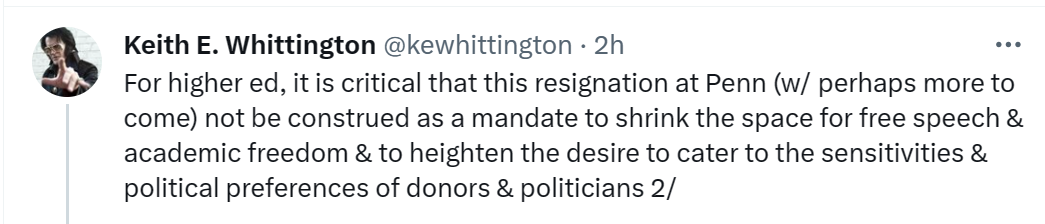
Now that Magill has resigned, here is how Whittington reacted to the news:


It's hard to imagine missing the point by a wider margin than this. Whittington's worried that Magill's resignation will be "construed" as a "mandate to shrink the space for free speech" and to "cater to the sensitivities and political preferences of donors and politicians"? Yeah, no kidding -- it will absolutely be "construed" as doing both of those things because that's exactly what prompted it. The lesson that was meant to be sent and which will be learned is "shrink the space for speech when politicians and donors demand that you do so." There's no ambiguity here; that's the entirety of what happened. Anyone who didn't want that to happen should have come out firing in defense of Magill and in opposition to the roiling censorial mob that Stefanik effectively incited.

Magill felt compelled to resign because she publicly articulated -- in the most hostile room imaginable -- the free speech values that Whittington claims are essential. That's it. And that Whittington still cannot name the actual enemy here -- cannot state clearly that Magill got it right, is being punished for getting it right, and it is rabble-rousing Republican demagogues who showed their whole face in terms of demanding censorship under the guise of protecting Jewish students -- is shameful.

I'm also not feeling especially patient towards some of the other common lines I've heard that try to rationalize why it's okay to blame Magill as having done something wrong. One common response I've seen is to say that the witnesses were poorly prepped for the particular environment of a congressional hearing; with better preparation, they could have avoided the "traps" laid out in front of them. I'm doubtful: I think it is the hubris of very smart people in particular that think they can go into a demagogue's home turf, where they're entirely in control of the proceedings, can control the flow of questioning, can reclaim time whenever they want, and outmaneuver their "traps". It's the same hubris that makes liberals think they can go on Fox News and "outdebate Hannity". No you can't, and it's not because Hannity is some secret genius. It's that he has the home field advantage -- he knows how to play this particular game better than you, precisely because it's a "game" that does not in any way reward intellectual honesty or virtuosity.

A similar argument is that, while the responses of Magill et al may have been formally, legally, correct, they were inappropriate in this context -- their role was not to be lawyers but public advocates for their university, and their sin was misapprehending what was called for from their position in this context. My former colleague at Berkeley Steven Davidoff Solomon, for example, described the university presidents as "prepared to give answers in the court — and not a public forum,” and that was their undoing: their job here is “not to give legal answers, it’s to give the vision of the university."

Once again, I'll cry foul. Yes, there are many situations where a technically correct answer nonetheless can be a bad answer because it skirts some larger truth or is inattentive to important surrounding context, which a good answer would pay heed to. But this argument only works if the problems with the "technically correct" answer are not the facts which make it correct. The people who are mad at Magill are not mad based on something like "yes, maybe it's technically true that there are some circumstances where 'calls to genocide' are protected from formal sanction, but it's more important right now to emphasize how heinous those calls are even if they always be literally punished." The thing they're mad about is the thing that Magill said which was true: there are some circumstances where even 'calls to genocide' -- and we're not even getting into Stefanik's attempt to frame the at the least more ambiguous case of 'intifada' chants as a "call to genocide" -- are protecting from formal punishment. As Howard Wasserman wrote:

Magill, Gay, and Kornbluth did not fail to denounce calls for genocide as antisemitic. No one asked whether calls for genocide or "river to sea" are antisemitic; Stefanik asked whether those statements constitute protected speech and they gave the correct answer of "it depends on context," because it does. In fact, they did at points condemn the message, just without expressing intent to sanction the speech where it remained protected.

Put differently, it's fine to say that in some cases a "technically correct answer" isn't good enough, but only if your proposed alternative is not to demand the speaker be overtly and substantively incorrect.

The last thing I'll say is that I'm not generally interested in point-tallying of the "this is the real cancel culture" variety. Free speech, as I've often said, has mostly fair-weather friends, and no camp has covered itself in glory across the board. What I will say though is that no matter how one tallies the overall scoreboard, this absolutely is an incident where the forces of censorship won and those demanding respect for free speech principles lost. The next time we face an incident where some controversial right-winger comes to campus, it will be a lot harder to persuasively lecture our students that as hateful and heinous as this figure may be, this is the demand of free speech protections etc. etc. etc., because they will have seen in vivid detail just how easily those principles can be forced to bend. 

Maybe you think that's a good thing. I still think it isn't. And at the very least, the practical shakeout of who will in practice see their speech censored and who in practice will be able to access administrative protections remains to be seen. I have zero confidence that this will either find a stable and accepted equilibrium or ultimately redound to the benefit of young Jews enduring antisemitism on campus.

Thursday, December 07, 2023

Hebrew Letters in Portland


Earlier today, I was chatting with a friend on the subject of whether we felt "afraid" as Jews. I said that I didn't personally feel especially "afraid" as a Jew, but that I acknowledged that others in my circle (students, colleagues) were articulating different experiences from mine, and that I didn't want my own relative lack of fear to imply that their experience was inauthentic, concocted, or an overreaction.

A few hours after that exchange, Jill asked if I wanted to go out and get donuts for Chanukah. I looked down and saw I was wearing that shirt -- the one that says "Carleton College" in transliterated Hebrew letters. And before I left the house, I changed shirts. While it's not that I was sure something bad would happen if I went out in public wearing Hebrew letters, I felt in no uncertain terms that it was unwise -- a risk not worth taking -- and that if I did wear it I'd certainly feel anxious from the moment we stepped into the car until the moment I got home.

What changed? Obviously, nothing -- there was no event over the interceding two hours that precipitated fear in me that I lacked before. The sense that wearing that t-shirt outside might be an Unwise Idea was already latent inside me (there's a reason why the "Hebrew Letters in ...." post is an ongoing series) -- I just sort of ... forgot about it. The fear was simultaneously always present and yet so sublimated that even in this moment I could earnestly assert in perfect good faith that I wasn't feeling it.

I'm reminded of a phenomenon Albert Memmi wrote about where Jews who experience antisemitism often simultaneously say things like "this is the first time I've ever truly faced antisemitism" and then, if you press a half-inch on the matter, will kind of belatedly remember a dozen prior instances where they also faced antisemitism. As much as there is, in some circles, pressure on Jews to trumpet our vulnerability and insist that everyone Acknowledge Our Peril, there's also, in a different register, a ton of pressure on Jews to downplay antisemitism, to show that we're not one of Those Jews who jumps at every shadow, to not make a big deal and agree to lump it on the small stuff (this dichotomy is, too, one that I think is very much one that is experienced not just by Jews but by many minority group members).

But still, I'm not sure what to make of all of this. What does it mean that I said -- again, perfectly earnestly, not as an exercise of bravado -- that I didn't feel significant "fear" right now as a Jew in a moment where at some level I knew full well I didn't feel comfortable being visibly Jewish in public? Perhaps my understanding of what it meant to be "afraid" as a Jew was one that envisioned something more visceral and panicked -- feeling as if any second now someone would jump me, terrified that we're an instant away from a mob demanding the evil Jew be removed from campus. The more workaday experiences of not feeling comfortable wearing a Hebrew t-shirt, or idly wondering (as I sometimes do) "what would happen if someone graffiti-ed my house with a swastika" -- that I've just internalized as a baseline state of being, it surely is not serious enough to qualify as being afraid. That seems a problematic thought -- the idea that as Jews we've just so thoroughly normalized a level of anxiety over antisemitism as the default setting that it feels wrong to even identify it as "fear". But clearly there's something to it -- recall my posts on how "schoolchildren shouldn't have to live like Jews", which also relates to how Jews just accept as normal certain orientations towards threat and danger that objectively speaking should be seen as intolerable.

Nonetheless, when I say I'm not sure what to make of all of this -- I mean it. I'm not fully convinced that the "right" answer is that actually, I am afraid as a Jew and I should embrace that sensation. Just the other day I was talking about how, in contrast to the zeitgeist, I haven't felt like my personal social media feed (Facebook and the like) has been overrun with extremists or monsters either cheering dead Israelis or gushing over dead Palestinians. There've been a few, but not all that many in the scheme of things. "What am I doing wrong?", I joked. "Am I being shadowbanned from all the bad content? Or am I just that good at picking friends?" But the point is that in the main the notion that my status as a Jew right now is defined by fear and alienation just doesn't resonate with me. I respect that it does for others, but it isn't how I'd generally characterize my experience, and I don't like the thought of being conscripted into endorsing an affective state that doesn't actually resonate with me.

But then again, I still took the shirt off. So am I just self-deluding? Or is there some middle ground? I don't have a good answer.

Bad Faith Grandstanding on Campus Free Speech Shouldn't Be Rewarded


Many of you have seen the fallout over recent congressional testimony about antisemitism on college campuses, featuring the presidents of MIT, Penn, and Harvard. A particularly high-profile exchange came from Rep. Elise Stefanik (R-NY), demanding to know if calling for "genocide" of Jews violated these university's conduct policies. 

The context of this questioning was the use of "intifada" in campus protests, which Stefanik suggested should be viewed as "genocidal". Right from the start, that should give us pause -- the ambiguity of "intifada" being conflated into "genocide" on its own gives ample reason for the university presidents to demur over committing to formal penalties. And certainly, in a world where its increasingly common to claim that Israel is pursuing a policy of genocide towards Palestinians, Jewish leaders should think long and hard about whether they really want to institute a rule that speech "advocating genocide" can be banned from campus. As Justice Black put it in his Beauharnais dissent, warning minority groups about the "victory" of securing a ban on hate speech: "Another such victory and I am undone."

Nonetheless, I've seen many people praising Stefanik for her "hard questioning", and dismissing the university presidents' responses as "dodges" or missteps. As grandstanding, I might concede that Stefanik was effective. But on substance, she was dead wrong, and the university presidents got it right. What we had here was a textbook example of an effective demagogue putting her targets in an impossible situation, and resolutely refusing to allow them to give a "good" answer, and I'm annoyed that this is being viewed as anything other than the bad faith rabble-rousing that it is.

Jon Chait has an excellent piece on this that strikes exactly the right notes. Here's his reprint of the relevant exchange between Stefanik and UPenn President Elizabeth Magill.

STEFANIK: Ms. Magill, at Penn, does calling for the genocide of Jews violate Penn’s rules or code of conduct? Yes or no?

MAGILL: If the speech turns into conduct, it can be harassment. Yes.

STEFANIK: I am asking, specifically calling for the genocide of Jews, does that constitute bullying or harassment?

MAGILL: If it is directed and severe, pervasive, it is harassment.

STEFANIK: So the answer is yes.

MAGILL: It is a context-dependent decision, congresswoman.

STEFANIK: So calling for the genocide of Jews is, depending upon the context, that is not bullying or harassment. This is the easiest question to answer. Yes, Ms. Magill. So is your testimony that you will not answer yes? Yes or no?

MAGILL: If the speech becomes conduct. It can be harassment, yes.

STEFANIK: Conduct meaning committing the act of genocide. The speech is not harassment. This is unacceptable. Ms. Magill, I’m gonna give you one more opportunity for the world to see your answer. Does calling for the genocide of Jews violate Penn’s code of conduct when it comes to bullying and harassment? Yes or no?

MAGILL: It can be harassment.

This has been treated as Magill being evasive and Stefanik trying to nail her down. But in reality, everything Magill is saying is exactly correct. What she said is pretty similar to how I would've responded to my own students if they asked what the rules were surrounding such speech in a campus environment, and I resent the notion that giving an accurate answer to that question should be characterized as a faux pas. 

The truth is that even hateful speech -- and a call to genocide certainly qualifies as one -- is not the subject of proscription on university campuses. This is not some rule that was just made up when Jews got antsy; it was the same principle that demanded UC-Berkeley permit an unabashed racist like Milo speak on campus and insisted that avowed White supremacist Richard Spencer be allowed to give talks at campuses nationwide. Antisemitic speech is antisemitic, but when it is just speech and not conduct, it is still protected by principles of free speech. In her testimony Magill held the line admirably, and now she's being pilloried for it.

This is why I'm actually a bit annoyed at this Chronicle article by Keith Whittington, speaking as founding chair of the Academic Committee of the Academic Freedom Alliance. Whittington presents a choice looming for college campuses on speech, between holding fast to free speech principles versus seeking to restrict speech on basis of content in the name of "safety". The former position (which is also Whittington's) he associates with Stanford Law Dean Jenny Martinez, and how she handled the aftermath of the anti-Kyle Duncan protests on her campus. The latter position he ties to Magill:

A quite different path is suggested by the University of Pennsylvania’s president, M. Elizabeth Magill. Magill has come under particularly intense pressure to address perceived antisemitism on her campus. In her testimony to the congressional committee, she emphasized that “Penn’s approach to protest is guided by the U.S. Constitution” and gives “broad protection to free expression — even expression that is offensive.” But when confronted with questions about whether calls for genocide violated university policy, Magill and her fellow presidents stumbled in their replies. As a result, Magill released a short video. There she repeated that “Penn’s policies have been guided by the Constitution,” but she added that “in today’s world … these policies need to be clarified and evaluated.” She promised a “serious and careful look at our policies” with an eye to ensuring a “safe, secure, and supportive environment.” She will, she promised, “get this right.”

Magill’s implication is clear: The university’s policies need to be revised so that they do not so closely follow the Constitution; they should instead prioritize students’ sense of safety. Protections for free expression and perhaps even academic freedom might well be pared back in the process.

Here's why I'm mad about this. It's true that Magill has backtracked on the commitment to absolutist free speech protections in the wake of the fallout over her testimony, and that's unfortunate. But Whittington's framing implies that Magill from the outset was hesitant to forthrightly defend the free speech rights of "offensive" speakers on campus, and now has gotten even worse. That's the opposite of what happened: Magill in her testimony said exactly what Whittington thinks she should have said -- and she's getting hammered for it. Contra Whittington, she did not "stumble" during the testimony itself -- or if she did, it's only from the vantage of those who take Stefanik's view that it is a misstep not to endorse paring back academic freedom and free expression in deference to students' sense of safety. 

For those who adopt Whittington's view on free speech, Magill's congressional testimony was not a "stumble" but a clear articulation of the proper position of the university. Whittington accordingly should have had her back; he should have said explicitly that the university presidents got it right in their congressional testimony and the backlash they're enduring for it is the real threat to free speech. Instead, he hung her out to dry as she takes the brunt of public heat for the position Whittington purportedly wants to see more university presidents defend. What do we expect will be the result of this? Unfairness to Magill aside, what does Whittington expect will happen -- what incentives are university administrators given -- when they see that putative "free speech" allies won't give them credit for saying the right thing on campus free speech rules. It's hardly a shocker that Magill is yielding in the face of overwhelming public backlash if even her "allies" refuse to back her up. As De Tallyrand put it, "it's worse than a crime, it's a blunder."

At the very least, Magill does not deserve to be the namesake of the censorial impulse. That dubious honor should have been attached to Stefanik (who isn't even named in Whittington's piece). As Chait writes:

What Stefanik was demanding was the wholesale ban on rhetoric and ideas that Jews find threatening, regardless of context. A university should protect students from being mobbed or having their classes occupied and disrupted. But should it protect them from an op-ed in the student newspaper calling to globalize the intifada? Or a demonstration in an open space demanding “From the river to the sea”? That would entail wholesale violations of free speech, which, in addition to the moral problem it would create, would likely backfire by making pro-Palestinian activism a kind of forbidden rebellion rather than (as many students currently find it) an irritant.

The presidents’ efforts to deflect every question about genocide of the Jews into a legalistic distinction between speech and conduct may have sounded grating, and Stefanik’s indignant replies may have sounded like moral clarity. But on the whole, they were right to focus on the distinction between speech and conduct, and Stefanik was wrong to sneer at it.

It may be unfortunate that, after the fact, Magill is bending on this important point. But as disappointing as that failing is, she isn't the originator of the threat. The actual villains of the story are the likes of Stefanik -- they're the ones proactively, not reactively, demanding that university's sacrifice free speech protections in service of student safety. If we can't name that wrongdoing; if we can't push past misbegotten awe at Stefanik's accomplishments in demagoguery, then the situation is going to get worse far before it gets better.

Wednesday, December 06, 2023

The Fantasy of Fighting Antisemitism Without Jews


A few years ago, I lamented the way in which popular discourse about antisemitism seems utterly impervious to what most Jews actually want to talk about. That sense has only grown in recent years, and it's certainly come to a fore over the past few weeks. Rep. Max Miller (R-OH) and David Kustoff (R-TN)'s recent House resolution against antisemitism that, among other things, "clearly and firmly states that anti-Zionism is antisemitism," is part of this trend -- it got the support of a majority of the House's Jews, but barely, and with palpable discomfort. At the very least, it seems evident that this resolution is not the one that would have been written if the resolution was driven by a consensus effort of the House's Jewish caucus. Were the Jewish House caucus as a whole taking the lead in articulating what antisemitism is right now, the resulting resolution almost certainly would have looked quite different.

But of course, Jewish discomfort doesn't matter when the goal isn't actually to help Jews. Certainly, this has been the campus trend. From UC-Berkeley to Michigan, interventions meant to "support" collegiate Jews from antisemitism display a brazen, almost taunting, disdain for the actually Jews going to school there. Do Michigan Jews think the "Canary Mission" is helping improve the campus climate? Who cares! Is a massive Hitler-displaying billboard truck across from the law school desired by Berkeley's Jewish students? Doesn't matter!

Through all of this, one gets the distinct sense that many self-anointed warriors against antisemitism view the actual Jewish community as a sort of inconvenient speedbump they'd rather avoid. For conservatives, it is equal parts infuriating and annoying how Jews regularly expressing criticism of the Netayanhu government and its illiberal militarism keep on ruining their well-crafted talking points about how if you don't think Israel should "bounce the rubble" in Gaza, you're a Hamas apologist; or how Jews insisting on including the rampant Soros-conspiracy mongering that gets synagogues shot up in Pittsburgh disturbs the notion that antisemitism in America starts and ends at the Squad. How nice it would be, for the right, if they could fight antisemitism without those pesky Jews getting in the way!

But, as always, there's also a left-wing version of this. Dave Zirin in the Nation, responding to the Miller/Kustoff resolution, states that the fight against antisemitism -- far from declaring that anti-Zionism is antisemitism -- must instead unequivocally state that Zionism is a form of racism and colonialism. "What Jews need," Zirin argues, "is a mass left resistance to antisemitism, and that resistance also needs to be against Zionism."

Once again, the pleasant ideological concordance envisioned by this passage is ruined by the harsh reality of the Jewish community's actual constitution. Almost half the world's Jewish population lives in Israel, and most of the diaspora retains significant measures of connection and affinity towards it -- by no means unwavering or uncritical support, but not blithe dismissal of Israel as a "150-year-old colonial project" either. Most Jews, to some extent or another, still see the project of Jewish self-determination in Israel as a conceptually valid one, regardless of their opposition to the increasingly right-wing and authoritarian practices of the Israeli government. I can't imagine that Zirin is unaware of this view or its prevalence, and one would think its too obvious to need saying to point out that a "mass left resistance to antisemitism" which is centered around the notion that most Jews are either racist colonizers or apologists for it is not going to be effective. But again, here we are. Here too, actual Jews annoyingly get in the way of protecting the Jews. How obnoxious of us.

Now clearly, when I say that there is a fantasy of "fighting antisemitism without Jews", it overstates the case. Miller and Kustoff, who authored the House antisemitism resolution, are both Jewish; Zirin, who wrote the Nation article, is as well. It's not the case that Jews aren't present at all. But it is the case that, in either case, the discourse around antisemitism that is being promoted is one that seems studiously indifferent to where the Jewish community as a whole places itself or what it actually seems to desire. The reality is that both the left and the right are going to have to make adjustments if they're interested in their fight against antisemitism actually bringing along the Jewish community as it is currently constituted. 

The right is going to have to accept that the American Jewish community is, by and large, a liberal one, that it is not desirous of or enamored by all-in rah-rah Israeli maximalism, that it shares deep concerns with the current conduct of the Israeli government's treatment of Palestinians (among other issues), and of course that our worries about antisemitism are not exhausted by Israel-related agenda items but very much include right-wing initiatives, rantings, and policies -- from abortion bans to Christian takeover of public institutions to "great replacement" conspiracy theories -- that threaten Jewish equality in a real and tangible way.

But the left is also going to have to come to terms with the fact that Jewish ties to Israel are real, authentic, and not simply some sort of warped indulgence in white privilege, that acknowledging the reality of these ties cannot be dismissed as a fallacious "conflation" of Judaism and Zionism, that we're entitled to be protected from antisemitism even if we do hold these ties and cherish those connections, and that Jews -- even those who have extremely sharp criticisms of Israeli policies -- overwhelmingly think that Israel's existence as a Jewish state is important and needs preserving.

In concept, I don't think any of these "adjustments" are unreasonable or should be difficult to manage. In practice, well, in practice people -- Jewish and not -- have long since learned that there is little cost to leaving the bulk of Jews out of the discourse against antisemitism. So people still can live in their fantasy world, organizing a struggle against antisemitism without paying much mind to what the broader Jewish community wants, needs, or thinks. If the goal is to actually fight antisemitism, this indifference probably will be fatal. If that isn't the goal -- well, that's a different conversation.

Sunday, December 03, 2023

The Baggage of Whiteness


There's a new essay being passed around by Megan Wachspress on "The 'New Antisemitism and the Logic of Whiteness." As one might imagine,* I have thoughts. The essay raises some interesting and useful points; it isn't bad by any means. But I do think its core hypothesis is not just wrong, but actually backwards. 

Wachspress argues that the panic amongst young Jews on campus stems from "the unconscious recognition that American Jews’ contingent whiteness may be threatened if 'the Jewish state' becomes a means by which other white people can disavow their own complicity in European colonialism," and that the Jewish response seeking safety from these emergent campus phenomena represents an effort to "double down" on their White status.

The notion that Israel is "a means by which other white people can disavow complicity" is, I think, an important one. But I don't think the Jewish response is aptly characterized as an effort to cleave to besieged Whiteness. Jews right now aren't worried about losing their White status, and they're certainly not trying to "double down" on it. To the contrary, they're worried that they're going to be left holding the bag for Whiteness.

To some extent, the wrongness of characterizing the Jewish call for safety as a plea to have their Whiteness respected is obvious -- it's hard to imagine a slogan less likely to be effective on contemporary college campuses than that one. But more to the point, what Jews are seeking to emphasize right now isn't "we're just like you" assimilation into dominant modes of discourse; they're emphasizing points of differentiation and separation, and asking for those to be respected and acknowledged -- to understand Israel and Zionism as Jewish categories, not "White" ones. To "double down" on Whiteness would not assist the campaign of campus Jews, it thwarts it.

To be clear, there absolutely are important ways in which American Jews are implicated into Whiteness -- in my essay, I reject both the simplistic notion that Jews are naught but White as well as the view that Jews are inherently and eternally non-White. I'm not here to endorse the slipshod view one sometimes sees asserting that it's wrong or antisemitic to ever identify a Jew with Whiteness. But with respect to the particular dynamics that Wachspress is analyzing, I do think more of the pressure she identifies is emanating from "over-Whiteneing" Jews compared to "under-Whitening" us.

Far from seeking inclusion under the umbrella of Whiteness and finding ourselves unceremoniously tossed out, what's happening on campuses today is that Jews are seeking to distinguish ourselves from Whiteness but are being involuntarily conscripted in. The very mechanism Wachspress talks about -- the utility of "'the Jewish state' [as] a means by which other white people can disavow their own complicity in European colonialism", an opportunity for young people to "work[] through their own discomfort with whiteness" -- only works if "the Jewish state" is categorized as a White one. Far from doubling down on Whiteness, Jews are being locked into it; ironically by other very-much-unconditionally White folk who are seeking to displace their Whiteness onto Jews. Jews aren't at risk of losing our Whiteness right now, because non-Jewish Whites need us to be White more than ever. They need us to be White so they can transcend their own Whiteness.

But even this, I think, is only part of the story. I've never met a progressive White person who holds any affinity for their identity as White. To be clear, they may hold quite a bit of affinity for their White privilege. But to be identified as White holds no positive valence for them -- there's no "White" traditions that they wish to pass down to the next generation, no "White" holidays they fondly reminiscence about celebrating. "Whiteness" holds no meaning for them other than as a repository of privilege. At most, there is a sort of a contingent pride in "acknowledging their Whiteness" as an awareness of their social positionality, the pride in not indulging in denialism surrounding their implication in White supremacist systems. But this is quite obviously a very different sort of "pride" than one might have in being, say, "Irish", or "Norwegian", or "Black", or -- at least in theory -- "Jewish". It's not pride in the substantive identity of Whiteness as something worth cheering and preserving; it's pride in recognizing a sometimes-obscured wrong and being committed to rectifying it.

This logic undergirds those who've argued for "abolishing Whiteness" -- as an identity, Whiteness lacks substantive content aside from its status as an organization point for unjust privilege. So the only thing that those raced-as-White would miss if "Whiteness" went away would be those privileges, and since those privileges have no right to exist, there's no legitimate loss in eliminating Whiteness altogether. Norwegian, Irish, French -- these at least conceptually have some genuine cultural content that isn't solely about domination and hierarchy, so why not revert to those registers and let Whiteness wither? And in a different register, the lack of affinity towards "Whiteness" as an identity is what buttresses many White people's support for radical colorblindness: they don't care any which way about being identified as "White" (the identity); they just want to keep the privileges. So if they can jettison the identity ("I'm just a person") while preserving all the privileges that Whiteness historically offered, that's a cost-free deal.

For Jews, though, things may be different. Notice, first of all, that the conscription of Jewish into White is not operating in the same way as it does for, say "Irish", where the ethnic identity demarcates the proper place to retreat to after the racial identity is abandoned. Irish may be associated with Whiteness, but Irish isn't conflated into whiteness; one might or might not characterize Ireland as a "white supremacist state" because of this or that policy, but I don't think it's common to say that the very concept of an Irish state is "white supremacist" by definition. By contrast, for Jews the "retreat" into the particular Jewish identity is taken to be the problem; paradoxically, it is taken to represent an embrace of Whiteness rather than a means of distinguishing oneself from it. In this way, while there are many ethnic groups which have in various ways been incorporated under Whiteness' umbrella, few if any have been so entirely conflated into Whiteness as has Jewishness, such that essentially any collective Jewish expression (no matter who does it, and in particular no matter the phenotype or social positionality of the expressor) can be immediately recategorized as "White" with no perceived loss of data (this also fits with what I'll talk about below, about Jews being seen as the paradigm or extreme case of Whiteness).

And to the extent that Jewishness gets conflated and forcibly assimilated into Whiteness, then Jews who are asked to slough off their "White" identity are being asked to dispense with something important. Even if we think that the existence of Israel means that Jewishness grants "privilege" (in Israel, perhaps; in America, hardly so -- as Wachspress observes, Israel doesn't seem to actually be making diaspora Jews all that much safer), Jewishness does have substantive content as an identity that, unlike Whiteness, is not reducible merely to privilege. And part -- not all, but part -- of that identity relates to a connection to Israel. Indeed, one can see how the efforts to present Israeli culture as entirely invented and concocted -- purely a product of theft or appropriation -- is an attempt to forcibly locate it into "Whiteness" by depriving of it any genuine substance that might carry value aside from structuring a form of domination. It's no accident how often the more extreme anti-Israel activists return to this well of fictiousness -- "Israel" in quotes, "the Zionist entity", any way of denying that Israel has any authenticity or truth to it, a tangibility that might engender real and thick bonds. It's an effort to slot Israel into the Whiteness framework; other identities may have bitter parts of their history or practice along with the sweet, but Israel, like Whiteness, only has existence as a tool of violently unjust hierarchy. But the lie of this move illuminates the truth of the problem: unlike Whiteness, Israel is a part of many Jews' substantive identity, it is not simply a manifestation of colonial privilege made real. And therefore, it is not cost-free -- not remotely -- to be asked to jettison it.

For non-Jewish Whites, disassociating from Israel is the best of all worlds: it removes oneself from an identity they do not care about, in service of abandoning "privileges" that they do not actually possess.  Wachspress understands this: as she says, "for these non-Jewish white students, Israel presents a way to condemn whiteness without implicating oneself, to support anti-racist ideology in a way that doesn’t lead to shame and self-abnegation." Or as I wrote back in 2010, "all the joy of liberal guilt-induced self-flagellation, except the wounds show up on someone else's body."

But for Jews, things land differently. Disassociating from Israel may or may not, depending on the circumstance, abandon privileges some Jews possess; but it almost always does represent cutting oneself off from a live, vibrant, and meaningful aspect of Jewish identity -- again, not the whole identity, and not one shared by all to the same degree, but also not a concocted or invented identity either. So at one level, we can see how for the White non-Jews, it is essential that the Jew = White conflation be retained -- that's how Israel can serve as this ideal, cost-free mode of disassociating from Whiteness. But even to the extent White non-Jews do offer a pathway for diaspora Jews to follow them, it's demanding a very different form of sacrifice. "Join us," they say, "all you need to do is cut yourself off from Israel, just as we cut ourselves off from Whiteness." But these choices are not the same. Non-Jews are asked to remove themselves from an identity they do not care about in order to dislodge privileges they have not earned. Jews are asked to remove themselves from an identity they are absolutely within their rights to care about in order to dislodge privileges that are, to say the least, far more ambivalently held.

At the end of the day, there's almost no chance that Jews will be able to do this. For one, non-Jews actually don't want Jews to do it since, to reiterate, Jews successfully disassociating ourselves from Whiteness threatens the coherency through which being not-like-the-Jews lets other White people work through and past their own Whiteness. The pressure from progressive non-Jewish Whites is not for Jews to cease "doubling down" on Whiteness, it is for Jews to obediently accept their new anointment as the paradigmatic Whites. For two, the forcible conflation of Jews and Whiteness makes the implied demand that we slough off not just our Whiteness but a large part of our Jewishness (almost half the world's Jewish population! A land that is and always has been the centerpiece of Jewish liturgy, theology, and cultural reference!) an impossible one to realize -- to quote Du Bois, we would not leave it if we could, and we could not leave it if we would. And of course, the functional impossibility of the "choice" on offer is in service of the implied desire that the choice not be made; it is better for non-Jewish Whites that Jews remain White, so they can serve as an exemplar of the demon they've successfully wrestled within themselves.

So what we're left with, perhaps, is a world where everybody but the Jews is able to successfully work through and past their Whiteness. Whether this would actually entail diminution of those privileges hitherto associated with "Whites", or if it would be closer to the aforementioned radical colorblindness, is an exercise I'll leave to the reader. The point is, when the music stops and the reshuffling is complete, the only people who the left can agree are still unambiguously White will be the Jews. Just as historical antisemites viewed modern Jewry as a fossilized relic that contrasts to Christianity's superior evolution, Jews-as-White will stand as the paradigm case of that which the more civilized, enlightened (former) White people have left behind.

At the end of this road, Jewishness exists as Whiteness' crystallized, undislodgeable core -- Whiteness at its absolute apex. This, too, is a well-established trope: in my "White Jews" essay, I wrote about those who see Jews as the "iciest of the ice people"; and how this hyper-Whiteness allows "'Jewish [to] simply displace[] white.' Jews ... stand in for those Whites who are irredeemably supremacist in orientation; we end White supremacy at the point where Whites stop acting like Jews." This displacement can awkwardly be described as Jews losing conditional White privilege; but it much more straightforwardly is characterized as White people trying to pin "Whiteness" on the Jews whilst escaping out the back door.

Again, Wachspress is aware of this mentality, speaking of those who see "Jews in Palestine" as "whiteness concentrated." She clearly understands how the way non-Jewish progressive Whites speak of Jews is often takes the form of accentuating rather than problematizing their Whiteness. But again, this entire framing seems to run exactly opposite of her ultimate thesis: here, too, the problem is not that Jews are choosing Whiteness, the problem is that non-Jews are imposing Whiteness on the Jews, are in fact gaining significant benefits from impressing Whiteness upon the Jews, and Jews are not being permitted to escape from it.

My "White Jews" essay doesn't actually talk that much about Israel (by design), but it does have a short portion addressing it. In the conclusion of that section, I write:

I am not suggesting that non-Jews should not critique Israel, whether moderately or sharply. I am suggesting that such critiques are neither critiques of the self nor of an undifferentiated “(Judeo-)Christianity,” “Western-ness,” or “Whiteness,” and ought not be conceptualized that way. When non-Jewish Whites assimilate Jewish entities or practices into Whiteness for purposes of criticizing them, they circumvent the need to put in the hard work of understanding Jewish experience as a distinct entity that they do not simply “know” by virtue of an assumed shared Whiteness. They also substitute out the genuinely necessary work of self-examination in favor of a literal Jewish scapegoat. It is a product of Jewish Whiteness that allows it to occupy this ambivalent role—included so that it can be virtuously excluded.

So too now. There is much in the way of critique -- moderate and sharp -- that might be made about Israel in 2023. But that does not mean it is appropriately used as a vector for young people to "work[] through their own discomfort with whiteness", and predictable problems emerge when it is used as such. It is the conflation of these two roles -- one very legitimate, the other all-too-convenient -- that is responsible for the anxiety that Wachspress identifies and the bad behavior that she acknowledges. But this problem is simply not one of Jews being too attached to Whiteness. It's one of non-Jews refusing to see Jews as anything other than White. And I think it is very fair to say to non-Jewish White people that the terrible circumstances in Israel and Gaza are not, and should not be, your gymnasium for working out your own relationship to Whiteness. Deal with that on your own time.

* I wrote a somewhat influential (if I do say so myself) essay in 2019 titled "White Jews: An Intersectional Approach," that worked through many of the themes I'll be exploring here.
Opposing Antisemitism is Hard When You Just Assume It's a Political Stunt


The Republican Party of Texas just voted down a resolution that would have barred the state GOP from associating with persons "known to espouse or tolerate antisemitism, pro-Nazi sympathies or Holocaust denial."

The internet is having a field day over this, and understandably so. Meanwhile, one of the resolution's proponents is baffled:

“I just don’t understand how people who routinely refer to others as leftists, liberals, communists, socialists and RINOs (‘Republicans in Name Only’) don’t have the discernment to define what a Nazi is,” committee member Morgan Cisneros Graham told the Tribune after the vote.

Far from raising a question, Graham has in fact answered it. The litany listed here -- "leftists, liberals, communists, socialists, RINOs" -- none of these are, in their "routine" use by Republican officials, terms that are actually meant to carry some sort of principled semantic meaning. They're slurs -- bits of rhetorical seasoning, nothing more. And it's no surprise that Republicans treat antisemitism and Nazism, like all other "-isms", in the same fashion -- as a contentless slur one opportunistically hurls at political opponents. They have genuinely drunk their own kool-aid on this. They really don't think that, when people talk about antisemitism or neo-Nazis, they might be referring to something real and objective in the world. Of course it's meaningless theater. 

And if one believes that, then it absolutely makes sense why one would be worried about vagueness and unclear boundaries. The article observes that some committee members "questioned how their colleagues could find words like 'antisemitism' too vague, despite frequently lobbing it and other terms at their political opponents." Again, this bafflement disappears once one realizes that for these Republicans, the vagueness and lack of definition is a service, not a barrier, to the frequent lobbing -- it is because they studiously avoid thinking that antisemitism means anything that they can toss it out to attack everything.

This is why one can never trust Republicans to tackle antisemitism. I mean yes, for the obvious reason that they can't even reliably disavow Nazis. But also for the slightly less obvious but still important reason that their entire orientation towards "antisemitism" is that it is nothing more than a gambit in a political game.* They don't take it seriously as an actual, extant phenomenon, and so they'll never be able to respond to it as one.

* Somewhere -- I can't find it -- I remarked on how Republicans, shortly after Ilhan Omar's "Benjamins" controversy, tried to gin up another controversy over Omar aggressively questioning conservative foreign policy maven Elliott Abrams. There was transparently nothing there on the Abrams thing, but many conservatives seemed baffled that their antisemitism claims weren't getting traction after so much attention was paid to the "Benjamins" tweet. What was the difference? The possibility that the difference could be explained by actual substance -- the "Benjamins" tweet was plausibly antisemitic, the Abrams questioning was not -- truly, genuinely didn't seem to occur to them.

Saturday, December 02, 2023

Pot Committed


The Israel/Hamas war in Gaza has resumed. Hamas ended the pause with rocket fire into Israel slightly before the expiration of the ceasefire Friday morning (it also conducted a mass shooting in Jerusalem, though I suppose one could argue that was outside the "theater of operations" covered by the ceasefire).

There's no joy in seeing a period of relative calm -- hostages being returned to Israel, humanitarian aid reaching Gazans -- yield to the resumption of hostilities. But I'll admit I was cynical that this ceasefire would last. Indeed, despite the growing intense international pressure on Israel in particular to wrap up its military operation, I thought it was quite likely that they'd see through their campaign to the end (whatever "end" means in this context). A durable ceasefire, in the present moment, always felt out of reach.

Why? For starters, Israel has been quite public that the ceasefire was temporary and that it would resume operations at its conclusion. There was no hiding the ball on that. There's also the fact that most political observers think that Netanyahu is toast the second the war concludes, which obviously gives him a political incentive to drag the war out for as long as possible in the hopes that some deus ex machina will reverse his fortune. Of course, that's contingent on Bibi's willingness to put his own private political interests over the good of his country while indefinitely imperiling millions in the process. Which is to say, obviously Bibi will try to drag the war out for as long as possible.

But aside from all of that, I think the Israeli government may well think that this is their last, best chance to destroy Hamas. As I've written, I think even some relatively hard-bitten "pro-Israel" (and Israeli) observers were stunned at just how quickly the world's sympathy evaporated towards Israel in the aftermath of the October 7 attack (and these were people whom I suspect, if you talked to them on October 6, would have described themselves as hard to surprise on that front). Even though Hamas has promised it will try to conduct October 7-style attacks again and again in the future, it is unlikely that one of those future attacks would give Israel even the limited window for responsive actions it enjoyed this time around -- the turnabout will if anything occur even faster.

Given all that, Israel might calculate that it's now or never. It could conclude that it's already absorbed the brunt of international opprobrium overs its Gaza campaign -- things have already topped out; they won't get worse if the campaign drags on for another month or two (that's the problem with going to the "genocide" accusation too quickly -- you don't have anything to escalate to). The question of destroying Hamas, from Israel's vantage point, was always something like "is the benefit worth the cost in terms of the international reputational consequences that would inevitably flow from the campaign?" But for better or worse, now Israel's already eaten the costs. It's pot committed. So it might as well gain the benefit of destroying Hamas; take some sweet to go with the bitter. After all, it might argue, the only thing worse than wreaking all this devastation on Gaza in the course of destroying Hamas would be to wreak all this devastation on Gaza and not destroy Hamas.

That's the logic on the Israeli side. But it's worth noting (though far fewer do) that Hamas doesn't seem especially interested in an enduring ceasefire either. 

Again, we can start with their own revealed preferences: Hamas broke a ceasefire that existed on October 6, and it was the party that ended the ceasefire that was negotiated at the end of November. It is not acting like a party that feels significant pressure to wind down the conflict.

Beyond that, Hamas' entire mid-term strategy behind October 7, after all, was to bait Israel into an apocalyptic conflict whose inevitable destruction upon the Palestinian population would fixate the world's gaze -- and in that endeavor, October 7 can only be seen as a smashing success for Hamas. A durable ceasefire doesn't help that strategy, it thwarts it -- Hamas needs the scenes of death and devastation in Gaza to rivet international attention and keep the world's eyes on the Palestinian situation. Under normal circumstances, the countervailing pressure on Hamas would be a desire to limit Palestinian casualties, but it's beyond clear that Hamas simply does not care about Palestinian life. The dead are martyrs to the cause, and just as Israel has been clear about its intent to continue the fighting, so too has Hamas been clear about its willingness to sacrifice Palestine's civilian population to its military agenda. And once you take limiting Palestinian misery off the table, what exactly does Hamas gain from a ceasefire?

Moreover, any realistic proposal for getting a durable ceasefire will likely include terms that Hamas will have little interest in accepting. It's not going to return the male, military-age hostages without a lot more than Israel probably is willing to give (it got a 1:3 ratio this time around exchanging the elderly and toddlers for Palestinian security prisoners; it's obviously going to ask for more in the next round and it's equally obvious that Israel will want to give less). Disarmament (as several Arab nations have proposed)? Fat chance it agrees to that. And there's little chance Israel will make its own offerings that will sweeten the deal. I've said from the get-go that Israel cannot, under any circumstances, let "the moral of the story" for 10/7 be that massacring Israeli civilians is a winning Palestinian strategy, which means that Israel couldn't offer a "good deal" to Hamas even if it were hypothetically interested in doing so (which it won't be). Again, given the fact that Hamas doesn't seem especially motivated to pursue a durable ceasefire, these obstacles are likely fatal to the endeavor.

I give the above analysis without any normative endorsement of any party's behavior. There's no joy in a prediction of more weeks or months of violence and death. But I'm not optimistic. The structural dynamics here just aren't good.

Friday, December 01, 2023

Intelligence Incompetence and Probabilistic Terrorism


When news of Hamas' 10/7 attacks broke, one of the first things I wrote was straightforward: "a massive intelligence and operational failure the likes of which Israel's security services have never seen in my lifetime." Now, the New York Times has a blockbuster report detailing exactly the magnitude of these failures, including the fact that Israeli intelligence did have knowledge that such an attack was being planned but nonetheless dismissed it as infeasible and unlikely to actually occur.
As always, I bow to nobody in my utter contempt for the Netanyahu administration. And there's little question that no matter what curve you grade them on, this was a spectacular failure of Israel's intelligence and security apparatus. Nonetheless, even in these cases one can't claim too much benefit from hindsight. And the "lessons" that many are implicitly seeking to draw from these reports are ones that I worry are neither reasonable ones nor, ultimately, salutary ones.

Every potential event, until it actually happens, is a probability cluster. It's something that might happen, but also, might not. Proximity and evidence can make the probability more or less certain; and probability will also inevitably be contingent on the presence or absence of certain interventions (whose effects, again, can only be measured probabilistically). Most importantly, a prospective future event that is successfully forestalled by definition never happens, and so we can never know whether its probability cluster would have borne fruit. In these deliberations, we're always weighing the reality that did occur against a hypothesized alternative that never did, and so it's understandable and inevitable that the former is going to carry disproportionate weight.

Consider the oft-fantasized prospect of assassinating Hitler in 1933. Let's stipulate that doing so would have averted the worst horrors of the following decade: no World War II, no gas chambers, no Holocaust. Knowing what we know now, it's essentially indisputable that this would have been a justified and salutary act that could have forestalled incalculable levels of human misery. But the problem is that, if Hitler was assassinated in 1933, they wouldn't -- they could never -- "know what we know now." They would never know the horrors that would have been averted. All they would know is that the new leader of Germany was assassinated, as well as whatever fallout resulted from that act. Without knowledge of what happened in the prime timeline, it'd be virtually impossible to persuade anyone that killing Hitler meant averting the most destructive war and the most brutal genocide of the modern era. All of that would simply be a probability cluster that now wouldn't ever come to fruition. Indeed, imagine, as I think is plausible, that the assassination of Hitler resulted in a series of Kristallnacht style riots against Germany's Jewish population, but that things stopped there -- no World War II, no gas chambers, no Holocaust. The history books in our alternative-universe probably would treat the assassination of Hitler as a disaster for Germany's Jewish community. They'd never know differently.

And the problem is worse than that. I have a relative who periodically sends me emails regarding the latest emerging global leader who's spouted off some antisemitic nonsense. Typically, I do my best to assuage her that this person is fringe, is not actually that influential, and is not in a position to do anything especially dangerous. She then inevitably replies to me by saying "that's what they said about Hitler." And the thing is -- she's right! That is what they said about Hitler! The problem is that that's also what they said about a lot of people who didn't turn out to be Hitler. If we violently removed from power every person who possibly could become Hitler, that's a recipe for geopolitical chaos -- and most of the violence would be directed in cases where it wasn't necessary, where the threat would dissipate on its own. In any event, we'd never know which case was real and which ones were false alarms.

Return to the matter at a hand. Roll back the clock to October 1. Israel has intelligence suggesting Hamas is planning an attack like Al-Aqsa Flood. In our parallel universe, they do take this intelligence seriously. What results? Most likely, some sort of preemptive attack or assault into Gaza meant to degrade Hamas' military capacity so that the attack cannot be launched. Would that have been justified? With the benefit of hindsight, we know that such an operation would have forestalled a much greater evil, both in terms of stopping the Hamas attack but also almost certainly avoiding the blistering Israeli response that's occurred over the past two months. But that's the problem -- if the operation is successful, none of that future would ever come to past, so the only thing people would see would be the preemptive, "unprovoked" Israeli attack into Gaza, justified at most by a hypothetical probability that if they hadn't acted, Hamas would have launched a brutal terrorist attack of its own.

There's no getting around this. Perhaps, you say, Israel could release the intelligence showcasing Hamas' plans. But again, try to rewind your mind to October 1. How likely is it that Israel would be believed? Many would dismiss the intelligence as warmongering propaganda. There's rampant denialism about the atrocities Hamas actually did commit; can you imagine how likely people would be to accept the proposed destruction of a hypothesized Hamas attack that never occurred? And even persons who did not believe that Israel was flatly lying might be quite likely to be dismissive of Hamas' actual capacity to launch the attack -- sure, they might fantasize about it, the argument would go, but it's rank fear-mongering to act as if they could actually pull it off against the Most Powerful Military in the Middle East. I've seen more than a few commentators suggest that it was "racism" on the part of the IDF to assume that Hamas was not operationally capable of successfully conducting Al-Aqsa Flood; but if we had publicly pitched this scenario on October 1, realistically it's Palestine sympathizers who would have been most dismissive of the prospect. The right-wing hawks, whatever their other sins, are not typically known for understating Hamas' threat; it's the left that has long treated Hamas' military capacity as essentially a null entity against the Israeli juggernaut, its rockets as glorified sparklers and its calls for antisemitic annihilation as slightly-overwrought rhetoric from impassioned revolutionaries. The uncertain probability of a future Hamas attack -- one that, in our alternative universe, never would happen (because it was successfully forestalled) -- will have little persuasive power against the reality of the Israeli intervention.

I don't want to suggest, however, that this is merely a PR problem. Again, the troubles run deeper than that. I have to assume that Israeli intelligence gets reports on the daily of incipient Palestinian militant activity, including desires for large-scale, major operations. Most, it's almost certainly the case, fizzle out without ever reaching fruition; just as most potential-Hitlers never actually become Hitler. For that reason, it is both good and necessary that Israel not respond to every one of these incipient threats as if it is the next October 7, for the same reason why it's good and necessary that we not preemptively assassinate every global politician who "could be Hitler". An Israel which is single-mindedly determined to stop the next 10/7 would be beyond aggressive, it would be lashing into the Palestinian territories with overwhelming force every week -- way beyond even the baseline levels of military activity and suppression that occur as part of the occupation, and in most cases it'd be in response to intelligence about activity that would have never led to a 10/7 anyway. Such behavior, in addition to its catastrophic impact on the Palestinian population, would have unpredictable (or perhaps all too predictable) knock on effects on Israeli security -- it's not sustainable, which is a good thing, because if it was sustainable it'd be horrifyingly dystopian.

Again, I'm not trying to downplay the magnitude of the intelligence failure in this case. The inevitable uncertainties and probabilistic reasoning I identify above is an inherent feature of life; one has to make better or worse choices within that uncertainty, and the Israeli security apparatus made a terrible choice. That assessment is not, I think, merely a product of hindsight. But recognizing that Israeli intelligence could have made a better choice knowing what they did at the time doesn't mean the problem of hindsight isn't real. A "good" choice by Israel likely would have been met with harsh condemnation, because (thankfully) people would never know what hell had been averted. And even that stipulation is too generous, since in the real world where we don't know and never will know what events we've averted, we can't actually know if we're killing the metaphorical Hitler or just unnecessarily engaging in superfluous preemptive violence.

Thursday, November 30, 2023

Roundup for Reading Days

We've just concluded our semester here at Lewis & Clark -- it's now "reading days" as students prepare for exams. I've already written my exam, so I'm going to use this time to clear some tabs off my browser. It's a roundup!


* * *

My latest article, "Liberal Jews and Religious Liberty," has been published in the N.Y.U. Law Review. It's good -- you should read it!

Standing Together is a joint Jewish-Arab Israeli group with a simple idea: under any future for Israel and Palestine, Jews and Arabs are going to have to live together. So no matter what your plan is for the future of Israel and Palestine, we have to start laying the foundations for mutual co-existence now. In that vein, organizational co-head Sally Abed, a Palestinian feminist socialist, had a message for the way international leftists are talking about current goings-on in Israel and Palestine: "If it's not helping, then shut the fuck up." I already posted a link to this on BlueSky and it basically went viral, but it's worth being memorialized here (and the entire piece is worth reading).

It's not surprising that Arab-Americans are reacting negatively to the Biden administration's policies regarding the Israel/Hamas war, but it may be surprising that more Arab-Americans now identify as Republicans than Democrats. That said, maybe not that surprising -- up through the 1990s, Arab-Americans were a swingy but lean-GOP voting bloc. And that makes sense when you think about it: it's a relatively socially conservative and comparatively affluent community; there's plenty of room for GOP appeal. 9/11 changed things dramatically, and one might think that continued rampant anti-Arab racism and Islamophobia would make the GOP brand toxic today. But between frustration with Democrats' continued pro-Israel stances and a backlash against socially liberal policies, there does seem to be an at least momentary shift back towards the Republican camp. We'll see if it holds through 2024.

I don't speak German so I can't backcheck the cited study, but this post claims that antisemitism is on the rise in Austria's Turkish- and Arabic-speaking communities ... but that rates are actually higher amongst persons who were born in Austria or lived there for some time compared to new immigrant arrivals. So far from validating the "imported antisemitism" narrative, the problem perhaps is that immigrants are assimilating a bit too well into traditional Austrian culture.

A sometimes-overlooked variable in the Israel/Hamas conflict is that most neighboring Arab states are not fans of Hamas either, viewing it as a destabilizing influence. Though Hamas' threat isn't as immediate to them as it is to Israel, it definitely still poses a threat. So there is quiet pressure emerging from Arab nations on Hamas to "disarm before it is destroyed."

Mark Harris is much, much more empathetic towards folks tearing down posters of Israeli hostages than I am, but in some ways that makes this essay -- documenting the sense of abandonment such an act generates amongst the Jews who see it -- even more powerful.

Tom Friedman has a great column from a few weeks ago on the "rescuers" in the Israeli Arab community who helped save their compatriots in the midst of Hamas' 10/7 attack.

I first heard about today's shooting attack in Jerusalem (which killed three civilians) via a social media post which used it to further emphasize the need for a "ceasefire". My first thought was "we're already in a ceasefire"; my second thought was "this demonstrates a problem with a 'ceasefire' -- even if Hamas agrees to it, other armed Palestinian factions won't feel bound." But apparently Hamas actually has claimed responsibility for this attack, so, take from that what you will vis-a-vis the vitality of the ceasefire.

I try not to be an alarmist about campus antisemitism, while simultaneously not being a denialist about its presence. Jews are not perpetually on the verge of mass expulsion, but nor is the entire concept of campus antisemitism a concocted astroturf campaign by bad faith right-wingers. All that said, this account in Rolling Stone (from a current student at Columbia) feels fairly reported and is harrowing.

"Jews Don't Count" vs. "All Lives Mattering"


A few days ago, three Palestinian-American students were shot in Vermont.

One of the wounded students attended Brown University, and so Brown University president Christina Paxson led a vigil on Monday. In her prepared remarks, Paxton planned to say the following:

At a faculty meeting last month, I said that "Every student, faculty and staff member should be able to proudly wear a Star of David or don a keffiyeh on the Brown campus, or to cover their head with a hijab or yarmulke."

But in the actual presentation, the "Star of David" and "yarmulke" references were dropped (the story states this occurred after anti-Israel heckling, but it's not clear what the exact causal relationship was).

I learned of all this via the National Review, which of course wants you to be aghast. "Jews Don't Count" and all that. But I'm so old, I remember when many Jewish actors, particularly on the center-right, were furious at what they termed "all lives mattering" antisemitism -- responding to an incident of antisemitism by condemning an array of other prejudices alongside antisemitism, rather than letting a condemnation of antisemitism stand alone. And the thing is, under that metric, we could say that Paxson's sin was -- in a vigil about an incident of anti-Palestinian racism -- including a reference to antisemitism. By doing so, she would have "all lives mattered" anti-Palestinian racism. She should have condemned anti-Palestinian violence "alone".

Now for my part, I don't believe that. I don't generally think that tying different forms of discrimination together is objectionable "all lives mattering", and so I don't think that condemning Islamophobia or racism weakens a condemnation of antisemitism (or vice versa). I also don't think that every condemnation of antisemitism has to include a condemnation of other forms of oppression (or again, vice versa). It's fine when they're linked together, and it's fine when they stand alone (and for what it's worth, it's just wrong to assert that antisemitism is never condemned "alone"). Either way Paxson could have done it would have been okay.

More broadly, I've argued that the concept of "all lives mattering" is not properly applied to any case where "where someone tries to link different forms of oppression or marginalization together." Rather, "all lives mattering" only obtains where one

respond[s] to a complaint of an injustice experienced by a particular community by suggesting the complaint is illegitimate or exclusionary unless it is reframed away from focusing on the particular community and instead presented in more universal language.

So it is not "all lives mattering" for Paxson to loop in an issue of antisemitism to her vigil responding to a claim of anti-Palestinian racism, but it would be "all lives mattering" if it was suggested that her vigil would be inappropriate or illegitimate if it didn't also talk about oppression in more universal terms. The National Review piece, though written in neutral tones, certainly carries the subtext of such an assertion.

But more to the point, my definition of "all lives mattering" is not the one I've been seeing in the quarters of the Jewish community who've been leveling the charge. Based on their more expansive account, Paxson would absolutely have been "all lives mattering" had she included the line about the Star of David, and so she was wise to omit it. But I don't think that the critics in question believe that -- they're more likely to be offended that the line was taken out (proving that "Jews don't count") than they were at the prospect it would be kept in. That suggests that their position on "all lives mattering" is not a consistent one (and I'd argue, that inconsistency at root derives from their position being fundamentally untenable). Worth keeping in mind.

Sunday, November 26, 2023

Swapping Strategies


Different minority groups often swap strategies for protection in the context of trying to overcome societal oppression, and an advance for one group often can lead to advances for others. In a recent interview I did with Lewis & Clark's alumni magazine, for instance, I talked about how the pathway used to ensure Jews receive Title VI protections (notwithstanding the fact that Title VI doesn't cover religion, only race, ethnicity, and nationality) was quickly adopted to also secure similar protections for Muslims. Security tips meant to keep synagogues safe are often used to help secure mosques as well. And so on.

Another example of this that's less remarked upon, though which is (depending on your vantage) more interesting, more amusing, or more grim, is how the legal arguments pro-Israel advocates have used to try to extend anti-discrimination protections to cover backlash against Jews-as-Zionists have increasingly been adapted by pro-Palestine advocates to try and create discrimination claims around backlash directed at Palestinians-as-anti-Zionists.

I think we're all familiar with the contours of these arguments, and the controversy surrounding them, in the context of the "anti-Zionism as antisemitism" play. A Jewish student says something "Zionist" and is targeted by adverse action as a result. The student's supporters say "this is antisemitism -- Zionism is an integral part of my Jewish identity, and so attacking me on the basis of 'Zionism' is tantamount to attacking me as a Jew." Opponents reply that Zionism is a political ideology and criticisms of that ideology -- whether ultimately well- or ill-taken -- cannot be deemed to be targeting persons on the basis of an ascriptive identity. Not all Jews are Zionists, and in any event there is a difference between an identity and an ideology many members of a given identity happen to believe in.

Yet increasingly, we're seeing similar arguments being raised to bolster claims of anti-Palestinian discrimination. Consider the civil rights complaint Palestine Legal filed on behalf of Ahmad Daraldik, who was removed from his position as head of the Florida State University in part due to speech characterized as anti-Israel, anti-Zionist, or antisemitic. This complaint followed shortly after a high-profile complaint filed against USC on behalf of a Rose Ritch, a Jewish student ousted from student government for being a "Zionist". There are more than a few similarities between how the cases are framed that may not be coincidental. While Ritch's case is not mentioned in Daraldik's complaint, there does seem to be something to the notion that Palestine Legal (which undoubtedly was aware of the Ritch case), thought something along the lines of "if the Zionists can make claims like this, than so can we."

To be sure, some of Daraldik's allegations are quite "traditional" cases of discrimination (e.g., social media messages directed at him containing racial slurs). But others very much seek to present Daraldik's anti-Zionist speech as integral to his identity as a Palestinian, such that backlash against the speech ought to be viewed as tantamount to attacking him as a Palestinian. For example, he characterizes the hostility he endured as resulting from his "speaking about my life as a Palestinian growing up under Israel’s violent system of apartheid". And his lawyers likewise argued that statements by the university president characterizing some of Daraldik's own speech as antisemitic (a social media post which referred to an IDF soldier as a "stupid Jew" was probably the most prominent) was said to "reinforc[e] the anti-Palestinian stereotype that Palestinians reacting to experiences of violence and oppression by the Israeli government/military are inspired by anti-Jewish animus, not their own oppression" -- what many wearing other shoes might characterize (favorably or derisively) a "trope-based" argument.

These arguments, too, try to present a political orientation vis-a-vis Israel and Zionism as an integral part of an ascriptive identity. In that respect, they parallel Ritch's efforts to make the same argument at USC, and they're vulnerable to the same objections: anti-Zionism, like Zionism, is a political ideology, and so we might also say that criticisms of that ideology -- whether ultimately well- or ill-taken -- cannot be deemed to be targeting persons on the basis of their Palestinian identity. But -- without taking a position on the substance of his complaint -- I have more sympathy for Daraldik's conceptual argument here than one might suspect (precisely because I have some sympathy for Ritch's iteration too). While it's true that "not all Palestinians" likely agree with what Daraldik said or believes (what is Bassem Eid doing these days?), that does not mean there is no connection between what Daraldik said (and the backlash to it) and his Palestinian identity. I can absolutely see how not being able to level criticisms of the Israeli government or its policies would be experienced as an oppressive blanket that functionally obstructs the ability of Palestinian students to participate as equals in educational spaces. And the belief that there is "pure" animus against outgroups that does not drape itself in the garb of reasons seems unrealistic to me; the problem of disentangling "political" speech from bigotry is assuredly difficult, but it's also unavoidable. These responses don't tell us, of course, how the law should handle cases like Daraldik's or Ritch's -- at most, they show why they present genuinely nettlesome problems. But the point is they present the same problems, and the strategies for trying to make Daraldik's claims legally legible are similar to those used to do the same for Ritch's -- an overlap which simply does not seem coincidental.

A few days ago, we saw another example of this overlap in Tannous v. Cabrini University, involving a Palestinian professor terminated from his position due to social media posts that were alleged to be antisemitic but which he insisted were actually anti-Zionist (among the offending messages was one reading: "zio controlled USGOV politicians promise to cancel 2T$ of student loan debt ... yet they sent that 2T$ to Ukraine, Nato, and Israel to arm NAZIs.... Israel and Ukraine are societal cancers and must be eradicated."). 

The professor sued under a variety of theories, including claiming racial discrimination (he was at one point represented by Palestine Legal, though I don't know if they remained his attorneys throughout the litigation). In general, the district court concluded that a belief that a plaintiff is racist -- even if "wrong" -- does not equate to showing that adverse action occurred due to unlawful prejudice. In other words, it's not discriminatory to (even wrongly) accuse people of antisemitism. The exception might be if there was evidence that the only reason why a person holding X views was deemed to be racist was because they were also a member of a given identity group (another person of a different identity, but holding otherwise similar views, wouldn't be targeted). And indeed, the professor did argue that "[d]ue to his status as a Palestinian American, [the university] presumed that his tweets critical of Israel were actually criticism of Jews." The court rejected this argument as conclusory (there was no evidence presented that the university wouldn't have been equally offended no matter who wrote these tweets) -- but again, the core claim being raised here is one relying on the existence of a "trope" that seeks to convert backlash against "tweets critical of Israel" into an ascriptive attack on his Palestinian identity.

Indeed, there's a part of me that read the Tannous case and wondered if there might be a bit of 10-dimensional chess going on. The main basis for the court's decision in Tannous was that even unfairly accusing someone of "racism" or "antisemitism" is not tantamount to discrimination on basis of a protected class. Tough luck for Professor Tannous. But also, maybe, tough luck for Rose Ritch, whose detractors also could say that they acted against her not because she was Jewish, but based on their belief that her ideology was racist. That belief might be wrongheaded, but under the logic of Tannous it is not antisemitism. Tannous might have lost the battle, but Palestine Legal may have won the war -- and in any event, one can see the logic of them pursuing the case as a win-win: if arguments like the one they made on behalf of Tannous are rejected, then these arguments aren't going to be available for Zionist Jews making similar claims of discrimination where the underlying facts suggest the antisemitism is cloaked in antisemitic garb; and by contrast if those arguments are in fact legal winners, then there's no reason why they shouldn't leverage them for their own clientele.

To be clear: there's nothing unsavory about what's going on here. Legal arguments and precedents travel, and it's entirely normal and ordinary that various groups will decry the outrageous, abusive advocacy tactics of their opponents in one moment and furiously crib off them in the next. Jewish groups do it too (witness the blinding oscillation between "DEI is the devil" and "let's use contemporary DEI language to explain antisemitism"). But it's still interesting/amusing/grim (take your pick) to witness the unacknowledged but almost certainly significant influence contemporary Zionist legal advocacy is having on developing the strategies of their anti-Zionist adversaries (and, probably, vice versa).

Saturday, November 25, 2023

Who Loves Prison Stabbings?


One of the sobering experiences of being a judicial clerk is the mountain of cases you see from prisoners alleging prison violence, abuse, and mistreatment. Even worse is the fate of most of these lawsuits, which is typically a swift and decisive dismissal. Earlier this year I alluded to one case that stood out to me out of the Eighth Circuit, Leonard v. St. Charles County Police Department, where a jailhouse nurse simply refused to give a mentally ill inmate his prescribed medication (despite the insistent efforts of the inmate's mother to ensure the medication was delivered). Instead of giving the man his medication, the nurse placed him under suicide observation -- the end result being jail staff "observing" the man claw out his own eyeball. This behavior, the Eighth Circuit held, carried no liability for the prison staff.

The Leonard case isn't an anomaly. If one is a clerk (or a judge, or an attorney who works on such matters), one sees allegations like this as a matter of course -- a terrible, unending drumbeat of abuse and neglect. Admittedly, these allegations are at the stage where we're talking about just allegations -- they aren't proven. But that it some ways makes it worse, because the procedural posture of the cases requires that judges assume the facts are true as the prisoner alleges them, and so it is those sets of facts which judges repeatedly conclude present no constitutional violation. There is no gainsaying that, as far as the dominant doctrine of constitutional law is concerned, the state is allowed to brutalize its prisoners in an unfathomable variety of sickening ways without any legal recourse whatsoever. 

Each time I read one of these cases, I'm horrified anew. They all have their horrible points that stick in your mind for different reasons. The sticker of the Leonard case was the role the plaintiff's mother played in the narrative. I don't know what Leonard did to be in jail; he may be a very bad man. But even if you feel no sympathy for him, the torment his mother must have been put through -- her desperate, impotent, and ultimately futile attempts to ensure her son would not be neglected in his moment of vulnerability -- is nothing short of horrifying. Him being incarcerated meant she was in a position of being completely at the mercy of the state as to whether her child would live or die, would be taken care of or would be cruelly and cavalierly abandoned. The state made the latter choice. There's nothing she could do about it, she ultimately could not protect him. And the law's reply to that choice and that impotence is to shrug its shoulders and say "fine by us".

The thing that gets me isn't (just) the cruelty itself. It's the option of it; the legalized indifference as to whether it happens or not. Another inmate is in an similar position perhaps, but the jailhouse nurse makes the humane choice -- she gives him his medication. Great, but as far as the law is concerned, that was nothing but a choice -- it's basically a matter of fortune she chose as she did. Being perpetually at the mercy of the arbitrary negligence of the state is a punishment, and is a cruel and unusual one at that. I don't make any claims as to whether a program of incarceration demands that sort of systematic indifference to human dignity. I will say that if this is what is necessary to make that program run, then the cost is too high. And that assessment in no way depends on any denial that the prisoners subjected to this system may in many cases legitimately be called bad people.

All of this is warmup to story you might have heard that Derek Chauvin, George Floyd's murderer, was stabbed in prison. This story has led to a lot of replies taking the form of "hope the knife is okay" and other witty posts of endorsement and cheer. Much of this, to be sure, stems from people who are not in any meaningful sense politically aware and active -- they view (correctly) Chauvin as a bad man, and so they cheer a bad thing happening to him. But I've seen plenty of people with more sophisticated political palates who've basically been taking the same line -- they're absolutely fine with Chauvin being subjected to violence and abuse in prison because he's a bad man who has it coming. Indeed, some of them are angry that some "liberals" have the temerity to say it's a bad thing that Chauvin was stabbed in prison. How dare the liberals not permit us to rejoice in Chauvin being subjected to a dose of state-supervised arbitrary violence?

There is, I'll agree, something to be said regarding a "Himpathy"-style critique here -- why, when this sort of violence is pervasive in the prison system, does it seem as if we suddenly find extra stocks of empathy when it's the Derek Chauvins of the world exposed to it? On the other hand, we might suspect that the persons appalled by Chauvin being stabbed are also appalled by other prisoners being stabbed, and the reason we haven't noticed it is because the world doesn't bother paying attention to their identical empathic responses except when it's the likes of Chauvin at issue. 

Leave that aside. I don't think resolving that debate changes the fact that it matters that a non-trivial chunk of the voices who present themselves as "abolitionists" are finding themselves unable to contain their joy at seeing Derek Chauvin stabbed in prison. Why? Because it reveals one of their core political promises to be a lie. A core differentiation between reformists and revolutionaries in this domain is that the latter purport to reject outright the leveraging of systemic, organized collective violence as a tool of social discipline and punishment. The former, by contrast, accept that organized, collective violence (which is what prison ultimately is) is sometimes justified as a tool of social regulation and are trying to constrain, ameliorate, or otherwise redirect it. The revolutionary appeal here is that supposedly it isn't just about reshuffling the deck of organized violence. It's a more fundamental alteration; which is why saying "but what about all the bad people who do bad things" isn't taken to be a knockout response. For the bad people too, we need to find an alternative to the leveraging of systematic, organized collective violence as a tool of social discipline and punishment.

But when the "revolutionaries" are seen cheering Chauvin being subjected to prison violence, it suggests that they, too, ultimately are just pursuing an agenda of redirecting these projects of collective violence towards more suitable targets. At that point, their only basis of appeal boils down to "we are better at identifying the true 'bad people' who are deserving of being subjected to collective violence as a means of social discipline, and better at channeling that violence to those people in appropriate dosages, than are the current powers-that-be." For my part, I don't see much basis for why they've earned that degree of trust (note, for what it's worth, that they're aligned with the current powers-that-be with respect to Chauvin -- both have demarcated him as among the "bads", and both are performatively fine with a system where he is at the arbitrary mercy of being stabbed), and it's certainly a far less ambitious proposition than how it's commonly framed. Ultimately, the most honest players of the game might be the relatively apolitical centrists: they never pretended to have a serious problem with "bad people" being subjected to unconstrained violence in prison, they view Chauvin as falling into the category of "bad people", and so they're perfectly happy to see him subjected to unconstrained violence in prison. Say what you will about it, but there's nothing inconsistent there.

One sees, I think, a similar dynamic manifest frequently in the discourse around a "one-state" solution to the Israel/Palestine conflict. In one moment, proponents declare their agenda to be a neutral, secular, "state-for-all-citizens" that is studiously equal in its orientation to Jews and Arabs alike and most certainly is not about institutionalizing a hierarchy of political dominance for their preferred faction. And who could oppose that? (Answer, we're told, is "only people who support hierarchies of ethnonationalist political domination"). But in the next moment, some of these same people can barely contain their ecstasy at witnessing "settlers fleeing the land", land that they are naught but foreign interlopers on to begin with, and also when they are fleeing to distant shores could anybody really blame the locals for organizing a light lynch mob to greet them, genocidal colonizing settlers that they are? The latter expression falsifies the sincerity of the former; the sort of person who believes that "Israelis are, to the man, thieving genocidal settler war criminals" obviously cannot be taken seriously when they portentously aver "and the political arrangement I hope to set up should welcome them as equals." It is beyond obvious that the people who oscillate between these two instincts are simply weaving a narrative that will support a reshuffling of political domination; that their ultimate pitch for why they should be backed is because they'll do a better job than the current powers-that-be at identifying who actually deserves to be on the top and who deserves to be on the bottom of the new state of affairs. And it's equally obvious that many of their backers lend their support to this political program for that exact reason -- they understand full well that this politics is a means to an end, not an end of harmonious equality, but an end of the bad people being thrown down, punished, made to be lessers, and getting the comeuppance they so richly deserve. Maybe they're right in their assessments -- but if they are, it isn't because they're representing some categorical break from what's come before or the politics they purport to reject. It really is a matter of whose ox gets gored.

To be honest, it really doesn't surprise me that, even in political movements that purport to represent rejection of arbitrary infliction of collective violence as a tool of social reform, or rejection of programs of ethnonationalist political domination, much of the practical "foot soldier" energy behind the causes really boils down to a desire to redirect the complained-of atrocities to new and better enemies. There's nothing especially new here (Angela Davis was infamously impassive regarding the mass imprisonment of political dissidents in Soviet bloc nations, for example). And the most cynical but not wholly-incorrect way of describing politics in general is that it is a series of debates regarding when, where, why, how, and to whom we should direct collective projects of violence as means of social regulation and punishment. In that sense, nobody is doing anything out of the ordinary. But that very ordinariness is what reveals the lie; the lie that there is something revolutionary at work here, and that those who don't trust this revolutionary impulse are suspicious only because they're addicted to the violence that their betters are trying to abjure. No -- it turns out, they're absolutely right to be suspicious and their suspicions are absolutely right. 

I'm not saying that nobody is principled here; in fact, I suspect there are plenty of people who are absolutely genuine in their commitments. But the number of persons for whom the high-minded rhetoric of abolition or secular equality or what have you is really just a thin veil for crafting a new narrative that can justify redirecting violence towards the "right" targets is, I think, far larger than anyone would care to admit. Cheer Chauvin's stabbing if you want. But don't expect anyone to then believe that the politics you propose is even in utopian concept about rejecting in principle the deployment of collective violence as a tool of social control.