Saturday, February 10, 2024

Australian Police: They Were Saying "Boo-Urns"


One of the more shocking incidents witnessed in anti-Israel protests that occurred immediately following Hamas' October 7 attack was the allegation that marchers in Sydney chanted "gas the Jews". But while several witnesses testified to hearing the chant, local police have now determined that they do not believe those were the words that were spoken.

Now, before I tell you what the police concluded was the chant actually deployed that day, I want to share a couple of reactions to this finding:

The Australian Federation of Islamic Councils called for prosecutions of those who disseminated "false claims" that had unfairly vilified Palestinians and Muslims and harmed the "delicate fabric" of social cohesion.

[....] 

Protest organiser Palestine Action Group, which long maintained the "gas" chant was never uttered, called for widespread media retractions. 

Spokesman Josh Lees suggested the wrongly captioned video was designed to damage the movement, pointing to "a long history of false claims of anti-Semitism used to silence critics of the state of Israel".

Strong stuff! Now here's what the police concluded was being chanted:

They "concluded with overwhelming certainty that the words used were, 'Where's the Jews?'" Deputy Commissioner Mal Lanyon said on Friday.

Ohhhh. It was only "where's the Jews?"! I can see why the organizers are demanding an apology -- it's getting to the point where an angry mob can't demand to know where the Jews are without someone saying that's antisemitic (rolls eyes). The only offensive thing I see here is the poor grammar!

For what it's worth, the umbrella Australian Jewish Association stands by its initial conclusion that the chant was indeed "gas the Jews."

Tuesday, February 06, 2024

"I Dressed Like a Crazy Pharoah for You, Man!" (Azerbaijan Edition)


Azerbaijan is holding a Potemkin presidential election tomorrow. But what makes this one especially outstanding is that not only did the authoritarian incumbent put a bunch of fake "opposition" parties on the ballot, he's also having them release deliberately idiotic policy proposals so he looks better by comparison (h/t).
The "opposition" candidates have brought some color to the election campaign by mooting a number of unlikely policy proposals: renaming the country the North Azerbaijan Republic, a nod to nationalist discourse that dreams of a greater Azerbaijan, including the ethnic Azerbaijani minority regions of Iran; formally claiming Armenia's Syunik Province as Azerbaijani; or sending Azerbaijani troops to support Russian forces in Syria.
"They want to talk about all these stupid ideas in order to show that Aliyev is better [and] that these are the only alternatives," Open Azerbaijan's [Zohrab] Ismayil said.

 Wasn't this a plotline on Community?

The presidential "debate" was equally farcical:

At a debate held before Azerbaijan's February 7 presidential election, the viewer could be forgiven for not being sure who was supporting the incumbent and who represented the opposition.

"President Ilham Aliyev has kept his word and fulfilled every promise he has made," said one candidate, Fuad Aliyev (no relation to the president), at the January 15 public television debate. Another candidate, Zahid Oruc, argued that great Azerbaijani statesmen throughout history would all have voted for Aliyev.

The president himself did not appear at the debate but sent an emissary, Tahir Budagov, to absorb some of the flattery.

"Dear Mr. Tahir, do you know the strengths of the candidate you represent?" Razi Nurullayev, the head of the National Front Party, asked Budagov. "For years, our party has stated that we will liberate Karabakh and restore the integrity and sovereignty of Azerbaijan, but your candidate has done it," Nurullayev said, referring to Azerbaijan's recapture of the ethnic Armenian-dominated region of Nagorno-Karabakh in September 2023.

One almost has to respect the commitment to bootlicking. Almost. 

You will not be surprised to learn that genuine opposition parties are boycotting the election entirely.

Friday, February 02, 2024

They're Talking About Us


In the latest effort to keep the reward loop for bad faith grandstanding on campus speech and antisemitism churning, right-wing actors are targeting prominent Jewish History professor Derek Penslar, who was tapped to co-chair* Harvard's recently announced taskforce on antisemitism.

I joined many of my colleagues who work in the arena of antisemitism and/or Israel or Jewish Studies in defending Penslar from these attacks. It's not because I necessarily agree with everything Penslar ever wrote (a statement I could make about anyone). Rather, it's because of the obvious true target here, for which Penslar was only a symbol: the broad swath of liberal Jews who are not wild-eyed anti-Zionists, who are not committed to the view that Israel's only role in the world is as demonspawn, but are clear-eyed about its flaws, insistent that the occupation is intolerable, and vocal that the trajectory Israel is on needs to change. For people like us, I think we can borrow from Frantz Fanon's philosophy teacher: "When you hear someone insulting Derek Penslar pay attention; he is talking about you." 

Consider this piece by David Mikics in Tablet, which, while graciously conceding that Penslar is not himself antisemitic, pushes the thesis that Penslar is motivated by making the world safe for people who are.

As a member of the Nexus Task Force, [Penslar] is in fact one of the key academic activists leading the effort to sanction a wide range of anti-Zionist speech and teachings. (The Jewish studies petition defending Penslar’s appointment was organized by Nexus.) Officially, Jonathan Jacoby, the incoming director of Nexus, says that he doesn’t want to erase the IHRA, just supplement it. But evidence suggests that Nexus is already lobbying lawmakers to absolve anti-Zionists from any taint of antisemitism. Nexus recently hired Kevin Rachlin, formerly of J Street, to lead its D.C. office—a hire that suggests Nexus’ origins in the world of the Democratic Party’s top-down campaigns to reconcile its “big donors” with some of the party’s more hateful constituencies.

Again, I appreciate the acknowledgment that Nexus is not "officially" pushing to erase IHRA. But of course we're lying. And how do you know we're lying? Not because of a critical analysis of Nexus' actual offering on antisemitism -- no no no. It's because we're tied to J Street, of course -- and J Street, in turn, is naught but an effort to launder radical anti-Zionist hate into the Democratic mainstream (that this piece came out right at the same time as J Street took its most overt step yet towards reconsolidating towards the Democratic Party center is *chef's kiss*).

But this is the point: trying to nitpick around this or that passage from Penslar's work is missing the broader game. If you're a Jew who's sympathetic to Nexus, if you're a Jew who aligns with J Street, if you're a Jew who thinks that there's sadly purchase to calling the situation in the West Bank "apartheid" -- if you fall into any of these categories, all the insults being lobbed toward Derek Penslar are talking about you. That's the reality of the situation, and we need to pay attention to what's actually happening here.

* The other co-chair is Raffaella Sadun, a professor at Harvard's Business School. It's interesting we've heard essentially nothing about her even as Penslar's every jot and tittle is being scrutinized to death. As best I can tell Sadun's research has nothing to do with Jews or antisemitism; there's little doubt that Penslar is, along traditional dimensions, a much more natural choice to lead this committee. 

To be clear, I don't think that makes Sadun an inappropriate choice to co-chair the committee. Leaving aside the possibility that she's deeply involved in these issues in her non-professional time, I actually think it's probably a good thing to have "lay" representation on these panels -- understanding how antisemitism effects persons who are not stewing in the hot house of Jewish or Israel Studies 24/7. For my part, the Jewish students who've expressed to me the most anxiety over the past few months are the ones who do not self-identify as particularly "involved" Jews -- they're buffeted by cross-winds of being confused and scared and uncertain if they have standing to be confused and/or scared. That isn't to say Sadun falls into that category either; only that a picture of Jewish life at Harvard which only considers the view of the Jews who are most tied into traditionally "Jewish" practices, organizations, or issues would be an incomplete picture.

Thursday, February 01, 2024

Birthday Month Roundup


It's February, which is Black History Month, or as it's better known around some parts, "Why Isn't There a White History Month" Month. It's also my birthday month! To celebrate the august occasion, here's a roundup!

* * *

The Biden administration announces sanctions against named Israelis implicated in radical settler violence. And while it starts with four people, it lays the foundation for much more sweeping action. People say Tom Friedman is the Biden administration's external "whisper", but maybe he's listening to me?

Speaking of Friedman, I'd love it if his proposed "Biden doctrine" became a reality. It might be wishcasting, but then, it might not (see, e.g., the above entry).

A very interesting conversation between Joshua Leifer and some Israeli leftists, including Standing Together's Sally Abed (and credit where it's due on the hat tip). I particularly appreciate Abed completing a circle that often is left unconnected: "Palestinian liberation necessitates Jewish safety, and vice versa. And I say it to both sides. You’re pro-Israel? You need to liberate Palestinians. You’re pro-Palestinian? You need to talk about Jewish safety." As another conversant observed, it's very obvious "that Hamas went for everyone—that they weren’t just trying to kill Jews," and that acknowledgment is part of -- not a distraction from -- their calls for a ceasefire.

And speaking of Standing Together, the BDS movement is currently targeting them for a boycott as a "normalizing" op. For the most part, this smacks of jealousy -- Standing Together has been getting a bunch of good press as the first significant Israeli organization actively calling for a ceasefire in Gaza (while also stressing the importance of returning Israeli hostages), and if there's one thing BDS activists cannot abide, it's the notion that Israelis are valid contributors to the creation of a just future for Israelis and Palestinians. In my endless search for silver linings, however, I will say that probably the fastest way for Standing Together to gain credibility with more centrist-y Israeli and diaspora Jews is to be publicly hated by BDS. Great heroes need great villains, after all.

I'm on the record as supporting the right and utility of judges offering their extra-legal "moral" opinion on issues that come before them, so long as this opinion does not displace the formal legal analysis. Opinions like, say, Justice Stewart's in Griswold, which both characterized Connecticut's anti-contraception law as "uncommonly silly" (a moral judgment) while nonetheless concluding it was constitutionally permitted (a legal judgment) are valuable contributors to public conversation. On that note, Judge Jeffrey White's just-released opinion dismissing on political question grounds a claim that the Biden administration's support for Israel is violating its duties under the Genocide Convention (a ruling which is I think indisputably correct on the law), while also making evident his personal sympathy with the plaintiff's substantive arguments, is -- regardless of whether one agrees with said moral judgment -- exactly how opinions like this should go. Some judges on the Northern District of Texas would do well to take notes. (For what it's worth, Judge White is a George W. Bush appointee and now a senior judge in the Northern District of California).

Oregon Republicans in the state legislature have a tendency of just refusing to show up to work to sabotage our state's legislative agenda. Oregon voters got tired of it and passed a constitutional amendment barring legislators from running for reelection if they miss too many session. Oregon Republicans kept doing it. And now those Oregon Republicans are barred from running for reelection.

Monday, January 29, 2024

J Street's Post-Bowman Reconsolidation


The Forward reports that J Street has dropped its endorsement of Jamaal Bowman after concluding that his recent rhetorical framings and practices around Israel (regular "genocide" charges; meeting with Norman Finkelstein) "crossed the line" and simply diverged too far from what the liberal lobby group was willing to accept. Bowman faces a challenging primary fight against Westchester County Executive George Latimer.

It seems like just yesterday that I was gaming out the fallout from Bowman's contretemps with the DSA over him being perceived as too close to Israel ("too close", here, meant "visiting it with J Street" and "voting for Iron Dome funding"). How the world turns.

But I don't actually have much to say on this development. The one observation I will make is that this is, I think the symbolic starting gun for a new political reality for J Street where it's going to face elected adversaries to its left.

Obviously, given where it positioned itself on the Israel spectrum, J Street has from its inception faced a pinch on either side -- AIPAC-y sorts attacking it from the right, JVPers from the left. But for most of its existence it has been somewhat insulated from the left flank attacks insofar as J Street is primarily a political lobby and left-ward critics of its positioned had little in the way of presence amongst elected officials. Because of that, J Street's strategy was basically to try to consolidate the progressive electorate starting at the most liberal Democrat (whom it basically took for granted as a J Street sympathizer) and then moving progressively towards the center of the party, where the actual battles would be fought. The abortive endorsement of Rashida Tlaib was part of this -- it couldn't really fathom that amongst elected Democrats there might be anyone who'd be a poor fit by virtue of being too left-wing or pro-Palestinian, even as it quickly became clear that Tlaib had genuine and material differences in policy orientation over Israel than what J Street was pushing.

Tlaib may have for a while been viewed as an anomaly, but as any good Kuhnian can tell you enough anomalies eventually compels a paradigm shift, and so too here. I observed back in 2022 that AIPAC's victories in Democratic primaries against more J Street aligned candidates perhaps counterintuitively would increase the appeal of more radical left positions on Israel amongst progressive Democrats (read that post for the logic), and while I think the shift we're seeing here is determined by a lot more than that, it goes to the point that J Street is acknowledging here a new era where there will be elected Democrats who are not mission-aligned with J Street from the left as well as the right, and it's doing so from a position of at least some vulnerability. This is a new world for J Street, and it has to figure out how to reconsolidate a base of support in the midst of a move from, functionally, being one pole of a (within the Democratic Party) bipolar struggle with AIPAC to sitting in the mushy middle taking flak from either side.

This doesn't mean that J Street lacks a constituency amongst Democrats -- there are I think still plenty of Democrats in the liberal two-state bucket -- but consolidating them is maybe a little less straightforward than it was when they had the left edge of the elected-branch of the party basically locked down. It will be an adjustment, and it'll be interesting to see how J Street adapts to it. There are ways to do this -- even ways to do this that can yield greater successes (e.g., by a "good cop/bad cop" play where they suddenly look a lot more attractive compared to the wolves lurking just over the horizon) -- but at the very least, J Street is going to need to develop some set of tactics for dealing with more left-wing rivals who it has to this point largely been able to ignore in the political realm. 

Saturday, January 27, 2024

How Should the Single-Issue Palestine Voter Vote?


One of the bigger political stories to cross my path the past week was the report that a planned meeting between Biden campaign surrogates and Arab and Muslim community leaders in Michigan was canceled due to local furor at Joe Biden's support for Israel during the current war in Gaza. It was a punctuation mark on evidence that Muslim and Arab voters are seriously considering, if not outright committed to, withholding their votes from Joe Biden come November -- a decision that could have serious electoral ramifications in a swing state like Michigan.

Some Democratic commentators have clearly been surprised at the scope and severity of this reaction. But their surprise, I think, stems a fundamental misunderstanding of how closely -- or not -- the Arab and Muslim community was tied to the Democratic Party in the first place. These ties were much, much shallower than it appeared; a shallowness that was masked by the seeming impossibility of Muslims voting Republican in the post-9/11 and especially Trumpist era of extreme GOP Islamophobia. But much like with Latinos, Democratic strategists confused a negative polarization story for deeper partisan loyalty. 

Before 9/11, Arabs and Muslims were considered a swingy, even potentially right-leaning, voting bloc. Those sentiments still have plenty of purchase, and for persons who hold them it's hardly unfathomable to not pull the lever for a Democrat. And while for White people, "I'm so mad at Biden about Palestine that I won't vote for him" is almost certainly a phenomenon overwhelmingly associated with the leftier edge of the progressive coalition, that almost certainly is not the case amongst Muslim and Arab voters, for whom strong support for Palestine is -- if not quite wall-to-wall -- something that very much crosses ideological borders. If you envision that centrist or even conservative Muslim who nonetheless voted Democrat in the last few elections for no other reason than the relatively straightforward rationale of "Republicans hate us", it wouldn't necessarily take that much for them to decide to drop Biden or even vote GOP if their furor at Biden's Israel policy grows intense enough.

On that note, Matthew Petti has a fascinating and thoughtful piece on how we might expect Muslim-American conservatism to affect partisan politics in the coming years. He runs through several possibilities, from "Muslim conservatives will perform right-wing pro-Israel bona fides" (something we've definitely seen in recent years) to "the GOP will grow significantly more open to pro-Palestinian politics". The latter possibility has been largely masked because of the degree to which the GOP has defined itself by extreme chest-thumping pro-Israel politics. But while it may not be the most likely outcome, at least in the near-term, there are burblings that might give hope or fear (depending on your point of view). The true nationalist-conservative MAGA base absolutely contains significant elements that (for the usual unsavory reasons) are absolutely prepared if not eager to jettison support for Israel and instead cast Israel and Zionism as enemies of the American volk. While these views aren't common amongst elected Republicans, they aren't utterly unheard of either -- as in Rep. Thomas Massie (R-KY)'s social media post pitting "American patriotism" against "Zionism". And while much has been written about young liberals turning against Israel, there's also evidence of similar ebbing of support amongst young conservatives -- both amongst the nationalist right and amongst evangelicals -- a trend which offers rare opportunities for the GOP to fight in a demographic they sorely want to make inroads with. Back in 2021 I floated the possibility -- unlikely, but not absolutely impossible to imagine -- of Trump turning against Israel in 2024 (remember the "fuck him!" heard 'round the world?); if that happened, it could really crack some coalitions wide open. At the very least, Trump's mercurial enough to do it, and the GOP base is slavish enough to follow along with it.

Given all that, I've been wondering: what should the pure single-issue pro-Palestine voter do in 2024? By single-issue voter, I mean someone for whom the sole and decisive basis upon which they'll cast their vote is the issue of Palestine. While for most people that's an oversimplification of their decisionmaking process, it might not be for everyone, and it in practice might also roughly capture a classic "centrist" or "independent" voter for whom all the other issues that might push one towards Biden or Trump (abortion rights, democracy, health care, whatever) basically wash out, such that Palestine becomes the decisive issue.

To that person, the Biden 2024 pitch has been pretty straightforward: If the only thing you care about is Palestine, Trump would be worse on Palestine. No matter how angry you are at Biden, he's still the lesser of two evils on this issue.

Of course, some people aren't willing to vote for the lesser of two evils. But let's leave even that cadre aside. One can absolutely imagine arguments contesting the premise -- is Biden actually a lesser evil? Obviously, if Trump makes the pivot against Israel discussed above, that would sharply contest the premise. If that possibility seems unlikely, there's also the argument that Trump and Biden are equivalently evil -- their positions are materially identical. Even if, by stipulation, Trump's rhetoric might be worse and more cheerleader-y of Israel's worst excesses, it might be that such additional "support" makes no marginal difference at the level of policy. If one thinks that Israel already is maxing out the brutality it can impose upon the Palestinian population, then Trump being "more" pro-Israel is superfluous -- it doesn't make a difference. In such a world, how one votes in 2024 will make no difference on the level of policy except to the extent that it signals that the pro-Palestine voting bloc is a force that needs to be reckoned with going forward. So what vote -- Biden, Trump, or neither -- would send that signal most strongly? That's not self-evident -- there's cases to be made for all three. But while, contrary to many loud internet folks, I don't think the case for "vote neither" is self-evident (leftists "voting neither" in 2000, far from generating the lesson "we are indispensable", instead led to widespread hatred for the left from normcore liberals that took almost two decades to work past), it's absolutely not implausible either.

And this argument extends even if one does agree that Trump would be materially worse for Palestinians if elected to office in 2024, because then the question is whether the marginal difference in Trump's badness -- which we can ruthlessly measure in "number of additional Palestinian lives taken or ruined" -- is worth the possible advantage of cracking historic bipartisan pro-Israel consensus and opening the door for a more robust, genuine pro-Palestinian position to take root in at least one of the two parties going forward. If it seems horribly cruel to sacrifice Palestinian lives in the short-term for sake of a political long game, you might be right; but calculations like that are sadly omnipresent in this space. In a much more brutal sense, this was after all Hamas' calculation behind the 10/7 attack -- the goal was to provoke a bruising Israeli military response that would lead to the loss of innumerable Palestinian lives and, in doing so, fixate the world's gaze in a way that would lead to long-term, durable shift in global attitudes towards Israel on the one hand and the Palestinian cause on the other -- a calculation which has proven to be successful beyond their wildest estimations (this is one reason why Hamas has -- contrary to the assumptions of some of its more gullible western supporters -- not demonstrated itself to be especially interested in a ceasefire; to some extent, it's happy for the war to continue because it's proven itself eager to sacrifice Palestinian lives in exchange for global sympathy, and doesn't want that trade route to be closed).

Note, once again, that this chain of logic only holds if one truly is a single-issue voter. The logic falls apart once one starts adding in all the additional bads of not voting for Biden (abortion rights, health care, death of democracy, and so on). At that point, to adopt the above chain of logic is to say "the possibility of cracking the historic bipartisan consensus over Israel come 2028 is worth seeing (among other things) women thrown in jail for miscarriages, trans status being criminalized, LGBTQ books banned in schools, and potentially permanent damage to the basic status of the country as a democracy." To be a single-issue voter (on Palestine or anything else) sells all those other issues out, and that choice does and should in my view be judged exceptionally harshly. Put differently, the decision to not vote for Biden in 2024, no matter why one does it, is a decision to abandon the people and values that would be devastated by a Trump victory -- anyone who does this absolutely should be said to not care about reproductive freedom or democratic robustness or reining in the extreme right judicial branch or any of the other issues of pressing importance whose futures are on the ballot in 2024. 

But the moral jeremiad aside, it's undeniable that caring about absolutely nothing but a single issue -- any issue -- gives one a sort of tactical flexibility that others don't have. And for a person who is genuinely in that state of mind, it's not actually that clear what the choice in 2024 should be.

Friday, January 26, 2024

Penn in Paper


Penn Gillette, the vocal half of the magical duo Penn & Teller, has a very interesting and thoughtful interview in Cracked that I enjoyed reading. It initially crossed my path when folks noted his apparent repudiation of his long-standing identity as a libertarian, which included this banger of a line:

I completely have not used the word Libertarian in describing myself since I got an email during lockdown where a person from a Libertarian organization wrote to me and said, “We’re doing an anti-mask demonstration in Vegas, and obviously we’d like you to head it.” I looked at that email and I went, “The fact they sent me this email is something I need to be very ashamed of, and I need to change.” Now, you can make the argument that maybe you don’t need to mandate masks — you can make the argument that maybe that shouldn’t be the government's job — but you cannot make the argument that you shouldn’t wear masks. It is the exact reciprocal of seatbelts because if I don’t wear a seatbelt, my chances of fucking myself up increase — if I don’t wear a mask, the chance of fucking someone else up increase. 

Many times when I identified as Libertarian, people said to me, “It’s just rich white guys that don’t want to be told what to do,” and I had a zillion answers to that — and now that seems 100 percent accurate.

But Penn also had some interesting comments when asked about Jews, Israel, and Palestine. At first, what he started to say made me a bit squirmy -- he indicated he didn't really understand the notion of being "culturally Jewish", and clearly thought it was a bit absurd. But he righted ship in the next question, when the interviewer asked "Because of the Israel-Hamas war, even talking about this can bring up accusations that, by being critical of Judaism[!!!] or Israel, it’s almost automatically anti-Semitism. Are you nervous talking about this?" Now, as you probably know, whenever I hear this "almost automatically antisemitic" claim, my blood pressure almost automatically spikes. But here I thought Penn said something very thoughtful in reply:

Yes, I’m very nervous. But I want to be a little more high-minded. I’m not as nervous about being attacked for it as I am nervous about being wrong. As a good friend of mine said, “I don’t mind being called an asshole — I don’t want to be an asshole.” (Laughs)

I've promised myself over and over again that I won’t say, publicly, even to friends, anything about what’s happening in Israel because it is far beyond me. I have no understanding of what it feels like for an organized group to come into where I’m living and kill people that I know — I’ve never experienced that, so, “Shut up.” And, yet, to live in the world, we have to contemplate that a little bit.

At the outset, I'm thrilled that Penn takes exactly the right line -- there's no entitlement not to be called an asshole ((or an antisemite)or an antisemite) when there's a colorable case that you're being one, and it's the latter prospect that one should worry about. Kudos to Penn for resisting this incredibly popular "anti-anti-racist" framing.

More broadly, someone -- I forget who -- said that one of the more pernicious features of current discursive climates on campuses is the immense pressure to declare an opinion, regardless of whether one feels confident enough in one's own knowledge to commit to one. "Silence is complicity" and all that; but it means that there is very little space for people to just step back and say "I don't know, I'm still learning about this, and I'm not going to be dragooned into a position before I'm ready to take one." The person who said this was talking about students in college, but I think the trend is more general than that, and again, I think Penn is quite right to resist it even as he notes (also correctly) that this forbearance is not stopping (and should not stop) him from thinking on the subject. As someone who thinks that one of the keystones of epistemic antisemitism is a perceived entitlement to talk about Jews without really knowing about Jews, I again view Penn's behavior here as a welcome form of epistemic humility.

So yes -- a good, thoughtful interview. I encourage folks to read it. It's a good example of someone who I think is committing himself to some important epistemic virtues even as he is clearly still, in my view, working through some thoughts.

Monday, January 22, 2024

The Point of Hamas' "Narrative"


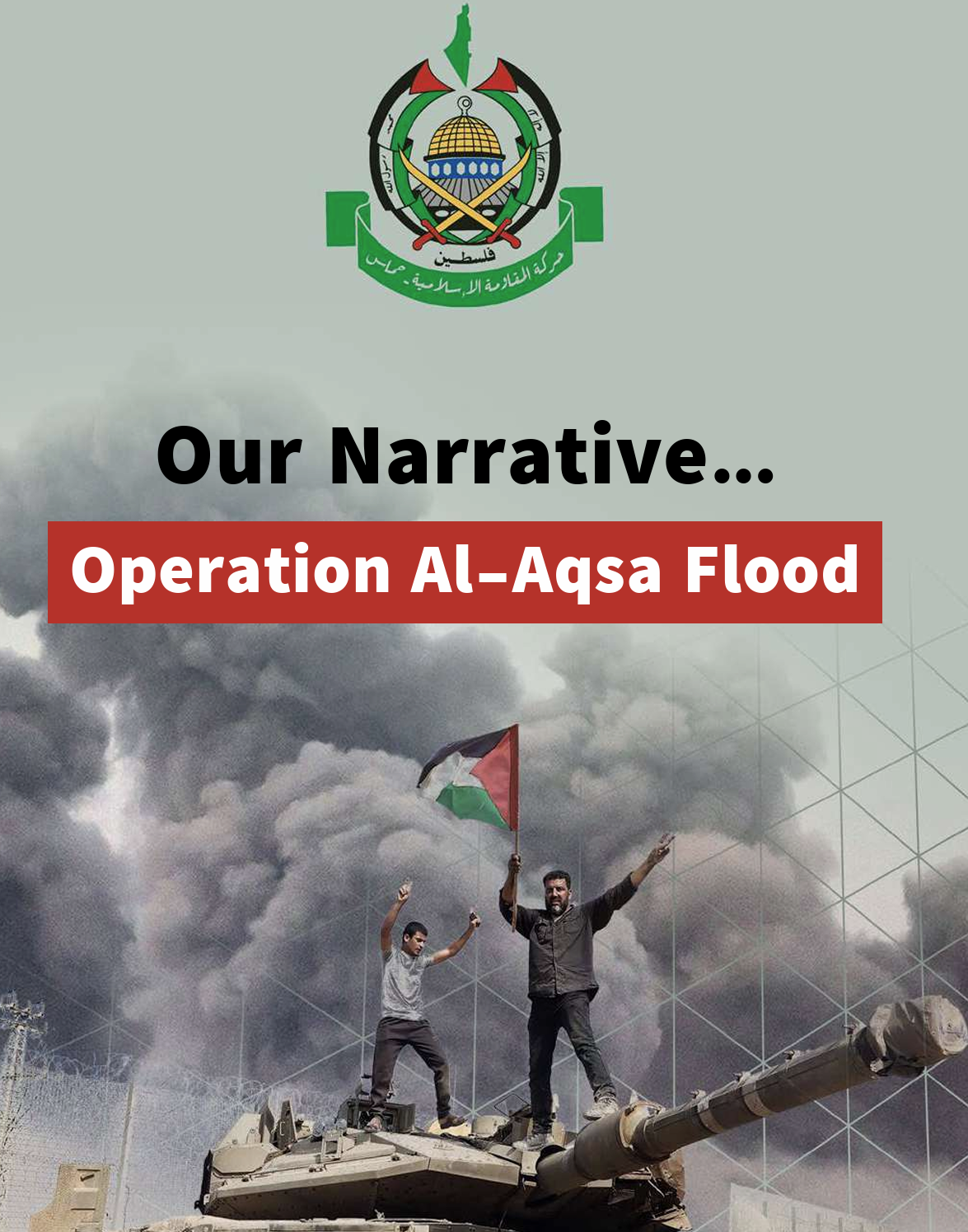
Hamas has released a slickly produced document providing a belated "narrative" of what happened on October 7. I link to it for reference, even though it's sickening reading for anyone with the slightest sense of justice or empathy for Israelis. 

It's quite obvious that this is written for a particular western audience and that Hamas knows how to write for that audience; it echoes many of the apologias one hears from its foreign sympathizers seeking to excuse its atrocities. Some of these are inserted in almost on reflex -- for example, in a section asserting that only military sites were targeted, the authors write that "the Palestinian fighters were keen to avoid harming civilians despite the fact that the resistance does not possess precise weapons." The lack of "precise weapons" is a line typically used in reference to Hamas' use of indiscriminate rocket fire, but it obviously has no bearing on the sort of close-quarters, ground operation that occurred on October 7 (Hamas' machine guns and grenades are more or less as "precise" as anyone else's machine guns and grenades; "imprecision" was not the problem here). But that follows from the overall tenor of the piece, which is to align Hamas' narrative with the way its most credulous apologists speak about Hamas -- to further bind these groups together as "all on the same side."

That said, for the most part this document should be read as an official extension of the 10/7 denialism that the Washington Post reported on the other day: that 10/7 essentially "didn't happen" (the targets were military, any civilians killed were either targeted accidentally or were actually murdered by Israelis, reports of atrocities like rape are propagandist fabrications, and so on).

What's the point of a document like this? There are several:

First, it is piggybacking on the aforementioned denialist movement that was from the get-go primed to accept any possible narrative of Israeli perfidy. This tendency exists on a continuum, but even "soft-core denialists" who are primarily invested in viewing some of the more heart-wrenching charges (mass rapes, slaughtered infants) as exaggerated or fictious will treat Hamas' document as moving the Overton Window further. Certainly, the useful idiots who promote this sort of view didn't need Hamas to give them this document, but they will be encouraged by it and will hungrily consume it and use it to fuel further excretions.

Second, it is attempting to rewrite history. Everyone and their mother has congratulated themselves for the "realization" that Hamas' goal on 10/7 was to commit an attack of sufficient brutality so as to compel a bruising Israeli response that would wreck Israel's reputation and bolster the profile of the Palestinian cause. Having succeeded in generating such a response, it only makes sense to try and erase the initial provocation. If October 7 essentially "didn't happen", then everything that happened after October 7 is simply random unmitigated acts of Israeli aggression -- no longer "backlash", now just "lash".

Third, it is a form of "I know you are but what am I" trolling. At various points, the document characterizes Hamas' operation as an "arrest" mission ("Operation Al-Aqsa Flood on Oct. 7 ... sought to arrest the enemy’s soldiers"). Here I actually don't think the goal is directly to rewrite history, because (though lord knows where this optimism comes from) I don't think even Hamas' most credulous dupes could possibly believe October 7 was actually an arrest operation. Rather, here the very absurdism is the point -- the goal is not to make anyone believe something as absurd as October 7 being an attempt at effectuating arrests, it's to make people associate claims about effectuating arrests with absurdist propaganda.

We're all familiar with the Sartre line about how antisemites "like to play with discourse" while aware of the "absurdity" of their arguments. and that's what we're seeing here. Israel does engage in genuine arrest operations on a regular basis. By "genuine", I don't mean that these operations are not or cannot be abusive, legally dubious, violent, unethical, etc.. But that doesn't mean the label of "arrest" operation is an absurd one; it's an accurate characterization of the operation (even if it is an abusive arrest, a legally dubious arrest, a violent arrest, and so on). Hamas' goal, though, is to render that word something absurd; the sort of thing we all know is just a euphemism for lawless authoritarian abuse. Think of a term like "re-education" -- when we hear a government say that a given political dissident was "re-educated", we go beyond viewing it with a skeptical eye ("was this an abusive form of education?"). We don't view it literally at all -- we understand that "re-education" is just a term authoritarians use to bowdlerize taking dissidents into a warehouse and beating them until they recant. "Re-education" isn't (sometimes, often, even always) "done abusively", "re-education" isn't done at all. The goal here is to make "arrest" be treated similarly -- an absurd term that Israel and Hamas use in obviously non-literal fashion to describe periodically raiding the territory of the other and killing people in it.

And finally, we should not overlook that this document is a means for Hamas to retraumatize its victims. There is power and sadistic pleasure in not just inflicting hurt, but also then being able to stand impassively (or -- perhaps even better -- with the most subtle of smirks) and declare that nothing actually happened, that the victim is making it all up. That, alone, would suffice as a motivator -- a psychological insult on top of injury. The forced photographs of captives "smiling" -- cited in the document as proof of Hamas' gentle hands -- are of course part of this play; a means through which victims are coerced into serving as testifiers against themselves.

A Palestinian friend of mine, responding to the article about increased 10/7 denialism, reposted comments by former Palestinian Israeli MK who observed that Palestinians are "not good people that only do good things." "Victims of the occupation aren't good people, they're victims. They are not righteous, they have a just cause." The cause of ending the occupation is just, but this does not mean that all persons under occupation -- or even all those who purport to act under the banner of "ending occupation" -- behave righteously (any more than the justness of the cause of Jewish self-determination means that all those who act under that banner behavior righteously). It is no adjunct to opposing the occupation that one must believe Hamas incapable of the horrific acts of violence and sadism that the evidence overwhelmingly documents occurred exactly as alleged, and to spread Hamas' lies on this front is not "solidarity" but sadism. The fellow travelers here -- for example, Mondoweiss, which was highlighted for the particularly vicious denial of sexual violence perpetrated by Hamas fighters -- should be called exactly what they are.

Can a Bibi-Led Israel Get to "Yes" on a Ceasefire?


A recurrent theme I've been hitting regarding calls for a "ceasefire" is that the term is meaningless without explication of the ceasefire's conditions. Everybody is fine with a ceasefire under certain conditions; the disagreement is regarding what those conditions should be. This, after all, is the basis for the obviously smarmy "Hamas could just surrender" take as a mechanism for ending hostilities -- it would cease the fire if "agreed" to, it just isn't a proposal that actually will be agreed to.  

Going off that insight, I've sometimes wondered why various Jewish groups -- or the U.S., for that matter -- haven't gone on offense a little bit in terms of proposing their own "ceasefire" plans whose conditions are agreeable. In general, any ceasefire proposal competes against whatever the belligerent parties think they can obtain from continuing military action, minus the costs of continuing military action. "Hamas could just surrender" may be a bit too brazen, but there are absolutely possible ceasefire conditions that wouldn't be quite so obvious non-starters that nonetheless could and should be viewed as substantial victories for Israel.

A ceasefire proposal based on immediate return of all hostages would be an obvious place to start. It could be paired with some other goodies -- Hamas' leadership agrees to go into exile into another country; proceedings against Israel at the ICJ are dropped. Submit that to the UN Security Council and make other countries vote against it. Make the other side be the one to say "yes, we might have said 'ceasefire now!', but not like this ...." The fact is, after all, that both Israel and Hamas have found themselves in the position of rejecting certain ceasefire proposals, but in the war of public opinion it would seem advisable for Israel and its allies to be seen as authoring proposals for peace rather than nixing them.

There are undoubtedly a multitude of reasons why this is too clever by half. But I think there is one specific, uncomfortable reason why we haven't seen Jewish groups pushing a line like this -- putting forward "ceasefire" conditions or urging the Biden administration to do the same. Simply put: they're worried that Israel would reject even a good, "reasonable" ceasefire proposal. And if that happens, after the Jewish groups endorsed the parameters, they'd have boxed themselves into the awkward position of positioning Israel as the obstacle to a just peace.

Several years ago, I broached the generic version of this worry in discussing the possibility -- unthinkable, in the Jewish world -- that contemporary, Bibi-era Israel might not be willing to agree to a "fair" peace agreement with the Palestinians. And at the moment, this worry is more than generic. Consider how Tom Friedman described the situation the other day in a conversation with Ezra Klein:

Netanyahu, I would argue, Ezra, doesn’t want to win. He wants to be winning, OK, that is, he wants to be able to say, we’re winning. We’re winning. We’re winning. It’s just around the corner. But he doesn’t want to actually win because, if the war actually ends, two things are going to happen. Then he can no longer avoid what is the new political end state. And I believe there will be an eruption, a massive eruption, of Israeli anger at him that I hope and pray will drive him from power because I believe he is not only the worst leader in Israel’s history. I believe he’s the worst leader in Jewish history.

And that’s a long history. And what is Netanyahu’s calculation? It’s very simple. If he is not in power and has to face the conclusion of his trial and three corruption charges without the protection and influence that comes over the judiciary from being in power, he has a very good chance of going to jail. People forget. Israel jailed a president and a former prime minister. They’re not afraid to do that. And he does not want to go to jail. And he does not want to give up power.

And so this is a terrible situation where Israel is in a existential war, and its prime minister has basically dual loyalties, one to the state and one to himself. And at every turn, he is prioritizing himself.

Put differently, where one takes Israel's goals to be things like "bringing the hostages home" or "destroying Hamas", one can at least understand opposing a ceasefire proposal to the extent that such a proposal will not lead to those outcomes (whilst continuing hostilities might). But the corollary to that is that if one believes those are Israel's goals, then a ceasefire proposal that does effectively accomplish them would be agreed to be Israel. And the corollary to that is that if Israel does not agree to such a proposal, it pretty decisively falsifies that these are the real goals. In short: making the proposal really puts that belief to the test, and no matter what they aver publicly I don't think most Jewish organizations are confident that this bet would pay out.

In a recent social media thread, Sen. Chris Van Hollen (D-MD), alluded to this point. The cause of bringing home the hostages and incapacitating Hamas is indubitably just. But Bibi has not been comporting himself as if these are his primary goals. He's been acting in a fashion that suggests that his main goals are dragging this war on indefinitely to prolong his moment of political reckoning and appeasing his ultra-right coalition mates. And those objectives are absolutely not worth opposing a ceasefire for.

It is possible -- and proper -- for the United States to put this to the proof: if Israel wants to continue to receive American military backing, it has to show its objectives are what they say they are, rather than a self-centered way for Bibi to save his own skin while permanently kneecapping the political and social viability of Palestinian nationhood. If Bibi decides that the latter is more important than maintaining American support, well, that's his call to make (until the next election anyway), and the rest of the world in turn can make any number of justified inferences from those revealed preferences.

Thursday, January 18, 2024

No Justice, Yes Peace


Among the signs that were spotted at a major pro-Palestine protest in New York back in November, there was one that read "Ceasefire Now," and another nearby insisting "No Peace on Stolen Land".

In my constant search for gallows humor to cut the bitterness of the present moment, I couldn't help but chuckle at this incongruity -- two messages at the same march, one calling for an end to violence, the other insisting that the violence must continue. And yet, despite their seemingly obvious incompatibility, one suspects that the sign-bearers don't see any conflict.

At one level, this validates the suspicion many pro-Israel folks have about the disingenuity of at least some calls for a "ceasefire" -- namely, that they don't want a ceasefire at all. They don't have a problem with military action per se, they just think only Palestinian militants should be allowed to do it -- a war where only one side is allowed to show up.* There is no incompatibility, it turns out, in demanding a ceasefire on October 6 and October 8 while insisting on the legitimacy of more October 7s. 

At another level, this illustrates something far more banal about calls for a "ceasefire" -- namely, "on what conditions"? As I've noted, everybody -- no matter what "side" they align with -- would support a cessation of hostilities under certain conditions. For some, the conditions are "the elimination of the Zionist settler-colony"; for others, it may be "the complete overthrow and overhaul of Gaza's Hamas-run government." Of course, these conditions are neither easily imposed nor agreed upon by at least one party to the conflict, hence, no ceasefire. And even once we get past those extremities, there still are plenty of sticking points that can thwart a ceasefire proposal. It's no accident that both Hamas and Israel have, over the course of the past few months, been in the position of rejecting various ceasefire proposals on offer. Neither party, unsurprisingly, is bent on an unconditional ceasefire. For both, there are certain demands that, if not met, will prompt them to keep fighting. And the same is true of their external backers. There is essentially no genuine "anti-war" movement to speak of, prioritizing ending the conflict above all else. What there is, rather, is widely divergent disagreements over under what circumstances war and military action are justified.

And that, in turn, brings to mind a different slogan one might find associated with protests like these: "No Justice, No Peace." Like "no peace on stolen land," this slogan places a boundary -- a condition -- on calls for peace. It is against a "ceasefire" that allows injustice to persist and retrench itself while under siege. It explains a circumstance in which calls for peace will be rejected; where violence must continue. Peace is not a sacrosanct good. Where there is no justice, then peace cannot be allowed to obtain.

We all, I think, can grasp the appeal of this slogan. And essentially anyone who is not a full-scale pacifist agrees with it in part -- believing that some injustices cannot be acquiesced to in peace. But I also think the events of the past few months should also prompt a critical reflection on this slogan, whose romantic valorization of the noble struggle perhaps masks what "No Justice, No Peace" actually means in practice.

Israelis will tell you that the war in Gaza is a war about justice: justice for those maimed, kidnapped, raped and murdered on October 7. They aren't without a point. Is it "justice" that those who orchestrated that awful butchery walk free? Is it "justice" that Hamas after all the terror it has wrought remains entrenched in power in Gaza? There is no justice in those states of affairs. Justice is ensuring that Hamas is utterly destroyed. Justice is seeing the terrorists behind October 7 either in custody or in graves. And so to those who call for a ceasefire now, the Israeli response at its most basic is: "no justice, no peace."

Of course, from the other perspective, there are different injustices that generate the impetus behind "no peace" -- the injustices of occupation, of settler violence and IDF attacks, of the Nakba, and so on. And one can respond to that expanded list of injustices with yet more injustices coming from the opposite direction. My point is not to litigate every party's litany of injustices. My point is to simply observe that this -- these past few months -- is what "No Justice, No Peace" actually looks like when brought into its fullest, most terrible bloom. Countless dead, countless more suffering, unspeakable devastation and destruction -- all for a "justice" that has proven itself elusive.

It may be that some justice is necessary for peace to endure, but the brute reality is that the opposite is true as well: in any realistic rendition, peace will only be achieved by consciously agreeing to yield to some measure of injustice. If one wants peace, one must be willing to support it even accepting that peace means some injustice will not be mended, that some villains will go free, that some wrongs will be allowed to persist -- to say "no justice, but yes peace." 

The rawer the lack of justice is, the more this reality will rankle. Just a few weeks after October 7, before the ground invasion began, I wrote:

It is infuriating that the proximate villains of the atrocities on October 7 are largely inaccessible to be brought to justice. At some level, what we're seeing is an interplay between Israel's immense power (in the form of bombs and missiles and tanks) and terrible impotence (to have stopped the attacks in the first place, to bring justice to their actual perpetrators).
.... It is, I'll repeat, infuriating that we can't figure out a way compatible with basic human rights standards to make it so that Hamas pays its deserved price for the atrocities it committed on October 7.
It is infuriating. It is, in a sense, unacceptable. And yet, it may have to be accepted, if peace is to reign. For if that fury makes one truly insistent on "No Justice, No Peace," it is a fury that can justify near-endless war and carnage.

To be sure, one can take this insight too far as well: the whole reason this slogan has the purchase it does is, again, we all have a sense that some injustices cannot be acquiesced to peacefully. We're all figuring out where that line is, and it's hard for a reason. There's no obvious rule for when peace must yield to justice or vice versa.

But what I will say is that peace is very precious, because not-peace is awful. One should be very hesitant to shatter peace even for the noblest cause, because there is no such thing as a war in which only side is allowed to show up.

* For what it's worth, one does have to pay the piper on this, and so to the extent one characterizes Israel and Palestine (or Hamas) as "at war", then both sides are allowed to show up. This means that, even if I think it would be fantastic if Hamas was annihilated as a military force as soon as possible, genuine military actions by Hamas -- e.g., attacking Israeli soldiers in Gaza -- are not themselves war crimes. While all is not fair in war and there are ways of prosecuting a war that are criminal, at the very least in a war Israeli soldiers are allowed to target Palestinian militants and vice versa.

Sunday, January 14, 2024

Turkey Implements the Stefanik Principle


One of the more common refrains I heard by persons who wanted to defend Elise Stefanik's bad faith grandstanding on campus free speech was the supposedly rhetorical question "how hard is it to simply condemn 'calls to genocide'?" The problem -- well, not the problem because that implies there is only one, but a problem -- is "who decides what count as a 'call to genocide'?" 

We already knew, for instance, plenty of campus actors characterizing Israel's conduct in Gaza as "genocidal"; and it was not long before South Africa brought its own "genocide" charge against Israel before the ICJ. If, as is not improbable, the ICJ rules that at least some of the genocide claims against Israel are "plausible", one can only imagine the turnabout that will occur by the usual on- and off-line subjects who just witnessed pro-Israel activists claim the skins of several high-profile academic actors on the principle of "zero tolerance for permitting speech 'supporting genocide.'" This turnabout was absolutely predictable and while I'm not sure "deserved" is exactly the right word to use here (given that the persons who will be victimized will almost certainly not be named "Chris Rufo" or "Bill Ackman"), it's hard to deny the karmic significance.

But we don't even need to wait that long to see this poisoned tree bear fruit. In Turkey, an Israeli national playing for a Turkish soccer club flashed a signal after scoring a goal meant to represent solidarity with the Israeli hostages who remain in Hamas' captivity. As a result, he's been arrested by the police for "supporting genocide", with threats of further recriminations by the Turkish Justice Minister as well as a promise by his team's president that he'd be kicked off the squad. It's entirely unsurprising that, in the wrong political climate, merely signaling sympathy for Israeli hostages will mark one as a genocidaire (hey, who remembers that essay just days after 10/7 that arguing that even grieving dead Israeli civilians was a means of fueling the Israeli death machine?). Again, all of this was obviously predictable in advance, and while I doubt Turkey is taking its cues from Congress' most craven opportunistic weasel, it still demonstrates the naivete of anyone who thinks that the answer to Stefanik's "genocide" question was "simple".

The Ice Weasels Cometh


As some of you may know, Portland has been hit by a brutal ice storm this weekend that's knocked out power throughout the city. Over 200,000 customers lost power initially, and though that's now down below 80,000, my house is alas in that unfortunate cadre, with no reports about when the electricity will be restored.

Since we've only been in Portland a few years, we don't have a full read on how "normal" this is (though the zeitgeist I've seen seems to indicate "not normal"). It is my growing impression that Portland weather is generally quite mild for 359 days of the year, but twice a year -- once in the summer, once in the winter -- we get absolutely blitzed with an extreme event (109 degree temperatures and chaotic evil ice storm, respectively).

We've been sheltering in a hotel since Saturday afternoon, but tomorrow we're heading home in hopes that power (and with it, heat) will be restored soon-ish. If not, we'll try to find another hotel (the one we're in now has no more vacancies, alas). While the snow stopped today, it's not supposed to get above freezing until Tuesday, and (in true Portland fashion) Tuesday also is slated to see a resumption of sleet. So on top of everything else, the roads are probably going to be hell for awhile. Classes are still scheduled to resume on Tuesday, but I may have to cancel mine depending on how things go.

Hope everyone here is staying warm and safe, and wish us luck as we begin our sojourn home.

Wednesday, January 10, 2024

DeSantis' "Asylum" Offer to Jewish College Students


Florida Governor Ron DeSantis has issued an emergency order waiving various requirements for prospective transfer students into Florida public universities "who are seeking to transfer to a Florida university because of a well-founded fear of antisemitic or other religious discrimination, harassment, intimidation, or violence" at their current colleges.*

The "well-founded fear" language is borrowed from asylum law, so if I were a Jewish student considering this offer I'd have to be concerned that DeSantis' next step would be to traffic me right back out of the state via a one-way to a New England island.

In all seriousness, I have to give DeSantis a very faint tip of the cap here, if only because a few months ago I had a similar thought about whether colleges in blue states should offer a form of "asylum" running in the opposite direction -- assisting admissions or transfers of students leaving Florida public universities in the wake of DeSantis' assault on academic freedom and the rights of sexual minorities. I've certainly noticed an at least anecdotal uptick in "red state refugees" on the faculty side of academia, and it wouldn't surprise me to learn there's similar pressure on the student side. And on the other side of things, I actually wondered back in 2022 if DeSantis might seek to expressly differentiate himself from Trump on the subject of antisemitism. He hasn't really done so -- the seemingly obvious need of a GOP challenger to challenge Trump continuing to founder on the absolute inability of any Republican of substance to say a bad word about the Supreme Leader -- but he has tried to make "antisemitism" a relatively large part of his presidential narrative.

And so as DeSantis' presidential campaign continues to flounder in the most pathetic fashion, this reads like a theatrical attempt to capture some of the Stefanik-magic from last month. Of course, DeSantis isn't alone here. For whatever reason, Republicans have learned that fake performative concern about antisemitism is the easiest route for craven gutless mediocrities to become media starlets, at least for a few days. That it keeps on filling this role is maybe something that the Jewish community needs to ponder -- while on the one hand I'm not convinced it's actually Jews who are most impressed by these stunts, there does seem to be a repeated gullibility on this front that deserves closer interrogation. How has the GOP become so convinced that this play, in particular, is a winning strategy for them? 

* Nominally, "other religious discrimination" encompasses Muslim students as well -- an interesting prospect as various Muslim and pro-Palestinian groups have begun adopting the broad understandings of "antisemitism" vis-a-vis discourse about Israel and Zionism promoted by some Jewish groups and trying to cross-apply them to similar broad understandings of Islamophobia vis-a-vis how university actors talk about Palestine and anti-Zionism. In practice, it's hard to imagine that will amount to much -- in part because of the vagueness surrounding "well-founded fear" of persecution, and in part because the sort of person who is concerned about that sort of Islamophobia is perhaps unlikely to find Florida an attractive destination to flee to.

Tuesday, January 09, 2024

Vulnerable Situations


I was driving home from work the other night, and on my dimly lit suburban street I passed not one but two people walking their dogs while wearing all black, rendering them nearly impossible to see in the darkness (one had put a glow ring around his dog, clearly demonstrating his priorities regarding whose survival he cared about most).

I was furious as I passed them. How could they be so irresponsible? How could they put me in that situation? 

And then once I reached home, I reflected on that emotion, because it struck me as a bit weird and in need of unpacking.

Obviously, I was worried that I wouldn't see the pedestrian and would strike them with my car. Of course, if that happened, it'd be the pedestrian who'd actually be injured. I'm encased inside a one-ton steel tank. I'd be fine. But it'd be very traumatizing, and I'd feel terrible, and then there are the potential legal consequences -- those are all pretty scary, and it's that imagined prospect that really motivates my anger at the pedestrian.

So to sum up: I'm mad at the pedestrian for putting me in a position where I might be emotionally traumatized and/or face legal liability for seriously hurting them.

The thing is, when you put it that way, I sound like a sociopath. "Did you ever consider how you getting physically maimed on the hood of my car might effect me?" Who thinks like that?

Apparently I do, at least instinctively. So ... is that a sociopathic emotion? Certainly, we might say the pedestrian should behave differently (say, wear brighter colors) out of a healthy sense of self-preservation. But is there some sort of implied duty to the driver as well? Is there a sense in which someone who is vulnerable has, at least in circumstances where it is feasible/relatively costless, an obligation to mitigate their own vulnerability? Or is that nuts?

No broad moral here. Just a thought I was wrestling through.

Monday, January 08, 2024

Hostage Situation


While it wasn't on my formal list, I propose that one of our collective new year's resolutions be to remember that one does not, under any circumstances, have to hand it to Elise Stefanik:

Rep. Jamie Raskin (D-Md.) went after Rep. Elise Stefanik (R-N.Y.) on Sunday after Stefanik called those found guilty of crimes related to the Jan. 6 Capitol riots “hostages,” claiming that her divisive remarks are part of her efforts to join former President Trump’s 2024 ticket.

[....] 

“I have concerns about the treatment of Jan. 6 hostages,” [Stefanik] said. “We have a rule in Congress of oversight over our treatment of prisoners. And I believe that we’re seeing the weaponization of the federal government against not just President Trump, but we’re seeing it against conservatives.”

In the immediate aftermath of January 6, Stefanik was vocal in demanding the Justice Department prosecute those responsible “to the fullest extent of the law.” But that was then, and this is now, and now Stefanik sees an opportunity to pander.

That Stefanik is a craven opportunistic weasel is too clear to need remarking on at this point. Kudos also to Raskin for taking the obvious but nonetheless necessary shot:

Raskin also demanded that Stefanik apologize for her comments, pointing to approximately 130 hostages held by Hamas in Gaza amid the brutal war with Israel.

“People convicted of violently assaulting police officers and conspiring to overthrow the government are not ‘hostages,’” he said on X. “Stefanik must apologize to the families of 130 people being held hostage by Hamas right now. Her pandering to Trump is dangerous.”

Israelis being raped and brutalized in Hamas captivity are "hostages". Insurrectionists imprisoned after being duly convicted for crimes following due process of law are not. Simple. And while Stefanik's casual insult towards actual hostages is hardly the primary story, anything that dims the ill-gotten luster Stefanik "earned" via her bad faith grandstanding about campus antisemitism is worth applauding.

(Actually, I'll make one more observation here, which is that somehow prison abolitionists -- who might agree in concept with characterizing workaday criminal convicts as "hostages" and certainly would support greater scrutiny of how we treat prisoners -- have somehow managed to resist any "well, I may not like her, but you've got to hand it to Stefanik ..." temptations. Fancy that.).

Wednesday, January 03, 2024

Things People Blame the Jews For, Volume LXIX: American Healthcare Inequities


I really do try to stay off the bad place. You know that trope in cartoons where the protagonist runs away from monsters or a blizzard or some other element of chaos, and slams the door behind him? And then after a bit of quiet, he opens the door a tiny crack to see if the coast is clear, and the maelstrom immediately swirls in the doorway and tries to batter its way inside for the split second before he slams it shut again?

Yeah, that's what checking Twitter is like these days. Peek your head in for even a moment, and it's just immediately somebody denying 10/7 atrocities or a tsunami of Nazi reply guys or, as we have here, a sparkling new 21st Century Jewish Doctors' Plot.

Over at the good somewhat better place, I alluded to these posts to call them "a crystalline example of anti-Zionism in its 'antisemitism is the socialism of fools' guise," but also to observe that the degree to which sentiments like these are accepted or repudiated in the relevant communities of interest will depend almost entirely on how they're treated by non-Jewish non-Zionists. Obviously, the folks pushing or considering this line don't care a whit what I think, but Jewish anti-Zionists may be dismayed to learn their opinions will be equally irrelevant. The non-Jewish non-Zionists might have the epistemic authority to be able to arrest its momentum, but it will be hard -- in large part, because posts like this, precisely because of their antisemitism, are genuinely helpful to anti-Zionism's growth and influence in American politics. 

It is a great and comforting lie that "antisemitism hurts our [anti-Zionist] movement". Antisemitism is one of the most powerful mobilizing forces the world has ever seen; it would be stunning if it did not provide at least some help to any movement that managed to successfully harness it. To the extent Americans can be persuaded that Jewish nationalism is why the US doesn't have good health care, that's very likely to make more Americans anti-Zionist and so benefit anti-Zionism as a movement. It would be, when you think about, far too convenient if "opposing antisemitism" only entailed opposing things that already hurt the movement -- that's a cost-free action. The trouble comes when opposing antisemitism means actually forgoing useful tactics and ceding promising opportunities -- but that's where the rubber hits the road. 

(This doesn't mean that the only problem with Dr. Marya's supposition is that it hurts Jews. It does, in this case, also hurt the movement for health care equity insofar as it diverts scarce political mobilizing resources towards attacking a "cause" that almost certainly plays no role in the effects she wishes to undo -- hence, the "socialism of fools" moniker. In terms of raw political calculus, the trade-off at issue here is "more effective anti-Zionism" pitted against "less effective health care equity advocacy" -- alongside, of course, the danger toward Jews).

But substantive issues aside, I also want to flag a move in the last pictured post, where Dr. Marya -- after calling Zionism as "supremacist, racist ideology" which may be a "structural impediment" to American healthcare equity -- contends that to accuse her of antisemitism is "an ad hominem attack" that obstructs "substantive debate".

Do you see the issue? This is what I was getting at in my Fathom essay: the easy, almost reflexive treatment of "antisemitism" as, not a subject or component of "substantive debate", but as an obstacle to it. This invariably occurs in tandem with the speaker demanding absolute free rein to open fire on Zionism as racist and white supremacist and colonialist and apartheid and genocidal. We must have an open debate on the merits about those important allegations! But not so "open" that "antisemitism" can be part of the discussion. Alone among the "isms", it is cordoned off from "substantive debate" and treated as an ad hominem attack. This, to borrow (as I did in the Fathom essay) from Jerome McCristal Culp Jr., is not open debate at all, it is a "a coerced argument … that concedes the key intellectual contest." That this happens even in this context, where the issue to be "substantive debated" is as transparently absurd as "Zionist doctors are why we can't have nice health care things in America", is demonstrative of just how deep-seated the reflex runs.

I cannot quite say I respect the position that all of these "isms" (racism and antisemitism and colonialism and so on) are toxic to "open debate" and must be avoided -- it's too clearly unworkable and renders impossible too many obviously essential social conversations -- but at least that's a facially coherent position. The notion that antisemitism alone carries this toxicity (or, for people with different politic, every "ism" but antisemitism does) and for that reason "doesn't count" as part of the "substantive debate" is incoherent save for its naked partisanship. But its incoherence in no way is arresting its prominence: it is held by many and seducing many more. All we can do is flag its absurdity and demand that, if open conversations are to be had, then this is part of the piper that must be paid. There is no entitlement to not have to think about antisemitism, even if you really, really don't want to. And a claim of antisemitism is an argument, not a smear.

Tuesday, January 02, 2024

Out/In List: 2023-24

The other, less old but still venerable Debate Link tradition: The Out/In list!

Out                                                                 In

Black Sea                                       Red Sea

Cornel West, truth-speaker            Cornel West, grifter

Paper mills                                     Chat-GPT

Pack the Israeli Sup. Ct.                 Don't mess with the Israeli Sup. Ct.

Mastodon                                       Blue Sky

Achievement Hunter                      Jet Lag: The Game

Assistant Professor                         Associate Professor

Abraham Accords                          Free Palestine

Elon Musk                                      Sam Altman

Substack                                         Buttondown

Pac-12                                            One Big Mega Conference

Surging Nikki Haley                     Trump wins every primary by 50

Reining in the 9th Circuit              Reining in the 5th Circuit

#BelieveSurvivors                         #NotAllHamasTerrorists

James Corden                                Taylor Tomlinson

Electoral Count Act                       14th Amendment Section 3

Cybertruck                                     Lawsuits about Cybertruck

Learn to code!                                Learn autoworking!

Somali pirates                                Houthi pirates

NFTs                                              Index ETFs

Grindset                                         Collective bargaining agreement


Saturday, December 30, 2023

Words Have Consequences


I'm still traveling for the holidays, and so I don't anticipate writing anything especially substantive about South Africa's charge before the ICJ that Israel had failed to prevent acts of genocide, and incitement to genocide, in the Gaza Strip. But I did want to observe one thing.

I haven't read the document in detail, but word is that it is buttressed by citation to numerous public statements and tweets by various high-level Israeli government functionaries who've indulged in deeply extreme rhetoric vis-a-vis the Palestinian people. Consider the Ministry of Intelligence "concept paper" proposing ethnically cleansing Gaza's Palestinian population to Egypt, or the Israeli minister who floating dropping a nuke on Gaza. Harrowing stuff. And there's more where that came from.

The response to such rhetoric in many pro-Israel circles, from what I've seen, reminds me of how we were "supposed" to treat similar extreme rhetoric from the Trump administration. Persons on the "establishment" side of the GOP -- not MAGA types, but also not NeverTrumpers -- often acted as if it was unfair, a form of cheating, to treat extreme pronouncements by Trump or has lackies as if they actually were evidence of any sort of substantive intent on the part of the Trump administration. Don't we know he's a blowhard, a rabble rouser, that he's just playing to the base, that it's not serious? How outrageous, to act as if Trump's Muslim ban was a Muslim ban just because he said it was a Muslim ban.

There was something deeply pathetic about this mewling, in how it echoed the broader infantilization of the right. No matter how high it ascends and no matter how much power it amasses, one cannot be expected to treat the right seriously. It can never matter. And certainly, they can never be asked to take responsibility for what they say.

The same sort of apologias seem to percolate around the extremism amongst Israeli government officials. It's not so much people condoning the rhetoric, but they think it's just unreasonable, unkosher, a foul that it be viewed as anything other than the usual blowhards being blowhards. It's unfair that Israel might face consequences for what its ministers are saying aloud.

No. I mean yes, these blowhards are blowhards. But at some point, the price of becoming a president or a minister or a high-ranking government official is that your words have consequences. They aren't the equivalent of just shit-posting for LOLs or edgelording to own the libs. People are absolutely entitled to think that when high-level government officials say something, that something they said is evidence about actual government policy.

So I admit some satisfaction that these words are now being used as substantive evidence, that they are carrying consequences. They should. It's a good thing that they're not cost-free actions anymore.

To be sure: a charge of genocide is a grave one, and a finding should never be used as a means of saying "got 'em" towards even the most repugnant political figures. The findings necessary to establish intent are properly high, and to that extent the apologists are right that one has to actually do the work of showing that this rhetoric -- repellant as it is -- is actually manifesting as operational policy; one can't just cite the tweets and call it day. This rhetoric is evidence that makes it reasonable to look into the charge; it does not establish the veracity of the charge itself. And on the whole, while we may dispute what does and does not count as genocide, I don't think Israel's conduct crosses the threshold of what international bodies have themselves treated as genocide in the past, and it would be a little too in character for the ICJ to decide it needs to lower the bar now.

However. Words have consequences, and one consequence of having major government officials speak the way that they have is that an allegation which might otherwise seem completely outrageous or unfounded now have to addressed. When you've killed as many people as Israel has, and your ministers are speaking the way they do -- well, now you've got to defend yourself. You may have an explanation, but now you've got to actually give it. You lose the prerogative that people just accept on faith that these claims are absurd. That loss, and the need to actually defend against charges like this, is entirely a consequence of the Israeli government's own choices, and in particular the choice of Bibi to elevate the most vicious, far-right extremists imaginable into positions of power. Their words are now carrying a cost, and they should. There's nothing unreasonable, unfair, or unkosher about that.