Thursday, March 13, 2025

Vaccine Day


Today was our baby's two-month checkup, and that included a suite of vaccination shots.

It was not fun.

We have a remarkably mellow and relaxed baby. He rarely fusses. He started sleeping through the night basically immediately. When we arrived at the doctor's office he was smiling and cheerful, happily interacting with us and the doctor and the nurses (which made us feel very guilty -- "you don't know what's coming"). He's even gotten a few pricks before in his first few weeks of life and handled them with aplomb.

But these shots he, understandably, did not like. And it was heartbreaking seeing his eyes suddenly go wide when the needle went in, followed by him screaming and crying hysterically. Indeed, I think today we saw actual tears for the very first time. He was clearly both hurt and scared, and that's an awful thing to witness as a parent. (My parents reminded me that as a kid I was so afraid of shots that I ran around the exam table to try and avoid them -- imagine how difficult that was for them to deal with!).

He was, to be sure, fine. In fact, objectively speaking, he was a real trooper. Some cuddles from mom and dad, and a quick feeding from the rest of his bottle (which we wisely had on hand), and he calmed down pretty quickly. He slept the entire car ride home, and for most of the rest of the day he was a little sleepier and a little fussier than normal, but basically okay. By bedtime, he was essentially back to normal. I'm pretty sure the whole process was a lot harder on us emotionally than it was on him.

I do not believe child vaccination is "a personal decision". Occasionally it is a medical decision, for a small number of children for whom vaccination is temporarily or permanently dangerous. But for most people, vaccination is no more and no less than a civic duty -- an unpleasant one, to be sure, but just something you have to do as part of being a good citizen. As someone who hated shots well into adulthood, I very much understand why babies don't like them. But I'm not a baby, so I get mine. It's that simple.

Anti-vaxx sentiment is often chalked up to conspiracy theorizing and lack of trust in established institutions, and I have no doubt that plays a role. I wonder, though, how much anti-vaxx sentiment ultimately boils down to it being really hard, and really unpleasant, to consciously elect to do something that hurts (even if very temporarily, and even for their greater benefit) your child. It is, in a sense, very understandable that parents would want to avoid that wherever possible -- we do try to avoid that wherever possible. And so when some quack comes along and dangles an excuse not to do it, of course it can be tempting -- particularly for parents who lack support, or who are predisposed to second-guess doctors and other "elites", or who are simply exhausted.

This is not, to be clear, a justification or an apologia for avoiding vaccination. Much the opposite, it is a searing indictment of those charlatans who exploit this latent parental instinct in order to make both their children and all children less healthy and less safe. I can't think of anyone lower, and the fact that one such hustler is in charge of the Department of Health and Human Services fills me with immeasurable shame, and rage.

Tuesday, March 11, 2025

The Lawless Pit Holding Mahmoud Kahlil


Over the past few days, I like many have been expressing outrage over the arrest and detention of Mahmoud Kahlil, a lawful permanent resident of the United States, due to his involvement in pro-Palestinian protests at Columbia University. Federal agents raided his home and told him that his visa had been revoked; when informed he held a green card, they summarily informed that that had been revoked too.

I know nothing about Kahlil personally or his involvement in the protests (I've seen differing accounts of his role, but I haven't dug deeper because it honestly doesn't matter right now). And on a moral level, so much of what happened here sickens me. It sickens me that a permanent resident could be summarily snatched from his home and detained in clear retaliation for his expression. It sickens me that Jewish organizations putatively "fighting antisemitism" appeared to have played a direct role in his arrest. It sickens me that the ADL has fulsomely praised the operation, tacitly endorsing draconian anti-immigrant legislation that in a prior life it recognized as "the worst kind of legislation, discriminatory and abusive of American concepts and ideals" (I am heartened that other Jewish groups are speaking out against it). It sickens me to see Trump use the word "shalom" as a taunt. It sickens me to witness people trying to argue that this is ultimately Columbia's fault for not cracking down on the protests more aggressively, as if there is some straight line between potential underenforcment of the student codes of conduct and arbitrary arrest and deportation (news flash: university disciplinary issues -- even if you think they're mishandled -- should not be seen as deportable offenses!). 

And finally, it sickens me to see folks trying to finesse the issue by adopting a "well, let's see what the courts say before we rush to judgment" handwash. Partially, that's a problem because the entire seizure of Kahlil is a sterling example of the Queen of Hearts' justice: "sentence first, verdict later." If you've got Kahlil on a deportable offense, go through the legal process and prove it; don't start with the obviously speech-motivated arrest and then after the fact grope around for some figleaf of a legal justification. Everyone and their mother knows that whatever legal argument gets dredged up will be a pretext; the Trump administration is not remotely hiding the fact that it is targeting Kahlil for his speech.

But the bigger problem with waiting for the process of law to take its course is that I don't think people fully realize what a legal blackhole immigration law truly is.

I am not an immigration lawyer. But I do have some experience with immigration law, mostly during my judicial clerkship. My assessment of immigration law following that year can be summarized in two parts: (1) it was some of the most meaningful and impactful work I did, and (2) I never, ever wanted to be involved in it again. The explanation behind both halves of that equation is one and the same: immigration felt like a lawless pit. Our immigration law and doctrine is supersaturated with opportunities for governmental abuse that is largely immunized from any sort of meaningful review. To anyone with a passing familiarity with this system, it is outlandish to assert that our immigration system is too generous to migrants. Our immigration system is cruel, and arbitrary, and unfair, and in many respects essentially lawless. I was involved with it for a very limited amount of time, and to a very limited extent, and it still traumatized me in ways I continue to feel to this day.

So when I read Steve Vladeck's assessment of actual legal questions surrounding Mahmoud Kahlil's detention, I was not surprised, but I was alarmed. Vladeck does not argue that Kahlil's detention is lawful. But he does think it is not as clearly unlawful as is being asserted. The reason why, to be clear, is not that the Trump administration has some secret reasonable argument that's been occluded by the media firestorm. It's that our immigration law is so stacked with vague and abusive rules and dangerously deferential precedents that even misconduct as egregious as this might not be clearly forbidden. The lawless pit holding Mahmoud Kahlil is not something new. The Trump administration might be more brazen in exploiting these opportunities for abuse, but doctrinally speaking it had many tools lying around waiting to be picked up.

Indeed, one interesting thing about Kahlil's case is that it demonstrates a fascinating and underappreciated bivalence in the political salience of pro-Palestinian advocacy. On the one hand, it is very clear that Kahlil was targeted and made vulnerable by virtue of his pro-Palestinian speech. However, it is also clearly true that Kahlil's situation has mobilized and galvanized popular attention also by virtue of the fact that his case involves pro-Palestinian speech. Kahlil's case more clearly demonstrates both the distinct vulnerability but also the distinct power held by pro-Palestinian advocates I can remember in quite some time.

Again, the core problem of abuse in our immigration system -- the ability to arbitrarily and (functionally) lawlessly detain and deport immigrants for any reason or none at all -- is nothing new. I'm sure immigration activists could hand you hundreds or thousands of comparable stories of lawful residents snatched and detained for the most absurd or malicious of reasons. And while I have little doubt that most persons protesting on Kahlil's behalf would, if you gave them those stories, express genuine outrage over them as well, there's little doubt that the reason this abuse and this outrage captured public attention in the way that it did was because it involves an attempt to suppress pro-Palestinian speech, specifically.

This, to be clear, is not a bad thing. It is a good thing -- anything that encourages people to recognize the wild, lawless abuses latent in our immigration system generally and in the Trump administration's enforcement specifically is a good thing. But it is worth noting the more complex relationship with power that is being demonstrated here. Mahmoud Kahlil's story is about how the Trump administration feels empowered to destroy the lives of pro-Palestinian advocates by any means necessary; it also (sickeningly) is a story about how some Jewish organizations are cheering on the project. But it is also a story about how a connection to Israel/Palestine makes people care about things more often and more intensely than they often otherwise would. That is expression of power, and one that has implications that go well beyond this case.

Monday, March 10, 2025

RIP Kevin Drum


Sadly, Kevin Drum, one of the leading lights of the liberal blogosphere, passed away a few days ago.

Kevin had been battling cancer for quite some time now, and had regularly given his readers updates on the ups and downs of his condition. So while this wasn't wholly unexpected, it still hits hard -- we had seen many, many times before where he had bounced back, and I had hoped against hope that this time would be more of the same. Alas.

When Kevin left his last perch at Mother Jones to hang his own shingle, I wrote a little tribute to him which still captures my feelings now:

Drum was one of the first bloggers I read -- I don't think I caught him during his Calpundit days, but I sure read him at the Washington Monthly -- and was a tremendous influence on my own development as a blogger. I'm certainly not alone in that: Drum was a towering figure during the Golden Age of blogging, whose influence on the mainstream liberal side of the commentariat could not be overstated. And while blogging is fading as an artform, Drum remained decidedly old school and has accordingly stayed as one of my favorites. His work on the lead/crime hypothesis was absolutely fascinating and dare-I-say important, and in general I've always respected him for being thoughtful, considerate, and fair-minded without being mushy or wooly. Those are virtues that are perhaps in rare supply these days, and so I'm especially grateful to Drum for modeling them for so many years.

He will be very sorely missed. RIP, Kevin, and my condolences to his loved ones.

(LGM also has a nice tribute up). 

Friday, March 07, 2025

We Won't Be Fig Leaves For Your Fascism


Last night, I posted about the Trump administration's declaration of war on American academia, there taking the form of a threatened academic boycott of Georgetown University for having "DEI" in its curriculum. Today, the Trump administration continued its attack in even more aggressive fashion, axing $400 million of government grants to Columbia University, putatively as a sanction for campus antisemitism.

Let's get one thing clear off the jump: this is not about "fighting antisemitism". It is about destroying American higher education. We do not need to pretend, even for a moment, that fighting antisemitism -- which is very real, at Columbia and elsewhere -- has even the slightest relevance to the Trump administration's decision. As Jews, our only response should be to declare, loudly and without hesitation, for Trump to get lost. We will not be fig leaves for your fascism.

Because in reality, the only role Columbia's Jews are playing in this drama is that of the scapegoat -- Donald Trump is using us to soak up the blame for his authoritarian thuggery. As I noted the last time I posted on MAGA government officials targeting Columbia for "BDS"-style tactics, if it seems like these choices are hurting the Columbia Jewish students they putatively are supposed to "help", that's entirely by design. These people loathe Jews, generally, and Columbia's Jews, specifically -- the claimed love for "Jews" is entirely superseded by seething hatred for actual Jews. And so while the main goal is to hurt the university as a whole, hurting Columbia's Jewish students is I'm sure seen as a delightful bonus.

That the Trump administration is colonizing "fighting antisemitism" in service of his authoritarian agenda is despicable, and it makes Jews less safe (which, again, is entirely intentional). The other day, I was thinking about my baby boy growing up and starting school here in Portland, and, as all parents are wont to do on occasion, I began catastrophizing a little bit. I imagined him the victim of some antisemitic incident, and what I would do about it. 

And what paralyzed me was the thought that if I did need external support in some way (to go to the press, to blog publicly about it, to get the local Jewish Federation involved, etc.), I knew things would rapidly spiral out of my control, and my son would become a mascot for politics we never signed up for and fervently reject. We'd see people exploit our tragedy to attack DEI or indulge in anti-Palestinian racism, and nothing we could say or do would stop them, and nothing we could say or do would stop others from projecting those agendas onto us.*

It's a paralyzing thought because this fear -- and I think it's a very realistic fear -- would genuinely and seriously deter me from seeking aid I desperately need. It would push me to stay silent and quiet and suffer because seeking support would only make things worse. That's an incredibly lonely position to be in, and it's one that I think aptly characterizes how many campus Jews feel right now. We're lonely -- lonely because of the antisemitism we endure, and lonely because we know any steps we do take to publicize the issue will rapidly and brutally rebound against us, often by the very actors who most loudly boast they're "standing with us".

It is this loneliness that the Trump administration is intensifying. By wrenching "fighting antisemitism" away from what Jews actually want, and seizing it for his personal authoritarian revenge project, he isolates Jews yet further. We're isolated from other members of our community, we're isolated from actual resources of care and support, we're isolated from one another. It's despicable, and it's disgusting, and it is frankly terrifying. But the only way to fight it is to fight it. Don't indulge it, don't tip toe around it, don't even for a second pretend to think it has anything to do with actually fighting actual antisemitism.

We will not be fig leaves for your fascism.

* In many ways this is just the JV version of "dying politically", and if you think people would respect the victims they're nominally "protecting", you should see how people are responding to Hayim Katsman's mother right now.

Thursday, March 06, 2025

Georgetown Stands Up in the Face of the Trump Admin's Attempted Academic Boycott


A little while ago, the Interim United States Attorney for the District of Columbia, Ed Martin -- who has rapidly begun distinguishing himself as one of Trump's most odious foot soldiers -- sent a letter to Georgetown Law School demanding that they eliminate all "DEI" from their curriculum and threatening to refuse to hire Georgetown graduates until they do so (if "a little while ago" sounds vague, that's because it took Martin two attempts to send the letter -- he misaddressed it the first time).

Martin's threats are reminiscent of the announced boycott of Columbia grads by Judge James Ho and some of his fellow far-right travelers, and the Dean of Georgetown responded exactly how I wish the Dean of Columbia would have responded: by refusing to give in and also by naming exactly what is happening here: a threat of official government penalty against private institutions for refusing to kowtow to official ideological orthodoxy. This goes way beyond the "jawboning" or informal requests that caused conservatives to shriek their heads off during the Biden administration; we have in these cases an explicit promise of legal retaliation on private actors who don't toe the government's line. It is hard to imagine a clearer instance of de jure censorship than this, and Georgetown Dean Bill Treanor doesn't mince words:
As a Catholic and Jesuit institution, Georgetown University was founded on the principle that serious and sustained discourse among people of different faiths, cultures, and beliefs promotes intellectual, ethical, and spiritual understanding. For us at Georgetown, this principle is a moral and educational imperative. It is a principle that defines our mission as a Catholic and Jesuit institution. Georgetown University also prohibits discrimination and harassment in its programs and activities and takes seriously its obligations to comply with all federal and local laws.

Your letter challenges Georgetown’s ability to define our mission as an educational institution. It inquires about Georgetown Law’s curriculum and classroom teaching, asks whether diversity, equity, and inclusion is part of the curriculum, and asserts that your office will not hire individuals from schools where you find the curriculum “unacceptable.” The First Amendment, however, guarantees that the government cannot direct what Georgetown and its faculty teach and how to teach it. The Supreme Court has continually affirmed that among the freedoms central to a university’s First Amendment rights are its abilities to determine, on academic grounds, who may teach, what to teach, and how to teach it.

This is a bedrock principle of constitutional law – recognized not only by the courts, but by the administration in which you serve. The Department of Education confirmed last week that it cannot restrict First Amendment rights and that it is statutorily prohibited from “exercising control over the content of school curricula.” 

Your letter informs me that your office will deny our students and graduates government employment opportunities until you, as Interim United States Attorney for the District of Columbia, approve of our curriculum. Given the First Amendment’s protection of a university’s freedom to determine its own curriculum and how to deliver it, the constitutional violation behind this threat is clear, as is the attack on the University’s mission as a Jesuit and Catholic institution.

Georgetown Law has one of the preeminent faculties in the country, fostering groundbreaking scholarship, educating students in a wide variety of perspectives, and thriving on the robust exchange of ideas. Georgetown Law faculty have educated world leaders, members of Congress, and Justice Department officials, from diverse backgrounds and perspectives. We pride ourselves on providing an excellent graduate and professional education, built upon the Catholic and Jesuit tradition. Georgetown-educated attorneys have, for decades, served this country capably and selflessly in offices such as yours, and we have confidence that tradition will continue. We look forward to your confirming that any Georgetown-affiliated candidates for employment with your office will receive full and fair consideration.

Very well said. The appeal to religious liberty is also appreciated in this context, though I suspect the Jesuits will fare as well as liberal Jews will under the new free exercise jurisprudence.

It should be clear by now that the Trump administration and its right-wing fellow travelers are launching a full-fledged BDS campaign against American universities that don't bow to its ideological agenda. The proposed academic boycott against Georgetown is one example, the myriad donor threats to divest their funding from colleges that don't crackdown on disfavored programs or speech is another, the proposal to sanction Columbia by axing over $50 million in contracts is yet another. These endeavors are an anathema to academic freedom and First Amendment values, and must be opposed by all principled defenders of the academy.*

* What a shame that the AAUP recently and abruptly shifted course and decided, after decades of strong opposition, that actually academic boycotts are a-okay. It's almost like it was eminently predictable that abandoning that principle might backfire very quickly given how the right has been racing for excuses to punish universities who they've deemed "complicit" in ideological projects and activities they oppose!

Tuesday, March 04, 2025

How To Handle Leopard Chow


Has there been a more resonant viral post in the past decade than "'I never thought leopards would eat my face,' sobs woman who voted for the Leopards Eating People's Faces Party"? It's so funny, and so evocative, and I can't believe we're going through it a second time.

But we are, and articles like this about axed federal workers ruing their votes are once again setting off a discussion about how the rest of us should relate to these remorseful Trump supporters. Basically the entire conversation is about being pulled between two entirely reasonable and understandable instincts.

  1. Trump won the last election. If Democrats are going to win the next election, by definition they need to persuade some number of people who either voted for Trump or couldn't be bothered to vote against him to make a different choice. When at least some erstwhile Trump backers signal they're waking up and recognizing their mistakes, that's an unabashed good thing.
  2. Trump voters made a choice that in all cases was some combination of bone-jarringly stupid and actively malicious. That they're now facing consequences for their actions is entirely their own fault and moral just deserts, and the idea that they're entitled to even a smidgeon of emotional care and support from the rest of us (many of whom are suffering too) is outrageous.
My basic belief is that if you are a professional political operative, you have to emphasize the first instinct over the second. That's not because the second is unreasonable or unfair! It's just that it's the job. If you don't think you can do it, if that thought makes your stomach turn, that doesn't make you a bad person, it just means you might not be cut out for this job. Politics as vocation is not a venue for people to simply pour out their personal emotional baggage, however genuine and heartfelt. Take a different job.

But most people, including most random Democrats who post on social media, are not professional political operatives, and our own frustration/schadenfreude should not be confused with some sort of official party line. It's one thing to say Democrats need to have message discipline, but that demand is an impossible one if it means preserving "discipline" over every BlueSky account with #resist in the bio.

As for me, perhaps the deepest root of my frustration is my sense that even for the leopard chow, these lessons will not be internalized. The WaPo article, for instance, notes at the outset that the protagonist's own family and loved ones are cheering the very governmental cuts that have destroyed her future. I'm sure they think her firing was a mistake, but it's prompting no broader reassessment. After all, how many times have we seen posts of the form of "I support the goal of eliminating government waste, but my job is important and I'm a hard worker, so I can't believe you would terminate me?" For every one of those posts, I guarantee that the guy you have mind as the example of "government waste" is drafting his own post explaining why his job matters while envisioning you as the right target to fire. The reality is that there just aren't, in the scheme of things, all that many government jobs that are useless or wasteful -- they're part of an important machine that makes society run. But as long as everyone thinks they're exceptional, they'll continue to miss the six-lane expressway starting from their contempt for their peers and ending at their own ruination.

Right after Trump was elected, I predicted this. The day after election day, I wrote of Trump's supporters that:
They will laugh as the leopard eats their neighbor's face, and then some number of them will be stunned, not just that the leopard turns on them, but that the people they were laughing with a moment earlier keep on laughing as it eats their face. There is no actual solidarity here, just an enjoyment of the cruelty and enjoyment of finding oneself on the right side of the cruelty, and there is perverse power in that -- your buddy next to you might get betrayed in an instant and it won't move the needle an inch. They will keep laughing even when their fellows are being hurt, so certainly they will keep laughing straight through our marches and protests and rage.

What are we do to do about this? Even if these people do recoil from the leopard gnawing on their face next election, they'll inevitably exhibit the memory of a goldfish the next a Democrat takes office and the price of eggs goes up 5 cents, or some Facebook meme convinces them that immigrants are going to eat their cat, or they just get bored with living in an era of unprecedented abundance and decide a little performative cruelty will fill their thirst for meaning. I just don't see a way of making the lesson stick with any scalability, and it's maddening.

Again, as a political message, none of this is useable. But that doesn't make the instincts unreasonable. Is it our job to try to win back half-eaten leopard chow, no matter how responsible they are for their own (and all of our) plights? Yes, it is. But nobody can judge us for judging them harshly, or having dim hopes that they'll actually clear the most bare-minimum bar of virtuous citizenship with any consistency going forward. They deserve the scorn they receive.

Thursday, February 27, 2025

WaPo Goes X


In the latest Bezos bulldozer to the Washington Post's credibility, the Amazon.com owner has announced a new party line for the editorial page. Henceforth, he wrote, the editorial page would be dedicated to two views: "personal liberties and free markets." "[V]iewpoints opposing those pillars" will not be published. Bezos argued that while once upon a time it might have been "a service" for a newspaper "to bring to the reader's doorstep every morning a broad-based opinion section that sought to cover all views[, t]oday, the internet does that job." The decision led to the resignation of the Post's opinion editor and another wave of discontent amongst the paper's rank-and-file.


My initial thought was to wonder exactly which viewpoints opposed to "personal liberties" and "free markets" Bezos thought the WaPo had been publishing. My second thought was to ponder which views contrary to "personal liberty" would actually no longer be published. Vaccine mandates, I assume. I certainly doubt opposition to trans healthcare, or impinging on a woman's right to choose an abortion, will take on verboten status. As for "free markets" -- kleptocratic suckling to government strongmen for fear of legal retaliation: free market, or no? We'll find out soon enough!

Bezos' move is obviously about effectuating another rightwing shift in the paper (the New York Times noted that Bezos' duo echoed the informal motto of the notoriously extreme Wall Street Journal editorial page: "Free Markets, Free People"). The newsroom remains unaffected for now (the Post's own article on Bezos' decision is a good read), but we'll see how long that lasts.

It gives Bezos far too much credit to compare this decision with his other attacks on the Post's independence, but let's go through the motions, because it does demonstrate that there are no actual principles -- journalistic or otherwise -- in play here. Bezos' indefensible defense of his presidential non-endorsement decree was predicated on the idea that the narrowing force of a presidential endorsement would necessarily suggest journalistic bias and damage the paper's credibility -- a demand for wider viewpoints, not narrower ones. The Post's Scholastic Kids Choice-esque new motto, "riveting storytelling for all of America" tries to sound a similar theme: the Post needs to speak to a wider audience by presenting a wider range of views; it cannot remain cloistered as the mouthpiece of a particular bubble. Juxtapose that against his newfound contempt for a "broad-based opinion section", and the contradiction is obvious -- but "contradiction" again assumes there was a principle in play in the first place. There wasn't -- that was obvious before, and it's more obvious now.

As a business move, there's zero chance that any part of Bezos' demolition derby will redound to the Post's benefit. But I don't think he cares, because he's realized that the Post offers him something far more valuable than a business. It offers him a mouthpiece.

The footsteps Bezos is following here are those of Elon Musk and X. As a business, Musk has of course run X into the ground. But if you're a rich as Musk or Bezos is, that loss is a rounding error. What Musk has gained, of course, has been a megaphone to promote and amplify whatever views and ideologies that appeal to his fancies -- in his case, a cavalcade of conspiracy theories and white supremacist MAGA garbage. Even for our most rapacious capitalists, not every investment has to be monetary -- spending money to bend the arc of the entire world's political discourse surely can be viewed as money well spent (and of course, under the right conditions even an objectively cratering business can still gain value if it is seen as a gateway to the autocrats).

So too, it seems, for Bezos and the Washington Post. Are these moves going to gain back the subscribers he lost? Doubtful. It probably will accelerate departures. But the Post's name still has value, and now it gets to be Bezos' own personal Pravda. Whatever that costs, Bezos is clearly willing to pay it.

Wednesday, February 26, 2025

Betar Expulsion as Trump Impeachment


The other day, I wrote about the new(-ish) far-right organization operating in Jewish spaces, Betar. Betar has distinguished itself for its open endorsement of hate and violence directed both at Palestinians (its response to reports of Israel killing children in Gaza was to say "Not enough. We demand blood in Gaza!") as well as Jews it views as insufficiently fundamentalist in our Zionism, which in their case means virtually all of us.

Since them, they've gotten into a spat with the ADL after the latter added them to its database of extremism. And then a competing slate in the World Zionist Congress elections, Kol Israel, moved to have Betar expelled from the American Zionist Movement, citing both electoral blackmail tactics and Betar's "abhorrent" calls "for genocide and the murder of Palestinian babies." Betar, through its coalition partner ZOA (there's a team-up everyone could see coming), has warned of filing retaliatory complaints against Kol Israel.

On the one hand, it's always good to see groups stand up to racist thugs like Betar. On the other hand, this feels eerily reminiscent of how the political establishment treated the rise of Donald Trump. 

After years of ignoring, excusing, coddling, and enabling him, January 6 happened and for an instant it seemed like folks woke up and sanity might be restored. But the reality was it was already too late -- the supposedly unthinkable extremism that Donald Trump represented had become normalized through those years of excuse and neglect. Even in the most incredible moment -- the immediate wake of an outright insurrection against the United States -- the effort to rein him in fizzled out, and he would soon reestablish himself as at the center of a conservative movement that at one point would have viewed as the most outrageous slander the charge that it would harbor the likes of Donald Trump. They failed to stop him when they could, and found themselves isolated and alone when they (briefly) roused themselves to try.

That pattern seems apt here. Efforts to kick out ZOA from the Conference went nowhere. A similar initiative at the Boston JCRC, one where it was admitted ZOA "elevated White supremacism", only ended up yielding the eventual departure of the left-wing group the Workers Circle (that group also left the Conference). In Isarel, years of enabling and nurturing the neo-Kahanists have made them into the dominant force in Bibi's coalition -- a cadre that is not just ("just") contained to secondary parties like Jewish Power but is running riot through Likud itself. In the diaspora, too, Kahanism is being ever-more normalized as something other than a violent mob of racist thugs. Everyone who thought this was just posturing, or political jockeying, or unsavory alliance-making, but who was sure that if and when the time came they could pump the brakes has been proven to be a fool. There are no brakes. As I wrote in my first post on Betar:

[L]eaders of social groups that simultaneously play footsie with the sort of extreme rhetoric while assuaging themselves that of course their actual politics are humanitarian and egalitarian, they're just revving up a crowd or exaggerating for effect, will quickly learn that much of their base isn't in on the bit. They're in it for the hate, and when someone offers that hate better, they won't listen to your attempts to rein things back in.

So as happy as I am to see groups try to stand up to Betar and ZOA, I am dubious about their likelihood of success. The most likely outcome for Betar and ZOA is exactly what they've enjoyed for years by the mainstream Jewish institutions: averting their eyes, kicking the can down the road, hoping the problem solves itself -- and with each passing moment, what once was unthinkable becomes undislodgeable.

Maybe eventually, someone will learn a lesson. But I doubt it will be this day.

Tuesday, February 25, 2025

How To Expand the NCAA Tournament


It's not breaking news, but apparently the NCAA is considering expanding its college basketball tournament to 72 or 76 teams (from the current 68).

As a certified curmudgeon, I've opposed every tournament expansion since it was at 64 teams. The basic problem is obvious: the expansions are all soulless cash grabs, and the beneficiaries are inevitably the ninth best team in the Big Ten with a barely over-500 record who'll get trounced in one round, two if lucky. Who cares?

The nominal reasons for this expansion (again, skipping past the real one, which remains "cash grab") are (a) that there are more schools in Division I than ever before, and (b) that the small number of "play-in" matches means that most fans don't view the games as "real" parts of the tournament. Expanding the number of play-ins so it more closely approximates a full tournament round means more attention to all of them.

The first reason doesn't move me. The second actually does carry some weight for me, since my absolute favorite sports weekend of the year is the first two rounds of the NCAA tournament when it's just an endless stream of do-or-die basketball and a more robust play-in round might approximate that. But again, I just don't have any real interest in seeing a few more mediocre Power Five conference teams get trotted in as sacrifices.

So here's my proposal: expand the tournament, but all the new at-large bids have to go to conferences who don't have any non-automatic qualifiers.

After all, isn't that why we watch the tournament? It's for random schools from nowhere-ville coming out of the 14 seed slot to knock off Kansas. Give me more opportunities for that! Right now, there are a bunch of conferences whose only representation is the auto-qualifier, and in some of those cases the auto-qualifier is not the best team in the conference (looking at you, 1997 Fairfield). I don't have a problem with that -- it's awesome when an objectively terrible team has a miracle run in their conference tournament to gain the auto-qualifier. But the point is I'd absolutely prefer the actual best team in that conference to get a chance to dance over some big-name school that's already proven they can't hack it.

So sure -- expand the tournament. But this time use the opportunity to spread the wealth. Down with the mediocre big names; up with the obscure mid-majors!

Monday, February 24, 2025

The Irrelevant Innumeracy of the Swarmed GOP Town Halls


Surely by now you've seen the stories about GOP congressmen, in deep red districts, being absolutely swarmed by angry constituents furious that they're not standing up to Trump, Musk, DOGE, and the buzzsaw attack on hardworking federal employees.

My thesis about this will be twofold. First, there's objectively less to these events than meets the eye. And second, it doesn't matter that there's objectively less to these events than meets the eye, and we should all behave like they're exactly what they appear to be.

Start with the first. The excitement over these protests relates to the sense that anger and outrage over Trump has expanded beyond the blue bubbles and is penetrating even dark red terrain. But the mistake here is something I alluded to in my How To Tokenize with Proportions post. A congressional district where a Republican won by, say, a 66-33 margin is by any measure a dark-red district. But it also is a district where one in three voters voted Democrat. One in three is a lot of people! In a congressional district of 750,000, it's 250,000 people! It is not hard to fill a high school auditorium, particularly if that 250,000 is feeling especially angry and activated.

It's an issue of framing, if you're generous, or innumeracy, if you're not: 33% doesn't feel very common, 1 in 3 feels very common. Politically speaking, the former is closer to accurate, which is why congressional districts where one sees 66/33 margins aren't typically treated as competitive.

But what innumeracy taketh away, innumeracy also giveth. The fact is that most people see a crowd of angry constituents filling an auditorium in a deep-red district and don't start doing math about how easy or hard it is to fill up the space given the baseline number of Democrats around. They just see the crowd. Politics is often a game of perception and of momentum -- people see others in their community and in their spaces expressing anger and fear and frustration, and it validates their own nascent feelings of anger, fear, and frustration. It makes them feel like they're not alone. It encourages them that these sentiments are common in their community, and that they're not weird or outcasts or loners if they feel them too. All of that starts to build a narrative conducive to resistance. And even if it doesn't mean the deepest-red congressional districts will flip blue in 2026, it gets that permission structure going that will make life very difficult for Republicans in more vulnerable seats.

So keep swarming. Keep yelling. Keep sharing those vids. Build up that narrative that people everywhere are mad as hell, and they're ready to fight. In politics, image becomes reality before you know it.

Ailing

An inevitable event every new parent dreads is the first time their baby gets sick. But a less remarked on, but almost as frightening prospect is the first time you, the parent, gets sick while caring for a baby.

This past week, my keratoconus has been acting up. Looking back on my chart notes from the last time this happens, it appears I have corneal hydrops, which starts manifesting as dry eyes and quickly progresses into significant eye irritation, light sensitivity, and extreme tearing (the other day tears literally started jetting from my eyes when I woke up). In my case, these symptoms also come alongside sinus symptoms on my left side -- so my left nostril is running and I have pain in my left orbital socket and along the teeth the upper left part of my jaw.

Being "sick" (I'll address the quotation marks in a moment) is never fun, but it is far less fun when you have an infant in your care. When it's just you and/or your fellow adult companion, you can kind of slough off your responsibilities temporarily until you're feeling better. No reasonable person will hold it against you if you push back a deadline or skip out on making dinner. In most cases, your loved ones will be able to shuffle some of their responsibilities around to help you. You get taken care of.

But an infant is, of course, quite needy, and it can't press pause on its needs to accommodate yours. If I need to tap out of my evening care shift, my wife has to take it, and then she isn't getting the sleep she needs. If we need to go to the doctor's and I'm not up to driving, then she has to drive, which means he has to come and she has to be up to driving, which, again, is harder when she's getting even less sleep than normal because I'm out of commission. The normal feeling of bodily vulnerability is accentuated because one also feels a little more trapped than usual. There's an extra layer of emotional unpleasantness that is a poor complement to the physical unpleasantness.

The saving grace right now is that I don't have an infection or anything else that could be transmitted to my baby. So at least I don't have to worry about that.

But in classic me-form, that got me thinking about linguistics. How do I generically (but not too generically) describe my condition? Stipulate that "not feeling well" is the umbrella generic term covering all health related reasons why one might, well, not feel well. Under that umbrella, there are some more specific terms.

For example, saying I'm "sick" feels wrong because sickness, to me, refers to an infection. If I told people I was "sick", they'd immediately assume I had some sort of bug. Perhaps more broadly it can include being made unwell by any foreign substance (hence why food poisoning or, for that matter, regular poisoning still to me qualifies one as being "sick"), but it still wouldn't fit what's happening here.

Likewise, Jill suggested "injured". But that for me suggests some discrete moment of trauma that I endured. If I got hit in the eye with a baseball and it felt like this, then I'd be injured. A flare-up of a chronic condition, not triggered by anything particular I'm aware of, doesn't seem to fit.

So -- if your chronic condition does develop a novel complication that makes one feel especially unwell, what are you. Not sick, not injured. "Ailing" also works, but feels too Victorian. Is that the best we can do?

Saturday, February 22, 2025

How Can I Be Antisemitic? I Know a Guy Named "Schwartz"!


A candidate for the Michigan Democratic Party Chairmanship, Al "BJ" Williams, is in hot water after saying that the Democratic Party is "not the Jewish party."

“This is not the Jewish party, this is the Democratic Party,” Williams told the group, according to the Detroit News. “There are more voices than just Zionists in this party. There are more voices than just Jewish Americans within this party. There are more voices than just those anti-Arab American voices within this party.”

Unsurprisingly, this has led to a chorus of condemnations from Michigan Democrats (Jewish and not). Reportedly, both of the organizations which hosted the event Williams made his remark at, the People's Coalition and Arab American Democratic Caucus, have endorsed Williams' main rival, former state senator Curtis Hertel. As one leader of the People's Coalition, Rima Mohammad, put it, "If that’s what Al thinks we want to hear as Palestinians, he is completely wrong."

Williams is, unsurprisingly, in damage control mode, insisting that his remarks were (say it with me now) "taken out of context." The right context is Williams' belief that "no single group should dominate the party’s identity," which, um, isn't really better.

But speaking of better, here's Williams' other big play to prove he isn't an antisemite: he knows a guy named Schwartz! Who's (probably) Jewish!

[E]arlier this week on Instagram, his campaign attempted to counter what they called “false claims of being an anti-Semite” by trumpeting an endorsement from a man named Michael Schwartz, who the Williams campaign identified only as an “attorney.” In a video accompanying the post, Schwartz — who never explicitly identifies himself as Jewish — called the antisemitism allegations "baloney."

Remember when Roy Moore tried to refute antisemitism allegation by telling us his attorney was a Jew, and people spent weeks trying to figure out who was Moore's Jewish buddy, and then it turned out the guy was Messianic? Definitely giving off some of those vibes (though I'll harbor a guess that this Schwartz is at least actually Jewish).

Hertel, in addition to the aforementioned endorsements from the Arab American Democratic Caucus and People's Coalition, also boasts the support of (among others) Michigan's incumbent Governor, Lieutenant Governor, both Senators, and the party's Black, Jewish, Bangladeshi American, Yemeni, and Veterans caucuses.

Friday, February 21, 2025

People Hate Mourning Jews


It is hard for me to see a picture of Kfir Bibas and not see my baby.

The news that Kfir Bibas and his family were murdered by Hamas is, of course, wrenching. And for me, at least, it intersected with two of my greatest fears. Of course, there is the fear of harm befalling my son or another a loved one. But there is also the more specific worry, which I've discussed before, of having a loved one die "politically" -- that is, in a context where their death inevitably becomes part of a broader political dispute. It is both unavoidable and unspeakably cruel that Kfir Bibas' death is part of politics now -- the politics of Hamas' depravity, the politics of the horrors of the Israel/Gaza War, the politics of the future of Israel and Palestine where, God willing, nobody will have to experience what the Bibas family has endured.

And it is not just the Bibas family, but the entire Jewish world, who is mourning Kfir's death. And, because we are Jews, that means that some people -- sometimes other Jews -- will tell us we are mourning Kfir wrong.

One way we might be "wrong" is if we have the temerity to focus, for even a short spell, just on the Bibas family. Don't we know others have suffered too? Are you saying that Jewish lives matter more? How tribal, how cloistered, how gauche, to not use this moment to make a statement about the universal value of all human life.

But another way we might be "wrong" is if we do mourn Kfir Bibas by reference to the universal value of all human life -- and in particular, of both Israeli and Palestinian life.

The New Jewish Narrative's statement mourning the deaths of Oded Lifschitz and Ariel, Kfir, and Shiri Bibas spoke in this register. It described the Bibas family as "distinct symbols of the human cost of this conflict," and averred that their "tragic deaths are a painful reminder of the unspeakable loss that this war has wrought." They juxtaposed Ariel and Kfir alongside Hind Rajab and infants in Al-Nasr Hospital. They concluded by renewing their commitment to "a future where children on both sides of the fence grow up safe, free from the horrors of war."

I am not the Bibas family, and I do not purport to speak for them. I can only speak for my own grief, and for me this was a message that spoke to my grief. But I've seen other Jews who were aghast by this statement, who were furious that NJN would use such universalist tones rather than concentrate solely and exclusively on the Bibas children.

Their complaint styles itself as one objecting to "All Lives Mattering", but notice that this isn't quite right. The NJN did not, anywhere in its statement, reproach those who decided this week to speak specifically and distinctively about the Bibases. They did not say that there was something improper or tribal or provincial about having that focus, or that Jews have some unique obligation to transcend their Jewishness and speak solely in universalist tones. They just chose, as an expression of their own Jewish voice, that they would make this universal connection. For them, the way to mourn Jewishly is to draw out this more expansive desire that Jewish children and Palestinian children be free from the horrors of war. If that is "All Lives Mattering", then any project of political solidarity and fellowship is, and I can hardly imagine a more short-sighted and self-destructive commitment than that.

When choosing that framing is presented not as a choice at all but as an implacable obligation, there is a problem. But when choosing that framing is presented as an impermissible option that betrays Jewish peoplehood, there is a problem as well. That Jews (or anyone else) are not obligated to always frame their suffering in universal tones does not mean that Jews should be forbidden from electing, of our own volition, to draw out those connections. The latter move is just as stifling as the former.

When I see a picture of Kfir Bibas, I see my baby, whom I love and cherish and would be shattered if he came into any danger or peril. And I know that every baby has parents who feel the exact same way, who would be shattered in the same way -- and how could I wish such a horrible fate upon any parent? When I imagine how horrible it would be for me, I imagine how horrible it would be for them, and my instinct is to think on ways to avert the horrors for us. If, God forbid, something did happen to my family, I hope nobody would begrudge me for concentrating specifically on my family. But I also hope that if I chose to rededicate myself to trying to prevent similar tragedies from befalling other families and other communities not mine, that that choice would not be begrudged either.

Tuesday, February 18, 2025

Falling on the Reputational Grenade, Part II


The other day, I had the thought that, sometime in the next four years, we will likely see the first legal filing by a government lawyer that will include some AI-hallucinated citations. Leaving aside that this is already happening with private firms (including sizeable ones) and so it only seems a matter of time, we also are entering the realm of overconfident and underqualified tech bros ransacking their way through Washington. AI-generated legal briefs are exactly the sort of "optimization" I can imagine Musk and his DOGE youth pushing out onto the bureaucracy, with predictably farcical results.

Generally, courts have responded rather mercilessly to lawyers who've submitted AI-generated hallucinated cases. Their reputations are ruined, and the underlying case is permanently discredited. And that thought got me thinking -- what would happen if an enterprising government lawyer decided to sabotage their own case by deliberately inserting AI-hallucinations into it?

Imagine the birthright citizenship case -- already viewed as a legal non-starter, with the usual conservative guns-for-hire flailing about trying and failing to whip up an even halfway plausible mechanism for circumventing the constitution's clear text and history. In court, the DOJ files a brief citing some late 19th century caselaw that seems to endorse a narrower view of the citizenship clause than currently prevails ... but it turns out that the citations are all made up.

Such a move would detonate the Department's credibility. As a form of internal sabotage, it would be devastatingly effective -- but (in here's the rub) only if the public didn't know it was sabotage. If the ruse was revealed, the plan doesn't work (having one's own attorney deliberately sabotage your case is not the sort of thing held against the client). But if the public remains unaware, the attorney who made the "mistake" would have committed career suicide twice over -- first, in putting his name on a defense of whatever neo-fascist Trump policy is before the court, and then second being a public laughingstock by "defending" it via inept use of generative AI.

During the first Trump administration, I wrote about actors who were knowingly wrecking their reputation by working in the Oval Office on the (probably correct) theory that if they didn't do it, someone worse would. They knew that history would view them as a villain, and accepted that judgment in order to avert greater evil. The above example is a perhaps even more extreme case -- a sort of reputational suicide bomber. The attorney would sabotage some great evil, but at the cost of everyone for all time thinking of him as Trump's most incompetent lickspittle.

We saw recently a longtime DOJ attorney, Ed Sullivan, agree to file a motion to dismiss the Eric Adams indictment, reportedly to avert a complete and total purge of the Public Integrity Unit by one of Trump's cronies. The order to dismiss the Adams case had already led to widespread resignations over what was transparent quid-pro-quo corruption -- trading non-prosecution in exchange for Adams' cooperation in enforcing Trumpist immigration policies. Sullivan reportedly agreed to fall on the grenade so as to spare his colleagues; this has in turn generated a roaring debate over whether Sullivan was right to do so or should have forced Trump's lackey to fully reenact the Saturday Night Massacre. I don't here make any judgment on which side of that debate got things right. But we're going to see more difficult questions as those on the inside consider how to resist abuse and forestall catastrophe. And while we like to imagine that the "right" choice at least comes with the perk of being viewed heroically, the more interesting choices may be ones where it is precisely one's reputation that must be sacrificed in order to truly avert the greatest evil.

Saturday, February 15, 2025

Cry, the Beloved Infant


My baby is one month old today.

At one month, he doesn't do much. One month is too young to crawl or sit up or babble. He doesn't even make many facial expressions yet. Crying is really his main move.

Perhaps unsurprisingly, I've been reflecting on baby cries of late. And I don't think we give them enough credit. In particular, a baby's cry is a profound expression of trust. A baby cries based on an innate, unshakeable trust that if they communicate they are in distress, someone will try to help them.

That's hardly something to take for granted. We could imagine instead the logic of "if I communicate I am in distress, a predator will know I'm vulnerable." Or "why bother communicating I am in distress, nobody cares." But babies operate on the firm belief that when they are truly in need, others will care for them.

We could take a bit of inspiration from that. All around us and all over the world, there are people in need of help. And too often, their sincere, agonized, plaintive cries for help are ignored -- a truly awful sensation. Of course, none of us (well, maybe not none of us) can help everyone. But most of us can do more. We can try to be a little better than we were yesterday. We can respond to the cries of others, and vindicate the first, most basic trust we are born with.

Thursday, February 13, 2025

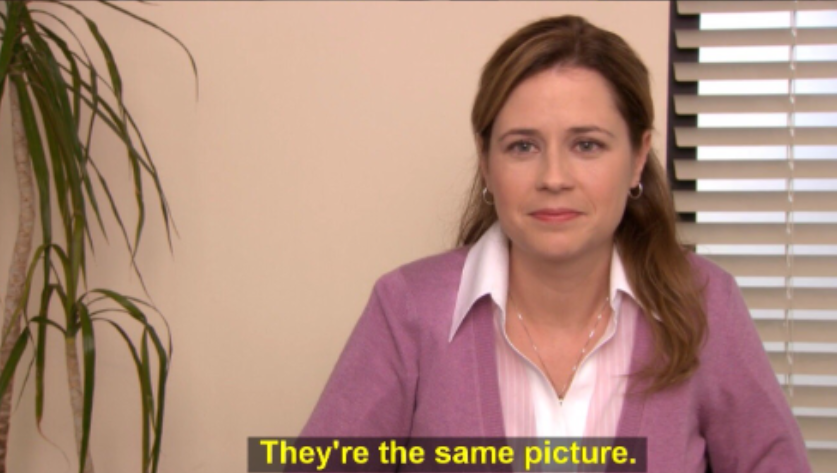
They're The Same Picture


The JTA has an interesting profile on a "new" right-wing Zionist organization, Betar ("new" in quotes because it claims to be a resurrection of a much older Zionist outfit active before Israel's founding). Betar has distinguished itself by its "confrontational" approach -- meaning that it engages in acts of vandalism and violence, and openly calls for things like ethnic cleansing of Palestinians and the expansion of Israel's borders well beyond the West Bank and Gaza and into modern Jordan, Egypt, and Syria.

Critical readers will spot a lot of commonalties between Betar and the more hardline elements of the pro-Palestinian movement. Most obviously, Betar uses almost identical rhetorical maximalism -- compare "We don't want two states, we want all of it" heard at pro-Palestinian protests with Betar's recent statement "We don’t want peace. We don’t want co-existence" -- and simply asks listeners to "choose a side". Pick your preferred ethnic cleanser and cleansee.

But there are some other commonalities. Perhaps the most important one to flag is that Betar hates "moderate" Jews as much if not more than it hates Palestinians, and its definition of "moderate" includes many Jews whom external observers would view as hardliners. Consider Betar's confrontational relationship with Columbia professor Shai Davidai, who has organized aggressive (to say the least) counterprotests aimed at pro-Palestinian activism on campus and had to deal with a Betar element crashing his event:

Despite their tiny size, the Betar contingent immediately worried Davidai. Most of them were young men, he recalled; several covered their faces; one had a flag of the Jewish Defense League, an extremist group that the United States has designated as a terrorist organization. “All they did was scream ‘F— Gaza,’ ‘Gaza is ours,’ ‘Here’s a beeper for you,’ ‘Deport them all,’ ‘ICE, ICE, ICE,’” he said. “Just violent rhetoric.”

Davidai is no stranger to provocation: Last fall, Columbia barred him from campus after months of his vocal criticisms of the university’s handling of antisemitism. Yet he views Betar as a serious obstacle to the movement he was trying to build, not least because they were adapting the same tactics as the pro-Palestinian side: expressing support for a terror group and hiding their faces as they did so.

“I think it’s hypocritical to spend 16 months blaming all protesters who are in this Free Palestine movement for not policing their own protesters, but then let hatred and violence take root in yours,” Davidai said. “I said, ‘Look, you’re doing exactly what we’re telling them not to do….’  At some point I asked them, ‘Go do your thing, but don’t be associated with us.’ They refused.”

After the rally, Betar and its followers began targeting him online. On Instagram he blasted them for only joining counter-protests, while never showing up to rallies for Israeli hostages. The rhetoric has only escalated from there, as Betar has mobilized its followers against him, in public and private. “You will be disrupted at all future speeches,” Torossian messaged Davidai on WhatsApp, according to communications shared with JTA. “You are a radical.”

Davidai has also urged his followers against supporting any further killings or mass expulsions in Gaza, a stark contrast to Betar’s own stated views. Yet in the comments, many of Davidai’s own followers have begun taking Betar’s side, accusing him of naively trying to make peace with the enemy.

There are some lessons to be learned here. One lesson is that there will always be someone more aggressive, confrontational, and hardline than you, and those actors will prove almost impossible to police. Moreover, they (in many ways correctly) view more "moderate" elements of their own community as their most important and salient competition and will ruthlessly try to attack and suppress those they deem "traitors" or "appeasers" in order to accumulate more power to themselves as the "authentic" voice of "true resistance" (this certainly characterizes how the BDS movement has been going after Standing Together, for instance). And finally, leaders of social groups that simultaneously play footsie with the sort of extreme rhetoric while assuaging themselves that of course their actual politics are humanitarian and egalitarian, they're just revving up a crowd or exaggerating for effect, will quickly learn that much of their base isn't in on the bit. They're in it for the hate, and when someone offers that hate better, they won't listen to your attempts to rein things back in.

There's also a very important lesson not to learn here. For some people, it is important to hear about groups like Betar so to disabuse any notions that calls for ethnic cleansing and political violence are only something "they" (the other side) does, whereas "our" movement is purely one of peace and coexistence. That illusion is dangerous and must be dispelled. But for others, the main function of groups like Betar is to give people a permission structure for their own counter-maximalism, because "this is what they're really like". If they're out there saying "Gaza is ours", what choice do we have but to fling them into the sea? If they're out there saying "Israel must be rooted out and destroyed", what choice do we have but to "transfer" them out of Gaza? There are a lot of people who just love the Betars or the Within Our Lifetimes of the world, and are constantly searching for examples of the genre. It's not because they agree with them. It's because their existence gives license to be as extreme and uncompromising and hateful as you want, because have you seen what they want?

The only way out of that trap is to recognize that it's the same picture. These organizations may have different preferred winners and losers, but they're fundamentally on the same side -- trying to convince you that the only choice there is to make is choosing your preferred extremism. And that is a false choice. As important as it is to name and shame these sorts of extremists, if you're main motivation in doing so is to validate your preconceived notion that this sort of extremism is the actual true authentic core of an entire people or culture, then you are not shaming anyone -- you are joining them.

The true enemy, as always, is anyone who rejects the equal dignity and democratic equality of Israelis and Palestinians alike. Anyone who rejects that there are two authentic nations whose homeland is in this territory. Anyone who rejects that there are two communities have legitimate claims to democratic self-determination. Anyone who rejects those premises is fundamentally on the same side, and the wrong side, no matter what flag they fly.

Tuesday, February 11, 2025

Happy Birthday To Me!


It's already been a very eventful year -- and, for me at least, not even primarily for horrible death-of-democracy related reasons!

That said, I have this terrible worry that we're going to be coming up on a "day of infamy" -- a stock market crash, or a decision to bomb Canada, or a mass arrest of dissident politicians. And I just really hope it isn't today, of all days, because I don't want my birthday being a date spoken in grim and somber tones for the rest of my life (sorry 9/11 babies).

Wednesday, February 05, 2025

How Many Robert Indianas Are Lost Per Year?


This is Robert Indiana's screenprint "Autumn", from the "Four Seasons of Hope (Gold)" portfolio. Executed in 2012, it was produced in an edition of 82. There were also some printer's proofs and hors commerce proofs set aside, so let's say that a total 100 of these prints were created.

Robert Indiana is a prominent artist and he has an active secondary market. A copy of this piece, for instance, is up for auction next week with an estimate of $3,000 - $5,000. That's far from jaw-dropping by art world standards, but it's definitely something worth keeping around if it's in your house.

So here's my question: of the circa 100 copies of this print that were created, how many do we think are "lost" per year? Or put differently, how many copies of this print still are, functionally speaking, "in existence" in the art world?

By lost, I mean to include things like:

  • The work being damaged beyond reasonable repair.
  • The work being thrown away or otherwise disposed of.
  • The work being in a location where it is forgotten about, or its owner not knowing what it is, such that it is unlikely that it would ever reemerge into the art world.
The last category does not include circumstances where the work is in someone's private collection and they have no interest in selling it (but they know what they have), but does include situations where someone just puts it in a box in their garage and forgets about it because they don't realize it is a prominent work by a prominent artist.

Presumably, all editioned art (or all art by a given artist, if we consider their entire career production as a whole) has an attrition rate. Once the edition is produced (or the artist dies), no more is created. Meanwhile, as life goes on and entropy takes its course, work progressively gets lost. Pieces in museum collections are, relatively speaking, safe from becoming "lost". But pieces in private hands are a different story -- it gets gifted to someone who doesn't realize the work is important, or someone dies and the print is tossed while the house is being cleaned up, or it is ruined a natural disaster. Stuff happens, in short, and so practically speaking that 100 figure is going to progressively tick down as time passes.

But I'm curious what people think the rate is. When one sees an editioned work by a prominent artist, how many of those works have disappeared?

Maybe 2012 is too recent for much of this particular edition to have been lost. Robert Indiana was very well-established by then; one would imagine most people who obtained his work would be people who knew what they were getting. The proportion of "lost" pieces for earlier works may be higher -- in part simply because of the passage of time, but in part because earlier in his career his work was more likely to end up in the hands of people who didn't really think of it as an artifact to be preserved.

My parents have a couple of great limited edition prints by some of the most famous artists from the mid-20th century, and last year I did a little project where I tried to "account for" as many copies of those pieces as possible -- looking at auction records, museum collections, gallery inventories, and so on. Even for the most prominent work with the smallest edition size (28 with 7 asides), I was only able to find info on less than half; for most of the works the number was far less. That doesn't mean those unaccounted for prints are "lost" as I defined it above -- I suspect many are in private hands with owners who know full well what they are* -- but it was still interesting to witness how much of even the most famous artwork in the world is, in practical terms, missing.

Anyway, no deep thought here, just a musing of the day.

* For example, my research would not have revealed anything about my parents' ownership of these prints, but for the fact that I obviously knew what they had.

Lies, and the Lying Liars Who Believe Them


The above conversation captures two different accounts of why people voted for Trump. In one corner, there are those who voted for him because "he'll do what he says" (unlike, presumably, other more feckless politicians who make big promises but never keep them). In the opposite corner, there are those who voted for him because he won't do what he says -- it's all bluster and trolling and hyperbole to trigger oversensitive woke libs, but in reality he's just playing a transactional game and will be reasonable.

Emma Briant flags these two accounts with the observation that it's interesting how Trump has been able to effectively activate both camps even though they have seemingly opposite priors. I'll suggest, though, that paradoxically these two opinions about Trump are not as far apart as they seem, and can -- albeit with a very healthy dose of self-delusion -- coexist in the same voter.

Start with the premise that Trump "tells it like it is." Obviously, this seems absurd to anyone who spends a half minute listening to Trump -- he's a grade-A bullshitter whose open lies can be spotted a mile away. But for a certain type of observer -- the self-styled cynic who prides himself on knowing that every politician is some type of liar or fraud -- Trump's very brazenness loops back around into a form of trustworthiness. At least he isn't trying to pull the wool over our eyes. The lies are so obvious that they don't even count anymore. But they're deemed to be in service of some greater agenda, an agenda which the listener is confident Trump very much believes in.

Once one adopts that approach, one can absolutely simultaneously believe that Trump obviously won't do what he says he'll do and that he alone will do what he says he'll do. Simply put, if one doesn't like something he says or if some ramble taken "literally" is acknowledged to go too far, then it is one of those obvious lies that can be discounted -- the listener patting himself on the back for his sophistication in not taken the clearly absurd seriously. And everything one does like is slotted into that greater agenda that is presumed to represent a substrata of absolute, passionate commitment -- the core promises that the listener does want to believe in, desperately, and so is willing to project onto Trump with reckless abandon.

Others have categorized Trump as a classic scam artist, and we see that here too -- the trick is convincing his followers that they're in on the con, as opposed to the marks. Seeing the lies doesn't drive them away from Trump, it makes them feel like they're insiders. Believing they've spotted the ruse, they become more confident that the underlying play is whatever they're being sold.

I've said before and I'll say again: it's no accident that Arendt identified this sort of cynical outlook as a harbinger of totalitarianism, because it leads to worse than believing lies -- it leads to an indifference towards truth. There's no falsifying this outlook, since it can equally and happily accommodate belief and disbelief in equal measure.

Sunday, February 02, 2025

Can One Man Really Stop the Senate?


As Donald Trump's disastrous march through America's legal institutions continues unabated, progressives are desperately looking for something -- anything -- that can stem the tide. One possibility folks have seized upon is Senate obstructionism. The line goes that even a single Senator can do a ton of things to throw sand in the gears -- objecting to unanimous consent, slowing down hearings, delaying votes -- that can extract real costs on the MAGA agenda and provide Democrats with some negotiating leverage. So far, no Senator has taken this approach, and that in turn is a source of considerable frustration to progressive partisans who feel that Democrats have been rolling over without a fight.

But for me, the fact that no Senator has done this raises a different question: If this strategy was so effective, wouldn't someone have done it by now?

There are 47 Democratic (or Democratic-aligned) Senators in Congress right now. And as a collective, I absolutely believe there are plenty of plausible explanations for why they're hesitant to adopt the defiant, resistant pose so many of us are thirsting for. If you told me that (too) many still harbor a gut desire for "bipartisanship" and "working across party lines", I'd believe you. If you told me that (too) many remain attached to Senate norms of civility and comity, I'd believe you. If you told me that Chuck Schumer has attempted to unify the caucus around a strategy that, for whatever reason, doesn't include maximal obstructionism, I'd believe you.

But if it's really true that just one Senator has in his or her power the ability to grind Congress' gears to a halt, is it really possible that not one of the forty-seven would try it? There wouldn't be a single defector?

Do you really think Bernie Sanders is afraid to rattle cages? Do you really believe that Adam Schiff has in the past few weeks become enamored by venerable Senate traditions? Do you really imagine that Tammy Baldwin is inclined to cower before any and all Chuck Schumer diktats (do you really believe Chuck Schumer is that good at keeping his entire caucus in absolute ramrod lockstep)?

It just doesn't seem plausible to me. Someone would have defected by now. In fact, even if this strategy was considerably less effective than it's cracked up to be, or even if you think Senate Democrats are all fat cat posers who don't actually care about resisting Trump at all, you'd still think someone would have tried it simply to be a clout-chaser. The fact that nobody has done it suggests that either it is a lot less effective than people think, or there are a lot more (and more serious) hidden costs to it than people recognize.

I won't claim to be an expert on Senate procedure, and reading about the various machinations around blue slips and unanimous consent and holds makes my head spin. So it's entirely possible I'm missing something here. But whatever I'm missing has to explain not why "Senate Democrats", collectively, aren't adopting an obstructionist strategy; it has to explain why every single individual Senate Democrat has so far refrained from using their power as a one-Senator army to bring things to a halt. And I just don't see what that explanation is, aside from this alleged silver bullet not actually being one.