Showing posts with label Joe Biden. Show all posts

Monday, December 02, 2024

We Who Are About To Die


The Romans loved their gladiator games.

I actually have no idea if that's true. Most of what I know about gladiators comes from how they're portrayed in Ridley Scott movies. For all I know, Romans did not actually enjoy seeing innocent people torn apart in the arena by wild animals or what have you.

But, to quote Philip J. Fry, "it's a widely-believed fact!", so we'll run with it.

It seems clear that a huge part of the second Trump administration will be vindictive political prosecution of his "enemies". This was a recurrent campaign theme of his, from proposing "military tribunals" for the likes of Liz Cheney to alleging "COVID crimes" by Anthony Fauci. Willingness -- implicit or explicit -- to engage in such thuggery has been a theme of his early announced appointees, from Kash Patel to Brendan Carr to Pete Hegseth. Concern over such tactics was expressly raised by Joe Biden in his pardon announcement for his son, Hunter. How deep down the list will he go? Unclear, though normalcy will not save you. The hammerfist coming to smash American rule of law is something unprecedented in my lifetime.

These prosecutions will be lawless along every possible dimension. The people driving them won't care about the law. The venues will be selected based on political convenience (I bet one will be amazed at how many of the "crimes" in question will center on the Western District of Texas). The "crimes" themselves either will be frivolous or nakedly selective. It will be undisguised authoritarian thuggery: the apparatus of law enforcement entirely perverted to immunize the president's allies while harassing his enemies (the almost-assured pardon of the January 6 insurrectionists is also part of this story).

I won't here venture a prediction as to how the judiciary will respond to these endeavors. It's possible they'll hold the line, as they largely did in 2020. But it's also the case that in 2024 the conservative legal movement has embraced and assimilated into full-blown MAGAism to a far greater degree than in 2020; even if they don't actively embrace the conspiracism (which they might), one can very easily imagine them hiding behind rules of deference to enable Trump to run wild.

The open question I want to consider, though, is how the public will respond to all of this. Of course, Trump's base will love it -- they've been baying for blood since 2016. And equally obviously, people like me will hate it. But I have a bad feeling -- maybe doom-mongering, maybe not -- that these spectacles of prosecution will go over better than one would think with low-information independents.

The reason isn't because they necessarily have strong opinions that Joe Biden or Anthony Fauci or various military generals actually are criminals. Rather, it is a more inchoate desire to see "the powerful" get their comeuppance. It almost doesn't matter whether they're guilty or not; the mere practice of seeing people one is accustomed to thinking of as "above you" laid low, ripped apart by the animals in the arena, is desired in of itself.

Consider what is for me one of the most infuriating aspects of Trump's victory: that he will not be held accountable for his many, many blatant crimes. No sentencing for the New York felony convictions, no consequences for the attempted 2020 insurrection, no pursuit of the document theft case, no nothing. It is maddening, to see such naked abuses of power result in nothing simply because Trump is powerful enough to evade responsibility for anything. If you take that indignant sensation and shear it from any substantive political knowledge, you're just left with the boiling resentment that a vague "they" keep "getting away with it". And the mere performance of going after a "they" can appeal to those resentments -- a fascist essence where the struggle is valuable in of itself, to show oneself to be the tribune of the people.

This suggests that Democrats could have leveraged this same atavistic desire to get at a powerful "them" by, for example, a fast Garland or prosecuting big bankers for the financial crisis or going after Elon Musk. And much like with echo chambers, I'm of two minds on this: torn between thinking that (for better or for worse) this is the strategy that works, versus thinking that it is a bad thing to encourage this sort of political climate (to be clear: I have no quarrel with "going after" big bankers or whoever when they commit crimes, but performatively going after an "enemy" class -- no matter who it is -- untethered by normal rule of law constraints strikes me as bad both morally and also conducive to a political environment that ultimately helps the right).

So once again, I'm at a bit of a loss here. But if we're relying on a natural popular revulsion to politicized sham prosecutions by the Trump administration, I'm not sure we're going to get it. We are going to be entering a very, very dark time.

Sunday, July 21, 2024

Harris '24


To be honest, I didn't have strong feelings about whether Biden should or shouldn't drop out of the race. But his decision to step down should be seen as an incredible act of selflessness and statesmanship. Joe Biden has had an amazing array of accomplishments as President. But this step was entirely about ensuring that the fascist maniac atop the cult of personality that's become the GOP does not return to the White House in January, and he deserves great praise for that.

The media, it seems clear, is not ready for the circus to leave town. It is bombarding us with calls for an open convention or speed primary or some nonsense about picking Mitt Romney -- anything to maintain the frenzy of Democrats in chaos. But overwhelmingly, the reaction I'm seeing from most Democrats is relief: relief that we have a resolution, and relief that we're in good hands with Harris. Whereas the drumbeat to get Biden out the race, while partially media generated, did reflect at some level of genuine concern from actual Democrats of note following the debate disaster, right now it's going to be very hard to maintain a narrative of Dems in Disarray given the rapidity with which the party coalesced behind Harris. Indeed, virtually all the chatter I've seen about the need to Avoid A Coronation!!! comes from the usual pundit has-beens -- I'm seeing essentially no appetite from any Democrat of note to offer themselves up as an alternative to Harris, and she's rapidly securing endorsements from every sector of the party. Kamala Harris is going to be the nominee, Democrats seem very happy that Harris is going to be the nominee, and I'm excited to rally behind her and return her to the White House.

The next few months won't be easy. For example, we can expect the media's interest in the age of candidates to disappear as rapidly as its interest in classified document security. But Harris is a good woman, a good leader, and a good politician. We can do this. Let's get to it.

Monday, March 18, 2024

Conversations with Normies


I enjoy talking to my brother about politics because he is, for lack of a better way of putting it, far more normal than I am. He is not passionate about politics, but he's not ignorant about it either. He pays some measure of attention because he's a good citizen who cares about the world around him, but it's not something he's independently especially interested in. There are, of course, a lot more people like him than there are people like me, even though there are a lot more people like me talking about politics online. So chatting with my brother feels like getting a sense of the pulse of normie America (even though of course he's not necessarily representative).

In terms of ideology, my brother is probably best described as a moderate Democrat. His line for the past several years has been pretty consistent in saying that there is a universe where he could imagine voting Republican, but it is not our universe because he fully recognizes that the Republican Party in America today is fully captured by insane people. 

So there was never any question that he'll be voting blue come November. But we happened to have a chat about his current political outlook on things. I present these not as endorsement or non-endorsement, but simply because what he said may be of interest to a readership who I suspect is (like me, unlike him) very much not of the normie bent.

1. He loves Joe Biden. One of the first things he said was that he's annoyed and frustrated by the notion that Biden is "the lesser of two evils" or a sort of shit sandwich you have to swallow given the alternative. My brother thinks Biden is great! He thinks he's had a tremendously successful presidency! In particular, my brother gave Biden a bunch of credit for lowering political temperatures and trying to pursue actual solutions to problems rather than demagoguing and grandstanding. 

Admittedly, my brother started off as a Biden supporter -- he was his favorite candidate at the outset of the 2020 primary (back when David was deciding between Booker and Warren). But now he wonders if he's really alone in that assessment, because so much of the prevailing narrative is centered around how nobody actually likes Joe Biden, they at best tolerate him. My brother is a loud and proud "I like Biden" guy.

2. He's lost patience with Israel's Gaza campaign. We're both Jewish, and while neither of us is super religious, we've both stayed involved in Jewish life as adults (and unlike me, he's visited Israel). He was obviously repelled by what happened on October 7 and thinks Hamas is a despicable terrorist outfit. Nonetheless, his take on the current status of the conflict in Gaza is that at this stage it feels to him as if it is no longer (if it ever was) about Israel's security, and now is just unconstrained vengeance being taken out upon the Palestinian population. He has no trust in or love for Bibi, and thinks he needs to go.

3. He's interested in Freddie DeBoer. That was, of all the names, the person he said he'd been reading recently whose work had been resonating with him -- didn't agree with all of it, but found him thought-provoking particularly on matters of mental health and "wokeness". I confessed that I hadn't thought about Freddie DeBoer in ages, so I couldn't really react to it. I suggested reading Matt Yglesias' "Slow Boring"; he laughed because Yglesias and DeBoer apparently despise each other even as they (in his mind) didn't seem too far apart when it came to tangible policy beliefs.

4. He's skeptical about the impact of "woke" trends. He doesn't identify with the efforts to destroy trans health care or anything like that (again -- he recognizes the GOP is crazy). But he did express concern about what he described as "wokeness", even though he also said he thought that term was clearly imprecise for what he was speaking of since it also captures plenty of activity he fully approves of. 

At first, I assumed he was talking about certain cringy performative activities that I could imagine being grating to someone of his views. But he emphasized that it wasn't just a matter of performance -- in his space (the non-profit world), he felt as if impactful programs that were doing a lot of good in marginalized communities were getting short-changed as donor priorities redirected towards initiatives that could more easily packaged as messaging DEI values (even if they didn't tangibly improve as many lives in the communities they purported to be uplifting). So his grief was partially an objection to performance, but with a tangible kick. I recommended he read Elite Capture: How the Powerful Took Over Identity Politics (And Everything Else) by Olúfẹ́mi O. Táíwò; he said he had heard of it but hadn't had the chance to read it.

Wednesday, March 06, 2024

The Uncommitted Story, Part II


I've been trying my best to give a dispassionate account of how the "uncommitted" campaign is doing. Obviously, supporters have an incentive to pump up its successes; opponents have a perhaps more mixed set of incentives (you don't want to give the impression that they represent the true majority, but there can be benefit in promoting a scary monster lurking in the woods). 

But for my part, I'd like to think we do ourselves no favors when we delude ourselves about the state of the world. If "uncommitted" is doing exceptionally well and demonstrating a genuine groundswell of opposition to Joe Biden's policies, there's no sense denying that just because one wishes it weren't so. If "uncommitted" is not performing especially impressively and doesn't stand out from always-present grousing at a coronated incumbent, then there's no sense denying that just because one wishes that weren't so.

So to actually figure out how "uncommitted" really is performing, it's important to establish our comparator. JTA put a piece up last night breathlessly comparing "uncommitted's" Super Tuesday support against how "uncommitted" fared in 2020. Framed that way, "uncommitted" had an outstanding night:

The uncommitted percentages barely dented Biden’s overwhelming win in each state, but far outdid 2020 percentages for uncommitted voters. In Minnesota, with 74% of votes counted at 10 p.m. Central Time, uncommitted was getting 20% of the vote; it garnered less than a half percent in 2020.

[...]

In Colorado, with 74% of the vote counted at 9 p.m. Mountain Time, uncommitted was getting 7.5% of the vote. It did not register at all in 2020.

In North Carolina,  at 11 p.m. Eastern Time, with 93% of the vote counted, uncommitted voters were 12.5% of those voting in the Democratic primary. In 2020, it was 1.64%.

In Tennessee, at 11 p.m. Eastern Time with 80% of the vote counted, uncommitted garnered 8% of the vote. It got less than a quarter of a percent in 2020.

In Massachusetts, with 51% of the count recorded at 11 p.m. Eastern Time, uncommitted was getting 9% of the vote. It got less than a half percent in 2020.

The problem is that 2020 is obviously not the right year of comparison -- an open Democratic primary with a sprawling field of candidates to choose from is very different from a reigning incumbent running for reelection (virtually) unopposed (if in 2020 you couldn't find a single Democrat of the approximately 531 running for president to "commit" to, I don't what your problem is).

So in terms of trying to give an objective assessment of "uncommitted's" performance, the actual comparison is to the last analogous presidential primary -- Obama 2012, since that was the last time we had an incumbent Democratic president running for re-election. 

In such cases, we would expect that there will always be some baseline number of people dissatisfied with the incumbent and looking to cast a protest vote. The question for "uncommitted" in 2024 is whether it is exceeding that baseline. Generously, we can assume that any overperformance compared to the 2012 figures is attributable to the "uncommitted" campaign vis-a-vis Gaza (though obviously, that might not be true). By contrast, if "uncommitted" isn't performing any differently (or worse!) than it did in 2012, then it seems unlikely that the "uncommitted" campaign is actually making much of a mark. So, for example, in Michigan "uncommitted" got 2.5% more in 2024 than it did in 2012, and then we have to decide what that level of improvement says about the strength of the underlying sentiment -- my conclusion was that this was a modest impact, but ultimately not too impressive save for the fact that Michigan's narrow margin makes anything meaningful.

With that in mind, how did "uncommitted" do compared to baseline expectations on Super Tuesday?

Unfortunately, Colorado and Minnesota didn't hold primaries in 2012, so we can't do a direct comparison. I will nonetheless eyeball agree that the 19% uncommitted took in Minnesota looks relatively impressive (though it actually isn't necessarily an outlier figure, as we'll see below). In the other three states, by contrast, things look very different for "uncommitted":

Massachusetts: 9% (2024) compared to 11% (2012)

Tennessee: 8% (2024) vs. 11.5% (2012)

North Carolina: 12.5% (2024) vs. 21% (2012)

These are all substantial underperformances compared to what we saw in 2012. Again, I understand why "uncommitted" backers are trying to juice them up, but these are not good showings! And these are the highlighted state where uncommitted did best! Except for Minnesota and Oklahoma (which seems to have a disproportionate share of randos on the ballot), Biden's broke 80% in every state he ran in on Super Tuesday. By contrast, back in 2012, Politico was running stories about Obama's primary weaknesses by pointing to states where he wasn't even cracking 60% of the vote (uncommitted got over 40% in Kentucky that year!).

So why is the media making a mountain out of this molehill? Certainly, "uncommitted" can give us some interesting microdata (the frustration among Michigan Arab and Muslim voters seems real, for instance, and notable). And in close states, any type of discontent can make a difference (though that proves too much -- any type can make a difference, meaning that any potential grouse or grumble is equally problematic). But I also think that we're seeing the effects of some relatively online journalists who are attuned to a relatively online campaign and so think there must be a "there" there. That, coupled with a deep-seated desire for anything that makes the horse-race story more interesting, and of course this is a tempting morsel.

But the reality seems to be that Biden actually is doing fine, compared to Democrats in analogous situations, of consolidating support. If anything, we've been seeing pretty persistent underestimation of his electoral appeal (itself perhaps a worthy topic for a post). "Uncommitted" right not seems to be mostly (not entirely, but mostly) sizzle rather than steak.

Wednesday, February 28, 2024

The Uncommitted Story


Last night, Joe Biden won the Michigan primary with approximately 81% of the vote. Donald Trump also won with 68% of the vote (you wouldn't necessarily clock that Trump did comparatively worse than Biden given the coverage, but that's hardly a surprise anymore). But while the foregone conclusion outcome isn't super interesting, many people have been keeping an eye on the relative performance of "uncommitted" in the Democratic column. 

For those of you who don't know, a campaign largely emanating from Michigan's substantial Arab and Muslim community urged Democratic primary voters to cast a ballot for "uncommitted" as a means of signaling discontent with President Biden's support for Israel in the war in Gaza. A few days ago, I registered my genuine curiosity regarding how "uncommitted" would play out in the Michigan Democratic primary. On the one hand, I said, I absolutely could see it "capturing genuine frustration amongst [Democratic] partisans (so getting substantial support)." On the other, I also could see it "mostly an online/activisty thing (so being a nothing burger come the actual vote tallies)." Since both hypotheses seemed plausible, I was genuinely interested to see what the reality would be.

Towards the start of the evening (with, as I recall, approximately 20% of the votes tallied), I wrote the following:

If “uncommitted” typically gets 10% and it holds at 16% (which it may not, in either direction), I’d say that’s not a huge performance (6% over baseline) but still meaningful given how tight MI will be. It’s not something that should be ignored; but neither is it “popular groundswell of rebellion”.

The "10%" baseline is based on the last analogous election where an incumbent Democrat was running -- Barack Obama in 2012. Ten percent (10.7%, to be precise) of Democratic voters then voted "uncommitted" despite there not being (to my knowledge) any significant organized campaign pushing for the vote, suggesting that this is baseline level of support for "uncommitted" that isn't attributable to anything more than inchoate background status quo discontent. Given that, my assessment was that getting an additional six percentage points of support is not trivial, but also isn't proof of some broad-based sentiments of frustration and opposition.

As I said, though, the tally was early and things might change in either direction over the course of the evening. I saw some people suggest that they expected the number to rise as the night went on, on the theory that "bluer" jurisdictions like cities were going to report later and the assumption that "uncommitted" voters would be more prevalent in those areas. But what ended up happening is that "uncommitted" faded over the course of the evening, finally settling at 13.2% -- about 2.5% over the baseline expectation (it's also below the 15% threshold necessary to pick up statewide delegates at the DNC, though it did get two delegates due to strong local performances).

From my vantage point, this really can't be said to be that impressive of a performance. It still matters in the sense that Michigan will likely be close and so every little bit counts. But ultimately, a well-organized campaign, with the support of some significant local Democratic figures (albeit opposition from many others) managing to overperform doing nothing by 2.5% really doesn't demonstrate much in the way of serious political muscle. I don't want to say the frustration that the "uncommitted" campaign is tapping into isn't real. But objectively speaking, it doesn't seem to be translating into significant alterations in Democratic voter behavior -- to that extent, it may be a largely cloistered thing. If I'm the Biden campaign, I'm certainly not ignoring this issue (for a variety of reasons, not the least being that its salience to activist, elite, and media cadres clearly punches above its weight, and then also because one wants to do the right thing and have a good policy that takes into account the views of all relevant stakeholders). But I think we've dispensed with the need for incipient panic.

That said, the "uncommitted" campaign did a wonderful job of setting expectations. The nice thing about a symbolic play like this is that since an objective win is obviously off the table (and not the realistic goal) pretty much anything can be sold as a victory. If you lose an actual election, you have to (well, I guess we've learned you don't have to) concede defeat. If you're not actually running to win but instead are just trying to trumpet your existence as a voting bloc, however, there's essentially no outcome where one has to "concede defeat". You will never see organizers release a statement to the effect of:

Our goal was to demonstrate that the people of Michigan care about X issue and that our values cannot be ignored. But given our anemic performance, the voters today have made clear that Michigan voters don't care about X at all and that we completely overestimated our influence. Thanks to everyone for taking part in this civic experiment, and we'll adjust our priors accordingly.

Here, the uncommitted organizers really basically set their bar on the floor -- they said their goal was to get 10,000 votes for "uncommitted", and they are celebrating for blowing past that tally. On the one hand, 10,000 is not a completely made-up figure -- it was roughly Donald Trump's margin of victory in 2016. On the other hand, in this primary 10,000 votes would have been barely over 1% of the total tally -- less than half of Dean Phillips' tally and a tenth of the Obama 2012 baseline. It is true that turnout is up considerably since 2012 (10.7% then was a little less than 21,000 votes; 13.2% in 2024 is over 100,000 votes) -- but it's hard to view that as bad news for Democrats.

The other observation I want to make relates to that prediction I saw that the "uncommitted" tally would rise as bluer, urban jurisdictions came in, when the reality was that "uncommitted" faded over the course of the evening. I wasn't following the returns closely enough to confirm whether the bluer areas were in fact reporting later. Assuming that they did, though, I think this is a good time to correct another common and understandable misapprehension: that the most partisan Democratic areas of a state are also necessarily the most progressive.

It's an understandable inference. In a two-party system, we might imagine that a voter who is only slightly left-of-center would regularly be at least tempted to vote GOP (given the "right" candidates), a voter who is more decisively liberal would be less likely to crossover, and the most liberal voter would also be the least likely to be tempted away to the other party. From that, we would infer that the most partisan Democratic voters (those least likely to ever vote Republican) are also the most progressive voters (there preferences are furthest away from those of Republicans).

But it isn't necessarily true. At one level, it's falsified by the presence of "both parties are the same" uber-leftists -- such persons may or may not be tempted to vote GOP, but they're obviously not Democratic partisans. The most partisan Democratic clusters are persons who are probably progressive enough not to be tempted by the GOP, but also not so left-wing that they find arguments like that appealing. But beyond that, there's more that goes into committed Democratic Party loyalty than ideological alignment. We know, for instance, that African-American voters are the most committed Democrats and that African-American Democrats are more likely to identify as moderate or conservative compared to White Democrats. There are other factors beyond ideology that are significantly responsible for why Black voters are Democratic loyalists. Likewise, the post 9/11 trend whereby Muslim voters overwhelmingly voted Democratic also was not primarily a feature of deep-seated ideological leftism -- it stemmed from "other factors" (i.e., rampant GOP Islamophobia) which superseded still-extant ideological moderation or even conservatism.

All of this is to say that the assumption that Black voters, because they are steadfast Democratic voters, also must sit on the left edge of the party on an ideological level, is a mistaken apprehension, and consequently the sorts of issues that are motivating the ideological left-edge of the party are not necessarily the same ones that motivate the base of the party. This isn't to say that the Democratic base is actually conservative; it's still probably true that it is relatively to the left of the average person who votes Democrat in any given November. It's just not all the way at the left-most edge of the party. That mistake, I suspect, is a large part of what generated the wrong assumption that "uncommitted" would perform substantially better in those locales.

For what it's worth, on a very quick gaze there doesn't seem to be much correlation between the Black vote and "uncommitted"; if anything, it seems to have underperformed. The overall Black population of Michigan is approximately 14%, and there are four counties which have proportionally larger Black populations than that: Wayne County (Detroit and Dearborn), Genesee County (Flint), Saginaw County (Saginaw), and Berrien County (St. Joseph) (Oakland County, north of Detroit, is exactly 14% Black).

Wayne County saw "uncommitted" get 16% -- but that's almost certainly more a product of Dearborn than Detroit (disaggregating those figures would be very interesting, but the fact that "uncommitted" outright won in Dearborn and Hamtramck, both of which are approximately half Arab-American, mathematically suggests it did much weaker numbers elsewhere in the county). By contrast, Genesee County, which contains Flint, saw "uncommitted" have one of its worst performances -- 9.5%. Saginaw County saw "uncommitted" get 10.2%, Berrien County 9.6%, and Oakland County 12.5%.

Plot "uncommitted" based on the most Democratic parts of the state (based on 2020 Democratic vote share), and things similarly look blurry at best. Joe Biden only won 11 counties in Michigan last time around. He won all of the above-mentioned counties except Berrien, plus Washtenaw (Ann Arbor), Ingham (Lansing), Kalamazoo (Kalamazoo), Kent (Grand Rapids), Muskegon (Muskegon), Leelanau (Traverse Bay), and Marquette (Marquette, on the upper peninsula). "Uncommitted" had possibly its best performance in the entire state in Washtenaw County, at 17.2% -- certainly a product of the University of Michigan community. And it did slightly better than its statewide average in Kent County (13.8%). But in every other county Joe Biden won, "uncommitted" underperformed its statewide average -- from 13.1% in Ingham to 9.1% in Saginaw. That said, the two counties "uncommitted" performed best in (Wayne and Washtenaw) are two of the heaviest Democratic hitters (along with Oakland) in terms of raw Democratic vote margins; the other counties listed, while won by Democrats, tend to be either smaller or closer (or both). 

So I'd say these results are mixed, and again, my advice to Biden isn't to just ignore this issue outright. Rather, it's to observe that the coalitional politics that drove the "uncommitted" movement are distinct from "the base" (and, in particular, Black voters). That's an important thing -- democracy is about appealing to diverse constituencies who have an array of distinct and differentiated interests, and this issue certainly had strong salience amongst Michigan's Arab and Muslim community, plus a fair amount of weight in the collegiate environs of Ann Arbor -- but it's not necessarily the same thing as it's been presented.

Saturday, January 27, 2024

How Should the Single-Issue Palestine Voter Vote?


One of the bigger political stories to cross my path the past week was the report that a planned meeting between Biden campaign surrogates and Arab and Muslim community leaders in Michigan was canceled due to local furor at Joe Biden's support for Israel during the current war in Gaza. It was a punctuation mark on evidence that Muslim and Arab voters are seriously considering, if not outright committed to, withholding their votes from Joe Biden come November -- a decision that could have serious electoral ramifications in a swing state like Michigan.

Some Democratic commentators have clearly been surprised at the scope and severity of this reaction. But their surprise, I think, stems a fundamental misunderstanding of how closely -- or not -- the Arab and Muslim community was tied to the Democratic Party in the first place. These ties were much, much shallower than it appeared; a shallowness that was masked by the seeming impossibility of Muslims voting Republican in the post-9/11 and especially Trumpist era of extreme GOP Islamophobia. But much like with Latinos, Democratic strategists confused a negative polarization story for deeper partisan loyalty. 

Before 9/11, Arabs and Muslims were considered a swingy, even potentially right-leaning, voting bloc. Those sentiments still have plenty of purchase, and for persons who hold them it's hardly unfathomable to not pull the lever for a Democrat. And while for White people, "I'm so mad at Biden about Palestine that I won't vote for him" is almost certainly a phenomenon overwhelmingly associated with the leftier edge of the progressive coalition, that almost certainly is not the case amongst Muslim and Arab voters, for whom strong support for Palestine is -- if not quite wall-to-wall -- something that very much crosses ideological borders. If you envision that centrist or even conservative Muslim who nonetheless voted Democrat in the last few elections for no other reason than the relatively straightforward rationale of "Republicans hate us", it wouldn't necessarily take that much for them to decide to drop Biden or even vote GOP if their furor at Biden's Israel policy grows intense enough.

On that note, Matthew Petti has a fascinating and thoughtful piece on how we might expect Muslim-American conservatism to affect partisan politics in the coming years. He runs through several possibilities, from "Muslim conservatives will perform right-wing pro-Israel bona fides" (something we've definitely seen in recent years) to "the GOP will grow significantly more open to pro-Palestinian politics". The latter possibility has been largely masked because of the degree to which the GOP has defined itself by extreme chest-thumping pro-Israel politics. But while it may not be the most likely outcome, at least in the near-term, there are burblings that might give hope or fear (depending on your point of view). The true nationalist-conservative MAGA base absolutely contains significant elements that (for the usual unsavory reasons) are absolutely prepared if not eager to jettison support for Israel and instead cast Israel and Zionism as enemies of the American volk. While these views aren't common amongst elected Republicans, they aren't utterly unheard of either -- as in Rep. Thomas Massie (R-KY)'s social media post pitting "American patriotism" against "Zionism". And while much has been written about young liberals turning against Israel, there's also evidence of similar ebbing of support amongst young conservatives -- both amongst the nationalist right and amongst evangelicals -- a trend which offers rare opportunities for the GOP to fight in a demographic they sorely want to make inroads with. Back in 2021 I floated the possibility -- unlikely, but not absolutely impossible to imagine -- of Trump turning against Israel in 2024 (remember the "fuck him!" heard 'round the world?); if that happened, it could really crack some coalitions wide open. At the very least, Trump's mercurial enough to do it, and the GOP base is slavish enough to follow along with it.

Given all that, I've been wondering: what should the pure single-issue pro-Palestine voter do in 2024? By single-issue voter, I mean someone for whom the sole and decisive basis upon which they'll cast their vote is the issue of Palestine. While for most people that's an oversimplification of their decisionmaking process, it might not be for everyone, and it in practice might also roughly capture a classic "centrist" or "independent" voter for whom all the other issues that might push one towards Biden or Trump (abortion rights, democracy, health care, whatever) basically wash out, such that Palestine becomes the decisive issue.

To that person, the Biden 2024 pitch has been pretty straightforward: If the only thing you care about is Palestine, Trump would be worse on Palestine. No matter how angry you are at Biden, he's still the lesser of two evils on this issue.

Of course, some people aren't willing to vote for the lesser of two evils. But let's leave even that cadre aside. One can absolutely imagine arguments contesting the premise -- is Biden actually a lesser evil? Obviously, if Trump makes the pivot against Israel discussed above, that would sharply contest the premise. If that possibility seems unlikely, there's also the argument that Trump and Biden are equivalently evil -- their positions are materially identical. Even if, by stipulation, Trump's rhetoric might be worse and more cheerleader-y of Israel's worst excesses, it might be that such additional "support" makes no marginal difference at the level of policy. If one thinks that Israel already is maxing out the brutality it can impose upon the Palestinian population, then Trump being "more" pro-Israel is superfluous -- it doesn't make a difference. In such a world, how one votes in 2024 will make no difference on the level of policy except to the extent that it signals that the pro-Palestine voting bloc is a force that needs to be reckoned with going forward. So what vote -- Biden, Trump, or neither -- would send that signal most strongly? That's not self-evident -- there's cases to be made for all three. But while, contrary to many loud internet folks, I don't think the case for "vote neither" is self-evident (leftists "voting neither" in 2000, far from generating the lesson "we are indispensable", instead led to widespread hatred for the left from normcore liberals that took almost two decades to work past), it's absolutely not implausible either.

And this argument extends even if one does agree that Trump would be materially worse for Palestinians if elected to office in 2024, because then the question is whether the marginal difference in Trump's badness -- which we can ruthlessly measure in "number of additional Palestinian lives taken or ruined" -- is worth the possible advantage of cracking historic bipartisan pro-Israel consensus and opening the door for a more robust, genuine pro-Palestinian position to take root in at least one of the two parties going forward. If it seems horribly cruel to sacrifice Palestinian lives in the short-term for sake of a political long game, you might be right; but calculations like that are sadly omnipresent in this space. In a much more brutal sense, this was after all Hamas' calculation behind the 10/7 attack -- the goal was to provoke a bruising Israeli military response that would lead to the loss of innumerable Palestinian lives and, in doing so, fixate the world's gaze in a way that would lead to long-term, durable shift in global attitudes towards Israel on the one hand and the Palestinian cause on the other -- a calculation which has proven to be successful beyond their wildest estimations (this is one reason why Hamas has -- contrary to the assumptions of some of its more gullible western supporters -- not demonstrated itself to be especially interested in a ceasefire; to some extent, it's happy for the war to continue because it's proven itself eager to sacrifice Palestinian lives in exchange for global sympathy, and doesn't want that trade route to be closed).

Note, once again, that this chain of logic only holds if one truly is a single-issue voter. The logic falls apart once one starts adding in all the additional bads of not voting for Biden (abortion rights, health care, death of democracy, and so on). At that point, to adopt the above chain of logic is to say "the possibility of cracking the historic bipartisan consensus over Israel come 2028 is worth seeing (among other things) women thrown in jail for miscarriages, trans status being criminalized, LGBTQ books banned in schools, and potentially permanent damage to the basic status of the country as a democracy." To be a single-issue voter (on Palestine or anything else) sells all those other issues out, and that choice does and should in my view be judged exceptionally harshly. Put differently, the decision to not vote for Biden in 2024, no matter why one does it, is a decision to abandon the people and values that would be devastated by a Trump victory -- anyone who does this absolutely should be said to not care about reproductive freedom or democratic robustness or reining in the extreme right judicial branch or any of the other issues of pressing importance whose futures are on the ballot in 2024. 

But the moral jeremiad aside, it's undeniable that caring about absolutely nothing but a single issue -- any issue -- gives one a sort of tactical flexibility that others don't have. And for a person who is genuinely in that state of mind, it's not actually that clear what the choice in 2024 should be.

Sunday, September 03, 2023

Media Alt-Centrists in Disarray


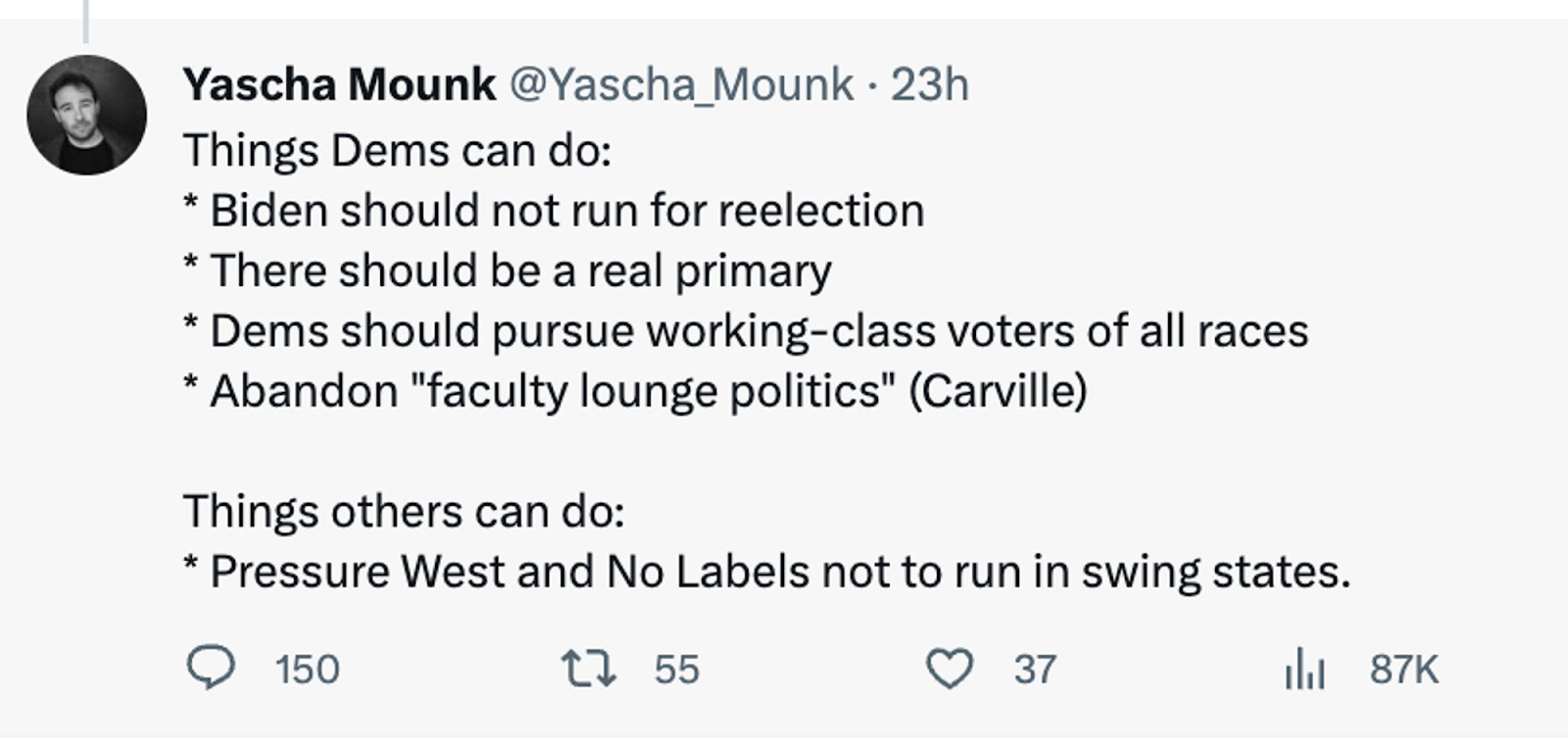
When I first saw this Tweet (Xeet?), my eye was drawn to "Dems should pursue working-class voters of all races." It's a great example of something that is simultaneously (a) alt-center conventional wisdom and (b) utterly inane. What are the sorts of policies Dems should pursue to working-class voters of all races? Answer: the ones they're already supporting! 


Price negotiations for prescription drugs is a great, obvious example of a policy that's geared to the interest of working-class voters of all races. Standing with the incipient wave of labor mobilization is another. The infrastructure bill was yet another. All of these are centerpiece items of the Democratic Party's economic agenda. But the alt-center punditry acts as if they don't exist. The "advice" on offer is "do what you're already doing, but make me pay attention to it." And one cannot help but think that the price the pundits have put on "make me pay attention to it" is "stop distracting me by also supporting policies that are distinctively to the benefit of specific historically marginalized communities."

At the same time, there is a separate vapidity in the "advice" that Biden shouldn't run for reelection. Again, as advice this is just terrible: Biden has a proven electoral track record and has already beaten Trump once. There's no universe where a chaotic primary free-for-all would actually be healthy for the Democratic Party or the broader prospect of ensuring that Trump or any of his lackeys stay out of the White House. The desire for "a real primary" is just thinly-disguised thirst for the good old days of "Dems in disarray" and the chaotic intraparty knife fights that aren't happening on the GOP side because virtually all of Trump's "challengers" can't help but cozy up to him (with a not-so-subtle wink to the various factions within the Democratic Party whose definition of a "real primary" excludes any primary where their preferred candidate doesn't march to victory).

Finally, "faculty lounge" politics is also a meaningless phrase. If it's meant to refer to the notion that Democratic party politics take their cues from whatever petition is currently being passed around the Wesleyan anthropology department email list, it's delusional. If it's meant to be a general referent to so-called "culture war" politics, then it's horribly outdated -- we are long past the days where the main "culture" wedge issues favored Republicans over Democrats. Republicans are getting absolutely blitzed on reproductive rights as their radical campaigns to imprison, maim, and murder women are predictably reviled. And their anti-LGBTQ agenda doesn't fare much better. Democrats have a lot of room to punish Republicans for their extremism here, and absolutely should.

Biden should run for reelection, and in the process will no doubt trounce token primary opposition. He should promote his policies which will improve the lives of working class voters of all races, and he should absolutely torch Republicans for their unabashed extremism in desiring to take American "culture" back to the 19th century.

Monday, February 20, 2023

Biden Visits Ukraine

President Joe Biden made a top-secret (but now public) visit to Ukraine in a show of solidarity as the country continues to face down Russia's war of aggression.

I don't have a lot to add to this except to say that as symbolic gestures go, this is quite the move. It obviously is reminiscent to trips Presidents Bush and Obama had made to Iraq and Afghanistan, but even more difficult to pull off given that Ukraine doesn't have American troops on the ground providing a security buffer.

As the GOP continues to play footsie with Putin's authoritarian thuggery, and the usual red-brown alliance pushes for Ukrainian capitulation and subjugation, this act of solidarity by the President is more than welcome.

Monday, December 12, 2022

Why Is Biden Exceeding Expectations as a Progressive President?

Scott Lemieux makes the following observation explaining why Joe Biden has been a much, much better president than many progressives had predicted:
For those of us who lived through the 90s, pragmatism on the part of prominent Democrats was inherently suspect because it was generally used to justify feints to the right, sometimes plausibly rooted in public opinion but other times much more rooted in elite prejudices. For Biden, though, having a sense of public opinion isn’t just a pretext for moving to the right — sometimes it means sensing that the public is with you and going to be more with you and acting accordingly. 

[...]

Biden’s value as a president was going to be heavily context dependent — but, then, if LBJ had magically become president in 1952 or 1992 nobody would remember him as a great liberal on domestic policy either.

I don't disagree with this, but I'll add to it: Biden a good progressive president because he's a consummate party man in a situation where the Democratic Party has institutionally moved in a substantially progressive direction.

When I talked about what I liked about Biden back in the 2020 primary, one area I ranked him highly on is on the "staff positions with good people" metric, and that is part of this. Biden understands very well where the political center of gravity is both nationally and within the Democratic coalition, and acts accordingly. He is going to surround himself with smart, capable individuals who are roughly aligned with median Democratic Party opinion.  And under circumstances where the Democratic center of gravity is in a generally progressive place -- neither captured by bomb-throwing extremists nor slavishly adherent to chin-stroking centrism -- that's a recipe for happy outcomes for progressives.

Monday, August 16, 2021

For the GOP, It's Trolling All the Way Down

Senator Rick Scott (R-FL), responding to the chaotic withdrawal of U.S. troops from Afghanistan, asks what he calls a "serious question": "Is Joe Biden capable of discharging the duties of his office or has time come to exercise the provisions of the 25th Amendment?"

Biden can justifiably take his share of lumps for the Afghanistan pullout. We can talk about how Trump set the wheels in motion, we can talk about how the military leadership screwed the pooch, but Biden is President right now and so the ultimate buck stops with him. But saying he's mentally incapacitated and needs to be involuntarily removed from office? Seriously?

Well, not seriously, but perfectly expectedly coming from someone like Rick Scott. Yet not everyone agrees with me on that score. CNN reporter Ryan Nobles, for example, says that such a call is "startling" coming from Scott: "Scott is a major Biden critic, but not a flamethrower."

For my part, I'm startled that Nobles, who watches politics for a living, is startled. As Brian Beutler notes. Rick Scott tried to overturn the election -- this isn't even the first time this year he's spuriously decided that Joe Biden cannot be allowed to serve as President because he doesn't like him. What could be less startling?

That Rick Scott is trolling is utterly unsurprising, because trolling is all the GOP is capable of at this point. To be clear, I don't think Scott actually thinks Biden is mentally incapacitated. That's not what's happening here. Rather, it's "I-know-you-are-but-what-am-I" directed at the calls to invoke the 25th following Trump's encouragement of the January 6 insurrection. Those were serious, this is not, but that's the point: the fundamental unseriousness of Scott's call is meant to make the entire discourse unseriousness -- the sort of thing only trolls do -- and so retroactively make the suggestion that the 25th might have to be invoked to stop Trump from literally destroying American democracy the stuff of trolls too. Tit-for-tat, both sides do it. 

The same logic applies to the resonance with the "sleepy Joe" narrative Trump ran on in 2020 (and the parallel claim that Kamala Harris would be the true power behind the throne): it's meant to be absurd, smirking, winking, because in doing so it suggests that everything is absurd, smirking, and winking -- even that which should be deadly serious. That was Trump's genius as a political actor, and the GOP is nothing if not Donald Trump's party. What Sartre said of the antisemite applies to Rick Scott, and virtually the entire Republican Party, as well:
Never believe that anti‐Semites are completely unaware of the absurdity of their replies. They know that their remarks are frivolous, open to challenge. But they are amusing themselves, for it is their adversary who is obliged to use words responsibly, since he believes in words. The anti‐Semites have the right to play. They even like to play with discourse for, by giving ridiculous reasons, they discredit the seriousness of their interlocutors. They delight in acting in bad faith, since they seek not to persuade by sound argument but to intimidate and disconcert.

Perhaps Nobles is surprise because he views Rick Scott as falling pretty far down the line of the GOP troll depth chart. He might be right -- the competition is stiff -- but that only illustrates just how deep the GOP's bench is on that axis. Rick Scott doesn't stand out as a GOP troll, but that's only because among the GOP trolling has become so normalized being a troll doesn't stand out anymore. 

In short: when it comes to frivolous, unserious taunting, the GOP is trolls all the way down. A political reporter like Ryan Nobles should have figured that out by now.

UPDATE: Paul Campos makes essentially the same point.

Tuesday, June 01, 2021

What To Over-Extrapolate From the NM-01 Special Election

Democrats easily held New Mexico's first congressional district in a special election tonight, with state Rep. Melanie Stansbury (D) currently leading state Sen. Mark Moores (R) by a 62-34 margin. The seat was vacant after former Rep. Deb Haaland was appointed Secretary of the Interior.

The result is not a surprise. The NM-01 is a solid blue seat. But in the grand election coverage tradition of over-extrapolating from a single data point, what can we learn?

The reason people were paying attention to this district was not because anyone seriously expected the GOP to flip the seat. It was the margins that mattered, and in particular, whether Democratic turnout would fall off with Donald Trump no longer serving as our common enemy (the other question was whether Republicans could effectively leverage a "rising crime is the fault of defund the police" narrative). Mid-term and off-cycle election turnout has long been the Democratic bête noire, with the conventional wisdom being that Team Blue struggled more to get its voters to the non-presidential polls compared to the GOP. Hence, Dave Wasserman set the following benchmarks for what should count as a "win" in this blue seat:
  • Win by >15: Dems should be very happy
  • Win by 10-15: about what we might expect
  • Win by <10: sign of a Dem turnout problem post-Trump
For comparison's sake, Biden won this district by 23 in 2020, and Haaland (with the benefit of incumbency and Biden's coattails) won it by 16.

Stansbury is currently up by 24 -- not just blowing Wasserman's benchmarks out the water, but overperforming Haaland and at the moment even Biden (it's possible these margins might narrow a bit as the last few votes come in).

This makes me wonder if we might be missing a shift in the relevant dynamics. Is it still the case that Democrats are disadvantaged by off-cycle turnout dynamics? With the almost complete transition of party polarization away from class and towards education, I wonder if the opposite may be true -- if Democrats might start being better-positioned to hang onto their voters in low-turnout elections (high-education voters also tend to be high-turnout voters). I've been flagging this possibility for awhile now, and count this as another data point. One bonus bit of irony is that this likely means many of the GOP voter suppression techniques will actually end up backfiring -- doing more to deter their own base than the Black Democratic voters they're so nakedly targeting.

In addition, I think it's worth asking whether Trump on the ballot was doing more to boost GOP turnout compared to Democratic turnout -- and, in turn, whether the lack of Trump topping the ticket will see more of a red fall-off than a blue one. In the above post, I noted how the needle barely moved on Texas in 2020 not because Democrats failed to get their voters out -- they did, and then some -- but because Trump managed to match increased blue turnout step-for-step. Take Trump out the equation, and it's far from clear the GOP can rally its base as effectively.

All of this points -- and again, "points" is very much about over-extrapolation -- to the GOP being the one to struggle mightily as we head into 2022. Midterms are often a referendum on the presidential incumbent, and Biden's approval line has been ramrod straight throughout his term at around 53%. If he can hold onto that, and benefit from a post-pandemic recovery, he and the Democrats will be very well-positioned for a good outcome next November.

Sunday, May 16, 2021

In Praise of Getting Out of the Way (If You're Not Going To Lead)

It's been noted by several sources that mainstream Democratic politicians have been considerably more vocal in calling out Israeli behavior during the latest round of hostilities to grip the holy land. This includes criticisms of Israeli conduct in Jerusalem and on the Temple Mount, as well as in the ensuing conflict with Hamas in Gaza. We have nearly thirty Democratic Senators, led by Sen. Jon Ossoff, calling for a ceasefire to stop further loss of civilian life. A cadre of Jewish lawmakers, including some stalwarts like Jerry Nadler, specifically called out Israeli police violence as a precipitator of the conflict,  and condemned evictions as well as the "deepening occupation". This, in many respects, is a far more interesting development than the more predictable harsh condemnations emanating out of folks like Cori Bush, Ilhan Omar, or AOC.

To be clear: there's been no meaningful hesitation among the bulk of Democrats to condemn Hamas or to stand with Israeli civilians under fire. But, far more than in years past, these statements are existing side-by-side with vocal declarations of Palestinian rights. It's getting to the point where folks have begun noticing just how far behind President Biden is from the bulk of the party. 

That's all very notable, but there's a particular angle I've noticed that I think is worth flagging specifically: as Democratic politicians have evinced this shift, there's been relatively little pushback against it from mainstream Jewish organizations. I've seen a bit a sniping at the rhetoric from the furthest-left, "squad"-aligned wing of the caucus, but by and large it's been pretty quiet. Liel Leibovitz  wrote a characteristically sophomoric hit job on Jamaal Bowman, but it got no traction. I haven't seen any serious recriminations against folks like Nadler, or Ossoff, or Raphael Warnock, or Jan Schakowsky, Steve Cohen, or Chris Van Hollen, or Ro Khanna, or any of the other folks who seem to be increasingly comfortable articulating the new Democratic Party line. Groups like the AJC and AIPAC are tweeting out generic messages thanking congressfolk for "standing with Israel" when they condemn Hamas rockets, but they aren't outwardly attacking members of Congress who pair those messages with ones strongly criticizing Israeli actions and insisting that a change is necessary.

Now, to be clear, these Jewish organizations are by no means leading on the subject. But at the very least, they're not standing in the way of those folks who are. I'd rather they lead, but if they're not going to do that I'll settle for them getting out of the way. 

If that seems like a low bar, maybe it is, but I think this actually matters a great deal for at least two reasons. Conceptually, it matters because it falsifies the notion that anyone who criticizes Israel in the slightest way will face the unbridled fury of the entirety of the Jewish Lobby. It turns out "the Jewish Lobby" seems relatively okay about criticism framed in this way, and the more that everyone internalizes that truth (both so criticisms of this sort become more standard parts of our politics, and so that we might finally rid ourselves of the self-pitying "calling me antisemitic because I said Israelis are the new Nazis is just another case of how any 'criticism of Israel' is forbidden" mewls) the happier we'll all be. And practically, the muted response signals that the sort of politics that's becoming the Democratic consensus is a viable one to hold -- it won't cause some deep intra-party crackup, it won't be the fodder for devastating attack ads, it won't make moderate Democrats vulnerable with either swing voters or middle-of-the-road Jewish voters. 

This politics can work -- which is good, because it should work and it must work. And we should take the time to notice that it is working.

Friday, April 09, 2021

The Pleasant Surprise of the Biden Administration

Joe Biden has set out a muscular, progressive agenda.

This has come as a surprise to some people, particularly those on the leftier edge of the party, who thought Biden would simply be an extension of Third Way Clintonism and were despondent over what they assumed was a guarantee of four years of anemic faux-progress.

But what's most surprising to me* is that we're actually seeing some of these leftier folks acknowledge the pleasant surprise. More and more, they're not dismissing what Biden's doing, they're not pooh-poohing it with "both parties are the same." They're admitting that Biden has been far better than they anticipated.

We saw this shift first, I think, when it came to the COVID stimulus bill. A couple of people certainly lapsed into reflexive Eeyore-ing, complaining that the $1.9 trillion bill wasn't bold enough or expansive enough or was worthless without the minimum wage increase. But most people, including those on the left, recognized that it was in fact a B.F.D.. It probably helped that Biden did not let the GOP tie him knots with endless delay disguised as "negotiating". Biden made it clear that he learned the lesson of the Obama years on that front: if the GOP wants to get onboard with a popular bill, lovely, but he's not going to get himself mired in a political bog for months in a futile effort to make Susan Collins vote for an inferior bill.

The early days of the Biden administration are a vindication for the persons who saw him, not as a "moderate" or a "progressive" figure, but as a party figure. Joe Biden has historically aligned himself with the middle of the Democratic Party. As the Democratic Party has shifted left, Biden has shifted left too. And that, we should say, is to the credit of folks like Bernie Sanders and Elizabeth Warren, who have done great work in pushing the conversation left in the context of being Democrats (as opposed to in the context of smirking about how Democrats are worthless).

The team is coming together. It doesn't mean everything will be perfect -- it never is -- but it is coming together, and it's getting stuff done.

* My version of being surprised by Biden adopting a progressive agenda was definitely Terry McAuliffe's tenure as governor of Virginia, where he was just way better than I think anyone could have anticipated ex ante.

Wednesday, September 30, 2020

Is Trump the Republican Jimmy Carter?

I had this strange thought the other night that Donald Trump might be the Republican equivalent of the Carter administration. That is, a failed presidency whose somewhat fluke-ish victory was a blip in an otherwise sustained period of other-party dominance.

The failed presidency part certainly checks out. There's a decent chance that Democrats, if they can win a 2020 trifecta, can sustain power for a long period thereafter (especially if they're smart enough to admit some new states). The demographic trends that made people (too) confident about 2016 still are in force, after all, and it's at least arguable that Trump was the last hail mary gasp of unadulterated conservative White male resentment as a driving electoral force.

The biggest difference is that while Carter was a wonderful ex-President, Trump undoubtedly will be every bit as wretched after being turned out as he was in office.

All that said, I can't help but be pessimistic about what can accomplished in a (knock on wood) Biden administration. That's not a knock on Biden. It's rather a reflection of the sober reality that it will take an inordinate and disproportionate amount of energy and resources by a Democratic administration simply to repair and remediate the mess Donald Trump has created, leaving little time focus on any genuine positive change. Just getting back to square one would be a massive accomplishment, let alone advancing the ball.

Tuesday, August 11, 2020

The Harris Pick versus White Fragility

California Senator Kamala Harris has been selected as Joe Biden's running mate.

This is, I think, the chalk pick, and one I'm quite content with. I like Harris -- she was my off-the-blocks favorite before I switched my support to Warren -- and I think she'd make a fine President in the event that Biden's health fails him. It's momentous that a Black woman is filling this role, and that shouldn't be undersold just because many predicted it in advance (as Yair Rosenberg notes, part of what makes it historic is precisely that it feels conventional). I also am excited for the prospect of the first Second Man being the first Jewish Second Man.

There is one other thing that rose to my mind that I haven't seen fully emphasized. Harris' biggest moment on the campaign trail this primary season was, of course, when she hit Joe Biden on his failure to support busing as a racial integration measure. Given that, it is I think notable that Biden picked her as his VP anyway. The standard "White Fragility" narrative* is that such a challenge, from a Black woman, to a White man, will be taken as the gravest and most unforgivable of insults -- a shattering offense from which there can be no recovery. Biden is modeling an alternative -- he did not respond to a very public, very pointed anti-racism challenge by treating the challenger as cherem. He stayed in relationship with her and elevated her as his political partner. It's not the largest thing, but it is a thing that matters.

* I know "White Fragility" is passe now among the cool kids, but for what it's worth I read it back when it was a random academic article published in an obscure journal in 2011.

Wednesday, July 08, 2020

What Will Happen That Night?

I can imagine the moment: When the networks agree that Joe Biden has defeated Donald Trump and will become the next President of the United States.

But it's hard to imagine the very next moment. Which, in itself, is a sign of how bizarre and precarious our political era is right now.

We all wonder if Donald Trump will actually concede, even if he's clearly losing. Which is a scary thought on its own. But suppose he does concede. What does a Donald Trump concession speech even sound like? I literally can't imagine it. I have no idea what he'd say.

Meanwhile, there are some standard phrases one gives when accepting a concession -- ran a strong campaign blah blah blah thank you for your service blah blah blah unite as a country. But, even as platitudes, can you really say those things about Donald Trump? Joe Biden doesn't strike me as the sort of man to deviate from tradition on this front, but I wonder who will be the first to demand we condemn Biden as soft on fascism because he mouths some meaningless rhetoric of graciousness.

It's a night I can't imagine. So I sure do hope I get to live through it.

Friday, July 03, 2020

Come 2021, Jews Should Prepare for a "Stabbed in the Back" Narrative from the Right

A recurrent feature on this blog are conservative commentators who are just baffled that Jews vote Democrat. Don't we realize that Republicans are our best friend? When we will be come to our senses.

In general, the tone of my posts is relatively jocular -- it amuses me to watch Republicans twist themselves into an emotional knot, unable to grasp why Jews continue to be such a reliable Democratic voting bloc. It's funny because the conservative disbelief is based on their own willful blindness to the priorities of most Jews. They assume that Jews (a) only care about Israel and (b) express "caring" about Israel in terms of providing carte blanche support to the most right-ward manifestations of Israeli politics towards Palestinians. In reality, the eternal mystery of why Jews vote Democrat is not that difficult to solve. It boils down to two things:
First, on every issue aside from Israel, Jews prefer Democrats to Republicans.
Second, on the issue of Israel, Jews prefer Democrats to Republicans.
But I think, if Joe Biden wins in 2020, we might have to brace ourselves for this sentiment to evolve in a more dangerous direction. In 2020, Jews will undoubtedly vote much the same way they've always voted: for the Democrat, in overwhelming numbers. From the vantage of the right, this will be especially inexplicable. Trump moved the embassy. He recognized the annexation of the Golan. He gave the green light to West Bank annexation. He's called Ilhan Omar an antisemite literally dozens of times. What more could Jews want?

If Republicans were truly interested in engaging with Jews as political equals, this might invite some introspection: maybe what Republicans think Jews want (endless occupation coupled with Islamophobic hysteria) is not what Jews actually want. But introspection in the face of Jewish critiques is not exactly a Republican strong suit. So what's more likely is for befuddlement to transform into resentment. The ungrateful Jews -- we gave them everything and yet still they defy us! A philo-semite is an antisemite who loves Jews, the saying goes, and it doesn't take much for obsessive unrequited love to turn into seething passionate hatred. When the turn comes, it will come quickly.

More so than at any point in my lifetime, the Republican Party under Trump has latched onto a self-identification as "friend of the Jews", our bold centurions standing between us and the antisemitic hordes of the radical left and the Muslims. This self-image has thus far been more or less impervious to the Jewish identification of the Republican Party under Trump as the prime driver of antisemitic hate and violence threatening Jews in America today. So when Jews in the next election do what we've done in every other election -- vote Democratic by overwhelming margins -- it will be seen as not just inexplicable, but a betrayal.

The tides of Trumpism have already paved the way for a resurgence of right-wing antisemitism -- we're already seeing it manifest in Soros conspiracies and "globalism" and "replacement theory". I firmly believe that the only reason it hasn't gotten more explicit is the historical accident that Trump has Jewish relatives. But Trumpism after Trump will not be so constrained (one already hears murmurings to the effect that Trump's decaying political fortunes are the fault of Jared Kushner). The right is primed and ready to accept a message of Jewish perfidy, and it will be accelerated by the GOP's wounded insistence that they are entitled to our adoration.

Sunday, April 12, 2020

What We Owe To Each Other: Democratic Unity Edition

The vast majority of Bernie Sanders primary voters intend to vote for Joe Biden in the general. Indeed, it isn't even all that begrudging: a majority of Sanders supporters view Joe Biden favorably. It is easy to be mislead by a loud, raucous, but ultimately small online minority.

Still, as the primary season concludes and we pivot to the general, we are seeing claims and counterclaims from the erstwhile Sanders and Biden camps regarding what each one now expects from the other. Sanders backers are demanding to be courted and that their vote be "earned". Bidenites are crowing about how they won and that anyone who doesn't back Joe come November is a fascist enabler.

As it stands, this is not a productive conversation. But as we emerge from another harsh primary, we should be think about what we owe each other in the service of unity and making Trump a one term president.

To that end, I suggest the following things we can reasonably expect out of each camp:

From Biden Supporters

  1. Do not promote the baseline expectation that Sanders voters will not end up voting for Biden in November. For one, as noted above it's not true. For two, it tends to create its own reality--the more the message is communicated that there is a gaping rift between Sanders voters and Biden voters, the more it becomes the truth. The more rhetoric we put out in the world that communicates mistrust and suspicion, the more the relationship will be characterized by mistrust and suspicion.
  2. Following on that, treat everyone who voted in the Democratic primary -- no matter for which candidate -- as being presumptively all on the same team, with everyone's contributions welcome.
  3. Do not gloat. Do not crow. Do not take joy in the defeat of Sanders or his faction. I don't care if it's to someone who two months ago was telling you to "bend the knee". Don't do it.
  4. Promote those elements of the Democratic platform that demonstrate the influence of the progressive wing and common ground within the party. This is a good example. Use it as outreach to the extent Sanders backers say they want an affirmative reason to vote for Biden. Things like paid family leave, universal healthcare with a public option, rejoining the Paris Accords, and the $15 minimum wage are all part of the Biden campaign now, and we should credit progressive activists for laying the foundation that made those mainstream in the Democratic Party.
  5. Do not run against Sanders. The primary is over. There is no good reason, particularly given whom Biden is running against, for why Biden or his supporters should engage in any performative hippie-punching.
  6. Nominate a VP who reasonably will be perceived as extending an olive branch to the Sanders faction. It doesn't have to be Nina Turner (and in fact it almost assuredly should not and will not be). But Stacey Abrams remains a good choice. There are, presumably, others. But don't double-down on a "moderate".

From Sanders Supporters

  1. Vote for Biden. Obviously. That's starkly put, but there really isn't room for hedging or caveating around this.
  2. Don't publicly mope about it. We know he wasn't your first (or likely, third) choice. But public expressions of sourness and unhappiness are contagious and depress turnout, and the corollary of "vote for Biden" is "do what you can to make sure Biden wins the race". Think of it this way: the only thing worse than having to vote for Biden to become President is having to vote for Biden and Trump still being President anyway.
  3. Following on the above: find something to be enthusiastic and cheerful about. It doesn't have to be Biden himself. It can be "Trump doesn't replace RBG". It can be the $15 minimum wage. It can be something else. Worst case scenario -- fake it. But find something, anything, that you can be passionate about that compliments the agenda of electing Joe Biden
  4. Do not impose "conditions" on your vote that boil down to "Biden must become Sanders". Instead, look for the elements of Biden's platform that are most likely to be harmonious with or complimentary to Sanders agenda, and focus on locking those down.
  5. Biden is the consummate party man -- his instincts are to do whatever is the conventional wisdom of the median Democrat. Take advantage of that by making your agenda items part of that conventional wisdom. It won't all happen at once, but there is a lot of room for real progress here.
  6. Do not look for reasons why efforts at outreach from the Biden camp are dishonest, disingenuous, or otherwise insufficient. Politics is the strong and slow boring of hard boards. Collect the carrots offered and lay the groundwork so that they can be cashed in come 2021.

On a lighter note, the need for Democrats to be cheerful and enthusiastic and united and optimistic brought to mind some old Boondocks comic strips way back from 2004.


Sunday, March 22, 2020

How It All Came Apart for Sanders

In the space of about a week, Bernie Sanders went from likely Democratic nominee to virtually dead in the water. How did it all go wrong? The New York Times has its entry up in what I'm sure will be a crowded pool.

It's an interesting article, in part because it doesn't have a clear through-line. At times, the piece seems to blame Sanders' reluctance to directly attack Joe Biden (whom he apparently is personally fond of), against the recommendation of more pugnacious advisers (but in line with others who urged him to take a more unifying line). Under this view, going after Biden (on things like the crime bill) would have been the only way to crack his solid support in the African-American community -- but Sanders wasn't willing to "go low" and it cost him.

That account would pose a direct challenge to the "Sanders was too mean" narrative that many folks have coalesced around. But at other points in the article, the authors suggest a different diagnosis -- focusing on Sanders' refusal to modulate his attacks on the "establishment" as a means of expanding his core progressive base and making inroads to the rest of the party. Sanders was extremely reluctant to do the basic political legwork of "assuring concerned stakeholders" or "reach out to secure endorsements", and instead alienated potential allies with undifferentiated broadsides that seemed to be fired against the Democratic Party as a whole. Advisers who defended his strategy here seemed to think that Sanders should only approach the Democratic Party from a position of strength (remember "bend the knee"?). Once Sanders were clearly in a dominant position, then they could reconcile -- but with it obvious who the alpha dog was.

This is a perhaps more "traditional" (if we can use that term yet) account of why the Sanders campaign ended up unraveling, one that puts the blame on his refusal to do the political work of winning an entire party. The same no-compromise qualities that endeared him to his core base severely hampered any instincts Sanders might have had to reach out.

Anyway, it is an interesting piece even (or perhaps because) the account it gives doesn't lend itself to a clear conclusion.

Thursday, March 05, 2020

Why Winning Alabama Matters

Chris Koski makes an important point regarding one talking point aimed at dismissing Biden's Super Tuesday performance: that it's meaningless because he was only winning "red states" that will play no role in the general election anyway.

To begin, it's not really true: of all the states which have had primary elections so far, the state most likely to be "pivotal" in November is North Carolina, and Biden won there by almost 20 points. And in terms of Sanders' victories, it's not like Utah or (in the other direction) Vermont are going to play decisive roles in the general either.

But also, Koski notes, between voter suppression and high rates of racial polarization in voting, the presidential primary is one of the few opportunities for African-American voters in deep south states like Alabama to influence national and Democratic politics at all. Given that they are a core Democratic constituency, it is a good thing that they get the opportunity to make their mark in the primary process precisely because in the general the Democratic candidate won't really have the opportunity to invest any time there.

This is changing a little bit as some shallow south states become more competitive (see North Carolina again). But if the raw bloodless political calculus is that a Democratic presidential candidate really should ignore African-American voters in Alabama during the general election campaign, that makes it more important that they have the opportunity to exert meaningful influence in the primary.