Showing posts with label polls. Show all posts

Sunday, November 03, 2024

Read an Iowa-Selzer and You'll Feel Better Fast!

A few days ago, the watchword of the pollster-watchers was "herding". Polls adjust based on underlying assumptions (models) of the electorate, and these assumptions can sharply shift the reported results. Many have hypothesized that the pollsters, feeling burned by underestimating Trump's support in 2016 and 2020, are now overcorrecting to show a tight race so they don't look foolish in the event that we have our third straight tight race.

To this possibility, a lot of responses online took the form of "report the data you cowards!" If the data was showing Harris with a larger than "expected" lead (say, because she's cleaning up amongst women still furious about the fall of Roe), then don't hide from your own conclusions -- report them!

And then, right as that call of "don't be a coward" was cresting, the extremely highly regarded Selzer poll in Iowa put Harris over Trump by three in a state virtually nobody had in play. And that, in turn, generated a wave of "now I'm not saying I expect Harris to win Iowa, but ...."

Turns out, we're all cowards too.

No pollster is perfect, but Selzer's reputation for accuracy is well-earned. As you can see, in the last seven statewide Iowa races, Selzer's biggest miss was 5 points (2018 Governor), and more often she nails it to within a point or two.

So I'll add my voice to the chorus, but basically to echo Scott Lemieux: I'm also not going to venture a prediction that Harris wins Iowa, but even Iowa being closer than expected (say, Trump +2 rather than his 8-9 point margin from the last two elections -- this would equate to Selzer's largest recent "miss") augurs very, very well for Democrats across the country (and in contested House races in Iowa, for that matter).

Thursday, October 17, 2024

The Nebraska Cornwhisker Scenario (U.S. Senate Edition)


As polling for incumbent Montana Senator Jon Tester (D) looks increasingly grim, it becomes increasingly hard to see how Democrats maintain control of the Senate this election. But because the universe's sadistic screenwriters love a good out-of-nowhere twist, there may be one last shot at reprieve from the most unlikeliest of places: Nebraska.

Something really interesting is happening in Nebraska, where Dan Osborn, who is running as an independent, is leading incumbent Republican Deb Fischer in a couple of new polls. (Fischer is being hurt by among other things her decision to ignore her previous commitment not to run for a third term. Her explanation is that she just hadn’t realized that seniority is a thing in the US Senate.)

Osborn, a former union leader, is pro-choice and anti-billionaire, which are two unacceptable positions in the contemporary GOP caucus, but still the best that can be hoped is that he would be more or less the Nebraska version of Joe Manchin.

He’s promising not to caucus with either party, but that’s not realistic, given that caucusing is how committee assignments are handed out. If the Senate ends up 50 GOP 49 Dem and Osborn, and Harris wins, Osborn will be in a position to essentially hand control of the Senate to the Democrats, which of course will given him enormous negotiating leverage. Assuming Tester loses and the Dems hold all the other genuinely competitive seats, that will in fact be the split, so this is definitely a race to watch closely.

While both campaigns are issuing dueling internal polls showing them ahead, Fischer hasn't led in an independent poll since August; the last independent poll of the race (at the end of September) had Osborn up five.

If Osborn wins, I do think it is most likely he will end up caucusing with Democrats (after extracting some monster concessions) -- partially because it'd be weird to run against a Republican in the general and then caucus as a Republican, partially because that's what all the other recent "Independent" Senators have done. But I do wonder at the possibility that he tries to create some sort of centrist junta to run the show,  like we've seen in some state legislatures (Alaska, New York). It'd probably be Murkowski and Collins on the Republican side, Angus King on the Dem/Independent side -- maybe someone like Bob Casey joins them from the Democrats too? Hard to know the exact personnel.

Obviously, from a Democratic vantage point such a setup would be (a) better than GOP control of the Senate and (b) worse than Democratic control of the Senate. But I'm inclined to think that such a setup would be closer to better for Democrats (though I may be unduly influenced by just how catastrophic full GOP control of the Senate would be). It would probably mean that more ambitious Democratic priorities (including things like DC statehood) would be DOA. But I do think it would mean that a President Harris could get (most of) her cabinet and other major appointees through, which is not something we can take for granted under Republican rule. At the very least, it would enable a semi-functioning government, which is a lot more than we can say if Republicans control the Senate and decide to filibuster absolutely everything.

Saturday, October 03, 2020

Nobody Expects the Muslim Trump Supporter!

There's a fascinating tidbit in a newly released poll about various religious groups' political opinions: Muslims and Jews hold very similar views about the presidency of Donald Trump. Specifically, for both groups his approvals are in the low 30s (30% for Muslims, 34% for Jews).

The poll is a bit dated -- it was apparently conducted in March just before the coronavirus lockdown, so certainly politics have ... evolved since then -- but it still raises a fascinating question: why does one never hear about Muslim Trump supporters? Compared to Jewish Trump supporters, who seemingly have an outsized presence in the media and in the public eye, one virtually never sees Muslim Trump supporters interviewed in the press, or internal debates within the Muslim community about Trump vs. not-Trump aired. (And it's worth noting that, unlike Jews, Muslims have historically been a lean-conservative voting bloc -- it was only after 9/11 and the immense wave of Islamophobia that poured out of the GOP that they shifted to the Democratic camp).

Why the disparity? Here are some hypotheses, which are just spitballs at this point:

  • Republicans are less likely to highlight Muslim support than Jewish support, which lowers the salience of their Muslim backing.
  • Despite their historically (and consistent) progressive voting patterns, there is a strong narrative that Jews are a politically conservative group (wealthy, White, entrenched and invested in preserving the existing order) which makes people assume that Jews are more conservative than they are.
  • The high-profile nature of Donald Trump's anti-Muslim actions (most notably the travel ban) makes it really hard for the media to imagine "Muslims for Trump" as a live phenomenon, whereas the high-profile nature of his (nominally, at least) "pro-Jewish" measures (e.g., the embassy move) makes it seem plausible that he'd garner a non-trivial proportion of Jewish support.
  • The major Muslim political organizations are decisively anti-Trump in a way that the major Jewish political organizations are not. Jewish Trump supporters have far more prominent positions within the institutional Jewish community than do their Muslim counterparts.
  • The media has less experience delving into the weeds of intra-Muslim communal splits, and so is less likely to pick up on smaller (but still extant) political factions.
Fortunately, I wrote a whole article on the distinctive political status of dissident minorities such as Muslim Trump backers (though I didn't address that example specifically). I'm not saying that it's good that such persons are completely ignored -- I'm curious as to what makes them tick! -- but I do think it's a good thing that our public dialogue does not treat them as if they're equally representative of the Muslim community when they're clearly not.

Tuesday, June 02, 2020

Are Americans Grasping the Reality of Police Violence?

As the nation continues to be gripped by protests against police brutality, I've been struck by the near-constant footage of excessive police force against journalists and civilians who seem to be doing nothing more than exercising their constitutional rights. For me, it powerfully communicates the reality of a central theme of the protests: that the police are out of control and are acting as a tool of repression and violence against the Americans they nominally are there to protect.

But my vantage is only a partial one, and I've been waiting to see evidence about how the American people as a whole are reacting. We all still are living in the shadow of 1968, and there is the constant fear that the narrative that emerges will be one where the police are the victims and "law and order" must be restored. Is that what's happening?

Today, Kevin Drum links to new polling that gives cause for optimism: Asked over the weekend whether "police violence against the public" or "violence against the police" was a more serious problem, Americans picked the former by a 55/30 margin. Independents answered at roughly the same margin -- 54/27. Even White Americans agreed by a 50/35 margin (for Black Americans, the gap was a whopping 85/8).

It's just one poll, and just one question. But it does seem to point to a potential sea change (also on that note: a Minneapolis city councilor talking seriously about trying to disband the Minneapolis Police Department outright).

Meanwhile, it's primary night in several states across America -- off-hand, none of the marquee races seem like they'd be particularly impacted by the protests (maybe the effort to take out White Supremacist GOP Rep. Steve King), but I suppose we'll see.

Friday, April 03, 2020

If You're One in a Million...

Many of you are familiar with the saying "If you're one in a million, there are a thousand people just like you in China alone."

It helps illustrate that while one in a million is certainly very rare, on another way of looking it at it's also quite common. A thousand people! You could fill a high school gymnasium with that!

Push the proportion down a bit and things get even more stark. Imagine a political view held by only 1% of the population. That's pretty fringe, right (for reference, 33% of Americans believe that alien UFOs have visited Earth)? But it's also one in a hundred -- in America, that translates to well over three million people. That's a lot! (We explored this dynamic previously in my "how to tokenize with proportions" post.)

One thing I often think about is how modernity and modern technology, in conjunction with our decidedly pre-modern lizard-brains, don't always mesh well. We know, for example, that fat tastes delicious because in the primordial environment it was rare and vital, and thus highly desirable to consume -- unfortunately, this doesn't translate well to a contemporary context where calories and fat are plentiful and we can easily over-saturate ourselves.

I suspect there's something similar going on with political opinions. One of the oft-proclaimed virtues of the internet is it allows you to find communities of like-minded persons no matter how obscure or random the interest. Obsessed with underwater basketweaving? You can find dozens of people who share that passion with minimal effort!

What does it mean when the same is true for political opinions? I suspect our brains have a rough heuristic at the ready that correlates how difficult it is to find holders of a given opinion with how uncommon it is in society. If one struggles to come across individuals who believe ideology X, one assumes that X is rarely believed in a given society. If one comes across X-believers without too much trouble, one infers that X is a common ideology. If 1% of Americans hold a particular political stance, that may be three million people -- but (at least until recently) they're not going to be easy to find via the normal modes of political engagement. If you just read newspaper columns, chatted with your neighbors, watched TV pundits, and so forth, you'd probably come across it rarely, if ever. If one really wanted to find a sizable chunk of Americans who believe this 1% view, one would have to expend considerably more effort.

Now to be clear: what I'm describing is only a heuristic, which means it's imperfect -- there are all sorts of reasons why, for example, a rare opinion might nonetheless be easy to spot "in the wild" (it's favored among extroverts or celebrities, e.g.) or a common one might be rarely seen (it's embarrassing). But it has some logic as a rough-and-ready way of telling us which views are common in our social circle and which aren't. It's not quite the same as the availability heuristic, but it is similar. Call it the search heuristic. Something easy to find upon commencing a search for it is common; something hard to find even when searching for it is rare.

The problem is that if modern technology makes pretty much any opinion with even a speck of public salience "easy to find", that hijacks our heuristic circuitry to make all of these opinions register in our minds as "commonplace". What is the result of that?

One potentially positive result is that it might offset some mechanisms that serve to silence dissident views via the so-called "spiral of silence" -- they learn that they're not alone, and so they're more willing to air their dissident views knowing that there are peers who share their perspective.

But there are also some potential upshots that I'm more ambivalent about. One thing that we might experience is the erosion of perceived consensus -- a sense of widespread opinion balkanization and a corresponding vertiginous inability to tell when there is an opinion that carries significant social agreement. There's a push/pull on this -- sometimes, a feeling of "consensus" is dependent on wrongly not perceiving the existence of dissent, and so the elevation of dissident voices corrects a widespread social misperception. But, assuming "consensus" does not require universal agreement, sometimes, a feeling of dissensus is falsely inspired by the presence of high-profile but ultimately negligible dissenters. To the extent that modern technology makes very small ideological minorities loom larger, we might believe ourselves to be far more disunited than we actually are. And if the search heuristic causes a wide range of opinions (many mutually incompatible with one another) to register as "common", we may have trouble grasping onto distinctions between actually common versus fringe outlooks.

In a similar vein, it is at least plausible that in a democracy there is a prima facie obligation to consider and give airing to certain viewpoints simply by virtue of the fact that they're common. This wouldn't necessarily mean that uncommon views can be automatically rejected, only that they must "earn" their space on the democratic agenda by means other than "because many people believe it". If this is so, then the perception that more views are "common" mean that more views can claim access to this prima facie obligation of consideration. Perhaps that doesn't strike you as a bad thing -- but consider it in the case of, say, openly avowed racism or extremism -- views which might objectively be as rare as ever, but perhaps feel more common than they've been in recent memory.

There are also risks latent even for the holders of the dissident opinions themselves, for they as much as anyone might be mislead into thinking their views are more widely shared than they are. If someone holds a view they know is rare but wish was widely shared, they must endeavor to persuade others to adopt it. If they then, say, run for office on its platform whose tenets are held by only 10% of the population, if (or when) they lose they probably won't be happy but they at least probably won't be confused. Unpopular opinions don't win elections.

But things are different if the search heuristic misfires and makes the dissident believe they are actually expressing a very common view. If they nonetheless persistently lose in the democratic arena, they might suspect bias, corruption, institutional barriers, or other forms of foul play are obstructing them. To be clear: there are many cases where such things are at work; I'm not saying that everyone who believes their views are not carrying the democratic day because of various social biases is simply misleading themselves. But sometimes a democratic spade really is just a spade; and there is at least the potential for this sort of self-deception to accelerate -- the result being greater mistrust and resentment of social institutions.

It's worth noting that there isn't an "objective" way of declaring whether a view is "rare" or not. Much of it already lies in framing: "held by 1% of the population" sounds uncommon, "held by three million Americans" sounds reasonably common. So we can't quite say that, even if the search heuristic is misfiring, it is objectively causing us to label "uncommon opinions" as "common". But I do suspect that our wider net of appraisals around how we relate to an opinion based on its perceived "commonality" are tied to the same set of assumptions under which the search heuristic should function at least roughly well -- meaning that if we no longer exist in that social world, the whole edifice comes under serious strain (if it doesn't collapse outright).

These are preliminary thoughts; they are not wholly hashed out in my mind yet, and I'm curious to hear others' views. Here's the tl;dr

  1. The search heuristic tells us that, roughly speaking, a view that is hard to find upon searching for it is rare, and a view that is easy to find upon searching for it is commonplace.
  2. The social media revolution has drastically reduced the search costs required to find large absolute numbers of persons who hold any particular view, even when they are actually relatively uncommon.
  3. Together, (1) & (2) cause us to mentally code many viewpoints which we'd perceive as uncommon as quite common (since we are able to find examples of them with little effort).
  4. The effects of this are unclear, but may include (a) increased willingness to air dissident views; (b) decreased sense of social consensus; (c) decreased ability to distinguish relatively common versus uncommon views; (d) decreased trust that formal mechanisms for measuring public opinion reliably track actual public viewpoints (even when they are in fact doing so reasonably well).

Friday, February 28, 2020

No News is Good News When It Comes To Polling Jews

There's a new survey out of Jewish voters, and it's chock full of interesting information. The most interesting parts, however, are how normal it is. Every election cycle, it seems, we get a new flurry of psyched-up conservative theorizing insisting that this will be the year that Jews abandon Democrats. And every year, it turns out that Jews still overwhelmingly support Democrats.

And so come 2020, the big news is ... there is no news. Jews are overwhelmingly Democrats. Jews overwhelmingly loathe Trump. While Jews have preferences among the different Democratic candidates, Jews will overwhelmingly back the Democratic nominee no matter who it is. Same as last election. Same as every election.

To go into some more detail:

  • Bernie Sanders is the least popular candidate of the various Democrats running for President. But he's still in net positive territory (+7).
  • Of the other Democrats running, Buttigieg and Klobuchar are the most well liked (+32), followed by Biden (+24), Bloomberg (+19), then Warren (+14).
  • Donald Trump? His approval ratings are a cool -40. 
  • Differences in relative favorability sentiments towards the potential Democratic candidates are not translating into different voting intentions come November. All six Democratic contenders poll roughly the same against Trump, pulling between 65% and 69% of the Jewish vote (Trump's numbers float between 28% and 32%).
At least as far as the general election goes, there is no significant "NeverBernie" movement in the Jewish community to speak of. So yeah, I will screenshot that tweet:


More broadly: I've seen a ton of folks on social media saying things like "Jews don't trust Bernie -- he's only got 11% support in the primary!" These were always misleading and now have been pretty decisively refuted. There's a difference between not being one's top primary choice and being outright mistrusted, let alone being someone who one would vote for Trump over. Jews may not be as keen on Sanders compared to his Democratic competition, but most still like him and we certainly like him a heck of a lot more than Trump.

(As to why Pete Buttigieg is so popular, my hypothesis is that Pete -- whatever else you might say about him -- certainly has serious "such a nice young man!" energy).

Some other high-profile conclusions from the poll are likewise not-news to those in the know. Yes, the vast majority of Jews identify broadly as "pro-Israel". No, this doesn't mean they support the Israeli government uncritically, nor does Israel rank particularly highly as a voting criteria compared to more traditional issues like healthcare or the economy. Again, this is all more-of-the-same behavior from the American Jewish electorate.

So what is at least a little more noteworthy? Well, most Jews feel that both they personally and Jews generally are less safe than they were two years ago. 71% of Jews disapprove of how Donald Trump has handled the issue of "Anti-Semitism/White Nationalism" -- his single worst performance on any issue area -- and 56% say he's at least partially to blame for synagogue shootings. This corresponds to a broader repudiation of Trump in essentially every major domestic policy arena -- his disapprovals are upwards of 60% on issues ranging from taxes to health care to guns to reproductive freedom.

Another point of interest is that President Trump's issue-approvals are strongest (which is distinguishable from "strong") on Israel-related issues. The only two issues where Trump enjoys the approval of a majority of Jews is on "US-Israel relations" (51%) and recognition of Israeli sovereignty over the Golan Heights (52%). Moving the embassy to Jerusalem and "support for Israel annexing the West Bank" generate sharp divisions, with narrow pluralities favoring Trump here too. On annexation, in particular, this is one figure which I was genuinely surprised to see, as this seems to indicate far higher support for annexation in the Jewish community than I'd have predicted. That it's refracted through the lens of "do you approve of Donald Trump's performance on..." is unfortunate and creates a potential for blurring, but nonetheless it is a striking data point worth digging into more.

Nonetheless, even these numbers suggest that near wall-to-wall Jewish identification as "pro-Israel" yields immense diversity in opinions on specific issues. Jews are very much divided on questions like whether the embassy move was a good idea, and that division is one that largely is operating within those of us identifying as pro-Israel. This, too, should not be surprising for those of us in the know.

Saturday, November 23, 2019

We Need More (and Better) Polling on BDS--Ask Me How!

A new poll, from the left-wing "Data for Progress" outfit, has dropped on BDS. This is the second poll that's devoted significant attention to BDS to have been released in the past month (I talked about the first, which came out of the University of Maryland, in this post).

The main takeaway I'm getting from reading these polls is, first and foremost, that most people don't know that much about BDS. The UMD poll, for instance, found that strong majorities of respondents had heard either "a little" or "nothing" about BDS; the Data for Progress memo acknowledges that it got an abnormally high amount of "not sure" responses even after dedicating lengthy paragraphs explaining to respondents what BDS (supposedly) is.

This actually is reflective of a larger methodological problem facing polls like this. They want to generate data that's neither just noise or "I don't knows". But since most people don't know anything about BDS, that means the surveyors need to explain what BDS is. This, in turn, creates two problems:
  1. "BDS" is a fragmented idea; there are a host of different tactics and programs which have at one form or another fallen under its ambit. Any effort to explain BDS in a remotely brief fashion inevitably will end up elevating and promoting a particular iteration of BDS over potential competitors.
  2. The more description one has to do, the more opportunity there is to inject surveyor bias -- describing BDS in terms that reflect the questioner's own support or opposition to the movement.
In the case of both surveys, but especially this new Data for Progress one, it is pretty evident that the questioner is at the very least BDS-sympathetic. The cynic might say that all these polls are therefore demonstrating is that when BDS is described in exactly the manner its supporters would want it to be described (It's non-violent! It seeks nothing more than the end of the occupation! Opponents want to take speech pathologists out of the classroom because of their beliefs!), it gets a respectable amount of support. Fancy that! Draw up a push poll pushing in the opposite direction, and it's likely you'd get different results.

Still, one could nonetheless find these surveys useful as a means of message-testing, i.e., telling us whether particular ways of framing BDS are likely to gain a sympathetic hearing. Perhaps unsurprisingly, framing BDS relatively narrowly -- targeted divestment from a company that "provides services and equipment to Israeli prisons" -- generates support in a way one would suspect might dissipate if one instead illustrated its demands more broadly -- say, "severing ties with all Israeli colleges and universities". BDS critics will accordingly say that these messages are based on lies -- BDS, after all, isn't narrow in this way. But as I've written elsewhere, I expect BDS to behave like other social movements in that it will moderate as it mainstreams. So I actually do think polls like these are emblematic of and may accelerate a trend whereby "BDS" supporters will coalesce around narrower actions like targeted consumer boycotts of particular companies (e.g., settlement goods), and jettison more ambitious actions like blanket boycotts of all Israeli companies, period.

That said, I'd actually like to test my hypothesis that more moderate forms of BDS poll better than more radical versions. And I'd also like to sidestep the problem that most people don't know what BDS is, and the problem of injecting my own biases in describing to them what BDS "actually" is.

So if someone wanted to fund my survey -- and if you do, feel free to email me -- what I'd do is avoid asking about BDS (other than a raw, unadorned "do you support or oppose the Boycott, Divestment, and Sanctions campaign targeting Israel" [yes/no/not sure]), since it's a term that it seems most people don't know and is quite pluralized even for those who do know it. Instead, I'd just ask questions about support for various campaigns or policies that have, at one time or another, been promoted under the BDS banner, to see what people actually do and do not back.

Here are my rough ideas for questions:
1. Should products from Israeli companies operating in the West Bank be labeled as coming from "Israel" or "the West Bank"? [Israel/West Bank/other/not sure]
2a. Some people support a consumer boycott of Israeli products which are made or manufactured in the West Bank. Do you, personally, support such a boycott? [Yes/no/not sure]
2b. Some people support the US government banning the sale of Israeli products which are made or manufactured in the West Bank. Do you, personally, support such a ban? [Yes/no/not sure] 
3a. Some people think investors such as pension funds and university endowments should divest from specific companies operating in Israel or the Palestinian territories which are accused of assisting in human rights violations against Palestinians. Do you, personally, support such divesting? [Yes/no/not sure]
3b. Some people think investors such as pension funds and university endowments should divest from all Israeli companies. Do you, personally, support such divesting? [Yes/no/not sure] 
4. Some people think America should place conditions on foreign aid to Israel, for example, by requiring that such aid not be used to support settlement construction. Do you support placing such a condition on foreign to Israel? [Yes/no/not sure] 
5. Some people think that Americans should refuse to do business with all Israeli or Israeli-owned companies operating in the United States. Do you, personally, support boycotting all Israeli or Israeli-owned businesses? [Yes/no/not sure] 
6. Some people think that American universities should sever institutional ties with all Israeli colleges and universities (for example, ending research partnerships, study-abroad programs, and student exchange programs). Do you, personally, believe American universities should sever institutional ties with all Israeli universities? [Yes/no/not sure]
7. Some people think that Israeli teams should be forbidden from participating in international athletic competitions, such as the Olympics and the World Cup. Do you, personally, support barring Israeli national teams from international athletic competitions? [Yes/no/not sure]
8. Some people think that Israeli artists and cultural figures should not be invited to perform at American theaters and centers. Do you, personally, support a policy of refusing to invite Israeli artists and cultural figures to perform in America? [Yes/no/not sure]
9. Some people think that American colleges should not host talks from Israeli political or academic officials. Do you, personally, believe colleges should not host talks given by Israeli political or academic officials? [Yes/no/not sure]
10. Some people think that American governmental officials should not work with counterparts in the Israeli government (for example, by traveling on trade missions to Israel or participating in training exercises with Israeli colleagues). Do you, personally, believe American governmental officials should refuse to work with counterparts in the Israeli government? [Yes/no/not sure]
11. Some people think that Jewish student organizations at American colleges should be defunded, and that other student groups should refuse to work with them, because these Jewish student organizations are "pro-Israel". Do you, personally, support defunding and/or refusing to work with Jewish student organizations because they are "pro-Israel"? [Yes/no/not sure]
My hypothesis is that we'd see significant differences in levels of support as we moved through these different questions. And if there is significant stratification across these various questions, that suggests (a) that asking people whether they support "BDS" doesn't tell us that much, because the term encompasses a huge variety of different proposals which carry different levels of support and (b) that support for "BDS" is not "in for a penny, in for a pound" -- people can support "BDS" while not supporting all campaigns which fly the BDS flag.

I'd also like to ask a few follow-up questions the answers to which I think might be very illuminating:
12. In general, the decision by a corporation to refuse to do business with Israeli customers or Israeli businesses because they are Israeli should be ... [Protected, as a matter of free speech/Prohibited, as a form of nationality-based discrimination/not sure]
13. Which of the following statements do you most agree with?
(a) We should encourage closer connections between Israelis and Americans, as a means of transmitting shared values and facilitating understanding across cultures; or
(b) We should sever connections between Israelis and Americans, as a means of signaling disapproval of Israeli policies and putting pressure on Israelis to change them.
14. Some people believe the state of Israel should be eliminated and replaced by a state of Palestine. Do you believe the state of Israel should be eliminated? [Yes/no/not sure]
Anyway, if you'd be interested in the answers to these questions and have access to funding for survey work, let me know! My contact details are very available on the internet.

Wednesday, October 23, 2019

Working Through Two New Polls on Antisemitism and BDS

Two very interesting surveys have just dropped on the subject of BDS and antisemitism in America.

The first is the AJC's survey of American Jews on the subject of antisemitism in America.

The second, a "Critical Issues" poll out of the University of Maryland, surveys all Americans on various Middle East policy related questions, including BDS.

Both have some intriguing findings that are worth discussing.

Start with the AJC poll. There's a lot of great stuff to unpack in here on how American Jews assess the lay of the antisemitic land. For one, it finally gives me some data on what American Jews think about BDS. Unlike Americans writ large, who've barely heard of BDS (we'll get into that more in the other poll), Jews have definitely heard about the BDS movement (76% are at least a little familiar with it, and 62% of "somewhat" or "very" familiar). There isn't a direct "do you support BDS" question, but they do ask about BDS and antisemitism. 35% say BDS is "mostly" antisemitic, 47% say it has "some antisemitic supporters", and 14% say it is simply "not antisemitic".

Of course, that middle response is vague -- it could mean anything from "BDS is not inherently antisemitic, but it's got a significant antisemitism problem" to "BDS is mostly fine, but sure, obviously it has some antisemitic supporters." Nonetheless, paired with some of the other responses -- such as the 84%(!) who view the statement "Israel has no right to exist" as antisemitic -- I think it is fair to infer that the majority of American Jews are, to say the least, not BDS fans.

In terms of broad assessments on antisemitism in America, things don't look great: 88% of Jews say it is a "very" or "somewhat" serious problem and 84% say it has increased in severity over the past five years. The silver lining is that most Jews have not been victimized by either physical or verbal antisemitic attack and most Jews are not avoiding Jewish spaces or advertising their Jewish status out of fear of antisemitic attacks.

But perhaps the more interesting data comes in terms of where American Jews think antisemitism is coming from, and who is mostly responsible for it. It's no surprise that most Jews are Democrats, most Jews lean liberal, and most Jews have an unfavorable view of Donald Trump (by a 22/76 margin -- whoof!). It might be a little more surprising -- at least given how the issue has been covered by both the Jewish and non-Jewish press -- how Jews assess the threat of antisemitism and the response to it on an ideological level.

Jews strongly disapprove of how Donald Trump is handling the threat of antisemitism in the United States -- literally, 62% "strongly disapprove", the overall approve/disapprove spread is 24/73. In terms of where the threat of antisemitism is strongest in America, the answer is "the extreme right" -- 49% of respondents say it is a "very serious" threat, compared to 15% for "the extreme left" and 27% for "extremism in the name of Islam". Add in the "moderately serious" threat respondents and the extreme right gets 78%, the extreme left 36%, and Islamic extremism 54%.

But that's dealing with "extremists". What about mainstream political parties? Here we see something that I think should blow some doors off. Asked to assess the Democratic and Republican parties' responsibility for contemporary antisemitism on a 1 - 10 scale (where 1 is "no responsibility" and 10 is "total" responsibility), Democrats saw 75% of respondents give them a grade of 5 or below (i.e., the bottom half of the scale), versus 22% at 6 or higher (the modal response was a "1" -- no responsibility -- the second most common response was a "2"). For Republicans, by contrast, just 38% of respondents gave them a 5 or below score, while 61% scored them above a 6. Their modal response was an "8", the second most common response a "10".

The way it's been covered in the press, one would think that Jews are fearful of left antisemitism and furious at the Democratic Party for not tamping down on it. In reality, the consensus position in the Jewish community is that the most dangerous antisemitism remains far-right antisemitism, and that in terms of political responsibility the Republican Party is a far more dangerous actor than the Democratic Party is. That consensus has the added advantage of reflecting reality -- it's obviously true that right-wing antisemitism (the sort that gets Jews killed) in America is more dangerous than other varieties, and it's obviously true that the GOP has been nothing short of abysmal in policing itself and reining in its antisemitic conspiracy mongers (thinking instead that its Israel policies entitle it to a nice fat "get-out-of-antisemitism-free" card).

Now the question is whether Jewish institutions and the Jewish media (or -- dare to dream -- the mainstream media) will follow the lead on this, and start reallocating attention and emphasis accordingly.

Now let's move to the Critical Issues poll. It covers a bunch of ground on Mid-East policy, but it is in particular one of the first I've seen to try and gauge American attitudes towards BDS, so let's focus on that.

Perhaps the most striking finding is being slightly misreported -- the Jerusalem Post says it found that 48% of Democrats support BDS. But that's not right -- the true number is probably around half that.

The survey first asked how much people had heard about BDS -- and for a majority of respondents (including 55% of Democrats), the answer was "nothing". They hadn't heard of BDS at all. The next-most common response was "a little" (29%), while "a good amount" and "a great deal" combined for just 20%. Only those who had heard at least "a little" about BDS were then asked whether they supported it or not. Overall, 26% of respondents supported it ("strongly" or "somewhat"), while 47% opposed it, and 26% were neutral. For Democrats, that split was 48% support (14% "strongly", 34% "somewhat"), 37% neutral, and 15% opposed. So that's where the 48% figure comes from -- but again, it excludes the majority of Democrats who've never heard about BDS at all. Add them in (and assume they'll be at "neither support nor oppose"), and the percentage of Democrats supporting BDS probably falls into the mid-20s.

Now obviously, that's itself noteworthy. But it's hard to know what to make of it, especially given that most of those who have heard about BDS still have only heard "a little" about it. That in itself is worth pointing out -- for all the indigestion this issue is causing the Jewish community, it's barely made an imprint on the polity writ large: 80% of all Americans have heard little or nothing about it. It's hardly some sort of generational wave that's caught the attention of the nation.

Still, it would have been interesting to know if those who had heard more were more or less likely to support the campaign -- my guess is actually it would yield greater polarization (those who've heard a lot about BDS would be more likely to either strongly support or strongly oppose it). But -- probably because the number of respondents who've heard more than "a little" about BDS is so small -- we don't have data at that level of granularity.

In any event: What does seem to be the case is that there is a sizable -- though still minority -- chunk of Democratic voters who (a) haven't heard that much about BDS and (b) say they support it "somewhat" (recall the "somewhats" vastly outstripped the "stronglys"). My suspicion is that this represents a set of voters who (a) are pretty pissed off at Israel and Netanyahu right now, and don't feel particularly inclined to think it is pursuing an end to the occupation in good faith, and (b) view BDS vaguely as a means of exerting pressure on Israel to change course, or if not that, at least signal that they don't endorse its current tack. In practice this probably means only supporting more "moderate" forms of BDS (if you even want to call it that) -- sanctions against settlements yes, full-fledged academic boycotts no -- and as I've written before that is actually a predictable consequence of BDS going "mainstream": it will lose some of its harder edges (much to the consternation of its founding, more radical core).

Basically, these are people who are looking for ways to signal "what Israel is doing is not okay", and while I strongly doubt they are ride-or-die on BDS, absent other avenues for expressing that sentiment they'll at least be open to some form of "BDS" -- albeit probably not the more radical iterations of it that, say, characterize the PACBI guidelines. The challenge for pro-Israel Democrats isn't, I think, that the 2020 Democratic electorate is going to demand that the US treat Israel as a pariah state. The challenge is that these voters are looking for ways to vent their frustration at Israel, and are going to want their candidates to speak in terms of sticks as well as carrots with respect to how Israel is engaged with. We're already seeing a bit of that -- and it's frankly a healthy move.

The survey asks a few more message-based questions about BDS (again, only to those who've heard at least a "little" about it), leading questions of the "is it antisemitism or is it legitimate" variety. I'm very much not a fan of the wording of those questions, and don't think they tell us much other than effective messaging frames to make people more positively disposed towards BDS (including that "Opposing Israeli policy does not equal anti-Semitism" is the salt of Israel discourse -- there's no recipe that isn't tastier with at least a sprinkle of it, so why not just toss it on everything?).

The final question the survey asks on this topic returns back to all respondents (not just those who've heard of BDS) and asks about "laws that penalize people who boycott Israel". One can quibble again about the verbiage here (the laws in question impose no criminal penalties, they just bar government contractors from also boycotting Israel -- but then, wouldn't many naturally view that as "penalty", albeit a non-criminal one?), but the numbers are nonetheless striking: 72% of respondents (including 62% of Republicans) oppose such laws. So that's probably something worth keeping in mind (again, might I recommend replacing those laws with general prohibitions on nationality-based discrimination? I bet that would poll much better).

Monday, May 27, 2019

Young Jews Might Really Be a Touch(!) More Conservative

I crowed a bit at the recent poll showing Donald Trump has an abysmal 29/71 approval among Jews, and a bit more at the effort by GOP Jewish groups to present this as good news.

But dig a little deeper into the data and you do find something more interesting: younger Jews are at least a little less anti-Trump than our older compatriots. Millennial Jews (35 and younger) give Trump his best net favorability rating -- and that's after Orthodox Jews are excluded (the pollsters actually don't give the breakout with Orthodox Jews included, but eyeballing it their inclusion would probably see Trump's favorables among Millennials rise to the mid-to-high 30s).

Now "best" is pretty relative -- it's still a wretched 33/67. But it beats Gen Xers (30/70), Boomers (25/75), and Greatest/Silent Generation (22/78). (The very youngest Jews -- just those under 30 -- are slightly more anti-Trump than "Millennials" writ large. So maybe it's my cohort -- the 30-to-35 year olds -- who are the problem, though more likely that's just a statistical blip).

I don't know exactly what to make of this. The narrative, of course, is that the youth are liberal and the elders are less so. Then again, maybe it's not surprising that the generation that lived through the Holocaust and its immediate aftermath would be even more aggressively anti-Trump than today's comparatively coddled kids.

The big question, for me, is the degree to which these opinions cut with or against other demographic correlations. For example, one possible explanation for more ambivalence among younger Jews is bad experiences with extreme left-wing politics in college. Yet this would cut against normal demographic findings where college education correlates to greater anti-Trump sentiment. Now, I'd be extremely surprised if Jews with college education were more pro-Trump than those without -- that would be stunning if it were true. But it's possible that the liberalizing effect of college education on young Jews is weaker than it is on non-Jews of the same generation -- and that would still be quite revealing.

Basically, it'd be interesting (it's always interesting, but unfortunately also expensive) to chop the sample up into finer bits. How do Jewish opinions on Trump compare when you start controlling for variables like college education (Jews are disproportionately well-educated, which in turn correlates to liberalism); race (Jews are disproportionately White -- yes, for this purpose we are -- which correlates to conservatism); wealth, urban residence, etc.? Such inquiries can overturn some considerable established wisdom (one recent study, for example, found that controlling for relevant social positionality American Jews are less politically-engaged than comparable non-Jews)

Indeed, similar questions can be asked about whether the "youth", generally, are actually more liberal, or just more diverse (a greater proportion of young people are non-White, but are White Millennials any less conservative than White people generally? What happens if we start controlling for urban residence, education, etc.?).

Anyway, it's easy to read too much into this -- especially since, again, we're talking about the difference between "overwhelmingly anti-Trump" and "really overwhelmingly anti-Trump". But it does present at least a slight corrective to the narrative that young Jews today are actually a vanguard of leftism compared to the staid centrism of their elders.

Wednesday, May 22, 2019

It's Just a Flesh Wound!

Donald Trump does not poll well among Jews.

His favorables are a miserable 29/71. His re-elect statistics against a generic Democratic opponent stand at 23/67. Jews overwhelmingly oppose him on virtually every policy: from abortion (40/60) to immigration (33/67) to healthcare (31/69) to the Iran Deal (36/64 -- take note, American Jewish leadership) to antisemitism (29/71 -- really take note, American Jewish leadership). Even his handling of US/Israel relations -- supposedly his strongest suit -- barely squeaks into positive territory (55/45).

Yet if you're the Republican Jewish Coalition, these figures are good news!
Matt Brooks, the Republican Jewish Coalition’s executive director, said the news was good for Trump.
“The Jewish numbers for Trump are a floor and generic Dem numbers are a ceiling,” Brooks said on Twitter. “No one who now says they’re for Trump are going to change their minds. He will get a higher share of the Jewish vote than this.”
Higher than 23%! Can you feel the Jexodus yet?

Oh, and Barack Obama? He stands at a cool 70% favorable, 23% unfavorable spread.

(Another fun bonus stat: Israeli Prime Minister Bibi Netanyahu inspires deep ambivalence, currently sporting a 45/38 favorability spread. That's worse than Bernie Sanders -- 51/43 -- and far worse than Joe Biden's 66/29. But he's still net positive, so hey, congrats on that).

Thursday, May 16, 2019

71% of Jews Must Be Very Confused

It feels like a lifetime ago that a Greek newspaper, writing on Barack Obama's 2008 election, heralded it as "the end of Jewish domination" (in fact, it was over a decade ago). I remarked then that if Obama was the loyal opposition to the Jewish people, then the 78% of us who voted for him must have been very confused.

Today, President Trump's approval ratings by Jews hover somewhere south of abysmal -- he's rocking a 71% disapproval rate (against 26% approvals).

And yet over and over again, I hear people -- usually non-Jews -- describe Trump as "the most pro-Jewish President in American history". Their rationale, I imagine, is that Trump has willingly backed the right-wing tendencies of the Netanyahu government, and that is all they think it takes to be "pro-Jewish".

Of course, it fails to register that many Jews don't actually like the Netanyahu government and thus don't view this joined-at-the-hip quality to be a perk. And beyond that, since American Jews are -- you know -- American, we understandably care far more about how Trump has affected the status of American Jews in America than we do about Trump's self-professed love for us when we're citizens of another country half the world away.

But if I were to describe American philosemitism ("a philosemite is an antisemite who [thinks he] loves Jews") in a nutshell, it's non-Jews completely ignoring what Jews thinks in order to anoint their own hero as the Jews' beloved. In the philosemitic imagination, the opinions of actual Jews are utterly unnecessary (if not actively obtrusive) to the project of declaring what is good for the Jews.

(Cf.: Alabama citing the Holocaust to justify its draconian anti-abortion ban without any regard to actual Jewish teaching and practice on abortion).

Thursday, January 31, 2019

New Data on BDS, "Apartheid", and Antisemitism

A new report from the Institute for Jewish Policy Research explores who and how many in the UK that Israel is an "apartheid" state, how many think we should boycott Israeli goods, and the relationship of both beliefs to antisemitism. It's fascinating just as a treasure trove of data (though I'm not 100% sold on the methodology the authors use to draw inferences from that data). But even just looking at face value, there's quite a lot I find interesting:

First, lots of people in the UK just don't have an opinion on these questions. On the "apartheid" question, for example, the plurality winner was "I don't know" at 37% (only a minority -- 21% -- endorsed the apartheid label, but that was still slightly larger than the 19% who affirmatively rejected it. The remaining 22% neither agreed nor disagreed). Obviously, from a Jewish vantage these are very pressing questions and are occupying a lot of our attention with respect to British politics, but it's useful to remember that a great many people simply don't care about this issue. It isn't as big for everyone else as it is for us.

Second, respondents were far more likely to call Israel an "apartheid" state than to support boycotting it, which surprised me greatly. I figured that those who endorse the "apartheid" label are those who think Israel is the worst-of-the-worst, whereas boycotters would include that cadre but also some number of people with more moderate views who support boycotts for tactical or contingent reason. Instead, boycotting was pretty roundly rejected (9% support, 46% reject, the remainder split along "don't know" or "neither agree/disagree"), which means presumably there's a solid chunk of Brits who think Israel is an apartheid state but don't back boycotting it. I'm not really sure what to make of that.

Third, Labour doesn't stand out in these surveys quite to the degree one might think. Labour voters seem comparatively more supportive of both the "apartheid" label and boycotting Israel compared to Tories, LibDems, or UKIPers, but it's hardly a consensus view and there's far more expression of uncertainty than one would expect given current press coverage. On the apartheid label the breakdown is 27/16, with the rest undecided; and on boycotting Labour voters are opposed by a 16/40 margin (the rest, again, are undecided).

Finally, the study authors explore the connection between believing Israel is an apartheid state or supporting boycotts and more "traditional" antisemitic beliefs. They survey a battery of non-Israel related statements (e.g.: "Jews think they are better than other people" or "Jews exploit Holocaust victimhood for their own purposes"), and see how many people endorse zero, one, two, all the way up to six or more of these statements. Then they plot that against supporting BDS or the "apartheid" label.

Perhaps unsurprisingly, they find a pretty solid correlation. People who subscribed to none of the antisemitic statements are the least likely to support either boycotts (6%) or the apartheid label (16%). As people support more of the antisemitic statements, the likelihood that they back to the two anti-Israel questions correspondingly rises -- of those who endorse six or more of the antisemitic statements, 47% back the apartheid label and 52% back boycotting Israel.

(Note that I've seen media reports which appear to get this backwards, saying that 52% of boycott supporters also endorse 6+ antisemitic statements. That doesn't appear to be correct, and there is a very large difference between 52% of those who endorse 6+ antisemitic statements back boycotts, and 52% of those who back boycotts endorsing 6+ antisemitic statements. The Jewish Chronicle already issued a correction here -- it seems like this confusion was originally in the actual report as well -- and hopefully others will follow suit).

One thing that's immediately striking about this is, oddly enough, how low the support is for boycotting Israel/calling it an apartheid state is among the "extreme" antisemites (endorsing 6+ antisemitic statements). Intuitively, I'd suspect that someone who dislikes Jews that much would search out any and every possible means for striking out against Jewish-identified institutions. And to be sure, the fact that support for boycotts and the "apartheid" label increases significantly as one endorses more and more antisemitic statements is compatible with that story. But for the pretty sizaable chunk of extreme antisemites who don't seem to endorse anti-Israel practices, I wonder if we're picking up on the existence of significant "pro-Israel" antisemitism (or if another factor is in play).

Even with that caveat though, it's probably not that surprising that antisemites are more drawn to anti-Israel sentiment than are people who possess no antisemitic beliefs. Still, as is often rightly pointed out, correlation doesn't equal causation. For any correlation between A and B, there are three possible causation stories: A causes B, B causes A, or neither causes the other and there is a some other unstated variable that happens to cause both (the classic example of the last case is the correlation between ice cream consumption and crime. Ice cream consumption doesn't cause crime, and crime doesn't cause ice cream consumption. Rather, warm weather causes ice cream consumption and, by causing more people to spend more time outside, also causes increases in crime).

So what causal story can we tell about the correlation between antisemitic attitudes and support for (among other things) BDS? One possibility, of course, is that the correlation is spurious -- there's a confounding variable that explains both (the "warm weather" case). I'm open to that possibility, but I confess I'm not sure what likely candidate is. For example, imagine it was the case (and the data actually doesn't support this) that old people were more likely to be antisemitic and more likely to support BDS. Even if that were true, it seems highly unlikely that their antisemitism and their BDS advocacy were unrelated to one another (compare if there had been a correlation between BDS support and having "blue" as one's favorite color. If that was explained by old people being most likely to support BDS and most likely to favor the color blue, then it'd be very implausible that there was any causal story linking blue and BDS to one another).

Again, I'm open to the confounding variable explanation, but I'd need to hear the story. So let's leave that aside, and explore the other two possibilities.

BDS proponents usually seem most invested in falsifying the causal story whereby BDS support is caused by antisemitism. The reason that's so important is because, in popular argot, BDS is antisemitic if and only if it is motivated (caused) by antisemitic sentiment. This actually strikes me as too great of a concession -- I'm don't think the antisemitism of a given policy position can only be established via the existence of antecedent antisemitic beliefs that motivate it -- but I might be in a minority there.

In any event, the idea here is that if someone arrives at BDS without harboring any antisemitic sentiment, then their support of BDS is not antisemitic (and consequently BDS is not antisemitic at least so far as it is endorsed by that sort of person). Proponents of this view generally might concede that antisemites are attracted to BDS, but maintain that many people support BDS without harboring any antisemitic impulses whatsoever. Or put differently, antisemitism is a cause of BDS, but not the only cause, and it's unfair to tar the whole movement by focusing solely on that one cause.

Though it doesn't directly speak to this question, the JPR dataset does raise questions about this apologia, since only 6% of people who harbored no antisemitic beliefs backed BDS. That doesn't itself show that most people who back BDS harbor antisemitic beliefs -- we'd need to know more about the base rates to establish that. But it does raise the question of what causal force is operating on that 6% that doesn't apply to the 94% of their non-antisemitic peers who don't back BDS?

If that's what we can say about "antisemitism causes BDS", what is there to say about the flip causal story: "BDS causes antisemitism"? Though it gets less attention, for me that's the story that's more interesting (and more worrisome). If this causal story is true, then people might arrive at BDS without any antisemitic ideology whatsoever, but the time spent in the "waters" of BDS would actually cause them to develop more systematically negative views about Jews qua Jews. And that would I think be a far more damning indictment. It's one thing -- arguably a trivial thing -- to say that antisemites will be attracted to any movement which seems to be sticking it to the Jews, and BDS happens to be one such movement. There might not be all that much the BDS movement could do about that. It's another thing to say that people who aren't antisemitic are more likely to become so the more interaction and engagement they have with BDS.

Put differently: it strikes me as likely that antisemites would be more likely to want to punish Bernie Madoff extremely harshly compared to the population writ large. It also seems likely that there are plenty of people who want to punish Bernie Madoff extremely harshly who are not motivated by antisemitism. But it strikes me as relatively unlikely that non-antisemites who want to punish Madoff harshly will emerge "out the other side" of that campaign as antisemitic. If BDS is different -- if people come in without antisemitic attitudes and come out with them -- that would be extremely worrying, and it would suggest that there is something fundamentally rotten going on inside the movement, such that it is actually generating of antisemitism.

That claim requires a lot more research to establish. But if that causal story is plausible, then we have to be able to talk about BDS as potentially antisemitic notwithstanding the fact that many of its arrivees don't start off as motivated by antisemitism. A movement which converts non-antisemites into antisemites is antisemitic even if the recruits don't come in with any particular desire to disparage Jews. This alternative causal story demands a different way of thinking about antisemitism beyond the question of antecedent motivations.

Saturday, November 03, 2018

Beckles' Chevron Money is Shockingly Irrelevant

Way at the bottom of my elections predictions post, I revealed that I was supporting Buffy Wicks for my local Assembly race. It was a contest I was undecided on even three weeks ago, but then I found out that Wicks' opponent, Jovanka Beckles, had voted for Jill Stein in 2016 and ... well, that "decided" things real quick for me. It was more than just a "protest vote" (though that'd be bad enough), she was actually pushing the "DemExit" line and urging African-American voters to rethink their "loyalty" to the Democratic Party (which, I can't count the ughs).

That said, despite endorsing Wicks in that post I also predicted a Beckles victory. It seemed like her campaign was showing more energy and hustle than Wicks, and while Berkeley's reputation for wild-eyed radicalism is in this day and age significantly overstated, it's still the case that a Berkeley- and Richmond-centered district is one in which a candidate with Beckles' profile could do well.

Now, Berkeleyside reports that we finally have a poll in the district, and it indeed shows Beckles narrowly ahead. There are reasons to take a grain of salt with it: it's a Beckles internal, it's within the margin of error, and it actually shows Wicks with better favorability ratings. That said, Wicks hasn't released her own numbers, and while Assembly races are rarely polled, it's hard for me to imagine that given Wicks' massive resource edge over Beckles that she hasn't done some internal polling of her own. If she had better numbers, I think we'd see them.

But that's not what this post is about either. The most interesting thing about that Berkeleyside article comes in the middle, when it reveals who funded the poll for Beckles: a group called California African American PAC whose backers include Chevron (as well as many other corporations and like groups). This is a bit embarrassing for Beckles, as much of her line of attack on Wicks has been of the "funded by X which includes Y who supported Z" variety, and so Wicks is unsurprisingly making hay. Beckles has since disavowed the funding (it's an independent expenditure, so she can't actually do anything about it); though Wicks pointed out that this was a convenient position for Beckles to take after they've already dumped a bunch of money into doing polling work for the campaign.

All of this, I have to say, is pretty standard-issue political sniping, and normally I'd tune it out. Indeed, for me, this demonstrates just how stupid this whole "funded by" line of attack is. I get why Beckles had to disavow the cash (and I get why Wicks is nonetheless making hay over it), but it also feels profoundly stupid.

Simply put, Jovanka Beckles has made her career on fighting Chevron. Say what you will about her, but I have zero concern that if and when she gets to Sacramento she'll suddenly be in Chevron's pocket because of this expenditure, and it frankly strikes me as flat-bonkers to believe otherwise. Beckles can't control who spends money on her behalf, and neither she nor any other politician is an automaton obligated to dispense favors in exchange for campaign cash (I've often joked that if I were running for office -- which I never want to do -- I'd happily take coal money: it'd be a redistribution of wealth away from destroying the planet and towards things like reproductive justice).

So I'm sure Wicks appreciates the hypocrisy, and I'm sure Beckles is a tinge embarrassed. But really, this happenstance does more than anything to convince me that the "who's funding who" line just isn't germane in a race like this. I have a very particular reason for backing Wicks over Beckles, one that relates to Beckles' own judgment. I don't need to make an off-the-wall inference regarding the agenda of a funder-of-a-funder to get there, and I think that's a frankly silly reason to make a decision in a race like this.

Saturday, June 09, 2018

American Jews are Republican and Anti-Zionist in Roughly Equal (Tiny) Numbers

The American Jewish Committee has released its 2018 survey of American Jewish opinion (along with Israeli Jewish opinion -- and they conveniently offer a side-by-side comparison here).

A lot of it is predictable: American Jews loathe Trump, support gun control, support DACA, and oppose greater immigration restrictions. Some of it doesn't surprise me but might surprise some: American Jews think Trump is doing a lousy job handling the U.S./Israel relationship, think Russia is the greatest threat to America (well ahead of Iran and North Korea, in a statistical dead heat for second), and think caring about Israel is important to our identities as Jews.

(One area I desperately wish the AJC had polled on is on Jewish attitudes towards BDS -- both "support/oppose" numbers as well as "a lot/somewhat/a little/not at all antisemitic" numbers).

But if one digs into the data a bit more, there are some fun observations to be had. For one, American Jews continue to overwhelmingly identify as Democrats (51% versus 16% Republicans). This tracks 2016 voting patterns, where 60% of respondents voted for Clinton versus 19% for Trump.

The survey doesn't ask about Zionist identity, but it does ask whether respondents believe Israel can be a Jewish and democratic state, and then asks those who say no whether it should be Jewish or democratic. If we use the "no, and it should be a democratic state" as a rough proxy for anti-Zionist -- well, that figure is 20%.

So basically, the proportion of American Jews who are anti-Zionist is about the same as the proportion of American Jews who are Republican -- and in both cases, it is less than the proportion of Idaho voters who backed Hillary Clinton. Which is to say, in the scheme of things, both are trivial. (Incidentally, the percentage of American Jews who oppose a two-state solution "in the current situation" sits at about 30% -- not quite as tiny, but still pretty small).

Of course, that a given topical minority is rather small doesn't mean that it shouldn't have a voice, and I'm agnostic as to exactly how much of a voice such a group should have in broader Jewish communal affairs. There's a fine line to be drawn between pluralism and representativeness.

But equally-sized groups should be treated equally. As much (or as little) attention as we pay and influence we accord to Jewish Republicans is precisely as much as should be meted out to Jewish anti-Zionists. Fair is fair, after all.

Friday, May 25, 2018

The French Have Some Weird Views About Zionism

Ifop, on behalf of the Union of Jewish Students in France, commissioned a poll on Israel and Zionism. Here are some things a majority of French respondents believe:

  1. "Zionism is an international organization that seeks to influence the world and societies to the Jews’ benefit."
  2. "Zionism is a racist ideology"
  3. Anti-Zionism is an antisemitic ideology.
  4. Zionism is a "movement of liberation and emancipation for the Jewish people."
Presumably, most of these aren't overlapping. But since they all claimed majority support, by definition there must be some people who think both that "Zionism is a racist ideology" and "Anti-Zionism is an antisemitic ideology", or "Zionism is a movement for liberation and emancipation for the Jewish people" and "Zionism is an international organization that seeks to influence the world and societies to the Jews’ benefit."

I can't tell if that means their views on Zionism are really deep, or just incoherent. My vote is "incoherent."

Thursday, January 25, 2018

Back to Bitter (Israeli/Palestinian Polling Edition)

I've seen this poll from the Palestinian Center for Policy and Survey Research floating around the internet. Depending on their desired narrative, the pull-story has either been that both Israelis and Palestinians have dipped below majority support for a two-state solution or that Israelis and Palestinians still prefer a two-state solution over any other outcome (interesting side-bar: the one demographic that is overwhelmingly in support of a two-state solution? Israeli Arabs).

My view on polling Israeli and Palestinian attitudes has always been that we have to take the bitter polls with the sweet and the sweet polls with the bitter. By that I mean we shouldn't contort polls so that they fit our narrative agenda, whether that agenda is a positive view of the parties willingness to compromise or a cynical view that says that one side or the other simply "will never accept" this or that red line.

Under that framework, though, I consider this poll to be quite negative -- and, because of a peculiar methodological decision -- far more negative than it lets on, and in fact may be quite terrifying.

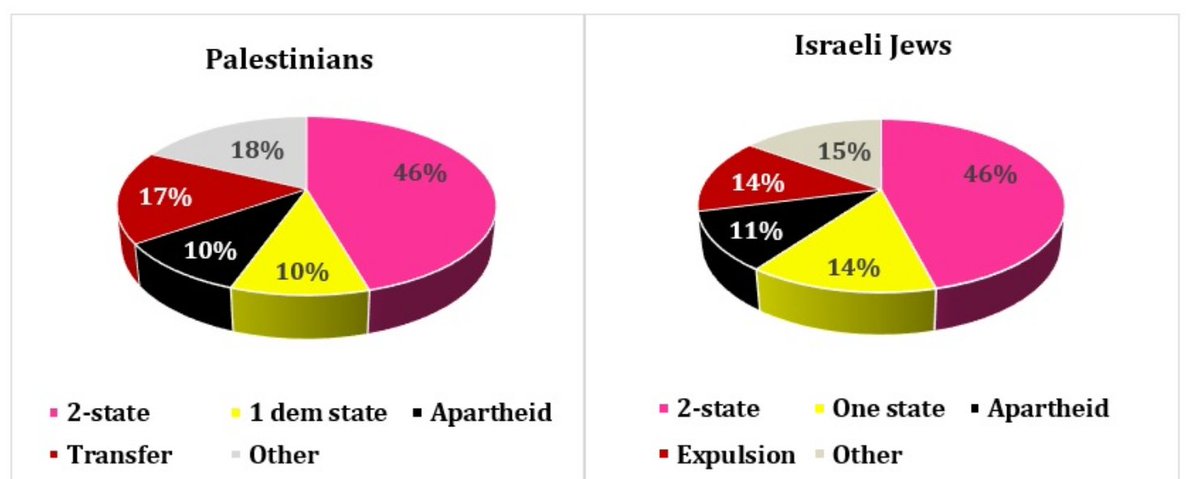
Take a look at this image, from the poll memo:


Just looking at that pie chart, you'd think that the pollsters asked respondents to choose among several potential "solutions" to the conflict: two-state, one-state with equal rights, one-state with only rights for one's own ethnic group ("apartheid"), and one-state where the other ethnic group has been removed (expulsion/transfer). And we'd see that a plurality (albeit a sub-majority plurality) picked the two-state solution, with smaller numbers divided across the other options.

But that's not actually what the pollsters did. Here's their explanation:
The findings show a high level of overlap: in other words, a single respondent often supported more than one of the three alternative options. In the following analysis we sought to identify a “core constituency” for each alternative option: i.e., the greatest number of respondents who would support the most desirable response – for the purposes of this analysis, the two-state solution – even if they support other responses, since policymakers can count on their support for two states. We then quantified the greatest number who supported the second-best option, but who would not support the two-state solution, and so on for the third and least desirable options.
To explain how this was done - in the first stage of the analysis, respondents who support a two-state solution are removed from the constituencies that support any of the other alternatives. In a second stage, those who support a one-state solution are removed from the constituencies that support either or both of the remaining two alternatives, apartheid and expulsion. In the final stage, we separate the remaining two groups by removing those who support apartheid from the constituency that supports expulsion. 
What does this mean in practice? Imagine three respondents to the poll. The first, Avi, says he supports a two-state solution and would not endorse any other outcome. The second, Batem, says he prefers a two-state solution over all others, but he would be okay with his ethnic group expelling the other side and ruling the land solo. The third, Chaya, says she prefers a one-state solution where members of the other ethnic group have been expelled, but she would be okay with a two-state solution outcome.

Not only would all three respondents "count" for the 46% two-state solution figure, but neither Batem nor Chaya would count for the one-state-via-expulsion solution, even though Chaya actually prefers that outcome to a two-state solution. In other words, it's not that 46% of Israelis and Palestinians prefer a two-state solution, it's that 46% of Israelis and Palestinians would accept a two-state solution even though some of them would actually prefer an outcome that's considerably more radical.

By the same token, the poll suggests that 17% of Palestinians and 14% of Israelis would back expelling their counterparts and just keeping the entire land for themselves. But that figure only includes those respondents who are only okay with the expulsion solution. It doesn't include people like Batem, who would back that outcome (albeit as a second-best solution) or even people like Chaya, who prefer that outcome (but are willing to accede to others). The percentage of persons who at least are willing to countenance -- or even prefer -- an expulsion scenario is almost assuredly higher than the figures given.

The pollsters justify this methodological move because they want to encompass the maximum number of people who would back the most "moderate" solution (a two-state). That strikes me as a little dodgy, but fair enough. Still, there's no question that -- insofar as it is being used to reflect the current political temperament amongst Israelis and Palestinians -- it massively overstates practical support for a two-state solution and undersells the support for more radical scenarios.

And what's most frustrating is that the pollsters don't even give us (as far as I see) the underlying figures to let us make apples-to-apples comparisons. I can understand why one wants a measurement of all those who'd at least be willing to support a two-state solution (even if they'd also back other outcomes). But then I'd want to compare that figure to how many persons are at least willing support those other outcomes (the possibility that more persons right now are at least willing to back expulsion -- or, more terrifyingly, prefer the expulsion outcome -- than desire a two-state solution or even a one-democratic-state outcome is left entirely on the table given that data that the pollsters made available).

Ultimately, then, the way this poll is being presented is more than a little shady in order to cast a far rosier picture on Israeli and Palestinian attitudes towards the peace process than I think is warranted. If this isn't quite as bad as those JVP maps (because at least they're explaining their methodology, albeit in a way that makes it clear how they're loading the deck), it's close.

Friday, January 12, 2018

What's a One Point Dip Among Friends?

Is it just me, or am I rightfully a bit skeeved out by this Erik Loomis post on "which demographic has Trump best held his support"?
Since his inauguration, Trump’s support in every polled demographic has fallen. That includes groups where he had massive support (his own voters, evangelicals) and where he had very low support (Hillary voters, African-Americans). But there is only one group where his approval has fallen by a mere 1 point. What do you think that is? Christians? The wealthy? The South? Nope, nope, and nope.
It’s Jews.
Of course, Trump had low Jewish support initially. But those Jewish voters who care only about an aggressive, expansionist Israel love Donald Trump. If you were Jewish and a Trump supporter in 2016, you are still a Trump supporter. Which says a remarkable amount about a particular type of politics that makes you a stickier Trump supporter than literally every other demographic group in the nation.
And yet, among all religious groups, Jews still have the lowest overall Trump support, at 30 percent, although Trump now has a lower approval rating among atheists/agnostics, which he did not a year ago.
Loomis is drawing from this NYT article detailing how much Trump's approvals have dropped off across various demographic groups between inauguration day and today. These range from a 12 point drop for Democratic men and a 10 point drop amongst Latinos to a 3 point drop amongst Blacks and a 1 point drop with Jews.

One bit of context that is missing is that Jews were one of the few demographic groups that moved left from 2012 to 2016. Obama got 69% of the Jewish vote in 2012, versus 70% for Clinton in 2016. That's not a huge shift, obviously, but given that the country as a whole lurched right (most groups -- including Blacks, Latinos, Asians, and women -- gave Clinton smaller margins than Obama), it stands out. So one way of interpreting this data is that "NeverTrump" GOP or Independent Jews actually walked the walk in 2016 -- they disapproved of Trump and actually voted against Trump when it counted. Put another way, the Jews most likely to have been "soft" Trump supporters were already were turned off on him by election day, whereas other groups' "soft" supporters only turned against him later.

To be clear, there's nothing in Loomis' post that's inaccurate. We could say that writing a whole post on Jewish support for Trump dipping "only" 1 point seems like a weird thing to focus on given the extremely low baseline of support Trump had with Jews to begin with (although, as Loomis notes, some other groups where Trump also began with very low support rates saw those rates dip by much greater amounts). We could also question how much narrative weight should be put upon the difference between a 1 point drop amongst Jews versus a 3 point drop amongst Blacks (if we're comparing groups that began with low baselines of support). Indeed, since the demographic "voted Trump in 2016" also saw only a modest 3 point dip, maybe the real lesson here is "If you were [a Trump voter in 2016], you are probably still a Trump supporter" -- full stop.

But really, my discomfort stems from what to reads as a weirdly triumphant tone, as if Loomis is eager to have proven something particularly diseased about the Jews -- the one group whose Trump flunkies are sticking to Trump more than any other group in the nation.

Maybe I'm reading into it. But Loomis sure sounds excited to put "Jews" and "Trump diehards" in the same conversation, doesn't he?

Wednesday, September 13, 2017

The Eternal Mystery of Why Jews Vote Democratic

People sometimes ask me why Jews vote Democratic. There's no real mystery behind it. The explanation is simple:
First, on every issue aside from Israel, Jews prefer Democrats to Republicans.
Second, on the issue of Israel, Jews prefer Democrats to Republicans.
As we look at Donald Trump's poll ratings amongst Jews -- far lower than even his catastrophic nationwide ratings -- we see this born out. On every issue save Israel, Jews think Trump sucks. And on Israel ... Trump still is significantly underwater, and well below where Barack Obama polled on that issue at his nadir. It's just not that mysterious why an overwhelmingly liberal electoral subgroup would keep voting for the more liberal of the two parties.

But, you know. 2014 2015 2016 2017 will be the year Jews finally come to our senses and realize who truly loved us all along!

Monday, September 04, 2017

Who We Thought They Were, Part II

The headline said: "Why a Republican Pollster is Losing Faith in Her Party." I immediately thought: "I bet it's Kristen Soltis Anderson."

I was right.

I've known Kristen since high school -- we were on the debate circuit at the same time, albeit she a few years older than I. It's been a bit weird watching someone you know become, you know, an official Big Deal (fun fact: Washington Post reporter Bob Costa was also part of this same era of debaters -- the conservative Student Congress set has done very well for itself!). Kristen was always on the more moderate side of her party, and as a pollster had long been pushing reforms to the Republican Party to make it more appealing to young voters -- tamping down on right-wing social issues and focusing on matters of economic opportunity.

But the reason I knew this article was talking about Kristen wasn't because she's a moderate, per se. It's because as a pollster, I suspected Kristen would not be able to shrink from a reality that many others in her ideological camp -- more intellectual, moderate, thoughtful Republicans -- are somehow still in denial about:

The brand of politics represented by Donald Trump is, as of now, the dominant form of Republicanism in the United States.

It isn't an aberration. It isn't a hijacking. It isn't a tiny minority that's somehow taken over.

Most Republicans fundamentally like the things Donald Trump does and the politics he represents. And that includes him at his most wretched -- for example, the aid and comfort to the neo-Nazis marching in Charlottesville. Quoth Anderson:
Anderson’s fear is that in a rapidly diversifying America, Trump is stamping the GOP as a party of white racial backlash—and that too much of the party’s base is comfortable with that. Trump’s morally stunted response to the violence in Charlottesville, Virginia, this month unsettled her. But she was even more unnerved by polls showing that most Republican voters defended his remarks.

“What has really shaken me in recent weeks is the consistency in polling where I see Republican voters excusing really bad things because their leader has excused them,” she told me. “[Massachusetts Governor] Charlie Baker, [UN Ambassador] Nikki Haley, [Illinois Representative] Adam Kinzinger—I want to be in the party with them. But in the last few weeks it has become increasingly clear to me that most Republican voters are not in that camp. They are in the Trump camp.”
The portion of the party coalition willing to tolerate, if not actively embrace, white nationalism “is larger than most mainstream Republicans have ever been willing to grapple with,” she added.
[...]
Polls showing Trump’s approval among young people falling to 25 percent or less justify her pessimism. And yet, as she noted, Trump’s approval among Republicans, while slightly eroding, remains at about 80 percent. Only one-fourth of GOP partisans criticized his handling of white-supremacist groups in a recent Quinnipiac University national survey.
That's the key point. Most Republicans of Anderson's political orientation simply won't admit that white nationalism is not some fringe phenomenon in their ranks. It is, as of now, the dominant position in Republican Party politics.

I can understand why Anderson thinks the Republican Party is worth saving. One could certainly say there are elements of conservative ideology that are not tied to White racist resentment and are worth preserving and defending. But those engaged in that project need to be honest about the status quo. And the status quo is that what drives the median Republican voter, right now, isn't economic opportunity or limited government or human liberty or any of the other markers that might justify an intellectually and morally defensible conservatism. It's a vicious form of identity politics that manifests in and celebrates things like DACA elimination, the Arpaio pardon, the transgender service ban, the Muslim immigration ban, and so on and so forth ad infinitum.

They are exactly who we thought they were. Some recognize that now. Most remain in denial.

Thursday, April 06, 2017

Peer Review Stinks Roundup

Well, I've just had my ritual instance of early-academic peer review hazing. Grouch grouch grouch etc.. A roundup of things on my browser.

* * *

Foreign Policy has an interesting story about how affirmative action programs work in Brazil. The story is primarily about the concept of "fraudulent" claims of blackness in a country where, on the one hand, most people identify as mixed-race, but on the other hand discrimination is less about "one-drop" ancestry and more focused on phenotype.

Israel appoints its first female Muslim diplomat. She will serve in Turkey.

The Atlanta Jewish Times writes on the racialized Jewish experience of Jews of color.

Lots of interesting data in this new ADL poll, including the perhaps surprising finding that a majority of American Muslims have positive views about Israel. Most Americans also think Donald Trump harbors racist, anti-Latino, and anti-Muslim views (only a minority think he holds antisemitic views), and while a bare majority of Americans are currently concerned about violence in the U.S. against Jews, over three-quarters of Americans are concerned about violence in the U.S. against Muslims.

The Trump administration's Syria policy has been pinballing wildly over the past few days. As I've stressed before, Syria is a complicated issue -- there is no obvious right move. But the fact that the Trump administration seems to just be lurching to and fro virtually at random is not reassuring.