Friday, February 02, 2018

Zioness Has a "Manifesto"

Zioness -- a campaign for progressive Zionists launched in the wake of the Chicago Dyke March fiasco -- has a "manifesto". This perhaps offers an opportunity for me to share my thoughts on Zioness, which I've been observing since its initial inception and towards which I maintain a wary but not wholly antagonistic posture.

Some people think that Zioness is just a false flag operation -- people who don't actually care about progressivism at all trying to infiltrate and kick-up-dust within progressive communities. There are several bases for this assertion. First, critics point out the links between Zioness' leadership and the Lawfare Project, which tends to take a relatively conservative line on Israel advocacy issues.  Hence, they suggest that Zioness is really just a stalking horse for Lawfare's right-wing agenda. Second, some have claimed that Zioness has taken a confrontational posture towards the progressive groups it marches with that, it is alleged, is designed to provoke and sow division. This, the argument goes, militates against the interpretation that all they really want is inclusion.

These arguments don't quite track for me, however. On the first point, there are, for better or for worse, plenty of Jews with non-progressive (even conservative) views on Israel who genuinely care about and support things like reproductive access, gay rights, economic redistribution, and other pillars of the progressive community. I'd be entirely unsurprised if the leaders of the Lawfare Project fit that profile. Call them inconsistent if you like, but I think there is little evidence to suggest they're lying about the cluster of beliefs they hold. And indeed, at least in the social media feed I've been pleasantly surprised at how Zioness has seemed to genuinely pick up and promote progressive causes in a way that feels organic and heartfelt. Groups or commenters that ignore, say, women's rights six days a week and then parachute in to say "what about women in Saudi Arabia?" whenever someone says a bad word about Israel are a dime a dozen. But Zioness has not actually been doing this -- it has promoted progressive causes in ways and in contexts where there is no clear reason to do it other than that they believe in it.

On the second, there's probably something to the claim that Zioness takes on a defiant tone that can be read as hostile. There's also probably something to the claim that people being open and unapologetic about their Zionism in spaces like this will be automatically read as "confrontational." Both of these interpretations, I think, make sense given the genealogy of Zioness as reaction to the expulsion of several Jewish marchers from the Chicago Dyke March for simply holding a rainbow flag with a Star of David on it -- an act which was taken to be sufficient proof of being an outside agitator who wasn't part of the progressive community. One lesson one can take from CDM is that being subdued in one's Jewishness, and adopting a go-along-get-along stance, isn't going to save you -- in fact, it isn't even going to protect you from accusations of tossing "Zionism" in everyone's face. Another lesson is the need to avoid the heads-I-win-tails-you-lose logic where Zionists are told not to be open in their Zionism when engaging in progressive causes (because it's distracting and making it "about us") and then, when progressive activists seek to define Zionists out of the camp it's justified (because where were all the Zionists during all these other campaigns?). So it doesn't surprise that the new tactic will be out-and-proud, taking a more aggressive and less conciliatory stance.

To be clear: this sort of confrontational, disruptive presence is very definitively not my preference. It flies in the face of all my own political instincts. But I've written about how certain modalities of organizing and protesting serve as markers for progressive orientation -- the medium very much being part of the message -- and as much as I hate it there might come a point where it's necessary for more mainstream Jewish groups to pivot towards more confrontational methods of political advocacy that "code" as progressive. Put another way, there's something a bit odd about folks from the IfNotNow wing of Jewish political action complaining that another group is behaving in a disruptive and confrontational manner, and doesn't seem interested in quietly and unobtrusively talking things out without making a big stink in public. To the extent Zioness is confrontational in demanding inclusion, that's wholly consistent with, not in opposition to, speaking in progressive shibboleths.

So those are reasons why I don't join the antagonistic camp. Yet I remain wary. And the main reason is that Zioness utterly refuses to even try to think through what progressive commitments mean with respect to Israel.

If we return to the manifesto, for example, it's pretty vague on what Zioness actually wants to achieve in the world. Indeed, it tries to hold that vagueness out as a virtue: "We will not define your progressivism or your Zionism." But the fact of the matter is it gives very little guidance regarding what it means, in practice, to "dismantle institutionalized racism in our government and our society." What does that commit us to? What policies are and aren't compatible with that ambition?

Most tellingly, Zioness doesn't seem willing to grapple with the fact that progressivism requires certain things out of Zionism. One can believe (and I do) that Zionism and progressivism are compatible while observing the should-be-obvious fact that not all iterations or implementations of Zionism are progressive or consistent with progressivism. Being a progressive Zionist imposes certain obligations with respect to Israel as much as anywhere else; a fact that Zioness seems resolutely uninterested in contending with (and here the link to the Lawfare Project really may do some important explanatory work). So while it claims that it wants to mobilize "progressive Zionists," that term doesn't actually encompass any set of "Zionist" beliefs about Israel so long as the holder is also pro-choice. The progressive Zionist community is already existent in organizations like Ameinu, Partners for a Progressive Israel, and J Street (to name a few), and all of these understand that progressive mobilization around Israel can't be agnostic on matters of Israeli policy or even the best understanding of Zionism. If, as I've often argued, caring about Israel means having opinions about it, these groups care a lot about Israel -- but that manifests precisely because they have particular concepts of what they want Israel to be and an active desire for it to live out a progressive credo.

So ultimately, I remain wary. I've already got a progressive Zionist community that I'm comfortable with; it works through the organizations I've just mentioned and they seem to do it better than Zioness is currently capable of. And while I can't fully join the critique of Zioness for behaving in a confrontational, stand-up-and-notice-me sort of way since that mode of social activism is increasingly de rigueur on the left, I don't like it and I don't have any interest in joining it.

Monday, January 29, 2018

Cleveland Indians Phasing Out "Chief Wahoo"

The Cleveland Indians' nakedly racist mascot, "Chief Wahoo", is being phased out of the team uniforms. About time. Frankly, while of course plenty of people have been complaining about the racist caricature that is Chief Wahoo for a long time, I've always been a bit surprised that the Indians largely managed to avoid a Redskins-style boycott over it.

Thursday, January 25, 2018

Back to Bitter (Israeli/Palestinian Polling Edition)

I've seen this poll from the Palestinian Center for Policy and Survey Research floating around the internet. Depending on their desired narrative, the pull-story has either been that both Israelis and Palestinians have dipped below majority support for a two-state solution or that Israelis and Palestinians still prefer a two-state solution over any other outcome (interesting side-bar: the one demographic that is overwhelmingly in support of a two-state solution? Israeli Arabs).

My view on polling Israeli and Palestinian attitudes has always been that we have to take the bitter polls with the sweet and the sweet polls with the bitter. By that I mean we shouldn't contort polls so that they fit our narrative agenda, whether that agenda is a positive view of the parties willingness to compromise or a cynical view that says that one side or the other simply "will never accept" this or that red line.

Under that framework, though, I consider this poll to be quite negative -- and, because of a peculiar methodological decision -- far more negative than it lets on, and in fact may be quite terrifying.

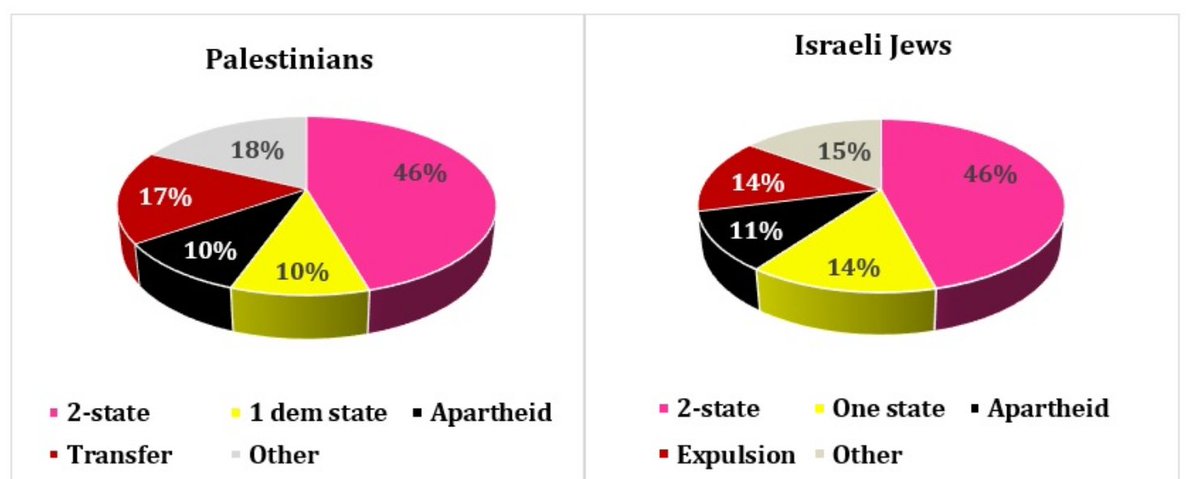
Take a look at this image, from the poll memo:


Just looking at that pie chart, you'd think that the pollsters asked respondents to choose among several potential "solutions" to the conflict: two-state, one-state with equal rights, one-state with only rights for one's own ethnic group ("apartheid"), and one-state where the other ethnic group has been removed (expulsion/transfer). And we'd see that a plurality (albeit a sub-majority plurality) picked the two-state solution, with smaller numbers divided across the other options.

But that's not actually what the pollsters did. Here's their explanation:
The findings show a high level of overlap: in other words, a single respondent often supported more than one of the three alternative options. In the following analysis we sought to identify a “core constituency” for each alternative option: i.e., the greatest number of respondents who would support the most desirable response – for the purposes of this analysis, the two-state solution – even if they support other responses, since policymakers can count on their support for two states. We then quantified the greatest number who supported the second-best option, but who would not support the two-state solution, and so on for the third and least desirable options.
To explain how this was done - in the first stage of the analysis, respondents who support a two-state solution are removed from the constituencies that support any of the other alternatives. In a second stage, those who support a one-state solution are removed from the constituencies that support either or both of the remaining two alternatives, apartheid and expulsion. In the final stage, we separate the remaining two groups by removing those who support apartheid from the constituency that supports expulsion. 
What does this mean in practice? Imagine three respondents to the poll. The first, Avi, says he supports a two-state solution and would not endorse any other outcome. The second, Batem, says he prefers a two-state solution over all others, but he would be okay with his ethnic group expelling the other side and ruling the land solo. The third, Chaya, says she prefers a one-state solution where members of the other ethnic group have been expelled, but she would be okay with a two-state solution outcome.

Not only would all three respondents "count" for the 46% two-state solution figure, but neither Batem nor Chaya would count for the one-state-via-expulsion solution, even though Chaya actually prefers that outcome to a two-state solution. In other words, it's not that 46% of Israelis and Palestinians prefer a two-state solution, it's that 46% of Israelis and Palestinians would accept a two-state solution even though some of them would actually prefer an outcome that's considerably more radical.

By the same token, the poll suggests that 17% of Palestinians and 14% of Israelis would back expelling their counterparts and just keeping the entire land for themselves. But that figure only includes those respondents who are only okay with the expulsion solution. It doesn't include people like Batem, who would back that outcome (albeit as a second-best solution) or even people like Chaya, who prefer that outcome (but are willing to accede to others). The percentage of persons who at least are willing to countenance -- or even prefer -- an expulsion scenario is almost assuredly higher than the figures given.

The pollsters justify this methodological move because they want to encompass the maximum number of people who would back the most "moderate" solution (a two-state). That strikes me as a little dodgy, but fair enough. Still, there's no question that -- insofar as it is being used to reflect the current political temperament amongst Israelis and Palestinians -- it massively overstates practical support for a two-state solution and undersells the support for more radical scenarios.

And what's most frustrating is that the pollsters don't even give us (as far as I see) the underlying figures to let us make apples-to-apples comparisons. I can understand why one wants a measurement of all those who'd at least be willing to support a two-state solution (even if they'd also back other outcomes). But then I'd want to compare that figure to how many persons are at least willing support those other outcomes (the possibility that more persons right now are at least willing to back expulsion -- or, more terrifyingly, prefer the expulsion outcome -- than desire a two-state solution or even a one-democratic-state outcome is left entirely on the table given that data that the pollsters made available).

Ultimately, then, the way this poll is being presented is more than a little shady in order to cast a far rosier picture on Israeli and Palestinian attitudes towards the peace process than I think is warranted. If this isn't quite as bad as those JVP maps (because at least they're explaining their methodology, albeit in a way that makes it clear how they're loading the deck), it's close.

Tuesday, January 23, 2018

West on Sex, Law, and Consent

I just wanted to flag this outstanding essay by Georgetown Law Professor Robin West: "Sex, Law, and Consent" (published in The Ethics of Consent: Theory and Practice, Franklin Miller & Alan Wertheimer, eds.). It's about a decade old now, but it is incredibly resonant with ongoing debates, and deserves to be recirculated.

The thrust of the piece is a defense of "consent" as a demarcation between criminal and non-criminal sexual acts, coupled with a critique of "consent" as automatically delineating the difference between "good" (non-harmful, valorous, laudatory) and "bad" sex.  West's argument is framed as a critique of certain radical feminist and queer theorists who have attacked the importance of consent -- either because it understates the background coercive conditions and inequalities of power which often render "consent" constructed or empty (RadFem) or because it nullifies the radical transgressive power of sexuality which is hot precisely because it plays upon these inequalities of power (queer theoretics).

West suggests that both of these critiques are ill-advised because they don't take sufficient account of the subjective experience of harm that is distinctive to nonconsensual sex (i.e., rape). There is, West suggests, a difference between agreeing to an exploitative contract and being robbed -- both might be problems, and the former may actually in aggregate contribute more to the broader spectrum of injustice than the latter, but nonetheless the subjective experience of signing a contract under exploitative conditions is not the same as being held up at gunpoint, and people don't experience it as such, and people don't expect the state to respond to them in the same way. The way we stop exploitative contracting isn't by expanding the definition of theft and robbery to encompass it. That they both represent wrongs doesn't mean they should be collapsed into the same category of social injustice.

Yet at the same time, West argues, that sex may be consensual (and therefore, in her view, not properly subjected to criminal sanction) should not exhaust our moral vocabulary when speaking of sex. Sex can be fully consensual and yet still harmful. Sex can be fully consensual and desired and yet still harmful. Ironically, we're more likely to speak of the harms of consensual sex in the case where it is mutually desired, as when we're lecturing a teenager that sure, they might want to have sex, but there's always the risk of an unexpected pregnancy or a disease that can derail a promising career or trap one in a life trajectory one very much does not desire. Yet this all obscures a different but still important case of consensual but undesired sex. Even here, West is appropriately circumspect -- we consent to things we don't desire all the time (West gives the example of consenting to see a movie one does not actually wish to see, because one's partner or children wish to). This isn't necessarily a terrible thing in isolation, but it can be, if it becomes pervasive or occupies the entirety of one's sexual being (if one's entire life of movie-watching is one that is wholly about what others desire, with no regard to what you yourself would like to see, that's a pretty crappy cinematic life irrespective of whether all the choices are "consensual"). In those cases, one is being harmed in a very real way -- internalizing (as West points out, quite literally) the notion that one's body is solely for others pleasure and that one's own desires are immaterial -- even though it's also a very distinctive way from that which comes through nonconsensual sex.

The point, then, is to avoid the Charybdis of calling it all rape, because consent is an effectively meaningless concept (or, on the other side, all sexy transgressive power play because consent is a fictive projection of repressed sexual desire) and the Scylla of saying that none of it matters because it was all consensual. As we move from the unambiguously criminal actions of a Harvey Weinstein to the more complex case of an Aziz Ansari, the failure to make these distinctions becomes more and more of an obstacle to pushing the conversation forward. People read about the Ansari case and say "you want to throw him in jail for that?" or "was it really non-consensual?" But that's a product of a crimped imagination whereby a broad range of moral questions get collapsed into a legal (criminal) question which gets collapsed into a "consensual" question -- and there's much more to be said than that. What happened to Grace, in her telling, may not be something that should result in Ansari being incarcerated, but it also isn't the equivalent of Grace agreeing to see a movie she has no interest in because her partner wants to watch it (let alone the equivalent of an actively desired encounter which, in the aftermath, turns out to have negative consequences).

Anyway, when I started writing this post I meant it to be a single paragraph of consisting of "read West's essay", and I've gone on much longer than that. So I'll just let it rest here -- but you should definitely read her piece.

Friday, January 19, 2018

"Like Giving Zizek To a First-Year" Roundup

Next week is the first substantive meeting of the "Intro to Political Theory" class I'm GSIing. It's mostly made up of first- and second-year students. The professor's initial reading assignment includes excerpts from Zizek and Gramsci. I'm prepared to be absolutely despised.

* * *

An LSU professor fired (against the advice of a faculty committee who reviewed her case) for using profanity in the classroom has lost a First Amendment suit against the university. I can't comment on the legal issues involved, but I can say that I fully agree with the AAUP's decision to censure LSU (in part) over the termination (the ruling does not effect the AAUP censuring decision).

The best piece I've read on liberal opposition to Ken Marcus taking up a civil rights position at the Department of Education. Tl;dr: It's not about BDS, it's about him being a conservative who isn't trusted to enforce the priorities of the civil rights community.

Why do Republicans need 60 votes to pass a budget? Because they used reconciliation to slam through a giant tax cut for the rich. Priorities, priorities.

RIP, Julius Lester.

Jewish convert discovers that her conversion means her old leftist buddies assume she's now all-in for apartheid. Welcome to the club!

A bank executive actually will go to prison for fraud (relating to the collapse of Nebraska bank TierOne).

Wednesday, January 17, 2018

Not-Bad Takes on Aziz and Grace

You probably missed it -- it didn't exactly get much traction -- but an essay came out the other day where a woman detailed what she termed a "sexual assault" by Aziz Ansari on their first date. It has spawned a legion of takes, many of them terrible. But some of them are pretty good! So in lieu of substantive commentary, I thought I'd just link to the essays I found not-bad (or better!).

KatyKatiKate: "Not That Bad."

Danielle Tcholakian, Nylon"On Aziz Ansari And Rape Culture’s Generation Gap: Why can’t we hear each other?"

Anna North, Vox: "The Aziz Ansari story is ordinary. That’s why we have to talk about it."

Jill Filipovic, The Guardian: "The poorly reported Aziz Ansari exposé was a missed opportunity."

Elizabeth Nolan Brown, Reason: "Aziz Ansari and the Limits of 'He Should Know Better.'"

Hyejin Shim, Medium"Consenting to Normal."

Tuesday, January 16, 2018

Taking Rural To School: The Carleton/Minnesota Case

MinnPost has an interesting article detailing the various programs and practices Minnesota private schools (including my beloved Carleton College) use to bring more students from rural communities to campus.

One thing I think the article does a good job of emphasizing is that attracting rural students, specifically, means being attentive to particular range of problems, concerns, or obstacles which transcend a simple, naked, "we're open to everyone" outlook. Obviously, scholarships are helpful -- and some schools have scholarship programs specifically open to students from rural backgrounds.

But another issue that is pointed out in the article goes to recruitment: when sending admissions representatives on recruiting trips around the country, it's obviously more efficient to visit densely populated sub/urban areas (particularly in relatively wealthy high-performing school districts) that are likely to yield more applicants. Hence, rural students may be less likely to hear about (say) Carleton or get information as to why they should attend or how it will be financially possible to attend. This is a structural disadvantage students from rural communities might face, and so it is incumbent on college admissions offices to take proactive steps to counteract it. Likewise, rural school districts may lack the range of extracurricular activities or programs that are found in their suburban counterparts, and so figuring out who are the true "stars" coming out of rural districts may require more work than simply an apples-to-apples comparison of applicant profiles. And for some schools (particularly those which are not themselves nestled in rural communities), there might also be some attention to mitigating the effects of culture shock -- the delicate balancing between wanting to expand horizons while also respecting that adjustment to new and different communities is something that requires work and support.

All of this is to say, to the extent a school like Carleton desires geographic diversity -- and it does, and it should -- it will have to take specific steps to make itself available and accessible to that community. Tailored scholarship programs, extra attention to non-traditional recruiting, and holistic appraisals of applications are just some of the ways Carleton might take these steps.

There's one last thing worth remarking on. Frequently, when talking about "affirmative action" programs, we hear a stock refrain about the "rural White kid from a small town in South Dakota -- what about him?"  As this article makes clear, the myth that colleges don't care about diversity when it comes to rural kids is just that -- a myth. But there's a bigger issue here. The implication of this critique is that concern for rural students is something competitive with, and antagonistic to, affirmative action programs which seek to increase enrollment of underrepresented racial and ethnic groups. In reality, they're two peas in a pod.

The strategies discussed in this article include scholarships that are just "for" rural kids (I wouldn't have been able to access them), specific efforts to recruit from these communities, and even certain types of "weighting" when assessing their application (why should their two extracurricular activities be more impressive than my seven?). These are no different in form than how racial affirmative action works. In neither case is the strategy simply a facial neutrality where we tally up GPAs and standardized test scores and rank accordingly. It isn't even a simple reduction of the entire program to class -- scholarships for people (regardless of race or location) below a certain income. Rather, both the race and the geography case involve taking specific actions that are tailored to, and sometimes restricted to, the particular underrepresented community.

Yet I think this article will elicit very few complaints about "special privileges", or the need for "location-blindness", or odes to the lost meritocracy of yore. I suspect most people will read this article and think these are salutary efforts to improve educational accessibility for a community that is often-overlooked in higher education.

For the record: it's the latter reaction that's the right one. While I myself come from the suburbs, and thus did not receive any of the scholarship money or specialized recruitment or tailored review of my application, I still consider myself a beneficiary of these programs. Why? Well, most obviously, I'm engaged to a fellow Carl who comes from what the article calls "Greater Minnesota" -- that turned out to be a great benefit for me. And of course, one of the many virtues of a truly great liberal arts education is getting to meet and learn from people who hail from a variety of different backgrounds.

My life and learning is better than it otherwise would have been because I got to meet and become friends with people from rural communities. It's also better than it otherwise would have been because I got to meet and become friends with people from lots of other communities, many of which were quite distant (spatially and otherwise) from where I grew up in the DC suburbs. Carleton's efforts to promote this sort of diversity are part of what makes it strong -- in all cases, not just some.

American Political Commentary, in a Nutshell

Here's Scott Lemieux:
The heuristic the typical voter uses to resign responsibility is to assign it to whoever controls the White House. This is often wrong. But it’s better than the heuristic used by the typical political reporter or pundit, “no matter who controls what, the Democratic Party is fully responsible.” And of course, there’s the particularly dumb lefty variant, “when Republicans I spent a year before the election assuring you were basically harmless pass terrible legislation with zero Democratic votes, that proves the Democrat Party secretly favors it.”
Sounds about right.

Friday, January 12, 2018

What's a One Point Dip Among Friends?

Is it just me, or am I rightfully a bit skeeved out by this Erik Loomis post on "which demographic has Trump best held his support"?
Since his inauguration, Trump’s support in every polled demographic has fallen. That includes groups where he had massive support (his own voters, evangelicals) and where he had very low support (Hillary voters, African-Americans). But there is only one group where his approval has fallen by a mere 1 point. What do you think that is? Christians? The wealthy? The South? Nope, nope, and nope.
It’s Jews.
Of course, Trump had low Jewish support initially. But those Jewish voters who care only about an aggressive, expansionist Israel love Donald Trump. If you were Jewish and a Trump supporter in 2016, you are still a Trump supporter. Which says a remarkable amount about a particular type of politics that makes you a stickier Trump supporter than literally every other demographic group in the nation.
And yet, among all religious groups, Jews still have the lowest overall Trump support, at 30 percent, although Trump now has a lower approval rating among atheists/agnostics, which he did not a year ago.
Loomis is drawing from this NYT article detailing how much Trump's approvals have dropped off across various demographic groups between inauguration day and today. These range from a 12 point drop for Democratic men and a 10 point drop amongst Latinos to a 3 point drop amongst Blacks and a 1 point drop with Jews.

One bit of context that is missing is that Jews were one of the few demographic groups that moved left from 2012 to 2016. Obama got 69% of the Jewish vote in 2012, versus 70% for Clinton in 2016. That's not a huge shift, obviously, but given that the country as a whole lurched right (most groups -- including Blacks, Latinos, Asians, and women -- gave Clinton smaller margins than Obama), it stands out. So one way of interpreting this data is that "NeverTrump" GOP or Independent Jews actually walked the walk in 2016 -- they disapproved of Trump and actually voted against Trump when it counted. Put another way, the Jews most likely to have been "soft" Trump supporters were already were turned off on him by election day, whereas other groups' "soft" supporters only turned against him later.

To be clear, there's nothing in Loomis' post that's inaccurate. We could say that writing a whole post on Jewish support for Trump dipping "only" 1 point seems like a weird thing to focus on given the extremely low baseline of support Trump had with Jews to begin with (although, as Loomis notes, some other groups where Trump also began with very low support rates saw those rates dip by much greater amounts). We could also question how much narrative weight should be put upon the difference between a 1 point drop amongst Jews versus a 3 point drop amongst Blacks (if we're comparing groups that began with low baselines of support). Indeed, since the demographic "voted Trump in 2016" also saw only a modest 3 point dip, maybe the real lesson here is "If you were [a Trump voter in 2016], you are probably still a Trump supporter" -- full stop.

But really, my discomfort stems from what to reads as a weirdly triumphant tone, as if Loomis is eager to have proven something particularly diseased about the Jews -- the one group whose Trump flunkies are sticking to Trump more than any other group in the nation.

Maybe I'm reading into it. But Loomis sure sounds excited to put "Jews" and "Trump diehards" in the same conversation, doesn't he?

Things People Blame the Jews For, Part XLI/Rate That Apology, Part 7: Puerto Rican Power Edition

It's a double-header!

As many of you know, Puerto Rico continues to suffer in the wake of a debilitating hurricane last year, with almost half of the island still lacking electricity. Island residents are justifiably angry at the lackluster federal response to their plight.

So why have repair efforts taken so long? Maybe it's because they're basically a colonized territory lacking full voting rights and so equal status as Americans. Maybe it's good old-fashioned racism (maybe explanations #1 and #2 are not mutually exclusive).

Or maybe, as an op-ed published in Puerto Rico's largest paper posited, it's the revenge of "the Jew":
Monday’s column by Wilda Rodriguez in the newspaper El Nuevo Día, titled “What Does ‘The Jew’ Want From The Colony?”, claimed that “Wall Street types” dictate U.S. policy, and that “Congress will do what ‘the Jew’ wants, as the vulgar prototype of true power is called.” 
“No offense to people of that religion,” she added. 
She went on to claim that Wall Street and “the Jew” are punishing Puerto Rico in order to get the island to pay its $70 billion debts.
I'm glad she added the "no offense" caveat. Who knows how it might have been interpreted otherwise?

Anyway, before I got to this Rodriguez issued an ... well, let's decide whether we'll call it an apology:
“I’m profoundly sorry that some have interpreted one of my pieces as anti-Semitism,” she wrote. “My career as a writer has been clear, and prejudice and racial and religious hostility have never been a part of it. I can understand the strong reaction that some of have had to the mere usage of the word ‘Jew.’ My intention was not to offend, but to provoke a public discussion. With that clear, I ask for forgiveness from those of good faith that were hurt by my political allusion. I have not and never will intend to offend them.”
Call me crazy, but I'm not convinced that the "mere usage of the word 'Jew'" was what set people off here. Had she written the sentence "At the age of 13, a Jew undergoes a Bar or Bat Mitzvah and becomes a full adult member of his or her community," I dare say everybody would be cool. I'd say the objection is 25% to the invocation of "the Jew" as a general archetype, and 75% to the content of that archetype being unbridled financial greed and power.

But hey -- public discussion provoked!

Grade: 2.5/10

Wednesday, January 10, 2018

The Issue is (Jewish) Power

Andrew Mark Bennett has a searing piece in the Forward detailing Jewish Voice for Peace's antisemitic obsession with Jewish power. One striking aspect of it is that it self-consciously does not focus on BDS. JVP has plenty of other sins that can be hung on its head, and Bennett does a good job detailing many of them.

Let me put it this way: reading this article made me want a cigarette. And I don't smoke. That's how good it felt.

Tuesday, January 09, 2018

Many People Are The Real Threat To Free Speech, Part 2

Last Fall, I noted that while we basically only hear about "threats to free speech" on campus when the alleged perpetrators are liberal, attempts to shut down distasteful speech are quite bipartisan in flavor. In the Chronicle of Higher Education, Aaron Hanlon collects some right wing instances of speech suppression on campus -- including the striking statistic (drawn from FIRE) that, while campus liberals are more likely to try to disrupt or shutdown speakers, conservatives are more likely to succeed in doing so. This doesn't really surprise me -- on the one hand, there are more liberals than conservatives on campus, and on the other hand, if there's one thing conservatives are really good at, it's working the refs.

Again, the moral of this story isn't to simply flip things on their heads -- conservatives are the only threat to free speech, and liberals are as pure as driven snow. The right lesson is, to reiterate, that threats to free speech come from all sides of the political spectrum, and that genuine commitment to the principles of free expression -- as opposed to opportunistically crying "free speech!" only to swiftly abandon it once it ceases to be politically convenient -- is actually a rare beast.

Monday, January 08, 2018

Lacking God's Time

Jelani Cobb has a great profile of Wayne A. I. Frederick, the President of Howard University, and the difficult dynamic even elite HBCUs face as they seek to navigate Trump-dominated political waters.

Cobb does a great job giving historical context to an ongoing dilemma HBCU leaders often face between directly challenging White supremacist power structures in America versus accommodating White leaders who control desperately-needed resources and access. It grates -- obviously it grates -- for students on these campuses to see their President, say, appear in a photo-op with President Trump, or to watch as Betsy DeVos uses their campus as a backdrop to prattle on about "school choice", or (in a particularly extreme example) to hear that Lee "Willie Horton" Atwater may join the university's  board. Such moves are, to say the least, way out of step with the prevailing sentiment of the campus community.

On the other hand, "Pragmatic" leaders often consider the putative conciliation to be its own form of power. What could be more revolutionary than extracting money and support from inside the belly of the beast?  Yes, it might be ideal to not have to make such compromises. But, Cobb quotes Frederick as saying: "People think we’re doing God’s work, on God’s time, with God’s money. The problem is, we don’t have access to the latter two."

The paradox of being an HBCU leadership position is that "pragmatists are in the business of producing new generations of fierce idealists." It's a difficult issue, without clear answers. But Cobb's piece is well worth a read to begin unpacking it, at the very least.

Saturday, January 06, 2018

Things People Blame the Jews For, Volume XL: Weed

Andrew Anglin. chieftain of the neo-Nazi website Daily Stormer, has a message for his followers regarding who controls the legal marijuana industry. Give you one guess:
“It is personally disgusting to me that we are condemning a generation of children to grow up baked in this noxious substance. But there is now huge public support for it,” website editor Andrew Anglin complained in a post about the Trump administration potentially pushing back against marijuana consumption and distribution. “Most of the marijuana industry, I can assure you, is run by Jews.”
Sadly for Anglin, it seems like many of his followers like toking up and so are resistant to the message that they have fallen under the thrall of the Jew-agenda. As one of Anglin's followers put it in eloquent rejoinder: "I enjoy cannabis and I'm not some filthy fucking hippie … or some faggot libertarian or [civic nationalism] cuck."

Can't wait to see how this debate plays out.

Friday, January 05, 2018

The Humiliation of The "Responsible" Republicans

I firmly believe that the "responsible" Republicans -- those who didn't already start on the Trump/Bannon side of the Party -- are deeply humiliated that Donald Trump is now the standard-bearer for their party.

It's embarrassing that a man whom everyone -- including his closest confidants -- agrees is a complete idiot has become the Republican mascot.

Of course, nobody likes being humiliated. But rather than taking aim at the actual root problem -- that they're Republicans in a world where Donald Trump is the Republican Party -- they're instead lashing out against those figures who are keeping Trump's mendacity and incompetence in the public eye.

This is how we get Senators Grassley and Graham -- often thought of as members of the "responsible" GOP wing -- requesting a criminal investigation of the author of the Steele Dossier. This is how we get Speaker Paul Ryan backing Trump water-carrier Rep. Devin Nunes over the Department of Justice regarding access to classified documents in the Russia probe (Nunes recused himself from that investigation after being accused of disclosing classified information; the House Ethics Committee cleared him last month). We see it in the ongoing efforts to discredit virtually our entire law enforcement apparatus as it continues to zero in on Trump administration malfeasance. We see it in the flatly incredible pivot back to LOOK AT HILLARY'S EMAILS in a last-ditch attempt to deflect attention.

They know that they're in bed with a bad guy. I have no doubt they find it deeply shameful. But instead of manning up and actually working to extract themselves from the situation, they're instead more upset that everyone keeps on talking about it. What they want is to return to a state of blissful -- if not ignorance, than at least quiescence -- where Trump's obvious deficiencies can be laughed off as within the bounds of normal politics, and they can just pass tax cuts and gut health care without having constant whispers of "is the Republican Party fiddling while American burns" hovering in the background.

It won't work, of course. It isn't Comey, or Mueller, or Rosenstein, or the FBI, or the DOJ, or the mainstream media, that is the root of their humiliation. It all boils down to the fact that they're Republicans in a period where Donald Trump has ascended to the fore of the Republican Party. So long as Trump is still in charge and still a Republican in good standing, he will continue to do things that will humiliate other members of his party.

The only question is how much damage the so-called "responsible" Republicans will do in their desperate attempt to avoid responsibility and pretend like if they close their (and everyone else's) eyes, this will all go away.

The Other Voting Rights Travesty

One interesting aspect of studying "anti-discrimination" issues in America is the degree to which Indigenous rights are frequently simply forgotten. In Australia, New Zealand, or to a lesser extent Canada, indigenous issues often occupy a substantial part of the attention of scholars in this area, but in the United States Native Americans are completely overlooked. An American law student, for example, will invariably get a significant education in the history of civil rights legislation and jurisprudence spanning the entirety of American history. But one can get an entire American legal education at most schools and pretty much never read a case that is primarily about Native American law.

On that note, I found very interesting this New York Times article about renewed pushes in Native communities to get and protect their right to vote. Whether the demand is opening polling stations in remote areas where Native Americans often live, to contesting gerrymandered districting lines which deprive Native Americans of proportionate representation, to ensuring that Native Americans have equal access to the necessary infrastructural prerequisites to voting (e.g., adequate postal service in vote-by-mail communities, or available registration offices in places that require voter ID), Native voting rights issues overlap with but are also distinct from the more familiar set of problems that are present in the race field.

Anyway, the article makes for a good read. Recommended.

Wednesday, January 03, 2018

And To Think, For a Minute I Thought Roy Moore Really *Did* Have a Jewish Friend

As you might recall, at the tail end of his campaign Roy Moore's wife Kayla tried to refute allegations that he was antisemitic by saying their "attorney is a Jew". This set off a media manhunt to figure out who the Jew in question was, and my prediction was that whoever it was, he'd turn out to be a Messianic Jew -- which is to say, not really Jewish at all.

Sadly for me, it looked like I was wrong: reporters discovered that Richard Jaffe -- who defended the Moore's son Caleb on drug charges -- was Jewish (actually Jewish) and so likely the man in question. While disappointed that my take didn't pan out, I took solace in the fact that Jaffe was a longtime friend and backer of Moore's Democratic opponent, Doug Jones.

But twist! Now Kayla is back in the news and claiming that Jaffe was not the Jew she was referring to. The suspect is still at large; and the hunt is back on!

Now two thoughts occupy my mind:

(1) I cannot believe this is still a story.

(2) Given that at least some of Moore's "Jewish" friends and Rabbis are indeed actually Messianic, I'm thinking that my original prediction has new life within it.

UPDATE: And boom goes the dynamite.

Tuesday, January 02, 2018

The West Coast is the Best (Target for a North Korean Nuclear Apocalypse) Coast

After many wonderful travels around the country to see family and friends -- in Fort Walton Beach, in Coral Gables, in Boca Raton, and in Chicago -- I'm now finally back home in Berkeley, California to begin the year 2018.

These travels make me miss my own time living in the middle of the country. Less because Chicago is so much better than the Bay Area (though it is), and more because Chicago is far less likely to be incinerated in an atomic holocaust after the President of the United States decided to get into a Twitter war with North Korea over who has a "bigger" nuclear button.

Anyway, Happy New Year!


Saturday, December 30, 2017

New Year's Resolutions: 2018

It's time for New Year's Resolutions -- the only time of year half of you ever read this blog.

2017 edition is here. As a bonus, I've gone back to prior years' posts and added whether I met or missed (or "pick 'em'd") each resolution! This is a feature long requested -- work your way back and relive the memories (this is a work-in-progress).

  • Met: 1, 2 (borderline, but let's be glass-half-full), 3, 4 (just came out!), 5, 6 (JTA and Forward), 8, 9(!), 10, 11, 12, 14
  • Missed: 13 (kidney stone is gone, but we've got no clear idea of why it formed in the first place), 15
  • Pick 'em: 7 (I've been a decently consistent gadfly in the ear of my local ADL representative)

Solid performance! Now for this year:

(1) Get married to Jill. I'm feeling optimistic about this one. (Met!)

(2) Complete my prospectus. (Met!)

(3) Publish or have accepted for publication an academic article. (Met! And it's already getting citations!)

(4) Exercise a non-trivial amount. (Pick 'em -- but I'm proud of myself for even that much)

(5) Attend a conference I have never attended before. (Met -- WPSA!)

(6) Present a paper before the Berkeley Law faculty. (Missed -- but I'm scheduled to do something early 2019)

(7) Meet with all of my advisers at least once (prospectus defense excluded). (Met. I'm 99% confident this is true, at least over the course of the whole year)

(8) Buy new pants. (Met! And they're super comfy)

(9) Buy new shoes. (Met! And they're super stylish)

(10) Have a successful Bachelor Party. (Met! It featured Peking Duck and an Escape Room -- which we escaped from!)

(11) Find a new steak guy (RIP, former steak guy's cattle ranch). (Met! The old steak ranch reopened!)

(12) Finish a draft of "Doctrinal Sunsets" (title subject to change). (Met! It was a brutal slog too, but the draft got done a few weeks ago)

(13) Contact an elected official about something. (Missed? I think? I might have written an email once)

(14) Contribute to a new cause or charity. (Met! I donated to HIAS after the Pittsburgh massacre. And many of my friends joined me)

(15) Convert at least one undergraduate student to Political Theory as a discipline. (Met, and she's jumped in with both feet. It made me super proud!)

Thursday, December 28, 2017

2018 Holiday Interregnum Roundup

What do you call the period between Christmas and New Years, anyway?

* * *

The Huffington Post (H/T: Nancy Leong) profiles a group of Black gun owners -- getting their perspective on why they own guns, the racial history of gun rights in America, and their perspective on potential encounters with the police while carrying. Very interesting. I've blogged a bit on the intersection of race and gun ownership here and here.

Conservative intellectual Max Boot concedes that the anti-racists and the feminists were pretty much right all along about the presence of bigotry in America (and particularly the American right). Max was also the guy who wrote, in February 2016, that "I'm a lifelong Republican but Trump surge proves that every bad thing Democrats have ever said about GOP is basically true."

Rosa Doherty sees a woman she admires say something antisemitic. So she -- gently and privately -- brings it to her attention. It doesn't go well. "If messages sent in good faith, with the hope of deepening understanding, are rejected in favour of hysteria and hate, then 2018 will be as depressing as 2017 has been."

Scott Lemieux: "'Democrats Need To Run People Whose Policy Positions Are Identical To Mine In Every Jurisdiction,' A Useless Political Analysis Editors Love". Yes, yes, and more yes.

Houston imam "mortified" that sermon calling for Muslims to kill the Jews "is being seen as a call for" killing Jews.

"Cornel West Has a Jewish Problem." Even if you think headline is a touch provocative, this is a good column by Yishai Schwartz (I say this as someone who genuinely appreciated the volume West cowrote with Michael Lerner on Black/Jewish relations).

Speaking of Jews, trying to map "The Last Jedi" onto a debate about the virtues of Orthodox versus Reform Judaism strikes me as trying way too hard, but if you must indulge Jenny Singer clearly bests Liel Leibovitz.

This thread has it all:

  • Alt-right troll: "Let me list all the Jews who run the media!"
  • Jew: " You're antisemitic trash. Also, that list isn't even accurate, so you're not even good at making lists of Jews."
  • Far-left Corbynista: "Well they are all 'Zionists', so stop your nitpicking and show some solidarity with our allies in the struggle."