Monday, April 11, 2011
Tipsy Cup
It is only because everything turned out okay that I am rolling over laughing imagining the scene: Applebee's accidentally serves alcohol to a toddler.


Saturday, April 09, 2011
Learning a Valuable Lesson
After an anti-tank rocket struck an Israeli school bus, Hamas is now claiming it didn't mean to hit a civilian target. They claim the road is often used by military vehicles (Israel points out the bus was bright yellow).
This reminds me of the brief period when Hamas was claiming that its rocket attacks during Cast Lead were also only hitting civilian targets accidentally. In response to Matt Yglesias' argument that this demonstrated at least a superficial belief that human rights norms were important -- a salutary step towards putting Hamas in dialogue with the broader human rights community -- I argued that this was better understood as an attempt to blur the "human rights" waters by accessing forms of discourse with proven legitimating force.
All forms of warfare cause civilian casualties. One of the critical distinctions Israel draws between itself and the terrorist groups it fights is that its civilian casualties are unintentional. So, Hamas thinks, why don't we just assert ours are unintentional too? Voila: moral parity!
The question isn't whether Hamas is serious in making this claim -- as Matt agreed last time around, their claims of accident are "transparent nonsense". I doubt even Hamas privately believes its rhetoric here (at best, they think they're just countering supposed Israeli disingenuous regarding their claims of non-intention). The problem is that bad-faith participation in human rights discourse is a proven successful tactic. The predecessor to Human Rights Watch was known as "Helsinki Watch", and its point wasn't to get the Soviet Union to sign human rights accords, but to try and create enforcement pressure on agreements already signed. If one looks at the body of human rights treaties floating around, nearly every country has signed them, because signing them is free credibility.
In any event, what I do see is Hamas taking another step forward in its abilities as a player in the global "lawfare" (in the broad sense) game. And that is most certainly not a good thing.
This reminds me of the brief period when Hamas was claiming that its rocket attacks during Cast Lead were also only hitting civilian targets accidentally. In response to Matt Yglesias' argument that this demonstrated at least a superficial belief that human rights norms were important -- a salutary step towards putting Hamas in dialogue with the broader human rights community -- I argued that this was better understood as an attempt to blur the "human rights" waters by accessing forms of discourse with proven legitimating force.
All forms of warfare cause civilian casualties. One of the critical distinctions Israel draws between itself and the terrorist groups it fights is that its civilian casualties are unintentional. So, Hamas thinks, why don't we just assert ours are unintentional too? Voila: moral parity!
The question isn't whether Hamas is serious in making this claim -- as Matt agreed last time around, their claims of accident are "transparent nonsense". I doubt even Hamas privately believes its rhetoric here (at best, they think they're just countering supposed Israeli disingenuous regarding their claims of non-intention). The problem is that bad-faith participation in human rights discourse is a proven successful tactic. The predecessor to Human Rights Watch was known as "Helsinki Watch", and its point wasn't to get the Soviet Union to sign human rights accords, but to try and create enforcement pressure on agreements already signed. If one looks at the body of human rights treaties floating around, nearly every country has signed them, because signing them is free credibility.
In any event, what I do see is Hamas taking another step forward in its abilities as a player in the global "lawfare" (in the broad sense) game. And that is most certainly not a good thing.
Apple of My Eye Roundup
In NYC for my cousin's wedding. Big weekend for her, and decently large one for me -- this is Jill's roll out to my dad's side of the family. Wish us luck!
* * *
I don't care whether they're actually happy or not, if I were the Tea Party, I would have declared victory on the budget battle.
Former top NOMer comes out in favor of full marriage equality.
The first Democrat officially jumps into the recall race, taking on highly endangered state Sen. Dan Kapanke (R-La Crosse).
I don't know whether anyone was thinking of reading Schools for Misrule based on David Bernstein's recommendation, but allow me to say: don't. It joins a Michael Moore volume as tied for the worst (and most nakedly hackish) non-fiction book I've ever read. And I'm someone who supports increased conservative representation in legal academia.
Can someone tell me what race-selective abortion even is? "Evidence shows that minorities are targeted for abortion" -- what, do they think African-American couples are getting pregnant, find out their baby will be Black, and are hoping for better luck next time? I find this utterly baffling.
Black student group condemns Israel-as-apartheid analogies. It's a group I haven't heard of -- it appears to be a grassroots organization centered on HBCUs, and has been strongly supported by AIPAC.
* * *
I don't care whether they're actually happy or not, if I were the Tea Party, I would have declared victory on the budget battle.
Former top NOMer comes out in favor of full marriage equality.
The first Democrat officially jumps into the recall race, taking on highly endangered state Sen. Dan Kapanke (R-La Crosse).
I don't know whether anyone was thinking of reading Schools for Misrule based on David Bernstein's recommendation, but allow me to say: don't. It joins a Michael Moore volume as tied for the worst (and most nakedly hackish) non-fiction book I've ever read. And I'm someone who supports increased conservative representation in legal academia.
Can someone tell me what race-selective abortion even is? "Evidence shows that minorities are targeted for abortion" -- what, do they think African-American couples are getting pregnant, find out their baby will be Black, and are hoping for better luck next time? I find this utterly baffling.
Black student group condemns Israel-as-apartheid analogies. It's a group I haven't heard of -- it appears to be a grassroots organization centered on HBCUs, and has been strongly supported by AIPAC.
Friday, April 08, 2011
Prosser Retakes Lead, Waukesha County to the Rescue
After posting a tiny lead in the first count, Democrat JoAnne Kloppenburg has fallen behind incumbent David Prosser after 14,000 additional votes were found in conservative Waukesha County, netting him a gain of 7,000 (quite a lot, given that the margin between the two was hanging in the low triple digits).
Some folks have been having a lot of fun observing how the inevitable GOP cries of "fraud" have magically disappeared since Prosser retook the lead. Of course, hypocrisy tends to be a double-edged sword -- are Democrats who were formerly poo-pooing the fraud allegations now ready to storm the ramparts about the stolen election? To Daily Kos, responding to an announced state-level probe into the circumstances surrounding the newly discovered ballots:
Hmm. That sounds ... amazingly mature. Imagine that. And I'm inclined to agree, incidentally -- rank incompetence strikes me as a far more likely explanation for these new votes than anything sinister.
In any event, since it looks extremely likely that Judge Prosser has retained his seat, I congratulate him on his hard-fought victory -- as well as to the Democratic and union organizers who managed to close a thirty point gap in the space of two months. This wasn't just Madison -- throughout the state of Wisconsin, there was strong and definitive movement in the blue direction that provides ample room to build upon as the recall races heat up.
Some folks have been having a lot of fun observing how the inevitable GOP cries of "fraud" have magically disappeared since Prosser retook the lead. Of course, hypocrisy tends to be a double-edged sword -- are Democrats who were formerly poo-pooing the fraud allegations now ready to storm the ramparts about the stolen election? To Daily Kos, responding to an announced state-level probe into the circumstances surrounding the newly discovered ballots:
[I]t's probably best not to get your hopes up about Kloppenburg potentially winning the campaign as a result of this probe. There are, as I noted earlier today, good reasons to believe that this was gross incompetence rather than fraud, even if the clerk and circumstances involved are extremely sketchy.
Hmm. That sounds ... amazingly mature. Imagine that. And I'm inclined to agree, incidentally -- rank incompetence strikes me as a far more likely explanation for these new votes than anything sinister.
In any event, since it looks extremely likely that Judge Prosser has retained his seat, I congratulate him on his hard-fought victory -- as well as to the Democratic and union organizers who managed to close a thirty point gap in the space of two months. This wasn't just Madison -- throughout the state of Wisconsin, there was strong and definitive movement in the blue direction that provides ample room to build upon as the recall races heat up.
Thursday, April 07, 2011
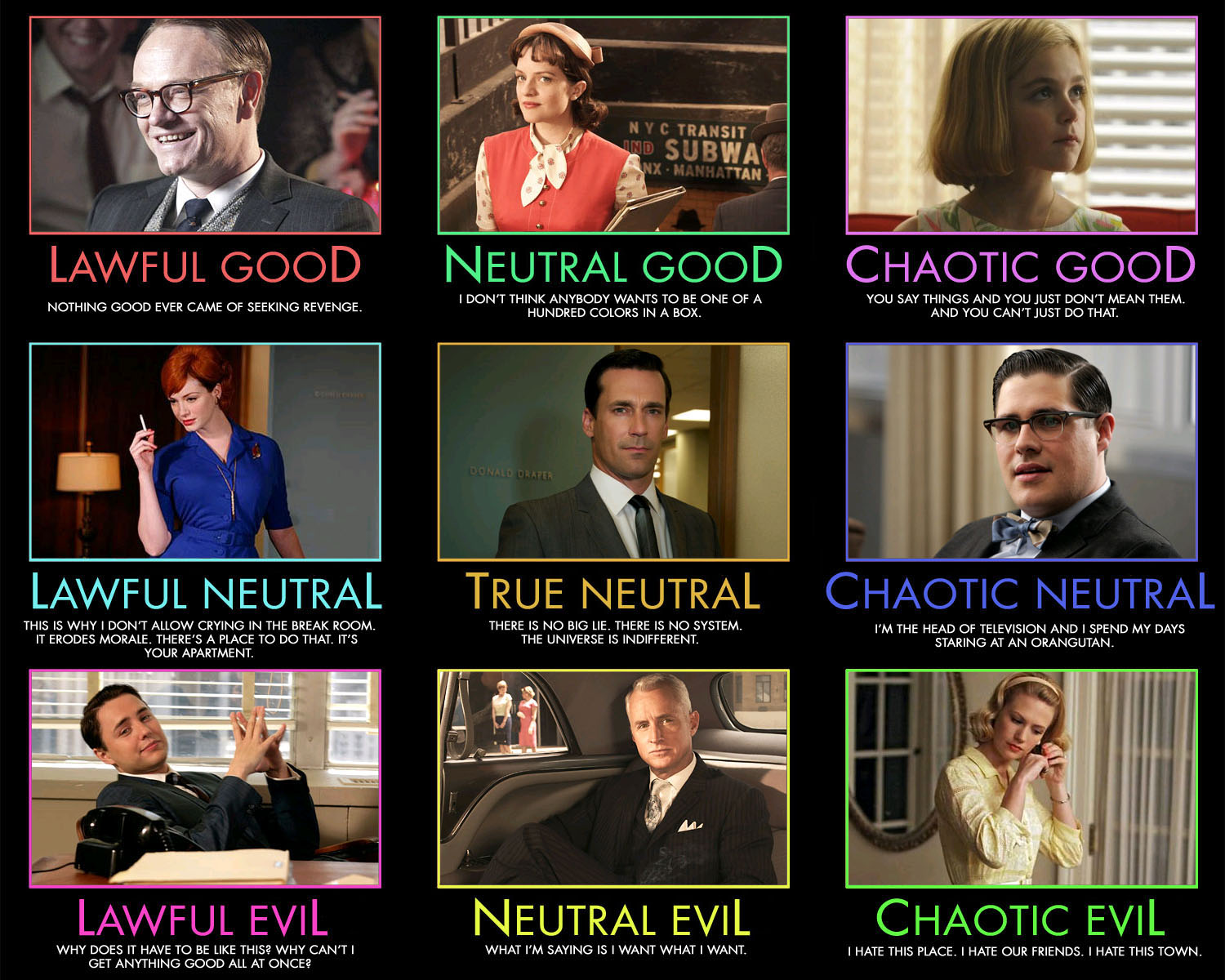
Blog of Ratings: Women Don Draper Has Slept With
The Book of Ratings may be no more, but this blog carries on its spirit. Earlier, we did a series rating state mottoes. Today, we examine a more popular focus -- the women Don Draper of Mad Men has slept with. Tuck in, folks -- this will be a long one (even without including some of the more random obscure ones, like that flight attendant).
Midge
The first of Don's dames we're introduced to, even before his wife Betty, which is very appropriate. Midge represents the Beatnik world, and immediately provides a fun and whimsical counterpoise to Don's grim seriousness. She's in control of herself, and she's a carbon copy (in looks and attitude) of every Mary Louise Parker character ever (that's a major, major plus). Tragically, she makes her return to the show as a drug addict -- but the whole reason that has so much emotional punch is because we all love her so much and remember her happiness. Here's hoping she lands on her feet. B+.
Betty
Oh Betty. Chaotic evil personified, Betty Draper (now Francis) starts off as a very sympathetic character, given that Don treats her like a child and given, um, the topic of this list. But it soon becomes apparent that Betty basically is a child -- a malevolent, uncontrolled, petty, spiteful child (the actual child in the picture, Sally, on the other hand, is all manner of awesome). She doesn't know what she wants, but boy is she upset when she doesn't get it. I don't fault her for leaving Don -- who could? -- but I do find it baffling that she did so seemingly precisely as their relationship seemed to be improving dramatically. And poor Henry Francis -- you can tell he's only just realizing what he's gotten himself into. D.
Rachel Menken
Now we're talking. The Jew Power in me loves that the woman who easily the most all-around badass on the show -- yes, I'm including Joanie -- is a Jew. And not just in the "I ended up marrying someone named Katz" way, but an out-and-proud Jew who doesn't apologize for it. Rachel is smart, accomplished, in charge, smoking hot, and self-aware enough to cut Don loose when he's about to throw his entire life away. When Betty left Don, I was kind of hoping that Tilden Katz would get hit by a bus so they could get back together. Alas, no dice. A+.
Bobbie Barrett
If you took all of Don's evil qualities and added breast implants, you'd have Bobbie Barrett. Utterly amoral, her relationship with Don is basically paired sexual assaults mixed with self-destructive alcoholism. Yes, show, we get the symbolism of that. Anyway, Bobbie's relationship with Don has no redeeming qualities, though forcing her to stay with Peggy for awhile -- whose blinding light of earnest niceness manages to pierce even Bobbie's cynicism -- was fun to watch. But Bobbie herself has basically no redeeming qualities. The only things that prevents her from sinking below Betty are (a) she has a mind of her own and (b) we give at least grudging admiration to Don's negative qualities, so why not hers? D.
Joy
Okay, let's get one thing out the way: Joy is 21 in the same way that I'm 30. Alright, so Joy basically isn't a person so much as she is the incarnation of Don's sexual id -- unrestrained wealthy hedonism with no responsibilities or meaning. Joy is also perhaps the most prominent member of the club of women who basically demand Don sleep with them based on no more interaction than across-the-room eye contact. And her family probably smuggles drugs. This is precisely why Don was wise not ask questions, and eventually get the hell out of there. B-.
Ms. Farrell
There are many pluses to Ms. Farrell. Sally loves her, and she's a good teacher. She went to Bowdoin, which competes with Bates and Colby for the title "Carleton of Maine." And, oh yeah, she's basically a living saint. Which raises the question -- why does she fall for Don in the first place? It's established very early that she knows his game and knows it won't end well for her. And she actually manages to turn him down flat a few times. But then he gives her a full blast of Don-stare, and it's off with her dress. Ugh. I had such high hopes that you'd play a starring role in the (much smaller) "Blog of Ratings: Women Don Draper Hasn't Slept With" list. Alas. B.
Allison
It takes awhile, but Don finally dips into the secretarial pool. And I always liked Allison. She's competent, professional, understanding -- she's probably the best secretary qua secretary Don's ever had. So of course he treats her more cruelly than probably any of his other damsels, and she justifiably breaks one of his knick-knacks in fury. Serves him right. A-.
Dr. Faye Miller
Finally, another blond. Dr. Miller is certainly a step up from Betty. And I do like that her mob connections may see Don killed -- it's about time he actually suffered some consequences for his inability to form meaningful relationships. The main problem I have with Dr. Miller is that her introduction stymied a perfectly good opportunity to bring back that Austrian doctor who was so badass in Season 1. Also, I admit it's been awhile since I've seen Season 4, and my memory of the new doctor is a bit fuzzy. B+.
Megan
Megan's ... okay. She comes into the picture because of Allison's departure, and Allison is much cooler than Megan is. The best thing you can say about Megan is that Don's marriage proposal appears motivated by his belief that she'd make a good stepmom for his children, which is surprisingly noble of him (and fortunate, given that his original attraction to her was the standard commtiment-phobia thing against Dr. Faye). I don't have anything against Megan per se, it's just that when I make my list of "who should Don be married to, since Betty is a raging sociopath", she ranks pretty far down. B-.
Don Draper
Obviously, Don Draper is not a woman Don Draper has slept with. But it felt unfair to be grading all these women and yet let Don escape the critical gaze. For the main character of a show that prides itself on its verisimilitude, Don's ... kind of a parody, when you think about it. He's not just mysterious, he's got a back story that makes Harry Potter look plausible. He's not just sexy, women basically toss themselves into his bed approximately every 6 hours. He's smart, but he's benefited by being surrounded by idiots -- when Jill and I encounter a decent idea that's being promoted way above its candle power, one of us inevitably mumbles "It's called the Carousel." And that doesn't even go into his "mainstream" character flaws, like serial adultery. Still, he is dashingly handsome, and has some ability with words, I concede. B.
Midge
The first of Don's dames we're introduced to, even before his wife Betty, which is very appropriate. Midge represents the Beatnik world, and immediately provides a fun and whimsical counterpoise to Don's grim seriousness. She's in control of herself, and she's a carbon copy (in looks and attitude) of every Mary Louise Parker character ever (that's a major, major plus). Tragically, she makes her return to the show as a drug addict -- but the whole reason that has so much emotional punch is because we all love her so much and remember her happiness. Here's hoping she lands on her feet. B+.
Betty
Oh Betty. Chaotic evil personified, Betty Draper (now Francis) starts off as a very sympathetic character, given that Don treats her like a child and given, um, the topic of this list. But it soon becomes apparent that Betty basically is a child -- a malevolent, uncontrolled, petty, spiteful child (the actual child in the picture, Sally, on the other hand, is all manner of awesome). She doesn't know what she wants, but boy is she upset when she doesn't get it. I don't fault her for leaving Don -- who could? -- but I do find it baffling that she did so seemingly precisely as their relationship seemed to be improving dramatically. And poor Henry Francis -- you can tell he's only just realizing what he's gotten himself into. D.
Rachel Menken
Now we're talking. The Jew Power in me loves that the woman who easily the most all-around badass on the show -- yes, I'm including Joanie -- is a Jew. And not just in the "I ended up marrying someone named Katz" way, but an out-and-proud Jew who doesn't apologize for it. Rachel is smart, accomplished, in charge, smoking hot, and self-aware enough to cut Don loose when he's about to throw his entire life away. When Betty left Don, I was kind of hoping that Tilden Katz would get hit by a bus so they could get back together. Alas, no dice. A+.
Bobbie Barrett
If you took all of Don's evil qualities and added breast implants, you'd have Bobbie Barrett. Utterly amoral, her relationship with Don is basically paired sexual assaults mixed with self-destructive alcoholism. Yes, show, we get the symbolism of that. Anyway, Bobbie's relationship with Don has no redeeming qualities, though forcing her to stay with Peggy for awhile -- whose blinding light of earnest niceness manages to pierce even Bobbie's cynicism -- was fun to watch. But Bobbie herself has basically no redeeming qualities. The only things that prevents her from sinking below Betty are (a) she has a mind of her own and (b) we give at least grudging admiration to Don's negative qualities, so why not hers? D.
Joy
Okay, let's get one thing out the way: Joy is 21 in the same way that I'm 30. Alright, so Joy basically isn't a person so much as she is the incarnation of Don's sexual id -- unrestrained wealthy hedonism with no responsibilities or meaning. Joy is also perhaps the most prominent member of the club of women who basically demand Don sleep with them based on no more interaction than across-the-room eye contact. And her family probably smuggles drugs. This is precisely why Don was wise not ask questions, and eventually get the hell out of there. B-.
Ms. Farrell
There are many pluses to Ms. Farrell. Sally loves her, and she's a good teacher. She went to Bowdoin, which competes with Bates and Colby for the title "Carleton of Maine." And, oh yeah, she's basically a living saint. Which raises the question -- why does she fall for Don in the first place? It's established very early that she knows his game and knows it won't end well for her. And she actually manages to turn him down flat a few times. But then he gives her a full blast of Don-stare, and it's off with her dress. Ugh. I had such high hopes that you'd play a starring role in the (much smaller) "Blog of Ratings: Women Don Draper Hasn't Slept With" list. Alas. B.
Allison
It takes awhile, but Don finally dips into the secretarial pool. And I always liked Allison. She's competent, professional, understanding -- she's probably the best secretary qua secretary Don's ever had. So of course he treats her more cruelly than probably any of his other damsels, and she justifiably breaks one of his knick-knacks in fury. Serves him right. A-.
Dr. Faye Miller
Finally, another blond. Dr. Miller is certainly a step up from Betty. And I do like that her mob connections may see Don killed -- it's about time he actually suffered some consequences for his inability to form meaningful relationships. The main problem I have with Dr. Miller is that her introduction stymied a perfectly good opportunity to bring back that Austrian doctor who was so badass in Season 1. Also, I admit it's been awhile since I've seen Season 4, and my memory of the new doctor is a bit fuzzy. B+.
Megan
Megan's ... okay. She comes into the picture because of Allison's departure, and Allison is much cooler than Megan is. The best thing you can say about Megan is that Don's marriage proposal appears motivated by his belief that she'd make a good stepmom for his children, which is surprisingly noble of him (and fortunate, given that his original attraction to her was the standard commtiment-phobia thing against Dr. Faye). I don't have anything against Megan per se, it's just that when I make my list of "who should Don be married to, since Betty is a raging sociopath", she ranks pretty far down. B-.
Don Draper
Obviously, Don Draper is not a woman Don Draper has slept with. But it felt unfair to be grading all these women and yet let Don escape the critical gaze. For the main character of a show that prides itself on its verisimilitude, Don's ... kind of a parody, when you think about it. He's not just mysterious, he's got a back story that makes Harry Potter look plausible. He's not just sexy, women basically toss themselves into his bed approximately every 6 hours. He's smart, but he's benefited by being surrounded by idiots -- when Jill and I encounter a decent idea that's being promoted way above its candle power, one of us inevitably mumbles "It's called the Carousel." And that doesn't even go into his "mainstream" character flaws, like serial adultery. Still, he is dashingly handsome, and has some ability with words, I concede. B.
Twitter Debunks the "Israeli" Libyan Munitions
See here (keep clicking "load more" to read the whole story). Some munitions were found with an image of an umbrella (at first folks were saying a crescent) and a six-pointed star. The latter symbol had folks saying the weapons were Israeli-manufactured. Turns out, the umbrella is a parachute icon and the star is a symbol predating the existence of Israel indicating a flare round. The weapon itself was identified as an 81 mm illumination round, probably of Indian or British manufacture.
Alas, the story that Israel is supplying Qaddafi with weaponry has been making the rounds on al-Jazeera and PressTV.
Alas, the story that Israel is supplying Qaddafi with weaponry has been making the rounds on al-Jazeera and PressTV.
Wednesday, April 06, 2011
Madison Versus the World
All ballots (minus absentees, I believe) have been tallied, and JoAnne Kloppenburg has pulled out an exceptionally tight, 200-vote-margin victory over incumbent David Prosser. The election was widely considered the first salvo in the recall fight sparked by Gov. Scott Walker's radical anti-union agenda, and Walker was eager to downplay what it all means for those races.
The problem is that this doesn't actually tell the story of yesterday's contest at all. While Madison and (to a lesser extent) Milwaukee are key Democratic strongholds, it is not those two cities versus the rest of the state. Much the opposite: it's those two cities versus Milwaukee's suburbs, with the rest of the state being far more swingy than one might expect.
Look at this results map. Obviously, large chunks of Kloppenburg's margins came from Milwaukee and Madison (Dane County), though actually the bluest parts of the state are in the northwest corner. Meanwhile, the darkest red swaths are Ozaukee, Washington, and Waukesha counties -- the Milwaukee suburbs. Beyond that, the divide is not Madison versus the rest of the state, but east and west -- the eastern part of the state being more conservative, the western portions more liberal.
And while Walker's right that the recall elections aren't occurring in Madison, they're not occurring in Waukesha either. None of the five most vulnerable Republican state senators -- the five with re-elects under 50% -- are anywhere near Milwaukee. Dan Kapanke's district is in southwest Wisconsin, anchored in LaCrosse -- a pretty blue area. Self-inflicted wounds notwithstanding, Randy Hopper's geographically in good shape, with the help of the GOP stronghold of Fond du Lac. Luther Olson is right on the border of where red meets blue, with conservative Waushara and Waupaca counties alongside more liberal climes in Columbia and Sauk counties. Shawano, Outagamie, and Brown counties are all red, which is good news for Rob Cowles, but Sheila Harsdorf is like Olson in that her district straddles a red/blue divide (here, where Pierce and Dunn counties meet St. Croix and Polk, plus Burnett).
This isn't to say this is terrible terrain for the GOP (except for Kapanke, who may well be toast). But just as Democrats aren't operating out of their home base in Madison, Republicans aren't on their strongest Milwaukee metro turf either. If Walker thinks he can chalk this race up to Madison saving the liberal day, he's got another thing coming.
Gov. Scott Walker said this afternoon that the spring election results show there are "two very different worlds in this state."
"You've got a world driven by Madison, and a world driven by everybody else out across the majority of the rest of the state of Wisconsin," Walker said at a press conference in the Capitol.
[...]
Walker added that Justice Prosser's performance in many parts of the state bodes well for GOP senators who may face recall elections later this year.
"For those who believe it's a referendum, while it might have a statewide impact that we may lean one way or the other, it's largely driven by Madison, and to a lesser extent Milwaukee," the governor said. "But those Senate recall elections on both the Democrat and Republican side aren't being held in Madison, they aren't being held in Milwaukee."
The problem is that this doesn't actually tell the story of yesterday's contest at all. While Madison and (to a lesser extent) Milwaukee are key Democratic strongholds, it is not those two cities versus the rest of the state. Much the opposite: it's those two cities versus Milwaukee's suburbs, with the rest of the state being far more swingy than one might expect.
Look at this results map. Obviously, large chunks of Kloppenburg's margins came from Milwaukee and Madison (Dane County), though actually the bluest parts of the state are in the northwest corner. Meanwhile, the darkest red swaths are Ozaukee, Washington, and Waukesha counties -- the Milwaukee suburbs. Beyond that, the divide is not Madison versus the rest of the state, but east and west -- the eastern part of the state being more conservative, the western portions more liberal.
And while Walker's right that the recall elections aren't occurring in Madison, they're not occurring in Waukesha either. None of the five most vulnerable Republican state senators -- the five with re-elects under 50% -- are anywhere near Milwaukee. Dan Kapanke's district is in southwest Wisconsin, anchored in LaCrosse -- a pretty blue area. Self-inflicted wounds notwithstanding, Randy Hopper's geographically in good shape, with the help of the GOP stronghold of Fond du Lac. Luther Olson is right on the border of where red meets blue, with conservative Waushara and Waupaca counties alongside more liberal climes in Columbia and Sauk counties. Shawano, Outagamie, and Brown counties are all red, which is good news for Rob Cowles, but Sheila Harsdorf is like Olson in that her district straddles a red/blue divide (here, where Pierce and Dunn counties meet St. Croix and Polk, plus Burnett).
This isn't to say this is terrible terrain for the GOP (except for Kapanke, who may well be toast). But just as Democrats aren't operating out of their home base in Madison, Republicans aren't on their strongest Milwaukee metro turf either. If Walker thinks he can chalk this race up to Madison saving the liberal day, he's got another thing coming.
Hard-Earned Money
Bristol Palin, who received a $262,000 salary for her efforts to combat teen pregnancy, remarked "If I can prevent even one girl from getting pregnant, I will feel a sense of accomplishment." Jon Chait retorts "One prevented pregnancy at a cost of $262,000 would not be a terribly effective investment."
I'll go further -- if becoming a teen mother qualifies you to pull in $262,000, it's preventing the pregnancy that would be the tragedy.
I'll go further -- if becoming a teen mother qualifies you to pull in $262,000, it's preventing the pregnancy that would be the tragedy.
Tuesday, April 05, 2011
Wisconsin Nightmares
I'm following the Wisconsin Supreme Court race, widely seen as a preview of the emerging Democratic recall threat. Unfortunately, I don't know the state well enough to offer much independent analysis -- I'm reliant on Swing State Project for that (and the AP for up to date results). One thing I do know is that the vote patterns seem to be tracking the 2004 Presidential election very closely. For those of you who don't remember, Kerry beat Bush in Wisconsin ... by .4%. Yeah, this is going to be a long night.
One thing that intrigues me about Wisconsin -- Minnesota is the same way -- is that the suburbs are, far and away, the most conservative parts of the state. Prosser is racking up massive margins in Waukesha County, outside Milwaukee. Why is that? In Maryland, Montgomery and PG County are huge Democratic strongholds, and the inner-ring NoVa suburbs are key blue regions in Virginia as well. Are we the weirdos, or is it a Midwest thing?
UPDATE: Dave Weigel has been doing some good 2004 vs. 2012 side-by-sides. Kloppenberg (D) appears to be barely outperforming Kerry in the counties measured. But all these counties are ones that Kerry ended up winning -- no word if Prosser is outperforming in more conservative regions.
UPDATE #2: SSP has also been observing the huge numbers coming in from Waukesha County and other Milwaukee suburbs. But it observes that something seems off about them -- the turnout is monstrous; not "we're really excited about this race" high, more "it's illegal not to vote" high. And while, hey, maybe that's what's up, another option is that the numbers are overstated (not because of fraud or anything, just the denser precincts have already reported, and the more sparsely populated ones are yet to come). If that's not the case -- well, we might just be screwed.
One thing that intrigues me about Wisconsin -- Minnesota is the same way -- is that the suburbs are, far and away, the most conservative parts of the state. Prosser is racking up massive margins in Waukesha County, outside Milwaukee. Why is that? In Maryland, Montgomery and PG County are huge Democratic strongholds, and the inner-ring NoVa suburbs are key blue regions in Virginia as well. Are we the weirdos, or is it a Midwest thing?
UPDATE: Dave Weigel has been doing some good 2004 vs. 2012 side-by-sides. Kloppenberg (D) appears to be barely outperforming Kerry in the counties measured. But all these counties are ones that Kerry ended up winning -- no word if Prosser is outperforming in more conservative regions.
UPDATE #2: SSP has also been observing the huge numbers coming in from Waukesha County and other Milwaukee suburbs. But it observes that something seems off about them -- the turnout is monstrous; not "we're really excited about this race" high, more "it's illegal not to vote" high. And while, hey, maybe that's what's up, another option is that the numbers are overstated (not because of fraud or anything, just the denser precincts have already reported, and the more sparsely populated ones are yet to come). If that's not the case -- well, we might just be screwed.
Yay Precedent
I read today that recall organizers can collect signatures outside the polling sites for today's Wisconsin Supreme Court election contest. Incumbent David Prosser is locked in a tooth and nail battle to keep his seat after tying himself to the highly unpopular Scott Walker administration (and after calling the chief justice of his own court a "bitch").
Wisconsin law prohibits "electioneering" outside polling places, but the decision was that this did not apply to political work for contests unrelated that day's election. And I read that, and I thought "here comes a controversy". Because while that's a perfectly plausible interpretation, the contrary one would be perfectly plausible too.
But then I read that this decision didn't come today, but rather four years ago, in a totally unrelated matter involving the recall of a Milwaukee alderman. It's just settled precedent that is being cross-applied to the current case. It's nice when precedent works that way -- defusing a potentially explosive controversy because the relevant rule had already been decided in a much more low-profile situation.
Wisconsin law prohibits "electioneering" outside polling places, but the decision was that this did not apply to political work for contests unrelated that day's election. And I read that, and I thought "here comes a controversy". Because while that's a perfectly plausible interpretation, the contrary one would be perfectly plausible too.
But then I read that this decision didn't come today, but rather four years ago, in a totally unrelated matter involving the recall of a Milwaukee alderman. It's just settled precedent that is being cross-applied to the current case. It's nice when precedent works that way -- defusing a potentially explosive controversy because the relevant rule had already been decided in a much more low-profile situation.
Monday, April 04, 2011
Bar None Roundup
There's a feeling of freedom in the air, but it will dissipate as soon as I start working on my bar application in earnest.
* * *
Israeli and Iranian relief workers join together in Japan. Unfortunately, as Harry's Place notes it is likely that one of the two countries will force out a denial that any cooperation occurred at all (remember this?).
I really like the cartoon at the bottom of this post.
Ahmadinejad predicts that the Arab revolutions will destroy Israel. Of course, he seems to say everything from the sun setting to the birds chirping will have that effect, so forgive my skepticism of his savvy geopolitical analysis.
Dahlia Lithwick describes Connick v. Thompson as "one of the meanest Supreme Court decisions ever."
More minimalism from the Roberts Court! (see my older post on the subject).
* * *
Israeli and Iranian relief workers join together in Japan. Unfortunately, as Harry's Place notes it is likely that one of the two countries will force out a denial that any cooperation occurred at all (remember this?).
I really like the cartoon at the bottom of this post.
Ahmadinejad predicts that the Arab revolutions will destroy Israel. Of course, he seems to say everything from the sun setting to the birds chirping will have that effect, so forgive my skepticism of his savvy geopolitical analysis.
Dahlia Lithwick describes Connick v. Thompson as "one of the meanest Supreme Court decisions ever."
More minimalism from the Roberts Court! (see my older post on the subject).
Saturday, April 02, 2011
Goldstone Reassesses
The blogosphere is abuzz over Judge Richard Goldstone's reconsideration of his commission's report on Operation Cast Lead. Judge Goldstone, more or less, states that he's satisfied with the results of Israel's investigation into the accusations, that he no longer believes Israel can fairly be accused of targeting civilians as a matter of policy, and that he regrets that Israel did not cooperate with his commission's inquiry, as the evidence they have mustered would have substantially changed their conclusions. I had wondered what Judge Goldstone thought of Israel's ongoing investigations, and now we have our answers.
Jeffrey Goldberg calls this admission "as shocking as it is unexpected". I'm not sure I agree. I actually think it coheres pretty well to my read on Judge Goldstone as an arch-formalist. One of the things Judge Goldstone reemphasized in his reappraisal was that his investigation was not and was not meant to be "judicial" (in that it wasn't meant to offer definitive conclusions, only raise issues worthy of investigation). I observed that, technically true or not, Judge Goldstone was "the only person on the planet who hasn't taken the report as a definitive pronouncement of guilt and innocence." Ditto Judge Goldstone's clear disappointment that Hamas has not investigated the war crimes accusations against it, and the UNHRC's marked unwillingness to hold human rights violations against Israelis accountable. I remarked at the time that Judge Goldstone's surprise at these omissions is genuine if incredibly naive, and I think that's still accurate.
My line on Goldstone had always been that the problems in his report were structural, not the result of a malignant heart. It was Goldstone's determination to play a straight hand in a marked deck that was his undoing. Judge Goldstone was trying his level best, but there was no way to have a full and fair investigation -- no matter how diligent one is at crossing t's and dotting i's -- when the propagating party is the UNHRC and the investigation occurs within a context (the international legal community) that is shot through with bias and prejudice. There seems to be some belated realization by Judge Goldstone that this is true, but I fear it is for naught. Like his original report, his mea culpa is too legalistic to have much of an impact -- it is, shall we say, unlikely that the UN will accede to PM Netanyahu's demand that the original report be retracted in the wake of Judge Goldstone's recantation. We are, and always were, in the realm of politics, not law. Judge Goldstone tried as hard as he could to imagine that was not so, but there is no way to extract oneself in cases such as this. His colleagues in the system understood the game, and he got rolled.
I imagine some will question the reliability of Judge Goldstone's change of heart. We are, after all, dealing with the full weight and fury of the global Zionist monster -- Judge Goldstone could have simply finally cracked under the pressure. This strikes me as extremely unlikely. The Goldstone report had, frankly, fallen out of the news. It wasn't a story anymore, and the Jewish and pro-Israel community had moved on. This op-ed came out of the blue, and it is hard to imagine what leverage the Israel Lobby had over Judge Goldstone yesterday that outweighed the incredible fire he took in the immediate aftermath of the report's release. It's also difficult to imagine that Judge Goldstone's reputation or place in history will change all that much even with this op-ed. His legacy, for better or for worse, is tied to that report.
And even beyond what we think of Judge Goldstone, there is a larger sense in which this all doesn't matter. Nobody expects the folks who were Goldstone's greatest cheerleaders to reassess their evaluation of Israel's conduct. The people who excoriated may have an extra rhetorical arrow in their quiver, but they don't really need him either -- he's simply belatedly affirming the position they took all along. The world will spin on as normal. When the system is as badly broken as the UN's human rights apparatus is, it takes a far more herculean effort to see real change than what we see here.
Jeffrey Goldberg calls this admission "as shocking as it is unexpected". I'm not sure I agree. I actually think it coheres pretty well to my read on Judge Goldstone as an arch-formalist. One of the things Judge Goldstone reemphasized in his reappraisal was that his investigation was not and was not meant to be "judicial" (in that it wasn't meant to offer definitive conclusions, only raise issues worthy of investigation). I observed that, technically true or not, Judge Goldstone was "the only person on the planet who hasn't taken the report as a definitive pronouncement of guilt and innocence." Ditto Judge Goldstone's clear disappointment that Hamas has not investigated the war crimes accusations against it, and the UNHRC's marked unwillingness to hold human rights violations against Israelis accountable. I remarked at the time that Judge Goldstone's surprise at these omissions is genuine if incredibly naive, and I think that's still accurate.
My line on Goldstone had always been that the problems in his report were structural, not the result of a malignant heart. It was Goldstone's determination to play a straight hand in a marked deck that was his undoing. Judge Goldstone was trying his level best, but there was no way to have a full and fair investigation -- no matter how diligent one is at crossing t's and dotting i's -- when the propagating party is the UNHRC and the investigation occurs within a context (the international legal community) that is shot through with bias and prejudice. There seems to be some belated realization by Judge Goldstone that this is true, but I fear it is for naught. Like his original report, his mea culpa is too legalistic to have much of an impact -- it is, shall we say, unlikely that the UN will accede to PM Netanyahu's demand that the original report be retracted in the wake of Judge Goldstone's recantation. We are, and always were, in the realm of politics, not law. Judge Goldstone tried as hard as he could to imagine that was not so, but there is no way to extract oneself in cases such as this. His colleagues in the system understood the game, and he got rolled.
I imagine some will question the reliability of Judge Goldstone's change of heart. We are, after all, dealing with the full weight and fury of the global Zionist monster -- Judge Goldstone could have simply finally cracked under the pressure. This strikes me as extremely unlikely. The Goldstone report had, frankly, fallen out of the news. It wasn't a story anymore, and the Jewish and pro-Israel community had moved on. This op-ed came out of the blue, and it is hard to imagine what leverage the Israel Lobby had over Judge Goldstone yesterday that outweighed the incredible fire he took in the immediate aftermath of the report's release. It's also difficult to imagine that Judge Goldstone's reputation or place in history will change all that much even with this op-ed. His legacy, for better or for worse, is tied to that report.
And even beyond what we think of Judge Goldstone, there is a larger sense in which this all doesn't matter. Nobody expects the folks who were Goldstone's greatest cheerleaders to reassess their evaluation of Israel's conduct. The people who excoriated may have an extra rhetorical arrow in their quiver, but they don't really need him either -- he's simply belatedly affirming the position they took all along. The world will spin on as normal. When the system is as badly broken as the UN's human rights apparatus is, it takes a far more herculean effort to see real change than what we see here.
Friday, April 01, 2011
Wisconsin Woman Charged with Bomb Threats
A Wisconsin woman who allegedly sent messages to GOP lawmakers threatening to bomb them and their families has been arrested.
Utterly unacceptable, thuggish behavior that deserves the full legal sanction available.
Utterly unacceptable, thuggish behavior that deserves the full legal sanction available.
Thursday, March 31, 2011
Iron Range
Ohio is about to pass a Wisconsin-like union-busting bill. And Democrats, who can force a referendum on the law before it goes into effect, are spitting for a fight.
The referendum will be held in November of 2011. And while some folks aren't thrilled about that (a few more days and the contest would be in November of 2012 -- alongside a likely more Democrat-friendly electorate aided by President Obama), the Daily Kos is stoked at the early race.
And while I agree with the particulars of their analysis (strike while the iron is hot, clear attention to this one issue, forces GOP presidential contenders to take a stand during the primaries), what I'm more hyped about is the enthusiasm. After a demoralizing 2010, the Democratic base is fired up. And that sort of enthusiasm, more than anything else, is symbolic of a political movement making a comeback.
The referendum will be held in November of 2011. And while some folks aren't thrilled about that (a few more days and the contest would be in November of 2012 -- alongside a likely more Democrat-friendly electorate aided by President Obama), the Daily Kos is stoked at the early race.
And while I agree with the particulars of their analysis (strike while the iron is hot, clear attention to this one issue, forces GOP presidential contenders to take a stand during the primaries), what I'm more hyped about is the enthusiasm. After a demoralizing 2010, the Democratic base is fired up. And that sort of enthusiasm, more than anything else, is symbolic of a political movement making a comeback.
Village Idiot
Michelle Bachmann posing next to a sign which reads: "Somewhere in Kenya, a village is missing its idiot."
Alas, somewhere in Anoka, Minnesota, they still have theirs.
Alas, somewhere in Anoka, Minnesota, they still have theirs.
Wednesday, March 30, 2011
Numbered Days
After Israeli police responded in force to violent settlers stoning officers sent to arrest a resident of Givat Ronen, Israeli MK Michael Ben Ari of the far-right National Union party compared the Israeli government to that of Muammar Gaddafi (a comparison I doubt either party appreciates):
Can we get over the illusion that Ben Ari is anything but an enemy of the state? It's the sort of statement that I almost wish Ben Ari would try to back up -- the folks Ben Ari represents are an existential threat to the long-term security of the state of Israel, and there needs to be (dare I say) a "price tag" put upon their thuggish, illiberal, and frankly seditious activities.
Following the West Bank clashes Knesset Member Michael Ben Ari (National Union) said: "Internal Security Minister Yitzhak Aharonovitch must remember he's not Gaddafi and that any regime that acts violently towards its citizens, beating, humiliating and punishing them collectively – his days are numbered."
Can we get over the illusion that Ben Ari is anything but an enemy of the state? It's the sort of statement that I almost wish Ben Ari would try to back up -- the folks Ben Ari represents are an existential threat to the long-term security of the state of Israel, and there needs to be (dare I say) a "price tag" put upon their thuggish, illiberal, and frankly seditious activities.
Meme Alert
"With notably rare exceptions (the Holocaust, for example), Europe has been very friendly to the Jews."
Alan Greenspan, defending the system of unrestrained capitalism:
Henry Farrell proclaims the birth of a new meme.
The commenters, indeed, come through (with varying degrees of success). Contribute your own!
I think, incidentally, that the essence of this meme lies in the existence of a catastrophic exception to the "rule" being forwarded, which is waved away as something "notably rare" and thus irrelevant in our overall assessment, when, obviously, it shouldn't be. The proximity we came in 2008 to a global financial meltdown is hardly something that can just be shrugged off as exceptional just because there where many more years where we weren't on the brink of economic anarchy. That's like complaining that using the Holocaust to indict German anti-Semitism ignores all those years Jews weren't being put in gas chambers.
Alan Greenspan, defending the system of unrestrained capitalism:
Today’s competitive markets, whether we seek to recognise it or not, are driven by an international version of Adam Smith’s “invisible hand” that is unredeemably opaque. With notably rare exceptions (2008, for example), the global “invisible hand” has created relatively stable exchange rates, interest rates, prices, and wage rates.
Henry Farrell proclaims the birth of a new meme.
It’s best not to interpret this as an empirical claim, but a carefully-thought-out bid for Internet immortality. It has the sublime combination of supreme self-confidence and utter cluelessness of previously successful memes such as “I am aware of all Internet traditions” and the “argument that has never been made in such detail or with such care,” but with added Greenspanny goodness. I tried to think of useful variations on the way in to work this morning – “With notably rare exceptions, Russian Roulette is a fun, safe game for all the family to play,” and “With notably rare exceptions, (the Third Punic War for example), the Carthaginian war machine was extremely successful,” but none do proper justice to the magnificence of the original. But then, that’s why we have commenters. Have at it.
The commenters, indeed, come through (with varying degrees of success). Contribute your own!
I think, incidentally, that the essence of this meme lies in the existence of a catastrophic exception to the "rule" being forwarded, which is waved away as something "notably rare" and thus irrelevant in our overall assessment, when, obviously, it shouldn't be. The proximity we came in 2008 to a global financial meltdown is hardly something that can just be shrugged off as exceptional just because there where many more years where we weren't on the brink of economic anarchy. That's like complaining that using the Holocaust to indict German anti-Semitism ignores all those years Jews weren't being put in gas chambers.
How a Bill Becomes a Law
It's been awhile since I took high school civics, but I think I recall the basics: The House and the Senate both have to pass it, and then the President signs it. There are some wrinkles involving vetoes and conference negotiations and whatnot, but the basics aren't too difficult.
Unless, apparently, you're the GOP Majority Leader in the House. Then a bill becomes a law solely upon action by the House, regardless of whether the Senate and President like it or not:
In other basic checks-and-balances news, the Wisconsin Assistant Attorney General says that the state's new anti-union law is "absolutely" still in effect despite a state judge's restraining order blocking the law from going into effect (a temporary measure while the judge determines whether the passage of the law violated the state's open meetings requirement).
Unless, apparently, you're the GOP Majority Leader in the House. Then a bill becomes a law solely upon action by the House, regardless of whether the Senate and President like it or not:
House Majority Leader Eric Cantor (R-Va.) said at a press conference that Republicans would consider the Government Shutdown Prevention Act on Friday. The bill would make H.R. 1 law if the Senate fails to pass a measure “before April 6” to fund the government for the rest of the fiscal year. H.R. 1, which passed the House but has gone nowhere in the Senate, would fund the government through the end of September and seeks to cut $61 billion in spending.
Despite GOP claims to the contrary, the Government Shutdown Prevention Act would not become law unless the Senate also approves it and the president signs it into law, neither of which is expected to occur.
In other basic checks-and-balances news, the Wisconsin Assistant Attorney General says that the state's new anti-union law is "absolutely" still in effect despite a state judge's restraining order blocking the law from going into effect (a temporary measure while the judge determines whether the passage of the law violated the state's open meetings requirement).
Tuesday, March 29, 2011
Liberation Transmissions
Herman Cain is telling conservative audiences exactly what they want to here, to wit, the ol' "Democrats are the true racists" game:
As Adam Serwer notes, the one audience whom this statement would go over like a stone is an audience of Black people. As Serwer observes:
Black people, I imagine, also don't like being told they mostly can't "think for themselves."
I have no doubt that Cain's conservatism is genuine. But if the idea behind promoting someone like Herman Cain is to show that the GOP is an inclusive place for Black people -- a place where their issues and concerns and beliefs will be taken seriously -- it's going to be an obvious failure. If the goal is to reassure the GOP's overwhelmingly White voting base that they're not racist, on the other hand, he's very useful.
Cain then went on to say he thought liberals were upset with him "because I won't stay on the Democrat plantation like I'm supposed to."
"It may shock you but some black people can think for themselves," he added.
As Adam Serwer notes, the one audience whom this statement would go over like a stone is an audience of Black people. As Serwer observes:
Again, it's hard to imagine Cain talking like this to the average black audience, because the average black person doesn't really enjoy being compared to a slave. But it's the sort of thing white conservatives really eat up, which is why black conservatives often draw these kinds of comparisons.
Black people, I imagine, also don't like being told they mostly can't "think for themselves."
I have no doubt that Cain's conservatism is genuine. But if the idea behind promoting someone like Herman Cain is to show that the GOP is an inclusive place for Black people -- a place where their issues and concerns and beliefs will be taken seriously -- it's going to be an obvious failure. If the goal is to reassure the GOP's overwhelmingly White voting base that they're not racist, on the other hand, he's very useful.
Monday, March 28, 2011
Birth of a Monster
I'm really just thrilled that Donald Trump is (a) apparently serious about running for President under the GOP banner and (b) is going the full birther (and not just because he can't even manage to grandstand on it effectively). Trump is not a serious figure, but he has enough money to at least command attention in a GOP primary (and enough delusion to actually throw it away). Which means birtherism stays in the news as Republicans debate, and the Party can't dodge that it's a thing for them.
Anything that emphasizes to America that, hey, we're dealing with a Party that collectively has gone off the rails, is something good for not just Obama, but that entire Democratic Party in 2012.
UPDATE: Dave Weigel basically concurs.
Anything that emphasizes to America that, hey, we're dealing with a Party that collectively has gone off the rails, is something good for not just Obama, but that entire Democratic Party in 2012.
UPDATE: Dave Weigel basically concurs.
Turnover
The law review board officially turned over today. As of 12 noon, I am officially an ex-Articles Editor. Unofficially, we still have some work to do. But it's a milestone all the same.
Congratulations to the incoming board, all of whom will do a fabulous job I'm sure. And congratulations to the outgoing folks from Volume 78 -- I think, all in all, we did a fine job we can be proud of.
Congratulations to the incoming board, all of whom will do a fabulous job I'm sure. And congratulations to the outgoing folks from Volume 78 -- I think, all in all, we did a fine job we can be proud of.
Friday, March 25, 2011
I Wish I Was Special
This story about citizens in Westhampton Beach, NY (including many Jews) opposing the creation of an eruv within the town limits rings very odd to me. Religiously speaking, an eruv refers to a sort of enclosure which allows observant Jews to undertake various activities on Shabbat they otherwise would be unable to do (because of rules governing the carrying of burdens across property lines). In modern times, the eruv typically a sort of religious-legal fiction -- as I understand it, it usually is comprised of some wires hung on utility poles to demarcate the borders of the "enclosure". I don't think it entails anything more substantive than that.
Reading the story, then, I really had trouble grasping the substantive nature of the town residents' objections. There was a lot of gesticulation against "special rights" and giving into to a special interest pressure group (that would be the Orthodox Jews). But it didn't sound like that maintenance of the eruv would cost more than a trivial sum, if anything (and I imagine it would be the Jews who funded it). The only reason they need permission is to hang the wires from the utility poles, as I understand it. An eruv is something that requires virtually nothing out of the surrounding community -- it is a near-costless accommodation.
The real motivator seemed to be that allowing an eruv might make the community too Orthodox-friendly, risking "changing the town." The residents were worried about the wrong sorts moving in, the wrong sorts being observant Jews. There seemed to be a lot of preexisting tension between the Orthodox community and the rest of the town (some of the residents accused the Orthodox Jews of being isolated and reticent to support other community institutions), and it seemed pretty obvious that many wished they would just go somewhere else ("If he [the local Rabbi] doesn't like the way things are, he can leave.").
There's a lot here that reminds me of the Incantalupo case (also in NY). It seems quite possible that the Orthodox Jews haven't been the warmest neighbors, and that's a contributing factor. But ultimately, even if that's true (and the evidence is much weaker than it was in Incantalupo), there's something unnerving about the way a ton of classic and modern anti-Semitic tropes ("hidden agendas", Jewish provincialism, half-formed dreams of forcing them out, worries about being taken over by observant Jews) are floating around in this story. Religious accommodation isn't (or shouldn't) be a grace bestowed by the beneficent majority upon its favored supplicants. In America, in a land built upon religious liberty (and religious pluralism), I think it ought to be assumed as of right. That assumption can be rebutted, but it would need stronger evidence than what appears to be going on in Westhampton, which is that much of the community simply doesn't like the local Orthodox community.
Reading the story, then, I really had trouble grasping the substantive nature of the town residents' objections. There was a lot of gesticulation against "special rights" and giving into to a special interest pressure group (that would be the Orthodox Jews). But it didn't sound like that maintenance of the eruv would cost more than a trivial sum, if anything (and I imagine it would be the Jews who funded it). The only reason they need permission is to hang the wires from the utility poles, as I understand it. An eruv is something that requires virtually nothing out of the surrounding community -- it is a near-costless accommodation.
The real motivator seemed to be that allowing an eruv might make the community too Orthodox-friendly, risking "changing the town." The residents were worried about the wrong sorts moving in, the wrong sorts being observant Jews. There seemed to be a lot of preexisting tension between the Orthodox community and the rest of the town (some of the residents accused the Orthodox Jews of being isolated and reticent to support other community institutions), and it seemed pretty obvious that many wished they would just go somewhere else ("If he [the local Rabbi] doesn't like the way things are, he can leave.").
There's a lot here that reminds me of the Incantalupo case (also in NY). It seems quite possible that the Orthodox Jews haven't been the warmest neighbors, and that's a contributing factor. But ultimately, even if that's true (and the evidence is much weaker than it was in Incantalupo), there's something unnerving about the way a ton of classic and modern anti-Semitic tropes ("hidden agendas", Jewish provincialism, half-formed dreams of forcing them out, worries about being taken over by observant Jews) are floating around in this story. Religious accommodation isn't (or shouldn't) be a grace bestowed by the beneficent majority upon its favored supplicants. In America, in a land built upon religious liberty (and religious pluralism), I think it ought to be assumed as of right. That assumption can be rebutted, but it would need stronger evidence than what appears to be going on in Westhampton, which is that much of the community simply doesn't like the local Orthodox community.
Raise Ya Game
Kevin Drum on "the coming GOP spectacle":
I have to say, I've been impressed at the, er, relatively less-sane wing of the GOP to come up with fun, novel, and interesting conspiracy theories as the Obama administration goes on.
I just want to say that I am so looking forward to the Republican primary campaign this cycle. It looks like Michele Bachmann is going to run, Palin might run, Newt Gingrich is probably going to run, Jim DeMint seems like he might run, and I suppose Ron Paul will run again too. This is a freak show of stupendous proportions, and it would be perfect if Donald Trump really did decide to join all these nutbags on the stage during the debates.
I guess I'm wondering how these debates are going to go. I mean, the party line even among the relatively sane wing of the GOP holds that Obama is a socialist Kenyan sleeper agent, global warming doesn't exist, millionaires are taxed too highly, and Ben Bernanke is courting hyperinflation. Parroting those positions won't make you stand out from the pack, so the crazy wing is going to have to up the ante. But how? Obama needs to turn over a DNA sample to prove he's not a mutant mole? Our real danger is the potential for ice caps to start forming in Los Angeles by the middle of the century? We should take a cue from the airlines and give rich people a million-dollar-club card from the government that exempts them from all taxes for the rest of their lives?
I have to say, I've been impressed at the, er, relatively less-sane wing of the GOP to come up with fun, novel, and interesting conspiracy theories as the Obama administration goes on.
Thursday, March 24, 2011
Fatal Furies, Take Two
Jesus, this wasn't a one-off? CNN's Erick Erickson gets in on the "it's the ladies fault" action for why the U.S. is in Libya:
Unbelievable.
ERICKSON: By the way, it's the women's fault. … It's, apparently, the women in the Obama administration who have decided we needed to go to war in Libya. … This is typical. This is so typ-- i'm mean, I'm going to bring my inner sexist out I'm afraid tonight, some of you are going to be very upset with me. But this is like women drivers. We're going to war in Libya, we have no plan, we have no map, even if we have a map of war, um, it wasn't going to get read, they were going to pull over and ask the French apparently for help, or at least make the guy pull over and ask the French for help. This is crazy.
[...]
This is just silly. I mean, back-seat driving by the women, and they're gonna get Barack Obama lost. What is it with Barack Obama caving to the women? I mean, now we know who rules his personal life. I guess Michelle is firmly in charge as well, if Barack Obama is going to cave that easy to three women in his administration over what to do with Libya.
[...]
It took the women to get him involved, and the women apparently went in without a clear plan. No shopping list.
Unbelievable.
Statehood Ho
The cynic in me thinks that DC's loss of a Black majority is, far and away, the best thing that could have happened to it in terms of getting real voting rights in Congress.
New Comments Policy
Countermand all of that. I've just created a new, more comprehensive policy (here, but you can also access it from those shiny new "tabs" at the top of the page).
And what better way to inaugurate a new comments policy than with somebeheadings bannings! N. Friedman, Joe (who I think is posting anonymously now, but I'm not sure), Superdestroyer, that insanely passive-aggressive person who I banned awhile ago and can't be bothered to look up, but hasn't been back since anyway -- thanks for all your contributions, but this blog is changing direction and I don't see you as part of our plan for future growth. Take care, and enjoy our generous severance package -- a link for you to start your very own blog! I may even link to it on occasion. You never know.
For the rest of y'all, I hope this clears out the weeds and gives us a better space for future discussion. I also hope it pulls some of the lurkers back into the light -- there are several people who used to comment here far more frequently and I now rarely see around, and I'd love to have you back. Yes, that means you, whoever is reading this. And if you've never commented before because you thought it was just jumping into a cesspool, well, can't say I blame you, but give it a try now! I do care about this blog and the community it engenders, and I really want the comments section to be something I look forward to reading, not dread slogging through.
Let's try this out as a comments policy. I've never seen this before (in fact, I just thought of it two minutes ago), so maybe it will fail miserably, but I'm inclined to try it and see if play out.
You (which is to say, not me) are limited to one comment for every three posted. So if you post a comment, you cannot comment again until at least two other comments are written, at which point you can post again. "Two part" comments count as one comment for purpose of this rule. Any violators will have their comments summarily deleted, regardless of content. I retain the right to waive this rule at any point, for any commenter, and for any reason that I desire (including not counting my own comments as "comments" for the purpose of the rule -- e.g., if I'm explaining why someone is being deleted, that probably won't count as one of the intervening "two" before you comment again).
The goal is to provoke conversation, not endless two-person shouting matches that choke off the life for other commenters. I may move the threshold to three comments if it looks like this increases section vibrancy, or I may keep it the same, or I might abandon the project. But for now, this is the new rule.
And what better way to inaugurate a new comments policy than with some
For the rest of y'all, I hope this clears out the weeds and gives us a better space for future discussion. I also hope it pulls some of the lurkers back into the light -- there are several people who used to comment here far more frequently and I now rarely see around, and I'd love to have you back. Yes, that means you, whoever is reading this. And if you've never commented before because you thought it was just jumping into a cesspool, well, can't say I blame you, but give it a try now! I do care about this blog and the community it engenders, and I really want the comments section to be something I look forward to reading, not dread slogging through.
You (which is to say, not me) are limited to one comment for every three posted. So if you post a comment, you cannot comment again until at least two other comments are written, at which point you can post again. "Two part" comments count as one comment for purpose of this rule. Any violators will have their comments summarily deleted, regardless of content. I retain the right to waive this rule at any point, for any commenter, and for any reason that I desire (including not counting my own comments as "comments" for the purpose of the rule -- e.g., if I'm explaining why someone is being deleted, that probably won't count as one of the intervening "two" before you comment again).
The goal is to provoke conversation, not endless two-person shouting matches that choke off the life for other commenters. I may move the threshold to three comments if it looks like this increases section vibrancy, or I may keep it the same, or I might abandon the project. But for now, this is the new rule.
On the Other Hand ...
Really, Reuters?
Mmm ... I don't think that it's just an Israeli idiosyncrasy that labels putting a bomb in a public bus station a "terrorist attack". It might, however, be a Reuters idiosyncrasy that such an attack is only open to multiple labels when its victims are Israelis. Just sayin'.
Via Goldblog.
Meanwhile, my coblogger Kathy Kattenberg and BooMan try to "contextualize" Reuters statement by arguing that it comes in the wake of growing global discontent towards Israel and its settlement project which renders people unsympathetic to their victims. BM asks
Kathy, for her part, asks where the outrage was at the media's inability to call CIA torture "torture". Which is ironic, because that's exactly where my thoughts turned. I called the NYT's refusal to call waterboarding "torture" only when the US did it "cowardice in the face of ginned-up controversy." Torture is torture even when "the good guys" are doing it; similarly, terrorism is terrorism even when the victims are people Kathy -- or even large swaths of the world -- hold in contempt.
Returning to BM, though. As a descriptive matter -- that Israel's delegitimization stems from "nothing else" but its settlement campaign -- it's clearly wrong. Israel's defenders would assert that the settlements are naught but a spurious variable -- after all, there was a time in Israel's history when it possessed no settlements and it was hardly basking in regional legitimation at the time. More to the point, there currently is an important section of Palestinian territory that is entirely settlement-free, and its relationship with Israel badly deteriorated in the years following Israel's pullout. BT asks what Palestinians are supposed to think if their adoption of nonviolence gets them nothing (I think BT is once again descriptively inaccurate here -- the situation in the West Bank has improved for Palestinians in the since 2001, while the situation in Gaza has gotten far worse -- but certainly one could say that relative nonviolence hasn't gotten them enough, fast enough). But of course, Israelis are asking the same question -- withdrawing from Gaza got them rockets, withdrawing from Lebanon got them a war with Hezbollah, and neither action seemed to exert much influence on the pace or even rhetoric of "delegitimization." Hell, I've heard many folks assert Gaza is still occupied -- a position which seems legally untenable (occupation requires effective control of the territory in question, and, as one international law scholar wryly put it, at least one threshold for "effective control" is that the occupier "does not have to fight his way in") and motivated by little more than a refusal to give Israel credit for anything that could be called an improvement.
But that's a little rantish. What's more disheartening about these two posts is their profound moral laziness. Deeply entrenched conflicts are morally complicated, and often require us to balance several important commitments which are not firmly lashed together. Lord knows the Israeli/Palestinian conflict meets that description. But, as often as it's been where I've felt like I've had to do a delicate balancing act between competing moral commitments with respect to this conflict -- this case wasn't one of them. Balancing the need to condemn the settlement project as immoral, counterproductive, and severely damaging to the peace process is easy to reconcile with calling a bus bombing "terrorism". It's just not hard to pull off. Balancing nationalism with liberalism is difficult, security with free movement is difficult, when a security measure's effectiveness is a reason to perpetuate it or declare "mission accomplished" is difficult. This is not difficult. Which raises the question why Kathy and BM, and Reuters and the "global community" whom Reuters is supposedly reflecting, are finding it so difficult. If it was settlements alone that were doing all the work, this wouldn't be causing so much consternation.
BM claims that Reuters' reticence to call a bus bombing "terrorism" stems from its connotation of "illegitimacy". But, he asserts, many people don't think that indiscriminate bombings of Israeli civilians are illegitimate at all -- legitimate struggle against a more powerful enemy. And so, he says, there is no "reflexive" (I hate the way "reflexive" is used in these discussions -- as if immediate sympathy for people blown to pieces is a sort of cognitive defect) sympathy for Israeli victims. My feeling is that if your fury over settlement activity burns so hot that you don't really care if a random Israeli bus passenger is bombed, then maybe you're the one who needs to do some introspection -- both about your sense of prioritization, but also about whether "settlements" really capture everything, whether there is "nothing else" playing a role in your thought process.
The "legitimacy" point goes to our belief that terrorism is only done by bad people (and thus the hedge is traceable to increased sympathy for the Palestinians, but it also implicates our belief that terrorism is only done to good people (and thus is traceable to increased demonization of Israelis qua Israelis). This is Naomi Klein and Alice Walkerism -- a writing out of Israelis as real people, the sorts of human beings who even are candidates to be terrorist victims, even candidates to be objects of our sympathies. I think BM is actually probably right that Israelis are rapidly being so written out, but that's the sort of profound moral abdication that Reuters should be challenging, not magnifying.
BM wonders why Israel's defenders aren't inquiring as to the "why" Israel's being delegitimized, focusing instead on the "how". The answer, I think, lies within BM's post itself -- for it demonstrates that the supposed "why" and the actual "how" are so weakly connected so as to raise the question as to whether there is any meaningful link whatsoever. It will be hard to get Israel to disengage from its settlements in any circumstance, but surely it's much more difficult to the extent that Israelis doubt it will actually have any positive effect on their moral standing. What BM and Kathy demonstrate is that the delegitimizers -- whether they think themselves motivated by the settlement project alone or not -- cannot arrest their own train. They can't stop themselves from bleeding over into far more serious assertions -- delegitimizing Israelis as human beings, delegitimizing Israel as a legitimate state, delegitimizing Jews as legitimate speakers about their own experiences.
Israelis should abandon the settlements because they're bad policy, are a (not the) barrier to peace, and are profoundly unfair to Palestinians under the best of circumstances (and, when they're built on private Palestinian land, simple theft). Whether or not it arrests the state's "delegitimatization", I don't know. Maybe it will, and that will be nice. But it would hardly be inconsistent with past practice if it doesn't.
Building settlements may be a serious bar to a final resolution of the conflict, but so is the refusal to call terror victims "terror victims". The sort of dehumanizing mentality that renders that sort of logic comprehensible has become part-and-parcel of the "delegitimization" campaign, whether they admit or not, and it is incompatible with a future resolution to the conflict where Israelis and Palestinians view each other as friends and neighbors. The first step for everyone is remembering that we are dealing with human beings, not monsters. And that's why I think the delegitimizers fundamentally are problem-creating rather than problem-solving. Everybody has some introspection to do -- it's not just Israel with blindspots.
A bomb planted in a bag exploded near a bus stop in a Jewish district of Jerusalem on Wednesday, killing a woman and injuring at least 30 people, in an attack police blamed on Palestinian militants.
[...]
Police said it was a "terrorist attack" -- Israel's term for a Palestinian strike. It was the first time Jerusalem had been hit by such a bomb since 2004.
Mmm ... I don't think that it's just an Israeli idiosyncrasy that labels putting a bomb in a public bus station a "terrorist attack". It might, however, be a Reuters idiosyncrasy that such an attack is only open to multiple labels when its victims are Israelis. Just sayin'.
Via Goldblog.
Meanwhile, my coblogger Kathy Kattenberg and BooMan try to "contextualize" Reuters statement by arguing that it comes in the wake of growing global discontent towards Israel and its settlement project which renders people unsympathetic to their victims. BM asks
that Israel's defenders focus less on how they've been delegitimized and more on why they've been delegitimized. Israel is building settlements on Palestinian land, not as a bargaining chip, but with every intention of keeping the land in perpetuity. That's what is killing Israel's legitimacy. Nothing else.
Kathy, for her part, asks where the outrage was at the media's inability to call CIA torture "torture". Which is ironic, because that's exactly where my thoughts turned. I called the NYT's refusal to call waterboarding "torture" only when the US did it "cowardice in the face of ginned-up controversy." Torture is torture even when "the good guys" are doing it; similarly, terrorism is terrorism even when the victims are people Kathy -- or even large swaths of the world -- hold in contempt.
Returning to BM, though. As a descriptive matter -- that Israel's delegitimization stems from "nothing else" but its settlement campaign -- it's clearly wrong. Israel's defenders would assert that the settlements are naught but a spurious variable -- after all, there was a time in Israel's history when it possessed no settlements and it was hardly basking in regional legitimation at the time. More to the point, there currently is an important section of Palestinian territory that is entirely settlement-free, and its relationship with Israel badly deteriorated in the years following Israel's pullout. BT asks what Palestinians are supposed to think if their adoption of nonviolence gets them nothing (I think BT is once again descriptively inaccurate here -- the situation in the West Bank has improved for Palestinians in the since 2001, while the situation in Gaza has gotten far worse -- but certainly one could say that relative nonviolence hasn't gotten them enough, fast enough). But of course, Israelis are asking the same question -- withdrawing from Gaza got them rockets, withdrawing from Lebanon got them a war with Hezbollah, and neither action seemed to exert much influence on the pace or even rhetoric of "delegitimization." Hell, I've heard many folks assert Gaza is still occupied -- a position which seems legally untenable (occupation requires effective control of the territory in question, and, as one international law scholar wryly put it, at least one threshold for "effective control" is that the occupier "does not have to fight his way in") and motivated by little more than a refusal to give Israel credit for anything that could be called an improvement.
But that's a little rantish. What's more disheartening about these two posts is their profound moral laziness. Deeply entrenched conflicts are morally complicated, and often require us to balance several important commitments which are not firmly lashed together. Lord knows the Israeli/Palestinian conflict meets that description. But, as often as it's been where I've felt like I've had to do a delicate balancing act between competing moral commitments with respect to this conflict -- this case wasn't one of them. Balancing the need to condemn the settlement project as immoral, counterproductive, and severely damaging to the peace process is easy to reconcile with calling a bus bombing "terrorism". It's just not hard to pull off. Balancing nationalism with liberalism is difficult, security with free movement is difficult, when a security measure's effectiveness is a reason to perpetuate it or declare "mission accomplished" is difficult. This is not difficult. Which raises the question why Kathy and BM, and Reuters and the "global community" whom Reuters is supposedly reflecting, are finding it so difficult. If it was settlements alone that were doing all the work, this wouldn't be causing so much consternation.
BM claims that Reuters' reticence to call a bus bombing "terrorism" stems from its connotation of "illegitimacy". But, he asserts, many people don't think that indiscriminate bombings of Israeli civilians are illegitimate at all -- legitimate struggle against a more powerful enemy. And so, he says, there is no "reflexive" (I hate the way "reflexive" is used in these discussions -- as if immediate sympathy for people blown to pieces is a sort of cognitive defect) sympathy for Israeli victims. My feeling is that if your fury over settlement activity burns so hot that you don't really care if a random Israeli bus passenger is bombed, then maybe you're the one who needs to do some introspection -- both about your sense of prioritization, but also about whether "settlements" really capture everything, whether there is "nothing else" playing a role in your thought process.
The "legitimacy" point goes to our belief that terrorism is only done by bad people (and thus the hedge is traceable to increased sympathy for the Palestinians, but it also implicates our belief that terrorism is only done to good people (and thus is traceable to increased demonization of Israelis qua Israelis). This is Naomi Klein and Alice Walkerism -- a writing out of Israelis as real people, the sorts of human beings who even are candidates to be terrorist victims, even candidates to be objects of our sympathies. I think BM is actually probably right that Israelis are rapidly being so written out, but that's the sort of profound moral abdication that Reuters should be challenging, not magnifying.
BM wonders why Israel's defenders aren't inquiring as to the "why" Israel's being delegitimized, focusing instead on the "how". The answer, I think, lies within BM's post itself -- for it demonstrates that the supposed "why" and the actual "how" are so weakly connected so as to raise the question as to whether there is any meaningful link whatsoever. It will be hard to get Israel to disengage from its settlements in any circumstance, but surely it's much more difficult to the extent that Israelis doubt it will actually have any positive effect on their moral standing. What BM and Kathy demonstrate is that the delegitimizers -- whether they think themselves motivated by the settlement project alone or not -- cannot arrest their own train. They can't stop themselves from bleeding over into far more serious assertions -- delegitimizing Israelis as human beings, delegitimizing Israel as a legitimate state, delegitimizing Jews as legitimate speakers about their own experiences.
Israelis should abandon the settlements because they're bad policy, are a (not the) barrier to peace, and are profoundly unfair to Palestinians under the best of circumstances (and, when they're built on private Palestinian land, simple theft). Whether or not it arrests the state's "delegitimatization", I don't know. Maybe it will, and that will be nice. But it would hardly be inconsistent with past practice if it doesn't.
Building settlements may be a serious bar to a final resolution of the conflict, but so is the refusal to call terror victims "terror victims". The sort of dehumanizing mentality that renders that sort of logic comprehensible has become part-and-parcel of the "delegitimization" campaign, whether they admit or not, and it is incompatible with a future resolution to the conflict where Israelis and Palestinians view each other as friends and neighbors. The first step for everyone is remembering that we are dealing with human beings, not monsters. And that's why I think the delegitimizers fundamentally are problem-creating rather than problem-solving. Everybody has some introspection to do -- it's not just Israel with blindspots.
Wednesday, March 23, 2011
Registration Requirement?
I'm thinking of requiring folks to register (either via a Google account or OpenID) in order to comment on the blog. It seems like a reasonable enough policy -- accounts are free and easy to set up (and can even be done with a fair amount of anonymity), so it shouldn't be much of a barrier to entry. And lots of folks have been doing it in order to raise the quality of their comment sections and deter trolling. I'm not sure how effective it is at that, but I've been less-than-thrilled at the quality of the commentariat for some time now, and I know I'm not the only one. I also know several former commenters whose contributions I did generally enjoy who have left precisely because they don't like the direction the section has gone in, and that bothers me, a lot.
On the other hand, I do sort of like the ability of a random reader with no connection to the blogosphere being able to pop in and leave thoughts without having to go through any hoops. It feels very democratic. But how often does that actually happen?
The (very few) blogs I know of that have comments sections that I consider "value-added" to the blog itself are ones that take an extremely aggressive moderating posture -- far more than I've ever done here. I don't think Blogger's comment moderations software is robust enough to let me do that even if I wanted to. But perhaps this is a small step.
In any event, consider this a notice-and-comment period. I have some unaccounted (heh) commenters who post here regularly. How would this affect your posting? What do you think of the possible change? And I also especially want to here from lurkers and former-commenters who have been quiet for awhile -- come out from the shadows for a moment and give me your perspective too.
On the other hand, I do sort of like the ability of a random reader with no connection to the blogosphere being able to pop in and leave thoughts without having to go through any hoops. It feels very democratic. But how often does that actually happen?
The (very few) blogs I know of that have comments sections that I consider "value-added" to the blog itself are ones that take an extremely aggressive moderating posture -- far more than I've ever done here. I don't think Blogger's comment moderations software is robust enough to let me do that even if I wanted to. But perhaps this is a small step.
In any event, consider this a notice-and-comment period. I have some unaccounted (heh) commenters who post here regularly. How would this affect your posting? What do you think of the possible change? And I also especially want to here from lurkers and former-commenters who have been quiet for awhile -- come out from the shadows for a moment and give me your perspective too.
Disaster Money
As many of you know, a bomb went of in Jerusalem, killing one and injuring 30. The attack was harshly condemned by the United States, Israel, and the Palestinian Authority.
It's the first terrorist attack in Jerusalem in quite some time, but follows the brutal massacre of a Jewish family in the Itamar settlement and increasing tension in Gaza, where Palestinian militants have stepped up rocket fire and have been met with IDF reprisals. And I'm a little baffled as to the "why now" -- it seems as if this recent flare-up doesn't have any particular precipitation. Perhaps it doesn't need one -- when you're in a conflict, flare-up happens for many, little, or no reasons. That's the nature of being at war with someone. Still, it just strikes me as a bit odd. I haven't gotten my head around it.
Meanwhile, ThinkProgress chides AIPAC for dashing off a fundraising letter in response to the bombing. Apparently, it's gauche of them? I really don't understand the objection. If something bad happens to a group, institution, or entity you style yourself as defending, why wouldn't you try to muster up additional resources to assist in the reconstruction? Criticizing AIPAC for fundraising in the wake of the Jerusalem bombing is like criticizing the Red Cross for fundraising after Haiti. Rabbi Michael Lerner's home has been repeatedly attacked by right-wing thugs, and each time it happens I get a fundraising letter along with it.
One doesn't have to agree with AIPAC's policies to understand that its behavior is completely normal. As it happens, I don't donate either to Tikkun or to AIPAC, but that's because I find neither of them sufficiently attuned to my positions to justify supporting them financially. But I don't blame them for trying, and I particularly don't find it weird that they'd step up their efforts when a highly salient strike against what they claim to represent hits the news. If Israel is seen as under attack, groups which support Israel are going to try and muster resources dedicated to defending it. This pearl-clutching about how crass it all is -- ugh. It's just so nakedly opportunistic.
It's the first terrorist attack in Jerusalem in quite some time, but follows the brutal massacre of a Jewish family in the Itamar settlement and increasing tension in Gaza, where Palestinian militants have stepped up rocket fire and have been met with IDF reprisals. And I'm a little baffled as to the "why now" -- it seems as if this recent flare-up doesn't have any particular precipitation. Perhaps it doesn't need one -- when you're in a conflict, flare-up happens for many, little, or no reasons. That's the nature of being at war with someone. Still, it just strikes me as a bit odd. I haven't gotten my head around it.
Meanwhile, ThinkProgress chides AIPAC for dashing off a fundraising letter in response to the bombing. Apparently, it's gauche of them? I really don't understand the objection. If something bad happens to a group, institution, or entity you style yourself as defending, why wouldn't you try to muster up additional resources to assist in the reconstruction? Criticizing AIPAC for fundraising in the wake of the Jerusalem bombing is like criticizing the Red Cross for fundraising after Haiti. Rabbi Michael Lerner's home has been repeatedly attacked by right-wing thugs, and each time it happens I get a fundraising letter along with it.
One doesn't have to agree with AIPAC's policies to understand that its behavior is completely normal. As it happens, I don't donate either to Tikkun or to AIPAC, but that's because I find neither of them sufficiently attuned to my positions to justify supporting them financially. But I don't blame them for trying, and I particularly don't find it weird that they'd step up their efforts when a highly salient strike against what they claim to represent hits the news. If Israel is seen as under attack, groups which support Israel are going to try and muster resources dedicated to defending it. This pearl-clutching about how crass it all is -- ugh. It's just so nakedly opportunistic.
Tuesday, March 22, 2011
Love and Respect
In Minnesota, some conservative gadflies are up in arms because Jewish members of the state legislature were offended by a sectarian prayer delivered before the chamber by a Baptist priest.
Meanwhile, I found Rev. Campbell's own account of the aftermath intriguing:
Boy, do I relate to that. I wonder what Rev. Campbell thinks of the concept?
[Bradlee] Dean is the founder of You Can Run But You Cannot Hide International, a Christian youth ministry that holds assemblies in public schools. He suggested that [Rev. Dennis] Campbell's [the minister who delivered the prayer] ministry work against Bonoff's re-election in 2012.
“Maybe what we need to do is get her name eradicated,” Dean said, according to the Minnesota Independent. “She’s looking to get rid of who we are as a people. Well, then, why don’t we help her possibly leave?”
Meanwhile, I found Rev. Campbell's own account of the aftermath intriguing:
“After the prayer we were ushered out to the back room there and I had one or two people that opposed the prayer -- and they were both Jewish folks -- to one of them I said, ‘I want you to know that as Christians that we really love the Jews,’ ” Campbell told Dean and his radio sidekick, Jake McMillian. “He made a comment that they weren’t interested in our love so much as respect.”
Boy, do I relate to that. I wonder what Rev. Campbell thinks of the concept?
Monday, March 21, 2011
Fatal Furies
Frank Gaffney, former Reagan defense official turned leading anti-Muslim nutjob, is wondering whether Obama's Libya intervention is ... wait for it ... just a stalking horse so he can later invade Israel. It provides "precedent". Or something.
And while a mind who thinks that Obama is merely prepping for a military action against the IDF in the West Bank is not the sort of insanity one willingly plumbs (at least, if one wants to keep one's own sanity intact), I really don't know why Gaffney blames the femaleness of Obama's top foreign policy advisers (Hillary Clinton, Samantha Power, and Susan Rice) as the leading cause of the imminent America strike against Israel. I mean, I guess if you're going to throw together a toxic cocktail of wild-eyed conspiracy-mongering and degenerative sexism, I shouldn't be surprised at its randomness, but I am.
And while a mind who thinks that Obama is merely prepping for a military action against the IDF in the West Bank is not the sort of insanity one willingly plumbs (at least, if one wants to keep one's own sanity intact), I really don't know why Gaffney blames the femaleness of Obama's top foreign policy advisers (Hillary Clinton, Samantha Power, and Susan Rice) as the leading cause of the imminent America strike against Israel. I mean, I guess if you're going to throw together a toxic cocktail of wild-eyed conspiracy-mongering and degenerative sexism, I shouldn't be surprised at its randomness, but I am.
Is That Discrimination?
In an NYT article about alleged discrimination by Evangelical churches against unmarried male pastors, one evangelical leader makes the following defense:
Putting aside whether an open bias against unmarried men for the mentioned reasons is or isn't "wrongful", I do agree with Mr. (Rev.? Dr.?) Mohler on one thing: "discrimination" does imply something "wrongful".
Some folks try to get very cute with defining "discrimination" as any sort of distinction or evaluation. It's a valid usage, and can even be a point of praise (as in "he has discriminating taste"), but it is also rapidly becoming archaic. In our society, discrimination does imply not just that a distinction is being made, but that the distinction is wrongful. Which, perhaps it is -- but that's usually precisely what is being debated. If one doesn't think that there is anything wrong with Evangelical churches preferring married men to their single peers, then it's a bit weird to still call it "discrimination". The way that language has involved gives discrimination an inherent connotation of wrongfulness and immorality, which is something that must be demonstrated by argument -- it can't be inferred simply from the fact of a distinction.
R. Albert Mohler Jr., president of Southern Baptist Theological Seminary in Louisville, Ky., said it was unfair to accuse churches of discrimination because that word implied something "wrongful."
"Both the logic of Scripture and the centrality of marriage in society," he said, justify "the strong inclination of congregations to hire a man who is not only married but faithfully married."
Putting aside whether an open bias against unmarried men for the mentioned reasons is or isn't "wrongful", I do agree with Mr. (Rev.? Dr.?) Mohler on one thing: "discrimination" does imply something "wrongful".
Some folks try to get very cute with defining "discrimination" as any sort of distinction or evaluation. It's a valid usage, and can even be a point of praise (as in "he has discriminating taste"), but it is also rapidly becoming archaic. In our society, discrimination does imply not just that a distinction is being made, but that the distinction is wrongful. Which, perhaps it is -- but that's usually precisely what is being debated. If one doesn't think that there is anything wrong with Evangelical churches preferring married men to their single peers, then it's a bit weird to still call it "discrimination". The way that language has involved gives discrimination an inherent connotation of wrongfulness and immorality, which is something that must be demonstrated by argument -- it can't be inferred simply from the fact of a distinction.
Femme Up
You've seen those Bud Miller Light "man up" ads, right? Possibly the most misogynist (and annoying) ads on television now (and that's saying something), they feature a man declaring to a hot female bartender that he doesn't care what his beer tastes like, at which the bartender derides him for undertaking some stereotypically female activity (wearing skinny jeans, wearing a thong, excessive texting). The early versions were even worse, amazingly -- they had the bartender tell the guy to take off his girlfriend's skirt (and showed him actually wearing a skirt) -- I guess the literal statement by women that being a bad drinker = being a women (horrors) was a little too obvious.
Anyway, I was thinking -- wouldn't it be an awesome-yet-revealing parody to create a serious of "femme up" ads for, I don't know, sparkling wine? The women could ask for a glass of wine, the hunky male bartender could ask "sparkling or not", and the women could declare her indifference. At which point the man could mock her for being like a man: "Kinda like how your boyfriend doesn't mind you're borrowing his football jersey?" "But I actually like the Jets!" "Whatever -- femme up."
The point being that it's pretty difficult to imagine a female equivalent of theBud Miller Light campaign, because we don't view stereotypically manly acts as humiliating, even (normally) when women do them. I guess you could pull it off if you had the women being staggeringly incompetent in their attempts at being masculine, but that's not the point of the Bud Miller Light commercials -- it's not that the dude looks bad in skinny jeans, it's that he deigns wear them in the first place. By contrast, it is difficult to think of a situation where a woman "performing" masculinity is considered inherently absurd or worthy of scorn, without regard to whether she's able to perform.
Anyway, I was thinking -- wouldn't it be an awesome-yet-revealing parody to create a serious of "femme up" ads for, I don't know, sparkling wine? The women could ask for a glass of wine, the hunky male bartender could ask "sparkling or not", and the women could declare her indifference. At which point the man could mock her for being like a man: "Kinda like how your boyfriend doesn't mind you're borrowing his football jersey?" "But I actually like the Jets!" "Whatever -- femme up."
The point being that it's pretty difficult to imagine a female equivalent of the
Friday, March 18, 2011
"Round Two" Roundup
That will be the last time I refer to the round of 64 as "round two". Stupid play-in games. And stupid Marquette for blowing my bracket halfway to St. Louis. (Also, with respect to the Hoyas: "Actual Jesuits could play better than Georgetown is right now.").
* * *
Grant Hill's response to being thought of as an "Uncle Tom". Ta-Nehisi Coates has characteristically insightful comments.
Minnesota Republicans propose criminalizing possession of money by the poor. No, seriously.
Sen. Jim DeMint (R-SC) was for Romneycare before he decided it was a "colossal mistake".
Color me unconvinced, but Ed Kilgore thinks Rep. Michele Bachmann (R-MN) could make a serious play in the Iowa caucuses. If it happens, it won't be because she's less "flawed" than Palin (I'm unconvinced that she's actually more media savvy), but because Republican crazification can never be underestimated.
GreaT post at Post-Bourgie on how being a Black kid growing up on the rough side of Philly turned the writer into a feminist.
Latinos in California are fleeing the GOP in droves. Can the rest of the West be far behind?
Keep the IRS Out of My [Girlfriend's] Uterus!
* * *
Grant Hill's response to being thought of as an "Uncle Tom". Ta-Nehisi Coates has characteristically insightful comments.
Minnesota Republicans propose criminalizing possession of money by the poor. No, seriously.
Sen. Jim DeMint (R-SC) was for Romneycare before he decided it was a "colossal mistake".
Color me unconvinced, but Ed Kilgore thinks Rep. Michele Bachmann (R-MN) could make a serious play in the Iowa caucuses. If it happens, it won't be because she's less "flawed" than Palin (I'm unconvinced that she's actually more media savvy), but because Republican crazification can never be underestimated.
GreaT post at Post-Bourgie on how being a Black kid growing up on the rough side of Philly turned the writer into a feminist.
Latinos in California are fleeing the GOP in droves. Can the rest of the West be far behind?
Keep the IRS Out of My [Girlfriend's] Uterus!
What Does It Mean To Be Loved?
I just read an article by Rabbi Justin Baird entitled "What if Jews Knew That Americans Love Them?". It was recommended by my childhood friend Joshua Stanton, who is making a name for himself as a rabbinical student doing the yeoman's work building up interfaith dialogue and relationships. He called the article "brilliant and challenging."
Josh's work is invaluable. But Rabbi Baird's article is deeply patronizing and spectacularly superficial in its analysis of what both anti-Semitism and "philo-Semitism" mean. His promotion of it is thus deeply disappointing, as it betrays an exceptionally thin notion of what anti-Semitism means that is, in my view, deeply damaging to the project of Jewish equality and part of a broader, poisonous intellectual trend which does not apply the same standards to anti-Semitism as it does to any other "-ism".
Rabbi Baird alleges that the Jewish community's "anti-Semitism education machine" has effectively brainwashed American Jews (or at least tried to) into believing that Jews are a hated, despised minority in this country. But really, survey data demonstrates that most Americans have rather warm, fuzzy feelings towards American Jews. Consequently, we should understand that anti-Semitism in the United States as a serious social or political influence is mostly a dead letter, and we should concentrate on (a) threats from abroad (which Rabbi Baird concedes still exist), (b) managing our internal affairs (such as dealing with intermarriage and decreased Jewish commitment among younger Jews), and (c) doing "more to help others who are not yet accepted in America."
I don't dispute the survey data. I agree entirely that most Americans have warm feelings towards Jews, and that those feelings are perfectly genuine -- the respondents aren't just lying to pollsters because they're embarrassed to admit that they're secret anti-Semites. And I agree that this is certainly significant -- it's obviously better for any minority group for the majority to think positively of them rather than negatively.
Nonetheless, I don't think this establishes that America is "philo-Semitic" in any robust sense. By "philo-Semitic", I mean a polity that respects Jews qua Jews, particularly, one that respects Jewish difference. Anybody can be friends with someone with whom they share common needs and convergent interests. The true test of equality is whether a group has a right to be different, to have divergent interests, to stake out positions independent of the majority and chart paths others do not wish to explore. Jews share some things in common with the dominant social castes in our society, and along other axes, we're different. A philo-Semitic polity would respect our right to be different, and acknowledge the Jewish voice (as well as other voices) as an independent and valuable contributor in crafting the American nomos.
The survey Rabbi Baird cites is perfectly consistent with my belief that Jews are not respected in this way. Rather, Jews are respected as "Judeo-Christian"; as some sort of subset of the Christian majority, and not as independent actors. A truly differentiated Jewish voice, one that speaks as Jews and is clear and unapologetic about where it differs from Christians and Christianity, has very little presence in the public life. And many of those who consider themselves (and genuinely believe themselves) to be great friends of the Jews are actively patronizing to these assertions of Jewish independence. What we see is not philo-Semitism is that is meant as genuine respect for Jews as equal human beings. What we're seeing is instead the imposition of brute political influence to define the problem out of existence without having to do anything so messy as actually listen to Jewish qua Jewish perspectives.
Before I turn to that case, though, I want to provide some background which will help illuminate some objections I have towards Rabbi Baird's piece. I'm informed here by my main academic focus on anti-racism work in America. There is a lot of scholarship on what it means to oppose racism, less on what it means to oppose anti-Semitism, and almost no cross-pollination between the two fields. The idea that the mechanics of anti-Semitism discourse in America differ in any meaningful sense from racism discourse appears to be universally held, and for the life of me I can't fathom the foundation for it.
First, my background in anti-racism work and the way racism is operationalized in American society makes me extraordinarily suspicious of claims of excessive "card playing" by minority groups. The "race card" is topped by the "'race card' card"; the "anti-Semitism card" is typically trumped by the "'anti-Semitism card' card". The degree to which Jews actually allege "anti-Semitism" is wildly overstated compared to the amount of times it actually happens, and -- as everyone who has been trying in vain to get Fox to pay attention to Glenn Beck's naked anti-Semitism has found out -- the mythos that anti-Semitism is an accusation that can't be ignored and can't be defended against likewise is greatly exaggerated. The main function of this mythology is not to open space for criticizing Jewish institutions (like Israel), but rather to rationalize refusing to listen to Jewish complaints regardless of their validity -- a threshold barrier that indicts and dismisses any claim of anti-Semitism prior to assessing the merits (see also).
I really would like to see some empirical work done on the relative tendency of American Jews to call things anti-Semitic -- how often and what does and doesn't get the label -- rather than have to listen again and again to vapid conventional wisdom that simply assumes an epidemic that I don't think exists. Frankly, I've seen this argument raised too often, with too little hard evidence, in too many contexts for me to take it seriously as anything but concern-trolling.
I mentioned I found Rabbi Baird to be tremendously patronizing, and this is the first dimension that explains why -- lectures to minority groups (whether delivered by a Jew or not, delivered by a person of color or not) about how they're really just imagining their victimization, that they're more or less brainwashed by a culture of victimology that doesn't let them see that hey, everything's equal now -- is Exhibit A in how racism, anti-Semitism, sexism, or any other -ism is marginalized and erased. Yes, it's possible that the Jewish community has a mass communal psychosis. Or it's possible that we have something worth saying that other people ought to listen to, even where it can't be choately expressed. This is anti-racism 101, and it's about time it became anti-anti-Semitism 101 too.
Second, also flowing out of my work in anti-racism circles, is the premise that personal attitudes are the primary, if not solitary, relevant question regarding whether racism or anti-Semitism exists or not. If a person genuinely feels that they're a-okay with Jews or friendly towards Black people, then case closed. It is, in the immortal words of Kimberle Crenshaw, declaring the end of racism "by proclamation alone."
This presupposition is deeply problematic. For starters, it's nearly unfalsifiable -- we have very few ways of gaining insight into what anyone truly believes in their heart of hearts. Anyone can claim to be philo-Semitic -- I mean, Helen Thomas is still insistently telling everyone how much she loves Jews. But putting that aside, the bigger problem is that framing the question this way entirely cedes what is due to Jews to whatever Christians think is their due. If Christians think they're treating Jews fairly, then, ipso facto, Jews are being treated fairly. And why should I make that concession? Why is Jewish equality defined by non-Jews? They had the power to tell us why we were inferior, and now they get the authority to tell us that we're equal? Bullshit. It's epistemically precarious (non-Jews are considerably less likely to know what Jews need in order for us to be truly equal than Jews are) and politically reactionary (reinscribing the same old power arrangements whereby the conditions of Jewish life are set by and for the non-Jewish majority).
Again, the point isn't to say that all these people who say they're friends of Jews are lying -- as I said, I think the survey respondents are answering honestly. The point is that what's being measured isn't any sort of genuine encounter with Jewish lives and experience; what's being measured is how well Christians stack up against a metric they themselves created -- one that may bear little, if any, resemblance to what Jews think constitutes equal respect and equal dignity. That's the question that we should be exploring, and that's the one Rabbi Baird resolutely ignores -- or worse, declares we have no right to ask at all.
Third, insights from the burgeoning literature on the psychology of prejudice (note that while most of this research has been done regarding race, I don't see any reason why it wouldn't apply with equal force to anti-Semitism) should make us appropriately skeptical that conscious attitudes represent the totality of relevant information regarding personal prejudice. Much the opposite: what we've discovered is that the "American dilemma" -- a strong commitment to liberal egalitarianism, paired with deeply ingrained prejudicial biases -- leads to the conscious suppression of these attitudes, which then reemerge as subconscious bias. Moreover, as Jon and Kathleen Hansen have documented, while people "crave justice", they satisfy this craving by the path of least resistance -- which often means simply redefining an unjust state of affairs as just. We should expect, then, that given the choice between a deep, wide-encompassing reckoning with Jewish experiences that might require a substantial and painful reassessment of a bevy of social arrangements and political priors, and simply using their overwhelming political and social dominance to decide that they're already good friends of the Jews, the American Christian community will choose the latter.
These observations interlock with each other to provide a cohesive and coherent explanation for how genuine positive views about Jews can coexist with a social structure that is not remotely philo-Semitic at all. The liberal consensus against anti-Semitism means that everybody needs to craft a self-image that is not anti-Semitic. The assumption that anti-Semitism is only "in the heart" means that it is a concept primarily in control of non-Jews, who, consistent with the desire to not view themselves as anti-Semitic, have every incentive to define anti-Semitism narrowly and, more importantly, in such a way so that it doesn't touch on any beliefs or principles that they actually care about -- the aforementioned path of least resistance. Finally, in order to complete the moral cleansing, it is necessary to excise the residual "anti-Semitism talk", that is, the discourses which make it seem like anti-Semitism is and remains a serious problem (which would destabilize the notion that it is something we really have overcome). It is notable, then, that the one anti-Semitic stereotype that retains quite a bit of vitality in American social and political discourse is the one Rabbi Baird himself invokes -- that Jews are too quick to claim things are anti-Semitic when they're not, that the accusation of anti-Semitism is typically abused, and that the belief that anti-Semitism remains a problem is nothing more than the product of Jewish brainwashing and victim-mongering.
There's plenty of evidence, not the least of which is the survey cited by Rabbi Baird, that indicates positive feelings towards Jews. Is there significant evidence demonstrate actual philo-Semitism in the sense I described it above -- as willingness to hear a Jewish voice that diverges from what one is already telling oneself about what justice means, what a good foreign policy is, what a moral America represents? I think the answer is: clearly not.
Consider the infamous J.D. Hayworth incident, where the (non-Jewish) Hayworth had a staffer tell a synagogue that Hayworth was, in fact, a better and more observant Jew than they were. When the congregation walked out in protest, another Hayworth flack declared "no wonder their are anti-Semites!" What moves are being made here? Obviously, Hayworth and his staffers don't think being Jewish is a bad thing -- they're identifying with it. But they're defining "Jewish" in a way that obviously bears no resemblance to how Jews define themselves, but instead is coterminous with how Hayworth sees himself already. And so Hayworth's observant Christianity in facts makes him a better Jew than the Jews. And when Jews try to protest this arrangement -- try to restate a Jewish identity independent of Hayworth's appropriation -- that's, we're told, the cause of anti-Semitism. Jews are okay so long as Jews are tamed and turned into, in the words of Stephen Feldman, "a quirky Protestant sect". If they try to assert their autonomy, then danger strikes.
What happened to Hayworth's audience has happened to me as well. Perhaps Josh has had the experience of being told by a non-Jewish interlocutor that some position I take -- some fundamentally Jewish position I take -- on abortion, or Israel, or the rights of religious minorities -- makes me a bad Jew. I've had a Christian commenter ask wonderously why, in her view, so many Jews didn't see that the Republican Party was the real "pro-Israel party"? She definitely believed herself a friend of the Jews; she just thought we were all delusional (much like Rabbi Baird, apparently she thought we'd been brainwashed). Nonetheless, I stand by my response to her -- the fact that the bulk of the Jewish community appears to have a different conception of what "pro-Israel" means than that held by Mike Huckabee should by all rights be a sign for Huckabee to reassess. Instead, it's a sign of Jewish pathology. Jews differ from what non-Jews construct as philo-Semitism, and so Jews are marginalized.
Socially speaking, this is most prominently instantiated by the "Judeo-Christian" dynamic, whereby Jews are included by name but excluded in every other respect. As I have previously argued:
I noted in that post that the dynamic bears disturbing overtones of Christian (and Enlightenment Liberal) supersessionist ideology. But here the point is more basic -- the rhetoric of "Judeo-Christianity" is an integral part of the system of Jewish silencing whereby Jews, having already been "spoken for", are deprived of the opportunity to speak with their own voice. It maintains Christian control over the content of Judaism, preventing any autonomous Jewish existence that might challenge Christian self-image as "friend of the Jews".
I don't want to act like this a problem only of the right. The left does much the same thing. In crafting its Church policy on Israel the Presbyterian Church went out of its way to engage only with those Jewish groups that it viewed as already amenable to its political priors. It was a massive expression of Christian arrogance towards the Jewish community -- that it, not we, gets to decide who to talk to, what to talk about, and what the contours of the discussion will be. I think that the BDS wing of the anti-Israel left is infected with this sort of logic -- instead of grappling with Jews qua Jews and the Jewish community as a whole, they take a few "good Jews" as inoculation against the idea that there is possibly anything for them to talk about or think about with respect to how their politics intersect with an egalitarian treatment of the Jewish community.
Christine Littleton once defined the feminist method as starting "with the very radical act of taking women seriously, believing that what we say about ourselves and our experience is important and valid, even when (or perhaps especially when) it has little or no relationship to what has been or is being said about us." I used that quote as part of the close to my series on anti-Semitism because I think it says something very important, particularly with respect to articles like Rabbi Baird's, which starts with the very reactionary act of assuring his audience not to take Jews seriously, to ignore what we say about ourselves and how we describe our experience as irrelevant in the face of what others say about us. But Philo-Semitism isn't about what Christians say about us. It's about whether they listen to us, not just when we agree, but also (and especially) where we disagree and demand changes.
As I alluded to above, I don't measure my equality based on some stylized thermostat of what feelings other people have in their heart. I measure it based on whether I feel like I have the right to present my own perspective as a Jew and have it be listened to, even when what I say isn't what non-Jews want to hear from me. I want to be able to tell people that radical anti-choice politics bear no relationship to how the Talmud treats the issue of abortion, that my synagogue would happily perform a gay marriage, that declaring America a "Christian nation" whose schools should teach Christianity is profoundly anti-Semitic, and that promoting radical Israeli settlers who demonize Palestinians and would see Israel destroyed is offensive to my faith -- and have them listen. I want to be able to tell people that we have the right to communal autonomy, that while Jews predominantly opposed the Iraq War we also had the same right as anyone else to support or even cheerlead for it, that universalism is not a panacea for anti-Semitism or any other oppression, that our faith should be judged based on what our faith does, not on some generic skepticism towards "faith" -- and have them listen.
And I don't feel that way. I believe that when I speak as a Jew (as opposed to "as a liberal" or "as a man" or "as a scholar on race" or as nearly any other identity I possess), and I say things that don't cohere to how others think Jews should think, I'm systematically ignored and shunted aside by audiences that are, I suspect, universally comprised of persons who think themselves quite friendly towards Jews. I found Rabbi Baird's article to be profoundly disrespectful of huge swaths of the Jewish community who don't think that all we have the right to ask of Christians is that they no longer harbor a conscious wish for our demise. The love that Rabbi Baird identifies is not a love that interests me, because it isn't born out of any respect for Jews qua Jews, for Jews as a group with independent desires, politics, dreams, and aspirations.
In the immortal framing of Dietrich Bonhoeffer, Rabbi Baird is granting "cheap grace" to the Gentile public -- an easy absolution for what should be hard work. Equality is hard, it isn't simply the exorcism of negative thoughts and impure hearts. It entails costs. It entails listening. It entails letting groups that historically have had little control over their fate space to chart their own destiny, and entails a willingness sometimes to give up the privilege of saying "no". That is not something that can be measured by any thermometer. That is true love of an equal, and it's costly, and difficult, and unlikely to come easy. But I know when I see it, and I have faith in my coreligionists that they'll do the same.
Josh's work is invaluable. But Rabbi Baird's article is deeply patronizing and spectacularly superficial in its analysis of what both anti-Semitism and "philo-Semitism" mean. His promotion of it is thus deeply disappointing, as it betrays an exceptionally thin notion of what anti-Semitism means that is, in my view, deeply damaging to the project of Jewish equality and part of a broader, poisonous intellectual trend which does not apply the same standards to anti-Semitism as it does to any other "-ism".
Rabbi Baird alleges that the Jewish community's "anti-Semitism education machine" has effectively brainwashed American Jews (or at least tried to) into believing that Jews are a hated, despised minority in this country. But really, survey data demonstrates that most Americans have rather warm, fuzzy feelings towards American Jews. Consequently, we should understand that anti-Semitism in the United States as a serious social or political influence is mostly a dead letter, and we should concentrate on (a) threats from abroad (which Rabbi Baird concedes still exist), (b) managing our internal affairs (such as dealing with intermarriage and decreased Jewish commitment among younger Jews), and (c) doing "more to help others who are not yet accepted in America."
I don't dispute the survey data. I agree entirely that most Americans have warm feelings towards Jews, and that those feelings are perfectly genuine -- the respondents aren't just lying to pollsters because they're embarrassed to admit that they're secret anti-Semites. And I agree that this is certainly significant -- it's obviously better for any minority group for the majority to think positively of them rather than negatively.
Nonetheless, I don't think this establishes that America is "philo-Semitic" in any robust sense. By "philo-Semitic", I mean a polity that respects Jews qua Jews, particularly, one that respects Jewish difference. Anybody can be friends with someone with whom they share common needs and convergent interests. The true test of equality is whether a group has a right to be different, to have divergent interests, to stake out positions independent of the majority and chart paths others do not wish to explore. Jews share some things in common with the dominant social castes in our society, and along other axes, we're different. A philo-Semitic polity would respect our right to be different, and acknowledge the Jewish voice (as well as other voices) as an independent and valuable contributor in crafting the American nomos.
The survey Rabbi Baird cites is perfectly consistent with my belief that Jews are not respected in this way. Rather, Jews are respected as "Judeo-Christian"; as some sort of subset of the Christian majority, and not as independent actors. A truly differentiated Jewish voice, one that speaks as Jews and is clear and unapologetic about where it differs from Christians and Christianity, has very little presence in the public life. And many of those who consider themselves (and genuinely believe themselves) to be great friends of the Jews are actively patronizing to these assertions of Jewish independence. What we see is not philo-Semitism is that is meant as genuine respect for Jews as equal human beings. What we're seeing is instead the imposition of brute political influence to define the problem out of existence without having to do anything so messy as actually listen to Jewish qua Jewish perspectives.
Before I turn to that case, though, I want to provide some background which will help illuminate some objections I have towards Rabbi Baird's piece. I'm informed here by my main academic focus on anti-racism work in America. There is a lot of scholarship on what it means to oppose racism, less on what it means to oppose anti-Semitism, and almost no cross-pollination between the two fields. The idea that the mechanics of anti-Semitism discourse in America differ in any meaningful sense from racism discourse appears to be universally held, and for the life of me I can't fathom the foundation for it.
First, my background in anti-racism work and the way racism is operationalized in American society makes me extraordinarily suspicious of claims of excessive "card playing" by minority groups. The "race card" is topped by the "'race card' card"; the "anti-Semitism card" is typically trumped by the "'anti-Semitism card' card". The degree to which Jews actually allege "anti-Semitism" is wildly overstated compared to the amount of times it actually happens, and -- as everyone who has been trying in vain to get Fox to pay attention to Glenn Beck's naked anti-Semitism has found out -- the mythos that anti-Semitism is an accusation that can't be ignored and can't be defended against likewise is greatly exaggerated. The main function of this mythology is not to open space for criticizing Jewish institutions (like Israel), but rather to rationalize refusing to listen to Jewish complaints regardless of their validity -- a threshold barrier that indicts and dismisses any claim of anti-Semitism prior to assessing the merits (see also).
I really would like to see some empirical work done on the relative tendency of American Jews to call things anti-Semitic -- how often and what does and doesn't get the label -- rather than have to listen again and again to vapid conventional wisdom that simply assumes an epidemic that I don't think exists. Frankly, I've seen this argument raised too often, with too little hard evidence, in too many contexts for me to take it seriously as anything but concern-trolling.
I mentioned I found Rabbi Baird to be tremendously patronizing, and this is the first dimension that explains why -- lectures to minority groups (whether delivered by a Jew or not, delivered by a person of color or not) about how they're really just imagining their victimization, that they're more or less brainwashed by a culture of victimology that doesn't let them see that hey, everything's equal now -- is Exhibit A in how racism, anti-Semitism, sexism, or any other -ism is marginalized and erased. Yes, it's possible that the Jewish community has a mass communal psychosis. Or it's possible that we have something worth saying that other people ought to listen to, even where it can't be choately expressed. This is anti-racism 101, and it's about time it became anti-anti-Semitism 101 too.
Second, also flowing out of my work in anti-racism circles, is the premise that personal attitudes are the primary, if not solitary, relevant question regarding whether racism or anti-Semitism exists or not. If a person genuinely feels that they're a-okay with Jews or friendly towards Black people, then case closed. It is, in the immortal words of Kimberle Crenshaw, declaring the end of racism "by proclamation alone."
This presupposition is deeply problematic. For starters, it's nearly unfalsifiable -- we have very few ways of gaining insight into what anyone truly believes in their heart of hearts. Anyone can claim to be philo-Semitic -- I mean, Helen Thomas is still insistently telling everyone how much she loves Jews. But putting that aside, the bigger problem is that framing the question this way entirely cedes what is due to Jews to whatever Christians think is their due. If Christians think they're treating Jews fairly, then, ipso facto, Jews are being treated fairly. And why should I make that concession? Why is Jewish equality defined by non-Jews? They had the power to tell us why we were inferior, and now they get the authority to tell us that we're equal? Bullshit. It's epistemically precarious (non-Jews are considerably less likely to know what Jews need in order for us to be truly equal than Jews are) and politically reactionary (reinscribing the same old power arrangements whereby the conditions of Jewish life are set by and for the non-Jewish majority).
Again, the point isn't to say that all these people who say they're friends of Jews are lying -- as I said, I think the survey respondents are answering honestly. The point is that what's being measured isn't any sort of genuine encounter with Jewish lives and experience; what's being measured is how well Christians stack up against a metric they themselves created -- one that may bear little, if any, resemblance to what Jews think constitutes equal respect and equal dignity. That's the question that we should be exploring, and that's the one Rabbi Baird resolutely ignores -- or worse, declares we have no right to ask at all.
Third, insights from the burgeoning literature on the psychology of prejudice (note that while most of this research has been done regarding race, I don't see any reason why it wouldn't apply with equal force to anti-Semitism) should make us appropriately skeptical that conscious attitudes represent the totality of relevant information regarding personal prejudice. Much the opposite: what we've discovered is that the "American dilemma" -- a strong commitment to liberal egalitarianism, paired with deeply ingrained prejudicial biases -- leads to the conscious suppression of these attitudes, which then reemerge as subconscious bias. Moreover, as Jon and Kathleen Hansen have documented, while people "crave justice", they satisfy this craving by the path of least resistance -- which often means simply redefining an unjust state of affairs as just. We should expect, then, that given the choice between a deep, wide-encompassing reckoning with Jewish experiences that might require a substantial and painful reassessment of a bevy of social arrangements and political priors, and simply using their overwhelming political and social dominance to decide that they're already good friends of the Jews, the American Christian community will choose the latter.
These observations interlock with each other to provide a cohesive and coherent explanation for how genuine positive views about Jews can coexist with a social structure that is not remotely philo-Semitic at all. The liberal consensus against anti-Semitism means that everybody needs to craft a self-image that is not anti-Semitic. The assumption that anti-Semitism is only "in the heart" means that it is a concept primarily in control of non-Jews, who, consistent with the desire to not view themselves as anti-Semitic, have every incentive to define anti-Semitism narrowly and, more importantly, in such a way so that it doesn't touch on any beliefs or principles that they actually care about -- the aforementioned path of least resistance. Finally, in order to complete the moral cleansing, it is necessary to excise the residual "anti-Semitism talk", that is, the discourses which make it seem like anti-Semitism is and remains a serious problem (which would destabilize the notion that it is something we really have overcome). It is notable, then, that the one anti-Semitic stereotype that retains quite a bit of vitality in American social and political discourse is the one Rabbi Baird himself invokes -- that Jews are too quick to claim things are anti-Semitic when they're not, that the accusation of anti-Semitism is typically abused, and that the belief that anti-Semitism remains a problem is nothing more than the product of Jewish brainwashing and victim-mongering.
There's plenty of evidence, not the least of which is the survey cited by Rabbi Baird, that indicates positive feelings towards Jews. Is there significant evidence demonstrate actual philo-Semitism in the sense I described it above -- as willingness to hear a Jewish voice that diverges from what one is already telling oneself about what justice means, what a good foreign policy is, what a moral America represents? I think the answer is: clearly not.
Consider the infamous J.D. Hayworth incident, where the (non-Jewish) Hayworth had a staffer tell a synagogue that Hayworth was, in fact, a better and more observant Jew than they were. When the congregation walked out in protest, another Hayworth flack declared "no wonder their are anti-Semites!" What moves are being made here? Obviously, Hayworth and his staffers don't think being Jewish is a bad thing -- they're identifying with it. But they're defining "Jewish" in a way that obviously bears no resemblance to how Jews define themselves, but instead is coterminous with how Hayworth sees himself already. And so Hayworth's observant Christianity in facts makes him a better Jew than the Jews. And when Jews try to protest this arrangement -- try to restate a Jewish identity independent of Hayworth's appropriation -- that's, we're told, the cause of anti-Semitism. Jews are okay so long as Jews are tamed and turned into, in the words of Stephen Feldman, "a quirky Protestant sect". If they try to assert their autonomy, then danger strikes.
What happened to Hayworth's audience has happened to me as well. Perhaps Josh has had the experience of being told by a non-Jewish interlocutor that some position I take -- some fundamentally Jewish position I take -- on abortion, or Israel, or the rights of religious minorities -- makes me a bad Jew. I've had a Christian commenter ask wonderously why, in her view, so many Jews didn't see that the Republican Party was the real "pro-Israel party"? She definitely believed herself a friend of the Jews; she just thought we were all delusional (much like Rabbi Baird, apparently she thought we'd been brainwashed). Nonetheless, I stand by my response to her -- the fact that the bulk of the Jewish community appears to have a different conception of what "pro-Israel" means than that held by Mike Huckabee should by all rights be a sign for Huckabee to reassess. Instead, it's a sign of Jewish pathology. Jews differ from what non-Jews construct as philo-Semitism, and so Jews are marginalized.
Socially speaking, this is most prominently instantiated by the "Judeo-Christian" dynamic, whereby Jews are included by name but excluded in every other respect. As I have previously argued:
“Judeo-Christian”, of course, is a nonsense phrase that is 100% Christian and, where it does happen to overlap with Jewish perspectives, does so completely by accident. And where Jewish ideology clashes even a little bit with Christian hegemony, it is immediately jettisoned from the pantheon. So we get Katherine Harris telling folks that adhering to “Judeo-Christian values” means only electing Christian legislators (presumably, not Jews), and Duncan Hunter explaining that the reason Israel can have gay soldiers but America can’t is because the latter’s combat troops have, you guessed it, “Judeo-Christian values.”
I noted in that post that the dynamic bears disturbing overtones of Christian (and Enlightenment Liberal) supersessionist ideology. But here the point is more basic -- the rhetoric of "Judeo-Christianity" is an integral part of the system of Jewish silencing whereby Jews, having already been "spoken for", are deprived of the opportunity to speak with their own voice. It maintains Christian control over the content of Judaism, preventing any autonomous Jewish existence that might challenge Christian self-image as "friend of the Jews".
I don't want to act like this a problem only of the right. The left does much the same thing. In crafting its Church policy on Israel the Presbyterian Church went out of its way to engage only with those Jewish groups that it viewed as already amenable to its political priors. It was a massive expression of Christian arrogance towards the Jewish community -- that it, not we, gets to decide who to talk to, what to talk about, and what the contours of the discussion will be. I think that the BDS wing of the anti-Israel left is infected with this sort of logic -- instead of grappling with Jews qua Jews and the Jewish community as a whole, they take a few "good Jews" as inoculation against the idea that there is possibly anything for them to talk about or think about with respect to how their politics intersect with an egalitarian treatment of the Jewish community.
Christine Littleton once defined the feminist method as starting "with the very radical act of taking women seriously, believing that what we say about ourselves and our experience is important and valid, even when (or perhaps especially when) it has little or no relationship to what has been or is being said about us." I used that quote as part of the close to my series on anti-Semitism because I think it says something very important, particularly with respect to articles like Rabbi Baird's, which starts with the very reactionary act of assuring his audience not to take Jews seriously, to ignore what we say about ourselves and how we describe our experience as irrelevant in the face of what others say about us. But Philo-Semitism isn't about what Christians say about us. It's about whether they listen to us, not just when we agree, but also (and especially) where we disagree and demand changes.
As I alluded to above, I don't measure my equality based on some stylized thermostat of what feelings other people have in their heart. I measure it based on whether I feel like I have the right to present my own perspective as a Jew and have it be listened to, even when what I say isn't what non-Jews want to hear from me. I want to be able to tell people that radical anti-choice politics bear no relationship to how the Talmud treats the issue of abortion, that my synagogue would happily perform a gay marriage, that declaring America a "Christian nation" whose schools should teach Christianity is profoundly anti-Semitic, and that promoting radical Israeli settlers who demonize Palestinians and would see Israel destroyed is offensive to my faith -- and have them listen. I want to be able to tell people that we have the right to communal autonomy, that while Jews predominantly opposed the Iraq War we also had the same right as anyone else to support or even cheerlead for it, that universalism is not a panacea for anti-Semitism or any other oppression, that our faith should be judged based on what our faith does, not on some generic skepticism towards "faith" -- and have them listen.
And I don't feel that way. I believe that when I speak as a Jew (as opposed to "as a liberal" or "as a man" or "as a scholar on race" or as nearly any other identity I possess), and I say things that don't cohere to how others think Jews should think, I'm systematically ignored and shunted aside by audiences that are, I suspect, universally comprised of persons who think themselves quite friendly towards Jews. I found Rabbi Baird's article to be profoundly disrespectful of huge swaths of the Jewish community who don't think that all we have the right to ask of Christians is that they no longer harbor a conscious wish for our demise. The love that Rabbi Baird identifies is not a love that interests me, because it isn't born out of any respect for Jews qua Jews, for Jews as a group with independent desires, politics, dreams, and aspirations.
In the immortal framing of Dietrich Bonhoeffer, Rabbi Baird is granting "cheap grace" to the Gentile public -- an easy absolution for what should be hard work. Equality is hard, it isn't simply the exorcism of negative thoughts and impure hearts. It entails costs. It entails listening. It entails letting groups that historically have had little control over their fate space to chart their own destiny, and entails a willingness sometimes to give up the privilege of saying "no". That is not something that can be measured by any thermometer. That is true love of an equal, and it's costly, and difficult, and unlikely to come easy. But I know when I see it, and I have faith in my coreligionists that they'll do the same.
Cease-Fire?
While UN-approved threats of airstrikes appeared to prompt the Libyan government to declare an "immediate" cease-fire in its ongoing civil war with rebel forces, it doesn't appear to be taking on the ground. Government forces continue to pound rebel-held cities, which means either that Qaddafi is just playing for time with a bogus ceasefire announcement or some of his forces are going a bit rogue. Either way, it essentially is a dare on whether the UN will follow through and launch some of those strikes on Libyan ordinance.
Thursday, March 17, 2011
Living Like a Prof Star
I spent the day in Champaign today, visiting the University of Illinois (and my to-be apartment) for the first time. It was great. I got picked up by the Associate Dean in his BMW convertible, taken out to lunch, shown around the school, showered with Cristal (okay, not that last part). And everyone was really nice. The overall effect was to sort of hit home that yes, this is actually happening. And that's very exciting!
Unfortunately, my train back isn't for another three hours, so I'm hanging at a coffee shop to kill time until I go back to the train station (I may stop for a bite to eat first). Nothing to do but browse the internet and sip hot chocolate.
Wait a minute -- what's "unfortunate" about that?
Unfortunately, my train back isn't for another three hours, so I'm hanging at a coffee shop to kill time until I go back to the train station (I may stop for a bite to eat first). Nothing to do but browse the internet and sip hot chocolate.
Wait a minute -- what's "unfortunate" about that?
Wednesday, March 16, 2011
Belt-Tightening
One of the ongoing challenges for the House Republican majority has been finding programs to cut. It turns out, "waste, fraud, and abuse" actually doesn't cover a substantial portion of the federal budget, which means our adorable "small-government" crusaders need to start hacking away at programs that people like. Like Medicare. Or Social Security. Or defense.
Not willing to do any of those things, Republicans have been left scrambling a little bit. But they've apparently found one program whose beneficiaries may need to resign themselves to a bit of, er, "belt-tightening": Food stamps!
Poor people -- what lucky duckies. It's time to get them off the government hog, so we don't have to make cuts in areas that might really hurt. Like farm subsidies.
Not willing to do any of those things, Republicans have been left scrambling a little bit. But they've apparently found one program whose beneficiaries may need to resign themselves to a bit of, er, "belt-tightening": Food stamps!
Poor people -- what lucky duckies. It's time to get them off the government hog, so we don't have to make cuts in areas that might really hurt. Like farm subsidies.
Tuesday, March 15, 2011
Partial Redemption?
The Maryland state senate has passed a local version of the DREAM act, giving in-state tuition to undocumented immigrants who came to this country as children. It now goes to the House of Delegates, which can blot out at least some of the disgrace from its shameful decision not to legalize gay marriage this year.
Misplaced Priorities
Jesse Singal in the Boston Globe, regarding the ever-increasing influence of J Street at the expense of "mainline" groups like the ADL, AJC, and AIPAC:
Amen to that. It's unfortunately becoming at least a bit murky whether J Street can avoid being co-opted by the far-left -- I think they need to draw a much firmer line in the sand against, for example, the BDS crowd. Hence, my ever-fickle loyalties are beginning to swing towards Ameinu (formerly known as the Labor Zionist Alliance). But the broader point -- that there is a profoundly skewed perception of what pro-Israel means such that radical clerics who favor a one-state solution qualify -- is spot on, and can't be emphasized enough.
Any state of affairs in which Mike Huckabee is lauded as a pro-Israel stalwart, but the hypothetical “median American Jew’’ is viewed as inexcusably wobbly on Israel, is profoundly problematic.
Amen to that. It's unfortunately becoming at least a bit murky whether J Street can avoid being co-opted by the far-left -- I think they need to draw a much firmer line in the sand against, for example, the BDS crowd. Hence, my ever-fickle loyalties are beginning to swing towards Ameinu (formerly known as the Labor Zionist Alliance). But the broader point -- that there is a profoundly skewed perception of what pro-Israel means such that radical clerics who favor a one-state solution qualify -- is spot on, and can't be emphasized enough.
Monday, March 14, 2011
Stand By Your Man
The bad news: The wife of Wisconsin State Sen. Randy Hopper (R), one of the 8 GOP senators being targeted for removal, is signing the petition to get him recalled.
The good news: Sen. Hopper has moved out of his house and in with a 25 year-old mistress, so his "wife" likely will soon be his "ex-wife". Because otherwise, that'd be really embarrassing.
The good news: Sen. Hopper has moved out of his house and in with a 25 year-old mistress, so his "wife" likely will soon be his "ex-wife". Because otherwise, that'd be really embarrassing.
Bleg: "Conservative" Scholarship on Racism in America
I'm crafting a syllabus for an anti-discrimination seminar I'll be teaching at the University of Illinois next year (focusing on race in America). I want to make sure that the course covers the full range of perspectives on the topic, which means ensuring that I give conservative scholarship its due deference.
I've already got a few pieces that are definitely in: William Van Alstyne, Rites of Passage: Race, the Supreme Court, and the Constitution, 46 U. Chi. L. Rev. 775 (1979) and Antonin Scalia, The Disease as Cure, 1979 Wash. U. L.Q. 147 as introductions to and defenses of the ideal of "colorblindness". Jim Chen's Unloving, 80 Iowa L. Rev. 145 (1994) seems like a good selection as well. I also plan on doing a unit on the race jurisprudence of Clarence Thomas, and I'm going to look into some of the work by Stephen Carter and Shelby Steele to see if any strikes me fancy.
But I want to know if there are any other important works or theorists that folks feel it is important for me to add in. The works have to be scholarly (no David Horowitz), and obviously of high academic quality. And they should bring something new to the table -- they shouldn't just be a reprise of "colorblindness = good".
So, suggestions? Have at it in the comments.
I've already got a few pieces that are definitely in: William Van Alstyne, Rites of Passage: Race, the Supreme Court, and the Constitution, 46 U. Chi. L. Rev. 775 (1979) and Antonin Scalia, The Disease as Cure, 1979 Wash. U. L.Q. 147 as introductions to and defenses of the ideal of "colorblindness". Jim Chen's Unloving, 80 Iowa L. Rev. 145 (1994) seems like a good selection as well. I also plan on doing a unit on the race jurisprudence of Clarence Thomas, and I'm going to look into some of the work by Stephen Carter and Shelby Steele to see if any strikes me fancy.
But I want to know if there are any other important works or theorists that folks feel it is important for me to add in. The works have to be scholarly (no David Horowitz), and obviously of high academic quality. And they should bring something new to the table -- they shouldn't just be a reprise of "colorblindness = good".
So, suggestions? Have at it in the comments.
Sunday, March 13, 2011
The 5 and the 500
A horrific terror attack occurred in a West Bank settlement this weekend, with five Jews (including an infant child) stabbed to death. The Palestinian Authority immediately condemned the attack, which was the first after a long period of calm in the area.
In response (in addition to seeking out the perpetrators), the Israeli government has approved 500 new West Bank settlement units, after a long official lull period. The Interior Minister urged Israel to build 1000 new settlement units for every person killed.
It's impossible to give an analogy for how stupid this is without being inordinately offensive to the victims of the Itamar attack, so I won't try. Suffice to say, the terrorist threat Israel faces is serious, and requires a serious response. Building new settlements betrays a fundamental lack of seriousness that typifies the utter incompetence of the Netanyahu government. I'm honestly unsure if there has ever been an Israeli government that's been worse for Israel and Palestine than Netanyahu's.
In response (in addition to seeking out the perpetrators), the Israeli government has approved 500 new West Bank settlement units, after a long official lull period. The Interior Minister urged Israel to build 1000 new settlement units for every person killed.
It's impossible to give an analogy for how stupid this is without being inordinately offensive to the victims of the Itamar attack, so I won't try. Suffice to say, the terrorist threat Israel faces is serious, and requires a serious response. Building new settlements betrays a fundamental lack of seriousness that typifies the utter incompetence of the Netanyahu government. I'm honestly unsure if there has ever been an Israeli government that's been worse for Israel and Palestine than Netanyahu's.
Subscribe to:
Posts (Atom)