Wednesday, March 17, 2010

What a Strange Hypothetical

DougJ poses the following thought experiment:
Suppose there was a small country in Africa that was deemed vital to American political interests for whatever reasons. Suppose furthermore that it was constantly at war with its non-African neighbors, for whatever reason (maybe the country’s fault to some extent, maybe not). Suppose that African-American families owned the Washington Post, New York Times, and Wall Street Journal and that the heads of the editorial boards of two of the papers were African-American and that the editorial pages of these newspapers consistently expressed support for this small African country, more or less whatever it did (for the sake of accuracy, let’s say the Times was a bit more critical than the others). Suppose further that Ebony and Jet (now owned by an aging Harvard adjunct and someone from Australia) devoted a large part of each issue to describing anyone who criticized this small African country as racist (EDIT: or as a “self-hating African-American”).

People would eventually start to laugh at the “racism” charges, right?

The second thing that hit me upon reading this, which I'm putting first because it's a shorter thought, is the idea that it is particularly suspicious when Black people say things are racist, or Jews say something is anti-Semitic. Doug puts a lot of weight on this, and it is hard to see why -- presumably, if the hypothetical racism allegations regarding this country are so misguided, they should be considered suspect regardless of who was promoting them. I'm not sure what else to take from Doug's hypothetical except that he subscribes wholeheartedly to Professor Bell's rules of racial standing. Or perhaps I should respond with "suppose there was a community widely dominated by non-Jews, that greets every claim that something is anti-Semitic (and some claims that say nothing of the sort) with dismissal and derision. People would eventually start to laugh at the notion that they care about anti-Semitism at all, right?" (The answer, of course, is "wrong").

But what immediately struck me as weird here was this notion that people don't laugh at racism charges in America right now. It's not like we live in an America where, any time someone makes an allegation of racism, everyone immediately takes it seriously and demands accountability from the wrongdoer. Much the opposite -- the standard operating procedure for a significant swath of the American population (including one major political party) is to simply allege the folks are playing the "race card", make jokes about political correctness run amok, and whine about how nobody can say anything that isn't pre-screened for approval by Al Sharpton without being called a racist (cue eyeroll).

What does this tell us? Two things. First, that "ism" charges are considered laughable based on conduct that doesn't even approach Doug's hypothetical. Second, if one asks the purveyors of the "race card card" why they do so, they won't answer "because racism isn't a bad thing". They'll tell you a story very similar to Doug's -- about how the charge of racism has been diluted to non-existence by overuse, how it's important to preserve for "true, serious" cases, how they're merely reacting to aggressive thought-policing by the gatekeepers of acceptable racial discourse.

In other words, the narrative of why racism became laughable is a tale of majoritarian speakers telling themselves a highly distorted story of how "racism" is used as a weapon, so they can justify dismissing it out of hand. Or laugh at it.

One way of exaggerating the prominence of an "ism" charge is to presume that anytime a member of the minority group opposes your position, they are implicitly accusing you of racism/anti-semitism. As Doug laments, "I’ve had it with the fact that every time someone says something that opposes the Israeli far-right that person is labeled as an anti-Semite (EDIT: I forgot about the ones who are labeled self-hating Jews.)"

But if one canvasses the reaction of prominent Jewish organizations, one notices the anti-Semitism charge is pretty absent -- rather mysterious, given its presumed ubiquity. To be sure, many groups are now asking the Obama administration to defuse tensions after having expressed its condemnation. And they might be wrong. But if one looks at those statements -- AIPAC, CPMAJO (no permalink), and the American Jewish Committee -- neither the word, nor anything insinuating it, is present. Indeed, as I noted, a top official at the AJC wrote a furious post in the scandal's aftermath accusing Israel of "taking the US for granted". Those editorials Doug alludes to? Here's the Washington Post, maybe your ctrl-f for anti-Semitism works better than mine. The NYT editorial board hasn't issued a piece on the controversy, but Tom Friedman and Maureen Dowd have, both backing tough action towards Israel. Jeffrey Goldberg called Secretary of State Clinton's chew out "smart and necessary". Even Abe Foxman, the particular villain of Doug's play, was clear that he viewed some American reaction to the Israeli move as entirely appropriate and understandable. And that doesn't even get into J Street.

The fundamental premise behind Doug's story -- of anti-Semitism accusations being pervasive and pervasively abused -- is simply wrong. Not only are important players in the Jewish pro-Israel community openly backing the Obama administration, but even those more circumspect simply haven't been accusing anybody of anti-Semitism. So enough with the victimology, already.

Tuesday, March 16, 2010

Revenge of the Bigelow Memo

An intrusion upon seclusion case is going up to the Supreme Court. Maybe the University of Chicago Law class of 2011 can jointly write an amicus brief, taking advantage of our extensive (and well-remembered!) knowledge of the subject.

Monday, March 15, 2010

The Beautiful Letdown

Finished with exams; kind of beat. I'm traveling home Wednesday, then coming back here over the weekend. We'll see when I get my blogging mojo back.

Sunday, March 14, 2010

No True Egyptian

Egyptian Culture Minister Farouk Hosny is an interesting fellow. He had run to be chief of UNESCO, but ran into trouble after he had been reported as saying he wished to burn any Israeli books found in Egyptian libraries. He recanted that stance, but was rejected anyway, after which he blamed a global Jewish conspiracy for his defeat.

One of the things I observed was most distressing at the time was Hosny's conflation of "Jew" and "Israeli", as when, for example, he declared his opposition to building a museum of Egyptian Jewish heritage so long as the Israeli-Palestinian conflict was ongoing. Recently, we saw another example of this two-step, regarding the financing of restoration of Jewish synagogues in Cairo. Hosny declared, accurately, that these locations were as much a part of Egyptian culture as any Church or Mosque. So, good. Except that now, the Egyptian government has nixed a re-dedication ceremony, citing "Israeli aggression" against Palestinian protesters (it isn't clear, to be sure, if Hosny had any role in that decision).

Again, if Egyptian Jews are Egyptian, then it's not altogether clear what Israel's actions have to do with the rights of the Egyptian Jewish community. Unfortunately, the actions of the Egyptian government make it clear that it doesn't consider its country's Jews to be true citizens, but essentially representatives of a foreign power, and valid pawns in its diplomatic proceedings.

Saturday, March 13, 2010

Hey: Jews Can Engage in Anti-Semitism Too

Obviously, it is really important for any community to have room for a vigorous internal debate on the issues of the day. So if some Jews want to dissent from the consensus of the majority regarding guns, that's their right. But to do so in this way, by calling your opponents "bagel brain Jews" and placing them inside Nazi uniforms, is simply a case of Jews utilizing anti-Semitic tropes. The fact that your organization includes a (non-Jewish) Holocaust denier doesn't help things.

The group also is targeting Black politicians who support gun control, arguing that it is inconsistent with a civil rights paradigm. It has to be said that there is some history of gun control laws being used by racist Southern governments as a tool of control against the Black population, and it is also true that the availability of guns was seen as critical by many civil rights leaders to defend their homes against KKK vigilantes (see, for example, Radio Free Dixie). That being said, the Black community today is perfectly within its rights to conclude that the risks to its community's safety from widespread gun proliferation into the hands of criminals outweighs the benefits of freer gun sales to be used as self-defense. Folks can argue that's the wrong decision, but it ultimately ought to be theirs to make.

Corporations are People Too!

It might be a sign of just how outside the mainstream the Citizens United decision was that the Washington Post just published a quasi-serious article on the quasi-serious effort of Murray Hill, Inc., a Public Relations firm, to get on the ballot as a Republican in the 8th District of Maryland.

Friday, March 12, 2010

The Reinhardt Dissent

Orin Kerr notices the dissent's shot at Sarah Palin, but for me, it was the first link to the 9th Circuit's opinion upholding "under God" in the pledge. Judge Reinhardt, author of the original 9th Circuit panel decision striking the words down as unconstitutional, wrote an epic, 133 page dissent that essentially calls the majority lawless cowards bowing to pervasive political pressure.

To which I say: duh. It's cases like this that disabused me of the notion that legal formalism has any bite when push comes to shove, because under any straightforward reading of the doctrine this isn't a hard case. It's hard because there is massive political pressure in its favor, not because it represents some sort of tough, borderline issue.

I was going to say that I'm no longer even cynical about this sort of thing anymore -- I've just accepted that its part of law, and we have to go and do it anyway. But on reflection, that's just cynicism taken to the most extreme degree possible, right?

Taking on the Army

Matt Yglesias believes that Glenn Beck's targeting of social justice churches is going to turn out like when McCarthy decided to take on the army. Normally, I'd dismiss anything that relies on the media acknowledging the existence of progressive faith traditions, but Jim Wallis' challenge to Beck currently has front page billing on CNN, so maybe my cynicism is unwarranted.

Thursday, March 11, 2010

Jewish Refugees To Be Part of the Picture

The Knesset has approved a proposal which would require that any peace talks the Israeli government enter into advance the compensation claims of the 856,000 Jews who were forced out of their Arab homelands in the wake of Israel's independence. This is a linkage I've long felt appropriate, though some are raising alarms that it adds in another variable to an already complicated equation, and one that isn't traceable to Palestinian action to boot.

Nonetheless, I think it is a perfectly sensible and just addition, for three reasons (aside from the obvious one, which is that these people were wronged and deserve compensation). First, the proposal is specifically attached to the Saudi Peace Initiative, which does take the idea of peace to be comprehensive. Second, nobody seriously thinks that a peace agreement between Israel and Palestine will actually occur absent some broader regional settlement -- particularly given that on the Israeli side the security threat posed by groups like Hamas is simply a subspecies of a broader fear that all their neighbors want to wipe them out. And third, I think bringing to the fore the history and experience of the Jewish refugees is part of the politics of recognition approach that I think is critical to resolving the conflict. The more nuance we add to the history, the more we can break from simplified notions of "oppressor" and "victim", "native" and "colonizer", and other binaries that both sides use to nurture the moral foundation for maximalist and counter-productive policies.

Jewish Community Has Harsh Words for Israeli Settlement Announcement

The announcement by the Israeli Interior Ministry that it was planning new settlements in East Jerusalem, during Vice President Biden's trip to Israel to promote the restart of talks between Israel and Palestine, was a disaster all around. The government is apologizing for embarrassing the United States, and trying to claim the move won't stop the reemergence of peace talks. I'm somewhat skeptical -- this was such a blatantly stupid and offensive blunder that I predict it will set back talks for the indefinite future.

But nobody cares about my thoughts. More interesting has been the reaction of the broader American Jewish community, which by and large has been openly critical of the Israeli government as well. Obviously, groups like J Street joined Biden's denunciation. But more centrist and cautious organizations joined the chorus as well. Kenneth Bandler of the American Jewish Committee wrote a post entitled "Taking the US for Granted" that flamed Israel for its decision, warning that "Israel’s leaders will need to decide which is more important," continued settlement construction, or its relationship with the United States. Abe Foxman also had harsh words, though he urged that this setback not be used to drive a permanent rift between Israel and the United States.

Foxman's post, unsurprisingly, drew another Jews and their spurious anti-Semitism talk remark from Matt Yglesias. Astute observers might note that the word "anti-Semitism" doesn't appear anywhere in Foxman's article, but that is rapidly ceasing to be a relevant data point for the truism that anti-Semitism allegations run wild and unchecked. In any event, Yglesias' effort to paint it otherwise notwithstanding, these are welcome indications that the American Jewish community does not, in fact, simply rubberstamp the Israeli policy d'jour, but instead thinks critically and speaks openly about what it takes to be the best practices for securing the future of Israel and the peace process.

The Payoff Pitch

That Corporations Exam was rather nasty. By which I mean, I'm calling it as my worst grade to date in law school.

The week hasn't been a total loss though. I beat Tie Fighter, and have made excellent progress in Super Mario World.

The preceding two paragraphs are, of course, wholly unrelated to one another.

Wednesday, March 10, 2010

Finals Week

In case you've been wondering about my absence, it's finals week. One down, two to go.

Also: Lawyers, Guns, and Money has a new home. I'm sad -- it was one of the last of the blogs I read to maintain its blogspot address. I'm feeling a bit lonely here.

Monday, March 08, 2010

Sins of the Mother

A Catholic school is refusing to enroll a student because her parents are lesbians.

It's not that there is zero rationale for this within a Catholic framework that views homosexuality as immoral. And I admit I have a hard time putting myself in the shoes of those who view homosexuality as contrary to God's law. But it still strikes me as deeply wrong, what the school is doing. To effectively banish the child from your community, because one disapproves of her parents, seems like a corruption of Christianity to me. I could be wrong, and I'm not Christian or Catholic, so it's not ultimately up to me how they interpret their doctrines. But this does offend me even a step further than "normal" anti-gay prejudice does. The corruption of blood angle seems to push it that extra mile.

UPDATE: The Daily Camera has more, including a rather stunning statement by Rev. William Breslin arguing that the community has "ample love" but "a scarcity of discipleship" (hence his decision to, in his words, "be on the side of what was lacking"). I should note that I don't really buy the argument that because the parents are becoming part of the community of the school, the decision is really one against the parents. Obviously, the child is the one experiencing the deprivation, hence, I think it is perfectly fair to characterize the act as being against the child.

Saturday, March 06, 2010

Opposing Genocide? Is There Nothing Jews Won't Resort To?

A London-based Arabic newspaper is alleging that -- quelle surprise -- the Jewish lobby is behind the recent vote by a House committee to recognize the Armenian genocide by the Turks. The claim is that pro-Israel groups, which had previously backed Turkey on the issue, switched in retaliation for Turkey's vitriolic condemnation of Israel in the wake of Cast Lead.

As someone who was extremely critical of the ambivalence of Jewish organizations on this issue, I still have to call BS. First, there is virtually no evidence that Jewish organizations are the causal players here. Second, to the extent that there is a link between Turkey's relationship with Israel and America's decisions regarding the Armenian genocide, it's one that Turkey created when it threatened to hold hostage its relationship with Israel unless American Jews backed off on the issue. There's a difference between Jews nefariously embarrassing Turkey for being bold truthsayers regarding Gaza, and Jews taking the clearly correct and moral stance that they were hitherto deterred from due to Turkey's (now expended) threats regarding its diplomatic stances toward Israel.

That being said, my position remains the same as ever. Jewish organizations, same as everyone else, have an obligation to be truth-tellers on this issue. Aside from the necessity of doing justice to the victims, it does not bode well for the Jewish community if the historical fact of genocide is considered to be a legitimate political football.

Justice Thomas and Constitutionalism

Via PrawfsBlawg, I've come across a fascinating conference hosted by the N.Y.U. Journal of Law and Liberty on the "unknown Justice" -- that is, Justice Thomas. There are several good articles in the symposium, including Nicle Garnett's contribution regarding Justice Thomas' perspective on the disadvantaged and marginalized. But I want to focus on Professor Stephen F. Smith's contribution: Clarence X? The Black Nationalist Behind Justice Thomas’s Constitutionalism.

The thesis may sound familiar, but neither he nor I are the first to come up with it, and Professor Smith does cite some of the other scholars making the same point, like Mark Tushnet and Angela Onwuachi-Willig. Nonetheless, Parts I and II, making this argument, is a perfectly welcome contribution to the literature.

Part III tries to reconcile this outlook with Justice Thomas as a strict "constitutionalist" (originalist), and here, unsurprisingly, the wheels begin to fall off the wagon. Mostly, we get a reprise of Clarence Thomas' embarrassingly weak "originalist" justification for his Parents Involved opinion. There's the citation to Plessy, which boils down to "any sufficiently old source is a valid 'originalist' warrant, even if it postdates ratification of the relevant amendment by a quarter-century". Then we have the enlistment of Thurgood Marshall as a paladin of constitutional color-blindness thanks to his Brown advocacy, despite the fact that his opinion in Bakke clearly indicates (at the very least) a change in outlook. Finally, and most tragically, there is the tortured attempts to show how color-conscious acts during Reconstruction don't actually conflict with a constitutional color-blindness principle. These aren't that persuasive to begin with, but what's worse is that they don't actually prove anything, except that the two apparently believe that the best offense is a mediocre defense. In a system of government where we presume the state has residual power to act, and the federal government is explicitly given expansive powers regarding racial remediation, a principled advocate needs to provide affirmative evidence showing that government was meant to be restricted from acting in this manner. Simply showing that the way the government acted would have been compatible with a theoretical restriction means jack without some evidence that the framers intended for the restriction to, you know, exist. Absent that, the presumption ought to be deference to the legislature -- a stance which I think Justice Thomas takes on essentially every other issue.

Smith also adds a few new arguments of his own, but they fare no better. Against all evidence, he throws out a stare decisis argument that the color-blind ethos is "settled law" and should not be disturbed this late in the game, despite the fact that obviously the principle has always been and remains heavily contested, as evidenced by the fractured courts in racial preference cases ranging from Bakke to Grutter to Parents Involved (particularly for someone like Justice Thomas, who is perhaps least sympathetic to stare decisis of any sitting Justice, this is spectacularly unpersuasive). Finally, he accuses Justice Thomas' liberal critics of hypocrisy: it is permissible for someone like Justice Marshall to impose his policy preferences into law, but not Justice Thomas. But that misses the point entirely: I have no problem with Justice Thomas articulating his constitutional vision, and I think he does it quite eloquently. I object to the notion that it exists on some superior legalistic plane, whereby his is "constitutionalist" and mine is just "policy". Once the playing field is leveled, I'm happy to pit my vision against his.

The War on Refusing Drugs

A middle school girl is suspended by her school after giving back the pills her friend gave her.
The girl did not bring the prescription drug to her Jeffersonville, IN school, nor did she take it, but she admits that she touched it and in Greater Clark County Schools that is drug possession.

Rachael Greer said it happened on Feb. 23 during fifth period gym class at River Valley Middle School when a girl walked into the locker room with a bag of pills.

"She was talking to another girl and me about them and she put one in my hand and I was like, ‘I don't want this,' so I put it back in the bag and I went to gym class," said Rachael.

The pills were the prescription ADHD drug, Adderall. Patty Greer, Rachael's mother, said she and her husband are proud of their daughter for turning down drugs, just like she's been taught for years by DARE (Drug Abuse Resistance Education) instructors at school.
[...]
According to Greater Clark County Schools district policy, even a touch equals drug possession and a one week suspension.

The district says as far as it's concern, that counts as possession. The article claims "District officials say if they're not strict about drug policies no one will take them seriously." Oh, I don't know if they have to worry about that. And if I'm the judge in the inevitable lawsuit, my first question for the district's attorney is "what if the girl just had a pill thrown at her? What if it was tossed at her and she reflexively caught it and dropped it?"

Kind of extreme examples -- but then, under normal circumstances so is the case of the girl who is handed the pill and immediately gave it back. What we have is a situation where the school district officials clearly are less intelligent than the students they're overseeing.

Friday, March 05, 2010

On Another Armenia Resolution

The House Foreign Affairs Committee narrowly passed a resolution declaring the 1915 mass killings of Armenians by the Ottoman Empire (now Turkey) a genocide. The Turks are, as is their wont, apoplectic.

My views on this issue are well-known and not particularly subtle. It is exceedingly important to recognize genocide as genocide. This is not simply a case of historical semantics -- the way that mass killings are remembered by history is a critical factor in deterring or enabling future perpetrators for enacting similar atrocities.

But the other thing I've been thinking about is this: while Turkey has threatened various retaliatory measures against the US whenever we inch towards official recognition of the Armenian genocide, there is a limit to how long they can do so. Turkey may withdraw overflight permission temporarily in protest, but do we really expect that in 3, 5, or 10 years, they'll still be denying us aid and pitching diplomatic fits over a House resolution passed years earlier? Yes, the prospect of losing some Turkish support in the region is intimidating. But once the resolution is out the door, the gains are locked in, while the losses are temporary and can be ridden out.

So you know what I say? Pass the damn bill.

Boycotts, Divestments, and Sanctions: A Global History

An excellent Ha'aretz article detailing the history of boycott movements worldwide, including Mussolini's Italy, Cuba, Iran, Israel, Palestine, and South Africa. By and large, the verdict seems to be an outsized faith in the ability of boycotts to contribute to positive change based on the single example of South Africa. In the context of Italy, Cuba, Iran, North Korea, and for that matter Israel (which, lest we forget, is being faced with a comprehensive Arab boycott), boycott policies have ranged from simply ineffective to outright counterproductive.

Incidentally, this I think is one of the reasons why I'm increasingly skeptical of the boycott of Gaza. Part of the goal is to deprive the Hamas regime of materials it can use to enact terrorist policies, and the boycott probably is reasonably good at that. But part of the justification is to try and signal to the local Palestinians that they need to change their government and policies, and I'm very skeptical it will have that effect, when typically such boycott policies tend to re-entrench extremist elements and allow them to blame all their problems on the boycotting outsiders. (There's also a punitive rationale for boycotts, but while I believe moral wrongdoing is a necessary condition for justifying a boycott, I don't believe it is by itself sufficient). More importantly, the efficacy of a policy of boycott and isolation becomes effectively unfalsifiable: If it results in positive change by Hamas, then great, it succeeds (though that raises the question of where the line is between "it's working, keep up the pressure" and "it worked, time to reengage"), but if it cause retrenchment, instead of signaling the policy is a failure, it tends to be taken as an even stronger sign that we can't talk with such a radical regime. It's difficult for me to say a way out of that muck.

Thursday, March 04, 2010

....To Be Fair, We Have Our Equivalents

I posted earlier on the dominance of the absolute crazies of the GOP in states like Maryland, where the effective one-party nature of the state leaves the opposition as an effective rump party whose extreme flanks carry outsized influence. You want a Democratic example? How about Kesha Rogers, a LaRouchite Democrat who just won the Democratic primary in the blood red Texas 22nd district, on a platform of impeaching President Obama (and fighting the British Empire. No, really).

Panel Announcement: Social Change in Unexpected Ways

I am pleased to announce the 2010 Law & Society Conference, being held this May in Chicago, will be featuring a panel on "Social Change in Unexpected Ways". The panel will be chaired by Prof. Gerald Rosenberg (who also will serve as discussant), and is tentatively scheduled for Friday, May 28th between 10:15 - 12:00. The four papers being presented are:
"Sticky Slopes", David Schraub (University of Chicago -- Law);

"From a Critique of Sovereignty to a Politics of Solicitude: Narrative Identity and the Alternatives to Legal and Political Recognition", Matthew B. Cole (Duke University -- Political Science);

"College Debate: A Preliminary Study on Gender Disparity", Marisa Maleck (University of Chicago -- Law); and

"Accommodation and Condemnation: Teen Pregnancy and Education Equality", Jillian Rodde (University of Chicago -- Social Science/Anthropology).

If anybody is in the neighborhood that week, I know all of us would be thrilled be your attendance.

Wednesday, March 03, 2010

A Lesser Evil Exception to IHL?

Gabriella Blum, Assistant Professor of Law at Harvard, has an interesting new article in the Yale Journal of International Law (short form here) explore whether there should be a "lesser evil" doctrine in International Humanitarian Law (basically, the law protecting civilians in armed conflict). A lesser evil defense would be available when a facial violation of international humanitarian actually results in the preservation of enemy civilian lives.
My interest in this puzzle was sparked by the Israeli Supreme Court’s decision to strike down the “Early Warning Procedure” employed by the Israel Defense Forces (IDF) in the West Bank. Under the Procedure, the IDF would approach a neighbor of a suspected Palestinian militant and request the neighbor to urge the suspect to surrender quietly to the security forces. If the suspect refused, the neighbor would then attempt to clear the residence from its other inhabitants. The stated goal of the Procedure was to reduce potential casualties, both among IDF and local civilians, in case the arrest turned violent. Despite some evidence that the Procedure was effective in reducing civilian casualties, the Court ruled that it violated strict prohibitions on the reliance on local civilians by an Occupying Power for security operations, and was therefore unlawful.

The prohibition cited by the Israeli court is but one instance of IHL’s absolutist stance. Others include the prohibitions on mercy killings, the assassination of rogue leaders, the use of non-lethal chemical weapons, or the intentional killing of any civilian – even where such actions are taken with the attempt to minimize humanitarian harm. The claim that certain prohibited acts might actually lead to the saving of innocent lives, even many thousands of lives, is categorically rejected by the laws of war. Put bluntly, in many cases IHL demands an excessive sacrifice of lives for preserving the integrity of the law.

What is particularly odd is that IHL does take into account military necessity in crafting its rules. But it has no comparable procedure for "humanitarian necessity". In other words, international humanitarian law can be bent for military ends, but not humanitarian ends.

My first thought on reading this thesis was skepticism, simply because everyone argues, or could argue, that their military actions ultimately saved lives (by bringing the war to a close sooner, for instance). Professor Blum, though, anticipates this objection and crafts her definitions accordingly.
The blueprint definition I ultimately suggest is designed to work in a way that would allow us to distinguish the “right” case from all the wrong ones. It is as follows:
A person shall not be criminally responsible if, at the time of that person’s conduct: . . . The conduct which is alleged to constitute a crime was designed to minimize harm to individuals other than the defendant’s compatriots, the person could reasonably expect that his action would be effective as the direct cause of minimizing the harm, and there were no less harmful alternatives under the circumstances to produce a similar humanitarian outcome.

Three elements of this definition are worth emphasizing (and all elements are open to further debate and examination). The first is that to benefit from a humanitarian necessity justification, the actor must show that the violation of the law was designed to benefit not – or not only – his own fellow soldiers or civilians, but enemy nationals. The rationale behind this condition is that IHL was designed to curb the aggressive tendencies of parties in war and offer protections to the most vulnerable. It is therefore preoccupied primarily with how parties treat their enemies, not how they treat their own people. For the humanitarian necessity justification to be compatible with the project of IHL, it must follow a similar logic. Consequently, the paradigmatic case of interrogational torture, most commonly used to avert an attack on one’s own people, cannot be justified on the basis of a humanitarian necessity.

A second, straightforward element of the justification is that the actor used the least egregious means possible in choosing between two evils. Following this condition, whatever one’s judgment is of the atomic bombing of Hiroshima, the bombing of Nagasaki – just three days after Hiroshima and without testing alternative means of securing Japanese surrender – could not be justified under a humanitarian necessity.

A third crucial element is causation: The justification depends on a direct causal relation between the breach of law and the aversion of harm. This condition follows from the internal logic of IHL, which does not allow for unbounded cruelty in the name of bringing wars closer to end.

Anyway, it's a provocative and interesting idea. The folks at OpJur have this article as part of their online symposium, with a response from Matthew Waxman and reply from Professor Blum. Check it out.

Tuesday, March 02, 2010

Carrying On

I pretty much had the same thoughts regarding the "scandal" of the Canadian woman's ice hockey team's celebration of the Olympic Gold. Having attended college, it is pretty difficult for me to get incensed about underaged drinking (not that I'd be inclined to). And beyond that, it seems like a large part of the outrage stems from a real, if sub silentio, sense that these women aren't behaving like proper ladies. One sees champagne flying at all sorts of other championship proceedings without comment. It baffles me that this is being seen as somehow exceptional.

Throw Down The Middle -- It's a Gap!

The old mascot of the University of Mississippi was one "Colonel Reb", a reference to the old Confederate Army. The university recently provisionally abandoned the mascot, and a new search is underway. One originally parodic suggestion that's been gaining real steam is, amazingly enough, Admiral Ackbar, leader of the Rebel Alliance from Star Wars. Like Ilya Somin, I heartily approve.

Also, I thought long and hard about this title. I hope it works.

Monday, March 01, 2010

The Fun House

Adam Serwer always has a sharp eye, but I particularly liked this post on the evolution of racist tropes that one today sees only in the South (and even there more and more rarely). Serwer's point is that though the language and framing has shifted, the underlying logic remains essentially the same nationwide, and he does an excellent job drawing the parallels between the Southern storekeeper saying of a local Black pol: "If [he] wasn't black, you'd think he was white," and someone like Chris Matthews saying how he "forgot the President was Black" when he spoke in language that didn't evoke some mythological image of the crazed avenger of racial wrongs and maladies.

H/T: PostBourgie.

The Revisionism Starts Now

The defense arguments made by Radovan Karadžić in his war crimes tribunal for genocide and ethnic cleansing, in which he argues that he was only responding defensively to Muslim aggression, leads Matt Yglesias to
wonder sometimes if Karadzic isn’t a man who was ahead of his time. If the Bosnian civil war had come around 10 years later, couldn’t you imagine him getting a sympathetic hearing from guys like Daniel Pipes and Andy McCarthy and Geert Wilders and Bibi Netanyahu and Frank Gaffney who’d be open to the argument that Karadzic & Milosevic were basically just somewhat unsavory allies in the Balkan front of the war on Islamofascism?

Nothing ahead about it. At least with regard to Slobodan Milosevic, this reassessment has already occurred amongst some right-wing figures, who wondered back in 2006 if "Milosevic ends up being remembered by history as a hero and a kind of prophet".

Sunday, February 28, 2010

...But Not Here

Israel's ambassador to Spain lodged a formal complaint with the Spanish government after receiving postcards from schoolchildren, aged between 5 and 6, with such messages as "Jews kill for money," "Evacuate the country for Palestinians," and "Go to someplace where someone will be willing to accept you." The last of these is, of course, particularly ironic given that Spain only repealed its edict of expulsion against the Jewish community in 1968.

The messages apparently stem from an organization that is not formally part of the Spanish educational system, but has been given permission to work with students by the Spanish government.

Pay it Forward

I was running to catch the bus today, but I wasn't going to make it. Until a person ahead of me on the sidewalk, walking the other way, flagged the bus down to keep it from rolling away.

Then, on the bus, I saw someone drop their glove as he left. I yelled at him to get his attention, and then pointed down so he saw the missing article.

It was a nice day.

Friday, February 26, 2010

The Pledge in Montgomery

A middle school student who was escorted out by two police officers after she refused to say the pledge is likely to receive an apology from the teacher and school, for, you know, flagrantly violating her constitutional rights.

Germantown, Maryland is located on the other end of Montgomery County, where I grew up. My history with the Pledge in school is slightly different, but if one could call any part of Montgomery County "conservative", that might be it (though it's all relative).

Hurting America for Pork

I think the pork issue is generally over-rated. It's not that I particularly care for random unnecessary pet projects sprouting up across the United States; it's that these projects are a relatively insignificant part of the federal budget, and thus "opposing" them (usually by Senators themselves shoulder-deep in the trough) is an easy way to sound fiscally diligent without actually doing anything about it.

But I do get annoyed when Senators and Representatives actively threaten the national security of the nation simply to point jobs towards their district. Senator Richard Shelby (R-AL), on the other hand, is proud to be doing just that:
In his first television interview on the subject since then, the lawmaker admitted he put a near-blanket hold on 47 Obama nominees for a simple reason. "Well, I did it to get the attention of the administration," Shelby said.
[...]
Shelby is remarkably candid about the reasons for his controversial action. At a time when bringing home the bacon makes for some unappetizing politics, he unapologetically explains that he is just trying to put money and jobs into his home state.

"Ultimately, I am a senator from Alabama. I wanted to make sure there was fairness because if there was fairness, the jobs would go there," Shelby said.

He eventually lifted his hold on all but three nominees for senior Air Force positions.

Morrell, the Pentagon spokesman, said those vacancies "adversely affect the organization."

"Without these highly qualified professionals, we are not firing on all cylinders," Morrell said.

Shelby admits that issue doesn't really much matter to him. When asked about the qualifications of nominees he held up, Shelby replied, "Oh, I don't have any idea."

He openly concedes he is blocking them for one reason: leverage. "That's part of the life up here," he said.

Because this is an article written by the media, there is the requisite shot at Barack Obama, who placed a hold on Hans von Spakovsky when he was nominated to the FEC. Notably, they don't give any quotes from Obama, but simply ask von Spakovsky what he thought about the hold. And while he tries to play the martyr, he gets at an important distinction: Obama opposed von Spakovsky himself, on the merits of his nomination. And why not? Von Spakovsky's main claim to fame is as an expert at voter suppression -- not exactly what you want to see on the Federal Elections Commission. Maybe he could tag-team with Robert Mugabe.

In any event, Senator Shelby's holds had nothing to do with the nominees' policies, or indeed, about the nominees themselves. It was simply a power play to try and bring jobs to his district.

Thursday, February 25, 2010

Ed Cite Roundup

My weekend begins whenever law review says it begins.

* * *

We've heard this refrain before: It is such a grave injustice when "anti-Israel" rioters are punished for violating the law.

Maryland set to recognize out-of-state gay marriages. The state Attorney General held that the prohibition on gay marriage did not constitute a strong public policy, meaning that gay marriages ought to be placed in the same category as other marriages that Maryland does not perform in-state but recognizes when done out-of-state (such as common law marriages).

If only Blackwater did something really heinous, like registering Black people to vote! Then we'd have 'em!

Some Jewish and Christian organizations were organizing against "Israel Apartheid Week" at York University. Until the school decided to cancel all their events due to "security" concerns. It's nice to see that York cares so much about the safety of its Jewish students.

UNGA poised to urge Israel and Hamas to conduct investigations into the Goldstone allegations, even though Secretary General Ban Ki-Moon already noted that Israel has followed up on every allegation through processes which are identical to those by other Western countries. Whose surprised that the UNGA doesn't care?

It's tough to not sound condescending when your interlocutor a) knows less than you and b) takes great offense at the insinuation that he could stand to learn more.

Admin Law Nerds, Rejoice!

The famous Vermont Yankee nuclear power plant is back in the news!

We Can't Rely on this Brand of Support

Last year, discussing Mike Huckabee's comment that evangelicals are more supportive of Israel than the Jews, I remarked that perhaps that should be a flag to Gov. Huckabee that the brand of "support" his peers promulgate for Israel is perhaps not the ideal form.

I don't think Matt Yglesias quite gets the argument right, but the data he presents showing a correlation between Republican affiliation, support for Israel, and belief that the Israeli-Palestinian conflict is intractable gets at this problem. As he writes:
To conjecture a bit beyond what the data can strictly tell us, I think it’s plausible to posit that there’s a large Republican-identified Christian Zionist bloc that’s extremely comfortable with the idea of aligning itself with Israel for the purposes of an endless religious war and of course they have their counterparts in the “revisionist” strand of Zionism in Israel and among American Jews. To my way of thinking—and I think that of most Jewish liberals—this is a chilling vision and we choose to believe that the conflict both can and will be resolved at some point. But many Americans have a level of cultural and ideological affiliation with violence and coercive domination that makes it easy for them to identify with this version of future Israeli history.

I don't deny that there are "revisionist" Zionists who sign on to this, but I think it is fair to say that far and away the dominant purveyors of this ideology are not Zionist Jews but the evangelical Christians Governor Huckabee was referring to. And Jewish opposition to that vision isn't just hopeful pollyannaism -- we recognize that the substantive vision of the future underlying the alternative is one that is deeply dangerous to Israel and the Jewish community, regardless of whether it carries forward American support or not.

It's bad for Jews and Israelis to be caught in an endless apocalyptic ethnic conflict. It's bad to have your lives perpetually at risk, it's bad to have spend inordinate amount money and resources on security concerns, it's bad to nourish extremists inside and outside the Jewish community, and it's bad to have to constantly make extraordinarily difficult choices regarding human rights and national defense. And of course, it's bad for the Palestinians to be left without equal political and social rights indefinitely. All of these things are more likely to be recognized by Jews, because we have more invested and have to deal with its consequences to a degree that dwarfs the stake held by the American Christian right. When they get all cowboy, it's our lives that bear the burden, and I for one don't appreciate it.

Wednesday, February 24, 2010

Then Again....

Maybe I shouldn't have underestimated the potency of the crazy-right wing in a classic red state.

Carrie Prejean Inspires the Next Generation

Ms. California Carrie Prejean, best known for her openly anti-gay marriage views, seems to have done a great job inspiring the next generation of California pageant competitors. Now working her way up the California ranks comes Lauren Ashley, who doesn't just oppose gay marriage, but opposes letting gay people live:
“The Bible says that marriage is between a man and a woman. In Leviticus it says, ‘If man lies with mankind as he would lie with a woman, both of them have committed an abomination. They shall surely be put to death and their blood shall be upon them.’ The Bible is pretty black and white,” Ashley told Pop Tarts.

“I feel like God himself created mankind and he loves everyone, and he has the best for everyone. If he says that having sex with someone of your same gender is going to bring death upon you, that’s a pretty stern warning, and he knows more than we do about life.”

Fortunately, she assures us, she has gay friends. Because nothing is ever bigoted, ever.

I imagine that some sniveling liberals will want to condemn this brave young woman for advocating putting to death homosexuals. Political correctness runs amok in this country, let me tell you.

The Green Prince

An interesting profile in Ha'aretz about the son of Hamas' founder, who later became a critical Shin Bet asset responsible for averting untold terrorist attacks.

UPDATE: Hamas is labeling the story "Zionist propaganda", but given that the man in question is writing a book on the subject, I'm not sure what their angle is. Sounds like they're just deeply embarrassed at how badly they got played.

LA Times Gives Dubai Assassination Quick Hits

I almost missed the pun ... I assure you, it's unintended.

The LA Times has a mini-symposium on the legality and morality of the Dubai assassination of a top Hamas leader (presumed, but not proven, to be done by Israel). It's very interesting reading.

With a bit of critical distance from my initial reaction, I think my view on the matter is changing slightly. What I wrote then, and what I still believe, is that within the facial framework by which Israel is being evaluated upon, this assassination was an unqualified success: one terrorist eliminated, no civilian casualties, no civilian hardship. It's also not particularly scalable, which is why it's unreasonable to base an entire security apparatus around it. But more importantly, it's somewhat annoying to see folks who last year were holding Israel to unreasonable standards regarding the degree of care it had to take regarding civilian casualties being equally aggrieved by this operation. It really feeds into my broader intuition that -- no matter what they protest -- the real objection is Israel doing anything to defend itself at all.

That being said, I do think there are perfectly legitimate concerns about undertaking these operations. The sovereignty violation bothers me. The passport theft bothers me even more. And that doesn't get into the diplomatic hellstorm that develops when you forge passports from your nominal allies. Bradley Burston's frustration is not unwarranted.

What I think is really going on here is the continued dearth of sophisticated visions regarding what a progressive, human rights oriented law of war should look like in the era of terrorism and counter-insurgency. Instead, we have visceral reactions tinted by our pre-conceptualizations of what (and who) constitutes good and evil, and then build out principles to match. And lo and behold, such an approach doesn't create optimal incentives. But when we keep changing the rules in midgame, it can't come as a surprise when people begin to suggest there are no rules at all. And that, unsurprisingly, is even worse.

Tuesday, February 23, 2010

Prosecutors and Prostitots

Some scary stuff happened in the Denver area recently:
Residents were alarmed last summer by a rash of thefts, trespasses and burglaries in Stonegate, a neighborhood in Douglas County.

Fear turned to panic in July after an intruder reportedly climbed into a second- story window and groped an 8-year-old girl in her bed.

A sicko was on the loose and pressure was on to catch him.

And they got a suspect:
A week later, Sheriff David Weaver announced that his office had made an arrest.

What Weaver didn't say is that the suspect, Tyler Sanchez, a thin 19-year-old redhead, looks nothing like the 40ish, stockier, brown-haired intruder described by the victim.

What the sheriff left out is that Sanchez has serious cognitive delays.

What the news release failed to mention was that investigators' only evidence against him is a short statement that seems to repeat what Sanchez was told about the crime during 17 hours of interrogation by detectives who didn't seem to catch that he's mentally disabled and hearing impaired.

Like responsible investigators, they decided to run a DNA test. It didn't match. So prosecutors were left with two theories:

1) A bare bones confession by a mentally disabled 19-year old who looks nothing like witness reports maybe isn't reliable, and they've got the wrong man, or

2) Have you seen the clothes young girls are wearing these days?
District Attorney Carol Chambers' office should have dropped the case when the state released its DNA report in November. Instead, the 18th Judicial District official keeps pressing charges because she says the results don't prove anything.

"With the low-cut jeans that girls wear, she could have picked up anyone's DNA off any surface her panties touched while they may have been riding up above her pants. I hate those low-cut pants," Chambers said Friday, swear to God.

"Depending on how long she had been wearing those panties and where, they could have rubbed up against the back of her chair at school, a restaurant, the couch at home that someone else had been sitting on, a bus seat, someone's toilet seat if she did not pull them down far enough — there are many ways to get unknown DNA on clothing. Another kid could have snapped the elastic on her underwear — kids do that sort of thing."

You have to admit: the latter is way less embarrassing for the prosecutor cooler.

Via the Agitator.

Red Guy in a Blue State

The dynamics of the minority party in an (effectively) one-party state like Maryland are interesting. On the one hand, one sees plenty of moderate Republicans in MD, both because the entire window of mainstream politics is shifted left, and because honestly, that's the only way they'll be elected. Steele and Ehrlich certainly shift right on the national scene, but in terms of what they proposed and did in Maryland, they were firmly on the party's moderate wing.

At the same time, the very fact that the Maryland Republican Party is, all things considered, pretty tiny, does give outsized influence to the crazies. And so it is we have Dr. Eric Wargotz, Republican candidate for Senate in my home state (he claims he's the "presumptive nominee", but I have no idea how presumptuous that is), who is a loud and proud birther. It's a strange thing.

How Does More Information Affect Attitudes Towards Healthcare Reform?

Apropos the debate we've been having regarding how more facts would affect political views, Tapped links to some interesting polling which sheds light on the question at least with regards to health care.

My thesis on these issues is that facts can persuade when the underlying dispute is factual, but not when it is based on values. So if American opposition to the Obama health care plan is based off a principled objection to government intervention in health care, then more facts won't change that value assessment. By contrast, if opposition is premised off factual miscues about what is in the bill, then providing the truth would result in some changes.

The poll in question first starts by simply asking respondents whether they support or oppose the Obama plan, and come out with a 40/48 split against. They then poll the individual components of the plan, finding that Americans like pretty much all of it, except the parts where they have to pay for it (Californians empathize). Finally, the poll informs the respondents that the previously named components are the Obama plan, and ask them again to register support or opposition. The results in this second round are a 48/43 split in favor -- not overwhelming, but still a pretty substantial 13 point swing (as TAPPED notes, this might understate things given the reticence some people might have to effectively admitting that their prior opposition was based off a lack of information and their own fickleness).

Consequently, it seems apparent that some, though certainly not all, opposition to the Obama plan is traceable to factual error. More importantly, the poll here indicates that this matters at the margin -- that is, providing the facts makes the difference between plurality opposition and plurality support.

Monday, February 22, 2010

It Turns Out Taxes are Uncertain Too

The folks at Verum Serum decided to call out TNR's Jon Chait for supposed hypocrisy, after he flagged poll results indicating that the American people think the rich don't pay enough in taxes. You see, Jon Chait also was outraged (or Isaac Chotiner -- but probably Chait too) "threw a hissy fit" regarding Sarah Palin's "death panel" nonsense. But here, they argue, Chait is relying on those same ignorant viewpoints he previously condemned. Doesn't he know that the rich actually pay the far and away largest share of American income taxes?

Oh, boy, this is going to be good. Anytime Chait gets the chance to throw down with smug idiots who think they got game, I break out the popcorn. And he doesn't disappoint.

Chait kind of eviscerates the post on every angle, but I want to focus on one thing in particular. The VS authors seem not to understand the difference between facts and values. The death panel claim was factually incorrect. The claim "the rich don't pay enough in taxes" cannot be factually correct or incorrect -- it is a subjective value judgment. This isn't to say facts can't play a role in forming normative judgments, only that they never inherently support one side over the other. It is entirely plausible to notice that the rich (defined as they are in the studies in question) pay 70% of total federal income taxes, and still say they should pay more. It's particularly plausible when one notes that the rich make over 50% of America's total income. Let's keep repeating this for the slow folks in the class: in any society with income stratification and percentage-based income taxation (including a flat tax) the rich will pay a higher percentage of the total income tax receipts than anyone else. That's not a shortcoming in the system design, that's a product of elementary mathematics.

VS offers a remarkably weak-sauce response that, to the extent it proffers an argument, claims that Chait is advancing falsehoods because if people knew the facts about tax rates, they wouldn't hold the subjective opinions that they do. Chait says there's virtually no reason to think this is true, and I agree -- as I noted above, there is a perfectly compelling story where -- taking into account the share of wealth owned by the wealthiest 20%, a preference for a progressive tax structure, and a desire to counteract regressive state tax structures -- the wealthiest 20% paying a 70% share of taxes is perfectly sensible or, indeed, too small of a share. I'm not saying that's the only plausible inference from the facts, but the VS folks are effectively saying the opposite, and that's simply not feasible. It's almost definitely true that most Americans don't know the specifics of federal tax rates or distributions. But it is hardly the case that knowledge of these specifics would compel a change in belief, even from a ideal deliberative standpoint.

That the VS folks believe the facts to so obviously compel one normative outcome, even as other folks believe (with equal fervor) that the same facts point to a completely opposite normative stance, is explainable based on a popular misconception of how facts aid political deliberation. Generally, we believe that as people learn more facts about a given subject, their policy beliefs on the subject will begin to converge. The idea makes sense: learning more means dispelling inaccurate stereotypes and prejudices; as information is attained, people begin discarding stances that don't fit the facts and instead adopt those which do.

Unfortunately, as research by Dan Kahan and others indicates, the opposite is usually true (Professor Kahan actually delivered a lecture at Chicago today on this very topic). Providing additional facts and information doesn't cause policy convergence, it causes policy polarization. The reason is that most fact patterns contain narratives, inferences, and interpretations which plausibly can be deployed to support diverse policy positions. People accordingly interpret the information they receive in manners which support their prior dispositions, only now they feel more comfortable in these beliefs because they have "facts" to back them up. Given this latent ambiguity, there is no incentive to agree, and lots of psychological incentives to latch on to friendly fact stories in order to preserve ones preexisting beliefs.

Fundamentally, one cannot bridge the fact/value division here. It is true that I do, in fact, support higher taxes on the wealthy, and part of my reasons have to do with the above factual account I gave (wealthy earn a higher share of the income, state tax systems are often regressive), mixed with some value positions (progressive tax schemes are good). But I would never claim that the above factual account mandates the policy positions I hold, because that would be nonsense -- if you have different values than I do, the same facts will carry entirely different meaning.* Facts matter, but at bottom what really matters are subjective value preferences.

So to be clear, the reason Chait is right and the VS folks are wrong isn't because the facts prove his policy prescriptions correct. The facts don't prove anything by themselves; they are vessels for attaining our value preferences. Chait is correct because he recognizes that tax policy is a value judgment and thus opinions about it exist on a fundamentally different plane than purely factual claims like Sarah Palin's imaginary death panels.

* Professor Kahan related an amusing story on this. Regarding a study he published on differing interpretations of facts surrounding the HPV vaccine debate, he cited a blogger who reported the study and then said it showed why some conservatives opposed the vaccine: "they're biased -- they just interpret the facts to support a preexisting worldview!" Of course, Professor Kahan noted, the point of the study is that this is how everyone evaluates facts -- the people who support vaccination are as "guilty" of it as the opponents -- and the errant blogger was a perfect illustration of that very theory: s/he interpreted the text presented in such a way as to verify prior intuitions, even though it actually contained no such normative force.

UPDATE: At TMV, I adopted this post to focus more specifically on the inability of increased information to give us the fabled convergence towards "moderate" policies.

Lieberman to Lead on DADT Repeal

Sen. Joe Lieberman (I-CT) has announced he will be the sponsor of legislation repealing the military's risible "Don't Ask, Don't Tell" policy forbidding openly gay soldiers from serving their country in the armed forces. Now, Sen. Lieberman has annoyed the hell out of me in recent years, but fair is fair -- he's doing the right thing here, and I have no problem recognizing that.

Now, I unfortunately can't say I share John Cole's optimism about the impact of Lieberman's announcement:
I know I am going to be accused of hippie punching and gay bashing, but a certain someone has been claiming for months this is how this was going to happen. Let the military get out in front and be agents of change, neutering Republican opposition, and then let the Democrat who the Republicans simply can’t attack as anti-military propose the bill. And with the public showing great support for repeal, it will pass, Ike Skelton be damned.

This might have been a good strategic move or not, but let's not deceive ourselves with the one "Democrat who the Republicans simply can't attack as anti-military" business. Of course they can attack Lieberman as anti-military. They can attack anyone as anti-military. They're already attacking the military leadership as anti-military -- why on earth would Joe Lieberman be immune.

I think we're going to win the DADT battle. Aside from the bent of the arc of history and all that jazz, the polls are strongly in our favor as well. But let's not kid ourselves. The GOP pitches a fit over any proposal to allow gays and lesbians equal status as American citizens. There is no reason to suspect they'll do any different here.

Sunday, February 21, 2010

Man's Last Stand

With the announced addition of women's boxing to the summer Olympics (which Cuba will not partake in), ski jumping stands alone as the final sport in the Olympics without gender parity. The reason? Well, there really isn't one: just a parade of sexist non-sense which should embarrass any remotely egalitarian individual.

Friday, February 19, 2010

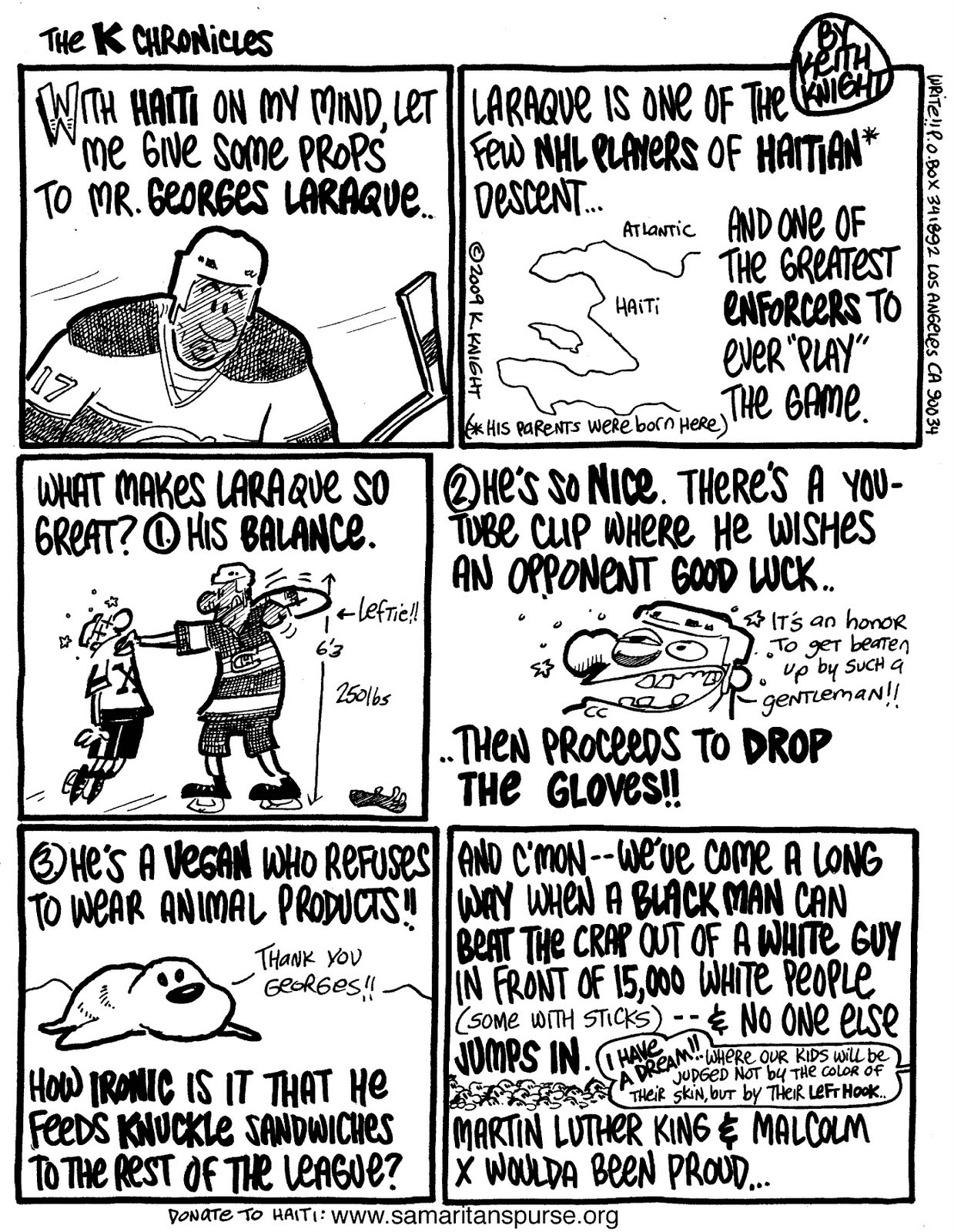
Good Luck, Man

Alas points me to the comics of Keith Knight, including this one of famed hockey enforcer Georges Laraque.


The video referenced is here, and yeah, it's pretty hilarious:

You Gotta Throw an Elbow Sometimes

I have no idea if this will work or even accomplishes anything useful, but I have to think it got the bank's attention:
Hoskins said he's been in a struggle with RiverHills Bank over his Clermont County home for nearly a decade, a struggle that was coming to an end as the bank began foreclosure proceedings on his $350,000 home.

"When I see I owe $160,000 on a home valued at $350,000, and someone decides they want to take it – no, I wasn't going to stand for that, so I took it down," Hoskins said.
[...]
Hoskins said he'd gotten a $170,000 offer from someone to pay off the house, but the bank refused, saying they could get more from selling it in foreclosure.

Hoskins told News 5's Courtis Fuller that he issued the bank an ultimatum.

"I'll tear it down before I let you take it," Hoskins told them.

And that's exactly what Hoskins did.

Sometimes, one elbow is enough. Here -- I'm doubtful.

Thursday, February 18, 2010

Very Targeted Assassinations

One major shift we've seen from the Bush to Obama administration is an increase in targeted strikes successfully killing al-Qaeda terrorists. Most people consider this a good thing, though a few die-hard Obama haters are annoyed that we aren't capturing and sending them to Gitmo instead. But by and large, we consider this an example of a step forward in the war against al-Qaeda.

The recent assassination of Hamas leader Mahmoud al-Mabhouh, possibly (though not assuredly) at the hands of Israel, has not raised similar cries of pleasure. Indeed, it seems to be seen as some sort of mini-scandal. This despite the fact that this manner of eliminating a known terrorist resulted in precisely zero civilian casualties, property damage, or serious negative effect whatsoever. I seriously object to some of the policies endorsed here, but Sonny Bunch has a point when he writes:
I mean, look, I’m all in favor of lobbing missiles at terrorists from airplanes; it’d be nice to capture them alive and get some info out of them via harsh interrogations, but a Tomahawk up the keister works just as well as far as I’m concerned. But then you get all the hemming and hawing about “Oh, we’re just creating more terrorists when we accidentally kill an innocent bystander.” Well, there’s none of that here, is there? The guy was traced to his hotel room, zapped with a stun gun, and smothered to death. Quick and easy. If only all terrorists could meet the same fate.

I don't endorse torturing anybody, and I don't endorse recklessly lobbing missiles at terrorists without regard to the surrounding civilian population (though that doesn't mean no collateral damage is acceptable). Nonetheless, from within the framework folks say they judge Israel within (accepting its right to self-defense, but urging it to do more to avoid collective punishment and civilian hardship), this really was the ideal killing. At least, Alan Dershowitz writes, that was seemingly Judge Goldstone's view on things:
The Goldstone report suggests that Israel cannot lawfully fight Hamas rockets by wholesale air attacks. Richard Goldstone, in his interviews, has suggested that Israel should protect itself from these unlawful attacks by more proportionate retail measures, such as commando raids and targeted killing of terrorists engaged in the firing of rockets. Well, there could be no better example of a proportionate, retail and focused attack on a combatant who was deeply involved in the rocket attacks on Israel, than the killing of Mahmoud al-Mabhouh. Not only was Mabhouh the commander in charge of Hamas' unlawful military actions at the time of his death, he was also personally responsible for the kidnapping and coldblooded murder of two Israeli soldiers several years earlier.

Not putting any words in Judge Goldstone's mouth -- he may have no problem with the killing of Mr. Mabhouh -- but the global community hardly seems to be taking this stance. One gets the distinct sense it's damned if you do, damned if you don't.

Broomball Roundup

They play with weak-sauce rules here at Chicago, but I'm just excited to retake the ice.

* * *

Early reports of a possible coup attempt in Niger.

Crazed South Carolina state Rep. wants to eliminate the use of US currency in his state.

Given that I don't drink at all, I found Alyssa Rosenberg's story of how she learned to drink surprisingly fascinating. Then again, she is just a really good writer.

BBC interviewee: One million Jews are secretly available to aid Mossad assassins.

Phoebe Maltz says she's too tired to give thoughts on the Wieseltier/Sullivan quasi-anti-Semitism throw-down, but even her exhausted contribution is pretty spot-on. Still, you should scope the older, longer version.

It must be tough being a news writer who can't even rely on he said/she said. Sometimes, one side is just wrong.

Whaling protesters as pirates?

This strikes me as pretty thin gruel in terms of a benefit for joining the UNHRC.

Israeli foreign ministry apologizes for snubbing J Street-linked American Congressman. This is yet another case of Deputy FM Danny Ayalon unilaterally embarrassing his country.

A Loose Coalition of Arguments

Stephen Walt makes an interesting two-step in defending his claims regarding the "Israel Lobby's" influence in getting America to go to war in Iraq. First, he dilutes the hypothesis so much that it ceases to have virtually any normative punch, but becomes descriptively banal. Then, having established that banality, he dresses it back up as something shocking, disturbing, and pernicious, for which we should be thankful to have bold truthsayers like Walt pulling back the curtain.

The first thing Walt does is blur together necessary and sufficient conditions. He asks us to consider what Andrew Sullivan calls a "powerful counter-factual":
What if Bush and Cheney had independently dreamed up the idea of invading Iraq after 9/11, but the plan was openly questioned by Israel, AIPAC, the Conference of Presidents, and the ADL, on the grounds that it might lead to a quagmire and maybe even strengthen Iran? What if these groups had openly opposed the war, or just quietly pushed for an genuine debate on different options, or simply remained on the sidelines and let members of Congress know that they had their doubts? What if their counsels of restraint had been reinforced by similarly prudent advice from respected think-tanks like the Saban Center at Brookings, the American Enterprise Institute or the Washington Institute for Near East Policy (WINEP)? What if staunchly pro-Israel pundits like Charles Krauthammer, Max Boot, Kenneth Pollack, Jeffrey Goldberg, and Thomas Friedman, among others, had spent 2002 raising questions about the wisdom of an attack, or arguing as passionately against the war as they did in favor of it? It's possible that Bush & Co. still might have been able to stampede the country to war, but surely it would have been much harder.

In other words, if a large quantity of important beltway players supporting the Iraq War had taken the opposite stance, the push for war would have been considerably more difficult. Ladies and gentleman, consider my mind officially blown. It never occurred to me that major reversals in political support would have political consequences. Of course, one can tell the same story about, inter alia, the Evangelical right, or the congressional Republican leadership. Nobody disputes that "neoconservatives" (who are not synonymous with "the Israel Lobby" -- particularly given the expansive definition Walt provides that I'll discuss below) were in favor of the war in Iraq. What's supposed to be controversial is that they were essentially sufficient to get America to go to war. A claim that they were a necessary part of the pro-war coalition is utterly banal. If important elements of the pro-war coalition were not, in fact, pro-war, the pro-war position would suffer. Yes, duh. Can I get a book deal now?

Now let's go to Walt's, shall we say, expansive definition of the Israel Lobby. It isn't just formal lobbying organizations like AIPAC. Nope, it is
a "loose coalition" of individuals and groups that actively works to promote and defend the "special relationship" between the United States and Israel (i.e., the policy of generous and unconditional U.S. support). Having a favorable view of Israel or generally pro-Israel attitude doesn't make someone part of the Israel lobby; to qualify, a person or group has to devote a significant portion of time, effort or money to promoting that "special relationship."

You may note that this definition is amorphous to the point of incoherency. A "special relationship" isn't the same thing as a policy of "unconditional U.S. support". Many of the folks he characterizes as unquestionably part of The Lobby would, I think, hotly dispute that they are in favor of "unconditional support" for Israel. To "devote a significant portion of time, effort or money" to promote this vague vision is a standard begging for scholarly manipulation.

Indeed, as best I can tell, this standard is just double-speak for "people who publicly advocate views on Israel Stephen Walt disagrees with". It hardly restricts itself to uncritical allies of Israel -- elsewhere in the piece Walt completely gives up the ghost by characterizing J Street and Americans for Peace Now as part of The Lobby under this definition. Now, I speak as a staunch supporter of J Street when I point out that there is no conceivable world in which it is uniformly uncritical of Israel. That is, bluntly, a bizarre claim. If everyone to the right of Jewish Voice for Peace (which is, literally, where Walt places the border) who speaks out on Israel is part of the Israel Lobby, the term encompasses nearly the totality of the American Jewish community. A community which, we might point out, was disproportionately opposed to the Iraq War.

Third, even conceding that it makes sense to speak of the Israel Lobby in Walt's broad, messy brushstrokes, he still falls into a trap we've seen before: that folks who hold a particular set of views on Israel (that Walt finds distasteful) can't possibly hold any other policy positions. Everything that they say, do, or advocate for has to stem, ultimately, from determinations of Israel's best interest. And that's clearly false (and offensive). The absolute most generous interpretation of Walt's evidence is establishing a correlation between Israel Lobby views and support for the Iraq War. But this doesn't imply any sort of causation, and as Andrew Sullivan himself noted, in 2003 he'd have qualified as part of the Israel Lobby under Walt's definition, yet his support had nothing to do with Israel in all "but a peripheral sense." At most, Sullivan writes, "Israel was one factor, if one of the least prominent ones, in their [the neo-conservatives] case."

And Walt's essentially concedes this. Turning back to the testimony of Tony Blair which sparked this debate in the first place, he writes:
I made it clear in my post that Blair's comments were not a "smoking gun" that proved we were right, and I neither suggested nor implied that Blair's testimony demonstrated that Bush went to war at Israel's urging or to accommodate the Israel lobby. I merely noted that Blair had said that concerns about Israel were part of the discussion, and that Israeli officials were consulted as part of the conversation. Indeed, after summarizing Blair's testimony, I wrote:
Notice that Blair is not saying that Israel dreamed up the idea of attacking Iraq or that Bush was bent on war solely to benefit Israel or even to appease the Israel lobby here at home. But Blair is acknowledging that concerns about Israel were part of the equation, and that the Israeli government was being actively consulted in the planning for the war."

Yeah, that's pretty peripheral if you ask me. Indeed, to characterize this as even remotely mendacious is absurd. "Concerns about Israel were part of the equation"! You're kidding me! You're telling me that, in determining whether to take a relatively major foreign policy operation (say, invading a country), we including in our deliberations considerations about how the shockwaves would affect regional entities particularly vulnerable to the reverberations? How irresponsible! Clearly, the only patriotic approach is to adopt an appropriate, devil-may-care attitude to how launching a war would affect other countries in the region.

So what are we left with. It's hard to say, mostly because the inconsistent definition Walt provides for the Israel Lobby defies cohesive analysis. But at worst, we have (1) Actors who take certain views on Israel that Walt finds disagreeable (2) were part of a pro-war political coalition, which would (naturally) suffer if they weren't part of it (which is somewhat implicit in the notion of a coalition) (3) whose support for the war seems to have stemmed from policy stances entirely independent of their views on Israel but (4) may have acted to insure that Israeli concerns were "part of the equation" in the deliberations over war.

Shocking.

Wednesday, February 17, 2010

February Blues Roundup

I've been feeling very tired these past few weeks -- both physically and academically. Someone said I had the "February blues", which depresses me (paradox!) because I like February. I find winter to be a beautiful season, and February contains my birthday.

Anyway, I think I might be snapping out of it a little. So that's good.

* * *

Write your very own incendiary blog post

Is Citizens United the perfect wedge issue for Democrats? Answer: Only if they can muster the balls to really take on corporate power.

More race-baiting in the 9th congressional district. Fortunately, this electorate in this district has proven itself against these sorts of campaign tactics -- though Cohen's opponent poses easily the toughest challenge of his congressional career.

New Virginia Governor Bob McDonnell (R) reverses non-discrimination protections for gay state workers.

Fortunately, the American people are moving in the right direction on gay rights.

And the Jewish Council on Public Affairs is also set to endorse DADT repeal.

Arizona's proposed rule barring all use of foreign or religious law in state court adjudication is unbelievably stupid.

Jon Chait eviscerates the principle-less Harold Ford.

What drives the tea party movement? The fact that affluent conservative White men don't like President Obama or his policies. Wow -- shocking political development.

Rep. Jason Chaffetz (R-UT): 9/11 troofer?

And THIS is How You Repay Us?

The former premier of Malaysia, Mahathir Mohamad -- a key player in the red-brown-green alliance uniting over anti-Semitism -- got some negative press coverage recently for a speech in which, among other things, he said the following:
Jews “had always been a problem in European countries. They had to be confined to ghettoes and periodically massacred. But still they remained, they thrived and they held whole governments to ransom,” Mahathir said.

“Even after their massacre by the Nazis of Germany, they survived to continue to be a source of even greater problems for the world.”

A Malaysian paper reported on the remarks, but accidentally omitted "in European countries". An incensed Mr. Mohamad wrote a letter to the editor correcting the mistake, and adding the following:
I would like to point out that in the past when Europeans confined (the Jews) to ghettos, and periodically massacred (them), they used to seek refuge in Muslim countries (of North Africa and the Ottoman empire).

They couldn't have gone there if Muslim countries were less hospitable than the Europeans. Even today, Jews live in Muslim countries including in Iran. It was only after the US welcomed the Jews that they ceased to migrate to Muslim countries.

For the hospitality of the Muslim countries, they were repaid by the Zionists by seizing Palestine to create the state of Israel. Not content with seizing Arab land, they went on to expel the largely Muslim Palestinian [sic].

All that I say here can be verified by the history books of Europe. If Muslims are antagonistic towards the Jews today, it is because of the way the Jews repaid them for their hospitality.

As Judeosphere put it: "So, to clarify—we control the world and we’re ingrates."

It is quite true that many Muslim nations were more hospitable to Jews than their European colleagues throughout the last millenia (though not for all of it, and certainly they still weren't treated as equals). One might note, however, that hundreds of thousands of Jews felt it necessary to flee these countries in the mid-20th century, as that "hospitality" turned with astounding rapidity into rabid, genocidal hatred. Indicating, perhaps, that this wasn't exactly a paradise of equality to begin with.

Regardless, I think it is quite telling that this is all presented as a favor done to the Jewish people -- something we should be grateful for. "Yeah ... we tried not massacring Jews at the first opportunity, and the bastards still complained about unfair treatment! See if we ever make that mistake again!"

As obviously abhorrent as such a stance is, I think there are two elements to it that need to be teased out and given emphasis. The first is how clearly it indicates the danger of such things as a "one-state" solution. Mr. Mohamad's argument, in essence, is that they (Muslims) tried being nice to the Jews, and they've proven they can't be trusted. Given that outlook, it is pretty apparent that reverting to a situation in which Jews are under foreign domination is one unlikely to be result in the (largely mythical) equal treatment that Mr. Mohamad now considers failed policy. Second, it demonstrates the thinness of Mr. Mohamad's conception of just treatment of Jews. Anything that extends beyond "periodic massacres" is "hospitality" -- not even something Jews can demand as of right, but a favor that we should be grateful for. From within that framework, is it any wonder that even relatively basic, fundamental human rights claims made by Jews are looked upon with disdain by Mr. Mohamad and his cohort? It's way beyond what Jews have any right to claim. Pushy Jews -- we give and give and give, and they still want things like self-determination. Schmucks.

More Jewish than the Jews, Take 43

The legal questions in this case (via), involving a restraining order preventing a Catholic father from exposing his daughter to non-Jewish religious influences (the mother is Jewish), are extremely complex, and raise a number of tough issues from both a moral and doctrinal point of view. That being said, I feel perfectly free in calling the father a dick for his snotty supersessionist view of the Christian-Jewish relationship.
"Catholicism falls right under the umbrella of Judaism."

A court is scheduled to rule today on whether or not Reyes violated the temporary restraining order barring him from "exposing his daughter to any other religion than the Jewish religion" for 30 days. While the restraining order is highly unusual, Reyes obviously knew he wasn't supposed to take her to church, even if he was, "taking her to hear the teachings of perhaps the most prominent Jewish rabbi in the history of this great planet of ours."

Seriously -- can Christians stop doing this? Catholicism is not "under the umbrella of Judaism" -- a particularly obnoxious claim given the centuries we have spent under the jackboot of Catholicism (and Protestantism, to be fair).

We're separate religions. There are some commonalities of tradition. But Judaism and Christianity are, at this point, quite distinct. And more importantly, given the degree to which Christian anti-Semitic oppression has historically flowed from supersessionist ideology, it's really important for Christians who purport to be interested in egalitarian interfaith dynamics to back off this appropriation, and let us have our independent space.

Palin's a Partisan? No!

The CNN link currently reads as "Ticker: Palin gives surprising advice". But the advice itself really isn't that surprising:
"Now the smart thing will be for independents who are such a part of this Tea Party movement to, I guess, kind of start picking a party," Palin said at an Arkansas GOP fundraising event Tuesday, according to CBS News.

"Which party reflects how that smaller, smarter government steps to be taken? Which party will best fit you? And then because the Tea Party movement is not a party, and we have a two-party system, they're going to have to pick a party and run one or the other: 'R' or 'D'."

Trying to get the tea party movement to integrate itself in the Republican Party makes perfect sense for someone who is trying to be the new leader of the Republican Party. More people makes the GOP more powerful. More people who are specifically and notably sympathetic to Gov. Palin in the Republican Party is clearly in Palin's interest. What on earth could possibly be surprising about this?

Tuesday, February 16, 2010

It's Like Living in a Dadaist Hell

For someone who really thinks policy discussions and political deliberations, this exemplifies why I have so much trouble following the path of debate anymore. I mean, what's the point? It's so utterly disconnected from reality -- or even the day before -- that I'd go insane even trying.

It's Just Not Coming To Me

I have a terrible case of writer's block. I'm sorry -- I'm really at a loss. I'm not even seeing roundup material.

Monday, February 15, 2010

Ron Paul Mourns Loss of Great Anti-Semite

Adam Holland has the story. Paul has always attracted fringe figures in American politics -- some because they're just strange, some because they're genuinely dangerous. Suffice to say, the pro-Paul movement comes at the expense of Jewish safety in the United States.

Bayh Retires

I have a speechwriter friend who I guess is now out of a job. Senator Bayh is blaming excessive partisanship as his reason for departure. Kos calls bullshit, but I don't know -- I think that Bayh simply didn't know how to adjust to the current legislative climate where Republicans are willing to block everything, and didn't really care to learn. Regardless, this sets up a very tough hold for the Big D Machine.

Sunday, February 14, 2010

Your Parts Seem To Check Out. Marry Me?

After being turned down in her effort to marry her long-time partner, Kitty Lambert turned to the crowd and asked any willing man to step forward and marry her. A gay man agreed, they presented the proper documentation, and voila! Marriage.

I'm pretty sure this was staged, but it's still a pretty vivid demonstration of the sex discrimination element latent in anti-gay marriage laws.